Mediating Trans-Boundary
Water Conflicts
Issues and Approaches to
Long-Term Resource
Management and Conflict
Resolution
Dorothea Blank (s1053159)
First Reader: Professor J. Melissen Second Reader: Professor M. Hosli MSc International Relations and Diplomacy
Abstract
Table of Contents
Abstract...2
Table of Contents...3
Chapter One Introduction...5
The Central Problematic...5
The Question...6 The Argument...7 Outline...7 Conclusion...8 Chapter Two Literature Review...9
Beginnings of the Debate...9
The Evolution of “Conflict” and “Cooperation”...11
Conclusion...13
Chapter Three Theoretical Framework...15
Is Cooperation Possible?...15
The Mediation...17
The Management Institution...18
Conclusion...21
Chapter Four Research Design...22
Method of Analysis...22
Case Selection Strategy...22
Scope and Limitations...24
Chapter Five The Indus River Conflict: Mediation and Management...26
Background...26
The Situation on the Ground...27
The Conflict...28
Mediating the Indus River Conflict...31
The Indus Water Treaty...34
The Permanent Indus Commission...35
Long-Term Cooperation in the Indus Basin...37
Conclusion...39
Chapter Six The Tigris-Euphrates Rivers Conflict...40
Background...40
The Situation on the Ground...41
The Conflict...42
The Keban and Tabqa Dams...43
The Southeast Anatolia Development Project...44
Attempts at Conflict Management...46
Chapter Seven
Long-Term Cooperation in the Tigris-Euphrates Basin...49
Facilitating a Trilateral Agreement...49
Potential Issue Linkages...52
Potential Side-Payments...54
The Management Institution...55
Conclusion...56
Chapter Eight Conclusion...58
Chapter One
Introduction
The Central Problematic
Water is a scarce and vital resource needed for all aspects of human existence and production. Unlike other, often fought-over resources such as oil, there is no viable alternative to water. Without a sufficient quantity or quality of water, economic development as well as industrial and agricultural production grind to a halt, human suffering grows, and societal stability becomes increasingly threatened. Humanity’s main sources of water are freshwater rivers.1
There are 263 trans-boundary rivers around the world, some of which are shared by as many as 17 countries.2 A trans-boundary river is a river that crosses political boundaries such as international borders.3 Growing populations, increasing
industrialization and pollution, and changing resource and energy needs bring into focus the precarious situation in which riparians4 find themselves. So long as there is no
cooperation over the shared resources, each state must use the water in the river to its best advantage before it crosses international borders and becomes unreachable. The actions of one state, for instance building a dam and diverting part of the river’s flow or polluting the water can seriously affect the water security of the other riparians. Because of this, trans-boundary rivers are potential loci for conflict over the use of the shared river. Zawahri explains that “conflict over international rivers arises when states undertake unilateral development of the shared river system to accommodate their own needs and without regard for the impact on their riparian neighbor.”5 While scholars of water conflicts are quick to point out that instances of cooperation over shared freshwater rivers
1 Igor A. Shiklomanov,“2. World Fresh Water Resources,” in Water in Crisis: A Guide to the World’s Freshwater
Resources ed. Peter H. Gleick, (New York: Oxford University Press, 1993), 13.
2 Aaron T. Wolf et al, “5. Managing Water Conflict and Cooperation,” State of the World 2005: Redefining Global
Security, (W.W. Norton & Company: New York, 2005), 82-83.
3 “Description and Definition of Transboundary Impacts and Resources,” Convention on Biological Diversity, retrieved
from: http://www.cbd.int/programmes/areas/water/toolkit/html/1.11.2_description_transboundary.html, (24. 05. 2012).
4 Riparian is defined as: “those nations through which the river passes.” From: Ali Akanda et al. “The Tigris-Euphrates
River Basin: Mediating a Path Towards Regional Water Stability,” Al Nakhlah (Spring 2007), 1.
? Samuel Luzi, “International River Basins: Management and Conflict Perspectives,” CSS Environment and Conflict
Transformation (2007), 1.
5 Neda A. Zawahri, “Third Party Mediation of International River Disputes: Lessons from the Indus River,”
far outnumber conflicts6, the causes of conflict should not be dismissed, and likewise the need for ways to promote cooperation must be investigated further.
Asymmetric power distribution among riparians, unilateral development and difficult political histories affect the relationship among riparians and make cooperative solutions for the use and distribution of the river’s resources harder to achieve. A riparian with first access to the river may, for instance, be unwilling to curtail its use of the river in order to accommodate the needs of its downstream neighbors unless there is some benefit it would derive from such an arrangement. Such situations generate instability and insecurity among all riparians because they cannot overcome the zero-sum mentality in regards to the use of the river and worsen already difficult political relationships.
Conflicts over trans-boundary rivers are also made more difficult because their resolution is not a matter of a one-time negotiation. The river and its resources do not cease to exist once its use and resources are allocated to individual riparians and neither do the needs of the riparians remain constant indefinitely. “The issue at the heart of the conflict for riparian states is a long-term management problem that involves the need to address disputes continuously and compels them to interact indefinitely.”7 These
dynamics make the likelihood of building lasting, binding agreements that adequately address the dynamics of trans-boundary river conflicts slim. How then can these conflicts move from zero-sum unilateral use to a win-win situation of cooperation?
The Question
One powerful means of influencing taciturn riparians and promoting cooperation among them is the involvement of a third party mediator. A mediator can both offer incentives to bring reluctant parties to the table and mobilize resources to smooth the way to agreement.8 This “carrots and sticks” approach to mediation can induce even the most unwilling parties to compromise. The goal of this thesis is to address the following question on the role of mediators in facilitating short and long-term cooperation over the trans-boundary river among riparian states. Considering the unique characteristics of
6 Ariel Dinar, “Cooperation in Managing Transboundary Water Resources: Evaluation Approaches and Experiences,”
Paper Presented at 4th Rosenberg International Forum on water Policy, (3-9 September, 2004), 13.
conflicts over trans-boundary freshwater rivers, what can third party mediation offer riparians that would address both the short-term and long-term causes of conflict?
The Argument
Drawing on water conflict and third party mediation literature, this thesis will use a neoliberal institutionalist framework to argue that third party mediation and the
subsequent creation of a management institution can help states overcome their zero-sum attitude toward cooperation and provide a means of credibly committing to cooperative river management. The actual mediation process can help states overcome their
unwillingness to join negotiations by offering incentives, which make the agreement more attractive to otherwise unwilling parties. A well-designed management institution with a robust mandate and the power to enforce that mandate can help to foster long-term cooperation by providing a means for states to credibly commit to joint management of the river and alleviate their fear of being cheated by other riparians. The following hypothesis outlines the central argument of this thesis that will be investigated in the subsequent chapters. In conflicts over trans-boundary freshwater river resources, use of incentives such as side-payments and issue linkage by a third party mediator as well as the creation of a management institution can help parties reach an agreement and facilitate their long-term cooperation over the river.
Outline
The thesis will be divided into the following sections. The first chapter will review the literature on water conflicts, their causes and the likelihood of conflict versus cooperation in order to situate the argument in the relevant social science literature. The second chapter will provide the theoretical framework, outlining the liberal
institutionalist framework and the role of the third part mediator in facilitating a lasting resolution to the conflict. In chapter three, a discussion of the methodology, case
selection strategy and scope and limitations of this project will clearly define the area of focus of this thesis. The fourth and fifth chapters will illustrate this argument and provide real world examples of the utility of the dual short and long-term approach to the
The Indus River dispute between India and Pakistan is the first of the two cases analyzed. The Indus dispute serves as a best-case example of a successful mediation of a trans-boundary water conflict and subsequent creation of a management institution that addresses the ongoing issues a shared river presents.9 The second case study focuses on the unresolved conflict between Turkey, Syria, and Iraq over the Tigris-Euphrates rivers.10 The concluding chapter will sum up the findings and discuss the transferability of them to other cases of trans-boundary water conflicts.
Conclusion
Trans-boundary water conflicts pose immense difficulties to both the riparians and the mediator. A mediated agreement which does not address the long-term issues that come from the necessity of managing the river and its resources ad infinitum will cause riparians to renege on the signed agreement or to simply wait until the agreement runs out and then continue their unilateral development of the river. The conflict’s resolution requires not only a signed agreement among riparians to equitably allocate the river’s resources, but also a long-term means of addressing the changing needs of the riparians and any conflicts that might arise. Only this makes joint management of the river
possible. Conflicts over trans-boundary rivers benefit from third party mediation because the mediator can provide incentives to bring otherwise uninterested parties to the table, smooth the path to an agreement and ensure compliance with the terms of the treaty. However, the potential for conflict remains, because the river itself is a shared good that does not disappear once riparians reach an agreement, making a management institution with a strong mandate and conflict resolution powers vital to the success of the mediation and future cooperation of the riparians.
9 Aaron T. Wolf and Joshua T. Newton, “Case Study of Transboundary Dispute Resolution: The Indus Water Treaty,”
Appendix C in, Delli Priscoli, Jerry and Aaron T. Wolf, Managing and Transforming Water Conflicts, (Cambridge: Cambridge University Press, 2008), retrieved from:
http://www.transboundarywaters.orst.edu/research/case_studies/Indus_New.htm, (13 May, 2012).
10 Aaron T. Wolf and Joshua T. Newton, “Case Study of Transboundary Dispute Resolution: The Tigris-Euphrates
Basin,” Appendix C in, Delli Priscoli, Jerry and Aaron T. Wolf, Managing and Transforming Water Conflicts, (Cambridge: Cambridge University Press, 2008), retrieved from:
Chapter Two
Literature Review
Beginnings of the Debate
Scholarly work on water conflicts gained importance following the end of the Cold War when realist conceptions of security began to give way to more encompassing understandings of “human security” that included the environment and both renewable and non-renewable resources.11 Within the literature, water comprised one of the renewable resources conflicts might erupt over.12
Much of the initial scholarly work on water conflicts focused on the potential for so called “water wars,” cases of violent interstate conflict over scarce water resources.13 Homer-Dixon, argued, “The renewable resource most likely to stimulate interstate resource war is river water.”14 Others compared the link between water scarcity and armed conflict to oil’s propensity to cause violence: “Nations go to war over oil but there are substitutes for oil. How much more intractable might be wars that are fought over water, an ever-scarcer commodity for which there is no substitute?”15 This
Neo-Malthusian approach sought to draw direct causal links between the scarcity of resources such as freshwater and violent conflict. Scholars16 saw resource conflicts as the next nexus of violent, interstate conflicts: “The end-stage of unequal power relations and economic exploitation in the world will be tension and struggle over life-sustaining resources. Fossil fuels, freshwater, farming and fishing have already become the foci of armed struggles.”17
However, this body of literature could not conclusively establish the causal link between water scarcity and violent interstate conflict. The primary methodological
11 Simon A. Mason et al. “Linking Environment and Conflict Prevention: The Role of the United Nations.” CSS and
swisspeace 2008, 16.
12 Nils Peter Gleditsch, “Armed Conflict and the Environment: A Critique of the Literature,” Journal of Peace
Research 35 no. 3 (May 1998), 382-383.
13 Shira B. Yoffe and Aaron T. Wolf, “Water, Conflict and Co-operation: Geographical Perspectives,” Cambridge
Review of International Affairs 12 no. 2 (Spring/ Summer 1999), 198.
14 Ibid.
15 Paul Simon, “An Empty Cup, a Threat to Peace,” New York Times (14 August 2001), pg. A17.
16 For examples of this trend see: Gleick (1993); Opschoor (1989); Maxwell and Reuveny (2000); Gleditsch (1998);
Homer-Dixon (1994)
problems with this approach were twofold. First, because the scholars largely based their conclusions on a few, select cases, the evidence for the direct cause and effect link between water scarcity and violent conflict presented was far from conclusive and scholars could not come to a consensus on the causal mechanisms.18 Second, the scholars focused on violence as an indicator of whether or not conflict occurred. The idea that conflict only occurs when there is an outbreak of violence is too conceptually narrow when it comes to water conflicts and therefore overlooks many instances of actual conflict.19
In reaction to the alarmist tone of the “war waters” literature and because scholars could not establish a direct causal link between freshwater scarcity and violent, intrastate conflict, another avenue of scholarly research emerged, arguing that trans-boundary rivers were a source of cooperation much more than conflict. Scholars such as Yoffe and Wolfe pointed out that “over 3,600 treaties have been signed over different aspects of international waters.”20 The lack of empirical evidence found by both the statistical and the Neo-Malthusian approaches to link freshwater resources and conflict, together with the number of treaties on water that already existed, led these scholars21 to conclude that freshwater scarcity would lead to cooperation among affected parties instead of
violence.22 The researchers who developed the Basins at Risk Database found that of the 1,800 events they documented, “incidents of cooperation outnumbered those of conflict and none involved any war over water.”23 Zawahri and Gerlak point out that international cooperation over water has spawned global water initiatives and international conferences
18 Gleditsch, “Armed Conflict and the Environment,” 383.
19 Another branch of research that sought to find/discount the direct causation between water resource scarcity and
conflict used large-N statistical analysis. These scholars ran into their own methodological problems however because this branch of research determined conflict to occur when there were “more than 25 battle deaths per year.” Lower levels of conflict and non-violent forms of conflict were not included, thereby discounting many cases that we would consider conflict.
Mason et al. “Linking Environment and Conflict Prevention,” 17.
20 Yoffe and Wolf, “Water, Conflict and Co-operation,” 4.
21 Other examples of this avenue of scholarly research include: Baechler (1998); Postel (2000); Carter and Ndegwa
(2002); Wolf et al. (2005)
22 Tobias Hagmann, “Confronting the Concept of Environmentally Induced Conflict,” Peace, Conflict and
Development 6 (January 2005), 10.
23 Neda A Zawahri and Andrea K. Gerlak, “Navigating International River Disputes to Avert Conflict,” International
to promote interstate cooperation.24 Examples of this include the World Water Council and the World Commission on Dams.25
This strain of scholarly research suffered many of the same conceptual problems as the “water wars” school of thought. The conceptualization of water as purely a source of cooperation does not provide sufficient nuance to the factors present in trans-boundary river basins which can push riparians towards cooperative or conflictual behavior. Using the existence of treaties or agreements in a basin as the primary means of determining that the relationship between riparians is cooperative is problematic because:
Management of Transboundary rivers remains in its conceptual infancy. More than half of these treaties lack monitoring provisions; perhaps as a consequence, two-thirds fail to delineate specific allocations, and four-fifths have no enforcement mechanisms… multilateral basins are (almost without exception) governed by bilateral treaties, precluding the integrated basin management long advocated by water managers.26
Riparians may sign a bilateral agreement or have some type of management institution but this does not mean they are cooperating. Understanding what conflict and cooperation mean in trans-boundary river basins requires a closer look at the interaction among riparians.
The Evolution of “Conflict” and “Cooperation”
Understandings of what entails conflict and cooperation among riparians of trans-boundary rivers has become more nuanced in the past years. The focus shifted from instances of violence as indicators of conflict or treaties as indicators of cooperation to focus more on the actions of the individual riparians to see if they take a hostile or collaborative stance in their use of the shared river basin. Based on this shift, new ways of understanding conflict and cooperation emerged. The literature also shifted from the
24 Ibid., 212.
25 Luzi, “International River Basins: 3.
26 Elizabeth L.Chalecki et al., “Fire & Water: An examination of the Technologies, Institutions and Social Issues in
deterministic “water conflicts/cooperation are an inevitable consequence of water scarcity” approach towards a more management-oriented way of thinking.
Cases of violence among sovereign riparians are few and far between, meaning that violent hostilities are not an accurate measure of conflict in trans-boundary river basins. The lack of violence does not mean there is a cooperative situation in the basin, however. Instead, Zawahri better conceptualizes water conflict as, “a situation in which the status quo allocation and use of the resource is contested.”27 A tendency towards unilateral action, potentially to the detriment of co-riparians proves a better determinant of whether the riparians are in a state of conflict with each other. Keohane identifies conflict as arising when “states undertake unilateral development of the shared river system to accommodate their own needs and without regard for the impact on their riparian neighbor.”28 Zawahri further explains that:
Conflict over international rivers exists when… states design, construct and impound hydrological infrastructure to accommodate their own needs, without regard for the impact on their riparian neighbor. When disputes arise, states do not select the path of negotiation but instead rely on military means to resolve their water disputes.29
Although, violence is generally not an element of water conflicts over trans-boundary rivers, in some instances, there is military posturing or skirmishes.30 For the purposes of this thesis, a conflict over a trans-boundary river exists when one or more riparians act unilaterally to use and develop the river’s resources and this is contested by the other riparians, who are negatively affected by the unilateral actions. States may contest the actions of their neighboring riparians in a multitude of ways, but violence does not have to occur for the case to constitute a conflict.
On the other hand, the existence of a river treaty among two or more riparians does not necessarily mean that they are in a state of cooperation. Because the actions of
27 Zawahri, “Third Party Mediation of International River Disputes,” 287.
28 Robert O. Keohane, After Hegemony, (Princeton: Princeton University Press, 1984), 53.
29 Neda A. Zawahri, “Stabilizing Iraq’s Water Supply: What the Euphrates and Tigris Rivers Can Learn from the
Indus,” Third World Quarterly 27 no. 6 (2006), 1044.
30 For instance, Iraq threatened to bomb Syria’s Tabqa dam because Syria’s filling of the dam’s reservoir decreased the
one riparian are highly likely to affect the other riparian’s ability to utilize the river, whether a state takes the need of its co-riparians into account, adjusting its actions to balance its own needs and those of the others, is a better determinant of whether the riparians are cooperating. Keohane argues that riparians cooperate “when states adjust their behavior to the actual or anticipated preferences of others.”31 Brochmann and Hensel go into greater detail about the initial position and interests parties have as well as what effect acting in a cooperative manner has:
Cooperation features an underlying difference of interests that requires policy coordination and making adjustments in each state’s behavior… involving a situation where the parties have some sort of diverging interests, in which there is some potential for policy adjustment and coordination that can benefit each of them.32
Riparians cooperate over their shared river when they adjust their actions so that they suit not only their needs but also the needs of the other riparians. For this thesis, cooperation in a trans-boundary river basin entails managing the river and each state’s individual needs in such a way that the needs of each riparian are met as far as is possible without causing harm to any of the others and, as a group, they are better off than if they act unilaterally.
Conclusion
Conflicts over trans-boundary rivers cannot be solved. The river, the source of conflict, will not disappear, and the resources and uses it provides to riparians will not likely become less important. In light of this, scholars have turned their attention to the
management of water conflicts, because conflicts over trans-boundary rivers can be, and have been, managed peacefully.33 At their heart, these are conflicts over the use and management of the shared resource, water, which play out on the political stage because states primarily interact with each other on that level. Here resource and conflict
management approaches converge in an attempt to deal with both the immediate causes
31 Keohane, After Hegemony, 53.
32 Marit Brochmann and Paul R. Hensel, “Peaceful Management of International River Claims,” International
Negotiation 14 (2009), 395.
of conflict while adequately addressing the long-term management problems a trans-boundary river poses for riparians.34 It is in this framework that the central argument of this thesis is placed. The following section outlines the theoretical framework based in third-party mediation thought and liberal institutionalism to show how the short and long-term causes of trans-boundary river conflicts and their management can be addressed and managed peacefully.
Chapter Three
Theoretical Framework
Trans-boundary rivers can be a source of cooperation or a cause of conflict among riparians. Even though such disputes do not often cause armed violence, conflicts over trans-boundary rivers can still cause significant harm to all riparians and strain already tenuous political relationships. Examples of riparians cooperatively managing their shared rivers show that cooperation is a realistic option, but how can states move from a state of conflict to one of cooperation? Despite the breadth of literature dealing with conflict and cooperation among riparian states, and the previous explanation of the nuances of these two types of riparian interaction, it is still unclear what pushes states towards cooperation or drives them to fight over the river.35
Mediation and neoliberal institutionalist theory provide a framework to explain how durable, long-term cooperation is possible. Third party mediation can facilitate cooperation by providing incentives for states to join the mediation and sign the agreement. The mediator can also help states address their long-term commitment problems and provide a means of settling future disputes peacefully through the creation of a management institution that gathers information, regulates the use of the river, and possesses conflict resolution mechanisms to settle disputes as they arise. In conflicts over trans-boundary freshwater river resources, the use of incentives such as side-payments and issue linkage, as well as the creation of a management institution by a 3rd party mediator, can induce riparians to join the mediation and to facilitate their long-term cooperation over the shared water resources.
Is Cooperation Possible?
Trans-boundary rivers create tensions between those that share them because the resource in question is frequently scarce; the power dynamic is often asymmetric and there is no viable alternative to the water the river provides.36 In such situations, states are unlikely to back off from the conflict and let the other riparians do as they wish because this could have immensely detrimental effects for their population and economy. If the
river itself, its resources, and uses are important enough for states to fight over, though, they are likely also important enough to make states willing to compromise if they see that by compromising they would gain more collectively than they would if they
continued on their unilateral path. Brochmann and Hensel explain that “in order for states to cooperate over an issue, there needs to be an underlying difference of interest, and the issue must be considered important enough to be worth pursuing one’s own interest rather than simply ceding it to the adversary.”37 In water-scarce, arid, or semi-arid regions, trans-boundary rivers often provide the main source of water for consumption, agricultural production, and industry. The more dependent the riparians are on the river, the more their economy and society is held hostage by the actions of their co-riparians, making cooperation that allows for the regulation of the actions of each riparian in relation to the river, even if it requires concessions, the favorable option.
Cooperation between self-interested parties can emerge even under the condition of anarchy, especially when there is an expectation of long-term benefits. To help facilitate cooperation, states create international institutions- such as river treaties- that spell out the rewards and obligations of the signatories, deal with technical details, and perhaps offer dispute-resolving mechanisms. The treaties can consequently change the states’ preferences toward cooperation by providing predictability, decreasing uncertainty and costs of cooperation, and increasing the costs of non-cooperation.38
Trans-boundary river mediations that culminate in an agreement between all riparians and the development of a cooperative river management institution can create the basis for long-term cooperation, because it gives riparians an incentive to cooperate in the short-term (via issue linkage and side-payments), overcoming the commitment problem and creating a long-term situation where all riparians profit (or expect to profit)
collectively more than they would if they acted unilaterally.
37 Brochmann and Hensel, “Peaceful Management of International River Claims,” 396.
38 Jaroslav Tir and John T. Ackerman, “Politics of Formalized River Cooperation,” Journal of Peace Research, 46 no.
The Mediation
Mediation is a type of conflict management that involves the intervention of a third party not directly involved in the conflict “for the purpose of abating or resolving that conflict through negotiation.”39 The role of the mediator is to “assist disputants in their efforts at conflict resolution and to supplement these efforts if they are
unsuccessful.”40 Because the distribution of power among riparians in conflicts over trans-boundary rivers is often asymmetrical, with one riparian having more access or greater economic means to develop their section of the river, the initial task of the mediator is to induce reluctant parties to take part in the mediation and to sign any resulting agreement. Mediation is also voluntary process; riparians must feel that they will derive some benefit from the mediation or else they do not participate.41 To “overcome the asymmetry of interests,” to bring parties to the table or to make an agreement more enticing and therefore more likely to be signed by the riparians, a mediator can offer incentives such as issue linkage or side-payments.42
Issue linkageentails the linking of directly or indirectly related issues to the original batch of issues under negotiation in order to create a “bigger basket” that provides riparians with benefits to compensate for the concessions they have to make if they sign the agreement.43 By using issue linkage, the mediator gives each party the opportunity to win on some issues, thereby making conceding on others less painful and more likely. Issue linkage also makes it possible to address the underlying insecurities that led to conflict over the trans-boundary river. By using issue linkage the agreement can go beyond water quantity allocations to include fishing rights, dam building, pollution control, water quality, shipping, and other issues that are related to the river itself, its uses, and resources. A riparian will be more likely to join a negotiation and sign an agreement if the issues it values are part of the agreement. Instead of breaking down conflicts and issues, the use of linkage strategy means that the mediator builds on the 39 Saadia Touval and I. William Zartman, International Mediation in Theory and Practice, (Boulder CO: Westview
Press, 1985), 7.
40 3. Dean G. Pruitt, “Mediator Behavior and Success in Mediation,” in Studies in International Mediation ed. Jacob
Bercovitch, (New York, Palgrave Macmillan, 2002), 41.
41 Jacob Bercovitch and Gerald Schneider, “Who Mediates? The Political Economy of International Conflict
Management,” Journal of Peace Research 37 no. 2 (2000), 146.
42 Zawahri and Gerlak, “Navigating International River Disputes to Avert Conflict,” 216.
43 Marwa Doudy, “Asymmetric Power: Negotiating Water in the Euphrates and Tigris,” International Negotiation 14
complexity of the conflict as well as the needs and concerns of the individual parties to reshape perceptions, overcome the unwillingness to negotiate, and create new collective solutions that address both the issues on the table and underlying insecurities that hindered conflict resolution previously.44
Side-payments are another way the mediator may use a carrot to induce riparians to join the mediation, cooperate, sign, and uphold the agreement. A side-paymentis financial or technical assistance given to one or more of the riparians to fund or help realize projects that have to do with the river. For instance, the mediator might organize the donor community to fund the building of new irrigation systems or wastewater treatment plants. Also, “the mediator may co-ordinate the donor community to provide financial and technical assistance to preserve the water’s quality… donors can be coordinated to distribute water-efficient technology.”45 A side-payment is a way of encouraging otherwise reluctant riparians to compromise and can be used to get states with more to lose from an equitable allocation of the river’s resources to sign and adhere to the agreement.46 Large river development projects such as the building of Turkey’s Grand Anatolia Project (GAP) require foreign investment, which the mediator could get the donor community to provide in exchange for Turkish cooperation in the cooperative management of the Tigris-Euphrates Rivers.47
The Management Institution
Issue linkage and side-payments are two ways a mediator can induce otherwise reluctant riparians to join the negotiation and facilitate an agreement. However the source of conflict, the river itself, will never disappear, making it necessary to provide the riparians with a means to settle their disputes peacefully once the mediator departs and the side-payments that guarantee adherence to the terms of the agreement end.
Cooperation over shared trans-boundary rivers is a long-term problem requiring continual reevaluation of the riparian’s needs and the means to address conflicts as they arise.
44 G. R. Berridge, “Diplomacy and the Angola/ Namibia Accords,” International Affairs 65, no. 3 (1989), 470-473. 45 Zawahri, “Stabilizing Iraq’s Water Supply,” 1052.
46 J. Michael Greig and Patrick M. Regan, “When Do They Say Yes? An Analysis of the Willingness to Offer and
Accept Mediation in Civil Wars,” International Studies Quarterly 52 no. 4 (2008), 761.
According to neoliberal institutionalist theory, states exist in an anarchic world, in which each acts in a rational, egoist manner.48 States within this international system cooperate for one of two reasons. First, they do so when there is an expectation that constructing an institution will provide them with long-term benefits greater than those they could attain on their own. Second, states cooperate “to prevent a pending threat from leading to a costly conflict.”49 According to neoliberal institutionalists cooperation is possible but how is it achieved?
In order to cooperate, states must overcome four problems associated with the enforcement of cooperative arrangements such as river management institutions:
monitoring, sanctioning, distribution, and information.50 Monitoring is a problem because without it, it is difficult to determine if a party is cheating or assess the validity of an accusation of cheating. Unless a party that cheats is then punished through sanctions, there are no consequences to being caught cheating, making cheating more likely.51 A distribution problem occurs when riparians prefer different solutions, while an
information problem stems from the actors being unsure of which solution would be best and not sharing relevant information with each other. Management institutions for trans-boundary rivers offer riparians a way of tackling the four problems to forge long-term cooperation:
According to neoliberal institutionalists, an institution is needed to facilitate cooperation because states with an interest in cooperation must overcome their mutual fear of being cheated. To accomplish this task, states require an institution to monitor members’ activities, make commitments more credible, sanction defectors, lower
transaction costs, and gather information.52
A properly designed management institution with a strong mandate provides the
necessary structure to facilitate long-term cooperation among riparians after the mediator
48 Brochmann and Hensel, “Peaceful Management of International River Claims,” 396. 49 Ibid.
50 James D. Morrow, “Modeling the Form of International Cooperation: Distribution Versus Information,”
International Organization 48 no. 3 (Sumer 1994), 387.
51 Ibid.
and donor community departs.53 River management institutions “create positive-sum situations in which the incentives for cooperation become palatable even in the face of problematic relationships” among riparians.54
For the purposes of this thesis, a management institution is a physical
commission tasked with monitoring the river, gathering information, and settling disputes between riparians.55 The river management institution is meant to decrease the costs and increase the benefits of cooperation while simultaneously decreasing the benefits and increasing the costs of unilateral action. In order to foster cooperation among riparians, the institution must be imbued with sufficient power to be effective. A river management institution cannot be effective if, for instance, it does not possess the power to sanction a riparian that breaches the river management agreement. Without a strong mandate, the temptation for riparians to stop cooperating rises, because the costs of defection are lowered.
To be effective a river management institution should have the following capabilities. First, the commissioners should collect data on the river and monitor how riparians use the river in order to hinder cheating. Second, the commissioners themselves should be technical experts who meet regularly and have a means of directly
communicating with each other. Making river management a technical issue and
providing the commissioners a direct means of communication helps keep the riparian’s political relationship from interfering. Finally, the commission should have specific conflict resolution mechanisms that operate outside of the political sphere to provide clear avenues through which riparians can settle disputes.
Creating a management institution with a strong mandate, conflict resolution mechanisms, and the ability to gather and exchange information as well as act
autonomously of the broader political relationships among the riparians, decreases the likelihood of defection. The better designed it is, the better this institution will manage the river. This in turn reduces cooperation costs and provides long-term benefits. Through the management institution, cooperation becomes routine for the riparians.
53 Ibid., 282.
Conclusion
The theoretical argument bases itself in mediation and neoliberal institutionalist theory to argue that long-term cooperation among riparians in trans-boundary river systems is possible. Although mediation is a voluntary process, a mediator can induce riparians to join and sign an agreement through the targeted use of incentives. A management institution helps riparians overcome the four barriers to cooperation
(monitoring, sanctioning, distribution, and information) and promotes compliance to the terms of the treaty.
Chapter Four
Research Design
Method of Analysis
This project uses process tracing as the method of analysis for the two cases under investigation. The process tracing method, as explained by George and Bennett
“attempts to identify the intervening causal process- the causal chain and causal mechanism- between an independent variable (or variables) and the outcome of the dependent variable.”56 Process tracing makes it possible to examine complex cases in detail and to assess evidence in order to “affirm some explanations and to cast into doubt, through eliminative induction, explanations that do not fit the evidence.”57 The goal of this project is to examine the complexities of trans-boundary freshwater conflicts in the Indus and Tigris-Euphrates basins in order to assess what third party mediation must entail for a long-term solution to be possible. For the purposes of this thesis, process tracing is the best method of analysis because it allows for an in depth examination of the each individual case and a comparison of the two. The causal pathways between the independent and dependent variables of interest are traced in order to determine whether they are both necessary and sufficient to address the issues and solutions hypothesized in this research project.
Case Selection Strategy
A comparative case analysis will asses the validity of the following hypothesis: In conflicts over trans-boundary freshwater river resources, use of incentives such as side-payments and issue linkage by a third party mediator as well as the creation of a management institution can help parties reach an agreement and facilitate their long-term cooperation over the river. One best-case example of a successful mediation and subsequent creation of a management body and one case where the dispute over the trans-boundary river has yet to be resolved are examined. Positive and negative aspects of the mediation process and subsequent management of the conflict are drawn from the
best-56 Alexander L. George and Andrew Bennett, Case Studies and Theory Development in the Social Sciences,
(Cambridge: MIT Press, 2005), 206.
57 Andrew Bennett and Colin Elman, “Case Study Methods,” In The Oxford Handbook of International Relations, ed.
case example and then used to assess the situation in the un-resolved conflict. The
assessment of the conflict and its causes makes it possible to then offer a strategy both for the short-term mediation among the parties and the long-term management of the
disputed river.
The first case is the conflict over the Indus River System between India and Pakistan (1948-1960). The World Bank acted as mediator and, through the use of incentives, facilitated an agreement between the two parties. The Indus Water Treaty (IWT), facilitated by the World Bank and signed in 1960 by India and Pakistan, created the Permanent Indus Commission to manage the use of the Indus River and address conflicts between the two states as they arise.58 This case is used as a best-case example to assess the possibilities incentives and a management institution provide in addressing both the short and long-term issues associated with river basin management. The Indus case provides the foundation for the investigation of the second case, where third party mediation and collaborative basin management remains unsuccessful.
The second case study will focus on the Tigris-Euphrates Rivers and the ongoing conflict between Turkey, Syria, and Iraq. This water conflict is characterized by a “lack of communication, conflicting approaches, unilateral development, and inefficient water management practices.”59 Although there are several bilateral agreements between various combinations of the three riparians, a tripartite agreement on the equitable allocation of the waters of the Tigris and Euphrates rivers remains elusive. The situation between the three riparians is politically charged and, according to the Fletcher School’s
al Naklah journal, war was only narrowly avoided in both 1975 and 1998 through external mediation.60
The cases were selected based on Gleick’s “factors that make water a source of conflict for riparians.”61 The factors determine how vulnerable a state’s water resources are and therefore how likely it is that conflict would erupt over them. The first criterion is the degree of water scarcity, the ratio of annual water demand (withdrawals) to annual renewable water availability (supply).62 The greater the demand is compared to the 58 Wolf and Newton, “Case Study of Transboundary Dispute Resolution: The Indus Water Treaty,”
59 Akanda et al. “The Tigris-Euphrates River Basin,” 1. 60 Ibid.
available supply, the higher the resource vulnerability of the individual state. The second criterion is the power distribution among the riparians.63 The more asymmetric the power distribution, the less secure weaker riparians feel. The third indicator is the reliance on water originating outside of the country’s borders. The more a state is reliant on outside water sources, the more it is beholden to the actions of the upstream riparian. The final criterion is the ease with which riparians can access other sources of water.64 If no other sources of water are available, the riparian is significantly more vulnerable to the actions of its co-riparians. Each of these factors can increase a state’s sense of insecurity vis-à-vis the other riparians and make a zero-sum attitude towards water use and conflict more likely.
The cases also have other similarities that help control for exogenous variables. Both the Indus and Tigris-Euphrates Rivers flow through states with a history of conflict. The upstream riparian in both cases is the more democratic of the riparians. The upstream riparian (India and Turkey) is also economically more developed and possessing greater military capabilities than its downstream counterparts.65 Because the basins are in arid or semi-arid areas, the riparians are highly dependent on the river to supply sufficient quantities of water for domestic consumption, agricultural production, and industries.66 Based on these similarities and the case selection strategy, a comparison of the two cases is possible.
Scope and Limitations
This thesis seeks to highlight how the mediation process and the creation of a management institution address both the short and long-term causes of conflict, providing riparians a way to settle future disputes cooperatively. Theoretically the scope of this research project extends to all water conflicts in any one of the 263 trans-boundary freshwater rivers worldwide.67 However, the generalizability of the findings is hampered by the uniqueness of each trans-boundary river basin and relations between the riparian states. Precisely because the context is so important, the generalizability of the findings 63 Ibid.
64 Ibid.
65 Zawahri, “Stabilizing Iraq’s Water Supply,” 1042. 66 Ibid.
suffers. In view of the importance of finding long-term solutions to these conflicts, it would be better to forgo generalizability in favor of properly assessing the causes of conflict in each individual case and creating a long-term solution that fits the situation in the trans-boundary basin. Long-term management is possible. Many trans-boundary rivers such as the Danube (shared by 17 states), the Mekong (shared by 6 states), and the Colorado River (shared by 2 states) already possess management institutions that
monitor, allocate, and settle disputes between the riparians.
Selection bias presents a problem in all qualitative case studies. Although the universe of cases is fairly large, using Gleick’s factors significantly narrowed the possible cases for this research project. However, using the factors to select cases for more in-depth research ensures that cases are not selected only on the dependent variable but fit independent criteria.
Another limitation stems from the problem of comparing real world cases because there will unavoidably be differences between the cases.68 Controlling for all outside variables is next to impossible in this situation and must be taken into account when examining cases and testing hypotheses. For instance, the Indus is considered one river while the Tigris-Euphrates are two. However, while the Indus is considered one river, it actually “consists of six relatively large tributaries that flow independently through several Indian provinces before meeting in the Pakistani province of Punjab, to form the Indus River.”69 Similarly, the Tigris and Euphrates each have a number of tributaries and flow independently until they meet in Iraq to become the Shatt al-Arab.70
A final limitation of the comparison is the difference in the number of riparians involved in the conflict: two in the case of the Indus and three in the Tigris-Euphrates conflict.71 It could be argued that a successful mediation and long-term cooperation is easier to achieve when there are less riparians. Considering, however, that trans-boundary rivers with as many as 17 riparians are managed peacefully, the number of riparians involved is likely not as important as the relationship between these riparians.
68 Neda A Zawahri, “Stabilizing Iraq’s Water Supply,” 1042. 69 Ibid., 1043.
70 Ibid.
Chapter Five
The Indus River Conflict: Mediation and Management
Background
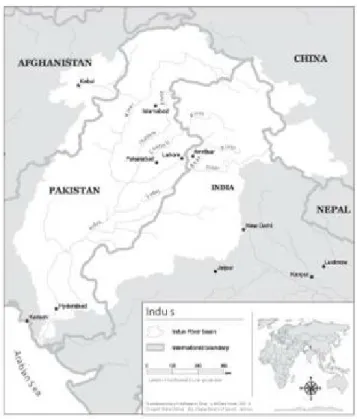
The Indus River basin spans 1,138,800 km2, originating in the Himalayas, passing through China, Afghanistan, India, and Pakistan before emptying into the Arabian Sea.72 Because of the rugged terrain that surrounds the Indus in China and Afghanistan, neither country has made significant progress in developing the Indus for their country’s water needs. India and Pakistan, on the other hand, have developed the river extensively and Pakistan in particular depends on the river for its domestic water needs.73
The Indus is comprised of
six main tributaries: main Indus, Jhelum, Chenab, Ravi, Beas, and Sutlej.74 India utilizes 57.1% of the water available from the Indus river system while Pakistan uses 53.8%.75 The river is a vital source of water for irrigation, energy production, and domestic consumption for both countries. The northwestern Indian provinces, which use the Indus for irrigation, have become one of the country’s main food producing areas. In Pakistan, the Indus provides the only source of water to the arid land.76
72 Wolf and Newton, “Case Study of Transboundary Dispute Resolution,” Appendix C. 73 Zawahri, “Third Party Mediation of International River Disputes,” 289.
74 Aaron T. Wolf and Joshua T. Newton, “Case Study of Transboundary Dispute Resolution: The Indus Water Treaty.” 75 Ibid.
76 Undala Z. Alam, “Questioning the Water Wars Rationale: A Case Study of the Indus Waters Treaty,” The
Geographical Journal 168 no. 4 (December 2002), 342.
Figure 1: Map of the Indus River Basin
The partition of the British-ruled Indian subcontinent into independent India and Pakistan in 1947 turned what were domestic disputes about the use of the Indus River into an international conflict. Relations between India and Pakistan had been troubled before partition, and tensions increased with the formation of the two independent states. Along with the religious divide between Hindus and Muslims, unresolved territorial issues, and problems caused by population displacements, the Indus River system became a central cause of conflict between the two new states.77 Although partition was carried out in only 73 days, no plan for the Indus basin itself, nor the cohesive system of canals and irrigation that was constructed during British rule to bring water to the agricultural regions in and around the Indus basin were made. Suddenly an international border bisected the irrigation and river system of the Indus basin.78
The Situation on the Ground
Once partition was complete newly independent Pakistan became dependent on water from Indus tributaries that flowed through India before crossing the Pakistani border. Alam explains that:
Pakistan’s geography makes it completely dependent upon the Indus basin for its agricultural and municipal uses. Unlike India, which has a number of river systems including the Ganges-Jumna system in the north, or the Cauvery River in the south, Pakistan only has the waters from the Indus basin… If Pakistan was deprived of her canal water from the Indus system, the whole of west Pakistan would really become a desert.79
As the downstream riparian and the state more completely dependent on sufficient quantities of water flowing across the border from India, Pakistan was in a precarious position. Pakistani East Punjab was dependent on water from the Upper Bari Doab (UBDC), Dipalpur, and Eastern Grey canals to irrigate its farmlands. The headworks (the structures that control water flow) of these canals now lay across the border in India.80
77 Alam, “Questioning the Water Wars Rationale,” 342.
78 “The Indus Waters Treaty: A History,” Stimson Center, retrieved from:
http://www.stimson.org/research-pages/the-indus-waters-treaty-a-history/, (31. 05. 2012).
79 Alam, “Questioning the Water Wars Rationale,” 342.
India, on the other hand, controlled the headworks of canals vital to Pakistani agriculture, giving it a position of power vis-à-vis Pakistan. It also gained a means to put pressure on Pakistan by threatening to close the headworks and cut off West Punjab’s water supply. India had other sources of water that could be used for consumption, industry and agriculture, making it less dependent on the Indus. Finally, because the Indus river system flowed through India before reaching Pakistani territory, and the country in which the Indus originated, China, could not develop the river, India had unrestricted first access to the river and its resources.
The situation on the ground fulfills each of Gleick’s four factors that make water a source of conflict.81 Water is scarce in the region and must be shared between the two riparians. Pakistan in particular depends on the water the Indus provides. The power dynamic was also asymmetrical since India possessed the relative advantage of being the upstream riparian and had other sources of freshwater. Each of these factors made conflict between the two riparians more likely. As will be seen in the next section, India and Pakistan were in a state of conflict over the Indus river.
The Conflict
Following partition in August 1947, India and Pakistan signed a Standstill Agreement that froze the use and division of the contested canals (the Upper Bari Doab, Dipalpur, and Eastern Grey) to the status quo that existed prior to independence. The agreement favored Pakistan because it required India to leave the canals alone and ensured that Pakistan received sufficient water to irrigate the western Punjab farmlands.82 Indian leaders were not pleased with this agreement because they wanted to further develop East Punjab83 and felt that they had a sovereign right to the water.84
When the Standstill Agreement expired on March 31, 1948, India closed the headworks that fed the Upper Bari Doab and Dipalpur canals. According to
Zawahri“This action deprived Pakistan’s important city, Lahore, of municipal water and
81 Gleick, “Water and Conflict: Fresh Water Resources and International Security,” 84. 82 Zawahri, “Third Party Mediation of International River Disputes,” 290.
83 India received only 5 million acres of irrigated land through partition whereas Pakistan received 26 million. (Ibid.) 84 Scott Barrett, “Conflict and Cooperation in Managing International Water Resources,” Policy Research Working
hydropower. It also deprived irrigation water to 1.66 million acres of farmland.”85
Although India reopened the canals on May 4th and signed the Inter-Dominion Agreement (also known as the Dehli Agreement), this was only a temporary solution. The agreement “recognized India’s right to increase it’s consumption of the Indus River and it required that Pakistan pay India for operating the canals.”86 India further maintained that Pakistan had no right to any of the waters flowing through the Indus before it crossed the border. Although the agreement ended the immediate crisis, the causes of conflict remained. Pakistan was not pleased with the terms of the agreement or their position vis-à-vis India.
On June 16, 1949, the Pakistani government sent a note to India calling for a new conference to “make an equitable appointment of the flow of all waters common to Pakistan and India and resolving by agreement all disputes incidental to the use of these waters,” because “the present modus vivendi is onerous and unsatisfactory to Pakistan.”87 Pakistan also suggested that should a bilateral solution not be possible, the conflict should be given to the International Court of Justice for resolution.88 India was not inclined to hand the dispute over to third party adjudication and suggested a commission of judges from both countries should be formed to resolve the dispute.89 Bilateral negotiations soon reached a stalemate as political tensions between the two countries grew and each side’s position became more entrenched. As Alam notes, “The enormity of the situation struck observers as potentially catastrophic- a powder keg waiting to explode.”90 Not only had political efforts reached a stalemate, but during this time, India and Pakistan also engaged in competitive development of the Indus basin. The following two examples highlight this competitive development and underscore the conflictual relationship between the riparians.
In 1948 India began construction on “the Bhakra Dam, Nangal Barrage, Bhakra Canals, Bhakra Main Line and Perozepore Feeder. Once completed these structures would have the capacity to control and divert waters on which Pakistan depended.”91
85 Zawahri, “Third Party Mediation of International River Disputes,” 290. 86 Ibid.
87 Biswas, “Indus Water Treaty,” 204. 88 Ibid.
89 Wolf and Newton, “Case Study of Transboundary Dispute Resolution.” Appendix C. 90 Alam, “Questioning the Water Wars Rationale,” 343.
Indian control over water Pakistan needed heightened Pakistani insecurity significantly and caused it to begin development projects to minimize the potential damage. Pakistan’s goal became minimizing its dependence on canals originating in India in order to ensure that Indian threats to shut off Pakistan’s water would no longer cause catastrophic damage. Therefore it began construction on the Bhulam Mohammed, Kotri, Gugu and Aunsa Barrages as well as the Balloki-Suleianke Link and Bambanwala-Ravi-Bedian Link canals. The riparians were locked in a race to develop the river first, causing insecurity for both and further fueling the conflict spiral.
The Sutlej tributary was another source of conflict for the two riparians. To hinder India from being able to stop the water flowing into the Dipalur Canal (one of the canals India had previously stopped water flowing into), Pakistan began work to divert the Sutlej River before it could reach the headwork located on the Indian side of the border.92 This would have made it impossible for India to threaten Pakistan with closing the headwork and stopping water flowing through the canal. However, it “would also have depleted the waters feeding into India’s Ganga Canal Colony and the planned Bhakra Canals and bestowed on Pakistan the ability to impose an artificial drought or flood on India by manipulating the Sutlej.”93 Diplomatic intervention by India did nothing to resolve the conflict and in response to the stalemate India unilaterally diverted the Sutlej before it entered Pakistan.
Riparians are in a state of conflict when they act unilaterally to use and develop the river’s resources and this is contested by the other riparian, who is negatively affected by the unilateral actions. As can be seen from the above examples, India and Pakistan were locked in a state of conflict. Both riparians unilaterally developed the river and actively attempted to hinder the other riparian from gaining the upper hand. There was also no behavior modification once it became clear that unilateral development harmed the other riparian. Neither India nor Pakistan felt secure in their access or use of the Indus basin, leading both to engage in conflictual behavior. The insecurity surrounding the
92 Although the river begins in India, it crosses the border into Pakistan before turning back into India and reaching the
headworks that allow India to shut off Pakistan’s water supply. Ibid.
Indus basin and the conflict it created persisted until the intervention of the World Bank in 1951.
Mediating the Indus River Conflict
The World Bank’s president, Eugene R. Black, offered the Bank’s “good offices” to help resolve the conflict in September 1951 after reading an article about the potential for integrated river management in the Indus basin and what role the World Bank could play in facilitating this.94 Black came up with three “essential principles” that he
determined should form the basis for mediation and guide the resolution of the conflict. Both India and Pakistan agreed to negotiate on the basis of the following principles. They agreed that the Indus had enough water to meet all current and future water needs both countries would have from that source. Second, that during the negotiation and in any resulting agreement the basin should be treated as a single entity and its resources should be developed in line with this assumption. Third, the negotiations should remain on a technical instead of political level and previous negotiations or past grievances would not be brought into the discussion.95 Both India and Pakistan accepted the World Bank’s offer, and the first meeting took place in Washington D.C. in May 1952.
In line with the three essential principles, Black suggested that India and Pakistan each pick a qualified engineer who, in collaboration with the other, would create a comprehensive, long-term plan for the use and development of the Indus basin. The World Bank would also provide an engineer to act as a consultant.96 Together they would form the Working Party. After discussing for three weeks, the Working Party came up with a plan of action for collecting the necessary information to develop a plan for collaborative development of the basin. The Working Party would determine the total water supply of the Indus river system and how much water irrigated agriculture required. The Working Party would also collect data and do surveys as requested by either riparian. Finally, the group would prepare cost estimates and a schedule for the construction of new engineering works that would be needed as part of the comprehensive plan.97 To
94 Wolf and Newton, “Case Study of Transboundary Dispute Resolution.” Appendix C. 95 Alam, “Questioning the Water Wars Rationale,” 344.
avoid conflict, the negotiating parties agreed that no data collected or requested would “commit either side as to its relevance or materiality.”98 However, it proved impossible for the Working Party to agree on a joint approach to developing the basin, so Black suggested each riparian prepare its own plan, which they submitted to the World Bank on October 6, 1953.99
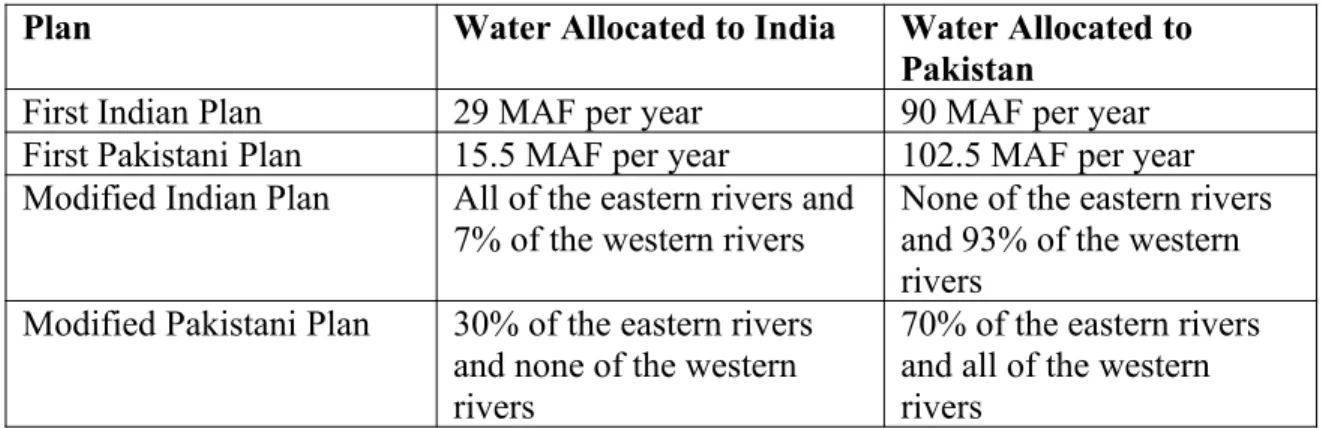
The individual Indian and Pakistani plans almost overlapped on the available water supply for irrigation100 but differed enormously on how these supplies should be allocated. Even after both sides modified their proposals, they were still nowhere near each other. Both the initial and the revised plans are summarized in the table below.
Table 1: Initial and Modified Indian and Pakistani Plans for Water Allocation101 (Allocation in Million Acre Feet)
Plan Water Allocated to India Water Allocated to
Pakistan
First Indian Plan 29 MAF per year 90 MAF per year
First Pakistani Plan 15.5 MAF per year 102.5 MAF per year Modified Indian Plan All of the eastern rivers and
7% of the western rivers
None of the eastern rivers and 93% of the western rivers
Modified Pakistani Plan 30% of the eastern rivers and none of the western rivers
70% of the eastern rivers and all of the western rivers
In the modified Indian plan, India would have sole access to all of the eastern rivers and receive an additional 7% of the water from the western rivers while Pakistan would receive only 93% of the western rivers. Pakistan’s modified plan allocated 30% of the water from the eastern rivers to India, while Pakistan would receive the remaining 70% of the eastern rivers and all of the western rivers. Clearly, common ground remained elusive, and it looked like communal development of the Indus basin was an unlikely prospect. At this time, the riparians were not in a state of cooperation because neither side
98 Ibid.
99 Alam, “Questioning the Water Wars Rationale,” 344.
100 The Indian plan determined that there were 119 million acre-feet (MAF) available while the Pakistan plan came to
118 MAF available for irrigation.
was willing to modify their demands to ensure that the needs of both parties would be met.
In response to the stalemate, the World Bank came up with its own plan that divided the rivers between the two riparians instead of attempting to find a collaborative settlement. The proposal allocated all of the eastern rivers to India and all of the western rivers, except for a small amount of water from the Jhelum, to Pakistan. The plan also called for the construction of canals and storage dams to divert waters from the western rivers, replacing the water lost to Pakistan in the eastern rivers.102 India accepted the World Bank’s plan as the basis for agreement on March 25, 1954. Pakistan worried that the water flowing through the western rivers would not be enough to make up for the loss of the eastern rivers, in particular since the country had limited capacities to store the water it was allocated. Therefore Pakistan gave only qualified acceptance on July 28, 1954.
In order to alleviate Pakistani concerns over insufficient water or storage facilities, the World Bank added an Aide Memoir that called for more storage facilities on the western rivers to make up for the water Pakistan would be losing in the eastern rivers. The Aide Memoir also suggested that these costs should be borne by India. Unsurprisingly, India rejected the Aide Memoir, while Pakistan accepted it.103 India further rejected Pakistan’s 1958 plan that called for the building of two large storage facilities, three small dams, and expanded link canals on the Jhelum and Indus tributaries, the total cost of which would have been $1.12 billion. India rejected this plan on the basis that, although it had agreed to pay for facilities to replace those lost once the rivers were divided, it would not pay for Pakistani development works.104
The World Bank found itself in a predicament. Pakistan needed additional storage facilities to make up for the water they would lose by not being able to use the eastern rivers. These facilities needed to be paid for somehow, but India refused the additional cost of these facilities because it saw them as not replacing what was lost but additionally developing the river to Pakistan’s advantage.
102 “The Indus Waters Treaty: A History,” Stimson Center.
103 Rahul Reddy, “The Indus Water Treaty: It’s Persistence and Prospects,” The Northwestern Journal of International
Affairs 10 no. 1 (Fall 2009), retrieved from: http://groups.northwestern.edu/njia/?p=478, (3 June, 2012).
In order to break the stalemate and finally reach an agreement after seven years of negotiations, Black suggested that India pay one fixed sum as a contribution to the replacement works, and the World Bank would organize financial assistance in the form of a side payment to pay for the rest.105 The Indus Basin Development Fund Agreement provided $541 million in grants to Pakistan, India contributed a fixed $174 million, and Pakistan received another $150 million in loans.106 By mobilizing the donor community to provide a side-payment, Black was able to break the financial stalemate that hindered the agreement and create favorable conditions for both India and Pakistan. Without the use of side-payments, the negotiations would likely have remained at an impasse, because India felt Pakistan was asking for too much, while Pakistan felt India was offering too little to compensate Pakistan for what it was giving up. By mobilizing the international community to provide outside funding, the issue of the replacement and development facilities became a moot point, and the final roadblock to agreement was overcome. India, Pakistan and the World Bank signed the Indus Water Treaty on September 19, 1960.107
The Indus Waters Treaty
Under the terms of the Indus Waters Treaty (IWT), India received the three eastern rivers (the Sutlej, Beas, and Ravi), which equaled 20% of the basin’s water, while Pakistan now claimed the three western rivers (the Chenab, Jhelum, and Indus) giving it the remaining 80% of the basin’s water.108 The division of the tributaries did not
completely disentangle India and Pakistan from each other, however. The treaty put in place a ten-year transition period to give Pakistan time to build the necessary dams, canals, barrages, and wells to make up for the water previously obtained from the eastern rivers.109 The countries would have to continue to cooperate, because the treaty further specified that India had the right to use water from the western rivers to irrigate existing
105 Biswas, “Indus Water Treaty,” 208. 106 Ibid.
107 Salman M. A. Salman, “International Water Disputes: A New Breed of Claims, Claimants and Settlement
Institutions,” Water International 31 no. 1 (March 2006), 6.
108 Alam, “Questioning the Water Wars Rationale,” 344.
109 World Bank, “Annexure E- Storage of Waters by India on the Western Rivers,” Indus Waters Treaty, 19 September