GRAPHIC NOVELS IN ADVANCED ENGLISH/LANGUAGE ARTS CLASSROOMS: A PHENOMENOLOGICAL CASE STUDY
Cary Gillenwater
A dissertation submitted to the faculty of the University of North Carolina at Chapel Hill in partial fulfillment of the requirements for the degree of Doctor of Philosophy in the School of Education.
Chapel Hill 2012
Approved by: Madeleine Grumet James Trier
iii ABSTRACT
CARY GILLENWATER: Graphic novels in advanced English/language arts classrooms: A phenomenological case study
(Under the direction of Madeleine Grumet)
This dissertation is a phenomenological case study of two 12th grade
English/language arts (ELA) classrooms where teachers used graphic novels with their advanced students. The primary purpose of this case study was to gain insight into the phenomenon of using graphic novels with these students—a research area that is currently limited. Literature from a variety of disciplines was compared and contrasted with observations, interviews, questionnaires, and structured think-aloud activities for this purpose. The following questions guided the study: (1) What are the prevailing attitudes/opinions held by the ELA teachers who use graphic novels and their students about this medium? (2) What interests do the students have that connect to the
phenomenon of comic book/graphic novel reading? (3) How do the teachers and the students make meaning from graphic novels?
The findings generally affirmed previous scholarship that the medium of comic books/graphic novels can play a beneficial role in ELA classrooms, encouraging student involvement and ownership of texts and their visual literacy development. The findings also confirmed, however, that teachers must first conceive of literacy as more than just reading and writing phonetic texts if the use of the medium is to be more than just
iv
pedagogy, curriculum, and historical influences inform, affect, and shape this
phenomenon and create tensions around the use of this medium, particularly for students. The study also produced some interesting findings that complicated and even challenged current scholarship about the canon, literacy, and using comic books/graphic novels in the ELA classroom. While it is understood that canonical texts often persist due to social and cultural forces that influence both schooling and our society, there are also less controlling forces influencing the canon, particularly nostalgia. The findings also suggest that excellent traditional literacy abilities can play an important role in understanding and interpreting images; however, instruction in the arts and visual literacy can augment and deepen students’ visual literacy. Finally, the findings suggest that scholarship on comic books, particularly how to read them, may be overly complicated and pedantic.
v
ACKNOWLEDGEMENTS
There are many people who have contributed to the journey I have taken as a graduate student. I wish to acknowledge them and extend my deeply felt and sincere gratitude to them. I would like to thank Chuck Nolan, the principal of Orange Charter School, who allowed me to make time in the day to pursue graduate courses at the University of North Carolina at Chapel Hill. Without his flexibility I would not have been able to begin this journey.
I would also like to thank Lynda Stone, Gerald Unks, and James Trier who welcomed me to the Culture, Curriculum, and Change program and helped mentor and navigate me as I
pursued my Masters. I consider Lynda, Gerry, and Jim to be true friends.
I am forever indebted to Madeleine Grumet, whom I asked to be my advisor several years ago because I knew she would not allow anything less than the best I could give. Her guidance, patience, and reality checks made me not only a better writer but a better scholar. I would also like to thank the rest of my committee, James Trier, Jeff Greene, Lucila Vargas, and Renee Hobbs, for all their support and guidance along this journey as well.
vi
vii
TABLE OF CONTENTS
LIST OF FIGURES...x
Chapter I. INTRODUCTION...1
Purpose of the Study...5
Background of Study...5
A Passion for Comic Books...6
The Superhero Genre...10
Inappropriate Reading Material!...15
How Things Change...16
II. COMICS AND EDUCATION...20
Mid Century Views of Comic Books and Literacy...20
Comic Books as Literacy in the New Millennium...27
III. METHODOLOGY...34
Rationale for Methods...34
Study Procedures...35
Overview...35
Researcher’s Role...36
Research Sites...36
viii
Graphic Novels in the Study...44
In-depth interviews and Questionnaires...46
Non-Participant Observation...47
Structured Think-Aloud Activities...48
Analysis...50
IV. NORMATIVE READING...52
V. ELA CURRICULUM, PEDAGOGY, AND EVALUATION...67
ELA Curriculum...68
Popular culture...72
ELA Pedagogy...75
ELA Evaluation...78
VI. LITERACIES AND THE ELA CLASSROOM...82
Traditional Literacy...83
Intertextuality...86
Visual Literacy...92
Toward a visual literacy pedagogy...96
Hybrid Literacy...106
21st Century Literacies...110
VII. MEANING MAKING IN THE ELA CLASSROOM…...118
Visualization and Imagination...130
Meaning Made...135
VIII. CONCLUDING REMARKS...141
ix
Literacy as Fluid...143
Over Thinking the Mark...145
APPENDICES...147
x
LIST OF FIGURES
Figure
CHAPTER 1: INTRODUCTION
The idea of using a comic book in the classroom, particularly the
English/Language Arts (ELA) classroom, is not as far-fetched as it was just a decade or two ago. Back in 1989 I was in eighth grade, and between class bells my friends and I would stand huddled around my locker looking at comic books. We would flip through the pages and speak in almost guarded whispers about the images we were seeing. We knew that if we brought them into the classroom, they would immediately be
confiscated—a fact my best friend learned the hard way—so the two minutes between classes was our only option if we were to share in the pleasure they brought each of us. Reflecting back on these early experiences with comic books in school, I realize that having comic books seemed tantamount to having pornography stashed in the locker. In retrospect, the idea that I had to be secretive about my reading choice of comic books seems almost laughable, but in fact it was a serious issue because they simply were not acceptable in school. Currently, it is still an uncommon practice to read comic books and/or graphic novels1 in the ELA classroom; however, it is not as unheard of as it was when I was in school.
2
Another distinction that exists between then and now is the internet. Finding a space in ELA classrooms for comic books is potentially more critical now than at any other time in comics’ history because in comparison with phonetic texts this medium has more elements in common with reading on the web, both in how they are created and how they are understood (Clarke, 2007; P. Gutiérrez, 2008). It is interesting that one of the earliest modes of communication, images, is the most relevant to the newest mode.
Over the last two decades, scholarship on the medium has come from a number of disciplines, mostly focusing on the conventions of the medium (e.g. Carrier, 2000;
3
literacy implies that the medium of comic books is secondary or what James “Bucky” Carter, a comic book scholar and teacher educator, calls minor in relation to the major role of traditional literature (personal communication, 2012).
In order to circumvent this persistent subordination that appreciates comic books merely as a bridge to something else, I have chosen to work specifically with advanced2 students and advanced ELA curriculum in this study. This population could be
particularly helpful in understanding how comic books and graphic novels can function in the ELA classroom beyond that of bridging them to traditional phonetic texts because these advanced students already have the ability to comprehend and make meaning from traditional texts. There is also very little research on the use of comic books and graphic novels with this population (Carter, 2007a, 2007b; Mitchell & George, 1996). This study will help to expand on this literature.
The research questions that guided this study were created based on literature from a variety of disciplines. They were the foundation for the initial interview protocols for teachers and students (see appendices A & B for interview protocols):
1. What are the prevailing attitudes/opinions held by the English teachers who use graphic novels and their students about the medium of comic books/graphic novels?
- What contributes to these attitudes/opinions?
2
4
- Do the teachers’ attitudes/opinions affect their pedagogical approach?
- Do the students’ attitudes/opinions affect their initial reception of these texts?
- What is the outcome of the use of these texts on the students’ attitudes/opinions about these texts specifically and about the advanced ELA curriculum generally?
2. What interests do the students have that connect to the phenomenon of comic book/graphic novel reading?
- What are the circumstances of their initial encounters with the medium?
- Do the students become interested in these texts at any specific point of time?
- How do students compare and contrast their experiences with these texts with those of purely phonetic text?
3. How do the teachers and the students make meaning from graphic novels? - How does their meaning making contribute to their
5
Purpose of the Study
In addition to expanding the literature on the use of comic books and graphic novels, what I term hybrid texts3, with advanced students, this study will examine how hybrid texts exist within the institution of schooling, specifically the advanced
English/Language Arts (ELA) classroom. Furthermore, the study will illuminate how hybrid tests are negotiated or analyzed, critiqued, and engaged with, by both the teachers and the students in an accelerated and demanding curriculum that is historically grounded in traditional literacy. It also suggests that hybrid texts might add to students’ traditional and visual literacy development and understanding of phonetic, visual, and hybrid texts. The pedagogical approach of the teachers working with these various texts is analyzed to further understand what differences, if any, exist in teaching them compared to traditional texts, as well as what a pedagogy of visual literacy may entail. The main purpose of this study is to gain insight into how the interfacing of pedagogy and curriculum, each influenced by historical forces, inform, affect, and shape the phenomenon of hybrid text use in the advanced ELA classroom as well as how students learn how to make meaning with these texts.
Background of Study
This study stems from my involvement with comic books and graphic novels since my youth and from my career as a middle school language arts teacher. It is further informed by my graduate studies in literacy, as well as a class project I worked on in the School of Journalism at the University of North Carolina at Chapel Hill (subsequently
3
6
referred to in this text as UNCSJ). These experiences were the catalysts for this study and help to situate the perspectives I bring to the use of comic books and graphic novels in education.
A Passion for Comic Books
In 1986 I picked up three comic books at a local convenience store. They were superhero comics: Amazing Spider-man #298, Batman #418, and Uncanny X-Men #224, which featured Wolverine. I was eleven years old and in sixth grade. I immediately fell in love with the medium. Interestingly this purchase inspired me to get a job at a local produce stand that was located adjacent to the 7-11. I would get off the bus on
Wednesday afternoons and work at the produce stand for an hour. I earned three
7
When I began reading comic books, my joy stemmed from the battles between the heroes and villains, but as I have matured, I now find the internal conflicts of the heroes and even the villains more compelling. I have also come to realize that their physical battles are often—at least in the best comics—a manifestation of their internal struggles. Spider-man’s battles are an example. I also thoroughly enjoy the visuals in comic books because they connect to my love of movies and of drawing. Even though I drew prior to becoming involved with comic books, I became a better artist after reading them because I would spend hours with my friends trying to duplicate the styles of the artists in the comics. I believe that reading comic books contributed heavily to my ability to draw and ultimately to acquiring jobs in Hollywood, California, as a storyboard artist—again a mixing of my two favorite activities: movies and drawing.
While I enjoyed reading comic books as an eleven year old, my mother was not happy about this new hobby of mine because she felt comic books were a waste of time and money and that reading them was not really reading. Her worry was not unfounded, because in my early adolescence I was a borderline nonreader (Hughes-Hassell & Rodge, 2007). Typically, nonreaders are considered to be students who do not read, whether for school or recreation (Williams, 2007). Interestingly, Williams (2007) found that many nonreaders do read, but they are reading texts such as comic books, magazines, trading cards, films, and the like—texts that are not generally school sanctioned. In my case, I did read what I had to for school, often the night before and sometimes opting for Cliff’s Notes when I was out of time. In short, I was not interested in traditional reading and writing beyond theirconnection to getting good grades, thus the designation of
8
enacted their literacy in this same manner, opting for the easiest and most efficient methods of “reading” their school texts to secure a good grade as opposed to engaging with the texts for the sake of pleasure and/or learning. (This issue will be discussed further in chapter 4.)
9
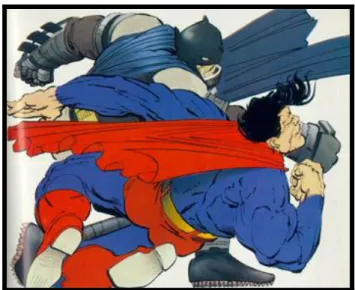
Figure 1: Batman punching Superman
Batman: The Dark Knight Returns, writer and artist Frank Miller ©1986 DC Comics
After subsequent and more nuanced analytical readings of Batman: The Dark Knight Returns, I have come to understand the image of Batman hitting Superman as symbolic of a rejection of oppression and even a triumph of the individual against those who wish to oppress him. This image is compelling because Superman is iconic as a good guy who stands for “truth, justice, and the American way”; however, in Batman: The Dark Knight Returns Superman has been co-opted by the government, and
10
immediately apparent, I feel I would have been better equipped to interpret and understand this text at a deeper level, i.e. going beyond the text to make meanings informed by my own prior knowledge and sociocultural contexts.
The Superhero Genre.Chapter two of this study provides a historical analysis of the medium, which also includes claims that the medium contributes directly to violent behavior. While this study is not about violence in comic books, it is an important topic that must be addressed at this point if the discussion on their use in the advanced ELA classroom is to be productive.
In superhero comic books and graphic novels violence tends to be the main approach to conflict resolution, and not all uses of violence in these texts are symbolic. Violence when used gratuitously can be problematic, not only for comic books, but for other media as well, as it may be understood as advocating it. There are likely many reasons for the use of gratuitous violence, including appealing to young males who may be struggling with their masculine identity or even adult males who may take pleasure in the violence or feel it is cathartic; either way, it tends to promote an extreme view of masculinity that translates into sales for the industry. It may also be a response to Americans’ fascination with conflict and/or for shock value. Nevertheless, there are those comic books and graphic novels that use violence symbolically; therefore, they transcend the trappings of the superhero genre. The image discussed above from
11
Figure 2: Anthropomorphic Art Spiegelman atop mice bodies
Maus II, writer and artist Art Spiegelman ©1986 by Art Spiegelman
The image above portrays Art Spiegelman, wearing a mouse mask, at his drawing table sitting atop a pile of dead bodies that symbolize his despair about being able to tell his father’s story of Auschwitz faithfully (Ewert, 2000).
Of course, violence also appears in phonetic texts that are considered canonical and important to our culture. Some examples include many of Western culture’s myths as well as works by Shakespeare. The traditional plot outline of much of our literature is that of conflict leading to resolution. While not all of the conflict is violent, the point is that violence is not uncommon in our literature and our history.
12
image discussed above is an excellent example of violence as symbolic, particularly in relation to Barthes concept of violence of the state while also simultaneously being concerned with individual bodies. However, before proceeding with a further analysis of this image, the image must be understood in the context of both the time period it was published and its narrative.
Batman: The Dark Knight Returns was originally published as a four issue comic book mini-series in the mid-1980s during the Reagan administration. It was later
published as a graphic novel and received status as a piece of graphic literature. Batman: The Dark Knight Returns stands as a critique of both the Reagan administration, with Ronald Reagan portrayed as a robot that has become president for life, and a critique of the cultural milieu of the time, particularly aspects of national security, economic disparity, and the news media. It has also maintained its relevance in light of the recent Bush administration, the current economic crisis, and the prevalence of news media in our daily lives.
Batman: The Dark Knight Returns is about Bruce Wayne struggling with becoming Batman again after being forced into retirement by the governmentten years prior along with all the other superheroes, save Superman. Gotham City, his home, has devolved into a state of near chaos with only a semblance of order being maintained by the news media, which airs 24 hours a day a la CNN, and Superman, who is now a covert government agent whose name cannot be said by the news media without fear of
13
common superhero genre element, by suggesting that the man, Bruce Wayne, is in actuality the mask of Batman who is much larger than just one man. This idea is enacted during the course of the narrative as Batman becomes a movement within Gotham City. The return of Batman into this new world where those in power know that Batman is Bruce Wayne also leads to a loss of all the economic, social, and cultural capital that Bruce Wayne had accumulated as well as inherited. In this story, Batman is fully
14
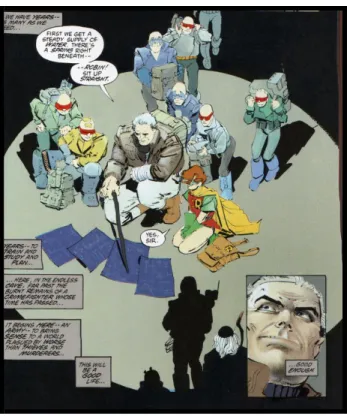
Figure 3: Batman as mentor/teacher
Batman: The Dark Knight Returns, writer and artist Frank Miller ©1986 DC Comics
From a literary standpoint, Batman: The Dark Knight Returns is replete with symbolism and universal themes that resonate with people at a personal and a societal level, from the death of loved ones and the destruction of the family, (see Appendix C for an example) to concepts foundational to our country’s identity such as the individual and the struggle for freedom, as well as, and possibly counter to the latter theme, a rejection of the status quo. In the end, Batman: The Dark Knight Returns transcends the
superhero genre, establishing it as a piece of literature and validating it as a part of this study.
15
in comic book form, is another example of a superhero graphic novel that has
transcended its genre. Additionally, Art Spiegelman’s Maus, which won a Pulitzer Prize in 1992, Marjane Satrapi’s Persepolis, and many others are widely regarded as literature and are used in high school and college literature courses. All of the graphic novels mentioned by name contain to lesser and greater degrees portrayals of violence, with Maus being arguably the most jarring because of Spiegelman use of children’s character archetypes, mice and cats, in its portrayal of life during and after the Holocaust.
Inappropriate Reading Material!
During my first year teaching middle school in 2001, I had a student who refused to read anything in class or at home. He was the very definition of a nonreader. He struggled all year and subsequently failed the sixth grade due to poor grades and a non-passing score on his North Carolina Reading End-of-Grade (EOG) standardized reading test. In my second year, I was the remediation instructor for the school. This same student showed up in my classroom one day, and he had The Simpsons comic books with him. The student read them during sustained, silent reading time (SSR) and made modest progress on his practice Reading EOG tests. I was also very pleased to see that he was taking an interest in reading something. Whether he was just reading the images or reading the texts I do not know; however, what mattered to me was that he was engaged with a mode of text.
16
material and negatively documented their use on the appraisal instrument. I attempted to make the case that he was at least reading something, but she refused to hear it, and claimed that reading comic books was simply not appropriate for school. Her disdain for a whole medium raised many questions for me as an educator, particularly about the place traditional literacy occupies in our schools, and by extension society, and the absence of other modes of literacy in the classroom. These questions have remained with me as I have pursued my doctorate in education, and they motivated the class project I completed at the University of North Carolina at Chapel Hill School of Journalism (UNCSJ) that would become the foundation for the current study.
How Things Change
The class project I conducted at UNCSJ was an exploratory, qualitative study. The purpose of the project was to uncover perspectives that teachers and students brought to comic books and graphic novels, particularly considering their literary merit. I
conducted interviews with a language arts teacher and some of her students that produced some interesting findings.
The teacher stated that she had viewed the medium as having no literary merit, a position that upon reflection she attributed to her own primary and secondary schooling, as well as her professional training as a language arts teacher. Nevertheless, she had recently warmed to the idea that the medium could contribute to the ELA classroom due to some events in her personal and professional life. She stopped short, however, of acknowledging it as having literary merit on its own, but instead viewed it as a
17
the use of comic books and graphic novels in schools (see Freeman, 1998; Galley, 2004; Leckbee, 2005; McTaggart, 2005; Schwarz, 2002; Versaci, 2001). I initially felt that bridging was the best use of the medium as well when I first became interested in it from a scholarly standpoint. I now believe that the scholarship on the subject inadvertently perpetuates the idea that image-oriented media are, at best, subservient to traditional literature. In order to circumvent this line of thinking, I decided in my class project to interview only students who were considered advanced as defined by their involvement with texts in and outside of the classroom, their analytical and evaluative engagement with texts in the classroom, and their teacher’s evaluation of their performance in class and on assessments, as well as on their Reading EOG test scores.
I also discovered that the student participants reflected their teacher’s view that these texts lacked any substantial merit through the way they discussed them in personal interviews and during a focus group, both of which were held without their teacher present. Their interpretative efforts betrayed a superficiality that was in keeping with how my friends and I discussed these texts in our youth. For example, during the focus group the students talked about Naruto, a Manga or Japanese graphic novel, which they all read and socialized around outside of class, typically during lunch at school or online after school. I asked them to describe its basic plot, and they stated that it was about an adolescent male, Naruto, who is feared and shunned by the villagers because he is cursed. Nevertheless, he continually proves to be their savior throughout the series. I then
18
unable to draw any further interpretations beyond the obvious ones present in the basic plot.
One student participant claimed that graphic novel reading was easy and therefore was not really appropriate for the language arts classroom. Her conclusion may be attributable to an ELA curriculum that is dominated by the need to perform well on standardized tests, resulting in an emphasis on process over substance, where process is knowing and applying the specific literary analysis toolkit in order to perform well (Street, 2006). In middle school, the toolkit tends to focus on skills necessary to understanding the foundational elements of narrative, i.e. plot, characters and
characterization, setting, point-of-view, and theme. Therefore, her assertion that it was easy to read devalued the process of reading the comic and also disregarded any substance in it. Whatever the reason, it was evident that she was making a distinction between texts that were school sanctioned and those that were not (Norton, 2003; Williams, 2007; Versaci, 2001).
In reflecting on these particular circumstances and experiences as well as my own passion for the medium of comic books and graphic novels, I had to make a decision about whether to be a participant or a non-participant in this current study. I felt that these factors had the potential to complicate this study by attaching assumptions that may or may not actually be present in the actual classrooms where this medium is being used. In an effort to avoid these assumptions, I chose to work with teachers who significantly surpassed my five years teaching experience within the public school ELA classroom and who also had significant experience using comic books and graphic novels in their
19
CHAPTER 2: COMICS AND EDUCATION
The history of comic books in America reveals a medium that has been both heralded and derided as a mode of literacy since its inception. During the early 20th century, comics in the form of comic strips began to appear more frequently in
newspapers (Dorell, Curtis, & Rampal, 1995). They were enjoyed by adults and children alike and typically followed the conventions of print text in the sense that the narrative was linear (Schmitt, 1992). Nevertheless, they often troubled parents and educators because they were believed to be a waste of time that kept young readers away from more quality reading material (Lent, 1999). As comic strips grew more popular, they began to appear in collected “books” called “comic books” (Dorell et al., 1995), and with the advent of comic books the backlash against them as a form of literacy also began
(Freeman, 1998). However, the history of comic books also reveals that at one time they were studied and regarded by some as beneficial to education, a position that has recently found support again (Buhle, 2003; Dorrell et al., 1995). Nevertheless, during the 1950s the public and academy turned against the medium, leaving a legacy of disdain that still haunts the medium today.
Mid Century Views of Comic Books and Literacy
21
complaint raised was that comic books were leading children away from better, i.e. educationally sanctioned or canonical, literature and thus creating a generation of semi-literates (Nyberg, 1998). Despite protests that the medium was not suitable reading material, comic books hit their highest circulation during the 1940s due to the popularity of the first superhero, Superman, and also found their way into classrooms across the country (Dorrell et al., 1995). During this time there was also an influx of research and scholarship promoting their use in the classroom, the result of which yielded scholarly and professional evidence of how comic books could promote literacy (Dorrell et al., 1995). For example, Robert Thorndike (1941), a prominent educational psychologist at Columbia’s Teachers College (as cited in Dorrell et al., 1995) argued that comic books were a valuable resource in vocabulary building and in the area of remedial reading. He attributed their value in remedial reading to the images, which helped the reader
understand concepts that would have been difficult with a phonetic text. His conclusions would be reconfirmed decades later in research on effective use of images in texts
(Carney & Levin, 2002; Levin & Mayer, 1993; Peeck, 1993).
22
comic books as propaganda within the classroom. Comic books were an excellent vehicle for this propaganda because they were heavily read by the youth and the comic book industry was depicting their heroes fighting in World War II. By 1948, 92% of junior high age students (those that would now be in middle school) were reported to read comic books (DeLara, 1948, as cited in Dorrell et al., 1995).
Nevertheless, despite scholarly research in support of using the medium in schools and active use of comic books by teachers, in the early 1940s school librarians initiated a crusade to keep comic books out of schools (Dorrell et al., 1995). They saw comic books as a “menace” and spoke about them as if they were a disease, stating, for example, that “a severe case of comics often leaves a serious aftermath of disinterest and disability in reading” (Hunter, 1949, as cited in Dorrell et al., 1995, p. 231). Ironically, the claims of disinterest and disability in phonetic reading are the argument offered in support of including comic books in classrooms today (e.g. Freeman, 1998; Galley, 2004; Leckbee, 2005; McTaggart, 2005; Schwarz, 2002; Versaci, 2001).
Counter to pro-comic book research, there also existed research that found that comics were to some degree detrimental to literacy development. For example, in 1952 a survey was conducted, and it was reported to the public that comic books did not help to improve educational attainment, but that reading standard literature did show an increase in literacy (Dorrell et al., 1995). Dorell et al. (1995) note that it has become clear that this conclusion was mainly predicated on inference as opposed to any scientific evidence.
23
reading comprehension and imagination, and therefore children should be reading more acceptable materials (Dorrell, et al., 1995). Beyond a growing fear that comic books were harming literacy abilities, a new and more troubling claim was also made: comic books caused violent behavior (Nyberg, 1998; Schmitt, 1992; Wright, 2001). For example, in 1940 the Chicago Daily News ran an article entitled “A National Disgrace” wherein comic books were argued to be instigators of violence and deviance that made children impatient with what were called “quieter stories” (Nyberg, 1998, p. 4).
By the mid-1950s, due to the efforts of Dr. Frederick Wertham, Senior
Psychiatrist to New York City Hospitals, and other concerned citizens, the comic book industry was completely discredited and nearly destroyed (Nyberg, 1998). In his 1953 book Seduction of the Innocent, Wertham argued that because comic books focused on images rather than words, they disrupted "proper reading habits” (p. 126). Consequently, he determined that the reading of comic books was an inadequate experience that not only contributed nothing to a child's education, but was also potentially damaging to it. Wertham also concluded that comic books could be held accountable for criminal elements of society such as the growth in juvenile delinquency— a conclusion that in later years has not only been refuted, but completely invalidated on grounds that his methods and therefore his conclusions were unsound because they were based on the fact that many of the delinquents in his study read comic books (Nyberg, 1998). This
24
book to convince a great many parents, teachers, and politicians that comic book reading was detrimental to society. Seduction of the Innocent resulted in hearings of the Senate Subcommittee to Investigate Juvenile Delinquency, which led to the establishment of the Comics Code Authority (CCA) in 1954.
The CCA was a regulatory body charged with making sure that comic books did not contain any deleterious or objectionable content (Nyberg, 1998). This task was accomplished by establishing guidelines that were primarily concerned with sex, violence, and language. All comics that passed the authority’s scrutiny received their stamp of approval denoting that they were safe for juvenile consumption. The ones that did not pass scrutiny and therefore did not receive the stamp could still be sold, but saw their audiences dwindle to nearly nonexistent because parents no longer allowed their kids to possess them. EC Comics, publisher of the very popular crime and horror comics, which were specifically cited as causing juvenile delinquency by Wertham, did not receive the stamp, and consequently the company went out of business.
25
contend that the fight against comic books was actually a fight over the notion that kids are capable of having their own desires, opinions, and points of view.
Wright (2003) further posits that the problem with comic books was not the threat of violence, but the associations that violence had with poverty. Comic books during this period were often associated with the poor because they were a cheaply made and mass produced medium, which correlated to cheap and inappropriate reading material. This is a deterministic view of reading, which suggests that the particular ways people read, including what they choose to read, is determined by their social positions (Buckingham & Sefton-Green, 1994). Comic books were equated with slums and broken homes and seen as contributing to the degradation of American youth (Wright, 2003). For instance, in 1947 The New Republic claimed that those residing in poorer households were most likely to be regular readers of comic books as opposed to those in wealthier households (as cited in Wright, 2003). The implication of this report was that comic books appealed to the unsophisticated and poorly educated. The fear was that comic book reading would result in a group of people incapable of reading ordinary text and would ultimately ruin American culture.
26
viewed as natural due to having been the “gold” standard for so long; therefore, this challenging of the boundaries was felt to be dangerous (Gee, 1996).
The attacks on the medium in the 1950s and the prevailing attitude against comic books put an end, for a while, to research on the benefits of comic books and teachers’ use of them in the classroom. However, during the 1960s society became more and more disillusioned with the establishment (Nyberg, 1998), and comic books once again found a readership, this time among adults. During the early 1960s, underground comix4 began to appear sporadically, and by the late 1960s, they had gained a strong counterculture readership (Sabin, 1996). Underground comix were influenced by EC Comics, publishers of the crime and horror comics that had been the impetus for the backlash against the medium in the 1950s. Underground comix portrayed drug use, sexuality, violence, and other socially relevant content that were forbidden under the Comics Code Authority (Sabin, 1996). They were a clear rejection of the code and the mainstream values the code tried to impose. While these comic books were praised as being socially relevant and politically progressive, they were also criticized for their explicitness, particularly their sexual explicitness and portrayals of sexual violence such as rape. These issues notwithstanding, as the enforcement of the Comics Code relaxed in the 1970s to bring it in line with the contemporary standards of American society, these underground comix began to find a more mainstream audience, and though many still remained very graphic, explicit, and subcultural, some titles began to explore progressive political ideas such as feminism and the environment (Sabin, 1996).
4 The spelling “comix” was used to differentiate these comic books from mainstream comics and the “x”
27
Also during the late 1960s and 1970s, mainstream superhero comics began to explore the grittier side of society. One of the most famous examples is Green
Lantern/Green Arrow #85-86 published by DC Comics, which dealt with Green Arrow’s ward Speedy’s heroin addiction. Also, Marvel published a story arch in Amazing Spider-man #96-98 that dealt with a character’s cocaine addiction. Interestingly, the Amazing Spider-man story arch is infamously dubbed “Not Approved by the Comics Code
Authority.” As comic books began to reflect the darker aspects of society and dealt with problems that were more socially relevant, the Comics Code Authority began to lose its significance, and in 1989, the Comics Code was again revamped, resulting in a move away from specific guidelines in favor of principles in various categories. The 1980s became a turning point for comic books, leading to a current renaissance both at the academic level and in the broader society.
Comic Books as Literacy in the New Millennium
28
each of these forms of text and further calls into question any distinctions these names may lend. Ultimately, it is not the name of the form that is important, but the quality of the work itself, and there are many comic books that are not considered graphic novels but that are considered quality works. This fact notwithstanding, each of these texts has received scholarly attention: Batman: The Dark Knight Returns (e.g. Blackmore, 2004; Morris & Morris, 2005, Tipton, 2008), Watchmen (e.g. Hughes, 2006; White & Irwin, 2009; Van Ness, 2010), and Maus (e.g. Ewert, 2000; Rothberg & Spiegelman, 1994; Young, 1998). Additionally, Maus won a Pulitzer Prize in 1992, and in 2005 Time magazine labeled Watchmen one of the top 100 novels since 1923 (Grossman & Lacayo, 2005).
Currently, comic books, which were once viewed as a menace to reading by librarians, are now trumpeted by them as an excellent way to get children interested in literature (Bucher & Manning, 2004; Leckbee, 2005). In 2004, the New York Times heralded graphic novels as possibly the next new level of literacy (Thompson, 2007). This conclusion is understandable due to the medium’s permeation of main stream culture through blockbuster films and television shows that are made from the endless array of characters and stories the medium has to offer (The BG News, bgnews.com, retrieved February 18th, 2012).
29
deconstruct their own assumptions not just about comic books, but about the world in general by focusing on the concept of multiple perspectives. McCloud’s graphic text challenged the notion that comics are a “low brow” or minor form of art and
re-conceptualized them in new and relevant ways that re-situated them as a medium worthy of study and merit. Understanding Comics: The Invisible Art is now considered to be the seminal text on the medium because of McCloud’s depth of analysis and his calling into question long held assumptions of the medium.
All this attention has again sparked the interest of the academy, and in the last few years much scholarship has been devoted to graphic novels. Comic books have been found, yet again, to aid in literacy skills acquisition (Galley, 2004), and they are also being used to motivate so-called “non-readers” or reluctant readers (McTaggart, 2005; Snowball, 2005; Versaci, 2001) and to remediate students that have issues with reading, particularly visualization (Freeman, 1998; Leckbee, 2005). There have been a number of scholarly articles in top tier journals of professional associations such as the International Reading Association (IRA) and the National Council of Teachers of English (NCTE) that discuss comic books as a mode of literacy (Freeman, 1998), and there have also been a number of studies suggesting that comic books be brought into the school curricula (e.g. Bakis, 2012; Carter, 2007a, 2007 b; Versaci, 2001, 2007).
well-30
respected web designer who argues that graphic novels are very similar to principles of text and image synergy (Sipe, 1998) that are used to develop web pages. While very little work exists on this idea currently, and what does exist is being done by the web
community, it is very interesting that one of the oldest mediums for communication, comics, may speak more directly to the newest one, the web, than the mode that is currently valued above all others, phonetic text.
It is evident that comic books have experienced a renaissance within literacy education, but will the medium finally find a permanent place in both the classroom and the academy? History suggests not, and this may be the case when a closer examination of the medium, particularly in the academy, is taken. In 2011, several popular press articles appeared discussing the use of comics at the university level. Though positive in their assessment of the medium as a mode of literacy and for learning, the language implies something a bit different: an infatuation that may not be long lived. For example, on the Sign On San Diego news site, Peter Rowe (2011) reported:
At UCSD’s (University of California, San Diego) Geisel Library, former librarian Susan Jurist is credited with beginning that school’s collection [of graphic novels] about a decade ago, even though she’s not wild about comics. “But it’s part of the culture, you know?” said Jurist, who retired in 2009. “I don’t think we, as academics and artists, should be fighting the culture.”
Of course, if comics again lose popularity with “the culture,” understood to be the mass or dominant culture, then her comments imply that they will also lose their status within education as well. The article continues:
31
students,” Losh [a professor of UCSD] noted, “some of the comments we’ve gotten from people, they really think it’s the end of the world.”
While it is clear from the article that UCSD values the medium for scholarly reasons and has stocked its library with the medium, there still appears to be apprehension. Articles often mention that the medium is not just about superheroes or that the medium has moved away from superheroes (Rowe, 2011; Whiteley, 2011). The implication of this declaration is that there is a need to distance the medium from its supposedly more childish fare in order to maintain its legitimacy. However, most superhero-centered comic books and graphic novels counter this perception. The fact that most comic books are not childish is validated by a need in the industry to begin to appeal to kids again; for example, in 2003, Marvel Comics launched a line of superhero titles intended for
younger readers and even small children under the imprint Marvel Adventures.
Furthermore, comic books find their roots in the superhero/hero genre, and this distancing could result in a decontextualization of the medium from its historical and cultural
origins. Interestingly, this decontextualization could be the medium’s ticket into the realm of high or major literature as it has for many once “pop” phonetic works such as those by Shakespeare (Lentricchia & McLaughlin, 1995). What is more likely to occur is that some graphic novels will become canonized, a state that Maus appears to have already achieved and Watchmen to a degree as well, while much of the
32
Another issue plaguing the medium is the default position of comic bookscholars that the medium is best suited to scaffolding reluctant, struggling, and non-readers to traditional literature. This conclusion contributes, albeit inadvertently, to undermining the medium’s potential literary merit, thus limiting the role it can have in the literacy classroom (e.g. Freeman, 1998; McTaggart, 2005; Snowball, 2005; Versaci, 2001).
Another point that may affect the above mentioned direction the medium may take within education is the current contention around the use of the term graphic novel. Julia Wolfe (2011) discusses this issue in her web article “Death to the Graphic Novel,” in which she quotes Art Spiegelman, the author of Maus, stating, “The graphic novel is really a stupid name…I’ve been saddled as one of the fathers of the graphic novel, and I am still demanding a blood test” (thelinknewspaper.ca). Wolfe also states that people who refer to comic books as graphic novels “know nothing about comics and seem to treat this ignorance as a point of pride. They label the mass of comics as ‘low art’ and other, better marketed pieces, as high-class.” Her claim is important, if accurate, because it suggests that graphic novels that find a broader audience may not do so because of their literary merit but because they were more hyped/promoted in the media. Pat Grant, a cartoonist and zinemaker, echoes Wolfe’s sentiment when he stated in a web article for the Sydney Morning Herald, “It’s [the term graphic novel] just pretentious. It’s a way of separating the jokes from the literary stuff” (Stegner, 2011).
This analysis of the history of the comic book from its inception to the present reveals a medium that is plagued by its past, and may be damned by its present
33
CHAPTER 3: METHODOLOGY
The following study is a phenomenological case study comprised of two cases where hybrid texts, specifically graphic novels, were used in advanced English/language arts (ELA) classrooms. These two cases are compared and contrasted with each other, as well as with literature from a diverse array of disciplines, including education, literature theory, arts education, cultural studies, and media literacy. What follows is a rationale for the study and for the methods utilized, a discussion of the methodology, and finally an overview of the analysis process.
Rationale for Methods
Karen Gutiérrez (2004) argues that “rigorous qualitative studies should be the cornerstone of educational policy” because “they provide important insights gained from textured descriptions of developmental processes and microanalysis of learning activity and may expose the inherent inequity of educational policies and practices” (p. 109). The reason for utilizing qualitative research methods in this study, specifically interpretive case study method that attempts to “illustrate, support, or challenge theoretical
35
methodology promotes a deep understanding because it allows for multiple perspectives to be voiced, making the data complex and nuanced (Bloomberg & Volpe, 2008).
Study Procedures
Overview
36
Case 2 consisted of one round of data collection that took place in May 2011 at the end of the school year. Case 2 data was collected from a questionnaire that was sent by email to a 12th grade English teacher and seven of her students in an affluent suburban high school in Massachusetts. The questionnaires were devised from the Case 1
interview guides and Case 1 follow-up interview questions (see appendix E). These were returned to me by email for analysis.
Researcher’s Role
My role as the researcher was essentially non-participatory (Corbin & Strauss, 2008); however, as I became more familiar to the teacher and students, the teacher began to include me in the classroom discussion. Much of what I commented on was about college life and academics, but occasionally I was asked about comics. Despite fielding some questions during my time in the AP classroom, I maintained a non-participatory role based on the potential that my knowledge of and passion for the medium could potentially affect the data. My concern was that if I became involved, particularly pedagogically, I would lose perspective on the phenomenon I was studying.
Research Sites
37
descriptions of the site from the teacher who participated, as well as research on the web about the school and the community.
The Case 1 school is located in a rural Kentucky town. The population of the town is under 7,000. Data on the racial make-up of the town states that over 96% of the town’s population is white; consequently, the school is also predominantly white.
The school is an older, one-story, sprawling structure with metal and concrete features. It is located just a few miles from the downtown area. The high school is the only high school in the entire county, and many of the students’ parents and the AP teacher had previously attended the school as students.
Every morning that I was at the school, I stood in the commons area/main lobby as the students arrived and observed how courteous, respectful, and calm the students were. On several mornings I was also able to speak with the principal of the school, the assistant principal, and the resource officer. Each one confirmed that they had very few instances of altercations, either verbal and/or physical. The teacher participant also confirmed this fact.
38
terrorist trying to expose governmental corruption and mass murder, was in the youth section. As for the town, there is no local comic shop, and the Wal-Mart does not carry any form of comic book and/or graphic novel either. The nearest comic shops are one hour away, effectively preventing the students and the teacher from being able to frequent them. The importance of the lack of access to the comic book medium is that the student participants were completely removed from any outlet to purchase them; therefore, very few of them had had any exposure with the medium. Those who did have exposure borrowed comic books from older siblings. Their teacher, who has collected comics since his youth, mail orders them.
39
pedagogical approach. Nevertheless, the teacher maintained a relatively discursive climate in the classroom.
Most of the student participants in Case 1 were interviewed in the media center. Interestingly, the media center had a few displays on the wall that reflected comics. For example, there was an NEA (National Education Association) poster showing a Zits comic strip. There was also a sign for a math tutor that had the tutor depicted as Superman proclaiming, “They call me Superman, I’m here to tutor you!” The media center also had several graphic novels, but the media center specialist said they were rarely checked out.
The Case 2 high school is located in a suburban area of Massachusetts. The school is a modern-looking building with large expanses of windows and a symmetrical layout. The school serves three towns that are affluent, with income levels averaging around the mid $90,000s. The student body is also majority white (93%) and is reflective of the district population, which is 94.4% white.
40
Study Participants
41
Department Chair for the high school for 15 years. As the chair of the department, he has been able to encourage the use of graphic novels by other teachers, but has only had one teacher actually use a graphic novel, Maus, in his entire tenure at the high school.
Mr. Ryan was located through purposive sampling (Corbin & Strauss, 2008) but by informal means. I was able to find him because he had taught one of my friends who, upon finding out about my research, remembered that her high school English teacher, Mr. Ryan, sometimes used graphic novels in his AP English class. The task of locating a teacher that fit the parameters I had designated was much more difficult than I had anticipated; therefore, I had to use informal means to locate one. While I feel there are likely teachers in NC that use graphic novels in their classrooms, my limited network did not put me in contact with any of them.
After two rounds of data collection at the Case 1 site, it was decided that I should find another teacher who used graphic novels with advanced students to help deepen and strengthen my data. After the difficulties I had had locating one teacher, I was concerned with trying to find another one. Again luck intervened when the Case 2 teacher
42
class involving them a few years ago during her graduate studies for her Masters. The result of this difference was that Mr. Ryan had a stronger knowledge base of the characters, the writers, the artist, and even the industry than Ms. Veronica, and he also had, arguably, a deeper passion for the medium. This difference did not appear to affect how the medium was treated in the classroom; however, Case 1 students often
commented that Mr. Ryan’s passion for the medium helped him to be able to teach with it effectively—a claim that was not substantiated by data in Case 2.
The Student Participants in both Case 1 and Case 2 were the students of the teacher participants during the 2010-2011 school year; therefore, they were found through convenience sampling (Corbin & Strauss, 2008). The circumstance of being the teacher participants’ students connected directly with research questions 1through 3. No student was excluded from the study for any reason, and participation was completely voluntary. For Case 1, all eighteen students who were in the AP English class were potential participants; however, only seven chose to officially participate. Upon returning assent forms, the student participants numbered six males and one female. Reading comic books was not a necessary parameter for the students, and of the Case 1 students, only one actively read them because his older brother had several.
Unfortunately, this same student was not present in the AP English class for the second round of data collection due to poor performance the prior trimester. Case 2 student participants were students of the teacher participant; however, they were doing an internship during the end of the school year so they were no longer in the teacher
43
males, and one unknown gender. Of these seven student participants, four had read comic books and/or graphic novels prior to The Graphic Novel course, and of these four, two were female. The reason I mention the gender of these students is that comic books are often considered male centric reading material, but there is a growing female
readership.
All participants in the study are identified by pseudonyms of their own choosing. Interestingly, several of the pseudonyms reflected a popular culture slant. Some
examples from Case 1:
Michael Scott (from The Office television show)
Leroy Jenkins (an internet sensation from World of Warcraft)
Thor Plath (a combination of the Marvel Comics character Thor and
Sylvia Plath, making this one an interesting combination of popular culture and high culture)
Tyrone Biggums (from the short-lived but extremely popular Chappelle’s
Show)
Wade Wilson (from the Marvel Comic series Deadpool).
Case 2 examples:
Veronica (teacher participant pseudonym from the Archie comic books) Admiral Ackbar (from Star Wars: Return of the Jedi)
Tyler Durden (from Fight Club, the pulp novel and film) Seth Peterson (an actor)
44
In having the participants pick their own pseudonyms it was believed that the participants would buy into and subsequently have a stake in the research (Stake, 1995).
Graphic Novels in the Study
As discussed above during the Case 1 data collection, I utilized excerpts from Batman: The Dark Knight Returns (see Appendices C & F). This text was picked for its literary merit, which was discussed in chapter 1, as well as its status in the world of comic books. It also provided a modicum of continuity between the first graphic novel used by Mr. Ryan, Daredevil: Born Again, because it was also written by Frank Miller. I believed that the familiarity with the author might help the students feel more
comfortable with analyzing this text.
Mr. Ryan chose Daredevil: Born Again for his class to read during the unit on romanticism and symbolism. He chose this text because the main character, Matt Murdoch, aka Daredevil, is trapped in a spiraling loss of everything he holds dear
because of the betrayal of a former lover, Karen Page. Additionally, this graphic novel is replete with religious symbolism (see Appendix I for examples).
45
observed, Mr. Ryan told the class that this type of storytelling produces the “illusion of change.”
During one observation, the class engaged in a discussion of literary merit. Mr. Ryan discussed the idea of formula fiction versus literary fiction. He explained that formula fiction is genre driven, and Born Again does ultimately descend into the
superhero genre because of the need to return the character to status quo by the end of the story. Born Again achieves this through a genre cliché of a large scale battle between Daredevil and Captain America against a super villain named Nuke. Mr. Ryan felt that Daredevil: Born Again lacked literary merit; nevertheless, I counter that its themes of decline and fall of an individual humanize the character of Matt Murdoch/Daredevil and provide an “every man” quality to him. Even his subsequent vindication suggests themes of hope and redemption. These themes are persistent throughout canonized literature as well; such examples include The Odyssey and The Scarlett Letter.
46
transcendent being, worked very well as a foil to Beowulf. During my observations I noted that Mr. Ryan discussed this dynamic between Superman and Beowulf with the students, noting that Beowulf, while considered a hero, is effectively a hero for hire because he seeks fame and riches for his heroic deeds. Mr. Ryan further pointed out that Beowulf is actually more aligned, though not completely, with Superman’s nemesis Lex
Luthor who attempts to appear heroic but is actually motivated by greed and power. In Case 2, The Graphic Novel course taught by Ms. Veronica had nine core texts
as well as several supplementary texts. The core texts consisted of seven graphic novels, which were Batman: The Dark Knight Returns by Frank Miller, Maus: A Survivor’s Tale by Art Spiegelman, Persepolis by Marjane Satrapi, A Life Force by Will Eisner, A Contract with God by Will Eisner, American Born Chinese by Gene Luen Yang, and V for Vendetta by Alan Moore, all of which are considered exemplary works. There were also two core texts on the medium, Understanding Comics: The Invisible Art by Scott McCloud and Graphic Storytelling and Visual Narrative by Will Eisner.
In-depth Interviews and Questionnaires
47
more of a dialogue, allowing additional questions to arise as needed (Stake, 1995). I also maintained some notations in the form of memos as necessary (Emerson, Fretz, & Shaw, 1995). The initial interviews were transcribed and used in conjunction with the memos, the structured think-aloud activities, and the observations during analysis.
The Case 1 student participants were interviewed at the beginning of the school year during their first unit in their AP English class and then later in mid-November during another unit that also used a graphic novel. All student participants were interviewed individually in various places around the school building, with the media center being the most common place. Interviews took place before and after school to minimize the student losing instructional time in the classroom. Each student participant was interviewed twice: one initial interview and then a follow-up. The interviews ranged in time between 30 minutes to 1 hour. These interviews were also audiotaped so that I could ask questions and have a conversation without worry of having to maintain detailed notes, which could be intimidating to the students (Stake, 1995). Memos were also taken during the interviews as necessary (Emerson, Fretz, & Shaw, 1995). These interviews were also transcribed and used in conjunction with the memos, the structured think-aloud activities, and the observations during analysis. Case 2 data collection consisted of questionnaires that were distributed to the teacher and student participants through email; therefore, there was no need for audio-taping.
Non-Participant Observation
48
observations of the teacher participant Mr. Ryan and his students as they interacted with each other during two units that involved graphic novels. I performed a total of 10 observations over two separate visits to the Case 1 site, and they ranged in time from 60 to 90 minutes. The observations were used to orient me to the classroom, as well as to begin to ascertain Mr. Ryan’s primary perspectives on literacy, the curriculum he teaches, and his pedagogical methods. They were also useful in augmenting information and understanding gained through interviews of both Mr. Ryan and his students. The observations of student participants were focused on the interactions the students had within the classroom, primarily with the teacher and the texts they were studying, but also with the other students. I used the information gathered from these observations to construct additional questions for interviews that helped me to verify, modify, or reject my previous understandings. An observation guide (see appendix D for sample) was used to help organize the information collected in the classroom. It was understood that the observation guide was just a guide; therefore, it did not dictate what I was observing (Corbin & Strauss, 2008). I also used field notes to log my observations and memos (Emerson, Fretz, & Shaw, 1995). My observations of Case 1 were very helpful because they focused my attention on the happenings in the classroom and helped give a backdrop to the interviews. When data drawn from observations is discussed I state that it came from observations.
Structured Think-Aloud Activities
49
verbalizations of a person's thoughts while undertaking a cognitive activity” (p. 765), help model the thought processes as a person reads. The think-aloud method may draw out whatever strategies the reader is using, such as connecting the text with prior knowledge and experience, determining the significance of aspects of the text, and/or drawing inferences and interpretations about the text’s meaning. During round 1, the participants’ were asked to analyze an excerpt from Batman: The Dark Knight Returns (see appendix C) so that I could gain insight into how they approached reading these texts, as well as how they perceived them, comprehended them, and made meaning with them. An additional purpose of this exercise was to help provide an understanding about students’ visual literacy abilities or lack thereof, and how these abilities may complement or interfere with traditional literacy. As the participants read the excerpt, they verbalized what they were doing cognitively to the best of their abilities, as well as asked questions as desired (Someran, Barnard, & Sandberg, 1994). Their verbalizations were audiotaped so that I would not distract them from the task at hand with writing their verbalizations. After the think-aloud portion was finished, I followed it up with a few questions about the excerpt to ensure I gained the information I needed for the study.
50
Analysis
Utilizing Glaser and Strauss’s (1967) constant comparative method coupled with Corbin and Strauss’s (2008) coding process of open, axial, and selective coding, the interview data collected was not only compared with literature and research from multiple disciplines, but also against the data collected from the observations and the structured think-alouds. Additionally, both Case 1 and Case 2 were compared with each other.
The initial open coding of the Case 1, round 1 data decontextualized the data and allowed for initial, tentative understandings and interpretations of the phenomenon being studied (Corbin & Strauss, 2008; Coffey & Atkinson, 1996). The round 1 data was then subsequently axial coded, allowing for the data to be reconceptualized, which further strengthened the connections between merging categories of data. Analyses of Case 1, round 1 data lead to further questions that were subsequently coded through the same analysis model that informed Case 2 data collection. The process of open and axial coding also helped to identify the dimensions of the phenomenon, as well as its consequences and relationships with other phenomena, specifically traditional literacy (Coffey & Atkinson, 1996). After three iterations of coding, four primary themes and several secondary themes emerged that began to elucidate the phenomenon further. The primary themes are:
Normative reading
ELA pedagogy, curriculum, and evaluation
Literacies and the ELA classroom, including visual literacy, hybrid
51
Meaning making in the ELA classroom
It is critical to note that these primary themes are not completely independent of one another, but often times functioned simultaneously. Their designation as primary is based on their prevalence in the data. There were also secondary themes that emerged and connected to the primary themes. These secondary themes were testing, engagement, experience/exposure, interest, pleasure, popular culture, and visualization/imagination. The primary themes frame the discussion that follows.
The multiple interviews and questionnaires from teachers and students in conjunction with the literature, observations, and the structured think-aloud activities allowed for triangulation of the data by providing multiple means by which to validate and lend credibility to this study (Bloomberg & Volpe, 2008; Corbin & Strauss, 2008).
CHAPTER 4: NORMATIVE READINGS
The history of comic books and their involvement in and around schooling discussed in chapter 2 addressed an important point –those who make decisions about children, i.e. parents, teachers, librarians, administrators, politicians, etc. also dictate what is appropriate for children to read/view and what is not appropriate. Of course, youth can and do reject the dictates of adults and pursue their own interests (Hall, 1980); however, they may be doing so to the detriment of their schooling career (Alvermann, Moon, & Hagood, 1999; Compton Lilly, 2006; Moss, 2000).
53
and were still being forced to comply with the dictates of ELA curriculum that they no longer found to be compelling. As Leroy Jenkins, a Case 1 student, sarcastically commented during an interview:
It seems like my previous teachers focused solely on reading comprehension. I mean, quite frankly, or at least I would hope—most of the students know how to read by now.
The type of reading comprehension that Leroy is referring to is not deep comprehension as indicated by his statement about already knowing how to read.
During the interviews as well as during classroom observations, students in Case 1 confirmed Gallagher’s (2009) argument that schooling kills students’ love of reading when they stated that they no longer enjoyed reading and did not read recreationally because they viewed it as a chore. For example, during the first observation on the first day of the AP English class Mr. Ryan asked, “Who likes to read recreationally?” 6 out of his 18 students (1/3) raised their hands. Nevertheless, the majority of them were still very successful students in school. Thomas Hinkey, a student in Case 1 who was also the salutatorian of his graduating class provided an excellent example of this issue when he stated during an interview:
English classes are always novels or short stories or poems or something that’s acceptable in a learning environment, which is annoying, because I get tired of reading all these things that are socially acceptable or classroom acceptable, when graphic novels are a style that’s out there and just as many people like these.