THE EFFECT OF EMAIL COMMUNICATION ON ADHERENCE AND COMPLIANCE IN A CARDIAC REHABILITATION EXERCISE PROGRAM
Jamie Lynn Simerly
A thesis submitted to the faculty of the University of North Carolina at Chapel Hill in partial fulfillment of the requirements for the degree of Master of Arts in the department of Exercise and
Sport Science (specialization: Exercise Physiology).
Chapel Hill 2013
Approved by:
Bonita L. Marks, Ph.D.
Betty Matteson, MA
ii ABSTRACT
JAMIE SIMERLY: The Effect of Email Communication on Adherence and Compliance in a Cardiac Rehabilitation Exercise Session
(Under the direction of Dr. Bonita L. Marks)
This study investigated the impact of weekly email communication and email content on
attendance adherence and exercise prescription compliance in a cardiac rehabilitation program.
Fifteen cardiac rehabilitation patients aged 36 to 87 (7 males, 8 females) volunteered and were
randomly assigned into one of three groups (informational email group, motivational email group,
and control group). The informational email group received weekly emails with precise programmatic
information, the motivational group received weekly emails with generic motivational sayings, and
the control group received no emails. During the 12-week intervention, subjects’ exercise session
attendance and attained heart rate, rating of perceived exertion, and duration at all exercise sessions
were tracked. A one-way ANOVA found there was no difference in attendance adherence rates
between groups (F = 3.161, p = 0.079). A 3 x 2 Chi Square test for independence found a significant difference between the three groups in heart rate compliance rates (2
(2, n = 540) = 19.5, p <
0.0001),rating of perceived exertion compliance rates(2
(2, n = 540) = 19.1, p < 0.0001), and duration
compliance rates (2
(2, n = 540) = 6.1, p = 0.047).Descriptive statistics found the control group to
have the highest compliance rates. A 2 x 2 Chi Square test for independence found a significant
difference between the informational email group and the motivational email group in heart rate compliance(2(1, n = 360) = 6.778, p = 0.009), rating of perceived exertion compliance(2
(1, n = 360)
= 6.334, p = 0.012), and duration compliance (2
(1, n = 360) = 5.378, p = 0.020). In summary, email
communication did not improve attendance adherence but an informational email may improve
iii
ACKNOWLEDGMENTS
This would not have been possible without the continuous support and guidance from my
family, friends, and thesis committee. I would like to thank Dr. Bonita L. Marks, Dr. Abbie
Smith-Ryan, and Mrs. Betty Matteson for their time and effort in helping me to complete this project. I
would also like to thank Mom, Dad, Scottie, and Dave for their never-ending patience with me and
iv
TABLE OF CONTENTS
LIST OF TABLES...….………..………..………6
LIST OF FIGURES...….……….….……..………..7
LIST OF ABBREVIATONS…....………...….8
Chapter I. INTRODUCTION………...……….……….…..9
Statement of the Problem……….…..10
Aims and Hypotheses………11
Definition of Terms and Abbreviations……….………..……….……...…..12
Delimitations……….………...13
Limitations……….13
Significance of the Study………...14
II. REVIEW OF LITERATURE……….…….….……...15
Cardiac Rehabilitation Programs……….………..15
Rating of Perceived Exertion……….16
Adherence and Compliance to Cardiac Rehabilitation Programs………..17
Previous Cardiac Rehabilitation Interventions………..18
Internet Communication Studies………19
v
III. METHODOLOGY……….…….………..23
Subjects……….………….23
Group Assignment……….24
Instrumentation………..25
Procedures………...26
Statistical Design and Analyses………...27
IV. RESULTS………..29
Subject Characteristics………...29
Impact of Email Communication on Attendance Adherence………31
Impact of Email Communication on Exercise Prescription Compliance………….…….32
V. DISCUSSION………...……….36
Impact of Email Communication on Attendance Adherence………36
Impact of Email Communication on Exercise Prescription Compliance………..………38
Limitations……….…………39
VI. CONCLUSION……….………..….……..41
Summary………...……….41
Conclusions………...….42
Practical Application and Suggestions for Future Research……….….43
APPENDIX A: Informational Email Templates………….………45
APPENDIX B: Attention Control Email Templates………..………....…………48
APPENDIX C: Exercise Log Template…….……….…………51
APPENDIX D: Optional Subject Characteristic Questionnaire……….52
vi
LIST OF TABLES
Table
1. Modified category-ratio RPE scale………..25
2. Body composition and aerobic fitness of subjects per group……...………29
3. Frequency table for self-reported educational level and annual income……….……....30
4. Frequency rates of compliance for prescribed heart rate range………34
5. Frequency rates of compliance for prescribed RPE range……….…….……….………34
vii
LIST OF FIGURES
Figure
1. Attendance adherence rates per group……….………..32
2. Mean compliance percentage rates for heart rate, RPE, and duration
viii
LIST OFABBREVIATIONS
AACVPR American Association of Cardiovascular and Pulmonary Rehabilitation
ACSM American College of Sports Medicine
AHA American Heart Association
BMI Body Mass Index
HR Heart Rate
MET Metabolic Equivalent
RPE Rating of Perceived Exertion
SES Socioeconomic Status
UNC University of North Carolina
CHAPTER ONE Introduction
Over 64 million people in the United States have one or more types of cardiovascular disease,
resulting in substantial disability, loss of productivity, and considerable contribution to the rising cost
of healthcare (Giannuzzi et al., 2003; Brooks, Fahey, and Baldwin, 2005). To diminish these negative
outcomes, cardiac rehabilitation is offered after cardiac events to aid in the recovery and prevention
of further cardiac illness (Dalal, Zawada, Jolly, Moxham, and Taylor, 2010). Studies have shown that
a comprehensive approach to lifestyle changes, including regular exercise interventions and behavior
modification strategies, can greatly reduce the effects of cardiovascular disease. This approach has
been found to be the most effective and economically justified approach for cardiovascular disease
risk reduction with cardiac patients (Giannuzzi et al., 2003).
Despite the potential benefits of structured cardiac rehabilitation courses, many patients fail
to attend and patient participation is suboptimal (Cooper, Jackson, Weinmann, and Horne, 2002;
Dalal et al., 2010). Studies suggest that only 63% to 80% of enrolled patients will complete the three
month center based program (Balady et al., 1994; Vongvanich, Paul-Labrador, and Merz, 1996;
Sundararajan, Bunker, Begg, Marshall, and McBurney, 2004). Many studies have been conducted
introducing intervention methods with the aim of improving adherence and participation in cardiac
rehabilitation patients. These interventions include signed contracts between patients and cardiac
rehabilitation staff (Oldridge, 1983), implementing behavior change practices and planning strategies
(Wyer, Earll, Joseph, Harrison, Giles, and Johnston, 2001; Sniehotta, Scholz, and Schwarzer, 2006),
10
Recent studies indicate that over 77% of all adults use the internet on an occasional basis;
therefore the internet can reach an expansive number of patients (U.S. Census Bureau, 2011a). Email
can connect patients with health care providers, thereby increasing access to care, enhancing patient
education, and improving adherence to treatment plans (Mandl, Kohane, and Brandt, 1998). In health
related fields, internet communication between health care providers and patients has proven to be
effective in promoting adherence. Internet communication studies have found beneficial effects in
weight control, symptom management following coronary artery bypass grafts, glucose level control
in diabetic patients, and management of depression (Balas et al., 2007; Barnason, Zimmerman,
Nieveen, and Hertzog, 2006;Robertson, Smith, Castle, and Tannenbaum, 2006; Tate, Jackvony, and
Wing, 2006) . Internet based interventions have the potential to change risk factor profiles in patients
with cardiovascular disease (Kuhls, 2006); however, few studies have explored the impact of
communication technologies, particularly email, on attendance in cardiac rehabilitation patients.
Statement of the Problem
Internet communication has emerged as an innovative way of delivering healthcare
interventions. Studies utilizing this new and emerging technology need to be explored in cardiac
rehabilitation settings (Thompson and Clark, 2009). Few studies have investigated the impact of
email communication on adherence and compliance in a cardiac rehabilitation exercise program. The
primary purpose of this study was to determine the impact of email communication on adherence
rates and exercise prescription compliance in a cardiac rehabilitation exercise program. A secondary
purpose of this study was to determine if email content is related to adherence rates and exercise
11 Aims and Hypotheses
The first aim of this study was to determine the effects of two distinct types of weekly email
communication versus standard (no email) communication on patient adherence rates in a cardiac
rehabilitation exercise program. The second aim of this study was to determine the effects of two
distinct types of weekly email communication versus standard (no email) communication on exercise
prescription compliance: attainment of prescribed duration (time in minutes), target heart rate (HR)
range in beats per minute (bpm), and rating of perceived exertion(RPE) range. The research questions
and hypotheses are listed below:
Research Question One: Will weekly email communication impact patient adherence to cardiac rehabilitation sessions?
Hypothesis 1a: Simply an email, regardless of content, will improve adherence rates in comparison to no email intervention.
Hypothesis 1b: An email that contains precise programmatic information will be more effective in improving adherence than a more generic email.
Research Question Two: Will weekly email communication impact patient compliance to the cardiovascular stimulus period of the exercise session?
Hypothesis 2a: Simply an email, regardless of content, will improve exercise prescription compliance (attainment of prescribed ranges for HR, RPE, and cardio-exercise duration) in
comparison to no email intervention.
12 Definitions of Terms and Abbreviations
Adherence: In this study, adherence was defined as the proportion of sessions a subject attends out of the number of sessions available.
Body Mass Index (BMI): an estimate of overweight status using the following formula: BMI = Body weight (kg) height (m2
).
Compliance: The extent to which a person’s behavior coincides with the medical advice (Oldridge, 1982). In this study, compliance was defined as the proportion of sessions
that a subject meets the prescribed ranges for time, HR, and RPE.
Rating of Perceived Exertion (RPE) Range: A scale used to quantify an individual’s
subjective perception of exertion as a means of determining exercise
intensity (Skinner, Hutsler, Bergsteinova, and Buskirk, 1973). In this study
RPE ranges were measured using a modified category-ratio RPE scale of one
to ten.
Target Heart Rate (HR) Range: A way to assess intensity level of exercise as a
percentage of maximal heart rate (Swain, Abernathy, Smith, Lee, and Bunn,
1994).In this study, target HR range was 40% to 85% of the maximal heart
rate achieved during a prescreening graded exercise test.
Metabolic Equivalent (MET): The resting metabolic rate (equal to an oxygen consumption of 3.5 ml/kg/min) that is used to express exercise intensity as a proportion to the
resting rate (Brooks et al., 2005). For this study, each subject’s MET peak was
determined before beginning the cardiac rehabilitation program and after completing
the cardiac rehabilitation program using a graded exercise test on a motorized
13
Peak Aerobic Capacity (VO2 peak): The estimated peak rate at which an individual can consume oxygen. It is an important determinant of peak power output, physical work
capacity, perceived exertion, and cardiovascular fitness (Brooks et al., 2005).For this
study, VO2 peak was determined using the equation:
VO2 peak (ml/kg/min) = MET x 3.5ml/kg/min (Brooks et al., 2005)
Premature Drop-Out: A subject was considered a premature drop-out from the exercise program if he/she never attended the exercise program and/or declared s/he was
dropping out within the first week of the intervention program.
Delimitations
This study was delimited to incoming patients from a south/central North Carolina hospital
who were entering the hospital’s community-based cardiac rehabilitation program as outpatients. This
study was delimited to patients with email accounts and weekly access to the internet.
Limitations
Generalizability of this study was limited to cardiac rehabilitation patients in south/central
North Carolina. This study was limited by the assumption that the subjects in the email
communication groups are reading the weekly emails. To improve compliance for reading emails, all
email notifications were sent out before noon on Sunday, a day which may be less hectic and allowed
patients to check their emails as they prepared for the upcoming week. Automated delivery receipts
were attached to all emails to ensure that the emails were received by all subjects in the email
intervention groups.
Subject comorbidities can limit adherence separate from the email grouping. Psycho-social
14
patients. Comorbidities that have been shown to have a negative impact on adherence include age,
gender, obesity, smoking, lack of spousal/family support, and job related factors (Moore et al., 1998;
Oldridge, 1991). Random assignment of all subjects was used in aims to distribute bias from
comorbidities unrelated to the email intervention.
Another limitation was that subjects recorded the HR, RPE level, and duration attained at
each exercise session on their individual exercise logs. Studies have shown that self-reported data can
be inaccurate, with subjects misreporting physical activity measures by up to 51% of actual measures
(Lichtman et al., 1992). To encourage more accurate records, the exercise physiologists and registered
nurses at the cardiac rehabilitation program assisted the subjects with obtaining their HR, provided
charts to aid subjects in determining their RPE level, and helped subjects accurately fill out their
exercise logs.
Significance of the Study
The significance of the study is that it can provide valuable insight on the impact of email
communication for improving attendance adherence and exercise prescription compliance in cardiac
rehabilitation exercise programs. Improving attendance adherence and exercise prescription
compliance can lead to greater health and fitness improvements in patients throughout the cardiac
rehabilitation program. This can also provide cardiac rehabilitation centers with a convenient and
inexpensive method to improve attendance adherence and exercise prescription effectiveness of their
CHAPTER TWO Review of Literature
Cardiac Rehabilitation Programs
Cardiac rehabilitation programs were first introduced in the 1960s after it was discovered that
physical activity was beneficial to cardiac patients during prolonged hospitalization following
coronary events. This led to the development of structured rehabilitation programs that were overseen
by physicians and included electrocardiogram monitoring (Giannuzzi et al., 2003). These programs
were originally limited to survivors of “uncomplicated myocardial infarctions”. Now, cardiac
rehabilitation encompasses a broader array of conditions such as revascularization, transplants, heart
failure, or those simply with known risk factors (Giannuzzi et al., 2003).
The World Health Organization (WHO) indicates that cardiac rehabilitation programs should
provide activities to favorably influence the underlying causes of cardiovascular disease in order for
patients to resume a normal place in society (Thompson et al., 2009). Likewise, the American Heart
Association (AHA) and the American Association of Cardiovascular and Pulmonary Rehabilitation
(AACVPR) recognize that all cardiac rehabilitation programs should contain components that aim to
optimize cardiovascular risk reduction, foster healthy behaviors and compliance to healthy behaviors,
reduce disability, and promote an active lifestyle for patients with cardiovascular disease (Balady et
16
The AHA and AACVPR have developed specific exercise training guidelines for
center-based cardiac rehabilitation programs. All sessions should include a warm-up, cool-down, and
flexibility exercises. Aerobic exercise training should be conducted three to five days a week at an
intensity of 50% to 80 % of exercise capacity for 20 to 60 minutes each session. Resistance training
should be completed two to three days a week with ten to fifteen repetitions of one to three sets.
Resistance training should focus on eight to ten upper and lower body exercises using elastic bands,
hand weights, free weights or weight machines. Each patient’s exercise regimen should be reviewed
by the program medical director and modified based upon risk stratification and comorbidities
(Balady et al., 2007).
Rating of Perceived Exertion
Self-monitoring is an important component of exercise training for it allows an individual to
adjust the exercise intensity in order to reach a level that is best suited for their state of health and
fitness. Subjectively assessing exercise intensity is a continuous process involving self-monitoring of
internal cues and external cues (Ceci and Hassmen, 1991). Internal cues involve the integration of
signals elicited from the peripheral working muscles and joints, and from the central cardiovascular,
respiratory, and nervous systems (Borg, 1982). External cues involve the environment surrounding
the individual, such as wind speed and velocity (Ceci and Hassmen, 1991). An individual’s perceived
exertion is a product of configuring all of these signals.
Borg (1982) developed a linear perceived exertion scale that relates these subjective
perceptions to objective measures, the Borg RPE scale. The category-scale values range from 6 to 20
and can be used to denote heart rate ranges from 60-200 bpm. Several studies have found correlations
of 0.80-0.90 between RPE and heart rate (Borg, 1982). Another study found that RPE is a good
predictor of maximal oxygen uptake, with only a + 2% error rate (Noble, 1982). Correlation
17
(Robertson, 1982). This suggests that though there is some variance, RPE is a good indicator of these
physiological responses to exercise.
Borg also developed the category-ratio RPE scale to correlate perceived exertion with
nonlinear physiological responses, such as lactate, that are a better indicator of fatigue (Noble, Borg,
Jacobs, Ceci, and Kaiser, 1983). The category-ratio RPE scale ranges from 0 to 10+ and is anchored
by verbal expressions that are simple and understandable by most people (Borg, 1982). With this
scale, the use of decimals and going beyond 10 is permitted. Noble et al. (1983) found that the
category-ratio scale had high correlations (0.995-0.999) with heart rate, power output and blood
lactate. Borg (1982) also determined that the category-ratio scale is suitable for “determining
subjective symptoms, such as breathing difficulties, aches and pains”.
Rating of Perceived Exertion and Cardiac Patients
The category-ratio scale is used in cardiac rehabilitation exercise programs for a variety of
reasons. One reason is the ease in understanding the verbal cues that are associated with the scale.
The scale was designed to be easily understood by those who are unfamiliar with perceived exertion
ratings (Borg, 1982). Also, the category-ratio scale can be used to express subjective symptoms such
as fatigue, breathlessness and pain (Capodaglio, 2002). Cardiac patients are an at-risk population, and
focusing on these symptoms is important during exercise. The ability to express these symptoms
makes the use of this scale more appropriate for a clinical setting.
Adherence and Compliance to Cardiac Rehabilitation Programs
The long-term success of any secondary prevention program is directly related to patient
adherence and compliance to the program (Balady et al., 1994). Meta-analyses of randomized control
trials have shown that patients who adhere to cardiac rehabilitation programs have demonstrated a 20
18
risk factors, and improvement in emotional health and quality of life (Oldridge, 1991; Dolansky,
Stepanczuk, Charvat, and Moore, 2010). However, studies have repeatedly shown poor attendance
and high program dropout rates, which reduces the health benefits associated with regular cardiac
rehabilitation program participation. It has been generally acknowledged that adherence rates
(proportion of sessions attended) to center-based cardiac rehabilitation programs range from 75% to
80% (Balady et al., 1994; Sundararajan et al., 2004). Predictor variables for lower adherence rates
include women, the elderly, smokers, lower socio-economic class, low self-motivation, lack of
support, anxiety, distress, and mood disturbance (Oldridge, 1991; Moore et al., 1998).
Limited studies have investigated patient compliance to specific exercise prescriptions in
center-based cardiac rehabilitation programs. One study at the Cedars-Sinai Medical Center
Preventive and Rehabilitative Cardiac Center found that patient compliance to prescribed heart rate
and metabolic energy equivalent (MET) ranged from 63% to 77% (Vongvanich et al., 1996). Other
studies have assessed exercise prescription compliance in qualitative terms, finding patient
compliance to be “generally poor” (Oldridge, 1991) and “suboptimal” (Dalal et al., 2010). Studies
have suggested that there is a need for research for adherence and compliance enhancing strategies to
optimize the probability for all patients to gain the potential benefits of cardiac rehabilitation
(Oldridge, 1991).
Previous Cardiac Rehabilitation Interventions
Various studies have investigated the effects of different intervention protocols on adherence
and compliance to cardiac rehabilitation programs with limited success. Effective studies involved the
use of agreements, letters, and detailed action plans(Oldridge and Jones, 1983; Wyer et al., 2001;
Sniehotta et al., 2006).Oldridge and Jones (1983) conducted a controlled trial having subjects sign an
19
duration of the program. Results indicated a significant difference in compliance to prescribed
exercise protocols in the intervention group compared to the control group with compliance rates of
65 % and 42 %, respectively (p < 0.01). Wyer et al. (2001) conducted a randomized control trial using
letters based on the theory of planned behavior in an attempt to increase cardiac rehabilitation
attendance. Cardiac rehabilitation attendance was 86% in the intervention group, which was
significantly greater than the 57% attendance in the control group (p < 0.002). Sniehotta et al. (2006)
examined the impact of action planning (having patients form plans of when, where, and how they
intended to exercise) and coping planning (having patients proactively plan for unwanted behaviors
and situations) in cardiac rehabilitation. Patients who made use of both action and coping planning
reported significantly more daily exercise than those who made use of only action planning (p < 0.01)
or none of the planning types (p < 0.01).
Less effective treatments were conducted by Leslie and Schuster (1991) and Daltroy (1985).
Although Leslie and Schuster’s study used written exercise contracts which were individually
negotiated with each subject plus a reward system upon completion of the contract, no significant
differences in compliance were found between the intervention and control group (90% and 89%,
respectively). A more novel approach using oral commitments by the subject, as well as telephone
education interventions for both the subject and significant other, failed to significantly improve
subject exercise adherence rates (Daltroy, 1985). The intervention group had an attendance rate of
63.8% whereas the adherence rate for the control (neither telephone intervention nor oral
commitment) was 62.2% (p > 0.05).
Internet Communication Studies
According to the most recent reports by the United States Census Bureau, 79% of all adults
use the internet on an occasional basis (U.S. Census Bureau, 2011a). Of those internet users, 94%
20
effective medium for reaching patients. Employing technology to support exercise and activity
adherence embraces a new way to decrease participation barriers (Dirkin, 1994). A study by Nigg
(2002) suggested that the coupling of technology and physical activity interventions can allow for the
distribution of physical activity interventions to large numbers of individuals in a way that is
efficacious yet also cost-effective.
The terms tele-health and tele-medicine have become common place in describing
communication using phone, internet, and video conference between the patient and healthcare
provider (Balas et al., 1997; Thompson and Clark, 2009). Studies employing tele-medicine have
shown that computer-based communication is an effective means for promoting behavior change and
adherence in health related fields.
Barnason, Zimmerman, Nieveen, and Hertzog (2006) conducted a study using a two-way
messaging device with patients undergoing coronary artery bypass grafts (n = 50). The researchers
randomized subjects into a control group and an intervention group. The intervention group received
daily messages encompassing strategies to manage recovery-related symptoms, education on
coronary artery bypass graft recovery, and positive reinforcement to increase patients’ self-efficacy
with symptom management and functioning. Compared to the control group, the intervention group
reported significantly higher general health functioning (p < 0.01), and higher perceptions of their
current and future health status, suggesting that informational messaging is beneficial for coronary
artery bypass graft recovery. The current study aimed to expand on this by exploring the use of
informational and motivational email messages in a cardiac rehabilitation exercise program.
A study by Tate, Jackvony, and Wing (2006) evaluated the use of email correspondence in an
internet weight loss program. All subjects had access to an interactive weight loss website where they
could track their weight and get weight loss tips and recipes. The automated email group received
automated weekly email reminders about tracking their weight on the website and general behavior
change lessons. The human counselor group received emails specifically tailored to their progress
21
for self-monitoring. The control group received no emails throughout the study. After three months,
the automated email group and the human counselor email group had lost significantly more weight
than the control group (p = 0.005 and p = 0.001, respectively). This supported the need for the current
study because the groups that received emails benefitted from greater weight loss than the control
group, suggesting that adherence and compliance may also be improved through the use of email
reminders in cardiac patients.
Four studies of computer-based communication found beneficial effects in the management
of patients with diabetes. Two studies by Balas et al. (1997) documented significant decreases in
glycohemoglobin levels in diabetic patients who electronically communicated their glucose values to
their physicians. Robertson, Smith, Castle, and Tannenbaum (2006) conducted a study using email
adherence reminders and internet based monitoring for the treatment of depression. Improvements
were found in medication adherence, reduction in depression severity, and enhanced patient/physician
relationships. These studies infer that electronic communication is beneficial in adherence to
physician instructed protocols for the treatment of depression. However, the direct interaction with
the physician may have motivated the subjects to adhere to protocol which confounds the use of email
messaging. To prevent this from occurring in current study, primary investigators had no direct
contact with the subjects during exercise sessions in order to limit the influence on their behavior.
Tele-health has emerged as an innovative way to deliver health interventions. In particular,
internet-based behavioral change interventions show promise in their effectiveness and accessibility
(Hurling et al., 2007). Previous studies have explored the use of internet-based communication on
weight loss, diabetes, depression, and coronary artery bypass graft recovery. Currently, more
research is necessary involving email interventions specific to the needs of cardiac patients (Kuhls et
al., 2006). The current study addressed this by utilizing email communication with intention to
improve attendance adherence and exercise prescription compliance. It replicated these previous
tele-health studies by having a group that receives informational emails that involve reminders and
22
the other studies by incorporating a group that receives a motivational email, with no information
pertaining to the cardiac rehabilitation program, to assess if it is simply the email that improves
adherence or the content of email.
Conclusion
Center-based cardiac rehabilitation has proven to be effective in reducing cardiovascular
disease risk factors, reducing morbidity and mortality, and improving the quality of life in cardiac
patients. However, these benefits are only achieved when patients adhere and comply to the cardiac
rehabilitation program. Many studies have been conducted to improve retention rates to cardiac
rehabilitation programs, but few have explored newer advanced technologies for adherence
enhancement. In other health fields, the use of technology has been beneficial in improving patient
adherence to designated protocol. Therefore, the purpose of this study was to determine the efficacy
of email communication as a strategy to improve attendance adherence and exercise prescription
compliance to center-based cardiac rehabilitation programs by the enrolled patients. Information
derived from this study can provide a convenient method for improving both attendance adherence
CHAPTER THREE Methodology
Subjects
Due to recruitment problems and graduation hardships, the proposed sample size of 30
subjects (10 subjects per group) was reduced to a sample size of 15 (5 subjects per group).With an
estimated adherence rate of 90% and an estimated power of 0.50, the sample size for each group with
continuity correction was determined to be five per a power analysis using the Primer of Biostatistics
software program (Glantz, 2012). Statistically, five subjects in each group was adequate to perform
the originally proposed analyses of one way ANOVA and Chi Square tests. Fifteen Caucasian
subjects were recruited for this 12-week study. All subjects were previous inpatients at a
south/central North Carolina hospital who were entering as outpatients into the hospital’s
community-based cardiac rehabilitation program. Subjects were required to have weekly access to the internet.
Access could be at home, work, public network, or a cellular phone with email capabilities. Adult
men and women (aged 18+) without known cognitive deficits were eligible to participate in this study
based upon the cardiac rehabilitation program admission criteria and the patient’s weekly internet
access to email. Patients without an ability to access email on a weekly basis were not eligible for
this study. All subjects read and signed an informed consent document, after a verbal review with a
study investigator or trained staff member. All forms were approved by the University’s Office of
Human Research Ethics Institutional Review Board and the cardiac rehabilitation program director.
Subjects signed an agreement to be randomized into one of three study groups (described below) as
24 Premature Drop-Outs
A subject would have been considered a premature drop-out from the exercise program if
he/she never attended the exercise program and/or declared he/she was dropping out within the first
week of the intervention program. There were no premature drop outs in this study, eliminating the
need for subject replacement due to premature drop out.
Group Assignment
Upon signing the consent and agreement forms for this study, patients were randomly
assigned using a random assignment generator software program (Haahr, 2012), without replacement,
into one of three study groups:
Group 1 (n = 5): Information email intervention. Throughout the 12-week center-based
program, subjects received a standardized email every Sunday. This email included the
following:
Reminders about the center-based exercise session dates and times
Reminders about the time and intensity they have been instructed to follow at
the center-based exercise sessions
Encouragement to attend the center-based exercise sessions and comply to
the prescribed time and intensity at these sessions
Appendix A contains the text of the informational emails.
Group 2 (n = 5): Attention control email intervention. Throughout the 12-week center-based
program, subjects received a standardized email every Sunday. This email included
25
cardiac rehabilitation program. Appendix B contains the text of the attention control
emails.
Group 3 (n = 5): Standard care control group. This group did not receive any emails
throughout the 12-week center-based program.
Instrumentation
The GE Marquette T2000 (Milwaukee, Wisconsin) was used by the cardiac rehabilitation
center for all pre-screening graded exercise peak testing. All emails were sent to the subjects from an
IBM ThinkPad R60 laptop (Armonk, New York) via the Microsoft Outlook (New York, New York)
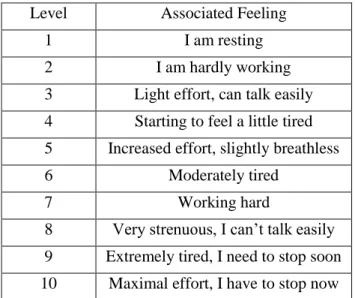
student email system at the student investigator’s university. A modified Borg’s category-ratio RPE
scale was used for all RPE recordings (Table1). The subjects’ center-based exercise logs, which were
used to record cardio-exercise duration (time), HR (bpm) and RPE, are property of the cardiac
rehabilitation program.
Table 1. Modified category-ratio RPE scale (Borg, 1982). Level Associated Feeling
1 I am resting
2 I am hardly working
3 Light effort, can talk easily 4 Starting to feel a little tired 5 Increased effort, slightly breathless
6 Moderately tired
7 Working hard
26 Procedures
Measuring Adherence Rates
For this study, adherence was defined as the proportion of sessions that a subject attended out
of the number of sessions available to them. All subjects were expected to attend the cardiac
rehabilitation program sessions three days per week, for a total of 36 sessions during the 12-week
intervention period. Adherence rate was determined by reviewing the attendance records for the
12-week intervention period for each subject at the cardiac rehabilitation program.
Measuring Compliance Rates
As part of the cardiac rehabilitation program, all subjects were given a specific exercise
prescription before beginning any cardiac rehabilitation sessions. During the cardiovascular portion of
the exercise sessions, subjects were prescribed to exercise for 30 minutes at an RPE of 3-7 (using the
1-10 RPE category-ratio scale). Subjects were prescribed a progressive target HR range of 40% to
85% of the peak heart rate the subject achieved in a pre-screening graded exercise test on a motorized
treadmill. Although this exercise protocol is slightly different than the one recommended in the
literature review by Balady et al (2000), this is the standardized prescription guideline designed by
this particular cardiac rehabilitation program, and is based upon the American College of Sport
Medicine guidelines for clinical exercise prescription in cardiac patients (ACSM, 2010).
As part of the cardiac rehabilitation program, subjects kept exercise logs of the duration
(min), HR (bpm), and RPE score that they attained during the cardiovascular portion of the exercise
sessions (Appendix C). Subjects recorded their HR and RPE halfway through the exercise session (15
minutes) and at the end of the exercise session (30 minutes).Subjects also recorded the total exercise
duration at the end of the exercise session. This study evaluated the subjects’ mean HR values (bpm),
RPE scores, and total exercise duration (min) per each exercise session. The individual session results
27
Compliance was determined by reviewing the subject’s exercise log entries. Based upon each subject’s specific exercise prescription, it was determined if the subject attained the prescribed
duration and ranges for RPE and HR for each exercise session. The subjects were considered
compliant if they attained 80% of the prescribed dosages for duration, RPE range, and HR range.
Compliance rates were also reported as a proportion of sessions that the subject averaged over the
12-week program for the prescribed doses of duration (min), RPE, and HR. If a subject did not attend a
session or did not record required information on the exercise log, it was determined the subject was
non-compliant for that particular session and/or variable.
Statistical Design and Analyses
This was a true randomized prospective experimental design utilizing a convenient subject
sample. The independent variable for this study was email intervention type, and the dependent
variables were exercise session attendance rate and exercise session compliance rates (duration, HR
range, and RPE range). One-way ANOVAs were used to determine descriptive statistics (means,
standard deviations) and between group differences for age, BMI, estimated peak VO2, attendance
and compliance rates. Socioeconomic status (SES) variables were optional self-report descriptive data
and included age, gender, ethnicity, highest level of education attained, and approximate annual
income (see Appendix D). Chi Square Analyses with Cramer’s V adjustment were used to determine
if the subjects were compliant to their prescribed regimens (HR range, RPE range, exercise duration).
The specific data analyses for each research hypothesis are detailed below. Power analyses conducted
with the Primer of Biostatistics 7th Edition software package (Glantz, 2012). All other statistical
analyses were completed using SPSS Grad Pack Version 20.0 (IBM solutions, Durham, NC). For all
28
Research Question One: Will weekly email communication impact patient adherence to cardiac rehabilitation sessions?
Hypothesis 1a: Simply an email, regardless of content, will improve adherence rates in comparison to no email intervention.
Hypothesis 1b: An email that contains precise programmatic information will be more effective in improving adherence than a more generic email.
Statistical Analysis: A simple one-way ANOVA was performed (three intervention
groups x adherence total) with Tukey’s HSD post hoc analysis to determine specific
between group differences.
Research Question Two: Will weekly email communication impact patient compliance to the cardiovascular stimulus period of the exercise session?
Hypothesis 2a: Simply an email, regardless of content, will improve exercise prescription compliance (attainment of prescribed ranges for HR, RPE, and duration) in comparison to no
email intervention.
Hypothesis 2b: An email that contains precise programmatic information will be more effective in improving exercise prescription compliance than a more general email.
Statistical Analysis: Three separate 3 x 2Chi Square Analyses (“test for
independence”) with Cramer’s V adjustment were performed to determine
relationships between group and compliance (yes, complied versus no, did not
comply) specific to each dependent variable (attainment of prescribed HR range,
CHAPTER FOUR Results
Subject Characteristics
Fifteen Caucasian subjects (8 females aged 64.0 + 16.7 years and 7 males aged 64.8 + 11.5
years) volunteered to participate and complete this study. A one-way ANOVA verified that the age
distribution between the three treatment groups was not statistically different (Group 1 = 64.4 + 10.7
years; Group 2 = 61.4 + 9.6 years; Group 3 = 67.4 + 21.4 years; overall F = 0.202; p = 0.804).
Similarly, there were no significant differences between groups at baseline for body mass (overall
F = 0.045; p = 0.956), BMI (overall F = 0.038; p = 0.963), or aerobic fitness (overall F = 0.835;
p = 0.458). Table 2 provides group information on body mass, BMI, and aerobic fitness for both pre-
and post-intervention.
Table 2. Body composition and aerobic fitness of subjects per group (mean + SD).
Informational Email Group 1 (n = 5; 2 males)
Motivational Email Group 2 (n = 5, 3 males)
Control
Group 3 (n = 5, 2 males)
Variable Pre Post Pre Post Pre Post
Body Mass (kg) 179.6 + 63.49 177.4 + 59.63 189.0 + 37.98 188.4 + 36.89 183.1 + 44.51 180.3 + 38.53 BMI (kg/m2)
28.68 + 10.78 28.26 + 9.97 27.34 + 7.08 27.28 + 6.89 27.76 + 4.56 27.36 + 3.70 VO2 Peak (ml/kg/min) 25.83 + 13.59 *
36.05 + 17.42 30.59 + 11.42 40.25 + 12.73 35.14 +8.62 35.77 + 7.22
30
One-way ANOVAs on the difference scores detected no significant differences for either body mass change or BMI change pre- to post-intervention between groups (overall F 0.33;
p 0.72), however; a one-way ANOVA on the difference scores detected a significant difference for
VO2peak change pre- to post-intervention between groups (overall F = 4.36; p = 0.038,Bonferroni
correction for multiple comparisons). Independent samples T-tests found the informational email
group (Group 1) had a significant improvement in VO2 peak in comparison to the control group
(Group 3) (t = 2.781; p = 0.024). No significant difference was found between the informational
email group (Group 1) and the motivational email group (Group 2) (t = 1.688; p = 0.130), or between
the motivational email group (Group 2) and the control group (Group 3) (t = 1.394; p = 0.201).
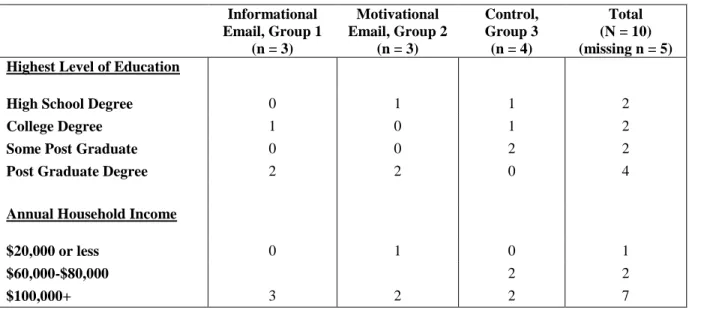
Of the total sample, sixty-seven percent (n=10) of the subjects voluntarily reported their
educational and economic status level. Two completed high school, two completed college, two had
some post graduate training, and four had a post graduate degree. The majority of these subjects had
incomes in excess of $100,000 (n = 7), two had annual incomes between $60-80,000, and one’s
annual income was less than $21,000. Specific group distributions can be seen in Table 3.
Table 3. Frequency table for self-reported educational level and annual income Informational
Email, Group 1 (n = 3)
Motivational Email, Group 2
(n = 3)
Control, Group 3 (n = 4)
Total (N = 10) (missing n = 5) Highest Level of Education
High School Degree 0 1 1 2
College Degree 1 0 1 2
Some Post Graduate 0 0 2 2
Post Graduate Degree 2 2 0 4
Annual Household Income
$20,000 or less 0 1 0 1
$60,000-$80,000 2 2
31
Impact of Email Communication on Attendance Adherence
The following research question and corresponding hypotheses statements were posed:
Research Question One: Will weekly email communication impact patient adherence to
cardiac rehabilitation sessions?
Hypothesis 1a: Simply an email, regardless of content, would improve adherence rates in
comparison to no email intervention.
Hypothesis 1b: An email that contains precise programmatic information would be more
effective in improving adherence than a more generic motivational email.
All subjects completed the 12-week cardiac rehabilitation program, thus there were no
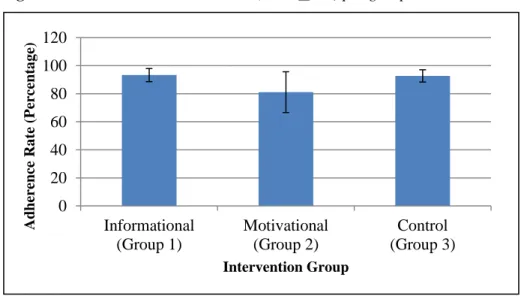
premature drop-outs, thereby eliminating the need for replacement subjects. As shown in Figure 1, no
significant differences were found between intervention groups for attendance adherence (one-way
ANOVA, overall F = 3.161; overall p = 0.079). Although the informational email intervention group
(Group 1) had a higher mean attendance adherence rate (33.6 sessions/36.0 sessions) than the
motivational email intervention group (Group 2, 29.2 sessions/36 sessions), that difference was not
statistically significant (Tukey HSD post hoc analyses, p = 0.098). Attendance adherence for the
no-email control group (Group 3) was similar to the informational no-email group (Group 3, 33.4
sessions/36 sessions). A power analysis demonstrated the power to obtain a significant difference for
this variable to be only 11.8%. In order to obtain a significant difference, an n of at least 33/group
32
Figure 1. Attendance adherence rates (mean+ SD) per group
Impact of Email Communication on Exercise Prescription Compliance
The following research question and corresponding hypotheses statements were posed:
Research Question Two: Will weekly email communication impact patient compliance to
the cardiovascular stimulus period of the exercise session
Hypothesis 2a: Simply an email, regardless of content, would improve exercise prescription
compliance (attainment of prescribed ranges for HR, RPE, and duration) in comparison to no
email intervention.
Descriptive statistics were used to determine mean (+ SD) compliance for HR, RPE, and
duration prescription for all three groups. Values are reported as the mean number of sessions that
prescribed variable ranges were attained, with 36 being 100% session compliance. For HR
prescription compliance, the control group (Group 3) had the highest mean with 33.4 + 2.3 out of 36
sessions, followed by the informational email group (Group 1) with 31.4 + 3.4 out of 36 sessions, and
the motivational email group (Group 2) with 27.6 + 4.6 out of 36 sessions. A power analysis
demonstrated the power to obtain a significant difference for this variable to be only 17.5%. In order
to obtain a significant difference, an n of at least 18/group would be needed, yielding a power of 60%
33
For RPE compliance, the control group had the highest mean with 33 + 2.5 out of 36
sessions, followed by the informational email group with 30.8 + 4.3, and the motivational email
group with 27.0 + 4.0 out of 36 sessions. A power analysis demonstrated the power to obtain a
significant difference for this variable to be only 16%. In order to obtain a significant difference, an n
of at least 18/group would be needed, yielding a power of 60% ability to detect a significant
difference (Glantz, 2012).
The informational email group had the highest mean session compliance for duration with
20.4 + 9.7 out of 36 sessions, followed by the control group with 19.6 + 4.6 out of 36 sessions, and
the motivational email group with 16.0 + 2.4 out of 36 sessions. A power analysis demonstrated the
power to obtain a significant difference for this variable to be 95%. Therefore, an n = 5 should be
sufficient to detect a significant difference (Glantz, 2012).
In summary, across all three variables, the motivational email group (Group 2) was the least
compliant. Descriptive data of the percentage compliance based upon the above means is provided in
Figure 2 for the three treatment groups and the three exercise prescription variables.
Figure 2. Mean (+ SD) compliance percentage rates for HR, RPE, and duration for informational email group, motivational email group, and control group.
0.0
20.0
40.0
60.0
80.0
100.0
120.0
Heart Rate
RPE
Duration
Com
p
li
an
ce
Rat
e
(P
er
ce
n
tage
)
Exercise Prescription Variable
34
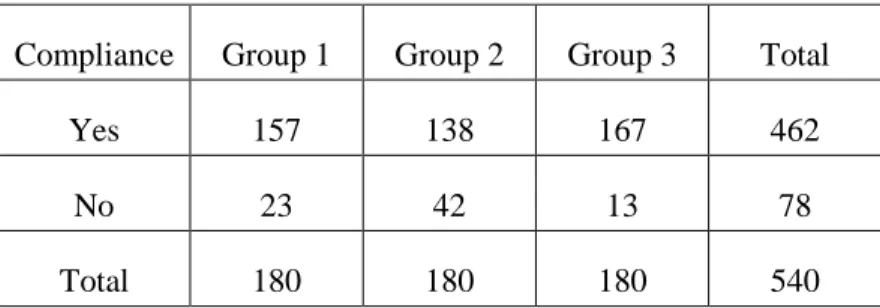
Chi Square tests were run on each dependent variable (HR, RPE, duration) to determine if
there were significant differences between groups for the total number of recordings possible over the
12-week intervention period (i.e. 5 subject recordings/session x 3 sessions/week x 12 weeks = 180
possible recordings per group x 3 groups = 540 total recordings possible).
A 3 x 2 Chi Square test for independence using Cramer’s V adjustment found a significant
difference in HR compliance rates between the three groups 2
(2, n = 540 = 19.5, p < 0.0001. There
was also a significant difference found in the RPE compliance frequencies 2
(2, n = 540) = 19.1, p <
0.0001, and in the duration compliance frequencies 2
(2, n = 540) = 6.1, p = 0.047. Tables 4, 5, and 6
provide the total variable compliance frequencies of all subjects and exercise sessions.
Table 4. Frequency rates of compliance for prescribed HR range.
Compliance Group 1 Group 2 Group 3 Total
Yes 157 138 167 462
No 23 42 13 78
Total 180 180 180 540
Table 5. Frequency rates of compliance for prescribed RPE range.
Compliance Group 1 Group 2 Group 3 Total
Yes 154 135 165 454
No 26 45 15 86
Total 180 180 180 540
Table 6. Frequency rates of compliance for prescribed duration range.
Compliance Group 1 Group 2 Group 3 Total
Yes 102 80 98 280
No 78 100 82 260
35
Hypothesis 2b: An email that contains precise programmatic information would be more
effective in improving exercise prescription compliance than a more general email.
In order to verify that the compliance rates were significantly different between the two email
groups, 2 x 2 Chi Square test for independence with continuity correction were run for each of the
three variables. In each analysis, the informational email (Group 1) compliance was significantly
greater than the motivational email (Group 2) compliance. The results were as follows:
HR Chi Square analysis result: 2
(1, n = 360) = 6.778, p = 0.009
RPE Chi Square analysis result: 2
(1, n = 360) = 6.334, p = 0.012
Duration Chi Square analysis result: 2
(1, n = 360) = 5.378, p = 0.020
In summary, the informational email resulted in significantly greater compliance rates to the
exercise prescription variables of target HR range, RPE range, and duration of exercise. Although
there was no hypothesis proposed to compare the informational email (Group 1) to the control group
(Group 3), due to the similar compliance rates illustrated in Figure 2, three additional 2 x 2 Chi
Square analyses were run to confirm that no significant differences existed between Groups 1 and 3.
The results were as follows:
HR Chi Square analysis result: 2
(1, n = 360) = 3.086, p = 0.079
RPE Chi Square analysis result: 2
(1, n = 360) = 3.331, p = 0.068
Duration Chi Square analysis result: 2
(1, n = 360) = 0.180, p = 0.671
As can be seen from these Chi Square analyses, the compliance rates for HR, RPE, and
duration were not significantly different between the informational email group and the control group.
CHAPTER FIVE Discussion
The primary purpose of this study was to determine the impact of email communication on
adherence rates and exercise prescription compliance in a cardiac rehabilitation exercise program. A
secondary purpose of this study was to determine if email content is related to adherence rates and
exercise prescription compliance in cardiac patients. No significant difference was found between
attendance adherence rates in the informational email intervention group, motivational email
intervention group, and the control group (p = 0.079). A significant difference was found between
groups for exercise prescription compliance (overall p value < 0.008) for all variables (i.e. attainment
of prescribed HR range, RPE range, and duration). The following discussion focuses on the
aforementioned results followed by a review of limitations in this study.
Impact of Email Communication on Attendance Adherence
The present study found that email intervention did not significantly increase attendance
adherence to the 12-week cardiac rehabilitation program. It was also determined that an email
intervention with specific programmatic information did not significantly increase attendance
adherence compared to a more generic motivational email. One explanation for why the present study
failed to find a significant difference in attendance adherence between the email intervention groups
and the control group is that all groups reported relatively high attendance adherence rates (ranging
from 81.1% to 93.3%) compared to average cardiac rehabilitation program adherence rates of 75% to
37
intrinsically motivated to attend cardiac rehabilitation sessions, lessening the impact of an extrinsic
informational or motivational email on attendance adherence. The pre-intervention VO2peak
measures also suggest that intrinsic motivation could have been a factor in attendance adherence.
Previous studies have shown that a lack of physical activity and lower measures of physical fitness
prior to beginning a cardiac rehabilitation program is a predictor of poor uptake and a barrier to
adherence at cardiac rehabilitation program sessions (Lane et al., 2001). Though there was no
significant difference found between the pre-intervention VO2peak measures of the three treatment
groups, the control group began the program with the highest VO2peak of 35.14 +8.62 ml/kg/min.
This suggests that the control group began the cardiac rehabilitation program with the highest level of
cardiovascular fitness compared to both email intervention groups. With a higher level of physical
fitness, the control group may have been more motivated to exercise, while the lower VO2peaks of
the informational and motivational email groups (25.83 + 13.59 ml/kg/min and 30.59 + 11.42
ml/kg/min, respectively) could have been external factors limiting adherence to the cardiac
rehabilitation program. Subject comorbidities could have also limited adherence rates independent
from the email interventions. Psycho-social and physiological comorbidities have been shown to
effect adherence rates in cardiac rehabilitation patients. Comorbidities that have been shown to have a
negative impact on adherence include age, gender, obesity, smoking, lack of spousal/family support,
and job related factors (Moore et al., 1998; Oldridge, 1991).
Another factor that could explain the failure to find significance in attendance adherence rates
between the informational email group, motivational email group, and control group is the small
sample size of the study. Due to recruitment hardships, the study sample size was reduced from a total
of 30 subjects to 15 subjects, thus having 5 subjects for each group. With a smaller sample size, it is
possible that high variability in the data could have impacted the overall outcomes (Dowell, 2007).
The differences between the informational email group (Group 1) and the motivational email
group (Group 2) provide implications for future research. Even with a small sample size (n = 5 per
38
group approached significance (p = 0.079), suggesting that a study with an adequate sample size
could potentially find a difference in attendance adherence rates between the two different email
intervention groups. This suggests that email content could have an impact on attendance adherence,
but more research with a larger sample population of at least 18 subjects per group would be needed.
Impact of Email Communication on Exercise Prescription Compliance
The present study found that there was a significant difference between treatment groups and
exercise prescription compliance. As noted in the results, the compliance rates to the prescribed HR
range, RPE range, and duration during the cardiac rehabilitation program exercise sessions was found
to be significantly different between treatment groups. However, the mean percentage of compliance
suggests that this significance may be due to confounding factors and not the email intervention per
se. As shown in Figure 2, the control group (which received no emails throughout the 12-week
intervention) had the highest rates of HR prescription compliance at 92.8% and the highest rates of
RPE prescription compliance at 91.7%, whereas the informational email intervention group had the
highest rates of duration prescription compliance with 56.79%. A 2 x 2 Chi Square analysis showed
that none of the variables were significantly different between the informational email group and the
control group. Similar to the results with attendance adherence, an explanation for these findings
could be that the control group was more intrinsically motivated to adhere and comply with the
cardiac rehabilitation program due to being more physically fit before beginning the cardiac
rehabilitation program. Also, other barriers to physical activity that are beyond the control of the
subject could have affected compliance rates. Common barriers to physical activity include: lack of
transportation, conflicts with work schedules, unforeseen illness or injury, limited insurance coverage,
and lack of social support (Dishman, 1994). All of these factors can contribute to limited compliance
39
Also, a type II error cannot be ruled out. As suggested in the results, larger sample sizes are
needed for the majority of the variables in order to make sure that the null hypothesis was indeed true
and not due to a lack of power from insufficient subject numbers.
Focusing solely on the email intervention groups, the findings suggest that email content may
have a positive association with exercise prescription compliance. A significant difference was found
between the informational email group compliance frequencies and the motivational email group
compliance frequencies. The mean compliance percentage rates support the notion that exercise
compliance may be related to email content, given that the informational email group had at least
10% higher prescription compliance rates for all three exercise variables than did the motivational
email group. This suggests that if emails are used, weekly emails with precise information about the
cardiac rehabilitation program and exercise prescription reminders could be more effective in
motivating subjects to attain prescribed values compared to a more generic motivational email. That
being said, it is unclear if an email is necessary at all since there were no significant differences
between the no-email control group and the informational email group. Therefore, future research
needs to replicate this study with larger sample sizes for all three groups in order to: 1) discern if email correspondence is efficient use of staff members’ time in terms of improving adherence and
compliance to the exercise prescription and, 2) better discern if email content has a significant impact
on improving exercise adherence and prescription compliance rates to HR, RPE, and duration
recommendations in a cardiac rehabilitation program.
Limitations
The present study had a few limitations that need to be acknowledged. All exercise logs
(attained HR, RPE, and duration) from the cardiac rehabilitation program sessions were self-reported
40
the actual measures attained (Lichtman et al., 1992).To help counteract this, the exercise physiologists
and nurses at the cardiac rehabilitation program helped the subjects obtain an accurate HR, and
assisted subjects with filling out the exercise logs with the correct attained RPE and duration. This
may have helped to diminish the inaccuracy of the self-reported exercise logs, but cannot eliminate
this confounding factor.
This study was limited by the assumption that the subjects in the email communication
groups read the weekly emails. To improve compliance for reading emails, all email notifications
were sent out before noon on Sunday, a day which may be less hectic and allowed patients to check
their emails as they prepared for the upcoming week. Automated delivery receipts were attached to all
emails to ensure that the emails were received by all subjects in the email intervention groups, but
there is no indication as to if the emails were actually read by the subjects.
Another limiting factor in the present study is the lack of socioeconomic diversity in the
composition of the groups. Previous studies have shown that lower levels of education and lower
annual household income are indicators of lower attendance and higher dropout rates in cardiac
rehabilitation patients (Cooper et al., 2002). Of the 10 subjects (67% of total subjects) that completed
the optional socioeconomic status questionnaire, 8 of them had completed a college degree or higher.
Similarly, 7 out of the 10 subjects that completed the questionnaire reported an annual household
income of $100,000 or more. Both of these variables suggest that subjects were more educated and
had higher annual household incomes, which traditionally correlate with greater attendance rates.
This could diminish the effect of an informational or motivational email on adherence and
compliance rates because subjects may be more intrinsically motivated to attend cardiac rehabilitation
sessions based on their socioeconomic status. Future studies focusing on demographics (e.g. lower
educational levels, lower annual household incomes) are needed to determine if similar results would
be obtained for both adherence rates and compliance to the exercise prescription.
CHAPTER SIX Conclusion
Summary
The purpose of this study was to determine the impact of email communication on adherence
rates and exercise prescription compliance in a cardiac rehabilitation exercise program. A secondary
purpose of this study was to determine if email content is related to adherence rates and exercise
prescription compliance (attainment of prescribed HR range, RPE range, and duration) in cardiac
patients. Attendance records and exercise logs from a cardiac rehabilitation program were analyzed to
determine if an email intervention program focusing on specific exercise goals would be effective in
increasing adherence and prescription compliance rates in comparison to a motivational email or no
email (standard program protocol).
This study did not find evidence that an email intervention significantly improved attendance
adherence in a cardiac rehabilitation program. Both email intervention groups and the control (no
email) group reported relatively high attendance adherence rates compared to normative data of
cardiac rehabilitation program attendance, but no significant differences were found between the three
groups. Similarly, the study did not find evidence that email content significantly improved
attendance adherence in a cardiac rehabilitation program.
This study did not find evidence that exercise prescription compliance was associated with
treatment group (informational email, motivational email, and control), as the highest compliance
rates were found in the control group and not the email groups. However, in comparison to the
42
better exercise prescription compliance for all three prescription variables (HR, RPE, and duration).
This suggests that if an email is to be used, an email containing precise information about cardiac
rehabilitation exercise prescription may be more effective in improving exercise prescription
compliance than a more generic motivational email.
Conclusions
Based on the results of the present study, the following research questions and hypotheses
were addressed:
Research Question One: Will weekly email communication impact patient adherence to cardiac rehabilitation sessions?
Hypothesis 1a: Simply an email, regardless of content, will improve adherence rates in comparison to no email intervention.
This hypothesis was rejected because there were no significant differences in attendance
adherence rates between the informational email group, motivational email group, and control group.
Hypothesis 1b: An email that contains precise programmatic information will be more effective in improving adherence than a more generic email.
This hypothesis was rejected because there was no significant difference in attendance
adherence rates between the informational email group and the motivational email group.
43
Hypothesis 2a: Simply an email, regardless of content, will improve exercise prescription compliance (attainment of prescribed ranges for HR, RPE, and cardio-exercise duration) in
comparison to no email intervention.
This hypothesis was rejected because the control (no email intervention) group had the
highest overall levels of exercise prescription compliance.
Hypothesis 2b: An email that contains precise programmatic information will be more effective in improving exercise prescription compliance than a more general email.
This hypothesis was accepted because the informational email group that received emails
with precise programmatic information had significantly higher compliance rates for all prescribed
variables compared to the motivational email group that received more generic emails.
Practical Application and Suggestions for Future Research
To the knowledge of the investigator, this study was a novel approach to examining the
effects of email communication and email content on adherence and compliance in a cardiac
rehabilitation program. The results of this study suggest that future research is warranted to further
explore the use of email interventions in cardiac rehabilitation programs. Though the current study
had no significant findings on the impact of email intervention on attendance adherence rates, the
differences in attendance adherence rates between the informational email group and the motivational
email group approached statistical significance. This suggests that if emails are used, informational
emails may be more effective in improving attendance adherence rates. Also, the significant
association between email intervention group and exercise prescription compliance suggests that
programmatic informational emails could be more beneficial in motivating cardiac rehabilitation
patients to comply with prescribed exercise protocols. Thus, if emails are to be used, precise