DECENTRALIZATION AND THE WELFARE STATE:
TERRITORIAL DISPARITIES, REGIONAL GOVERNMENTS AND POLITICAL PARTIES
Hanna Kleider
A dissertation submitted to the faculty at the University of North Carolina at Chapel Hill in partial fulfillment of the requirements for the degree of Doctor of Philosophy in the
Department of Political Science.
Chapel Hill 2014
Approved by: John D. Stephens
! ! ! ! ! ! ! ! ! ! ! ! ! ! ! ! ! ! ! ! ©!2014! Hanna Kleider ALL RIGHTS RESERVED
ABSTRACT
Hanna Kleider: Decentralization and the Welfare State: Territorial Disparities, Regional Governments and Political Parties
(Under the direction of John D. Stephens)
This dissertation analyzes decentralization processes and their impact on the welfare state. I argue that decentralization processes amplify the impact of regional differences in partisanship and regional socio-economic disparities on social spending. Decentralized systems therefore exhibit significantly higher levels of within-country social program heterogeneity, which in turn can lead to higher levels of territorial inequality. By putting a spotlight on regional social expenditure, this dissertation departs from existing welfare state research, which
predominantly focuses on the effects of decentralization on national social policy-making. Furthermore, the analysis moves beyond the unitary-federal dichotomy of earlier studies by relying on more nuanced measures of decentralization.
Using a three-level model that accounts for the nested structure of regional spending data over time, I demonstrate that the ideological orientation of regional governments has the most consistent effect on regional social program generosity. Left-leaning regional governments tend to pursue more generous social programs than right-leaning governments. This finding
contradicts earlier accounts of regional policy-making that have described it as non-political. My analysis also shows that context factors like regional GDP per capita and regional demographic factors strongly impact regional social policy expenditure. Regional social policy choices are however also impacted by the macro-institutional context, in particular by the level and quality of decentralization. Higher levels of decentralization amplify the effects of regional affluence and regional partisanship.
My analysis further shows that decentralization contributes to higher levels of within-country variation in social spending. This contradicts popular accounts of decentralization, which argue that the competitive pressures inherent in decentralized systems force regional
governments to converge on similar and low levels of social spending. I do however find that policy coordination between regional governments counteracts the variation-increasing effect of decentralization. Fiscal equalization schemes seem to reduce within-country variation although their effect is weak and less consistent across countries.
ACKNOWLEDGEMENTS
I would like to thank my dissertation adviser John Stephens as well as my committee members Liesbet Hooghe, Evelyne Huber, Gary Marks and Milada Vachudova for their invaluable insights and support. Additionally I would like to thank Arjan Schakel and Andrew Fullerton for commenting on earlier versions of this project and for their methodological advice.
The data collection for this dissertation has been a long, sometimes difficult but always interesting undertaking. I benefited greatly from the support of my colleagues Sandra Chapman-Osterkatz and Davide Vampa and from the help of staff at national statistics offices and archives. Among them, special thanks go to Claude Vaillancourt at Statistics Canada, Günter Hinkes at Statistics Germany, Anders Norrlid from RKA Sweden, and Robert Willhide at the U.S. Census Bureau. I would also like to thank David Brady for hosting me at the Social Science Research Center in Berlin during my field research. For generous funding throughout my doctoral research, I am indebted to the Center for European Studies at UNC Chapel Hill, the UNC graduate school and the Uhlman endowment.
My deepest gratitude goes to my parents who, despite hoping their daughter would
! !
TABLE OF CONTENTS
!LIST OF TABLES ... VIII! LIST OF FIGURES ... IX!
I. INTRODUCTION ... 1!
2. THEORETICAL FRAMEWORK AND METHODOLOGICAL APPROACH ... 6!
Review of main theories ... 7!
Theoretical framework ... 14!
Methodological approach ... 22!
3. REGIONAL SOCIAL EXPENDITURE: VARIATION OVER TIME AND ACROSS COUNTRIES ... 26!
The role of regional governments in social policy-making ... 26!
Social welfare programs ... 32!
Education ... 33!
Healthcare ... 35!
Regional spending data ... 36!
Trends in regional social spending over time ... 38!
Conclusion ... 47!
4. PUTTING A SPOTLIGHT ON REGIONAL GOVERNMENTS: EXPLAINING REGIONAL SOCIAL POLICY GENEROSITY... 49!
Hypotheses ... 49!
Results ... 62!
Conclusion ... 77!
5. TERRITORIAL INEQUALITIES: EXPLAINING LEVELS OF SOCIAL PROGRAM HETEROGENEITY OVER TIME AND ACROSS COUNTRIES ... 79!
Hypotheses ... 80!
Operationalization ... 86!
Model and results ... 94!
Conclusion ... 102!
6. A QUALITATIVE COMPARATIVE ANALYSIS OF SOCIAL PROGRAM HETEROGENEITY ... 103!
Three types of decentralized systems ... 103!
Decentralization and policy coordination ... 109!
Historical origins of policy coordination mechanisms ... 131!
Conclusion ... 134!
7. CONCLUSION ... 137!
LIST OF TABLES
Table 1: Variable Definitions and Sources ... 59!
Table 2: Determinants of regional spending on social welfare, 1990-2010 ... 63!
Table 3: Determinants of regional spending on education, 1990-2010 ... 69!
Table 4: Determinants of regional healthcare spending, 1990-2010 ... 74!
Table 5: Variable Definitions and Sources ... 90!
Table 6: Determinants of within-country variation in spending on social welfare, education, and healthcare ... 98!
Table 7: Self-rule and shared-rule ... 106!
LIST OF FIGURES
!!
Figure 1: Theoretical Model ... 19!
Figure 2: Average regional spending on social welfare ... 40!
Figure 3: Average regional spending on education ... 41!
Figure 4: Average regional spending on healthcare ... 42!
Figure 5: Variation in regional social welfare spending ... 44!
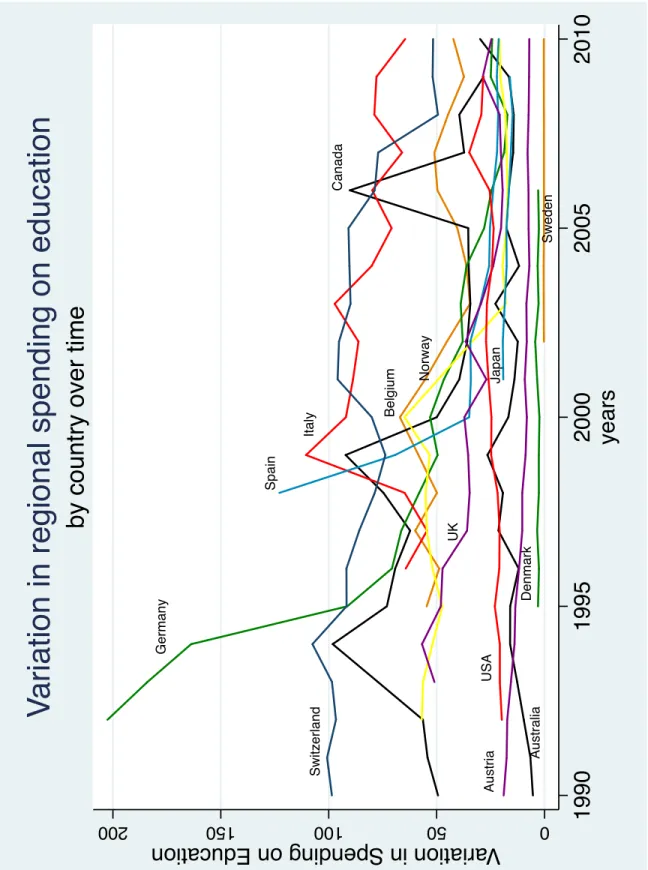
Figure 6: Variation on regional spending on education ... 45!
Figure 7: Variation in regional spending on healthcare ... 46!
Figure 8: Policy space ... 55!
Figure 9: The marginal effect of left government on social welfare spending at different levels of decentralization ... 65!
Figure 10: The marginal effect of regional GDP per capita on social welfare spending at different levels of decentralization ... 66!
Figure 11: Effects of independent variables on regional welfare spending as a % of regional GDP ... 67!
Figure 12: Effects of independent variables on regional social welfare spending per capita ... 68!
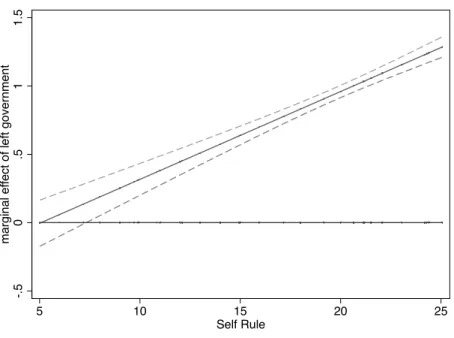
Figure 13: The marginal effect of left government on education spending at different levels of decentralization ... 70!
Figure 14: Effects of independent variables on regional education spending as a % of regional GDP ... 71!
Figure 15: The effects of independent variables on regional education spending per capita ... 72!
Figure 16: The marginal effect of left government on healthcare spending at different levels of decentralization ... 75!
Figure 17: Effects of independent variables on regional healthcare spending as a % of regional GDP ... 76!
Figure 19: Variation in regional social welfare spending by level of decentralization ... 92!
Figure 20: Variation in regional spending on education by level of decentralization ... 92!
Figure 21: Variation on regional healthcare spending by level of decentralization ... 93!
Figure 22: Effect of regional reform in Denmark ... 94!
Figure 23: Effect of regional reform in Italy ... 94!
Figure 24: Marginal effect of fiscal equalization on within-country variation in spending on social welfare ... 99!
Figure 25: Marginal effect of fiscal equalization on within-country variation in spending on education ... 99!
Figure 26: Effect of independent variables on regional variation in social welfare spending .... 101!
Figure 27: Effect of independent variables on regional variation in spending on education ... 101!
I. INTRODUCTION
The question of how changes in demographic and family structures, more flexible labor markets, and globalization processes have affected the welfare state has spurred a large body of research. Numerous studies analyze how these changes have transformed the welfare state and its ability to alleviate economic and social inequality. A development with important
implications for the provision of welfare, which has been largely ignored by the welfare state literature, is the increasing decentralization of social policy authority to regional governments. In the last decades, a majority of countries in the OECD area has experienced an increase in the level of authority granted to regional governments (Hooghe, Marks & Schakel 2010). Regional governments are no longer a phenomenon limited to highly federalized countries but they do in fact represent the norm. Yet, only a handful of studies examine the effect of decentralization on the welfare state, which has prompted Obinger, Leibfried and Castles to call this area of
research an academic “no-man’s land” (Obinger, Leibfried & Castles 2005: 1)
Argument
The existing welfare state research assumes the national level to be the natural unit of analysis when examining the effect of decentralization on the welfare state. Welfare state scholars mostly focus on second legislative chambers that represent regional interests at the national level. They find that second legislative chambers disperse political power and therefore make it more difficult to reach political consensus on social policy expansion (Bonoli 2001; Swank 2001; Huber & Stephens 2001). The welfare state literature’s focus on the national level has prevented it from appreciating the fact that decentralization introduces a set of new actors to the provision of welfare, namely regional governments. My theoretical approach therefore departs from earlier welfare state research on decentralization by focusing on the role of regional governments rather than on the role of national governments.
What complicates the analysis of regional social policies is the fact that regional
In my analysis, I further find that higher levels of decentralization amplify the effects of regional affluence and regional partisanship but not the effect of regional demographic factors. The effect of regional differences in affluence and in ideological orientation on social program generosity becomes more pronounced at higher levels of decentralization. This finding
contradicts the popular convergence hypothesis, which predicts that the tax competition inherent in decentralized systems forces all regional governments to converge on similar and low levels of social expenditure.
The link between decentralization and higher within-country variation in social expenditure is however not direct. My results show that policy coordination between regional governments counteracts the variation-increasing effect of decentralization. In my qualitative analysis I find that policy coordination between lawmakers and between representatives of regional executives provide regional governments with the possibility to find common ground and commit to common policy positions. There is also some tentative evidence that fiscal equalization schemes, that transfer resources from richer to poorer regions, can reduce within-country variation in social programs. Overall however, I find their effect to be weaker and less consistent than the effect of policy coordination. The redistribution created by fiscal equalization schemes might be too small to counteract the centrifugal forces of high levels of decentralization.
This project enriches the previous welfare state literature on decentralization. It shows that decentralization increases within-country heterogeneity in social programs and leads to territorial inequalities in the level and quality of social services. This effect on the welfare state might be equally important or even more important than the relationship between
convergence hypothesis, which suggests that decentralization fuels a downward spiral in regional social service provision.
To test my theoretical framework I examine both quantitative and qualitative evidence. My quantitative analysis is based on a novel dataset that I have specifically compiled for this research project. This dataset presents regional social expenditure data for 14 OECD countries from 1990 to 2010. Countries included in the dataset are Australia, Austria, Belgium, Canada, Denmark, France, Germany, Italy, Japan, Norway, Spain, Sweden, Switzerland, UK, and the US. The 14 countries included in the dataset are all established democracies, which typically form the basis of current welfare state research.!I also examine the institutional characteristics of
decentralized countries in a more qualitative and in-depth manner to assess the plausibility of my observed statistical correlations (Huber & Stephens 2001; Lieberman 2005). Since I am
particularly interested in the degree of within-country heterogeneity, the qualitative analysis hones in on two institutions that have been identified by my quantitative analysis as crucial factors influencing within-country variation in social programs: the level of decentralization and policy coordination.
Outline
the factors that explain regional governments’ social policy choices. My results show that
regional fiscal and demographic challenges have a major impact on regional governments’ social expenditure. I also find that the ideological orientation of the regional government is a consistent predictor of regional social policy generosity. The macro-institutional context – most importantly the level of decentralization – conditions the effect of regional affluence and partisanship but not the effect of regional demographic factors. The more decentralized a country is, the more
regional partisanship and affluence matter for regional social policy. In Chapter 5 I examine the relationship between the level of decentralization on the one hand and within-country
2. THEORETICAL FRAMEWORK AND METHODOLOGICAL
APPROACH
In this chapter I briefly review two theories that help to elucidate the relationship between decentralization and social policies. I first review the welfare state literature to identify factors that determine social policy efforts more generally. I then turn to the decentralization literature, which sheds light on decentralization processes and how they impact social policy-making. In the second part of this chapter I elaborate on my own theoretical framework. What makes my theoretical approach distinctive from other approaches explaining the relationship between decentralization and the welfare state is that I focus on the role of regional governments rather than on the role of the national government. I ask: What is the role of regional governments in social policy-making? What factors influence their social program choices? How is their
behavior moderated by the national context especially by the level and type of decentralization? And lastly, what are the implications of regional governments’ social policy choices for national welfare outcomes? Here I focus on whether decentralization forces regional governments to converge on low levels of social expenditure or whether it increases within-country
heterogeneity in social expenditure. I conclude with a discussion of methodology.
Review of main theories
Welfare State literature
The welfare state literature has yielded a wealth of insights into the causes of welfare state development and into the determinants of social policy effort at the national level. One of the literature’s most important findings is that the expansion of social policy in the post-war era was a by-product of economic development (Wilensky 1975; Pampel & Williamson 1989; Myles & Quadango 2002; Pierson 2001; Swank 2001). High GDP growth during the golden age of the welfare state generated the public revenue necessary to finance the expansion of social policies. The rapid wage increases that accompanied GDP growth meant that workers saw their pay checks increase even as new taxes were levied to finance new and more generous social policies (Myles & Quadango 2002). When GDP growth decreased in the 1980s, the growth of wages and salaries on which public revenues depended also declined, generating serious problems for the welfare state (Swank 2001). This so-called “logic of industrialism” explanation falls short in explaining the tremendous cross-national variation in social policy generosity that exists among countries with very similar post-war economic growth rates.
A new strand of welfare state research emerged in response, which emphasized the centrality of societal and political actors in the post-war expansion of welfare. Proponents of this so-called “power resources” approach attribute cross-national variation in social policy
1979; Huber & Stephens 2001). Today the “power resources” approach has achieved the status of a dominant paradigm within the welfare state literature (Orloff 1993).
While earlier “power resource” scholars predominantly focused on labor union pressures and left-leaning popular sentiments, more recent studies have honed in on the presence of leftist parties in government. Rather than downplaying the importance of societal factors like labor union strength, these studies argue that the presence of left parties in government is crucial for the translation of societal demands into actual policy (Huber & Stephens 2001). Recent studies have also found that the incumbency of Christian Democratic parties leads to higher levels of social spending than the presence of secular conservative or liberal parties, although the social programs promoted by Christian-Democratic parties tend to be less universalistic than those proposed by left-wing political parties (Huber & Stephens 2001; Van Kersbergen 1995).
In addition to economic affluence and left party incumbency need-based factors have been consistently found to affect governments’ social policy effort. The level of unemployment, for example, is a need-based factor that tends to have a very strong impact on social spending (Huber & Stephens 2001). Higher unemployment causes higher expenditures for unemployment compensation and other types of social services for low-income groups. A higher percentage of elderly population has also been found to lead to higher social spending (Pampel & Williamson 1989).
A new strand of welfare state research emerged during the 1980s that focused on the role of political institutions. This strand emphasized the organization and structure of state
institutions and called attention to the fact that political institutions play a crucial role in shaping the social forces identified by the power resources theory (Weir, Orloff & Skocpol 1988;
argued that political institutions not only determine the rules of the game, but also the capacities and financial resources of political actors, thereby facilitating some policy outcomes rather than others (Pierson 1995). The new institutionalism literature placed a particular emphasis on institutions that enhance the dispersion of political power – for example weak party discipline and strong constitutional courts. Scholars argued that institutions, which disperse power, are associated with delayed welfare state development and with slower social policy change.
It is in the context of the new institutionalism debate, that the effect of decentralization on the welfare state attracted more scholarly attention. Decentralization was considered to be one of the main power-dispersing institutions. It was believed to encourage fragmentation and to
complicate the policy-making process thereby delaying the expansion of the welfare state. Comparative empirical research largely supports this argument (Huber & Stephens 2001; Swank 2001; Bonoli 2001). Another group of institutionalist welfare scholars argued the contrary, namely that decentralization might in fact be favorable to policy change. More precisely these scholars called attention to the fact that regional governments are oftentimes the first to experiment with new social policies. Through a process of policy diffusion the national government might then adopt policies that have proven to be successful in a particular region (Maioni 1998; Immergut 1992). More recent research suggest that both arguments need not be considered contradictory since the effect of decentralization on welfare policies is not likely to be consistent across countries and time (Leibfried, Obinger & Castles 2005). Whether the
decentralization has a dampening or an expansionist effect on social policies might depend on other institutional characteristics.
their 2005 book “somewhere between the literatures of political science and social policy, there is an unexplored territory where federalism and the welfare state meet, a no man’s land without even a conceptual map to guide us” (Obinger, Leibfried & Castles 2005: 1). An important downside of the few existing welfare state studies on decentralization is that they assume the national level to be the natural unit of analysis. The only institutional facet of decentralization that receives attention from welfare state scholars is the representation of regional interests in national-law-making through a second legislative chamber, which has the authority to veto social policy legislation proposed by other national level institutions. The welfare state literature’s focus on the national level has prevented it from appreciating the fact that decentralization introduces a set of new actors to the provision of welfare, namely regional governments. In the course of decentralization reforms regional governments receive considerable authority over social programs and become important players in the provision of welfare (Hooghe, Marks & Schakel 2010; Pierson 1995). What is more, the welfare state literature has not yet fully recognized that regional governments with authority over social policy are not a phenomenon limited to federal countries but are in fact the norm in the OECD area.
Decentralization literature
institutional independence from the national government. Recent research also reveals that decentralization has numerous institutional facets, which might not always be connected to each other. For example decentralization involves an increasing institutional independence of regional governments, a larger range of policies for which regional governments are responsible, regional governments’ capacity to tax and lastly the extent to which regional legislatures and executives are elected by the region’s citizens rather than being appointed by national governments
(Hooghe, Marks & Schakel 2010). These four aspects are considered crucial for a region’s degree of self-rule, which is a region’s capacity to rule its own territory (Hooghe, Marks & Schakel 2010). But decentralization also involves another dimension, namely the shared-rule dimension, which is the degree to which regional governments can “co-determine the exercise of authority for the country as a whole” (Hooghe, Marks & Schakel 2010: 6). Although both self-rule and shared-self-rule are key dimensions of decentralization, they do not always need to go together (Elazar 1987).
Most empirical research in political science has tended to focus on the causes of
decentralization rather than its consequences, although some scholars have analyzed the effect of decentralization on democratic quality, arguing that in decentralized systems more people are inclined to engage in political activities (Montero & Samuels 2004; Diamond & Tsalik 1999; Eaton 2001; Samuels & Mainwaring 2004). A few studies also examine the conflict-reducing impact of decentralization in large multi-ethnic societies.
empirical testing. Fiscal decentralization scholars believe cross-regional competition to be the most important trait of decentralized systems. This cross-regional competition results from the fact that regional governments in a decentralized system have to deal with the mobility of households and businesses. Both households and businesses can “vote with their feet” and move into another region if they are unhappy with a regional government’s policies (Rodden 2006). Faced with this mobility and wanting to keep residents and businesses as sources of tax revenue, regional governments are competing with each other.
The competition-enhancing effect of decentralization might have fundamental implications for the welfare state. Pierson was the first to recognize the relevance of this literature for welfare state research in his 1995 article “Fragmented Welfare States: federal institutions and the development of social policy” (Pierson 1995). One of the potential
consequences of this cross-regional competition for the welfare state is that it might lead to less social policy expenditure (Weingast 1995; Brennan & Buchanan 1980; Persson & Tabellini 1994, 1996). Competition between regions, so the argument, incentivizes regional governments in decentralized systems to lower their taxes and to avoid spending sprees, since “only those restrictions that citizens are willing to pay for will survive” (Weingast 1995: 5). Faced with a common pressure to reduce taxes, regional governments will converge on similar and low levels of public spending, which might eventually lead to an under-provision of social services. Pierson suggested “In extreme scenarios, competitive deregulation in a decentralized system could fuel a downward spiral in social provision, eventually producing very rudimentary ‘lowest common denominator’ social policies” (Pierson 1995: 452).
public spending levels (Blöchliger & Pinero-Campo 2011; Brueckner 2004; Tiebout 1956). Proponents of this strand call attention to the fact that regional governments not only compete for low taxes but may also decide to attract citizens and businesses by providing better quality services. The first one to have argued that sub-national governments also compete on the
spending side is Tiebout (1956). These scholars tend to conceive of residents as consumers who choose the jurisdiction that best approximates their preferences for public goods. Tiebout, for example, thought of the possibility of moving to a different region as an important selection mechanism: “Moving or failing to move replaces the usual market test of willingness to buy a good and reveals the consumer-voter's demand for public goods. Thus each locality has a revenue and expenditure pattern that reflects the desires of its residents.” (Tiebout 1956: 420). These scholars view the resulting within-country variation in the level and quality of public services as mostly positive since it increases citizen’s choices and allows them to choose the jurisdiction that best approximates their preferences. As Oates pointed out: “Some individuals may prefer an expanded and high quality program of public services, while others may want less public output and the accompanying reduced level of taxes” (Oates 1972: 11). Tiebout’s
conjectures generated a large body of theoretical literature (Musgrave 1959; Oates 1972). While Tiebout primarily developed his theory for local governments, many scholars have since also applied it to the regional level (Sorens 2010; Pierson 1995).
A number of fiscal decentralization scholars have built on Tiebout’s theory and
Rodriguez-Pose & Gill 2003). What is more, citizens may not voluntarily select into different jurisdictions based on their preferences. Instead, segregation processes could structure citizens’ relocation patterns. The wealthy might congregate together and try to exclude the poorer population via processes like zoning. The resulting differences in the tax base would cause a vicious circle of richer jurisdictions collecting more revenue and providing more and better services than poorer jurisdictions, which has prompted some authors to argue that
“Decentralization can therefore be the mother of segregation” (Prud’homme 1995: 203). While there has been much theoretical debate about the relationship between
decentralization and public service expenditure, there has been very little empirical research investigating this relationship. It is not clear whether the cross-regional competition induced by decentralization forces regional governments to converge on low levels of public service spending or whether decentralization increases within country variation in public service spending, dividing countries into high tax high service regions and low tax and low service regions. This is not only an empirical puzzle for studies examining decentralization’s impact on the welfare state but it also has important practical implications for citizen’s quality of life. While the first scenario would lead to overall low levels of public service spending the other would increase territorial inequalities within countries.
Theoretical framework
differentiates regional government from national governments is that their social policy choices are subject to the control and oversight of a hierarchically superordinate level of government. One might argue that the European Union represents a third, supranational level, that influences national social policies but with a few notable exceptions the European Union has not
constrained national autonomy in the area of social policy. To analyze regional social policies we therefore also have to consider cross-level interactions between the national level and the
regional level. The theoretical framework that guides my research is a multi-level approach that analyzes regional governments’ social policy choices, how they are moderated by the national institutional context, and how regional choices in turn impact national welfare outcomes.
I expect decentralization to lead to more within-country variation in regional
difficult to identify politics as the missing component in the prevailing literature on decentralization” (Rodden 2003: 8).
To bring politics back in, I conceptualize regional social expenditure as a regional choice process influenced by the ideological orientation of the incumbent regional government, the regional economic context and lastly regional demographic factors. I expect higher levels of decentralization to amplify the effect of regional context on regional social expenditure to the extent that regional social policy choice processes ultimately approximate national level choice processes.
In fact, a number of studies have examined whether the factors that influence national social policy choices also predict regional choices in highly decentralized contexts. These studies have focused on the United States (Winters 1976), Canada (Kellermann 2006), Germany
While these single case studies suggest that the factors which influence regional governments’ social policy choices in highly decentralized countries are similar to the factors that influence national social policy choices, it is not clear whether these findings generalize to a larger set of countries. Perhaps more importantly, the focus on single countries does not allow an analysis of how different macro-institutional contexts condition regional social policy-making. I therefore seek to build on the insights of these single case studies and join them with a theory on how the macro-institutional context shapes regional level social policy-making.
There are several ways in which the macro-institutional context – most importantly the level of decentralization – interacts with regional policy-making. First, at higher levels of decentralization regional governments tend to receive less grants from national governments, which means that they have to rely on their own tax revenue (Hooghe, Marks & Schakel 2010). With regional governments being more dependent on their own tax revenue, a region’s affluence is likely to have a stronger and more direct effect on regional social policy effort.
Second, regional governments are more independent from the national government at higher levels of decentralization and their social policy choices are subject to less oversight and control. The ideological orientation of the regional government should therefore have a stronger effect on regional social policy choices the more decentralized the country is.
Third, the link between a regional government and its voters should be more direct in highly decentralized countries. In less decentralized contexts, national government appointees will sometimes oversee the work of elected regional governments. By keeping this political influence over regional policy-making, national governments can constrain the decision-making leeway of the regional government and thereby reduce the effect of regional ideological
Lastly, higher levels of decentralization could also moderate the effect of regional need-based factors, such as higher regional unemployment or a higher proportion of elderly
population. Yet, even in very centralized countries social expenditure is not uniform across the national territory and adjusts to regional differences in demand. National governments will disburse more funds in regions with a higher numbers of social welfare dependents than in regions with a smaller proportion of dependents. Therefore it is not clear whether need-based factors have a stronger effect at higher levels of decentralization.
If regional-level contextual factors, like regional affluence and regional government partisanship have a stronger impact on regional social policy choices at higher levels of decentralization, as my theoretical framework suggests, I would expect there to be a higher degree of social program heterogeneity in decentralized countries.
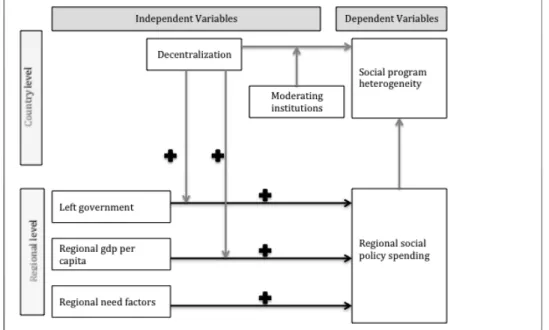
The figure below visualizes the hypothesized relationships derived from my theoretical framework. Building on the insights from single case studies in highly decentralized countries I expect left-party incumbency at the regional level, a higher regional GDP per capita and a higher regional demand for welfare to be positively associated with regional social expenditure. I further assume that the level of decentralization conditions the effect of left party incumbency and regional GDP per capita but not the effect of regional need-based factors. Left party incumbency and regional GDP per capita should have a more pronounced effect on regional social expenditure at higher levels of decentralization. The fact that regional context factors influence regional social expenditure at higher levels of decentralization is likely to lead to more social program heterogeneity within countries. We should therefore not only observe a
within-country variation in social programs. This prediction contradicts the convergence
hypothesis, which expects regional governments to converge on similar and low levels of social expenditure at higher levels of decentralization.
! Figure 1: Theoretical Model
Even assuming that decentralization will lead to increased within country variation, the link between decentralized systems and increasing within-country variation is not likely to be direct. Other institutions, like for example fiscal equalization systems, can counteract the variation-increasing effects of decentralization. The figure above refers to these institutions as moderating institutions since they condition the effect of decentralization. It is equally likely that these institutions have an independent additive effect on the level of within-country variation. The decentralization literature points to a large number of institutions that may affect within-country variation. Here I theorize the effect of three institutions: policy coordination
Decentralized systems have generally been thought to foster coordination and consensus in ethnically heterogeneous societies by allowing sub-state communities a certain degree of self-determination and thereby avoiding violent conflict (Lijphart 1999; Stepan 1999; Gurr 2000; Bermeo 2002). Some scholars have, however, pointed out that decentralized structures alone might not be sufficient in generating consensus and may in fact be counter-productive in that they generate demands for secession (Norris 2008; Nordlinger 1972). These scholars argued that decentralized systems need to be accompanied by additional institutions in order to achieve the desired consensus effect. Elazar for example pointed out that the constituent units’ desire for self-determination has to be balanced by power-sharing institutions that commit all units to the maintenance of the system and guarantee peace and stability (Elazar 1994). He termed this latter dimension the shared-rule dimension.
Lijphart suggested a number of mechanisms that would commit the constituent units of a decentralized system to the maintenance of the system and help to establish consociational relationships (Lijphart 1969). However, as Andeweg points out, the consociational mechanisms described by Lijphart remain vague and mostly informal (Andeweg 2000). Building on Elazar’s shared-rule dimension, Hooghe, Marks and Schakel identify mechanisms through which regional governments can be committed to the maintenance of the system and involved in the governance of a shared political sphere (Hooghe, Marks and Schakel 2010). They identify four institutions that are crucial to shared-rule: shared law-making, shared policy-making at the executive level, the consultation of regional governments over the distribution of national tax revenue and lastly the ability of regional governments to participate in decisions over constitutional change.
law-making refers to the extent to which regional governments participate in national law-law-making through the second legislative chamber. The more powerful the second legislative chamber is and the more directly regional governments are represented in this chamber, the stronger the impact that regional governments can have over national legislation. I conceptualize the process of shared law-making as crucial in helping regional governments define common policy
positions vis-à-vis the national government.
Shared policy-making describes intergovernmental meetings between the national government and all of the regional governments. The more routinized these meetings and the more legally binding their decisions, the higher the commitment to shared rule. Germany for example is a country with very routinized meetings that yield authoritative decisions.
Switzerland, on the other hand, is a country where these meetings are less routinized and where they almost never yield binding decisions (Hooghe, Marks & Schakel 2010). I expect shared policy-making to commit the constituent units of a federal system to common and legally binding decisions. Both shared law-making and shared policy-making are likely to decrease within-country variation in social services.
A second institution that could mediate the effect of decentralization is fiscal
equalization. Fiscal equalization schemes transfer fiscal resources from richer to poorer regions. By transferring fiscal resources, they offset the effect of differences in wealth on the provision of social services (Blöchliger et al. 2007). In other words, fiscal equalization schemes allow
incorporated into a constitution that mandates the “uniformity of living conditions”. In the United States, by contrast, fiscal equalization is limited (Pierson 1995).
The organization of political parties within a country might be a third institution that could influence the within-country variation in social spending (Gibson 2004; Mainwaring & Samuels 2004; Wibbels 2005). As Riker and Ronald point out “The one agency that might be expected to harmonize the policies of central and constituent governments is a political party.” (Riker & Shaps 1957: 277). Rather than providing a legal framework for coordination, a political party can set important political incentives for coordination. In a centralized party system voters tend to focus on the national party label and the value of national level co-partisans when
electing regional-level legislators, which creates strong electoral externalities. In other words, the electoral success of regional-level legislators is driven by the value of the national party. This gives central party leaders an important leverage and allows them to commit regional
government leaders to preferred policies. The leverage of the party leadership is enhanced if it has other tools with which it can incentivize regional-level legislators to support national policy positions – nominations, party lists, committee assignments, endorsements, or the allocation of campaign funds (Rodden 2006). It is therefore likely that a centralized party system could reduce the within country variation in social services.
Methodological approach
Countries included in the dataset are Australia, Austria, Belgium, Canada, Denmark, France, Germany, Italy, Japan, Norway, Spain, Sweden, Switzerland, UK, US.1 The 14 countries
included in the dataset are all established democracies, which typically form the basis of welfare state research. Countries included in the sample further must have a regional level that is not hierarchically subordinate to the national level government, regional assemblies and regional executives must be elected by the region’s citizens, and thirdly, regional governments must have some authority over social policies.
I examine three different policy areas: education, healthcare and social welfare (minimum income schemes and personal social services). Social policies that are primarily determined at the national level, like sickness and unemployment insurance, pension payments and healthcare are not included. Regional spending on each of these three policy areas serves as a proxy for regional social policy generosity. The focus on regional social spending variables as a proxy for regional social policy effort might be criticized since spending variables are sensitive to
economic ups and downs. Yet, while there is a clear trend toward collecting more and better data below the country level, subnational indicators that can gauge the generosity via replacement rates (Scruggs 2004) do not exist.
Two different dependent variables are examined in the quantitative chapters: the social policy choice of individual regional governments and cross-regional variation in social policy choices. The units of analysis are different for the two dependent variables. The unit of analysis for analyzing regional social policy choices is region-years. The unit of analysis for examining cross-regional variation is country-years.
!!!!!!!!!!!!!!!!!!!!!!!!!!!!!!!!!!!!!!!!!!!!!!!!!!!!!!!!
I also examine the institutional characteristics of decentralized countries in a more qualitative and in-depth manner. The recent mixed-methods debate in political science yielded two main suggestions on how best to combine large-N statistical analysis and qualitative analysis. One suggestion is to use case studies to generate theoretical insights and measurement strategies, which could then serve as inputs for large-N analyses. The other suggestion is to use qualitative analyses to assess the plausibility of observed statistical correlations (Huber & Stephens 2001; Lieberman 2005). For the purpose of this project I opt for the latter strategy. Since I am particularly interested in the degree of within-country heterogeneity, the qualitative analysis hones in on two institutions that have been identified by my quantitative analysis as crucial factors influencing within-country variation in social programs: the level of
decentralization and policy coordination mechanisms.
The qualitative analysis therefore examines multiple combinations of independent variables and qualifies as what Gerring refers to as typological theorizing: “Where multiple variables are under consideration, the logic of diverse-case analysis rests upon the logic of typological theorizing - where different combinations of variables are assumed to have effects on an outcome that vary across types” (Gerring 2008a: 651). The categorization into three groups of different institutional combinations helps me to abstract from individual country
3. REGIONAL SOCIAL EXPENDITURE: VARIATION OVER TIME AND
ACROSS COUNTRIES
I now turn to the role that regional governments play in social policy-making. This chapter aims to provide a better understanding of the social programs for which regional governments are responsible. I will describe the means by which regional governments shape social policies and their funding responsibilities before delving deeper into each of the three policy areas: social welfare policies, education and healthcare. After having portrayed regional governments’ role in regional social policy-making, I introduce my regional social spending dataset and give some insights into trends and developments in regional social spending over the last 20 years.
The role of regional governments in social policy-making
Regional governments tend to play a minor role in the provision of cash transfers. Cash transfers - such as unemployment insurance, pensions, or sickness insurance - are oftentimes disbursed by regional governments, but they rarely have the authority to decide over any of transfer details, like the amount, the duration during which the benefit is received or the
qualifying conditions. These program details are primarily decided at the national level. Transfer payments also tend to be financed by national tax revenue and not by regional governments.
minimum income schemes were also regionally managed until they where replaced by national schemes in 2010 (Bundesverfassungsgericht 2010; Bundesministerium für Arbeit, Soziales, und Konsumentenschutz 2010). As a result of regional legislation substantial within-country
differences have emerged in these countries regarding the amount, length and qualifying conditions. Another cash transfer that is sometimes subject to regional legislation is health insurance. In Switzerland, for example, individual cantons provide tax-financed subsidies directly to those unable to afford basic health insurance premiums. The cost of health insurance therefore varies substantially between cantons (Herzlinger & Parsa-Parsi 2004).
In all of the above countries, however, regional cash transfers only account for a relatively small share of regional governments’ social policy efforts. For example regional expenditure on minimum income schemes in Spain accounts for only 0.3 per cent of the regional budget (Arriba & Ibáñez 2002). This is partly due to the fact that regional transfer programs like minimum income schemes only target a very small share of the population unlike national transfer programs, such as pension schemes and unemployment insurance.
in-home care and mobility services, but also a variety of services aimed at their integration into society like sheltered workshops. To establish definitional clarity I will refer to these personal social services as social welfare services. The term social services will be used to refer to all three services: social welfare services, education and healthcare. The welfare state literature’s lack of attention to social services might also explain why they have overlooked regional governments as important actors in the provision of welfare.
In contrast to cash transfers social services do not tend to have a fixed set of program characteristics. In fact, they involve multiple areas of regulation like staff, facilities, training and equipment, all of which have to be adapted to the regional context. Social services also benefit from a more localized provision than transfer payments that can be administered at the national level (Ostrom & Ostrom 1971).
Only very rarely, however, do regional governments have the exclusive competence over social services. Primarily the Anglo-Saxon federations, especially Canada and the United States, tend to assign both legislative and executive power over a particular social policy area
exclusively to the regional level (Thorlakson 2003). Being in charge of both legislation and implementation gives regional governments great authority over a social policy area but it also opens the door to significant policy variation within a country. Having exclusive legislative power over social programs also involves long-term financial obligations on the side of regional governments. Based on regional legislation residents can derive legal claims to the provision of particular services so that regional governments have to possess the fiscal resources to maintain the level and quality of services they promised.
Thorlakson 2003). For instance, in both countries the national government has the right to a certain degree of co-decision if it subsidizes social services, which are formally assigned to the regional level. The provision of healthcare in Canada for example is formally assigned to the provincial level, but since the national government provides substantial subsidies it is allowed to legislate national minimum standards in the area of healthcare (Bakvis & Brown 2010; Graefe & Bourns 2009).
In most decentralized countries the distribution of responsibilities between the national and the regional level is not clear-cut and legislative competencies tend to be shared both formally and in practice (Thorlakson 2003). There are numerous ways to organize shared
legislative competencies. Legislative authority in a policy area may be formally assigned to both the national and the regional level of government allowing either level to act. In this case most countries observe the rule that national law overrides regional law. The constitution may also provide each level with legislative authority over different aspects of a policy. Or more commonly, the national level is assigned the responsibility for setting national standards and drawing up a framework legislation leaving the regional level to legislate the more specific details of legislation.
tend to shoulder the largest part of the financial burden associated with service provision. Finally, shared competence can also mean that legislative power is exclusively allocated to the national level, leaving regional governments to implement laws (Thorlakson 2003). Although regional governments lack any legislative authority, they can still derive power from implementing social services, especially since they are responsible for funding their provision. Having the financial authority allows regional governments to increase or to decrease their funding for particular social services. The regional budgetary process also involves regional legislatures, which have to approve the budget prepared and proposed by regional governments, or more precisely by the region’s treasury department.
Given the general context of austerity in most OECD countries, the most common way for regional governments to increase spending on social services is to shift resources from one government portfolio to another. Regional governments can however also decide to raise revenues in order to finance increased spending on social services. They can do so by either raising regional taxes or by borrowing on financial markets.
Regional governments’ power to influence social services therefore ranges from
Implementation of regional social services
Although regional governments are responsible for implementing and funding social services in all of the countries discussed here, they rarely provide social services themselves. Depending on the country and region, services are provided by a mix of not-for profit, private or municipal service providers. While regional governments in Anglo-American countries tend to rely on private service providers, the majority of regional governments in Continental Europe depend on a multitude of mostly religious not-for-profit service providers. Especially the
Catholic Church frequently operates schools, hospitals, childcare and elderly care institutions. In the Scandinavian countries, services either tend to be directly provided by regional government agencies or by the municipalities (Anttonen & Sipilä 1996). The precise mix of private, not-for profit, and public providers does however not only depend on the country, but also on the particular regional government and the policy area. For instance, due to Germany’s history most Western German regions rely on religious not-for-profit service providers while most Eastern German regions rely on private providers.
Most commonly regional governments reimburse service providers, no matter whether they are private, not-for-profit or municipal although sometimes-regional governments also pay service providers up front. For example, regional governments reimburse all types of schools - public, not-for-profit or private - for providing education. In some countries regional
governments share funding responsibilities with other actors. In Germany for example regional governments fund the hospital infrastructure, including buildings and equipment. This
staff resources exists in France, where regional governments fund investments into the school infrastructure, while teacher salaries are funded by the national government.
After having described the role regional governments play in social policy-making more generally, I will now turn to regional government involvement in each of the three policy areas: social welfare, education and healthcare.
Social welfare programs
Social welfare targets society’s most vulnerable population groups, including the elderly, youth and children, and people with disabilities. A fourth and more heterogeneous recipient group includes people facing particularly difficult life circumstances. Services targeted at this group may include debtor counseling services, drug addiction counseling or psychological counseling (Naegele, Frerichs, & Reichert 2000)
Regional governments sometimes manage their own social welfare cash transfers in addition to legislating and implementing their own personal welfare services. For example, regional governments in Italy, Spain and Switzerland have exclusive competence over minimum income schemes (Obinger 1999; Marchal, Marx & Van Mechelen 2011).
In most countries, however, regional governments are only responsible for legislating and implementing personal welfare services. Regional governments often share legislative authority over personal welfare services with national governments. A common way of allocating
care services (Naegele, Frerichs, & Reichert 2000). In contrast to the basic level of care services that most regional governments in Germany provide, the Northwestern region of Nordrhein-Westfalen has passed very generous regional legislation for long-term care patients. The Nordrhein-Westfalen law, Wohn-und Teilhabegesetz NRW, guarantees each in-home care or nursing care resident the right to a self-determined life; the right to participate to every degree possible in social life; and lastly the right to die in dignity. All care providers in Nordrhein-Westfalen, whether public or private, are thus obligated to make the necessary staffing and infrastructure arrangements in order to guarantee care patients’ right in all of the above categories (Kassen et al. 2011).
Even when regional governments do not have any legislative authority over social
welfare programs they still shape the provision of social welfare services via their budget bills. In Demark, for example, regional governments are responsible for funding and administering residential homes for children and young people and institutions for people with severe physical or mental disabilities (Danish Ministry of Interior 2002).
Education
In a number of countries – Belgium, Canada, Germany and Switzerland – regional governments have exclusive jurisdiction over educational policies. The German Länder governments, for example, have exclusive authority over schools, vocational schools, adult education and to a lesser degree over universities (Erk 2003; Wolf 2008). The German
constitution not only grants regional governments exclusive legislative and executive authority over the educational realm, it also explicitly prohibits any type of national government
teachers’ and university professors’ pay, but also about the length of schooling and the type of educational system. Students can for instance obtain a high school diploma after 12 years in some regions while other regions require 13 years of schooling (Kultusministerkonferenz 2014). Some regions still maintain the division into three different types of educational institutions - Gymnasium, Realschule, and Hauptschule – while others promote one educational institution Gesamtschule (Kultusministerkonferenz 2014).
The high degree of regional autonomy over educational policy in Germany was a reaction to the totalitarian take-over of the education system under the Nazi regime (Erk 2003). The considerable degree of regional diversity that had existed under the Weimar Republic, was brought to an end in 1934 when the first law of “forcible-cooperation” (Gleichschaltung) brought education under the control of the national education ministry with the aim of instilling Nazi ideology and mobilizing the youth for war (Köster et al. 2007). Against the backdrop of this experience, the 1949 constitution constructed regional governments as a bulwark against a totalitarian takeover of public education.
Healthcare
In contrast to the other two policy areas – social welfare and education – the overall degree of regional government autonomy is not a good predictor for regional governments’
responsibilities in the area of healthcare. The way the healthcare system is funded strongly influences how much regional governments are involved in the organization of healthcare. In countries where healthcare is funded by tax revenues – for example in Australia, Canada, Denmark, Italy, Norway, Spain Sweden and the UK - the degree of regional government involvement tends to be higher than in countries where healthcare is insurance-based (Wagstaff et al. 2000; Wagstaff et al. 1999)
In some tax-based systems, like in Denmark and Sweden, regional governments directly foot the bill for the provision of healthcare (Wagstaff 1999). In other countries, funding
responsibilities are divided between the national government and the regional governments. In Canada, for example, the national government subsidizes regional government spending on healthcare (Bakvis & Brown 2010; Graefe & Bourns 2009). In yet a different set of countries, the national government provides regional government with grants to pay for the provision of
healthcare. In the United Kingdom for example none of the regional governments has its own revenues (Hooghe, Marks & Schakel 2010). They all rely on grants by the UK government. Since these grants are, for the most part, not earmarked to specific policy areas, regional
services!were!only!administratively!separate!but!since!1999 each system is politically
accountable to the relevant regional governments. This means that they operate!under!different! management,!rules,!and!political!authority!(National!Audit!Office!2012).!
In contrast to tax-based systems, medical treatments in countries with insurance-based healthcare systems – Austria, Belgium, France, Germany, and Japan, Switzerland and the United States– are either directly paid for by the health-insurance or by patients who are reimbursed after having paid for the medical treatment first. Because health insurances act as an important intermediary, regional governments are comparatively less involved in the organization of healthcare. The Swiss healthcare system is a hybrid system in terms of funding since cantonal governments play an important role in offering tax-financed subsidies directly to those unable to afford basic insurance package premiums. According to the Federal Office of Public Health 32.7 percent of insured individuals require this financial assistance (Herzlinger & Parsa-Parsi 2004)
In insurance-based healthcare systems regional governments are mostly responsible for funding hospital equipment and infrastructure as well as for the long-term planning of hospital demand. In Belgium and Germany, for example, regional governments plan the long-term need for somatic specialties based on demographic projections. Regional governments then decide about their investments into hospital infrastructure and equipment. For example, in regions with an aging population, maternity clinics might be less needed in the future.
Regional spending data
short-term economic ups and downs that may be unrelated to social program generosity. While alternative measures for social policy effort, such as replacement rates are available for national level social policies they do not yet exist at the subnational level.
To my knowledge, the regional social spending dataset I collected is the first cross-national dataset of this sort. It includes data on regional social spending by policy area for 14 OECD countries. Countries included are Australia, Austria, Belgium, Canada, Denmark, France, Germany, Italy, Japan, Norway, Spain, Sweden, Switzerland, UK, US.2 The comparability of regional spending data was simplified by the introduction of the “Classification of the Functions of Government” (COFOG) in 1993.3 The “COFOG” system, which is also used to classify national spending, is a procedure of standardizing the bookkeeping of governments. The system splits government expenditure into 10 functional groups, three of which are social welfare, education and healthcare. Each of these 10 functional groups can be further divided into nine subgroups. Expenditure within each functional group is roughly comparable.
The regional spending data included in the dataset only refers to expenditure that is decided at the regional level. It excludes expenditure that is only disbursed at the regional level but decided at the national level. This means that spending on most social transfer programs, like unemployment insurance schemes, has been extracted from the data.
!!!!!!!!!!!!!!!!!!!!!!!!!!!!!!!!!!!!!!!!!!!!!!!!!!!!!!!!
2 These are fifteen countries but in each spending category there are only 14 countries. There is no data available on regional social welfare expenditure in Sweden and there is no data on regional education and healthcare expenditure in France.
Trends in regional social spending over time
Before examining the determinants of regional social policy choices (Chapter four) and the effects of decentralization on social program heterogeneity within countries (Chapter five), I briefly describe the main trends in regional social spending. I answer a number of important questions. How much do regional governments spend on social welfare programs, education and healthcare? Has regional spending increased over the last 20 years? And, has social program heterogeneity within countries increased over the last few years?
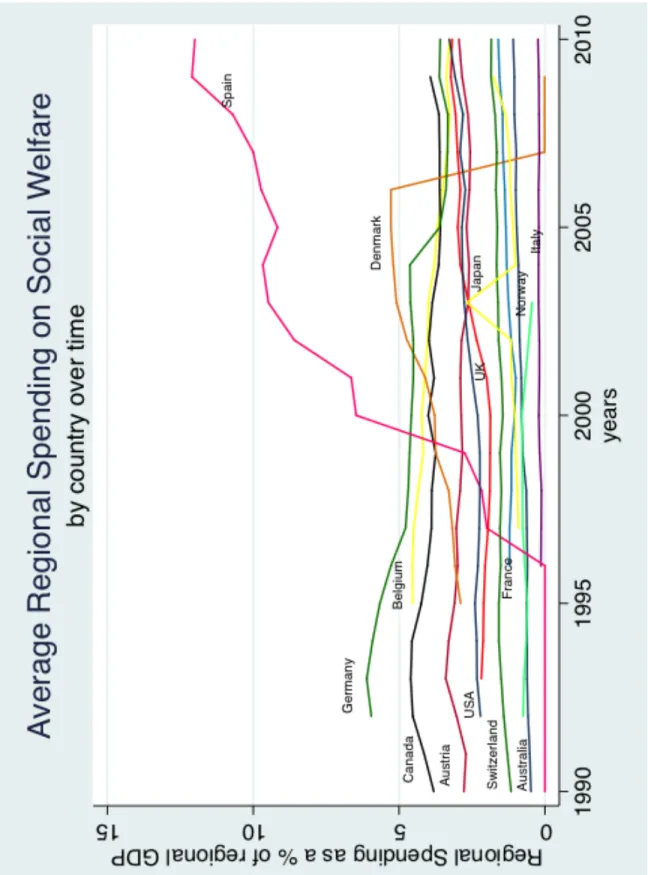
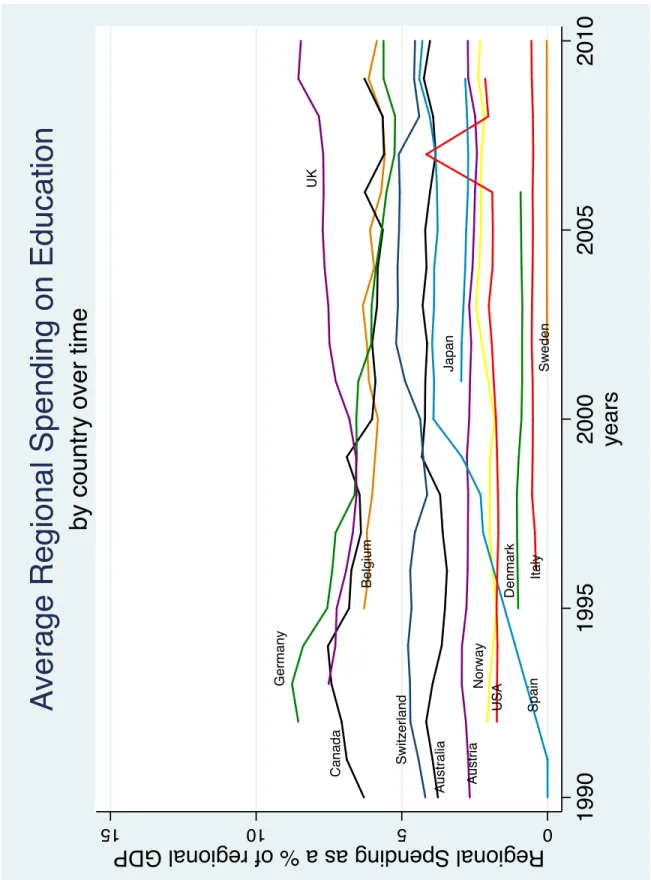
The graphs below show how much the average regional government spends on social welfare, education, and healthcare in a particular country in a given year. To correct for inflation, regional expenditure is presented as a share of regional GDP. Overall regional governments tend to spend more on education and healthcare than on social welfare. The average regional
government expenditure on education is about 3.65 per cent of the regional GDP during the period from 1990 to 2010. Regional spending on education ranges from 8.77 per cent of regional GDP in Germany to 0.4 per cent of regional GDP in Sweden. The average regional government spends 971 International Dollars per capita each year on education. The two regional
governments with the highest education expenditure are the Canadian Northwest Territories (7314 $) and Alaska (3071 $). Their high education expenditure is partly explained by the challenge of maintaining a high quality education system in a very vast but sparsely populated area.
spends 938 International Dollars per capita per year on healthcare. The regional government with the highest per capita spending is again the Northwest Territories in Canada.
! Figure 3: Average regional spending on education
Average regional spending on social welfare and healthcare increased slightly over the period from 1990-2010, whereas the average regional spending on education has decreased slightly over the same period, but the experiences of individual countries differ vastly. For example, regional spending on social welfare has dropped drastically in Denmark as a result of re-centralization reforms. Regional social welfare spending in Spain, by contrast, has increased dramatically. While the educational spending of Germany’s Länder governments has gradually declined over the last couple of years, the Spanish Autonomous Communities now spend more on education then ever before. Regional healthcare spending in the UK has gradually increased from 1990 to 2010 while regional governments in Norway and Germany now spend less on healthcare than they did 20 years ago.
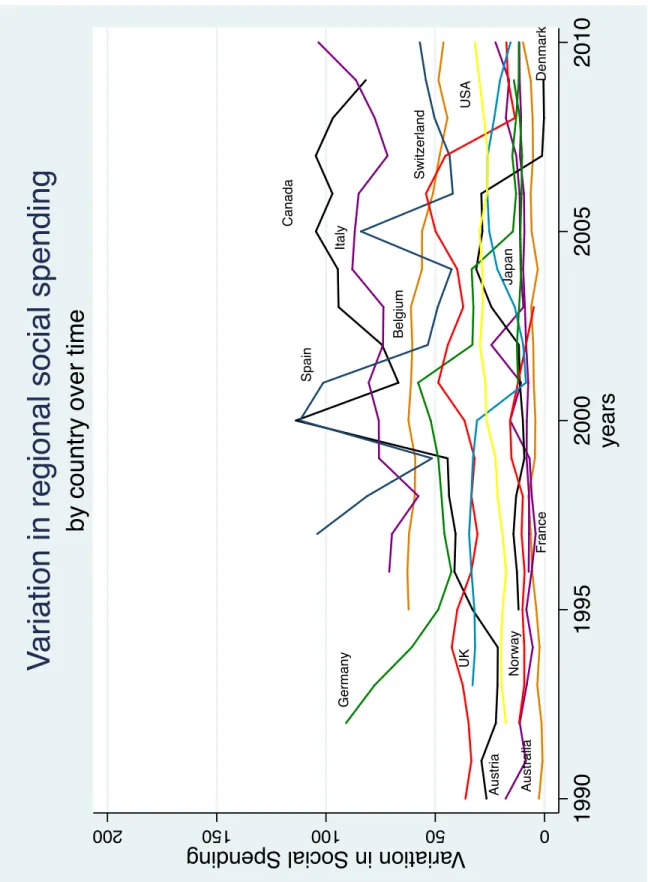
Figure 6: Variation on regional spending on education G e rma n y Sw itze rl a n d Sp a in Italy Canada Au st ri a Au st ra lia U SA D e n ma rk Sw e d e n Ja p a n Be lg iu
m No
In the area of regional spending on social welfare, there has been a slight increase in the within country variation over the last 20 years, while variation in spending on education and healthcare seem to have decreased. Again, there is no unified trend across all countries. In Germany for example, within-country variation in regional spending in all three policy areas peaked in the early 1990s as a result of unification but slowly decreased thereafter. A decreasing trend in within-country variation can also be observed in Denmark and Norway. The
heterogeneity in regional spending on social welfare services declined drastically in Denmark and Norway in the mid 2000s, due to recentralization reforms. In contrast, within-country variation increased in Italy in all but one policy area.
Conclusion
This chapter described the role regional governments play in social policy-making. It also explored some cross-national variation in the degree of regional government involvement in the organization and management of social welfare, education, and healthcare. The descriptive statistics, presented in this chapter, show that there is quite considerable variation in how much regional governments spend on social welfare, education and healthcare. There is no uniform trend toward higher regional spending in any of the there areas. The next chapter will explore in more detail the determinants of regional spending in each of these three areas and how these determinants are conditioned by the macro-institutional context.
4. PUTTING A SPOTLIGHT ON REGIONAL GOVERNMENTS:
EXPLAINING REGIONAL SOCIAL POLICY GENEROSITY
The previous chapter described the role that regional governments play in the legislation and implementation of social policy. In this chapter I look more closely at the factors that influence regional governments’ social policy choices. I seek to explain when regional governments decide on social programs that are more generous than those of other regional governments within the same country. In addition to examining the effect of regional context I also draw attention to the macro-institutional context – namely the level of decentralization – and how it conditions regional social policy-making. This chapter’s goal is to explore how macro-institutional context and regional level factors interact to shape regional social policy.
Hypotheses
decentralized countries like the United States (Winters 1976), Canada (Kellermann 2006), Germany (Potrafke 2006), Switzerland (Feld 2000) and Italy (Vampa 2013). The focus on single countries raises the question whether their findings are generalizable to a broader set of
countries. Regional governments do not only exist in highly decentralized contexts but are in fact fairly ubiquitous. In 23 out of 34 OECD countries, regional governments are directly elected, enjoy some degree of institutional independence from the national government, and have
authority over a number of policy areas. More importantly, however, by only focusing on single countries these studies are unable to examine how different macro-institutional contexts
condition the effect of regional context factors like affluence and partisanship on regional social policy generosity. In other words they fall short in examining the scope conditions under which regional context matters for regional social policy generosity.
The decentralization literature helps us in understanding how the level of decentralization conditions the behavior of regional governments. Most importantly the decentralization literature assumes that decentralization leads to increased competition between regional governments for mobile residents and businesses. Some proponents of the fiscal decentralization literature believe that this competition incentivizes all regional governments to lower their taxes and social