AUTOCRACY VS. DEMOCRACY: POLITICAL REGIMES AND PUNCTUATED EQUILIBRIUM IN BRAZIL
Beatriz Rey
A thesis submitted to the faculty at the University of North Carolina at Chapel Hill in partial fulfillment of the requirements for the degree of Master of Arts in the Department of Political Science in the College of Arts and Sciences.
Chapel Hill 2014
Approved by:
Frank R. Baumgartner
ii © 2014 Beatriz Rey
iii ABSTRACT
Beatriz Rey: Autocracy vs. Democracy:
Political Regimes and Punctuated Equilibrium in Brazil (Under the direction of Frank R. Baumgartner)
I test the punctuated equilibrium theory (PET) developed by Jones and Baumgartner (2005) in the context of authoritarianism and democracy in Latin America. By analyzing public budgeting in Brazil, I find evidence that supports the PET. In both political regimes, there is a combination of policy stability and policy punctuations, implying that the distinction between authoritarianism and democracy is not fundamental for understanding budget allocation in Latin America. I find that the level of proportionality in governmental response in
authoritarian regimes is greater than in democracies and that proportionality is substantially lower in democracies when centrist ideology and severe economic constraints lead
policymakers to develop a narrower set of goals. Once severe economic constraints decrease and a left-wing political party assumes power, the level of proportionality increases.
iv
ACKNOLEDGMENTS
I am thankful for the support that I received from the faculty at UNC during the last two years. The guidance of Frank R. Baumgartner since the very first week of my Master’s program was extremely important for my development as a graduate student. Graeme
Robertson’s class on Democratization provided me with a strong theoretical background that made me increasingly curious about the topic of this thesis. Finally, Evelyne Huber’s classes encouraged me to think more and more about theoretical questions in the context of Latin America.
I am also grateful for the friendships that I made in this department. Kiran Auerbach, Bilyana Petrova, Gabriele Magni, Zoila Ponce de Leon, and Federico Fuchs: thank you for the countless days of laughs and tears.
I thank the Rotary Foundation for offering me a fellowship that allowed me to study in this department.
v
TABLE OF CONTENTS
LIST OF TABLES ………. vii
LIST OF FIGURES ………..… viii
Introduction……….….………. 9
Theoretical Perspectives and Hypotheses……….….……….….……11
Methods……….….……….….……….….………..32
Public Spending: Autocracy vs. Democracy……….….……….….…37
Proportionality and the PTE: Autocracy vs. Democracy……….….………...42
Conclusion and future research ...………....60
vi
LIST OF TABLES
Table 1 – Components of the variable “multiplicity of goals” ………... 16
Table 2 – Measurement of proportionality ……….….... 35
Table 3 – Measurement of the variable “signal detection” ……….... 37
vii
LIST OF FIGURES
Figure 1 – Summary of the theoretical model ……….….……...18
Figure 2 – Total Spending in all policy areas – Authoritarianism and Democracy…...39
Figure 3 – Total Spending in all policy areas – Authoritarianism (1964-1985)……….39
Figure 4 – Total Spending in Education and Culture and Health ………...……...40
Figure 5 – Budget change frequency distribution – Authoritarianism (1965-1985)…………44
Figure 6 – Budget change frequency distribution – Democracy (1995-2010) ………....45
Figure 7 – Budget change frequency distribution – Authoritarianism 1 (1964-1974)……….46
Figure 8 – Budget change frequency distribution – Authoritarianism 2 (1975-1985)……….46
Figure 9 – Budget change frequency distribution – Cardoso (1995-2002) ……….47
Figure 10 – Budget change frequency distribution – Lula (2003-2010) ……….47
Figure 11 – Political Rights Score and L-Kurtosis ……….….……...48
Figure 12 – Civil Liberties Score and L-Kurtosis ………...49
Figure 13 – Percent Change in Education and Culture, Health, and Social Affairs ...…….57
viii
Figure 15 – Percent Change in Agriculture, Labor, and Justice ……...58
9 INTRODUCTION
Scholars from different methodological traditions have produced a wide range of theories about what prompts democratization in the last thirty years (e.g. Rueschemeyer, Stephens, and Stephens 1992; Przeworski and Limongi 1997; Boix 2003; Acemoglu and Robinson 2006). While studies of regime change allowed us to learn a great deal about the mechanisms that sustain authoritarianism or lead countries to democratize, our knowledge about the ways in which governing takes place in various political regimes is still limited. To put it
differently, the puzzle of how policymaking is affected by the key features of political regimes still merits the attention of political scientists.
In this paper, I make a contribution to policymaking scholarship by testing the
punctuated equilibrium theory developed by Jones and Baumgartner (2005) in the contexts of authoritarianism and democracy in Latin America. To my knowledge, this is the first test of the theory in both circumstances. The punctuated equilibrium theory states that
disproportionality in governmental response to the vast array of societal problems creates patterns of extended periods of policy stability marked by sudden shifts of policy change. The authors argue that disproportionate information processing is caused by institutional friction (the existence of veto points that can provoke political deadlock) and cognitive limitations (triggered by bounded rationality).
10
proportionality or disproportionality in governmental response. Also the extent to which there is signal detection, economic constraints, and the level of monopoly of government by
autocrats (in authoritarian regimes) or different partisan ideologies (in democracies) impact the formation of governmental goals.
By analyzing public budgeting in Brazil (1964-1985, 1995-2010), I find evidence that supports the punctuated equilibrium theory, that is, in both political regimes there is a
combination of policy stability and policy punctuations. I also find that the level of proportionality in governmental response in authoritarian regimes is greater than in democracies. The analysis of different periods of government within each political regime makes clear that proportionality is substantially lower in democracies when centrist ideology and severe economic constraints lead policymakers to develop narrower sets of goals. Once severe economic constraints are gone and there is a presence of leftist ideology, the level of proportionality increases.
However, I find that the level of proportionality can be at best medium because of policymakers’ limited attention to all issues. In other words, I find medium levels of
proportionality under different circumstances in authoritarian regimes and democracies that encourage a strong connection between the size of changes in governmental response to the size of changes in the incoming signals from the environment.
11
The fourth section highlights the importance of democracies to social spending. The fifth section presents evidence about proportionality in governmental response and analyzes the case of energy policy. The last section concludes and indicates issues that require future research.
THEORETICAL PERSPECTIVES AND HYPOTHESES
This paper is mainly concerned with the development of a theory of policy change in authoritarian and democratic regimes. The body of work that explores the internal dynamics of decision-making and governing in authoritarian regimes is not vast, and it is generally focused on research questions related to the mechanisms that explain regime durability (Gandhi and Przeworski 2007; Malesky and Shuler 2010; Falleti 2011) or on specific policy issues (Brown 2002; Kinne 2005; Taylor 2013). In other words, not much is known about the patterns of decision-making in such political regimes or the extent to which autocrats use their power to maintain status quo policies or to promote policy changes.
The field of policy studies in democracies, on the other hand, offers various frameworks that prioritize information, institutions, preferences, or power distributions among holders of different preferences to explain policymaking and policy change. Among the authors that highlight the role of institutions is Tsebelis (1995, 2002), who argues that policymaking is defined by the number of institutional, partisan, or other veto players1. In
general, Tsebelis argues that a high number of veto players is associated with a low probability of policy change. Similarly, Immergut (1992) maintains that the institutional designs of different decision-making processes account for divergent policy outcomes.
12
Other scholars have explored the role political parties and electoral outcomes have as the central source of policy change in democracies (e.g. Hibbs 1975, 1977, 1992; Alesina and Rosenthal 1995; Klingemann, Hofferbert, & Budge 1994; Cusak 1995; Hicks 1999; Huber and Stephens 1993, 2001, 2012). The party theory as described by Hibbs (1992) states that because parties are moved by their electoral ambitions, they implement policies that favor their core constituencies. But party platforms explain the rise of issues to the policy agenda only to a certain extent, since incumbents and their platforms cannot predict the problems that will rise to the agenda over the term of an electoral mandate nor the strategies of the
opposition, which may highlight problems that were not government priorities (Baumgartner, Jones, and Wilkerson 2011, 954).
The acknowledgment that policymaking cannot be fully explained by partisanship led scholars to investigate the role of information and information processing in decision-making and policy outcomes. Developed mostly in the American politics subfield, the study of policymaking through public budgeting has evolved substantially in the last decades.
Theories of incrementalism (Lindblom 1959; Wildavsky 1964), which propose that decision-makers make incremental corrections from the status quo, have been questioned by several scholars since the 1970s2. The main criticism of incrementalism is its inability to explain abrupt policy changes. If policymaking comes down to policy stability, how is it possible to account for policy instability? This question recently led political scientists to develop alternative accounts for the overall pattern of policy behavior. Jones and Baumgartner’s (2005) disproportionate information-processing framework argues that the same mechanism – the interaction between cognitive and institutional friction – explains both stability and punctuations in public policy. These patterns generate what the authors call the punctuated equilibrium model of public policy, a model this paper explores in great depth.
13
Approaches that prioritize institutions, preferences, and ideas have also been used by scholars who explore policymaking in Latin America. Studies of public policy have focused on specific policy issues and oscillated between the complete adoption or the absolute rejection of theories and concepts developed in the context of advanced industrial countries (Díez and Franceschet 2012). Among the body of works that emphasize institutions is the work developed by a group of scholars (Stein et al. 2005; Stein and Tommasi 2008; Stein et al. 2010; Alston et al. 2006) whose rational choice institutionalist approach takes
policymaking as the result of political actors’ exchanges and bargains in different arenas. Drawing on the power constellation theory, Huber and Stephens (2012) maintain that democracy, through the rise of left parties, has a strong direct influence on education and health spending in Latin American countries. The literature on the role of ideas in the region is not extensive. Weyland’s (2007) work on policy diffusion in the Latin American social sector is one of the few that emphasizes the role of ideas and bounded rationality in
policymaking, while more recent research (Patroni and Felder 2012; Lacombe 2012) explore the themes of framing and agenda-setting. Works that prioritize information processing in the region are, however, still rare in the field.
14
particular in terms of what policy processes accumulate across regimes. Therefore, this paper hopes to make a threefold theoretical contribution to the literature in that it expands our knowledge about (1) policymaking in authoritarian regimes, (2) the differences between policymaking in authoritarian and democratic regimes and (3) policy formation processes in developing countries.
Theoretical framework
In this paper, government is not understood primarily as the representative of
dominant economic interests, the mediator of conflicts between individual or among groups, or a simple tool in the hands of political leaders that wish to retain power (Ames 1987). I adopt a definition of government that highlights its problem-solving nature: governments are systems that detect problems and discuss and adopt solutions to address those problems (Jones and Baumgartner 2005; Adler and Wilkerson 2012). The fact that I adopt such framework does not imply that my work is insulated from other approaches to government. The focus on problem-solving allows me to investigate how the different characteristics of political regimes affect the detection of problems, the allocation of resources, and the policy priorities of decision-makers. I believe the assessment of these three dimensions can bring about implications for other bodies of work that are not directly associated with the definition of government adopted in this paper.
The larger goal of this thesis is to understand how political regimes affect
15
interaction between what I call the “multiplicity of goals,” the level of threshold that triggers government action, and cognitive overload determines the patterns of stability and change. In contrast to what the original PET predicts, institutional friction (or the existence of veto points that can lead to possible political deadlock in policymaking) is always low in some authoritarian regimes and democracies in Latin America.
An example of the lack of an institutional friction constraint in Latin America is that autocrats do not need to be concerned with institutional checks and balances. Given the structure of even the democratic regimes in some countries of the region, certain executives also retain extensive powers and hold strong authority over budgeting. Democracies and authoritarian regimes differ substantially, however, with regard to the extent to which governments are exposed to civil society and political leaders are responsive to the mass population. Openness to civil society and electoral accountability, two fundamental problem-detection and problem-prioritization devices, enhance signal problem-detection, that is, the capacity of governments to absorb information from the external environment. In authoritarian regimes, low levels of signal detection push governments to develop narrow sets of goals. In
democracies, low to medium levels of signal detection push governments to develop multiple sets of goals.
I argue, however, that two other groups of factors affect the extent to which
governments establish multiple goals. In both political regimes, economic constraints shape goal definition through (1) the existence of economic crises or (2) the dependence of Latin American countries in relation to multinational corporations or financial markets. The second variable differs according to the political regime. In authoritarian regimes, the variable in question is authoritarian monopoly, that is, the extent to which autocrats and their ruling coalition are united and exert control over government. In democracies, the variable in
16
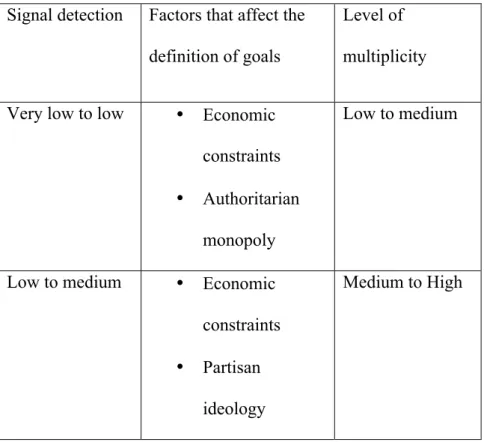
expense of not considering others. Table 1 summarizes the definition of the variable “multiplicity of goals:” it is comprised of the form of government (authoritarian or
democratic) and two groups of factors (economic constraints, authoritarian monopoly, in the case of authoritarianism, and partisan ideology, in the case of democracies). It is the
interaction between signal detection and the factors that affect the definition of goals that determine the level of multiplicity. For instance, variation in authoritarian monopoly and economic constraints under authoritarianism can provoke changes in signal detection. Similarly, variation in partisan ideology and economic constraints in democracies can provoke changes in signal detection.
Table 1 – Components of the variable “multiplicity of goals”
Signal detection Factors that affect the definition of goals
Level of multiplicity
Very low to low • Economic
constraints
• Authoritarian monopoly
Low to medium
Low to medium • Economic
constraints
• Partisan ideology
17
Openness to civil society and electoral accountability also affect what Jones and Baumgartner (2005) call the level of threshold that triggers government action. I argue that the more isolated the government is from social problems, the higher the level of threshold, that is, the less burdensome it is for policymakers to ignore the severity of problems.
Conversely, the more embodied the government is within social problems, the lower the level of threshold, that is, the more burdensome it is for policymakers to ignore the severity of problems. Finally, in this paper, the variable “cognitive overload” refers to two types of cognitive limitations: policymakers may be unable to address social problems because of constraints of attention allocation, or policymakers may be unwilling to address social problems because of the presence of political crises, economic crises, or ideological preferences.
In my framework, the variable multiplicity of goals interacts with both the level of threshold and cognitive overload to generate different levels of disproportionate information processing in both political regimes. In other words, the sizes of the changes in governmental response are not proportionate to the sizes of the changes in the incoming signals from the environment. I argue that unaddressed problems accumulate within and across regimes and eventually force themselves into the boundaries of government, which provokes the patterns of stability and punctuations predicted by Jones and Baumgartner (2005). Figure 1 presents the full theoretical model. The first step to develop a better understanding of these
18 Figure 1 – Summary of the theoretical model
Jones and Baumgartner’s (2005) framework aims to explain how governments detect, prioritize, and respond to information. It is based on a model of cognition that predicts
bounded rationality for decision-makers – that is, it states that decision-makers face problems related to attention scarcity and issue interpretation, and struggle to choose among competing solutions to the same problem. Besides being incapable of focusing on and addressing a particular social problem, policymakers can also be unwilling to do so since (1) some
19
the problem is not worth the effort given other competing claims, and (3) they can be guided by ideology. These cognitive limitations operate together with institutional arrangements (“institutional friction”) to generate disproportionate information-processing. Political institutions can prevent policy change (Tsebelis 1995, 2002; Immergut 1992) because they generate costs that keep the course of public policy steady and unvarying in the face of lots of change (Jones and Baumgartner 2005). The result is a disproportionality in governmental response, that is, the government cannot respond in a proportionate manner to the intensity of the signals from the broader political environment (Jones and Baumgartner 2005, 276).
The authors use a stochastic approach to explore patterns of proportionality and disproportionality in governmental response in the United States. They measure the policy processes through several indicators, the most relevant for this thesis being budgets, and make a frequency distribution of annual percent changes in spending from year to year. If information were proportionately processed (that is, if all policy changes were keyed to changes in the external environment), one would expect to find a normal distribution of budget change. This happens because the Central Limit Theorem guarantees that multiple independent random variables (in this case, individual social inputs) will be normally distributed in the aggregate.
20
policymakers must take information from the media or social groups into consideration. They do so by overreacting. As a result, one finds a pattern of long periods of policy stability marked by abrupt policy changes, or what the authors call a punctuated equilibrium model of public policy. Jones and Baumgartner study several distributions of policy change
(congressional hearings, laws, executive orders, budget outlays and so on) and find that all of them present the shape of a leptokurtic distribution. In other words, all of them have a
combination of fat tails and a slender central peak (Jones and Baumgartner 2005; 111), which characterize extreme stability and occasional punctuations.
The first question of interest for this paper is: What happens to policymaking when the type of political regime is altered? What patterns can we expect in terms of governmental efficiency and policy behavior in bureaucratic authoritarian regimes? Developing an
understanding about the nature of governing in such regimes is a first step to make
predictions in this sense. A good starting point is the model proposed by Cohen, March, and Olsen (1972) of “organized anarchies,” which was adapted to Kingdon (1984) to explain the operation of government in democracies. Organized anarchies are characterized by
21
conflicting purposes because it responds to interests that are equally disparate and antagonistic.
Authoritarian governments, and in particular contested autocracies3 (Svolik 2012), are not organized anarchies. To start, boundaries are not fluid, since decision-making is in the hands of a few groups. Svolik (2012) uses the term “ruling coalition” to refer to the set of individuals who support a dictator and, jointly with him, hold enough power to guarantee the regime’s survival. In authoritarian settings, governing is in the hands of dictators and their ruling coalition. There is another reason why boundaries are not fluid: authoritarian
governments do not allow different people to drift in and out of decision-making because the majority of the population is excluded from governmental affairs. Though mechanisms guarantee the exclusion of the masses, dictators are not elected (so there is no responsiveness to the preferences) and freedom of expression and freedom of assembly are severely
constrained (so there is no political participation). In this scenario, the only people that mobilize interests are those who are a part of the ruling coalition.
Svolik (2012) introduces the idea that the key features of authoritarianism (institutions, policies, and even the survival of leaders and regimes) are shaped by the problems of power-sharing and authoritarian control. The first refers to the challenges in power-sharing between dictators and their ruling coalition. The second describes the confrontations between dictators and the majority excluded from power. I use Svolik’s typology to define the variable “authoritarian monopoly,” which refers to the extent to which dictators and their ruling coalition remain united and maintain control of the state. As long as authoritarian monopoly exists, I argue that governmental goals should be not numerous and should be less conflicting.
22
Narrow goals result in clear technology, that is, the means to accomplish authoritarian goals should be known to participants in government. Take, for instance, the goal of
controlling subversive movements, which is common in autocracies. The technology to achieve this is clear: the regime must develop repressive apparatuses. In theory, as long as the dictator and his ruling coalition are united and control governing, there should be low
multiplicity of goals, that is, government should have similar and consonant goals, because it responds to the interests that are equally conforming and agreeable. If the dictator and his ruling coalition lose control of the authoritarian government, the level of multiplicity of goals can vary from low to medium, since government should have to respond to interests that can be diverse and conflicting4.
Yet in the case of the bureaucratic authoritarian regimes (O’Donnell 1973) that developed in South America in the 1960s and 1970s, another factor must be taken into account in the process of definition of governmental goals. At the core of the concept of bureaucratic authoritarianism is the capitalist-dependent position of Latin American countries within the global economy, which constrains policymaking in the region (also in
democracies, as I argue below), especially in periods of economic crises. Latin American states are mostly weak, lacking autonomy to act independently from the pressures of
international actors and foreign investors. The problems associated with import-substitution industrialization resulted in economic crises in the 1960s and 1970s, which engendered an alliance between the domestic elites (military and civilian technocrats) and foreign capital. This association favored orthodox economic policies that would promote the long-term economic stability desired by multinational corporations (Collier 1979). Some countries, however, adopted gradualist versions of orthodox economic policies (Ames 1987; Baer 2014), and Brazil was one of them.
23
The military coups that instituted those regimes were themselves the products of an alliance between military and civilian technocrats. The control of the state was in the hands of non-elected military rulers, and decision-making was largely a responsibility of technocrats. These technocrats were public officials who had attended business schools molded after prestigious U.S. institutions; military officers who had studied abroad and in military academies and who had adopted the curricula and approaches proposed by foreign advisory missions; and técnicos who received their degrees outside of South America (O’Donnell 1973; 78). O’Donnell notes that the training technocrats acquired stressed a “technical problem-solving approach” of “rational decision-makers:” emotional issues were discarded, the ambiguity of bargaining and politics were considered hindrances to rational solutions, and conflict was by definition considered to be dysfunctional. Technocrats also prioritized
efficiency in decision-making, and considered that efficient outcomes were the ones that could be measured. Thus, one goal of bureaucratic authoritarian governments was rationality.
Rationality was perceived as a prerequisite in the accomplishment of a second priority of those regimes: long-term economic stability. Regardless of the level of adoption of
orthodox economic policies, technocratic policymakers were only concerned with the enactment of policies that promoted industrialization; there was no preoccupation with the needs of the masses. In fact, the adopted policies hurt the popular sectors, since they led to cuts in social spending and elimination of social benefits, greater inequality and the
elimination of inefficient producers from the economy. Not surprisingly, technocrats
24
O’Donnell’s argument is that the alliance between the coercive apparatus of the bureaucratic authoritarian state and the technocrats resulted in stable policy options.
Governments that successfully blocked popular resistance to the aforementioned policies with coercion received support from/became more dependent on technocrats, for whom “the only policy options are more of the same” (O’Donnell 1973; 103). In order to guarantee that popular resistance would be blocked, the solution was to close all channels of political access to policymaking by means of repression, through the abolition of political parties, or the imposition of vertical control by the state on organizations such as labor unions. In fact, such exclusion was seen as a step in the process of macroeconomic stabilization. Political
democracy and wealth redistribution could occur only after the regime achieved political hegemony and capital accumulation in the more “dynamic” sectors (O’Donnell 1973; 88).
The question of how long can a government ignore the severity of social problems is critical to my framework. In their theory, Jones and Baumgartner assume that the measures of severity that are indexed to problems (in other words, information) carry thresholds that trigger governmental action (Jones and Baumgartner 2005: 51). In other words, governmental attentions shift when information about a problem accumulates to a point that makes the problem too severe to be disregarded or when the contents of certain pieces of information are too severe to be ignored. If a government is purposefully paying attention to some problems, but not to all social problems, its attention only shifts in relation to the monitored problems. The work of O’Donnell (1973) indicates that bureaucratic-authoritarian
policymakers were insulated from social problems because (1) the important goal was the stabilization of the economy (any indicator beyond the ones mentioned above were considered “noise”) and (2) the popular sectors were not only excluded but repressed. The threshold that triggers governmental action was, therefore, high, which means that
25
I hypothesize that in bureaucratic authoritarian regimes in which there is strong authoritarian monopoly, economic crises of low to medium severity, and very low signal detection, policymakers are able to pursue the narrow set of goals that initially motivated the coup. I further theorize that the level of proportionality of government to problems in this case is medium, since policymakers are constrained by cognitive limitations, and the level of threshold is high, which allows them to ignore several problems.
In terms of budgeting during the first period of the bureaucratic authoritarian regime, technocrats attempt to act rationally and efficiently in order to contain the economic crises and satisfy multinational corporations by making small budgetary adjustments in the policy areas monitored by them, namely, those that promote industrialization and capital
accumulation. However, policymakers can only be bounded rationally. I argue that attention limitation leads technocrats to ignore different issues, even in the context of low multiplicity of goals. Accordingly, technocrats eventually make a number of substantial budgetary adjustments because they are not able to pay full attention to the problems that suit their narrow set of goals. Thus I expect to find evidence that supports the PET in such periods in the form of a leptokurtic distribution of budget changes with a medium value of kurtosis. This indicates medium proportionality, that is, that the level of association between policy changes and changes in the environment monitored by technocrats was medium.
H1: In the first period of bureaucratic authoritarianism, low multiplicity of goals, high
threshold, and cognitive overload produce a leptokurtic distribution of budget changes with a
26
The use of repression as the means to control the mass population creates a by-product problem of power sharing to dictators: the repressive apparatus gain muscle to resist political control (Svolik 2012: 159). In this context, the level of authoritarian monopoly weakens. The fact that several problems are unaddressed because policymakers are blinded from the real external signals and are insulated from social issues creates more problems of authoritarian control. As problems become more numerous and more severe, and the right to participate is constantly denied to the population, the external environment becomes unstable. In the presence of economic crises of high severity, such instability is heightened.
Under the circumstances of weak authoritarian monopoly and economic crises of high severity, dictators envision the possibility of regime collapse. They opt to marginally increase signal detection to low and to adopt goals whose level of multiplicity varies from low to medium. Although political participation and electoral accountability are still absent in this stage, policymakers are more attentive to social problems because they need to promote policy innovations that legitimize the regime with the excluded population and the ruling coalition. In the case of bureaucratic authoritarianism, the reason why dictators need to legitimize the regime is that they want to avoid any sort of government dismantlement not initiated by them and which can hurt the military as an institution. Stepan (1988) points out four interests of the military in maintaining the regime, despite their intent of promoting liberalization: in order to protect themselves, they preferred to have a pro-government civilian who would maintain the regime; they feared the declining prestige in the public’s eyes and future retaliation; and they wanted to maintain a strong and personnel presence in all state enterprises associated with national security (Stepan 1988; 57-59).
27
the population and the ruling coalition than on other goals. I further theorize that decision-makers promote several policy innovations despite the signals that point to the existence of economic crises of high severity. Such signals can be ignored because the level of threshold is not low in this stage; it is medium5.
In terms of budgeting during the second period of bureaucratic authoritarianism, policymakers promote more minor investments than cuts, despite the economic constraints, and they also enact more substantial policy changes than policy cuts. I argue that they are unwilling to pay attention to all problems (including the ones generated by economic crises) because they are mostly concerned with promoting policy innovations that allow them to present results to the population and the ruling coalition. Thus I expect to find evidence that supports the PET in such period in the form a leptokurtic distribution of budget changes with a high value of kurtosis. This indicates low proportionality, that is, that level of association between policy changes and changes in the environment monitored by policymakers was low. Furthermore, I expect the budget frequency distribution to be skewed to the right, which indicates that policy innovations were more frequent than policy cuts.
H2: In the second period of bureaucratic authoritarian regimes, low to medium multiplicity
of goals, medium threshold, and cognitive overload produce a leptokurtic distribution of
budget changes with a high value of the kurtosis (low proportionality). The budget frequency
distribution in this case is skewed to the right.
28
As opposed to advanced industrial democracies, institutional friction is not a constraint in budgeting in Latin American democracies because presidents are central in policy processes. Díez (2012) refers to the presidencialist systems in the region as “hyperpresidentialism.” The author notes that in some circumstances there is an undue concentration of power in the hands of presidents, whose authority derives from an array of sources, such as personal relations and informal accepted practices, and who possess large discretion in the exercise of administrative and regulatory powers. As I argue in the next sections, this is the case in Brazil, where the president relies on formal institutions to control policymaking processes, including budgeting. In any case, it would be necessary to collect other sources of data – House and Senate hearings, House and Senate bills, media analysis and so forth – in order to investigate the extent to which there is institutional friction in policymaking processes that go beyond public budgeting.
29
choice is extensive (see for instance Hibbs 1977 and Boix 2000). To sum up, while leftist governments adopt policies that smooth the business cycle by stimulating aggregate demand and favor larger government, right governments avoid inflation, run balanced budgets, and favor smaller government (Ha and Kang forthcoming). Given the role of presidents in budgeting in Latin American countries, their ideological orientations are of great importance to this paper.
My argument is that both the Cardoso (1995-2002) and the Lula (2003-2010) administrations face pressures to maintain macroeconomic stability and growth, but the association of severe economic crises with a centrist ideological orientation leads the Cardoso administration to develop a narrower set of governmental goals of medium level of
multiplicity. In the context of the highly severe economic crises of the 1990s, policymakers opt to comply with the policy reforms endorsed by international organizations, which leads them to place more weight on economic goals – austerity and the need to establish balanced budgets – than on others. Being in a democratic government and embodied in social
problems, decision-makers need to pay attention to the demands put forth by the masses as the level of threshold that triggers government action in democracies is low. For instance, the Cardoso administration expanded social expenditures, particularly in education. However, the weight placed on economic goals impairs the ability of policymakers to substantially increase spending in the issues that fit their goals or to address other issues in general.
30
proportionality, that is, the level of association between policy changes and changes in the environment were extremely low.
H3: In the first period of democracy, medium multiplicity of goals, low level of threshold, and
cognitive overload produce a leptokurtic distribution of budget changes with a very high
value of the kurtosis (very low proportionality).
In the case of the second period of democracy analyzed in this paper, I maintain that a combination of (1) no economic crises, (2) economic dependence on financial markets and (3) a leftist ideological orientation leads the Lula administration to develop a set of multiple governmental goals, which involves economic stability and growth, redistribution, poverty alleviation, investment in health and education, and so forth. In the context of high
multiplicity of goals, policymakers’ ability to take signals that come through the environment is not impaired. But since they are still constrained by the attention limitation, they cannot absorb all external signals. This results in disproportionate information processing. In terms of budgeting during the second period of democracy, I expect to find frequent incremental increases in expenses and also a small number of policy changes. Finally, in the case of the Lula administration, I expect to find evidence that supports the PET in the form of a
31
H4: In the second period of democracy, high multiplicity of goals, low threshold, and
cognitive overload produce a leptokurtic distribution of budget changes with a medium value
of the kurtosis (medium proportionality).
The argument I make in this thesis is, therefore, twofold. First, narrower sets of goals developed in the second period of bureaucratic authoritarianism and the first period of democracy lead policymakers to be reluctant to address societal problems. Under authoritarianism, weak levels of authoritarian monopoly push for the development of narrower sets of goals in authoritarianism, locking-in decision-making to promote policy innovations that do not necessarily address the signals of economic crises. In the case of democracies, the combination of the economic crises of high severity that push policymakers to adopt the policy prescriptions of international financial institutions as well as the centrist ideology cause the development of “blinders” in policymaking – even in Brazil, a country whose size of the economy creates leverage in terms of avoiding ISI prescriptions.
Furthermore, this thesis also makes the contention that, notwithstanding the political regime, proportionality in governmental response can best be medium because of limited attention. As I argue below, I find evidence of medium proportionality in the case of the first period of bureaucratic authoritarianism and the second period of democracy. The underlying mechanisms that result in such level of proportionality are undoubtedly different, but they yield the same outcome: even working under conditions that should encourage
proportionality, policymakers are unable to address all societal problems.
32
allowed them to not address problems. In the second period of democracy, decision-makers favored larger government and had no constraints to monitoring as many problems as possible. There were no economic crises, electoral accountability and political participation functioned at a minimum satisfactory, and decision-makers dealt with a low level of
thresholds that forced them to address problems. In both cases, governmental proportionality in addressing problems reaches the level of medium. It is true that social spending increases in democracy, and in particular during the second period, but poverty, education, and health are hardly the only problems that demand solution in democratic governments. The next section delves into the methodological approach of this paper.
METHODS
The aim of this thesis is to understand how political regimes affect policymaking. I do so by testing the punctuation equilibrium theory with public budgeting data in authoritarian and democratic Brazil (1964-1985, 1995-2010). I consider Brazil an ideal testing ground for my research question because it allows me to test the PET not only in the context of
authoritarianism, but also in the context of Latin America. To my knowledge, this is the first test of the theory in both environments. Furthermore, the case of Brazil offers the opportunity of engaging in future comparative studies of budgeting in countries that also had bureaucratic authoritarian regimes, such as Argentina.
The periods of analysis represent the years of authoritarian rule (1964-1985), and, in
the democratic period, the years of center wing party rule (PSDB, 1995-2002) and the years
of left wing party rule (Workers’ Party, or the PT, 2003-2010). I will not look at the period
33
which are beyond the scope of this paper. Also, I decided to focus on the aforementioned democratic periods in order to capture the possible variation caused by partisanship rule in the country. While the PSDB is a centrist party, the Workers’ Party is a leftist party, so if partisanship plays any role in spending in all policy areas, one would expect to find it within this period.
This paper adopts a mix-methods approach that combines stochastic analysis of budget data with qualitative assessment of the independent variables. I compiled two data sets to measure my dependent variable (policymaking/budgeting). The first data set is comprised of all available authorized budget data extracted from the Brazilian Institute of Geography and Statistics (IBGE) from 1964 to 1985 and from 1995 to 2010. The IBGE data set is extracted from the Lei Orçamentária Annual (LOA), the Brazilian Budgetary Law. In Brazil, the LOA only authorizes the government to promote expenditures; it does not require the government to do so. In this paper I focus on the decision-making process of the LOA because it is not possible to compare budgeting under the authoritarian and democratic periods using budget data as it was implemented.
34
I calculate all annual percent changes in spending from year to year (spending for each category in year y minus spending for each category in year y-1 divided by spending for each category in year y-1), for each of about the 162 categories of spending present in my first data set. This means that I have a percent change variable for each year (authoritarian and democratic) indicating how much spending changed from one year to the next across 162 spending categories. The total number of observations (N= 1,592) is smaller in the case of the percent change data set because if a category had a change in definition in a certain year or is not present in a certain year, I do not analyze that category in that certain year. After
calculating the annual percent changes, I set up frequency distributions of budget changes for authoritarianism, the first period of authoritarianism, the second period of authoritarianism, democracy, Cardoso’s administration, and Lula’s administration.
35 Table 2 – Measurement of proportionality
L-kurtosis value Level of proportionality
0.123 High
0.123<value<0.4 Medium
0.4<value<0.7 Low
0.7<value<1 Very low
The second data set is comprised of a sample of the first. The data is listed by policy issues and was developed by a recoding of the initial codes. I recoded only the Executive branch initial codes (which yields spending of different ministries and general expenses of the Executive branch) because they are consistent throughout both political regimes, although the names of the ministries vary within and across regimes. I solved this problem by creating broader policy issue codes that allowed me to code ministries with different names but that relate to the same issue under the same category. For instance, the Ministry of Transportation and Public Works (authoritarian period) and Ministry of Transportation (democratic period) were coded in the same policy issue (Public Works). The following policy issues are captured in the data set: Defense, Public Works, Education and Culture, Agriculture, Finance, Labor, Science and Technology, Social Affairs, Industry, Justice, Health, Energy, and
36
calculate expenditures as a percentage of GDP because of time constraints, but I plan to do this in the future using data from the Penn World Table.
I begin the qualitative assessment of the independent variables by evaluating the level of institutional friction in budgeting in Brazil. In order to do so, I rely on information
37
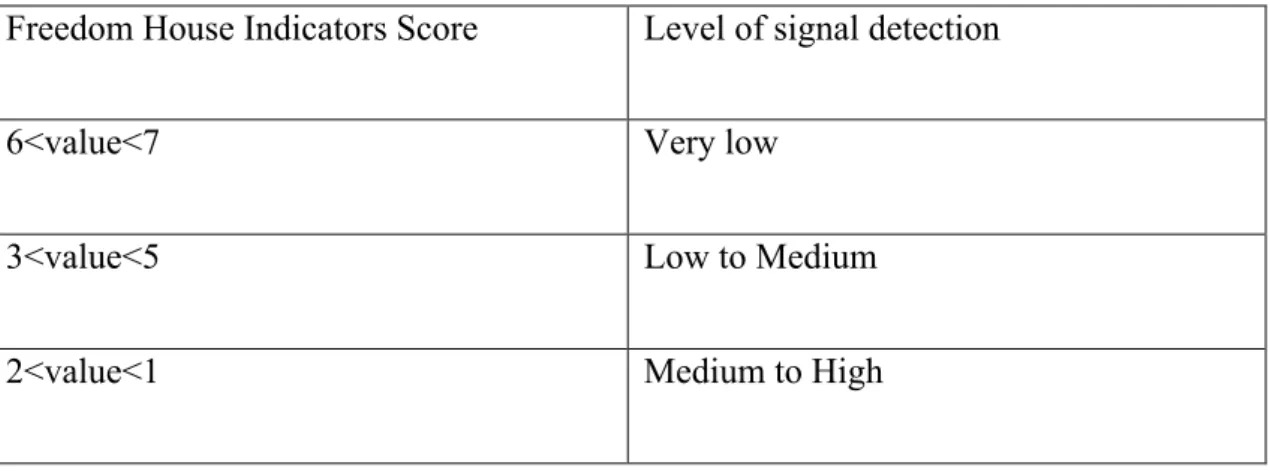
Table 3 – Measurement of the variable “signal detection”
Freedom House Indicators Score Level of signal detection
6<value<7 Very low
3<value<5 Low to Medium
2<value<1 Medium to High
I also use secondary sources to measure the variables multiplicity of goals and level of threshold. I collect information from the literature about the Brazilian economy and the Brazilian political history. I assess the variable “cognitive overload” by presenting
information extracted from the literature about the topic (Jones 1999; Baumgartner and Jones 2005; Weyland 2008), but, as I note in the last section of this thesis, I plan to measure this variable through interviews in the future. Finally, I complement the analysis presented in this paper with a short assessment of which policy areas drive strong commitment to the status quo or policy punctuations by plotting graphs of percentage change for different issues. Although this thesis does not delve into policy processes with great depth, I briefly analyze social assistance policies in the next section and energy policy in the fourth section.
PUBLIC SPENDING: AUTOCRACY VS. DEMOCRACY
There is a wide-ranging6 body of work in social sciences that explores the effects of democracy in social spending. Some scholars argue that democracies have important effects on human development across the globe (Lake and Baum 2001; Boix 2001; Brown and
38
Hunter 2004), while others still question the existence or the robustness of such correlations (Gauri and Khaleghian; Shandra et al. 2004). A part of this literature also asserts that the relationship between democracy and human development is strong in OECD countries, but not so much in non-OECD countries (Filmer and Pritchett 1999; McGuire 2004; Keefer 2006). Recently, Gerring et al. (2012) proposed that it is the stock of democracy, and not the level of democracy, that affects a country’s level of development. This argument dialogues with the also recent work of Huber and Stephens (2012), who maintain that the stock of democracy, through the rise of left parties, impacts the allocation of social spending on poverty and inequality in Latin American countries.
This thesis finds evidence that supports the views according to which the stock of democracy and the rise of leftist parties have substantial effects on social spending. In the figures below, the category “social affairs” is comprised of spending with social security, hunger alleviation, and social assistance. Health and education figure as separate categories of spending, and the category “education and culture” is comprised of spending with
education, culture, and sports. Finally, the category “public works” is comprised of spending with transportation and infrastructure in general. It is important to note that, for now, the data presented in this section is total spending and not expenditures as a percentage of GDP, which would be the ideal indicator. For this reason, it is possible to find discrepancies
between this paper and other works that analyze social spending in Brazil. For instance, while my thesis indicates that the Lula government, when compared to the Cardoso administration, increased spending in education and culture, Huber and Stephens (2012) argue that
39
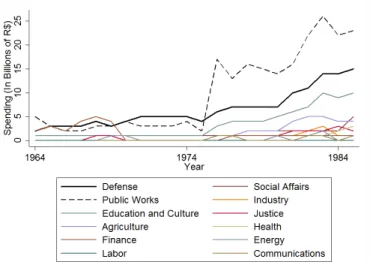
health and social spending remains low throughout the entire period. The figure indicates three other policy priorities for autocrats: public works, defense, and agriculture.
Figure 2 – Total spending in all policy areas – Authoritarianism and Democracy
40
Figure 4 – Total spending in Education and Culture and Health
Figure 2 plots spending in all policy areas in both political regimes. Spending on social affairs increased substantially after 19957. The same pattern is observed in spending with health and education and culture, as revealed by Figure 4, although I find decline in spending in both areas from 1997 to 1999, when the country faced the Asian economic crisis and the Brazilian monetary crisis. The increase in spending in social affairs, health, and education and culture is even more substantial after 2003, the year in which President Lula, from the Worker’s Party, took office. One of the two major goals of President Lula was to achieve a greater degree of socioeconomic equality (Baer 2014). In terms of social assistance, the Lula administration established the Bolsa Família, a program that combines previously existing policies, such as President Cardoso’s Bolsa Escola, and provides a cash payment to poor families on the condition that they send their children to school and that children under the age of 7 participate in health checkups. While the Bolsa Escola had reached 5.1 million families in its peak, the Bolsa Família reached 12.4 million families in 2009 (Huber and Stephens 2012). Another policy innovation of the Lula administration was the expansion of
41
the minimum wage, which increased from present value R$ 200 in 2002 to R$ 510 in 20098.
Thus, as anticipated by Huber and Stephens (2012), center parties play important roles in the enactment of social policies in Latin American, but leftist parties shifted the structure of spending to make it more redistributive (Huber and Stephens 2012: 151).
The purpose of this section is to specify that this paper conforms to the mainstream works that explore the relationship between democracy and social spending. The data
presented here indicates that, in the context of social spending, democracy and especially the
rise of left parties are key drivers of policy processes in Latin America. Spending in social
affairs and health were not priorities of the bureaucratic authoritarian government, and as
Brown and Hunter (2004) suggest, education is often a priority of autocrats because (1)
human capital is critical to economic development, (2) investment in basic schooling helps
autocrats to gain legitimacy with the popular sectors, and (3) investment in higher education
helps autocrats to maintain middle-class support and stability. As I argue in the next section,
economic growth and development and the control of social unrest and subversion were top
priorities of the Brazilian bureaucratic authoritarian regime.
The questions of interest to this paper, however, are (1) the degree to which the
government responds proportionally to societal problems in general through public budgeting
and (2) the resulting patterns of stability and policy punctuations in autocracies and
democracies. I turn to this analysis in the next section.
42
PROPORTIONALITY AND THE PTE: AUTOCRACY VS. DEMOCRACY
The case I analyze in this paper is the one of Brazil. I argue that institutional friction does not severely constrain decision-makers in Brazil because executives retain power in decision-making of the public budget in both political regimes. In the bureaucratic
authoritarian period, the military government used constitutional amendments, institutional acts, and executive decrees to reduce in great depth the roles of the legislatures and the judiciary (Skidmore 1988). The Institutional Act No 1, issued by General Arthur da Costa e Silva in 1964 before the nomination of General Humberto de Castello Branco as the first military president, established that the president would have exclusive power to propose expenditure bills to Congress, which could not increase any spending item (Skidmore 1988). Afterward, the Constitution of 1967 deliberately isolated legislators from decision-making in terms of budgeting. Rocha (2008) notes that the executive employed such restrictions for congressional involvement because it prioritized rationality over participation. At the same time, the bureaucratic authoritarian government conceded broader decision-making capacity to technocrats in budgeting and in the management of public policies. This pattern would be maintained until the end of the military regime.
The Constitution of 1988 maintained strong presidential powers for Brazilian
presidents that were inherited from the military regime (Alston et al. 2006). The literature that explores the strong institutional powers of presidents in Brazil is extensive (see Limongi 2006; Figueiredo and Limongi 1995, 1997, 1999, 2007; Pereira and Mueller 2000;
43
during the Lula presidency, the Brazilian president “has generally gotten what he wanted”, with gridlock and similar outcomes being exceptional (Alston et al. 2006: 10). Furthermore, while the authors recognize the existence of democratic checks and balances, they argue that the separation of powers is clearly biased towards the president.
Brazilian presidents enjoy several prerogatives in policymaking, including the exclusive right to initiate new legislation in budget. Every year, the budgetary law – Lei Orçamentária Anual (LOA) – is drafted by the executive and referred to the congressional
Budget Committee to be approved by legislators. Although the congressional majority has the right to amend the bill, it is the executive who determines which amendments are
appropriated since they have to be compatible with both a multi-year budget plan elaborated on by the executive as well as with a law on budgetary guidelines (Alston et al. 2006: 19-20). In other words, legislators do not have the power to authorize expenditures; they can only reallocate public investment after the executive has defined the priority areas. Rocha (2008) argues that even their reallocation power is restricted, and it was remarkably so during the periods of economic crises that took place during the 1990s.
44
contends that the executive has maintained a strong prominence in the budgeting processes since the establishment of the Constitution in 1988.
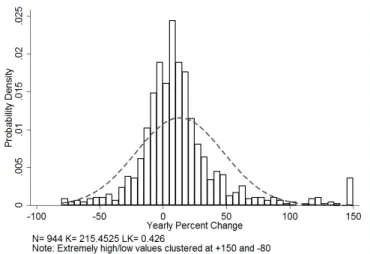
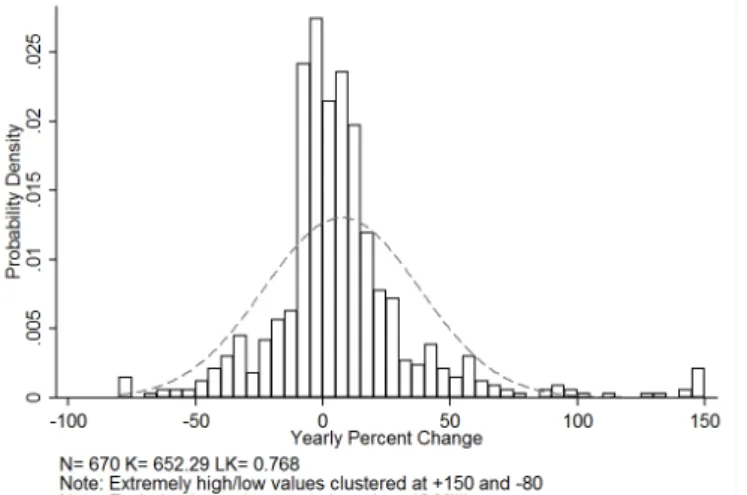
Figures 5 and 6 diagram the budget frequency distribution for the bureaucratic
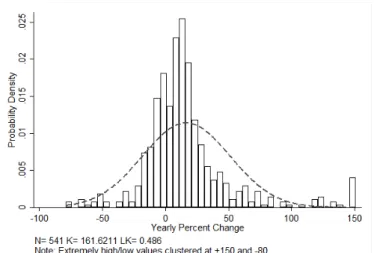
authoritarian and democratic periods; each figure contains a hypothetical normal distribution. Both have l-kurtosis values bigger than 0.123, fat tails, and slender central peaks, which indicate leptokurtosis. The level of proportionality is low in both cases, but it is surprisingly lower in the case of democracy (the l-kurtosis is 0.768). The best approach to grapple with such result is to decompose these budget frequency distributions into four new distributions, which are presented in Figures 7-10. As predicted, the level of proportionality in the first period of bureaucratic authoritarianism is higher than in the second (the l-kurtosis for the first period is 0.324 and for the second period is 0.486). In the case of the second period of
authoritarianism, the distribution is skewed toward the positive side, which indicates that policymakers promoted more investments than cuts, despite the presence of severe economic crises, as I argue below. The budget frequency distribution for the first period seems balanced in terms of investments and cuts, since it is not clearly skewed toward the positive or the negative side.
45
Figure 6 – Budget Change Frequency Distribution – Democracy (1995-2010)
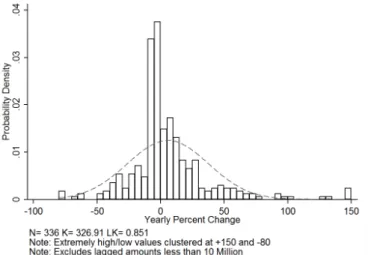
Figure 9 explains why the level of proportionality in the democratic period is lower than under bureaucratic authoritarianism. In the case of the Cardoso administration (1995-2002), the l-kurtosis is 0.851, which indicates very low proportionality in governmental response. The figure also indicates that policymakers conducted frequent cuts in the range of 5 to 20 percent, and investments were less frequent. Figure 9, on the contrary, indicates a medium level of proportionality during the Lula presidency (2003-2010), since the l-kurtosis is 0.378. Also, policymakers promoted more policy innovations than cuts. Finally, as
predicted, the level of proportionality is medium in the first stage of the bureaucratic
46
Figure 7 – Budget Change Frequency Distribution – Authoritarianism 1 (1964-1974)
47
Figure 9 – Budget Change Frequency Distribution – Cardoso (1995-2002)
Figure 10 – Budget Change Frequency Distribution – Lula (2003-2010)
As Figure 1 indicates, the first step to interpret the above results is to assess how the characteristics of political regimes affect signal detection. Figures 11 and 12 plot the average Freedom House scores for each period of government and the corresponding L-Kurtosis values. I assume that the average of both indicators reach 6 or 7 in the first period of
48
government was a compromise between two groups of rulers: the hard-liners (mostly military officers) and the moderates (military officers and civilians). The hard-liners adopted extreme authoritarianism, while the moderates aimed to eventually re-establish democracy. Although President Humberto de Alencar Castello Branco (1964-1966) was from the moderate group, his administration started under the shadow of the Institutional Act No. 1, which gave him arbitrary powers for 90 days; purged the Congress and the civil service; removed several governors; and forced the military officer corps that supported overthrown president Goulart to retire (Skidmore 1973). In 1969, the military established the Institutional Act No. 5, which allowed the non-elected president to order the Congress into forced recess, to promote
censorship of different types of media, and to determine the illegality of all political meetings that were not authorized by the police, among other measures. Having lost control of the presidency in 1967, the moderate military group would only take office again in 1974, when President Ernesto Geisel took office.
Figure 11 – Political Rights Score and L-Kurtosis
49 Figure 12 – Civil Liberties Score and L-Kurtosis
Assuming that the level of signal detection was very low during the first period of authoritarianism, Figures 11 and 12 indicate that the level of signal detection within the second period of bureaucratic authoritarianism varied from low to medium. In the case of democracy, the level of signal detection during the Cardoso administration varied from low to medium, and during the Lula administration varied from medium to high. Figure 12 indicates that the average civil liberties score of the Cardoso administration (3.75) was lower and very similar to average score of the second period of bureaucratic authoritarianism (3.85). This indicates that from 1995 to 2002 the country only moderately protected all civil liberties or protected some civil liberties while less strongly protecting others. Since detailed reports about Brazil are only available from 2002 onward, it is not possible to explore the civil liberties indicator with greater depth. Further research needs to be conducted in order to develop a better understanding of how civil liberties were being inhibited.
50
1964, it dropped to 25 percent in 1967 and to 15.7 percent in 19739. The overall GDP growth
rate was 2.9 percent in 1964, but reached 11 percent in 1968 and 9.5 percent in 1974
(Skidmore 1988). At the moment, economic growth, the consensus goal of the upper classes that formed the ruling coalition, was secured through the “economic miracle.” Not only the ruling coalition was united with the military rulers: from 1967 to 1974 there was a united military leadership with a clear vision, as both Presidents Costa e Silva and Médici
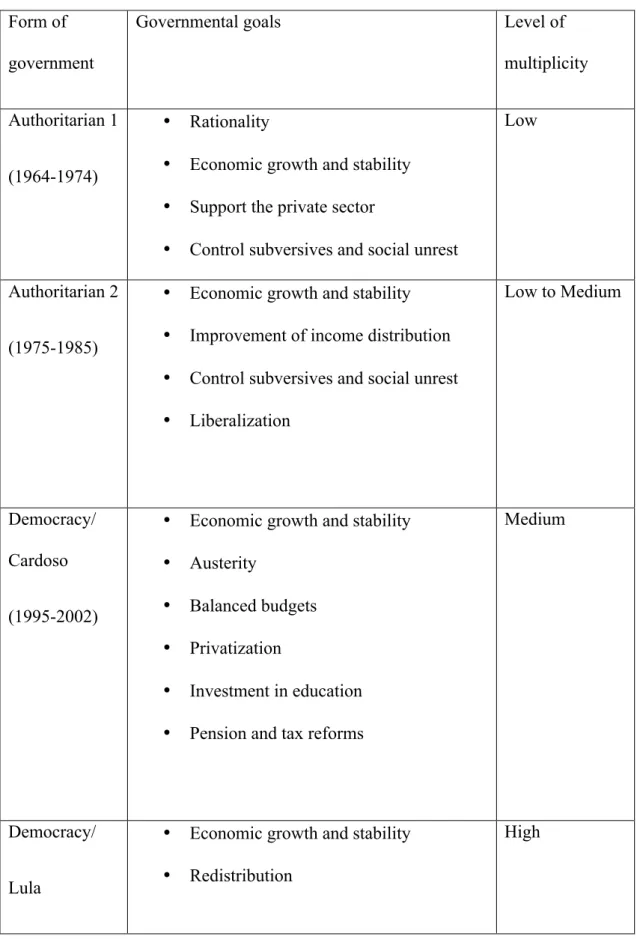
represented the group of hard-liners. In this context, we can expect to see low multiplicity of goals, as indicated by Table 4: technocratic policymakers were concerned with rational decision-making, the maintenance of economic growth and stability, the adoption of policies that would foster capital accumulation, and the control of subversion. Following the logic of O’Donnell’s (1973) argument, the range of problems with which policymakers were
concerned was small because wealth redistribution and other social goals could only be achieved after the stabilization of the economy.
During the second period of the bureaucratic authoritarian regime, signal detection varied from low to medium. To begin with, it was during this stage that the divergences between the hard-liners and the moderates became more evident. This is what leads Stepan (1988: 27) to indicate the existence of “a state within the state.” There was a clear intent to initiate the liberalization process from the military rulers, but the repressive apparatus led by the hard-liners was autonomous and still relying on torture and disappearance to stop social conflicts (Stepan 1988). The economic crisis was of high severity during this period, especially after the OPEC oil shock in late 1973. The Ernesto Geisel presidency maintained economic growth by rapidly increasing its borrowing abroad – in 1974, the external debt jumped from $6.2 billion to $11.9 billion (Skidmore 1988). Given the option of the Geisel administration to sustain economic growth despite unfavorable circumstances, the average
51
annual GDP growth rate between 1974 and 1978 was 7 percent, although in 1977 it declined to 5.4 percent and in 1978 decreased to 4.8 percent. In 1975, policymakers enacted the Second National Development Plan (PND II, 1975-1979), which was a huge investment program aimed at the rapid expansion of the economic infrastructure, authorizing investments in energy policy, transportation, and communication (Baer 2014).
Meanwhile, the annual rate of inflation did not stop growing. In 1974, it reached 34.5 percent. From 1979 to 1984, the increase in the index was constant: from 77 percent in 1979, to 99.7 percent in 1981, to 223.8 percent in 1983 and 222 percent in 1984 (Skidmore 1988). The most clear evidence that the Brazilian military regime had decided to focus on economic growth at all costs despite the severity of the economic crisis was the resignation of Planning Minister Mario Simonsen, who in 1979 attempted to warn the government that they had to throttle down the economy because of the increasing balance of payments pressure and the rise in the inflation rate. His message was poorly received not only by the military
government and their technocrats, but also by the business community. Simonsen received support only from the MDB, the opposition party. With his resignation in late 1979 and the choice of Delfim Netto as the new Planning Minister, the priority for economic growth remained unquestioned.
52
When the government finally recognized the signals of an economic crisis, President Figueiredo attempted to avoid an agreement with the IMF by carrying out austerity programs developed by the government. In November 1982 it finally turned to the IMF, although Baer (2014) contends that the Brazilian military government did not find its relations with the organization easy. That happened because the policies that were adopted did not result in the attainment of targets set with the IMF (Baer 2014: 84-85). Besides the goal of sustaining economic growth, policymakers in the second period of bureaucratic authoritarianism also wanted to improve income distribution, control subversion and social unrest, and start the process of political liberalization. Their set of goals was, thus, of low to medium level in terms of multiplicity.
From 1995, when President Fernando Henrique Cardoso took office (from the centrist party PSDB), to 1997, the threat of hyperinflation that was present in the country from mid-1980s and most of the 1990s was gone. However, the world financial crisis that started in Asia in July 1997 hit Russia strongly in 1998 and then hit Brazil. Cardoso’s policymakers were thus forced to raise interest rates and increase taxes to save the strength of the Real (Skidmore et al. 2010).
maxi-53
devaluation of the Real, which led policymakers to promote primary budget surpluses in order to receive loans from the IMF (Baer 2014).
Nevertheless, Cardoso still promoted a moderate push to strengthen elementary education and attempted to conduct pension and tax reforms. He also enacted policies in social assistance, such as the Bolsa Escola and the Comunidade Solidária, but the reach of these policies was not substantial10. Because of the centrist ideology of president’s party, the strong weight given to the economic priorities and the modest investment in social issues, I classify the level of multiplicity of the Cardoso administration as medium.
The economic crises were gone by the time President Luiz Inácio Lula da Silva, from the Worker’s Party, took office in 2003, but he suffered substantial pressure from
international financial circles to maintain the orthodox macroeconomic policies of the
Cardoso administration – which he did. The Lula administration achieved satisfactory budget surplus in its first two years as required by the IMF, and paid off its debt in full with the organization by 2005, two years ahead of schedule (Skidmore et al. 2010). The commodities boom in the 2000s strengthened the economy (Skidmore et al. 2010) and reduced economic constraints on policymaking (Huber and Stephens 2012). As noted in the previous section, President Lula invested substantially in social policy and approved a reform of the social security system, attempted to promote tax reform, and enacted education policies that aimed to increase quality in schooling (Love and Baer 2009). Therefore, the level of multiplicity of goals was high, since the partisan ideology was leftist, there were no economic crises, and, despite the strong weight put on social policy, the Lula administration had several other goals in terms of governing. Table 4 summarizes the different goals of the bureaucratic
authoritarian and democratic governments.