The association between the MAOA 2R genotype and
delinquency over time among men: the interactive role of
parental closeness and parental incarceration
Michael E. Roettger,
The Australian National University
Jason D. Boardman, University of Colorado
Kathleen Mullan Harris, and
University of North Carolina at Chapel Hill
Guang Guo
University of North Carolina at Chapel Hill
Abstract
Using a panel of 6,001 males from the National Longitudinal Study of Adolescent and Adult Health, we examine potential moderation by paternal incarceration and parent-child closeness altering the relationship between the rare 2R MAOA genotype and delinquency. By jointly examining moderation patterns for both the mother and father with the transmission of the MAOA genotype from mother to son, we are able to make inferences about the specific genetic model that best explains these outcomes. In line with prior research, we find a direct relationship between the MAOA 2R genotype and delinquency, independent of parental incarceration and closeness. Examining moderation patterns, we find that delinquency risk for the 2R allele is buffered for males close to their biological or social father, but not their biological mother. We conclude that the 2R delinquency association is not due to passive gene-environment correlation but is best characterized as a social control gene-environment interaction.
For decades, researchers have observed that behaviors and criminal histories concentrate within families (Ellis, 1982; Farrington, 2011; Robins, 1966; Robison, 1936; Sampson & Laub, 1993; Thornberry, 2005), but identifying underlying combined etiological genetic and environmental sources within families remains elusive. Results from sibling, twin and gene-candidate studies indicate that genetic and environmental factors remain important in the clustering of delinquency and criminal justice involvement within families (Barnes et al., 2014; Beaver, 2011; 2013; DeLisi, Beaver, Vaughn, & Wright, 2009; DiLalla & Gottesman, 1991; Rowe & Farrington, 1997; Tuvblad, Narusyte, Grann, Sarnecki, & Lichtenstein, 2011). A separate, but extensive body of research has examined environmental patterns and causes related to intergenerational delinquency (Giordano & Copp, 2015; Murray, Bijleveld,
Please direct all inquiries to Michael Everett Roettger Address: Australian Demographic & Social Research Institute; ANU College of Arts & Social Sciences; The Australian National University; 9 Fellows Road; Acton ACT 2601; Australia.
HHS Public Access
Author manuscript
Crim Justice Behav
. Author manuscript; available in PMC 2017 October 13.Published in final edited form as:
Crim Justice Behav. 2016 ; 43(8): 1076–1094. doi:10.1177/0093854816629184.
A
uthor Man
uscr
ipt
A
uthor Man
uscr
ipt
A
uthor Man
uscr
ipt
A
uthor Man
uscr
Farrington, & Loeber, 2014; Murray & Farrington, 2008; Thornberry, 2005), but has largely
ignored or faced significant data limitations for examining related genetic components1.
Consequently, empirical research on the underlying gene-environment underpinnings of intergenerational delinquency can help to increase knowledge of the etiology of patterns of intergenerational delinquency and crime. Unfortunately, to date, only a few studies have begun to directly examine these genetic and environmental factors underlying crime in families (Beaver, 2013; Delisi et al., 2009; Miller & Barnes, 2013), with limited inference. The ability to attribute genetic and/or environmental causes for family patterns of delinquent behavior is complicated by the obvious fact that family members share the same
environment, parents and child share genes, and genes and environment interact within families (Farrington & Welsh, 2007; Rowe & Farrington, 1997). Additionally, simultaneous measurement of both parents and children is generally lacking in the study of
intergenerational delinquency (Thornberry, 2009; Wakefield & Wildeman, 2011), and we are unaware of a study providing both genetic and behavioral data from both parents and children. Identity by descent is the gold standard of genetic association studies, and a pure assessment of this status is possible only with genetic information from both parents and the child. While medical datasets like the Framingham Heart Study contain genetic data across three generations, there are no comparable multiple-generation studies in criminology, so attributing intergenerational delinquency to specific genetic and environmental sources has been beyond the scope of current research (Farrington, Coid, & Murray 2009).
Despite these limitations, targeted analyses on select genetic and environmental factors associated with crime in families make it possible to identify possible patterns of gene-environment interplay that may lead to observed patterns of crime within families. To accomplish this task, our study jointly examines how measures of parental incarceration and parental closeness moderate the effects of the 2R variant of the MAOA gene on delinquent behaviors. Regulating the production of the enzyme monoamine oxidase, an enzyme which controls levels of neurotransmitters such as dopamine and serotonin in the brain linked to antisocial behavior in adults (Meyer-Lindenberg et al., 2006), the MAOA gene has been extensively and persistently associated with antisocial and violent behavior for over a decade. A recent meta-analysis of 31 studies, including one study focusing on the 2R allele in the MAOA, found polymorphisms of the gene to be associated with increased aggression and antisocial behavior among males (Ficks & Waldman, 2014). Recent research suggests deleterious environmental influences during adolescence may lead those with risky variants of MAOA to exhibit antisocial and extremely violent behaviors well into adulthood, increasing risk for criminal behavior and incarceration (Armstrong, Boutwell, Flores, Symonds, Keller, & Gangitano, 2014; Beaver, DeLisi, Vaughn, & Barnes, 2010; Beaver, DeLisi, Vaughn, & Wright, 2008; Suri, Teixeira, Cagliostro, Mahadevia, & Ansorge, 2014; Tiihonen et al., 2014). The rare 2R polymorphism in MAOA has been found to be associated with increased risk for delinquent behavior and criminal justice involvement among males (Beaver et al., 2013; Beaver, Barnes, & Boutwell, 2014; Guo, Roettger & Cai 2008; Guo,
1The lack of consideration of genetic-environment interplay is notable in the larger body of research and research reviews on parental incarceration and child outcomes (for example, see the recent exchange between Johnson & Easterling (2012) and Wildeman, Wakefield, & Turney (2013)).
A
uthor Man
uscr
ipt
A
uthor Man
uscr
ipt
A
uthor Man
uscr
ipt
A
uthor Man
uscr
Ou, Roettger, & Shih, 2008).2 Because the MAOA gene is located on the X chromosome, it is possible to infer identity by descent of the risk allele among males. To be clear, XY males with the 2R allele must have inherited it from their biological mother, while XX women inherit copies from both the biological father and biological mother (Eisenberger, 2007). The fact that MAOA is hemizygous among males thus provides a mechanism to infer if a son’s delinquency is caused by inheritance of this risky allele. That is, father-son concordance for risk behavior cannot be due to the transmission of this risk allele because sons must have inherited this allele from their mothers. As we describe in detail below, the sex-linked nature of this gene provides a unique opportunity to differentiate between different forms of gene-environment correlation and gene-gene-environment interaction.
MAOA 2R Genetic & Familial Environment Interplay
Examining family processes as antecedents to the 2R-delinquency association is important because it is possible that family environment risk factors are necessary for the 2R allele to be expressed in delinquency and violence among males. Recently, for example, DeLisi and colleagues (DeLisi et al., 2009, pg. 1994) have suggested that some parents may cause a “double whammy” for children with risky genetic backgrounds by creating an environment in which otherwise small genetic associations are exacerbated. This association is described as a gene-environment interaction (GxE) in which the effect of each component depends on the level of the other. That is, the effect of parental incarceration on the likelihood of delinquency depends on genotype and the effect of genotype may depend on parental incarceration histories. Some have called this effect a social trigger model because the social environment is required to trigger latent genetic tendencies (Shanahan & Hofer, 2005, pg. 66). Researchers focused on the MAOA gene following Caspi et al.’s (2002) publication, which demonstrated that maltreatment during childhood was more likely to lead to violence among adults for those that carried risky alleles in the MAOA gene. Those without the risk alleles demonstrated measurable resilience to the otherwise deleterious effects during childhood. Work in this area typically emphasizes environments as ‘risk exposure’; there is an explicit focus on noxious, stressful, or risky environments rather than protective, stable, and nurturing ones. For example, Beaver (2013) finds that both (a) parental criminality and (b) maternal disengagement and lack of maternal attachment predict delinquency among children (p < 0.05), with the influence of parental incarceration not mediated by lack of attachment or disengagement. Beaver’s (2013) analysis, like that of Delisi and colleagues (2009), suggests that having a mother or father with a criminal background acts as an environmental pathogen which interacts with genetic propensities to increase delinquent behaviors. We focus on parental incarceration as the environmental trigger because it is a clear environmental risk for delinquency among adolescents (Giordano, 2010; Murray & Farrington, 2008; Murray, Farrington, & Sekol, 2012; Roettger & Swisher, 2011). Equally important, previous work has shown that parental incarceration interacts with the total number of risky alleles for the DAT1, DRD2, and DRD4 genes in predicting arrest and incarceration (Miller & Barnes, 2013).
2In laboratory experiments, Guo et al. (2008) reported that the 2R MAOA variant exhibited substantially lower promoter activity for regulating neurotransmitters vis-a-vis all other common polymorphisms of MAOA. This molecular evidence suggests that those with the 2R allele are at particularly high risk for antisocial behaviours.
A
uthor Man
uscr
ipt
A
uthor Man
uscr
ipt
A
uthor Man
uscr
ipt
A
uthor Man
uscr
But this explicit focus on risk overlooks the possibility that family factors may control genetic tendencies for delinquent behavior. While, as noted above, an almost limitless number of factors (familial, peer, school, etc.) may influence delinquency, the closeness of children to their parents is well known to reduce it (Booth, Scott, & King, 2010; Demuth & Brown, 2004; Johnson, 1987). Booth and colleagues (Booth, Scott, & King, 2010) suggest that attachment to either a non-biological or a biological parent significantly reduces delinquency, while Johnson (1987) suggests that closeness to the biological father is much more likely to reduce delinquency than closeness to the biological mother. Simons et al. (2011) show that a generally supportive social environment moderates genetic propensities to aggression. Similarly, Guo and colleagues (Guo, Roettger, & Cai, 2008) provide strong evidence that family social resources limit the association between genetic risks and problem behaviors. But more importantly, this research shows that the risk can be significantly controlled with socially supportive familial environments, through mechanisms such as the influence of a close mother or father in engaging in prosocial behaviors or desisting from antisocial behaviors. Similar results have been shown using comparable measures of social controls, and similar measures of delinquency, from the National Youth Study (Boardman et al., 2014). In this paper, we use an indicator of parental closeness to characterize the social control model because of its robust association in generally reducing delinquency (Booth, Scott, & King, 2010; Demuth & Brown, 2004), along with its salience for examining how behavioral genetics models may be used to further understand the expression of 2R-related delinquency.
The research described above is important and has led to the very large body of work in GxE studies, but it is limited in an important way. No existing study in this area has examined the incarceration histories of the parents as related to the 2R-delinquency association. Other than knowledge that the respondents were maltreated as children, there is no information about the involvement of the parents in the criminal justice system. This is particularly important because what is considered a environment interaction (GxE) may simply be a gene-environment correlation (rGE) (Jaffee & Price, 2007). While GxE models assume that genotype and environmental exposure are independent of one another, it is possible that the environmental exposure (parental incarceration) manifests as a risk for the children because the child and their parent share one-half of their genes. That is, the child inherits the environment (including experiences of parental incarceration) and the alleles that are believed to be risky (what is also called passive rGE). With respect to Caspi et al. (2003), it is possible that children may have been raised in an environment that was more conducive to delinquent behaviors (e.g., exposure to maltreatment) because their of their parents genotype which they share (e.g., passive rGE) or because they inherited this risky allele from their mothers and they created their risky environment (e.g., evocative rGE) common genetic risk. In our case, if the 2R allele is linked to delinquent behaviors, then mothers with this risk allele may be more likely than those without the allele to have engaged in risky behaviors themselves. It is therefore important to adjust for maternal criminal history in examining the association between this risk allele and problem behaviors.
A
uthor Man
uscr
ipt
A
uthor Man
uscr
ipt
A
uthor Man
uscr
ipt
A
uthor Man
uscr
Identifying Patterns rGE and GxE Patterns for 2R
The MAOA 2R genotype, while rare, provides an opportunity to isolate social from genetic effects due to its location on the X chromosome and direct association with increased activity. Because males cannot inherit the MAOA 2R genotype from their biological father, mediating or moderating effects for 2R-related delinquency by father incarceration (FI) or father closeness (FC) must be environmentally oriented. In contrast, a moderating effect of mother’s incarceration (MI) or maternal closeness (MC) would make it difficult to
differentiate between rGE and GxE. Keeping in mind the two forms of gene-environment interplay (e.g., GxE and rGE) and that each form has different sub-models (e.g., social control and social trigger GxE and passive or evocative rGE), the resulting explanatory framework is fairly complicated. We summarize these different possibilities in Table 1 to illustrate both the utility of this study design for evaluating rGE and GxE models but also to illustrate the necessary complexity with respect to inference about population processes from our data.
With all due caution about the possibility of type I and type II errors in candidate gene-by-environment interaction research (Duncan and Keller 2011), we would interpret the results as follows: (1) non-significance of father interaction and significance of mother interaction would suggest that the link between 2R and delinquent behavior is mostly genetic (i.e., it would constitute evidence of passive rGE); (2) significance of both father and mother interactions would suggest that both genetic and non-genetic components are central to the link (i.e., evidence for GxE plus rGE); (3) significance of father interaction but not mother interaction would suggest that social factors moderate the link (i.e., evidence for GxE after examining for potential rGE); and (4) non-significance of both father and mother
interactions would provide evidence that rGE and GxE are largely irrelevant with respect to this genotype and these measures of the environment. If evidence is found for the GxE model only, then significant interactions for parental attachment but not parental
incarceration will support the social control model, whereas the reverse finding will support the social trigger model.
Study Focus
As outlined above, understanding how genetic and environmental sources may interact to create intergenerational delinquency and criminal justice involvement remains an area has been limited in existing research. Using the novel-transmission between mothers and sons for the MAOA gene, it is possible to study how the relationship between the MAOA 2R genotype and delinquency may be moderated by parental incarceration and closeness. The joint pattern of interaction for mother and father variables, furthermore, may be jointly examined to infer possible rGE and GxE patterns which may underlie these associations. We analyze joint patterns of mother-father incarceration and closeness as moderators of the MAOA 2R genotype’s association with delinquency, exploring how known rGE and GxE models (e.g., social trigger, social control) may inform existing research on intergenerational delinquency and criminal justice involvement.
A
uthor Man
uscr
ipt
A
uthor Man
uscr
ipt
A
uthor Man
uscr
ipt
A
uthor Man
uscr
Methods
Data
Data are taken from the National Longitudinal Study of Adolescent and Adult Health (Add Health). The Add Health in-home sample consists of 20,700 respondents enrolled in grades 7–12 at Wave I. Follow-up interviews were conducted in 1996, 2001–2002, and 2007–2008, with approximately 14,700 (71%), 15,200 (73%), and 15,700 (75.5%) of the respondents, respectively, completing interviews at Waves II, III, and IV. Answers to sensitive questions in Add Health, including adolescent/adult offending and parental incarceration, were obtained using audio-CASI technology that is known to generally increase reliability of self-reports (Harris et al., 2009).
Sample
For this study, we examined males who had completed interviews at Waves I and IV, and had complete data for the genetic, environmental, and control variables we used. We use the Wave I and IV interviews as criteria for inclusion in this study, due to data for parental incarceration and genetic data for the full sample being collected at Wave IV, while control variables were collected at Wave 1. Because women may have two copies of the 2R allele but men can only have a maximum of one, it is difficult to simultaneously evaluate the genetic association with problem behaviors among men and women. Accordingly, other research in this area limits their analyses to boys (Kim-Cohen et al., 2006) and men (Caspi et al., 2003). Our resulting sample contains 6,001 male respondents and 21,432 person-year observations that meet these criteria. Our analysis includes 76 individuals and 263
observations with the MAOA 2R genotype, which we discuss further below.
Measures
Delinquency—To measure delinquency, we use eight violent and nonviolent actions (also used in previous work; see DeLisi et al., 2009; Guo et al., 2008; Roettger & Swisher, 2011) that may lead to arrest and incarceration over the 12 months before the interview:
deliberately damaging another’s property, stealing something worth more than $50, stealing something worth less than $50, selling drugs, threatening or using a weapon to take something from someone, participating in a group fight, burglary of a home or other building, or getting into a physical fight. Each item was measured as a collapsed frequency count so that 0=did not occur in previous 12 months; 1= occurred 1–2 times in previous 12 months; 2=occurred 3–4 times in previous 12 months; 3= occurred 5 or more times in previous 12 months. At each wave, the eight items are summed to create an aggregate score. The Cronbach’s alpha for the scale is 0.78 at Wave I, 0.77 at Wave II, 0.72 at Wave III, and 0.67 at Wave IV. We use self-reports of delinquency, which have been found to be reliable measures, while official measures such as arrest and incarceration frequently undercount illegal behaviors (Hindelang, 1981; Thornberry & Krohn, 2000). Following work by Bosick (2009) on crime over the life course and general analysis of panel data (Allison, 2009; Halaby, 2004), we use consistent measurement across waves.
Mother/Father Incarceration—To measure incarceration histories of the biological mothers and fathers, we rely on self-reports by respondents during Wave IV interviews.
A
uthor Man
uscr
ipt
A
uthor Man
uscr
ipt
A
uthor Man
uscr
ipt
A
uthor Man
uscr
Respondents were asked, “Has your biological mother/father ever spent time in jail or prison?” If respondents answered “yes,” they were next asked, “How old were you when your biological father went to jail or prison (the first time)?” Responses ranged from “not yet born” to “31 years old.” In order to address temporal ordering issues (e.g., child delinquency influencing parent incarceration) and timing of parental incarceration in the lifecourse that are potential concerns in our analysis (Murray, Loeber, & Pardini, 2012; Roettger & Swisher, 2011; Sampson, 2011), we use a time-varying measure which indicates if the respondent’s biological mother or father was previously incarcerated prior to each wave of interview. We note that our use of an indicator variable for mother/father
incarceration allows us sufficient power to consider GxE interactions for the rare MAOA 2R allele, but we are limited in our ability to detect small GxE effects.
Mother/Father Closeness—At each wave, respondents were asked how close they felt to their mothers and fathers; this included biological and non-biological parents (step-parent, adoptive parent, mother/father figure). Responses for closeness ranged from “not at all” to “extremely close.” In order to capture potential time-varying gene-environment interplay between parental closeness and 2R association with respondent delinquency, we use time-varying measures for respondent closeness to their biological mother, and biological or social father. Given that the 2R genotype is not transmitted from fathers to sons, use of biological and social fathers allows us to make inferences from gene-environment moderation for 2R-related delinquency patterns consistent with using only the biological
father, while ameliorating missing data issues for the biological father at Wave IV3. We
measure mother/father closeness using the following scheme: (1) if the respondent reported it, we used the value for the biological mother/father who was either resident or nonresident at time of Wave I interviews; (2) if no report for the biological mother/father was present, we used the value for the non–biologically related father only when provided, and (3) if no data were reported for either the biological mother or father, we used the value of “not at all” if the biological mother/father was unknown or known but absent. A smaller subsample using only cases with no missing values for closeness to the biological mother/father yielded
substantively similar results4.
Previous Add Health research has combined subjective parental closeness with a series of activities the parent and respondent jointly participated. We do not use this more complex measure, for three reasons. First, parental involvement measures are restricted to activities within a 30-day period (Harris & Ryan, 2003). Second, while parental closeness has been found to be a significant predictor of delinquency, parental involvement remains statistically non-significant (Roettger & Swisher, 2011). Third, incarcerated parents often are physically
3At Wave 4, respondents were asked about closeness or for the mother or father-figure, defined as “the man/woman you feel raised you.” This could be the biological parent, or any non-biological parent. Approximately 28.6% of biological fathers had missing father closeness data at Wave 4.
4To examine if distinct patterns emerged for closeness to the respondent’s biological mother and father, we ran supplemental analyses for the MAOA 2R X mother/father closeness interactions using only cases where closeness to the biological parent was reported. This deleted 1009 respondents and 4746 observations for 2R X FC interaction, and 273 cases and 1652 cases for the 2R X MC interaction. The 2R x FC interaction term was statistically significant (p<0.05) for biological fathers only and similar in magnitude to the results described below, while the MC x 2R interaction was not statistically significant and also similar in magnitude to the results reported below.
A
uthor Man
uscr
ipt
A
uthor Man
uscr
ipt
A
uthor Man
uscr
ipt
A
uthor Man
uscr
far away from their children, but the vast majority of incarcerated parents maintain some form of contact with them (Braman, 2004; Mumola, 2000).
We include a control variable for if the biological /mother father was dead at each interview wave. Bereavement of a dead biological parent is linked to delinquency (Draper & Hancock, 2011), but it is unclear if this process is moderated by closeness to a non-biological parent, as in the case of non-biological fathers which have been shown to moderate delinquent behaviors outlined in the literature above. By controlling for the death of the biological parent along with the 2R-parental closeness moderation, we empirically examine if the death of a parent differentially impacts sons from those whose who report their biological parent is
not deceased5.
MAOA 2R Genotype—We measure the MAOA gene using data from the sibling sample collected at Wave III and the full population sample at Wave IV. The MAOA gene is located between base pairs 43,654,906 and 43,746,823 (cytogenetic location: Xp11.3). Together with its neighboring MAOB gene, MAO genes encode mitochondrial enzymes which have important implications for the oxidization of biogenic amines including 5-HT, dopamine, norepinephrine, and serotonin. Those with low MAOA activity appear to have a reduced capability to degrade norepinephrine quickly which accounts for the regular association between specific alleles in this gene and levels of sympathetic arousal and anger. The MAOA 2R genotype is a rare polymorphism in MAOA and is located at the 30-bp promoter region for the Variable Number of Tandem Repeats (VNTR) in MAOA, with other variations including the 3R, 3.5R, 4R, and 5R variants of the gene (Guo et al., 2008; Sabol, Hu, & Hamer, 1998). While the MAOA gene has been extensively studied for its potential links to delinquency and violence (Kim-Cohen et al., 2006), and the 2R allele has been identified in population and biochemical analyses as a particularly promising candidate for causing these behaviors due to the 2R’s low promotor activity and it direct correlation with delinquency, research remains difficult because the gene is rare and disproportionately concentrated in minority populations, along with other ‘short’ alleles in analysis (Beaver et al., 2013; Guo et al., 2008; Kim-Cohen et al., 2006; Sabol et al., 1998). As far as we know, the MAOA 2R genotype association with delinquency has been directly studied in only a few studies, primarily due to rarity of the genotypes prevalence in the general population (Ficks and Waldman, 2014; Holland & DeLisi 2014). Guang Guo and colleagues (Guo et al., 2008; Guo, Roettger, & Cai, 2008), originally examined this relationship using molecular data and the sibling sample of Add Health; one recent study by Beaver and colleagues (Beaver et al., 2013), examined criminal justice and violence measures for ~8 black males with MAOA 2R in the Add Health sibling subsample. Recently, with the genotyping of the full Add Health sample, it has become possible to analyze more cases involving the MAOA 2R gene. We thus examine the 2R genotype as a predictor of delinquency, vis-à-vis the 3R, 3.5R, 4R, and
5R MAOA genotypes, among a panel of U.S. males6.
5The number of cases of a respondent who reported a mother or father dead prior to Wave 4 interviews was 1–4%. For the 2R genotype, the resulting number of cases is insufficient to test if the death of a parent moderates the expression of the 2R-delinquency relationship.
6The work by Beaver et al. (2013) report differential distribution of the 2R allele by race and ethnicity for the Add Health sibling sample. In our sample we find a comparable distribution, with the 2R allele frequency of 0.33% for non-black respondents and 4.65% among black respondents. The lack of sufficient sample size for the number of 2R cases among non-black respondents in our sample
A
uthor Man
uscr
ipt
A
uthor Man
uscr
ipt
A
uthor Man
uscr
ipt
A
uthor Man
uscr
Familial and Neighborhood Factors—We also control for familial and neighborhood factors. We measure family structure as co-residence with both biological parents (a protective factor relative to single parent or two-parent non-biological families). To control for household income and the oversampling of middle-class blacks in Add Health, we include a measure for parental education. An alternative measure used by Ford, Bearman, & Moody (1999) for family socioeconomic status at Wave I produced virtually identical results; we do not include this measure because it removed about one hundred cases from the analysis. For neighborhood measures, we incorporate the proportion of blacks residing in the census tract, which approximates relative deprivation and effects of residential
segregation (Guo et al., 2008), and the county’s overall violent crime rate (unfortunately, reliable measures of violence at the local neighborhood level are not available in the data).
Analytic Plan
We adopt a three-level modeling strategy similar to that used by Guo and colleagues (Guo, Roettger, & Cia, 2008; Guo et al, 2008) that models the main and interactive effects of 2R and (1) mother/father incarceration and (2) mother/father closeness on longitudinal
delinquency. We estimate a random intercepts model in which observations are nested within individuals and individuals are nested within families, allowing us to adjust for individual and familial clustering in the data. In supplemental analysis, we found that our results did not substantively change when an additional error term was added for (1) schools and (2) geographic locality. In order to reduce the influence of outliers, we log delinquency scores across waves; we found this model to yield comparable results with count-based regression
models7.
In all analyses we use list-wise deletion, which is generally known to produce more consistent, though inefficient estimates than multiple imputation when imputations may be biased by unobserved factors (Allison, 2001). In this case, the relative rarity of the 2R genotype within the U.S. population and the unique nature of the inheritance process for the MAOA gene violate the “missing at random” assumption necessary for imputation. Because the sample is school based, clustering and nonresponse are of potential concern. As Chantala and colleagues (Chantala, Kalsbeek & Andraca, 2004) have shown, nonresponse for
delinquency items in scales similar to those we use causes underestimation of delinquency by 1%. Nonresponse for the MAOA 2R genotype and parental incarceration are also concerns. Roettger and Swisher (2011) found that those reporting paternal incarceration did not differ substantially from those who did not complete interviews. The rarity of the MAOA genotype makes it difficult to ascertain whether nonresponse is a concern disproportionately for this genotype; however, we note that previous research has produced significant effects for 2R in Add Health (Guo, Roettger, & Cai, 2008; Guo et al., 2008). Importantly, at Wave IV, we find that the joint probability of (1) having a parent incarcerated before Wave 1 and (2) having the MAOA 2R genotype does not vary significantly from respondents who
creates a substantial probably of type II errors. Population stratification leading to the results below is a concern; as a result, we also examine and report the consistency of results for the main 2R effect and interactions among black respondents only.
7In supplemental models, we also explored using a 3-level, negative binomial regression model for raw delinquency scores to examine robustness of the results presented below. We found substantively similar results, but found these count-based models were sensitive to slight changes in model specification. As such, we opted for use of the 3-level multilevel model presented in the text.
A
uthor Man
uscr
ipt
A
uthor Man
uscr
ipt
A
uthor Man
uscr
ipt
A
uthor Man
uscr
reported having only either (a) the MAOA 2R genotype or (b) a parent incarcerated before Wave 1. This suggests that rGE or GxE findings are not biased by the choice of interview at Wave IV.
It is important to note that, while our sample of 76 cases and 263 observations with MAOA 2R data is small, this number constitutes a sufficient sample size to detect moderate differences between those with and without the 2R genotype in longitudinal data. Assuming
a standard power analysis withα=0.05 and β=0.80, a sufficient sample size would constitute
a need for ~44 cases.
Results
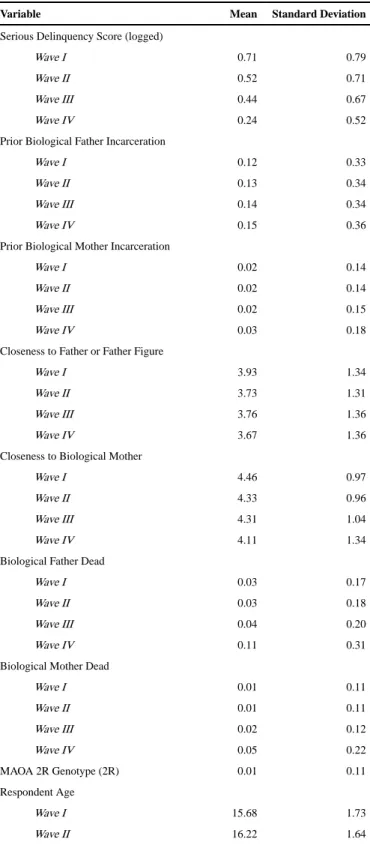
Means and standard deviations for the sample are described in Table 2.
Tables 3 and 4 report the results of multilevel regression estimates. Paternal risks are presented in Table 3 and maternal risks in Table 4. Models 1–4 of both tables show the main and moderating effects of paternal/maternal incarceration and the MAOA 2R gene, while Models 5–6 show the main and moderating role of mother/father closeness.
Father/Mother Incarceration
In both tables, Model 1 shows a strong and statistically significant association between delinquency and father (p < 0.001) and mother (p < 0.001) incarceration. Similarly, in Model 2, the MAOA 2R genotype has a strong and statistically significant main effect; those with the 2R allele are significantly more likely to engage in delinquent behaviors (b = 0.114, p = 0.036). In Model 3 of both tables, we find that the addition of either father or mother incarceration does not substantially alter the main effect of 2R: father incarceration (p < 0.001) and the 2R genotype (p = 0.038) retain similar effect magnitudes and are
simultaneously statistically significant, as do mother incarceration (p < 0.001) and the 2R allele (p = 0.035). These results provide strong evidence against the passive form of gene-environment correlation (rGE) for the 2R allele, parental incarceration, and delinquent behaviors.
In Model 4 of both tables, we include an interaction term between mother/father incarceration and the 2R genotype. For the Fix2R interaction, father incarceration (p < 0.001) remains significant, while the associations for both the 2R genotype and interaction term fall below the threshold of statistical significance. Similarly, mother incarceration (p < 0.001) remains highly significant, while both the 2R genotype and interaction term remain non-significant.
In sum, mother incarceration, father incarceration, and the 2R genotype all have direct and statistically significant associations with delinquency, but neither the MIx2R nor the FIx2R interaction is significant. This suggests that both the 2R genotype and mother/father incarceration (directly, along with associated variables such as parental criminality, family instability, poverty, etc.) exert largely independent effects on sons’ adolescent and adult problem behavior. These findings do not support the social trigger model of gene-environment interaction, nor suggest a gene-gene-environment correlation.
A
uthor Man
uscr
ipt
A
uthor Man
uscr
ipt
A
uthor Man
uscr
ipt
A
uthor Man
uscr
Father/Mother Closeness
In Models 5 and 6 of Tables 3–4, we examine how maternal and paternal closeness may potentially moderate the effects of the 2R genotype when parental incarceration is
controlled. Model 5 in Tables 3 and 4 provides a baseline relative to Model 3. Table 3 shows a statistically significant inverse relationship between father closeness and delinquency (b = −0.33, p < 0.001): delinquency declines with increasing closeness to the father. At the same time, the 2R genotype remains significant (p = 0.022), while father incarceration (p < 0.001) remains highly statistically significant. Table 4 shows an equally significant, inverse relationship between mother closeness and delinquency (b = −0.32, p < 0.001). The 2R genotype remains a statistically significant factor (p = 0.035) as in Models 1–4, along with maternal incarceration (p < 0.001).
Model 6 in Tables 3–4 shows the interaction between mother-father closeness and the 2R genotype. In Table 3, the main effect of the 2R genotype remains statistically significant (p = 0.035), while the main effect of father closeness is negative and highly significant (p < 0.001). The interaction is also significant (b = −0.086, p = 0.012), and its direction suggests that father closeness reduces the risks associated with the 2R allele; these findings support the social control model described above. We did not find a significant interaction between maternal closeness, the 2R allele, and delinquency.
Figure 1 shows the predicted level of delinquency for the interaction between MAOA 2R and father closeness. Among those who do not report being close to a father or father figure, respondents with a MAOA 2R genotype have a predicted delinquency score approximately 1.6 times higher (p < 0.001) than those without this genotype. As reported closeness to a father or father figure increases, the difference in delinquency between the two groups declines. When respondents report being very close to their father or father figure, those with the MAOA 2R genotype have a higher, but not statistically different level of
delinquency; when they report the highest level of closeness, the two groups have identical predicted levels of delinquency.
Overall, moderation patterns suggest that the main effect of 2R is moderated by closeness of the respondent to the father, and not by closeness to the biological mother. Research suggests that absence of and lack of closeness to a father (biological or otherwise) reduces delinquency and risk of incarceration (Booth, Scott, & King, 2010; Demuth & Brown, 2004; Harper & McLanahan, 2002). Our findings generally fit those reported by Johnson (1987), where father closeness was a more significant predictor of delinquency and maternal closeness did not vary significantly within the sample.
Although we controlled for race/ethnicity in all models, misleading results due to population stratification are a potential issue with our analysis. This arises because of the
disproportionate concentration of the 2R allele among blacks in our sample and increased levels of externalizing behaviors among non-Hispanic black compared to non-Hispanic white males. To test against this possibility that 2R was a proxy for socially defined racial identification, we evaluated the same models among black males only. We replicated the statistical and substantive results described above (results available upon request). In short,
A
uthor Man
uscr
ipt
A
uthor Man
uscr
ipt
A
uthor Man
uscr
ipt
A
uthor Man
uscr
these ancillary analyses provide strong evidence that our results are not being driven by population stratification.
Discussion
Research on gene-environment interplay has produced exciting but sometimes contradictory results (Caspi et al., 2002; Freese & Shostak, 2010). In this study, we show that social resources and protective factors may be more salient moderators of genetic influences on delinquent behavior than social risks or stressors, a finding consistent with other studies in this area (Guo, Roettger, & Cai, 2008; Boardman et al., 2011). Importantly, the finding that closeness to a father decreases the influence of a risky genotype aligns with previous research. In contrast, the effect of the 2R genotype on delinquency is not moderated by closeness to the biological mother, though increased maternal closeness, generally, is associated with reduced delinquency. While our results are in-line with prior research, we encourage future researchers to examine comparable associations with independent samples, particularly given the paucity of data analyzing the MAOA 2R genotype in existing research.
How do we explain the moderation effects among our panel? As we discuss in more detail below, data limitations make it important to avoid making causal inferences from the analysis. However, it is possible to deduce some basic conclusions. The fact that both the 2R genotype and father/mother incarcerations exert strong and significant main effects, but show little or no interaction for those with the 2R genotype is noteworthy. It suggests that father/mother incarceration and the 2R genotype are largely independent effects. Instead, father closeness is the only variable found to moderate the 2R genotype, even when we control for father incarceration. This result fits with the general findings that closeness to a father, either biological or non-biological, reduces delinquency, while absence of a father increases risk of delinquency and incarceration (Booth, Scott, & King, 2010; Demuth & Brown, 2004; Harper & McLanahan, 2002). The results also fit the GxE model of social
control,8 through which environmental variables moderate the expression of the 2R
genotype on delinquent behavior.
The rise of mass incarceration in recent decades has resulted in parental incarceration becoming a common lifecourse event (Western & Wildeman, 2009). While the 2R genotype may be associated with increased risk of arrest, incarceration and antisocial behavior (Beaver et al, 2013), we did not observe rGE or GxE interactions between mother/father incarceration and 2R. This lack of association may be a result of statistical error, but also may suggest that parental incarceration and associated delinquency may not constitute environments which socially trigger the 2R-delinquency association. Recent scholarship has suggested that the effects of parental incarceration on children is a result of an array of a
8Alternatively, an evocative gene-environment correlation may explain the moderation for father-only results. For example, respondents with the 2R genotype may be less close to their fathers with increased 2R-related delinquency due to their imprisonment, or fathers distancing themselves from their children. It is also important to consider that father closeness could very well be shaped by other genetic polymorphisms across the genome. This is not the case with the 2R genotype in the MAOA gene because boys must have inherited this from their mothers but this is not meant to imply that father closeness does not have genetic underpinnings. Simply, that it cannot be the case with this specific genotype. The assortative mating literature has shown that genetically similar individuals are more likely to enter an marriage than genetically dissimilar persons (Domingue, Fletcher, Conley, & Boardman, 2014) and partners also sort on antisocial behaviour (**Kruger, Moffitt, Caspi, Bleske, & Silva, 1998) but we are unware of any study demonstrating assortative mating by the 2R allele in MAOA. We encourage future work to consider this idea.
A
uthor Man
uscr
ipt
A
uthor Man
uscr
ipt
A
uthor Man
uscr
ipt
A
uthor Man
uscr
complex set of related events, which may include social, biological, familial, and developmental factors (Giordano & Copp, 2015; Roettger, 2015); consequently, this may imply that more complex gene-environment interactions may also explain results.
Genetic propensities may thus, instead, be moderated more by factors that control
delinquency, such as families. In accord with the rise of single-parent families over the last half-century (Livingston & Parker, 2011), roughly one-third of males in our sample report not residing with both biological parents at Wave I. The lack of a resident father is associated with an increase in delinquency (Booth, Scott, & King, 2010), with father involvement and closeness also generally declining over time as years progress beyond the father’s departure (Livingston & Parker, 2011; Cheadle, Amato, & King, 2010). Families where a father has undergone incarceration experience relationship instability and lack of a stable father or father figure, arising from separation during incarceration, relationship instability, and the gatekeeping role mothers frequently use to limit father-child involvement after a biological father is released (Braman, 2004; Roy & Dyson, 2005; Swisher & Waller, 2008). These conditions create environments where the lack of close father or father-figure favors expression of 2R-related delinquency, & not genetic transmission of delinquency. In an era when mass incarceration, (lack of) stable familial relationships restraining deviant behaviors may drive intergenerational criminal justice involvement vis-à-vis social
conditions where social environments may lead to intergenerational incarceration in families which have genetic propensities for delinquency.
Regardless, many familial, social, and neighborhood factors are thought to influence intergenerational delinquency, including low socioeconomic status, abusive parenting, low self-control, lack of prosocial parenting skills, family instability, friendships, and poor school and neighborhood environments (Boutwell & Beaver, 2010; Farrington et al., 2009; Roettger & Swisher, 2011; Thornberry et al., 2003). What is sometimes called a
“criminogenic environment” is associated with early-onset offending (Moffitt, 1993; Tibbetts & Piquero, 1999) and implicated in the link between parental incarceration and child antisocial behavior/delinquency (Wakefield & Wildeman, 2011; Farrington, 2011). While our observations with the 2R genotype are not consistent with those of DeLisi and colleagues (2009), this does not invalidate their findings, but rather highlights the variation in the types of gene-environment interplay at work in complex phenotype like delinquency. The interplay of thousands of genetic and environmental variables is further complicated when millions of genetic markers are assessed across the genome. As the results of null findings from one recent genome-wide-association-study for delinquency by Tuvblad and colleagues (2011) suggests, fitting these pieces together into a coherent story while accounting for both type I and type II errors is a Herculean task (Turkheimer, 2012). By examining gene-candidates and arrays of genes on the X or Y chromosomes which are linked with delinquency which can be exploited by study design, rather than entire genomes, we believe it is possible to make some inference about underlying gene-environment interplay while reducing issues with multiple testing that may lead to null effects. Such research is necessary to unravel the complex causation underlying the genetic and social factors which may lead the more easily observed pattern of crime occurring within families.
A
uthor Man
uscr
ipt
A
uthor Man
uscr
ipt
A
uthor Man
uscr
ipt
A
uthor Man
uscr
Acknowledgments
This research uses data from The National Longitudinal Study of Adolescent to Adult Health (Add Health), a program project directed by Kathleen Mullan Harris and designed by J. Richard Udry, Peter S. Bearman, and Kathleen Mullan Harris at the University of North Carolina at Chapel Hill, and funded by Grant P01-HD31921 from the Eunice Kennedy Shriver National Institute of Child Health and Human Development, with cooperative funding from 23 other federal agencies and foundations. Special acknowledgment is due to Ronald R. Rindfuss and Barbara Entwisle for assistance in the original design. Information on how to obtain the Add Health data files is available on the Add Health website (http://www.cpc.unc.edu/addhealth). No direct support was received from Grant P01-HD31921 for this analysis. Research funding was provided by a grant to the National Center for Family and Marriage Research from the U.S. Department of Health and Human Services, Office of the Assistant Secretary for Planning and Evaluation, grant number 1 U01 AE000001-01, the National Institute of Child Health and Human Development (R01HD060726), and the NIH/NICHD funded CU Population Center (R24HD066613). The opinions and conclusions expressed herein are solely those of the author(s) and should not be construed as representing the opinions or policy of any agency of the federal government.
References
Allison, PD. Missing data. Thousand Oaks, CA: Russell Sage; 2001.
Allison, PD. Fixed effect regression models. Thousand Oaks, CA: Russell Sage; 2009.
Braman, D. Doing time on the outside: Incarceration and family life in urban america. New York: New York University Press; 2004.
Armstrong TA, Boutwell BB, Flores S, Symonds M, Keller S, Gangitano DA. Monoamine oxidase A genotype, childhood adversity, and criminal behavior in an incarcerated sample. Psychiatric Genetics. 2014; 24(4):164–171. [PubMed: 24983833]
Barnes JC, Wright JP, Boutwell BB, Schwartz JA, Connolly EJ, Nedelec JL, Beaver KM. Demonstrating the validity of twin research in criminology. Criminology. 2014; 52(4):588–626. Beaver KM. Genetic influences on being processed through the criminal justice system: results from a
sample of adoptees. Biological Psychiatry. 2011; 69:282–287. [PubMed: 21071016]
Beaver KM. The familial concentration and transmission of crime. Criminal Justice and Behavior. 2013; 40:139–155.
Beaver KM, Barnes JC, Boutwell BB. The 2-repeat allele of the MAOA gene confers an increased risk for shooting and stabbing behaviors. Psychiatric quarterly. 2014; 85(3):257–265. [PubMed: 24326626]
Beaver KM, DeLisi M, Vaughn MG, Barnes JC. Monoamine oxidase A genotype is associated with gang membership and weapon use. Comprehensive Psychiatry. 2010; 51(2):130–134. [PubMed: 20152292]
Beaver KM, DeLisi M, Vaughn MG, Wright JP. The intersection of genes and neuropsychological deficits in the prediction of adolescent delinquency and low self-control. International Journal of Offender Therapy and Comparative Criminology. 2010; 54:22–44. [PubMed: 18955512] Beaver KM, Wright JP, Boutwell BB, Barnes JC, DeLisi M, Vaughn MG. Exploring the association
between the 2-repeat allele of the MAOA gene promoter polymorphism and psychopathic personality traits, arrests, incarceration, and lifetime antisocial behavior. Personality and Individual Differences. 2013; 54:164–168.
Boardman JD, Blalock CL, Pampel F, Hatemi P, Heath A, Eaves L. Population composition, public policy, and the genetics of smoking. Demography. 2011; 48(4):1517–1533. [PubMed: 21845502] Boardman JD, Menard S, Roettger ME, Knight KE, Boutwell B, Smolen A. Genes in the
dopaminergic system and delinquent behaviors across the life course: the role of social controls and risks. Criminal Justice & Behavior. 2014; 41(6):713–731. [PubMed: 25419014]
Booth A, Scott ME, King V. Father residence and adolescent problem behavior: are youth always better off in two-parent families? Journal of Family Issues. 2010; 31(5):585–605. [PubMed: 20379350]
Bosick SJ. Operationalizing crime over the life course. Crime & Delinquency. 2009; 55:472–496. Boutwell BB, Beaver KM. The intergenerational transmission of low self-control. Journal of Research
on Crime & Delinquency. 2010; 47:174–209.
A
uthor Man
uscr
ipt
A
uthor Man
uscr
ipt
A
uthor Man
uscr
ipt
A
uthor Man
uscr
Caspi A, McClay J, Moffitt TE, Mill J, Martin J, Craig IW, Taylor A, Poulton R. Role of genotype in the cycle of violence in maltreated children. Science. 2002; 297:851–54. [PubMed: 12161658] Caspi A, Sugden K, Moffitt TE, Taylor A, Craig IW, Harrington HL, Poulton R. Influence of life stress
on depression: moderation by a polymorphism in the 5-HTT gene. Science. 2003; 301:386–389. [PubMed: 12869766]
Chantala, K., Kalsbeek, WD., Andraca, E. Non-response in wave iii of the add health study. Chapel Hill, NC: Carolina Population Center; 2004. Available online at: https://www.cpc.unc.edu/projects/ addhealth/data/guides/W3nonres.pdf
Cheadle JE, Amato PR, King V. Patterns of nonresident father contact. Demography. 2010; 47:205– 225. [PubMed: 20355691]
DeLisi M, Beaver KM, Vaughn MG, Wright JP. All in the family: Gene x environment interaction between DRD2 and criminal father is associated with five antisocial phenotypes. Criminal Justice & Behavior. 2009; 36:1187–1197.
Demuth S, Brown SL. Family structure, family processes, and adolescent delinquency: The significance of parental absence versus parental gender. Journal of Research on Crime & Delinquency. 2004; 41:58–81.
DiLalla LF, Gottesman II. Biological and genetic contributors to violence: Widom’s untold tale. Psychological Bulletin. 1991; 109:125–129. [PubMed: 2006224]
Domingue BW, Fletcher J, Conley D, Boardman JD. Genetic and educational assortative mating among US adults. Proceedings of the National Academy of Sciences. 2014; 111(22):7996–8000. Draper A, Hancock M. Childhood parental bereavement: The risk of vulnerability to delinquency and
factors that compromise resilience. Mortality. 2011; 16(4):285–306.
Duncan LE, Keller MC. A critical review of the first ten years of candidate gene-by-environment interaction research in psychiatry. American Journal of Psychiatry. 2011; 168:1041–1049. [PubMed: 21890791]
Eisenberger NI, Way BM, Taylor SE, Welch WT, Lieberman MD. Understanding genetic risk for aggression: clues from the brain’s response to social exclusion. Biological Psychiatry. 2007; 61(9): 1100–1108. [PubMed: 17137563]
Ellis L. Genetics and criminal behavior: evidence through the end of the 1970s. Criminology. 1982; 20:43–66.
Farrington, DP. Families and crime. In: Wilson, JQ., Petersilia, J., editors. Crime and public policy. 3rd. Oxford; Oxford University Press; 2011. p. 130-157.
Farrington DP, Coid JW, Murray J. Family factors in the intergenerational transmission of offending. Criminal Behavior and Mental Health. 2009; 19:109–124.
Farrington, DP., Welsh, BC. Saving children from a life of crime: early risk factors and effective interventions. Oxford; Oxford University Press; 2007.
Fergusson DM, Boden JM, Horwood LJ, Miller A, Kennedy MA. Moderating role of the MAOA genotype in antisocial behavior. British Journal of Psychiatry. 2012; 200(2):116–123. [PubMed: 22297589]
Ficks CA, Waldman ID. Candidate genes for aggression and antisocial behavior: A meta-analysis of association studies of the 5HTTLPR and MAOA-uVNTR. Behavioral Genetics. 2014; 44(5):1–18. Ford CA, Bearman PS, Moody J. Foregone health care among adolescents. Journal of the American
Medical Association. 1999; 282:2227–2234. [PubMed: 10605974]
Freese J, Shostak S. Genetics and Social Inquiry. Annual Review of Sociology. 2010; 35:107–128. Giordano, PC. Legacies of crime: A follow-up of the children of highly delinquent girls and boys.
Cambridge: Cambridge University Press; 2010.
Giordano PC, Copp JE. Packages of risk. Criminology & Public Policy. 2015; 14(1):157–168. [PubMed: 26617473]
Guo G, Roettger ME, Cai T. The integration of genetic propensities into a social control model of delinquency. American Sociological Review. 2008; 73:543–568.
Guang G, Ou XM, Roettger ME, Shih JC. The MAOA VNTR 2-repeat, youth delinquency, their associations, and MAOA VNTR promoter activity. European Journal of Human Genetics. 2008; 16:626–634. [PubMed: 18212819]
A
uthor Man
uscr
ipt
A
uthor Man
uscr
ipt
A
uthor Man
uscr
ipt
A
uthor Man
uscr
Halaby CN. Panel models in sociological research: Theory into practice. Annual Review of Sociology. 2004; 30:507–544.
Harper C, McLanahan S. Father absence and youth incarceration. Journal of Research on Adolescence. 2002; 14:369–397.
Harris, KM., Halpern, CT., Whitsel, E., Hussey, J., Tabor, J., Udry, JR. The National Longitudinal Study of Adolescent Health: Research Design [WWW document]. 2009. URL: http:// www.cpc.unc.edu/projects/addhealth/design
Harris, KM., Ryan, S. Father involvement and the diversity of family context. In: Lamb, M., editor. Conceptualizing and Measuring Father Involvement. Mahwah, NJ: Lawrence Erlbaum Associates; 2003. p. 293-319.
Hindelang MJ. Variations in sex-race-age-specific incidence rates of offending. American Sociological Review. 1981; 46:461–474.
Jaffee SR, Price TS. Gene-environment correlations: a review of the evidence and implications for prevention of mental illness. Molecular Psychiatry. 2007; 12:432–442. [PubMed: 17453060] Johnson EI, Easterling B. Understanding unique effects of parental incarceration on children:
Challenges, progress, and recommendations. Journal of Marriage and Family. 2012; 74(2):342– 356.
Johnson RE. Mother’s versus father’s role in causing delinquency. Adolescence. 1987; 22:305–315. [PubMed: 3618333]
Kim-Cohen J, Caspi A, Taylor A, Williams B, Newcombe T, Craig IW, Moffitt TE. MAOA, early adversity, and gene-environment interaction predicting children’s mental health: New evidence and a meta-analysis. Molecular Psychiatry. 2006; 11:903–913. [PubMed: 16801953]
Krueger RF, Moffitt TE, Caspi A, Bleske A, Silva PA. Assortative mating for antisocial behavior: Developmental and methodological implications. Behavior genetics. 1998; 28(3):173–186. [PubMed: 9670593]
Livingston, G., Parker, K. A tale of two fathers: More are active, but more are absent. Washington, D.C.: Pew Research Foundation; 2011. Available online at: http://www.pewsocialtrends.org/files/ 2011/06/fathers-FINAL-report.pdf
Meyer-Lindenberg A, Buckholtz JW, Kolachana B, Hariri AR, Pezawas L, Blasi G, Weinberger DR. Neural mechanisms of genetic risk for impulsivity and violence in humans. Proceedings of the National Academy of Sciences. 2006; 103(16):6269–6274.
Miller HV, Barnes JC. Genetic transmission effects and intergenerational contact with the criminal justice system: a consideration of three dopamine polymorphisms. Criminal Justice and Behavior. 2013; 40(6):671–689.
Moffitt TE. Adolescence-limited and life-course-persistent antisocial behavior: A developmental taxonomy. Psychological Review. 1993; 100(4):674–701. [PubMed: 8255953]
Mumola, CJ. Incarcerated parents and their children. Washington, DC: Bureau of Justice Statistics; 2000. Available online at: http://bjs.ojp.usdoj.gov/index.cfm?ty=pbdetail&iid=981
Murray, J., Bijleveld, CCJH., Farrington, DP., Loeber, R. Effects of parental imprisonment on children: Cross-national comparative studies. Washington, DC: American Psychological Association; 2014. Murray J, Farrington DP. The effects of parental imprisonment on children. Crime and Justice. 2008;
37:133–206.
Murray J, Farrington DP, Sekol I. Children’s antisocial behavior, mental health, drug use, and educational performance after parental incarceration: A systematic review and meta-analysis. Psychological bulletin. 2012; 138(2):175–210. [PubMed: 22229730]
Murray J, Loeber R, Pardini D. Parental involvement in the criminal justice system and the development of youth theft, marijuana use, depression, and poor academic performance. Criminology. 2012; 50:255–302.
Robison, SM. Can delinquency be measured?. New York: Columbia University Press; 1936. Roettger ME. Promoting child wellbeing among children who experience maternal incarceration.
Criminology & Public Policy. 2015; 14:121–124.
Roettger ME, Swisher RR. Associations of father’s history of incarceration with delinquency and arrest among black, white, and Hispanic males in the US. Criminology. 2011; 49:1109–1147.
A
uthor Man
uscr
ipt
A
uthor Man
uscr
ipt
A
uthor Man
uscr
ipt
A
uthor Man
uscr
Roy K, Dyson OL. Gatekeeping in context: Babymama drama and the involvement of incarcerated fathers. Fathering. 2005; 3:289–310.
Rowe DC, Farrington DP. The familial transmission of criminal convictions. Criminology. 1997; 35:177–201.
Sabol SZ, Hu S, Hamer D. A functional polymorphism in the monoamine oxidase A gene promoter. Human Genetics. 1998; 103:273–279. [PubMed: 9799080]
Sampson RJ. The incarceration ledger: Toward a new era of assessing societal consequences. Criminology & Public Policy. 2011; 10:819–828.
Sampson, RJ., Laub, JH. Crime in the making: Pathways and turning points through life. Cambridge, MA: Harvard University Press; 1993.
Shanahan, MJ., Boardman, JD. Gene-environment interplay across the life course: overview and problematics at a new frontier. In: Giele, JZ., Elder, GH., Jr, editors. Methods of life course research: qualitative and quantitative approaches. Thousand Oaks, CA: Sage; 2009. p. 215-235. Shanahan MJ, Hofer SM. Social context in gene-environment interactions: Retrospect and prospect.
The Journals of Gerontology, Series B. 2005; 60B:65–76.
Simons RL, Lei M, Beach SRH, Brody GH, Philibert RA, Gibbons FX. Social environmental variation, plasticity genes, and aggression: evidence for the differential susceptibility hypothesis. American Sociological Review. 2011; 76:883–912.
Stetler DA, Davis C, Leavitt K, Schriger I, Benson K, Bhakta S, Bortolato M. Association of low-activity MAOA allelic variants with violent crime in incarcerated offenders. Journal of Psychiatric Research. 2014; 58:69–75. [PubMed: 25082653]
Suri D, Teixeira CM, Cagliostro MKC, Mahadevia D, Ansorge MS. Monoamine-sensitive developmental periods impacting adult emotional and cognitive behaviors.
Neuropsychopharmacology. 2015; 40:88–112. [PubMed: 25178408]
Swisher RR, Roettger ME. Father’s incarceration and youth delinquency and depression: Examining differences by race and ethnicity. Journal of Research on Adolescence. 2012; 22:597–603. [PubMed: 23264723]
Swisher RR, Waller MR. Confining fatherhood: Incarceration and paternal involvement among unmarried white, African American, and Latino Fathers. Journal of Family Issues. 2008; 29(8): 1067–1088.
Thornberry TP. Explaining multiple patterns of offending across the life course and across generations. Annuals of the American Academy of Political and Social Sciences. 2005; 602:156–195.
Thornberry TP. The apple doesn’t fall far from the tree (or does it?): Intergenerational patterns of antisocial behavior. Criminology. 2009; 47:297–325. [PubMed: 25308976]
Thornberry TP, Freeman-Gallant A, Lizotte AJ, Krohn MD, Smith CA. Linked lives: The intergenerational transmission of antisocial behavior. Journal of Abnormal Child Psychology. 2003; 31:171–184. [PubMed: 12735399]
Thornberry, TP., Krohn, MD. Criminal Justice 2000. Vol. 4. Washington, DC: National Institute of Justice; 2000. The self-report method for measuring delinquency and crime; p. 33-83.
Tielbeek JJ, Medland SE, Benyamin B, Byrne EM, Heath AC, Madden PAF, Verweij K. Unraveling the genetic etiology of adult antisocial behavior: a genome-wide association study. PLoS ONE. 2012; 7(10):e45086. [PubMed: 23077488]
Tiihonen J, Rautiainen MR, Ollila HM, Repo-Tiihonen E, Virkkunen M, Palotie A, Paunio T. Genetic background of extreme violent behavior. Molecular Psychiatry. 2014; 20:786–792. [PubMed: 25349169]
Turkheimer, E. Genome wide association studies of behavior are social science. In: Plaisance, KS., Reydon, TAC., editors. Philosophy of Behavioral Biology. New York, NY: Springer; 2012. p. 43-64.
Tuvblad C, Narusyte J, Grann M, Sarnecki J, Lichtenstein P. The genetic and environmental etiology of antisocial behavior from childhood to emerging adulthood. Behavioral Genetics. 2011; 41:629– 640.
Wakefield S, Wildeman C. Mass imprisonment and racial disparities in childhood behavioral problems. Criminology & Public Policy. 2011; 10:791–817.
A
uthor Man
uscr
ipt
A
uthor Man
uscr
ipt
A
uthor Man
uscr
ipt
A
uthor Man
uscr
Western B, Wildeman C. The black family and mass incarceration. Annals of the American Academy of Political and Social Science. 2009; 621(1):221–242.
Wildeman C, Wakefield S, Turney K. Misidentifying the effects of parental incarceration? A comment on Johnson and Easterling (2012). Journal of Marriage and Family. 2013; 75(1):252–258.
A
uthor Man
uscr
ipt
A
uthor Man
uscr
ipt
A
uthor Man
uscr
ipt
A
uthor Man
uscr
Figure 1.
Interaction of MAOA 2R Genotype and Father Closeness in Predicting Delinquency. Note: Estimates derived from Model 6 of Table 2.
A
uthor Man
uscr
ipt
A
uthor Man
uscr
ipt
A
uthor Man
uscr
ipt
A
uthor Man
uscr
A
uthor Man
uscr
ipt
A
uthor Man
uscr
ipt
A
uthor Man
uscr
ipt
A
uthor Man
uscr
ipt
Table 1
Behavioral genetics models associated with MAOA-2R and common parent environmental moderator predicting son’s delinquency
Significance of Mother Environment-MAOA 2R Moderation
Significance For Father Environment-MAOA Moderation
Potential Behavioral Genetic Patterns of Inference
Biological Mother Incarceration Biological Father Incarceration
No No No GxE or rGE
Yes No Passive rGE or Social Trigger GxE
No Yes Social trigger GxE
Yes Yes rGE and GxE
Biological Mother Closeness Biological/Non-Biological Father Closeness
No No No GxE or rGE
Yes No Evocative rGE or Social Control GxE
No Yes Social control GxE
Yes Yes rGE and GxE
A
uthor Man
uscr
ipt
A
uthor Man
uscr
ipt
A
uthor Man
uscr
ipt
A
uthor Man
uscr
ipt
Table 2
Descriptive statistics for all variables used in the analyses
Variable Mean Standard Deviation
Serious Delinquency Score (logged)
Wave I 0.71 0.79
Wave II 0.52 0.71
Wave III 0.44 0.67
Wave IV 0.24 0.52
Prior Biological Father Incarceration
Wave I 0.12 0.33
Wave II 0.13 0.34
Wave III 0.14 0.34
Wave IV 0.15 0.36
Prior Biological Mother Incarceration
Wave I 0.02 0.14
Wave II 0.02 0.14
Wave III 0.02 0.15
Wave IV 0.03 0.18
Closeness to Father or Father Figure
Wave I 3.93 1.34
Wave II 3.73 1.31
Wave III 3.76 1.36
Wave IV 3.67 1.36
Closeness to Biological Mother
Wave I 4.46 0.97
Wave II 4.33 0.96
Wave III 4.31 1.04
Wave IV 4.11 1.34
Biological Father Dead
Wave I 0.03 0.17
Wave II 0.03 0.18
Wave III 0.04 0.20
Wave IV 0.11 0.31
Biological Mother Dead
Wave I 0.01 0.11
Wave II 0.01 0.11
Wave III 0.02 0.12
Wave IV 0.05 0.22
MAOA 2R Genotype (2R) 0.01 0.11
Respondent Age
Wave I 15.68 1.73
A
uthor Man
uscr
ipt
A
uthor Man
uscr
ipt
A
uthor Man
uscr
ipt
A
uthor Man
uscr
ipt
Variable Mean Standard Deviation
Wave III 21.91 1.84
Wave IV 28.49 1.84
Race
Non-Hispanic White [Reference] 0.54 0.50
Non-Hispanic Black 0.20 0.40
Hispanic 0.16 0.37
Asian 0.07 0.25
Native American 0.02 0.13
Other Race 0.01 0.09
Resided with Both Biological Parents at Wave I 0.56 0.5
Parent Completed BA 0.25 0.43
Percentage of Census Tract African American 0.15 0.25
Violent Crime Rate 1.98 0.16
Number of Respondents 6001 6001