This project is dedicated to the memory of Dr. Bruno Erwan Louchouarn (1959 – 2018)
Acknowledgements
I would like to express my sincerest thanks to my advisor at the University of North Carolina at Chapel Hill, Dr. John Pickles, for his invaluable guidance, perspective, and consultation during the development and realization of this project and for his constant encouragement, constructive critisicm, and insitence on geographic
thinking. I would also like to thank Dr. Chad Bryant, who sparked my fascination with Prague and introduced me its literary and urban history, and who has
continued to support my interest in all things Prague. To my reader Dr. Christian Lentz I would like to extend my thanks for his advice and assistance throuhgout my research and writing process.
I would like to extend a heartfelt děkuji to my hosts in Prague, Lenka Honzová and Honza Urbánek, for opening their home to me and showing me around the city, and to my colleagues at Charles University who connected me to their vibrant academic community: Luděk Sýkora, Petr Pavlinek, Tereza Freidingerová, Branislav Machela, among many others too numerous to name here.
Table of Contents
Abstract ... 1
Introduction: The Marketplace ... 2
Research Design ... 8
A Note on Terminology ... 9
I: The Production of Space in the Post-Socialist City ... 12
Situating Sapa ... 12
Legacies of Socialism on the Urban Periphery ... 14
The Question of Ownership ... 25
Public Spaces, Private Property, and Socialism ... 26
Toward a Lefebvrian Reading ... 29
II: The Vietnamese in Czech(oslovak)ia ... 31
The Praktikanti & Historical Immigration Patterns ... 31
Contemporary Immigration Patterns ... 32
Media & Scholoarly Representations of the Vietnamese ... 36
English-Language & Foreign Media ... 38
A Novel Spatial Form? ... 42
Fractured & Multiple Geographies ... 44
III: Informality and the “Secondary Economy” ... 46
Informality & “Open” Borders ... 46
A Diverse Economy... 48
Conclusion: Toward the City as a Text ... 51
List of Figures
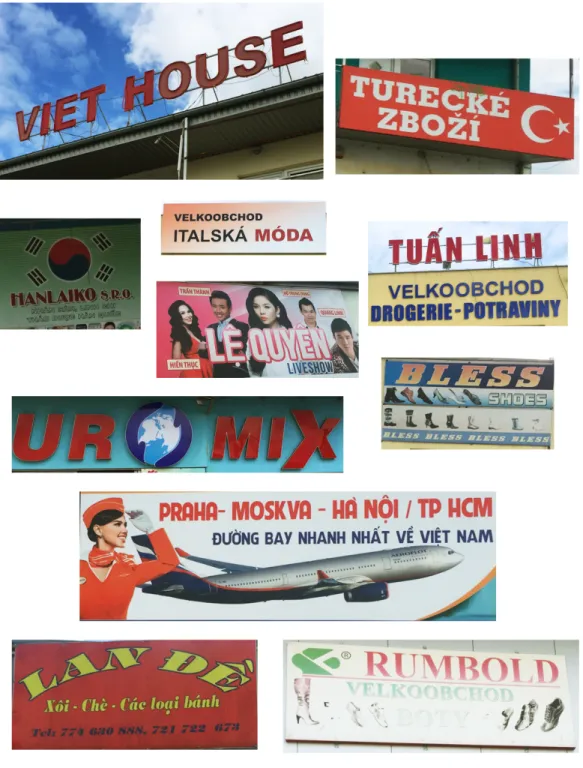
Figure 1: A streetscape just north of Sapa’s main entry gate (Author photo). ... 3 Figure 2: The flag of Vietnam flies over Sapa’s Buddhist shrine, one of only a few in Prague (Author photo)... 4 Figure 3: A multilingual advertisement in Czech and Vietnamese for flights from Prague to Hanoi on Aeroflot, the Russian national air carrier (Author photo). ... 5 Figure 4: The various signs on display at Sapa (Author photos). ... 6 Figure 5: The Sapa site, center, as it appears in a 2018 aerial photograph (I.P.R. Praha GIS Database). ... 14 Figure 6: A 1971 city map of Prague does not depict the future Sapa site (Prague City Archives). ... 15 Figure 7: The Masokombinat site is depicted on a 1979 plan of the city of Prague (Prague City Archives). ... 16 Figure 8: A 1945 aerial photo of the present-day site of Sapa Marketplace, near the village of Libuš (upper left) south of Prague’s historical center (I.P.R. Praha GIS Database). ... 17 Figure 9: A 1953 area photograph looks much the same as the 1945 photograph; however, the collectivization of agricultural land is evident in the erasure of
boundaries between plots (I.P.R. Praha GIS Database). ... 18 Figure 10: The construction site of the Masokombinat Libuš as it appeared in a 1975 aerial photograph. The main building of the southern area of the complex, which today houses merchants and wholesalers, appears nearly finished (I.P.R. Praha GIS Database). ... 19 Figure 11: The finished Masokombinat pictured in a 1988 or 1989 aerial photograph. The northern area of the site, constructed after the southern area, is now visible (I.P.R. Praha GIS Database). ... 20 Figure 12: The site as it appeared in 1996, relatively unchanged from seven years prior (I.P.R. Praha GIS Database). ... 22 Figure 13: A 2000 aerial photo shows new temporary market halls (I.P.R. Praha GIS Database). ... 23 Figure 14: Gibson-Graham’s diverse economy, diagrammed (Gibson-Graham,
“When I opened the newspaper on the morning of August 17, I saw the
headline “Market Crashes.” I’m not an economist and understand nothing of the enigmatic world of money. For me, the word “market” means open-air stands where old ladies from villages near Moscow sell cheap freshly picked mushrooms, garlic, potatoes, and dill, and men from the Caucasus whose teeth are capped in gold for the beauty and prestige of it offer unbelievably expensive peaches and a spicy sauce called adzhika—you taste a drop and flames leap out of your mouth.
Reading the words “market crashes,” I imagined dilapidated wooden stands collapsing and velvety peaches rolling across wet asphalt in consort with escaping potatoes.
Nonetheless I stopped in my tracks. No serious newspaper ever covers such trivial events on the first page.”
Abstract
Central and Eastern European post-Socialist states have undergone profound political and economic changes in the three decades since 1989. Though the dramatic transformations of the immediate post-Socialist period were highly visible and widely documented, recent political and economic developments are crucial to understanding the region’s contemporary conjuncture. A broad trend away from Liberalism and toward an emergent authoritarian politics, both in the Visegrad states and elsewhere, raises new uncertainties regarding the rule of law, the civil rights of minority groups, and the status of democratic rule. Meanwhile, the region’s increasingly globalized economies have variously embraced and shunned Western economic influence, maintaining and cultivating trade and political linkages with the former “Soviet ecumene” and in East Asia, notably China.
Amid these broad trends, novel forms of urban space locate and reveal a variety of perspectives on the nature of the Transition. Sapa Marketplace, a wholesale trade and cultural center outside of Prague, Czechia, illustrates how processes of spatial production and diverse economic practices are articulated to the materiality of post-Socialism. Reading Sapa in conversation with the physical
Introduction: The Marketplace
Sapa Marketplace is 66 acres of wholesale-retail-commercial-cultural-culinary-religious space on the outskirts of urban Prague. It is among the largest
marketplaces in Central and Eastern Europe. Known in the popular imagination of Praguers and many visitors to Czechia’s capital as “the Vietnamese market”, Sapa has been characterized in academic and popular writing as a marketplace (Drbohlav & Čermáková, 2016), a “bazaar” (Fiedlerová & Sýkora, 2015; Hüwelmeier 2013), described as “Little Hanoi” (Děd and de Babraque, 2010), and called “a Vietnamese paradise” (Storm, 2015).
Figure 1: A streetscape just north of Sapa’s main entry gate (Author photo).
There are wholesalers who deal only in multiples of one thousand; there are pensioners who come for a single bag of groceries. Worshippers offer incense at the base of a statue of the Buddha, one of Prague’s few public Buddhist temples.
Children play in and out of their parents’ storefronts while mothers tend cash registers, scale fish, prepare Che Ba Mau, and talk.
and Beijing. Three travel agencies, all within thirty seconds’ walk of one another, attract passers-by with signs in Chinese, Czech, English, and Vietnamese.
Figure 3: A multilingual advertisement in Czech and Vietnamese for flights from Prague to Hanoi on Aeroflot, the Russian national air carrier (Author photo).
The English section of another trilingual sign reads “Korea Mart and Asian Foods Supermarket”. Nearby, a store owner claims to be Czechia’s largest importer of traditional goods from India, Indonesia, and China. Around another corner a sign reads, “Turecké Zboží”—Turkish Goods—alongside the star and crescent.
Academic inquiry into Czechia’s Sapa is a relatively recent phenomenon, having emerged in earnest among Czech-speaking researchers just ten years ago. The past decade has produced a literature that tends to emphasize Sapa’s
resulting landscape—rich with “foreign” symbols such as Vietnamese-language signs and traditional Vietnamese cuisine—has drawn interest among the public and scholars alike to “the Vietnamese market”.
Existing readings of Sapa’s urban landscape present an opportunity to
interrogate what else is embedded in the workaday circumstances of this dynamic marketplace. This paper suggests multiple ways of seeing the landscape of Sapa Market, not only as an important cultural and commercial space for Central and Eastern European Vietnamese people but also as:
1. Reflective of the urban political economies of post-Socialism, especially the production of spaces that conform to post-Socialist political, social, and economic frameworks (Here I reference Henri Lefebvre’s Production of Space)
2. Exemplary of the fractured, multiple, and overlapping geographies of Socialism and post-Socialism, which defy unidimensional understanding (Here I reference Doreen Massey’s concepts of progressive sense of place and power geometries)
Research Design
Methodology & Approaches
This project has emerged from a lifetime of exposure to the expatriate communities of Central and Eastern Europe in Los Angeles, California and a longstanding desire to engage firsthand the landscape remembered to me at
countless gatherings of family and friends. My interest in post-Socialist cities began as an intern for a housing N.G.O. in Bratislava, Slovakia, where during the summer of 2016 I worked on a research project concerning the nature of public spaces in the post-Socialist period.
In first visited Prague in June 2016, but it wasn’t until a visit in the spring of 2017 that I happened to wander into a restaurant serving pho. After a short
conversation with the restaurant’s manager, I learned of Sapa. Intrigued by the possible geographies of such a marketplace, I made a mental note for the next time I visited.
In the fall of 2017, I began developing a research proposal that sought to understand how Vietnamese cuisine and foodways were legible in Prague’s
streetscape. After advice from three professors who would later become my advisors and readers—Profs. Chad Bryant, Christian Lentz, and John Pickles—I chose to pursue a research project centered on the physical landscape of Sapa Marketplace. In the spring of 2018, my proposal received funding from the Morehead-Cain
Foundation and I prepared to make a third trip to Prague.
and historical research. The conversations I had and observations I made guided further inquiry into disparate sources, from city archives to geotagged posts on social media to aerial photographs of the Sapa Marketplace site. The resulting work is a synthesis of these interrelated repositories and my personal notes, photographs, recordings, and memories.
I worked with a research group at Charles University to establish connections at Prague’s main archive, Archiv hlavního města Prahy, in Chodovec, and with Institut plánování a rozvoje hlavního města Prahy, the city’s institute of planning and urban design. With the help of my contacts at these organizations, I was able to arrange viewings of historical urban plans and access repositories of aerial
photography which illustrated how the site now home to Sapa was imagined and transformed over time. My interviews with numerous academics involved with these organizations contextualized my research process and allowed me to proceed with a better-informed perspective through many layers of data and bureaucracy.
I.P.R. Praha and the city of Prague maintain excellent online repositories of GIS data and imagery that were invaluable to my project. These repositories insured my ability to take my research from Prague back to North Carolina and continue my work throughout the fall of 2018 and the spring of 2019.
This combination of methodological approaches aims to interface with and extend existing literature, offering several cultural and historical geographic approaches to understanding the cityscape of post-Socialist Prague.
A Note on Terminology
Attempting to situate the marketplace in its urban context reveals the
has a dual meaning: there is the metaphorical marketplace (“the marketplace of ideas”) and the located marketplace (“the town’s marketplace”). I deal mostly with the second sense of the term— “Prague’s open-air marketplaces” —defined as a physical space where the exchange of goods takes place.
In Czech, there are multiple words that describe such a space. The first, trh, is closest to “market” in its definition and usage, meaning metaphorical and physical markets—take for example Uhelný trh, “Coal market”, a city square in Prague’s Old Town, or a recent headline in a Czech newspaper: “Klíčem úspěchu čínských
mobilních gigantů je domácí trh”: “The Key to Success for Chinese Mobile Giants is the Domestic Market”. Tržnice, “marketplace”, describes the physical space where goods are exchanged, as in the case of Pražská tržnice, which is shortened in
translation by its management as “Prague Market”. The third commonly-used term,
obchodní centrum (“commercial center”) takes as its root obchod, which can mean “store”, “trade”, or “business”. This term is used to describe urban shopping malls, suburban strip-mall developments, and other kinds of marketplaces: Sapa’s official name in Czech is Sapa Praha obchodní a kulturní centrum (“Prague Sapa Commercial
and Cultural Center”) and in Vietnamese, Trung Tâm Thuong Mai Sapa, (“Sapa
Trading Center”).
Scholars writing about Central and Eastern European marketplaces in English
have tended to adopt “bazaar” as a term to describe open-air marketplaces in the
region, yet there is a tendency to assign this term only to emergent marketplaces
managed by non-European minorities. Hüwelmeier (2013) situates her use of bazaar
to describe emergent urban marketplaces in Berlin, Prague, and Warsaw within
which constitutes “a particular kind of economy” in which “information is poor,
scarce, maldistributed, inefficiently communicated, and intensely valued” (Geertz,
1978; Hüwelmeier, 2013). Setting aside a broader terminological debate, I have
decided not to employ this term and its specific theoretical connotations to this
I: The Production of Space in the Post-Socialist City
The spatial transformation visible at Sapa in the two decades since the
marketplace’s founding reflects the ongoing processes by which spaces constructed in the Socialist conjuncture are reformed, reimagined, and reconstructed. The
transformation of spaces reflects the transformation of political, social, and economic condition. In reading the changing geographies of the cityscape, the conjunctural changes of the past decades are evident.
Situating Sapa
Sapa Marketplace is situated in the district Praha-Libuš, an outlying
neighborhood south of Prague’s historical center which was primarily farmland until the early 1970s. The village of Libuš, centered on an intersection to the north-west of the present-day marketplace, predates the intensive development of the area, which was initiated after the area was annexed into municipal administration in 1974. The site which now houses Sapa was originally constructed as an integrated complex of industrial, residential, and recreational buildings (a microdistrict or
mikrorayon, here from the Russian микрорайон): a meat processing factory (the
Masokombinat Libuš), residential tower-block apartments (typical prefabricated
uncertainty. During this time, informal and open-air markets emerged on underused “brownfield” sites around Prague, including the present-day Sapa site (Drbohlav & Čermáková, 2016). In 1999, the facility was sold to Vietnamese consortium of
investors doing business as Saparia, a.s., which established market stalls within existing warehouses and factory buildings, and made them available for rent to independent wholesalers and merchants (Fiedlerová & Sýkora, 2015; Freidingerová & Svobodová, 2015).
While Sapa was founded as a wholesale marketplace, mostly for soft goods and electronics, it has grown to accommodate a large variety of functions. One can find at Sapa “restaurants, grocery shops, hairdressers, nail studios, travel agencies, medical doctors, a nursery, a translation bureau, a wedding studio and a Buddhist pagoda” (Freidingerová & Svobodová, 2015). One can also find a unique streetscape characterized by multilingual signage, street-facing retail sales kiosks, and food and beverage stands.
Sapa is a focal point of Vietnamese culture, commerce, and social life not only in Prague, but in Czechia more broadly. “Unlike neighboring states,” write
Freidingerová & Svobodová, “the Vietnamese residing in Czechia are literally scattered all around the country, even in villages with less than 2,000 inhabitants” (Freidingerová & Svobodová, 2015). Because of the geographic distribution of Vietnamese people in Czechia, “Prague plays a very important role for the Vietnamese, mostly because of … the trade and cultural centre of Sapa”
Vietnamese at all” (Freidingerová & Svobodová, 2015). Furthermore, Sapa serves as a “gateway” not only for Vietnamese immigrants arriving to the Czech Republic, but also for Czechs who wish to learn more about Vietnamese culture (Freidingerová & Svobodová, 2015).
Figure 5: The Sapa site, center, as it appears in a 2018 aerial photograph (I.P.R. Praha GIS Database).
Legacies of Socialism on the Urban Periphery
The history of the Sapa site reveals how the physical structures of Socialism endure in the urban form of the marketplace and its surroundings.
gap in available aerial imagery; however, a 1971 city plan does not depict the site. Further, the 1971 plan shows that the administrative boundary of the city of Prague did not yet encompass the site that today houses Sapa.
Figure 9: A 1953 area photograph looks much the same as the 1945 photograph; however, the collectivization of agricultural land is evident in the erasure of boundaries between plots (I.P.R. Praha GIS
Database).
Figure 10: The construction site of the Masokombinat Libuš as it appeared in a 1975 aerial photograph. The main building of the southern area of the complex, which today houses merchants and wholesalers, appears
nearly finished (I.P.R. Praha GIS Database).
In 1989, on the eve of the Transition, aerial photographs show an expanded complex of factory and residential buildings now fully intertwined with the
Figure 11: The finished Masokombinat pictured in a 1988 or 1989 aerial photograph. The northern area of the site, constructed after the southern area, is now visible (I.P.R. Praha GIS Database).
Exactly what occurred with the Sapa site in the ten years following the Velvet Revolution is up for some debate, but a fractured portrait suggests a bungled privatization process with implications of fraud that resulted in the bankruptcy of the Kombinat facility. It is known that between 1995 and 1996 František Chvalovský, a Czech footballer and entrepreneur, took a majority stake in the privatized
successor to Masokombinat Libuš, which adopted the trade name “Satrapa” and sought to establish a group of meat producers at the former Kombinat. Plans
“tunneling”1, in which the remaining cash and solvent assets of one firm are fraudulently transferred to another through the “tunnel” of a dubious bankruptcy scheme, surround Satrapa’s ruin. The uncertain circumstances of Satrapa’s
insolvency were not ameliorated by the subsequent arrest at Prague airport of majority shareholder Chvalovský on February 27th, 2001 and his indictment for a fraud alleged at 640,000,000 Kč (Carey, 2000, Flint, 2017).
Saparia a.s., the consortium of investors that would come to own the Kombinat site, incorporated on October 5th, 1999. By early 2001 “cheap electronics and clothing” were already on sale at the Sapa site (Cizner, 2000). By 2003, shipping containers, that foundational symbol of globalizing trade, lined the fences that form the boundary of the Sapa site. Aerial photographs reveal how Saparia and its tenants appropriated, adapted, and reformed Socialist-era spaces to meet the needs of their enterprise.
In a 1996 aerial photograph, the site does not appear to be visibly different from the final aerial photograph of the Socialist era, taken in 1988 or 1989. But there are features of the landscape that should be noted as they served as the basis for the expansion and development of the Sapa site. Comparing aerial photographs year-by-year, numerous transformations of the landscape become evident.
Comparing aerial photos taken in 1996 and 2000, new structures are visible on the grounds of the former Masokombinat. These structures, which resemble the contemporary market warehouses at the Sapa site today, are temporary covered market halls. These market halls were built lining up dozens of
style mobile office modules and creating a covered corridor between them. The market halls, visible near the south-east side of the Sapa site, stand out for their multicolored appearance. Also visible are modular shops lining the boundary of the Sapa site. They are the first new structures to be built on site since the Socialist era.
Figure 13: A 2000 aerial photo shows new temporary market halls (I.P.R. Praha GIS Database).
Between 1995 and 2010, approximately ten to fifteen new buildings of various sizes, from small sheds to large warehouses, were constructed on the Sapa site. Between 2000 and 2003, the largest temporary market hall was demolished in order to construct a more permanent covered market hall in an adjacent area. By 2005, however, a second iteration of the temporary market hall is once again visible, having been built with the same dimensions as before but with materials different from the earlier building. Today, these large market halls house many of the marketplace’s soft goods merchants.
Wholesalers occupied the largest buildings, former factory floors and distribution warehouses, and established storefronts along their loading docks.
To the right of center of our aerial photo frame, a curious transformation took place between 2003 and 2007. An area that resembles a water storage or treatment facility appears to the right of center of an aerial photo taken in 2003. Over the intervening years, the circular tanks at the center of this area are used as the
foundations for cylindrical buildings capped with octagonal roofs. The ground-level appearance of this building today does not give away its industrial origins.
However, aerial photos reveal how inherited structures of the Socialist era were molded to the needs of the marketplace.
A transformation of green spaces is also visible in the aerial photo archive. Over the course of the late 1990s and early 2000s, the site’s landscaped grounds were gradually reappropriated for use as parking lots and building sites. A large buffer of trees and grass was removed to connect the north and south areas of the Sapa site. Swaths of grass were removed and paved over to create additional parking space.
A fire that occurred in November 2008 heavily damaged Sapa’s main building. A 2009 aerial photo reveals the extent of the damage: approximately 1/5th of the
building’s roof was destroyed in the fire. Visible in the 2009 photograph,
reconstruction efforts took five years to complete. Damage from the fire is visible in aerial photographs taken in 2010, 2011, 2012, and 2013. By 2014, the roof is repaired and no damage is evident; however, large piles of construction materials can be seen just south of the repaired building.
numerous individual traders engaged in business at Sapa. Though not statistically representative, the abundance of cars suggests the economic dynamism of the
marketplace. “Car culture” remains an important facet of life at Sapa, where status is conveyed by one’s automobile. Today, a significant proportion (perhaps ten percent) of automobiles parked at Sapa are luxury models, a contrast with the
near-ubiquitous white work vans that represent the majority of automobiles at Sapa.
The Question of Ownership
Prague’s real estate cadaster reveals the extent to which Sapa has prepared for the eventual expansion of the marketplace. Much of the land surrounding the Sapa site, including adjacent agricultural land, is held by Saparia, the marketplace’s owner and management firm. One parcel is of particular note: to the south-east of the site’s current boundary, a 15,180 square meter plot is jointly owned by Saparia and the Community of Vietnamese Buddhism in the Czech Republic. This is the site of a planned Buddhist temple whose development has been held up by a variety of political and economic factors. The cadaster also confirms that Saparia has no ownership stake in the residential section of the former Masokombinat across Libušká; rather, the grounds and buildings are owned by the municipality of Prague.
In a parallel way, existing physical spaces at Sapa—spaces produced in a Socialist milieu—guided the expansion of the marketplace. The “end” of Socialism did not correspond to a wiping clean of the landscape it created; rather, the
landscape was gradually reformed in the mold of new economic, social, and political relations. The water-treatment-plant-cum-market-hall is perhaps the smallest-scale example of how the structures of the command economy guided the development of the market economy in a somewhat path-dependent manner. Such a facility could not have been converted into anything; rather, its physical form, its relationship to former command economy industrial structures as well as to Sapa, a novelty of the emergent market economy, guided the range of possible outcomes. Sapa as a whole is exemplary of this phenomenon on a slightly larger scale.
Public Spaces, Private Property, and Socialism
Macro-level restructuring of the political economies of post-Socialist states has been accompanied by a ground-level transformation of the spatial environment of post-Socialist cities. Reading Sapa Market in the context of these changes, I suggest that the urban form of Sapa reflects a post-Socialist, Lefebvrian production of space.
Kiril Stalinov (2007) argues that Socialist governments in Central and Eastern Europe wrought significant change to the nature of urban public spaces, here
three-quarters of urban land—spanning residential, commercial, industrial, and institutional uses, as well as other traditional arenas of public life (streets, parks, squares, etc.) was held in public ownership, a ratio that was “more or less inverse” in cities in the West, where approximately one third of urban land was publicly held. Significantly more of the Socialist city was “public space”; at the same time, a significantly higher proportion of the Socialist city was public space (Stalinov, 2007:270).
Yet Socialist cities “significantly curtailed” one of the vital functions of urban public spaces in pre-Socialist Europe: their use as marketplaces (Stalinov, 2007:270). To fill the vacuum left by limitations on quotidian commerce and public religious life, traditionally important public spaces (central market squares, main boulevards, etc.) were filled with ideological symbols and monuments, programmed with
coordinated mass events such as parades, and appropriated for other politically important projects (Stalinov, 2007:271).
Much of the remainder of the Socialist city was constituted by “an abundance of desolate, unkempt, and undifferentiated open spaces” which were devoid of any clear functional purpose other than social interaction, which diffused thinly across the vast landscape of public open spaces (Stalinov, 2007:271). These sorts of spaces can still be observed in the immense housing estates on the outskirts of most major C.E.E. cities, though paradoxically many such spaces are now held in private hands.
The post-Socialist transition saw the large-scale re-privatization of public space in Socialist cities. Stalinov argues that local and national governments have in general bungled the privatization process, allowing corruption and graft to
emerged spaces of novel form and use for cities in the C.E.E. region, including automobile-oriented developments in burgeoning suburbs and indoor shopping malls. These novel spaces, in dialogue with Socialist-era developments such as the pervasive mikrorayon highlight the idiosyncrasies of the post-Socialist landscape and point to the emergence of spaces like Sapa in which the structures and uses of a Socialist past are embedded, reimagined, and reformed.
Sapa is exemplary of these idiosyncrasies. Originally established as an outer-ring industrial mikrorayon, the marketplace appropriated the physical structures of a Socialist development to construct a thoroughly un-Socialist marketplace. Sapa also inherited certain relational geographies of the Socialist era. The peripheral location of the mikrorayon reflects the Socialist development strategy, which aimed to equalize regional differences. Sapa Marketplace may be said to magnify, or perhaps focus, regional geographic differences as one component of the machinery of globalization.
There is an obvious irony in the development of Sapa: Previously held in public ownership but not accessible as a public space, the site which now houses Sapa is currently accessible to members of the public but held in private ownership. This quirk has roots in the Socialist past and implicates an openly
anti-public-ownership paradigm in the post-Socialist production of space.
Sonia Hirt (2012) argues that distinctions between urban spaces according to a public-private binary must be altered in the context of Central and Eastern
European Socialism. The relationships between public and private in “Eastern
counterpart” (Hirt, 2012:18). From the central squares of cities and towns to the arenas of civil society and public discourse, the overwhelming presence of the state in public life imbued citizens with a skepticism toward the public realm (Hirt, 2012). Hirt argues that while the “private realm” tended to shrink in relation to the
profundity of the public, private spaces attained a new importance as refuges from the watchful eyes of the state: “What the private lost in size, it gained in sanctity” (Hirt, 2012:19). As a result, she argues, “contrary to conventional wisdom … socialism did not obliterate the private; it obliterated the public — not as
institutions, but as an ideal” (Hirt, 2012:22). Thus, Hirt asserts that a key paradigm of the post-Socialist period was a reluctance to emphasize the development of the public realm in favor of a focus on private spaces: suburban housing, Western-style shopping malls, auto-oriented commercial and residential developments, etc. (Hirt, 2012).
What Hirt characterizes as an erasure of the public in the Socialist period reveals the significance of enduring elements of Sapa’s physical design. Despite being held in public ownership, the Masokombinat was constructed as a “closed” facility. Vestiges of these controls, in the form of high fences and vehicle and pedestrian gates, remain today.
The peri-urban location of Sapa Market reflects the idiosyncrasies of urban development bridging the late Socialist and early post-Socialist period.
Toward a Lefebvrian Reading
repurpose and transform a space paradigmatic of modes of Socialist production. This process recalls the Lefebvrian maxim that “new social relations demand a new space, and vice-versa” (Lefebvre 1991:59).
Sapa can be read across Lefebvre’s tripartite conception of space as conceived, perceived, and lived (Lefebvre, 1991). Each perspective on the nature of the social production of space is legible in the overlapping urban geographies of the
Marketplace. Conceived of as a Socialist enterprise, the Masokombinat came into being as a representation of a spatial future; that is, as an urban plan framed by the political, social, and economic ideologies of the Communist Party. Yet as ideological context changed during the Transition, so too did the materiality of the
Masokombinat site, which was appropriated for new spatial practices amid changing conceptions of the nature of space itself. The resulting affective
landscape—what Lefebvre would call Sapa’s “lived space”, i.e. the spatial realm of daily life—is often read as essentially Vietnamese and remains represented that way in most media and some scholarly work. Turning to these sources next, I highlight how a complex-relational approach to reading the landscape adds another
II: The Vietnamese in Czech(oslovak)ia
Illustrating the diverse processes that have contributed to the formation of Sapa requires examining the history of Vietnamese immigration to Czechoslovakia and Czechia and the dominant narratives that have emerged to explain this process.
The Praktikanti & Historical Immigration Patterns
Czechoslovakia emerged among citizens of Socialist countries outside Europe as a common destination for education, training, and work. Migration pathways that originated in the “Socialist ecumene” endure in Czechia to this day. Yet most
contemporary migration from Vietnam to Czechia has occurred in the 21st century. Media and scholarly representations of the Vietnamese community in Czechia tend to reinforce the ethnicity as the essential force in the production of spaces like Sapa. However, while Sapa is an important center of the Vietnamese community in Central and Eastern Europe, numerous other functions, practices, and identities are legible in the landscape.
Beginning in 1967, Czechoslovakia operated skills-training and guest-worker programs for nationals of the Democratic Republic of Vietnam, later the Socialist Republic of Vietnam (hereafter simply Vietnam). The first praktikanti [trainees] treaty stipulated that Vietnam would send 2,100 of its citizens to live and work in
Czechoslovak authorities to determine workers’ placement according to the needs of the Czechoslovak economy. This difference represented a change from the previous framework, under which Vietnamese workers were trained according to skills demanded in their country of origin (Alamgir, 2013).
Under the 1980 agreement, a significantly greater number of Vietnamese guest workers were sent to Czechoslovakia. Drbohlav (2007) estimated that in 1981, “between 30,000 and 35,000” Vietnamese guest workers lived in Czechoslovakia (Drbohlav, 2007). Molterer and Hackl (n.d.) have estimated that 70,000 to 120,000 Vietnamese nationals lived in Czechoslovakia for periods of four to seven years over the course of the 1980s (Molterer & Hackl). However, these figures only represent the number of guest workers temporarily resident in the country—permanent immigration of Vietnamese to Czechoslovakia began with the collapse of the Socialist system. At the end of the 1980s, an estimated 13,000 Vietnamese nationals were living in Czechoslovakia (Molterer & Hackl).
Contemporary Immigration Patterns
The Czechoslovak Statistical Office did not publish figures for the number of Vietnamese nationals living in Czechoslovakia in their annual statistical yearbooks (Statní Statistický Úřad, 1970, 1980 and Federální Statistický Úřad, 1990). Official estimates began in the Czech Republic in 1998, when the Statistical Office began tracking on an annual basis the number of Vietnamese nationals living in the Czech Republic. Statistical yearbooks published in 2000 show that between January 1, 1998 and December 31, 1999, a total of 2,013 Vietnamese nationals arrived in the Czech Republic, a figure roughly equal to the number of people who arrived from Ukraine during the same period (Český Statistický Úřad, 2000:122). By 2004, the total
between 2004 and 2008, the Vietnamese-national population in the Czech Republic nearly doubled to an estimated 60,255 from 34,248 (Český Statistický Úřad,
2010:141). These figures likely undercount Vietnamese holding other nationalities (e.g. ethnically Vietnamese Czech citizens) and undocumented migrants to the Czech Republic from Vietnam. Perhaps surprisingly, they underscore that most permanent immigration of Vietnamese to the Czech Republic has occurred in the last fifteen years. Unofficial estimates today place the total number of Vietnamese-identifying inhabitants as high as 90,000 (Hüwelmeier, 2015). Notably, the Czech Statistical Office does not publish annual information regarding the “ethnicity” of Czech residents: only the term “nationality” is used; nor are language use statistics published annually. Decennial censuses collect this data but group Vietnamese residents within the Other [jiná] category. The lack of official counts of the language and ethnic origin of the Vietnamese population of the Czech Republic presents an obstacle to achieving an accurate understanding of its total Vietnamese population.
Vietnamese individuals’ and familial response to economic opportunity (Brouček & Martínková, 2016).
“They have come to sacrifice the presence of their lives for material profit, though all-day work and living in makeshift circumstances,” they write of the Vietnamese community (emphasis in original) (Brouček & Martínková, 2016:7). Brouček & Martínková claim many Vietnamese migrants have chosen to leave Vietnam as a response to “severe economic distress”: the often-temporary transition to life in the Czech Republic presents a viable alternative for those unable to
establish financial stability in Vietnam (Brouček & Martínková, 2016:13). Recounting hundreds of informal interviews conducted for his study, Brouček & Martínková develop a complex, layered portrait of the Vietnamese community in the Czech Republic from the perspective of their business dealings. Yet they also note that stereotypes about the Vietnamese community persist among Czechs; in particular, they claim assertions of widespread organized criminal activity within the
Vietnamese community have become more prevalent in Czech reporting since the beginning of the decade (Brouček, 2016:163).
In dialogue with Brouček & Martínková’s work, Getrud Hüwelmeier’s
findings regarding the prevalence of Vietnamese enterprise in and around Prague in the post-1989 period suggest understanding entrepreneurship is crucial to
understanding the context of the Czech-Vietnamese migration in general.
and Kunratice markets, failed to gain official approval and survived only until the mid-1990s. Yet open-air markets that attracted sufficient investment and secured real estate, as in the case of what is now called Sapa Market, established and maintained formalized footholds as nodes in a network of global trade from East Asia to Eastern Europe (Hüwelmeier, 2015). Sapa is the largest immigrant-operated market in the Czech Republic, and it boasts 350,000 square meters of warehouse and retail space. As a result, the market has become a focal point of interest among Czechs and tourists alike (Hüwelmeier, 2015).
Any research on the Vietnamese community in the Czech Republic would be incomplete without a discussion of historical and contemporary Czech racial
politics. As Alena Alamgir has asserted, before 1989, official Czechoslovak state ideology supposedly precluded the possibility of racism under Socialism. Still, argues Alamgir, racial attitudes were inherent to judgements of Vietnamese
migrants’ ability to demonstrate “honest Socialist labor”—criticisms of Vietnamese work ethic by Czechs were infused with racial undertones. Cloaking racial
resentment within the ideology of the state allowed racist attitudes regarding Vietnamese migrants to persist, and those attitudes form the basis of continued discriminatory behavior by Czechs toward members of the Vietnamese community (Alamgir, 2013:76-77).
Existing literature suggests public cultural exchange between Czechs and Vietnamese is carried out primarily in the context of commerce—and that
migration and resettlement to Central and Eastern Europe, the case of the
Vietnamese community will undoubtedly attract additional interest in the future.
Media & Scholoarly Representations of the Vietnamese
Čada, et al. (2016) argue that members of the Vietnamese minority have
established a positive public self-image in the proliferation of their ethnic-national cuisine around the city of Prague, which has become ubiquitous in Prague and other cities in Czechia in the past decade. They argue the establishment of Vietnamese restaurants has bolstered the portrayal of Vietnamese people in Czech media as “acting subjects with their own agency”; second, Vietnamese cuisine is seen by “Czech middle class consumers” as a “welcome addition to the construction of Prague as a modern and cosmopolitan city” and to the “otherwise rather dull Czech gastroscape” (Čada, et al., 2016).
In a survey of 320 articles published between 1996 and 2012, Čada, et al. outline six dominant periodic images ascribed by Czech-language media to the Vietnamese minority. Early media portraits of the Vietnamese community focused on “exoticism and dissimilarity” of Vietnamese cuisine. Around the turn of the century, Czech media began to focus on the cultural assimilation of Vietnamese people through their adoption of Czech and Bohemian food traditions, e.g., that the “Vietnamese eat carp at Christmas”. In the early 2000s, a focus on the daily routines and life experiences of Vietnamese merchants, entrepreneurs, and cooks proliferated in Czech media, albeit usually from the perspective of Czechs’ “exotic encounters” with Vietnamese people. More recently, Czech media have emphasized the
narrative that promotes Vietnamese food as a “culinary miracle, associated with people whose presence is enriching us” (Čada et al., 2016). The result is a common “gastroscape” in Prague, in which Vietnamese food is brought into material
proximity with the daily experience of many Praguers, the majority of whom are Czech. Still, Čada argues, the success of Vietnamese cuisine depends to some extent on catering to Czech tastes. Čada et al. illustrate how one small group of “creative class” Praguers engaged in a tour of Sapa Market rely on the authority of restaurant critics and “foodies” to judge the “[e]xotisicm, authenticity, and difference” of Vietnamese food (Čada et al., 2015).
At the same time, they argue, the emergence of a more positive media representation of Vietnamese people living in Czechia depends on a narrative of diligent labor and honest entrepreneurship. Vietnamese people in Czechia have come to be viewed in a positive light as a consequence of their efforts to establish businesses and a common perception that they work harder and more consistently than Czechs. A common refrain in my interviews and conversations while in Prague was the belief that many Czechs preferred the simplicity of working a set schedule and collecting a regular paycheck, whereas many Vietnamese people sought out opportunities to build independent businesses and worked tirelessly to achieve financial success.
could be changed and even “erased” by one’s ability to demonstrate “honest Socialist labor”, that is, productive work in service of the state. Official ideology a priori “prevented” racism from existing in Czechoslovakia; however, Alamgir demonstrates how Czechoslovaks deployed “honest Socialist labor” as a proxy for racialized criticism of guest workers (Cubans, Vietnamese, Ethiopians, and others) and members of the Roma minority:
“References to ‘honest Socialist work’ in relation to foreign workers are frequently found in archival documents, particularly in accounts of conflict situations. For instance, a man testifying to the police about a brawl in a beer pub is quoted as saying that the Vietnamese sitting at a neighbouring table were loud, and that he [the Czech man] and his companions ‘were critical of them, and we were saying that they should return back to Vietnam; they don’t work anyway and money is paid to them unnecessarily’” (Alamgir, 2013).
For state authorities, criticism of a group’s gratitude toward and productivity on behalf of the state was a tolerable resignification of racism that also promoted the primary importance of the subject’s labor relationship to the state. “Honest Socialist labor” was the precept by which guest workers and ethnic minorities could solidify their position as subjects entitled to state protection; at the same time, Czechoslovaks who deployed evidence of its absence in others could enforce an oblique racial
hierarchy that was officially prohibited.
English-Language & Foreign Media
“Inside the lot that constitutes Sapa, Prague’s ‘Little Vietnam,’ it’s easy to pretend one has traveled to another country,” begins a 2015 article typical of this genre. “At Sapa, you can pretend, if only for an afternoon, you have been transported to another country entirely” (Storm, 2015).
“[S]kip the travel agent—you don’t need a ticket to Vietnam,” reads a webpage on Czech.CZ, a media outlet operated by the Czech Ministry of Foreign Affairs. The author continues, “I feel like I have been transported to some far away land, certainly nothing like historical, baroque Prague … I see Vietnamese merchants not only trading, but also cooking meals mostly intended for their fellow Vietnamese workers (Crane, 2015).
“SAPA [sic] is about as close as you are going to get to feeling like you are in Hanoi, or Ho Chi Minh City, while you are still, in fact, in Prague,” a Czech Radio article reads, “At certain moments, and from certain angles, you can almost forget the prefab housing which surrounds the Vietnamese market, and believe that you are on a completely different continent” (Johnston, 2008). A 2010 episode of the American television show “Anthony Bourdain: No Reservations”
features a three-minute segment on Prague’s Vietnamese community that includes a visit to Sapa. Bourdain’s guest, “Tina,” a Czech-Vietnamese woman whom he meets at the renowned First Republic-era Café Savoy, describes Sapa: “at the market, Sapa, there is everything you need” (Bourdain, 2010).Bourdain narrates their subsequent visit:
“Sapa is like a commercial compound. One-hundred-percent Vietnamese and one-hundred-percent unhappy about cameras within the perimeter. Getting a pho shop to agree to be filmed here took a lot of doing” (Bourdain, 2010). We cannot read too much into such a short segment. Yet Bourdain tends to
reproduce existing stereotypes about Sapa as a closed, extraterritorial “compound” made up by a monolithic “Vietnamese” population that is skeptical of if not hostile to outsiders: Bourdain narrates their difficulty with “the mysterious market
A 2010 Vice magazine article entitled “Big Fun in Little Hanoi” (a revealing reference to the 1986 martial arts comedy Big Trouble in Little China starring Kurt Russel) offers perhaps the most caricatured representation of Sapa:
“‘Wow, it looks like a Jackie Chan movie,’ shouts our marveled friend as we plunge into the metal inside of the Vietnamese marketplace, SAPA … we're surrounded by small restaurants offering exotic food and huge halls loaded to the rooftop with cheap clothes … [Y]ou catch a whiff of something similar to monkey feces every now and then … besides sweaty shop-keepers, you may very well come across individuals capable of inducing some serious erotic tickling.” (Děd and de Babraque, 2010).
While the provocative, offensive tone of this particular article is a relatively extreme example, a condescending attitude toward Vietnamese people is typical of media published for Czech-speaking and English-speaking audiences alike (this particular article was published by Vice in Czech first and later translated to English): In every case these authors represent Sapa as essentially Vietnamese. With the added
implication that to experience Sapa’s “Vietnamese-ness” is to be alienated from Prague itself, the authors implore readers to forget the surrounding landscape— suggesting Sapa’s physical space is produced as a reflection of the essentially Vietnamese character of the people who work at the market, “Vietnamese
merchants” and their “fellow … workers” (Crane, 2015), but not as a product of the social, political, and economic relations that undergird the broader cityscape of Prague. These “one-hundred percent Vietnamese” characteristics, the authors imply, render the marketplace a space apart, discontiguous its surroundings and
necessarily understood as distinct from it.
storage … According to the inspectors the meat was sold to Vietnamese restaurants around town, presenting a serious health risk. Sapa management faces a million crown fine. The matter is being further investigated” (Lazarová, 2016). A 2010 Radio Prague story reported, “The [Libuš] town hall has recently complained of growing tension between the Czech and Vietnamese communities in the area, where they say the latter is forming a ghetto [at Sapa]. Although the police have noted no significant increase in crime, the district mayor has warned of problems on the horizon”
(Falvey, 2010). A 2018 Radio Prague headline read, “Police Crack Down On Illegal Tiger Trade”: “[T]he sites raided by the police included Sapa, a large Vietnamese market place [sic] on the southern outskirts of Prague… detained was a Vietnamese national, who is suspected of organising the criminal activity and ensuring the sale of these products in the Sapa market and elsewhere” (Fraňková, 2018). Like features articles, these examples of news coverage are characterized by a sensational tone and reinforce conceptions of the marketplace as a space apart from Prague’s cityscape, even as a “ghetto”.
Drawing contrast with pervasive media representations, Sapa cannot be understood as separate from the cityscape. Rather, I argue that Sapa and its
A Novel Spatial Form?
Dusan Drbohlav and Dita Čermaková (2016) discuss the relationship between common forms of migrant business concentration and the urban form of the Praha-Libuš neighborhood, seeking to determine whether a spatial type novel to Central and Eastern Europe has emerged at Sapa. The authors note that throughout C.E.E., sites that bear at least an aesthetic resemblance to Sapa are not uncommon: “These sites—called by scientists bazaars, markets or central markets—are usually located in the old industrial areas on the outskirts of the post-Socialist cities” (Drbohlav & Čermáková, 2016:430). Though sites bearing this outward appearance “mainly
function as wholesale markets”, the authors allude to the diversity of practices situated on these market sites, writing that such areas house other functions as well, a commonality shared with Sapa (Drbohlav & Čermáková, 2016).
Though they note that the ethnic diversity of those engaged in commerce at the Sapa site has changed in recent years, the authors argue that members of the Vietnamese ethnic group constitute the primary motivating force in the everyday operation of Sapa. They argue that the entrepreneurial focus of Vietnamese migrants to what is now Czechia had their origins in the Socialist period, when the
consolidated wholesale spaces like Sapa (Drbohlav & Čermáková, 2016:431). While the immediate post-Socialist period (roughly 1989 – 1999) was characterized by large wholesale markets in Czechia’s western and southern border regions, proximate to Austria and the Federal Republic of Germany, the authors argue that Prague, and Sapa more specifically, has more recently established itself as the primary node in a network of “Vietnamese enterprise” in Czechia.
Yet “Vietnamese enterprise” cannot be read as only Vietnamese—business at Sapa is locally, regionally, and globally entangled. A focus on the “Vietnamese-ness” of Sapa obscures other ways of seeing the marketplace’s form, location, and function as illustrative of broader trends. Drbohlav & Čermáková have acknowledged this shortcoming, finding in their surveys of merchants at Sapa that connections to the Vietnamese community were not the primary reported motivating factor in
merchants’ decisions to establish their businesses at Sapa: “the main reason for business locating on the Sapa site lies in their business strategies,” they write, “Sapa is chosen by entrepreneurs because of its large scale, which is lacking at other
Fractured & Multiple Geographies
We have seen how Sapa has been conceptualized as a “Vietnamese” space. But these characterizations obscure the overlapping identities, functions, and practices located at Sapa. Likewise, reading Sapa as essentially Vietnamese leaves out the relations of power—the power of representation, of capital, etc.—that have constructed the contemporary image of Sapa. Analyzing the landscape in its multiplicity requires adopting a non-essential approach to seeing Sapa. One such approach is guided by Doreen Massey’s progressive sense of place in dialogue with her concept of power geometries.
outside Yiwu, China, a hard-sided suitcase is pressed from a thin layer of plastic. It is shipped to a distribution center where it is loaded along with hundreds of
identical suitcases onto a freight train bound for Czechia via Kazakhstan, Russia, Belarus and Poland. In two weeks, it will be loaded onto a truck in Prague and transferred to merchant holding Czech citizenship born to Vietnamese parents in what used to be East Germany. At Sapa it will sold among a lot of one hundred suitcases to a retailer in Bratislava, Slovakia and eventually purchased by a Cuban graduate student.
The above imaginary is one of thousands of such geographies residing just below the surface at Sapa. In each of these geographies of goods, of labor, and of capital, there is an opportunity to interrogate their embedded spatial power relations—what Massey calls power geometries. Embedded within each of the trajectories that pass through the Marketplace are differential relations of power that have heterogenous effects on the groups who relate to the Marketplace. The
overlapping, fractured nature of the Marketplace’s urban geography is inextricably connected to the differential relations of power that have contributed to its
III: Informality and the “Secondary Economy”
Informal economic practices rooted in the “secondary economies” of the Socialist era undergirded the rapid expansion of informal and open-air markets during the Transition. Sapa Market was part of a broader trend illustrative of the diverse economic responses to the command economy’s collapse.
Under Socialism, the urban marketplace did not disappear. Rather, state-owned firms took over the operation of traditional marketplaces, as in the case of Pražka trznice, Prague’s traditional farmer’s market. Informal markets, which were officially tolerated to varying extents across Central and Eastern Europe, were an integral part of the region’s “shortage economies”, in which consumer goods were constantly in short supply (Sik & Wallace, 1999).
Informality & “Open” Borders
Rainer Neef argues that informal economic activity flourished in the
the everyday economy (Sik & Wallace, 1999). According to Sik & Wallace, the relationship between formal Communist structure and informal “secondary” structures before the Transition provided a framework for life in a market society:
“People used to behaving resourcefully by combining different sources of economic activity continued to use these skills in a new environment, and the skills used for surviving in a Communist society turned out to be very useful ones for surviving in a post-Communist one as well (Piirainen, 1997; Wallace, 1998). There is, perhaps, even a longer line of continuity to the strategies people developed for surviving under wartime occupation or conditions of shortage (Wedel, 1992). … Far from not having the values associated with market capitalism, they developed these values very quickly and in fact were already familiar with them from activity in the former second economy” (Sik & Wallace, 1999:700).
The shortages endemic to the command economy before 1989 worsened in the immediate post-Socialist period as COMECON import-export agreements collapsed and Socialist countries denominated exports in convertible currencies. Yet as macro systems faltered, newly liberalized travel policies, long restricted in Czechoslovakia and across the region, allowed individuals to cross into Western territory and engage in small-scale transnational trade. The lethargy of the formal sector stood in stark contrast with the dynamism and agility of these early entrepreneurs and
informal economy: soon, practically anything that could be sold was being trafficked among the countries of Central and Eastern Europe (Sik & Wallace, 1999).
Klaus Molterer and Joachim Hackl have written that the quirks of border liberalization played a key role in the proliferation of marketplaces that were run by and in many cases catered to Asian migrants to Czechoslovakia, in particular the Vietnamese. They argue that the Czechoslovak handling of its hard border with Austria resulted in a 2-km strip of land between Austrian and Czechoslovak
“The unique situation along the Czechoslovakian border allowed the development of duty-free shops set in between two customs posts enabling the sale of goods exempt from taxation for a fraction of the Austrian price level. The first duty-free Shop, named “Excalibur City”, opened in 1992 on the grounds of former Haté, one of the villages demolished during the clearance of the border area [in 1950]” (Molterer & Hackl).
Higher-tax goods such as alcohol and cigarettes were available to Western consumers at cut-rate prices at border-region markets like Excalibur City. These liminal spaces attracted marginal labor: sex workers from across the Eastern Bloc, members of the Roma minority, and, of interest to this thesis, Vietnamese people rendered unemployed with the collapse of communism (Molterer & Hackl).
Vignettes such as these reflect the numerous responses by individuals to systemic economic issues before and during the Transition. The economic practices developed under Socialism, namely informality, undergirded the expansion of marketplaces into the urban realm of the Socialist city.
A Diverse Economy
Informality remains integral to the operation of Sapa. Several examples are apparent in the marketplace, from a commercial culture predicated on bargaining and personal relationships to the overwhelming preference among merchants for cash-based deals. These practices exemplify what J.K. Gibson-Graham has called the “diverse economy”, a conceptual frame which seeks to parse what is often called “the market economy” or “capitalism” into non-essential, discursive categories. In so doing, Gibson-Graham argue for a more granular understanding of “the economy” outside of a hegemonic framing of capitalism.
Figure 14: Gibson-Graham’s diverse economy, diagrammed (Gibson-Graham, 2002:xiii).
In Gibson-Graham’s work we can see a conceptual connection to Massey’s fractured and multiple geographies. If Massey offers a non-essential reading of space and the social processes which produce it, Gibson-Graham add that such a discursive strategy can also be applied to economic processes mediated by those spaces.
Gibson-Graham offers a conceptual frame that help to situate Sapa Marketplace not only as a locus of post-Socialist “capitalism” but also as an
Conclusion: Toward the City as a Text
The urban landscape of Prague has been shaped in the context of far-reaching regional social, political, and economic changes of the late 20th and early 21st
centuries. As the cityscape has changed, novel forms of urban space have emerged that reveal the differential effects of the Transition on the city. I have proposed several approaches to reading these complex, interrelated geographies of urban landscape in Prague: I have illustrated the physical changes of the Sapa site over its seven-decade history, arguing that the materiality of the site reflects regional socio-spatial processes. I have examined the history and representations of the Vietnamese community in Czechia and suggested the shortcomings of reading Sapa as an
essentially Vietnamese place. Finally, I have shown how these essential readings obscure that Sapa is but one example of a much broader regional trend of informal marketplaces in the immediate post-Socialist period, and that such marketplaces defy narratives of Transition as a linear process of “Communism-to-Capitalism”.
I wish to suggest that Sapa typifies the workaday idiosyncrasies of post-Socialism, and that reading these outlying elements of the cityscape sheds new light on the geographic unevenness of the Transition. More broadly, I wish to suggest approaches that treat the city as a text that may be analyzed to construct meaning.
suggests a promising future for urban studies in the region. The development of new flows of capital and goods across the Eurasian continent all but guarantees that Central and Eastern Europe, and by extension the region’s cities, will remain
contested ground for influence among the world’s large economies. Amid these large-scale contests, sites like Sapa Marketplace will continue to reveal what is obscured by hegemonic narratives.
References
Alamgir, A. K. (2013). Race is elsewhere: State-socialist ideology and the racialisation of Vietnamese workers in Czechoslovakia. Race and Class, 54(4), 67–85.
http://doi.org/10.1177/0306396813476171
Bourdain, A. (Writer & Director). (2010). Prague [Television series episode]. In Collins, C., & Tenaglia, L. (Executive Producers), Anthony Bourdain: No Reservations. CNN.
Brouček, S., & Martínková, P. (2016). The visible and invisible Vietnamese in the Czech Republic: The problems of adaptation of the modern-day ethnic group in the local environment of the Czech majority. Prague, Czechia: Prague Institute of Ethnology CAS
Čada, K., Grygar, J., & Freidingerová, T. (2016) Vietnamese Diaspora in Prague: food, consumption, and socio-material proximity in the making of a
cosmopolitan city. Unpublished manuscript, Charles University, Prague, Czechia.
Carey, N. (2001, April 4). FOOTBALL ASSOCIATION COMMITTEE RESIGNS OVER CHVALOVSKY AFFAIR. Radio Praha, retrieved from
https://www.radio.cz/en/section/curraffrs/football-association-committee-resigns-over-chvalovsky-affair
Český Statistický Úřad. 2000. Statistická Ročenka České Republiky. Prague: Český Statistický Úřad.
Český Statistický Úřad. 2009. Statistická Ročenka České Republiky. Prague: Český Statistický Úřad.
Děd, M. & de Babraque, Y. (2010, August 24). Big Fun in Little Hanoi. Vice
Travel, retrieved from https://www.vice.com/en_us/article/kw75pa/big-fun-in-little-hanoi
Cizner, J. (2000, January 22). Satrapa: dobrá idea, špatné hospodaření. Mladá fronta dnes, retrieved from http://www.agris.cz/clanek/93847
Crane, H. (2015, February 28). A Vietnamese paradise in the heart of the Czech Republic. Czech.CZ, retrieved from http://www.czech.cz/en/Life-Work/A-Vietnamese-paradise-in-the-heart-of-the-Czech-Re
Drbohlav, D., & Čermáková, D. (2016). “A new song or evergreen...?” The spatial concentration of Vietnamese migrants’ businesses on Prague’s Sapa site.
Osterreichische Zeitschrift Fur Soziologie, 41(4), 427–447.
in the Czech Republic (A case study on Ukrainians, Vietnamese, and Armenians in Prague). International Migration, 45(2), 69–95. http://doi.org/10.1111/j.1468-2435.2007.00404.x
Falvey, C. (2010, April 6). PRAGUE DISTRICT MAYOR WARNS OF WORSENING RELATIONS IN “LITTLE HANOI”. Radio Praha, retrieved from
https://www.radio.cz/en/section/curraffrs/prague-district-mayor-warns-of-worsening-relations-in-little-hanoi
Federální Statistický Úřad. 1990. Statistická Ročenka České a Slovenské Federativní Republiky. Prague: Federální Statistický Úřad.
Fiedlerová, K., & Sýkora, L. (2015). Everyday conviviality in emerging multicultural neighborhood: insights from postsocialist city. Presented at RC21 International Conference, Urbino, Italy, 27-29 August 2015.
Flint, A. (2017, September 26). The unlikely rise and fall of the strangest village football club in Europe. The Guardian, retrieved from
https://www.theguardian.com/football/these-football- times/2017/sep/26/chmel-blsany-czech-republic-strangest-village-football-club-europe
Fraňková, R. (2018, July 19). POLICE CRACK DOWN ON ILLEGAL TIGER TRADE.
Radio Praha, retrieved from
https://www.radio.cz/en/section/curraffrs/police-crack-down-on-illegal-tiger-trade
Freidingerová, T. & Svobodová (2015). Sapa in Prague. A gate for the Vietnamese into the Czech society. Or vice versa? Visegrad Revue, retrieved from
http://visegradrevue.eu/sapa-in-prague-a-gate-for-the-vietnamese-into-the-czech-society-or-vice-versa/
Gibson-Graham, J. K. (2002). Beyond global vs. local: economic politics outside the binary frame. Geographies of power: Placing scale, 25-60.
Geertz, C. (1978). The bazaar economy: Information and search in peasant marketing. The American Economic Review, 68(2), 28-32.
Hirt, S. (2012). Iron Curtains: Gates, Suburbs and Privatization of Space in the Post- socialist City. Chichester, West Sussex, U.K.: Wiley-Blackwell.
Hüwelmeier, G. (2013). Postsocialist Bazaars: Diversity, Solidarity, and Conflict in the Marketplace. Laboratorium: Russian Review of Social Research, 5(1), 52–72. Johnston, R. (2008, April 30). SAPA: PRAGUE’S ‘LITTLE VIETNAM’. Radio Praha,
Lazarová, D. (2016, September 23). Sapa market in trouble over uncertified meat.
Radio
Praha, retrieved from http://old.radio.cz/en/news/493077 Lefebvre, H. (1991). The production of space. Oxford, U.K.: Blackwell. Massey, D. B. (2013). World city. Cambridge, U.K.: Polity Press.
Molterer, K. and Hackl, J. (n.d.) Vietnamese Markets on the Czech Border: Informal Street Trade as a Border Phenomenon. Retrieved from
http://www.othermarkets.org/index.php?tdid=6&txt=1
Neef, R. (2002). Observations on the concept and forms of the informal economy in Eastern Europe. In Neef, R. & Stănculescu, M., The Social Impact of Informal Economies in Eastern Europe (1-27). Aldershot, England: Ashgate.
Sik, S., & Wallace, C. (1999). The development of open-air markets in East-Central Europe. International Journal of Urban and Regional Research, 23(4), 697–714. http://doi.org/10.1111/1468-2427.00223
Stalinov, K. (2007). Democracy, markets, and public space in the transitional societies of Central and Eastern Europe. In Stalinov, K., The Post-Socialist City
(269-283). Dordrecht, The Netherlands: Springer.
Statní Statistický Úřad. 1970. Statistická Ročenka Československé Socialistické Republiky.
Prague: Statní Statistický Úřad.
Statní Statistický Úřad. 1980. Statistická Ročenka Československé Socialistické Republiky.
Prague: Statní Statistický Úřad.
Storm, A. (2015, April 17). SAPA, PRAGUE’S “LITTLE VIETNAM". Prague.TV.