Examining the Interior of the Llaima Volcano, Chile:
Evidence from Receiver Functions
Jordan Bishop
Honor’s Thesis
The University of North Carolina, Chapel Hill
Department of Geological Sciences
Advisor: Dr. Jonathan M. Lees
Abstract
1
The Llaima volcano is the second most active volcano in the southern Andes. However, 2
despite its frequent eruptions and close proximity to the towns of Melipueco and Vilc´un, not 3
much is known about the interior of the volcano. In 2012, a petrologic study was conducted on 4
the volcano, producing the first images of what its magmatic system is like. However, seismic 5
imaging of the interior of the volcano had yet to be conducted. In this paper, we apply receiver 6
functions to produce the first seismic study of the interior of the Llaima volcano. An iterative 7
deconvolution technique was applied to both deep local events and teleseismic earthquakes 8
recorded by seismometers near the Llaima. Once receiver functions were calculated, H-κ
9
stacking was applied to probe the Earth structure under the volcano and search for areas of 10
partial melting. From this survey, it was found that the Mohorovii discontinuity (Moho) was 11
located at approximately sixty kilometers beneath the volcano, and that a pocket of partial 12
melting was found at approximately twenty kilometers depth. This study provides the first 13
look at the deep magmatic system structure underneath Llaima. 14
1
Introduction
16The Llaima volcano in Chile is one of the most active volcanoes in the world, with more than 17
50 observed eruptions since 1640 ([Naranjo and Moreno, 2005]). While many of these eruptions are 18
small, the eruption mechanics causing such frequent eruptions are unknown, and more information 19
about the crustal structure beneath Llaima is needed. 20
While many investigations have been done on the petrology and eruption history of this highly 21
active volcano, the interior of the volcano has not yet been examined using seismic imaging and 22
remains virtually unknown. In this study, we apply an iterative deconvolution technique to compute 23
receiver functions from a dense array around the Llaima volcano. By applying stacking techniques to 24
the receiver functions we attempt to provide the first seismic evidence of Llaima’s internal geometry. 25
2
Previous Work
26
2.1 Geologic Background
27
Llaima is a basaltic to basaltic-andesitic (51.0-55.7% SiO2) stratovolcano located in the Chilean
28
Southern Andes Volcanic Zone (SAVZ). Active since the late Pleistocene, the present complex, one 29
of the largest in the region (volume = 400 km3), was formed through strombolian, hawaiian, and 30
minor subplinean eruptions [Naranjo and Moreno, 1991, 2005]. 31
By examining olivine-hosted melt inclusions from four different eruptions, Maisonneuve et al. 32
[2012] concluded that magma is stored at shallow depths (≤ 4 km) beneath Llaima where it un-33
dergoes intense degassing and crystallization before eruption. A dike complex beneath Llaima was 34
Figure 1: A proposed dike complex beneath Llaima [Maisonneuve et al., 2012]
2.2 A summary of InSAR Modeling applied to Llaima
36
One of the motivations behind this thesis is a series of papers published on Llaima from 2010 37
to 2015. Fournier et al. [2010] used a combination of L band (23.6 cm) and C band (5.6 cm) radar 38
satellites in an attempt to detect deformation in volcanoes. Focusing primarily on Latin America, 39
they found deformation on the Llaima, Lonquimay, Laguna del Maule, and Cait´en volcanoes. They 40
detected an 11 cm subsidence on the eastern flank of Llaima during December 2007. Due to 41
the close proximity to the January-February 2008 eruption, it was suggested that the eruption is 42
associated with an eruption process. The authors concluded it was the result of sector collapse and 43
creep movement. It should be noted that no associated deformation was detected with the 2003 44
and 2007 eruptions at Llaima; potentially due to poor temporal or spatial modeling as a result of 45
interferogram decorrelation. 46
Bathke et al. [2011] applied a model-assisted phase unwrapping and modeling approach to noisy 47
interferograms in an attempt to characterize deformation sources. They applied this technique to a 48
similar data set at Fournier and discovered two deformation periods on Llaima: subsidence between 49
11/2003 and 05/2007 and uplift from 05/2007 to 11/2008. For both periods, they used inverse 50
modeling to determine that a magma body was located approximately 1 km to the southeast of 51
to 6-12 km and the depth of the uplift source to 4-9 km, with volume changes of 4.5−10×106
53
m3 and 6−20×106 m3, respectively. They then noted that the uplift and deflation sources are
54
possibly at to the same source due to sources of error such as 1) uncertainty with depth calculation 55
from inverse modeling (see Dawson and Tregoning [2007]) the use of a simple point source model in 56
the forward modeling, 3) upward migration of the magma during magma inflow, and 4) combined 57
magmatic and hydrothermal activity (see Battaglia et al. [2006]). 58
Three main forms of error arise when using InSAR to measure deformation on stratovolcanoes. 59
Temporal decorrelation can occur in signals due to dense vegetation, snow and ice cover, and rapid 60
gullying of sediments [Lu and Dzurisin, 2014]. Geometric distortions (foreshortening-layover) can 61
also occur due to the steep slopes of the volcano. Tropospheric chemical and physical properties 62
can also cause a changing phase delay between successive SAR images, resulting in a bias from both 63
short-wavelength and long-wavelength interferogram artifacts [Fournier et al., 2010]. In addition 64
to discussing the errors above Remy et al. [2015] noted how reliable solutions to the tropospheric 65
bias problem do not yet exist; see their paper for more details. Particularly, Remy et al. [2015] 66
analyzed the magnitude and variation of water vapor over Llaima using estimates from Medium-67
Resolution Imaging Spectrometer (MERIS) and Moderate Resolution Imaging Spectroradiometer 68
(MODIS) data, which is known to be a large source of error in InSAR imaging [Li, 2011]. As part of 69
their analysis, they used a Mogi point source model in a homogeneous elastic half-space to calculate 70
displacement vectors. The point source was placed at 7km depth to correspond with the deformation 71
source proposed by Bathke et al. [2011]. The displacement vectors were then converted to phase 72
values and compared to the interferograms. From their analysis, they cautioned the interpretation of 73
ground displacement less than±7 cm when using a single interferogram to view the entire volcanic 74
edifice. They then concluded that there was no clear evidence of ground surface displacement in the 75
2003-2011 InSAR data, and that the observed fringes are due to tropospheric effects rather than 76
ground displacements. Finally, Remy et al. [2015] postulated that the lack of coeruptive ground 77
of the sensors, displacement related to a deep source, displacement related to a very shallow source, 79
displacement confined to the incoherent peak area of the volcano, or that preeruptive inflation and 80
posteruptive deflation were observed in a single orbital cycle [Lu and Dzurisin, 2014]. 81
2.3 Receiver Function Theory
82
2.3.1 A Deconvolution Problem 83
Teleseismic receiver functions are time series derived by deconvolving the source time func-84
tion from raw seismic records on three-component seismograms [Langston, 1979]. The theoretical 85
displacement for a P-wave in the time domain is given by: 86
DV(t) = I(t)∗S(t)∗EV(t)
DR(t) =I(t)∗S(t)∗ER(t)
DT(t) = I(t)∗S(t)∗ET(t)
(2.1)
where I(t) is the instrument impulse response, S(t) is the effective source time function for the 87
earthquake, and EV(t), ER(t), and ET(t) are the impulse responses of the vertical, radial, and 88
transverse components, respectively. 89
In practice, the source time functionS(t) of the earthquake can be approximated by the vertical 90
component of the seismogram [Langston, 1977b], thereforeI(t)∗S(t)≈Dv(t). With the assumption
91
that instrument responses are matched to components,ER(t) andET(t) can then be approximated
92
by deconvolving the instrument response and source time function from the the components DR(t)
93
andDT(t). From the convolution theorem, this process is accomplished by division in the frequency
94
domain: 95
ER(ω) =
DR(ω) I(ω)S(ω) ≈
DR(ω) DV(ω)
ET(ω) =
DT(ω)
I(ω)S(ω) ≈
DT(ω)
DV(ω)
96
As noted in Langston [1979], the deconvolution in (2) may be numerically unstable due to 97
random noise and the limited bandwidth of the signal. Numerous deconvolution algorithms have 98
since been developed [Clayton and Wiggins, 1976; Oldenburg, 1981; Ligorra and Ammon, 1999; 99
Park and Levin, 2000] with both frequency-domain and time-domain approaches. In this study, we 100
calculated radial receiver functions using an iterative deconvolution technique [Ligorra and Ammon, 101
1999]. First illustrated by Kikuchi and Kanamori [1982], this technique has the advantages of 102
both constraining the spectral shape at long periods and intuitively stripping information from 103
the original signal in order of decreasing importance. Least squares minimization is applied to the 104
difference between the horizontal seismic trace and the iteratively updated convolution of a spike 105
train (i.e. the estimated receiver function) with the vertical component of the seismogram. The 106
convolution of the estimated receiver function with the vertical seismic trace is subtracted from 107
the radial component of the seismogram with each iteration, and then the process is repeated for 108
different spike amplitudes and lags. The residual between the convolution of the vertical component 109
and receiver function and the radial component of the seismogram is reduced with each additional 110
spike, and the iterations stop once the misfit reaches some tolerance. 111
2.3.2 H-κ Stacking 112
Figure 2: Ray paths for Ps,PpPs,PpSs, and PsPs phases (from Zhu and Kanamori [2000])
One of the most common receiver function processing techniques is the Zhu and Kanamori 113
[2000] H-κ stacking algorithm. Sharp velocity discontinuities, such as the Moho, often lead to 114
seismic wave polarization (see Figure 1). In a radial receiver function, the signal corresponding to 115
the P-to-S conversion (Ps) is usually the largest spike after the direct P arrival. The time separating
the P and Ps arrivals can be used to estimate crustal thickness:
117
H = q tPs
1
V2
s −p
2−q 1
V2
p −p
2
(2.3)
where Vp and Vs are the average crustal velocities of the P and S waves, respectively, and p is 118
the ray parameter of the incoming wave. Depth estimation from this method is advantageous due 119
to its robustness to lateral velocity variations, however, there is a trade-off between the estimated 120
thickness H and the Vp/Vs ratio κ. To better constrain this interchange, later phase arrivals are
121
also used to estimate crustal thickness: 122
H = q tP pP s
1
V2
s −p
2 +q 1
V2
p −p
2
(2.4)
123
H = tP sSs+P sP s 2qV12
s −p
2
(2.5)
which can also be used to estimate H andκ. 124
Stacking is an important technique to increase the signal-to-noise ratio of a time series. This method 125
utilizes a stacking scheme in the H-κ domain: 126
s(H, k) =w1r(t1) +w2r(t2)−w3r(t3) (2.6)
where r(t) is the radial receiver function, tj=1,2,3 are the predicted arrival times for the Ps, PpPs,
127
and PpSs+PsPs phases at crustal thickness H and Vp/Vs ratio κ, found by equations 3, 4, and 5;
128
and wj=1,2,3 are weighting factors (P3j=1wj = 1). The sum s(H, κ) is the largest when all three
129
2.3.3 Jackknife and Bootstrap Estimations of Error 131
The Quenouille-Tukey jackknife technique is a nonparametric tool for estimating the bias and 132
variance of a statistic of interest [Efron, 1979; Efron and Tibshirani, 1986; Miller, 1974]. The 133
jackknife is defined in terms of the quantities ˆρ(i) = ˆρ(x1, ..., xi−1, xi, ..., xn):
134
σJ( ˆρ) =
"
n−1
n n
X
i=1
{ρˆ(i)−ρˆ(.)}2
#12
, ρˆ(.) =
n
X
i
ˆ
ρ(i)/n (2.7)
According to Efron and Tibshirani [1986], the jackknife method can be interpreted as a linear 135
approximation to the statistic of interest R. This approximation matches a linear function p to 136
the sample statistic at then points corresponding to the deletion of a single xi form the observed
137
data set x1, x2, ..., xn. This means that the jackknife can only be applied to statistics where a
138
linear approximation is applicable, so it has trouble approximating statistics as the median of a 139
data set. The bootstrap estimation of a sample statistic is another nonparametric technique 140
that is simple in practice and has a number of attractive statistical qualities [Efron and Tibshirani, 141
1986]. Particularly, analysis using the bootstrap technique is used to calculate standard errors and 142
confidence intervals on statistics with unknown distributions. We will first describe the method 143
before going on to elaborate on its properties. In the following analysis, we assert that observed 144
datax1, x2, ..., xnconsists of independent and identically distributed observations. Furthermore, F∗
145
represents an unknown probability distribution [Efron and Tibshirani, 1986]. 146
In executing the bootstrap method: 147
1. After Efron and Tibshirani [1986], we construct an empirical sample probability distribution 148
F∗, where each element x1, x2, ..., xn is weighted equally.
149
2. With the distribution F∗ fixed, select a random sample of size n fromF∗, 150
This sample is called the bootstrap sample of the distribution F∗. BecauseF∗ is an empirical 151
distribution of the data, the bootstrap sample is the same as a random sample of size n drawn 152
with replacement form the actual sample x1, x2, ..., xn.
153
3. The sampling distribution of a statistic of interest,R(x∗, F∗), is approximated by thebootstrap 154
distribution, i.e. the distribution induced by step (1), of: 155
R∗ =R(x∗, F∗) (2.9)
with F∗ held fixed at its observed value. 156
4. The standard deviation of the R∗ values are then calculated and then used as the standard 157
error on the calculated statistic. 158
Fisher consistency is a property of estimators that asserts that the estimator will return the true 159
value of the statistical parameter if estimate was calculated using the entire population rather than 160
a sample of the population. By applying the Fisher consistency to our particular statistic estimation 161
problem, we see that the bootstrap estimation of a statistic R will be exactly right for F =F∗. It 162
turns out that the bootstrap estimate is also the nonparametric maximum likelihood estimate of 163
the true standard error. 164
In the bootstrap procedure, calculating the bootstrap distribution is the most difficult part, 165
and there are three methods to do this: 166
1. By direct theoretical calculation. 167
2. By making a Monte Carlo approximation to the bootstrap distribution. In this method, 168
repeated calculations of x∗j, j = 1,2,3, ..., N are found by taking random samples of size n
169
from F∗. The histogram of the corresponding statistics is then taken as an approximation to 170
3. By Taylor series expansion methods (i.e. delta methods, which are similar to the infinitesimal 172
jackknife (see [Jaeckel, 1972])). 173
In this paper, we will approximate the bootstrap distribution using the Monte Carlo method. 174
As mentioned above, the bootstrap method is related to the jackknife method through the 175
Taylor series expansion, now used to approximate the bootstrap distribution. In fact, the jackknife 176
can be viewed as a bootstrap estimate applied to a linear approximation [Efron and Tibshirani, 177
1986]. By adding a linear approximation to the data, the jackknife requires n resamples, while 178
the bootstrap requires 50 to 200 resamples for accurate estimation. However, the bootstrap is free 179
from being a linear approximation and thus is applicable to a wider variety of statistics than the 180
jackknife, such as finding the median of an unknown data set. 181
2.4 Applications of Receiver Functions
182
Receiver functions have been widely applied to look at crustal structure[Lombardi et al., 2008; 183
Julia and Mejia, 2004; Chevrot, 2000; Owens and Zandt, 1997]. In these studies, obtaining the 184
Moho depth and average crustalVp/Vs ratio was the primary objective.
185
This technique has also been applied to volcanic regions to search for low velocity zones (LVZ), 186
which have usually been interpreted as regions of partial melt. Volcanism, such as that at Mt. 187
Vesuvius [Agostinetti and Chiarabba, 2008], Mt. Iwate [Nakamichi et al., 2001], and the hot spot 188
beneath Iceland [Darbyshire et al., 2000] has been explored this way. 189
An interesting application of teleseismic receiver functions is their use in calculating the Poisson 190
ratio of the region beneath them [Chevrot, 2000]. The Zhu and Kanamori H-κ stacking technique 191
can be used to extract the Vp
Vs ratioκunderneath a station. This ratio is related to the Poisson ratio
192
µthrough the following equation: 193
µ= 1 2(1−
1
Watanabe [1993] demonstrated the positive correlation between partial melting and Vp
Vs ratio. Owens
194
and Zandt [1997] concluded that a Poisson ratio greater than 0.30 was strong evidence for extensive 195
crustal melting. 196
3
Data and Analysis
197
In this study, 25 broadband, 3-component stations (Guralp 40T and Nanometrics Trillium 198
120T) were deployed around and on the Llaima volcano from January 2015 to March 2015. From 199
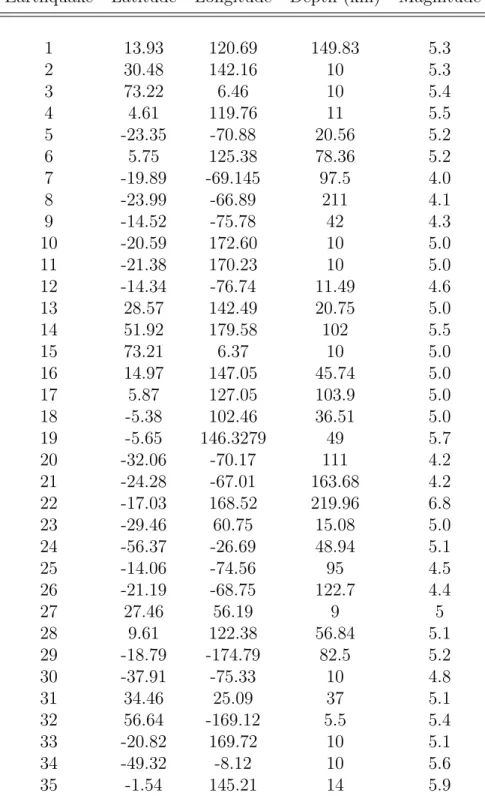
this deployment, 35 teleseismic earthquakes were used to generate 423 receiver functions. From 200
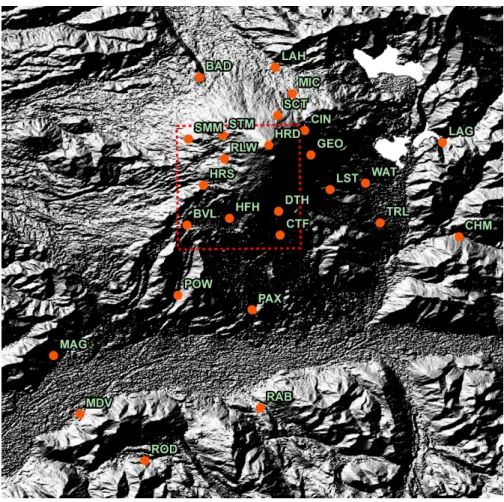
the 25 stations, the stations near the peak of the volcano (denoted by the red box) were primarily 201
focused on. Furthermore, station BAD was not considered due to a suspected error with the seis-202
mometer to earth coupling. 203
In calculating the receiver functions, the iasp91 earth model was used. In the iterative decon-204
volution procedure, a Gaussian width of 5 was also used. Standard errors on the H-κ results were 205
Figure 3: Seismic station deployment around the Llaima Volcano in Chile.The stations focused on in this study are denoted by the red box.
Earthquake Latitude Longitude Depth (km) Magnitude
1 13.93 120.69 149.83 5.3
2 30.48 142.16 10 5.3
3 73.22 6.46 10 5.4
4 4.61 119.76 11 5.5
5 -23.35 -70.88 20.56 5.2
6 5.75 125.38 78.36 5.2
7 -19.89 -69.145 97.5 4.0
8 -23.99 -66.89 211 4.1
9 -14.52 -75.78 42 4.3
10 -20.59 172.60 10 5.0
11 -21.38 170.23 10 5.0
12 -14.34 -76.74 11.49 4.6
13 28.57 142.49 20.75 5.0
14 51.92 179.58 102 5.5
15 73.21 6.37 10 5.0
16 14.97 147.05 45.74 5.0
17 5.87 127.05 103.9 5.0
18 -5.38 102.46 36.51 5.0
19 -5.65 146.3279 49 5.7
20 -32.06 -70.17 111 4.2
21 -24.28 -67.01 163.68 4.2
22 -17.03 168.52 219.96 6.8
23 -29.46 60.75 15.08 5.0
24 -56.37 -26.69 48.94 5.1
25 -14.06 -74.56 95 4.5
26 -21.19 -68.75 122.7 4.4
27 27.46 56.19 9 5
28 9.61 122.38 56.84 5.1
29 -18.79 -174.79 82.5 5.2
30 -37.91 -75.33 10 4.8
31 34.46 25.09 37 5.1
32 56.64 -169.12 5.5 5.4
33 -20.82 169.72 10 5.1
34 -49.32 -8.12 10 5.6
35 -1.54 145.21 14 5.9
Station Latitude Longitude Number of Traces
BAD -38.6441 -71.7829 15
BVL -38.7561 -71.7925 23
CHM -38.7560 -71.5855 13
CIN -38.6844 -71.7029 17
CTF -38.7637 -71.7217 8
DTH -38.7457 -71.7227 11
GEO -38.7029 -71.6982 12
HFH -38.7510 -71.7603 18
HRD -38.6955 -71.7303 7
HRS -38.7259 -71.7800 18
LAG -38.6935 -71.5980 24
LAH -38.6364 -71.7253 23
LST -38.7292 -71.6837 15
MAG -38.8551 -71.8941 12
MDV -38.8996 -71.8741 16
MIC -38.6565 -71.7123 2
PAX -38.8203 -71.7430 18
POW -38.8094 -71.7993 2
RAB -38.8949 -71.7367 8
RLW -38.7059 -71.7639 11
ROD -38.9348 -71.8244 3
SCT -38.6729 -71.7235 17
SMM -38.6908 -71.7914 27
STM -38.6879 -71.7651 21
TRL -38.7545 -71.6456 11
Table 2: The data for the 25 deployed seismic stations
4
Results and Discussion
207
Before this study, the internal plumbing system of Llaima was largely unknown. [Bathke et al., 208
2011] applied inverse modeling to InSAR data and proposed structures at both 4-9 km and 6-12 209
km, however these results are contested. Maisonneuve et al. [2012], using evidence from petrologic 210
data, proposed a magmatic body≤4 km beneath the volcano with an accompanying dike complex. 211
However, these conjectured structures have not previously been confirmed using seismic data. 212
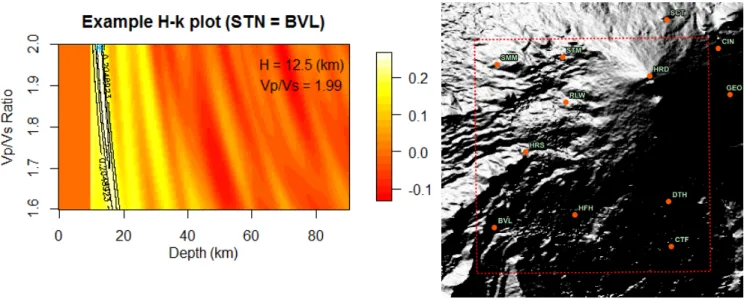
discon-tinuity (H) converged to shallow values for some stations (e.g. station BVL). 214
Figure 5: The initial H-κplot of station BVL.
Figure 6: The red box (Figure 3) inset of the Llaima stations.
As the Moho in the southern Andes is between 30 and 40 km [Tassara et al., 2006], this 215
data suggests that there are other discontinuities under Llaima that could cause P-wave to S-wave 216
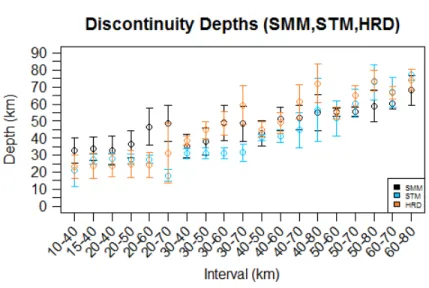
conversions. To search for possible converters, slices of depth structure were examined using the 217
H-κ stacking method. 218
Figure 8: Possible discontinuities revealed by slices of earth structure.
Figure 9: Possible discontinuities revealed by slices of earth structure.
This method of searching in depth intervals could also be interpreted as bandpass filtering 219
the H-κ algorithm results, where the maximum overlap was returned in a depth band. From the 220
resulting search, two main discontinuities are evident, one at approximately 20 km and another at 221
approximately 60 km. While this value is deeper than expected for the region [Tassara et al., 2006], 222
The 20 km discontinuity is interpreted as an area of partial melting beneath Llaima. It is 224
visible on all 9 stations focused on in this study with the exception of station SMM (Figures 7, 8, 225
and 9). 226
From the collection of stations CTF, DTH, and HFH (Figure 7), a possible converter around 227
40 km depth is possible, but more analysis is necessary. In particular, this converter is not visible 228
on the nearby station CTF, so the ray paths to stations DTH and HFH need to be examined. 229
Other possible discontinuities are possible within the region, and one interpretation of the 230
complex converter pattern seen in Figure 8 and Figure 9 is that there is a system of complex 231
melting geometries beneath the volcano. However, it needs to be stressed as well that some of 232
these possible discontinuities may be numerical artifacts stemming from the division of depth into 233
intervals that include neither the 20 km discontinuity or the 60 km discontinuity. 234
5
Conclusions
235
This study presents a first look at the deep magmatic system structure underneath the Llaima 236
volcano in Chile. By applying receiver functions taken from a dense array around the volcano, it was 237
determined that a magmatic body is present at approximately 20 km depth beneath the volcano. 238
This partial melt body could be feeding the shallow region proposed by [Maisonneuve et al., 2012] 239
via the dike system. 240
In future work, forward modeling using synthetic receiver functions [Ammon et al., 1990] can 241
be used to examine these discontinuities further. For an example of this technique, see Chmeilowski 242
et al. [1999]. Furthermore, more analysis can be completed on the Vp/Vs ratios obtained from
243
the H-κ stacks for the region, which provides more information on the percentage of partial melt 244
[Chevrot, 2000]. 245
References
chamber. Geophysical Journal International, na(175):1298–1308, June 2008.
C.J. Ammon, G.E. Randall, and G. Zandt. On the nonuniqueness of receiver function inversions. Journal of Geophysical Research, 95(B10):303–315, September 1990. URL http://onlinelibrary.wiley.com/doi/10.1029/JB095iB10p15303/epdf.
H. Bathke, M. Shirzaei, and T. R. Walter. Inflation and deflation at the steep-sided llaima stratovol-cano (chile) detected by using insar. Geophysical Research Letters, 38(10):n/a–n/a, 2011. ISSN 1944-8007. doi: 10.1029/2011GL047168. URL http://dx.doi.org/10.1029/2011GL047168. L10304.
Maurizio Battaglia, Claudia Troise, Francesco Obrizzo, Folco Pingue, and Giuseppe De Natale. Evidence for fluid migration as the source of deformation at campi flegrei caldera (italy). Geo-physical Research Letters, 33(1):n/a–n/a, 2006. ISSN 1944-8007. doi: 10.1029/2005GL024904. URL http://dx.doi.org/10.1029/2005GL024904. L01307.
Robert D. Chevrot, Sebastien; van der Hilst. The poisson ratio of the australian crust: geological and geophysical implications. Earth and Planetary Science Letters, 183:121–132, August 2000.
J. Chmeilowski, G. Zandt, and C. Haberland. The central andean altiplano-puna magma body. Geophysical Research Letters, 26(6):783–786, March 1999.
Rob W. Clayton and Ralph A. Wiggins. Source shape estimation and deconvolution of teleseismic bodywaves. Geophys. J. R. astr. Soc., 47:151–177, April 1976.
F.A. Darbyshire, K.F. Priestly, R.S. White, R. Stefansson, G.B. Gudmundsson, and S.S. Jakob-sdottir. Crustal structure of central and northern iceland from analysis of teleseismic receiver functions. Geophysical Journal International, na(143):163–184, May 2000.
J. Dawson and P. Tregoning. Uncertainty analysis of earthquake source parameters de-termined from insar: A simulation study. Journal of Geophysical Research: Solid Earth, 112(B9):n/a–n/a, 2007. ISSN 2156-2202. doi: 10.1029/2007JB005209. URL http://dx.doi.org/10.1029/2007JB005209. B09406.
B. Efron. Bootstrap methods: Another look at the jackkife. The Annals of Statistics, 7(1):1–26, 1979.
B. Efron and R. Tibshirani. Boostrap methods for standard errors, confidence intervals, and other measures of statistical accuracy. Statistical Science, 1(1):54–77, 1986.
T. J. Fournier, M. E. Pritchard, and S. N. Riddick. Duration, magnitude, and frequency of sub-aerial volcano deformation events: New results from latin america using insar and a global synthesis. Geochemistry, Geophysics, Geosystems, 11(1):n/a–n/a, 2010. ISSN 1525-2027. doi: 10.1029/2009GC002558. URL http://dx.doi.org/10.1029/2009GC002558. Q01003.
Louis A. Jaeckel. The infintismal jackknife, 1972. URL
J. Julia and J. Mejia. Thickness and vp/vs ratio variation in the iberian crust. Geophysical Journal International, na(156):59–72, September 2004. doi: 10.1111/j.1365-246X.2004.02127.x.
Kikuchi and Kanamori. Inversion of complex body waves. Bulletin of the Seismological Society of America, 72(2):491–506, April 1982.
Charles A. Langston. The effect of planar dipping structure on source and receiver responses for constant ray parameter. Bulletin of the Seismological Society of America, 67(4):1029–1050, August 1977b.
Charles A. Langston. Structure under mount ranier, washington, inferred from teleseismic body waves. Journal of Geophysical Research, 84(B9):4749–4762, August 1979.
Z. Li. Meris atmospheric water vapor correction model for wide swath interferometric synthetic aperture radar. IEEE Geoscience and Remote Sensing Letters, 9(2):257–261, October 2011.
Ligorra and Ammon. Iterative deconvolution and receiver-function estimation. Bulletin of the Seismological Society of America, 89(5):1395–1400, October 1999.
D. Lombardi, J. Braunmiller, E. Kissling, , and D. Giardini. Moho depth and poisson’s ratio in the western-central alps from receiver functions. Geophysical Journal International, na(173):249–264, November 2008.
Zhong Lu and Daniel Dzurisin. InSAR Imaging of Aleutian Volcanoes, volume 1. Springer Berlin Heidelberg, 2014.
C.B. Maisonneuve, M.A. Dungan, O. Bachmann, and A. Burgisser. Insights into shallow magma storage and crystallization at volcn llaima (andean southern volcanic zone, chile). Journal of Vol-canology and Geothermal Research, 211-212:76–91, 2012. doi: 10.1016/j.jvolgeores.2011.09.010.
Rupert G. Miller. The jackknife - a review. Biometrika, 61(1):1–15, April 1974. URL http://www.jstor.org/stable/2334280.
H. Nakamichi, Tanaka S., and Hamaguchi H. Fine s wave velocity structure beneath iwate volcano, northeastern japan, as derived from receiver functions and travel times. Journal of Volcanology and Geothermal Research, 116(na):235–255, July 2001.
J.A. Naranjo and H. Moreno. Geologa del volcn Llaima . SERNAGEOMIN, Chile. Carta Geolgica de Chile, No.88, mapa escala 1:50.000. Number 88 in n/a. Gobierno de Chile Servicio Nacional de Geologia y Mineria, Santiago, Chile, 2005.
Jose A. Naranjo and Hugo Moreno. Actividad explosiva postglacial en el volcan llaima, andes del sur (3845?s). Revista Geolgica de Chile, 18(1):69–80, na 1991.
D. W. Oldenburg. A comprehensive solution to the linear deconvolution problem. Geophys. J. R. astr. Soc., 65:331–357, April 1981.
Jeffrey Park and Vadim Levin. Receiver functions from multiple-taper spectral correlation estimates. Bulletin of the Seismological Society of America, 90(6):1507–1520, December 2000.
D. Remy, Y. Chen, J. L. Froger, S. Bonvalot, L. Cordoba, and J. Fustos. Revised inter-pretation of recent insar signals observed at llaima volcano (chile). Geophysical Research Letters, 42(10):3870–3879, 2015. ISSN 1944-8007. doi: 10.1002/2015GL063872. URL http://dx.doi.org/10.1002/2015GL063872. 2015GL063872.
A. Tassara, H.J. Gotze, S. Schmidt, and R. Hackney. Three-dimensional density model of the nazca plate and the andean continental margin.Journal of Geophysical Research, 111(B09404):na, 2006. doi: 10.1029/2005JB003976, 200.
Tohru Watanabe. Effects of water and melt on seismic velocities and their application to charac-terization of seismic reflectors. Geophysical Research Letters, 20(24):2933–2936, December 1993.
![Figure 1: A proposed dike complex beneath Llaima [Maisonneuve et al., 2012]](https://thumb-us.123doks.com/thumbv2/123dok_us/8329928.2209416/4.918.193.710.131.358/figure-proposed-dike-complex-beneath-llaima-maisonneuve-et.webp)
![Figure 2: Ray paths for P s , P p P s , P p S s , and P s P s phases (from Zhu and Kanamori [2000]) One of the most common receiver function processing techniques is the Zhu and Kanamori](https://thumb-us.123doks.com/thumbv2/123dok_us/8329928.2209416/7.918.317.588.769.822/figure-phases-kanamori-receiver-function-processing-techniques-kanamori.webp)