The Informational Role of the Media in Private Lending
Robert M. Bushman
Kenan-Flagler Business School, University of North Carolina-Chapel Hill Chapel Hill, North Carolina 27599
Christopher D. Williams
Ross School of Business, University of Michigan Ann Arbor, MI 48109
Regina Wittenberg-Moerman Marshall School of Business University of Southern California Email: [email protected]
January 2016
The Informational Role of the Media in Private Lending
Abstract
1
1. Introduction
An important source of public information about a firm is the business press. There is
substantial evidence that the business press provides information about firm fundamentals to
equity market participants, incremental to that provided by other information intermediaries and
accounting data (e.g., Tetlock et al., 2008), and reduces information asymmetries between equity
investors (e.g., Bushee et al., 2010). However, there is little research examining the role played
by the media in private lending markets. In this paper, we investigate the extent to which media
coverage of borrowers influences the loan origination and participation decisions of
informationally disadvantaged lenders, loan syndicate structures and interest rate spreads.
A defining feature of equity markets is that investors do not generally have privileged
access to firms’ confidential information as securities law prohibits unequal access to such
information. This creates scope for the media to serve as an information intermediary to equity
investors seeking information from sources external to the firm.1 In contrast, private debt
markets are not subject to securities laws, allowing lenders significant access to private
information from borrowers as an integral part of the lending process. Syndicated loans involve
multiple lenders where the degree of access to borrowers’ inside information can differ
substantially across lenders. Such differential access to information creates information
asymmetries between lenders at two levels.
First, syndicated lending involves information asymmetry between inside lenders with a
prior relationship with a borrower and outside, non-relationship lenders competing for a mandate
to serve as lead arranger on a borrower’s loan.2 Non-relationship lenders are typically at an
1 Bushee et al. (2010) define an information intermediary as an agent that provides information that is new and useful to other parties, either because it has not been publicly released or widely disseminated.
2
information disadvantage relative to relationship lenders. Through sustained engagement,
relationship lead banks gain extensive inside knowledge of a borrower’s operations and develop
private channels of communication with its managers. Borrowers are also inclined to reveal
sensitive private information to relationship lenders (e.g., Greenbaum and Thakor, 1995, Boot,
2000, and Bharath et al., 2009).3 Second, information asymmetries exist between lead banks and
other syndicate participants.4 Although syndicate participants may receive some private
information from the lead bank or borrower, they are generally at an information disadvantage
relative to the lead bank because they primarily maintain an arm’s-length relationship with the
borrower, while the lead bank has the primary due diligence and monitoring responsibilities
(e.g., Lee and Mullineaux, 2004, Sufi, 2007, and Ivashina, 2009).
Outside lenders, analogous to equity investors, have incentives to seek credit-relevant
information about a borrower to mitigate their information disadvantage relative to more
informed inside lenders.5 To the extent that the media transmits information to less informed
lenders about a borrower’s credit fundamentals that is incremental to information they receive
from other sources, it can directly impact relative information asymmetries across lenders and
influence loan syndicate formation and pricing. We investigate the informational role of the
media in syndicated lending by employing a quantitative measure of media sentiment in business
press articles about a borrower. Using data from RavenPack News Analytics, we construct a
measure that reflects the average sentiment across all full size borrower-specific articles
among other duties. The lead arranger receives a fee for arranging and managing the syndicated loan. We discuss institutional aspects of syndicated lending in more detail in section 2.1.
3 The idea that inside banks have an information advantage is well established in the literature (e.g., Kane and Malkiel, 1965, Fama, 1985, Greenbaum, Kanatas, and Venezia, 1989, Sharpe, 1990, Rajan, 1992, Petersen and Rajan, 1994, 1995, and Dell’Ariccia and Marquez, 2004).
4 We use the terms lead arranger and lead bank interchangeably.
3
published over the six-month period preceding loan origination (Media Sentiment). RavenPack’s
sentiment measure reflects assessments of the tone of the news in a given article (i.e., positive or
negative news) as well as the strength of the news the article contains.6
We first investigate if media influences competition between inside and outside lenders for
the mandate to serve as lead arranger on a borrower’s loan. This analysis builds on the model
from Rajan (1992) in which an informed (inside) bank in a current lending relationship with a
risky borrower competes with less informed (outside) banks to supply new financing to a
borrower. Inside banks exploit their information advantage by opportunistically bidding only for
good loans while avoiding bad loans. Because inside banks avoid bad loans, outside lenders are
exposed to adverse selection as they face significant risk of loss if they bid. Outside lenders
respond by moderating how aggressively they compete, becoming more reluctant to participate
as their assessed probability that a loan is bad increases. Rajan (1992) further considers how
public information signals about a borrower shape competitive dynamics, showing that outside
lenders’ willingness to compete increases in the sentiment of the signal. A more favorable signal
increases outside lenders assessment of loan quality, reducing their risk of getting stuck with a
bad loan and increasing the aggressiveness with which they compete against an inside lender. In
contrast, a less favorable signal decreases outside lenders’ willingness to compete due to
heightened adverse selection concerns driven by lower assessed loan quality.
A direct implication of Rajan (1992) is that the more (less) aggressively outsiders bid, the
higher (lower) is the probability of their winning the loan deal. We extrapolate this economic
reasoning to syndicated loans where inside, relationship lenders and outside, non-relationship
4
lenders compete to be selected by a borrower as a lead arranger of the syndication.7 We
empirically investigate whether media sentiment is associated with the probability that the lead
arranger of a loan is an outside lender with no established relationship with a borrower.
Consistent with the impact of more favorable public signals on outsiders’ bidding strategy as
shown by Rajan (1992), we hypothesize that the aggressiveness with which outside lenders
compete to arrange a loan is increasing in media sentiment, thus raising their probability of
winning the loan. We find that the probability of a non-relationship lender serving as a lead
arranger is higher when media sentiment is more positive. A one standard deviation increase in
media sentiment increases the probability that a loan is syndicated by a non-relationship lead
arranger by 6.2%.
Having examined competition between inside and outside lenders for the lead arranger job,
we next consider whether the media influences the willingness of lenders to participate in a loan
syndicate. We classify as more informed inside participants those lenders who have a previous
relationship with either the borrower or a loan’s lead arranger (e.g., Sufi, 2007, and Ivashina,
2009), and as less informed outside participants those without a relationship. We hypothesize
that the willingness of less informed lenders to participate in a loan syndicate is increasing in
media sentiment. Because a lead arranger has an information advantage relative to syndicate
participants and its monitoring effort after a loan closes is unobservable, participants face both
adverse selection and moral hazard problems (e.g., Sufi, 2007, Ivashina, 2009, and Mora, 2015).
While it is difficult to empirically distinguish between adverse selection and moral hazard, we
argue that media can influence lenders’ participation through either channel.
To motivate an adverse selection explanation, we extend the economic reasoning from
5
Rajan (1992) to loan syndicates where loan participants compete to become syndicate members.
In forming a syndicate, a lead bank sends out invitations to a large set of potential lenders who
choose whether to bid on joining the syndicate (Champagne and Kryzanowski, 2007). As noted
by Ivashina and Sun (2011), the syndication process can be viewed as an auction where loan
participants submit sealed bids to the lead arranger. The same winner’s curse issue developed in
Rajan (1992) plausibly operates here to the extent that inside participants pursue good loans,
leaving bad loans for less informed bidders. Analogous to Rajan (1992), media can influence the
severity of the winner’s curse problem, where more positive media signals increase the
willingness of non-relationship (less informed) lenders to bid for loan participation.
Under moral hazard, syndicate participants are concerned about ex-post monitoring efforts
of the lead arranger, where monitoring becomes more crucial for troubled borrowers (Sufi,
2007). If media reveals negative news, outside participants plausibly downgrade their assessment
of loan quality, which increases their concern about the lead arranger shirking. Thus outside
participants may be less likely to join a syndicate than relationship participants with superior
information about the lead arranger and/or the borrower. Similar to the adverse selection case,
outside lenders may either not submit bids or submit bids that are rejected by the lead arranger in
favor of superior bids by relationship participants. Based on these arguments, we predict that the
probability of non-relationship syndicate participants joining the syndicate increases in media
sentiment. We find evidence consistent with this prediction: a one standard deviation increase in
Media Sentiment increases the probability that a participant without a prior relationship with the
borrower (lead arranger) joins the syndicate by 7.1% (9.3%).
Next, we examine the proportion of a loan retained by the lead bank. Due to adverse
6
the game by holding a proportion of the loan that is increasing in the severity of the agency
problem (e.g., Leland and Pyle, 1977, Holmstrom and Tirole, 1997, and Sufi, 2007). Because, as
argued above, more positive public signals are expected to decrease both adverse selection and
moral hazard risks faced by less informed syndicate participants, we hypothesize that the loan
share retained by the lead arranger (i.e., the lead’s skin in the game) is decreasing in media
sentiment. We show that a one standard deviation increase in media sentiment decreases this
proportion by 5.3%.
Finally, we investigate whether more positive media sentiment is associated with lower
interest rate spreads. We hypothesize that if, as argued earlier, loan attractiveness to
non-relationship lead arrangers and syndicate participants increases when media sentiment is more
positive, the expanded set of potential lenders willing to fund the loan will increase the supply of
credit available to the borrower and put downward pressure on interest spreads. We find that
interest rate spreads are decreasing in media sentiment: a one standard deviation increase in
Media Sentiment translates into a 6.9 basis point decrease in the spread.
Our previous analyses presume that the media provides new information to less informed
lenders by publicly revealing either private information known to inside but not outside lenders,
or information not previously known by either inside or outside lenders. To bolster this claim, we
show that our findings with respect to lead arranger choice, syndicate participation, lead arranger
share and interest spreads are robust to controlling for alternative public information sources,
including equity analysts, credit rating agencies and firm-initiated press releases. Further, we
split our sample into partitions based on the extent of borrowers’ analyst coverage. Prior research
suggests that financial analysts provide useful information to lenders (e.g., Guntay and
7
lenders face more uncertainty about borrowers’ prospects and rely more on alternative
information sources. We predict that if media is informative to outside lenders, then the effect of
media sentiment on private lending practices will be stronger when equity analyst coverage is
less intensive. Consistently, we find that syndicate structure and loan spreads are more sensitive
to media sentiment when analyst coverage is lower. We further find some evidence that the
effect of media sentiment is stronger for borrowers that experience an exogenous reduction in
analyst coverage preceding loan issuance.
While our findings are consistent with the media providing incremental information to
outside lenders, the media may also influence private lending deals through alternative channels.
We explore one such channel by examining the possibility that the media influences consumers’
perceptions of a borrower, changing their future purchasing decisions and consequently a
borrower’s future cash flows. For example, news that a consumer-product firm acted
irresponsibly towards the environment may cause some consumers to abandon the firm’s
products. It is plausible that lenders would incorporate the expected impact of changes in
consumer behavior on a borrower’s future sales and cash flows into loan pricing.8 We thus
hypothesis that the media, operating through a consumer perception channel, impacts the interest
spreads of consumer-product borrowers more intensively than the spreads of other borrowers.
We indeed find that interest spreads are more sensitive to media sentiment for
consumer-product-oriented borrowers. This evidence suggests that media can affect loan pricing via at least
two channels - by informing outside lenders with limited access to private information and by
changing consumers’ perception of the borrower, which is in turn priced by lenders.
8
While our analyses provide robust evidence consistent with the media being a direct source
of information to lenders, we cannot fully rule out the possibility that media sentiment proxies
for information from other sources. However, whether the media is a direct source of information
or simply mimics information from other sources, our results contribute to the literature by
providing substantive evidence on the role of information signal sentiment in shaping loan deals.
The evidence that lenders’ decisions are influenced by media sentiment is consistent with the
theory of Rajan (1992) and differentiates our analysis from prior studies that focus primarily on
the availability of public information about a borrower without considering a role of its sentiment
(e.g., Sufi, 2007, Ball et al., 2008, Ivashina, 2009 and Schenone, 2010). We extend the literature
by demonstrating that critical aspects of syndicate lending, such as lead arranger choice,
syndicate participation decisions, loan share retained by the lead arranger and loan pricing are
significantly associated with the sentiment of business press articles, controlling for alternative
information sources about the borrower. We also provide novel evidence consistent with media
sentiment impacting loan pricing via its influence on consumer perceptions and behavior.
The remainder of the paper is organized as follows. Section 2 presents prior research that
motivates our analyses and the hypotheses development. Section 3 describes the sample and
data. Section 4 reports our main results and section 5 concludes the paper.
2. Motivation and Related Literature
2.1. Information asymmetry between lenders competing to serve as a lead arranger
Private debt contracts rely on the flow of confidential information between lenders and
borrowers (e.g., Diamond, 1984, and Fama 1985). Confidential information includes hard
information, such as timely financial disclosures, covenant compliance information, amendment
9
and Poor’s, 2011), as well as softer information, such as observations about a management
team’s abilities, honesty, and how they react under pressure (Petersen, 2004). Lenders with
access to borrowers’ confidential information are surely less reliant on public information than
are equity investors. However, not all lenders have equivalent access to borrowers’ private
information, and information asymmetries across lenders create a demand from informationally
disadvantaged lenders for public information.
A syndicated loan is a loan issued to a firm jointly by more than one financial institution.
Members of a syndicate can be classified as either lead arrangers or participant lenders. The lead
arranger initiates a loan, negotiates with a borrower and then syndicates shares of the loan to
participant lenders. Before any loan participants are invited to join a syndicate, the borrower first
selects the lead arranger from the set of competing lenders. Information asymmetry can affect the
competition among lenders competing for a mandate to serve as a lead arranger on a loan. Here
we must distinguish between inside lenders with a prior relationship with a borrower and outside,
non-relationship lenders.
Relationship lenders interact repeatedly with borrowers over an extended time period, and
in the process gain extensive inside knowledge of borrowers’ operations and develop private
channels of communication with managers. Due to this information advantage, relationships are
an important source of an incumbent bank’s comparative advantage over new lenders without a
relationship (Boot, 2000). Thus, when lenders compete to serve as lead arranger, outside,
non-relationship lenders face adverse selection risk due to their pre-bidding information
disadvantage. This adverse selection issue is the focus of Rajan (1992).
Rajan models competitive dynamics in private lending markets in a setting where a
10
premise is that the inside bank acquires private information through privileged access to the
borrower, while an outside bank lacks access. The model assumes that the inside bank knows for
sure whether the firm will succeed or fail, while an outside bank has an assessed probability of
success.9 Under these conditions, an outside bank is at a disadvantage in bidding against the
inside lender. The outside bank understands that if it adopts an aggressive strategy of always
bidding, the inside bank will exploit this predictability and always win good loans by offering the
borrower slightly better terms than does the outsider in the good state (when the firm will
succeed) and leaving outside lenders with bad loans by not bidding in the bad state (when the
firm will fail). This exposes the outsider to a Winner’s Curse problem in which it would finance
only bad projects.
To deal with this problem, an outside lender plays a mixed strategy in which it randomizes
between bidding and not bidding. This implies that with some probability the outside lender will
not participate in the bidding process. Rajan (1992) shows that outsiders bid less frequently as
their assessed probability that the loan is bad increases. Taking as given the outsider’s mixed
strategy, the insider’s equilibrium strategy is to bid for good loans, but not for bad loans. For
good loans, the insider offers higher interest rates than outsiders do, knowing that when the
outsider does not bid they will win the loan and earn high profits, but lose the loan and earn zero
profits if the outsider bids. In an important extension, Rajan (1992) shows that public disclosure
influences outside lenders’ probability of bidding by changing their assessments of loan quality.
While a more positive signal increases outside lenders’ assessments of loan quality, a more
negative signal increases the adverse selection problem.
11
This leads to the result that the probability of an outsider bidding for a loan is higher for
signals with higher sentiment.10 Further, the greater the probability of outsiders’ bidding, the
higher is their probability of winning the loan. Building on this intuition, we hypothesize that the
probability of an outside, non-relationship lender serving as the lead arranger of a syndicated
loan is increasing in media sentiment. Following Schenone (2010), we classify a loan as
syndicated by a relationship lead arranger if the lender has syndicated a majority of the
borrower’s prior loan deals by volume over the five-year period preceding the loan issuance date,
and syndicated by a non-relationship lender otherwise. We construct a media sentiment variable
using the RavenPack database to proxy for the sentiment of public information signals in Rajan.
While Rajan (1992) describes well competition among differentially informed lenders to
win a loan deal, the model does not directly consider information asymmetry issues associated
with loan syndicate formation. We turn to this issue next.
2.2. Information asymmetry within loan syndicates
We examine whether the media influences the willingness of lenders to participate as
members in a loan syndicate. Participant lenders generally do not directly communicate with the
borrower and maintain an arm’s-length relationship through the lead arranger. The lead arranger
establishes and maintains a relationship with the borrower and acts as an agent for the syndicate
by collecting and processing information about the borrower. Prior to syndication, the lead bank
conducts due diligence and presents an assessment of the borrower's quality to potential
participants. Thus, participants face adverse selection risk because the lead bank may have an
incentive to syndicate low quality loans. Lead banks may, for example, originate and then
12
syndicate low quality loans to capture private benefits or future cross-selling opportunities with
the borrower (Mora, 2015). After syndication, the lead bank is charged with monitoring the
borrower. This introduces moral hazard risk as lead banks only retain part of the loan, which
reduces incentives to monitor.
Both adverse selection and moral hazard expose syndicate participants to risk of
wrongdoing by the lead bank (Sufi, 2007, and Ivashina, 2009). The vast majority of research on
syndicate lending does not distinguish between moral hazard and adverse selection risks (e.g.,
Ball et al., 2008, Ivashina, 2009, Dennis and Mullineaux, 2000, Jones, Lang, and Nigro, 2005).
An exception is Sufi (2007), who does provide some evidence that moral hazard is an operative
risk in syndicates. However, Sufi does not claim that his evidence rules out a role for adverse
selection in the syndicate. In fact, separating these two risks empirically is very challenging. As
noted by Cohen and Siegelman (2009), the consequences of moral hazard and adverse selection
are generally observationally equivalent, and thus very difficult to disentangle. In our paper, we
do not attempt to distinguish the two. Rather, as we argue next, the media can influence lenders’
participation through either an adverse selection or moral hazard channel.
The syndication process seeks to match borrowers with a set of lenders that value the
loan most highly. To form a syndicate, a lead bank sends out invitations to a large set of potential
lenders who choose whether to submit bids to join the syndicate. It is the case that invitations to
bid generally outnumber acceptances, implying that many invitees choose not to participate
(Champagne and Kryzanowski, 2007). Lenders that accept the invitation submit sealed bids
13
who bid that spread or below are awarded a share of the loan on a pro-rata basis (Ivashina and
Sun, 2011).11
Given this institutional setting, we extend the adverse selection dynamics reasoning from
Rajan (1992) to competition among differentially informed participant lenders to become
syndicate members. We consider as more informed inside participants those lenders who have a
previous relationship with either the borrower or a loan’s lead arranger, and as less informed
outside participants those without a previous relationship (e.g., Sufi, 2007, and Ivashina, 2009).
We posit that syndicate participants with a previous relationship face less severe information
risks than participants without a relationship. A participant’s familiarity with the lead bank or
borrower allows them access to alternative sources of information or assurances about loan
quality not available to participants without a relationship. Thus, the winner’s curse issue
developed in Rajan (1992) is likely to play a role in lender syndicate participation decisions to
the extent that inside participants pursue good loans, leaving bad loans for less informed bidders.
In line with Rajan (1992), media can influence the severity of the winner’s curse problem, where
more positive media signals increase the willingness of non-relationship (less informed) lenders
to bid for loan participation.Note that outside lenders that do not join the syndicate can either not
submit bids or submit bids that are rejected by the lead arranger in favor of superior bids by
relationship participants.
Further, syndicate participants also face the moral hazard risk that the lead arranger may
shirk on supplying monitoring effort after a loan closes. While Rajan (1992) does not address
moral hazard issues, it is plausible that media sentiment can influence bidding strategies of
outside participants facing moral hazard by influencing their assessments of potential losses from
14
lead arranger shirking. The idea is that the severity of potential losses due to a lack of monitoring
effort is likely to be higher for troubled borrowers (Sufi, 2007). Negative media news can lower
outside participants’ assessments of loan quality and so increase their concerns about the lead
arranger shirking. This can in turn increase the information disadvantage of non-relationship
participants relative to relationship participants possessing enhanced channels of communication
with the borrower or lead arranger. Thus outside participants may be less willing to bid against
relationship lenders to join a syndicate or demand terms that are less favorable than those
demanded by relationship participants and therefore are rejected by the lead arranger. Based on
these arguments, we hypothesize that the probability of non-relationship syndicate participants
joining the syndicate increases in media sentiment also through the moral hazard channel.
We further examine the effect of media on information asymmetry within syndicates by
investigating whether media sentiment is associated with the proportion of the loan retained by
the lead bank. Theory posits that a key mechanism for resolving information asymmetry issues
and securing potential syndicate lenders’ willingness to join the loan syndicate is to require lead
banks to have skin in the game by holding a stake in the loan that increases in the severity of
agency problems (e.g., Leland and Pyle, 1977, Diamond, 1984, and Holmström and Tirole,
1997). Empirical research provides evidence consistent with the theory. Sufi (2007) shows that
lead banks hold a larger share of the loan when borrowers are more opaque, while Ball et al.
(2008) show that the share retained by lead banks is decreasing in the debt contracting value of
the borrower’s accounting numbers. We extend and innovate on this literature by conjecturing
that the share retained by the lead arranger depends not only on the fact that there is public
15
more positive public signal decreases adverse selection and moral hazard risk, we predict that the
loan share retained by the lead arranger is decreasing in media sentiment.
2.3. Media sentiment and loan pricing
In addition to lenders’ willingness to originate or participate in a loan, we also hypothesize
that more favorable media sentiment decreases interest rate spreads. This hypothesis is motivated
by Rajan (1992) who shows that more positive disclosure increases the aggressiveness of outside
lenders in bidding for a loan, which decreases the rents that inside lenders can extract from
borrowers and thus results in lower interest rate spreads. Our hypothesis is also related to recent
empirical research that exploits changes in a firm’s information environment to identify whether
the information advantage of inside banks is reflected in loan pricing. Specifically, Hale and
Santos (2009) examine how loan pricing changes following bond IPOs. They predict that when
public information released during the IPO process reveals positive news about a borrower – that
a borrower is creditworthy – it increases outside banks’ willingness to bid on its loans and
consequently reduces the information advantage of inside lenders. Consistently, Hale and Santos
(2009) find that firms revealed as having investment grade credit ratings pay lower spreads on
their loans after they undertake a bond IPO.
Hale and Santos (2009) rely on a significant information event to identify the effects of
public disclosure on reducing inside banks’ ability to extract rents from borrowers. We
complement Hale and Santos (2009) by examining whether more favorable media sentiment
results in lower spreads. In a syndicated loan setting, we expect more favorable media sentiment
to increase both the aggressiveness with which outside lenders bid to arrange loans and to
participate in loan syndicates, thus expanding the set of lenders willing to fund the loan. This
16
the extent that interest spreads are negatively associated with the supply of credit (e.g., Ivashina
and Sun, 2011), we predict that the wider range of syndicate participants and arrangers
associated with more positive media sentiment results in lower loan pricing.
2.4. The role of the business press in capital markets
The main premise of our paper is that the business press plays an important role in the
private lending market by mitigating information asymmetries between differentially informed
lenders. While there has been little research to date on this topic, a growing body of research
demonstrates a substantive role played by the business press in the equity market. Although the
information structures and contractual features of private lending differ from those of the equity
markets, prior research supports the plausibility of our premise that the media can be informative
to less informed outside lenders and influence their behavior.
Miller (2006) finds that the press serves as a watchdog for accounting fraud by
rebroadcasting information from other information intermediaries and by undertaking original
investigations that provide new information to the markets. Several papers find that media
articles pressure firms to alter governance structures and strategic decisions. Dyck and Zingales
(2002) show that the media affects firms’ environmental policies and the amount of corporate
resources diverted to the advantage of controlling shareholders, while Bednar et al. (2012) show
that negative media coverage prompts firms to change their resource allocations. Kuhnen and
Niessen (2012) find that following negative press coverage of CEO pay, firms reduce option
grants and increase less contentious types of compensation, such as salary. Joe et al. (2009) find
that media exposure about board ineffectiveness pressures firms to take corrective actions. For
lenders without privileged access to a borrower, media articles that reveal fraud or pressure firms
17
integrity of a borrower’s executives, litigation risk or changes in managerial incentives. These
are important aspects of lenders’ assessments of a borrower’s future prospects and
creditworthiness.
Further, there is evidence that the business press provides information about firm
fundamentals to equity market participants over and above that provided by other information
intermediaries and accounting data.12 Bushee et al. (2010) demonstrate that the press reduces
information asymmetry in the equity market, incremental to firm-initiated disclosure and
disclosures by equity analysts. Fang and Peress (2009) show that stocks with no media coverage
earn higher future returns than do stocks with high media coverage. Tetlock et al. (2008) finds
that the fraction of negative words in firm-specific news stories forecasts low firm earnings and
that equity prices quickly respond to the information in negative words. They suggest that
linguistic media sentiment captures otherwise hard-to-quantify aspects of firms’ fundamentals.
Further, using textual analysis to distinguish press articles that reflect relevant news from those
that do not, Boudoukh et al. (2012) find a strong relation between news and stock price
changes.13 Overall, this literature provides evidence that the media informs equity market
participants by providing information on hard-to-quantify aspects of firms’ fundamentals.14
It is thus plausible that the media can also impact private lending markets by providing
information on hard-to-quantify aspects of firms’ fundamentals underpinning credit quality.
Lenders’ assessments of firms’ credit risk can be affected by information about products,
18
competitors, customers, industry growth potential, top executive teams, governance, strategic
plans, acquisitions, labor markets, regulation and legal issues, among many other topics (Green
et al., 2012). The information revealed by the media may be new information not available to
lenders from other sources, or it could be a signal that confirms, corroborates or substantiates
noisy information that lenders received from a different source. In this later case, the media
could, for example, confirm soft information the lender obtained about the borrower elsewhere,
or allow the lender to filter noise from signals received from other sources. While our research
design does not allow us to distinguish the specific topics covered in the media articles
underpinning our media sentiment measure, extant research shows the power of a computational
linguistics approach to quantify the language of a wide swath of firms’ media coverage rather
than focusing on specific categories of news. As noted by Tetlock et al. (2008), by quantifying
language, researchers can examine the directional impact of a wide variety of events, rather than
focusing on particular event types.
In addition to providing direct information to lenders about a borrower’s circumstances,
media can indirectly influence private lending deals by changing a borrower’s circumstances
through its impact on the behavior of a borrower’s stakeholders. We explore one such channel by
examining the possibility that the media influences consumers’ perceptions of a borrower,
changing their future purchasing decisions and consequently a borrower’s future cash flows. The
idea is that lenders would incorporate the expected consequences of these changes into the loan
terms offered to the borrower.
3. Sample, Data and Descriptive Statistics
3.1. Data sources and sample selection
19
Corporation (TRLPC) to obtain loan-specific characteristics. Media sentiment scores are from
RavenPack News Analytics, which covers all news disseminated via Dow Jones Newswires.
RavenPack employs a variety of advanced textual analysis techniques to create news sentiment
scores for business news stories. We obtain firm characteristics from Compustat. Firms’ senior
debt ratings, watchlist and outlook data (at the firm level) are retrieved from the S&P historical
database. For borrowers with no rating data in the S&P database, we collect the S&P, Moody’s
and Fitch ratings from the Internet-based version of TRLPC.
Table 1 summarizes the sample selection process. For the period from 2000 to 2012,
DealScan reports 31,974 facilities issued to U.S. public firms in U.S. dollars. This time period
reflects the availability of media data from RavenPack. Merging this sample with RavenPack
leaves us with 24,308 facilities. Next, we exclude facilities with insufficient loan data, reducing
the sample to 12,397 facilities. We also require borrowers to have sufficient Compustat data to
estimate borrower characteristics and sufficient RavenPack data to estimate media sentiment
prior to loan issuance. We estimate borrower characteristics in the quarter prior to the loan
issuance and media sentiment over the 180 days prior to the loan issuance.15 We limit media data
to full-size articles, excluding news flashes (news articles composed only of a headline and no
body text), news articles composed of a headline and mostly tabular data and firm-initiated press
releases. We further restrict our sample to full-size articles with a relevance score of 75 and
above. The relevance score is assigned by RavenPack to indicate when the firm is strongly
related to the underlying news story. The scores range from 0 (low relevance) to 100 (high
relevance). Our final sample contains 7,244 facilities related to 2,031 firms.
3.2. Descriptive statistics
15 We focus on the 180 days prior to the loan issuance to allow a sufficient time period prior to the start of the
20
Table 2 presents descriptive statistics for the main variables used in our tests (all variables
are described in detail in Appendix A). Media Sentiment is estimated as the average news
sentiment over the 180 days prior to a loan’s origination date. We utilize RavenPack’s
Composite Sentiment Score (CSS), which represents the news sentiment of a given story by
combining various textual analysis techniques.16 CSS scores range between 0 to 100, with a
score above 50 indicating positive news; a score equal to 50, neutral news; and a score below 50,
negative news. We apply a linear transformation to the CSS score and define Media Sentiment =
(CSS-50)/50, so that the Media Sentiment ranges from -1 to 1, with zero being equivalent to
neutral sentiment.The mean (median) value of Media Sentiment is -0.0046 (0.0000), suggesting
that sentiment is typically neutral over the 180 days prior to a loan announcement.
We examine five primary loan characteristics. Our first measure reflects the previous
relationship of the lead arranger and a borrower. The mean value of Borr-Lead No-Relationship
indicates that 63.8% of loans are issued by non-relationship lead arrangers. The next two
measures are concerned with previous relationships of syndicate participants. The mean value of
Part-Borr No-Relationship indicates that 56.75% of syndicate participants have not participated
in a borrower’s syndicated loans in the five years preceding a loan’s issuance. The mean value of
Part-Lead No-Relationship indicates that 15.25% of syndicate participants have not participated
in syndicates arranged by the loan’s lead arranger in the five years preceding the loan’s issuance.
We also examine the proportion of a loan retained by the lead arranger. For loans with sufficient
data, the mean (median) value of Lead Share is 21.05% (13.38%). With respect to loan pricing,
the average interest rate spread is 159.5 basis points (Spread is the logarithm of the interest
spread).
21
With respect to sample firm characteristics, the average ratio of earnings before
extraordinary items to total assets (ROA) is 0.85%. Sample firms have an average interest
coverage ratio (Interest coverage) of 10.51, and an average Leverage, measured as the ratio of
total liabilities to total assets, of 0.25. The firms in our sample are relatively large, with a mean
value of total assets of $1,411M (Size is measured by the logarithm of the total assets). An
average Altman’s (1968) bankruptcy score (Z-score) is 2.24 (a higher score indicates a lower
credit risk). The average market-to-book ratio is 3.01. 14.76% of the sample observations relate
to the borrowers experiencing losses.
We report statistics for loan characteristics that serve as controls. Sample loans have an
average size of $167.0M (Amount is the logarithm of loan amount) and a maturity (Maturity) of
47.9 months. The majority of the loans are revolvers (62.3 percent) and 10 percent are term loans
B and below, which are typically issued to non-bank institutional investors. 71.4 percent of the
sample loans have performance pricing provisions (PP), 63.9 percent are secured (Collateral)
and loans have on average 2.3 financial covenants (#Covenants).
Finally, we provide statistics for three alternative sources of information about borrowers.
First, we estimate the sentiment of all borrower-initiated press releases over the 180 days prior to
a loan’s origination date. To isolate firm-initiated press releases, we impose a more stringent
relevance criterion than the one applied to media articles and require a relevance score of 90 or
greater. Press releases with a relevance score above 75 and below 90 often relate to cases where
the firm is mentioned in the press releases of other firms. We apply a linear transformation to the
CSS score and define Press Release Sentiment = (CSS-50)/50, so that Press Release Sentiment
ranges from -1 to 1, with zero being equivalent to neutral sentiment.The press release sentiment
22
Second, we report on whether the borrower is rated by a credit rating agency. 56% of sample
loans are issued to rated borrowers. Third, because prior research suggests that equity analysts
are informative to lenders (e.g., Guntay and Hackbarth, 2010, and Mansi et al., 2010), we
measure whether a borrower has equity analyst coverage at loan origination. 87.5% of sample
loans are issued to borrowers with analyst coverage.
To reflect additional information available about a borrower, we also estimate a borrower’s
abnormal stock returns over the same period during which media sentiment is measured. Sample
borrowers experience mean (median) abnormal returns of 5.6% (2.2%) over the 180 days prior to
a loan’s issuance (Return), with 42.75% of borrowers having a negative return over this period
(Negative Return).
4. Empirical Results
We organize the discussion of our empirical findings into four subsections. Section 4.1
provides evidence on the association between media sentiment and the probability of a
non-relationship bank leading the loan deal. Section 4.2 examines the relations between media
sentiment and syndicate structure and section 4.3 between media sentiment and loan pricing. In
section 4.4 we provide evidence consistent with the media being a direct source of information to
less informed, outside lenders. Finally, in section 4.5 we examine an additional channel through
witch media may affect loan pricing.
4.1. Media sentiment and the probability of a non-relationship bank leading the loan deal
In this section we examine whether media sentiment is positively associated with the
probability of outside, non-relationship lenders serving as a lead arranger. Rajan (1992) theorizes
that as public disclosure sentiment increases, outsider lenders will bid more aggressively for a
23
lead arrangers in the syndicated loan market, we predict that a more positive media sentiment is
associated with a higher probability that a lender without an established relationship with the
borrower originates the loan. We estimate the following logistic model:
0 1 2
3 ,
Borr-Lead No-Relationship= Media Sentiment Controls Alternative Info Sources
(1)
where Borr-Lead No-Relationship is an indicator variable equal to 1 if a loan is issued by a
non-relationship lender, and zero otherwise.17 Media Sentiment is our main variable of interest; we
predict that 1 > 0.
We control for a number of factors that prior research suggests are associated with the
probability of non-relationship lead arranger syndicating the loan (e.g., Gopalan et al., 2011, and
Bolton et al., 2013). We control for whether a firm’s previous loan is still outstanding when the
current loan is issued (Outstanding), the time between the current and previous loan (Time
Between) and the tightness of the credit supply in the economy (Tight Credit Supply). We proxy
for credit supply tightness using changes in bank lending standards for mid-sized and large
commercial loans as reported in the Federal Reserve Board’s quarterly Senior Loan Officer
Opinion Survey on Bank Lending Practices (e.g., Bassett et al. 2012). The Tight Credit Supply
variable takes a value of 1 if the change in lending standards in the quarter of a loan’s origination
is in the top quartile of the sample’s distribution, and 0 otherwise.
We also control for borrower characteristics reflecting its creditworthiness, including
profitability (ROA), interest coverage ratio (Interest Coverage), leverage (Leverage), size of total
assets (Size), z-score (Z-score), the market-to-book ratio (MTB) and an indicator variable
reflecting whether the borrower has experienced losses (Loss). In terms of loan-specific
17 To be able to measure this relationship variable, we restrict the estimation of model (2) to the sample of
24
characteristics, we control for loan size (Amount), maturity (Maturity), whether the loan is a
revolving line of credit (Revolver) and if the loan is a term loan B and below (Term Loan B).
Finally, we control for alternative information sources about the borrower, including its
press release sentiment (Press Release Sentiment), whether it is rated (Rated) and whether it has
analysts’ coverage (Analyst Coverage).18 To reflect borrower-related news not captured by
additional information sources and firm controls, we also include a borrower’s abnormal stock
returns (Return) and an indicator variable reflecting whether stock returns are negative (Negative
Return), measured contemporaneously with Media Sentiment. Although stock returns impound
all available information, there is still scope for Media Sentiment to play an independent role in
informing lenders. The idea here is that the weights placed on available information signals are
tailored to the specific decision context at hand. Our paper focuses on lenders’ use of media
articles to assess credit quality and overcome information asymmetry. While stock prices imbed
valuation weights on information signals that are optimal for purposes of valuing equity, it is
plausible that lenders assessing credit quality would generally weigh these same signals
differently. Thus, the separate media variable can play an important role in allowing lenders to
optimally balance weights across information signals for credit evaluation purposes (Paul, 1992,
Bushman and Indjejikian, 1993).19 Finally, we cluster the standard errors at the firm and calendar
18 In section 4.4 we include additional measures of alternative information sources in the specification.
19 Consider a simple example. Assume that equity investors’ information set consist of two signals, X1 (e.g., media
sentiment) and X2 (another signal). This information gets impounded into price via trading activity resulting in equilibrium price. For valuation purposes, equilibrium price applies equal weights to the signals giving: Price = X1+X2. Assume that for credit purposes, a lender would optimally weight the signals as: Credit quality = 1X1 +
25 quarter levels (this applies to all the remaining analyses).20
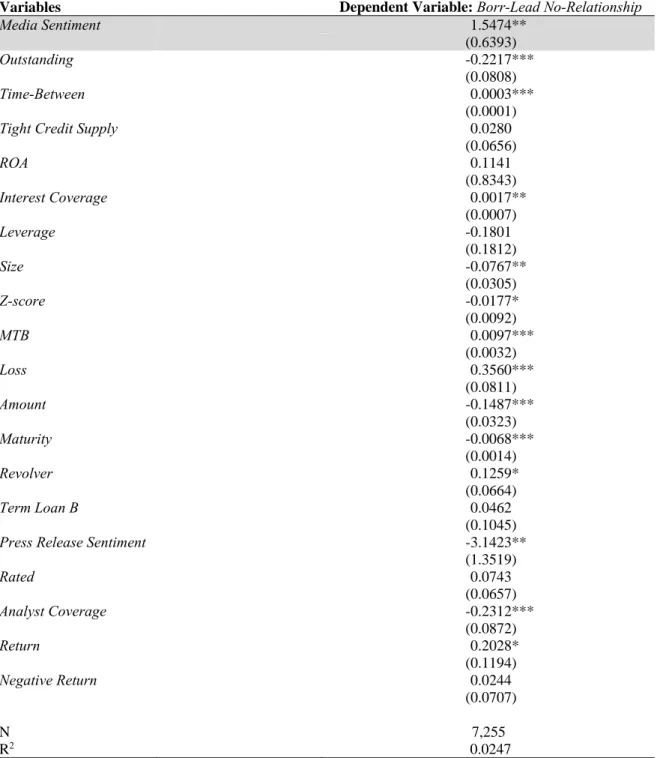
We present our findings Table 3. Consistent with the theory of Rajan (1992), we find that
the coefficient on Media Sentiment is positive and significant, suggesting that the probability of a
non-relationship lead arranger syndicating the loan is increasing in media sentiment. A one
standard deviation increase in media sentiment increases the probability that a loan is syndicated
by a non-relationship lead arranger by 6.2%.
With respect to control variables, similar to Gopalan et al. (2011), we find that the
probability of a non-relationship lender syndicating the loan decreases when the borrower’s
previous loan is still outstanding when the current loan is issued (Outstanding), but increases
when the time span between the current and the previous loan increases (Time-Between). We do
not find that the tightness of the credit supply significantly affects the probability of a
non-relationship lead arranger originating the loan.21 The probability of a non-relationship lender
syndicating the loan is also affected by a borrower’s interest coverage, size, Z-score and
market-to-book ratio. When borrowers issue larger loans or loans with a longer maturity, we find that it
is less likely that these loans are arranged by non-relationship lenders. These results suggest that
because non-relationship lenders have inferior access to a borrower’s private information relative
to relationship lenders, they are less willing to syndicate larger and longer term credit.
We find a negative coefficient on Press Release Sentiment. While this negative sign may
be surprising, it is important to note that press releases are fundamentally different from press
articles. Specifically, press releases are an aspect of firms’ strategic disclosure decisions, where
20 In light of Greene’s (2004) criticism of the inclusion of fixed effects in non-linear models, we do not incorporate year and industry and loan purpose fixed effects into the model. The same applies to the probability of non-relationship lender syndicate participation model.
21
26
in contrast media articles are independent of a firm’s disclosure strategy (note that the sentiment
of press releases for our sample firms is typically positive). For example, firms may issue
positive press releases when they are trying to counter negative events or to run-up stock prices
around mergers (e.g., Davis and Tama-Sweet, 2012, and Ahern and Sosyura, 2014). Most
important for our purposes is that our Media Sentimnet result is robust to including press release
sentiment, ruling out the possibility that media sentiment simply echoes firm press releases. We
also find a negative coefficient on Analyst Coverage; this result is in line with Gopalan et al.
(2011).
4.2. The effect of media sentiment on syndicate participation and lead arranger share
We next investigate the relation between media sentiment and syndicate participation. As
discussed previously, higher media sentiment is expected to reduce less-informed lenders’ risk of
funding a bad loan and to mitigate their concerns about lead arrangers shirking on monitoring
effort. We predict that the likelihood of less informed lenders with no previous relationship with
the borrower or the lead arranger participating in a syndicate is increasing in media sentiment.
We follow Sufi (2007) and estimate the following logit model at the syndicate participant level:
0 1 2 3 ,
Participation Media Sentiment Controls Alternative Info Sources (1)
where Participation is one of two participant relationship variables. Part-Borr No-Relationship
is an indicator variable set equal to one if the participant has not participated in a borrower’s
loans in the five years prior to a loan’s issuance date, and zero otherwise. Part-Lead No
Relationship is an indicator variable set equal to one if the participant has not participated in a
syndicate arranged by the loan’s lead arranger in the five years preceding the loan’s issuance,
and zero otherwise. Media Sentiment is our main variable of interest, where we predict 1 > 0.
27
We also extend the set of loan-specific controls. We add controls for a borrower’s previous
relationship with the lead arranger (Borr-Lead No-Relationship) and for whether this is the first
deal syndicated by the lead arranger (First Time Lead), as both may affect the attractiveness of
the loan deal to syndicate participants. We also control for whether the loan is secured
(Collateral), the existence of performance pricing provisions (PP) and the number of covenants
(#Covenants).22 Similar to Model 1, we control for alternative information sources about the
borrower and its stock returns.
We present our findings in Table 4. In column 1 we report the estimation of model (1) with
Part-Borr No-Relationship as the dependent variable. Consistent with our predictions, the
coefficient on Media Sentiment is positive and significant, indicating that the probability of a
participant with no relationship with the borrower joining the syndicate increases with media
sentiment. This result is also economically significant: a one standard deviation increase in
Media Sentiment increases this probability by 7.1%.
With respect to controls, in line with lower information asymmetry between the lead
arranger and syndicate participants when a borrower is more creditworthy, we find positive
coefficients on ROA, Interest Coverage and Z-Score and negative coefficient on Leverage. We
also find a positive coefficient on Borr-Lead No-Relationship, which suggests that the
probability of non-relationship participants joining the syndicate increases when a new lead
arranger without previous relationship with the borrower arranges the loan. The coefficient on
Press Release Sentiment is insignificant, suggesting that while media sentiment influences less
informed participants, the content of firm-initiated press releases does not incrementally affect
the likelihood of their participation. When a borrower is rated, the probability of a
28
relationship participant joining the syndicate is significantly higher, consistent with their higher
confidence in a loan’s quality when creditworthiness is assessed by an independent third party
(e.g., Sufi, 2007). Note that the coefficients on Return and Negative Return are difficult to
interpret. Stock returns consist of two components: changes in cash flow news and changes in
discount rates (e.g., Vuolteenaho, 2002). Stock return controls therefore reflect both news about
the borrower’s performance and discount rate news associated with a borrower’s riskiness.23
In column 2, we report the results from the estimation of model (1) with Part-Lead No-
Relationship as the dependent variable and find similar results. The coefficient on Media
Sentiment is positive and significant, suggesting that the probability of a participant without a
previous relationship with the lead arranger joining the syndicate increases with media
sentiment. A one standard deviation increase in Media Sentiment increases this probability by
9.3%. The coefficients on control variables are generally consistent with those in column 1.
Our results so far indicate that more positive media sentiment extends the range of
participants willing to join the syndicate to those without a relationship with the borrower or the
lead arranger. Column 3 focuses on the loan share retained by the lead arranger (Lead Share).
Because more positive media sentiment is expected to increase syndicate participants’
assessment of loan quality and thus decrease adverse selection and moral hazard risk, we predict
that the share of a loan retained by the lead arranger is decreasing in media sentiment as
participants require the lead to have less skin in the game.
We estimate model (1) as an OLS specification with Lead Share as the dependent variable.
This specification also includes loan purpose, industry and year fixed effects. In line with our
expectations, we find a negative and significant coefficient on Media Sentiment. Economically, a
29
one standard deviation increase in media sentiment decreases the loan proportion held by the
lead arranger by 5.3%. This evidence further supports a significant effect of media sentiment on
syndicate structure and suggests that it operates via both channels – syndicate participants’
willingness to join the syndicate and the loan share the lead arranger is required to retain.
With respect to control variables, a lead arranger retains a smaller proportion of the loan
when the borrower is larger and more profitable. Consistent with lower agency problems within
the syndicate when a borrower is more transparent (e.g., Sufi, 2007), the lead arranger retains a
smaller proportion of the loan when a borrower is rated and has analyst coverage. We also find
that a non-relationship lead arranger and the first time lead arranger hold a higher loan share,
suggesting that participants require a lead arranger to have higher skin in the game in these cases.
4.3. The effect of media sentiment on loan pricing
Our analyses show that the decisions of less informed lenders to arrange and participate in
syndicated loans are sensitive to media sentiment, where loan attractiveness is increasing in
media sentiment. While it is important to show connections between media sentiment and
lenders’ decisions, our results thus far do not quantify the implications of media sentiment from
the perspective of a borrower seeking financing. We examine this issue in this section.
As shown in Rajan (1992), more favorable public information signals can directly impact
interest spreads by increasing outside, non-relationship lenders’ aggressiveness in bidding for a
loan, which results in a reduction in the rents that more informed inside lenders can extract from
borrowers. Consistently, Hale and Santos (2009) find that the reduction in the information
advantage of inside banks following a borrower’s bond IPOs is reflected in lower loan pricing
for borrowers identified as more creditworthy at the time of the IPO. We build on this evidence
30
syndicated loan setting, where, as we show in our previous analyses, higher media sentiment not
only increases the non-relationship lead arrangers’ aggressiveness in bidding for a loan, but also
attracts less informed syndicate participants to join the syndicate. This expanded set of outside
lenders is likely to increases the supply of financing available to fund the borrower’s loan,
exerting significant downward pressure on the interest rate spread.
To examine this hypothesis, we estimate the following OLS model:
Interest Spread=01Media Sentiment2Controls3Alternative Info Sources, (3)
where Spread is the logarithm of the interest rate spread in basis points above LIBOR. We
predict a negative coefficient on our main variable of interest - Media Sentiment. Variables
reflecting controls and other information sources about the borrower are defined as previously.
Further, the model includes loan purpose, industry and year fixed effects.
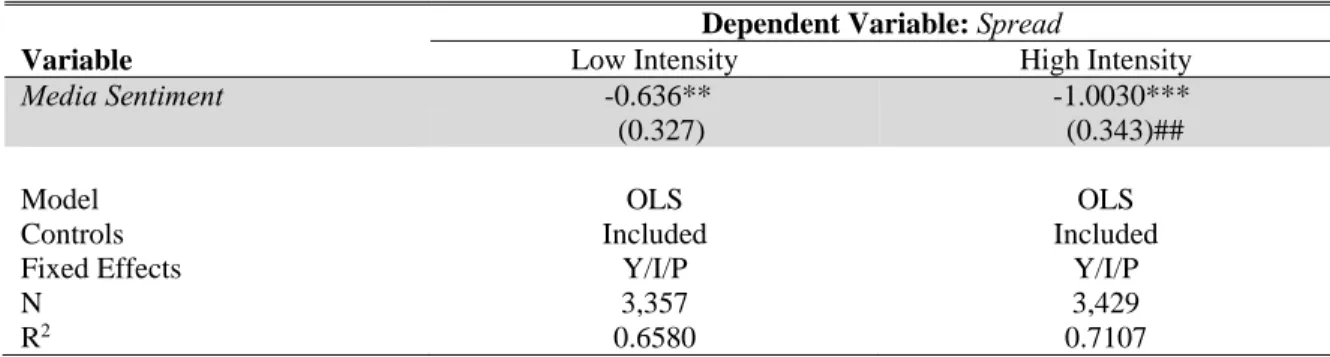
We present our findings in Table 5. Consistent with our predictions, we find that the
interest spread is inversely associated with media sentiment, with more positive sentiment
reducing the interest spread. In terms of economic significance, a one standard deviation increase
in Media Sentiment translates into a 6.9 basis point decrease in spread. While this effect seems
relatively modest, it is similar to the effect of a one standard deviation change in key credit risk
measures, such as ROA (5.5 basis points) and Leverage (12.7 basis points).
With respect to controls, as expected, we report a negative relation between the spread and
a borrower’s profitability, size, Z-Score, and market-to-book ratios, and a positive relation
between the spread and leverage and an indicator variable reflecting losses. The coefficients on
loan-level controls are generally consistent with prior research. Larger loans and loans with
31
al., 2005).24 Due to the endogenous determination of contractual terms, we observe a positive
relation between the interest spread and both Collateral and #Covenants (Berger and Udell,
1990, Bradley and Roberts, 2004, and Costello and Wittenberg-Moerman, 2011).25 While
concurrently endogenizing all loan terms is beyond the scope of our paper, in untabulated
analyses we estimate the interest rate model excluding loan controls; our findings are unchanged.
We find that revolvers (Term Loans B and below) are priced at lower (higher) rates, consistent
with prior research (Harjoto et al., 2004, Zhang, 2008, Nandy and Shao, 2010, and Lim et al.,
2014). We also show that more positive press release sentiment and analyst coverage are
negatively associated with the spread.
The results presented in Tables 4-6 are consistent with the media providing incremental
information to less informed, non-relationship lenders. To further support our claim that these
lenders learn directly from the media, in the next section we provide additional analyses that
address alternative information sources available for lenders in more detail.
4.4 Is the media a direct source of information to less informed, outside lenders?
4.4.1 The effect of media sentiment, controlling for alternative public information sources
In Table 3, 4 and 5 we control for variables that reflect three alternative sources of
information available to lenders: firm-initiated press releases, equity analysts and rating
agencies. We also incorporate stock return related variables. To further identify whether
non-relationship lenders learn from the media, we extend the analysis by including in models (1), (2)
and (3) a large vector of additional information controls.
32
First, we add controls for the number of media articles (#Articles) and firm-initiated press
releases (#Press Releases) over the 180 day period prior to loan issuance. With respect to rating
agencies, we control for the level of credit rating (Credit Rating) at a loan’s issuance date, the
change in credit rating over the 180 day period prior to issuance (ΔCredit Rating); whether the
borrower is on a credit watchlist at the time of issuance (Current Watch) or over the 180 days
prior to the issuance (Prior 180 Watch); and a borrower’s long-term credit outlook at loan
issuance (Current Outlook) and over the 180 days prior to the issuance (Prior 180 Outlook).
With respect to equity analysts, we control for analysts’ earnings forecasts (Analyst Forecast)
and recommendations (Analyst Recommendation) at the time of a loan’s issuance, and the
forecast revisions (Forecast Revision)and recommendation revision (Recommendation Revision)
over the 180 days prior to the issuance.
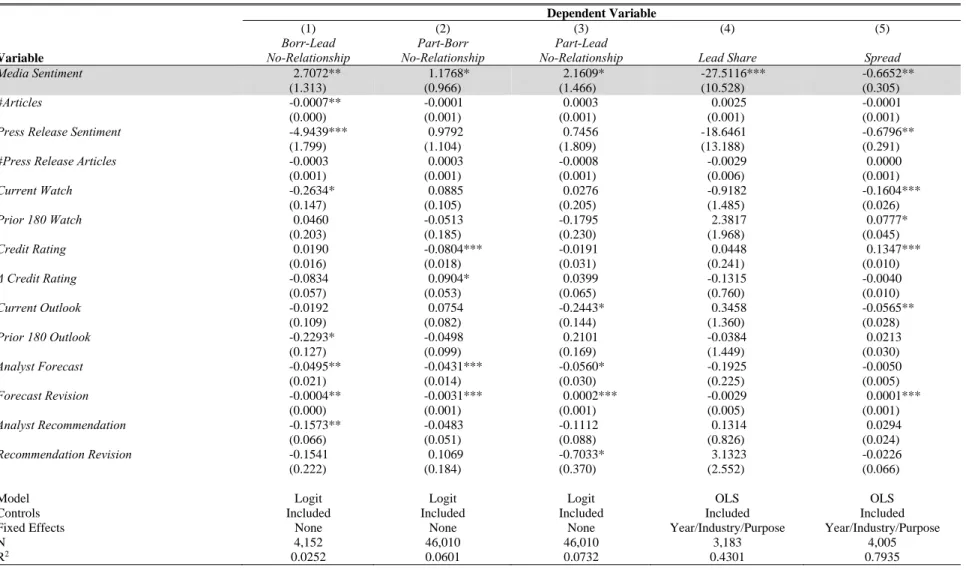
The results are reported in Table 6. In column 1, we find that the effect of media sentiment
on the probability that a non-relationship lead arranger syndicates the loan continues to be
statistically and economically significant after incorporating this wide set of additional
information controls. One standard deviation increase in Media Sentiment increases this
probability by 11.0%. As we report in columns 2 and 3, we continue to find a positive coefficient
on Media Sentiment in both the Part-Borr No-Relationship and Part-Lead No-Relationship
specifications respectively, although at a lower level of statistical significance. A one standard
deviation increase in Media Sentiment increases the probability that a participant without a prior
relationship with the borrower (lead arranger) joins the syndicate by 4.7% (8.7%). The relation
between Media Sentiment and Lead Share is also robust to additional information controls. The
coefficient on Media Sentiment is negative and significant in column 4. A one standard deviation
33
Finally, for loan pricing analyses presented in column 5, we find that the coefficient on Media
Sentiment continues to be negative and significant. A one standard deviation increase in Media
Sentiment decreases the interest spread by 4.2 basis points.
The evidence in Table 6 suggests that it is unlikely that the effect of media sentiment on the
probability of an outside lead arranger syndicating a loan, syndicate structure and loan pricing
are explained by the media rebroadcasting information provided by other information sources.
4.4.2 The effect of media sentiment, conditional on the intensity of analyst coverage
To provide further evidence that media is a direct source of information to lenders, we
conduct analyses conditional on the intensity of a borrower’s analysts’ coverage. We conjecture
that if media sentiment is informative to less informed lenders, its effect on syndicate structure
will be stronger when a borrower’s coverage by other information intermediaries is less
intensive. This prediction is motivated by prior evidence that analysts are an important
information source to lenders (e.g., Guntay and Hackbarth, 2010, and Mansi et al., 2010).
Therefore, outside lenders will rely more on alternative information sources, such as the media,
when analyst following is relatively low. The general idea is that investors’ posterior
expectations will respond more intensively to an information signal of a given precision as prior
uncertainty about a firm’s prospects increases (e.g., Verrecchia, 2001). We classify borrowers as
having highly intensive analyst coverage if the number of analysts covering the firm falls into the
top quintile of the sample distribution, and as less intensive otherwise. We then estimate models
(1), (2) and (3) for the two sub-samples – borrowers with highly intensive and less intensive
coverage.26 We report these tests in Table 7.
As we report in Table 7, Panel A, for the lead arranger analyses, the coefficient on Media
26 Our results are robust when we define borrowers as having highly intensive analyst coverage if the number of
34
Sentiment is positive and significant for the less intensive analyst coverage partition, but that it is
not significant for the highly intensive coverage partition, although the difference in the
coefficients between the two partitions is not significant. Economically, for the less intensive
analysts’ coverage partition, a one standard deviation increase in Media Sentiment increases the
probability that a lender without a prior relationship with the borrower arranges the loan by
7.6%.
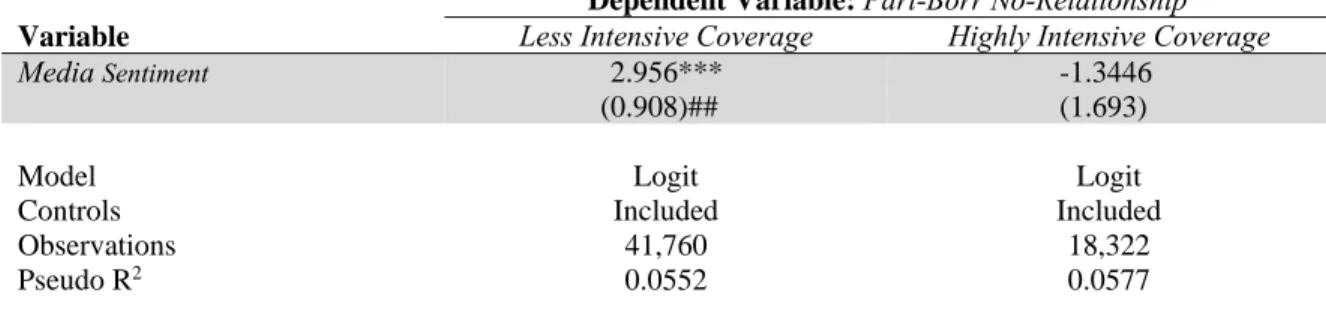
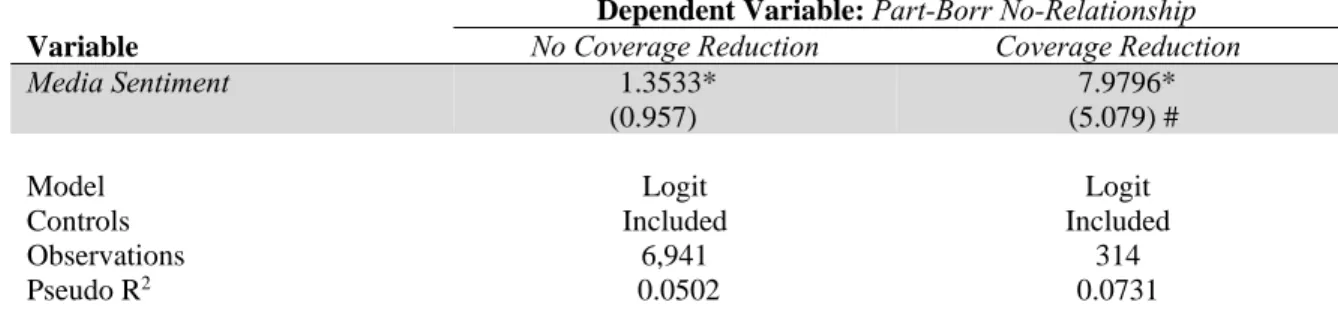
We find that for both the Part-Borr No-Relationship and Part-Lead No-Relationship
specifications the coefficient on Media Sentiment is negative and significant for the less intensive
analyst coverage partition, but it is not significant for the highly intensive coverage partition
(Table 7, Panels B and C). The difference in coefficients on Media Sentiment between these
partitions is also statistically significant. Economically, for the less intensive analysts’ coverage
sub-sample, one standard deviation increase in Media Sentiment increases the probability that a
syndicate participant without a prior relationship with the borrower (lead arranger) joins the
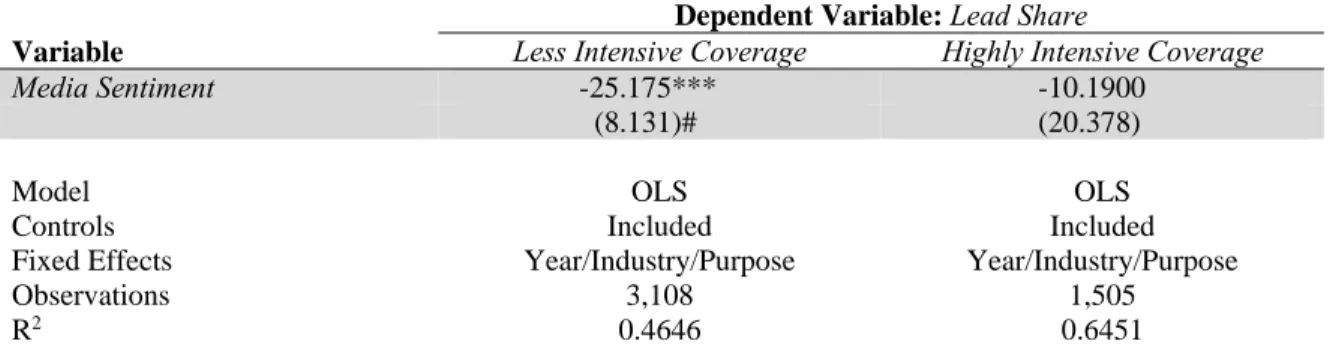
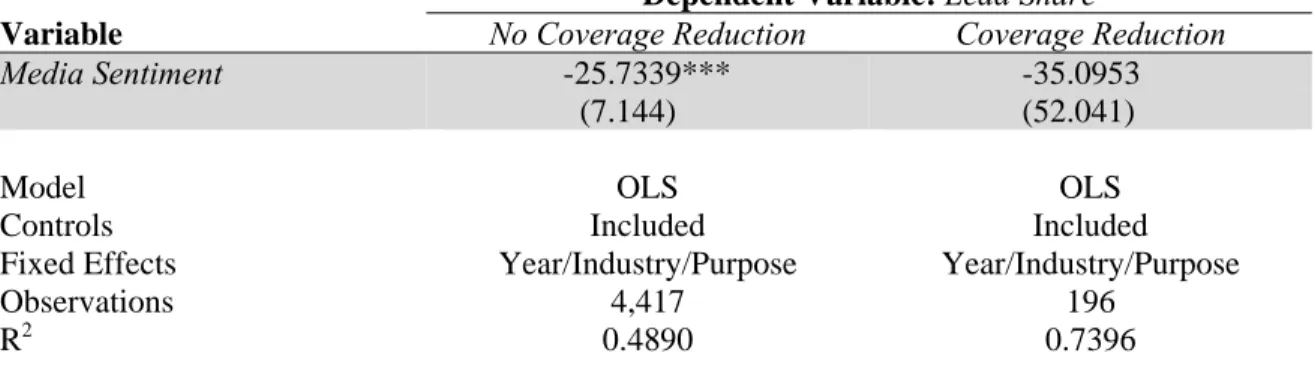
syndicate by 12.1% (12.1%). The results are similar when we examine the lead bank’s loan share
aspect of the syndicate structure (Table 7, Panel D). The effect of media sentiment is significant
for borrowers with less intensive analyst coverage, but not for those with highly intensive
coverage. The difference in coefficients on Media Sentiment between the two partitions is
significant at the 10% level. For borrowers with less intensive analyst coverage, a one standard
deviation increase in Media Sentiment decreases the proportion held by the lead arranger by
4.6%.
Based on our findings that the effect of media sentiment on the willingness of less informed
lead arrangers and syndicate participants to fund a loan is stronger when the equity analysts’