CHOLINE/ BETAINE HABITUAL INTAKE AND INCIDENT CORONARY HEART DISEASE
Daniel Arthur Caños
A dissertation submitted to the faculty of the University of North Carolina at Chapel Hill in partial fulfillment of the requirements for the degree of Doctor of Philosophy in the
Department of Epidemiology.
Chapel Hill 2013
Approved By
Gerardo Heiss, MD, PhD
Christy Avery, PhD
Lloyd Chambless, PhD
Jane Schroeder DVM, PhD
iii
ABSTRACT
DANIEL ARTHUR CAÑOS: Choline/ Betaine Habitual Intake and Incident Coronary Heart Disease
(Under the direction of Gerardo Heiss, MD, PhD)
Increased whole blood levels of total choline have previously been found to be
associated with cardiovascular disease. We estimated the association between dietary choline
and betaine intake and risk of incident CHD in the Women’s Health Initiative (WHI)
Observational Study (n=93,676) and the WHI Dietary Modification trial data (n=48,835)
collected over 8-12 years of follow-up. Food consumption data, quantified from the WHI
Food Frequency Questionnaire (FFQ) were converted into estimates of daily intake of
choline and betaine. These FFQ estimates were compared to four-day food records (FDFR)
estimates, and reliability was quantified through the comparison of FFQs administered at
baseline and one year follow-up. Based on the intra-individual variability for all interrelated
nutrients models, we estimated the associations between choline and betaine and incident
CHD corrected for reliability. Median daily choline and betaine intakes were 264 (IQR:
201−341) and 164 (IQR: 114−230). Only 10% of the population (n=14,313) met the
adequate intake of 425 mg/day. Median daily intakes of choline and betaine respectively
were 268 mg and 166 mg in Whites, 242 mg and 164 mg in Blacks, 250 mg and 123 mg in
Hispanic/Latinos; 233 mg and 150 mg in Asian or Pacific Islanders. A mixed model
assessing the joint intra-individual variability for all interrelated nutrients yielded reliability
(B6) 0.60, (B12) 0.55; (methionine) 0.56. Correlations between FFQ and FDFR estimates
were highest for natural folate (0.32); choline (0.30); methionine (0.27). Correlations were
lowest for betaine (0.22); total folate (0.12); B6 (0.08); B12 (0.10). Hazard ratios (HRs)
associated with a one standard deviation (SD) nutrient density adjusted choline intake (35.30
mg/dy per kilocarlorie) were 1.26 [95% confidence interval (CI): 1.09,1.46] for Blacks and
1.06 (95% CI: 1.01,1.11) for Whites. After reliability correction, HRs were further from the
null in Blacks [1.42 (95% CI: 1.03,1.86)] and Whites [HR: 1.13 (95% CI: 1.02,1.23)].
In conclusion, choline intake was postively associated with incident CHD in Whites
and Blacks with a substantially greater effect estimate within Blacks. Correction for
reliability demonstrated that measurement error results in substantial attenuation of effect
v
DEDICATION
To my wife, Kristin, and children, Jack and Mia, who supported me throughout this journey.
To my big brother, Mike, who encouraged and inspired me to begin a career in
cardiovascular epidemiology.
To my cat Scooter that hung out with me during the late nights, early morning, and weekend
ACKNOWLEDGEMENTS
I would like to thank my dissertation advisor, Gerardo Heiss, for his patience,
guidance, well-timed motivation and support throughout the process of my doctoral
dissertation. In addition, I would like to thank the members of my dissertation committee,
Christy Avery, Lloyd Chambless, Jane Schroeder, and Anna Maria Siega-Riz, for their
helpful comments, guidance, and for serving on my dissertation committee. I would also like
to thank my parents for their love and support during this long journey.
Gratitude should also be extended to Aurelian Bidulescu, Marian Neuhouser, and
Shirely Beresford for their assistance and support.
Finally, I would also like to thank the WHI investigators and staff for their dedication,
and the study participants for making the program possible. Without their generous
vii
TABLE OF CONTENTS
LIST OF TABLES..……….………...……ix
LIST OF FIGURES………..……..xii
LIST OF ABBREVIATIONS……….………...…...xiv
Chapter I. BACKGROUND AND SIGNIFICANCE……… ... 1
I.1 Choline... 1
I.2 Importance of Total Dietary Choline ... 9
I.3 Choline/Betaine and Cancer ... 21
I.4 Choline/Betaine and Cardiovascular Disease ... 24
I.5 Significance ... 36
II. SPECIFIC AIMS/ SCIENTIFIC QUESTIONS………. ... 59
II.1 Specific aims ... 59
III. STUDY DESIGN AND RESEARCH METHODS……… .... 61
III.1 Overview ... 61
III.2 Design ... 62
III.3 Data Analysis Overview ... 74
III.4 Statistical Power... 83
IV. RESULTS……… ... 90
IV.2 Variability of betaine, choline, folate, methionine, vitamin B6 and vitamin B12 intake estimated
from the WHI Food Frequency Questionnaire, and
comparison to Four-Day Food Record data. The
Women’s Health Initiative (WHI) ... 111
IV.3 Choline and Betaine Habitual Intake and Incident Coronary Heart Disease in the Women’s Health Initiative ... 136
V. CONCLUSIONS……… ... 163
V.1 Summary of Findings ... 163
V.2 Strengths and Limitations ... 167
ix
LIST OF TABLES
Table
I.1 Foods with the highest choline and betaine content
from the United States Department of Agriculture Database
for the choline content of common foods ... 2
I.2 Baseline nutritional characteristics of the European Prospective study Into Cancer and nutrition women
(n=16,165) (From Dalmeijer 2007). ... 34
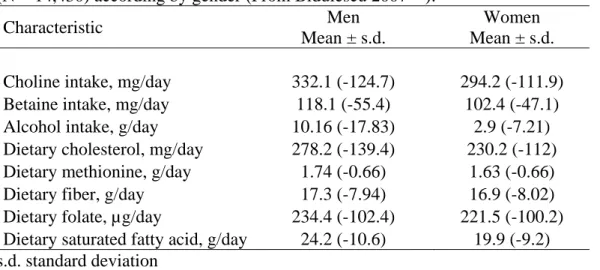
I.3 Distribution of baseline nutritional characterisitics
of the ARIC Study population (N = 14,430) according by
gender (From Bidulescu 2007). ... 34
I.4 Hazard rate ratios (and 95% CI) for CHD across quartiles of dietary intakes among 14,430 participants in the ARIC
Study (From Bidulescu 2007). ... 35
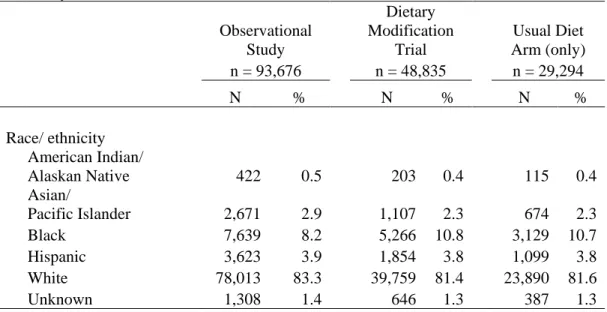
III.1 WHI observational and dietary modification study
randomization/ enrollment by ethnicity ... 64
III.2 Centrally adjudicated results for locally confirmed outcomes from the Clinical Trials and a sample of the
Observational Study from Curb et al. 2003 ... 65
III.3 Criteria for the classification of myocardial infarction
from Curb et al. 2003 ... 68
III.4 Dietary assessment data from each Women’s Health
Initiative Study component required to address study aims ... 70
III.5 Pearson correlation coefficients between selected nutrient intakes estimated by a food frequency
questionnaire and 8 days of dietary intake in the Women’s Health Initiative Dietary Assessment Study (N=113),
From Patterson et al. 1999 ... 74
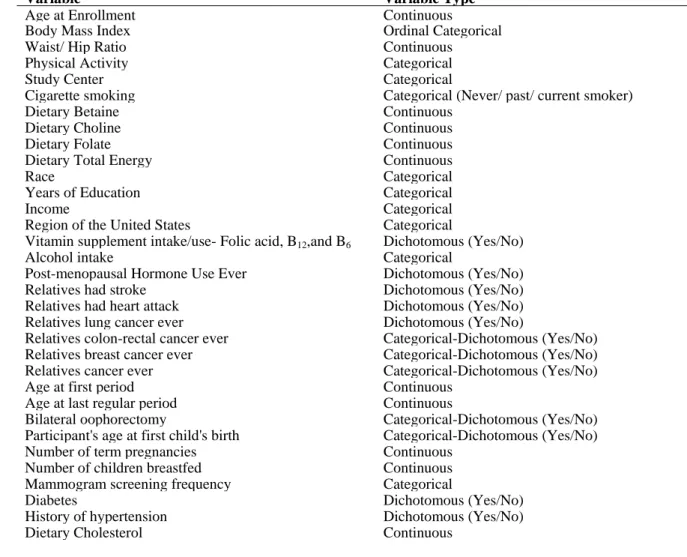
III.6 Variables of interest from the Women's Health Initiative
database ... 76
study. ... 84
IV.1.1 Distribution of baseline Food Frequency Questionnaire and baseline characteristics of the Women’s
Health Initiative (WHI) population (N = 138,612). ... 102
IV.1.2 Food item sources of choline and betaine in the Women's Health Initiative, estimated from the Women’s Health Initiative Food Frequency Questionnaire for all
Observational Study and Dietary Modification Trial
collected at the time of enrollment into the study ... 103
IV.1.3 Food item sources of choline and betaine in the
Women's Health Initiative, estimated from the Women’s Health Initiative Food Frequency Questionnaire (FFQ) for all Observational Study and Clinical Trial participants by region of the United States collected at the time of
enrollment into the study ... 104
IV.1.4 Food item sources of choline and betaine in the Women's Health Initiative, estimated from the Women’s
Health Initiative Food Frequency Questionnaire (FFQ) for all Observational Study and Clinical Trial participants by race/ethnicity of the United States collected at the time of
enrollment into the study ... 105
IV.1.5 Mean daily intake of choline, betaine, and total energy estimated from semi-quantitative food frequency questionnaires (FFQ) in the Atherosclerosis Risk in Communities (ARIC) Study; the Dutch Contribution to the European Prospective Investigation in Cancer and Nutrition (PROSPECT-EPIC); The Nurses’ Health Study;
Women’s Health Initiative (WHI). ... 106
IV.2.1 Distribution of baseline Food Frequency Questionnaire (FFQ) and baseline characteristics of the Women’s Health Initiative Dietary Modification Trial (DM)
population overall; by Usual Diet participants who completed a FFQ at baseline and one-year follow-up; and case-only analyses (breast cancer, colorectal cancer, ovarian cancer
and coronary heart disease cases) DM participants. ... 124
xi
follow-up (n=25,701). ... 125
IV.2.3 Components of reliability and measurement error
expressed as ratios of between-person variance or covariance to total (co)variance for related dietary nutrients estimated from the Women’s Health Initiative Usual Diet participants who completed a Food Frequency Questionnaire at baseline
and one-year follow-up (N= 25,701) ... 126
IV.2.4 Baseline distribution of folate, B6, B12, methionine, choline and betaine intakes estimated from the Women’s Health Initiative Food Frequency Questionnaire and Four-day Food Record in case-only analyses (breast cancer, colorectal cancer, ovarian cancer and coronary heart disease cases)
Dietary Modification Trial participants (n=4,475). ... 127
IV.3.1 Characteristics of the 96,065 White and 9,160 Black
participants in the Women's Health Initiative across quartiles of Women’s Health Initiative Food Frequency Questionnaire
estimate of nutrient density dietary choline intake at enrollment. ... 149
IV.3.2 Cox proportional hazard estimates (and 95%
confidence intervals) for incident coronary heart disease through 12 years of follow-up in White (n = 89,741) and
Black (n=8,389) Women's Health Initiative (WHI) participants. ... 152
IV.3.3 Cox proportional hazard estimates (and 95% confidence intervals) for incident coronary heart disease through 12 years of follow-up comparing truncated to winsorized values at 99th percentile for betaine; choline; B6,; B12; folic acid; methionine
LIST OF FIGURES
Figure
I.1 Choline metabolism and links to methionine metabolism. The pathways described are all present in liver, with other tissues having one or more of these pathways. (Adapted from
Zeisel, SH 2006 and Zeisel, SH 1990) ... 5
I.2 Schematic representation of homocysteine metabolism
(From Steenge et al.) MTHFR, methylenetetrahydrofolate ... 7
I.3 Pathways for the biosynthesis of lecithin. The
CDP-choline pathway and the Base Exchange pathway form lecithin by using pre-existing choline molecules (choline indicated by darker print), The Methyltransferase Pathway synthesizes lecithin by methylating
phosphatidylethanolamine, thereby forming the choline moiety de novo. CDP, Cytidine diphosphocholine; CTP, Choline phosphate cytidylyltransferase. (From Blusztajn,
JK et al. 1981) ... 9
I.4 Types of error common in nutritional epidemiology studies
from Willett 1989 ... 20
I.5 The interconnecting DNA methylation pathways of choline, methionine and methylene tetrahydrofolate (THF). Taken from
Niculescu and Zeisel 2002 ... 23
I.6 Plasma total homocysteine response in humans after the ingestion of 100 mg methionine/kg body mass before (A) and on the last day of treatment (B). Treatment consisted of the ingestion of 3 g of betaine (n = 12), 400 µg folic acid with 3 g of placebo (n = 12) or 3 g of placebo (n = 10) twice each day for 6 weeks. Values are means ± standard error. The dotted line represents the placebo group excluding the subject with an abnormal plasma homocysteine response after the second
methionine challenge Steenge et al. 2003. ... 33
III.1 Prototypical directed acyclic graph of the association
between habitual betaine/ choline dietary intake and coronary
heart disease ... 79
IV.1.1 Cumulative frequency distribution of mean daily
xiii
derived from the Women’s Health Initiative FFQ for all Observational Study and Clinical Trial participants collected
around time of enrollment by race/ethnicity. ... 107
IV.1.2 Cumulative frequency distribution of mean daily
choline and betaine consumption within the last 3 months, derived from the Women’s Health Initiative FFQ for all Observational Study and Clinical Trial participants collected around time of enrollment by United States region in which
the participant resides. ... 108
IV.1.3 Mean choline consumption within the last 3 months, derived from the Women’s Health Initiative FFQ for all Observational Study and Clinical Trial participants collected around time of enrollment. Mean choline mg/day consumption with upper and lower standard deviation boundaries are
presented by United States region in which the participant
resides and month when the FFQ was completed. ... 109
IV.1.4 Mean betaine mg/day consumption within the last 3 months, derived from the Women’s Health Initiative FFQ for all Observational Study and Clinical Trial participants collected around time of enrollment. Mean betaine mg/day consumption with upper and lower standard deviation boundaries are presented by United States region in which the participant
resides and month when the FFQ was completed. ... 110
IV.2.1 Participant Flow in the Dietary Modification Usual
Diet Arm Component of the Women’s Health Initiative ... 123
IV.2.2 Bland-Altman plot showing bias against the mean
of betaine, choline, B6, B12, natural folate, dietary folate equivalents, and methionine measurements obtained baseline and one year with 95% levels of agreement (broken lines) estimated from the Women’s Health Initiative Usual Diet participants who completed a Food Frequency Questionnaire
at baseline and one-year follow-up. ... 128
IV.2.3 Scatter plots with regression lines and 95% confidence limits for nutrient intakes estimated from baseline food
frequency questionnaires (FFQ) and four day food record (FDFR) estimated from the Women’s Health Initiative in case-only
analyses (breast cancer, colorectal cancer, ovarian cancer and coronary heart disease cases) Dietary Modification Trial
LIST OF ABBREVIATIONS
AI Adequate Intake
ARIC Atherosclerosis Risk in Communities
BHMT Betaine homocysteine methyltransferase
CCC Clinical Coordinating Center
CDP Cytidine diphosphocholine
CHDH Choline dehydrogenase
CHD Coronary Heart Disease
CI Confidence Interval
CT Clinical Trial
CTP Choline phosphate cytidylyltransferase
CVD Cardiovascular Disease
DAG Directed Acyclic Graph
DFE Dietary Folate Equivalents
DM Dietary Modification Trial
DNA Deoxyribonucleic acid
DNMT3B DNA (cytosine-5-)-methyltransferase 3 beta
ECG Electrocardiogram
e.g. Exempli gratia
et al. Et alia
FDFR Four Day Food Record
FFQ Food Frequency Questionnaire
xv
HOPE2 Heart Outcomes Prevention Evaluation 2
HR Hazard ratio
ICF Immunodeficiency, centromeric instability and facial abnormalities
ICR Interaction Contrast Ratio
i.e. Id est
kcal Kilocalorie
kg Kilograms
L Liter
LDL Low Density Lipoprotein
µ Microgram
µmol Micromole
mg Milligrams
MI Myocardial Infarction
mmol Millimoles
MTHFR Methylenetetrahydrofolate reductase
NDS-R Nutrition Data System for Research
NHANES National Health and Nutrition Examination Survey
NORVIT Norwegian Vitamin Trial
OR Odds Ratio
OS Observational Study
PEMT Phosphatidylethanolamine N-methyltransferase
PROSPECT–EPIC European Prospective study Into Cancer and nutrition
SAMe S-adenosylmethionine
SD Standard Deviation
SEER Surveillance, Epidemiology, and End Results
THF Tetrahydrofolate
UL Tolerable upper limit
ULN Upper limit of normal
U.S. United States (of America)
USDA United States Department of Agriculture
VISP Vitamin Intervention for Stroke Prevention
CHAPTER I
BACKGROUND AND SIGNIFICANCE
I.1 Choline
Choline (trimethyl-beta-hydroxyethylammonium), discovered by Strecker in 18621
and first chemically synthesized in 1866,2 is a quaternary ammonium compound that is
widely distributed in plants and animals.3 Choline is a dietary component necessary for
normal function of all cells.4 Prolonged (weeks to months) ingestion of a diet deficient in
choline, with adequate though limited methionine and folate content, has consequences that
include hepatic5, renal6, pancreatic4, cognitive6, and growth disorders7 in most mammals.
Dietary choline occurs in free and esterified forms (i.e. phosphocholine,
glycerophosphocholine, phosphatidylcholine, and sphingomyelin)8, excellent sources of
which include liver, eggs, soybeans, and wheat germ (See Table I.1).9 In the human diet,
most choline is consumed in the form of lecithin. Lecithin, a term often used
interchangeably with phosphatidylcholine, is a phosphatidylcholine-rich fraction prepared
during commercial purification of phospholipids.3 It is added to commercially prepared
foods as an emulsifier, a stabilizer, a dispersing aid, and an incidental additive, such as a
release agent for baked goods.10, 11 Zeisel 20068 states that free and esterified choline forms
are very likely exchangeable, however there is some evidence that they may have different
absorbed from the diet, while the water-soluble forms (choline, phosphocholine, and
glycerophosphocholine) enter the portal circulation and are mostly absorbed by the liver.
Table I.1 Foods with the highest choline and betaine content from the United States Department of Agriculture Database for the choline content of common foods9
Betaine Total choline
mg/100g of food mg/100g of food
Beef Liver 6 418
Chicken Liver 11 290
Pork 1 103
Bacon 3 125
Eggs 1 251
Shrimp 218 71
Wheat Bran 1339 74
Wheat Germ 1241 152
Wheat Bread 201 27
Pretzels 237 38
Cooked Spinach 645 25
Dried Soybeans 2 116
mg = milligrams, g = grams.
I.1.1 Dietary Choline Absorption
Choline and phosphatidylcholine are absorbed in the small intestine.13 Specifically,
unesterified choline is absorbed in the lumen of the upper small intestine, primarily in the
jejunum, by transporter proteins in enterocytes.14-18 The absorption of phosphatidylcholine
occurs in a process independent from that of choline.3 Briefly, phosphatidylcholine is
absorbed by enterocytes through a mechanism involving hydrolysis to form
lysophosphatidylcholine, after which phosphatidylcholine is reformed through reacylation in
the enterocyte.14 There is little known about the mechanisms which mediate the absorption
of the other choline compounds found in foods: phosphocholine, sphingomyelin, and
3
compounds are absorbed through the portal circulation and are mainly taken up by the liver,
whereas lipid-soluble compounds bypass the liver and are absorbed through the thoracic
duct.12 Some ingested choline is metabolized by bacteria before it can be absorbed from the
gut, primarily forming degradation products of betaine16 and trimethylamine.17-22 The rate of
trimethylamine production is highest when relatively large amounts of choline are ingested.17
Once absorbed, choline can be acetylated, phosphorylated, and oxidized.23 On the choline
oxidase pathway, choline is metabolized to form betaine, in a two-step oxidation process.
This pathway is described in detail within I.1.3 Betaine and Oxidation of Choline.
I.1.2 Interconversion of Choline Metabolic Pathways
I.1.2.1 Acetylcholine
Only a small portion of dietary choline is acetylated,24-26 which occurs in a reaction
catalyzed by choline acetyltransferase27, 28 (See Figure I.1) (Reviewed by Blusztajn et al.). 29
Choline acetyltransferase is highly concentrated in the terminals of cholinergic neurons.27-29
This pathway is important due to the role of acetylcholine as a neurotransmitter.3
I.1.2.2 Phospatidylcholine
The phosphorylation of choline is catalyzed by choline kinase using Mg2+ -ATP.30-32
Phosphorylation of choline, making phosphorylcholine, is the first step in the major pathway
for phosphatidylcholine synthesis on the Cytidine diphosphocholine (CDP)-pathway.33, 34
Choline phosphate cytidylyltransferase (CTP) then catalyzes the synthesis of CDP choline
from CTP and phosphocholine. Once CDP choline is formed, it rapidly combines with
diacylglycerol to form phospatidylcholine. This metabolic pathway is displayed in Figure
of membrane phospholipids.8, 35 Phosphatidylcholine, the resultant product of the
CDP-pathway, is the predominant phospholipid (>50%) in most mammalian membranes.8 It
accounts for roughly half of the phospholipids in cells and over half of serum
phospholipids.35, 36 The rate of metabolism for the CDP-pathway is less rapid than that
estimated for the choline oxidase pathway.37
I.1.2.3 Sphingomyelin
Sphingomyelin, a choline-phospholipid, is an important precursor for the generation
of intracellular signals that is found in all tissues and lipoproteins.38, 39 Sphingomyelin
metabolism has been reviewed extensively by Merril 199040 and Snook CF et al. 2006.41
Briefly, sphingomyelin biosynthesis de novo involves ceramide formation from serine and
acetylcholine, followed by the addition of the phosphocholine headgroup, which appears to
originate from phosphatidylcholine (Figure I.1).40, 42 An alternative minor pathway for
sphingomyelin synthesis includes the combination of the phosphocholine from CDP-choline
with ceramide and acylation of sphingosylphosphocholine;40 however, this only accounts for
an estimated 2-6% of the total biosynthesis. Sphingomyelin can be hydrolyzed to reform
choline.43
I.1.2.4 Glycerophosphocholine
Glycerophosphocholine is also involved in the interconversion of metabolic pathways
(Figure I.1). Phospholipase B deacylatesphosphatidylcholine, producing
glycerophosphocholine and two free fatty acids44. Glycerophosphocholine can also be
5
Figure I.1 Choline metabolism and links to methionine metabolism. The pathways described are all present in liver, with other tissues having one or more of these pathways. (Adapted from Zeisel, SH 20068 and Zeisel, SH 199045)
I.1.3 Betaine and Oxidation of Choline
Betaine (trimethylglycine), the trimethyletated compound of the amino acid glycine,
is a quaternary ammonium compound and essential biochemical component of the
methionine/ homocysteine cycle. Betaine, a choline derivative, is important because of its
role in the donation of methyl groups to homocysteine to form methionine. Betaine is found
in the diet (See Table I.1) and it can be synthesized from choline (See Figure I.1).46 As
previously mentioned, some ingested choline is metabolized by bacteria before it can be
absorbed from the gut, primarily forming degradation products of betaine.16 In addition to
the creation of betaine in the gut, a substantial portion of choline is oxidized to form betaine
aldehyde which is then converted to betaine by the enzyme system choline oxidase.47 This
irreversible two-step process,43 catalyzed by choline dehydrogenase, takes place in the
Acetylcholine
betaine aldehyde dehydrogenase choline dehydrogenase CDP-choline: diacylglycerol cholinephosphotranserase Betaine Phosphatidylcholine phosphatidylethanolamine Betaine aldehyde Choline acetyltransferase Phosphocholine CDP-choline CHOLINE Choline kinase methionine betaine homocysteine methyltransferase S-adenosylmethionine phosphatidylethanolamine-N-methyltransferase S-adenosylhomocysteine Sphingomyelin Glycero-phosphocholine
Ceramide Phospholipase B
homocysteine
liver48-52 and kidneys (See Figure I.1). 48, 51, 53-56 This accounts for up to 50% of the
destruction of ingested choline,16 while the remainder of dietary choline is used to make
acetylcholine and phospholipids (e.g. phosphatidylcholine).57 Thus, production of betaine
from choline oxidation diminishes the availability of choline to tissues and in the process,
scavenges some methyl groups. These methyl groups can be made available from
one-carbon metabolism, upon conversion to betaine.58 In this process, betaine homocysteine
methyltransferase (BHMT) catalyzes the methylation of homocysteine, using betaine as the
methyl donor (see Figure I.1).59-65 On an alternative pathway, 5-methyltetrahydrofolate
homocysteine methyltransferase (MTHFR) regenerates methionine using a methyl group
derived de novo from the one-carbon pool (Figure I.2).59 MTHFR methionine regeneration is
dependent upon vitamin B12 (B12) and folic acid66, 67. Deficiency of these nutrients has been
associated with elevated plasma homocysteine concentrations.68, 69 Interestingly, when
homocysteine flux is high, the capacity of the folate dependent pathway for methylation of
homocysteine is exceeded and the choline/betaine pathway becomes increasingly
important.70-72 However, when homocysteine flux is low, the folate-dependent methylation
pathways are sufficient for homocysteine removal.70-72 After the homocysteine is
methylated, methionine adenosyltransferase converts methionine to SAMe, which is the
active methylating agent for deoxyribonucleic acid (DNA) methylation.63 Dietary
methionine has been shown to decrease choline requirements; the hypothesized mechanism is
through the replacement of choline as a methyl donor for the regeneration of
S-denosylmethionine.73, 74 Consequently, dietary choline demand is modified by the metabolic
methyl-exchange relationships between choline and three nutrients: methionine, folate, and
7
Through the metabolic pathways described above, it has been shown that choline
functions as a precursor for acetylcholine, certain phospholipids, and betaine.4 Thus, choline
participates in the methylation of homocysteine to form methionine, 59-61, 63 directly affects
cholinergic neurotransmission (Section I.1.2 Interconversion of Choline Metabolic Pathways
), 3, 27-29 and directly affects lipid transport from the liver (Section I.1.2 Interconversion of
Choline Metabolic Pathways ).4, 8, 36, 75
Figure I.2 Schematic representation of homocysteine metabolism (From Steenge et al.76) MTHFR, methylenetetrahydrofolate
I.1.4 Non-dietary Choline Sources
Aside from diet, the only other source of choline is through an endogenous pathway,
named the Methytransferase Pathway, involving the de novo biosynthesis of
PEMT uses S-adenosylmethionine (SAMe) as a methyl donor for the sequential methylation
of phosphatidylethanolamine to form a new choline moiety (See Figure I.1). 8, 78-83 This
process is most active in the liver, however it also occurs in other tissues.75, 81 While there are
three pathways for the biosynthesis of lecthin (CDP, Base Exchange, and Methyltransferase),
only the Methyltransferase pathway results in a net synthesis of choline. The CDP34 and
9
Figure I.3 Pathways for the biosynthesis of lecithin. The CDP-choline pathway and the Base Exchange pathway form lecithin by using pre-existing choline molecules (choline indicated by darker print), The Methyltransferase Pathway synthesizes lecithin by
methylating phosphatidylethanolamine, thereby forming the choline moiety de novo. CDP, Cytidine diphosphocholine; CTP, Choline phosphate cytidylyltransferase. (From Blusztajn, JK et al. 198186)
I.2 Importance of Total Dietary Choline
While choline can be biosynthesized de novo, the concentration of free choline in
serum and tissues is heavily dependent on the dietary intake of choline.23, 27, 87-92 Existing
research suggests that de novo synthesis is not sufficient to meet human requirements. In
adult humans, serum choline concentration have been shown to fluctuate within a small range
when common foods are ingested.93 The administration of a single large dose of choline
chloride (0.05 grams (g)/ kilogram (kg) of body weight) was found to elevate plasma choline
concentration 300- 400%.73, 94 Hirsch MJ et al. 197894 observed peak choline concentrations
persisted for up to 8 hours.94 Similarly, large doses of lecithin (0.3 g/kg of body weight)
increased serum choline concentrations by as much as 400%, with elevations persisting for as
long as 12 hours.94 Due to the metabolic pathways for the interconversion of the
aforementioned choline forms (e.g. free choline, glycerophosphocholine, phosphocholine,
phosphatidlycholine, and sphingomyelin) and the demonstrated effect of choline and
phosphatidlycholine on serum choline levels, total dietary choline intake must be considered
when examining dietary choline requirements. While betaine and choline are also
metabolically related, dietary betaine is considered separately, as the conversion from choline
to betaine is irreversible.43
Humans can become depleted of choline and betaine.5, 95 Choline depletion can affect
health status, as it is a micronutrient that is essential for normal function of all cells.4 As
detailed above, choline participates in the methylation of homocysteine to form methionine,
59-61, 63
directly affects cholinergic neurotransmission,3, 27-29 and directly affects lipid transport
from the liver.4, 8, 36, 75 There are a number of published comprehensive reviews of the
metabolism and functions of choline.4, 96, 97 When deprived of dietary choline (from 1-4
weeks), studies performed by da Costa et al. 200498 and Zeisel et al. 19915 reported that most
adult men and postmenopausal women developed signs of organ dysfunction (fatty liver or
muscle damage). Choline deficiencies have also be associated with the reduced capacity for
handling a methionine load, resulting in elevated homocysteine,70 a risk factor for
cardiovascular disease99. In addition to these studies in humans, animal based research has
shown choline deficient diets to be associated with infertility,7 bone abnormalities,100, 101
11
and growth disorders.7 Although many foods contain choline,43 there is at least a two-fold
variation in the dietary intake of choline in humans.106-109
I.2.1 Choline Adequate Intake
Despite variability in human dietary choline intake and mounting evidence supporting
a relationship between choline deficiencies and adverse health states, no studies have
examined the relationship between chronic disease outcomes and habitual dietary choline and
betaine intake. Indeed, until very recently, the analytical data to address the dietary
requirement for choline in the general population were insufficient. Thus far, only an
“Adequate Intake” has been determined, a value based on observed or experimentally
determined approximations of nutrient intake in a group (or groups) of healthy individuals,
when levels sufficient to meet the nutrient requirement of nearly all healthy members of a
group cannot be determined (Recommended Dietary Allowance).23 In 1998 the U.S. Institute
of Medicine’s Food and Nutrition Board established an Adequate Intake (AI) and tolerable
Upper Limit (UL) for choline using data from liver damage prevention studies.23 Due to
insufficient data, the recommended AI of 500 milligrams (mg)/day for adult males and 425
mg/day for adult females (both aged 19 years and older) was based solely upon the results of
one study conducted in healthy men (Zeisel et al. 19915).23 Further, the UL of 3.5 g/day for
all adults was based on findings from a single case report of hypotension and several other
studies involving cholinergic effects and fishy body odor after oral administration of large
choline doses.23 In recognition of the dietary choline AI and UL estimate's shortcomings, the
Institute of Medicine publication list recommends that high priority be placed on research
which examines the effects of the use of graded levels of dietary intake of choline on
were no validated food composition data for betaine, choline, glycerophosphocholine,
phosphocholine, phosphatidylcholine, and sphingomyelin prior to 2003.9, 43
I.2.2 Choline and Betaine Conversion Tables
In the early 1940s some data were generated, using now outdated methods, on the
unesterified choline content of foods 110, 111 and in the early 1980s limited information was
generated about the phosphatidylcholine content of foods.112 Prior to 2003 there was some
information about the betaine concentration of foods,113-115 but no information concerning
other esterified forms of choline (glycerophosphocholine, phosphocholine,
phosphatidylcholine, and sphingomyelin). The recent development of the United States
Department of Agriculture (USDA) Special Interest database for choline and betaine in foods
has provided a means to estimate choline and betaine intake from common foods.9, 43 To
create the database, food samples were analyzed for betaine and the following choline
contributing compounds: free choline, glycerophosphocholine, phosphocholine,
phosphatidylcholine, and sphingomyelin. Total choline content was calculated as the sum of
the measured choline-contributing metabolites; acetylcholine and CDP-choline food
concentrations were not estimated because dietary sources are negligible.9, 43 The database
includes choline values (for individual metabolites and total choline) and betaine values for
434 foods across 22 food categories, with food items arranged by food category.9 Quality
assurance was monitored by duplicate sampling, and by the use of in-house control samples,
and standard reference material with known choline content.9 This choline and betaine
common food content database provides critical information needed to examine the
13
I.2.3 Measuring Diet
Included here for completeness is an overview of five common methods used to
identify foods consumed in individual diets: direct observation; food record or diary;
twenty-four hour food recalls; interviews about food intake from the previous day; usual diet intake
history.116, 117
I.2.3.1 Direct Observation
The use of direct observation is the only method of diet assessment for population
based studies that assures the quantitative and qualitative validity of all nutrients
consumed.117 Direct observation has been used to assess the validity of reported food intake
in smaller studies with 1- 2 days of diet observation.118-120 While direct observation captures
the participant’s current intake, it may not reflect usual intake. Studies investigating the
effects of usual diet on disease risk would require more prolonged direct observation; this
method is often too expensive to employ for population based studies of diet and disease.117
In addition to the associated costs, direct observation is particularly susceptible t to responder
bias. When participants are studied in the home a pseudo-artificial environment is created
where they know their diet is being directly observed which could yield temporary behavior
change.117, 121
I.2.3.2 Food History
An alternative to direct observation is the food history approach which is usually
practiced as a refinement of the method described by Burke122 in the 1940’s. The food
history approach includes: a twenty-four-hour diet recall; a history of usual foods; data on
since obtaining this information from participants usually requires a 1- 2 hour interview by a
specially trained nutritionist. Nonetheless, this method is also too costly for wide application
and is very dependent upon the quality of the interviewer.117 Despite these limitations, the
food history is used as a standard by which other methods not validated by observation are
measured.117
I.2.3.3 Twenty-four-hour Diet Recall
The twenty-four-hour diet recall was designed to assess recent nutrient intake
quantitatively.117, 123-126 This, 30-60 minute interview, is usually performed with a trained
dietitian using food models and containers to assess quantity.117 This quantitative estimate of
food intake reduces recall bias since it asks for diet within the past twenty-four hours. While
less expensive than the previous two methods, the twenty-four-hour diet recall is still
relatively costly and requires trained interviewers. Additionally, a twenty-four diet recall
provides a snapshot of an individual’s diet which is probably not representative of their
average dietary nutrient intake.117, 124, 127-130 The costs of performing multiple
twenty-four-hour food recalls to address the aforementioned shortcomings can be prohibitive for larger
population based studies. Number of recall days required to reliably place subjects in the
same quintile of intake for some nutrients ranges from 3-7 for dietary fat124, 127 to 17-19
recalls for calcium.129
I.2.3.4 Food Record or Diary
One dietary assessment tool that does not require a dietitian for data acquisition is the
food record or diary. Food records are usually compiled, by the participant, over 3-7 days
15
the costs of an interviewer; however, the food record is more accurate when participants are
trained by dietitians in how to estimate quantity and record intakes.117 Consequently, this
method may not be less costly than the aforesaid approaches. Some limitations of this
method revolve around its participant driven nature. The validity of food records can be
affected by compliance issues, bias due to self-report, and respondent’s perceptions.
Logging the details of every food item consumed can be a tedious task. Compliance rates,
accurately logging all foods, can be affected by differences in the level of vigilance by which
participants complete the records. More importantly, characteristics affecting vigilance may
also be related to diet patterns. Additionally, reporting could be biased since the participant
knows that their complete 3-7 day diet will be viewed by another person. This could result in
some underreporting of food items; like the compliance issue, this may be associated with
diet patterns. Finally, it is well known that behavior modification can be induced by just the
act of recording all food consumed for greater than one or two consecutive days.117 Despite
these shortcomings, the food record is often used as the gold standard for validating other
methods in the absence of food history or direct observation.117
I.2.3.5 Food Frequency Questionnaire
As stated previously, the twenty-four hour recall, diet record, and direct observation
are generally expensive and unrepresentative of usual intake when only a few days are
assessed131. The food frequency questionnaire, first touched upon by Burke (1947)122 and
further developed during the 1950s,132-135 represents an attempt to obtain a self-administered,
inexpensive, and rapid estimate of usual intake.117 With further substantial refinement in the
1980s and 1990s131 the Food Frequency Questionnaire (FFQ) has become the most
FFQ is directed to the average long-term dietary exposure (e.g. intake over weeks, months,
years).121 Most FFQs collect information on the consumption of roughly 60-130 food
items,131 depending upon the version. The information on foods items consumed is
aggregated across all meals, and quantification of diet is restricted to categories of
consumption (e.g. never, once a month or less, 2-3 times per month, etc.).131 Through the
collection of these details, the FFQ provides estimates of dietary exposure that are of
conceptual interest in most applications, which is average intake over an extended period of
time121. Further, estimates of habitual diet would likely be expected to be a better predictor
of chronic disease than would a single day’s diet.117
When compared to the other diet assessment tools, the FFQ is more cost effective and
representative of usual diet. It can be administered by personal interview, self-administered,
by telephone, or through the mail thus greatly reducing cost.136 The FFQ asks about usual
diet over an extended period of time, allowing it to be more representative of usual intake
than a short diet record or twenty-four-hour food recall.117 Also, examining usual diet over an
extended period of time tends to reduce misclassification, when compared to short term diet
observation, by increasing the chances of correctly ranking subjects (e.g. placing in quintiles
by usual intake), which is more likely to reflect a diet-disease association.117, 137, 138
There are also some limitations to the FFQ method. Completion of a short
non-quantitative self-administered questionnaire requires a certain level of literacy.117 The list of
foods specific items tends to be fairly culture specific. Due to the limited number of food
items in a FFQ some dietary habits may be missed.117 The FFQ relies on fixed or subjective
definitions of small, medium, or large portions making the size estimation more
17
consumption, but do not provide for more precise estimation of quantities. Consequently, the
combination of missing foods and semi-quantitative methods limits the accuracy of the
estimated caloric intake.117
I.2.3.6 Measurement Error in Dietary Assessment
In addition to the instrument specific considerations listed above, all of these dietary
assessment tools are subject to varying degrees of measurement error. While there are
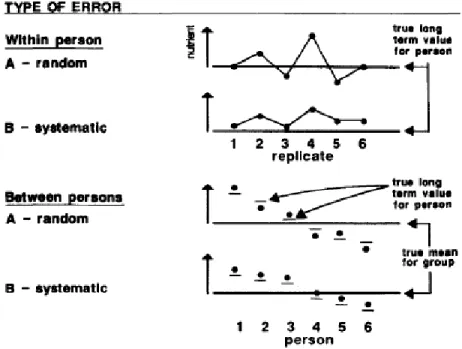
numerous sources of error, they can be roughly grouped into two general types: random and
systematic.139 Each of these two errors can be further subdivided into within and between
errors, resulting in four basic types of measurement error: random within-person, systematic
within-person, random between-person, and random within-person.139, 140 These four general
types of errors are depicted in a figure from Willett 1989 (See Figure I.4) 141.
Random within-person. Random within-person error is comprised of day-to-day fluctuations in dietary intake due to daily changes in food intake and errors in the
measurement on any given day (Figure I.4) 139. When only 1- 2 days are measured, a
subject’s true long-term intake is likely to be misrepresented/ misclassified.142 Within-person
dietary variation causes the observed correlation of the dietary exposure and disease outcome
to be attenuated. 124, 143 Random within-person error can be reduced through the use one or
more replicate measurements obtained from an individual.124, 143, 144 A single measurement is
an unbiased estimate of the true exposure and the mean of n replicate measurements is also
an unbiased estimate of the true exposure, but with a smaller variance.145 Additionally, a
Systematic within-person. Repeated measures of diet may also be subject to systematic
error in addition to random error. In the presence of systematic within-person error,
unbiasedness does not hold and the mean of many repeated measures will not necessarily
converge toward a person’s true intake (Figure I.4).145 Therefore systematic within-person
error is another valid concern when examining dietary assessment tools. This is can be in the
form of a consistent incorrect estimation of the true diet due to design aspect associated with
the instrument. Using dietary questionnaires can possibly result in systematic within-person
error because repeated administrations may consistently under- or over- estimate intake due
to conscious or unconscious under- or over- reporting.145 This can be the result of such things
as consistent misinterpretation of a question by a subject, or the omission of a food item from
the questionnaire that is important for some individuals.139, 145 Estimates of systematic
within-person error are obtained through the comparison of the observed measurement with
an independent measure of true exposure, which measures the validity.145 However, the
majority of studies considering measurement error use the assumption that within-person
error is strictly random since much of statistical theory is based on the assumption of random
error and systematic error is considerably more difficult to measure.139
Random between-person. When measuring diet among a group of persons, between-person error is also of concern.139 Random between-person error can occur when only a few
replicate measures per subject are obtained in the presence of random within-person error or
the consequence of systematic within-person errors that are randomly distributed among
subjects.139 Random between-person error implies that an overestimation for some
19
group of participants is the true mean of the group (Figure I.4) 139. However, this will result
in a net overestimation of the standard deviation for the group.139
Systematic between-person. Systematic between-person error can occur due to systematic
within-person error that affects subjects non-randomly.139 This will lead to an incorrect mean
value for a group of persons.139 Systematic between-person errors occur frequently and can
have many causes (e.g. the omission of a commonly eaten food from a standardized
questionnaire; the use of an incorrect nutrient composition value for a common food).139
Systematic within-person error infrequently affects all individuals equally.139 While the
omission of a commonly eaten food on a standardized questionnaire or the use of an incorrect
nutrient composition value for a common food will affect individuals in the same direction
(Figure I.4), it will not affect them to the same degree since the consumption of these foods
will differ among subjects.141 Many times, random and systematic between person errors
exist in combination.139
All four general types of error are described above for completeness. However, this
proposal is designed to estimate and adjust for the effects of random and systematic
within-person measurement error. Systematic between-within-person error will indirectly be examined as
both of the components that contribute to it will be considered (random within-person error
Figure I.4 Types of error common in nutritional epidemiology studies from Willett 1989141
I.2.3.7 Implementation of Dietary Assessment Tools in the Study of Chronic Disease
In summary, dietary intake can be estimated with diverse tools. Some assessment
tools involve opened ended records or recalls on specific days (i.e. twenty-four food recalls;
direct observation; four-day food records), while others are designed to examine habitual
intake using finite portion, food items, and frequency of consumption metrics (i.e. FFQ). It
has been argued that an individual’s stable, habitual nutrient intake is the more relevant
exposure in epidemiologic studies designed to assess the impact of long-term dietary habits
on chronic disease.139 Although prolonged diet recordings per subject provide the ideal
standard, this process is costly and of limited applicability in the setting of population
studies. The FFQ provides a cost effective means for estimating long-term diet and is widely
used in epidemiologic studies for such purposes.131 Therefore, the FFQ in combination with
the choline and betaine common food content database provides critical information needed
21 I.3 Choline/Betaine and Cancer
Choline, methionine, and folate are interconnected on the methylation metabolic
pathway that produces methionine from homocysteine (See Figure I.5). As previously mentioned (Section I.1.3 Betaine and Oxidation of Choline), oxidation of choline to betaine
produces methyl groups used to convert homocysteine to methionine(Figure I.1).58-65 Methionine adenosyltransferase then converts methionine to SAMe, which is the primary
methyl donor for numerous biochemical reactions throughout human tissue (See Loenen
2006 review146), including DNA methylation.63
Rats fed diets deficient in dietary choline and betaine have decreased SAMe
concentrations,147, 148 and DNA hypomethylation has also been observed in rats during
choline deficiency with adequate dietary levels of methionine.149, 150 Deficiencies in dietary
folate andB12 may also lead to decreases in SAMe concentrations through effects on the
folate dependent pathway (See Figure I.2). 151 Rat studies have consistently shown that diets
deficient in the methyl donors choline, folate, methionine and B12 induce genomic and
protooncogene DNA hypomethylation and elevated steady-state levels of corresponding
mRNAs.149, 152-157
Methylation is the enzymatic addition of a methyl group to the carbon-5 position of
cytosine.158, 159 Methylation of DNA is essential for the regulation of gene expression, and in
turn cell differentiation.160-165 Specifically, methylation regulates genetic elements including
promoters, enhancers, insulators, and repressors usually by suppressing their function.161
heterochromatin, appears crucial for maintaining the conformation and integrity of the
chromosome.161, 166
Epigenetic events are believed to play a significant role in the development and
progression of cancer. Hypermethylated regions have been found in virtually every type of
human neoplasm and are associated with the transcriptional silencing of genes.167, 168
Hypomethylation changes similar to those induced by dietary choline, methionine, and folate
deficiencies, have also been observed in tumors. They are similar to those induced by dietary
choline; methionine; folate deficiencies.
It has thus been hypothesized that hypomethylation of non-promoter regions of DNA
and of structural elements, such as centromeric DNAs, cause enhanced genomic
instability.169, 170 This is supported by the observation that many human tumors have similar
losses of DNA methylation and chromosomal structural changes in these regions.169, 171 In
humans germ-line mutations in DNA (cytosine-5-)-methyltransferase 3 beta (DNMT3B),
which encodes DNA methyltransferase 3β, an enzyme that catalyses DNA methylation, are
associated with decreased DNA methylation and the immunodeficiency, centromeric
instability and facial abnormalities (ICF) syndrome.172-174 ICF patients have a loss of
methylation at selected centromeric regions and profound chromosomal structural changes.169
Further supporting the enhanced genomic instability hypothesis, increased levels of gene
deletion have been reported in mouse embryonic stem cells that are deficient in DNA
methyltransferase 1.175
Hypomethylation may also influence carcinogenesis by modifying gene expression,
including increased expression of oncogenes165, 176 and may be a crucial factor facilitating
23
liver cells from the population which initially exhibited hypomethylation later advanced to
yield the tumors that formed, as observed from tissue samples.178 Finally, studies in humans
have found that the extent of genome-wide hypomethylation in tumors parallels closely the
degree of malignancy, though this is tumor-type dependent.161 In breast, ovarian, cervical,
and brain tumors, for example, hypomethylation is seen to increase progressively with
increasing malignancy grade.179, 180 The previously mentioned lines of evidence reflect
findings from association studies, and it is important to note that a cause and effect
relationship has yet to be established.
Thus, hypomethylation has been linked to transformation, tumor progression, and
oncogene expression,177-179, 181-184 thereby providing a basis for primary tumor growth.185
Several studies have thus provided evidence indicating that global hypomethylation serves as
an early, and fairly consistent, event in carcinogenesis.169, 186 Among these, cross-sectional
studies have reported associations between DNA hypomethylation and colorectal,187
breast,180 and lung cancer.161, 188
I.4 Choline/Betaine and Cardiovascular Disease
Dietary betaine and choline intake may also be associated with coronary heart disease
(CHD) and stroke risk through the homocysteine methylation pathway. Homocysteine, a
breakdown product of methionine, is further degraded to cysteine through B6 dependent
reactions.189 Alternatively, homocysteine is methylated to form methionine. This methylation
reaction can be catalyzed either by betaine homocysteine methyltransferase, where betaine is
the methyl donor for the reaction or methionine synthase (Figure I.2).62 In general, there is a
graded and direct association between plasma total homocysteine levels and cardiovascular
disease, including coronary vascular disease and cerebral vascular disease and arterial
thromboembolism.190-201 However, this association has not been confirmed by population
based studies or clinical trials of homocysteine modification via supplementation with folic
acid, vitamin B6 (B6) and vitamin B12 (e.g. the Vitamin Intervention for Stroke Prevention
(VISP)202, Norwegian Vitamin Trial (NORVIT) 203, Heart Outcomes Prevention Evaluation
(HOPE2)204 studies).
I.4.1 Choline/Betaine and Total Homocysteine
Homocysteine, a thiol-containing amino acid, is an intermediate of the intracellular
metabolism of methionine205, 206 on the methylation pathway connecting choline, methionine
and folate (Figure I.5).58-65 When exported into the blood, homocysteine is present in the
reduced form (homocysteine) and the oxidized state (i.e. the disulfides homocysteine and
cysteine-homocysteine).205, 207 All these forms, whether free or bound to proteins, contribute
to total homocysteine, also called, homocyst(e)ine.205 Only a small fraction of total
25
deficiencies and enzymatic deficiencies on either the methylation pathway or transulfuration
to cysteine result in elevated levels of total homocysteine. Elevated total homocysteine is
clinically referred to as homocysteinemia (elevated levels in blood) or homocystinuria
(elevated levels in urine).205, 208-212
I.4.2 Proposed Mechanisms Linking Total Homocysteine and Cardiovascular Disease Risk
The mechanisms by which homocysteinemia is associated with atherosclerosis are not
fully understood.213 There are a few plausible mechanisms by which relatively elevated
plasma total homocysteine may contribute to vascular disease, including mechanisms related
to increased thrombosis, impaired thrombolysis,214 endothelial dysfunction, 213, 215, 216 and
oxidation of low-density lipoprotein (LDL) 202, 217 (Reviewed in McCully 1996218 and
Stamler and Slivka 1996216). Of these mechanisms, only the impaired thrombolysis and
endothelial dysfunction hypotheses could plausibly be affected by dietary choline and betaine
intake.217 Randomized clinical trials of homocysteine reduction through various
supplementation combinations of -folic acid, B12, and B6; -folic acid and B12; -B6 showed no
appreciable reduction in either LDL or total cholesterol levels when each combination was
compared to the placebo treatment group.202-204 These findings are supported by the research
reported by Dalmeijer et al. 2007from the PROSPECT-EPIC study.108
I.4.2.1 Homocysteine and Increased Thrombosis and Impaired Thrombolysis
Multiple hypotheses have been put forth regarding the role of homocysteinemia in
venous thrombosis and atherosclerosis.214 Among them, it has been posited that
homocysteine has a toxic effect on the vascular endothelium and on the clotting cascade.219
cell function. Enhanced Factor V activity, decreased protein C activation, and diminished
fibrinolysis 220-222 are among the observations that provide evidence of a vascular coagulant
mechanism in the pathogenesis of hypercoagulability associated with
hyperhomocysteinemia.
I.4.2.2 Homocysteine and Endothelial Dysfunction
In addition to the mounting evidence of an effect of hyperhomocysteinemia on
hypercoagulability, there is also an increasing body of research which provides evidence that
chronically elevated total homocysteine also has adverse effects on the endothelial
function.213 Studies have reported that chronically elevated homocysteine concentrations are
associated with impaired flow-mediated endothelium dependent vasodilatation in children223
with severe hyperhomocysteinemia and in adults224, 225 with moderate
hyperhomocysteinemia.213 It is not completely known how homocysteinemia contributes to
endothelial dysfunction.223, 224 While the causal association has been established, the
mechanism of action has yet to be elucidated. In vitro studies have provided some clues to
the nature of the relationship. Specifically, while initial exposure of cultured endothelial
cells to homocysteine leads to the formation and release of nitric oxide, S-nitrosothiols, and
S-nitrosohomocysteine,226 continued exposure leads to reduced production of nitric oxide or
inactivation of nitric oxide226, 227 by superoxide anion radicals and hydrogen peroxide.226, 227
This impaired availability of nitric oxide, which has potent vasodilator and platelet-inhibitor
properties, leaves the endothelium vulnerable to unopposed homocysteine-mediated
oxidative damage.213, 228 However, these studies could not establish whether endothelial
dysfunction was caused by elevated homocysteine by atherosclerotic disease associated with
27
responses to acutely elevated homocysteine concentrations in healthy human subjects, and
found that an elevation in homocysteine concentration was associated with an acute
impairment of endothelial function that was prevented by pretreatment with vitamin C. This
finding supports the hypothesis that adverse effects of homocysteine on vascular endothelial
cells are mediated through oxidative stress mechanisms.213
I.4.3 Research in Total Homocysteine Reduction through Betaine Supplementation
Folic acid, B6, and vitamin B12 can reduce plasma total homocysteine,229, 230 and
possibly help reverse elevated total homocysteine-related endothelial injury.213, 215
Individuals with relatively higher plasma levels or dietary intake of folate and vitamin B6
have a decreased risk of CHD.231-234 Of the aforementioned B vitamins, studies have shown
folic acid to be the strongest dietary determinant of homocysteine, with daily
supplementation (between 0.5 to 5.0 mg) typically lowering plasma homocysteine levels ~25
percent, Vitamin B12 supplementation (at least 0.4 mg daily) further lowering levels by about
7 percent, and vitamin B6 supplements lowering homocysteine after methionine loading.204,
230, 235
Folic acid fortification of enriched grain in the U.S. began in 1996 and was mandated
by January 1998 in hopes of reducing the risk of neural tube defects in newborns. The
fortification was associated with a reduction in the population mean level of total
homocysteine in the U.S.,236 and a three-fold acceleration in the decline of stroke mortality,
and was subsequently estimated to have prevented 17,000 deaths from ischemic heart disease
and 31,000 stroke related deaths each year.237 However, these estimates are not supported
by population based studies or clinical trials of homocysteine modification via
previously mentioned homocysteine is an intermediate of the intracellular metabolism of
methionine205, 206 on the methylation pathway on which choline, methionine and folate
interconnect (Figure I.5). 58-65
Presumably, dietary choline and betaine intake could have a significant influence on
total homocysteine levels. This is of interest since, when homocysteine flux is high, the
capacity of folate dependent pathway for methylation of homocysteine is exceeded and the
choline/betaine pathway becomes increasingly important.70-72 While total homocysteine
lowering with B vitamin supplementation has been thoroughly researched in epidemiologic
and clinical trial studies, research into the effects of betaine supplementation have been
mainly limited to the clinical case reports.76 Clinical case reports have been published on the
success of betaine treatment in combination with folic acid supplementation in normalizing
total homocysteine concentrations in hyperhomocysteinemia patients with genetically
induced errors in homocysteine metabolism (e.g., cystathionine, β-synthase deficiency, 5, 10-
MTHFR deficiency).238-241 These studies report on a small number of patients with extremely
elevated total homocysteine levels; there are few data on the effects of betaine
supplementation in individuals with normal to mildly elevated homocysteine levels. In
smaller population-based studies, Brouwer et al. 2000242 and Schwab et al. 2002243 reported
that daily ingestion of 6 g/day betaine for 2 weeks and 6 g/day for 12 weeks, respectively,
was associated with a 8-9% reduction in mean fasting plasma total homocysteine levels.
Further, Steenge et al. 200376 conducted a study of the effects of prolonged betaine
versus placebo or folic acid supplementation on fasting plasma homocysteine concentrations
and plasma homocysteine levels after methionine loading (ingestion of 100 mg methionine
29
When compared to the placebo group, fasting plasma homocysteine changed by -1.8
micromoles (µmol)/ liter (L) (95% confidence interval [CI]: -3.6, 0.0) in the betaine group
and by -2.7 µmol/L (95% CI: -4.5, –0.9) in the folic acid group.76 Interestingly, betaine
suppressed the total area under the plasma homocysteine-time curve after methionine loading
by 221 µmol x 24 hours/L (95% CI: -425, –16) compared with placebo, whereas folic acid
had no effect when compared to the placebo treatment (See Figure I.6).76 All estimates
presented by Steenge et al. were unadjusted. Overall, daily ingestion of 6 g/day of betaine
for 6 weeks was associated with an 11% decrease in mean fasting plasma homocysteine
concentrations and a 40% reduction in mean plasma homocysteine peaks 6 hours post
methionine load (See Figure I.6).76 This further supports the folate dependent pathway for
methylation of homocysteine is exceeded and the choline/betaine pathway becomes
important when homocysteine flux is high.70-72 Some recent studies have additionally
examined whether total homocysteine lowering via betaine supplementation is associated
with subsequent reductions in blood lipid levels108, 244 and cardiovascular disease risk.108
Olthof et al. 2005244 combined data from four different placebo-controlled
intervention studies to investigated the effects of supplementation of three
homocysteine-lowering nutrients (betaine, choline, and folic acid) on blood lipid concentrations in modestly
hyperhomocysteinemic patients. Phosphatidylcholine (2.6 g/day), betaine (1.5, 3, or 6 g/day)
and folic acid (0.8 mg/day) treatment for 6 weeks lowered plasma homocysteine by 12% to
20%. However, betaine treatment appeared to be positively correlated with LDL, such that
participants receiving a 1.5 g/day betaine dose had an mean LDL that was 0.1 millimoles
(mmol)/ L higher than the placebo treatment group, while mean levels among those receiving
higher.244 Zeisel 2006245 argues that these differences are possibly an artifact attributable to
differences in the randomization of subjects.
I.4.4 Studies of the Association between Ingested Choline and Betaine and Cardiovascular Disease Risk
Extending the work of Olthof et al. 2005, Dalmeijer et al. 2007108 investigated the
association between dietary intakes of folate, betaine and choline and the risk of
cardiovascular disease (CVD) in 16,165 Dutch postmenopausal women from the Dutch
European Prospective study Into Cancer and nutrition (PROSPECT–EPIC) cohort.
Participants were followed for an average of 8.1 years.108 They also examined associations
between dietary intakes of folate, betaine and choline and plasma homocysteine
concentrations and cholesterol concentrations in a subsample of 1,610 women (homocysteine
in a subsample of 903 women) were also examined.108 The usual dietary intake of 178 food
items in the year preceding enrollment was estimated using a FFQ246, 247 with choline and
betaine contents in individual foods estimated from the available data of the USDA Special
Interest database for choline and betaine in foods.9
Baseline nutritional characteristics of these women are summarized inTable I.2.
Dalmeijer et al. 2007 did not find an association between betaine and homocysteine
concentrations, and intakes of choline and folate had only weak inverse associates with
plasma homocysteine concentrations,108 which they attributed to narrow ranges of intakes in
the study population. They did not observe the same betaine associated LDL lowering that
Olthof et al. 2005 reported; however, higher betaine intake was associated with lower
HDL-cholesterol (difference between fourth and first quartile -0.06± 0.03 mmol/l, 95% CI:
31
lower homocysteine levels (difference between fourth and first quartile – 0.87±0.35 mmol/l,
95% CI: -1.56; -0.19).108 They considered the following variables as confounders: intake of
energy, proteins (energy-adjusted), saturated fats (energy-adjusted), monounsaturated fats,
polyunsaturated fats (energy-adjusted), alcohol (energy-adjusted), B2 (energy-adjusted), B6
(energy-adjusted), B12 adjusted), betaine adjusted) and choline
(energy-adjusted). In the multivariable adjusted models, choline, betaine and folate intakes were not
associated with total CVD, CHD or cerebrovascular disease.108 Again, this could be
attributed the narrow ranges of choline, betaine and folate intakes in this study population.
Research similar to Dalmeijer et al. 2007 was also conducted within the
Atherosclerosis Risk in Communities (ARIC) study, where Bidulescu et al. 2007109 assessed
the association of dietary intake of choline and betaine with incident CHD. This study differs
from Dalmeijer et al. 2007 in that it was conducted in a large biethnic prospective cohort
with participants of both genders and adjusted for dietary intake measurement error. Study
participants (n=14,430), aged 45 and 64 at enrollment, were recruited from Forsyth County,
North Carolina; Jackson, Mississippi; suburbs of Minneapolis, Minnesota; Washington
County, Maryland.248 Participants were followed-up for an average 14 years (1987–2002)
for incident CHD events.248 Usual dietary choline and betaine intake, for the year preceding
enrollment, was quantified at the baseline visit (1987–1989), with a 66-item version of the
Willett semi-quantitative FFQ.249 As in Dalmeijer et al. 2007, the choline and betaine
contents in individual foods were estimated USDA Special Interest database.9 In addition to
the baseline FFQ, a random sample of 1,004 participants whose dietary intake was measured
three years after the ARIC baseline was also examined to assess the reliability of the FFQ for