STUDENT-GENERATED QUESTIONS IN INQUIRY SCIENCE: CONNECTING TO COLLABORATIVE ARGUMENTATION
Lana M. Minshew
A dissertation submitted to the faculty of the University of North Carolina at Chapel Hill in partial fulfillment of the requirements for the degree of Doctorate of Education in the School of
Education (Learning Sciences and Psychological Studies).
Chapel Hill 2018
Approved by: Janice L. Anderson Sharon J. Derry Lynda Stone Kelly Ryoo
ABSTRACT
LANA MARIE MINSHEW: Student-Generated Questions in Inquiry Science: Connecting to Collaborative Argumentation
(Under the direction of Janice L. Anderson)
The National Research Council (NRC) released the Next Generation Science Standards (NGSS Lead States, 2013) that established a framework for three-dimensional learning, which includes science and engineering practices, crosscutting concepts, and disciplinary core ideas. The first dimension of learning emphasizes scientific and engineering practices asserting that students should not only be familiar with scientific practices but also be able to successfully conduct an investigation utilizing the practices (NGSS Lead States, 2013). The science practices were included in the NGSS because knowing science content is not enough; students need to be able to use their understanding to investigate the natural world (NGSS Lead States, 2013). The expectation is that students not just know science content but can participate in science
exploration and the many discourses of science. The scientific practices intentionally overlap one another and are interconnected; they do not operate in isolation (NGSS Lead States, 2013). However, little is known about how the scientific practices overlap, specifically how one scientific practice influences another. Studies often focus on students’ development or
This work is dedicated to my Mom and Dad, who have always supported me and have been my biggest cheerleaders from the beginning. Their positive energy, love for my brother and I, and their tireless efforts to be amazing teachers have been my source of inspiration and dedication in
ACKNOWLEDGEMENTS
I have many people to thank for their unwavering support during the completion of my doctoral degree and this dissertation. First, my deepest gratitude goes to my advisor, Janice Anderson, thank you for always having an open door, providing me with endless opportunities for research, and being both supportive and critical of my growing knowledge and ideas. Your guidance through this process has been amazing and I cannot image working and thinking alongside anyone else. Next, I want to thank the rest of my committee, your help and guidance have made me a better researcher, thinker, and writer. I appreciate your time and effort in helping me in my journey. To Sharon Derry, thank you for always pushing me to produce my best work. You have been a crucial figure in making me a better researcher and scholar. You also make one hell of a travel partner. I would also like to thank the others, including Lynda Stone, Kelly Ryoo, and Meg Blanchard, who graciously served on my committee and provided valuable feedback and guidance during this research project.
great and providing affirmation every chance you got. To my niece, Emilee, for making me take a break from my studies and research so I could just have fun with her. You and me are one in the same kid; don’t ever stop smiling and having fun.
To all of my friends both near and far I could not have made it through this without you. To Sami, for always listening to me and allowing me to vent whenever I needed to. For
correcting my abhorrent use of commas and making multiple trips to North Carolina and my parents’ house just to spend time with me. To my little-buddy, Kelly, for wearing me down and forcing me to accept hugs and her friendship. You have no idea how much harder this process would have been if you hadn’t infiltrated my life. To Molly, for keeping me sane during my last few milestones of graduate school and being there to just hang out, drink wine, and not talk about graduate school. To Kayley, Kristin, Emily, Audra, and Liz thank you for friendship, taking time to be supportive of each other, and simply checking in to make sure shit hadn’t hit the fan. To Beth, Suzy, and Laura, thanks for reminding me to have fun and pulling me out the door to have it. Thank you to my many other SOE friends that I haven’t listed but have all been influential to me during my time at UNC.
Finally, to my amazing partner, Jared, you have been wonderful since the moment we met. You have navigated my seemingly endless work hours, my stress, tears, and anxiety, and yet only seem to love me more as time progressed. Thank you for standing strong next to me, providing on-demand hugs, and being my rock. I love you and I like you.
TABLE OF CONTENTS
LIST OF TABLES ………..xiii
LIST OF FIGURES ………..xv
I. ASKING QUESTIONS & ARGUMENTATION: INTRODUCTION & OVERVIEW……… 1
Statement of Problem ………...………. 3
Aim of Study & Research Questions ………...………. 6
Significance of Study ………...………. 7
Research Design ………...………. 8
Limitations ………. 8
Chapter One Summary and Overview ………...………... 9
Definition of Terms ……….. 10
II. REVIEW OF LITERATURE: ARGUMENTATION AND ASKING QUESTIONS IN SCIENCE EDUCATION ………... 12
Conceptual Framework ………...……… 12
Scientific Argumentation ………...………. 14
Asking Questions ………...………. 17
Asking Questions and Scientific Argumentation ………..….….… 27
III. EXAMING STUDENTS QUESTION & SCIENTIFIC ARGUMENTATION: METHODOLOGY ………..…….…..…. 30
Design-Based Research ………... 30
Case Study Design ………... 33
Research Questions ………...35
Context ………...………. 37
Compost Curriculum ……… 37
Collaborative Structures ………..…… 39
Design Changes ………...…………... 39
Setting ……….. 42
Participants ………...…………... 43
Data Collection ………...……… 45
Video Data Collection ……….. 45
Data Analysis ………...………... 49
Video Selection ……… 49
Identification of Student Questions ………. 50
Identification of Instances of Argumentation ……….. 53
IV. STUDENT’S QUESTIONS AND INSTANCES OF ARGUMENTATION: FINDINGS ………57
Initial Analysis of Questions and Arguments ………..57
Types of Questions ………...61
Argumentation ………..65
Case 1 - Making Observations (Card Sort) Activity ………68
Description of Activity ……….68
Argumentation & The Making Observations (Card Sort) Activity ……….….73
Simple Claims ………..…74
Increasing complexity of arguments ………..…..75
Case Summary ……….….…82
Case 2 - What Factors Help Decomposers Break Down Matter? – What Factors? Activity ……….…84
Description of Activity ……….…84
Questioning & The What Factors? Activity ……….…86
Inquiry/Science Content-focused questions ……….87
Argumentation & The What Factors? Activity ………….………91
Low instances of argumentation ……….……….91
I-2 Male group, the exception………...………95
Case Summary ……….……….98
Case 3 - Virtual Experiments – Moisture Level & Carbon to Nitrogen Ratio ………99
Description of Activity ……….99
Questions & The Virtual Experiments ………104
Implementation 1 – Moisture Virtual Experiment ………...………..105
Implementation 2 – Carbon to Nitrogen Virtual Experiment ………107
Argumentation & The Virtual Experiments ………...………111
Implementation 1 – Moisture Virtual Experiment ……….111
Implementation 2 – Carbon to Nitrogen Virtual Experiment ………114
Case Summary ………....118
Description of Activity ……….………..119
Questions & Big Ideas about Ecosystems Activity ………122
Argumentation & Big Ideas about Ecosystems Activity ………125
Case Summary ………132
Cross-Case Analysis ………..……133
Placement of Activities in Curricular Unit ……….………134
Structure of Activities ……….…136
Type of Inquiry/Science Content Question ………139
Asking Questions & Scientific Argumentation ………..144
Cross-Case Analysis Summary ………...151
V. SUMMARY OF FINDINGS, CONCLUSION, & IMPLICATIONS ………..…….153
Summary of Findings ………...………..153
Discussion ………...………...155
Conclusions ………...……….160
Strengths & Limitations ……….……163
Implications ………164
Implications for Practice ……….164
Implications for Future Research ………166
APPENDIX A : IMPLEMENTATION 1 – MAKING OBSERVATIONS (CARD SORT) ACTIVITY…………..………..169
APPENDIX B: IMPLEMENTATION 2 – MAKING OBSERVATIONS (CARD SORT) ACTIVITY………172
APPENDIX C: IMPLEMENTATION 1 – WHAT FACTORS? ACTIVITY……….…177
APPENDIX E: IMPLEMENTATION 1 – MOISTURE VIRTUAL EXPIREMENT ………...181 APPENDIX F: IMPLEMENTATION 2 – CARBON TO NITROGEN RATIO
VIRTUAL EXPIREMENT ……….186 APPENDIX G: IMPLEMENTATION 1 –
BIG IDEAS ABOUT ECOSYSTEMS ACTIVITY ………...192 APPENDIX H: IMPLEMENTATION 2 –
LIST OF TABLES
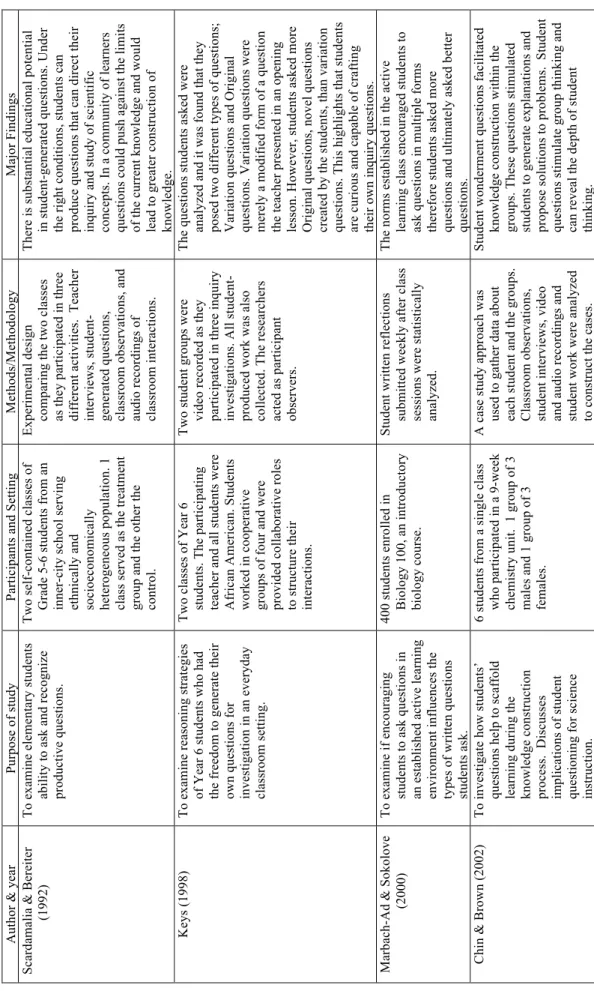
Table 1. Representative studies of student-generated questions in science……….…..20
Table 2. Studies that examine student questions and argumentation ………28
Table 3. Selected activities from the Compost curriculum ………...37
Table 4. Design changes Implementation 1 & Implementation 2……….... 40
Table 5. School and District demographics ………..44
Table 6. School and District student population ………...44
Table 7. Small group demographics ……….45
Table 8. Major question categories ………...53
Table 9. Argumentation coding framework ………..55
Table 10. Total number of questions posed by group per activity ………58
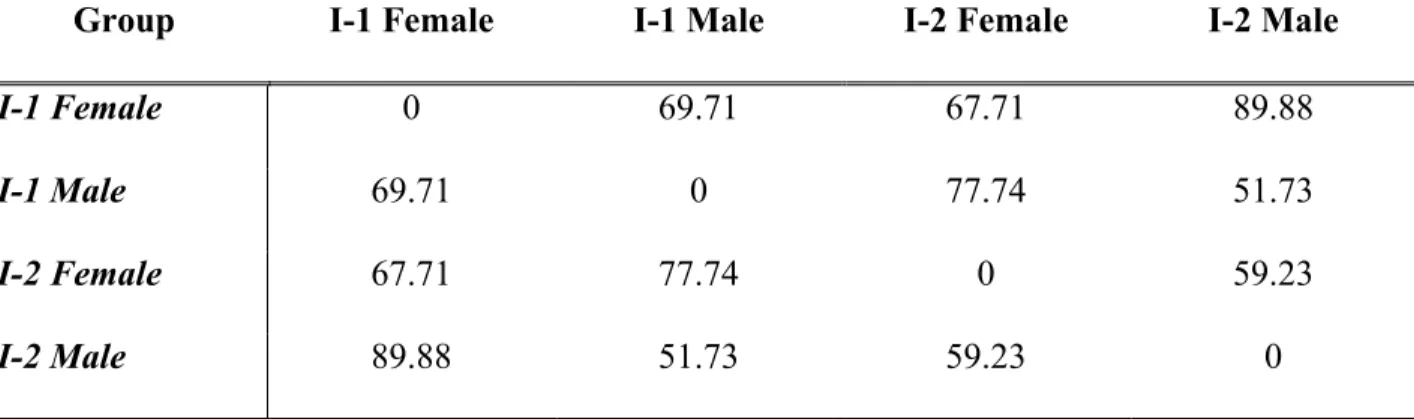
Table 11. Distance Matrix………..59
Table 12. Questions Asked by Individual Students ………..60
Table 13 Major Question Categories ………....62
Table 14. Inquiry/Science Content question sub-categories & examples ……….65
Table 15. Complexity of instances of argumentation descriptions ………...67
Table 16. Examples of student Inquiry/Science Content questions in the Making Observations (Card Sort) activity ………71
Table 17. Proposing potential research Verbal questions and examples ………..87
Table 18. Proposing potential research Written questions and examples ……….89
Table 19. I-1 Moisture virtual experiment – Science/Inquiry content questions ………106
Table 20. I-2 C:N virtual experiment – Seeking clarification/explanation of ideas …………...108
Table 21. I-2 C:N virtual experiment – Seeking input questions ………...110
Table 23. Big ideas about ecosystem – Inquiry/science content questions ………124 Table 24. Types and frequencies of questions asked by student during activities ……….135 Table 25. Type of Inquiry/science content questions per activity ………..140 Table 26. Relationship between Inquiry/science content questions & instances
LIST OF FIGURES
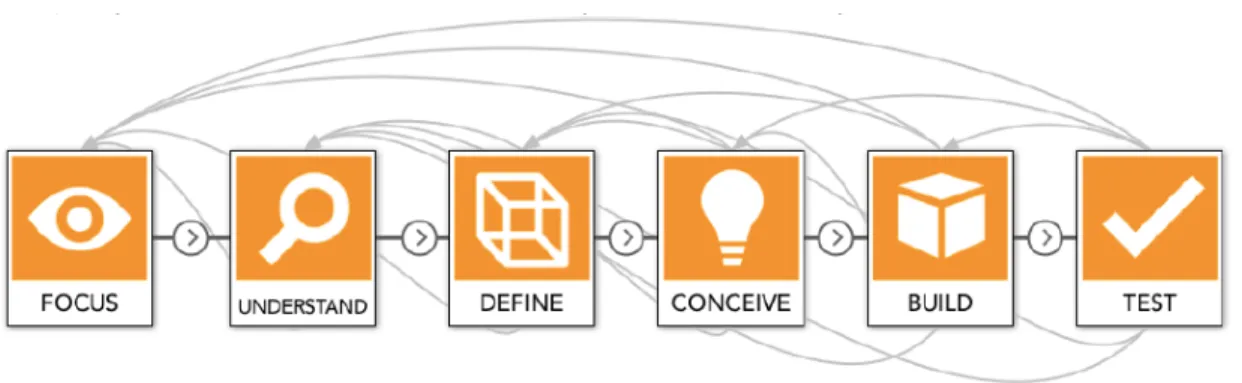
Figure 1. Easterday, Lewis, & Gerber (2014) Design Process ……….32
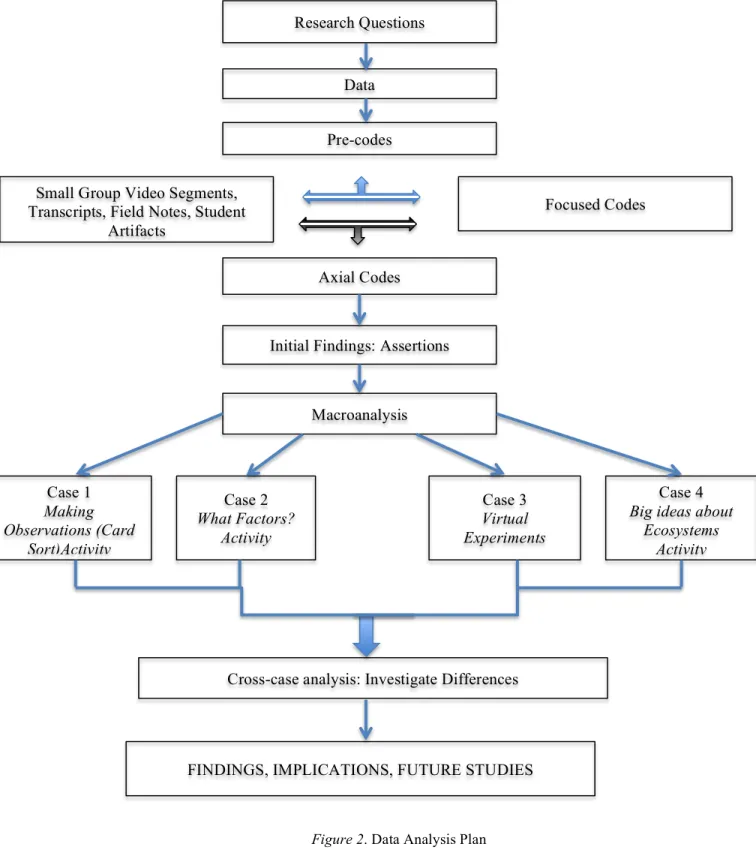
Figure 2. Data analysis plan ……….….36
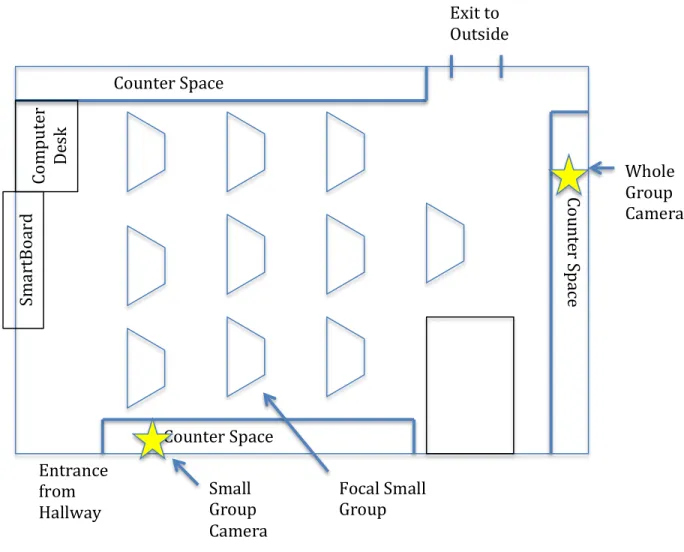
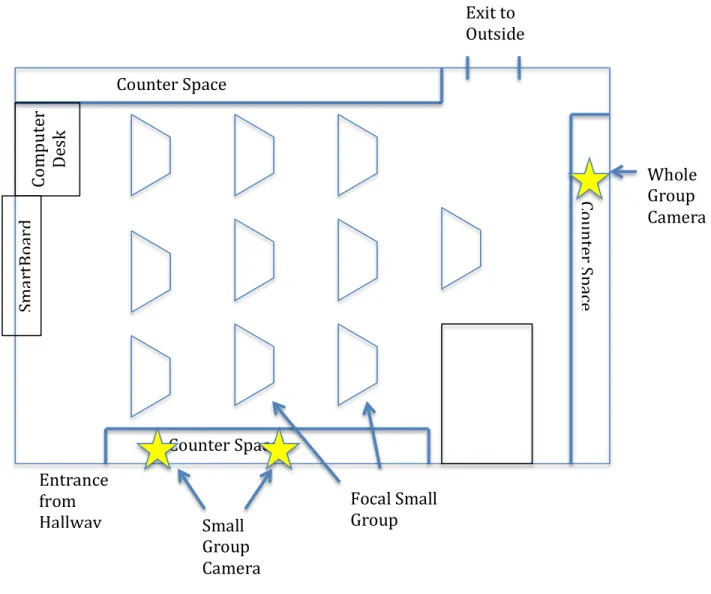
Figure 3. Implementation 1 video camera placement in classroom ………..47
Figure 4. Implementation 2 video camera placement in classroom ………..49
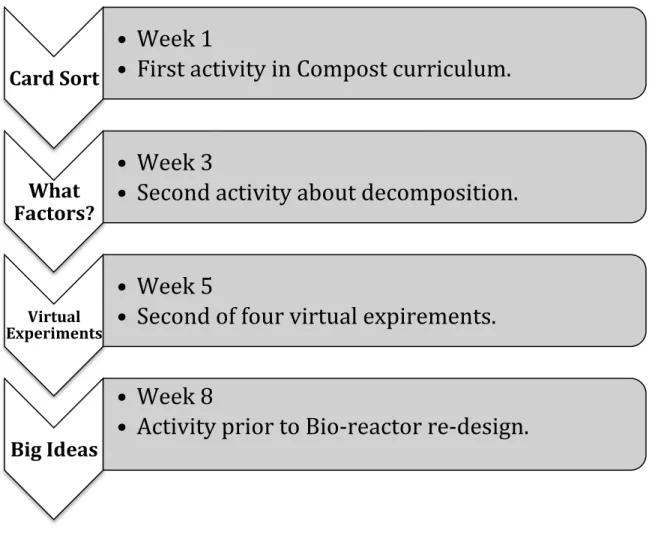
Figure 5. Timeline of activities ……….50
Figure 6. Think-Collaborate-Share Cycle from Compost curriculum ………..69
Figure 7. 30 centimeter card ……….73
Figure 8. Temperature card ………..75
Figure 9. The “20 meter tree” card ………...78
Figure 10. The “white couch” card ……….….79
Figure 11. Hardness card ………..81
Figure 12. Compost virtual experiment ………..101
Figure 13. Padlet Wall – Virtual experiments……….103
Figure 14. I-1 – Data table Moisture virtual experiment ………112
Figure 15. Casual chain – virtual experiment ……….115
Figure 16. Padlet Wall – Big Ideas about Ecosystems………120
Figure 17. Implementation 1 Team Journal ………121
Figure 18. Implementation 2 Team Journal ………122
Figure 19. Influence of Activities on Student Questions and Argumentation ………134
CHAPTER ONE
ASKING QUESTIONS AND ARGUMENTATION: INTRODUCTION AND OVERVIEW In many science classrooms it is the teacher, not the students, who initiates and
participates in the majority of the discourse (Baumfiled & Mroz, 2002; Duschl & Osborne, 2002; Newton, Driver, & Osborne, 1999). Teachers rely heavily on lecture and demonstrations to cover the breadth of the curriculum mandated by state standards, leaving the majority of students as passive participants of science. Classroom environments that encourage a single answer to a problem and reinforce the teacher as the authoritative voice are not reflective of authentic scientific practice. These classrooms are reproductive rather than productive in supporting students to engage in authentic disciplinary practice (Engle & Conant, 2002). When teachers dominate scientific discussions in classroom it gives students a false sense of how scientific investigations are conducted by scientists in the field.
science and engineering practices, crosscutting concepts, and disciplinary core ideas. The first dimension of learning emphasizes scientific and engineering practices asserting that students should not only be familiar with scientific practices but also be able to successfully conduct an investigation utilizing the practices (NGSS Lead States, 2013).
The first dimension of learning suggests that in order for students to be successful in science, they need to be able to navigate the different discourses or ways of knowing, doing, talking, reading and writing about science (McNeill, 2011). By having students engage in the different discourses and practices of science, students will be mimicking the collaborative
discussions and practices that scientists engage in everyday as they advance scientific knowledge within their community. It is the action of working collaboratively with others, the sharing of ideas, constructing scientific arguments, and the questioning of phenomenon that encourages the construction of science knowledge (Barron, 2003; Engle & Conant, 2002). It is not enough for students to merely hear or read expert scientific explanations; students need to engage in and practice scientific skills (Newton et al., 1999). Social interactions between and among students, not teacher-directed lecture, provide the basis for students to begin to construct their scientific understanding (Asterhan & Schwarz, 2009).
Recently in K-12 science education the use of more authentic inquiry activities that promote the development of students’ scientific practices have been on the rise (Kuhn,
Arvidsson, Lesperance, & Corprew, 2017). This is in part because the Next Generation Science Standards (NGSS Lead States, 2013) express the need for authentic science learning
(Jiménez-Aleixandre, Rodríguez, & Duschl, 2000). The NGSS states, “students cannot fully understand scientific and engineering ideas without engaging in the practices of inquiry and its discourses” (NGSS Lead States, 2013, p. 1, Appendix F). Therefore, it is crucial to expose students to and provide them opportunities to utilize scientific practices so students are able to develop their scientific practice, engage in scientific discourses, and ultimately think critically about science concepts.
A lot of attention has been paid to the scientific practice of argumentation, but studies about other scientific practices such as asking questions are much more limited (e.g., Chin & Brown, 2002; Keys, 1998; Marbach-Ad & Sokolove, 2000; Scardamalia & Bereiter, 1992). Even less attention has been paid to how the scientific practices influence each other during scientific inquiry. This study aimed to investigate students’ questions that occurred during four inquiry science activities and the connection between those questions and instances of dialogical argumentation that arose. In the following pages I present a brief rationale for development of students’ scientific practices, specifically focusing on Asking questions and Engaging in arguments with evidence, and why student questioning in conjunction with dialogic
argumentation should be studied. A brief overview of the methodology, the significance and limitations of the study are also provided.
Statement of Problem
memorization of scientific facts and instead begin to engage in constructing scientific knowledge (Berland, Schwarz, Krist, & Kenyon, 2016). The scientific practices are also important because when students engage in the practices of science they begin to understand how science
knowledge develops and it makes the knowledge more meaningful as students are able to draw connections to their individual worlds (NRC, 2012). The eight practices identified in the NGSS are: 1) Asking questions; 2) Developing and using models; 3) Planning and carrying out
investigations; 4) Analyzing and interpreting data; 5) Using mathematics and computational thinking; 6) Constructing explanations; 7) Engaging in argument from evidence; and 8) Obtaining, evaluating, and communicating information.
The identified scientific practices intentionally overlap one another and are
interconnected (NGSS Lead States, 2013). The scientific practices do not operate in isolation, and often lead from one practice to another. For example, the practice of Asking questions could lead to the Planning and carrying out investigation which then leads to Analyzing and
interpreting data that requires Using mathematics and computational thinking. The example demonstrates that students utilize multiple scientific practices during well-designed and implemented inquiry. However, little is known about how the scientific practices overlap, specifically how one scientific practice influences another. Studies often focus on students’ development or implementation of a single scientific practice such as developing and using models or engaging in argumentation. Yet, if the scientific practices overlap and lead to one another then as educators and researchers we need insight into these areas in order to better support students as they engage in scientific practices.
Osborne, Erduran, & Simon, 2004). K-12 student engagement in argumentation is often framed in a univariable experiment which only reveals a narrow part of authentic scientific inquiry and does not provide students the necessary context (Kuhn et al., 2017). The lack of context causes the construction of an argument to be interpreted as an isolated event and misconstrues students’ perception of argumentation, and other scientific practices, as a set of isolated procedures, instead of being interconnected to other scientific practices (Kuhn et al., 2017). Therefore scientific practices need to be viewed and implemented as a coherent network of activities that can support learners in building science knowledge (Berland et al., 2016).
The practice of argumentation overlaps with many of the other seven scientific practices. Argumentation is most frequently linked with planning and carrying out investigations and analyzing and interpreting data, as the expectation is that students use their data to construct an argument. One scientific practice that is often not directly linked to argumentation is the Asking of questions. Student questions have the potential to foster discussion and debate (Herrenkohl & Cornelius, 2013); and provide the opportunity to delve deeper into a topic because it encourages students to dwell and elaborate on a topic, as well as connect their ideas (Hogan, Nastasi, & Pressley, 1999). All of these are important aspects of developing strong claims with evidential support and justification.
2010a). Asking questions is also a key discursive move that is important for building student conceptual understanding (Hmelo-Silver & Barrows, 2008; Hogan et al., 1999). When students ask questions it indicates that they have been thinking about information presented and they are trying to extend and connect the information to what they already know (Chin & Brown, 2002; Chin & Osborne, 2008; Hogan et al., 1999). Questioning also contributes to the negotiation of understanding among group members because questions drive students to articulate their confusion, and encourage students to be explicit about their understanding (Chin & Osborne, 2010a; Chinn & Clark, 2013). Yet, despite the ability of students’ questions to enhance learning, opportunities for students to generate and explore their own questions are often limited (Chin & Osborne, 2008). In summary, questions are important in the development of scientific conceptual understanding and attention needs to be paid to how questions in collaborative groups influences other scientific practices, particularly argumentation.
Aim of Study and Research Questions
This study examines the relationship between questions posed and dialogical arguments constructed by students during collaborative work in small groups. The focus is on questions and dialogical arguments that arose naturally as students’ participated in a collaborative project-based inquiry science curriculum. The following research questions frame this study:
1. How does student questioning relate to their dialogic argument development during collaborative work?
a. In what way(s) does the number of questions posed within collaborative group work influence student development of dialogic arguments?
c. How does the complexity of student dialogic arguments (claim, evidence, justification) relate to questions posed during collaboration?
Significance of the study
This dissertation contributes to the literature of scientific practices specifically by pushing the conversation forward with regard to student-developed questions and student dialogic argumentation that are generated during small group collaboration. The study draws connections between students’ questions and the instances of dialogical argumentation that occurred. It examines how the number and different types of questions influence student engagement in argumentation. Questions are identified as a metacognitive tool that has the potential to broaden (a) student argumentation space, (b) the questioning space (i.e., types, depth, range, and frequency of questions), and (c) the negotiation space (Chin & Osborne, 2010b). Asking questions is a means to engage students in the process of learning and more research is needed in how questions within collaborative environments engage students in dialogical argumentation which can ultimately lead to stronger scientific understanding. Currently, little research reports on students’ use of questions in collaborative settings, and what successes (or failures) questioning practices have had in these settings. The studies that do exist regarding student-generated questions have focused on questions created by individuals and usually in written form. Other studies (e.g., Chin & Osborne, 2010b) note that there are bodies of literature for the value of questioning for science conceptual understanding and a separate one for
Research Design
This dissertation was a part of a larger Design-Based Research (DBR) project called Bio-sphere: Fostering Deep Learning of complex biology for Building Our Next Generation’s
Scientists, which was supported by the National Science Foundation. The Bio-sphere project was a collaborative effort between the University of Wisconsin at Madison and the University of North Carolina at Chapel Hill (UNC-Chapel Hill) that aimed to develop middle school biology curricula focused on sustainability of ecosystems. The UNC-Chapel Hill research team focused on the Compost curriculum and had data from two implementations with one science teacher and two cohorts of his students. Case study design was used to collect data about eight small groups during curriculum implementation. Each group was video and audio recorded during their science class while participating in activities from the Compost curriculum. Each video
recording has corresponding field notes collected by one of two graduate researchers during each implementation. Video data, along with other forms of collected data, were used to identify and examine student-generated questions and arguments. Four cases were developed; a cross case analysis of these cases was conducted to present the findings. Directed content analysis was used to construct the case studies which allowed the researcher to respond to the posed research questions.
Limitations
This study focused on a small sample of students and the discourse they engaged in over four activities from a larger curricular unit. The study therefore cannot be generalized to a larger population nor provide a definitive statement about student questions and the instances of
light on how (or not) student questions relate to argumentation that occurs between students in small groups as they engaged with four different science activities. The study design of
constructing multiple cases does not facilitate assessment of cause and effect. Student discourse in small groups cannot be directly linked to their post-assessment outcomes; therefore this connection will not be made.
Chapter One Summary and Overview
In this chapter, I have outlined my argument for the need to study scientific practices in tandem and to explore the relationships that exist between practices, as they are meant to overlap and be interconnected. If the expectation is for students to develop scientific practices within a context then educators and researchers need to know how the practices influence one another. This study uses the development of cases and cross case analysis to explore the questions students posed and the arguments that developed during a project-based, inquiry science curriculum.
The following chapters will provide more details for each specific section. Chapter Two presents an overview of the current and relevant literature and the conceptual framework that undergirds this work. The third chapter addresses the overall research design, outlines the methods employed to gather data, and the rationale behind selecting the methodologies. Chapter Three also includes the methods used to analyze the data. Chapter Four presents the findings of the study in the form of four case studies and a cross-case analysis. Chapter Five summarizes the findings, draws connections to previous literature, makes recommendations for practical
Definitions of Terms
There are several terms that need to be defined in order to effectively communicate how the context influenced student questions, argumentation, and collaboration. In education, terminology can accrue many definitions, with slight differences that can influence the
interpretation of meaning. Below are several terms that will be used throughout this dissertation; they are defined here and within the text.
Argument – An artifact constructed by individuals that often contains a claim, evidence, and justification (Kuhn & Reiser, 2005; McNeill, 2011; Osborne, 2010).
Argumentation – The process that individuals participate in, in order to construct an argument (Kuhn & Reiser, 2005; McNeill, 2011; Osborne, 2010).
Collaboration – The process of building and maintaining shared conception of a problem, mutually constructing and negotiating understanding (Engle & Conant, 2002; Roschelle, 1992).
Dialogical Argumentation – The process of constructing an argument orally that occurs in conversation, typically in a group setting. Additionally, dialogical argumentation is a form of collaborative discourse in which both parties strive to resolve an issue and reach agreement in pursuit of advancing knowledge within their community (Andriessen & Baker, 2014; Evagorou & Osborne, 2013).
Instances of argumentation – Any moment that has aspects of the argumentation process present. This does not always result in the formal development of an argument that contains a claim with supporting evidence and justification.
External scripts – Structured collaboration scripts (e.g., texts, graphics, etc.) that provide collaborators with external support for how to collaborate (Fischer, Kollar, Stegmann, &
Wecker, 2013). External scripts acts as guides to support individuals who do not have established internal collaboration scripts (Rummel & Spada, 2005; Fischer et al., 2013).
CHAPTER TWO
REVIEW OF THE LITERATURE: ARGUMENTATION & ASKING QUESTIONS IN SCIENCE EDUCATION
The Framework for K-12 Science Education (NRC, 2012) identifies scientific practices as the context in which students should learn the disciplinary core ideas of science. The
Framework also stresses that student knowledge of science can develop while also strengthening their competency in related science practices (NRC, 2012). As noted in Chapter One, this
enables students to not only know science concepts but to be able to actively participate in science. In Chapter Two, the discussion is expanded on the two scientific practices of interest; Asking questions and Engaging in argument from evidence (argumentation). Relevant research regarding the use of these two practices in the classroom will be discussed along with the how the two practices have been studied together. First, the study is situated in the conceptual framework of collaboration. Collaboration is a 21st Century skill (Dede, 2010) and is a fundamental element of the Compost curricular unit.
Conceptual Framework
As noted in Chapter One, students not only need to know science concepts, they also need to be able to participate in the discourses of science. Discourse refers to the use of language to communicate scientific ideas both verbally and in written text. This study focuses on students’ verbal discourse that occurs during inquiry science activities. Language, specifically
been stated, “there is no science without language” (Hand, Norton-Meier, Gunel, & Akkus, 2016, p. 848). It is through language that we are able to express ideas, communicate with others, and develop science knowledge (Evagorou & Osborne, 2013). The emphasis on language and discourse suggests development of understanding of scientific concepts is not conducted in isolation, but as a collaborative process. Though collaboration is not explicitly named in A Framework for K-12 Science Education (NRC, 2012), it is inferred that collaboration is needed to cultivate students’ scientific practices. The NRC Framework (2012) acknowledges that the scientific practices reflect the actual practices of professional scientists and engineers; both of which require the ability to collaborate and communicate with others.
For many science education researchers, knowledge is socially negotiated and the objects of science are constructs that the scientific community uses to interpret a particular phenomenon (Driver, Asoko, Leach, Mortimer, and Scott, 1994). This suggests that collaborative discourse is crucial for scientific discoveries, theory development, and the critique and verification of both (Osborne, 2010). The NRC states, “interaction with others is the most cognitively effective way of learning” (2012, p. 73), thus promoting collaboration as an essential element needed in order for students to acquire and use the science practices and construct their understanding of science concepts.
Collaborative settings provide a context for students to engage in and develop their scientific practices because it provides students the opportunity to share their individual
understandings, resolve differing perspective through argumentation, provide critiques of other’s ideas, and listen to explanations of others (Barron, 2003). It sets the stage for students to
expertise, monitor the collective understanding, and mutually construct and negotiate knowledge (Roschelle, 1992). Participation in collaboration allows for students to engage in a variety of cognitive and social activities that lead to a shared understanding of a phenomenon (Miyake & Kirschner, 2014). Thus, working collaboratively with others provides a platform for students to develop their scientific practices such as argumentation and asking questions.
Scientific Argumentation
Argumentation is a specific type of discourse and is identified by the National Research Council (2012) as a key scientific practice that demonstrates to students that science is an ever-evolving body of knowledge that is rooted in evidence. The NRC states, “science is replete with arguments that take place both informally, …and formally” (2012, p. 71). Argumentation is a central element to learning science (Osborne et al., 2004) and argumentation entails a
fundamental set of skills that are needed in order to be an active participant in scientific
discourses (Kuhn, 2010). Science education research has found that not only is argumentation a crucial science practice for students to acquire, it also suggests that participating in
argumentation has a positive impact on developing students’ reasoning, critical thinking, and communication skills (Chinn & Clark, 2013; Driver, Newton, & Osborne, 2000; Osborne et al., 2004; Sampson & Clark, 2011, von Aufschnaiter, Erduran, Osborne, & Simon, 2008).
The term ‘argument’ is used by science education researchers to describe the artifact that is generated by students and the term ‘argumentation’ to describe the complex process of
or collaborative argumentation, which is a form of collaborative discourse in which both parties strive to resolve an issue and reach agreement in pursuit of advancing knowledge within their community (Andriessen & Baker, 2014; Evagorou & Osborne, 2013). This suggests that
argumentation is an active process, that it is a social activity in which ideas are tested and refined as individuals work to persuade others and make sense of available evidence and
counter-evidence (Berland & Reiser, 2009; Chin & Osborne, 2010a; Nielson, 2013; Evagorou & Osborne, 2013). The discourse that students participate in during a science activity is essential for idea generation, idea improvement and conceptual understanding (Hsu, Chiu, Lin, & Wang, 2015; Nussbaum, 2008).
Several aspects of collaborative argumentation such as asking questions for clarification (Chin & Osborne, 2010a), coordinating evidence with claims (Chinn & Clark, 2013; Kuhn, 2010), as well as proposing, critiquing, and evaluating ideas (Berland & Reiser, 2009; Berland & Lee, 2012) encourages deeper discussions and aids students’ knowledge building of science concepts. This makes collaborative argumentation not just a way to actively learn science, but supports students’ overall thinking and comprehension (Chinn & Clark, 2013), which is a goal of the scientific practices (NRC, 2012). A second goal is to create critical consumers of science (NRC, 2012); students who can effectively participate in collaborative argumentation by constructing sound arguments are more capable of obtaining this goal (Ford, 2012).
within collaborative groups which is important for the constructing of arguments. The
development of sense-making and critiquing of ideas also position students as stakeholders for their own learning, and gives students agency within the collaborative group and the task (Engle & Conant, 2002).
Attending to peers’ understanding of science concepts by providing explanations is another aspect of collaborative argumentation that supports students in building their own knowledge and understanding (Baker, 2009). It is imperative that students attend to others’ ideas in collaborative argumentation in order to be successful in accomplishing their goals (Kuhn, 2015). Working collaboratively often leads to students providing elaborate and complex
explanations to peers during group work (Baker, 2009; Coleman, 1998). This is because students must construct and defend explanations; they have to make sense of the specific science content they are studying, articulate their understanding, and persuade others that their explanation is scientifically sound (Berland & Reiser, 2009; Chinn & Clark, 2013). This requires the speaker to be explicit not only with their explanations, but also with their problem-solving processes. This can lead to students producing more coherent discourse as well as potentially restructuring their knowledge (Baker, 2009; diSessa, 2014).
Research focusing on small group collaborative argumentation has reported mixed findings about the impact collaborative argumentation has had on student conceptual
groups did produce superior arguments in comparison to students who worked individually. These findings have prompted researchers to continue to examine the benefits of small group collaboration; focusing on the potential learning outcomes concerning student scientific knowledge, as well as the impact on students’ thinking in general.
The scientific practice of argumentation, specifically collaborative or dialogic argumentation, has numerous benefits for the building of science knowledge. The NRC has indicated that argumentation is an essential skill in the pursuit of the production of scientific knowledge. As noted above, argumentation is not only crucial for students’ scientific practice, but it also helps to develop students’ reasoning, critical thinking and communication skills; all of which extend beyond the K-12 science classroom. Finally, argumentation encourages students to be critical consumers of information, by providing a platform for students to ask questions and seek explanations from their peers. Asking questions is another scientific practice that is explored in this dissertation study and is discussed next in this chapter.
Asking Questions
science is a series of facts and figures to be memorized instead of a discipline inspired by curiosity.
As described above, collaborative discourse between and among students is essential in the development of student understanding of the different discourses of science (McNeill, 2011) and for their construction of science knowledge (Roschelle, 1992). If one of the aims of K-12 science education is to support and encourage students in their development as independent learners and critical thinkers, then encouraging students to ask questions is essential (Woodward, 1992). When students generate their own questions it conveys the message that science is a discipline of inquiry, for which curiosity and questioning are needed as well as encouraged (Chin & Osborne, 2008; Marbach-Ad & Sokolove, 2000). Some argue (e.g., Harper, Etkina, & Lin, 2003; Marbach-Ad & Sokolove, 2000) that questions are the most important part of scientific inquiry, because good questions are what drive inquiry (see Table 1).
There are many benefits to student engagement in asking questions in collaborative small
groups in science. As students participate in the process of asking questions, specifically during
argumentation, it broadens the opportunity for student knowledge building (Chin & Osborne,
2010b; Hmelo-silver & Barrows, 2008). Additionally, student questions expressed in small
groups are pivotal for the co-construction of knowledge (Hogan et al., 1999). Student questions
have been found to prompt students to think more deeply about a concept, dwell on it longer, and
provide opportunities to connect ideas (Hogan et al., 1999). Studies have also found that when
students ask questions while working in collaborative groups they engage with the content on a
deeper level (Barron, 2003) and construct stronger arguments (Evagorou & Osborne, 2013).
Asking questions drives students to articulate their confusion about a topic and
encourages them to be explicit about their beliefs, claims, and misconceptions (Chinn & Clark,
2013; Chin & Osborne, 2010a). Questions also enable students to clarify key scientific concepts,
make connections between ideas, and challenge opposing viewpoints in addition to providing
alternative ideas (Chin & Osborne, 2008, 2010a; Hogan et al., 1999). Asking questions also
initiates and helps sustain episodes of knowledge construction during collaborative
argumentation (Chin & Osborne, 2010b). The posing of questions enables students to articulate
their puzzlement, thus making their thinking visible to all group members (Woodward, 1992;
Hogan et al., 1999). Questions also support dialogical argumentation development; student
groups who ask more questions have been found to construct better arguments compared to
student groups who asked fewer questions (Chin & Osborne, 2010a, 2010b). Several studies
found that asking questions supports student reflection on how they and their peers organize
Questions also help collaborative groups clarify their findings as well as their own understanding
of an observed phenomenon (Herrenkohl & Cornelius, 2013).
Initially, studies regarding asking questions focused on those asked by teachers; it was
not until the early 1990s that research transitioned to focus on questions posed by students. One
study, conducted by Scardamalia and Bereiter (1992), investigated elementary students’ ability
to ask and recognize productive questions. In the study, productive questions posed by students
were organized into two broad types: text-based and knowledge-based questions (Scardamalia &
Bereiter, 1992). Text-based questions ranged from high-level critical questions to simple queries
about unfamiliar words; the root of text-based questions was that the answer could be found
within a text. Knowledge-based questions, referred to as wonderment questions, emerge from a
student’s deep interest in a topic or from a students’ attempt to make sense of the phenomenon
currently under investigation. The researchers found that knowledge-based questions were
students’ attempts to extend their knowledge, which was often thought to occur spontaneously
(Scardamalia & Bereiter, 1992). Students asked both text-based and knowledge-based questions
when they engaged with science content material in collaborative groups; both types of questions
were found to be beneficial for student learning (Scardamlia & Bereiter, 1992).
Beyond the identification of the types of questions students ask, other research focused
on how students generate questions specifically for inquiry investigations. One study conducted
by Keys (1998) found that students generated a variety of inquiry questions after they
experienced a teacher-directed exploration. Upon their release to work in small groups, students
were instructed to generate their own questions for further investigation about the same science
topic. Allowing students to pose their own investigative questions has a profound impact on the
concepts learned, and the scientific processes used during the investigation (Keys, 1998). Of the
student-generated questions, 63% were novel while the other 37% were questions identified as
variation questions (Keys, 1998). Variation questions were questions that were based upon the
demonstration conducted by the teacher with only slight modifications. The findings demonstrate
a need for students to be able to ask their own questions and to develop inquiry investigations.
Opportunities like these enabled students to gain experience and develop their ability to ask
investigable questions.
Others have investigated students’ ability to generate researchable scientific questions.
One experimental study consisted of a treatment group, which received instruction on how to
write a researchable question, and a control group receiving no instruction (Cuccio-Schirripa &
Steiner, 2000). In this study, when achievement in reading, mathematics, and science were
controlled, instruction on how to write a researchable question had a statistically significant
effect on the level of science question produced by students. Instruction on how to write a
high-level researchable science question was an important factor in these students’ ability to generate
these types of questions. Student past achievement level did not influence students’ ability to
generate researchable questions (Cuccio-Schirripa & Steiner, 2000). Although the two studies
conducted by Keys (1998) and Cuccio-Schirripa and Steiner (2000) are methodologically
different, both found that students of all achievement levels could generate worthwhile science
questions.
K-12 science classrooms are not the only places where asking questions plays an
important role in student knowledge construction. Marbach-Ad and Sokolove (2000) conducted a
study with two undergraduate entry-level biology courses (approximately 500 students) to
were enrolled in either a traditional lecture course or an active learning course. The active
learning course met as a large class for three, 50-minute sessions per week, and in ten smaller
weekly discussion sessions. Students in the active learning course were placed into small
collaborative groups and worked with these groups throughout the semester in both the large and
small class sessions. Both courses required students to complete five chapter-based homework
assignments over the course of the semester. These assignments prompted students to pose
questions about the current material being covered in class and served as the data for the study.
Over the course of the semester, the active learning students’ progressively asked more and
better questions in their homework assignments; whereas the traditional lecture students’ quality
and number of questions remained constant over the five homework assignments (Marbach-Ad
& Sokolove, 2000). The students in the active learning course also asked significantly more
questions during class meetings in comparison to the traditional lecture students (Marbach-Ad &
Sokolove, 2000). The norms established in the active learning course were productive in
encouraging students to ask questions and helped to support students’ question development.
The above study establishes that the development of classroom norms that foster asking
questions is important not only for engaging students in asking scientific questions but also for
advancing the quality of those questions. If students are to ask better and more relevant questions
then they need opportunities followed by experiences that investigate those questions (Hofstein,
Navon, Kipnis, & Mamlok-Naaman, 2005). The teacher cannot be the sole authority in science
classrooms; students need to be given agency and authority for their learning (Engle & Conant,
2002). One way to do this is for students to ask and investigate their own scientific questions.
Another study that examined students’ written questions was conducted in a college level
indicating points of confusion and submit them to the course instructors (Harper et al., 2003).
The questions students posed in their reflections gave insight into the difficulties the students
were experiencing in learning physics. The study found that students who had higher pre-test
scores asked more conceptual questions and ultimately had higher post-test scores (Harper et al.,
2003). Where students whose questions focused on equations and how to complete assigned
problems tended to score lower on both pre- and post-tests (Harper et al., 2003). The study
suggests that the questions students ask matter and that high-level conceptual questions indicate
that a student is trying to piece together knowledge in a coherent fashion.
Asking questions has been identified as a key strategy that students use to engage in deep
learning (Chin & Brown, 2000). Deep learning is characterized as an interpretative process
aimed at understanding reality; this is in contrast to learning as memorizing which focuses on
discrete individual pieces of knowledge and is associated with a surface approach to learning
(Chin & Brown, 2000). Specifically, wonderment type questions are associated with deep
learning (Chin & Brown, 2000; Scardamalia & Bereiter, 1992). Wonderment questions reflect
students’ curiosity, puzzlement, skepticism, or speculation; these questions are often spontaneous
and emerge from a student’s interest in the subject matter (Scardamalia & Bereiter, 1992).
Students also ask wonderment questions when they are attempting to relate new and existing
knowledge, integrate complex and divergent information, or build associations among different
aspects of new information in an effort to understand a new concept (Chin & Brown, 2000). This
suggests that students who ask wonderment questions stimulate group conversation, help to
advance group knowledge, and activate deeper learning (Chin & Brown, 2000; Scardamalia &
Bereiter, 1992). However, just because students utilize a deeper learning approach by using
scientifically correct answers. Yet, this approach does stimulate and develop student problem
solving skills despite students occasionally arriving at incorrect solutions (Chin & Brown, 2000).
As noted above, wonderment questions have been found to be associated with promoting
deep thinking during science. In fact, the highest cognitive thinking and the highest instances of
co-construction of knowledge occur during science activities that are open-ended inquiry during
which students have the opportunity to ask questions (Chin, 2001). This suggests that the
absence of a step-by-step procedure provides students an opportunity to be curious and ask more
wonderment questions thus stimulating student talk to occur at a higher cognitive level (Chin,
2001).
However, not all questions stimulate conversation in the same way. There are different
types of wonderment questions (comprehension, prediction, anomaly detection, application or
cognitive conflict, application, and planning or strategy questions) all of which influence student
discourse and the co-construction of knowledge (Chin & Brown, 2002; King, 1994). Students
ask more wonderment questions when they attempt to relate new knowledge to their existing
knowledge (Chin & Brown, 2002). Students also ask more wonderment questions when they
build internal associations between and among new knowledge in their effort to understand
science content (Chin & Brown, 2002). Students’ spontaneous wonderment questions during
collaboration are also beneficial for co-constructing group knowledge. Wonderment questions
have the ability to activate other students’ personal experiences which can then aid the group in
co-constructing their understanding of the science concept. The social act of sharing ideas and
asking questionings thus has the ability to spark a connection or developing a students’
In summary, in order for students to view science as something more than a series of
facts and figures to be memorized, they need the opportunity to ask questions both about science
content and of their peers during scientific investigations. As noted in this literature review,
asking questions is an active process that engages students with science content and challenges
their current understanding, as well as develops students’ critical thinking skills. Questions that
occur spontaneously during collaboration help students to articulate their confusion, which
makes student thinking visible; hence supporting students’ co-construction of knowledge.
Similar to argumentation, if students are to develop the scientific practice of Asking questions
they need the opportunity to engage in the activity of asking their own questions.
Asking Questions and Scientific Argumentation
Few studies (e.g., Chin & Osborne, 2010a, 2010b; see Table 2) have examined how
asking questions and scientific argumentation work together to aid in students’ development of
understanding science concepts. One of the few studies that examined these two science
practices in tandem found that the more questions that were asked during the inquiry process, the
more they influenced the quality of arguments constructed (Chin & Osborne, 2010a). The quality
of the questions increased as the number of questions asked increased. More significant,
however, was that the type of question mattered more for argument development than just an
overall high number of questions (Chin & Osborne, 2010a). Questions that focused on the
science concepts were more likely to contribute to students generating elaborate, high quality
arguments. Asking questions also helped students work towards a consensus of ideas and helped
Table 2
Studies that Examine Student Questions and Argumentation
Chin & Osborne (2010a)
The study investigated the potential of students’ written and oral questions both as an epistemic probe and heuristic for initiating collaborative argumentation in science.
129 Year 7-9 students in Singapore and England. 1 school in each country was coeducational and 1 school was single sex.
Students’ verbal and written questions were analyzed inductively for the kinds of questions posed.
There was a positive and significant correlation between the number of questions and students’ argument score. The more questions students posed about scientific concepts the higher in quality of arguments students produced. Less successful groups asked fewer questions in total and types of questions. Chin & Osborne
(2010b) To examine how student-generated questions can support
argumentation in science.
129 Year 7-9 students in Singapore and England. 1 school in each country was coeducational and 1 school was single sex.
1 small group in each class (4 groups total) was audiotaped during the collaborative argumentation activity along with all written work.
Productive discourse of successful groups was characterized by 1) questions that focused on key inquiry ideas, 2) explicit and conscious reference to the structure and components of an argument, 3) continual elaboration and expansion of student constructed arguments, and 4) high prevalence of
“exploratory talk.”
Questions have also been used during collaborative talk as a way to challenge a peer’s
idea thus encouraging clear articulation of ideas and reasoning which ultimately aids in the
development of coherent arguments (Chin and Osborne, 2010b). Students’ questions during
collaboration helped to sustain episodes of argumentation that led to the construction of
knowledge. Questions also act as epistemic tools that help students by providing structure to the
collaborative process which again led students to construct more sophisticated arguments (Chin
& Osborne, 2010b).
The current study extends the work of examining how asking questions impact students’
argumentation. As noted above, Chin and Osborne’s (2010a, 2010b) studies found that
Both studies utilized multiple scaffolds that aided students in asking questions and generating
arguments. Additionally, both studies also utilized the same data set, which was generated in the
United Kingdom and Singapore. Therefore, the current study will provide a different context and
a fresh perspective in which to examine student-generated questions, and how they influence
argumentation.
In this chapter the discussion was expanded about Engaging in argument from evidence
(argumentation) and Asking questions, two of the scientific practices outlined in The Framework
for K-12 Science Education (NRC, 2012). Both of the scientific practices have been established
as important for student engagement in the world of science; and have been studied quite heavily
in isolation. However, few studies have examined how the two scientific practices influence one
another; this dissertation study attempts to extend the literature in this area. The next chapter
describes the methodology used to study the relationship between student-generated questions
CHAPTER THREE
EXAMINING STUDENT QUESTIONS AND ARGUMENTATION: METHODOLOGY
This dissertation study is a part of a larger National Science Foundation (NSF) funded
Design-Based Research (DBR) project called Bio-sphere: Fostering Deep learning of Complex
Biology for Building Our Next Generation’s Scientist. The Bio-sphere project aimed to develop
two collaborative, project-based, technology-supported, inquiry biology curricular units suitable
for under-resourced middle schools in rural areas within the United States. This dissertation
utilized data collected from the University of North Carolina at Chapel Hill (UNC-Chapel Hill)
research site, which includes one school, one science teacher, and two cohorts of his students.
In this methodological chapter the over-arching research approach for the UNC-Chapel
Hill site-specific project will be described, along with the specific methodological approach and
rationale for data collection for this dissertation. The context of the study along with a
description of the participants is provided. Finally, the data analysis plan that was used for the
specific dissertation study is outlined.
Research Design
Design-Based Research. The over-arching methodological approach for the larger study was Design Based Research (DBR), an iterative process that simultaneously informs design of
educational innovations and develops theory (Cobb, Confrey, diSessa, Lehrer, & Schauble, 2003;
Collins, Joseph, & Bielzczyc, 2004; Easterday, Lewis, & Gerber, 2014; McKenney & Reeves,
complexity of the natural educational setting of the classroom (Cobb et al., 2003). The
curriculum developed by the UNC-Chapel Hill Bio-sphere team, which includes the researcher,
was tested in a sixth grade classroom in order to examine how teachers would implement the
curriculum to fit the unique context of their classroom. Design-based research studies must
operate under the constraint that an effective educational intervention must find its way to the
average classroom and be implemented with realistic technology and support (Brown, 1992).
The UNC-Chapel Hill Bio-sphere team worked with the participating teacher to adapt the
Compost curriculum to fit the teacher’s needs while simultaneously maintaining the integrity of
the goals of the curriculum.
DBR is conducted in complex authentic learning environments utilizing a variety of
methods to study educational phenomena (McKenney & Reeves, 2012); therefore, both
qualitative and quantitative methods were used in order to collect coherent and complete data
about the Compost curriculum with regard to learning and instruction. As noted above, DBR is
an iterative process that consists of cycles of data collection, analysis and reflection to inform the
design of the educational innovation in order to support continuous refinement of theory
(Easterday et al., 2014; McKenny & Reeves, 2012). The design process integrates design and
scientific methods in order for researchers to generate useful educational products and effective
theory.
Easterday and colleagues (2014) designed a model that consists of six iterative phases:
focus, understand, define, conceive, build, and test (Figure 1). Each phases enables the
researcher/designer to focus on a different aspect of the design and process. In the focus phase,
the researcher identifies the stakeholders, the specific problem that will be addressed and the
al., 2014). The understand phase prompts the researcher to investigate the context, gain an
understanding of the nature of the problem, and identify any existing solutions that do not work.
The define phase allows the researcher to set determinate goals to be achieved to solve the
identified problem. In the conceive phase the researcher sketches a plan for a potential solution to
the problem (Easterday et al., 2014). The build phase is when researchers construct their
conceived design solution. The products generated in this phase may be of low or high fidelity,
but they are generated to achieve a specific goal (Easterday et al., 2014). Then in the test phase
researchers test and evaluate their design solution. The identified phases are not necessarily
conducted in a linear sequence; each phase may raise new questions or problems requiring the
researcher to transition from phase to phase in an iterative fashion.
Figure 1. Easterday, Lewis, & Gerber (2014) Design Process.
This dissertation utilized data collected by the research team at The UNC- Chapel Hill
during the 2015-2016 & 2016-2017 school years. The author, Lana Minshew, was a member of
the research team that designed the study and collected the data at the research site. The initial
study design included examination of the Compost curriculum and the collaborative structures
gathered data would be considered primary data but the analysis will be secondary data analysis
due to this dissertation’s research questions being established after data collection had occurred.
The data that was used for this dissertation study was collected during two Test phases. The Test
phase allows researchers to evaluate the solution developed during the Conceive and Build
phases to their problem that was defined earlier in the design process. The Test phase also
provides researchers feedback about the success of their design for their intended practical and
theoretical goals (Easterday et al., 2014). Design changes occurred between the two Test phases;
those changes will be outlined later in the chapter.
Case Study Design. A case study design, according to Stake (2003), is not just a methodological choice but a choice in what is to be studied. A case study should be developed
when the focus of a study is to answer ‘why’ or ‘how’ questions about a phenomenon (Baxter &
Jack, 2008; Yazan, 2015). Using a case study approach to research facilitates exploration of a
phenomenon within its context utilizing a variety of data sources to ensure that all aspects of the
phenomenon can be described (Baxter & Jack, 2008).
A case is a bounded system that is complex and contains patterned behavior (Stake,
1995). The bounded system is the criteria a researcher establishes for the development of a case;
it indicates both the breadth and the depth of the study (Baxter & Jack, 2008). Case studies are
characterized as a process of inquiry about the defined case and the product of that particular
inquiry (Stake, 2003). Stake (2003) asserts that the case study should be used to study a
particular phenomenon and that close examination of a phenomenon is valuable research.
Multiple cases can also be constructed to provide further insight into the phenomenon.
Individual case studies along with multi-case studies can be used as a step toward theory,
(Stake, 2006). One aspect of the larger study conducted at UNC-Chapel Hill was designed to
generate data for multiple cases. The vast majority of classroom data collected focused on
student interaction during small group collaborative sessions. Eight small groups were video
recorded for the duration of the 8-week Compost curriculum implementation, thus providing the
research team with valuable data to be able to view the small groups as individual cases. By
collecting qualitative and quantitative data continuously for the same groups over an extended
period of time the researchers were able to examine how those students participated with the
various activities of the curriculum. Thus, providing the research team a view of the individual
activities and the curriculum as a whole.
A multiple case study method focuses on the phenomenon of interest of a study, which is
the common focus or unique issue of the cases (Stake, 2006). In this dissertation,
student-generated questions and collaborative argumentation in small collaborative groups are the
phenomenon of interest. Therefore, each of the four selected activities represents a single case
that is used to illustrate the phenomenon of student-generated questions within a collaborative
argumentation setting (see Figure 2). Multiple case studies allowed the researcher to separately
analyze each activity as its own unique entity and then scrutinize the cases holistically and
explore the commonalities and differences of questioning and how the questions influence
scientific argumentation. Below are the research questions that guided the study of the
phenomenon of interest; student-generated questions and collaborative argumentation. Following
the research questions, the next section will describe the context of the UNC-Chapel Hill project
Research Questions
1. How does student questioning relate to their dialogic argument development
during collaborative work?
a. In what way(s) does the number of questions posed within collaborative group
work influence student development of dialogic arguments?
b. How does the type of question posed in small group collaboration influence
students’ dialogic arguments?
c. How does the complexity of student dialogic arguments (claim, evidence,
Axial Codes
Initial Findings: Assertions
Macroanalysis Research Questions
Data
Pre-codes
Small Group Video Segments, Transcripts, Field Notes, Student
Artifacts
Focused Codes
Cross-case analysis: Investigate Differences
FINDINGS, IMPLICATIONS, FUTURE STUDIES Case 1
Making Observations (Card
Sort)Activity
Case 2
What Factors? Activity
Case 3
Virtual Experiments
Case 4
Big ideas about Ecosystems
Activity
Context
Compost curriculum. The Compost curriculum was created by researchers at the University of Wisconsin at Madison and modified by the partners at The University of North
Carolina at Chapel Hill. This dissertation focused on the modified curriculum generated at
UNC-Chapel Hill. The Compost curriculum is an eight week long, project-based,
technology-supported science curriculum. Students build, collect data on, and modify a compost bio-reactor
in order to develop compost that decomposes quickly. Students utilize computer simulations to
run tests on virtual compost piles and collect secondary inquiry information via an online
reference tool. The curriculum consists of several hands-on activities (see Table 3) that provide
students with experiences surrounding decomposition, waste, ecosystems, the cycling of matter,
and the flow of energy.
Table 3
Selected Activities from the Compost Curriculum
Activity Name Type of Activity Activity Description Goals
Make a Compost Bioreactor & Fill it! Small group, hands-on collaborative activity.
Students work in small groups to build their first compost bioreactor (physical structure and filling with materials for compost)
Students will also record their initial observations about their compost bioreactor.
• Students will practice engineering skill of following directions to construct their Bioreactor.
• Students create a model to
make future observations and test out ideas.
Making Observations (Card Sort)
Whole class and small group inquiry.
Students work in small groups through a card sorting task and an observation task in order to learn to differentiate between qualitative observations, quantitative observations and inferences. Students will participate in a Think-Collaborate-Share cycle and collaborative norms.
• Students will begin to
differentiate between qualitative and quantitative observations.
• Students will make
quantitative and qualitative observations.
• Students will generate
inferences based observations and their own knowledge.
• Students will begin to connect