COLLEGE AND CAREER READINESS OF BLACK MALES MENTORED BY BLACK FRATERNITIES: A COMPARATIVE CASE STUDY
Keyma T. Clark
A dissertation submitted to the faculty at the University of North Carolina at Chapel Hill in partial fulfillment of the requirements for the degree of Doctorate in Education in the School of
Education.
Chapel Hill 2019
ABSTRACT
Keyma Clark: College and Career Readiness of Black Males Mentored by Black Fraternities: A Comparative Case Study
(Under the direction of George Noblit)
ACKNOWLEDGEMENTS
TABLE OF CONTENTS
LIST OF FIGURES……..………...ix
CHAPTER 1: INTRODUCTION……….1
1.1 Background………...……….1
1.2 Statement of problem………...……..………....2
1.3 Positionality……….…………...………...4
1.4 On the other side………...………...………..8
1.5 Theoretical Framework………...………....………...9
CHAPTER 2: LITERATURE REVIEW……….……….10
2.1 Summary………...………..……….10
2.2 Disproportionality theory…………..……...………10
2.3 Masculinity theory………...………..………..11
2.4 The purpose of mentoring…………...……….13
2.5 School-based mentoring………...………14
2.6 Mentoring and college and career readiness………...……….15
2.7 Racial matching……...………16
2.8 Male Historically Black Greek Letter Organizations……...………...17
CHAPTER 3: METHOLOGY………..……….21
3.1 Background………..………..……….16
3.2 Role of researcher………...……….22
3.3 Research question………...………...………..22
3.4 Research procedures………...……….……23
3.5 Research design………...………23
3.6 Sample……….………..………..24
3.7 Data collection……….………….………..25
3.8 Data analyis……….……….……….………..26
3.9 Chapter summary………..………...…...26
CHAPTER 4: FINDINGS...………..………..………27
4.1 Introduction………..………27
4.2 Scholarship………....………..27
4.2.1 Chi Omega Lambda……….27
4.2.2 Theta Phi Psi………28
4.2.3 Kappa Leadership Development League 4.3 Brotherhood and Community Service ………..……….30
4.3.1 Theta Phi Psi……….30
4.3.2 Kappa Leadership……….31
4.3.3 Chi Omega Lambda………..31
4.4 Masculinity………..32
4.4.1 Chi Omega Lambda………..32
4.4.2 Kappa Leadership……….33
4.4.3 Theta Phi Psi……….33
4.5 The Mentoring Experience………..34
4.5.1 Introduction………...34
4.5.3 Kappa Leadership……….40
4.5.4 Theta Phi Psi……….44
4.6 Case by Case Comparison………...48
4.6.1 Summary………...48
4.6.2 Chi Omega Lambda………..48
4.6.3 Kappa Leadership……….50
4.6.4 Theta Phi Psi……….52
4.6.5 Comparison Summary………..54
CHAPTER 5: CONCLUSIONS AND IMPLICATIONS………56
5.1 Conclusions……….56
5.2 Future Research………...59
5.3 Implications……….60
5.4 A Final Word………...61
LIST OF FIGURES
LIST OF ABBREVIATIONS
AAMI African American Male Initiative ACGR Adjusted Cohort Graduation Rates ACT American College Testing
AVID Advancement via Individual Determination BGLO Black Greek Letter Organization
HBCU Historically Black Colleges and Universities
NC A&T North Carolina Agricultural and Technical State University PWI Predominantly White Institution
CHAPTER 1: INTRODUCTION
1.1 Background
There is a long history of interest in school- and community-based mentoring programs with an emphasis on preparing students for post-secondary education. Mentoring programs can be instrumental in fostering the development of minority youth (Davidson & Redner, 1998; Grossman & Tierney, 1998; LoSciuto, Rajala, Townsend et al., 1996; McPartland & Nettles, 1991; Reisner, Petry & Armitage, 1998). Community-based and school-based mentoring programs have been around for several decades. Approximately five million American youth participate in community-based and school-based mentoring programs (McLearn, Colasanto, & Schoen, 1998). These positive outcomes are commonly thought to be a result of the mentoring relationships (Tierney & Grossman, 2000; Goldner & Mayseless, 2009; Rhodes, 2008).
1.2 Statement of Problem
This study is in response to the frustration with the long-standing racial disparities in graduation and incarceration rates, particularly among young African American males. As of 2010-2011, the national adjusted cohort graduation rate (ACGR) for all students was 79 percent; however, the rate for American Indian/Alaska Native, Black, and Hispanic students were below the national average at 65, 67, and 71 percent, respectively (Stetser & Stillwell, 2014). Although strides have been made in the national graduation rate for male students, minority males still fall short of their White peers. A recent report showed that only 52% of Black males and 58% of Latino males graduated from high school in four years, compared to 78% of non-Hispanic White males (Urgency of Now, 2013). It is true that significant improvements have been made in dropout rates nationally, yet still the dropout rate is highest among African American and Hispanic students at 8.4 and 21.4 percent, respectively (US Department of Education, 2009).
There is a long history of interest in school- and community-based mentoring programs which usually involve cross-race mentoring. Mentoring programs can be instrumental in fostering the development of minority youth. Community-based and school-based mentoring programs have been around for several decades. Approximately five million American youth participate in community-based and school-based mentoring programs (McLearn, Colasanto, & Schoen, 1998). Research studies evaluating mentoring programs have found them to be
associated with positive outcomes such as peer and parent relationships, academic achievement, and lower rates of juvenile delinquency and substance abuse (Davidson & Redner, 1998;
Grossman & Tierney, 1998; LoSciuto, Rajala, Townsend et al., 1996; McPartland & Nettles, 1991; Reisner, Petry & Armitage, 1998). Again, these positive outcomes are commonly thought of as a result of the mentoring relationships (Tierney & Grossman, 2000; Goldner & Mayseless, 2009; Rhodes, 2008).
This study is to examine three programs through which Black males are mentored under the auspices of Black male fraternities. In addition it will also investigate the experiences of mentor-mentee relationships in order to illustrate the influence of racial matching on the mentoring relationship. The research questions for this study are:
(1) What are the characteristics of each program and their mentors and mentees?
(2) What are the key logics and activities of each program? How is race and masculinity implicated in these?
(3) How are mentoring relationships characterized by former mentees in each program? And especially, how is race and masculinity implicated in these relationships?
(5) How do the three mentoring programs compare with each other?
I investigated the mentoring experience of former African-American male students participating in each of three High School Greek letter organizations at one high school in a Southern city. Mentee interviews were conducted in a focus groups of past members from Kappa League, Chi Omega Lambda, and Theta Phi Psi. This comparative case study design is used to capture involvement in Greek lettered organizations, extracurricular activities, school life, mentoring experience, relationships with mentors, role of race in the mentoring relationship, and overall perception of the male mentoring programs. Overall, I hope that this study will uncover how to help young Black males build long lasting relationships with adults that also have positive effects on their futures. Also, it is important for upcoming and current mentoring
programs to recognize and appreciate the factors that help build positive mentoring relationships. Particularly, when the mentoring program’s target population is underrepresented youth, special attention should be placed on the roles of race and culture.
1.3 Positionality
I remember one of my close friend in middle school talking about joining the STAR program. This after school program was filled with many of the troubled older African American students from my community. As a sixth grader, I saw many of my troubled peers with purple shirts with STAR written in gold letter and on the back was there name with STAR defined as Students Tackling Adversity Right. Having no idea what the STAR program was, I followed my friend to the after school meeting located in the gymnasium hoping to get a shirt with my name on it.
taking responsibility for your actions in the process. I recall his statement generating a realization within me and drove me to say “I need to be around this man more often”. Mr. Wilborn asked that if we had ever been part of a mentoring program to stand and tell the group about the
program. Two seventh graders stood and spoke about a church mentoring program they had been participating in for two summer. I began to wonder what a mentoring program does, and asked myself what changes will the mentoring have on my life. Over the next week I would learn the answer to a few of my questions. For example, all the participants were given a behavior and academic log to keep track of missing assignments and to explain our negative and positive behaviors over the next week. This log contained multiple camouflaged interventions [that is, having to get signatures for turned in homework made us interact with the teacher in a new, positive way] to alter our behaviors inside the classroom and take accountability for our academics. The log was our first step in becoming a member of the STAR organization. After completing two weeks of logging behaviors and academic plans, five new males including myself were chosen to become “rising stars”. This new opportunity completely changed my peers and my behavior. For example, we stopped using profanity as often, talked less in class, engaged in less verbal and physical altercations, and submitted homework as part of our daily routine. Adding these structures to our lives was vital because many of us did not have fathers, but the men who were part of the mentoring program acted as father figures to many of us.
was the mentors we looked up to all had attended college and they were a part of the same fraternity. Over the next two years the influence these African American men had on my life was vital in my matriculation through high school and into college. This program changed my life. It taught me how to be a leader, what mentoring was, and how brotherhood is the foundation for male success. These hands on experiences were very influential in my growth while in high school and it set a positive foundation for my matriculation into my undergraduate education. The experiences the STAR program gave me exposed me universities like Winston-Salem State University, Fayetteville State University, and North Carolina A&T State University (NC A&T) was vital to me having never been exposed to what a college atmosphere looked or felt like. While visiting these institutions I recall seeing the promotion of African American
accomplishments and the commitment to educate the past and the present African American student. After completing high school, I wanted to find the “real me;” something I had never encountered in my educational experience. I decided to attend NC A&T after reading about the role many students displayed during the Civil Rights Movement. I found narratives about African American students who choose Historically Black College and University’s (HBCU) to embrace the history and continue the tradition. The mentorship I had been given led me to
students seek these institutions of higher education for intellectual gain, building racial pride, and psychosocial adjustment (Freeman & Thomas, 2002). Over all the leadership and masculine foundation I had been given as a youth lead me to a North Carolina A&T State University and this institution provided everything I wanted in my post-secondary experience. For example, being introduced to Africa American professors and advocates that looked like me. It was the first time I had ever been exposed to an African American male instructors. I recall two
present in this space. I recall my professor introducing himself to a room full of freshman political science majors, he shared his story of making it to where he stood and the passion he had for helping others achieve their life goals. This was a life changing moment. I recall saying to myself in amazement, “wow an African American instructor—this shit is crazy.” I knew at that moment I had just made the best decision of my life coming to this university and seeds that had been sowed into me as young man had blossomed because I was happy in this educational space.
That night I sat alone outside my assigned dormitory and watched individuals as they passed by. I thought to myself; how many students here are the first in their families to ever attend college? Was attending college their first time leaving their small town? That experience is still vivid in my mind because it was in this moment that I felt whole, accepted, and a part of the majority. It was in that moment that I saw my future headed in the right direction, I wanted to become one of the men who had influence my life in the STAR Program.
During my four years of undergraduate work, I participated in a number of clubs
including Model United Nations, Henry Fry Pre Law Society, and the Law Enforcement Process club. These extracurricular activities allowed me gain the peer interaction that I missed in high school. Also, these club exposed me to careers, different careers that I had no clue existed until I arrived at NC A&T. I recall being exposed to African American judges, district attorneys, city managers, and former mayors. The networks built at NC A&T turned into lasting relationships. In fact, one of my mentors today is an African American male lawyer who I was introduced to during my undergraduate program. One city official was an alumnus of NC A&T and I
striving for greatness in my classwork in the clubs I participated and greatness was the standard nothing else. As graduation was nearing, I had no clue what direction I wanted my career to take. All I knew was that I wanted to make others feel the way the individuals I encountered during college made me feel. I wanted to empower African American males to pursue their dreams and understand it did not matter where they came from you can achieve greatness with a mentor and hard work. After talking with my advisor, I decided to pursue a career in education.
1.4 On the Other Side
Thus, I have both first-hand experience with same race male mentoring programs and a desire for them to be highly effective. The latter drives this study and the former becomes one basis of my interpretations of the programs studied. The former can be a source of bias, of course. I have ‘worked against’ (Noblit, 1999) this by being careful to collect data that is both positive and negative about the programs, by checking my interpretations against the literature, and by working closely with my advisor to consider alternative explanations and critiques of my perspective. Yet I want to be clear, this is a study by someone who wants these programs to work well and not someone who seeking to undercut them in entirety. I believe such a critique requires that there is considerable research on these programs—but this is not the case at this time. This study is the first of its kind.
I should clarify that this study is not an evaluation of these programs. The principal of the high school, in which these programs are in, thought that an evaluation was premature, and asked for a description and comparison. This said, interview data from participants can include
assessments of strengths and weaknesses and comparisons may reveal difference amongst the programs. I have tried to keep my role to stay close to participant accounts in both reporting the case studies and in making comparisons.
1.5 Theoretical framework
CHAPTER 2: LITERATURE REVIEW 2.1 Summary
In this chapter, I first review the literature on my theoretical viewpoints and then on school based mentoring, the mentoring relationship. I end with the literature on Black male fraternity mentoring programs. These literatures undergird my study and will be returned to in the conclusions.
2.2 Disproportionality theory
School districts do not treat all groups of students the same. Through this different
treatment, different students have different experiences and outcomes in education. One example of disproportionality that schools create is when in schools’ large proportions of minority
Ultimately, education disproportionalities affect the student, parents, and their communities of color. These inequalities become larger issues in school (and later in
communities and the larger society) because school leaders hinder an individual’s family for multiple generations (Voulgrides & Zweger). Over time race and class differences are created, and sadly limited resources are provided for minority students (Harry, 1992). Overall,
researchers must analyze these assumptions to modify the disproportionalities evident in schools and in the larger context if minority people are seen as equals in society (Harper, 2006). It is these school processes that mentoring programs try to overcome, but of course it is difficult for a mentoring program to counter forces of schooling and of race and class formation.
2.3 Masculinity theory
Masculinity is defined by Webster as “characteristics of men”; these features are said to be linked to showing strength or boldness. While it is difficult to portray masculinity in a definitive way, these are behaviors, languages and practices, and specific cultural and
organizational locations, which are commonly associated with males. It is also often seen as part of a binary masculinity that is culturally defined as not feminine (Itulua-Abumere, 2013). The foundation of the theory of masculinity dates back to the early 1990’s by an Australian
sociologist named Raewyn Connell (Wedgwood, 2009). Connell’s work in masculinity argued there is no single depiction of masculinity, but there is a hegemonic masculinity taught in
source that has negative views of homosexuality it is just the most recognized organization (Ward, 2005). Many of the behaviors displayed by males date back to pre-colonization (Itulua-Abumere, 2013). Also, masculine behaviors are primarily grounded in the white male dominant model (McClure, 2006). Recent work has been done to alter the perspectives of homophobia in the black church and communities that surround them, these efforts by theologians and biblical scholars are attempting to move Christian leaders toward integrity on homophobia and issues that hinder homosexual individuals (Ward, 2005).
Black masculinity and its characterizations are flawed because many ideas that depict the treatment of African American men are flawed (McClure, 2006). During slavery both Caucasian and African men displayed these behaviors in roles of power and defiance. Today, these
masculine behaviors have transitioned into pop culture, sports, and main stream media (Ferber, 2007). For example, In John Singleton’s portrayal of college in the 1995 film Higher Learning, masculinity is depicted in multiple ways throughout the film. The negative behavior of the campus police toward the African American students on a PWI campus was unjust.
masculinity of a college athlete who was accustomed to having things coming easy, until his encounter with an African America professor who urged him to become more of a student athlete. Many researchers have flawed views of African American masculinity and their research promotes negative views of masculinities in African American men as a whole. The studies that were conducted selected African American men from lower class background and often time those men had criminal records (McClure, 2006). The research then enabled generalizations to all African American males but in fact was drawn from a very specific and subjugated subset of African American males. There are other masculinities which are largely ignored for African American males. These include those who succeed in school, go to postsecondary education, and are employed in middle and upper class occupations. The mentoring programs to be studied here are designed to foster these masculinities—and to counter the negative images promoted by the wider White society about African American males.
2.4 The purpose of mentoring
Mentoring is often defined as a process of providing an individual support, nurturing and guidance from someone outside of the immediate and extended family (Hickman &Wright 2011, Jekielek, Moore, Hair & Scarupa 2002). Barondess (1995) discusses Levinson’s view of the true purpose of a mentor in stating that the mentor must nurture “the realization of the dream”
(p.7). This essentially requires the creation of an environment that fosters the development of the mentee in order to achieve the mentee’s dream. Fundamentally, mentoring is the idea that if caring, concerned adults are available to young people, youth will be more likely to become successful adults themselves (Jekielek, Moore, Hair & Scarupa 2002).
techniques that can be used to foster the desired goals of each mentee (Jekielek, Moore, Hair & Scarupa 2002). For example, the Big Brother Big Sister mentor program focuses on the
development of individual goals for mentees and the necessary steps to achieve these goals (Sipes 2002). Other mentoring programs such as Project RAISE (McPartland et al., 1991), Career Beginnings (Cave et al., 1990), Sponsor-A-Scholar (Johnson, 1998), and TeamWorks (VanPatten, 1997) were created with the goals of improving mentees’ attendance, grades, and aspirations to attend an institution of higher learning.
2.5 School-based mentoring
Many school-based mentoring programs also aim to provide guidance, support, and encouragement with the main outcome of improving the mentees character over time. According to Jekielek, Moore, Hair & Scarupa (2002) academic achievement is a fundamental building block and indicator of socioeconomic status, therefore academic achievement is one of the main focuses of many mentoring programs, and especially school-based mentoring programs. An important reality of mentoring is that it extends beyond the immediate academic achievement, and instead promotes lifetime achievement. A study conducted in 1977 by Vaillant of the nation’s most prominent men found that the majority of the men that participated in the study had a mentor present during early adulthood (Barondess, 1995; Eby, Rhodes & Allen
2010). Findings from an evaluation of the Career Beginnings program showed that of youth enrolled in the program, 53 percent were enrolled in college the first year after high school graduation, compared to 49 percent in the control group (Cave & Quint, 2000), a small but important difference. Mentorship programs are expounding their program elements by
Studies have shown that at-risk students can benefit substantially from developing relationships with adults, who are unrelated in the parental capacity, through services and trainings (DuBois & Karcher, 2005). Additionally, mentoring programs serve as a layer of protection for parents, as it is positive engagement for students before and after school. Ayers (2005) found that students who are involved in a school-based mentoring program were less involved in fights, bullying, and nonattendance. In addition, the students involved in mentoring programs are less likely to drop out, enabling them to attain their academic potential. In
optimizing mentorship, it is important to develop balanced relationships with the mentee’s family, without such a bond it is possible that the mentor/mentee relationship can be discredited by a non-supportive family and/or family member (Sipes, 2002). The quality of a successful mentorship experience requires the cooperation of the mentor, mentee, and family.
2.6 Mentoring and college and career readiness
in achieving their academic and post-graduation goals (Gardenhire, Cerna, & Ivery, 2016). Young African-American and Latino male students are more likely to attend under resourced schools with poor academic outcomes than white male students (Saenz & Ponjuan, 2011). As a result, only 10 percent of African-Americans who graduated high school in 2013 achieved passing scores on the American College Testing (ACT) four College-Readiness Benchmarks, while 39 percent of their peers passed their assessment (Morones, 2014). Research prepared by the ACT reported that students who meet the College- Readiness benchmarks are more likely to stay in college. Overall, success in college is strongly linked to precollege academic preparation and achievement and other factors such as family income and parental education levels. (Saenz & Ponjuan, 2011). Although many students feel that their pre-college education has prepared them for life after high school, many factors prevent students from being successful in post-secondary opportunities. The emergence of new mentoring programs provides the opportunity to combat these issues over time and are a vital mechanism supporting academic success.
Many mentoring programs are working across the country for students of color to alter these statistics. One example, is University System of Georgia’s African-American Male
Initiative (AAMI) is developing programs based on past evaluations that they will apply to assist current high school graduates in preparation for retention in their post- secondary opportunities (Gardenhire, Cerna, & Ivery, 2016).
2.7 Racial matching
Because of cultural mistrust, minority youth may be less likely to initially connect with a mentor of another background (Rhodes & Reedy, 2002).
Differences in values across racial/ethnic groups can have significant effects on the mentoring relationship. The assumption is that a mentor of a different background cannot understand their mentees experiences or help them to achieve their goals. Researchers supporting same-race mentoring believe that a mentor that does not share the same racial or ethnic background is not able to teach minority youth effectively (Rhodes & Reedy, 2002).
Advocates of racial matching believe that mentors without a shared racial or ethnic background will subconsciously enact their own views onto the child (Rhodes & Reedy, 2002). As Rhodes and Reedy (2002) point out, many mentors are European American, and there is the idea that cross-race mentoring brings along “symbolism of historical treatment that the dominant Anglo culture has inflicted on minority youth” (p. 2116). Ogbu (1990) concluded after
observing cross-race mentor relationships that mentors come into mentoring with the zeal of a missionary to help at-risk youth from the dangers of their environments by introducing them to mainstream activities. However, the mainstream activities may not align with the child’s
realities and may underscore the differences between Whites and youth of color. Such fears have propelled the use of racial matching in mentoring relationships. Racial matching has also been used in mentoring programs as a means of providing minority youth with positive role models. Those advocating for racial matching in mentoring programs explain that cross-race mentors may communicate the incorrect message that proper role models do not exist within their own communities (Ogbu, 1990).
2.8 Male Historically Black Greek Letter Organizations and Mentoring
Hughes (Patton & Bonner, 2001). Yet these men are exceptions in some ways. For example, prior to 1908 many African American males who attended Predominantly White Institutions (PWI) faced exclusion, marginalization, and racism (Kimbrough, 1995). As a tool of survival and academic success at the PWI, African Americans began to gather with one another to create self-unity because the African America voice was non-existent on these campuses. At Cornell University in Ithaca, New York, a group of African American male scholars decided to establish a study club to provide other African American students with mentoring and academic support (Patton & Bonner, 2001). On December 4, 1906, this social group would create the first college Greek-letter fraternity for African American men -- Alpha Phi Alpha Fraternity. This
organization gave Africa American men some unity on a campus where the color lines remained apparent and students of color were not welcome (McClure, 2006).
The positive outcomes from the emergence of Alpha Phi Alpha led students at another PWI to start another African American male fraternity--at Indiana University in 1911. Black students at Indiana in the early 1900’s were not allowed the use of campus facilities or
In 1911 another fraternity would emerge but this time it would be established on the campus of a Historically Black College University (HBCU), Howard University, in Washington DC. On November 17, 1911, Omega Psi Phi Fraternity was founded by three undergraduates and a faculty advisor, with the motto being “friendship is essential to the soul” (Patton & Bonner, 2001). Like the other fraternities these students faced issues while becoming a recognized organization on Howard’s campus as Alpha phi Alpha and Kappa Alpha Psi did on their respective campuses. This organization had a different agenda than the two others that were created before. The founders wanted a governing body that would allow its potential members to enjoy fraternity life without feeling inferior because of physical traits or family economic status (Jenkins, 2012). Achieving approval was a difficult task for the four founders even though one of the founders was a faculty member of Howard. The president of Howard University at the time, Wilbur P. Thirkield felt that Omega Psi Phi was a secret society and encouraged his staff not to allow the fraternity to exist on Howard’s campus. Nevertheless, on October 28, 1914,
Washington, DC incorporated it under law and it officially became an organization.
American male BGLOs would emerge in Baltimore, Maryland on the campus of Morgan State College. Iota Phi Theta would be founded by 12 students with the motto, “Building a Tradition, Not Resting Upon One” (Patton & Bonner, 2001). Their foundation would be based on
scholarship, leadership, citizenship, and fidelity (Patton & Bonner, 2001). 2.9 Conclusion
The mentoring relationship in relation to improving academic outcomes for African American students needs additional research. Although surveys have been conducted, the voices of the youth participants are not being conveyed. Many studies are only interested in the
CHAPTER 3: METHODOLOGY 3.1 Background
This study compared three junior youth fraternities at a High School in the South. The study uncovered how the three mentoring programs are preparing African American males for opportunities after completing high school. Each mentoring program has a rich tradition of mentoring, brotherhood, and scholarship to their credit with members keeping the history, traditions, and success of each organization moving forward. Most high school organizations connected to Black fraternities have a major connection with the community and providing success for youth as their foundation (Ayers, 2005). For example, Kappa Leadership, the Alumni Chapter of Kappa Alpha Psi Fraternity, Inc., at Alain LeRoy Locke High School. With the nucleus and primary foci of Kappa League being: 1. Self-Identity -having discipline in your awareness and appearance; 2. Training - Academic excellence and understanding career choices and what preparation is required; 3. Competition - unbiased views on politics and clear
instantiated. As the summer came, the young men never let up in their pursuit. Upon the start of the new school year, and after listening to the young men plead their case, their teacher gave in and charged the young men with the designing of their organization. On a sunny October day they began the first journey of CHI OMEGA LAMBDA. The last organization is Theta Phi Psi Fraternity founded in 1991. This adolescent male mentoring program was formed with the
objectives: to encourage academic excellence, to instill a strong sense of personal responsibility,
to develop leadership skills, and for students to serve as a positive role model in their school and
community. Students are encouraged to develop and perform monthly community service
projects as a group. In addition, students may engage in social gatherings such as dinner, athletic
events and a diverse selection of cultural events and experiences.
The objectives of the mentoring programs are coordinated by adult advisors who are
responsible for guiding the weekly club operations by empowering the student leaders to
function within their elected offices of President, Vice-President, Secretary, Treasurer and
Sargent at arms/Parliamentarian. Advisors follow-up with students on academic progress and
provide support for long term success academically while participating and after graduation.
3.2 Role of Researcher
My position as the researcher in this context is highly influenced by my own personal experiences as an African American male who participated in mentoring programs as an adolescent as well as worked with multiple mentoring programs as an educator with my
fraternity Omega Psi Phi. I also work in the school as a College Liaison, and have interpersonal relationships with many of the adults and youth involved.
3.3 Research Question
(1) What are the characteristics of each program and their mentors and mentees? (2) What are the key logics and activities of each program?
(2) How is race and masculinity implicated in these?
(3) How are mentoring relationships characterized by former mentees in each program? And especially, how is race and masculinity implicated in these relationships?
(4) How do the former mentees of each program characterize how each program, and their specific mentoring relationships, as impacting their preparation for college and careers?
(5) How do the three mentoring programs compare with each other? 3.4 Research Procedures
The goal of the three youth fraternities is grounded in improving the achievement of African-American males in part by matching students with adults that gave them the support needed to attain their academic and personal goals. They are provided with mentoring, tutoring, advocacy, enrichment, leadership training, and scholarship support services. Data were collected to address the above research questions, exploring how these mentoring programs affect African American male student’s transition into postsecondary and career opportunities after graduation, among other things.
3.5 Research Design
There are three approaches to case studies that are most commonly used. Yin (2002), Stake (1995), Merriam (1998) each authored one of these. Yin’s approach is positivistic and thus not appropriate for this study, but Stake and Merriam are both based in constructivism and thus are appropriate. They are also quite similar. In general, they argue a case study is of a bounded system. That is, each program I studied is discrete but contained within the high school. Both Stake and Merriam emphasize a focus on particularity—staying close to the phenomenon of interest. In this study, I obtained descriptive data on the program, the participants’ experiences, and how the programs addressed college access and career readiness. Finally, both Stake and Merriam address a qualitative design for the case studies that uses interviews, observations and document reviews. In this study, observation was not be used. Focus group interviews, individual interviews, and document reviews were employed. In addition, this study was comparative of the three mentoring programs. To enable this, similar data were gathered for each case so that
similarities and differences can be ascertained. 3.6 Sample
The cases are three school base mentoring programs-- Kappa Leadership Development, Chi Omega Lambda, and Theta Phi Psi. Adults and students who were participants in these programs were interviewed to address the research questions. The adults were interviewed to
learn about day to day program operations and relationships with mentees. The former students
that were interviewed are graduates of the high school that were one to three years removed from
high school.
study and received permission to contact graduated members of the mentoring programs. Students were asked to participate in the study via email. They were asked to respond back via email if they were available to participate in the focus group. If they were available to participate they were asked to select one of provided days and times of their availability. Students who responded yes were emailed a confirmation time and date to participate in the focus group. Lastly, the recent graduates were asked to respond to the email and sign a consent form. 3.7 Data Collection
Data were gathered on the following topics:
1. Program Description: Adult participants and mentors were interviewed about the history, organization, activities and purposes of each mentoring program. They were also interviewed on how issues of race and masculinity are implicated in the
preceding topics. All available documents were collected on each program.
2. Mentoring Relationships: Qualitative data was collected from former students using focus group interviews. A total of 23 former mentees participated in the focus groups. They were divided across the programs into groups of 8, 8, and 7 respectively. The student interview guide assessed their involvement in the school, extracurricular activities, advocacy, enrichment, mentoring experience, mentoring relationship, role of race and masculinity in life and in the mentoring relationship, and overall
concerning the mentoring relationships they had and how they perceived the effects of the program and the mentoring relationships on college attendance and careers. 3.8 Data Analysis
All interviews were transcribed, and coded for descriptions of the program, salience of race and masculinity, and effects on youth college attendance and career plans and experiences. The data was organized by program to generate case studies of each program. They were written up and used to address the first four research questions for each program. Subsequently, the programs were compared, noting similarities and differences across them, to address the fifth research question.
3.9 Chapter Summary
CHAPTER 4: FINDINGS
4.1 Introduction
The lead mentors in this study each led one of the Black Fraternity Black male mentoring programs. From interviews with the three adult mentors emerged three categories of findings regarding their experiences with African American male students. Reported below are descriptions of how these mentors sponsor scholarship, instill brotherhood and community service, and promote ways to alter negative masculine behaviors. These themes have both points of similarity, and of difference, across the three organizations. All three mentoring programs addressed each of these themes but sometimes in different ways.
4.2 Scholarship
For many of the original participants, scholarship was the farthest thing on their mind, but promoting things like after school study hall and peer tutoring has enhanced scholarship in the mentoring program.” The organization prides themselves on college access and college readiness to prepare all members for opportunities after high school graduation. Me, and other mentors who work with these males, encourage them to visit the student services department for direction on college fit, major, and financial opportunities. I stress the use of student services because they have access to scholarships, community colleges access, and community outreach opportunities that can propel these young men into tomorrow.
Also, the lead mentor discussed the way he promotes college readiness for the males in
organization: “I try to bring in members of my fraternity who attended HBCUs or PWIs to give their experiences and the things they experienced while they were in college. This gives these young me the opportunity to ask questions in hopes this they will learn something that will prepare them for their college experience.”
4.2.2 Theta Phi Psi. Theta Phi Psi was founded by a guidance counselor at the high
school in 1991 by member of Alpha Phi Alpha Fraternity. Scholarship has been at foundation of
Theta Phi Psi since it began in 1991. For example, the current members are challenged to have
all their grades at 80 percent or a B average to participate in any extracurricular activity. Also,
they have tutoring sessions with individuals from local colleges two times a month providing
assistance in courses that the student may need help. “These moments are good for these young
men because they get to see individuals who are scholars and giving back to the community,”
The lead mentor has his mentees prepare questions they may have about college or concerns they
may face entering college. The lead mentor stated that the answers to “these questions really
open my guys eyes to what it takes to be a scholar at a these institutions they plan on attending.”
He noted:
My guys have learned the value in using a professor’s office hours, building a
relationship with the writing center, and knowing that a professor or instructor may be
from a different country and how to overcome those language barriers. I really want my
guys to be successful when they transition from high school to college. This is why I
have tried to expose my mentees to multiple college campuses not only four year school
but community colleges. Leaving a positive academic impression on these men will help
them become great scholars tomorrow.
4.2.3 Kappa Leadership Development League. The Kappa Leadership Development
League is a “guide right” program for my fraternity, Kappa Alpha Psi Fraternity Incorporated where we work with students, in every aspect of their life, trying to help them build achievement. The focus is five-fold where we look at students and we help them with self-identity, training, competition, socializing and health education, so those five phases guide Kappa Leadership Development League. The expectation of all members is rooted in achievement beyond the high school experience. For example, as the lead mentor explained, “we connect with other Kappa Leagues across the nation to do college tours and resume preps to prepare our mentees for college.” Another way this organization is exposing there mentees to college access is doing in depth research on schools the young men plan on attend after graduation: “We spend a lot of our summer planning for the upcoming school year, researching those college admission
those institutions.” The young men also spend time learning about the culture of the institutions they plan to attend, and the mentors try to engage them on all institutions and the differences between HBCUs and PWIs. During the summer when past members visit the current members they expose them to level of rigor they will experience in college courses. As the lead mentor explained: “When it comes to expectations of all universities and institutions the mentees plan on attend we what them to be as ready as they can be.” Last, the mentors educate the mentees on selecting the college that fits their academic goals rather than choosing an institution based upon its reputation.
4.3 Brotherhood and Community Service
The promotion of community service is a major focus for these three organizations. Each
organization collaborates with local community organizations to expose their young men to
strategies that build a solid community bridge that simultaneously promotes strong brotherhood.
One of the constant themes that emerged in all three organizations was getting there mentees
committed to community service and brotherhood.
4.3.1 Theta Phi Psi. Theta Phi Psi partners with two local elementary school where they
have created Big Theta little Theta. This community service project allows the mentees to read
books and mentor elementary school males in hopes of being big brother figures to them. As the
lead mentor explained: “This project is very big portion of what we stand for, it not only builds
brotherhood-- it builds a connection to the community because many of my mentees have
younger siblings or family member we connect with in the schools. “ Building brotherhood starts
from day one in the program and as stated by the mentor: “I challenge the mentees to work
together on projects to build peer accountability.” For example, the members of Theta all
member decided to help the janitors on Saturday mornings because he needed community
service hours. After, sharing his experience with his peers, the mentors challenged all the
members to begin in the effort as a team building activity. As the lead mentor explained: “Over
the years all members enjoy Saturday morning clean up, it gives the mentees time to build
brotherhood while working together.” Similarly, “visiting Ronald McDonald was a great time to
see these young men grow up by helping kids with illnesses and bring smiles to the families’
faces during a difficult time.”
4.3.2 Kappa Leadership Development League. Kappa Leadership Development
League also promotes in community outreach. The community outreach they engage in has to be
aligned with the five phases the organization was founded upon. For example, this mentoring
group participates in Read across America with various elementary and middle schools. As the
lead mentor explained: “This community outreach helps my mentees with socialization skills
that will be need in any walk of like after transition from the program.” Also, Kappa Leadership
has a collaborated with the Boys Club of America. The bridge that has been built gives mentees
an opportunity for service and to self-identify with individuals who look like them, are from the
same community, and have many of the same struggles the mentees have faced. As the lead
mentor explained: “These community opportunities allow my mentees to build brotherhood
among each other know they assisted people from their community for the greater good.”
4.3.3 Chi Omega Lambda. Chi Omega Lambda promotes their community service by
serving food to homeless. They visit the local men’s shelter and serve food to gentlemen who are
currently without housing. As the lead mentor explained: “This experience help bring our guys
together every year after they see how many men are without housing it forces them to want to
do more.” Chi Omega Lambda has been seeking out outreach opportunities. As the lead mentor
a bike drive for local kids and delivered them to low income families during Christmas.” This
community outreach forced the members to hold each other accountable for the bikes to be
collected and delivered. “I was very impressed all hands were on deck and the kids really took
this project on by themselves,” the lead mentor observed. Also, the lead mentor has the mentees
working with members of Omega Psi Phi Fraternity to pack lunches during the summer for kids
who need lunches while school is out. “All of our efforts are designed to build support,
brotherhood, and leadership.”
4.4 Masculinity
One of the major goals for these young men when they enter these programs is to change holistically and become better men while being mentored. All of these organizations have created ways to strengthen, teach, and develop young black men to become better socially, academically, and intellectually as they transition out of the high school setting.
4.4.1 Chi Omega Lambda. Chi Omega Lambda has helped their mentees see the value
in altering negative behaviors before transiting to other spaces. “I really try to get my guys to see what changes they need to make individually and as an entire organizations.” The lack of
professionalism many of the members have is one of the first things the mentors attempt help the mentees change. As the lead mentor put it: “We have the young men to dress professionally one day a week to show them what is acceptable in professional setting and what is not.” For
correct path to take-- one bad decision could lead to a future of trouble.” Further, it is important to acknowledge that “As a man you are going to fail, in reality what you learned and who you look to guide you after you fail is what matters.” In teaching their mentees, the organization allow the mentors to tell stories about failures and successes, hoping to plant a seeds that will one day help these young men overcome some of the obstacles they will face in the future.
4.4.2 Kappa Leadership. Kappa Leadership addresses masculinity a lot like Chi Omega
Lambda. For example, they center their male transformation on self-identity. This strategy is designed to get young men to see that masculinity has no one singular approach or definition: “One of the things about the Kappa Leadership Development League is that we really spend a lot of time getting young men to understand what makes them different and unique.” Many of the mentees learn that their ideas of masculinity differ based upon things they have experienced. The lead mentor explains: “We teach our members to understand the difference in behaviors and why many of these behaviors they see are different and how some are different.” The mentors spend time showing their mentees ways to alter negative masculine behaviors. This practice is also used via peer mentoring roles to help all mentees learn for, and from, each other. As the led mentor explained:
Many time the members see changes in their fellow brothers and those changes resonate with them, for example being disrespectful in class. When we corrected those behaviors with one member --the others hold each other accountable to being respectful in class as well.
“Although we teach our mentees the roles, thoughts, and descriptions of masculinity, we have to discuss with these young men why cops misinterpret their masculinity for bad. I spend so much time with my guys teaching them how to conduct themselves in any space no matter what the space looks like, but their positive behavior could cost them their lives as we have seen many young men their age die doing no wrong.”
This organization takes pride in addressing taboo subjects attached to masculinity one being emotions. Working on emotions with the youth is a very difficult task and addressing these issues beyond a surface level is important for these young men as they transition from who they are to who they can become. Lastly, the lead mentor explained, “we take the community
approach, it talks a village to raise a child. All the mentors have a hand in helping these young men define their perspective of masculinity.”
4.5 The Mentoring Experience
4.5.1 Introduction. Chi Omega Lambda, Kappa Leadership Development, and Theta Phi
Psi mentoring organizations were introduced to these young men as a school based mentoring programs that would provide additional assistance in school and assistance in the development of black male youth. In the above, the lead mentors shared each program’s view about what they provide to the youth. In this section, we will examine what former participants in each of these programs said about their mentoring experience in one of the Black male fraternity mentoring programs. Past members of the organization participated in a series of focus group interviews to discuss their experiences as members of these organizations.
4.5.2 Chi Omega Lambda
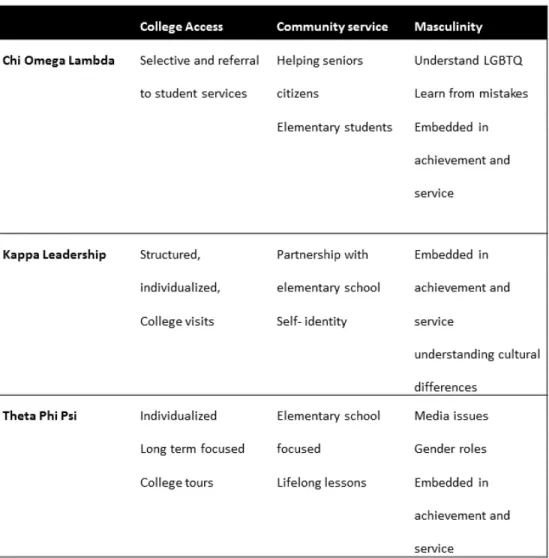
College Access
experiences in the organization- one in particular being college access. Student One stated “as whole in Chi Omega Lambda as a group outside of school I believe that each of us has done it, but within the group, no, we have not talked about college access.” Student Two elaborated:,
I was able to find them in terms of my student services, through my college advisor, my counselor, and my parents. And also, various clubs and organizations I’m in outside of school.
Student Three agreed: “Yeah. Just like Student Two said, it’s more the outside of school. I would get that type of assistance. Instead of from the organization. “
Student Five felt a little different. He exclaimed, “I got more from guidance and my guidance counselor about college access and about college readiness, and being prepared for what comes after college.”
Student Four felt this may not have been a reasonable expectation for the program:
I don’t think its sole purpose was to help us with our college. Even though that is a big part of us, like going to college or finding out what your goals are going forward. Student Six took a broader view concerning the program, and other programs here at the school,
They’re more hands on. Like one organization, during the whole process of the
organization they find out what they want to do after school. And others go on trips and visit colleges and we really don’t do any of that interaction with our mentors about college or post schooling.
Student Seven added his opinion about their mentors’ exposure to college access.
prepared them for college. Not only college but they focus on the options they had after their four years after high school and what they’re able to do. And I’m able to see that through having personal relationships with the kids that are in those organizations.
Student Eight said he has a great relationship with the mentors.
For me, personally, I know I worked a lot with my mentor in terms of him giving me advice and whatever was needed individually in terms of college access. And he put me in touch with the right people and constantly was on top of me about grades. I remember one situation was I was taking Chinese One, the course. And pretty much I think it was a third period course and I was like playing around a lot in the class. And she ]the teacher] knew who my mentor was and how much he helped me out and how much I looked up to him. So she sent him an email and he really was the one that kind of sat me down, talked to me, told me what I should do, what I should not do, and as a man I needed to take on the responsibility for my future.
Student Two responded that student Eight’s interaction with the mentor he was referring to was because he was being recruited for a football scholarship. Student Nine’s experience was
different than that many of the other mentees.
I didn’t get hands on exposure from the organization. I actually go to the school [academic program] that's nontraditional. It gave me the opportunity to go … the local community college and I took classes there. This opportunity prepared me for college access understanding what pre requisites were, how to transfer class/credits to other school, and how to understand which college was best for me to apply to. That’s what really helped me, man--to be honest.
Community Service is one of the foundations of the Chi Omega Lambda’s program. Many of the young men had strong feelings about their efforts in the community that surrounds their school. Student One expressed how the organization works to better the elderly in the community:
We’ve done many different community services through our school. We’ve done sock drives for homeless people. We’ve hosted parties as fundraisers to buy food for the elderly.
Student Two added, “we always have campus cleanups around our high school.” Student Five added to student Two’s response “my aunt always enjoyed seeing us coming and cleaning up by her house and [we] did her neighbors.”
Student six reminisced about a toy drive for elementary aged kids the program hosted during his sophomore year. Student One also added that the work they did at the local Urban Ministries was life changing: “Seeing people be so thankful for small bowls of soup was life changing.” Student Three stated “we learned so much that day about helping our community I wrote about it in my AP lit class that year.”
Two mentees described a community service project the organization did in conjunction with the Omega Psi Phi Fraternity. This community service project was a mobile market designed to deliver fresh fruit and vegetables to less fortunate families. They explained, “we took for granted that everyone had access to these items not understanding fresh fruits and vegetables are very expensive and most families around the school can’t afford them.”
exclaimed, “These moments helping my community urged me to help the community surrounding my college today.”
Masculinity
Being a Black male fraternity, Omega Psi Phi Fraternity has a major stake in altering and expanding these mentees understanding of masculine behaviors. Many of the mentees expressed that the mentors showed them positive examples of what it takes to become a true man, leader, and servant as you mature. Student One relived his sophomore year before joining the mentoring program. He stated:
I was a solid student but I was hanging with the wrong crowd. I was definitely not a leader. I was being a follower.
Student Three exclaimed:
I was too, we were in the same class but my grades were horrible not like Student One. Joining Chi Omega Lambda helped me change. The mentors were already in college and they made me feel like I needed to become like them.
Student Five added his take on how his behaviors changed after becoming a member of the organization:
I entered this organization my junior year of high school. It's helped me change
tremendously. My first two years of high school wasn't always the greatest, but towards the end I kind of started elevating, going up a little bit more, just looking at thing differently, academic-wise.
application. For many of these young men this was the defining moment of understating what shaped their definition of masculinity. The lead mentor expressed the current members that the organization allows all individual to join the organization if they meet the qualifications regardless of their sexual orientation. Also, the lead mentor had mentors speak to the mentees about self-growth in new environments. These techniques led members to be more open minded about understanding change growth as man. Student one described his feeling after the
conversation with his mentors as life changing:
I could say before that meeting and conversation we were never going to have a member of ours be gay, if you can say it. So that was like it, nobody wanted it.
Student five added:
We could talk about it but everybody be like nah, that’s not going to happen. But after meeting with our advisor, and mentors, he [the lead mentor] came to me and my other friend, Student One, we talked about it and he was like why not?
Student Four felt that allowing an openly gay member into the organization would change Chi Omega Lambda’s perception in the school:
We were mostly athletes and people would start to think we were gay….I was wrong. The mentors urged us to embrace him as a member and treat him like a brother because that was he will be a brother to all of us.
Student Eight responded with a difference of opinion from that his fellow members. His
Once I found out he was on line I personally stepped away from Chi Omega Lambda. I’m not a big fan of gay people or whatever you want to call them. I honestly hate them. So I don’t know why but I just can’t be around them. So I just stepped away and let my other members handle what they needed to handle.
Many of the members hated to see Student Eight not participate but he was firm on his decision not to participate in the organization after accepting a gay member into Chi Omega Lambda. Student Five urged Student Eight to use a technique they had been taught by one of their mentors, to look past the surface an individual for whole growth. Student Two added that “: we respected his decision to leave the organization but we had been taught many techniques on growing as men.” Many of the members expressed how the experiences in Chi Omega Lambda have helped them overcome adversities while they have been in college, some of them having to do with masculinity. For example, one student credited the program for helping him navigate ‘coming out’.
4.5.3 Kappa Leadership College access
The Kappa Leadership program is based upon five phases which are the foundations of the program. One of the five is preparing these young men for college. Many of the members expressed how the organization helped them with college access. Student One described how he participated in a common application and financial aid night: “We hosted and participated in this event not only to benefit ourselves but the other students who need help in applying to college.” Student Two agreed that this night was very vital in him “…getting the assistance from mentors to complete the application to my dream school.”
We got the opportunity to speak with multiple physicians about what they do daily and the amount of education needed to become a physician or physician assistant. This education opportunity was extremely eye opening because I had no clue what a physician assistant did on a daily basis and it gave us different career paths that you could take in the medical field.
Student four added:
Not only did it open our eyes. It help one of my brothers learn about careers that don’t require college degrees because not all of us are going to college.
Although Kappa Leadership is a school based mentoring program that requires you have passing grades in all your courses to participate in activities hosted by the organization, the mentees felt like this rule prepared them for college, and many felt like it taught them how to balance
academics and extracurricular activities: “Our [lead mentor] provided us with multiple resources to be college ready.” Student Five recalls being a full time International Baccalaureate (IB) student and needing a tutor. He then found out that the lead mentor provided tutoring for the mentees who needed for preparation for the IB final exams: “He also did transcript analysis with us to see if we met qualifications for the school we planned on applying to.” Student Five
expressed that many of the activities that he has participated in has tremendously helped him in college on many occasions.
Community service
service brings back memories for many of the mentees and seeing their former teachers was refreshing as well. Student five observed:
I learned so much from going to spend time with the fifth graders. I tried to encourage them to do homework and to ask for help when they need it.
Student Three added, “I needed something like this when I was in elementary school because we never had anyone to look up too, or had positive young men to come spend time with you to help you grow.” Many of the mentees were praised for this interaction their by former teacher and it really made them want to return on a consistent basis.
Kappa Leadership also hosted a professional day for students and other mentoring organizations to participate. This community outreach day was designed to expose students to professions that they may want to peruse after graduation. One student expressed: “after that day I knew more about post graduate schools and what is required to become a medical doctor.” The organization does a clothing drive every year before winter, this project is designed to allow families to obtain winter gloves, coats, and pants. The mentees all agree that of all the community outreach occasions this one really hits home. Student One spoke about his first clothing drive: “it was so many families who needed these items, and I was so not aware so many young kid had no coat until that day.”
The group also expressed the emphasis they place on helping their peers apply for
Lastly, Kappa Leadership hosted an annual health fair to educate seniors on maintain a healthy lifestyle as they transition into the real world. Student one explained how it helped him: “Being an athlete, the practices helped me stay away from much of the bad food when I got to college.”
Masculinity
The Kappa Leadership mentees have a multilayered view of masculinity and how it has been addressed in their organization: “It’s funny that we are discussing masculinity because we all have [all these] different meanings that the organization and mentors showed us over the years”, Student Two stated. Student Three added, “I mean leadership is what it [masculinity] used to mean to me until my senior year and then I learned that it’s how you lead, what examples you set as a leader, and the image people have of you after leadership [that counts].”
Many of the members hated dressing up one day a week, but the image it gave the teachers in building made them appreciate the effect of the transformation in attire. Student six learned after graduation that a student younger than him who attended his church looked up to him when he dressed up and that urged the young man to join the organization:
Our mentors stressed to us that leadership as a male comes with change and it definitely was true for me. I matured so much from junior year to senior year and my behavior change.
also added “I passed those tools to a family member and I have to credit the men in this organization for my success.” Student One concluded:
If I could combine college access and masculinity [themes] for a second-- the [Kappa Leadership] organization got us ready for college by instilling the qualities of a leader. We understand emotionally how to handle change. We accept rigor in academics as a building block of life, and image and delivery is what you will be measured on today as well as tomorrow.
4.5.4 Theta Phi Psi College access
Many of the past participants of Theta Phi Psi expressed that becoming a part of the mentoring program exposed them to what college was and what steps needed to be taken to become college ready. Student One stated”
For me, the tutoring in my IB classes really helped me along the way. It held me accountable to keep striving to do better.
The peer tutoring was two days a week on Thursday and Thursday. It was designed for students to assist each other with completing projects, assignments, and to improve overall academic standing. Student Three recalled:
We held each other accountable in class. We all encouraged each other to strive for A’s and B’s.
Theta Phi Psi also worked with Movement of Youth to tour colleges campuses on the east coast. Four of the mentees participated in the tours alone with their lead mentor and they spoke about how this opportunity exposed them to what a college dorm room looked, where resources are located on campus, and “what test score and GPA I needed to get into the college of our choice.” Student Six exclaimed,
This is where I learned to over achieve really--the opportunity to say this college is where I want to. I was not going to let anyone stop me.
Student Eight added
I learned to follow my dreams on this tour. One college visit showed me that if I wanted to become a music producer I can, so currently I am doing just that.
Many of the youth were very vocal about how the organization exposed them to scholarship opportunities. The lead mentor spent countless hours retrieving information about private and public colleges and universities for his mentees. Student four experienced the effect of this, “Knowing that my mom was a single parent and I was applying to a private school --he help me find a way get to my college.”
Community Service
Also, this organization does work with two local elementary schools on a weekly BASIS. The mentees read books to students, assist with EOG test prep, and participate in a field day yearly. Theta Psi Phi created an organization with these schools called Big Theta Little Theta. This project is where the mentees assist with males with behavioral issues by becoming big brothers to these students. Student Five explained: “This is my favorite community outreach we do because so many of these kids need someone to look up to like a big brother.” Student Two added “We help them grow so much in a school year-- it’s crazy to see them change for the better.”
Another local community service opportunity these student engaged in was conducting seminars on public health for students to gain better health tips for a better quality of life. The students detailed their experience with Habit for Humanity. Five of the students built a few houses and it really impacted their lives:
Habitat for Humanity and building these houses for the people that don't really have homes made me emotional. It made me feel like that we are changing some family’s lives.