
THE CALL OF MODERNITY:
CHINESE SCHOOL SONGS IN THE EARLY TWENTIETH CENTURY
Zhizhi Li (Stella)
A thesis submitted to the faculty at the University of North Carolina at Chapel Hill in partial fulfillment of the requirements for the degree of Master of Arts in the Department of Music.
Chapel Hill 2019
iii ABSTRACT
Zhizhi Li (Stella): The Call of Modernity: Chinese School Songs in the Early Twentieth Century (Under the direction of Annegret Fauser)
This thesis studies the Chinese school songs (xuetangyuege 学堂乐歌) of the early twentieth
iv
v
ACKNOWLEDGEMENTS
I would first like to thank my thesis advisor Dr. Annegret Fauser of the Music Department at UNC Chapel Hill. I am deeply grateful for her encouragement and trust throughout the entire working process of the thesis. I am also grateful to my thesis committee members—Dr. Mark Katz and Dr. Michael A. Figueroa of the Music Department at UNC Chapel Hill—for their support and valuable comments on this thesis. I would like to acknowledge Tan Fengxue 谭丰雪 at Yangzhou
University, Wang Shuguang 王曙光 at UNC Chapel Hill , and You Yaming 尤雅茗 at Duke University for their generous help with the Chinese texts and translations.
vi
TABLE OF CONTENTS
LIST OF FIGURES ... vii
INTRODUCTION ... 1
On Modernity ... 3
On Semicolonialism and Japan ... 5
“Can the Subaltern Speak?” ... 7
Synopsis of Case Studies ... 9
CHAPTER 1: DRAWING A MUSICAL LANDSCAPE ... 11
Historical Background ... 12
Finding China in Tokyo: Zeng Zhimin 曾志忞(1879-1929) , Shen Xingong 沈心工 (1870-1947), and Li Shutong 李叔同 (1880-1942)... 15
Mapping National and Transnational Landscapes ... 18
CHAPTER 2: FROM HEALTH TO MILITARISM... 32
Modernized Femininity: Women and Healthiness ... 33
Defining Women’s Healthiness through their Feet ... 35
Physical Strength and Gendered Militarism ... 39
CONCLUSION ... 51
vii
LIST OF FIGURES
Figure 1.1 - Map of the Qing Empire, 1906 ... 20 Figure 1.2 - Ōwada Tateki and Koyama Sakunosuke, “Nippon Kaigun” 日本海軍 [Japanese Navy],
1901 ... 24 Figure 1.3 - Shen Xingong, “Shiba sheng dili lishi” 十八省地理历史 [The Geography and History
of Eighteen Provinces], 1906... 25 Figure 1.4 - Xia Songlai, “He ri xing” 何日醒 [When to Awake], 1904... 28 Figure 1.5 - Ochiai Naobumi and Okuyama Tomoyasu, “Sakurai no ketsubetsu” 櫻井の訣別
[Farewell at Sakurai], 1899 ... 28 Figure 2.1 - Shen Xingong, “Chanjiao ge” 缠脚歌 [Foot-binding Song], 1905 ... 37 Figure 2.2 - Shen Xingong, “Ticao (Nüzi yong)” 体操(女子用) [Physical Exercise (for girls)], 1904
... 42 Figure 2.3 - “Chishizihui” 赤十字会 [Red Cross], 1913 ... 46
1
INTRODUCTION
This thesis is about the Chinese school songs (xuetangyuege 学堂乐歌) of the early twentieth
century, a genre at the origins of Chinese musical modernity. Xuetangyuege refers to the songs that were composed for the new school system between the late Qing dynasty and the years of the early Republic, when music classes were introduced to primary and secondary education. These songs were mostly based on pre-existing tunes from Japan, Europe, and the United States, that were adapted to newly composed Chinese lyrics. In addition, they comprised a small number of original compositions as well as arrangements of Chinese folk tunes. These songs were usually in strophic form, with each strophe featuring a simple, monophonic melody notated in numerical notation, although staff notation was not unfamiliar. Due to their unassuming musical nature, school songs were easy to memorize and designed for collective singing, for instance in music classes and school events. Music teachers were frequently expected to accompany the singing on the harmonium or piano. Xuetangyuege were published in music textbooks that circulate both regionally and nationally; journals and newspapers also published school song lyrics, often without scores, however.
2
our people’s character, then songs and music are necessary for the education of the human spirit.”1 From its very outset, “new music” was as much a political idea as an aesthetic one, and it continued to develop and transform throughout the early twentieth century in accordance to the versatile political demands of the different social movements.
In this thesis, I argue that it is necessary to study Chinese musical modernity through a political lens, particularly one that focuses on the questions of modernization and that is framed by the overall context of semicolonialism—the Chinese historical condition where multiple competing imperial powers coexisted with the dissolving native feudalist structure. At the same time, I consider it crucial to ground my discussion in the acknowledgment of local agency without negating the existence of power inequality. The theoretical framework of this thesis is greatly inspired by Chen Kuan-Hsing’s influential text Asia As Method: Toward Decolonization and Deimperialization (2010) and Shih Shu-Mei’s seminal work The Lure of the Modern: Writing Modernism in Semicolonial China, 1917– 1937 (2001). To clarify, the designation “China” in this study is not limited to the nation-state or to its former imperial structure. Instead, it is a spatial reference to the collective participation in a Chinese cultural imaginary. This notion may be better articulated using the Chinese term Zhonghua
中华, which imagines an entity beyond a national structure to that of Chinese ethnicities, diaspora,
and civilization. As I discuss in greater detail in the later chapters, China functioned as the emblem for a collective cultural imaginary formed at the center of the intellectual discourses during the historical period I am examining in this thesis. I argue that school songs constituted the major musical activity of early Chinese modernity, manifesting a cultural imaginary of modern Chinese civilization marked by the building of a coherent nation. This introduction delineates the theoretical
1 Liang Qichao, Yinbingshi shihua 饮冰室诗画 (Beijing: Remin wenxue chubanshe, 1959), Section 77. Cited in Ming Yan,
20shiji zhongguo yinyue piping daolun (Beijing: Renmin yinyue chubanshe, 2002), 17: “盖欲改造国民之品质,则诗歌音乐
3
framework that supports my analyses of the songs in the later chapters. I emphasize the need for music scholars who study this topic to engage with theories of transnationalism and postcolonialism. Using Chen and Shih’s works as guiding texts, I argue that it is crucial to articulate the negotiation of imperial power relations as the driving force of Chinese musical modernity in order to produce a more sophisticated historiography that decenter the penetration of the “West as method” in the current musicological discourse.2
On Modernity
“The ways in which [modernity] has been understood are practically equal to the number of scholars who have endeavored to understand it.”3 Ethnomusicologist Bonnie Wade’s comment reveals the versatile meanings of modernity in different cultural and scholarly contexts. In her own project on Japanese musical modernity, Wade draws on historian of Japan Carol Gluck’s model of a “blended modernity.” Specifically, Gluck argues that modernity is a historically produced condition, neither unitary nor universal, yet not optional either. Modernity runs by certain “common
grammars,” such as the nation-state, industrialization, urbanization, etc.4 Such a common grammar, however, must pertain to a specific historical and cultural syntax in order to take on meaning. To illustrate this process of modernization, Gluck uses the metaphor of conceptual “blending,” positing that the new product contains, yet essentially differentiates from, its sources.5 Despite their shared commonalities, the experiences of modernity are thus manifold and culturally specific. Given the close connections between China and Japan in their historical formations of modernity, especially in
2 Chen Kuan-Hsing, Asia as Method: Toward Decolonization and Deimperialization (Durham: Duke University Press, 2010), 216.
3 Bonnie Wade, Composing Japanese Musical Modernity (Chicago: University of Chicago Press, 2014), 7.
4 Carol Gluck, “The End of Elsewhere: Writing Modernity Now,” The American Historical Review 116, no. 3 (June 2011): 676.
4
the early twentieth century, Wade’s and Gluck’s approach offers important reflections that should inspire relevant discussions in the field of Chinese musical modernity where such debate has yet to formalize in musicological scholarship.
In effect, in the context of the cultural studies of China, Chen sheds light on the meaning of modernity in ways that share common perspectives with Gluck’s discussions. He argues that,
Modernity is not a normative drive to become modern, but an analytical concept that attempts to capture the effectiveness of modernizing forces as they negotiate and mix with local history and culture. In other words, modernity as an analytical term refers to the overall effects of modernization. Tradition is not opposed to modernity but is an integral and living part of it.6
Working from Chen and Gluck’s perspectives, I would emphasize two key relations indicated by the discussion of modernity: (1) the temporal relation of the modern with local history, and (2) the spatial relation between universality and particularity. In other words, modernity is a temporal and spatial analytical framework that captures not only China’s outward consciousness of the global imperial powers who claim ownership of modernity, but also China’s reflexive negotiations with its own past emerging in its cultured geographical space. Here, it is important to mention Japanese sinologist Mizoguchi Yūzō 溝口雄三’s theory of “base-entity” (jiti 基体) that informed Chen’s
statement.7 Mizoguchi, in his book China as Method, suggests that every cultural space has its own base-entity formed by the local history. The Chinese experience of modernity is thus specific because it is nurtured within its own indigenous culture.8 For example, Zhongtixiyong 中体西用, “Chinese knowledge as the substance, Western knowledge as the practice,” was one of the foundational strategies that sustained a continuous effect throughout the course of Chinese
6 Chen, Asia as Method, 244.
7 Ibid., 245.
5
modernization.9 In this sense, modernity in China never entailed a pure duplication of the West but always a process of blending and contextualization. Therefore, school songs—and new music of China in general—during the early decades of the twentieth century embodied the “Western
knowledge” that was constantly reconfigured by the Chinese locals to be best transplanted into their base-entity.
In her seminal work The Lure of the Modern, literary scholar Shih Shu-Mei provides a succinct summary of such a relational and comparative approach to modernity:
Where their difference from Western modernism is emphasized, we perceive them as offering different experiences and narratives of modernity, and we understand that they hybridize and heterogenize metropolitan concepts of modernity and modernism. Where similarity is emphasized, we perceive a transnational and deterritorialized modernism that promises the possibility of a cosmopolitan cultural politics, even as it necessarily hides a fundamentally hierarchical notion of center and periphery. When concerns over cultural domination are projected onto similarity, however, non-Western modernisms become sites of anxiety and paranoia. All of these modes of seeing non-Western modernisms
acknowledge a necessary confrontation with the West. It is from the perspective of this necessity that Chinese modernism must also be understood.10
Shi thus offers a succinct formulation of the complexities of the entangled histories of modernity in the construction of modernity in China that was, moreover, tightly connected to the pathways that the neighboring Japanese empire had begun to model for the region.
On Semicolonialism and Japan
To study the Chinese experience of modernity in the early twentieth century critically, we must engage with the cultural politics of semicolonialism which shaped the particular paths of
9 Arguably, the meaning of “Chinese substance” in the twentieth century had diverged to some extent from its genesis during the late nineteenth-century Western Affair Movement (洋务运动), which essentially advocated feudalism and Confucianism. I would argue, however, that this inner logic of “blending” the tradition with the modern, though constantly refashioned in different historical periods, has been a fundamental attribute of Chinese modernization. See Mizoguchi’s analysis of Sun Yat-sen’s political statements on democracy as one example: Mizoguchi, Zuogwei fangfa de zhongguo, 19.
6
Chinese modernization. As Shih defines it, semicolonialism describes “the specific effects of
multiple imperialist presences in China and their fragmentary colonial geography and control, as well as the resulting social and cultural formations.”11 China was never fully colonialized by any single colonial power but, instead, had become a site of “inter-imperialist” rivalry competing over the divided territory. This geopolitical situation created unique forms of colonial relationships that were “multiple, layered, intensified as well as incomplete and fragmentary.” The “semi-” as defined by Shih does not to denote “half” of something, but rather the fractured, informal, and indirect character of colonialism as well as its multilayered nature.12 Most importantly, the deep-seated frictions over the lack of cohesion in the political and culture sphere made the pursuit of a cohesive modern identity in the form of a Chinese nation-state appear ever more urgent. The school songs analyzed with further detail in the subsequent chapters often targeted the political project of nation building, thus justifying the utility of singing and music education in the minds of Chinese
intellectuals in the early twentieth century.
Under the overall consensus of national building, however, semicolonial fragmentations fostered the multidirectional pursuits toward modernity among the Chinese intellectuals which should be seen as “the paradoxical emergence of culture in the fissures among different agents of control.” As Shih articulated, “the multiplicity of intellectual positions largely reflected the state of emergency of the Chinese cultural imaginary, infused with a heterogeneity of often ambivalent and shifting positions, searching in different directions for answers to China’s problems.”13 School songs in particular, reflect one foundational site of the complex semicolonial ecology that was dominated by the ambivalent negotiations with Japan. Due to the recent success of its imperialist project
11 Shih, The Lure of the Modern, 32.
12 Ibid., 33‒34.
7
following the First Sino-Japanese War (1894‒95), many Chinese intellectuals considered Japan to be a model of successful modernization. Furthermore, Japan served also a crucial mediator and
shortcut to Westernization because of its geographical proximity and abundant, accessible translational sources of Western knowledge. As mentioned above, the positions of Chinese
intellectuals in regard to the solutions of modernization were heterogeneous and ambivalent, given that both Japan and the West were symbols of modern civilization in ideological terms, yet powers of imperialization in reality. According to Shih, such ambivalence should be understood as a bifurcation between the admiration for the modern culture of the metropolitan Japan and the
resentment of its imperial culture in colonial China.14 Furthermore, this capacity to “displace colonial reality through the discourse of cultural enlightenment” is a product of semicolonialism which owns a discursive power that shaped the conceptual bifurcation in the formation of Chinese modernity.15 In this context, school song itself became a transnational product mediated through Japan, that was supposed eventually to fulfill the Chinese cultural imaginary of Western musical modernity. The ambivalence about, and negotiations with, the enforced co-existence with both the metropolitan and the colonialist Japan pervaded the critical discourse surrounding school songs in the early twentieth century.
“Can the Subaltern Speak?”
A postcolonial approach to the study of musical modernity of early modern China needs to confront the challenge of difference among subalterns, in particular the multi-layered nature of the semicolonial ecology. This complex framework of alterities relates to Gayatri Chakravorty Spivak’s concern with “the permission to narrate” in the context of a highly stratified social structure in both
14 Ibid.,18.
8
colonial and class terms.16 In this context, Spivak engages with historian Ranajit Guha’s problematization of the role of local elites who serve as informants to first-world intellectuals. Specifically, Guha’s proposal of a “dynamic stratification grid describing colonial social production at large” organizes the colonial relations of the people as such:
1. Dominant foreign groups.
2. Dominant indigenous groups on the all-India level.
3. Dominant indigenous groups at the regional and local levels.
4. The terms “people” and “subaltern classes” have been used as synonymous throughout this note. The social groups and elements included in this category represent the demographic difference between the total Indian population and all those whom we have described as the “elite.”17 The point of considering the existence of stratification, as Spivak indicated, is not the creation of categorizations but to recognize the “in-betweenness” and fluidity across social groups, thus broadening the idea of the “subalterns” (and the “elite”) with multiplicities and flexibility. In this thesis, the third group described by Spivak as the “floating buffer-zone of the regional
elite-subaltern” is the most relevant. Most Chinese leaders of school songs—and modernist intellectuals in general—of the early twentieth-century China were located in this zone of in-betweenness. Many of them, coming from families of old local elites who had declined in the dissolution Chinese feudalism, became the new educated class of teachers and intellectuals who performed the role of transnational actors mediating between groups of the local, the national, and the global. Simply put, their identification was relative: they were subaltern relative to the colonizers but elite relative to the Chinese “people,” which encompassed peasants, workers, women, and others.
With respect to Chinese modernization, Shih calls attention to such structural classification among the subaltern while discussing the “inferiority complex” of the Chinese modernists of the early twentieth century. On the one hand, there was a strong inclination to self-criticism due to the
16 Gayatri Chakravorty Spivak, “Can the Subaltern Speak?” in Colonial Discourse and Post-colonial Theory: A Reader, ed. Patrick Williams and Laura Chrisma (New York: Columbia University Press, 1994), 79.
17 Ibid.
9
intensity of trauma when confronted with the imperial powers and the passionate belief in the proper diagnosis of social ill; on the other hand, the target for their criticism was often the
uncultured and irrational masses from whom the intellectuals distanced themselves. In short, “if the intellectuals felt inferior to the West and Japan then, this inferiority translated into superiority over the masses.”18 This entangled construction of identity is saliently reflected in school songs which precisely aim to educate the general public about modern knowledge while, more importantly, building a concerted national identity of the China.
Synopsis of Case Studies
The bloom of new schools (xinshi xuetang 新式学堂) that mimicked Western and Japanese education systems enabled, from the early 1900s onwards, the reform of music education and the nation-wide dissemination of school songs. These songs often borrowed existing tunes from Japan, Europe, and the United States, replacing their texts with Chinese lyrics composed by modernist Chinese intellectuals who had experienced Western music education. Much more prized than the songs’ music, the newly created lyrics served as the medium of disseminating the new knowledge of modernity, such as nationalism, gender equality, militarism, etc. These songs eventually engendered a musical discourse of modernity in the public sphere through the channel of music education. Values and concepts embedded in many school songs articulated and reinforced the Chinese cultural imaginary as it emerged in the process of modernization during the early twentieth century. Chapter 1 examines the use of national landscape in school songs as a rhetorical strategy that aimed at the political goal of nation-building. With a special attention to the transnational background of the major school-song leaders and the influence of Japan as a model and mediator of Western
modernity, I argue that the representation of landscape in school songs imagined the boundaries of
10
11
CHAPTER 1: DRAWING A MUSICAL LANDSCAPE
To study critically the emergence of Chinese school songs at the turn of the twentieth century, it is indispensable to understand the political role of music education in its historical context. A series of traumatic incidents, including the defeat by Japan in the First Sino-Japanese War, the failure of several reform movements, and the imposition of unequal treaties from the colonial empires collectively spurred Chinese imperial leaders and elite intellectuals to scrutinize the reasons for the nation’s tragic downfall. Especially the defeat in the war with Japan alerted the authorities that technological advancement was not sufficient to save China from lagging behind on a global scale, but that intellectual improvement was equally crucial. As early as 1898 during the Hundred-Day Reformation (bairi weixin百日维新), chancellor Kang Youwei 康有为 submitted to
the emperor a proposal titled Qing kai xuexiao zhe 请开学校折 [The Petition to Open Schools] in which Kang argued that “the reason why Japan defeated us was not that their military was better. It was because [Japan] has established wide-spread education in numerous subjects and therefore was able to utilize the abilities of their people to best us.” Kang continued to argue that in order to improve this situation of underdevelopment in education, China needed to model Germany and Japan and to reform its educational system in which music courses would form an important part.1 From its very initiation, education reform thus encompassed the stated political goal of empowering the national body politic, one triggered by these harrowing transnational encounters. This
1 Kang Youwei, Qing kai xuexiao zhe,cited in Ming Yan, 20 shiji zhongguo yinyue piping daolun (Beijing: Renmin yinyue
chubanshe, 2002),14-15. “近者日本胜我,亦非其将士兵士能胜我也,其国遍设各学,才艺足用,实能胜我
12
competitive consciousness of China’s own imperial power within global political structures, paired with a sentiment of self-rejection, continued to shadow the creative process of the school songs. In this chapter, I will first introduce the historical framework within which modern music education developed in China as well as the biographies of three key school-song leaders. I argue that the popularity of school songs fulfilled the urgent political task of evoking patriotism and nationalism in the face of the invading foreign powers. Through the close reading of two school songs—“Shiba sheng dili lishi” 十八省地理历史 [The Geography and History of Eighteen Provinces] and “He ri xing” 何日醒 [When to Awake]—I reveal that depictions of landscapes in school songs played an
important role in configuring and disseminating modern ideas of the nation-state. Historical Background
In April 1901, under the pressure due to foreign invasions of Chinese territory and demands from local rebellions, the Qing regime announced the “New Policy” (xinzheng 新政) which included a series of top-down reforms of its government, including changes to the administration, economic politics, the judiciary, the military, and most influentially, education. Early steps of educational reform had already taken place on local levels, for instance in the booming of Western-style Schools (yangwu xuetang洋务学堂) since the 1860s. These Western-style schools differed from traditional forms of education in that they functioned as specialized high schools providing instruction in foreign languages, industrial technologies, or military drill. Other schools that offered a more
13
In the context of education reform, music and music courses became especially important to realize the political goal of strengthening the national populace. In his 1904 thesis Yinyue jiaoyu lun 音 乐教育论 [On Music Education], Zeng Zhimin 曾志忞 developed some of the key concepts on how music could function politically and socially in a modern China. A leading activist of music-education reform and a major composer of school songs, Zeng delineated in this thesis the benefits of music and music education in five respects: the current challenges of Chinese music education, the concept of music, the utility of music, the practice of music, and the relation between music and poems. The third section “Yinyue zhi gongyong” 音乐之功用 [The Utility of Music] advertises the benefit of music, especially music composed for the public sphere, for schools, the military,
diplomatic efforts, and family settings. In one particular passage, Zeng related the utility of music with the success of international diplomacy:
Music is an essential and necessary tool in International Diplomacy with every country (I’ve heard that one of our diplomats because knew Western music well was immediately
respected by the Westerners). With music, the ceremonies are normally held with courtesy, the (diplomatic) schemes are refined, secrets (of the other side) can be scouted out, the power can be thoroughly manipulated. If we want to train diplomats, we must practice our musical skills. If we want to refine diplomatic skills and stand out from international diplomacy, we must study music. I am not saying that music generates immediate benefits for diplomacy, but based on the facts nowadays, the two are closely intertwined.2
Zeng’s emphasis on music’s power comes from the common fascination with, and anxiety about, Western culture and civilization during that time. Yet despite highlighting the utility of new music and educational reform, Zeng’s argument also reveals his grounding in Chinese musical traditions, given that the usage of music for political purposes constitutes an important aspect of
2 Zeng Zhimin, Yinyue jiaoyu lun, in Zhongguo jindai yinyue shiliao huibian,ed. Zhang Jingwei (Beijing: Renmin yinyue
chubanshe, 1998), 201-02. “音乐者,方今各国外交上不可缺之要具也(闻吾国某外交官谙洋乐,一时西人重
之)。有是而仪式不致失礼,有是而手法得以圆美,有是而机密得以探听,有是而权术得以运用。欲养成 外交官,非练习音乐之技术不可。欲完全外交方法,非与于外交地位备用音乐不可。予非谓有音乐而外交
14
Confucianism, which treats music (liyue礼乐) as a medium through which to construct and maintain feudalist rules and rituals. The use of drums and bugles in battle fields was common in local military traditions, and there were numerous historical tales relating the power of music in political and military negotiations. Zeng’s emphasis on, if not sacralization of, the power of music in diplomatic negotiations is, in effect, consistent with those historical tales. In other words, the “reform” drawing on Japanese and Western models is better understood in systematic and practical terms, whereas its conception of music maintained a deep connection with local musical and cultural tradition. This dualism harks back to a more general pattern of Chinese modernization, especially during this early period, the maxim of which was “Chinese basis, Western practice” (zhong ti xi yong中体西用). In addition, Zeng’s understanding of music was “relational,” focusing on music’s utility as a mediator shared by different groups, whether family members or different nations. Thus, Zeng and his fellow intellectuals chose school songs as the core of modern music education on account of singing’s potential for community building from interpersonal to national levels.
Scholars have disagreed over the emergence of the school songs. Some have argued that teaching school songs was a “top-down” reform led by the ruling class, imposed through official regulations and laws; others have instead cast school songs as a “down-up” practice that was initiated by the school teachers and the general public.3 Regardless, the emergence of school songs had above all several practical reasons. First and foremost, there was the financial concerns. Singing, unlike instrumental music, demanded little financial investment, given that musical instruments were hardly affordable for most of the Chinese families and schools during that time. Sometimes schools were able to buy used pedal harmoniums from abroad to accompany the teaching of songs.
Although a few new schools were able to start school bands and orchestra, singing was overall the
15
most popular form of music education offered. Another advantage of school songs over other types of music consisted in the lyrics. Creating new texts for melodies borrowed from Europe, the United States, and Japan, many Chinese educational and intellectual leaders utilized the lyrics of the school songs as an important medium through which to disseminate modern thoughts and concepts. As Zeng’s statements in On Music Education reveal, artistic pursuits were often subordinated to the discursive concerns during this early period of Chinese musical modernity, for school songs were considered as a highly effective medium to further political goals.
Finding China in Tokyo: Zeng Zhimin 曾志忞(1879-1929) , Shen Xingong 沈心工
(1870-1947), and Li Shutong 李叔同 (1880-1942)
Before diving into the analysis of specific school songs, it is helpful to review the biographies of the three core promoters or school songs—Zeng Zhimin, Shen Xingong, and Li Shutong—in order to understand the ideological framework for their intellectual and musical works. The
biographical connection of these three figures sheds light on the ideological consistency reflected in their compositions of, and writings about, school songs. Like many other contemporary intellectuals, Zeng, Shen, and Li were raised in bourgeois families, which enabled them to receive a high-quality education even in ages of turmoil. Their privileged economic and social status persisted through their careers as music educators and intellectuals, and laid the groundwork for the wide influence of their works. In fact, Shen was even financially capable to self-publish his own school-song
anthologies in 1904.4 And Zeng founded the Shanghai Orphanage which established the earliest Chinese string orchestra.5 During the “New Policy” era, the Qing government not only enforced the establishment of an educational system based on European, American, and Japanese models, but
4 Li Jing, “Xian ya yong jian: jindai yuege wenhua dui ‘xin nüxing’ de suzao,” Wenyi yanjiu 3 (2011): 60‒70, n.9.
16
also offered a series of incentives to encourage students to study abroad in Japan. As a result, from 1901 to 1905, Zeng, Shen, and Li all went to Tokyo to study in Japanese colleges and universities.
Prior to their departures to Tokyo, all three had already acquired knowledge associated with concepts of modernity. Shen and Li were students at the Nanyang Public School (Nanyang gongxue南 洋公学), one of the earliest comprehensive modern universities in Shanghai, studying education and economics respectively. Zeng also lived in Shanghai and was a teacher at the primary school
affiliated with the Nanyang Public School. Research focusing on school songs and musical modernity in China has thus far ignored their close biographical connection as well as their participation in the same intellectual networks. Yet given their similar education and class background, as well as the shared trajectories of their music careers, it is promising to read the biographies of these three major figures as forming the core of a network that influenced music education and school songs from local to national levels. Remarkably, none of them were originally music students when they arrived at Tokyo. Instead, they found their shared passion in new music during their respective stays in Japan, which served as catalyst for their devotion to different forms of Western music education which they promoted after their return to China. In this sense, Tokyo presented the key node in the transnational circulation of Western-music knowledge and education, which Chinese intellectuals appropriated as an effective and practical tool for China’s modernization and revitalization.
17
Association (ya ya yinyuehui 亚雅音乐会) which aimed to “help music to develop in schools and in society and to inspire a spirit of nationalism.”6 In addition, he sponsored, together with his fellow Chinese students, the Society for National Music (guomin yinyuehui 国民音乐会), another music society aiming for “the expansion of an ideology for, and the promotion of the spirit of, national music.”7 Though not a member of these national music societies, Li had started composing school songs during his stay in Japan. One of his representative compositions during his stay abroad was the patriotic school song “Wo de guo” 我的国 [My Country], first issued in Li’s self-published journal Yinyue xiao zazhi 音乐小杂志 [Music Magazine] in 1906.
Despite the nationalist sentiments developed and shared by the Chinese international students in Tokyo, they admired Japan as a successful model of modernization and probably imperialization as well. Such esteem is reflected in the heavy Japanese influence on the Chinese music-education reform led by Shen, Zeng, and Li. For instance, several of Zeng’s writings on music teaching—including Yuedian jiaokeshu 乐典教科书 [Music Textbook], Yueli dayi 乐理大意
[Introduction to Music Theory], and Fengqin jiaoshoufa 风琴教授法 [Harmonium Pedagogy]—were modeled on the work of Suzuki Yonejirō 鈴木米次郎who was Zeng’s teacher during his studies in Japan.8 New schools that had the financial means, moreover, often employed Japanese music
teachers. Most importantly, numerous Japanese school-song tunes were brought back to China, both compositions by Japanese musicians, and European and American tunes adopted for Japanese
6 “Ya ya yinyue hui zhi lishi” (亚雅音乐会之历史) in Zhang, Zhongguo jindai yinyue shiliao,119. Trans. by Caroline Mason in Ching-chih Liu, A Critical History of New Music in China (Hongkong: The Chinese University Press, 2010), 35: “宗旨:
发达学校社会音乐,鼓舞国民精神。”
7 Liu, A Critical History of New Music in China, 35.
18
schools. These melodies were rearranged with new Chinese lyrics and became widely disseminated among several generations of Chinese students through the new education system.
Nevertheless, Chinese music educators were also ambivalent with regard to these Japanese models and eager to embrace what was considered “better” European and Western music. As Shen once indicated,
When I first learned to compose songs, I usually picked Japanese tunes, but recently I got bored of it and turned to the Western ones. Japanese tunes have lovely and well-structured melodies, but they are limited in the ambiance. Western tunes are rather rich and thick, stronger and more powerful, and have a greater virtuosity.9
In many aspects, Japanese songs actually functioned as a useful means of transition towards the ultimate goal of adopting “Western” music without the mediation of Japan, as soon as China made enough progress acquiring the musical techniques and aesthetics of Western music. These
connections and tensions between Chinese and Japanese school songs have been discussed extensively in recent scholarship.10 Most of the existing literature, however, concentrates on examining the differences and similarities of such musical features as melody and rhythm, without significant attention being paid to the circulation of conceptual structures in the texts. In the
remainder of this chapter, I will investigate the use of geographical and spatial references in Chinese school songs, tracing their different purposes in the service of the patriotic if not arguably nationalist political goals.
Mapping National and Transnational Landscapes
Reference to national landscapes in pedagogical works is by no means a unique phenomenon in Chinese and Japanese school songs, but rather a shared tactic in all kinds of patriotic music
9 Shen Xingong, “Chongbian xuexiao changge ji bianji dayi” 《重编学校唱歌集》编辑大意 [Editor’s notes for The New
Edition of School Song Anthology], in Zhang, Zhongguo jindai yinyue shiliao, 162: “余初学作歌时,多选日本曲,近年则厌 之,而多选西洋曲。以日本曲之音节,一推一扳虽然动听,终不脱小家气派。若西洋曲之音节,则浑融浏
亮着多,甚或挺接硬转,别有一种高尚之风度也。”
19
around the world. However, depictions of landscape worked as a particularly popular and effective rhetorical strategy in Chinese and Japanese school songs because of its compatibility with regional literary traditions. In particular, the reference to an object or a natural view to express one’s thoughts and emotions (托物言志,借景抒情) is a quintessential rhetorical tradition in Sinic literary culture,
especially in poetic forms. The popularity of landscape imagery in Chinese school songs is thus better understood in a framework where local poetic traditions intersect with the transnational modernizing force. My analyses below focus on two exemplary Chinese school songs, exploring how modernist patterns of nation-state construction were visualized through familiar landscapes.
“Shiba sheng dili li shi” 十八省地理历史 [The Geography and History of Eighteen Provinces], an eighteen-strophe school song arranged by Shen Xingong, was first published in Shanghai, in 1906, in Xuexiao changge chuji 学校唱歌初集 [The First Volume of Elementary School Songs] edited by music educator Ye Zhongleng 叶中冷 (1880-1933). In this song, each strophe is dedicated to one Chinese province, starting from the central province Zhili 直隶, which
encompasses the contemporary Beijing, Tianjin, and the surrounding areas, to more the peripheral provinces including Yunnan and Guangxi, where ethnic minorities live together with the Han ethnic majority. Notice that the Eighteen Provinces covered in this song carried specific ethnic
20
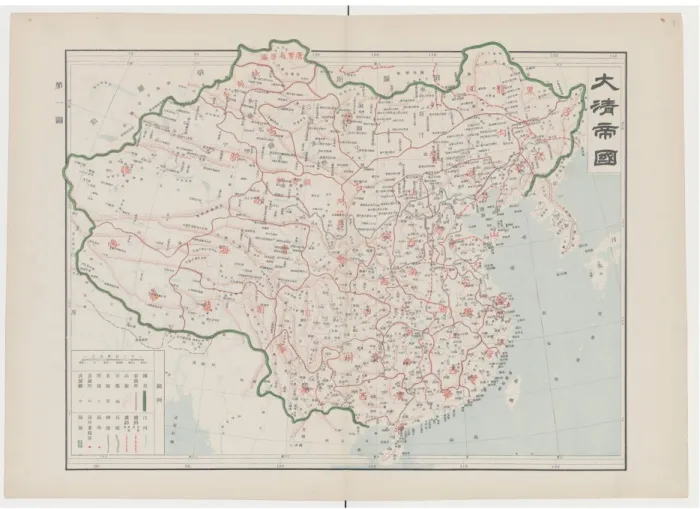
大清帝国全图 [The Complete Map of the Great Qing Empire] published in 1906 (Figure 1.1), three of the twenty-four provinces/regions were missing in the song: Qinghai-Tibet, inner and outer Mongolia, and Xinjiang Province, all of which have long been dominated by ethnic minorities. More specifically, the first two regions, dominated by the Tibetans and the Mongolians respectively, were not ruled by the Qing empire as provinces but as feudal territories; Xinjiang, a traditional area of the Uyghurs, had officially been a province since 1886.
Figure 1.1 Map of the Qing Empire, 190611
21
In the lyrics, we can trace fairly distinctive depictions that differentiate between the central inland provinces, the more peripheral ones, and those on the borderlands. For instance, the east-coast province Jiangsu where Shanghai is located was depicted as a historical region known for its gorgeous natural landscape dominated by the Yangtze river, and more importantly, as the place of origin for numerous historical heroic figures symbolizing Chinese civilization:
江苏
溯江苏龙盘虎踞,巍巍石头城, 长江滚滚太湖宽,毓秀与钟灵。 拜将台上旧风云,阁部坟前月,
万古不灭有精神,英雄在天魂。12
Jiangsu
Jiangsu (is a place where) the dragons and tigers rest And (where) the Stone City13 rises.
The rushing Yangtze River and the wide Taihu Lake
(Are places that nurture) Beautiful views and talented people, The wind and clouds over the epic Baijiangtai Square,
The moon over the old empire’s Chamber. Long live the immortal spirit,
The soul of the heroes.
By contrast, Yunnan province, a region historically dominated by the Hmong minorities on the borderland adjacent to India, was portrayed as a deserted, underdeveloped, and underpopulated area in need of revitalization led by the Han people. The lyrics contain ethnically demeaning lines like this place “Became an alien habitat since the Han and Tang Dynasty. How could the intelligence of the locals nowadays be comparable (to the inner lands)?”
云南
溯云南地处荒芜,巍城俯碧鸡, 汉唐以前化外居,民智今何如。 武侯南征浆壶迎,相将入版图,
山川辽阔人口稀,振起望群黎。14
12 Qian, Xuetang yuege kaoyuan,75.
13 Refers to Nanjing, the capital city of Jiangsu Province.
22 Yunnan
Yunnan located at a deserted place, With the city on top of the mountain.
(This place) Became an alien habitat since the Han and Tang Dynasty.
How could the intelligence of the locals nowadays be comparable (to the inner lands)? Wuhou campaigned to the south and was welcomed with wine,
(After which) this place merged into the inner land.
(With) The grandiose mountains and rivers, yet sparse population, This place expects to be revitalized by the people.
Yet the north-eastern borderland Heilongjiang Province in Manchuria, which is populated by the Man ethnicities, is described with an entirely different image as the glorious frontier guarding the nation against Russia.
黑龙江
溯黑省西北界俄,要塞如金汤, 兴安岭脉形势壮,嫩江贯中央。 龙江绥兰多沃土,黑河水慎边防,
严守北门固锁钥,增我邦家光。15
Heilongjiang
Heilongjiang is adjacent to Russia on the Northwest (Where) the fortress is impregnable,
The Xing’an Mountains have a powerful shape, The Nenjiang River crosses through its center. Longjiang and Suilan are full of fertile soil, The water of the Heihe River guards the frontier. Guard the North gate safely like a lock,
Glorify our homeland!
These three strophes reveal multiple layers of nation-state construction embedded in the texts, as the landscapes they describe are afforded different attributes in the imaginary community of a modern China. Borders are defined not only along the geographical lines, but also in historical and ethnic terms. This is the effect of the concept of “base-entity” proposed by Mizoguchi Yūzo, as I discussed in the Introduction: when the common grammar of modernity is transplanted to a new cultural context, it blends with the native syntax. In this case, the modern mechanism of border drawing
23
manifests in the Chinese “base-entity” as ethnic discrimination, because ethnic segregation has long been a local practice.
The tune of this song is adopted from the Japanese school song “Japanese Navy” (Figure 1.2) composed by Ōwada Tateki 大和田建樹 and Koyama Sakunosuke小山作之助, first
published in Shinsen kokumin shōka 新撰国民唱歌 [The New Anthology of Peoples’ Songs] in 1901. Compared with the original Japanese version, Shen adjusted the original rhythms in “Eighteen Provinces” (Figure 1.3) to match the Chinese poetic form. In measures 1, 6, and 14, Shen adjusted the position of the quarter-note beat to match the poetic rhythm of each seven- or five-syllable line. In measure 10, the original rearticulated dotted eighth notes are tied and become a quarter note in order to fit the seven syllables of the poetic line in the duple meter. Similar musical techniques are also seen in Japanese school songs translated from pre-existing Euro-American songs. Such
adjustments of rhythms are indeed common in order to fit foreign melodies originally composed for other languages to the native linguistic conventions and literary traditions.16
As I have already mentioned, the musical connections between the Chinese school songs and their Japanese models are well-recognized in existing scholarship; the intertextuality between the Chinese and the Japanese lyrics is rarely addressed, however. I would argue that many of the Chinese lyrics are, in effect, more complex than has been assumed, in that they reveal how schemes of ideological construction that were gleaned from the Japanese model were adapted for Chinese contexts. As analyzed above, the lyrics of the “Eighteen Provinces” embody a modern imaginary of the Chinese nation-state through the political and historical configuration of a national landscape. Compared with the lyrics of “Japanese Navy,” it is not hard to detect the conceptual consistency.
24
Figure 1.2. Ōwada Tateki and Koyama Sakunosuke, “Nippon Kaigun” 日本海軍[Japanese Navy], 190117
17Ōwada Tateki and Koyama Sakunosuke, “Nippon Kaigun,” in Koyama Sakunosuke, Shinsen kokumin shōka (Tokyo, Osaka: Kaiseikan, 1901), 5: 59-60, http://dl.ndl.go.jp/info:ndljp/pid/855458, accessed April 9, 2019.
25 「扶桑」の空に聳え立つ
「富士」の高嶺の「朝日」かげ かゞやく「吉野」の桜花 かをる誉の「高雄」山 栄ゆる影も「常盤」なる 松の操の「松島」と 世界にひびく我が国の 武威「高砂」の浦の波18
Standing below the sky of Fuso (Japan),
The high peak of Fuji Mountain glows in the Asahi (morning sun), The Yoshinoya cherry blossoms shine,
The aroma from Takao Mountain spreads widely, The glorious glow belongs to Jōban,
The virtue of the pine tree roots on Matsu Islands, The waves on the shore of Takasago
Disseminate our country’s mighty sound around the world.
Figure 1.3. Shen Xingong, “Shiba sheng dili lishi” 十八省地理历史 [The Geography and History of Eighteen Provinces, 190619
18 Ibid.
26
In the thirteen-strophe song “Japanese Navy,” each line (with four lines in each strophe) is dedicated to one or multiple Japanese warships that were named after Japanese places. Simply put, the
Japanese lyrics utilized the double-meaning of the warship names not only to brandish the power of the nation’s navy but also to sketch out a grandiose national landscape. The Chinese version
“Eighteen Provinces,” in turn, though not able to duplicate the exact literary scheme, successfully follows the same modern code of signifying nation-state through spatial construction. Here, the warships are turned into the provinces and Fuji mountain became the Yangtze river, but the common nationalist purpose realized through the literary portrayal of landscapes remains the same. As a result, a series of landmarks, such as the Yangtze River, the Yellow River, the Kunlun
Mountains, and the Great Wall, emerged into signifiers of Han history and civilizations, and began to populate Chinese school songs to evoke patriotic sentiments. In effect, numerous songs similarly used national landmarks as part of their patriotic rhetoric, some of which include: “Yangzijiang” 扬 子江 [The Yangtze River] (1904), “Huanghe” 黄河 [The Yellow River] (1904), “Zhongguo nan’er”
中国男儿 [Chinese Male Youth] (1906), “Shanhaiguan” 山海关 [The Shanhai Pass] (1907).
Landscape imagery not only played a role in celebrating Chinese (Han-centered) local history and civilization, it could also serve to address the uneasy negotiations between China and the
27
the ideas of Albert Memmi—the politics of resentment relates the colonized to the colonizer by establishing an imagined Other as the enemy thus evoking the sentiment of anticolonialism.20
One representative song that exemplifies this strategy is “Herixing” 何日醒 [When to Awake] (Figure 1.4). Its text was written by Xia Songlai 夏颂莱, one of Shen’s students at Shanghai
Wuben Women School (上海务本女塾), and it was first published in 1904 in Shen’s The First
Volume of School Songs. The melody came from the well-known Japanese song “Sakurai no
ketsubetsu” 櫻井の訣別 (青葉茂れる桜井の) [Farewell at Sakurai] (Figure 1.5) which narrates the Japanese tragic epic of General Kusonoki Masatsura 楠木正行 and his eldest son leaving for their last battle. In the Chinese re-composition “When to Awake,” each of the eight strophes is dedicated to a recent national crisis, including the signing of unequal treaties, the establishment of concessions, and defeats in wars. Every verse is cadenced by the repeated line “吾党何日醒,” a rhetorical question meaning “when do our people wake up?” Importantly, these historical moments connect through a spatial thread. Take the sixth strophe, “Haijun gang,” 海军港 [The Marine Harbor] as an example. The strophe opens up with the spatial juxtaposition between the West and the East by tracing the expanding imperial power from the European continent to East Asia. In the following five lines, eight Chinese place names mark the spatial trail of recent traumatic encounters with the invading German, French, and British powers.
28
Figure 1.4. Xia Songlai, “He ri xing” 何日醒 [When to Awake], 190421
Figure 1.5. Ochiai Naobumi and Okuyama Tomoyasu, “Sakurai no ketsubetsu” 櫻井の訣別 [Farewell at Sakurai], 189922
21 Xia Songlai, “He ri xing,” in Qian, Xuetang yuege kaoyuan, 64.
29 6. 海军港
欧洲均势恒相竞,风潮东亚侵。 胶州先启衅,德国无端驻戌兵。 大连旅顺让俄登,东清铁道城。 广州湾口,威海卫城,相将隶法英。 新界九龙订,三门湾又启纷争。 河山锦绣,豆剖瓜分,吾党何日醒。
6. The Marine Harbor
The Europeans compete with each other, and this trend has then invaded East Asia. They started with Jiaozhou where the Germans sent their troops.
Dalian and Lüshun were entered by the Russians, who built the Dongqing Railway.23 The bay of Guangzhou and the city of Weihaiwei were subdued by France and Britain. The New Territories were separated from Kowloon, and then the Sanmenwan became disputed.
The grandiose rivers and mountains are thus dissected and partitioned; when do our people wake up?
The entire song, exemplified by the strophe above, is packed with geographical references as a way to depict the nation’s collapsing land as “dissected and partitioned” by the invading imperial powers. The text uses fairly explicit and violent language that colors the landscape with darkness and trauma; it speaks of “the greatest humiliation at the city gate” (“奇羞城下盟” in strophe 2
“Yuanmingyuan” 圆明园 [The Old Summer Palace]) and “the massacre in the bloody city of Beijing” (“惨杀横施,燕云市血腥” in strophe 7 “Yihetuan” 义和团 [Boxer Rebellion]). Additionally, global spatial consciousness is clearly embedded in the lyrics despite their focus on local landscapes. Particularly, any failures of neighbors in their defense against colonial invasion served as reflections and references to China in the face of similar threats. For example, the fifth strophe “Jiawu” 甲午 [Year 1894] narrated the first Sino-Japanese War during which Japan’s colonization of the Korean peninsula represented the “first alert” of its expanding imperial power. Similarly, we see mentioning of Poland, then a colony of Russia, as an alert of China’s potential
30
future: “Alas the Manchuria that became a failure like a second Poland” (“呜呼东三省,第二波兰 错铸成”in strophe 8, “Dongsansheng” 东三省 [Manchuria]).24 In the same strophe, the defeat of Russia by Japan on the borderland of Manchuria is described as an event worth celebrating for the Chinese due to Russia’s loss of imperial control in the region.
The emerging of global spatial consciousness is also articulated in the common use of “Asia” in many school songs with geographical references, as seen in “When to Awake.” In fact, the
conceptual adoption of “Asia” in China is itself a reflection of the complex process of modernization. As Chinese historian Wang Hui 汪晖has argued,
[The notion of Asia] is colonial, and is also anti-colonial; it is nationalist and is also
internationalist; it is European, but also in turn has shaped the self-understanding of Europe; it is tightly connected to the question of the nation-state, and is overlapping with the
perspective of the empire; it is a civilizational concept in relation to Europe, but is also a geographical category established in geopolitical relations.25
In many ways, the portrayal of Chinese landscapes in school songs represented essentially gestures of border drawings, which evoke Benedict Anderson’s notion of a nation imagined through
limitation.26 The pervasive presence of a national landscape in school songs as a rhetorical scheme of patriotism is a phenomenon that emerged through the collective impact of local specificities and transnational influence. On the one hand, local social turmoil and failing transnational encounters led to Chinese education reformation, in which school songs played a significant role in fulfilling the urgent task of restoring patriotism and constructing nationalism. On the other hand, Japan served as a practical model of reformation that Chinese educators appropriated into their own use. In the next chapter, continuing the discussion centering at the ideological construction of modern nation-state, I
24 In other places, we also see usage of India to signify the ignominy of being colonized. See: “Junge”军歌 [Military Song], 1905; “Jingxing ge” 警醒歌 [Alert Song], 1913.
25 Wang Hui, “Imagining Asia: A Genealogical Analysis,” cited in Chen, Asia as Method, 214.
31
32
CHAPTER 2: FROM HEALTH TO MILITARISM
At the turn of the twentieth century, “healthiness” had crystalized into a central concern in the debate of cultivating a modern Chinese nation. This modern discourse about healthiness, especially with respect to establishing and maintaining physical health, emerged from the combined historical influence of the Opium War, widespread poverty, famine, and the exposure to seemingly biological differences of Chinese and Euro-American Caucasians. The result of this extensive debate was a conceptual association of weakness with defeat, on the one hand, and of physical strength with spiritual militarism, on the other. As Cai E 蔡锷 argued in his 1902 essay “Junguomin pian” 军 国民篇 [Militarism],
In China, the weakness of the body has reached its highest degree. People claim that we have a four-hundred-million population, but the physically weak women take up fifty percent, opium users take up ten to twenty percent, useless complainers take up ten percent, and the disabled, sick, old, and children take up another ten to twenty percent. As a result, the proportion of the population without any shortcomings is just ten percent. Yet even among this group, it is hard to guarantee that every one of them is martial and strong. Thus, even if the Europeans and the Americans forego their bullets and fight us with their fists, we are still going to be slaughtered.
体魄之弱,至中国而极矣。人称四万万,而身体不具之妇女居十之五,嗜鸦片者居 十之一二,埋头窗下久事呻吟,龙钟惫甚而若废人者居十之一,其他如跛者、聋 者、盲者、哑者、疾病零丁者,以及老者、少者,合而计之,又居十分之一二。综 而核之,其所谓完全无缺之人,不过十之一而已。此十分之一之中,复难保其人人
孔武可恃。以此观之,即欧美各强弃弹战而取拳斗,亦将悉为所格杀矣。1
33
In the overall framework of the nation’s anxiety over healthiness, it was particularly crucial for women, occupying half of the national population, to participate in the new movement to become healthy, strong, and militarist in order to fulfill the task of “saving the nation from subjugation” (jiuwang 救亡).2 In this chapter, I will examine the social discourse of healthiness through the lens of the school songs and their contribution to a broader debate of modern femininity and national militarism. In his studies of gender and education in early twentieth-century China, Paul Bailey used the term “modernizing conservatism” to describe “both an endorsement of modernizing change as a means to strengthen the polity and economy and an ambivalence about its possible consequences.”3 Borrowing this term, I argue that school songs created a discourse of modern feminine health by transplanting traditional social obligations of women into the modern context of school education and nation-state building. I will first delineate the reconfigured relation between maternity,
femininity, and nation-state in the early twentieth century, focusing on the discourse that frames the creation and reception of school songs targeting women’s health. In a second part, I will provide specific analyses of the lyrics for several of these school songs.
Modernized Femininity: Women and Healthiness
The political expectation of maternity, of women giving birth to healthy future citizens, was foundational to “modernizing conservatism.” Late Qing scholar Yan Fu 严复 argued in “Yuan Qiang” 原强 [The Origin of Strength] that the task to improve one’s health “applies not only to men but also women, because when mothers are strong, their children are healthy. (It is through the
2 Li Jing, “Xian ya yong jian: jindai yuege wenhua dui ‘xin nüxing’ de suzao,” Wenyi yanjiu 3 (2011): 61.
34
mothers that) the nature of the children becomes racially advanced.”4 Echoing Yan’s focus on the importance of women’s healthiness due to maternity, women activists emerging in the early
twentieth century also subscribed to the same reasoning by claiming that “women are the mother of the nation” (女子者,国民之母也). In the opening issue of Nüzi shijie 女子世界 [Women’s
World], a major monthly periodical published in the late Qing era that was dedicated to feminist activism, co-editor Jin Yi 金一 wrote that,
To renew China is to renew (Chinese) women. To strengthen China is to strengthen (Chinese) women. To civilize China is to civilize our women first. To save China is to save our women first. There is no doubt about this.5
In fact, the phrase “women are the mother of the nation” pervaded the contemporary intellectual discourse, grounding the writings of feminists, especially those advocating for women’s physical health. It also made its way into broader discourse, including school songs, where the idea of maternity was, however, often expressed in a less explicit manner than in intellectual writings, perhaps because the audience of school songs were mostly school-aged (female) children. Nevertheless, as the analysis of the texts will show, motherhood was transposed into the new context where women were expected to perform alternative forms of maternity, even outside the family.
In spite of the physical difference ascribed to women through their biological reproductive systems, the demand of spiritual strength for women was often equal to men. Militarism in particular served as the spiritual and moral counterpart of physical strength, which together targeted the ultimate political goal of nation-state building. More importantly, the point of reference for such
4 Yan Fu, ‘Yuan Qiang” in Yan Fu ji ed. by Wang Shi (Beijing: Zhonghua shuju, 1986), 1: 28. “此其事不仅施之男子已
也,乃至妇女亦莫不然。盖母健而后儿肥,培其先天而种乃进也。”
5 Jin Yi, “Nüzi shijie fakan ci,” cited in Xia Xiaohong, Nüzi shijie wenxuan (Guiyang: Guizhou jiaoyu chubanshe, 2014),
11-12. “女子者,国民之母也。欲新中国,必新女子;欲强中国,比强女子;欲文明中国,必先文明我女子;
35
moral healthiness was frequently the male part of the population, given that women were expected to be as “useful” and “qualified” in spirit as their physically stronger male counterparts. Singing and music-making thus became the space where women were regarded, and regarded themselves, equal to, if not better than, men. For example, even though most schools were separated along gender lines, many music text-books were designed for common usage by both male and female school children. As Shen Xingong indicated in the preface of his First Volume of School Song (1904), “Women’s tessitura is higher than that of men, but there is little difference between the lyrics.”6 Similarly, in the preface of Xuexiao changge ji 学校唱歌集 [School Songs Anthology] published by
the South Wuxi Public School (无锡城南公学堂) in 1906, the editors indicated that the book was designed for common usage in the core music classes “regardless for men or women.”7 In other words, male and female students were often expected to learn and share the same lyrics which delivered intellectual and ideological messages equally adaptable for both genders. With that being said, there were also songs and text books designed for female students specifically. As I will show, despite the gender specific purposes and context, these materials evince to a great extent political ideologies and expectations consistent with those aimed at the male population.
Defining Women’s Healthiness through their Feet
Physical strength is normally considered the foundation of healthiness, which manifests itself foremost in the free movement of human body. The freedom of movement became a rallying point for women’s health in modern China, given that one major task of pursuing physical healthiness consisted in the emancipation from foot-binding. The tradition of foot-binding dates back to the Ming Dynasty and reached its peak popularity in the mid-Qing period. Foot-binding was originally a
6 Shen Xingong, “Fanli”凡例 in Xuexiao changge chuji 学校唱歌初集, cited in Li, “Xian ya yong jian,” 65.
36
Han ethnic tradition, and the Qing court, ruled by the Man ethnicity, was officially against foot-binding, especially in the case of Man women. Due to the large population of Han people, however, the Qing court failed to ban the tradition in the wider public, but kept the rule in place among the imperial family and the court. As a result, the unbound foot often served as a sign of nobility. At the turn of the twentieth century, the unbound foot was given a new meaning as a sign of modernity, overwriting and yet also reconfiguring its traditional noble significance. Advocacy for the unbound foot thus became the linchpin in the movement toward modernity where women’s bodies were concerned.
School education was undoubtedly a major field of this activism, and school songs played a supporting but important role. The eleventh volume of Women’s World of April 1905 records several school-music activities that contributed to the critical discourses against foot-binding. One of most well-known school songs against foot-binding, Shen Xingong’s “Chanjiao ge” 缠脚歌
37
Figure 2.1. Shen Xingong, “Chanjiao ge” 缠脚歌 [Foot-Binding Song], 19058
你怕痛,叫亲娘,叫杀那亲娘像聋聱。 亲娘到底亲身养。
强做作,硬心肠,你看他眼睛也泪汪汪。9
You were afraid of the pain, and you called mommy, but she acted as if she was deaf. Yet she is your mother after all.
She acted calm, pretended to be tough, but you saw the tears in her eyes.
8 Shen Xingong, Xingong changge ji (Shanghai: Self-published, 1937), 67.
38
The last two strophes turn the sympathy established with the girls subjected to foot-binding into criticism of women who conformed to the custom, particularly their adoption of the aesthetics of foot-binding as a sign of beauty. As Xia Xiaohong argued, this song not only criticized the violence of foot-binding but also women’s self-enslavement through the very act of it.10 Indeed, a major task of feminist activism during this early time-period was to enlighten the female citizens first and foremost about their own rights. This task of educating and modernizing women was initially performed by men, as seen in Shen’s school songs written for female students, but female voices soon actively participated in the discourse.
Ten pages after where “Foot-Binding Song” was printed, a news report entitled “Fangzu jinian” 放足纪念 [Unbinding Foot Celebration] recorded a public school event that celebrated a
female student’s foot-unbinding. The event took place on December 21, 1902, at the Fameng School of Daixi in Zhejiang Province (浙江埭溪镇发蒙学堂). The female student was Cai Aihua 蔡爱花, the sister of the school’s headmaster. The event was attended by twenty male and female guests in addition to the students. It began with Cai’s speech criticizing the harm of foot-binding and announcing her decision to unbind her feet. Followed by two other speeches by school leaders, the event ended with a song entitled “Fangjiao ge” 放脚歌 [Foot-Unbinding Song] composed by the headmaster Cai Lünong 蔡绿农, Cai Aihua’s brother, and Xu Zehua 许则华. The song was
sung three times by all the attendees, conducted by Xu. The event closed with Xu’s cheer of “Long live Cai Aihua! Long live Daixi Women! Long live the future of Chinese women!”11 Although the score of the song was not published in the journal, the song’s lyrics were recorded as follow:
放脚乐,乐如何?请君听我放脚歌。 棉花塞脚缝,走路要平过。
10 Xia Xiaohong, Wanqing nüzi guomin changshi de jiangou (Beijing: Peking University Press, 2016), 172.
39
酸醋同水洗,裹脚勿要多。 七日剪一尺,一月细功夫。 夜间赤脚睡,血脉好调和。 放了一只脚,就勿怕风波。
放脚乐,乐如何?请君同唱放脚歌。12
The joy of unbinding the feet, what is it like? Listen to my foot-unbinding song. Put cotton in between your toes, and walk on flat feet.
Wash (the feet) with vinegar, and no more foot-binding.
Release one chi (33 centimeters) of the band every seven days for one month. Sleep with bare feet; harmonize the blood-circulation.
Now that one foot is unbound, (I am) no more afraid of disturbance.
The joy of unbinding the feet, what is it like? Let us sing the foot-unbinding song together. As seen here, the text is narrated from the female perspective, delineating the practical procedure of how to do unbind their feet. As Xia pointed out, this song first educated the female students on the act of unbinding in relatable and pragmatic ways by instructing them concisely, in a few lines, in the best method of unbinding. Second, the song reiterated the collectivism of unbinding female feet as a social movement by calling the audience to “sing together.” This harks back to the benefit of singing as an accessible and collective activity that can contributed to achieving political goals through evoking affect and response from the community.
Physical Strength and Gendered Militarism
Certainly, the advocacy of female physical strength did not end with the ousting of foot-binding. Now, with mobile bodies of free will, women were urged to participate in physical education, if not in the spirit of militarism. Because the traditional “Four Virtues” (四德)13 of Chinese womanhood did not include physical strength, as Xia Xiaohong argued, the advocacy for women’s physical strength and education (PE) became a particularly crucial and innovative
12 Ibid.
![Figure 1.2. Ōwada Tateki and Koyama Sakunosuke, “Nippon Kaigun” 日本海軍 [Japanese Navy], 1901 17](https://thumb-us.123doks.com/thumbv2/123dok_us/8327222.2208255/31.918.112.811.105.620/Figure12ŌwadaTatekiandKoyamaSakunosukeNipponKaigun日本海軍JapaneseNavy19117.webp)

![Figure 1.5. Ochiai Naobumi and Okuyama Tomoyasu, “Sakurai no ketsubetsu” 櫻井の訣別 [Farewell at Sakurai], 1899 22](https://thumb-us.123doks.com/thumbv2/123dok_us/8327222.2208255/35.918.202.719.576.893/Figure15OchiaiNaobumiandOkuyamaTomoyasuSakurainoketsubetsu櫻井の訣別FarewellatSakurai189922.webp)
![Figure 2.1. Shen Xingong, “Chanjiao ge” 缠脚歌 [Foot-Binding Song], 1905 8](https://thumb-us.123doks.com/thumbv2/123dok_us/8327222.2208255/44.918.268.696.126.729/Figure21ShenXingongChanjiaoge缠脚歌FootBindingSong1958.webp)
![Figure 2.2. Shen Xingong, “Ticao (Nüzi yong)” 体操(女子用) [Physical Exercise (for girls)], 1904 17](https://thumb-us.123doks.com/thumbv2/123dok_us/8327222.2208255/49.918.176.756.130.636/Figure22ShenXingongTicaoNüziyong体操女子用PhysicalExerciseforgirls19417.webp)
![Figure 2.3. “Chishizihui” 赤十字会 [Red Cross], 1913 22](https://thumb-us.123doks.com/thumbv2/123dok_us/8327222.2208255/53.918.183.780.520.860/Figure23Chishizihui赤十字会RedCross191322.webp)
![Figure 2.4. Shen Xingong, “Yundonghui ge” (运动会歌) [Sports Meeting Song], 1904 25](https://thumb-us.123doks.com/thumbv2/123dok_us/8327222.2208255/56.918.222.694.618.939/Figure24ShenXingongYundonghuige运动会歌SportsMeetingSong19425.webp)
