• No results found

Helgeson_unc_0153D_17193.pdf

N/A
N/A
Protected

Academic year: 2020

Share "Helgeson_unc_0153D_17193.pdf"

Copied!
145
0
0

Loading.... (view fulltext now)

Full text

(1)

NONPARAMETRIC METHODS FOR MACHINE LEARNING AND ASSOCIATION

TESTING

Erika S. Helgeson

A dissertation submitted to the faculty of the University of North Carolina at Chapel Hill in

partial fulfillment of the requirements for the degree of Doctor of Philosophy in the

Department of Biostatistics in the Gillings School of Global Public Health.

Chapel Hill

2017

Approved by:

Eric Bair

Michael Kosorok

Yufeng Liu

J. S. Marron

(2)
(3)

ABSTRACT

Erika S. Helgeson : Nonparametric methods for machine learning and association testing

(Under the direction of Eric Bair)

As data collection becomes easier, non-parametric machine learning methods are

in-creasing in popularity due to their ability to quickly discover informative data structures

useful for prediction. Unsupervised clustering methods can be especially valuable for

identifying subgroups in high dimensional gene expression data. Another important goal

is prediction of disease or symptom outcomes from a given genotype. One way to achieve

this goal is to first identify genetic factors associated with the outcome of interest. This

may be especially challenging if the association is investigated in a sample with selection

stratified with respect to a third variable, as occurs when studying secondary phenotypes in

case-control studies.

In Chapter 2 we develop a non-parametric, cluster significance testing algorithm. This

algorithm compares the strength of identified clusters to the strength of spurious clusters

produced from unimodal reference data. The method utilizes dimension reduction and

sparse covariance estimation, making it is especially relevant for high dimensional data sets.

We also extend the method to estimate the number of clusters present. The method is applied

to several simulated and real-world data sets. We find it has comparable accuracy to existing

methods and, in addition, can be used in a wider array of settings.

We next develop a permutation-based sparse biclustering algorithm built upon the

method of Witten and Tibshirani (2010) which iteratively employs a cluster significance

testing step. Biclustering identifies a submatrix such that the pattern of the features for the

observations within the submatrix are different than the pattern outside of the submatrix.

(4)

the accuracy of the proposed method in assigning observations to clusters and identifying

distinguishing features.

In the last chapter we develop a permutation-based method for assessing the association

between genetic factors and secondary phenotypes within a case control study.

Conven-tional inverse-probability-of-sampling-weighted (IPW) regression (Monsees et al., 2009 and

Richardson et al., 2007) may produce invalid estimates of association strength in situations

where most of the variation in the secondary phenotype is found in the cases. Simulation and

real data results indicate the proposed method has better type-I error rates and comparable

power to the conventional IPW method and can be used to identify novel SNPs associated

(5)
(6)

ACKNOWLEDGEMENTS

First, I would like to thank my advisor, Dr. Eric Bair, for persuading me to come to

UNC and for his help, guidance, and entertaining stories throughout my time here.

Secondly, I would like to thank my committee members: Dr. Michael Kosorok, Dr.

Yufeng Liu, Dr. Steve Marron, and Dr. Gary Slade for taking the time to review my work

and for their helpful advice.

Next, I would like to acknowledge Qian Liu for her preliminary work in developing a

sparse-clustering based biclustering method.

Last, but not least, I would like to thank my friends, family, and supporting crew, “Team

(7)

TABLE OF CONTENTS

LIST OF TABLES . . . xi

LIST OF FIGURES . . . xiv

LIST OF ABBREVIATIONS . . . .xvii

CHAPTER 1: LITERATURE REVIEW . . . .

1

1.1

Cluster Significance Testing and Cluster Number Estimation . . . .

1

1.1.1

An Overview of Cluster Significance Testing Approaches . . . .

2

1.1.1.1

SigClust . . . .

3

1.1.1.2

Bootstrapping for Significance of Clustering . . . .

5

1.1.1.3

Principal Curve Unimodality Test . . . .

7

1.1.1.4

Multivariate Modality Inference . . . .

9

1.1.1.5

IGP . . . 10

1.1.2

An Overview of Cluster Number Estimation Approaches . . . 11

1.1.2.1

Calinski-Harabasz index . . . 12

1.1.2.2

Average silhouette width . . . 12

1.1.2.3

Gap statistic . . . 12

1.1.2.4

Prediction Strength . . . 14

1.1.2.5

Cluster Instability . . . 14

1.2

Biclustering . . . 15

1.2.1

An Overview of Biclustering Approaches . . . 15

1.2.1.1

Plaid . . . 16

(8)

1.2.1.3

Sparse Singular Value Decomposition (SSVD) . . . 18

1.2.1.4

Heterogeneous SSVD (HSSVD) method . . . 19

1.2.1.5

Sparse Biclustering . . . 20

1.2.1.6

Sparse clustering . . . 21

1.3

Association between Intermediate Phenotypes and Genetic Markers

in a Case-Control Study . . . 22

1.3.1

Overview of Approaches . . . 23

1.3.1.1

Inverse-probability-of-sampling-weighted regression . . . 24

1.3.1.2

Maximum likelihood estimation. . . 24

1.3.1.3

Gaussian copula approach . . . 25

1.3.1.4

Non-linear equation modeling for binary phenotype . . . 27

CHAPTER 2: NON-PARAMETRIC CLUSTER SIGNIFICANCE

TEST-ING WITH REFERENCE TO A UNIMODAL NULL DISTRIBUTION . . . 29

2.1

Introduction . . . 29

2.2

The UNPaC Test Method . . . 31

2.3

Theoretical Properties . . . 35

2.4

Determining the Number of Clusters . . . 38

2.5

Simulations . . . 39

2.5.1

Technical details . . . 39

2.5.2

Low Dimensional Cluster Significance Simulations . . . 40

2.5.3

High Dimensional Cluster Significance Simulations . . . 44

2.5.4

Low Dimensional Number of Clusters Simulations . . . 45

2.5.5

High Dimensional Number of Clusters Simulations . . . 46

2.5.6

Simulation Summary . . . 48

2.6

An Application to Data from the OPPERA Study . . . 48

2.7

An Application to Breast Cancer Data . . . 51

(9)

2.9

Proof of Theorems . . . 59

2.10 Extension to Hierarchical Clustering . . . 66

CHAPTER 3: BICLUSTERING USING SPARSE CLUSTERING AND

SIGNIFICANCE TESTING . . . 69

3.1

Introduction . . . 69

3.2

Methods . . . 70

3.2.1

Sparse Clustering . . . 70

3.2.2

Biclustering Via Sparse Clustering . . . 71

3.2.2.1

Null Feature weights . . . 73

3.2.3

Existing Biclustering Methods . . . 75

3.3

Simulation Studies . . . 75

3.3.1

Comparison of SCBiclust to Existing Methods . . . 75

3.3.1.1

Simulation 1 Primary Bicluster Identification . . . 77

3.3.1.2

Simulation 2: Departure from Normality . . . 79

3.3.1.3

Simulation 3: Two Biclusters with no Overlap . . . 80

3.3.1.4

Simulation 4: Sequential Biclusters with Overlap . . . 82

3.3.1.5

Simulation 5: Non-Spherical Biclusters . . . 83

3.3.2

Comparison of Null Weights Methods in SCBiclust . . . 83

3.3.2.1

Simulation Results . . . 87

3.4

Real Data Application . . . 91

3.4.1

Analysis of OPPERA data . . . 91

3.4.2

Analysis of a Gene Expression Data Set . . . 95

3.5

Discussion . . . 96

CHAPTER 4: PERMUTATION ASSOCIATION TESTING BETWEEN

A SECONDARY PHENOTYPE AND GENETIC MARKERS IN A

CASE-CONTROL STUDY . . . 99

(10)

4.2

Methods . . . 101

4.2.1

P-value Calculation . . . 101

4.2.2

Strength of Association . . . 104

4.3

Simulation Studies . . . 105

4.3.1

Simple Type-I Error Study . . . 106

4.3.2

Type-I Error Study with Population Stratification . . . 108

4.3.3

Power Simulation . . . 110

4.3.4

Simulation Summary . . . 115

4.4

Application to the OPPERA Study . . . 117

4.5

Discussion . . . 119

CONCLUSION . . . 121

(11)

LIST OF TABLES

2.1

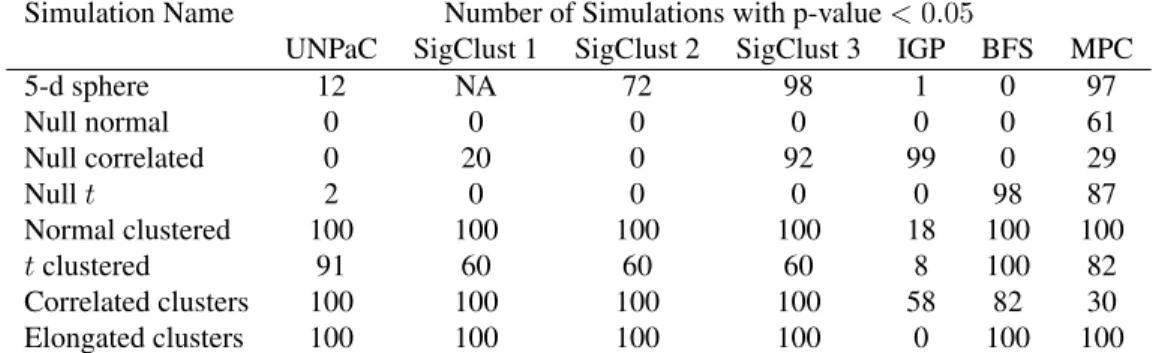
Comparison of cluster detection accuracy for low dimensional clustering

ex-amples

. The number of times each method gave a p-value

<

0

.

05

out of 100

simulations is recorded.

. . . 43

2.2

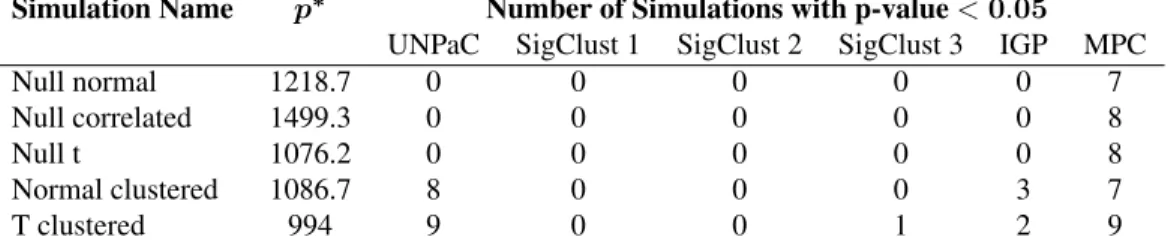
Comparison of cluster detection accuracy for high dimensional clustering

ex-amples

. The number of times each method gave a p-value

<

0

.

05

out of 10

simulations is recorded. The average number of features (p

) selected by the

dimension reduction step in UNPaC is also noted.

. . . 44

2.3

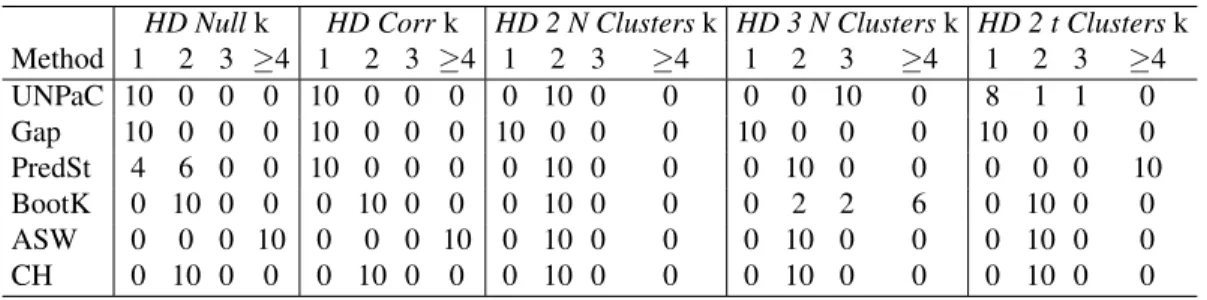
Comparison of cluster selection methods for low dimensional examples

. The

number of clusters, k, selected for each method in 100 simulations is presented.

PredSt= method proposed by Tibshirani and Walther (2005), BootK= method

proposed by Fang and Wang (2012), ASW= average silhouette width (Rousseeuw,

1987), and CH= Calinski-Harabasz index (Calinski and Harabasz, 1974).

. . . 46

2.4

Comparison of cluster selection methods for high dimensional examples

. The

number of clusters, k, selected for each method in 10 simulations is presented.

N=Normal. Corr=Correlated. PredSt= method proposed by Tibshirani and

Walther (2005), BootK= method proposed by Fang and Wang (2012), ASW=

average silhouette width (Rousseeuw, 1987), and CH= Calinski-Harabasz index

(Calinski and Harabasz, 1974).

. . . 47

2.5

Normalized p-values for testing the significance of k=2:10 versus no clusters in

the breast cancer microarray data.

. . . 51

2.6

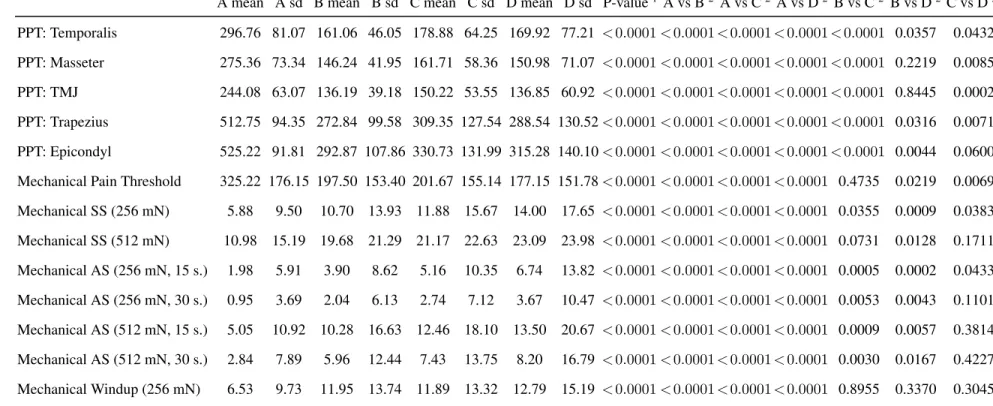
Pain Sensitivity, Psychosocial, and Autonomic Feature Summary Statistics by

Cluster for Four Clusters Identified in OPPERA data.

AS= Aftersensation,

AUC=Area Under the Curve, BP=Blood Pressure, CSQ=Coping Strategies

Ques-tionnaire, EPQ-R=Eysenck Personality Questionnaire-Revised, HRV=Heart Rate

Variability,IP=Interpersonal KRS=Kohn Reactivity Scale, LES=Life Experiences

Survey, PCS=Pain Catastrophizing Scale, PILL=Pennebaker Inventory for

Lim-bic Languidness, POMS=Profile of Mood States, PPT=Pressure Pain Threshold,

PSQI=Pittsburgh Sleep Quality Index, PSS=Perceived Stress Scale,

SCL90-R=Symptom Checklist-90-Revised, SS=Single Stimulus, TMJ=temporomandibular

joint, TS=Temporal Summation. See Bair et al. (2016) for more information

about the data.

. . . 55

2.7

Comparison of cluster detection accuracy for the hierarchical clustering

exam-ples.

The number of times each method gave a p-value

<

0

.

05

for 50 simulations

(12)

3.8

Comparison of identification accuracy (average of 100 simulations) and

compar-ison of reproducibility (average of 100 simulations x 10 partitions) for

simula-tions 1, 2, and 5

. OMR=object misclassification rate, FNR= false negative rate,

FPR=false positive rate, FMR=feature misclassification rate.

. . . 86

3.9

Comparison of identification accuracy for simulations 3, and 4

(average of 100

simulations). VBCs= Valid Biclusters, FNR=False Negative Rate, FPR=False

positive rate, SparseBC=Sparse Biclustering

. . . 87

3.10

Comparison of identification accuracy (average of 100 simulations) and

repro-ducibility (average of 100 simulations x 10 partitions) for SCBiclust methods for

simulations 1.1,1.2, 2, and 5

. OMR=object misclassification rate, FNR= false

negative rate, FPR=false positive rate, FMR=feature misclassification rate.

. . . 88

3.11

Comparison of identification accuracy for SCBiclust methods in simulations 3,

and 4

(average of 100 simulations). BCs=Biclusters, FNR=False Negative Rate,

FPR=False positive rate.

. . . 89

3.12

Stopping rule comparison for simulations 1.1, 1.2, and 4

(average of 100

simula-tions). Maximum number of biclusters was set to 7

. . . 91

3.13

OPPERA: comparison of different biclustering algorithms

. . . 93

3.14

OPPERA: association between biclusters and chronic and first-onset TMD

.

LRS=Log-rank Statistic

. . . 94

3.15

Gene expression: Comparison of biclustering and survival analysis results.

. . . 96

4.16

Comparison of conventional IPW vs. proposed permuted p-values and

boot-strapped standard errors for simulations where there was no association between

genetic factors and secondary phenotype

. “Lambda” represents the genomic

inflation factor with the optimal value being 1. “Ave SE” represents the average

standard error. “CI with 0” represents the number of confidence intervals (out of

10,000 SNPS), containing zero.

. . . 110

4.17

Power (Percentage of simulations which gave a p-value less than 0.05) for

conventional IPW method (IPW) versus the proposed permutation method (Perm)

.

10,000 simulations were run for each combination of parameters. The prevalence

of disease was set to be 0.01. MAF=minor allele frequency.

. . . 112

4.18

Power (Percentage of simulations which gave a p-value less than 0.05) for

conventional IPW method (IPW) versus the proposed permutation method (Perm).

10,000 simulations were run for each combination of parameters. The prevalence

(13)

4.19

Power (Percentage of simulations which gave a p-value less than 0.05) for

conventional IPW method (IPW) versus the proposed permutation method (Perm)

.

10,000 simulations were run for each combination of parameters. The prevalence

of disease was set to be 0.10. MAF=minor allele frequency.

. . . 114

4.20

Comparison of confidence interval coverage for conventional IPW versus the

bootstrapped method.

1,000 simulations were run for each combination of

parameters. The minor allele frequency=0.05 and the disease prevalence was

set to

10%

. Bias=average absolute difference between parameter estimate and

true

β

XY

. ASE=Average Standard Error. Coverage=Number of

95%

confidence

intervals containing the true

β

XY

.

. . . 115

4.21

Comparison of confidence interval coverage for conventional IPW versus the

bootstrapped method. 1,000 simulations were run for each combination of

parameters.

The minor allele frequency=0.075 and the disease prevalence was

set to

10%

. Bias=average absolute difference between parameter estimate and

true

β

XY

. ASE=Average Standard Error. Coverage=Number of

95%

confidence

intervals containing the true

β

XY

.

. . . 116

4.22

Comparison of confidence interval coverage for conventional IPW versus the

bootstrapped method. 1,000 simulations were run for each combination of

parameters.

The minor allele frequency=0.1 and the disease prevalence was

set to

10%

. Bias=average absolute difference between parameter estimate and

true

β

XY

. ASE=Average Standard Error. Coverage=Number of

95%

confidence

(14)

LIST OF FIGURES

2.1

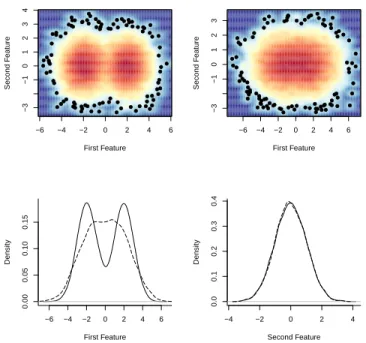
Illustration of the proposed reference distribution.

Two clusters are present in

the data and they differ only with respect to the mean of the first feature. The

first row gives the bivariate density for the observed data (left) and the reference

distribution (right) The second row gives the univariate density for the first

feature (left) and second feature (right). The solid lines are from the observed

data and the dashed lines are from the reference distribution. Note that the null

distribution is bivariate unimodal and also unimodal for each feature, separately.

The null data also closely approximates the density of the second feature.

. . . 33

2.2

Heat map of ”Normal clustered” simulation.

. . . 41

2.3

Heat map of ”T clustered” simulation.

. . . 42

2.4

Heat map of ”Correlated clusters” simulation.

. . . 42

2.5

Illustration of ”Elongated clusters” simulation.

. . . 43

2.6

OPPERA cluster significance tests:

Normal approximation p-values for testing

significance of clusters identified in the OPPERA study.

. . . 49

2.7

Optimal number of clusters for OPPERA data.

Plot of difference in cluster

indices (CI’s) between observed data and reference distribution for a range of

number of clusters, k. k=4 maximizes the difference in CI’s.

. . . 50

2.8

Clusters identified using UNPaC on OPPERA data.

Overlap between clusters

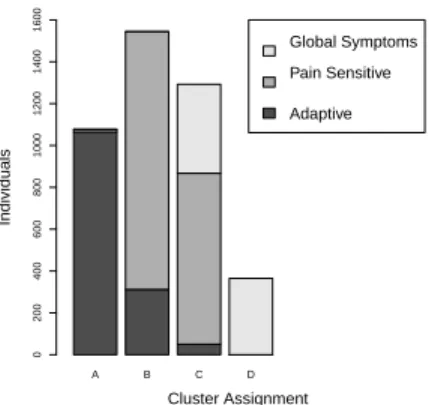
identified using UNPaC (Clusters “A”,“B”,“C”, and “D”) and clusters found

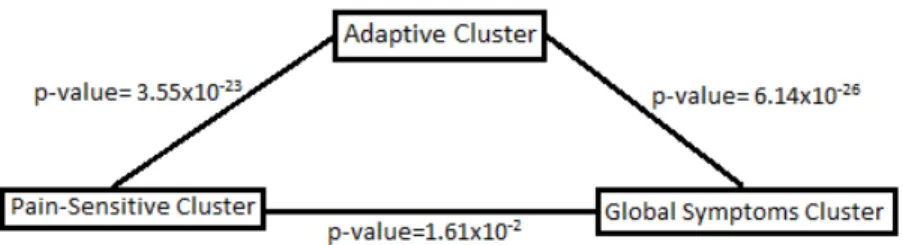
in Bair et al. (2016) (“Adaptive Cluster”,“Pain Sensitive Cluster”, and “Global

Symptoms Cluster”)

. . . 51

2.9

Optimal number of clusters for breast cancer microarray data.

Plot of difference

in cluster indices (CI’s) between observed data and reference distribution for a

range of number of clusters, k. k=5 maximizes the difference in CI’s.

. . . 52

2.10

Clusters identified using UNPaC on breast cancer microarray data.

Overlap

between clusters identified using UNPaC (Clusters “1”,“2”,“3”, “4”, and “5”)

and cancer subtypes (“Basal”,“Her2”, “LumA”,“LumB”, and ”LumI” )

. . . 52

(15)

3.12

Simulation 1.1 example: primary bicluster identification.

This is an illustration of

a single simulated data set from simulation 1.1. The first panel shows a heat map

of the (scaled) data. The primary bicluster is the rectangular yellow block in the

middle. The remaining panels show the biclusters identified by SCBiclust, LAS,

sparse biclustering, SSVD, and HSSVD, with the white regions corresponding

to the biclusters. For SSVD and HSSVD, both the 0/1/-1 indicator matrix and

the approximation matrix are plotted.

. . . 78

3.13

Simulation 1.2 example: primary bicluster identification with correlated features.

This is an illustration of a single simulated data set from simulation 1.2. The

first panel shows a heat map of the (scaled) data. The primary bicluster is the

rectangular yellow block in the middle. The remaining panels show the biclusters

identified by SCBiclust, LAS, sparse biclustering, SSVD, and HSSVD, with the

white regions corresponding to the biclusters. For SSVD and HSSVD, both the

0/1/-1 indicator matrix and the approximation matrix are plotted.

. . . 79

3.14

Simulation 2 example: departure from normality.

This is an illustration of a

single simulation from the second simulation scenario. The first panel shows a

heat map of the (scaled) data. The primary bicluster is the rectangular yellow

block in the middle. The remaining panels show the biclusters identified by

SCBiclust, HSSVD, and LAS, with the white regions corresponding to the biclusters.

. . . 80

3.15

Simulation 3 example: Symmetric Biclusters with no Overlap

This is an

illustra-tion of a single simulaillustra-tion from the third simulaillustra-tion scenario. The first panel

shows a heat map of the (scaled) data. The two biclusters are in the bottom left

corner of the data matrix; one is in red and the other is in yellow. The remaining

panels show the first two biclusters identified by SCBiclust, HSSVD, SSVD,

LAS, and sparse biclustering. The white regions correspond to the biclusters.

For SSVD and HSSVD, both the 0/1/-1 indicator matrix layers and the overall

approximation matrices are plotted.

. . . 81

3.16

Simulation 4 example: sequential biclusters with overlap.

This is an illustration

of a single simulation from the fourth simulation scenario. The first panel

shows a heat map of the (scaled) data. The two overlapping biclusters are

in the bottom left corner of the data matrix; one is in red and the other is

in yellow. The remaining panels show the first two biclusters identified by

SCBiclust and HSSVD, the first bicluster identified by SSVD and Plaid, and the

first three biclusters identified by LAS and sparse biclustering. The white regions

correspond to the biclusters. For SSVD and HSSVD, both the 0/1/-1 indicator

(16)

3.17

Simulation 5 example: non-spherical biclusters.

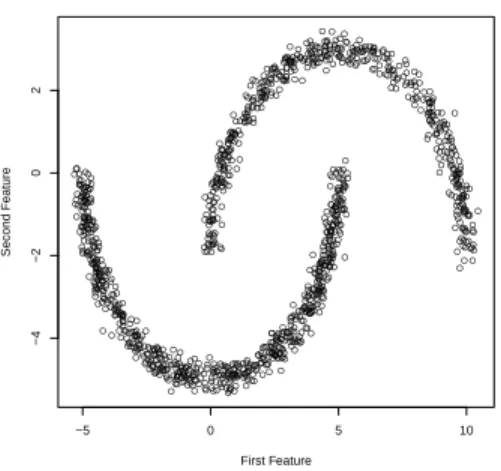
Each panel shows a plot of

the second feature versus the first feature for a single simulation from the fifth

simulation scenario. Note that the data forms two non-spherical clusters. Each

panel shows the result of applying a biclustering method (specifically

SCBi-clust, SSVD, HSSVD, Plaid, LAS, and sparse biclustering) to this data set.

Observations that belong to the putative bicluster are labeled in red.

. . . 84

3.18

OPPERA Kaplan-Meier plots.

The Kaplan-Meier plots showing the association

between first-onset TMD and the biclusters identified by SCBiclust (layer 2 and

3) and LAS (layer 2).

. . . 94

3.19

Breast cancer gene expression Kaplan-Meier plot.

The Kaplan-Meier plots

showing the association between time to metastases (months) and the biclusters

identified by SCBiclust, LAS, and sparse biclustering, and HSSVD mean.

. . . 96

4.20

Q-Q plot of the p-values produced by conventional IPW regression (left) and our

proposed semi-parametric test (right) from the simulated data set described in

section 4.3.1.

. . . 107

4.21

Q-Q plot of the p-values produced by conventional IPW regression (left) and our

proposed semi-parametric test (right) from the simulated data set described in

section 4.3.2.

. . . 109

4.22

Q-Q plot of the p-values produced by our proposed nonparametric test versus

the expected (uniform) distribution for testing the association between each SNP

and “pain free opening” in the OPPERA Study.

. . . 118

4.23

Q-Q plot of the p-values produced by our proposed nonparametric test versus

the expected (uniform) distribution for testing the association between each SNP

(17)

LIST OF ABBREVIATIONS

ANOVA

Analysis of Variance

AS

Aftersensation

ASE

Average Standard Error

ASW

Average Silhouette Width

AUC

Area Under the Curve

Auto

Autonomic

Ave

Average

BCs

Biclusters

BCSS

Between Cluster Sum of Squares

BFS

Bootstrapping for Significance

BIC

Bayesian Information Criterion

BP

Blood Pressure

CH

Calinski-Harabasz

CI

Cluster Index

CSQ

Coping Strategies Questionnaire

DF

Degrees of Freedom

EM

Expectation-Maximization

EPQ-R

Eysenck Personality Questionnaire-Revised

FDRs

False Discovery Rates

FMR

Feature Misclassification Rate

FNR

False Negative Rate

FPR

False Positive Rate

GWAS

Genome Wide Association Study

HDLSS

high-dimension, low-sample size

HRV

Heart Rate Variability

(18)

IGP

In-Group Proportion

IP

Interpersonal

IPW

Inverse-Probability-of-sampling-Weighted

KDE

Kernel Density Estimation

KRS

Kohn Reactivity Scale

LAS

Large Average Submatrix

LES

Life Experiences Survey

LumA

Luminal A

LumB

Luminal B

LumI

Luminal I

MAD

median absolute deviation from the median

MAF

Minor Allele Frequency

MEM

Modal ExpectationMaximization

MPC

Multimodality of Principal Curves

NA

Not Applicable

Obs

Observations

OMR

Object Misclassification Rate

OPPERA

Orofacial Pain: Prospective Evaluation and Risk Assessment

OR

Odds Ratio

PCS

Pain Catastrophizing Scale

PILL

Pennebaker Inventory of Limbic Languidness

POMS

Profile of Mood States

PPT

Pressure Pain Threshold

PSQI

Pittsburgh Sleep Quality Index

Psy

Psychosocial

QST

Quantitative Sensory Testing

(19)

SCBiclust

Sparse-Clustering Biclustering

SCL

Symptom Checklist

SE

Standard Error

Sec

Seconds

SigClust

Statistical Significance of Clustering

SNP

Single-Nucleotide Polymorphism

sparseBC

Sparse Biclustering

SS

Single Stimulus

SSVD

Sparse Singular Value Decomposition

SVD

Singular Value Decomposition

TCI

Theoretical Cluster Index

TMD

Temporomandibular Disorder

TS

Temporal Summation

TTSS

Theoretical Total Sum of Squares

TWSS

Theoretical Within Cluster Sum of Squares

UN-PaC

Unimodal Non-Paramateric Cluster

Var

Variance

(20)

CHAPTER 1: LITERATURE REVIEW

1.1

Cluster Significance Testing and Cluster Number Estimation

Often in an exploratory analysis of a data set it is of interest to discover if there are any

natural groupings present. Graphical visualizations can be useful for low dimensional data

sets, but for higher dimensions other methods are needed. Clustering techniques are common

tools used in the exploration of complex data sets. Since no response variable is identified,

and no model is being constructed, clustering falls under the category of unsupervised

learning. The versatility of clustering lies in the fact that it can be used in any data set where

the similarity between observations can be measured. Many clustering algorithms have been

proposed including hierarchical clustering, k-means clustering, and spectral and graph based

methods. The exploratory nature of clustering has been very useful for identifying patterns

in the field of bioinformatics. Unfortunately, most clustering methods will always group the

data into clusters even if the data is actually homogeneous. Given that there are so many

clustering methods available it is important to know whether the identified clusters do, in

fact, represent distinct subgroups or if they are merely a spurious finding. Another related

problem is being able to estimate the number of clusters present in the data set.

Several methods have been developed which allow the strength of identified clusters to

be assessed. These methods generally test the null hypotheses that the data is homogeneous

by comparing a statistic from the clustered data to the statistic from an appropriate null

distribution. This null distribution is generated under certain assumptions such as a specific

parametric distribution or non-parametric assumptions about the shape of unclustered data.

(21)

algorithm where the null data is generated under a unimodal assumption. We then compare

our algorithm with existing cluster validation approaches in a series of simulation studies.

A conventional way to determine the number of clusters present in the data is to examine

the within-cluster homogeneity or between-cluster heterogeneity, or a combination of both

measures, over a range of cluster numbers. The optimal number of clusters, k, is chosen to

maximize this value. Another way to estimate the number of clusters is examine the stability

of the clustering. If the addition of new data does not affect the cluster centroids, it is

assumed that the number of clusters is correct. The number of clusters can also be assessed

by examining prediction accuracy, the ability to correctly predict class labels. Many of these

methods incorporate a null distribution, either through data permutation or bootstrapping,

in order have a more rigorous assessment of cluster number. We propose a method that

uses a unimodal null distribution and we choose the number of clusters to be the value that

maximizes the difference in cluster strength calculated from the observed data and null data.

1.1.1

An Overview of Cluster Significance Testing Approaches

Several cluster significance tests have been proposed based on various assumptions

about cluster strength and cluster shape. Liu et al. (2008) take a parametric approach for their

SigClust method and define a cluster to be data coming from a single Gaussian distribution.

The significance test of Maitra et al. (2012) avoids defining a parametric distribution, but

assumes that the clusters are compact and can be transformed to be spherical and similar

to each other. Ahmed and Walther (2012) reduce a multidimensional data set to a single

dimension by projecting the data onto its principle curve. They then employ Silverman’s

bandwidth test (Silverman, 1981) to test for more than one mode. Cheng and Ray (2014)

take a local modal inference approach and test if two identified modes come from a unimodal

or bimodal distribution. Kapp and Tibshirani (2006) use a validation measure based on

(22)

cluster. In this section we briefly describe the above methods which will be compared to our

proposed method in the first part of the dissertation.

1.1.1.1

SigClust

The SigClust method developed by Liu et al. (2008) defines a cluster to be data

generated from a single multivariate Gaussian distribution. To assess the presence of

clustering the method compares the two-means clustering index (CI) calculated from the

data to the CI calculated from a single multivariate Gaussian distribution. To optimize this

method for high-dimension, low-sample size (HDLSS) settings, such as microarray data,

the method combines invariance principles and factor analysis to estimate the covariance

matrix. As an extension, Huang et al. (2015) incorporate a soft thresholding approach to

reduce type-I error inflation.

Assume the observed data,

X

, is of dimension

d

×

n

, with

d

features and

n

observations

and a clustering algorithm has split the data into two clusters. Liu et al. (2008) use the CI as

the test statistic for their hypothesis test. The CI is defined to be:

CI

=

P

2

k

=1

P

jC

k

x

j

x

¯

k

2

P

n

j

=1

k

x

j

x

¯

k

2

(1.1)

Where

C

k

is the sample index set for the kth cluster,

x

¯

k

is the sample mean for the kth

cluster, and k=1 and 2. Note, the CI is location and rotation invariant and a small value for

the CI indicates that a large proportion of the variance is explained by the given clustering.

To test the null hypothesis Liu et al. (2008) compare the CI from the observed data

to a CI generated from a null Gaussian distribution, represented as

N

(

µ,

Σ)

. Since the CI

is location invariant only the covariance matrix needs to be estimated. Liu et al. (2008)

make use of the rotational invariance of the CI and use a factor analysis model to greatly

reduce the number of parameters necessary for estimating the covariance matrix. As a first

(23)

matrix and

D

is a diagonal matrix with entries

λ

1

, . . . , λ

d

equal to the eigenvalues of

Σ

.

Replacing

X

with

M

T

X

results in the covariance matrix being the d-parameter matrix

D

.

D

is further simplified by assuming that the covariance has relatively few biologically

meaningful components. Liu et al. (2008) model D as:

D

= Σ

B

+

σ

N

2

xI

(1.2)

The diagonal matrix

Σ

B

represents the real biology and typically has a sparse structure.

σ

N

2

represents the level of background noise and is estimated as

ˆ

σ

N

2

=

MAD

d×n data set

MAD

N

(0

,

1)

(1.3)

Where MAD is the median absolute deviation from the median.

Lastly,

D

is estimated by

D

ˆ

which is a diagonal matrix of elements

d

ˆ

j

where

ˆ

d

j

=

˜

λ

j

τ if

λ

˜

j

> τ

+

σ

N

2

σ

2

N

if

˜

λ

j

τ

+

σ

N

2

(1.4)

For the original “hard thresholding” method (Liu et al., 2008),

τ

= 0

. For the

“soft-thresholding” method (Huang et al., 2015), the positive constant

τ

is chosen such that

Σ

d

k

=1

(

σ

1

2

N

1

˜

λ

k

−τ

)

+

=

M

and

M

is chosen by setting the sum of the eigenvalues for the

estimated covariance matrix equal to the sum of the sample covariance.

The reference distribution is then generated from

(

x

1

, ..., x

d

)

where

x

j

N

(0

,

d

ˆ

j

)

. A

p-value can then be calculated by comparing the CI from the reference distribution to the CI

from the observed data.

In the second part of the dissertation we will compare our proposed significance testing

(24)

with 1000 permutation replications each. Our method also uses the cluster index given in

equation 1.1 as a test statistic.

1.1.1.2

Bootstrapping for Significance of Clustering

Maitra et al. (2012) take a different approach to formulating a cluster significance

test by assuming clusters are compact and can be transformed to be spherical and similar.

Their method is distribution-free and instead uses a bootstrap approach for testing the null

hypothesis that a smaller model (less clusters) better fits the data than a larger model (more

clusters). This method can also be applied to estimate the number of clusters present. Unlike

SigClust this method is not optimized for HDLSS data.

To illustrate the method first let the original data set be represented by

X

1

, X

2

, . . . , X

n

where

X

i

is a p-dimensional vector. Assume that each

X

i

P

K

k

=1

ζ

ik

f

k

(

x

)

for

i

= 1

, . . . , n

where

K

is the number of clusters;

f

k

is the density of an observation in the kth cluster;

ζ

ik

=

I

X

i

G

k

where

I

(

·

)

is the indicator function and

G

k

is the sample set for the kth cluster.

Under this framework, the null hypothesis, the data is from a family of distributions with K

clusters, is compared to the alternative, the data comes from a family of distributions with

more than K clusters. As a test statistic, Maitra et al. (2012) use the improvement of the

within-cluster sum of squares when the data is grouped into K* (

>

K) clusters instead of K

clusters,

s

K

;

K

=

W

K

W

K

where

W

K

=

P

n

i

=1

P

K

k

=1

ζ

K

ik

(

x

i

µ

k

)

0

(

x

i

µ

k

)

. Here

µ

k

represents the mean for the kth cluster.

For the case when K=0, no clustering of the data, the authors propose that the null

distri-bution should be generated by sampling from the uniform distridistri-bution on the p-dimensional

hyper-rectangle as in Tibshirani et al. (2001). For the

K >

0

scenario the authors develop

methodologies for generating the null distribution under the assumption of homogeneous

spherical structures and then general ellipsoidal clusters.

For the homogeneous spherical structures case: under the null hypothesis the

sam-ple

Ξ =

X

1

, . . . , X

n

is jointly distributed as:

Q

n

i

=1

P

K

k

=1

ζ

K

ik

1

σ

g

(

x

i

−µ

k

(25)

R

p

R

p

is invariant under orthogonal transformation. Using the K-clusters solution

the following estimates can be obtained:

ζ

ˆ

K

ik

’s,

µ

ˆ

k

=

P

n

i

=1

ζ

ˆ

ik

K

X

i

/

P

n

i

=1

ζ

ˆ

ik

K

, and

σ

ˆ

=

1

np

P

n

i

=1

P

K

k

=1

ζ

K

ik

(

X

i

µ

ˆ

k

)

0

(

X

i

µ

ˆ

k

)

.

The residuals from this solution,

ˆ

1

,

ˆ

2

, . . . ,

ˆ

n

, where

ˆ

i

= (

X

i

P

K

k

=1

ζ

ˆ

ik

K

µ

ˆ

k

)

/

σ

ˆ

now form a sample for the density

g

(

·

)

, but the following resampling strategy is needed

to increase power. Let

W

i

=

Z

i

/

k

Z

i

k

where

Z

i

is a p-variate standard normal random

vector. A random permutation

(

`

1

, . . . , `

n

)

of

1

, . . . , n

is generated. The ith resampled

residual is then given by

i

=

k

ˆ

`

i

k

W

i

. The resampled null distribution is then given by

Ξ

=

X

1

, . . . , X

n

where

X

i

=

P

K

k

=1

ζ

ˆ

K

ik

µ

ˆ

k

+ ˆ

σ

i

.

For the general ellipsoidal clusters case a similar resampling strategy is used, but the

residuals are defined differently. Under the null hypothesis the sample

Ξ =

X

1

, . . . , X

n

is jointly distributed as:

Π

n

i

=1

P

K

k

=1

ζ

ik

K

1

det (

|

Σ

k

|

1

2

)

g

1

/

2

k

(

x

i

µ

k

))

where

g

:

R

p

R

p

. Using the K-clusters solution the following estimates can be obtained:

ζ

ˆ

ik

K

’s,

µ

ˆ

k

=

P

n

i

=1

ζ

ˆ

K

ik

X

i

/

P

n

i

=1

ζ

ˆ

K

ik

, and

Σ

ˆ

k

=

P

n

i

=1

ζ

ˆ

K

ik

(

X

i

µ

ˆ

k

)(

X

i

µ

ˆ

k

)

0

/

P

n

i

=1

ζ

ˆ

K

ik

. The residuals

are given by

ˆ

1

,

ˆ

2

, . . . ,

ˆ

n

where

ˆ

i

=

P

K

k

=1

ζ

ˆ

ik

K

Σ

1

2

k

(

X

i

Σ

K

k

0

=1

ζ

ˆ

K

ik

0

µ

ˆ

k

0

)

. The resampled

null distribution is then given by

Ξ

=

X

1

, . . . , X

n

where

X

i

=

P

K

k

=1

ζ

ˆ

K

ik

µ

k

Σ

ˆ

1

2

k

i

)

.

To calculate the p-value, the null distribution resampling process is repeated to obtain

M data sets. For each null data set

Ξ

j

the test statistic

s

j,

(

K

;

K

)

is calculated. The p-value for

the

s

K

;

K

calculated from the original data set is the proportion of times

s

j,

(

K

;

K

)

is greater

than

s

K

;

K

.

Since the inverse of the covariance matrix is required for clustering the null distribution

when clusters are non-homogeneous the method is not applicable to the HDLSS setting.

For situations when the number of features is less than the number of observations we will

compare our proposed method to the method of Maitra et al. (2012) under the assumption

(26)

1.1.1.3

Principal Curve Unimodality Test

If one were to define a cluster as a single unimodal distribution then cluster significance

testing would simply reduce to testing for multimodality. Thus if more than one mode is

present in the data it signifies that multiple clusters are present. Much work has been done in

determining the number of modes present in univariate data, but work in the multivariate case

has been more limited. This is due to many factors including the complication of defining

multivariate unimodality, the “curse of dimensionality”, and computational constraints.

Instead of tackling the problem of multivariate modality testing, Ahmed and Walther (2012)

assess the number of subpopulations by first reducing the data to one dimension using

principal curves and then employing Silverman’s bandwidth test (Silverman, 1981).

The principal curve of the data

X

R

p

is defined to be

f

(

λ

) =

E

(

X

|

λ

f

(

X

) =

λ

)

(1.5)

Where

f

(

λ

)

is a smooth curve in

R

p

,

λ

is a real variable, and the projection index

λ

f

(

X

)

is the largest value of

λ

for which

f

(

λ

)

is closest to X. The principal curve is the mean of

the points that project onto it and thus gives a univariate approximation of X. Using the

nonlinear principal curve is much more flexible than a linear projection and is more likely to

avoid the problem of projecting different clusters near the same location. See (Hastie and

Stuetzle, 1989) and (Tarpey and Flury, 1996) for more information on principal curves.

After the data has been reduced to one-dimension, Silverman’s bandwidth test

(Silver-man, 1981) is used to test for the presence of more than one cluster. The null hypothesis

for this test is that the univariate data has k modes, here k=1, and it is tested against the

alternative that

k

> k

modes are present. As a first step, the data is approximated using the

kernel density estimate:

ˆ

f

(

t

;

h

) = (

nh

)

1

n

X

(27)

Where h is the bandwidth;

K

(

·

)

is the Gaussian kernel function; and

X

1

, . . . , X

n

are the

observed data. Silverman (1981) shows that a critical bandwidth,

h

k

can be determined such

that

h

k

= inf

{

h

: ˆ

f

(

·

;

h

)

has at most k modes

}

.

(1.7)

Larger values of

h

1

indicate that more smoothing must be done to make the data unimodal.

To test for unimodality the critical bandwidth,

h

1

, is compared to the bandwidth from a

reference distribution which is known to be unimodal. Observations,

y

i

, from the reference

unimodal distribution

f

ˆ

(

·

;

h

1

)

are generated by:

y

i

= (1 +

h

2

1

2

)

1

/

2

(

X

I

(

i

)

+

h

1

i

)

(1.8)

Where

i

N

(0

,

1)

;

σ

2

is the sample variance; and the

X

I

(

i

)

’s are sampled uniformly, with

replacement, from the data X. The bootstrap critical bandwidth,

h

i

, is determined for each

bootstrap replication. The p-value for the test of the null hypothesis is given by:

p

=

B

X

1

I

(

h

i

> h

1

)

B

(1.9)

where B is the number of bootstrap replicates and

I

(

·

)

is the indicator function.

The method proposed by Ahmed and Walther (2012) can be used to test for clustering,

assuming that a single cluster would have at most 1 mode. It can be extended to find

the number of clusters present through an iterative mode testing process. For algorithm

comparison in later sections we will use the default number of bootstrap simulations,

B=10,000. The method we propose in the Section 2.2 uses a process similar to equation 1.8

(28)

1.1.1.4

Multivariate Modality Inference

Instead of reducing the data to a univariate representation and performing a global

modality test, Cheng and Ray (2014) use a local test to assess modes identified in an estimate

of the multivariate density. Their method uses the Model EM method and Ridgeline EM

method of Li et al. (2007) to identify potential modes and saddle points, respectively. The

test statistic is based on the difference between the estimated density at the mode and saddle

point. Significance of the modes is assessed by comparing this statistic to its asymptotic

distribution.

Specifically, Cheng and Ray (2014) test the null hypothesis that pair of identified modes,

x

m

1

and

x

m

2

come from a unimodal density against the alternative that they are from a

bimodal density. As a first step in this process, a sphering transformation is applied to the

data and the multivariate kernel density estimator is used as a non-parametric estimate of

the probability density. For simplicity, only one bandwidth parameter, h, is used in the

estimation of the density

f

ˆ

(x) =

1

nh

d

P

n

i

=1

K

(

x−X

i

h

)

.

X

i

= (

X

i

1

, ..., X

id

)

; i=1,...,n are

are i.i.d samples from the population with some unknown probability density

f

.

K

(

·

)

is a

real-valued multivariate kernel function which here is chosen to be the multivariate normal

density function. The authors recommend that the “normal reference rule” (Scott, 1992) be

used for estimating the bandwidth which in this case is given by

h

=

{

4

(

d

+2)

n

}

1

d

+4

.

Once the multivariate density has been estimated putative modes are identified using

the Modal EM (MEM) algorithm (Li et al., 2007). The MEM uses an EM-style algorithm to

solve for the local maxima of a mixture density. Li et al. (2007) also proposed Ridgeline

EM for finding the ridgeline between two modes. Once the ridgeline is obtained, the saddle

point, the point on the ridgeline with the lowest density, can easily be computed.

To test the null hypothesis the estimated density at the smallest mode (denoted

x

ˆ

m

) is

compared to the density at the saddle point denoted

x

ˆ

s

. Cheng and Ray (2014) recommend

re-estimating the density using the Gaussian kernel density estimator with bandwidth chosen

(29)

statistic,

q

ˆ

f

(

x

ˆ

m

)

q

ˆ

f

(

x

ˆ

s

)

is asymptotically distributed as

N

0

,

2

nh

1

d

1

2

π

d

. The

asymptotic distribution can then be used to make inference about the modality of the density

containing the two putative modes.

1.1.1.5

IGP

A closely related concept to cluster significance is cluster reproducibility. If clusters

are found in one data set we hope that they would be found in similar data sets. Kapp and

Tibshirani (2006) develop a validation procedure for cluster reproducibility based on the

in-group proportion (IGP) which is defined to be the proportion of observations in a cluster

whose nearest neighbors are also located in the same cluster. The IGP procedure can be

used to validate individual clusters and therefore test cluster significance.

Let A be an

p

×

n

data set with

p

features and

n

observations which are classified into

k

clusters. Let C be the

p

×

k

matrix of cluster centroids. Suppose another data set

X

is

collected with the same

p

features and

q

observations such that each observation can be

classified into one of the

k

clusters or a “below cutoff group”. The cluster membership of an

observation,

j

, in

X

can be determined using the rule:

Class

X

(

j

) =

0

if

max

1

≤u≤k

d

(

X

[

, j

]

, C

[

, u

])

< c,

arg max

1

≤u≤k

d

(

X

[

, j

]

, C

[

, u

])

, if

max

1

≤u≤k

d

(

X

[

, j

]

, C

[

, u

])

c

Where the function d(x,y) is Person’s centered correlation for vectors x and y. The cluster

membership function is equivalent to classifying an observation to a cluster with whose

centroid it most highly correlates. Observations whose correlations with cluster centroids

are less than the cutoff, c, are classified to a “below cutoff group”

Once cluster membership has been established the IGP can be calculated and the

(30)

whose

Class

X

=

u

. Then the in-group proportion is defined to be:

IGP

(

u, X

) =

#

{

j

|

Class

X

(

j

) =

Class

X

(

j

N

) =

u

}

#

{

j

|

Class

X

(

j

) =

u

}

For the jth observation in X, where

j

N

= arg max

i6

=

j

d

(

X

[

, j

]

, X

[

, i

])

.

To validate the clusters identified in X, the IGPs from the data set are compared to the

IGPs from a null distribution in which centroids are randomly placed in the data. Kapp

and Tibshirani (2006) propose a null distribution in which the samples are permuted within

a box aligned with their principal components. Since the IGP depends on the size of the

cluster, the IGP for a given cluster is compared only to IGPs from null distributions that

came from groups of the same size. The p-value for this test is the fraction of the IGPs from

the null distribution that are as close or closer to 1 than the IGP for the cluster identified in

the data set.

For the comparison of methods in the first part of the dissertation, clusters were identified

from a sample simulation and the reproducibility of the clusters is assessed in an additional

generation of the same data set. Default settings were used including no cutoff for clustering.

1.1.2

An Overview of Cluster Number Estimation Approaches

There are several available approaches for estimating the number of clusters in a data

set. Rousseeuw (1987) and Calinski and Harabasz (1974) propose choosing the number

of clusters which maximizes their proposed measure of cluster strength. Tibshirani et al.

(2001) incorporate a reference distribution with no clusters into their method and choose

the number of clusters to maximize the difference between the within-cluster dispersion

from the data and the reference distribution. Fang and Wang (2012) tackle the problem by

choosing the number of clusters which minimizes cluster instability. These methods will be

(31)

1.1.2.1

Calinski-Harabasz index

Let

W

(

k

)

be the within-cluster sum of squares of a k-cluster assignment of the data.

W

(

k

) =

P

k

r

=1

1

n

r

D

r

where

n

r

is the number of observations in cluster

r

and

D

r

=

P

i,i

0

C

r

d

2

ii

0

with

d

2

ii

0

=

P

j

(

x

ij

x

i

0

j

)

2

,

i

6

=

i

0

. Let

B

k

be the between-cluster sum of

squares for a k-cluster assignment of the data.

B

(

k

) =

n

1

P

n

i,i

0

=1

d

2

ii

0

W

(

k

)

The Calinski-Harabasz index (Calinski and Harabasz, 1974) is defined to be

CH

(

k

) =

B

(

k

)(

n

k

)

W

(

k

)(

k

1)

The estimated number of clusters is chosen to be the

k

which maximizes

CH

(

k

)

.

1.1.2.2

Average silhouette width

Rousseeuw (1987) proposed choosing the number of clusters which maximizes the

“average silhouette width,” a measure assessing cluster tightness and separation. Borrowing

notation from (Hennig, 2014), let

d

(

x

i

, x

)

represent the dissimilarity between object

x

i

and

object

x

. Let

a

(

i, k

) =

|C

1

j

|−

1

P

x∈C

j

d

(

x

i

, x

)

where

C

j

represents the cluster containing

x

i

; and let

b

(

i, k

) = min

C

l

6

=

C

j

1

|C

l

|

P

x∈C

l

d

(

x

i

, x

)

. Then for a given object,

x

i

, and number of

clusters k the silhouette is defined to be

s

(

i, k

) =

b

(

i, k

)

a

(

i, k

)

max

{

a

(

i, k

)

b

(

i, k

)

}

(1.10)

The estimated number of clusters

k

is chosen to maximize

n

1

P

n

i

=1

s

(

i, k

)

.

1.1.2.3

Gap statistic

Tibshirani et al. (2001) propose the “gap statistic”, a measure based on the

(32)

Suppose

X

is an

n

×

p

data set with

n

independent observations and

p

features which

has been grouped into

k

clusters. Let

d

ii

0

=

P

j

(

x

ij

x

i

0

j

)

2

i

6

=

i

0

. Then the

pooled-within-cluster sum of squares around the pooled-within-cluster means is defined to be

W

k

=

P

k

r

=1

1

2

n

r

D

r

where

D

r

=

P

i,i

0

C

r

d

ii

0

, and

n

r

is the number of observations in cluster

r

.

To determine the number of clusters, the distribution of

log(

W

k

)

is compared to its

expectation in a reference distribution. The features for the reference distribution are

generated from a uniform distribution over a box aligned with the principal components of

the data.

Define the gap statistic to be

Gap

n

(

k

) =

E

n

{

log(

W

k

)

} −

log(

W

k

)

(1.11)

Where E

n

represents the expectation from the reference distribution with sample size

n

.

The number of clusters,

ˆ

k

, is chosen to maximize

Gap

n

(

k

)

, equivalently the point in the

distribution at which the two curves are farthest apart.

To carry out this method an iterative process then employed such that for each choice

of k, B reference data sets are generated. The gap statistic for k is given by

Gap

(

k

) =

(1

/B

)

P

b

log(

W

kb

)

log(

W

k

)

and the standard error is given by

s

k

= [(1

/B

)

P

b

{

log(

W

kb

)

¯

l

}

2

]

1

2

p

1 + 1

/B

)

where

¯

l

= (1

/B

)

P

b

log(

W

kb

)

. To account for variability, the number of

clusters,

ˆ

k

, is chosen to be the smallest k such that

Gap

(

k

)

Gap

(

k

+ 1)

s

k

+1

The gap statistic can be adapted for any clustering algorithm and the authors illustrate its

flexibility in identifying the number of clusters identified though k-means and hierarchical

clustering. A limitation of the gap statistic is it assumes that the clusters are well-separated

Figure

Figure 2.1: Illustration of the proposed reference distribution. Two clusters are present in the data and they differ only with respect to the mean of the first feature
Table 2.1: Comparison of cluster detection accuracy for low dimensional clustering examples
Table 2.2: Comparison of cluster detection accuracy for high dimensional clustering examples
Table 2.3: Comparison of cluster selection methods for low dimensional examples. The number of clusters, k, selected for each method in 100 simulations is presented
+7

References

Related documents

Keeping this tradition of epic poetry alive Pope has also used supernatural elements in “The Rape of the Lock”. Pope has

Volunteer ID Last Name First Name Spouse Last name Spouse First name Business Organization Business Position Business Address 1 Business Address 2 Business Address 3 Business

Table A-3.6 Marginal absolute effects of earthquake-related death of a family member on cumulative survival probability using outcome data partially imputed by risk score

Vehicle maintenance decisions are fully delegated to Municipal Fleet Maintenance Division whereas Ottawa Police Service Fleet and Technical Services concentrate mostly on

industrial action against the savage cuts in the education budget and the proposed changes to teachers’ pensions. Conference calls on Northern Committee to review and assess the

• If you have two or more job evaluation schemes covering all, or nearly all, your employees, you could estimate equal value by using the more generic job evaluation scheme to

9.3.1.3 The Bidder should propose a list of tools and test equipment (hardware and software) for TELCO PROV CO to acquire for daily O&amp;M

Skills: Battle 3, Craft: Armorsmithing 4, Craft: Weaponsmithing 3, Defense 4, Engineering (Siege) 5, Etiquette 2, Iaijutsu 3, Investigation 2, Kenjutsu 3, Know the School: