IntroClassJava: A Benchmark of 297 Small and Buggy
Java Programs
Thomas Durieux, Martin Monperrus
To cite this version:
Thomas Durieux, Martin Monperrus. IntroClassJava: A Benchmark of 297 Small and Buggy
Java Programs. [Research Report] Universite Lille 1. 2016.
<
hal-01272126
>
HAL Id: hal-01272126
https://hal.archives-ouvertes.fr/hal-01272126
Submitted on 11 Feb 2016
HAL
is a multi-disciplinary open access
archive for the deposit and dissemination of
sci-entific research documents, whether they are
pub-lished or not.
The documents may come from
teaching and research institutions in France or
abroad, or from public or private research centers.
L’archive ouverte pluridisciplinaire
HAL
, est
destin´
ee au d´
epˆ
ot et `
a la diffusion de documents
scientifiques de niveau recherche, publi´
es ou non,
´
emanant des ´
etablissements d’enseignement et de
recherche fran¸cais ou ´
etrangers, des laboratoires
IntroClassJava: A Benchmark of 297 Small and
Buggy Java Programs
Thomas Durieux, Martin Monperrus
February 11, 2016
To refer to this document: Thomas Durieux and Martin Monperrus. “IntroClassJava: A Benchmark of 297 Small Java Programs for Automatic Repair”, Technical Report #hal-01272126, University of Lille. 2016.
Abstract
Reproducible and comparative research requires well-designed and pub-licly available benchmarks. We present IntroClassJava, a benchmark of 297 small Java programs, specified by Junit test cases, and usable by any fault localization or repair system for Java. The dataset is based on the IntroClass benchmark and is publicly available on Github.
1
Introduction
Context Reproducible and comparative research requires well-designed and publicly available benchmarks. In the context of research in fault localization and automatic repair, this means benchmarks of buggy programs [5], where each buggy program comes with a specification of the bug, usually as test cases. Le Goues and colleagues [3] have published IntroClass a benchmark of small C programs written by students at the University of California Davis. The programs are 5-20 lines, usually in a single method, and are specified by a set of input-output pairs.
Objective We aim at providing a Java version of IntroClass, called Intro-ClassJava. IntroClassJava would allow to run and compare repair systems built for Java, such as Nopol [2].
Method We use source to source transformation for building IntroClass-Java. There are two main transformations: the first one transforms the program itself, and esp. takes care of correctly handling pointers and input parameters. The second one transforms the input-output specification as standard JUnit test cases. We discard the programs that cannot be transformed. The resulting programs are standard Maven projects.
ResultWe obtain a benchmark of 297 Java programs usable by any fault localization or repair systems for Java. The dataset is publicly available on Github [1].
2
Methodology
We present how we build the IntroClassJava benchmark.
2.1
Overview
We take the IntroClass benchmark. We remove the duplicate programs, we transform the C programs into Java using an ad hoc transformation. We check that each resulting Java program has the same behavior as the original C pro-gram, by executing them using the inputs provided with IntroClass. Also, we transform the input output test cases of the C program into standard JUnit test cases.
When the transformed program does not compile, or has an observable be-havior that is different from the original one (according to the provided input-output specification), we discard it. That is the reason for which IntroClassJava contains less programs than IntroClass.
2.2
Translating Pointers in Java
Many programs of IntroClass use pointer manipulation on primitive types, such as*ior&iif i is an integer. We use the following transformation to emulate this behavior in Java. The key idea of the transformation is to encapsulate every primitive value into a class. For instance, for integer this results in:
c l a s s I n t O b j {
i n t v a l u e ; I n t O b j
I n t O b j (i n t i ) {v a l u e = i ;}
. . .
}
Then all variable declarations, assignments and expressions are transformed as follows.
C code Java code
int i = 0 IntObj i = IntObj(0)
k = i; k.value = i.value
int* j = &i; IntObj j = i
We use this schema to handle C types int, float, long, double and char (using respectivelyIntObj, FloatObj,LongObj,DoublObj, andCharObj).
Listing 1: Handling of standard input and output c l a s s Median {
S c a n n e r s c a n n e r ; // f o r h a n d l i n g i n p u t s b o t h i n t e s t and command l i n e
S t r i n g o u t p u t = ” ” ; // f o r h a n d l i n g t h e o u t p u t
s t a t i c void main ( S t r i n g [ ] a r g s ) throws E x c e p t i o n {
Median m a i n C l a s s = new Median ( ) ; S t r i n g o u t p u t ; i f ( a r g s . l e n g t h > 0 ) { m a i n C l a s s . s c a n n e r = new j a v a . u t i l . S c a n n e r ( a r g s [ 0 ] ) ; } e l s e { // s t a n d a r d i n p u t m a i n C l a s s . s c a n n e r = new j a v a . u t i l . S c a n n e r ( System . i n ) ; } m a i n C l a s s . e x e c ( ) ; System . o u t . p r i n t l n ( m a i n C l a s s . o u t p u t ) ; } void e x e c ( ) throws E x c e p t i o n { // t h e program code } }
2.3
Testability
In IntroClass, the program are tested using standard command line arguments. For instance, to test a program computing the median of three numbers, one calls$ median 4 0 17. However, we aim at achieving standard Java testability using JUnit test cases. Consequently, we transforms the programs and test cases as follows.
2.3.1 Backward-compatible Main Method
We aim at supporting both command line arguments and JUnit invocations. This is achieved as follows. The main method of the Java programs takes either one argument or no argument. In the former case, it is meant to be used in a test case, in the latter case, it reads the arguments from the standard input as a Java program. We introduce an “exec” method for each program that is responsible of doing the actual computation. The “exec” method is used in test cases directly and in the main method when invoked in command line. Listing 2 shows an example main method.
2.3.2 Test Cases
In IntroClass, the specification of the expected behavior is based on input-output pairs, where each input and each output is in a separate file. For instance, file 1.in contains the input of the first input/output pair and fail 1.out the expected output.
We write a test case generator that reads those files and create Junit test classes accordingly. Consequently, there is one Junit test method per input-output pair. Each test case ends with the assertion corresponding to checking the actual output against the expected one. An example test case is shown in
Listing 2: Example of generated test case c l a s s WhiteBoxTest { @Test ( t i m e o u t = 1 0 0 0 ) // c o r r e s p o n d s t o f i l e ” w h i t e b o x / 1 . i n ” o f I n t r o C l a s s p u b l i c void t e s t 1 ( ) throws E x c e p t i o n { S m a l l e s t m a i n C l a s s =new S m a l l e s t ( ) ; S t r i n g e x p e c t e d = ” P l e a s e e n t e r 4 numbers s e p a r a t e d by s p a c e s > 0 i s t h e s m a l l e s t ” ; m a i n C l a s s . s c a n n e r = new j a v a . u t i l . S c a n n e r ( ” 0 0 0 0 ” ) ; m a i n C l a s s . e x e c ( ) ; S t r i n g o u t = m a i n C l a s s . o u t p u t . r e p l a c e ( ”\n” , ” ” ) . t r i m ( ) ; a s s e r t E q u a l s ( e x p e c t e d . r e p l a c e ( ” ” , ” ” ) , o u t . r e p l a c e ( ” ” , ” ” ) ) ; } // . . o t h e r t e s t } Listing 2.
Note that the original output specification of IntroClass contains the com-mand line invitations, they are kept as is in the generated test cases.
IntroClass contains two kinds of tests: blackbox and whitebox. Blackbox are manually written and whitebox ones are generated ones with symbolic exe-cution with the golden implementation as oracle. Consequently, IntroClassJava contains two test classes: WhiteBoxTest and BlackBoxTest.
2.4
Unique Naming
In order to be able to analyze and repair all programs of the benchmark in the same virtual machine, we give each program and each test class an unique name based on the original identifier of IntroClass. It follows the convention subject, user, revision. For instance, classsmallest 5a568359 004is a program for problem “smallest”, written by user 5a568359, for which it was the fourth revision. All programs are in package “introclassJava”.
2.5
Implementation
The transformations are implemented in Python. To analyze C code, we trans-form it into XML suing srcML [4]. srcML encodes the abstract syntax trees of programs as XML. We then load the resulting XML using a DOM library and generate the Java file using standard string manipulation. The printf format-ting instructions are transformed to their Java counterpart which are mostly compatible (e.g. “String.format (”%d is the smallest”, a.value)”). All programs of IntroClassJava are regular Maven projects.
3
Results
Final benchmarkAfter applying the transformation described in Section 2, we obtain a dataset of 297 Java programs, all specified with JUnit test cases, with at least one failing test cases. Table 1 gives the main statistics of this dataset.
Group # of buggy programs checksum 11 programs digits 75 programs grade 89 programs median 57 programs smallest 52 programs syllables 13 programs Total 297 programs
only black box failing tests 33 programs
only white box failing tests 39 programs
both white box and black box 225 programs
Total 297 programs
Table 1: Main descriptive statistics of the IntroClassJava benchmark
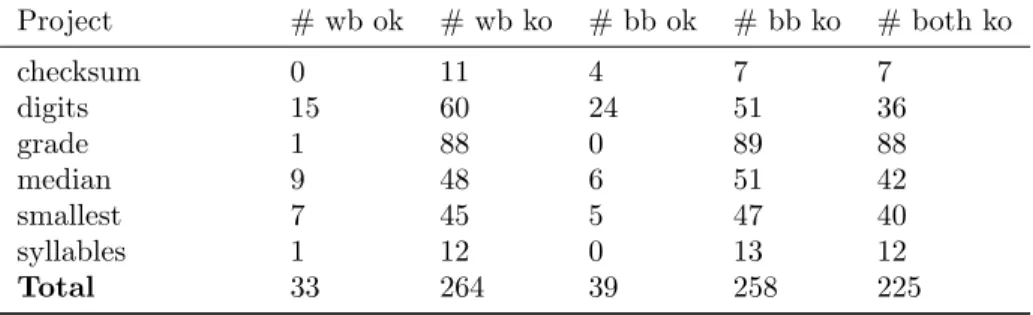
Project # wb ok # wb ko # bb ok # bb ko # both ko checksum 0 11 4 7 7 digits 15 60 24 51 36 grade 1 88 0 89 88 median 9 48 6 51 42 smallest 7 45 5 47 40 syllables 1 12 0 13 12 Total 33 264 39 258 225
Table 2: Full breakdown by project
It first indicates the breakdown according to the subject program. For instance, in “checksum”, there are 11 programs that are failing. It then indicates the breakdown according to the failure type. For instance, there are 33 programs that which only white tests are failing. Table 2 gives the full breakdown by project where ”wb” means whitebox, ”bb” means blackbox, ”ko” means failing and ”ok” means passing.
Comparison with IntroClassIn IntroClass, there are 450 failing programs, it means that the automatic transformation has failed for 450−297 = 153 programs. Either the resulting program was not syntactically correct Java and consequently does not compile, or the transformation has changed the execution behavior. Interestingly, for some programs, the transformation itself repaired the bug (the C program fails on some inputs, but the Java version is correct). This is mostly due to the different behavior of the non-initialized variable in C versus Java. In C, the non-initialized local variables have the value of the allocated memory space and in Java, all primitive types have a default value (e.g. 0 for numbers).
4
Conclusion
We have presented how we have set up IntroClassJava, a benchmark of 297 buggy Java programs. It results from the automated transformation from C to Java of the IntroClass benchmark. This dataset can be used for future research on fault localization and automatic repair on Java programs. The benchmark is publicly available on Github [1].
References
[1] The github repository of introclassjava. https://github.com/ Spirals-Team/IntroClassJava, 2015.
[2] F. DeMarco, J. Xuan, D. L. Berre, and M. Monperrus. Automatic repair of buggy if conditions and missing preconditions with smt. InProceedings of the 6th International Workshop on Constraints in Software Testing, Verifi-cation, and Analysis (CSTVA 2014), 2014.
[3] C. Le Goues, N. Holtschulte, E. K. Smith, Y. Brun, P. Devanbu, S. Forrest, and W. Weimer. The manybugs and introclass benchmarks for automated repair of c programs. IEEE Transactions on Software Engineering (TSE), in press, 2015.
[4] J. I. Maletic, M. L. Collard, and A. Marcus. Source code files as structured documents. InProceedings of the 10th International Workshop on Program Comprehension (IWPC), 2002.
[5] M. Monperrus. A critical review of ”automatic patch generation learned from human-written patches”: Essay on the problem statement and the evaluation of automatic software repair. InProceedings of the International Conference on Software Engineering, pages 234–242, 2014.