C H A P T E R
NINE
CCMP FINANCING
OBJECTIVES
1) At a minimum, continue to fund Federal, State, County, and local programs at current levels.
2) Aggressively seek additional public and private funds.
MEASURABLE GOALS
The PEP’s measurable goals with respect to financing are:
• Effectively use existing funding and secure new or additional governmental funding for CCMP implementation from the following sources:
- Federal Government, particularly the U.S. Department of Agriculture;
- State Government, particularly the Clean Water/Clean Air Bond Act and State Revolving Loan Fund;
- County Government, particularly the Suffolk County ¼% Sales Tax Program; - Town Governments; and,
- Village Governments.
(as measured by the Peconic Estuary Program Office). [See Actions F-2, F-3]
• Secure new or additional private sector funding for CCMP implementation, from the following sources:
- Businesses; and,
- Not for profit organizations.
INTRODUCTION
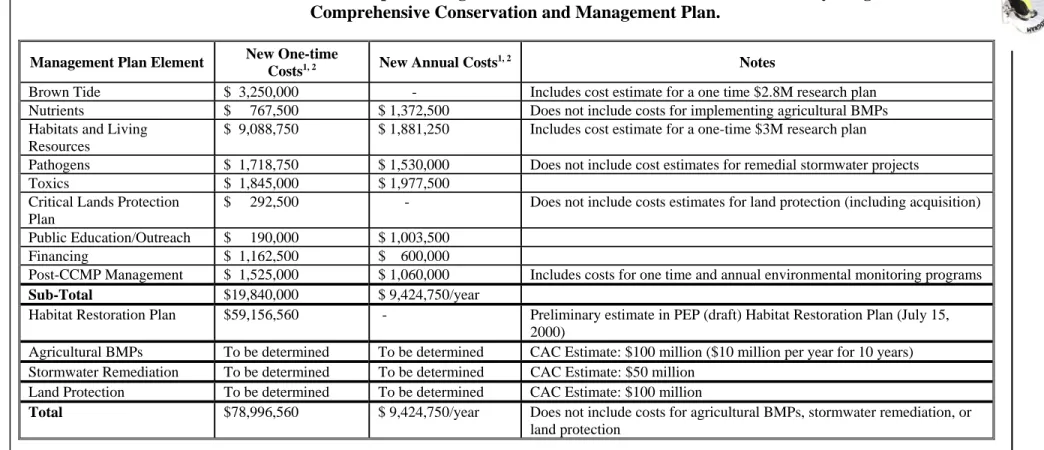
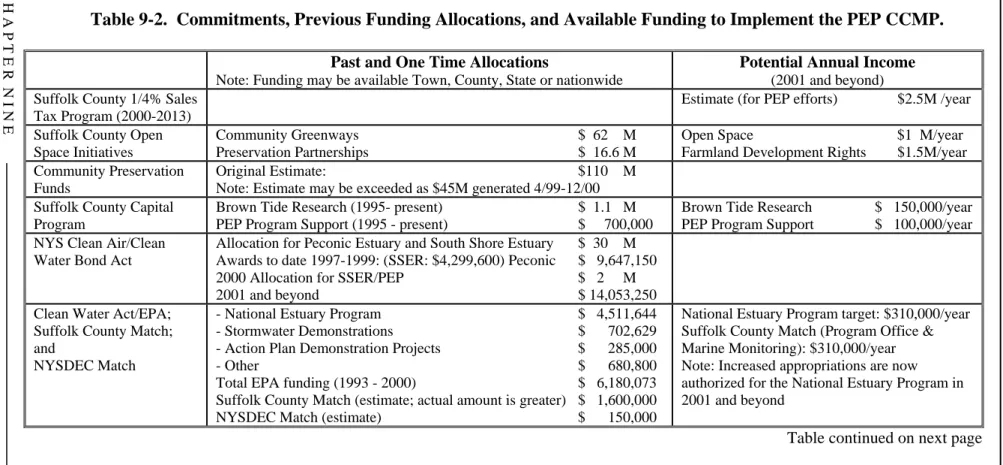
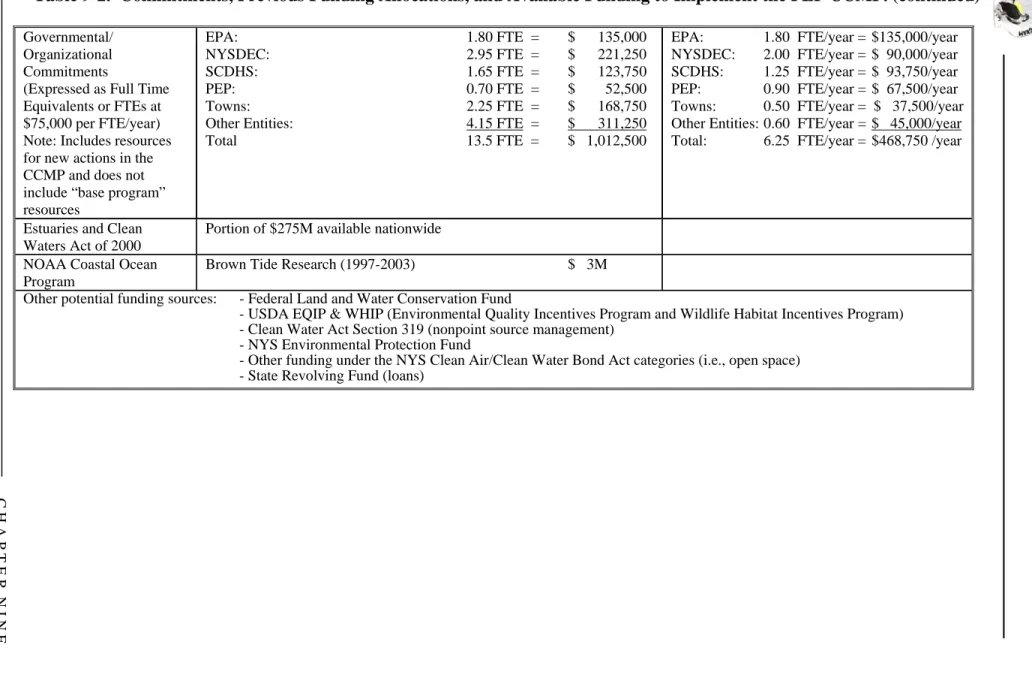
This Management Plan contains both committed and recommended actions for the protection and restoration of the Peconic Estuary System. These actions and this Plan have been created as part of the characterization and planning phases of the PEP. Funding for the planning process has been provided by the National Estuary Program under Section 320 of the Clean Water Act. Upon CCMP approval, the PEP will begin implementation of the Management Plan and its actions. Funding for the continued operation of the PEP and for the implementation of each action in the Plan will need to be secured. The estimated cost of plan implementation is shown in Table 9-1. Commitments, previous funding allocations, and available funding to implement the PEP CCMP are shown in Table 9-2.
It is anticipated that a wide variety of funding sources will need to be secured to ensure full implementation of the CCMP. Securing this funding is a responsibility of the Peconic Estuary
Program. Without a comprehensive strategy for funding the implementation of all aspects of the plan, the PEP runs the risk of not fully achieving its goal of becoming a guide to managing water quality, living resources, and habitats of the Peconic Estuary. The ability of the PEP to achieve its goals and objectives, and the pace at which progress is made, will clearly be a function of the availability of funding. The PEP will continue to use, where possible, cutting edge resource valuation techniques to guide decision-making and implement this Plan.
MANAGEMENT STRATEGY
The PEP supports implementation through a combination of existing resources and additional funds, including donations for project implementation and program enhancement. Early work on the financing strategy has identified four major categories of funding that are known to be available or that will be pursued: NEP Dedicated Funds, the NY State Clean Water/Clean Air Bond Act, Base Program Funding/Services, and Additional Funding Sources. Each of these categories is discussed below.
NEP Dedicated Funds
Although the EPA provided funds under the Clean Water Act for the development of the CCMP, Congress has not dedicated any long-term funding to the implementation of CCMPs. EPA’s intent is generally to provide post-CCMP funding to each National Estuary Program, contingent upon
sufficient annual funding and adequate progress in implementing actions described in annual workplans. In Federal fiscal years 1998-2001, it is estimated that the PEP will receive $300,000 per year in National Estuary Program funds, subject to availability of funds in EPA appropriations. An annual workplan required to receive these funds will be developed by the Management Conference (or its successor) and submitted to EPA for approval. These funds are designated for demonstration of CCMP actions and require a 50 percent non-Federal match. Priorities for the use of these funds include support of the PEP program office (or its successor), State and County staff support, and education/outreach actions. Beyond the first four years of post-CCMP status, continued National Estuary Program funding is dependent on the results of an EPA conducted Implementation Review. The purpose of the Implementation Review is to perform a comprehensive review of the PEP’s
C H A P T E R N I N E 9-4 P econic Estuar y Progr a m CC MP
Table 9-1. Cost Estimates for Implementing Recommended
1Actions in the Peconic Estuary Program
Comprehensive Conservation and Management Plan.
Management Plan Element New One-time
Costs1, 2 New Annual Costs
1, 2
Notes
Brown Tide $ 3,250,000 - Includes cost estimate for a one time $2.8M research plan Nutrients $ 767,500 $ 1,372,500 Does not include costs for implementing agricultural BMPs Habitats and Living
Resources
$ 9,088,750 $ 1,881,250 Includes cost estimate for a one-time $3M research plan Pathogens $ 1,718,750 $ 1,530,000 Does not include cost estimates for remedial stormwater projects Toxics $ 1,845,000 $ 1,977,500
Critical Lands Protection Plan
$ 292,500 - Does not include costs estimates for land protection (including acquisition) Public Education/Outreach $ 190,000 $ 1,003,500
Financing $ 1,162,500 $ 600,000
Post-CCMP Management $ 1,525,000 $ 1,060,000 Includes costs for one time and annual environmental monitoring programs
Sub-Total $19,840,000 $ 9,424,750/year
Habitat Restoration Plan $59,156,560 - Preliminary estimate in PEP (draft) Habitat Restoration Plan (July 15, 2000)
Agricultural BMPs To be determined To be determined CAC Estimate: $100 million ($10 million per year for 10 years) Stormwater Remediation To be determined To be determined CAC Estimate: $50 million
Land Protection To be determined To be determined CAC Estimate: $100 million
Total $78,996,560 $ 9,424,750/year Does not include costs for agricultural BMPs, stormwater remediation, or
land protection
1
These estimates do not include costs for actions already funded or underway or for which governmental or non-governmental commitments have been secured.
2
C H A P T E R N I N E 9 -5 Peconic Estuar y Progr a m CC M P
Table 9-2. Commitments, Previous Funding Allocations, and Available Funding to Implement the PEP CCMP.
Past and One Time Allocations
Note: Funding may be available Town, County, State or nationwide
Potential Annual Income
(2001 and beyond) Suffolk County 1/4% Sales
Tax Program (2000-2013)
Estimate (for PEP efforts) $2.5M /year Suffolk County Open
Space Initiatives
Community Greenways $ 62 M Preservation Partnerships $ 16.6 M
Open Space $1 M/year Farmland Development Rights $1.5M/year Community Preservation
Funds
Original Estimate: $110 M Note: Estimate may be exceeded as $45M generated 4/99-12/00 Suffolk County Capital
Program
Brown Tide Research (1995- present) $ 1.1 M PEP Program Support (1995 - present) $ 700,000
Brown Tide Research $ 150,000/year PEP Program Support $ 100,000/year NYS Clean Air/Clean
Water Bond Act
Allocation for Peconic Estuary and South Shore Estuary $ 30 M Awards to date 1997-1999: (SSER: $4,299,600) Peconic $ 9,647,150 2000 Allocation for SSER/PEP $ 2 M 2001 and beyond $ 14,053,250 Clean Water Act/EPA;
Suffolk County Match; and
NYSDEC Match
- National Estuary Program $ 4,511,644 - Stormwater Demonstrations $ 702,629 - Action Plan Demonstration Projects $ 285,000 - Other $ 680,800 Total EPA funding (1993 - 2000) $ 6,180,073 Suffolk County Match (estimate; actual amount is greater) $ 1,600,000 NYSDEC Match (estimate) $ 150,000
National Estuary Program target: $310,000/year Suffolk County Match (Program Office & Marine Monitoring): $310,000/year Note: Increased appropriations are now authorized for the National Estuary Program in 2001 and beyond
C H A P T E R N I N E 9-6 P econic Estuar y Progr a m CC MP
Table 9-2. Commitments, Previous Funding Allocations, and Available Funding to Implement the PEP CCMP. (continued)
Governmental/ Organizational Commitments
(Expressed as Full Time Equivalents or FTEs at $75,000 per FTE/year) Note: Includes resources for new actions in the CCMP and does not include “base program” resources EPA: 1.80 FTE = $ 135,000 NYSDEC: 2.95 FTE = $ 221,250 SCDHS: 1.65 FTE = $ 123,750 PEP: 0.70 FTE = $ 52,500 Towns: 2.25 FTE = $ 168,750 Other Entities: 4.15 FTE = $ 311,250 Total 13.5 FTE = $ 1,012,500
EPA: 1.80 FTE/year = $135,000/year NYSDEC: 2.00 FTE/year = $ 90,000/year SCDHS: 1.25 FTE/year = $ 93,750/year PEP: 0.90 FTE/year = $ 67,500/year Towns: 0.50 FTE/year = $ 37,500/year Other Entities: 0.60 FTE/year = $ 45,000/year Total: 6.25 FTE/year = $468,750 /year
Estuaries and Clean Waters Act of 2000
Portion of $275M available nationwide NOAA Coastal Ocean
Program
Brown Tide Research (1997-2003) $ 3M Other potential funding sources: - Federal Land and Water Conservation Fund
- USDA EQIP & WHIP (Environmental Quality Incentives Program and Wildlife Habitat Incentives Program) - Clean Water Act Section 319 (nonpoint source management)
- NYS Environmental Protection Fund
- Other funding under the NYS Clean Air/Clean Water Bond Act categories (i.e., open space) - State Revolving Fund (loans)
New York State Clean Water/Clean Air Bond Act
In November 1996, New Yorkers proclaimed their commitment to a clean environment by approving the $1.75 billion Clean Water/Clean Air Bond Act.
Five types of projects may qualify for funding under the Bond Act:
• Clean Water- $790 million;
• Safe Drinking Water- $355 million;
• Solid Waste- $175 million;
• Municipal Environment Restoration (Brownfields)- $200 million; and
• Air Quality-$230 million.
With passage of the 1996 Clean Water/Clean Air Bond Act, tremendous opportunities are available to restore, preserve, and protect the State’s valuable environmental resources. Section 56-0303 of Title 3 of the Bond Act provides $495 million to municipalities and soil and water conservation districts for water quality improvement projects. This includes $30 million for water quality improvement projects identified by the Comprehensive Conservation and Management Plans of the Peconic Estuary and the South Shore Estuary Reserve. No decision has been made at this time regarding the allocation of the $30 million between the two areas. Guidance from New York State has limited eligibility for Peconic Estuary projects to:
• Water quality improvement projects which address elimination of raw sewage, failing individual septic systems, and advanced wastewater treatment (beyond secondary);
• Nonpoint source pollution abatement and control projects; and,
• Aquatic habitat restoration.
$295 million is available statewide for other clean water projects that are applicable in the Peconic Estuary, including open space acquisition and programs to help small businesses protect the environment. Eligible applicants for Bond Act funds are municipalities and soil and water conservation districts. In the case of aquatic habitat restoration projects, the term municipality includes the State itself.
In determining eligibility and evaluating applications, the State has noted that due consideration will be given to:
• The suitability and feasibility of the project in relation to the goals of the respective management program, plan, or project;
• The priority of the project in relationship to other projects proposed under the same program or plan. Highest priority shall be given to projects that provide the greatest reduction in pollutants or most significant habitat improvement and are identified as priorities in the respective management program, plan, or project;
State assistance payments from the Bond Act will vary, depending on the type of project. For example, State assistance payments will fund: 1) up to 85 percent of the cost of the project for wastewater treatment improvement projects; 2) 50 percent of the cost of aquatic habitat projects; 3) 50 percent of the cost of pollution prevention projects; and 4) 50 percent of the cost for
nonagricultural nonpoint source abatement projects. For agricultural nonpoint source abatement projects, up to 75 percent of the project costs may be granted with no landowner or operator
contribution, or up to 90 percent with such a contribution. Project costs incurred after November 5, 1996 are eligible for consideration.
While the Bond Act funding for the Peconic Estuary is substantial, it is not likely to be sufficient to meet all needs, and there are limitations on the use of funds (i.e., private individuals or organizations cannot receive Bond Act funds; research activities are ineligible). Therefore, while it will provide much needed funding for many important projects, additional funding will still need to be identified and secured.
Base Program Funding
It is anticipated that a great many of the actions in this Plan can be implemented through the efforts and resources of existing programs. The costs for these actions are described in this Management Plan as “base program.” This term is used to refer to actions that can be funded within the existing programmatic support of the implementing entity. In many cases, these actions are ongoing elements of existing agency workplans; in other cases the actions can be accomplished by refocusing agency activities without identifying additional funding. The PEP has not estimated costs for individual base program actions since these actions are accomplished within existing programs and workplans. This CCMP includes numerous commitments on behalf of EPA, NYSDEC, SCDHS, other Federal, State and County agencies, local governments, and other implementing entities to continue the
implementation of ongoing programs. These commitments assume that base programs continue to be funded, at a minimum, at current levels.
Additional Funding Sources
Actions that do not fit within the scope of ongoing programs and existing agency efforts will require additional funding or resources. The Peconic Estuary Program will establish a Finance Work Group to develop a financing strategy and seek funding to carry out these recommended actions during the implementation process. In particular, special efforts may be needed to obtain funding for education, outreach, and participation efforts, as relatively little government agency funding seems to be
available for those sorts of actions.
Because of the significant role local governments bear in implementing many of the actions in this Plan, local governments will play a key role in identifying and securing additional funding sources. In all cases, the PEP will continue to consider the ability of local governments to pay for projects prior to their implementation. In addition, the PEP and participating agencies will:
• Ensure that local governments are actively involved in the Management Conference and are aware of CCMP actions that may impact them;
• Actively work with local governments to ensure their understanding and gain their support for the environmental benefits of proposed projects;
• Continue to develop cost estimates for project implementation and refine and update cost estimates as necessary;
• Actively work with local governments to identify funding sources; and,
• Foster the development of low-cost approaches to address environmental problems and implement such approaches whenever possible (for example, encouraging
non-structural, low tech, and low maintenance means to reduce runoff and pollutant inputs).
Action Costs
Information in the cost column of the management action tables in the back of each chapter represents the Peconic Estuary Program’s best estimate of the costs associated with each action implementation. “Base Program” means that no new or additional funds will be needed outside of the responsible entity’s operating budget to implement the action. Where practicable, the Peconic Estuary Program has made estimates of the costs of base programs, either in terms of dollars or work years. Where this Plan recommends or commits to new, expanded, or enhanced efforts beyond those tasks that may be described as base programs, the Peconic Estuary Program has attempted to quantify the necessary resources to carry out the new, expanded, or enhanced work.
Resources were expressed as a dollar amount, typically for projects suitable for contracting out, or as “work years” or full time equivalent” employees (or “FTEs”) for work that is most likely to be carried out by governmental staff. Some activities require both contracting dollars and FTEs. Resource needs expressed as FTEs are usually estimated to the nearest one-tenth of a work year (i.e., approximately one month or 20 work days). For some of the smaller tasks that are likely to be undertaken with other separate but related tasks, the FTE estimates may be combined, and this is indicated in the table. For estimating the overall cost of implementing this Plan, the Program will use an estimate of $75,000 per FTE per year, which includes salary, fringe benefits, and indirect costs. The actual cost of a full time worker may be more or less than this amount and will likely vary by agency, complexity of task, and point in time at which work is initiated.
Carrying out some tasks requires an annual and ongoing investment of resources. Other tasks have been expressed as one-time investments. This distinction is made for each action in the Plan, and is also reflected in the total cost of implementing the Plan.
For programmatic resource allocation analysis, a significant effort has been made to quantify time commitments for actions involving PEP sponsoring agencies (EPA, NYSDEC, or SCDHS). For such actions, a commitment has been indicated and resource needs have been estimated. Carrying out these actions forms the core workplan for the PEP coordinators from the sponsoring agencies and the PEP office staff.
In many cases, the Peconic Estuary Program was unable to quantify resources (either in dollar amount or in work years) associated with these base programs. This is because elements related to
recommendations and actions are frequently inextricably linked to regional management initiatives targeted at areas larger than the PEP watershed, making segregation of PEP resources exceedingly difficult or impossible (e.g., coastal zone management programs for all of Long Island; endangered species management, etc.). Also, recommendations and actions are often intertwined in larger and/or related programs, making their individual cost isolation impractical (e.g., staff working on wetland mapping and trends analysis also work on numerous other natural resource efforts, such as permitting and enforcement as well). Finally, parties responsible for implementing actions use diverse and often
Not all resource needs have been estimated at this point in time, and the costs of some activities will be subject to further refinement in the future. Many costs have not been estimated for the private sector, because the planning processes have not developed actions specific enough to do so (e.g., septic tank management recommendations, since recommended pump-out intervals have not yet been specified and upgrade incentive programs have not been fully agreed upon). The PEP will attempt to estimate these costs in the future as needed and will attempt to identify funding for compliance assistance where possible.
MANAGEMENT ACTIONS
The remainder of this chapter presents proposed actions for securing funding sources for CCMP implementation. These actions address each of the four major categories of funding discussed above: NEP Dedicated Funds, the NY State Clean Water/Clean Air Bond Act, Base Program
Funding/Services, and Additional Funding Sources.
Within the CCMP, some steps within the actions have been identified as priorities, as indicated under the step number. The PEP will seek to implement priority actions in the near term. Priorities may be either new or ongoing, commitments or recommendations. Completing some priority actions does not require any new or additional resources, because they are being undertaken through "base programs" or with funding that has been committed. In other cases, in order to complete the priority actions, new or additional resources need to be secured by some or all of the responsible entities.
CCMP FINANCING MANAGEMENT ACTIONS
F-1. Establish a Finance Work Group to Formulate/Refine Financing Options.
F-2. Effectively use NEP Funding, the NYS Bond Act Funding, the Suffolk County ¼% Sales Tax Program, and Base Programs to Implement the CCMP.
F-3. Explore Options for Federal, State, and County Funding. F-4. Encourage Non-Profit Organizations to Administer Funding for
Estuary Protection Efforts.
F-5. Fund Actions under the State Revolving Loan Fund. F-6. Use Municipal Bonds for Project Financing.
F-7. Identify and Obtain Sources of Private Sector Funding. F-8. Utilize Funds from Fines and Settlements.
F-9. Utilize Tax Abatements and Other Tax Incentives to Encourage Conservation Projects and Environmental Improvements. F-10. Establish Municipal Improvement Districts to Pay for Qualified
Projects.
F-11. Identify Sources of Funding for Land Preservation and Acquisition. F-12. Encourage Citizen Initiated Environmental Legislation.
F-13 Investigate the Feasibility of Establishing Selective Sales Fees to Fund Environmental Management Programs.
F-1
Establish a Finance Work Group to Formulate/Refine Financing Options.
Addresses Financing Objectives 1, 2 and 3.
A financing work group should be formed to assist in the further refinement of financing options to implement the CCMP.
Steps
F-1.1 Establish a finance workgroup to formulate/refine financing options Priority
Responsible Entities
F-2
Effectively Use NEP Funding, the NYS Bond Act, the Suffolk County ¼%
Sales Tax Program, and Base Programs to Implement the CCMP.
Addresses Financing Objective 1.
NEP Dedicated Funds, the NY State Clean Water/Clean Air Bond Act, and Base Program
Funding/Services are major funding sources that have already been identified. Additional funding sources that may be used for CCMP action implementation are described on the pages that follow. The information regarding these and other possible sources will be refined by the Finance Work Group during CCMP implementation.
The sales tax revenues from the Suffolk County ¼% Sales Tax Program, approximately $260 million over 13 years (beginning December 1, 2000), will be used for three distinct categories: open space acquisition ($100 million), farmland easements ($60 million), and water quality improvement projects ($100 million). A portion of the funding for water quality improvement projects will be available for use in the Peconic Estuary for projects including nonpoint source abatement and control, pollution prevention initiatives, and aquatic habitat restoration projects recommended by the PEP.
Steps
F-2.1 Provide post-CCMP funding to implement eligible CCMP actions; strive to obtain additional funding based on the results of EPA conducted Implementation Reviews. F-2.2 Ensure that funding reserved for the PEP in the New York State Clean Air/Clean Water
Bond Act is used effectively for the highest priority eligible projects.
F-2.3 Effectively use funding for PEP recommended projects from the Suffolk County ¼% Priority Sales Tax Program.
F-2.4 Utilize existing base program funding from Federal, State, County, and local government programs to implement actions as appropriate; ensure that funding for these agencies remains, at a minimum, at current levels.
Responsible Entities
F-2.1 EPA (lead), PEP F-2.2 NYSDEC (lead), PEP F-2.3 Suffolk County (lead), PEPF-2.4 EPA, NYSDEC, SCDHS, other Federal, State, and county agencies, and local governments (co-leads)
F-3
Explore Options for Federal, State, and County Funding.
Addresses Financing Objective 2.
A number of Federal statutes and programs provide grants or matching funds for projects related to conservation planning and management, including the Clean Water Act, Coastal Zone Management Act, Clean Vessel Act, Intermodal Surface Transportation Efficiency Act, and others under EPA, NOAA, USFWS, and NYSDOT.
There are numerous provisions in the Federal Clean Water Act that can provide funding for CCMP actions, such as the Nonpoint Source (NPS) Management Program under Section 319 and the Water Quality Management Planning (WQMP) Program under Section 604(b). Opportunities exist when the State carries out these and other Federally funded programs, and through other State programs, including those under the Environmental Protection Fund. There are also provisions which have established and capitalized the State Revolving Fund program, funds from which can be used to carry out CCMPs. Candidate funding sources exist in other Federal and State statutes and agencies. Two USDA programs, the Environmental Quality Incentives Program (EQIP) and the Wildlife Habitat Incentives Program (WHIP) are sources of funding and technical assistance for farmers, ranchers, and landowners. EQIP was established to provide a single voluntary conservation program for farmers and ranchers to address significant natural resource needs and objectives. Nationally, it provides technical, financial, and educational assistance, half of it targeted to livestock-related natural resource concerns and the other half to more general conservation priorities. EQIP is available primarily in priority areas where there are significant natural resource concerns and objectives. Assistance includes: cost sharing at up to 75 percent of costs of certain conservation practices; incentive payments to up to 100 percent for three years; and a maximum payment of $10,000 per person per year and $50,000 over the length of the contract. $3.495 million was available in New York State in 1997; $3.63 million in 1998. The FY99 budget included a 50 percent increase ($100 million nationwide) for EQIP. The majority of these funds have been allocated to upstate projects. Future allocations should include significant allocations to priority projects in the Peconic Watershed. The Wildlife Habitat Incentives Program (WHIP) is a voluntary program for people who want to develop and improve wildlife habitat on private lands. It provides both technical assistance and cost sharing to help establish and improve fish and wildlife habitat. Participants work with USDA’s Natural Resources Conservation Service to prepare a wildlife habitat development plan in consultation with the local conservation district. The plan describes the landowner’s goals for
improving wildlife habitat, includes a list of practices and schedule for installing them, and details the steps necessary to maintain the habitat for the life of the agreement.
Suffolk County is the leading agricultural county in New York State, based upon the value of products produced. Much of this agriculture is concentrated on the East End. Even though the Peconic Estuary supports the largest number and greatest concentration of rare and endangered species in the State, and aside from the fact that East Enders rely exclusively on groundwater for drinking water, to date, neither EQIP nor WHIP funds have been awarded to the Suffolk County Soil and Water Conservation District.
Steps
F-3.1 Support the Clean Water Act reauthorization, including grants to States for continued capitalization of State Revolving Loan Funds.
F-3.2 Advocate 100 percent funding of Clean Water Act Sections 319 and 604(b) by the Federal government and 100 percent funding of the New York Nonpoint Source Management Program through the State Environmental Protection Fund.
F-3.3 Fund CCMP Actionsunder non-CWA statutes, such as the Coastal Zone Management Act, Clean Vessel Act, Intermodal Surface Transportation Efficiency Act, and others. F-3.4 Provide funding under the USDA’s Environmental Quality Incentives Program and
Wildlife Habitat Incentives Program (EQIP/WHIP) for the Suffolk County Soil and Water Conservation District for priority projects consistent with the goals of the PEP. F-3.5 Actively seek government agency funding for program enhancements and projects
mentioned in the CCMP. Develop a list of government funding sources that matches CCMP recommendations with mission/authorities of various government agencies.
Responsible Entities
F-3.1 NYSDEC (lead), PEP CAC F-3.2 NYSDEC, NYSDOS (co-leads)
F-3.3 NOAA, USFWS, NYSDOT (leads) with input from PEP
F-3.4 USDA Natural Resources Conservation Service (lead); Suffolk County Soil and Water Conservation District in cooperation with PEP
F-4 Encourage
Non-Profit
Organizations to Administer Funding for Estuary
Protection Efforts.
Addresses Financing Objective 2.
Funding for proposed CCMP actions need not always be provided by government agencies. There are individuals and corporations interested in making contributions to implement estuary protection, preservation, and restoration efforts. Non-profit organizations under section 501(c)(3) of the Internal Revenue Code are ideally suited to receive such contributions and disburse funds for the purposes of furthering their mission as well as the PEP’s mission. One such fund that can be established and administered by non-profit entities is an “Environmental Improvement Fund.” Private citizens as well as private industry can receive monies from the Environmental Improvement Fund to install improved environmental systems and other environmental improvements that require large capital funding.
The PEP will encourage non-profit organizations to fund appropriate CCMP actions. To accomplish this, the PEP will:
• Identify CCMP actions that may be appropriate for funding by non-profit organizations. (Examples include research studies, environmental monitoring, and educational
programs);
• Identify existing non-profit organizations with missions that overlap with the PEP’s;
• Seek expressions of interest from non-profit organizations to work in partnership with the PEP to identify those actions they can implement; and,
• Work with interested non-profit organizations to develop a coordinated strategy to further mutual goals, including: soliciting private sector funds; funding appropriate CCMP actions; and, including non-profit organization activities in CCMP updates.
Steps
F-4.1 Identify actions suited for funding by profit organizations. Identify existing non-profit organizations with missions that overlap PEP’s and seek expressions of support from them. Work with interested organizations to further mutual goals and solicit private sector funding.
F-4.2 Investigate opportunities for establishing an Environmental Improvement Fund to provide funding for private citizens and industry for funding environmental improvements.
Responsible Entities
F-4.1 PEP (lead)
F-5
Fund Actions under the State Revolving Loan Fund.
Addresses Financing Objective 2.
The Federal Clean Water Act’s State Revolving Loan Fund (SRF) provision was established to provide low interest loans to localities for water pollution control projects. A SRF has been
established by the State within EPA guidelines. The New York State SRF was capitalized initially by a combination of Federal grants and State matching funds with the intent of recycling money back into the SRF as the loans were repaid, making the fund self sufficient over time. Since 1990, New York State has received over $1.6 billion in Federal capitalization grants and provided over $314 million in State matching funds. The State has executed over 590 loans totaling over $4.2 billion to over 250 communities throughout the State.
Funding decisions are made based on the State’s intended use plan (IUP) and priority project list. The SRF was primarily established to provide financing for conventional sewage treatment projects. However, the Clean Water Act and EPA guidance specifically allow the use of the SRF for nonpoint source projects consistent with the State’s Nonpoint Source Management Program, such as structural and vegetative stormwater management controls; sediment and erosion control practices; and certain waterbody and wetland restoration techniques. The Clean Water Act and EPA guidance also
specifically allow the use of the SRF for activities in an approved CCMP that are listed on the State’s IUP, such as land acquisition, habitat enhancement, monitoring and enforcement, education, and training.
The SRF is an important funding source for nonpoint source management and CCMP actions, particularly for capital improvements that have a substantial useful life and for which a strong case can be made that funding is available to repay the debt over time. Examples of CCMP projects for which long term borrowing may be appropriate include activities such as:
• Building sewage treatment facilities;
• Improving or upgrading on-site septic systems;
• Building stormwater management systems;
• Installing nonpoint source pollution controls or equipment; and,
• Building boat pumpout facilities for vessel waste.
The SRF may also be an important mechanism for land acquisition for preserving environmentally sensitive areas and open space. Land acquisition for drinking water source protection is currently eligible under the State SRF. Land acquisition can be through purchase (fee simple) or easement. For eligibility, the land to be acquired must be identified in a plan or report that includes a technical basis for the land acquisition; parcels must be excluded from future sale considerations; and the municipality must agree to protect the land from incompatible uses. Costs related to land acquisition that is eligible for SRF financing may include: cost of purchase (based on fair market value) or easement; property appraisal; survey; site assessment; and title search and other legal fees. Utilizing
The New York State SRF does not presently provide financing to private entities (individuals, businesses, or organizations). This precludes the SRF from directly financing certain environmental improvement or protection measures that may be important to the success of the CCMP. The establishment of special districts (as described elsewhere in this chapter) can provide a vehicle for financing certain specified environmental improvement or protection measures. Constitutional, statutory, or regulatory changes are necessary at the State level to provide funding to private entities. Providing SRF funding to private entities could enhance implementation of some CCMP actions. Most entities may be under the misconception that grants are always a better deal than SRF loans. Most State and local government officials are more familiar with grants, and consequently, many misconceptions exist. In fact, a loan may often be a better deal than a grant for the following reasons:
• Most grant programs require significant cost shares (as much as 50 percent or more). A State Revolving Fund Loan can cover 100 percent of project costs with no cash up front;
• SRF loans provide significant cost savings over the life of a loan. For example, a zero percent SRF loan will cost approximately 50 percent less than the same project financed by a commercial loan at 7.5 percent. Additionally, a zero percent SRF loan is equivalent to receiving a 50 percent grant (where the other 50 percent (match) is financed at market rate); and,
• Financing a project with an SRF loan means fewer Federal requirements than any other Federal grant. The SRF program is experienced in helping applicants through the loan application process and providing extensive technical assistance.
Steps
F-5.1 This CCMP includes both specific and general management actions aimed at preserving, protecting and restoring water quality, living resources, and habitats to ensure their eligibility for SRF financing. Ensure that CCMP projects are included on the State’s priority list and intended use plan. Identify priority nonpoint source projects and ensure that they are included on the State’s priority list and intended use plan.
F-5.2 Educate municipalities and other potential recipients on the possible benefits of SRF loans.
F-5.3 Make necessary constitutional, statutory, or regulatory changes necessary at the State level to provide SRF funding to private entities
Responsible Entities
F-5.1 NYSDEC (lead), NYS Environmental Facilities Corporation (EFC), PEP, Towns and Villages
F-5.2 PEP, NYS Environmental Facilities Corporation (co-leads) F-5.3 NYS Legislature, NYSDEC, EFC
F-6
Use Municipal Bonds for Project Financing.
Addresses Financing Objective 2.
If the SRF cannot be accessed, CCMP implementors may look to traditional municipal finance markets to fund capital projects. The substantial advantage of municipal bonds is that there is a lower effective interest rate than if the funds were borrowed directly by corporations or individuals to finance environmental projects. The capital requirements must meet the minimum threshold size for cost effective underwriting. The minimum recommended size for a bond issue is typically no less than one million dollars. While technically feasible to issue bonds with a smaller total issue size, the cost of issuing may be prohibitive.
Consolidating capital requirements is a general approach that integrates the financing needs of numerous localities to achieve economies of scale during the financing process. Approaches for consolidating municipal debt include:
• Creating special multi-jurisdictional districts;
• Using State bond banks/State financial agencies; and,
• Pooling bonds from multiple localities in a joint issue.
The fundamental advantage of these methods is that they allow individual municipalities more efficient access to capital. Consolidating debt is a logical approach to implementing CCMP actions where several municipalities must take similar actions to address a particular problem.
Steps
F-6.1 Consider traditional municipal finance markets to fund capital projects where appropriate.
Responsible Entities:
F-7
Identify and Obtain Sources of Private Sector Funding.
Addresses Financing Objective 2.
Some of the capital required to implement CCMP initiatives may be obtained either directly or indirectly from private sources. This approach is particularly effective in funding initiatives that are below the minimum threshold size for a viable municipal debt offering as well as for those projects for which funds are not available through traditional financing mechanisms. Using private capital has a number of advantages: it does not encumber the tax base of local and regional governments or constrain future borrowing; it links some of the contributors to estuary or watershed pollution with the costs of mitigating impacts; and it has the potential to create commercial opportunities for the private sector.
Developer Financing: Developer financing consists of securing funds to finance either mitigation or environmental protection activities from land developers. It is generally secured around impact fees, capacity credits, and negotiated extractions.
Impact fees are an assessment on real estate development activities to fund additional infrastructure capacity. Intended to compensate for additional demands placed on existing services by new development, they are most applicable to capital improvements directly related to needs such as traditional sewage treatment and stormwater management. Typically a fee (usually on the order of a few thousand dollars for each residential unit) is charged to the developer; the sum of the
accumulated impact fees provide a capital fund which may be used to finance any number of projects, although they are most commonly used to expand municipal infrastructure, such as sewage treatment facilities and stormwater management measures.
Capacity credits are essentially prepaid impact fees. They permit developers to protect the viability of a future development project by “reserving” an increment of capacity in a new or expanded facility. Although voluntary, developers often choose to pay them in order to ensure their ability to undertake development in the future.
Negotiated extractions, a type of impact fee, are assessments established on a case-by-case basis. They are most appropriate for large development projects, particularly commercial or industrial ventures. Negotiated extractions are considerably more complex to administer than impact fees, but they ultimately provide more flexibility.
Privatization: Privatization refers to the use of private firms to build and operate facilities, such as sewage treatment plants, or to provide services such as environmental inspections. Capital for financing the necessary investment is provided by the private firm, which then operates the project as a commercial venture. Privatization may be an effective approach for small-scale capital projects that can be tied to a revenue stream for a private operator. An example would be procuring vehicles and equipment for septic system maintenance. In this instance, a private operator provides the necessary capital items, the revenue streams to finance the investment are provided by commercial and
residential owners of septic systems, and incentives in the form of requirements to maintain septic systems facilitate private investment by ensuring a need for the services.
This approach depends on the availability of one or more firms that are able and willing to make the necessary investment in meaningful projects. Potential revenues or benefits from this approach may not be predictable or consistent.
Opportunities for firms to publicize their achievements can encourage voluntary donations of capital. For example, donated equipment or facilities could identify the provider, special plaques or citations could commemorate a donation, and local officials could participate in dedication ceremonies. Candidate firms include those who have a stake in potential regulation or who are otherwise interested in environmental protection. While it is important to ensure that projects are consistent with CCMP or watershed goals, industry-sponsored initiatives can be particularly attractive for small scale projects where the capital requirements are below the threshold for cost effective municipal debt financing.
Leasing: Leasing can be used to obtain capital equipment, facilities, or property, or in overcoming a funding shortfall. Examples include leasing oil spill containment equipment or vehicles and
equipment used for nonpoint source abatement or wetlands restoration. Mechanisms for leasing arrangements are generally available through standard local government procurement. While leasing does not circumvent the need for revenues to cover the carrying cost of the leased item, it does potentially allow a capital item to be procured in a more timely fashion. Assessments of the financial reasonableness of the lease include comparisons of the annual lease fee with the equivalent annual cost of buying equipment and should be based on estimates of useful life, residual value, and the cost of capital.
Steps
F-7.1 Collect and use developer fees from firms undertaking land development to finance mitigation and environmental protection activities.
F-7.2 Identify and promote opportunities for private firms to build and operate facilities and to provide services.
F-7.3 Identify and promote opportunities for voluntary, industry-sponsored initiatives. F-7.4 Utilize leasing arrangements, where appropriate, for small-scale capital purchases or
equipment or in overcoming a funding shortfall.
Responsible Entities
F-7.1 Towns, villages (leads)
F-7.2 PEP (lead), town and local governments, PEP, private entities
F-7.3 PEP (lead), PEP CAC, private entities, industry groups and trade associations, PEP, local governments
F-8
Utilize Funds from Fines and Settlements.
Addresses Financing Objective 3.
Occasionally, sufficient funds become available through fines, negotiated settlements, or jury awards to fund significant capital improvement programs. Although these are essentially unpredictable sources, it can be useful to establish a process for securing, using, and perhaps sustaining these funds when appropriate occasions arise. For example, an existing entity such as an environmental trust can be designated as the recipient for various punitive or restitution payments flowing to the State or local governments. Some Federal statutes, such as the Oil Pollution Act and the Comprehensive
Environmental Response, Compensation and Liability Act (CERCLA), provide that penalties for damages to natural resources be shared with State or local trustees to implement restoration activities. Where such opportunities present themselves, the results can be particularly attractive. Major cases may produce substantial revenue, and public acceptability is high based on the “polluter pays” principle. Projects funded through these means offer a vehicle to turn penalties and fines to positive purposes. Disadvantages of this source of funding are its uncertainty and vulnerability to competition for other uses.
The PEP should identify an appropriate legal entity with established administrative procedures for using funds, including clearly defined objectives, project eligibility and selection criteria, and fund recipient eligibility. A list of priority projects or funding needs to which proceeds can immediately be applied should be maintained. The need for establishing legislation to establish an endowment, including an assessment of the specific legal procedures in the State for distributing funds from penalties or litigation, should be further investigated.
Steps
F-8.1 Establish a program to utilize funds from fines, negotiated settlements, or jury awards for CCMP actions, should they become available.
Responsible Entities
F-9
Utilize Tax Abatements and Other Tax Incentives to Encourage
Conservation Projects and Environmental Improvements.
Addresses Financing Objective 3.
A variety of tax incentives can be used to encourage property owners to undertake improvement projects that benefit the environment, including real property tax abatements, income tax deductions, and real property tax reductions.
Real Property Tax Abatements: Real property tax abatements could be effectively used to support qualified environmental projects, such as replacement of underground gasoline and home heating oil tanks, septic system upgrades, commercial/residential stormwater abatement projects, certain environmental improvements at marinas, restoration of wetland buffers, re-establishment of native vegetation, and the removal of hardened shoreline structures. The Real Property Tax Law (RPTL) will need to be amended to enable towns to grant these real property tax abatements.
The real property tax law requires that all real property in the State be taxed unless exempt from State law. While the State law lists numerous exemptions to promote certain public policy objectives, the environmental protection and improvement measures mentioned above are not listed. The Municipal Home Rule Law prohibits towns from superseding a “State statute relating to...creation or alteration of areas of taxation.” Therefore, specific State legislation is necessary to enable towns to give tax relief to those who undertake qualified environmental projects.
Specifically, Section 487-a of the RPTL should be amended to include the conservation methods mentioned above, or a new section could be added specifically listing these exemptions from taxation of improvements which aid in environmental protection. Towns willing to implement this tax abatement would need to do so pursuant to a locally adopted plan outlining the condition needing remediation, the extent of the problem, the incentive to the recipient, and the impact on the tax base. Towns can establish programs to be limited and targeted to specific needs, with sunset provisions and other limits so as not to create unpredictable and unforeseen administrative complications and
unnecessary negative fiscal impacts to the tax base.
Environmental Improvement Income Tax Deduction: Revisions to the New York Tax Law can encourage certain qualified environmental protection measures by providing for interest deductions for these measures and permitting lending institutions to be exempted from earned income for loans for these projects. Tax credits (similar to those currently provided for solar and wind energy systems) could encourage replacement of underground gasoline and home heating oil tanks, upgrading of septic systems, commercial/residential stormwater abatement projects, certain environmental
improvements at marinas, restoration of wetland buffers, reestablishment of native vegetation, and the removal of hardened shoreline structures. Further, interest income earned by lending institutions is factored in to compute net income and thus is taxable in New York State. Lending institutions that receive interest income from municipalities are exempt from State tax, which provides for lower municipal interest rates. This action envisions banks developing environmental improvement loan portfolios with exemptions similar to those afforded municipalities whose interest payments are exempt from State taxation. This would enable businesses and residents to make environmental improvements to their property at less than prevailing market interest rates.
Homeowner Associations: Homeowner associations typically control the open lands created by reserved areas resulting from a subdivision. Regulations for the reserved area are typically written by the developer for the association; most regulations are without regard for the resource that constitutes the reserved area, be it farmland, woodlands, wetlands or dunes. Homeowner association land should be afforded an additional real property tax reduction if the reserved area conforms to a management plan for the reserved area. For example, agricultural reserves that are not farmed in accordance with a management plan would be taxed at a higher rate than those that are.
Steps
F-9.1 Amend the Real Property Tax Law (RPTL) to enable towns to grant real property tax abatements for qualified environmental protection measures.
F-9.2 Amend the New York State Tax Law to provide for deductions for certain qualified environmental protection measures and to exempt lending institutions from taxes on earned income for loans for these projects.
F-9.3 Identify the necessary mechanisms and feasibility providing for real property tax reductions for homeowner associations whose lands are managed in accordance with a management plan (i.e., amendments to the Real Property Tax Law).
Responsible Entities
F-9.1 State Legislature (lead), Towns, PEP (for coordination) F-9.2 State Legislature (lead), Towns, PEP (for coordination) F-9.3 Local governments, PEP (lead)
F-10 Establish Municipal Improvement Districts to Pay for Qualified Projects.
Addresses Financing Objective 3.
Municipalities can establish improvement districts (such as sewer, drainage, water, water quality treatment, water supply, harbor improvement, and others) and provide improvements or services wholly at the expense of the district. Such districts and the properties within the districts would receive the benefit of municipal finance rates, favorable terms to pay for certain improvements, and municipal requests for proposals to undertake certain improvements. Qualified improvements could include: replacement of underground gasoline and home heating oil tanks, septic system upgrades, commercial/residential stormwater abatement projects, certain environmental improvements at marinas, restoration of wetland buffers, reestablishment of native vegetation, and the removal of hardened shoreline structures. Town-wide septic system and fuel oil tank districts might be desirable, but State law may need to be amended to allow such districts. Instead of creating new districts, it may also be possible to amend existing districts to achieve the same ends. While the existing legislation for Wastewater Disposal Districts makes reference to “on-site wastewater disposal systems,” it is unclear if this provision pertains to private septic systems or simply to collection districts for the purpose of transporting sewage to treatment plants. This section could be amended or clarified to provide for private on-site septic system improvements.
Steps
F-10.1 Establish appropriate improvement districts (or amend existing districts) to encourage the adoption of certain qualified environmental improvements.
F-10.2 Amend the State Town Law to allow the establishment of town wide septic systems and fuel oil tank districts to encourage environmental improvements. Also, the existing legislation for Wastewater Disposal Districts should be amended or clarified to provide for private on-site septic system improvements.
Responsible Entities
F-10.1 Towns, PEP
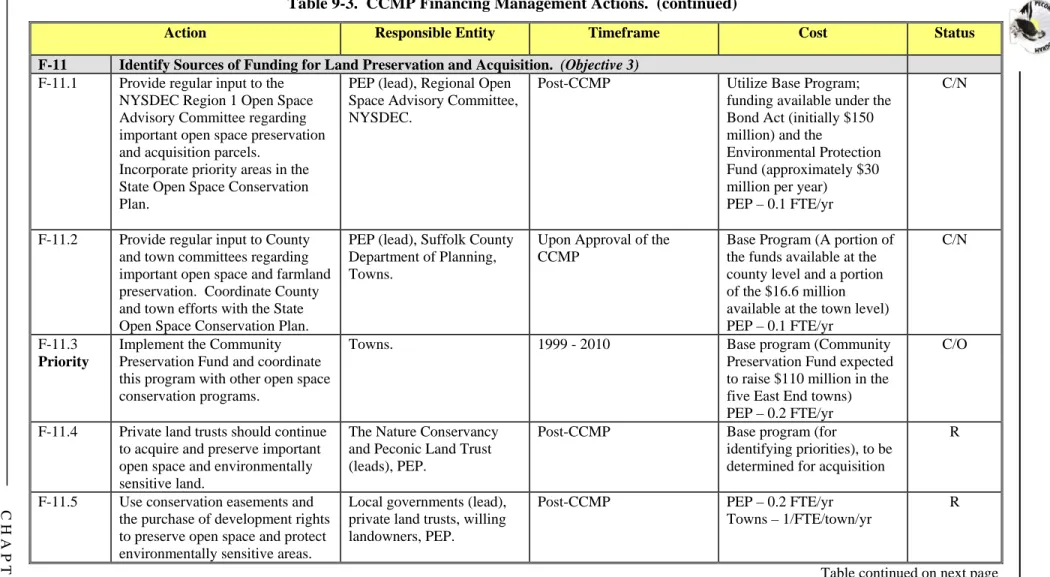
F-11 Identify Sources of Funding for Land Preservation and Acquisition.
Addresses Financing Objective 3.
Open space preservation through conservation planning, land acquisition, or the use of easements can be used to protect important habitats of rare or endangered species and can have social,
environmental, and economic benefits. Open space planning involves identifying and saving what is most important or most valued in a community or region while still accommodating desirable or sustainable growth. The environmental benefits of open space preservation are discussed in other chapters of this CCMP.
Community Preservation Fund: The Community Preservation Fund establishesa two percent real estate transfer tax to support farmland and open space conservation in the five East End towns. It is estimated that this tax will raise $110 million over 10 years. Elements of the program include:
• Exemption of up to $250,000 on improved property (to ameliorate concerns regarding affordable housing);
• A sunset provision in which the tax would expire in the year 2010;
• Creation of an advisory committee to identify lands to be preserved and oversee implementation;
• An agricultural land exemption;
• The tax is subject to mandatory referendum before any East End town can levy the tax;
• The buyer pays the tax;
• Money raised in a town stays in the town in which the tax is levied; and,
• The tax applies only in the East End towns and nowhere else in New York State. New York State Open Space Conservation Plan: Statewide, significant funding is available through the New York State Clean Water/Clean Air Bond Act specifically for open space preservation under the Clean Water provisions of the Act ($150 million). The New York State Environmental Protection Fund (EPF), which is funded primarily through real estate transfer taxes, also has funded open space preservation (approximately $30 million per year). Decisions regarding use of these funds are made according to the New York State Open Space Conservation Plan. The NYSDEC has established regional advisory committees to solicit recommendations regarding open space resource priorities. This Open Space Conservation Plan proposes strategies for conserving various types of areas. Acquisition is only one of many suggested approaches to conservation of open spaces. The plan also recommends voluntary landowner initiatives and establishment of partnerships between public agencies and private organizations for achieving the objectives of the plan.
County and Town Open Space Initiatives: Suffolk County and each of the East End towns have set aside significant funding for open space and farmland preservation. Preservation may take the form of outright acquisition or the purchase of development rights. Suffolk County programs include the
annual appropriations); Community Greenways Fund ($62 million in bonds for the acquisition of farmland development rights, open space, and parklands for active recreational use); and Preservation Partnerships. Funding available through town governments are as follows: East Hampton: $5 million; Riverhead: $2 million; Shelter Island: $0.6 million; Southampton: $5 million; and Southold $4 million. Additional match from Suffolk County may be available through Suffolk County
Preservation Partnerships. This funding is for open space and farmland preservation countywide and town-wide and not necessarily limited to land in the PEP Study area. County and town open space and farmland preservation and acquisition programs should consider open space priorities identified by the PEP.
Private Land Trusts: Land trusts are private, tax-exempt, non-profit organizations whose primary purpose is to conserve important open land, usually by acquiring it in fee or by conservation easement and ensuring that it is effectively managed for conservation purposes. A land trust may have its own specific objectives or strategies, such as conserving ecologically sensitive lands. Land trusts can also help others acquire land. To obtain an easement or acquire fee title to a parcel of land, a considerable amount of negotiation must take place and land trusts are often in the best position to do this. Land trusts have skills and experience and may already have established good working relationships with key landowners. Land trusts can explain the benefits of donating an easement and are knowledgeable about tax laws. The two primary land trusts in the Peconics are The Nature Conservancy and the Peconic Land Trust.
Conservation Easements and Purchase of Development Rights: Conservation easements encompass development rights along with other types of easements. This approach is based on the concept that it is not necessary to transfer ownership of the property, but only to restrict certain uses. Under a conservation easement, the right to develop a site in accordance with its highest zoned use is given up, in whole or in part, in return for certain financial and tax benefits. This separation of rights from the property is legally binding, is recorded along with the title and deed records, and is conveyed along with ownership of the land. Conservation easements are intended to be tradable, and thus enjoy much more flexibility to define specific rights and conditions. This makes it easier to tailor
easements to the distinctive needs of property owners, who define the restrictions they wish to observe. The principle is similar to owning land in a development subject to legally binding
covenants against subdividing property. Although easements can be structured for a given period of time, easements generally must give up development rights permanently in order to qualify for tax advantages. This is primarily because it is difficult to value fixed period easements, such as a 10-year moratorium on developing a property.
Easement donors can take advantage of three different tax benefits. First, the value of the easement (defined as the difference in value between the land with and without development rights) can be deducted from the donor’s income for Federal and State income tax purposes. Second, property values are assessed on the consequent lower value of the land, thus reducing the owner’s property taxes. Finally, the land is subject to lower estate taxes when the land passes on to the donor’s heirs, an advantage particularly relevant when farmland is at issue. These tax advantages can be significant in higher growth areas where development pressures create a high value for development rights and render purchase of such rights too expensive to undertake. In lower growth areas, on the other hand, the value of development rights may be low enough that the property owner would prefer to be paid for the rights because the tax advantages are so small, and the costs might be low enough that the agency or organization could more easily afford a purchase.
One of the greatest challenges in this approach is gaining the serious consideration of donors. In addition, it is essential to identify lands that are likely to provide the most environmental value. This
is particularly crucial in purchasing development rights, which are not tradable and whose purchase price is not likely to be recovered. Because donations create a monitoring responsibility, it is also important to focus resources on critical areas.
Conservation Improvement Districts: In a conservation improvement district, willing
landowners/neighbors finance the purchase of critical open space or environmentally sensitive land through their respective local property tax bills. The landowner is a willing seller, and neighboring property owners apply to the town to acquire the land pursuant to the provisions of the Conservation Improvement District. The town acquires the land using funding raised through a special assessment applied to the tax bills of the petitioning landowners. The landowners preserve the open space and their tax bills rise incrementally. This type of program facilitates the direct participation of concerned citizens in environmental conservation.
Agricultural Assessment Districts: The New York State Legislature allows the establishment of Agricultural Assessment Districts to help farmers keep land in agricultural production by reducing property taxes. In Agricultural Assessment Districts, farmers agree to keep land in agricultural production for eight years in exchange for reduction in property taxes. A similar program could be established to apply more generally to open space and environmentally sensitive lands. Taxes on these lands would be deferred and not forgiven so that the property owners must pay all back taxes if the land is developed in the future or prorated if there is partial development, thereby encouraging conservation. This process could, for example, reduce taxes by 30 percent or more and be limited to only those parcels identified by the town board as warranting this incentive. In an effort to limit the impact on town revenues/receipts, the town could further limit the percent reduction based on the importance of the parcel, the gross amount of reductions by any town board in any one year, and other factors.
Steps
F-11.1 Provide regular input to the NYSDEC Region 1 Open Space Advisory Committee regarding important open space preservation and acquisition parcels. Incorporate priority areas in the State Open Space Conservation Plan.
F-11.2 Provide regular input to County and town committees regarding important open space and farmland preservation. Coordinate County and town efforts with the State Open Space Conservation Plan.
F-11.3 Implement the Community Preservation Fund and coordinate this program with other Priority open space conservation programs.
F-11.4 Private land trusts should continue to acquire and preserve important open space and environmentally sensitive land.
F-11.5 Use conservation easements and the purchase of development rights to preserve open space and protect environmentally sensitive areas.
F-11.7 Amend the State Town Law to allow the establishment of Open Space Conservation Assessment Districts. Encourage the preservation of open space and environmentally sensitive lands through such districts.
Responsible Entities
F-11.1 PEP (lead), Regional Open Space Advisory Committee, NYSDEC F-11.2 PEP (lead), Suffolk County Department of Planning, Towns F-11.3 Towns
F-11.4 The Nature Conservancy, Peconic Land Trust (co-leads), PEP
F-11.5 Local governments, private land trusts (co-leads), willing landowners, PEP F-11.6 State Legislature (lead), Towns, private landowners, PEP
F-12 Encourage Citizen Initiated Environmental Legislation.
Addresses Financing Objective 3.
The State’s Town Law presently allows citizens to place a number of issues on the ballot without Town Board approval, i.e., to initiate legislation. The Town Law is vague with respect to measures regarding certain environmental improvements. The Town Law does provide that town boards may, upon a board motion or upon a petition, submit at special or biennial elections a proposition to dredge, bulkhead, dock, or otherwise improve navigable or other waterways within the town.
Whether or not such improvements could include septic tank improvements, fuel tank replacement, or wetland buffer restoration, and the like, is unclear. The Town Law should be clarified or an
additional section added.
Steps
F-12.1 Amend the State Town Law to enable citizens to put environmental protection measures (such as septic tank improvements, fuel tank replacement, or wetland buffer restoration) to a public vote which will result in funding to be allocated to pay for these measures.
Responsible Entities
F-13 Investigate the Feasibility of Establishing Selective Sales Fees to Fund
Environmental Management Programs.
Addresses Financing Objective 3.
In the absence of securing sufficient funds for CCMP implementation, the feasibility of establishing selective fees to fund environmental management programs should be investigated.
At least four states (Wisconsin, Iowa, Minnesota, and Oregon) currently assess a surcharge on fertilizer/pesticide sales or charge producers/distributors directly. These agricultural chemical fees are imposed on fertilizers, pesticides, agricultural additives and minerals, and some herbicides, as a sales distribution fee.
Such fees, if employed in the Peconics, could generate significant revenues because of the relatively large volume of fertilizers and pesticides used. For pesticides, there could be a graduated rate structure, which varies according to the toxicity of the ingredients. Fees could be collected to cover both commercial agriculture and residential garden uses. Revenues could be used to fund related education/outreach programs to discourage unnecessary/inappropriate fertilizer/pesticide use, agricultural best management practices, or surface or groundwater remediation projects.
Steps
F-13.1 Investigate the feasibility of establishing selective sales fees (on products such as Priority fertilizers and pesticides) to fund environmental management programs.
Responsible Entities
COSTS OF MANAGEMENT ACTIONS
The total cost of all new actions proposed in the Financing Chapter is $1,162,500 for one-time costs and $600,000 annually. (See “Action Costs” in Chapter 1 for an explanation of how these costs were determined.)
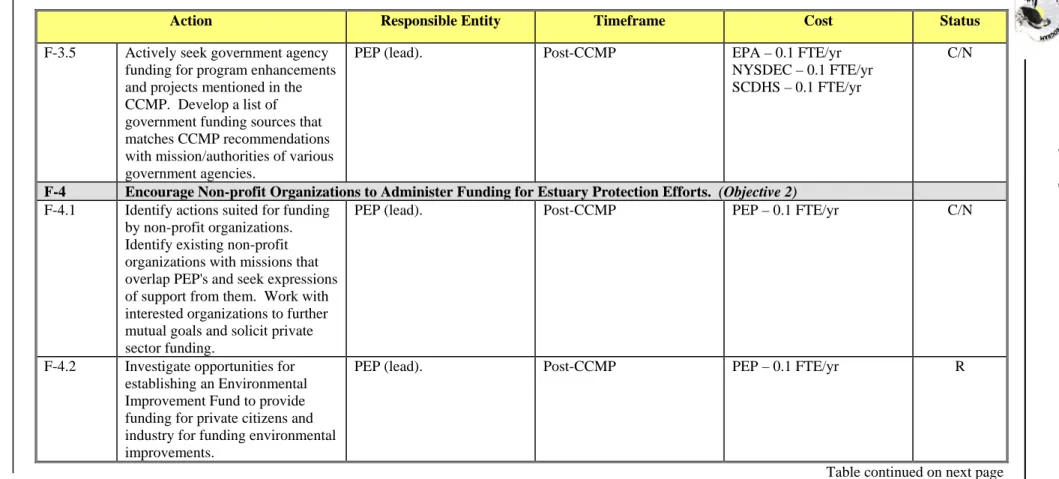
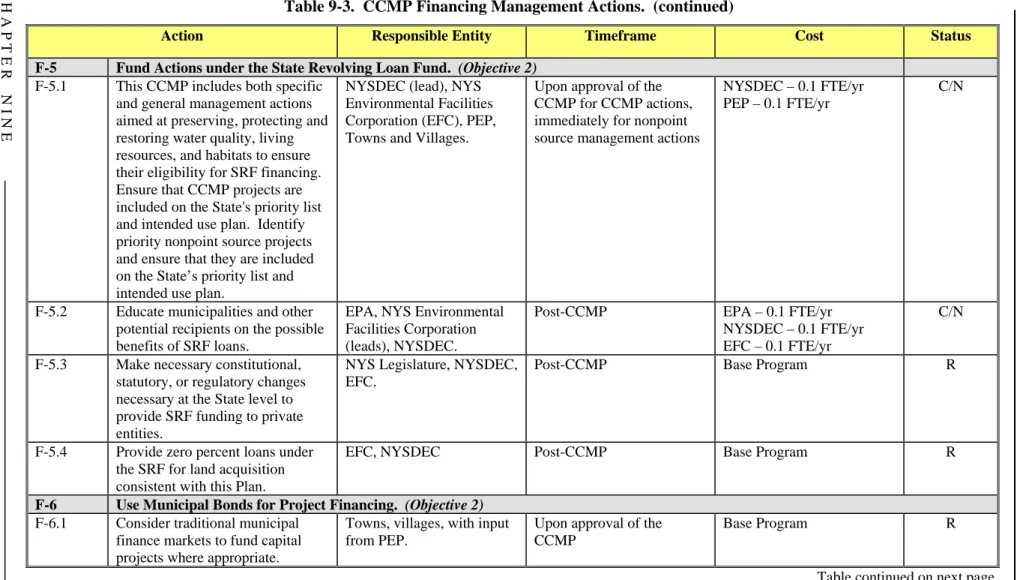
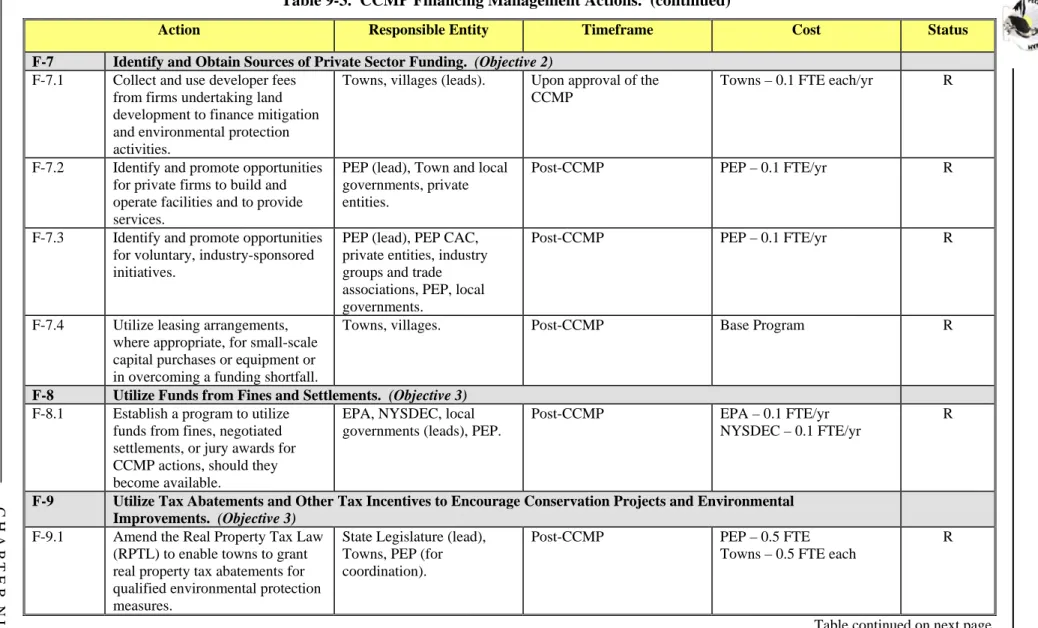
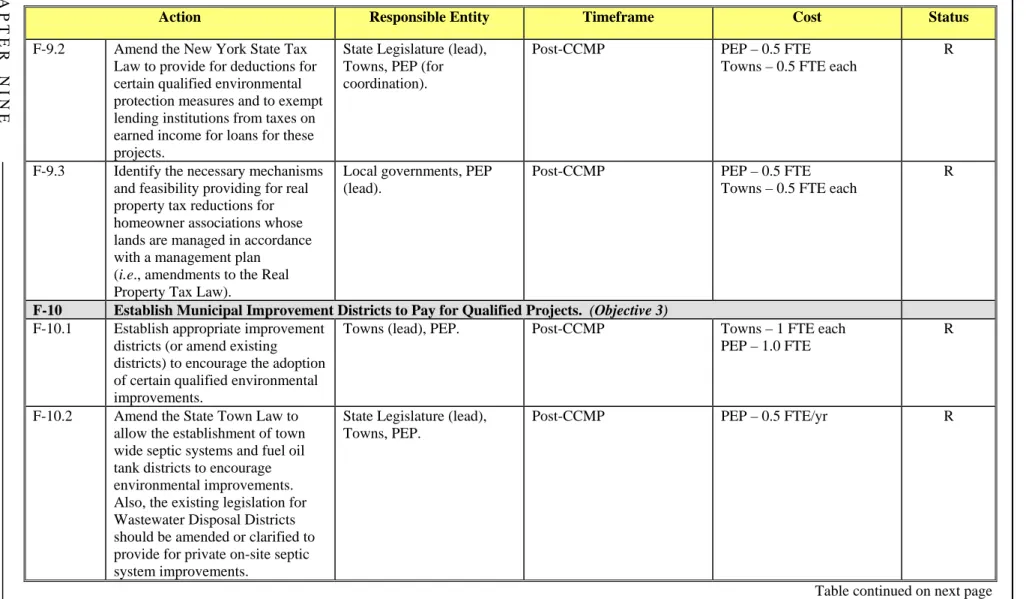
CCMP FINANCING MANAGEMENT PLAN ACTIONS SUMMARY
TABLE
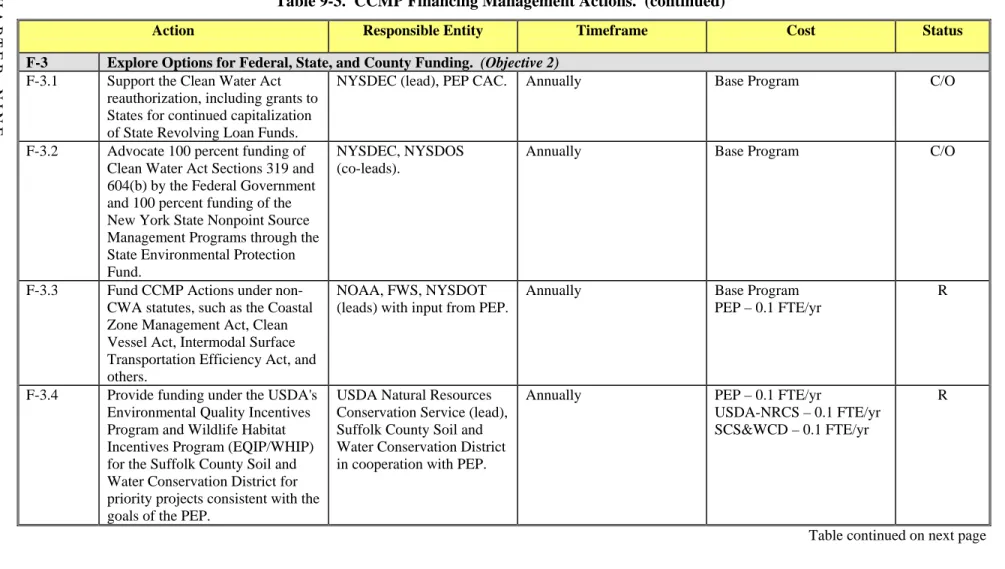
Table 9-3 provides the following summary information about each of the actions presented in this chapter.
Status
An action’s status is designated in the table by either an “R” for “Recommendation” or a “C” for “Commitment.” Actions that are commitments are being implemented because resources or funding and organizational support is available to carry them out. Actions that are “recommendations” require new or additional resources by some or all of the responsible entities. “O” refers to ongoing activities; “N” indicates new actions.
Timeframe
This category refers to the general timeframe for action implementation. Some actions are ongoing or nearing completion; implementation of other actions is not anticipated until some time in the future.
Cost
Information in the cost column represents the PEP’s best estimate of the costs associated with action implementation. “Base Program” means that no new or additional funds will be needed outside of the responsible entity’s operating budget to implement the action. Where additional funding is needed, resources to implement an action may be expressed as dollar amounts or work years or both. One full time equivalent employee or “FTE” is estimated as costing $75,000 per year, which includes salary, fringe benefits and indirect costs. The “Action Costs” description in both Chapter 1 and Chapter 9 provides an expanded explanation of base programs and action costs.
C H A P T E R N I N E 9-3 4 P econic Estuar y Progr a m CC MP
Table 9-3. CCMP Financing Management Actions.
Action Responsible Entity Timeframe Cost Status
F-1 Establish a Finance Work Group to Formulate/Refine Financing Options. (Objectives 1, 2 and 3.)
F-1.1
Priority
Establish a Finance Work Group to Formulate/Refine Financing Options.
PEP (lead). Post-CCMP EPA – 0.1 FTE/yr NYSDEC – 0.1 FTE/yr SCDHS – 0.1 FTE/yr
R
F-2 Effectively Use NEP Funding, the NYS Bond Act, the Suffolk County ¼% Sales Tax Program, and Base Programs to Implement the
CCMP. (Objective 1)
F-2.1 Provide post-CCMP funding to implement eligible CCMP actions, strive to obtain additional funding based on the results of EPA conducted Implementation Reviews.
EPA (lead), PEP. Federal fiscal years 1998 - 2001
($300,000 per year annual target)
C/O
F-2.2 Ensure that funding reserved for the PEP in the New York State Clean Air/Clean Water Bond Act is used effectively for the highest priority eligible projects.
NYSDEC (lead), PEP. Annually during 1998-2005 ($30,000,000 [less funds allocated to the South Shore Estuary Reserve Program], additional funds may also be available)
C/O
F-2.3
Priority
Effectively use funding for PEP recommended projects from the Suffolk County ¼ % Sales Tax Program.
Suffolk County (lead), PEP Beginning December 1, 2000
(Estimated funding available may be $2.5 M/yr for water quality
improvement projects alone)
C/N
F-2.4 Utilize existing base program funding from Federal, State, County, and local government programs to implement actions as appropriate; ensure that funding for these agencies remains, at a minimum, at current levels.
EPA, NYSDEC, SCDHS, other Federal, State, and county agencies, and local governments
(co-leads).
Ongoing Existing agency program staff and resources, as applicable
C/O