Development
I started out as a biologist at age 10. I would collect things outside, copy down pages and
pages of field guide information into my own notebooks, take photos of all the wildflowers I
would see in the national parks. Documentation was key: everything I saw on my family’s trip to
Yellowstone had to be written down, photographed, and drawn. I was collecting, all the time. My
honors project has been a continuation of this practice. My art combines observation (and with
this, wonder), and the gathering and displaying of information. In this body of work, I am
interested in the ecological address (the place and its influencing geology), the process of
ecology, and the communication of scientific findings. I am interested in considering my own
ecological research while creating work, but also drawing from systems of methodology and data
presentation that are commonly used in ecology.
The method of observing and data collection I developed as a child gained complexity
through my studies in ecology. Ecology, defined as the study of the relationships between living
things with each other and with their environment, has a scientific focus on energy transference
and place. Plants obtain energy from the sun, an insect obtains energy by eating new foliage, a
bird species obtains energy by eating an insect. The influencing geology of a place (a significant
component of the ecological address) also dictates what species can persist. In my scientific
research, I study phenology, or the seasonal patterning, of organisms. I am observing and making
conclusions about the seasonal fluctuations that occur: the leafhopper nymphs giving way to
adult leafhoppers, the decrease in bird singing as they begin their nesting period, the molting true
bugs, the uncoordinated bird fledglings being fed by their parents. The alignment of the seasonal
seasonal patterning is due to place. There is a power to the way organisms rely on each other and
the environment around them.
The way an ecologist studies these relationships and reports them parallels my own
artistic process. An ecologist uses the scientific method to study a phenomenon, and scientific
instruments to gather data. There is a story within scientific functionality, something I have noted
in the field while collecting data on bird presence or snail velocity. Scientific instruments,
including the diagram, gain an aesthetic because of the history of their use. These tools are a part
of something larger than their forms alone. Ecologists connect with the earth through the
instrument and the data obtained from it.
Diagrams and data have been especially important to my artistic development. The
diagram often translates the environment from a three-dimensional space existing over time to a
two-dimensional moment, and we are able to understand the workings of the environment more
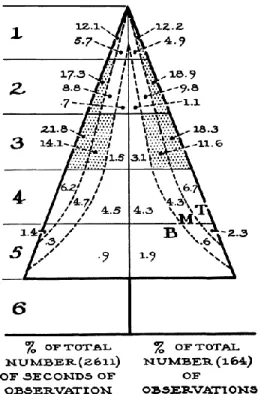
clearly. Robert MacArthur, a famous ecologist, watched the habits of five warblers in the conifer
forests of Maine (Figure 1). He hand-drew illustrations of where they spent their time on the tree
(MacArthur 603-605). He designed a geometric space to show organic interactions, and thus
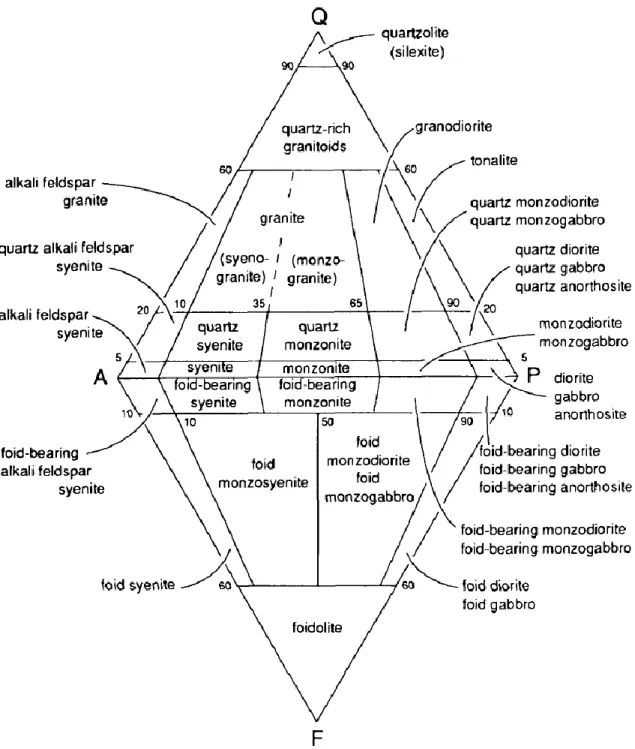
proved how the warblers coexist. This methodology is in tune with tertiary plots of geologists,
where precise line maps denote the mineral compositions of igneous rock (Figure 2).
Beyond this conceptual and process development occurring with my attraction to ecology
and its modes of discipline, my materials have also changed over the last couple of years. I was
originally focused on painting and drawing, but bringing in new materials such as wood and rock
allowed for an expansion of ideas and a specificity to my concept.
In my final exhibition, Multitroph, I have created the word “multitroph” from the
chain and throughout an ecosystem. I am interpreting this idea broadly to include all aspects of
ecological speculation and the study of ecosystems through data collection presented in
diagrams.
Materials
I have been working with wood, yarn, thread, hemp, oil paint, rocks, clay, pencil, and
paper. My materials are a combination of found and sought out. Found materials often involve
rocks or clay that I gather while at specific places, such as a lake ecosystem near where I live.
Sought out materials involve those that are particularly related to usefulness or instrumentation,
such as building wood and hemp.
The found rocks have been especially important materials. I am interested in the size of
the rock, its color and form, and how this interacts with my other materials. I choose to use rocks
in many of my pieces because they are not referential of a single organism, but rather a
foundation for many ecosystems. Rocks are usually collected from places that I have been
involved with ecologically, either through observation or data collection. One piece consists of
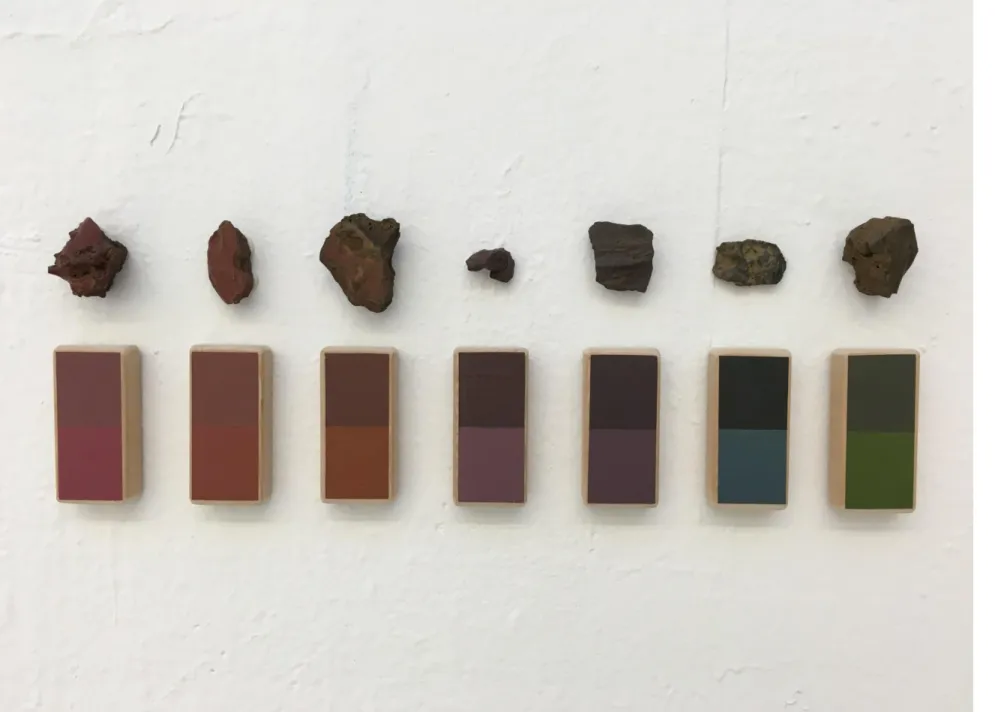
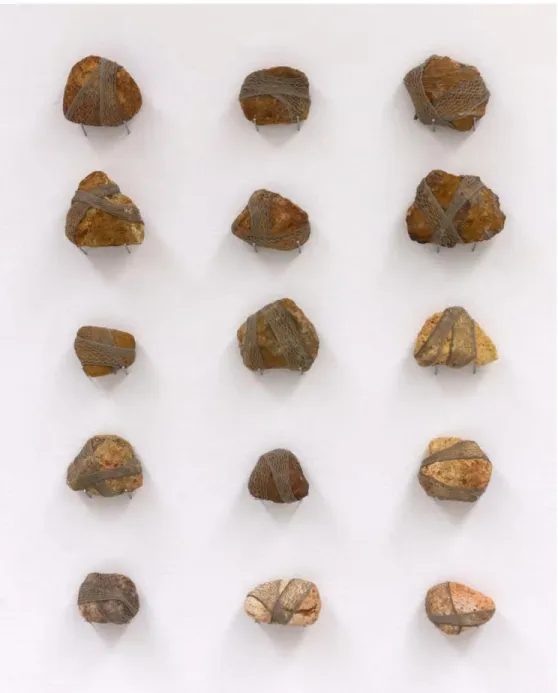
seven rocks I collected in Iceland at a crater called Kerið (Figure 3, 4). The slopes down into this
crater were littered with hardened igneous rocks that took forms reminiscent of dried globs of
crusty pieces of paint pulled from a palette. Many of my rocks and chunks of red clay were
collected from various locations in North Carolina, so they are referential of the ecosystem I am
most accustomed to studying and exploring. These locations include rocks I dug out of the
rocks found along the paths of Carolina North Forest. I am drawn to rocks that have character;
specimens that show their history with veins of minerals or rust from iron oxidation.
My primary sought out materials are different types of wood to build diagrammatic
structures, and thread or hemp to create a grid within these pieces. I often use the form of the
frame loom or support stretcher, a rectangular structure associated with weaving and painting. I
am interested in the grids produced by these structures when they are notched along their edges.
For most of my work, the notched shape is a foundational structure, like a tree’s foliage
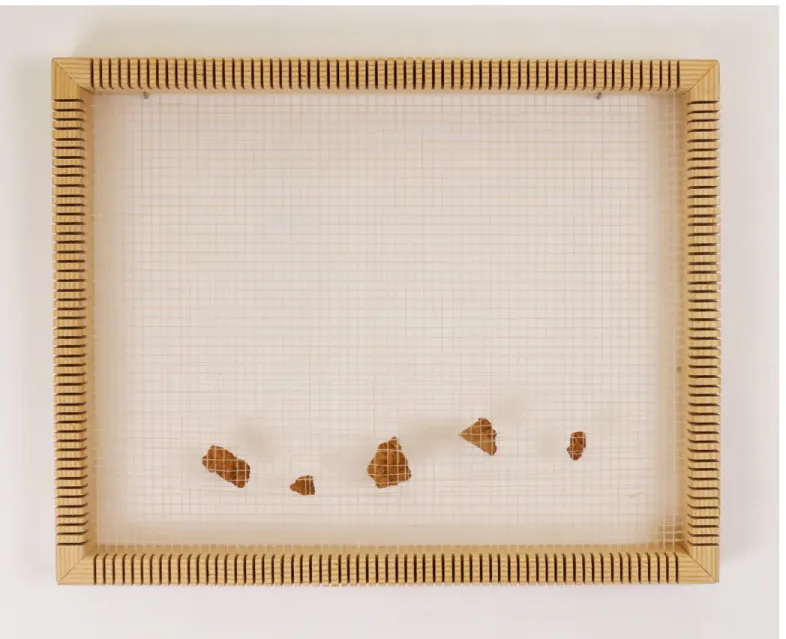
architecture begetting the arrangement of leaves. Chunks of red clay (Figure 5) or rocks of
various colors (Figure 6) are caught between two nets of thread wound about a notched structure.
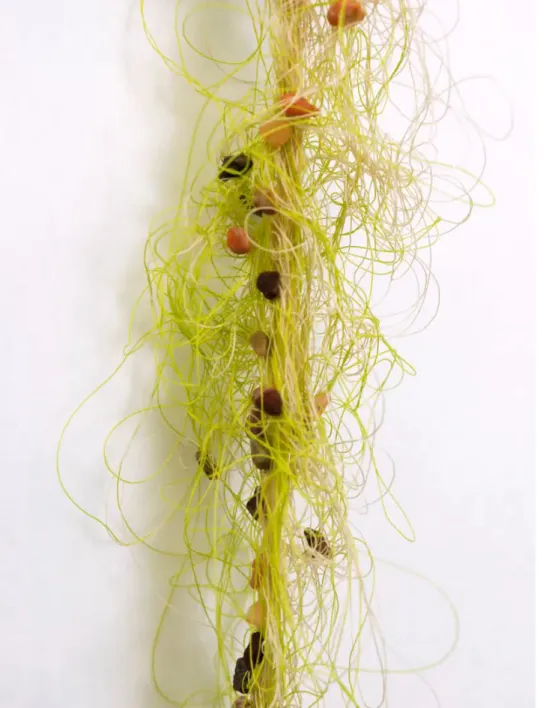
Another piece consists of a simple, small structure notched in threes on the top and bottom.
Green string falls in loops that vary in length rather than being wound through the opposite
notches (Figure 7). Some pieces consist of two open wooden shapes hinged with notches cut
around the edges; these pieces act more as a sculpture, taking up three-dimensional space (Figure
8-9). Finally, some of my pieces are off the notched structure, involving primarily yarn and
thread, and the various interactions of rocks with these materials (Figure 10-18).
In conjunction with the found rocks and sought out building materials, I have also
continued to experiment with paper, pencil, and oil paint throughout the year (Figure 19-20). The
use of pencil and paper as a material still has its place as part of my work, since this is so often
used by ecologists in the field. Ecologists are some of the few remaining scientists that still rely
heavily on pencil and paper, as field notebooks are used so often where a computer requiring a
Process
My process is greatly influenced by my experience with ecology and its use of the
scientific method. In my art I ask questions, I have hypotheses, I collect data, I analyze and
present data. This process may include a series of artistic steps similar to the scientific method,
or a piece focused on a single step, such as the use of a diagram as a compositional tool to begin
working from or the use of ecological theory to organize a piece.
The piece with Icelandic rocks (Figure 4) can be used as an example of the scientific
method used as my artistic process. I was asking: How different is the drying of paint versus the
drying of lava or magma? This served as my question. I was mesmerized by the variation of
color in the crater (Figure 3) due to the iron-laden minerals. I began collecting these rocks of
different colors, with each one acting as a piece of data. The colors I saw in these rocks changed
with the light, but I had clear memories of the colors they were when I found them. I arranged
each rock by color in this way, by memory, and then cut and sanded small pieces of wood to
serve as representative paint chips of the color I saw in each rock as I was painting, and the color
left in my memory. The arrangement of the rocks and addition of the wood palettes might be
considered the analysis and presentation of data. Many of my pieces develop in this way,
involving at least one of the components of the scientific method.
In some pieces I start with the diagram. Many of my materials translate easily into the
grid with an x and y axis. I cut notches around the edges of geometric structures, and this allows
for the threading of string. These components of warp (lines perpendicular to the x axis) and weft
(lines perpendicular to the y axis) mimic a typical plot of information in ecological studies. In
notched structures, and these rocks then become the data (Figure 5-6, 9). In one work (Figure 8),
I was responding directly to a diagram created by geologists to define igneous rocks by mineral
composition (Le Bas and Streckeisen 828) (Figure 2), with this diagram acting as my
composition. If this piece was laid flat, it would form the diamond seen in the diagram (Figure
2), and the black thread would indicate the delineations between rock types. Some of my works
start with the diagrammatic notched structure by threading string or hemp through differently
sized structures, weaving through the warp or adding knots and ties, and then continuing once I
pull them off the structure and hang them from a single point (Figure 13-14). The initial notched
structure is not always necessary, but it helps me to organize what will happen before the more
random and chaotic event of just letting the piece hang and fall naturally as it would. With
diagrammatic drawings on paper and wood, grid lines give me a place to allow marks to change
and transform as they cross the boundary.
Finally, my process also involves theories in ecology. In this case, the creation of the
work itself involves ideas relating to the balance and fragility of ecosystems and the connections
between organisms. I first started realizing that ecological theory drives my process while mixing
oil paint to create new colors. I would pull from colors already placed on my palette, so that
every color I painted with was connected with all other colors used.
This way of working has continued with my new pieces. Rocks are balanced either within
a notched structure or in hanging strands, and this process of balancing can take time (Figures
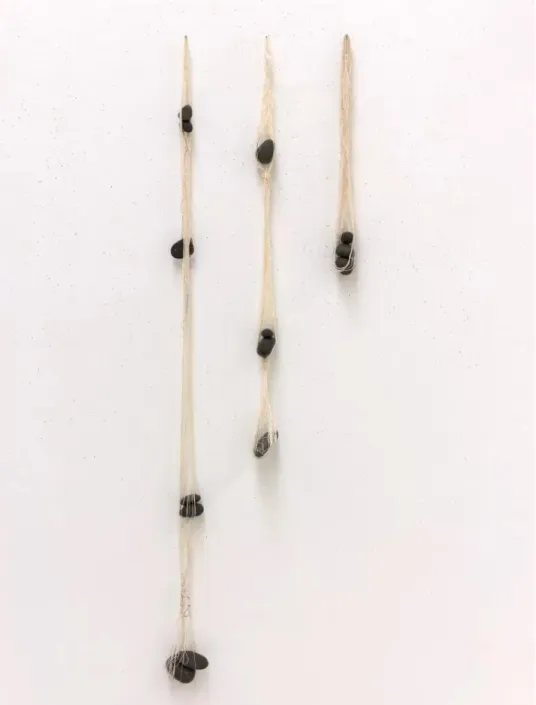
5-6, 9, 11-12, 14). I let the strands of material work with gravity, falling from a central point, the
materials accumulating as the eyes travel down. In many pieces, rocks are often cradled in an
abundance of securing thread or string. I have also been working on a collection of rocks
colors to compliment the specific rocks. Though different from the strands working with gravity,
these pieces also involve the engulfment of the rock by thread and string. Often rocks fall and
break and I have to replace them when I move the piece around. The process of balancing,
wrapping or cradling a rock in many tiny strands mirrors the way organisms or larger ecosystems
rely on each other.
Concept
Through my development, materials, and process, I have arrived at three different tenants
of conceptual thought: (1) the appearance of usefulness either as an instrument, tool, or diagram,
(2) the juxtaposition of irregularity, chaos, and randomness with the grid, order, and
measurement and how this contrast represents the scientific method’s attempt to simplify
ecological processes, and (3) the precarious nature of the work and how this suggests both
balance and fragility, providing an awareness of the surrounding environment and our impact as
humans. These concepts intermingle in many of my pieces, and they are all related to each other.
The scientific instrument
The scientific instrument or tool, including the diagram, have brought much of my work
to a place of apparent usefulness.
The pieces with notched structures are recognizable as a possible scientific instrument,
allowing their elements to play out as functional (Figure 5-9). The wooden structure itself is
exposed; its functionality is obvious. The notches connect to an idea of counting, as if these are
diagram (Figure 8), the light crossing threads, uninterrupted in their pattern behind the thin black
threads, form a grid. Any of these intersections could represent an existing rock on earth, but that
is not necessarily important for the viewer to know. The delineation with black thread lines call
to mind a sectioning and separation of different parts. The other notched structures include rocks
balanced between nets of warp and weft that work as points on a diagram, such as marks of a
location or state of a habitat (Figure 5-6, 9).
Yet other pieces off the wooden structure fall in line with usefulness in terms of
surveying. These structures could be imagined as a netting scientists use to filter out smaller
matter and survey what is found (Figure 13, 16-17), or a system of measuring and detailing a
surface (Figure 11-12).
Finally, I consider the installation of my pieces, as I am seeking a display that is “useful.”
I draw from scientific “museum-like” installation aesthetics, where all components are arranged
for easy comparison and pattern-finding (Figure 6, 10-11, 14, 18-19).
Irregularity and the grid
Many of my pieces involve both the regular and irregular, the chaotic and the orderly.
The study of ecology attempts to funnel this seemingly random data that nature provides into
generalizable patterns. The best theories in ecology are generalizable across different systems,
yet able to predict very specific results. My work explores this drive in ecology visually.
The irregularity of rocks is often paired with the rigidity of the wooden pieces and the
grid-like positioning of the elements. The information displayed (such as the rocks in the notched
structures) is possible because of these diagrammatic structures. In one piece, loops of string
regularity of the notches (Figure 7). Carefully aligned rectangular wooden palettes of color
describe one-of-a-kind found rocks (Figure 4). In one hanging piece (Figure 13), woven pieces
pull in the structural warp strands, attempting to organize them and keep the structure of the grid.
Yet the woven in pieces here are often separated or messy in their nature, so that the whole piece
appears as an organized tangle. This represents much of ecological research: there is the attempt
to explain things, and there is the realization that there are infinite exceptions.
Balance and fragility
One of the most consistently represented themes in my work is the idea of balance and
fragility. Ecosystems are dependent upon a multitude of things: abiotic factors such as
temperature and light, biotic factors such as keystone species and competition. While working on
these pieces, I think about the importance of balance in ecosystems and how the stability
between a resource and a consumer, or two different interacting species, is fragile and prone to
disturbance.
I represent this idea of balance and fragility in a variety of ways. Rocks hover, carefully
suspended, and temporary in their placement (Figure 5-6, 9, 11-12, 14). They are precarious,
sometimes much wider and thicker than the few strands that support them (Figure 11-12).
Chunks of clay look as if they could crumble easily (Figure 5, 13). There are balances between
small, complex patterns of weavings with the elemental core the of the rock, an intricate
handmade gesture next to geologic abstraction (Figure 18). If these rocks and chunks of red clay
can be considered symbols for an ecosystem, the viewer is reminded how fragile the
environment around us is. This idea also includes a concern with gravity and the pulling down by
foundation, or geologic driver of an ecosystem. The fragility of the strands in response to the
force of gravity, yet their ability to support large or numerous rocks, suggests trophic
connections and the possibility of human involvement in their change or destruction.
Influencing artists
A few artists have greatly influenced my artistic development, including Wolfgang Laib,
Anni Albers, Katie Paterson, and Annette Messager.
Wolfgang Laib’s involvement with the timing of the ecosystem during his periods of
pollen collection (Battista 68) inspires how I use my own study of ecology in my art. He gathers
pollen from specific plants only when they are available, so he is very in tune with the timing of
plant growth and the fluctuations of abundance in the spring. He collects jars of pollen and then
evenly distributes this color over a rectangular shape on a museum floor. The result is striking;
the pollen gains a presence due to its separation from source and recontextualization, its quantity,
and its history of getting to the museum space. Laib’s work makes me consider my materials,
and using them in a way that speaks to their origin.
When I became interested in working with thread and the grid, the ideas and work of
Anni Albers played a role in how I think about my process. I was drawn to weaving because of
the idea that thread is a material of connection, and because the frame loom was an easy
transition after building stretchers for painting. Albers describes weaving as “…building a whole
out of small parts” (Albers 22). Her explanations of the process and the loom provided me with a
vocabulary to bring diagrammatic thread into my work. Though her pieces involve experiments
alternatively over and under each warp thread it meets on its horizontal course from one side of
the warp to the other; returning, it reverses the order and crosses over those threads under which
it moved before and under those over which it crossed. This is the quintessence of weaving”
(Albers 39). This quintessence of weaving, along with the simplicity of the frame loom, allowed
for diagrammatic gestures in my work with thread, wood, and grid-like placement.
I have also spent time with the works of Katie Paterson. Instead of forcing her art to
detail a scientific concept, she lets the data and discoveries of science drive the aesthetics of her
pieces. She deals with time and distance, using elegant metaphors such as a telephone call to a
glacier in Iceland or an arrangement of clocks on a wall that indicate the time on other planets.
One of my favorite pieces by Paterson is Fossil Necklace, which is simply a necklace of 170
rounded fossils that span geologic time. This piece is accompanied by a diagram that denotes the
time period and location found for each fossil, along with symbols indicating if the fossil is a
living fossil, an endangered species, a trace fossil, or has a closely related living species with its
DNA sequenced. There is an abundance of scientific information in her works, and the aesthetics
always fall in line with the meaning. This is something I have been working towards with my
own art.
Lastly, I have also been influenced by Annette Messager, particularly her one piece titled
Le repos des pensionnaires. Dead birds lie in a display case, each with their own crocheted
sweater. With this piece, there is the interaction between the viewer knowing they are dead, and
the sweaters and title indicating that they are resting comfortable before continuing on. I was
intrigued by the wrapping of the birds; there is care taken to provide these lifeless bodies with
thoughtfulness, and an attention to the process of life. This has directly influenced works I have
done where I wrap rocks in woven fragments.
Challenges, limitations, and future exploration
I have found that I am drawn to work in a variety of media, and I have realized that this
parallels the study of ecology in many ways. There are an infinite number of survey techniques,
because there are an infinite number of interactions and niches to be studied in ecosystems. Each
material helps me communicate something that another material would not have, in the way that
the survey method allows for the results.
Throughout my process, I have negotiated between two ways of working: coming up with
an idea and then acquiring the materials, versus letting materials I have around dictate what I
make. This has been challenging in that sometimes I am just creating in what feels to me a
scientific manner, but this is not always evident with the completed work. I have to step back and
let my work find its place in my concept, even if some pieces are spontaneous or accidental. I
have found that the materials I have available play a huge role in how I think and move forward.
For that reason, materials will always be a limitation. I can never know exactly what I will need
while working. I usually have wood, embroidery thread, sewing thread, hemp, and oil paints on
hand, but there is something to be said for the found rocks sparking ideas organically. For my
rock-centered pieces, the traits of the rocks I collect, whether their color, form, or size, are
usually the beginning of my process. This has worked for me because rocks, once broken down
In the future, I think it will be important for me to consider space more. All of my pieces
are created in a confined studio space, and I have not gained the courage to create something
outdoors. I think that, moving forward, it will be interesting to consider large sculptural diagrams
filling a room, or alive outside in the elements. I also want to push the idea of utility that I only
just recently started to explore. This has been a driving force in a few works, but I think there is
Sources cited
Albers, Anni. On Weaving. Middletown: Wesleyan UP, 1979. Print.
"Annette Messager, Le Repos Des Pensionnaires, L'œuvre Désinvolte." Centre Pompidou Metz. Web. 06 Apr. 2017.
Bas, M. J. Le, and A. L. Streckeisen. "The IUGS Systematics of Igneous Rocks." Journal of the Geological Society 148.5 (1991): 825-33. Web.
Battista, Silvia. "A Posthuman Interpretation of Wolfgang Laib's Work with Pollen as an Ecological Proposition." Performance Research. 17.4 (2012): 67-73. Print.
MacArthur, Robert H. "Population Ecology of Some Warblers of Northeastern Coniferous Forests." Ecology 39.4 (1958): 599-619. Web.
Paterson, Katie. katiepaterson.org. Web. 06 Apr. 2017.
Sources consulted
Anastas, Rhea. Agnes Martin. New York: Dia Art Foundation, 2011. Print.
Brown, James H. Macroecology. Chicago [u.a.: University of Chicago Press, 2004. Print.
Drawing Center (New York, N. Eva Hesse Drawing. New York: The Drawing Center, 2006. Print.
Fisher-Wirth, Ann W. The Ecopoetry Anthology. San Antonio, Tex: Trinity Univ. Press, 2013. Print.
Hicks, Sheila, Joan Simon, Susan C. Faxon, and Whitney Chadwick. Sheila Hicks: 50 Years. Andover, Mass: Addison Gallery of American Art, Phillips Academy, 2010. Print.
Keith, Naima J. Charles Gaines: Gridwork 1974-1989. New York: Studio Museum in Harlem, 2014. Print.
McNear, Sarah Anne. Joan Snyder: Works with Paper. Allentown, Pa.: Allentown Art Museum, 1993. Print.
Mehretu, Julie. Julie Mehretu: Drawings. New York, N.Y.: Rizzoli International Publications, 2007. Print.
Sjoberg, Fredrik. "The Philosopher King of the Hoverflies - Issue 22: Slow." Nautilus. (2015): 2015-3. Print.