Prevalence oflntimate Partner Violence Screening By Healthcare Providers and the Effectiveness Of Interventions to Increase Intimate Partner Violence Screening in the Healthcare Setting: A Literature Review
By
Jamie White Charlson
A Master's Paper submitted to the faculty of The University of North Carolina at Chapel Hill
In partial fulfillment of the requirements for The degree of Master of Public Health in
The Public Health Leadership Program
Chapel Hill
2002
ABSTRACT
Introduction:
Intimate partner violence affects 1.5 million women in the United
States each year.
1Significant adverse health consequences are associated with the
experience of intimate partner violence.
2•3Leading health professional
L
organizations recommend that healthcare providers ask
allwomen about abuse by
intimate partners.
4•5 Anunderstanding of the prevalence of current intimate
partner violence screening practices and the effectiveness of screening
interventions is necessary to inform and improve future screening protocols,
practice guidelines, provider training, and screening practices.
Methods:
A review of existing studies examining the prevalence of screening of
screening for intimate partner violence, and the effectiveness of screening
I
interventions was conducted. Studies were selected according to established
criteria, and their methods and characteristics were summarized and compared for
similar and dissimilar results.
Results:
Routine screening rates ranged from 5 % to 70%. Screening rates for
high risk and other selected patients ranged from 20-51%. Screening rates varied
according to practice setting, healthcare provider characteristics, and the nature of
the clinical encounter. Screening interventions increased provider assessment and
identification of intimate partner violence as compared to pre-intervention rates.
Post-intervention increases in referrals for services and distribution of intimate
partner violence information were also reported.
and procedure for screening for intimate partner violence that are implemented in
healthcare organizations can lead to increased assessment, identification, and
INTRODUCTION
An estimated 1.5 million women are sexually and/or physically assaulted
by their intimate partners in the United States each year. 1 Significant physical and emotional sequelae are associated with the experience of intimate partner violence
(IPV), including physical injury, chronic pain and other somatic symptoms, STDs,
depression, and sleep disorders. Z-J The prevalence and consequences of abuse
distinguish intimate partner violence as a serious health problem among women.
Health care providers have a unique opportunity to identifY and assist
victims of violence through interactions with clients in acute and ambulatory care
settings. The American Medical Association (AMA) and the American College
of Obstetricians and Gynecologists (ACOG) recommend that physicians routinely
I
ask all women direct, specific questions about abuse by intimate partners.4-5 The
Joint Commission on Accreditation ofHealthcare Organizations standards require
that hospitals identifY possible victims of abuse using criteria developed by the
hospital (e.g. domestic violence identification protocols)6 Considering these
recommendations and guidelines, it is essential to understand the current
screening practices ofhealthcare providers for IPV and the effectiveness of
screening interventions in identifYing and assisting victims of violence, in order
to inform and improve future protocols and practice guidelines, education and
training, screening practices, and interventions.
In order to address these questions, a review of existing studies exploring
the prevalence of screening for IPV by healthcare providers, and the effectiveness
was conducted. The studies' methods and characteristics were summarized,
followed with a synthesis of findings based on comparison of similar and/or
dissimilar results.
METHODS Study Selection
Prevalence studies were selected according to the following criteria: 1)
published in years 1995-2001; 2) clearly defined research question(s) focusing on
the prevalence ofhealthcare provider screening for IPV; 3) included descriptions
of the sample, study design and variables; 4) included original data from the
United States. Selection criteria were expanded on for studies that examined
domestic violence identification rates in healthcare settings before and after an
intervention to increase assessment, identification, and referrals for victims of
abuse (e.g. the initiation of a domestic violence protocol) because there were
fewer original research articles on this topic, as compared to studies examining
the prevalence of screening behaviors. These criteria include: 1) published in the
years 1995-2002; 2) clearly defined research question(s) focusing on the
comparison of abuse detection rates pre- and post intervention; 3) included clear
descriptions of the study sample, design and research variables; 4) included
original data from the United States or other developed countries. Review and
opinion pieces were omitted.
Definitions
The terms "intimate partner violence (IPV)," "domestic violence (DV),"
and/or coercive behaviors perpetrated against a woman by a current or former
intimate partner.
Study Methods and Participants
Table 1 presents an overview of the prevalence studies' designs, variables,
samples, and findings. Each of the ten selected studies used self-administered
questionnaires for data collection, distributed either by mail or by the
investigators in person. Most of the study participants were physicians, including
general practitioners,7 family practitioners,7• 9'10• 12• 15 obstetrician-gynecologists,7•
10-ll, 14.15 internists,7• 10 pediatricians,9 and psychiatrists.10 Three studies included
other healthcare providers in the study sample, adding physician assistants, 12• 16
nurse practitioners, 12 prenatal nurses, 13 and primary care provider teams. 16 Only one study sample was comprised of non-healthcare professionals, with the study
surveying obstetric patients who had recently delivered live infants. 8 Practice settings varied to include private offices, public clinics, and hospitals.
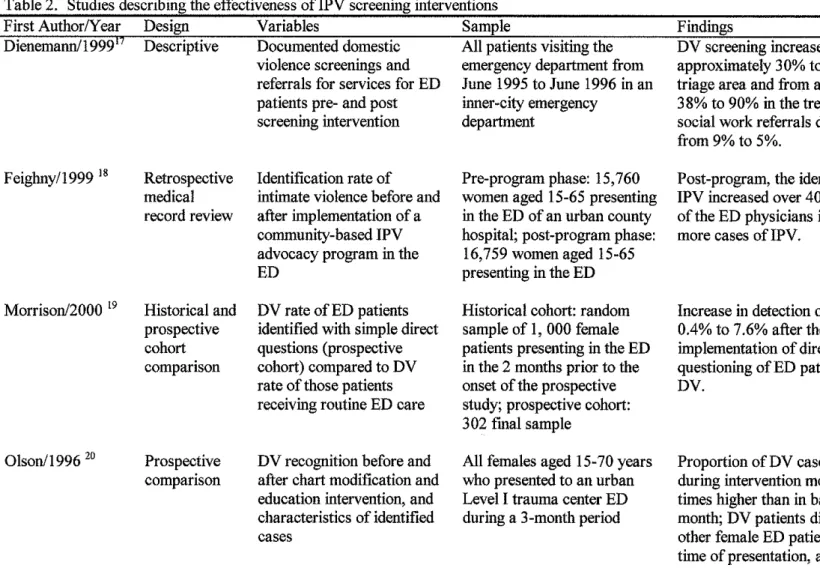
Table 2 presents a summary of the studies examining the effectiveness of
IPV screening interventions. Study designs varied from descriptive to
quasi-experimental. Each of the six studies included comparison data ofDV screening
rates before and after the implementation of an intervention designed to increase
provider IPV screening. Interventions varied among studies, with all studies
including a procedural change and educational component. Four of the six
studies' participants were emergency department patients, 1 7'20 while the remaining studies' participants were home visitation patients 21, and obstetric
physicians, 17-18• 20-22 while the remaining study used outside data collectors to administer a self-report questionnaire to participants.19 Measurement criteria varied among studies to include percentages of provider assessment for intimate partner violence, provider identification ofiPV, distribution ofiPV materials, and/or referrals for services.
RESULTS
Routine and High Risk Screening
Routine screening rates for IPV ranged from 5% to 70%.7• 9-15 In addition to routine screening, 20-51% of providers reported IPV screening for high risk and other selected patients (e.g. chronic somatic complaints, sexual problems, or chronic pelvic pain).9• 11• 13-16 Horan et al reported that 68-72% of respondents screen when abuse is suspected. 11 Rodriguez et a! reported that 79% of physicians screen for abuse in situations that involve physical injuries.15
Screening in Prenatal Care
Several studies reported screening rates specific to prenatal care settings. 7
-8· 11• 15 Eleven to 39% ofhealthcare providers report screening women for abuse during the first prenatal care visits. 7• 11• 15 Screening rates increase to 68% when abuse is suspected 11 and drop to 5% at follow-up visits. 7 Durant et al 8 found that 22-39% of women who gave birth to live infants reported that healthcare providers discussed physical abuse with them during their prenatal visits. In addition, Durant et al 8 report that prevalence of abuse was not a significant predictor of abuse discussion.
Four studies reported that IPV screening rates varied significantly by type
ofhealthcare setting. 7-8• 13• 15 In each instance, providers working in public
settings reported higher rates of screening than did providers in private settings.
Screening rates ranged from 26-89% for providers practicing in public settings,
varying according to the nature of the clinical encounter.7•8•13• 15 Screening rates
of providers practicing in private settings ranged from 1-68%, also varying
according to the nature of the clinical encounter. 7•8• 13• 15
Screening Practices by Provider Characteristics
Several studies reported that screening practices were associated with
certain healthcare provider characteristics. Findings were reported according to
provider specialty, age, gender, training in DV, and personal experience with DV.
Findings are inconsistent for associations between higher screening rates
and provider specialty. Erickson et al 9 and Groth et al 10 report that family practitioners are more likely to screen patients for abuse in certain clinical
situations. The studies compared screening levels of family practitioners to those
of pediatricians and to internist and obstetrician-gynecologists respectively.
Rodriguez et al 15 report that obstetrician-gynecologists have the highest level of
screening in certain clinical situations compared to internists and family
practitioners.
Younger physicians and female physicians were found to be more likely to
screen for abuse in certain clinical situations.11• 14 Provider training in DV as well
as provider personal experience with DV (either self or family) were associated
Effectiveness of Screening Interventions
In all six studies the identification rates ofDV increased in the post-intervention groups. Four studies reported similar levels of increase in identification rates, raoging from a 1.4 to 1.8 fold increase.17-18• 20-21 The
remaining two studies reported higher levels of increase in identification rates, with Morrison et al19 reporting ao increase from 0.4% to 7.6%, aod Wiist et al22 reporting ao increase from 0% to 88%. Increases in the rates of referrals for services for DV in post-intervention groups were reported by two of the three studies examining this variable.17• 21-22 Shepard et al 21 reported that DV
information was provided to more patients in the post-intervention group thao the baseline group.
Characteristics ofDV Patients in the Emergency Department
In addition to examining the effectiveness of ao intervention to increase emergency room physiciao recognition aod identification of domestic violence, Olson et al20 also examined the characteristics of those patients identified as having experienced DV. Female patients presenting to the emergency department with DV related complaints differed from other female ED patients in age, time of presentation, aod type of triage complaint. 20
DISCUSSION
Findings reported from the selected prevalence studies indicate that 5-70% ofhealthcare providers routinely screen for IPV, with the majority of studies reporting routine screening levels below 20%. Variations in screening levels were noted according to clinical situations, healthcare setting, aod provider
1
l
characteristics. Specifically, providers were more likely to screen for IPV in selected or high-risk situations, and when abuse was suspected or there was evidence of physical injury. Findings further indicate that a low percent of pregnant women are screened for IPV at initial prenatal care visits with this percent dropping lower as pregnancy advances. It is apparent from these findings that most healthcare providers are not complying with practice guidelines
requiring that
all
women be asked about abuse.A better understanding ofhealthcare providers' perceived barriers to screening for IPV might provide a more enlightened context in which to view the above findings. Commonly identified barriers include lack of education or training in DV, lack of institutional protoco~ insufficient or inadequate referral sources, lack of time, and patient related factors. 7• 9• 14 • 15 These barriers present implications for change in provider training, healthcare organization protocols concerning DV, and victim response systems. Findings from the prevalence studies in review strongly suggest a relationship between provider training and the services they provide, further suggesting that educational interventions focused on providers may be useful in increasing screening levels.
Another aspect of the effects ofhealthcare provider screening for IPV that should be considered is the experience of screening as perceived by the patients, both abused and non-abused. Most women agree that healthcare providers should screen all women for DV.23- 26•28 Victims of abuse express concerns about
negative consequences of screening such as fear of losing control, personal feelings of shame, less satisfactory healthcare encounters, and fear of mandatory
'
i
T
reporting.
25•27
Future research should be expanded to include more studies
examining the experiences of women and any benefit they receive, particularly
those who are victims of abuse, in healthcare encounters in which screening for
IPV occurs.
Study Limitations
Some discrepancies were noted among study findings. A lack of uniform
definitions for intimate partner abuse, and a variety of screening instruments and
data collection methods may have contributed to these inconsistencies.
Assuggested by Peterson et al,
29qualitative research is necessary to improve current
measurement scales used in the quantitative research examining the screening
i
levels ofhealthcare providers. Such work could aid in interpreting, explaining,
and validating the findings from quantitative research in screening for IPV by
providing a more complete view of the dynamics involved.
29As illustrated in Table 2, the differences in research design, setting,
methods, and measurements in the reviewed studies examining the effectiveness
of screening interventions make it is difficult to compare these studies.
Interventions were specifically noted to range from simple changes in an
assessment form to the initiation of an intimate partner violence advocacy
program. Additionally, four of the six studies took place in emergency
::rdepartments, which may further hinder the ability of these findings to be
generalized to broader situations.
increase personal awareness ofiPV. Despite these limitations, the findings
underscore the problem of missed opportunities by healthcare providers to
identifY and assist female victims of domestic violence, and identifY the
relationship between IPV protocols, procedures, and provider training and the
care and services that are provided.
Conclusions
Overall the findings from these studies suggest that the implementation of
an institutional protocol for screening for IPV increases the identification rates of
IPV as well as the rates of referral for services, and the distribution ofDV
information to patients, suggesting that when healthcare providers screen all
patients for IPV in a direct and consistent manner, these behaviors are effective in
identifYing more victims of abuse. Compared to the existing original research
concerning the prevalence of screening for IPV by healthcare providers, more
research is needed to further examine the effectiveness of these behaviors.
While the prevalence ofiPV among women is alarmingly high, few
healthcare providers routinely ask female patients about violence in their lives,
despite existing recommendations and practice guidelines. Abuse screening
protocols that are integrated into routine healthcare procedures can lead to
increased assessment, identification, and referrals for IPV. More research is
required in the effort to integrate healthcare recommendations and practices that
REFERENCES
1.
Tjaden P, Thoennes N. Prevalence, incidence and consequences of violenceagainst women. Findings from the National Violence Against Women Survey.
Washington DC: U.S. Department of Justice, National Institute of Justice, 1998.
NCJ. 172837.
2. Coker AL, Smith PH, Bethea L, King MR, McKeown RE. Physical health
consequences of physical and psychological intimate partner abuse. Archives of
Family Medicine 2000;9(5):451-7.
3. McCauley J, Kern DE, Kolodner K, Dill L, Schroeder AF, DeChant HK, Ryden
J, Bass EB, Derogatis LR. The "battering syndrome": prevalence and clinical
characteristics of domestic violence in primary care internal medicine practices.
Annals of Internal Medicine 1995;123(10):737-46.
4. American Medical Association. Diagnostic and treatment guidelines on
domestic violence. Chicago: American Medical Association, 1992.
5. American College of Obstetricians and Gynecologists. The obstetrician
gynecologist and primary preventive health care. Washington, DC: ACOG, 1993.
6. Joint Commission on Accreditation ofHealthcare Organizations.
Comprehensive Accreditation Manual for Hospitals: The Official Handbook.
Standard PE 1.9. Oakbrook Terrace, IL. Joint Commission on Accreditation of
Healthcare Organizations, 2002:PE-4.
7. Chamberlain L, Perham-Hester A. Physicians' screening practices for female
partner abuse during prenatal visits. Maternal and Child Health Journal
2000;4(2): 141-148.
;
I
t
8. Durant T, Gilbert BC, Saltzman LE, Johnson CH, PRAMS Working Group.
Opportunities for intervention, discussing physical abuse during prenatal care
visits. American Journal of Preventive Medicine 2000;19( 4):238-244.
9. Erickson MJ, Hill TD, Siegel MD. Barriers to domestic violence screening in
the pediatric setting. PEDIATRICS 2001 ;1 08(1 ):98-1 02.
10. Groth B, Chehnowski M, Batson TP. Domestic violence: level of training,
knowledge base, and practice among Milwaukee physicians. Wisconsin
Medical Journal2001;100(1):24-28.
II. Horan D, Chapin J, Klein L, Schmidt LA, Schulkin J. Domestic violence
Screening practices of obstetrician-gynecologists. Obstetrics & Gynecology
1998;92(5):785-789.
12. Molliconi SA, Runyan CW. Detecting domestic violence, a pilot study of
fumily practitioners. North Carolina Medical Journal May/June 1996;57(3):
136-138.
13. Moore ML, Zaccaro D, Parsons LH. Attitudes and practices of registered
nurses toward women who have experienced abuse/domestic violence. Journal of
Obstetric, Gynecologic, and Neonatal Nursing March/Aprill998;27(2): 175-182.
14. Parsons LH, Zaccaro D, Wells B, Stovall TG. Methods of and attitudes
toward screening obstetric and gynecology patients for domestic violence. Am J
Obstet Gynecol1995;173(2):381-387.
15. Rodriguez MA, Bauer HB, McLoughlin E, Grnmbach K. Screening and
16. Sugg NK, Thompson RS, Thompson DC, Maiuro R, Rivara FP. Domestic violence and primary care, attitudes, practices, and beliefs. Archives of Family Medicine July/August 1999;8:301-306.
17. Dienemann J, Trautman D, Shahan JB, Pinnella K, Krishnan P, Whyne D, Bekemeier B, Campbell. Developing a domestic violence program in an inner-city academic health center emergency department: the first 3 years. Journal of Emergency Nursing 1999;25(2):110-115.
18. Feighny KM, Muelleman RL. The effect of community-based intimate-partner violence advocacy program in the emergency department on identificiation rate of
19. Morrison LJ, Allan R, Grunfeld
A.
Improving the emergency departmentl
I
intimate-partner violence. Missouri Medicine 1999;96(7):242-244.
detection rate of doemstic violence using direct questioning. The Journal of Emergency Medicine 2000; 19(2): 117-124.
20. Olson L, Anctil C, Fullerton L, Brilman J, Arbuckle J, Sklar D. Increasing emergency physician recognition of domestic violence. Annals of Emergency Medicine 1996;27(6):741-746.
21. Shepard MF, Elliott BA, Falk DR, Regal RR. Public health nurses' responses to domestic violence: a report from the enhanced domestic abuse intervention project. Public Health Nursing 1999;16(5):359-366.
22. Wiist WH, McFarlane J. The effectiveness of an abuse assessment protocol in public health prenatal clinics. American Journal of Public Health
23. Bradley F, Smith M, Long J, O'Dowd T. Reported fresquency of domestic violence: cross sectional survey of women attending generl practice. British Medical Journal2002;324(2):271-274.
24. Caralis PV, Musialowski R. Women's experiences with domestic violence and their attitudes and expectation regarding medical care of abuse victims. Medical Care And Domestic Violence 1997;90(11):1075-1080.
25. Gielen AC, O'Campo PJ, Campbell JC, Schollenberger J, Woods AB, Jones AS, Dienemann JA, Kub J, Wynne EC. Women's opinions about domestic violence screening and mandatory reporting. American Journal of Preventive Medicine 2000;19(4):279-285.
26. McNutt LA, Carlson BE, Gagen D, Winterbauer N. Reproductive violence screening in primary care: perspectives and experiences of patients and battered women. JAMWA 1999;54(2):85-90.
27. McNutt LA, van Ryn M, Clark C, Fraiser I. Partner violence and medical encounters. American Journal of Preventive Medicine 2000; 19( 4):264-269.
28. Webster J, Stratigos M, Grimes KM. Women's responses to screeningin for domestic violence in a health-care setting. Midwifery 2001 ;17:289-294.
29. Peterson R, Gazmararian JA, Spitz AM, Rowley DL, Goodwin MM, Saltzman LE, Marks JS. Violence and adverse pregnancy outcomes: a review of the
Table 1. Research articles on the prevalence ofiPV screening by healthcare providers
First Author/Year Design Variable Sample
Chamberlain/2000 7 Descriptive mailed Physicians' screening (n=!57)
Durant/2000 8
Erickson/200 I 9
Groth/200 I 10
Horan/1998 1!
Questionnaire practices and beliefs about Primary care physicians (FP,
Descriptive mailed questionnaire (PRAMS) Descriptive mailed questionnaire Descriptive mailed questionnaire Descriptive mailed questionnaire
screening for IPV GP, OB/GYN, IM) providing
prenatal care in Alaska
Rates of discussion of physical abuse and pro-vider factors associated with the occurrence of discussion
Physicians' attitudes, training, and current DV screening practices
Physicians' attitudes towards DV, level of training, and practice and knowledge base with respect to DV intervention
Physicians' knowledge base and screening practices for DV
(n=21,970)
Unweighted sample included women from 14 states who had delivered live infants
(n=310)
General pediatricians and Family practitioners, practicing in an urban medical center serving Ohio and Kentucky
(n=I92)
Physicians practicing Internal medicine, Family practice, OB/GYN, or Psychiatry in an urban mid-west area
(n=662)
Obstetrician-gynecologists and members of the American College of Obstetricians and Gynecologists
Findings
I 7% routinely screen at ftrst prenatal visit; 5% routinely screen at follow-up visits.
22-3 9% of participants reported healthcare providers discussed physical abuse with them during prenatal visits.
51% of practitioners screened at least high risk families, 8.5% routinely screened for DV; those practitioners with DV training were I 0. 9 times more likely to screen .
30% report asking about abuse at least "half the time," 10% report asking about abuse "always" or "most of the time."
The majority of respondents screen both pregnant (68%) and non-pregnant (72%) when abuse is suspected; 3 9% screen non-pregnant patients at initial visit.
Molliconi/1996 12 Descriptive self- Family practitioners (n=59) on abuse asked more patients about
administered screening practices, One Physician assistant, one the possibility of abuse than those
questionnaire knowledge base, and Nurse practitioner, 57 with no exposure.
perceived barriers to physicians
screening for DV
Moore/199813 Descriptive self- Perinatal nurses' education, (n=275) Routine screening of all OB/GYN
administered and attitudes, and practices Perinatal nurses from public patients was reported by 4 3.
7-mailed questionnaire related to DV health (PHNs), hospital, and 70.1% ofpHNs, 7.8-18.3% of
private office settings in North private office nurses, and
17.6-Carolina. 43.5% of hospital nurses.
Parsons/1995 14 Descriptive mailed OB/GYNs' current (n=933) 18% of respondents report routine
questionnaire practices and attitudes National random sample of screening, over half report, "select"
regarding screening for D V ACOG Fellows screening.
Rodriguez/1999 15 Descriptive mailed Physicians' practices, (n=400) 10% report screening for abuse
questionnaire interventions, and Stratified probability sample of during new patient visits, 9% during
perceptions regarding Family physicians, internists, periodic check-ups, 11% during the
intimate partner abuse and OB/GYNs practicing in first prenatal visit, 79% in
California circumstances that involved
physical injuries.
Sugg/1999 16 Descriptive self- Primary care provider (n=206) Less than 20% of physicians always
administered teams' attitudes, beliefs, Physicians, PAs, nurses, and or ahnost always asked about DV in
questionnaire and practices regarding medical assistants from primary "high-risk" situations.
abused patients care clinics Pacific NW HMO
Table 1. Research articles on the prevalence ofiPV screening by healthcare providers, continued
Table 2. Studies describing the effectiveness ofiPV screening interventions
First Author/Year Design Variables Sample
Dienemann/199917 Descriptive Documented domestic All patients visiting the
Feighny/1999 18
Morrison/2000 19
0 Json/J 996 20
Retrospective medical record review Historical and prospective cohort comparison Prospective comparison
violence screenings and emergency department from
referrals for services for ED June 1995 to June 1996 in an
patients pre- and post inner-city emergency
screening intervention department
Identification rate of intimate violence before and after implementation of a community-based IPV advocacy program in the ED
DV rate of ED patients identified with simple direct questions (prospective cohort) compared to DV rate of those patients receiving routine ED care
DV recognition before and after chart modification and education intervention, and characteristics of identified cases
Pre-program phase: 15,760 women aged 15-65 presenting in the ED of an urban county hospital; post-program phase:
16,759 women aged 15-65 presenting in the ED
Historical cohort: random
sample of I, 000 female
patients presenting in the ED in the 2 months prior to the onset of the prospective study; prospective cohort: 302 final sample
All females aged 15-70 years who presented to an urban Level I trauma center ED during a 3-month period
Findings
DV screening increased from approximately 30% to 45% in the triage area and from approximately 3 8% to 90% in the treatment area; social work referrals decreased from 9% to 5%.
Post-program, the identification of IPV increased over 40% and 89% of the ED physicians identified more cases ofiPV.
Increase in detection of DV from 0.4% to 7.6% after the
implementation of direct
questioning of ED patients about DV.
Proportion of DV cases identified
during intervention months was I. 8
times higher than in baseline month; DV patients differed from other female ED patients in age, time of presentation, and complaint.
Shepard/1999 21
Wiist/1999 22
Nonequivalent comparison
Quasi-experimental
Percentage of DV identification and referral for services before and after the implementation of a DV protocol
Detection of, referral for, and charting of abuse before and after implementation of an abuse protocol
Baseline group: 546 women who received home visits from PHNs in 1994; Intervention group: 442 women who were visited in 1996, and 3 72 in 1997
540 first-visit maternity patients from each of the 3, 15 month comparison periods
Higher rates of DV identification, distribution of DV materials, and referrals for services were observed after protocol implementation.
Abuse assessment increased from 0 to 88% in protocol clinics, detection of and referral for abuse also increased. No changes were seen in control group.
Table 2. Studies describing the effectiveness ofiPV screening interventions, continued