EHRS AND NURSING BURNOUT 2
Abstract
The topic of burnout is one which has been heavily researched. The majority of this research centers around understanding the factors that contribute to burnout and potential interventions to address burnout in healthcare providers. In addition, studies have examined the association between Electronic Health Record (EHR) use by physicians and Advanced Practice Registered Nurses (APRNs) and burnout. However, a gap in the literature exists concerning this relationship for Registered Nurses (RNs). The objective of this study is to examine the association of EHRs with nursing satisfaction and overall perceived wellbeing for nurses in the hospital setting. RNs employed at the University of North Carolina (UNC) Medical Center in Chapel Hill, North Carolina were surveyed about their demographics, experience with EHRs, satisfaction with EHRs, and about elements of burnout. Kendall’s and Fisher’s tests were utilized to examine relationships between subgroup traits and survey questions. Nurses reported a general level of satisfaction with EHRs, and a high level of satisfaction with ability to manage work assignments, especially for nurses with greater years of clinical experience. Analysis indicates frustration with the time spent using EHRs compared to direct patient care, particularly for older nurses. EHR satisfaction was significantly correlated with perceived workload, RN wellbeing, and feelings of disconnection from work. These findings strongly indicate that lower EHR satisfaction can lead to experiencing characteristics of burnout.
EHRS AND NURSING BURNOUT 3
Understanding the Association between EHRs and Nursing Burnout Introduction
Professional burnout in the healthcare worker has been a topic of interest in research for decades, first being mentioned in a study addressing physician burnout in 1981 (Pines, 1981). Since that time, a wealth of research has been conducted to analyze what burnout is, the risk factors for its development, the negative outcomes related to burnout, and potential interventions to reduce its incidence. Burnout has been defined as one having feelings of hopelessness, apathy, and the eventual inability to effectively function in one’s professional role (Stamm, 2010). Additionally, burnout typically develops over time with a relatively slow onset related to continued exposure to contributing factors (Hunsaker, Chen, Maughan & Heaston, 2015).
While burnout has been described in a variety of manners, three overarching themes identified by Maslach, Jackson and Leiter (1997) shape the preeminent definition of burnout: feelings of emotional exhaustion, depersonalization, and reduced personal accomplishment. Of considerable importance when discussing burnout in relation to nursing is the topic of factors that contribute to its development. Factors such as high patient or unit acuity, inadequate staffing levels, and conflict with administration have been identified as key contributors in the
EHRS AND NURSING BURNOUT 4
unit type. Research on nursing burnout has primarily focused on intensive care unit (ICU) nurses, with the consensus being that ICU nurses experience very high levels of burnout, primarily related to the high-stress environment (Postelnicu et al., 2019; Awajeh, Issa, Rasheed & Amirah, 2018; Moss, Good, Gozal, Kleinpell & Sessler, 2016).. Additional studies identified nurses working in Emergency Departments (ED) as having elevated rates of burnout (Hunsaker et al., 2015). When considering other acute care settings such as medical surgical units, burnout is less prevalent, but most notably affects younger nurses on such units (Widger et al., 2007).
The negative outcomes resulting from nurses experiencing burnout are numerous. Of primary consideration is the mental health and general wellbeing of the affected nurses. Mealer, Burnham, Goode, Rothbaum and Moss (2009) identified in their study that approximately 21% of nurses with burnout syndrome had a concurrent diagnosis of Posttraumatic Stress Disorder (PTSD). Those nurses with both diagnoses were likely to experience high levels of anxiety and nightmares, as well as have altered perception and attitude toward elements of their personal lives (Mealer et al., 2009). High levels of burnout also significantly increase the rates of turnover on a unit, negatively affecting nurse retention (Hunsaker et al., 2015). Finally, high levels of nursing burnout are correlated with decreased patient safety and satisfaction (McHugh, Kutney- Lee, Cimiotti, Sloane & Aiken, 2011).
In the present technological age, a significant part of a healthcare provider’s day revolves around computerized charting systems, typically referred to as Electronic Health Records
EHRS AND NURSING BURNOUT 5
care quality, a number of issues with EHRs have been identified (Khairat et al., 2018). Nurses have indicated that the increased time spent documenting and the abundance of checkboxes negatively impacted their nursing work (Kossman, 2006). Usability-specific issues related to EHR design and changes to workflow have been shown to contribute to negative perception of EHRs, and in conjunction contribute to decreased professional satisfaction among physicians (Khairat et al., 2018). Decreased professional satisfaction among physicians in relation to EHR use was reported to be due to the clerical burden experienced (Shanafelt et al., 2016). The use of EHRs, and the associated clerical burden, is related to increased levels of physician burnout, regardless of their satisfaction with EHRs in general (Shanafelt et al., 2016). In contrast, the study conducted by Harris et al. (2018) regarding EHR-related stress and advanced practice registered nurses (APRNs) identified negative attitudes toward EHRs as strongly associated with APRN burnout.
EHRS AND NURSING BURNOUT 6
examining the association of EHRs with nursing satisfaction and overall perceived wellbeing for nurses in the hospital setting.
Methods Setting and participants
Participants in this study were Registered Nurses employed at the University of North Carolina (UNC) Medical Center in Chapel Hill, North Carolina (NC). The UNC Medical Center is a tertiary medical center comprising the NC Memorial Hospital, as well as the Children’s, Women’s, Cancer, and Neurosciences Hospitals. The Medical Center has a total of over 800 beds (UNC Health Care, 2019). Participants were asked to indicate their highest degree held, which included Associate Degree in Nursing (ADN), Bachelor of Science in Nursing (BSN), Master of Science in Nursing (MSN), and Doctorate of Nursing Practice (DNP). Participants indicated the name of the unit on which they worked. These units included a variety of Intensive Care Units (ICU), stepdown units, medical surgical floors, and others. Participating nurses were recruited via email listservs, as well as in person on select units. Participants completed the paper or electronic survey on a volunteer basis, and were not compensated for their participation. Materials
EHRS AND NURSING BURNOUT 7
asking participants to rate EHR satisfaction on a scale of Very Dissatisfied to Very Satisfied, and Strongly Disagree to Strongly Agree for the remaining two questions. Additionally, the burnout variable was measured by six questions adapted from the Maslach Burnout Inventory (Maslach, Jackson & Leiter, 1996). Each of these questions utilized a five point Likert scale, asking participants to indicate agreement with the provided statement by choosing Strongly Disagree, Disagree, Neutral, Agree, or Strongly Agree. A copy of the paper survey can be found in Appendix A.
Procedure
Participants were either verbally instructed or informed via email message that the survey was designed to explore any potential correlation between EHRs like Epic and nursing burnout. Data were collected by hard copy and electronic Qualtrics survey, both of which were designed to be completed within 5 minutes. Participants were informed that their participation in the survey was voluntary and that they could discontinue the survey at any time. Participants who completed the paper survey were additionally given a copy of the consent form to review prior to completing the survey. To preserve anonymity of these participants, signed consent forms were not collected. Completed surveys were placed in a folder for later data entry. The electronic Qualtrics survey link was distributed via email, with the consent form available for review as an attachment. The participants were told that if they had any questions or concerns, they could contact the principal investigator or the UNC Institutional Review Board (IRB). IRB approval was obtained for this research.
Outcome variable
EHRS AND NURSING BURNOUT 8
the accumulated score of all nine survey questions. On a range of 0-5, the lower the Burnout Score, the higher degree of burnout.
Statistical Analysis Data Processing
Incomplete entries, either missing some demographic information or some response, were not eliminated beforehand. Instead, only necessary removals were performed before carrying out various statistical analyses.
Linear Model for Burnout Score on Subgroups
A “step” function in R was used to perform a stepwise regression, regarding the Burnout Score as the response variable and respondents’ subgroups as predictors. This process enabled
the determination of which demographic traits would lead to differences in the Burnout Score. Kendall’s Test and Fisher’s Test
To examine each subgroup’s association with every question, Fisher’s test and Kendall’s test were adopted. Specifically, as gender was a nominal variable, the former was used to test its relationship to each survey question. For the remaining subgroups, which were ordinal, their relationship to each survey question was investigated by Kendall’s test. Both tests returned p- values, whereas Kendall’s test further provided a correlation coefficient, which was between -1 and 1. The sign of this coefficient noted the positivity or negativity of the relation and the absolute value of it represented the relation’s strength.
Results Demographic Characteristics
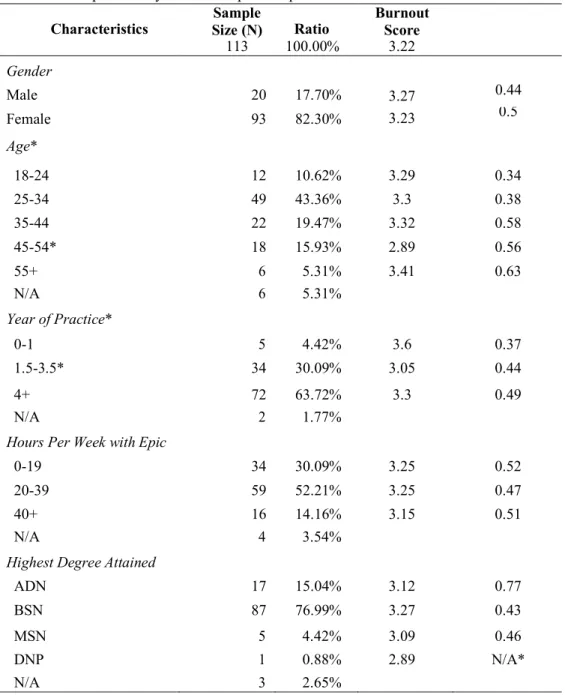
A total of 113 RN’s participated in this study. Female nurses made up 82.3% of the
EHRS AND NURSING BURNOUT 9
(SD=10.65). Approximately 3 out of 4 participants were under the age of 45, indicating a relatively young population. Among the participants, 87 held a BSN as their highest completed degree, while 17 participants held an ADN. 5 of the participants held an MSN, and only 1 held a
DNP. Table 1 displays the characteristics for study participants.
Descriptive Study of the Population
Table 1. Descriptive Analysis of Participants Population
Characteristics Size (N) Sample Ratio Burnout Score
113 100.00% 3.22
Gender
Male 20 17.70% 3.27 0.44
Female 93 82.30% 3.23 0.5
Age*
18-24 12 10.62% 3.29 0.34
25-34 49 43.36% 3.3 0.38
35-44 22 19.47% 3.32 0.58
45-54* 18 15.93% 2.89 0.56
55+ 6 5.31% 3.41 0.63
N/A 6 5.31%
Year of Practice*
0-1 5 4.42% 3.6 0.37
1.5-3.5* 34 30.09% 3.05 0.44
4+ 72 63.72% 3.3 0.49
N/A 2 1.77%
Hours Per Week with Epic
0-19 34 30.09% 3.25 0.52
20-39 59 52.21% 3.25 0.47
40+ 16 14.16% 3.15 0.51
N/A 4 3.54%
Highest Degree Attained
ADN 17 15.04% 3.12 0.77
BSN 87 76.99% 3.27 0.43
MSN 5 4.42% 3.09 0.46
DNP 1 0.88% 2.89 N/A*
EHRS AND NURSING BURNOUT 10
The population average Burnout Score was 3.22, which was between neutral and satisfied with their experience with nursing EHR. The responses of nurses were subsequently analyzed in sub-groups, as found in Table 1. From the linear model’s summary resulted from stepwise regression, nurses between 45 and 54 years old were found to respond to survey questions significantly more negatively than their peers, yielding a mean Burnout Score of 2.89.
Alternatively, nurses who had between 1.5 and 3.5 years of experience reported a higher degree of burnout than those who practiced for either longer or shorter periods of time. The result from the linear model suggested that belonging to other subgroups did not have significant impacts on the Burnout Score. Female nurses, which contributed to 80 percent of the participant population, did not demonstrate a significantly different average Burnout Score compared to male nurses.
Kendall’s test and Fisher’s exact tests were used to examine whether nurses of a certain trait tended to respond to any question differently. This data can be found in Table 2. Three such subgroup-question pairs demonstrated correlation. With a p-value of 0.0019, Kendall’s test suggested that respondents with higher ages tended to consider the amount of time they spent on EHR tasks related to direct patient care as less reasonable (Question 3). In addition, higher age respondents held a stronger opinion against EHR’s positive effect on efficiency (Question 2), supported by a p-value of 0.0245 and correlation coefficient -0.18. The last significant pair, subgroup “year of practice” versus Question 4, suggested that respondents with more years of practice are better able to manage the amount of their work well.
Table 2. Kendall’s Test for Demographics and Question Responses Kendall’s Test p-value Corr. Coefficient
Age vs. Q3 0.0019 -0.2566
Age vs. Q2 0.0245 -0.1838
EHRS AND NURSING BURNOUT 11
Analysis of Survey Questions
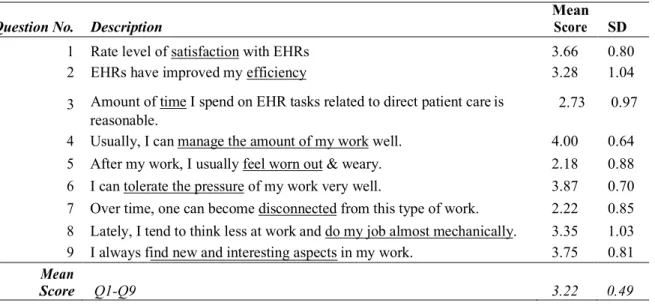
The average score of individual questions was calculated and compared to the population average, Table 3. Among the three EHR-specific survey items, Questions 1-3, participants responded most positively to Question 1 (3.66), suggesting an overall satisfaction with the
nursing EHR. However, the lower score received by Question 3 (2.73) indicated that, on average, participants believe that the balance between nursing EHR activities and direct patient care had not been achieved. The participants showed the highest agreement with Question 4 and Question 6, which measure the non-nursing EHR specific aspects of their work routine. Based on this information, nurses were generally positive about their ability to manage workload and work- related stress. Alternatively, the lowest agreement was observed in Question 5 and Question 7, where participants report feeling disconnected from the work and worn out.
Table 3. Mean and Mode Score of Survey Questions
Mean
Question No. Description Score SD
1 Rate level of satisfaction with EHRs 3.66 0.80
2 EHRs have improved my efficiency 3.28 1.04
3 Amount of time I spend on EHR tasks related to direct patient care is 2.73 0.97 reasonable.
4 Usually, I can manage the amount of my work well. 4.00 0.64 5 After my work, I usually feel worn out & weary. 2.18 0.88 6 I can tolerate the pressure of my work very well. 3.87 0.70 7 Over time, one can become disconnected from this type of work. 2.22 0.85 8 Lately, I tend to think less at work and do my job almost mechanically. 3.35 1.03 9 I always find new and interesting aspects in my work. 3.75 0.81 Mean
Score Q1-Q9 3.22 0.49
EHRS AND NURSING BURNOUT 12
questions. Concerns over EHR’s interference with direct patient care (Question 3) was the most reported issue among the three nursing EHR-related questions.
Figure 1. Diverging Bar Chart of Responses of Survey Questions
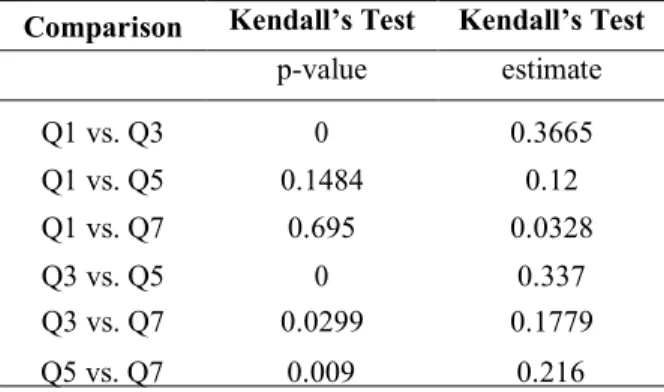
Kendall’s test was applied to assess the response resemblances among questions 1, 3, 5, 7, as seen in Table 4. Nurses who reported higher satisfaction with the balanced workload between nursing EHR and direct patient care (Question 3) also tended to report higher
satisfaction with EHR in general (Question 1). On the other hand, those who rated Question 3 lower also responded more negatively to Question 5 and 7, which captured the perceived level of stress and isolation an individual experienced in their work routine.
Table 4. Kendall’s Test for Question Comparisons Comparison Kendall’s Test Kendall’s Test
p-value estimate
Q1 vs. Q3 0 0.3665
Q1 vs. Q5 0.1484 0.12
Q1 vs. Q7 0.695 0.0328
Q3 vs. Q5 0 0.337
Q3 vs. Q7 0.0299 0.1779
EHRS AND NURSING BURNOUT 13
Discussion
This study evaluated EHR satisfaction among nurses across different units, age, clinical experience, gender, and EHR experience. Findings indicate that nurses were relatively satisfied with their EHR experience. However, they voiced concerns about their EHR experience, in which the EHR may hinder patient care and may lead to burnout. The highest reported
satisfaction scores were regarding nurses’ ability to manage the amount of assigned work. On the contrary, the proportion of time spent in the EHR compared to time on direct patient care was the lowest reported score, reflecting possible frustration.
Age was found to have a significantly negatively association with the perception of the EHR affecting direct patient care, with older nurses reporting that EHR time was not reasonable compared to patient care time. Additionally, age had a negative, significant correlation with the perceived improved efficiency as a result of EHR adoption; younger nurses agreed that EHRs have improved their efficiency compared to older nurses. Naturally, years of clinical experience had a significant, positive relationship with the ability to manage the amount of work, where nurses with more clinical experience reported higher ability to manage work.
EHR satisfaction had significant associations with perceived workload, overall wellbeing, and feeling disconnected from work, a characteristic of burnout. Nurses’ survey responses
EHRS AND NURSING BURNOUT 14
To the researchers’ knowledge, this is the first study to investigate the influence of EHR use on nursing burnout. Findings from this study are consistent with similar studies conducted on physicians and APRNs, wherein EHR use was found to contribute to professional burnout (Harris et al., 2018, Kossman, 2006, Shanafelt et al., 2016). Additionally, findings validate previous studies suggesting that professional experience and age affect the perceived EHR experience (Khairat et al., 2018).
Limitations and Future Direction
This study was conducted in a single site, which may affect the generalizability of findings. Another limitation of the study is the assessment of a single EHR system, despite the fact that this particular EHR system is a widely utilized system in the United States. Due to the lack of a validated survey instrument that measures the impact of EHRs on nursing burnout, a survey instrument was designed based on literature and domain experts’ input.
Future directions will include conducting a larger-scale, multi-site study to investigate if and how EHRs contribute to nursing burnout. This study provides baseline metrics for future research. Future studies will include conduction of formal usability testing to compliment findings from this study. Finally, additional studies and comparisons are needed around this problem beyond predominantly critical care settings in order to build a more holistic picture.
Conclusion
EHRS AND NURSING BURNOUT 15
16 EHRS AND NURSING BURNOUT
References
Awajeh, A.M., Issa, M.R., Rasheed, A.M., & Amirah, M.F. (2018). Burnout among critical care nurses in King Saud Medical City (KSMC). Journal of Nursing and Care, 7(2).
http://dx.doi.org/0.4172/2167-1168.1000450
Flarity, K., Gentry, J.E., & Mesnikoff, N. (2013). The effectiveness of an educational program on preventing and treating compassion fatigue in emergency nurses. Emergency Nursing Journal, 35(3), 247-258. http://dx.doi.org/10.1097/TME.0b013e31829b726f
Harris, D.A., Haskell, J., Cooper, E., Crouse, N., & Gardner, R. (2018). Estimating the
association between burnout and electronic health record-related stress among advanced practice registered nurses. Applied Nursing Research, 43, 36-41.
http://dx.doi.org/10.1016/j.apnr.2018.06.014
Hunsaker, S., Chen, H.C., Maughan, D., & Heaston, S. (2015). Factors that influence the development of compassion fatigue, burnout, and compassion satisfaction in emergency department nurses. Journal of Nursing Scholarship, 42(2), 186-194.
http://dx.doi.org/10.1111/jnu.12122
Khairat, S., Burke, G., Archambault, H., Schwartz, T., Larson, J., & Ratwani, R.M. (2018). Focus section on health IT usability: Perceived burned of EHRs on physicians at different stages of their career. Applied Clinical Informatics, 9, 336-347.
http://dx.doi.org/10.1055/s-0038-1648222
Kossman, S.P. (2006). Perceptions of impact of electronic health records on nurses' work. Studies in Health Technologies and Informatics, 122, 337-341. Retrieved from
17 EHRS AND NURSING BURNOUT
Maslach, C., Jackson, S.E., & Leiter, M.P. (1997). Maslach burnout inventory manual (3rd ed.). Retrieved from
https://www.researchgate.net/profile/Christina_Maslach/publication/277816643_The_Ma
slach_Burnout_Inventory_Manual/links/5574dbd708aeb6d8c01946d7.pdf
Maslach, C., Jackson, S., & Leiter, M. (1996). Maslach Burnout Inventory Manual (3rd ed.). Palo Alto, CA: Consulting Psychologists Press.
McHugh, M.D., Kutney-Lee, A., Cimiotti, J P., Sloane, D.M., & Aiken, L.H. (2011). Nurses' widespread job dissatisfaction, burnout, and frustration with health benefits signal problems for patient care. Health Affairs, 30(2), 202-210.
http://dx.doi.org/10.1377/hlthaff.2010.0100
Mealer, M., Burnham, E.L., Goode, C.J., Rothbaum, B., & Moss, M. (2009). The prevalence and impact of post traumatic stress disorder and burnout syndrome in nurses. Depression & Anxiety, 26(12), 1118-1126. http://dx.doi.org/10.1002/da.20631
Moss, M., Good, V.S., Gozal, D., Kleinpell, R., & Sessler, C.N. (2016, July). An official critical care societies collaborative statement: Burnout syndrome in critical care health care professionals: A call for action. American Journal of Critical Care, 25(4), 368-376. http://dx.doi.org/10.4037/ajcc2016133
Pines, A. (1981). Burnout: A current problem in pediatrics. Current Problems in Pediatrics, 11(7), 1-32.
18 EHRS AND NURSING BURNOUT
Shanafelt, T.D., Dyrbye, L.N., Sinsky, C., Hasan, O., Satele, D., Sloan, J., & West, C.P. (2016, July). Relationship between clerical burden and characteristics of the electronic
environment with physician burnout and professional satisfaction. Mayo Clinic Proceedings, 91(7), 836-848.
http://dx.doi.org/http://dx.doi.org/10.1016/j.mayocp.2016.05.007 Stamm, B.H. (2010). The concise ProQOL manual (2nd ed.). Retrieved from
http://www.proqol.org/uploads/ProQOL_Concise_2ndEd_12-2010.pdf UNC Health Care. (2019). About us. Retrieved March 1, 2019, from
https://www.uncmedicalcenter.org/uncmc/about/
19 EHRS AND NURSING BURNOUT
Demographics
Appendix A EHR-Burnout Survey
Age: Gender: Unit:
Highest Degree: (circle one) ADN BSN MSN DNP Years of Experience Using Epic:
Estimated # of Hours Weekly Using Epic: _
Please answer the following question using the following 1-5 scale: 1.
Please 2.
Strongly Disagree Disagree Neutral Agree Strongly Agree
1 2 3 4 5
3. Amount of time I spend on EHR tasks related to direct patient care is reasonable. Strongly Disagree Disagree Neutral Agree Strongly Agree
1 2 3 4 5
4. Usually, I can manage the amount of my work well.
Strongly Disagree Disagree Neutral Agree Strongly Agree
1 2 3 4 5
5. After my work, I usually feel worn out & weary.
Strongly Disagree Disagree Neutral Agree Strongly Agree
1 2 3 4 5
6. I can tolerate the pressure of my work very well.
Strongly Disagree Disagree Neutral Agree Strongly Agree
1 2 3 4 5
7. Over time, one can become disconnected from this type of work.
Strongly Disagree Disagree Neutral Agree Strongly Agree
1 2 3 4 5
8. Lately, I tend to think less at work and do my job almost mechanically.
Strongly Disagree Disagree Neutral Agree Strongly Agree
1 2 3 4 5
9. I always find new and interesting aspects in my work.
Strongly Disagree Disagree Neutral Agree Strongly Agree
1 2 3 4 5
Rate level of satisfaction with EHRs
Very Dissatisfied Dissatisfied Neutral Satisfied Very Satisfied
1 2 3 4 5