BRADLEY C. BLACKARD. A Technology Transfer Strategy for the National Institute of Environmental Sciences' Superfund Basic Research Program. (Under the Direction
of Dr. ALVIS G. TURNER)
A technology transfer strategy has been developed for the National Institute of Environmental Health Sciences' Superfund Basic Research Program to facilitate the dissemination of information and the transfer of technology from basic to applied research and eventually commercialization. This strategy was developed by examining the evolution of U.S. technology transfer policy and its implementation by the National Institutes of Health and the U.S. Environmental Protection Agency. Various methods of technology transfer are proposed by this strategy. These include developing and managing various information databases, the disseminating of information via publication and document mailouts, sponsoring and conducting conferences and workshops, supplying supplemental funds to grantees for scale-up and demonstration research, and providing a resource of contacts for our grantees within the environmental science field for technical assistance and the development of collaborative research efforts.
TABLE OF CONTENTS i LIST OF FIGURES AND TABLES iii
GLOSSARY V ACKNOWLEDGEMENTS vii
INTRODUCTION 1
I. THE SUPERFUND BASIC RESEARCH PROGRAM
A) Overview 5 B) Funding History 8 C) Current Technology Transfer Needs 10 D) Future Technology Transfer Needs 11
II. U.S. TECHNOLOGY TRANSFER POLICY
A) Introduction 14
B) The Evolution of U.S. Technology Transfer Policy Before 1980 15 C) The Evolution of U.S. Technology Transfer Policy in the 1980s 19 D) Conclusions 26 III. TECHNOLOGY TRANSFER WITHIN THE
NATIONAL INSTITUTES OF HEALTH
TABLE OF CONTENTS (cont'd) IV. TECHNOLOGY TRANSFER WITHIN THE U.S.
ENVIRONMENTAL PROTECTION AGENCY
A) Intra-agency Technology Transfer 44
B) The FTTA Program 47
(1) The CRADA Process 49
(2) The Licensing Agreement Process 54
C) The Superfund Innovative Technology Evaluation Program 56
D) The Hazardous Substance Research Center Program 60
E) EPA Database and Information Systems 61
V. TECHNOLOGY TRANSFER STRATEGY FORTHE SUPERFUND BASIC RESEARCH PROGRAM
A) Overview 65
B) Database Development 66
(1) The ERMIS Database 67
(2) Superfund-Specific Directory in Gopher 68
(3) Superfund Basic Research Program BBS 69
C) Superfund Basic Research Program Information Dissemination 70
D) Conferences and Workshops 72
E) Administrative Supplements for Additional Funding to Grantees 73
G) Technology Transfer Contacts in the Environmental Field 78
VI. CONCLUSIONS 80 REFERENCES AND BIBLIOGRAPHY 82
LIST OF FIGURES, TABLES AND APPENDICES
FIGURES;
FIGURE 1.1: Superfund Basic Research Programs 6
FIGURE 1.2: Superfund Basic Research Program Budget History 9
FIGURE III. 1: Technology Transfer Process at the NIH 29
FIGURE in.2: FTTA Implementation at the NIH 31
FIGURE III. 3: Invention Reporting Process at the NIH 35 FIGURE III.4: The Patent Application Process at the NIH 36 FIGURE III.5: The Licensing Process at the NIH 37 FIGURE III.6: The CRADA Review Process at the NIH 39 FIGURE III.7: The MTA Review Process at the NIH 41 FIGURE IV. 1: OSWER/ORD Hazardous Waste/Superfund 46
Research Committee
FIGURE IV.2: EPA's FTTA Program Process 50
FIGURE IV.3: CRADA Primary Review Process 52
FIGURE IV.4: 15-Day CRADA Signing Period 53 FIGURE IV.5: Process for Licensing Pre-existing Inventions 55 FIGURE IV.6: SITE Program Demonstration Technologies 57 FIGURE IV.7: SITE Program Emerging Technologies 59
TABLES;
TABLE I.l: Projects, Programs, and Funding Devoted to 12 Specific Research Categories
LIST OF FIGURES AND TABLES (cont'd)
TABLE II.2: % of Private Research Funded by the Government 16
TABLE IV. 1: U.S. EPA's Hazardous Substance Research Centers 62
TABLE IV.2: EPA Environmental Technology Information Sources 64
APPENDICES;
APPENDIX A: Superfund Basic Research Program Sponsored
Conferences and Workshops
APPENDIX B: Technology Transfer Contacts in the Environmental
ADAMHA BBS CDC CERI CRADA CSC DFM EPA ERMIS FIE FTTA GAD GOCO GOGO HERE HSRC ICD MeSH MTA NIEHS NIH
Alcohol, Drug Abuse and Mental Health Administration
Electronic Bulletin Board
Centers for Disease Control
Centers for Environmental Research Information
Cooperative Research and Development Agreement
Computer Sciences Corporation Division of Financial Management U.S. Environmental Protection Agency
Extramural Research Management Information System
Federal Information Exchange, Inc.
The Federal Technology Transfer Act of 1986
Grants Administration Division
Government Owned/Contractor Operated
Government Owned/Government Operated
EPA's Health Effects Research Laboratory
EPA's Hazardous Substance Research Centers
Institutes/Centers/Divisions Medical Subject Headings Material Transfer Agreement
National Institute of Environmental Health Sciences
NIST NTIS
OCTS
OE
OGC
OIG ORAM ORD ORTA OSWER OTT
OTTO
PHS SARA SITE
TDC
GLOSSARY (cont'd)
National Institute of Standards and Technology National Technology Information Service Office of Computer Technology and Services Office of Enforcement
Office of General Council
Office of Inspector General
Office of Administration, Resources, and Management EPA's Office of Research and Development
Office of Research and Technology Applications EPA's Office of Solid Waste and Emergency Response Office of Technology Transfer
Office of Technology Transfer On-line (BBS) Public Health Service
The Superfund Amendments and Reauthorization Act of 1986 Superfund Innovative Technology Evaluation Program
ACKNOWLEDGEMENTS
I would like to thank Dr. William A. Suk for his input and guidance during the
development of this report. I would also like to express my appreciation to the National
Institute of Environmental Health Sciences for allowing my flexible schedule and
supporting me during my study at Environmental Sciences and Engineering.
Special thanks go to my wife, Colleen, whose love, understanding, and patience
The United States government is investing a total of $70 billion on research and
development in fiscal year 1993 (FY93). Of this total, $25 billion is expended by
Federal Laboratories, $31 billion by industrial contractors and $11.8 billion by
universities.'' Approximately 100,000 scientists and engineers are employed by Federal
Laboratories, representing about 1 out of every 6 scientists and engineers in the United
States." This wealth of resources and knowledge represents great potential to benefit the
United States' technology base. A significant part of this potential is the development
of environmental technologies and the improvement of the understanding of the health effects from hazardous waste sites. "The international market for environmental goods
and services is more than $200 billion and growing at 5 percent a year. For smart U.S.
companies, our Federal Laboratories can be a source of innovative technologies, giving
them new opportunities and a competitive edge in the global marketplace".^^ As a result
of technology transfer, an abundance of innovative technologies can be accessed and
developed within the Federal Laboratory system, contributing to the advancement of U.S.
competitiveness at home and abroad.
For the purpose of this report, technology transfer is defined as the multi-faceted
process through which information, data, methods, and procedures developed through
research are delivered to and applied by other researchers, organizations, and individuals.
development agreements, the exchange of technical expertise, the dissemination of
information and research findings through publications and computer databases, and the
linking of potential research collaborators through the existing network of technology
transfer personnel and resources in government and private industry.
The transfer of basic research on the health effects of hazardous waste found at
Superfund sites, as well as innovative technologies designed to reduce and/or eliminate
the hazards associated with these wastes, to commercial uses is important for a number
of reasons. First, it is important to better understand the health effects of hazardous
wastes and to develop a means of determining the level and duration of exposure. This
knowledge can be used in the field to improve the process of risk assessment, provide
a more accurate means of prioritizing waste sites by their hazards, and determining when
a site has been remediated to a safe level. Second, by using innovative remediation
technologies at a waste site, the process of cleaning up can be done more completely and
usually at less cost. Finally, the economic benefits of transferring federally-funded
technologies to the private sector should result in an increase in economic activity due
to the large numbers of new products and methods being applied in the field as well as
the benefits to tax payers of receiving more "clean-up per dollar" with their
implementation.
The National Institute of Environmental Health Sciences' (NIEHS) Superfund
Basic Research Program is a university-based basic research program designed to study
the human health effects of hazardous substances in the environment, especially those
program has the potential to make significant contributions to the three important benefits
stated above. It is the purpose of this report to investigate technology transfer policy of
the United States government and examine the implementation of this policy in the
National Institutes of Health (NIH) and the United States Environmental Protection
Agency (EPA). This investigation will be used to develop a Technology Transfer
Strategy for the NIEHS Superfund Basic Research Program to help direct and prepare
its grantees for the successful development of their research from basic to applied,
scale-up and pre-commercial research, and eventually to commercialization.
This report begins by discussing the NIEHS Superfund Basic Research Program
including its development under the four mandates set forth by Congress, its
peer-reviewed grant selection process, its present situation and needs as well as the anticipated
future needs of this expanding program in the context of information and technology
transfer.
In part II the evolution of U.S. technology transfer policy is examined to plot a
course for the development of a technology transfer strategy for the NIEHS Superfund
Basic Research Program.
Part III examines the technology transfer policy of the NIH. Though the policy
of the NIH has traditionally been directed towards biomedical technology and does not
completely address the unique multidisciplinary requirements of the Superfund Basic
Research Program, the NIH may prove to be a valuable means by which to transfer
biomedical technologies from the Program.
programs and strategies that are used to develop technologies for waste site remediation.
Since the EPA's hazardous waste research objectives closely resemble those of the
Superfund Basic Research Program, their strategy will provide useful insight into the
development of a strategy for the Superfund Basic Research Program.
Part V discusses the technology transfer policy proposed for the Superfund Basic
Research Program which includes various means of information transfer using electronic
databases and annual mailouts; the sponsoring of conferences and workshops; and the use
of granting administrative supplements to Program grantees to collaborate with other
research institutions and private industry. This latter mechanism will be used specifically
to assist in translating their research to field and/or commercial application. In addition,
various contact resources to be used for technical assistance and/or the development of
A. Overview
The Superfund Amendments and Reauthorization Act (SARA) of 1986 established
a university-based program of basic research within the NIEHS, an institute of the NIH,
to complement existing activities within the EPA and the Agency for Toxic Substances
and Disease Registry. To accomplish this objective, the NIEHS developed the Superfund
Basic Research Program, which is now in its seventh year. This Program currently
provides funding to over 142 individual research projects within 18 programs at 29
universities around the United States to study the human health effects of hazardous
substances in the environment, especially those found at uncontrolled, leaking waste
disposal sites (see Figure 1.1).
The Program's primary objectives are to expand the base of scientific knowledge,
reduce the amount and toxicity of hazardous substances in the environment, and
ultimately, prevent adverse human health effects. The SARA legislation mandates that
the research funded by this Program should include development of (a) methods and
technologies to detect hazardous substances in the environment; (b) advanced techniques
for the detection, assessment and evaluation of the effects on human health of hazardous
substances; (c) methods to assess the risks to human health presented by hazardous
substances; and (d) basic biological, chemical and physical methods to reduce the amount
i
In meeting these objectives, the Superfund Basic Research Program is unique in that it supports coordinated, multicomponent, interdisciplinary research programs.
Sponsored research in the fields of ecology, engineering and hydrogeology (designated
collectively as non-biomedical research) have been integrated into a biomediccd research
program core which is designed to provide a broader and more detailed body of scientific
information. This information can then be used by state, local and federal agencies and
by private organizations and industry in making decisions related to the management of
hazardous substances. This approach encourages true collaborative efforts among researchers to address the public health concerns associated with hazardous wastes in the
environment.
To achieve a sound research program that is truly integrated, applications for funding are subjected to a competitive peer-review process. This process begins with the distribution of a Request for Applications (RFA) which formally announces granting opportunities. The NIEHS staff then selects applications that respond to the specific objectives listed in the RFA. These selected applications are then reviewed and evaluated by a group of outside consultants with expertise in fields relevant to the research the NIEHS seeks to encourage. The reviewed applications and comments are then subjected to a second level of review by the National Advisory Environmental Health Sciences Council. Selection of research programs are made by NIEHS staff based on Councils' and/or the reviewers' recommendations and on the funds available.
used successfully to establish support during Congressional budget testimony. Research
progress is evaluated administratively on a continuing basis through the submittal of
annual reports by grantees. These reports are used to monitor significant
accomplishments, publications, and to update the Program database.
B. Funding History^
The Superfund budget is administered by the EPA's Office of Solid Waste and Emergency Response (OSWER); however, Congress appropriates funding for the NIEHS Superfund Basic Research Program from the total Superfund budget. Funds are transferred from EPA to NIEHS via an interagency agreement. Figure 1.2 shows the funding history of the Superfund Basic Research Program. This Program was originally funded at $3 million in FY87. During the first year, only biomedical research was funded in four programs within four universities. The idea was to establish a biomedical
core within these programs and phase-in non-biomedical research after two years. At $3
million this Program represented only 0.19% of the total U.S.EPA Superfund budget.*
?;SJ5'S?
Ir^lS.S-yparlyjTjcJ tiBBmmh Pi-Dg/rsim
f^-if,: 'v^.r?. .x^i ͣ.< 'i):'?-%hXirJiiiVJ^i
s^! F/r;Jsifjiurjr'B
'^' ' , -,",4 -^ ,'. v'/^^-'
A''
'^' m
Dollars ^0
(in millions)
«^ »^^
it ^)UVWt}&'i!Bt
^ "VwuMv ^v ^w&i XwSv4hv 4w^ a ^ I v«w^M«
last expansion of the Program occurred in FY92 after another competitive renewal. The
funding rose to $30,615 million for 142 individual projects within 18 programs at 29
universities and institutions around the United States. Presently, the Program has been
appropriated $31.9 million for FY93 which represents 1.8% of the total EPA Superfund
budget.^ The House of Representatives has recently approved the budget for this
program at $32.9 million for FY94 while the overall Superfund budget has been cut by
$100 million. This budget is presently in the Senate and is expected to be passed with
similar funding amounts. At this level the Superfund Basic Research Program is 2.2%
of the total Superfund budget.*
While the budget for this program has seen increases over the past years, other
similar programs have not fared as well. The Health Effects Research Laboratory
(HERL) of the EPA, has been forced by reductions and eventual elimination of funding
to phase out its Superfund related health effects research.*-'^ This makes the NIEHS
Superfund Basic Research Program the only research of its kind being conducted by the
Federal government.
C. Current Technology Transfer Needs
Before its last expansion in FY92, this Program required very little technology
transfer. It consisted of compiling various program summaries, project descriptions,
research highlights, annual reports and other documents requested by NIH, U.S.EPA and
Congress. Since this was a basic research program very little was expected in the way
Program. As the Program expanded to its present size it became necessary to develop
an information database to manage the ever increasing amounts of information from 142
individual research projects. Table I.l shows the number of projects and funding
devoted to each major scientific discipline supported by this Program. This table
demonstrates the diversity of research and the size and difficulty in arranging this kind
of data into a comprehensible and usable format. Frequent requests were made to the
Principal Investigators of the 18 programs to supply information on significant research
findings, program summaries, project descriptions, listings of publications and summaries
of collaborations with other federal, state and local agencies as well as private
organizations and industries. This data is currently being compiled into a Superfund
Basic Research Program information database so that requests for data of this type can
be dealt with in a timely manner.
D. Future Technology Transfer Needs
In the future, this Program will require a more efficient means of disseminating
information as well as an innovative approach to transferring its technology from basic
research to applied, scale-up and demonstration research so that it may eventually be put
to work in the field. With the dissolution of the Superfund-related research being
conducted by HERL, it is increasingly important for this program to fulfill the task of
disseminating information and transferring basic technologies so that they can be used
to effectively clean up hazardous waste sites. The proposed technology transfer strategy
RESEARCH PROJECT CATEGORY *
NUMBER OFPROJECTS
NUMBER OF
PROGRAMS
TOTAL FIRST YEAR
FUNDING *
1 BIOMARKERS
35 11 $ 5,856,567HUMAN HEALTH EFFECTS 31 12 $ 3,788,134
BIOREMEDIATION 30 15 $ 3,918,289
EXPOSURE ASSESSMENT 27 12 $ 3,716,965
1 ECOLOGY
27 12 $ 3,299,4961 FATE AND TRANSPORT
27 12 $ 3,269,4361 EPIDEMIOLOGY
10 6 $ 1,414,877ANALYTICAL CHEMISTRY 6 6 $ 1,355,820
RISK ASSESSMENT
-BIOLOGICALLY BASED
8 5 $ 858,827
REMEDIATION
-NON-BIOLOGICAL
5 4 $ 737,859
COMBUSTION ENGINEERING 3 3 $ 372,286
TRAINING CORES N/A 10 $ 1,173,909
* The above categories and costs contain overlap with some projects being in more than one category. Cores in support
Research Program from basic to applied research but rather to facilitate the dissemination
of information and its application in the field. Criteria must be established to evaluate
the utility of each technology developed in this Program and the most appropriate vehicle
for transferring this information and technology. As this Program matures, the types of
transfers needed will continue to mature as well. With a well developed and flexible
strategy, the objective of this Program, to expand the base of scientific knowledge,
reduce the amount and toxicity of hazardous substances in the environment and to prevent
A. Introduction
In the late 1970s the United States realized that its technology policy of simply
funding basic research and allowing a wealth of scientific knowledge to remain hidden
behind the walls of academia and within federal laboratories was not a productive
approach to enhancing its technological base or the economy. The world market was
changing. Countries such as Japan and Germany were proving to be highly successful
with their policies of government and industry cooperating in the development of
innovative and marketable technologies. The United States, still unsurpassed in the
quality and quantity of federally funded basic research, would have to develop a policy
that would transfer this wealth of technology to its industries in order to remain
competitive in the world market. Over the next decade, a series of Congressional Acts
and Executive Orders would be signed which would change the United States' technology
policy and would allow for the government and the private sector to cooperate in the
development of technologies for commercial uses. Though the system is still evolving,
the proverbial ball is rolling and innovative environmental technologies are being
B. The Evolution of U.S. Technology Transfer Policy Before 1980
Before World War II the policy of the United States was to patent technologies
invented within the Federal Laboratory structure and make these patents available to
anyone who was interested through a non-exclusive license while the government retained
the rights to the patent.'*^-^^ This simple policy was adequate because a very large
majority of the federally funded research and development (R&D) was performed in
Federal Laboratories by government employees. The idea behind this policy was that
the public had financed the research so the public should keep the rights to the research.'*^
During World War II, the technological needs of the United States were greater
than could be supplied by Federal Laboratories and their employees alone. This caused
the U.S. government to begin the practice of utilizing contractors from private industry,
universities and non-profit organizations to fulfill its research and development
requirements. Table II. 1 shows the large role that the government has played in the
funding of all R&D from 1941 to 1988. This table also shows how the role of
government laboratories has decreased relative to the total R&D performed in the U.S.
Over the same time period the government has also contributed significantly to private
research and development. Table II.2 shows this large contribution from 1941 to 1988.
Comparison of Table II. 1 and II.2 indicates that, of the $60.5 billion invested by the
government on R&D in FY88, $46 billion was used to fund private research.
Throughout the time period from World War II to 1980, U.S. technology policy
remained largely unchanged from its pre-war position. No "government-wide" policies
(Amounts in Millions of Dollars)
Government R&D
Year Total R&D Funded R&D Percent Performed by Gov't Percent
1941 900 370 41.1 200 22.2
1945 1,520 1,070 70.4 430 28.3
1950 2,870 1,610 56.1 570 19.9
1955 6,279 3,510 55.9 905 14.1
1960 13,730 8,746 63.7 1,726 12.6
1965 20,439 13,040 63.8 3,093 15.1
1970 26,134 14,892 57.0 4,079 15.6
1975 35,213 18,109 51.4 5,354 15.2
1980 62,594 29,453 47.1 7,632 12.2
1985 107,757 51,668 47.9 12,945 12.0
1988 126,115 60,500 48.0 14,500 11.5
TABLE n.2: % OF PRIVATE RESEARCH FUNDED BY THE GOVERNMENT^'
(Amounts in Millions of Dollars)
Total Private R&D Funded
Year Private R&D byGovernment Percent
1941 700 170 24.3
1945 1,090 640 58.7
1950 2,300 1,040 45.2
1955 5,374 2,605 48.5
1960 12,004 7,020 58.5
1965 17,346 9,947 57.3
1970 22,055 10,813 49.0
1975 29,859 12,755 42.7
1980 54,962 21,821 39.7
1985 94,812 38,723 40.8
government contractors and grantees into the hands of those private parties who might
best use the technology to create something productive for society" or "to license
government-owned inventions to the private sector for commercialization".^^ Each
government agency developed its own procedure for licensing technology, making the
prospect of acquiring federally-owned technology for private use an extremely confusing
one.^** The first attempt to standardize the government patenting procedures throughout
the government was by President Kennedy in 1963 with a memorandum to agency
heads.^* This directive gave the government the right to obtain exclusive or principal
rights:
(1) where the purpose of the contract was to create, develop or improve
products, processes or methods for commercial use by the general public
or which were to be required for such use by government regulations;
(2) where the purpose of the contract was for research concerning public
health or welfare;
(3) where the research was in the field of science or technology where the
government has been the principal developer in the field; and
(4) where the contractor operates a government-owned research or production
facility or coordinates and directs the work of others.^^-^^
Contractors were allowed to obtain principal rights in situations not falling under
the above categories. Contractors were also required to report to the government on
their use of the acquired technology and, if no productive attempts were made at
commercializing this technology within three years, the government could "require the
granting of a license to an applicant on a non-exclusive royalty-free basis".^*'^^ This
directive also required the preparation of an annual report by the Federal Council for
Science and Technology, in consultation with the Department of Justice, which would
Because this policy left the decision of the fate of technologies to the separate agencies, this directive did little to standardize the patent process. President Nixon tried
again in 1971, witha "revised Statementof Government Patent Policy",^* by giving more
power to the heads of agencies in deciding if contractors receive principal rights. The
revised policy also gave principal rights to contractors in situations where government's
contribution to research is relatively small and the invention was not the primary objective of the contract.
These policies led to the development of many government-owned but unlicensed patents which were not being put to use. They had failed to transfer significant amounts of technology from basic research to commercial uses mainly due to lack of incentives for the collaboration between the government and private industry in the development of new technologies. Industry was wary when investigating a collaborative research effort with the government. There were no guarantees that returns on investment would be significant or whether a technology would be declared "for the public good" and would have to be licensed from the government. Some fundamental aspects of a capitalistic economy would have to be realized and incorporated into a technology transfer policy before the wealth of technology "owned" by the federal government could be utilized:
(1) technology transfer is not a hand off, but an exchange demanding significant interactions between the parties and potentially large commitments of money;
(2) "profits", however broadly defined, are the fuel of the nation's economic
engine; and
(3) without the prospect of profits, neither party in the exchange will be
Policy makers began to realize that the amount of resources being spent on R&D
was not being returned to society in an effective manner and was hurting the country's
productivity, as evident in the Congressional statement:
The United States can no longer afford the luxury of isolating its government laboratories from university and industry laboratories. Already endowed with the best research institutions in the world, this country is increasingly challenged in
its military and economic competitiveness. The national interest demands that the
Federal Laboratories collaborate with universities and industry to ensure continued advances in scientific knowledge and its translation into useful technology. The Federal Laboratories must be more responsive to national
needs. ^*
In response to these concerns, a series of Congressional acts and Executive Orders
were passed during the 1980s which would shape the U.S. Technology Transfer policy
of today.
C. The Evolution of U.S. Technolosv Transfer Policy in the 1980s
The first legislative attempt to deal with domestic technology transfer and address
the concerns of the United State's waning competitiveness in the world market was the
Stevenson-Wydler Technology Innovation Act of 1980."*^ The purpose of this act was to
"improve the economic, environmental, and social well-being of the United States"."^
To accomplish its objective, the act proposed five major initiatives to advance the
transfer of technology from Federal Laboratories to State and local government and
private industry. The first of these initiatives, found in section five, was the
establishment of an Office of Industrial Technology within the Department of Commerce.
This Office has the responsibility of investigating technology transfer policy, its
relationship to industry and the economy, and reporting to the President and Congress
The second major initiative of this act, section six, establishes Centers for
Industrial Technology. These Centers are affiliated with universities and/or non-profit
organizations through the assistance of the Department of Commerce and the National
Science Foundation. Their purpose is to enhance technological innovation by
participating in cooperative activities with individuals from universities and industry,
developing the generic research base, educating and training individuals in the
technological innovation process, improving mechanisms for the dissemination of
technological information, and utilizing the resources and expertise of the Federal
Laboratories. To promote the commercialization of any inventions developed within the
Centers, each Center has the option to acquire title to the invention provided that they
report this to the sponsoring agency and attempt to develop the invention to commercial
application within a reasonable period of time. Inventors were entitled to royalties from
the invention and the Federal Government was allowed to use the technology for its own
purposes.
The third major initiative of the Stevenson-Wydler Act is section nine which
establishes cooperative administrative arrangements between the Department of
Commerce, the National Science Foundation and eleven Departments and Agencies
within the Federal government. This establishes the authority for these Departments and
Agencies to participate in the funding or supplying of resources to research being
conducted at the Centers.
Section eleven of the Act is the forth major initiative and perhaps the most
Research and Technology Applications (ORTAs) and to fund this Office with not less
than 0.5% of its research and development budget. Those Laboratories which have a
budget exceeding $20 million will provide at least one full-time professional to handle
the job of technology transfer. This initiative is so important because it establishes a
technology transfer oriented office within each Federal Laboratory thereby adding
technology transfer to the mission of these laboratories.
The last major initiative is also found in section eleven, subpart (d), which
establishes a Center for the Utilization of Federal Technology within the Department of Commerce. This Center has several functions which include acting as a clearinghouse for the collection and dissemination of all federally owned or originated technology, coordinating the activities within the ORTAs, utilizing resources within the National
Science Foundation and the Federal Laboratory Consortium for Technology Transfer and
as a referral resource for State and local governments.
Though the Stevenson-Wydler Act made advances in the area of technology
transfer by establishing ORTAs in all federal laboratories and by adding the mission of
technology transfer to these laboratories, it did meet with some criticism. Many of the problems with implementing this act were a result of inadequate funding and resources. One study shows that many of the ORTAs were understaffed and were unable to carry
out the objectives of the legislation. This study also questions the ability of researchers
to judge the potential commercial viability of their own research.' Other criticisms have
been that the act was directed towards existing technologies and did not emphasize the
Later that same year Congress passed the Amendments to the U.S. Patent and
Trademark Laws of 1980 (more commonly known as the Bayh-Doyle Act of 1980) "to
use the patent system to promote the utilization of inventions arising from federally
supported research or development".^ Specifically, the Bayh-Doyle Act enabled small
businesses and non-profit organizations to patent and retain rights to inventions resulting
from federally funded R&D. This gave the much needed incentive for commercial and
non-profit organizations to develop and commercialize these inventions.''^ Even with the
added incentives from the Stevenson-Wydler Act and the Bayh-Doyle Act, the process
of technology development was hindered by the slow pace of patenting procedures and
proved to be discouraging.^'
In 1983, President Reagan signed a Memorandum on Government Patent Policy
which directed federal agencies to permit all government contractors to retain the rights
to inventions developed under contract or cooperative agreement with the government,
to the extent allowed by law,^° This memorandum opened up the Bayh-Doyle Act to
include essentially all government contractors, however, the problem of non-uniform
patent policies in different agencies remained.*^
In an attempt to bring previously exempt contractors into the technology transfer
process. Congress passed the Trademark Clarification Act of 1984 (or the Bayh-Doyle
Amendments).'** In Title V, section 501, of this Act, government-owned,
contractor-operated (GOCO) facilities which were not involved in naval nuclear propulsion or
weapons-related research and development were allowed to retain the title rights to their
inventions. These GOCOs also were given the right to license their technology without
In 1986, Congress amended the Stevenson-Wydler Act of 1980 by passing the
Federal Technology Transfer Act (FTTA) of 1986.'* This Act was a major step towards
facilitating technology transfer by establishing cooperative research and development as
an objective of Federal Laboratories. Under Section 12, the director of a
government-owned, government-operated (GOGO) facility may enter into a cooperative research and
development agreement (commonly referred to as a CRADA) with other Federal
agencies. State and local government, industrial organizations, public and private
foundations, non-profit organizations or other persons. CRADAs are a significant means
by which government and other organizations can collaborate to research and develop
pre-commercial inventions and ideas where the expense and risk would be too great for
either to research and develop on their own. This provides incentive for private
industries to look to the Federal government for ideas on new products and as a means
of developing existing ideas into products. Each agency has the authority to establish its
own CRADA development procedure.
Since private industry and many non-profit organizations already had a method
for rewarding innovation by recognition and monetary compensation, a similar method
was developed for Federal employees to provide them with incentive to be innovative.
In Section 13 of the Act, a process is established that rewards government personnel for
outstanding innovations, inventions or other scientific or technological contributions of
value to the United States and for exemplary activities that promote the domestic transfer
of science and technology resulting in the utilization of said technology. The inventor(s)
of the invention up to $100,000 per year per person (unless a greater amount is
authorized by the President). These amounts are in addition to the inventor's regular
income and the payments are continued for as long as the agency receives income from
the invention (even if the inventor leaves the agency).
Other amendments in this Act were the abolishment of the National Industrial
Technology Board and deleting the Centers for Industrial Technology and giving their
mandates to the Federal Laboratory Consortium for Technology Transfer. The
Consortium's activities include training Federal Laboratory employees about the
technology transfer process and determining the commercial viability of technology,
providing assistance to federal agencies with technology transfer as requested, and
serving as the government clearinghouse for technical assistance requests from public and
private sources. To address the problem of understaffed OTRAs, the Act required that
one full-time professional position devoted to technology transfer be established for every
200 full-time scientists, engineers and related technical positions instead of one full-time
position for every agency with expenditures over $20 million.
Though the FTTA of 1986 facilitated federal technology transfer, a couple of
issues remained unsettled. One such issue was that agencies and firms participating in
collaborative research found it difficult to protect proprietary information which resulted
from the CRADA.' Another issue was that the FTTA addressed GOGOs but GOCOs,
like Lawrence Livermore National Laboratory, were not included due to a concern for
protecting National security. Both of these issues were addressed in later legislation.
signed by President Reagan in 1987.^* This Order delegated authority from laboratory
directors to the laboratory itself to license, assign, or waive rights to technology
developed under a CRADA. In addition, the Secretary of Defense was instructed to
identify technologies within the Department which have the potential for
commercialization. Heads of Federal agencies were instructed to investigate the potential
for developing a university research center for science, engineering and technology in the
strategy and planning for future R&D programs. This Order reiterated the emphasis that
the administration was placing on technology transfer and assured that Federal facilities
were actively pursuing technology transfer objectives.
The Omnibus Trade and Competitiveness Act of 1988 changed the name of the National Bureau of Standards to the National Institute of Standards and Technology
(NIST). In addition to the objectives of the former National Bureau of Standards, the
NIST was mandated to facilitate efforts by the private sector to utilize advanced
technology through cooperative agreements between government, industry, and university
laboratories. The NIST was made responsible for assisting industry in technology
development to improve manufacturing processes and to develop more rapid
commercialization.
In the final piece of technology transfer legislation of the 1980s, the National
Competitiveness Technology Transfer Act of 1989 (or the Domenici Bill)^^ opened up the
GOCO facilities to provisions of the Stevenson-Wydler Technology Innovation Act of
1980 and its amendments, the FTTA of 1986, by allowing the development of CRADAs
purpose of this act was to enhance national economic well-being by facilitating
technology transfer from GOCO laboratories to the private sector and promoting the
development and commercialization of marketable technologies. This Act addressed the
other unresolved issue from the FTTA of 1986, namely problems experienced by
contractors in maintaining confidentiality of proprietary information developed under a
CRADA, Section 3133 amends the Stevenson-Wydler Act by requiring the director of
a GOGO or a GOCO to not disclose any proprietary information from a CRADA for a
period of five years.
D. Conclusions
This series of laws and Executive Orders laid the foundation for an efficient means to transfer technologies from the government to the private sector. The process of achieving a broad-based awareness throughout the government and private sector of the potential opportunities offered by this technology transfer structure is on-going.
Technology transfer is not a one-step process. There are many possible routes for
technology transfer and the diversity of processes to achieve transfer are vast and agency
specific. In order to understand the implications of these legislations on agencies with
a direct relevance to the Superfund Basic Research Program, the implementation of the FTTA will be examined for the NIH and the EPA. This discussion will outline the
existing structure within these agencies to direct possible collaborations and interactions
of the technology transfer personnel and the grantees of the Superfund Basic Research
OF HEALTH
A. Overview
The NIH is the world's largest basic biomedical research facility. The Institute is made up of twenty-one institutes, divisions, centers, and bureaus of which the NIEHS
is one. Traditionally, the NIH has conducted or funded research in the biomedical
sciences with the focus on improving human health and well being. Though the entire NIH spends over $7 billion annually on extramural research programs compared to approximately $900 million on research conducted within the Institute, or intramural programs, the FTTA Program at NIH is almost entirely focused on intramural research. The FTTA Program at NIH is responsible for assisting NIH scientists in patenting inventions, developing CRADAs between outside collaborators and NIH scientists, arranging licensing agreements, and approving Material Transfer Agreements (MTAs)
for NIH technology.
The extramural program is, by its very nature, excluded from the FTTA Program's objectives. This is because researchers receiving federal funds, in whole or
in part, are the owners of any inventions developed during the period of the grant.^ The
will be used as a resource and a service to guide grantees within the Program towards possible research collaborators, thereby developing their research or obtaining needed information to further their research. To this end, the FTTA process at NIH will be examined as a possible collaborator for the Superfund Basic Research Programs' biomedical scientists. Non-biomedical collaborations are more likely to be found within the EPA and related industries and will be examined in sections IV and V of this report. The FTTA Program at NIH is guided by five general principles: "(1) awareness of its central mission as a basic biomedical research institution; (2) adoption of procedures that complement but do no unduly complicate its research efforts; (3) recognition that public health and U.S. industrial competitiveness both are served by efficient technology transfer activities; (4) decentralized technology transfer authority; and (5) the involvement of industry and academia in the review of emerging policies and draft model agreements. These general principles are evident in the...day-to-day
activities of NIH's technology transfer programs."^
Under authority of the FTTA of 1986, NIH has developed a technology transfer strategy to facilitate collaborative efforts between itself and other government agencies,
universities, foundations, and industry through the use of CRADAs and patent licensing.
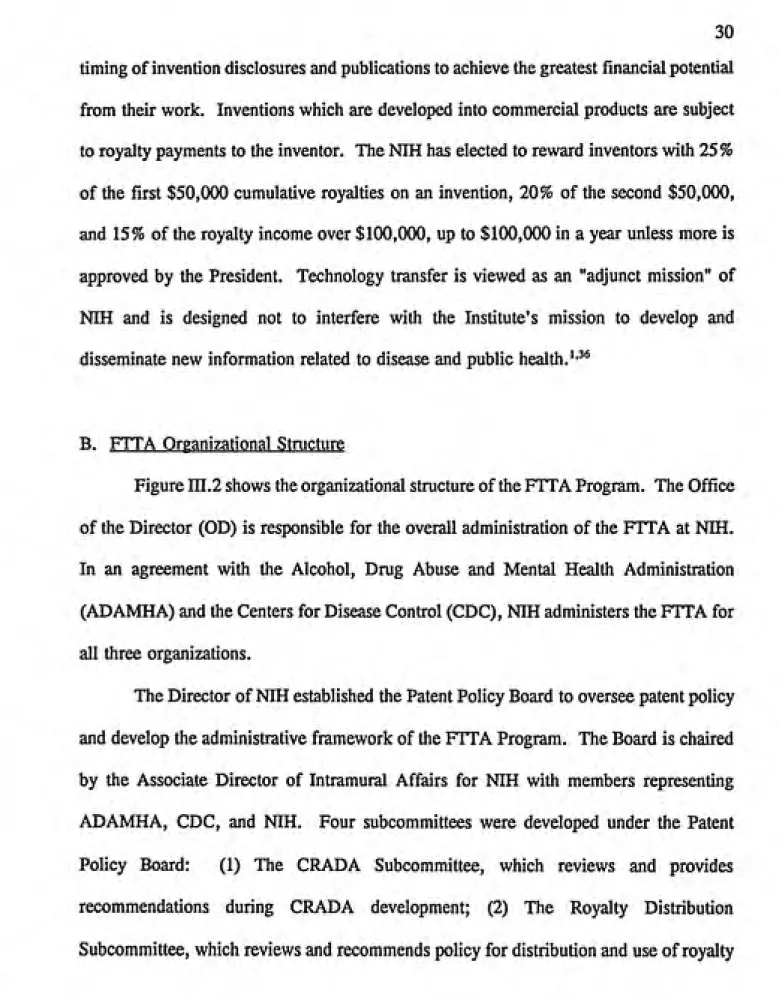
In addition, MTAs, which share research materials and data with outside sources, have been authorized by the Public Health Service (PHS). Figure III.l shows a schematic of the overall technology transfer process at NIH.
Scientists at NIH are encouraged to protect their research through the use of invention reports, patenting, licensing, MTAs, and CRADAs. Close interaction with the
INVENTIONS AT NIH
MTAs
m
DOMESTIC
~1 t
INVENTION REPORT
CRADAs
PATENTS
t
LICENSING AGREEMENTS
ROYALTIES
IlilllllWIIIII'llllllllllllllfllllllliill'l
timing of invention disclosures and publications to achieve the greatest financial potential
from their work. Inventions which are developed into commercial products are subject
to royalty payments to the inventor. The NIH has elected to reward inventors with 25 %
of the first $50,000 cumulative royalties on an invention, 20% of the second $50,000,
and 15% of the royalty income over $100,000, up to $100,000 in a year unless more is
approved by the President. Technology transfer is viewed as an "adjunct mission" of
NIH and is designed not to interfere with the Institute's mission to develop and
disseminate new information related to disease and public health. ^'^*
B. FTTA Organizational Structure
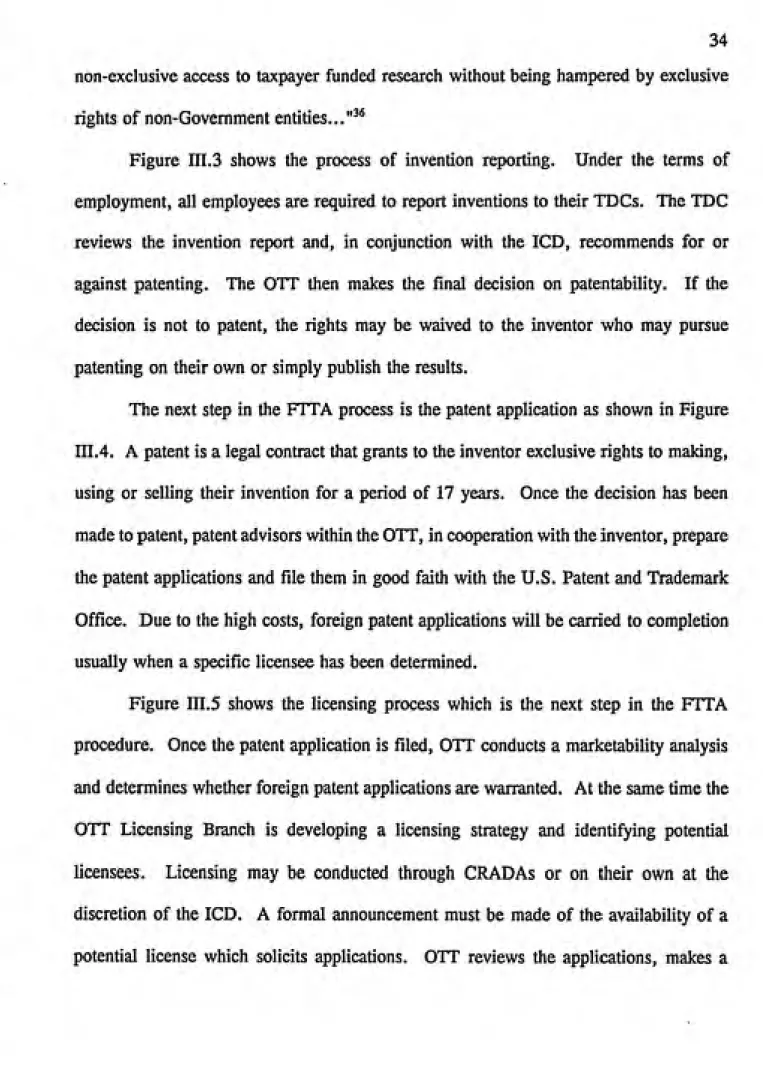
Figure III.2 shows the organizational structure of the FTTA Program. The Office
of the Director (OD) is responsible for the overall administration of the FTTA at NIH.
In an agreement with the Alcohol, Drug Abuse and Mental Health Administration
(ADAMHA) and the Centers for Disease Control (CDC), NIH administers the FTTA for
all three organizations.
The Director of NIH established the Patent Policy Board to oversee patent policy
and develop the administrative framework of the FTTA Program. The Board is chaired
by the Associate Director of Intramural Affairs for NIH with members representing
ADAMHA, CDC, and NIH. Four subcommittees were developed under the Patent
Policy Board: (1) The CRADA Subcommittee, which reviews and provides
recommendations during CRADA development; (2) The Royalty Distribution
Office of the Assistant Secretary for Health (DHHS Policy)
Director, NIH
Patent Policy Board (PPB) (recommends policy)
Subcommittees: 0 CRADA (reviews
CRADAs)
0 Royalty Distribution 0 Training
0 Technology Development Coordinators
Office of Technology Transfer (OTT) (implements policy)
inckjstry ttofversity
0 Patent Branch 0 Licensing Branch
incomes; (3) The Training Subcommittee, which recommends training requirements and
conducts training of NIH staff to facilitate technology transfer; and (4) The Technology
Development Coordinator Subcommittee, which provides a forum for Technology
Development Coordinators (TDCs) to be updated on new policy and provide comments
to the Patent Policy Board on technology transfer policy.
The OTT coordinates technology transfer policy and activities for NIH. Its major
responsibilities are to develop policy and procedures to implement Patent Policy Board
decisions, drafting CRADA and MTA models and other forms, and to patent and license
inventions. Other responsibilities include:
• coordinating a data management system for all PHS inventions, patents,
CRADAs, MTAs, licenses, and royalties.
• develop and maintain database of industry contacts and their area of research
interests.
• review CRADAs prior to Subcommittee review.
• host an annual Technology Transfer Forum where industry and government
scientists and representatives are brought together to showcase research and make
contacts for potential collaborations.
• publish an annual PHS Technology Transfer Directory listing names and
research interests of PHS contacts.'^
The OTT also has three Branches devoted to specific objectives of the FTTA. The
Technology Licensing Branch is responsible for marketing inventions to private
biomedical companies, the Patent Branch prepares and files for U.S. patents, and the
Technology Management Branch develops and maintains data and information
management systems.
implementation of the FTTA. The Office of General Counsel (OGC) oversees the
legalities of CRADAs and other agreements and also ensures that no conflicts of interest
occur in the technology transfer process. The Division of Financial Management (DFM)
receives and distributes royalty incomes from invention activities. The National
Technology Information Service (NTIS) provides advice and instructions to the OTT
through its Office of Federal Patent Licensing.
The Institutes/Centers/Divisions (ICD) of the NIH have the responsibility to
implement and monitor technology transfer activities within their organizations. These
include filing invention reports, negotiating CRADAs and MTAs, and distributing
royalties. All technical staff within the ICDs is made aware of the FTTA process
through training to ensure the proper and timely transfer of inventions. The interaction
between the ICDs and the OTT is facilitated by the TDC who acts as advisor, contact,
and liaison.
C. Invention Reports. Patent Applications, and Licensing
The major thrust of the FTTA Program within the NIH is technology transfer
through the patent process which includes reporting an invention, applying for a patent,
and licensing of the invention. The NIH pursues a patent for its inventions for three
reasons: "(1) to provide an incentive for private industry to develop and market the
invention and thus make it available to the public; (2) to provide royalty income through
licensing which [NIH] can utilize in carrying out their missions and which is shared with
non-exclusive access to taxpayer funded research without being hampered by exclusive
rights of non-Government entities... "^*
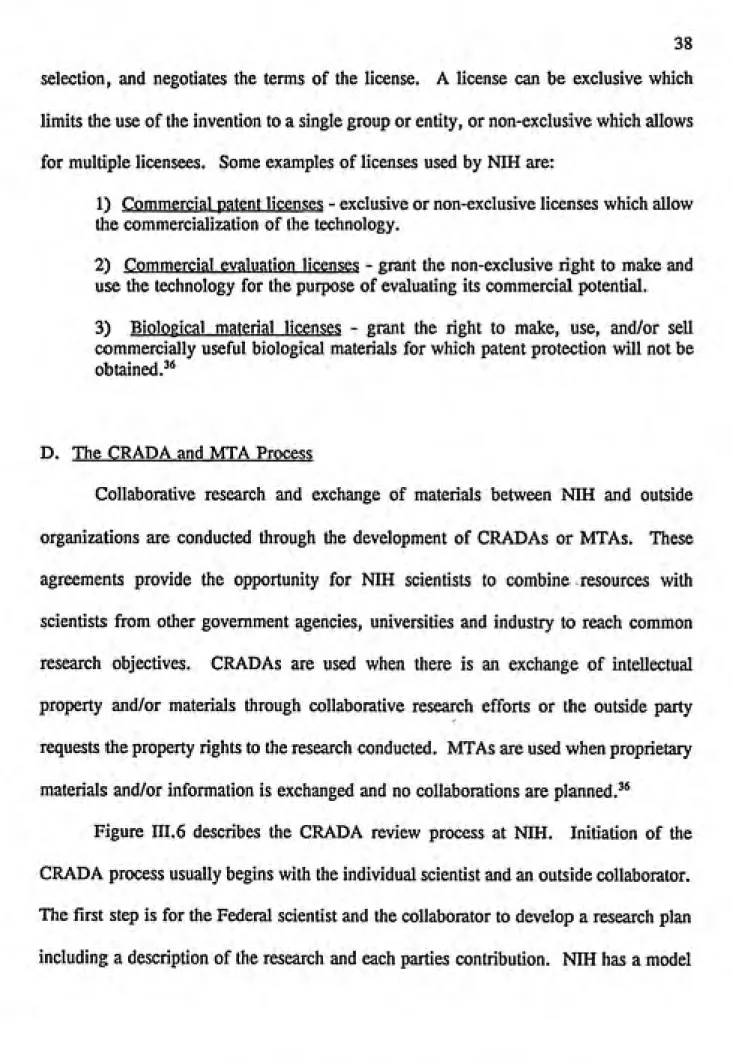
Figure III.3 shows the process of invention reporting. Under the terms of
employment, all employees are required to report inventions to their TDCs. The TDC
reviews the invention report and, in conjunction with the ICD, recommends for or
against patenting. The OTT then makes the final decision on patentability. If the
decision is not to patent, the rights may be waived to the inventor who may pursue
patenting on their own or simply publish the results.
The next step in the FTTA process is the patent application as shown in Figure
III.4. A patent is a legal contract that grants to the inventor exclusive rights to making,
using or selling their invention for a period of 17 years. Once the decision has been
made to patent, patent advisors within the OTT, in cooperation with the inventor, prepare
the patent applications and file them in good faith with the U.S. Patent and Trademark
Office. Due to the high costs, foreign patent applications will be carried to completion
usually when a specific licensee has been determined.
Figure III.5 shows the licensing process which is the next step in the FTTA
procedure. Once the patent application is filed, OTT conducts a marketability analysis
and determines whether foreign patent applications are warranted. At the same time the
OTT Licensing Branch is developing a licensing strategy and identifying potential
licensees. Licensing may be conducted through CRADAs or on their own at the
discretion of the ICD. A formal announcement must be made of the availability of a
ICD Technical Evaluation
Committee
Patent Branch Review:
o Determination of Rights
0 Inventorehip Determination 0 Patentability Analysis
f
Invention Report Submitted (DHHS FORM 570)
by Scientist
I
Lab/Branch/D ivisi on
Approval
i
To Technology Development Coordinator
for Review and Recommendation
re: Patenting
Determination to Patent
i
Invention Report to OTT
Case Docketed
\
OTT Coordinated
Patent and Licensing Review
OTT Licensing
Branch
0 Marketability Analysis
]
Determination not to Patent
T
T
Patent Rights
Waived to Inventor
Dedication of
Invention to Public
DETERMINATION TO PATENT
INVENTION DISCLOSURE TO PATENT ADVISOR FOR:
0 Patentability Search
0 Preparation of Patent Application
I
PATENT ADVISOR CONTACTS INVENTOR REGARDING PATENT APPLICATION PREPARATION
1
PATENT ADVISOR FILES
APPLICATION IN U.S. PATENT AND TRADEMARK OFFICE
THISISTHEOFFICiAL
U.S. PATENT FILING
DATEH!
PATENT APPLICATION FILED WITH U.S.
PATENT AND TRADEMARK OFFICE (PTO)
AND FOREIGN PATENTS APPLIED FOR AS APPROPRIATE
\
TECHNOLOGY MANAGEMENT TEAM
0 Considers licensing approach 0 identifies potential licensees o Works witli ICD to obtain input
\
WORLDWIDE LICENSING BY OTT
0 Advertise for potential licensees o Negotiate terms of license(s).
involving ICD when exclusive
license is a consideration
i
LICENSING ADMINISTERED
BY OTT OR NTIS
\
ROYALTY INCOME DISBURSED
BY NIH/DIVISION OF
selection, and negotiates the terms of the license. A license can be exclusive which
limits the use of the invention to a single group or entity, or non-exclusive which allows
for multiple licensees. Some examples of licenses used by NIH are:
1) Commercial patent licenses - exclusive or non-exclusive licenses which allow the commercialization of the technology.
2) CommercizJ evaluation licenses - grant the non-exclusive right to make and
use the technology for the purpose of evaluating its commercial potential.
3) Biological material licenses - grant the right to make, use, and/or sell commercially useful biological materials for which patent protection will not be
obtained. ^^
D. The CRADA and MTA Process
Collaborative research and exchange of materials between NIH and outside
organizations are conducted through the development of CRADAs or MTAs, These
agreements provide the opportunity for NIH scientists to combine resources with
scientists from other government agencies, universities and industry to reach common
research objectives. CRADAs are used when there is an exchange of intellectual
property and/or materials through collaborative research efforts or the outside party
requests the property rights to the research conducted. MTAs are used when proprietary
materials and/or information is exchanged and no collaborations are planned.^
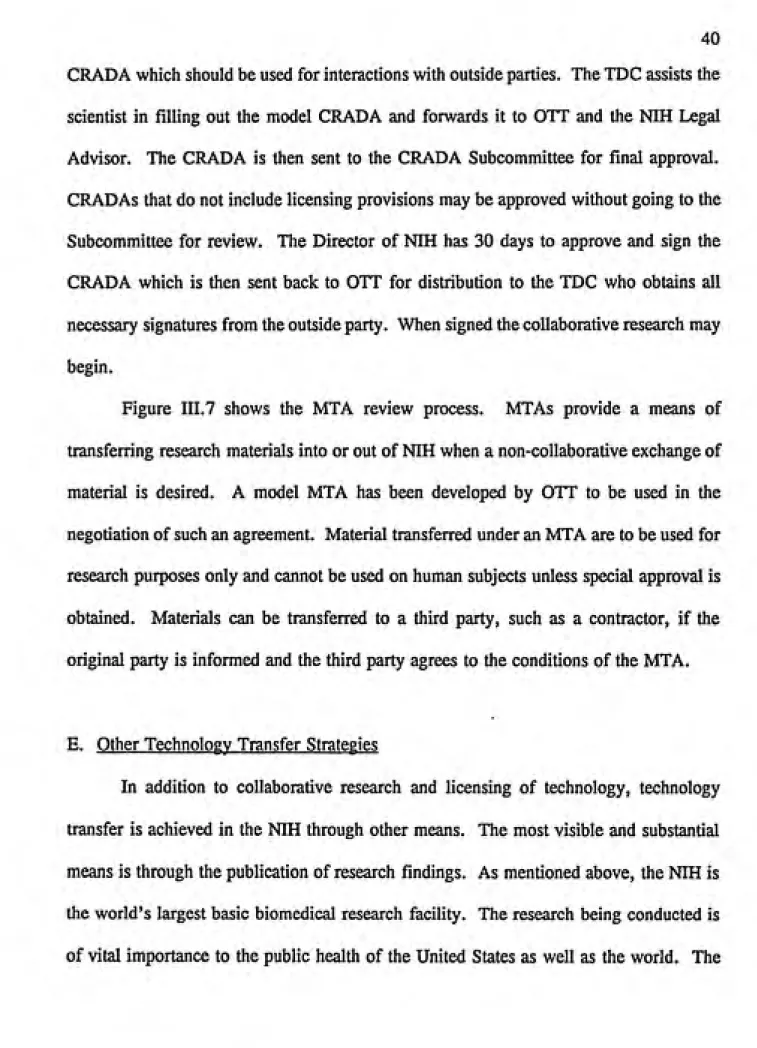
Figure III.6 describes the CRADA review process at NIH. Initiation of the
CRADA process usually begins with the individual scientist and an outside collaborator.
X NtH/ADAMHA SCIENTIST NIH/AOAMHA SCIENTIST/TECHNOLOGY DEVELOPMENT COORDINATOR RESEARCH PLAN
i
USE MODEL CRADA AND DEVELOP APPROPRIATE APPENDICES OTHER PARTY'S SCIENTIST OTHER PARTY TDC/SCIENTIST (OTTIF APPROPRIATE)REVIEW BY ICD
TECHNICAL ADIVISORY. COMMITTEE
i
CRADA NEGOTIATIONS OTHER PARTY\
CLEARANCES OBTAINED OTHER PARTY CLEARANCES LEGAL OFFICE/ OTT/TDC/ICD1
TECHNOLOGY DEVELOPMENT COORDINATORI
CRADA REVIEW SUBCOMMITTEEPATENT POLICY BOARD
£
APPROVAL RECOMMENDED;
RETURNED
TOTDC
TDC SENDS COPY OF EXECUTED AGREEMENT TO SCIENTIFIC DIRECTOR AND OTT
i
i
NIH/ADAMHA. DISAPPROVAL/ MODIFICATION : RETURNED TO SCIENTIFIC DIRECTOR VIA TDC FOR FURTHERACTION
CRADA which should be used for interactions with outside parties. The TDC assists the
scientist in filling out the model CRADA and forwards it to OTT and the NIH Legal
Advisor. The CRADA is then sent to the CRADA Subcommittee for final approval.
CRADAs that do not include licensing provisions may be approved without going to the
Subcommittee for review. The Director of NIH has 30 days to approve and sign the
CRADA which is then sent back to OTT for distribution to the TDC who obtains all
necessary signatures from the outside party. When signed the collaborative research may
begin.
Figure III.7 shows the MTA review process. MTAs provide a means of
transferring research materials into or out of NIH when a non-collaborative exchange of
material is desired. A model MTA has been developed by OTT to be used in the
negotiation of such an agreement. Material transferred under an MTA are to be used for
research purposes only and cannot be used on human subjects unless special approval is
obtained. Materials can be transferred to a third party, such as a contractor, if the
original party is informed and the third party agrees to the conditions of the MTA.
E. Other Technology Transfer Strategies
In addition to collaborative research and licensing of technology, technology
transfer is achieved in the NIH through other means. The most visible and substantial
means is through the publication of research findings. As mentioned above, the NIH is
the world's largest basic biomedical research facility. The research being conducted is
NIH/ADAMHA
SCIENTIST
DESIRED
MATERIAL
OTHER PARTY'S SCIENTIST
TECHNOLOGY DEVELOPMENT
COORDINATOR
I
MODEL MTA OTHER PARTY
i
OGC/OTT FOR ADVICE ON NON-MODEL
MTAs
MTA EXECUTED BY SCIENTIFIC DIRECTOR
OR ICD DESIGNEE
EXECUTED DOCUMENTS
DISTRIBUTED BY TDC TO SCIENTIST AND/OR
media has been a major player in making research findings of the NIH widely known.
Research concerning AIDS, cancer, and heart disease are hot topics for health-related
reports throughout the media.
Another means of technology transfer within NIH is the use of databases to
compile and manage information on research being conducted both intramurally and
extramurally. Most of the existing databases, such as the In-house Expertise Database
and the Extramural Research Management Information System (ERMIS), are Institute
specific with no means of access NIH-wide or publicly. This makes their use as
information sources for outside sources non-existent. This limited access is due to
concerns by Budget Directors and Administrators that funding amounts will be
misinterpreted by the public. In addition the scientific community is concerned with their
research findings being leaked to the outside without authorization. Although the major
objective of the NIH is to publish research findings for the public's use, this process is
controlled by NIH to protect its interests.
Two publicly accessible databases, the Public Health Service Office of
Technology Transfer On-line (PHS OTTO) and Gopher, are exceptions to NIH's closed
database policy. PHS OTTO is an electronic bulletin board which lists and updates a
variety of technology transfer information. This information includes current CRADA
listings, technologies available for licensing, research contacts within PHS, and
technology transfer procedure and policy information. Gopher is a worldwide
information access and retrieval program available through Internet. This program has
as an electronic bulletin board like PHS OTTO, will be investigated as potential
information systems for the Superfund Basic Research Program in section V of this
PROTECTION AGENCY
A. Intra-agency Technology Transfer
Technology Transfer within the U.S. EPA occurs through a variety of sources.
Essentially, they may be broken down into two categories: (1) technology transfer
between the various national and regional offices of the U.S. EPA, and, (2) transfer from within the U.S. EPA to the outside, including other federal, state and local agencies as well as non-profit organizations and private industry. This report is primarily interested with the second category, however, the first will be addressed briefly.
The transfer between Agency offices takes place on many levels and is designed to coordinate the approach of the Agency's overall mission, to protect human health and the environment. A detailed discussion of the structure and interworkings of this structure is beyond the scope of this report; however, a brief mention of the relationship between the Office of Research and Development (ORD), which is in charge of implementing the FTTA Program, and OSWER, which is responsible for Superfund, is
in order.
OSWER's mission is to utilize the researched, developed and demonstrated technologies from ORD and apply the best solutions available to clean-up hazardous
waste sites around the United States.^' To achieve an efficient exchange of research
Hazardous Waste/Superfund Research Committee (See Figure IV. 1). The Committee is
comprised of representatives from research, regulatory and enforcement offices, as well
as from Regional offices. This Committee establishes research needs and priorities for
ORD. It is "the principal cross-office organizational unit for integrating the needs and opinions of regulation developers in OSWER, regulation implementers in the Regions and
states, and scientists and engineers in ORD"."
With the passage of SARA in 1986, the U.S. EPA and several other agencies
were given Superfund money to research health effects of waste sites and alternative
technologies to clean up these sites (the NIEHS was one of the designated agencies). Because the interdependency between ORD and OSWER was emphasized with this mandate, a collective effort was made to evaluate the technology transfer needs of both Offices. In 1987 ORD and OSWER released an office-wide "Technology Transfer
Strategy". This Strategy centralized the planning for technology transfer to facilitate the
transfer of information and the prioritizing of strategies for transfer. While the planning and organization of technology transfer strategies is centralized, the implementation of the strategy is decentralized to streamline the process and eliminate unneeded bureaucracy.
Technology transfer was also incorporated into R&D planning by deciding from the beginning the target audience for each research project. To accomplish this, ORD
and OSWER require a one-page "Technology Transfer Plan" to accompany each project
proposal intended to produce technical information. This type of strategy was developed
FIGURE IV.l: OSWER/ORD HAZARDOUS WASTE/SUPERFUND RESEARCH COMMTTTEE^^
Research Needs Research Plans
Regions
\
Hazardous Waste/
Superlund
Research Committee
Lead
Regions *
National
Governor's
Association
K
• Sop9rhind
Sobcommitt00 • RCRA
Siit>oomfnitt0^ • Ttchnotogy
Transfer
Sohcomrmtt»9
— ORD
r
OSWER
-, f
ͣ Nto identify and design optimal technology transfer products".^' This idea of requiring
research objectives to be stated before research has begun is already being utilized by the NIEHS in its peer-review process.
To prioritize technology transfer needs, the Technology Transfer Subcommittee under the Hazardous Waste/Superfund Research Committee was formed. This subcommittee ranks technology transfer needs within the U.S. EPA and advises the Committee on the allocation of resources. The "Technology Transfer Strategy" developed by both ORD and OSWER establishes close operating ties for technology transfer and efficient planning. For the purpose of collaborating with the EPA, it is important to know how these offices transfer technology and information between themselves. This knowledge can be used to direct inquiries about potential collaborations to the correct Office. This Strategy addresses requirements made by SARA but does not deal with specifications of the FTTA.
B. The FTTA Program
The provisions of the FTTA of 1986 are implemented by the FTTA Program within ORD. The FTTA Program is "designed to promote a closer, collaborative
relationship between Federal government agencies and the private sector".^* This
Program is aware that innovative technologies flow in both directions. To accommodate this bi-directional flow, the FTTA Program is prepared to provide technical expertise, facilities, equipment, and supplies to research projects developed outside the U.S. EPA