Bet hedging via multiple mating: A
meta-analysis
Luke Holman1,2
1Division of Evolution, Ecology and Genetics, Research School of Biology, Australian National University, Canberra, ACT
2601, Australia
2E-mail: [email protected]
Received September 16, 2015 Accepted November 15, 2015
Polyandry has been hypothesized to allow females to “bet hedge” against mating only with unsuitable mates, reducing variance in offspring fitness between members of a polyandrous lineage relative to a single-mating one. Theoretically, this reduction in fitness variance could select for polyandrous genotypes even when polyandry carries a direct cost, especially in small populations. However, this hypothesis is controversial and difficult to test empirically. Here, I apply a novel simulation model to 49 published empirical datasets, and quantify the potential selective advantage of multiple mating via reduced offspring fitness variance. For a wide range of assumptions, including those that most favor the evolution of bet hedging, I show that any fitness gains are meager. The variance in offspring quality caused by mate identity does not appear to be high enough for bet hedging to drive the evolution of polyandry.
K E Y W O R D S : Evolution, fitness variance, multiple mating, polyandry, simulation.
By definition, a genotype conferring high mean fitness tends to increase in frequency relative to competing genotypes conferring lower mean fitness. Classic work in population genetics (e.g., Haldane 1927; Wright 1945; Kimura 1954, 1962) produced equa-tions linking a genotype’s mean relative fitness to its fixation prob-ability and expected time to fixation (reviewed in Patwa and Wahl 2008). These equations considered a population that was large and freely interbreeding, meaning that stochastic fluctuations around the genotypic mean fitness could be ignored. Because of the as-sumption of large population size, classic population genetics states that the evolution of a genotype is affected by the mean fitness of its carriers, but not by theirvariancein fitness.
However, one might expect that a genotype with highly vari-able fitness might sometimes be outcompeted by a genotype with similar mean fitness but lower variance, because the variable geno-type is more likely to go extinct due to stochastic “losing streaks.” For example, consider two genotypes of annual butterfly, one “risk taker” that lays all its eggs on an individual plant, and one “bet hedger” that spreads its eggs across several plants. Further, as-sume there is a fixed probabilityPthat any given plant will be eaten by other herbivores before the young can develop. Assum-ing there is no cost to layAssum-ing on multiple plants, such that the two
genotypes have identical mean fitness, the risk taker should have a higher extinction probability. If there are 10 females of each of the two genotypes in the population, the chance that all of the risk takers’ eggs fail in a given generation, causing that genotype to go locally extinct, isP10(e.g., 2.8% ifP=0.7); the corresponding chance for a bet-hedger genotype that lays its eggs on five plants isP50(<0.0001%). More subtly, the single-plant genotype has a
higher chance of underproducing offspring in some generations, and thereby reaching a sufficiently low frequency to go extinct for other reasons.
This example hints at the importance of population size to stochastic processes that act within a generation. If there were instead 1000 individuals of each genotype, the probabilities of total reproductive failure would beP1000 andP5000 for the two butterfly genotypes; both numbers are so close to zero that they are effectively identical (unlessP1), meaning that genotypic variance in fitness is inconsequential (c.f. Hopper et al. 2003). Later work (e.g., Gillespie 1973, 1974; Frank and Slatkin 1990) relaxed earlier population genetic models’ assumptions of large population size, and demonstrated that a genotype’s probability of spreading and fixing is positively related to its mean fitness, and negatively related to its variance in fitness. However, the
effect of relative variance in fitness on evolution is weighted by effective population size (Ne), and becomes vanishingly small even at moderateNe(Gillespie 1974; Starrfelt and Kokko 2012). Biological strategies with low variance in fitness are called “bet hedging” strategies, although this term is usually reserved strictly for strategies that exchange lower mean fitness for re-duced variance (e.g., a butterfly that lays eggs on multiple plants, but produces a smaller average clutch). Bet hedging is often fur-ther categorized into within- and between-generation bet hedging (but see Starrfelt and Kokko 2012; Schreiber 2015). In the for-mer, individuals within a given generation experience different environments (as in the butterfly example above); in the latter, the environment is the same for all members of a genotype within a given generation, but can shift between generations. Between-generation bet hedging is regarded as more likely to evolve, be-cause a genotype is likely to go extinct if all its members perform very poorly in some generations (Starrfelt and Kokko 2012). This means that between-generation variance in fitness can have non-trivial evolutionary effects even in infinite populations (Gillespie 1974). By contrast, adaptations to within-generation bet hedg-ing are considered less plausible because many populations ap-pear to have large Ne, suggesting that only the mean relative fitness of competing genotypes (and not the variance) will af-fect evolution (Gillespie 1974; Hopper et al. 2003; Starrfelt and Kokko 2012).
Here, I focus on bet hedging as a potential explanation for the evolution of polyandry, that is, when multiple males sire the offspring of a single female. Polyandry is considered puzzling be-cause it does not always obviously increase female mean fitness, and may even have a negative effect (Slatyer et al. 2012). Polyan-drous genotypes have been hypothesized to have lower variance in offspring fitness, and thereby to outcompete “monandrous” genotypes that produce offspring using sperm from a single male (Stockley et al. 1993; Yasui 1998, 2001; Fox and Rauter 2003; Starrfelt and Kokko 2012; Garc´ıa-Gonz´alez et al. 2015; Wilson and Tomkins 2015). There are at least three nonexclusive mecha-nisms by which polyandry might allow bet hedging. First, if males display additive genetic variance for fitness, polyandry reduces the chance of only producing offspring with “bad genes.” Second, if offspring fitness depends on an interaction between phenotype and the environment, and the environment varies in time or space, the increase in offspring phenotypic diversity resulting from mul-tiple paternity could reduce variance in fitness. Third, if offspring fitness depends on genetic (e.g., epistasis and dominance) or non-genetic (e.g., relating to the immune system) interactions between the mother and father, the polyandrous genotype will again tend to produce clutches with lower variance in fitness. For example, consider inbreeding: under random mating, a set of monandrous females is more likely to mate exclusively with close relatives than is a set of polyandrous females. Polyandrous females have
also been proposed to bet hedge against receiving insufficient sperm to fertilize all their eggs (Garc´ıa-Gonz´alez et al. 2015), or to remate to facilitate sperm competition in case the first mate has inferior genes and also uncompetitive sperm (Watson 1991, 1998). However, these two hypotheses do not strictly constitute bet hedging because they imply that polyandry has a net positive effect on mean fitness.
Variation in male quality is “within-generation” variation, so it is unclear whether polyandry could be strongly selected via bet hedging (Starrfelt and Kokko 2012). An intuitive method to test whether polyandry allows bet hedging is to simply compare the mean and variance in fitness of multiply and singly mated females. However, such experiments are problematic. Unlike monandry, polyandry often results in sperm competition, which putatively affects the mean and variance of offspring fitness (Slatyer et al. 2012). Females might also differentially invest in their offspring (e.g., Horv´athov´a et al. 2011) after mating onceversusmultiple times. Both of these confounding effects were removed in a recent, thoughtfully designed experiment on an externally fertilizing sea urchin (Garc´ıa-Gonz´alez et al. 2015), but the protocols employed (e.g., mixing of eggs and sperm in Petri dishes) cannot be used in most taxa.
To avoid the complications of sperm competition and fe-male differential investment, Fox and Rauter (2003) looked for bet hedging in an experimental design involvingmalemultiple mating. They mated males to several females each (whereas fe-males mated only once), and then used computer simulations to estimate the average mean and variance in offspring fitness traits for hypothetical single- and multiple-mating strategies, by ran-domly sampling males, females, and offspring from their dataset. Although one need not invoke selection on variance to explain the evolution of male multiple mating (e.g., Bateman 1948), Fox and Rauter reasoned that male multiple mating should reduce vari-ance in offspring fitness by a similar amount to female multiple mating, and thus provide a means of indirectly measuring the bet-hedging effects of polyandry while avoiding the associated confounds. Their approach seems reasonable, because the three mechanisms by which polyandry has been proposed to reduce offspring fitness variance (see above) are agnostic with respect to the sex of the multiply mated parent.
The experimental design used in Fox and Rauter (2003), that is, mating a “sire” to multiple “dams” and then measuring their offspring, is used very often in quantitative genetic studies; this so-called paternal half-sib design is popular because it provides accurate estimates of additive genetic variance and covariance (e.g., Lynch and Walsh 1998). In the present study, I collected many datasets from paternal half-sib designs, performed simula-tions loosely based on those of Fox and Rauter (2003) to measure the extent to which male multiple mating reduces variance in off-spring fitness, and then performed a meta-analysis of the results.
The results reveal the scope for the evolution of polyandry as a means of bet hedging across diverse taxa.
Methods
COLLECTING DATA ON THE OFFSPRING OF MULTIPLY MATED MALES
I gathered data from peer-reviewed empirical studies in which individual males had been mated to two or more females, and a fitness trait measured in the resulting offspring. Relevant studies were found by searching for [“paternal half-sib∗” OR “quanti-tative genetic∗” AND year published=2009–2014] in Web of Science on December 9, 2014. Search hits were included in this study if (1) they described trait measurements on full- and half-siblings resulting from male multiple mating, (2) data were col-lected on at least 15 males mated to two or more females each, (3) the trait measured in the offspring is likely correlated with fitness (I excluded a few studies where the focal trait was of agricultural but not Darwinian interest), (4) mating pairs were randomly as-signed by experimenters. I then obtained the raw data from the authors, or from a public repository such as DataDryad (where available). I also included suitable datasets that were found on DataDryad (for various search terms such as “quantitative genet-ics” and “half sib”), as well as additional suitable datasets sent by authors I contacted.
For primary studies that measured multiple offspring traits, I picked the trait that I judged to be most closely correlated with fitness. The trait was chosen before running any analyses, pre-cluding “fishing” for results. For two of the studies (Blows and Higgie 2003; Gosden and Chenoweth 2014), the authors measured a suite of cuticular hydrocarbons. Using data from other studies, I predicted the sexual attractiveness of these individuals (see Sup-porting Information), because predicted attractiveness is likely to be a better proxy for fitness than any particular hydrocarbon.
Many fitness traits differ between the sexes (e.g., body size, life span), and the relationship between relative trait size and rel-ative fitness is often sex specific. For example, a “large male” is one that is large relative to other males, and male competitive success sometimes depends on being larger than rival males, ir-respective of mean female size. I therefore split all datasets that measured both sexes of offspring (and reported their sex) into two single-sex datasets. Because 13 publications were split into male and female datasets, I used 49 datasets from 36 publications in the analyses.
SIMULATING THE FITNESS OF SINGLE- AND MULTIPLE-MATING STRATEGIES
Synopsis of the simulation
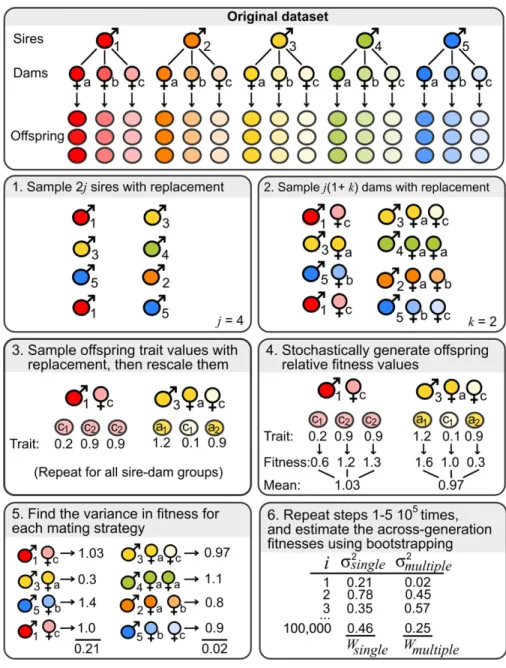
The simulation process is illustrated in Figure 1. In short, for each of the 49 datasets I simulated 100,000 “generations,” in whichj
hypothetical “single mater” males mated with one female each, and an additionalj“multiple mater” males mated withk dams each (i.e., there were 2jsires andj+jk) dams per generation).j
Was equal to the number of sires in the original dataset, whereask
was a parameter of the simulation (typicallyk=2). In each gen-eration, I first generated offspring trait values for the 2jsimulated males by sampling from the dataset, then stochastically generated offspring fitness values based on these trait values, and finally calculated the arithmetic mean and variance in fitness for the single- and multiple-mater strategies. The strategy-level within-generation mean and variance in fitness can be used to calculate the fitness of the two mating strategies across generations, allow-ing measurement of the benefits of bet hedgallow-ing (Gillespie 1974). I consider the assumptions made by this simulation exercise in the Discussion.
The simulation was written in R, and involved multiple rounds of random sampling within each generation. The resam-pling procedure aimed to model variance in offspring trait values present in the original datasets arising from (1) sampling of males from the total population, (2) sampling of females from the to-tal population, (3) random assignment of mates, (4) sampling of offspring trait values from the distribution of trait values that a given mating pair might produce. The simulation also allowed for stochasticity in the fitness of offspring possessing any particular trait value. The model needs to be complex, because it is important to incorporate all salient sources of sampling variance in offspring fitness when estimating selection for bet hedging (see Henshaw and Holman 2015).
Sampling offspring for the two male strategies
Prior to running the simulation, I removed all sires mentioned in the original study that had mated with fewer thankdams, prevent-ing artifacts due to oversamplprevent-ing. In each simulated generation, I first sampled (with replacement) two sets ofjmales (wherejwas equal to the number of sires in the original study) from among all the males that had been measured in the original dataset; one set represented some hypothetical singly mated males, and the other represented multiply mated males. Next, for each of the hypothet-ical singly mated males, I randomly selected a single dam from among their original mates. For each of the sires picked as multi-ply mated males, I randomly sampledkdams (with replacement) from among their original mates.
I next sampled a number of offspring for each of these hy-pothetical sire–dam combinations. For thejth singly mated sire, which had been randomly assigned to damk, I samplednjk off-spring with replacement, wherenjkwas the number of offspring produced by sirejand damkfor which trait values were available in the original dataset. For multiply mated males, I again sam-plednjk offspring, where dam kwas a randomly picked one of sirej’s hypothetical mates. This means that the average number
Figure 1. Schematic outlining the simulation.
of offspring sampled per sire was identical across the two mating strategies. For multiply mated males, I first determined how many of each sire’snjk offspring were produced by each of his dams (using a random number generator in which each dam had equal probability of contributing offspring), and then sampled offspring with replacement within each dam.
After picking the offspring for all the hypothetical singly and multiply mated males, I standardized the offspring trait values. Specifically, I subtracted the mean from all values, then divided by the standard deviation (SD), using the mean and SD for all offspring produced by both male types in the focal generation. I then added |zmin| (wherezminis the smallest standardized trait value observed in the sample) to all the trait values of all offspring. This procedure ensured that all the standardized trait values were
0, and that trait values from different datasets were expressed on the same scale, making them comparable.
Translating offspring trait values into relative fitness
The majority of datasets I collected measured a continuously vari-able trait that is probably positively correlated with fitness, such as body size or fecundity. For these datasets, I stochastically pro-duced a fitness value for each offspring, based on its standardized trait value. I assumed that the absolute fitness of offspringifrom sirejand damkwaswijkNT(μ=(zijk)a+c,σ=1), whereNT(μ,
σ) denotes a zero-truncated, normally distributed random variable with meanμand SDσ,ais a parameter affecting the shape of the relationship between trait value and fitness,cis a constant, andzijk is the focal offspring’s standardized trait value. When
0<a<1, there are diminishing returns in fitness as trait values increase, whilea=1 denotes linear fitness returns with trait size, anda>1 indicates accelerating fitness returns. I assumedc=
0.1 in all simulations, meaning that offspring for whichzijk=0 have an expected fitness of 0.1. Pilot simulations confirmed that higher values of c diminish the value of bet hedging, because highcensures that offspring trait values have less influence on fitness.
A minority of datasets (6/49) instead treated fitness as a binary trait, for example, as egg-to-adult survivorship or mating success. For these datasets, I assumed that unsuccessful offspring (e.g., those that died before maturation or failed to mate) had zero fitness, whereas successful offspring had a random fitness value drawn from a zero-truncated normal distribution with a mean and SD of 1.
After determining the absolute fitness values for all offspring, I expressed them as relative fitness by dividing each one by the mean fitness of all offspring in that generation. I then defined the fitness of each of the 2jsires as the mean of their offspring’s relative fitness values. Finally, I found the arithmetic mean and variance in fitness of all the singly mated sires, and all the multiply mated sires, in each of the 100,000 simulated generations.
Comparing the fitness of single- and multiple-mating strategies
I estimated the increase in relative fitness due to bet hedging via multiple mating (W) using Gillespie’s (1974) measure, expressed in percentage points:
WSi ngle=μSi ngle −
σ2 Si ngle
Ne
(1)
WMulti ple =μMulti ple−
σ2 Multi ple
Ne
(2)
W = 100
WMulti ple
WSi ngle
−1
, (3)
where the W,μ, andσ2 terms represent the strategies’ across-generation fitness, across-generation mean fitness, and within-generation variance in fitness, respectively. This measure of across-generation fitness is more appropriate than common al-ternatives (e.g., geometric mean fitness) in the present context (Henshaw and Holman 2015).
I estimated fitness metrics for each mating strategy, as well as the confidence limits of these metrics, by bootstrapping the 105estimates ofσ2
Si ngleandσ2Multi ple. In each bootstrap replicate, I sampled 105 of the simulated generations with replacement, and recorded the mean of the values ofσ2Si ngle andσ2Multi ple in the sample. This procedure was repeated 105times, yielding 105 bootstrap estimates ofσ2
Si ngleandσ2Multi ple.
First, I assumed there was no direct cost to multiple mating (i.e.,μSingle = μMultiple = 1), and then used equations (1)–(3) to find 105 estimates ofW from the bootstraps ofσ2
Si ngle and
σ2
Multi plefor a specified a value forNe(e.g.,Ne=10, as shown in Fig. 2). I term this valueWp=0, and for each dataset I calculated its mean, variance, and 2.5% and 97.5% quantiles from the 105 bootstraps.
Second, to gain another perspective on selection for bet hedg-ing, I assumed that multiple maters suffered a mean decline ofP
in fitness (μSingle=1,μMultiple=1 –P) due to costs associated with multiple mating (e.g., from mate-searching or additional sex-ually transmitted infections). I then used equations (1) and (2) to find theNeat which the two mating strategies have equal fitness (termedNcritical) for a specified value ofP(e.g.,P=0.001, as shown in Fig. 3). I again found the mean, variance and 2.5% and 97.5% quantiles ofNcriticalfrom the bootstraps. Multiple mating is predicted to have higher fitness than single mating in populations for whichNe<Ncritical.
META-ANALYSIS
I amalgamated all the estimates ofWp=0andNcriticalfrom the 49 datasets into a “consensus estimate” using mixed-effects meta-analysis, implemented with therma.mvfunction in themetafor
package for R. I fit study as a random effect, and used the variance in the focal metric across bootstrap replicates as a measure of the precision of the estimate provided by each dataset (i.e., datasets that produced an uncertain estimate ofWp=0andNcriticalhad less effect on the consensus than those providing a precise estimate). I also fit a second meta-analysis model incorporating the following three moderator variables: the sex of the offspring being measured (i.e., all male, all female, both sexes, or hermaphrodites), taxon (insect, fish, or snail), and trait type (see legend in Figs. 2 and 3). I used the Akaike Information Criterion (AIC) to assess the explanatory power of the moderator variables by finding the best-fitting meta-analytic model in a model set including the full three-moderator model and all simpler models.
Results
The datasets used in this study are described in the Supporting Information. I predominantly found paternal half-sib data from studies of insects and fish, and the most commonly studied fitness-linked trait was body size. A number of studies also measured female fecundity, success in competition for mating, and aspects of survival (e.g., egg-to-adult survivorship).
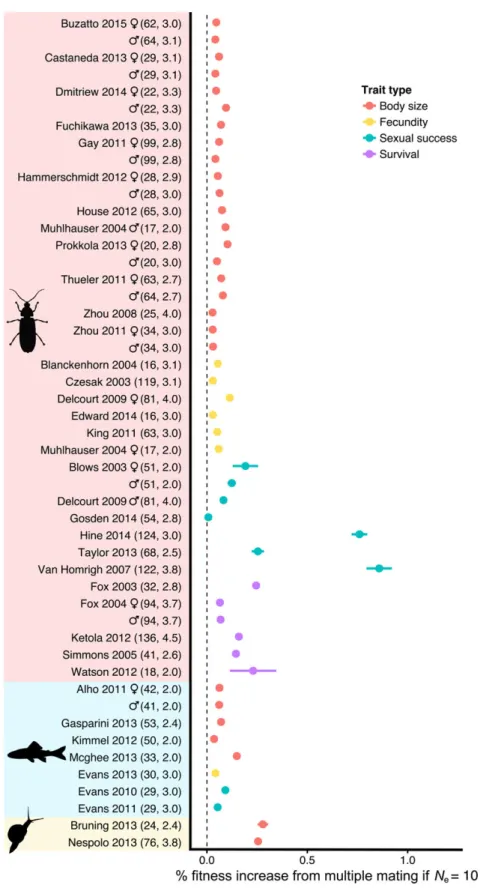
I began by assuming that males of the multiple-mating geno-type always mated with two dams (k = 2), and that fitness increases linearly with trait value. The estimated fitness bene-fits for bet hedging via multiple mating were generally modest. Figure 2 shows the estimated increase in fitness (in percentage
Figure 2. The fitness benefit of multiple mating resulting from reduced variance in offspring fitness estimated for each dataset, assuming that multiple mating has no fitness costs andNe=10 (Wp=0±95% CIs). The shading on they-axis groups studies of the same taxon
(insects, fish, or snails), whereas the color of the points indicates the type of fitness trait studied. These simulations assumed that relative fitness increases linearly with relative trait value (a=1). For brevity, I only give the first author of each study (see Supporting Information for full details of each study). The numbers in parentheses give the sample size in terms of number of sires, followed by average number of dams per sire.
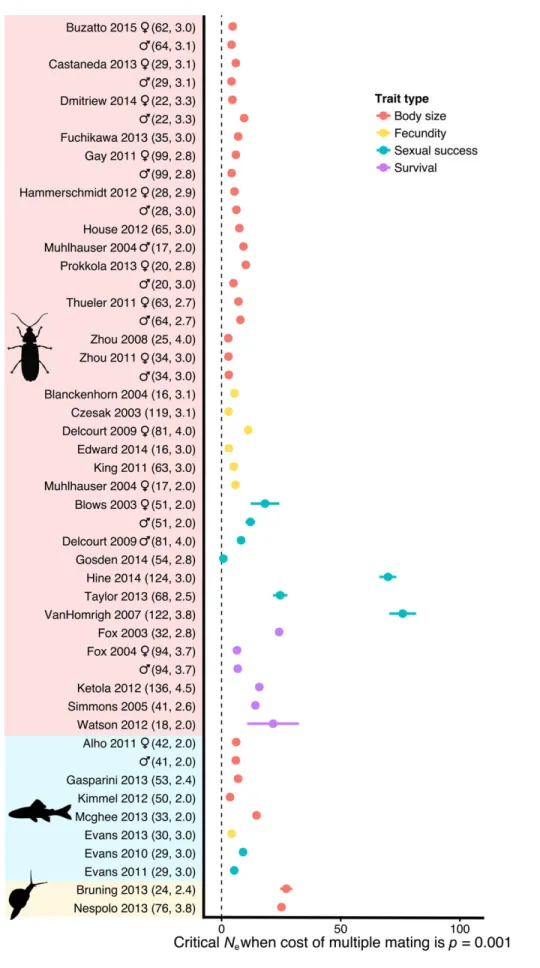
Figure 3. The smallest effective population size at which the bet-hedging strategy has higher fitness (Ncritical±95% CIs), estimated for each dataset, assuming that multiple maters have 99.9% of the expected fitness of single maters.
points) experienced by a multiple-mating genotype relative to a single-mating genotype (W), assuming that multiple mating has no direct costs or benefits (μSingle =μMultiple), and that the effective population size is small (Ne=10). The consensus esti-mate ofWp=0from meta-analysis was 0.13% (SE=0.030, 95% CIs: 0.074–0.19), and the best-supported meta-analytic model in-cluded the moderators trait type, but not taxon or sex (see trends in Fig. 2).
If I instead assumed that trait values provide diminishing returns with fitness (a= 0.5), estimates ofWp=0 were lower still (Fig. S1; meta-analysis estimate of Wp=0 = 0.080%, SE
=0.032, 95% CIs: 0.016–0.14). Under accelerating returns (a=
2), the benefits were slightly higher, although at most the mul-tiply mating lineage was estimated to have 2–3% higher fitness whenNe=10, and generally had0.5% higher fitness (Fig. S2; meta-analysis estimate ofWp=0=0.42%, SE=0.066, 95% CIs: 0.29–0.55). Thus, even under optimal conditions for bet hedging (very smallNe, no direct costs, and strong selection to produce some offspring with extreme trait values), the simulation suggests that a multiple-mating lineage would usually experience an in-crease in fitness of less than 1%. For a 10-fold larger Ne (i.e.,
Ne=100), the estimated benefits were 10-fold smaller.
An alternative way of visualizing the strength of selection for bet hedging is to assume that multiple mating causes a cer-tain reduction in mean fitness, and then find the maximumNe at which the multiple-mating strategy has higher fitness than the single mater. Figure 3 shows this value (Ncritical) for each dataset, assuming linear scaling of fitness with trait values and
P=0.001 (equivalent to assuming that multiple mating reduces one’s expected fitness by 0.1% relative to single mating). The meta-analysis estimate ofNcriticalwas 12.7 (SE=2.70, 95% CIs: 7.37–18.0), suggesting that mildly costly multiple mating would only be selected for in very small populations. Assuming that higher trait values provide accelerating returns in fitness (a=2) boosted the meta-analysis estimate toNcritical=39.3 (SE=5.92, 95% CIs: 27.7–50.9). When the cost of polyandry was reduced 10-fold toP=0.0001, the meta-analysis estimate ofNcriticalwas 10-fold higher (126.7; 95% CIs: 74–180). I reran the simulation assuming that males following the bet-hedger strategy mate with three females (k = 3), and found that the results were almost identical to those shown here.
Discussion
SUMMARY OF FINDINGS
Although the present results come with caveats, which I treat in detail below, the results suggest that the reduction in variance in fitness due to multiple mating is too low for bet hedging to be a major factor in the evolution of multiple mating for genetic ben-efits, at least in the taxa examined here (insects, fish, and snails).
Thus, bet hedging is unlikely to represent a general mechanism for the evolution of costly polyandry. This conclusion held even at very small effective population sizes, where bet hedging is strongest (Gillespie 1974; Starrfelt and Kokko 2012).
I found that the benefits of reduced variance in fitness were maximized when I assumed that individuals with high trait values have especially high fitness; that is, when there was an accel-erating relationship between trait values and fitness. This result can be interpreted as follows. When offspring with unusually high trait values have extremely high fitness, and when mating partners vary in their propensity to produce these high fitness offspring, multiple mating will cause an especially high reduction in fitness variance, because the difference between a “good mate” and a “bad mate” is high. This result can also be inferred from previous theoretical work. For example, Yasui (2001) showed that selection for bet hedging via polyandry is strongest when there is a large difference in fitness between females that mate only with good mates, and those that mate with only poor mates.
I found essentially no effect of additional mates (i.e., two vs. three dams) on the fitness of the multiple-mating genotype. This result is expected, because there should be strong diminishing returns of mate number on the variance in offspring fitness. As mate number increases, the chance that the next mate will be substantially better or worse than the previous mates declines, and so each successive mate will have a smaller effect than the last on the variance in offspring fitness.
I found some evidence that multiple mating reduces the vari-ance in offspring trait values for some traits more than others. Specifically, it appears that multiple mating might reduce the variance in offspring success in sexual selection, and in survival, more than for other traits such as body size. This result implies that dam identity explains a greater amount of variance in some offspring traits than it does for others. Finally, the benefits of bet hedging were of comparable magnitude in male and female offspring, and in insects and fish.
ASSUMPTIONS AND LIMITATIONS OF THE SIMULATION
One must make one key assumption when using the simulation’s results to make inferences about the evolution of polyandry: that the amount of variance in offspring fitness explained by dam identity is similar to that explained by sire identity. That is, the combined effect of variance in maternal effects and maternal genes on offspring fitness must be of roughly the same importance as the combined effect of variance in paternal effects and paternal genes on variance in female fitness.
Intuitively, one might expect dam identity to explain more variance in offspring fitness than sire identity, because mater-nal effects tend to be stronger than patermater-nal effects, especially when fathers have no contact with their offspring (as in paternal
half-sib experiments). If correct, this prediction would mean that the simulation would overestimate the benefits of bet hedging via polyandry because of its focus on males. One can test this prediction using the 49 datasets in the present study. I used 49 linear mixed models (one per dataset) to estimate the proportion of variance in the offspring trait values explained by sire ID and dam ID (using thelmerfunction in R). Sire ID explained a mean (±SE) of 8.5 ± 1.5% of the variance in offspring trait values compared to 12.4±1.9% for dam ID, with dam ID explaining more variance than sire in 26/49 datasets; this difference was not significant (Wilcoxon test: V=704,n= 49 pairs,P=0.24). Thus, it seems the simulation has not greatly overestimated the benefits of polyandry bet hedging by focusing on male multiple mating.
Conversely, the simulation might underestimate the bene-fits of bet hedging, because most of the datasets exclude off-spring/zygotes that died before they could be measured. Paternal half-sib studies typically collect one or more offspring per dam for measurement, but do not record the number of offspring sur-viving per dam. The sampling of offspring is thus nonrandom (be-cause only those offspring that survive are sampled; some half-sib studies may also exclude visibly unhealthy offspring), and as a consequence the simulation might underestimate how much vari-ance in offspring fitness is due to dam identity, and thus also the benefits of bet hedging. However, three studies in the dataset (Fox and Rauter 2003; Ketola et al. 2012; Watson and Simmons 2012) measured egg-to-adult survival, and thus do not suffer this limitation. These datasets produced broadly similar estimates to the others, suggesting that this issue is unlikely to have caused a large underestimation of the benefits of bet hedging. A related caveat is that paternal half-sibling studies might be preferentially conducted on species in which most sire–dam pairs manage to breed successfully, because reproductive failures add consider-ably to the workload. If true, my approach might underestimate the benefits of bet hedging in taxa for which half-sib data have not yet been collected.
Something else to consider is that the common definition of bet hedging reflects technical convenience rather than bio-logical reality. Bet-hedging genotypes are defined as those that pay a cost in expected fitness to reduce fitness variance. How-ever, the variance in fitness of a genotype can affect its evolution whether we define that genotype as a bet hedger. For example, a genotype that has a slightly higher mean fitness than its com-petitor will, on average, be more likely to fix (and go to fixation faster) if its variance is low rather than high (eq. 3). Thus, the effect of polyandry on variance in offspring fitness might some-times have nontrivial evolutionary consequences (although still small relative to effects on mean fitness), especially whenNeis low, even if variance reduction cannot explain the evolution of polyandry.
CONCLUSIONS
I used simulations to assess the extent to which individuals are able to reduce variance in the fitness traits of their offspring via multiple mating. Although multiple mating does reduce variance, the predicted benefits to fitness were small. Thus, it appears un-likely that polyandry commonly evolves primarily as a means of bet hedging against mating only with males that provide bad or in-compatible genes. This is especially true when one considers that the benefits of bet hedging are largest when effective population size is small, meaning that there is an antagonistic relationship between the selective advantage provided by bet hedging and the efficacy of selection. Genetic drift is strongest at lowNe, and so even strongly beneficial mutations can have near-identical fix-ation probabilities to neutral mutfix-ations (Kimura 1983). Genes for within-generation bet hedging (e.g., via polyandry) are thus caught in a bind: they confer no advantage in large populations, and are selected inefficiently in small ones.
ACKNOWLEDGMENTS
I am very grateful to the many authors who shared their raw data, and to J. Henshaw, F. Garcia-Gonzalez, and M. Higgie for extensive advice. LH was supported by a DECRA fellowship from the Australian Research Council (DE140101481).
DATA ARCHIVING
The R scripts used to run the simulation, and the results of the simulation, are archived at DataDryad (doi:10.5061/dryad.b6d75).
LITERATURE CITED
Bateman, A. J. 1948. Intra-sexual selection inDrosophila. Heredity 2:349– 368.
Blows, M. W., and M. Higgie. 2003. Genetic constraints on the evolution of mate recognition under natural selection. Am. Nat. 161:240–253. Fox, C. W., and C. M. Rauter. 2003. Bet-hedging and the evolution of multiple
mating. Evol. Ecol. Res. 5:273–286.
Frank, S. A., and M. Slatkin. 1990. Evolution in a variable environment. Am. Nat. 136:244–260.
Garc´ıa-Gonz´alez, F., Y. Yasui, and J. P. Evans. 2015. Mating portfolios: bet-hedging, sexual selection and female multiple mating. Proc. R. Soc. B 282:20141525.
Gillespie, J. H. 1973. Natural selection with varying selection coefficients—a haploid model. Genet. Res. 21:115–120.
———. 1974. Natural selection for within-generation variance in offspring number. Genetics 76:601.
Gosden, T. P., and S. F. Chenoweth. 2014. The evolutionary stability of cross-sex, cross-trait genetic covariances. Evolution 68:1687–1697. Haldane, J. B. S. 1927. A mathematical theory of natural and artificial
se-lection, part V: selection and mutation. Math. Proc. Camb. Phil. Soc. 23:838–844.
Henshaw, J. M., and L. Holman. 2015. Bet-hedging via polyandry: a comment on “Mating portfolios: bet-hedging, sexual selection and female multiple mating.” Proc. R. Soc. B 282:20150346.
Hopper, K. R., J. A. Rosenheim, T. Prout, and S. J. Oppenheim. 2003. Within-generation bet hedging: a seductive explanation? Oikos 101:219–222.
Horv´athov´a, T., S. Nakagawa, and T. Uller. 2011. Strategic female reproduc-tive investment in response to male attracreproduc-tiveness in birds. Proc. R. Soc. B 279:163–170.
Ketola, T., V. Kellermann, T. N. Kristensen, and V. Loeschcke. 2012. Constant, cycling, hot and cold thermal environments: strong effects on mean viability but not on genetic estimates. J. Evol. Biol. 25:1209–1215. Kimura, M. 1954. Process leading to quasi-fixation of genes in natural
pop-ulations due to random fluctuation of selection intensities. Genetics 39: 280.
———. 1962. On the probability of fixation of mutant genes in a population. Genetics 47:713.
———. 1983. The neutral theory of molecular evolution. Cambridge Univ. Press, Cambridge, U.K.
Lynch, M., and B. Walsh. 1998. Genetics and analysis of quantitative traits. Sinauer, Sunderland, MA.
Patwa, Z., and L. M. Wahl. 2008. The fixation probability of beneficial muta-tions. J. R. Soc. Interface 5:1279–1289.
Schreiber, S. J. 2015. Unifying within-and between-generation bet-hedging theories: an ode to JH Gillespie. Am. Nat. 186:792–796.
Slatyer, R. A., B. S. Mautz, P. R. Y. Backwell, and M. D. Jennions. 2012. Estimating genetic benefits of polyandry from experimental studies: a meta-analysis. Biol. Rev. 87:1–33.
Starrfelt, J., and H. Kokko. 2012. Bet-hedging—a triple trade-off between means, variances and correlations. Biol. Rev. 87:742–755.
Stockley, P., J. B. Searle, D. W. Macdonald, and C. S. Jones. 1993. Female multiple mating behavior in the common shrew as a strategy to reduce inbreeding. Proc. Biol. Sci. 254:173–179.
Watson, N. L., and L. W. Simmons. 2012. Unravelling the effects of differential maternal allocation and male genetic quality on offspring viability in the dung beetle,Onthophagus sagittarius. Evol. Ecol. 26:139–147. Watson, P. J. 1991. Multiple paternity as genetic bet-hedging in female sierra
dome spiders,Linyphia litigiosa(Linyphiidae). Anim. Behav. 41:343– 360.
———. 1998. Multi-male mating and female choice increase offspring growth in the spiderNeriene litigiosa(Linyphiidae). Anim. Behav. 55:387–403. Wilson, C. J., and J. L. Tomkins. 2015. FemaleCallosobruchus maculatuscan maximize long-term fitness through polyandry. Behav. Ecol. 26:502– 509.
Wright, S. 1945. The differential equation of the distribution of gene frequen-cies. Proc. Natl. Acad. Sci. USA 31:382.
Yasui, Y. 1998. The “genetic benefits” of female multiple mating reconsidered. Trends Ecol. Evol. 13:246–250.
———. 2001. Female multiple mating as a genetic bet-hedging strategy when mate choice criteria are unreliable. Ecol. Res. 16:605–616.
Associate Editor: W. Blanckenhorn Handling Editor: M. Servedio
Supporting Information
Additional Supporting Information may be found in the online version of this article at the publisher’s website:
Figure S1.The fitness benefit of the reduced variance in offspring fitness provided by multiple mating when a=0.5.