Introduction
Historically, compounding has been a fundamental component of pharmacy practice. Traditional pharmacy compounding involves the altering, combining, and/or mixing of pharmaceutical ingredients to create a customized medication prescribed to meet the needs of an individual patient by a licensed medical practitioner1. The safety and
efficacy of new medications created through compounding are rarely evaluated, and are dependent upon the equipment and skill level of the pharmacists preparing them. For this reason, compounding skills and techniques are included in the curriculum of many schools of pharmacy in the United States; however, a standardized curriculum for compounding does not exist. Furthermore, few schools of pharmacy use a quantitative method to evaluate the accuracy of compounded preparations made by student
pharmacists. According to an article published in the American Journal of
Pharmaceutical Education in 2014, which included 77 second-year PharmD students, 58% of samples collected were outside the acceptable potency range in which the range of error reported from the labeled potency was 0.6% to 140%2. The results of this study are consistent with the findings of two FDA investigations on a national level that reported ranges from labeled potency of 59% to 89% and 68% to 268%3,4. At the UNC Eshelman School of Pharmacy analytical analysis is a routine part of the compounding curriculum. Students are required to remake compounded preparations that fall outside of the USP acceptable range of ± 10% of the labeled potency. The purpose of this research study is to evaluate the confidence of student pharmacists in their ability to make compounded preparations as part of a pharmacy education program.
Methods
This study was conducted at the UNC Eshelman School of Pharmacy, and was
approved by the Institutional Review Board. It was intended to evaluate the confidence of student pharmacists in their first, second and third year of professional pharmacy training at the beginning and end of a semester in which they participated in a compounding course. A self-efficacy instrument was developed to assess the
pharmacy work experience (2 items), compounding experience (2 items), and students’ perception on their ability to complete steps necessary to make a compounded
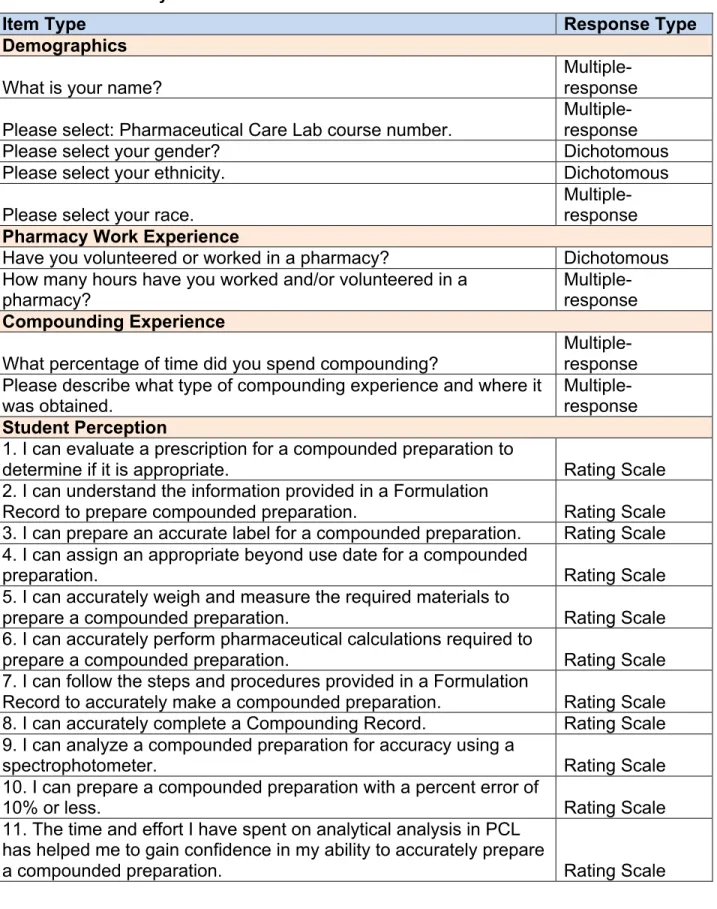
preparation (11 items). The self-efficacy instrument is summarized in Table 1.
Demographic, pharmacy work experience, and compounding experience information were collected using multiple-response and dichotomous response. The data for
questions 1 through 10 were collected using rating scale questions in which 0 = cannot do at all, 5 = moderately can do, and 10 = highly certain can do. The data for question 11 were collected using a similar rating scale in which 0 = do not agree at all, 5 = moderately agree, and 10 = highly agree. An example of the rating scales used can be seen in Figure 1.
Figure 1: Rating Scale for Self-Efficacy Instrument
All PharmD candidates in their first, second and third years of training at the UNC Eshelman School of Pharmacy were eligible to participate in the study. The survey was administered to the second year pharmacy students (PY2) and third year pharmacy students (PY3) in paper form during the first week PHCY 403 and PHCY 405
respectively in fall semester of 2015. The same survey was administered electronically through Qualtrics after completion of the Pharmaceutical Care Laboratory course. A new curriculum was initiated in the fall of 2015, and the first year pharmacy students (PY1) participated in a new compounding course that was not offered until the spring of 2016. The survey was administered to the first year pharmacy students (PY1)
Table 1: Self-Efficacy Instrument
Item Type Response Type
Demographics
What is your name?
Multiple-response
Please select: Pharmaceutical Care Lab course number.
Multiple-response
Please select your gender? Dichotomous
Please select your ethnicity. Dichotomous
Please select your race.
Multiple-response Pharmacy Work Experience
Have you volunteered or worked in a pharmacy? Dichotomous How many hours have you worked and/or volunteered in a
pharmacy?
Multiple-response Compounding Experience
What percentage of time did you spend compounding?
Multiple-response Please describe what type of compounding experience and where it
was obtained.
Multiple-response Student Perception
1. I can evaluate a prescription for a compounded preparation to
determine if it is appropriate. Rating Scale
2. I can understand the information provided in a Formulation
Record to prepare compounded preparation. Rating Scale 3. I can prepare an accurate label for a compounded preparation. Rating Scale 4. I can assign an appropriate beyond use date for a compounded
preparation. Rating Scale
5. I can accurately weigh and measure the required materials to
prepare a compounded preparation. Rating Scale
6. I can accurately perform pharmaceutical calculations required to
prepare a compounded preparation. Rating Scale
7. I can follow the steps and procedures provided in a Formulation
Record to accurately make a compounded preparation. Rating Scale 8. I can accurately complete a Compounding Record. Rating Scale 9. I can analyze a compounded preparation for accuracy using a
spectrophotometer. Rating Scale
10. I can prepare a compounded preparation with a percent error of
10% or less. Rating Scale
11. The time and effort I have spent on analytical analysis in PCL has helped me to gain confidence in my ability to accurately prepare
Results
Initial SurveyA total of 285 students participated in the initial survey, including 18 PY1 students, 109 PY2 students, and 158 PY3 students (12%, 63%, and 98% response rates). The majority of the respondents were female. The PY2 and PY3 classes had a higher
percent of participants with previous pharmacy experience (92% and 94%) compared to the PY1 class (67%). Additionally, the PY2 and PY3 classes also had a higher percent of participants with previous compounding experience out side of the pharmacy school curriculum (52% and 70%) compared to the PY1 class (39%). Of the participants with previous compounding experience, most of them spent less than 20% of the time
compounding. The most common compounded preparations reported were mouthwash, suspensions, parenteral compounds, and creams and ointments. The demographic information for the participants is provided in Table 2.
The students in all three classes consistently reported the highest confidence in the ability to accurately weigh and measure materials to make compounded preparations (7.44 ± 2.48, 9.03 ± 2.66, and 9.47± 2.55), and the least confidence in evaluating the appropriateness of a prescription (2.06± 2.48, 5.0 ± 2.53, and 6.16± 2.23). Both the PY2 and PY3 classes moderately agreed (7.64 ± 2.32 and 7.85 ± 2.31) that the time they spent on analytical analysis helped them gain confidence in their ability to accurately make compounded preparations. The trend in the data is for the students to gain
confidence in their compounding skills as they gain experience and progress in through the compounding curriculum. The initial survey results for the student perception
questions for the PY1, PY2, and PY3 classes are reported in Figure 2.
Finial Survey
A total of 87 students participated in the final survey, including 22 PY1 students, 27 PY2 students, and 38 PY3 students (15%, 16%, and 23% response rates). The PY1 class reported the highest confidence in the ability to follow a Formulation Record to
materials necessary to make compounded preparations (8.67 ± 1.98 and 9.73 ± 1.68). All three classes continued to report the least amount of confidence in evaluating the appropriateness of prescriptions for compounded preparations (6.18 ± 2.24, 6.19 ± 2.15, and 7.00 ± 2.03). The PY1 class moderately agreed (6.36 ± 2.84) while the PY2 and PY3 classes highly agreed (8.22 ± 2.31 and 8.84 ± 2.14) the time spent on
analytical analysis helped them to gain confidence in their ability to accurately make compounded preparations.
The PY1 students improved in confidence in all areas. The largest increases in
confidence occurred in the ability to assign appropriate beyond use dates, understand the information on a Formulation Record, and evaluate the appropriateness of a prescription. The PY2 students had improved confidence in evaluating prescriptions, performing pharmaceutical calculations, and preparing compounded preparations with a percent of 10% or less error. The PY2 students were less confidence in preparing an accurate label, assigning a beyond use date, measuring materials, following a
Formulation record, completing a Compounding Record, and using a
Table 2. Comparison by Class of Student Demographics PY1 (N=18) N (%) PY2 (N=109) N (%) PY3 (N=158) N (%) Gender Male Female
5 (28) 13 (72) 35 (32) 74 (68) 61 (39) 97 (61) Ethnicity White Asian
Black or African American
Native Hawaiian or Pacific Islander American Indian or Alaska Native Hispanic 14 (78) 2 (11) 3 (17) 0 (0) 2 (11) 1 (6) 65 (60) 29 (27) 9 (8) 0 (0) 0 (0) 3 (3) 115 (73) 27 (17) 10 (6) 2 (1) 4 (3) 3 (2) Previous Pharmacy Experience 12 (67) 100 (92) 148 (94) Previous Compounding Experience 7 (39) 57 (52) 110 (70) Compounded Preparations
Ointments and Creams Suspensions and Solutions Mouthwash Parenteral Compounds Suppositories Other 1 (6) 2 (11) 2 (11) 2 (11) 0 (0) 0 (0) 6 (6) 6 (6) 19 (17) 4 (4) 2 (2) 4 (4) 24 (15) 16 (10) 33 (21) 11 (7) 11 (7) 1 (<1) Percent of Time Spent Compounding
0%
Figure 2. Initial Student Perception Results for PY1, PY2, and PY3 Students
Discussion
This research study was conducted to assess the confidence of student pharmacists in their ability to make compounded preparations as part of a pharmacy education
program. Although compounding curriculums differ at each college of pharmacy, this study provides informative information about student perception on their compounding strengths and weakness and if the time spent on analytical analysis helped them gain confidence in their ability to accurately make compounded preparations.
There are several limitations to this research study worth acknowledging. First, the response rates to the online survey were very low for all three classes. The decision to change the survey administration from paper to online was made to facilitate the data collection process. It appears providing a paper survey with a designated time and location for completion results in a higher rate of response. Secondly, these data are only able to show trends in confidence based on the survey response, and cannot provide explanations or reasons. Lastly, this study was only conducted at a single institution. Since compounding curriculums differ at each college of pharmacy the results obtained at UNC Eshelman School of Pharmacy are not be generalizable.
Conclusion
Compounding is a fundamental part of pharmacy practice. Recent studies have demonstrated a wide variety in range from labeled potency on compounded
preparations. There is a lack of standardized compounding education in the United States, and the UNC Eshelman School of pharmacy is one of the few programs using quantitative analytical analysis as part of their curriculum to assess student products for accuracy. Student pharmacists agree that the analytical analysis helps them gain
confidence in their ability to accurately make compounded preparations. Further
research is needed to assess if there is any correlation between student confidence and the ability to make more accurate compounded preparations.
References
1. Galson SK. Federal and State Role in Pharmacy Compounding and Reconstitution: Exploring the Right Mix to Protect Patients. Hearing on Oversight Before the Senate Comm. on Health, Education, Labor, & Pensions, 108th Cong. 2003.
http://www.fda.gov.libproxy.lib.unc.edu/NewsEvents/Testimony/ucm115010.htm. Accessed Feb 2016
2. Pigantao A, Christine R. Birnie. Analysis of Compounded Pharmaceutical Products to Teach the Importance of Quality in an Applied Pharmaceutics Laboratory Course. Am J Pharm Educ. Apr 17, 2014; 78(3): 61.
3. US Food and Drug Administration. Pharmacy Compounding. 2006 Limited FDA Survey
of Compounded Drug Products. 2012
http://www.fda.gov.libproxy.lib.unc.edu/Drugs/GuidanceComplianceRegulatoryInformat ion/PharmacyCompounding/ucm204237.htm. Accessed Feb 2016
4. United States Food and Drug Administration. Limited FDA Survey of Compounded Drug
Products. 2001.