Bess P. Schrader. Cross-Language Citation Analysis of Traditional and Open Access Journals. A Master’s Paper for the M.S. in I.S degree. April, 2016. 43 pages. Advisor: Bradley Hemminger
This study examines the differences in the proportion of non-English language citations given to English language articles published in open access and traditional library and information science journals. It compares the average percentage of foreign language citations to total citations between 207 open access articles and 196 traditional articles published between 2011 and 2012. An independent, two-tailed t-test found no
statistically significant difference between the foreign language citation percentages of open access and traditional articles. An analysis of variance also found no significant difference in the proportion of citations given by each non-English language according to journal type.
Headings:
Citation analysis
CROSS-LANGUAGE CITATION ANALYSIS OF TRADITIONAL AND OPEN ACCESS JOURNALS
by
Bess P. Schrader
A Master’s paper submitted to the faculty of the School of Information and Library Science of the University of North Carolina at Chapel Hill
in partial fulfillment of the requirements for the degree of Master of Science in
Information Science.
Chapel Hill, North Carolina April 2016
Approved by
Table of Contents
1. Introduction ... 2
2. Literature Review ... 5
2.1 Introduction ... 5
2.2 Open Access... 6
2.3 Comparing citation rates between open access and traditional journals ... 8
2.4 Academic Language Diversity ... 9
2.5 Internet Language Diversity ... 12
2.6 Summary ... 15
3. Methods ... 16
3.1 Null Hypotheses ... 16
3.2 Citation Analysis ... 16
3.3 Journal Selection ... 17
3.4 Article Selection... 18
3.5 Data Collection ... 19
3.6 Analysis... 21
3.6.1 RQ1 ... 21
3.6.2 RQ2 ... 22
4. Results ... 23
4.1 Descriptive Statistics ... 23
4.2 RQ1 Results ... 24
4.3 RQ2 Results ... 26
5. Discussion... 30
5.1 Limitations ... 32
5.2 Future Work ... 32
6. Conclusion ... 34
Bibliography ... 36
1.
Introduction
Open access (OA) journals, defined as journals that are accessible online and free of cost, have been gaining popularity and acceptance in academia over the past two decades. Research shows that open access articles have a broader readership and receive more citations than their counterparts in traditional journals, a fact that may be due, in part, to the lower barriers, both physical and financial, involved in accessing OA journals. However, citation analyses of scholarly communication indicate that, while physical and financial access may be improved by OA, linguistic barriers still pose a challenge to information access in academia. English-language scholarly work is being cited to a greater degree than work in other languages, suggesting that academic knowledge
contained in non-English communities is not being shared as often, to the likely detriment of both English and non-English academic communities. If scholarly research is not shared among researchers speaking different languages, the body of academic knowledge will not be discussed, contributed to, and expanded to its full potential.
error has occurred. Similarly, the reader of an automatically translated text likely has no way of discerning the author’s original message (Yamashita, Inaba, Kuzuoka, & Ishida, 2009). While automatic translation tools show promise, the inability of users to evaluate the results is concerning from a cross-linguistic communication perspective.
However, it is clear that there is an increasing need to facilitate communication between language groups through some means; as Internet access continues to grow world wide, trends among language use on the Internet have shown an increase in the usage of non-English languages. Similarly, there has been a steady increase in both multilingual Internet users and multilingual content, both of which have improved interaction and communication between language groups. This cross-language
communication has the potential to increase the sum of human knowledge by increasing the ability of individuals to access, compile, and build on information that was previously isolated in different language groups.
Breaking linguistic barriers on the internet is improving the domain of knowledge for each individual language community. It would, therefore, be highly beneficial if scholarly communication could improve cross-language information diffusion. If increased Internet access and the rise of everyday, multilingual Internet users has been able to improve and increase cross-language communication by acting as a bridge between language communities, has increased access to scholarly research through open access journals improved communication between scholars speaking different languages?
communication, it can be used to approximate and explore communication patterns between researchers. Therefore, this paper will pose the following research questions:
RQ1: Is there a difference in the overall proportion of foreign language citations received by articles published in traditional versus open access library and information science journals?
2.
Literature Review
2.1
Introduction
Open access journals, due partly to the perceived ability to increase research impact and readership, have become an increasingly common channel in which to publish academic research. Authors wishing to increase the visibility of their work or to provide it free of cost to the public at large have used OA journals to their advantage. Citation analyses of traditional journals and open access journals do generally agree that OA articles and journals receive more citations than their traditional counterparts (though they do not always agree as to why), suggesting that OA articles reach more readers and have a greater research impact.
However, while OA journals may increase the accessibility of some academic research, academia is still largely dominated by the English language, leaving a large proportion of scholarly research inaccessible to those who do not speak English. This linguistic barrier hinders the diffusion of information across national borders and cultural groups, limiting the potential for progress in academic knowledge and isolating
information in geographically separated communities. According to Yamashita et al. (2009), “language remains the biggest barrier to intercultural collaboration.”
research forums, while technically more accessible than ever, suffer linguistic barriers to access from both their platform (the Internet) and their domain in academia. However, current trends show an overall increase in non-English language use on the Internet, both in terms of Internet users and web pages. This increased multilingualism has allowed key multilingual “bridge” web users to act as facilitators between different language groups, allowing different language communities to communicate with one another, sharing information and building collective knowledge.
OA journals may pose a unique opportunity to eliminate or reduce financial barriers to access, but the language barrier in both traditional and OA journals remains. Only by reducing this barrier can academia as a whole begin to take advantage of the full extent of academic knowledge that may be fragmented across different language groups.
2.2
Open Access
While efforts to make research results “open access,” that is, accessible online and free of cost, began in the 1990s (Craig, Plume, McVeigh, Pringle, & Amin, 2007), many scholars were skeptical about the quality of these early OA journals, and thus hesitated to publish in them (Björk & Solomon, 2012). However, open access remained popular in fields related to research about the Internet, and slowly gained wider acceptability. In 2002, the Budapest Open Access Initiative, launched by the Open Society Institute, called for widespread adoption of open access:
curious minds. Removing access barriers to this literature will accelerate research, enrich education, share the learning of the rich with the poor and the poor with the rich, make this literature as useful as it can be, and lay the foundation for uniting humanity in a common intellectual conversation and quest for knowledge.” (“Budapest,” 2002)
In the following decade, through the adoption of OA by several respected publishers such as BioMedCentral and the Public Library of Science (PLoS), as well as government mandates for OA research through the National Institute of Health, open access publications and their acceptability in academia quickly increased (Björk & Solomon, 2012). In agreement with the Budapest Open Access Initiative, many scholars, as well as the non-academic public, believed that electronic publishing provided an opportunity to share the results of publicly funded research to the public free of cost (Dewatripoint et al., 2006; McCabe, 2002). In fact, a survey of authors circa 2004 found that the most commonly cited reason for publishing in OA journals was a belief in the right of all users to freely access research (Antelman, 2004).
However, as noted by Gargouri et al., "OA is not just about public access rights or the general dissemination of knowledge: It is about increasing the impact and thereby the progress of research itself" (2010). As OA became more popular, many academics began to realize the advantages of their potential reach in the academic world, notably that the lack of financial barriers to access could vastly expand the readership and possible impact of published work (Antelman, 2004). The expanding readership can be seen though the particularly discernible OA impact in developing countries, where high subscription fees often prohibit scholars from accessing articles in traditional journals (Zhang, 2006; Dewatripoint et al., 2006; Gaulé & Maystre, 2011; Asemi, 2010).
traditional journals. Worries about the traditional peer review process being less rigorous or fully ignored have led to research attempting to prove the opposite (Björk & Solomon, 2012; Antelman, 2004). These studies often employ citation analysis as a means to compare the use and impact of traditional and open access journals.
2.3
Comparing citation rates between open access and traditional
journals
Although increased exposure and a wider readership are some of the reasons authors publish in open access resources, not all research agrees that open access journals are, in fact, cited more often than traditional journals. Davis, Lewenstein, Simon, Booth, and Connolly (2008) found that while the open access journals they examined did reach more readers, they didn’t have a “citation advantage” as compared to traditional journals. Björk and Solomon (2012) echoed this result, finding that, after controlling for discipline and country of publication, differences in citations between open access and non-open access journals published after 1996 more or less disappear. While this would discredit theories about higher citation rates for open access journals, similar citation rates of both OA and non-OA sources could suggest that there is not a drastic difference in quality between the two types of journals, as many early critics feared (Harnad & Brody, 2004).
open access channels, then open access articles could be cited more due to their quality, not their open accessibility.
However, a majority of studies have supported the more generally held view that open access does affect impact. Antleman (2004) finds a higher research impact for OA articles than for non-OA articles across four different fields. Eysenbach (2006) and Harnad & Brody (2004) both conducted studies in which open access and non-open access articles published in the same journal were compared to control for other factors. Both studies found that the OA articles had a definite citation advantage. Other studies have examined the existence of this OA citation advantage in a variety of fields and domains, including a study that found the OA citation advantage to be particularly prominent in web citations (Zhang, 2006).
Ultimately, while not all research agrees as to why open access articles are cited more frequently than their traditional access counterparts, the majority of studies do point towards a citation advantage for open access articles. For the purposes of this project, which aims to find correlation between cross language citation and journal type, the concurrence of the majority of studies on the OA citation advantage will be sufficient.
2.4 Academic Language Diversity
Lillis et al. note that citation patterns can vary wildly along “geolinguistic” lines; who and what gets cited can be very different across different languages and regions (Lillis, Hewings, Vladimirou, & Curry, 2010). However, it is generally acknowledged that English is the foremost cited language in most academic work (Michel, 1982;
academia is not a new phenomenon; Michel noted in 1982 that even in an era allowing academics to share information internationally more easily than ever, there was a drastic increase in publications in English that was not proportional to the growth of literature in other languages. This mirrors an increase in the global use of English outside of
academia, as the result of its adopt in certain political and economic institutions, as well as the global spread of American and British popular culture, through advertising, broadcasting, movies, and films (Crystal, 2012). More recently, Kellsey and Knieval (2004) found that English is the predominant language in humanities citations, although they did note that, for humanities specifically, citations of other language sources have not decreased. Thelwall et al. (2003) found that English also dominates web links on many European university web pages; although many universities studied were not in an English speaking country, many of the links to and from the university pages were for pages written in English.
This linguistic inaccessibility of information in academia leads to an overall loss of information for academia at large. If scholars are not able to communicate and share their research, they cannot build off of one another’s work, furthering academic
knowledge. Interestingly, Michel claims that scholars who are native English speakers may actually lose more information than native speakers of other languages. Many scholars who are non-native English speakers have learned English, allowing them to access information published in both their own language and information published in English. However, many native-English scholars do not speak or read other languages; therefore, the total pool of information many Anglophone researchers can access is smaller (Michel, 1982).
However, preference for one’s own language is not a purely Anglophone
phenomenon. Studies have shown that French and German researchers tend to cite works in their own language at a higher rate than would be expected, given the relative
proportion of the literature made up by French and German resources (Bookstein & Yitzhaki, 1999). Similarly, Thelwall et al. found that websites for universities in countries that speak the same language are more likely to link to each other than to websites for universities in countries with different languages (2003). While the fact that scholars are more likely to consult and cite sources in their own language is hardly surprising, it does lead to a general loss of information.
greater disadvantage with regards to information loss. Thelwall et al. take Greece as an example of the dangers of this linguistic citation pattern; As Greek is not widely spoken outside of Greece, universities in Greece become linguistically isolated, a fact that is reflected in their websites, which have few links to websites not in Greek (Thelwall et al., 2003). This natural preference for one’s own language, combined with the current
dominance of English among academic discourse, leaves some information isolated in separate linguistic groups, inhibiting its ability to be accessed, shared, and built upon.
2.5
Internet Language Diversity
As open access involves the free, online dissemination of information, open access journals are not used exclusively by academics; any Internet user can consult research published through open access channels. The web has given many individuals, academic or otherwise, unprecedented access to knowledge in other languages, yet linguistic access remains a barrier. Therefore, it is worth discussing the diversity of language not only in academia, but on the Internet as a whole. However, it is extremely difficult, if not impossible, to directly measure the aggregate use of any given language on the Internet. Instead, two main methods are often used to estimate Internet language use: trying to determine the number of Internet users in each language group or trying to estimate the number or proportion of pages written in each language (Gerrand, 2007).
used English on the web dropped from 80% in 1996 to about 35% in 2005. Pimienta et al. (2010) estimate that this figure further dropped to 32% in 2007. Both studies suggest this trend is likely to continue, meaning that non-English users are comprising a growing proportion of all Internet users.
Similarly, there is a higher percentage of non-English web pages than ever before. While this can be a difficult metric to estimate, Pimienta et al. (2010) found that from 1998 to 2007, the percentage of total web pages that were in English dropped from 75% to 45%. Site specific studies show a similar or more drastic trend, although it is
important to note that individual sites may have a focus or user-base particularly concentrated in one country, thus making them imperfect indicators of overall Internet language change. A 2011 study estimated that 50% of all tweets on Twitter are in languages other than English (Hong, Convertino, & Chi, 2011), while English articles comprised only 23% of Wikipedia as of July 2008 (Adar, Skinner, & Weld, 2009). Statistical trends, as well as the increasing adoption of the Internet world wide, suggest that this pattern will continue, leaving English as an important, but not overwhelming presence on the web (Hale, 2012).
Wikipedia can be seen as a non-scholarly open access source. Further, Wikipedia contains articles on the same topic in multiple languages; however, these articles sometimes contain vastly different information (Adar et al, 2009; Hale, 2014). This implies that information from different language groups is not being compiled and shared, preventing monolingual Wikipedia users from taking full benefit from the site’s knowledge. Potentially more concerning, though, is the fact that this can lead to a “self-focus” bias within language groups. For example, as of 2014, the Spanish-language Wikipedia page on Psychology included a section on Latin American contributions to the field, while other language pages on Psychology did not (Hale, 2014). This self-focus bias is not surprising, nor is it inherently negative; Hecht and Gergle (2010) note that if all languages or cultures cover the same information, it could actually lead to a lack of knowledge diversity through global consensus. However, the self-focus bias combined with a lack of communication and accessibility between language groups does reduce the access that any one language group has to the entire body of knowledge on a topic.
However, studies focused on non-academic web communication have found that multilingual Internet users and multilingual content can bridge this language divide, promoting communication between different language groups. Eleta & Golbeck (2012) observed the roles of multilingual Twitter “bridge” users in opening access between different language groups on Twitter. Looking at the vast amount of multilingual content on Wikipedia, Adar et al. (2009) developed a semi-automated process to combine
information from Wikipedia pages on the same topics but in different languages,
cross-language communication leads to a larger group of users being able to access and contribute information, more fully using the bulk of human knowledge on the web.
2.6
Summary
3.
Methods
3.1
Null Hypotheses
To answer the two research questions defined in the introduction of this paper, this study will test the following null hypotheses through the use of citation analysis:
Null Hypothesis 1: There is no difference in the overall proportion of foreign language citations received by articles published in traditional versus open access journals.
Null Hypothesis 2: There is no difference in the proportion of language specific citations received by articles published in traditional versus open access journals.
3.2
Citation Analysis
Citation analysis is a relatively simple, if imperfect, means of assessing patterns of scholarly communication. It is worth noting that citation analysis has several
drawbacks, most notably that it is often erroneously used to indicate the quality (or lack thereof) of a particular journal, institution, article, or author (Smith, 1982). However, because this paper does not seek to establish the quality of articles or journals, merely trace whether they are being used across language groups, this study will avoid some of these issues.
be corrected by implementing surveys or interviews to determine whether authors are truly using the materials they cite. However, due to time constraints and the relatively low risk that this assumption poses to this study, citation analysis is still an appropriate method for these research questions.
Several studies have pinpointed how difficult it is to claim causality in citation analysis (Gaulé and Maystre, 2011; Craig et. al, 2007). There are many factors regarding citation rates that make it challenging to conclude that a difference in citation rates between OA and traditional journals is directly caused by the type of journal. Therefore, this study will focus its findings on correlational information, not causality.
3.3
Journal Selection
This study aims to examine two different types of library and information science journals: open access versus traditional. Initially, the author sought to include language of publication as an additional characteristic in journal selection, developing a sample of articles from open access and traditional journals published in a variety of languages. However, it proved difficult, and in some cases impossible, to find library and
information science journals that fit all combinations of both journal type and publication language with comparable levels of citations. Due to these constraints, this study
restricted the selected journals to open access and traditional library and information science journals published in English only.
Journals were identified using the Journal Citation Record (JCR) available
through the ISI Web of Science. This index was used to generate a list of all information science and library science journals from 2014, the most recent year available. Because of the choice to restrict the sample to articles published in English language journals, any non-English language journals on the list were discarded. The remaining journals
included four open access journals, as identified by the ISI Web of Science index. The last of these journals was discarded due to a lack of citations. To ensure comparability of journals selected, the three remaining OA journals were compared to the traditional journals on the list to find the three traditional journals that were closest in terms of journal impact factor and citation levels to each of the three OA journals selected. The final result was a selection of six total English language library and information science journals, including three open access journals and three traditional journals.
3.4
Article Selection
To examine citations on an article level, a sample of articles from each of these six journals was collected. As open access journals have gained moderate academic acceptance in only the past decade, this study chose to only examine articles from 2006 to the present (Craig et al., 2007, Björk & Solomon, 2012). In light of time and technical constraints, however, it was not possible to include all articles over the past ten years. Instead, articles were collected for a two-year time span. In selecting this two-year span, it was necessary to choose years of publication that would allow articles sufficient time to collect citations. While Liu (1997) notes that high impact articles are accessed and cited at a high, stable level over time, less frequently cited articles typically receive the
declining thereafter. Yang & Zheng (2009) estimate that the majority of articles
published in Information and Library Science receive the vast majority of their citations in the three to four years following publication. Therefore, this study chose to select all articles published in the six selected journals during 2011 and 2012, ensuring that the articles had ample time to accrue citations.
To reduce confounding variables, this study discarded any article that was not a research based standard submission, eliminating editorials, errata, reviews, symposia, or special reports, including conference proceedings. Further, any articles published in languages other than English were discarded. The remaining articles made up the sample used in this study.
3.5
Data Collection
Multiple authors have discussed the difficulty in using ISI's Web of Science in citation analysis with regards to how it negatively skews the impact of both open access (Yang & Zheng, 2009; Zhang, 2006) and non-English language journals (van Raan, van Leeuwen, & Visser, 2011; Schloegl & Stock, 2004; Lopez Piniero & Hicks, 2014). Therefore, after developing the sample of articles, citation data was collected using Google Scholar, which has been successfully used to find citation data involving both open access and non-English sources (Norris, Oppenheim, & Rowland, 2008; Yang & Zheng, 2008; Gargouri et al., 2010; Dewatripoint et al., 2006; Lopez Pineiro & Hicks, 2014; Liu, 1997).
language in which the citing article was published. To determine the languages of citing articles, the Google Scholar language facets were used, allowing lists of citations to be split into Chinese (Simplified), Chinese (Traditional), Dutch, English, French, German, Italian, Japanese, Korean, Polish, Portuguese, Spanish, and Turkish. For the purposes of this study, both simplified and traditional Chinese citations were combined into one language group. For citations that did not fall into one of these language categories, the auto-detect language feature of Google Translate (https://translate.google.com/) was used to determine the language of the title and abstract provided through Google Scholar.
Because this study examines the interaction between articles written in different languages and not necessarily their research impact, self-citations were included. Multilingual authors may publish an article in one language and then cite that article while publishing in a second language. While this does not indicate that different
individuals are communicating across linguistic communities, it does indicate the spread of information from one language to another, and thus is relevant to this paper.
Further, citations from any source were included, regardless of whether they were academic in nature. Again, the purpose of this study is to examine interaction between language groups, so a non-academic website that references an article is just as
meaningful as an academic journal article that does so.
Citations given by bilingual sources were duplicated and counted as one citation for each language in order to reflect the interaction between each language. For example, if an article written in both Spanish and Portuguese cited one of the English articles in the sample, that citation would be counted once as a Spanish citation and once as a
English article. While this could be misleading if this study were using total citation numbers as an indicator of impact or quality, duplicating the citation here is essential to demonstrate that the information in the English article was used in an article accessible to both Spanish and Portuguese speaking readers. In order to be considered a bilingual source, the entire work must be written in two languages. Simply publishing the abstract or title in more than one language was not considered truly bilingual, and the citation was recorded as belonging to the language in which the full text of the work was published.
3.6
Analysis
After collecting the citations for each article, the percentage of total citations for each English article that came from non-English sources, or the foreign language citation percentage was computed. In other words, for every article a in the sample:
𝑓𝑜𝑟𝑒𝑖𝑔𝑛 𝑙𝑎𝑛𝑔𝑢𝑎𝑔𝑒 𝑐𝑖𝑡𝑎𝑖𝑡𝑖𝑜𝑛 𝑝𝑒𝑟𝑐𝑒𝑛𝑡𝑎𝑔𝑒𝑎=
|𝑛𝑜𝑛 𝐸𝑛𝑔𝑙𝑖𝑠ℎ 𝑐𝑖𝑡𝑎𝑡𝑖𝑜𝑛𝑠 𝑟𝑒𝑐𝑒𝑖𝑣𝑒𝑑 𝑏𝑦 𝑎| |𝑎𝑙𝑙 𝑐𝑖𝑡𝑎𝑡𝑖𝑜𝑛𝑠 𝑟𝑒𝑐𝑒𝑖𝑣𝑒𝑑 𝑏𝑦 𝑎| 𝑋 100
Using the foreign language citation percentage, as opposed to using the raw number of non-English citations received, normalizes for differences in journal size and article impact.
3.6.1 RQ1
After computing the foreign language citation percentage for each article, an F-test was performed to determine whether the variances of the open access and traditional articles samples were equal. As the F-test found unequal variances, an independent, two-tailed T-test assuming unequal variance was performed to determine whether a
3.6.2 RQ2
To determine whether a significant difference exists in the proportion of language specific citations received by articles published in traditional versus open access journals, analysis of variance (ANOVA) was used. While the original research question focused on differences at the article level, the resulting foreign language citations collected were too sparsely distributed across multiple levels to allow for article level analysis. Instead, the differences in language specific citations were examined at the level of journal type, open access versus traditional. For each language l and journal type j combination, a language/journal citation percentage was calculated as follows:
𝑙𝑎𝑛𝑔𝑢𝑎𝑔𝑒/𝑗𝑜𝑢𝑟𝑛𝑎𝑙 𝑐𝑖𝑡𝑎𝑡𝑖𝑜𝑛 𝑝𝑒𝑟𝑐𝑒𝑛𝑡𝑎𝑔𝑒𝑙𝑗=
|𝑡𝑜𝑡𝑎𝑙 𝑐𝑖𝑡𝑎𝑡𝑖𝑜𝑛𝑠 𝑔𝑖𝑣𝑒𝑛 𝑏𝑦 𝑙| |𝑎𝑙𝑙 𝑐𝑖𝑡𝑎𝑡𝑖𝑜𝑛𝑠 𝑟𝑒𝑐𝑒𝑖𝑣𝑒𝑑 𝑏𝑦 𝑗| X 100
4.
Results
4.1
Descriptive Statistics
This study collected 5183 citations of 403 articles published between January 2011 and December 2012. 207 of the articles came from the selected open access journals, while 196 were published in the selected traditional journals. The total number of
citations generated from the 207 open access articles was 3036, averaging 14.67 citations per article. The 196 traditional articles generated 2147 total citations, or 10.95 citations per article. This higher citation average of open access articles agrees with the research on higher numbers of citation in open access journals discussed in part 2 of this paper (see table 1).
Table 1. Descriptive sample statistics: total number of articles, citations, and average citations per article
Total number of articles
Total number of citations
Average citations per article
Open Access 207 3036 14.67
Traditional 196 2147 10.95
Total 403 5183 12.86
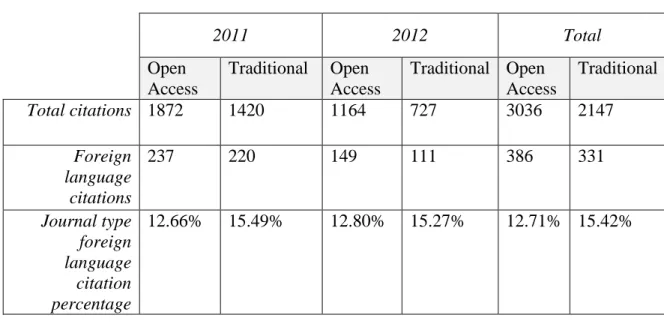
Table 2. Total number of citations, foreign language citations, and percentage of foreign language citations to total citations by year.
sample, it is unlikely that year of publication impacts the results. Note that the journal type foreign language citation percentage given in table 2 is calculated by dividing the total number of foreign language citations for each journal type by the total number of citations for that journal type, and thus is different than the foreign language citation percentage computed at the article level, as reported in table 3.
Table 3. Total number of articles, foreign language citations, average number of foreign language citations per article, average foreign language citation percentage by article.
2011 2012 Total
Open Access
Traditional Open Access
Traditional Open Access
Traditional
Total citations 1872 1420 1164 727 3036 2147
Foreign language citations
237 220 149 111 386 331
Journal type foreign language citation percentage
12.66% 15.49% 12.80% 15.27% 12.71% 15.42%
Total number of articles Total number of foreign language citations
Average number of foreign language citations per article
Average foreign language citation
percentage
Open Access 207 386 1.86 11.89%
4.2
RQ1 Results
RQ1: Is there a difference in the overall proportion of foreign language citations
received by articles published in traditional versus open access library and information
science journals?
There appears to be no statistically significant difference in the proportion of foreign language citations an article receives according to the journal type in which it is published (open access versus traditional). An F-test performed on the distribution of the average foreign language citation percentage for each journal type indicated that the variances of these distributions were unequal (F=1.4133, p=0.0073, see Appendix A).
4.3
RQ2 Results
RQ2: Is there a difference in the proportion of language specific citations
received by articles published in traditional versus open access library and information
science journals?
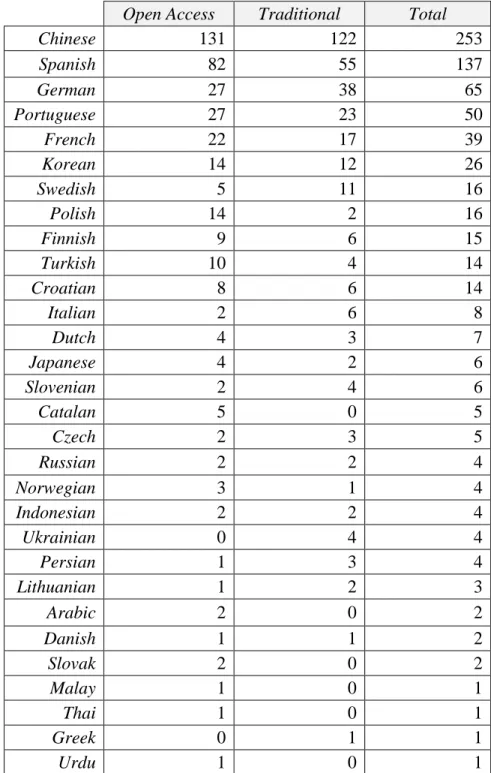
The articles in this sample generated citations from articles written in thirty different non-English languages (see Table 4). For nineteen of these languages, there were less than ten total citations for all 403 English articles in the sample, making it difficult to compare differences in language-specific foreign language citation
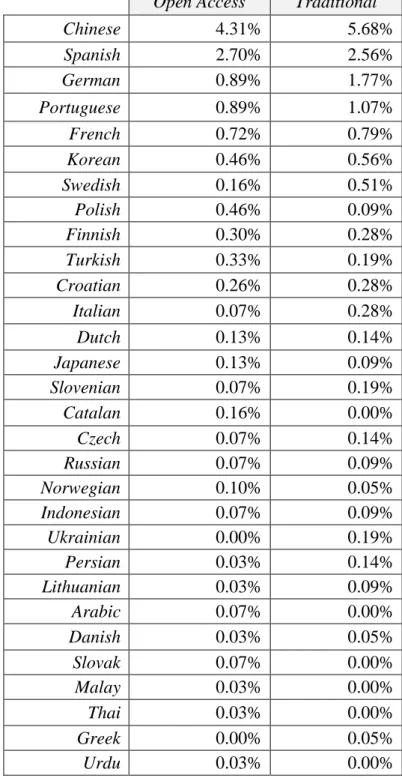
percentages between open access and traditional articles. Therefore, this study examined language specific citation differences at the journal type level, using the language/journal citation percentage for each language and journal type combination (see Table 5, Figure 1). An analysis of variance test indicated no significant differences in the
Table 4. Total number of foreign language citations according to language and journal type
Open Access Traditional Total
Chinese 131 122 253
Spanish 82 55 137
German 27 38 65
Portuguese 27 23 50
French 22 17 39
Korean 14 12 26
Swedish 5 11 16
Polish 14 2 16
Finnish 9 6 15
Turkish 10 4 14
Croatian 8 6 14
Italian 2 6 8
Dutch 4 3 7
Japanese 4 2 6
Slovenian 2 4 6
Catalan 5 0 5
Czech 2 3 5
Russian 2 2 4
Norwegian 3 1 4
Indonesian 2 2 4
Ukrainian 0 4 4
Persian 1 3 4
Lithuanian 1 2 3
Arabic 2 0 2
Danish 1 1 2
Slovak 2 0 2
Malay 1 0 1
Thai 1 0 1
Greek 0 1 1
Table 5. Language/Journal Citation Percentage
Open Access Traditional
Chinese 4.31% 5.68%
Spanish 2.70% 2.56%
German 0.89% 1.77%
Portuguese 0.89% 1.07%
French 0.72% 0.79%
Korean 0.46% 0.56%
Swedish 0.16% 0.51%
Polish 0.46% 0.09%
Finnish 0.30% 0.28%
Turkish 0.33% 0.19%
Croatian 0.26% 0.28%
Italian 0.07% 0.28%
Dutch 0.13% 0.14%
Japanese 0.13% 0.09%
Slovenian 0.07% 0.19%
Catalan 0.16% 0.00%
Czech 0.07% 0.14%
Russian 0.07% 0.09%
Norwegian 0.10% 0.05%
Indonesian 0.07% 0.09%
Ukrainian 0.00% 0.19%
Persian 0.03% 0.14%
Lithuanian 0.03% 0.09%
Arabic 0.07% 0.00%
Danish 0.03% 0.05%
Slovak 0.07% 0.00%
Malay 0.03% 0.00%
Thai 0.03% 0.00%
Greek 0.00% 0.05%
Figure 1. Language/Journal Citation Percentage
0.00% 1.00% 2.00% 3.00% 4.00% 5.00% 6.00%
Chinese Spanish German Portuguese French Korean Swedish Polish Finnish Turkish Croatian Italian Dutch Japanese Slovenian Catalan Czech Russian Norwegian Indonesian Ukrainian Persian Lithuanian Arabic Danish Slovak Malay Thai Greek Urdu
Language/Journal Citation Percentage
La
n
gu
age
Language/Journal Citation Percentage
5.
Discussion
While the results of this study did not find truly significant differences for RQ1 or RQ2, the results of first research question could benefit from further examination.
Although a two-tailed t-test found the differences in foreign language citation percentages between articles published in open access and traditional journals to be insignificant (df=382, t=1.9662, p=0.0692), the associated p-value is relatively low, and a one-tailed t-test showed statistically significant differences. While this is not enough to reject null hypothesis 1, it does suggest that some interaction between journal type and foreign language citation may be occurring.
While the traditional journals used in this study operate on a fee-based model, they do occasionally offer some volumes and articles online free of charge. These
articles then enjoy the same access to wider readership as their open access counterparts. Further, articles published in traditional journals that are made freely available online might not encounter the stigma sometimes associated with open access journals of being less rigorously peer reviewed. This may be a contributing factor to the observance of a higher average percentage of foreign language citations among traditional journals in this study and the significance found with the one-tailed t-test.
internet at large has not spread to academic work published on the internet. While the Internet has changed, factors within academia, such as the dominance of English in academic writing, may have a stronger influence on citation patterns of academic articles than the type of journal in which they are published.
Interestingly, languages with fewer citations overall (i.e. languages giving less than ten total citations for the sample of 403 articles) tended to concentrate those citations on one or two articles. For example, there were six total Japanese citations, four for open access journal articles and two for traditional journal articles. All four of the Japanese citations for open access articles cited the same article. This may be the result of data scarcity; however, it could also indicate the role of “bridge” articles similar to the
“bridge” Twitter users discussed in Eleta & Golbeck (2012). A bilingual author citing an English article while writing in their other language may then make other authors,
reading and writing in the same non-English language, aware of the English resource, acting as a bridge between language groups. Authors in this language group may then be more likely to seek out and read the English article.
5.1
Limitations
This study was limited by the inability to find non-English open access journals in the library and information science field with comparable levels of influence and citations to the English language journals used in this study. Therefore, this study only utilized English language articles in the sample, analyzing which non-English languages frequently cite English articles. However, this study was unable to analyze the interactions between different language groups. For example, only one citation was given by a document published in Greek in this study, indicating a lack of interaction between English and Greek publication. However, because the study was unable to examine a sample of Greek academic articles, it cannot conclude whether Greek is an isolated language, with most Greek authors citing and being cited by primarily other Greek authors, or whether Greek authors are interacting with other languages, not
including English. For similar reasons, the study was unable to examine whether authors in some languages are more likely to cite outside of their own language group than others.
5.2
Future Work
While this study produced inconclusive results, there is room for further research in determining the differences between open access and traditional journal citation patterns with respect to various languages. Future work might focus on the citations given versus the citations received in both open access and traditional articles to
Developing comparable samples of traditional and open articles published in various languages would allow for research on citation interactions between multiple languages. This could enable researchers to determine whether some languages or groups of languages are relatively isolated from other groups.
6.
Conclusion
This study presents the results of a citation analysis to determine the differences between open access and traditional journals in foreign language citations of English library and information science articles. A sample of 403 articles with 5,183 citations was evaluated to determine whether differences exist between the percentage of foreign language citations to total citations received by articles published in open access versus traditional journals. Further, the data were analyzed to see if, within all foreign language citations, open access and traditional journal types received different percentages of citations from the thirty non-English languages observed.
While a one-tailed t-test analysis indicated a statistically significant difference in the amount of foreign language citations received by articles published in open access versus traditional journals, no statistically significant differences were observed in a two-tailed t-test. ANOVA was employed to evaluate differences in the proportion of
language specific citations to total citations, also resulting in no significant differences between the two journal types.
Bibliography
Adar, E., Skinner, M., & Weld, D. S. (2009). Information arbitrage across multi-lingual Wikipedia. Proceedings of the Second ACM International Conference on Web Search and Data Mining - WSDM ’09, 94.
http://doi.org/10.1145/1498759.1498813
Antelman, K. (2004). Do Open-Access Articles Have a Greater Research Impact?
College & Research Libraries, 65(5), 372–382. http://doi.org/10.5860/crl.65.5.372 Asemi, A. (2010). A citation analysis of Iranian journals to open access (OA) articles and
journals. Scientometrics, 82(3), 487–494. http://doi.org/10.1007/s11192-010-0184-x
Björk, B., & Solomon, D. (2012). Open access versus subscription journals : a comparison of scientific impact. BMC Medicine, 10(73).
Bookstein, A., & Yitzhaki, M. (1999). Own-language preference: A new measure of “relative language self-citation.” Scientometrics, 46(2), 337–348.
http://doi.org/10.1007/BF02464782
Budapest Open Access Initiative. (2002). Retrieved September 7, 2015, from http://www.budapestopenaccessinitiative.org/read
Craig, I. D., Plume, A. M., McVeigh, M. E., Pringle, J., & Amin, M. (2007). Do open access articles have greater citation impact?. A critical review of the literature. Journal of Informetrics, 1(3), 239–248. http://doi.org/10.1016/j.joi.2007.04.001 Crystal, D. (2012). A global language. In P. Seargeant & J. Swann (Eds.), English in the
world: history, diversity, change (pp. 152-177). Routledge.
Davis, P. M., Lewenstein, B. V, Simon, D. H., Booth, J. G., & Connolly, M. J. L. (2008). Open access publishing, article downloads, and citations: randomised controlled trial. BMJ (Clinical Research Ed.), 337, a568. http://doi.org/10.1136/bmj.a568 Dewatripont, M., Ginsburgh, V., Legros, P., Walckiers, A., Devroey, J.-P., Dujardin, M.,
… Heusse, M.-D. (2006). Study on the economic and technical evolution of the scientific publication markets in Europe. European Commision. Retrieved from
Eleta, I., & Golbeck, J. (2012). Bridging languages in social networks: How multilingual users of Twitter connect language communities? Proceedings of the ASIST Annual Meeting, 49(1), 1–4. http://doi.org/10.1002/meet.14504901327
Eysenbach, G. (2006). Citation advantage of open access articles. PLoS Biology, 4(5), 692–698. http://doi.org/10.1371/journal.pbio.0040157
Gargouri, Y., Hajjem, C., Lariviére, V., Gingras, Y., Carr, L., Brody, T., & Harnad, S. (2010). Self-selected or mandated, open access increases citation impact for higher quality research. PLoS ONE, 5(10).
http://doi.org/10.1371/journal.pone.0013636
Gaulé, P., & Maystre, N. (2011). Getting cited: Does open access help? Research Policy, 40(10), 1332–1338. http://doi.org/10.1016/j.respol.2011.05.025
Gerrand, P. (2007). Estimating linguistic diversity on the internet: A taxonomy to avoid pitfalls and paradoxes. Journal of Computer-Mediated Communication, 12(4), 1298–1321. http://doi.org/10.1111/j.1083-6101.2007.00374.x
Hale, S. A. (2012). Impact of Platform Design on Cross-language Information Exchange. Chi, 1363–1368. http://doi.org/10.1145/2212776.2212456
Hale, S. A. (2014). Multilinguals and Wikipedia Editing. WebSci, 99–108. http://doi.org/arXiv:1312.0976
Harnad, S. (2004). The Access/Impact Problem and the Green and Gold Roads to Open Access. Serials Review, 30(4), 310–314.
Harnad, S., & Brody, T. (2004). Comparing the impact of Open Access (OA) vs. non-OA articles in the same journals. D-Lib Magazine. http://doi.org/10.1045/june2004-harnad
Hecht, B., & Gergle, D. (2010). The Tower of Babel Meets Web 2 . 0 : User-Generated Content and Its Applications in a Multilingual Context. Proceedings of the 2010 ACM Conference on Human Factors in Computing Systems, 291–300.
http://doi.org/10.1145/1753326.1753370
Hong, L., Convertino, G., & Chi, E. H. (2011). Language Matters in Twitter : A Large Scale Study Characterizing the Top Languages in Twitter Characterizing
Differences across Languages Including URLs and Hashtags. Proceedings of the Fifth International AAAI Conference on Weblogs and Social Media, (1), 518– 521.
Knievel, J. E., & Kellsey, C. (2005). Citation Analysis for Collection Development : A Comparative Study of Eight Humanities Fields. The Library Quarterly:
Information, Community, Policy, 75(2), 142–168.
Lillis, T., Hewings, A., Vladimirou, D., & Curry, M. J. (2010). The geolinguistics of English as an academic lingua franca: Citation practices across English-medium national and English-medium international journals. International Journal of Applied Linguistics, 20(1), 111–135.
http://doi.org/10.1111/j.1473-4192.2009.00233.x
Liu, Z. (1997). Citation theories in the framework of international flow of information: New evidence with translation analysis. Journal of the American Society for Information Science, 48(1), 80–87. http://doi.org/10.1002/(SICI)1097-4571(199701)48:1<80::AID-ASI9>3.0.CO;2-Y
Lopez Pineiro, C., & Hicks, D. (2014). Reception of Spanish sociology by domestic and foreign audiences differs and has consequences for evaluation. Research
Evaluation, 24(1), 78–89. http://doi.org/10.1093/reseval/rvu030
McCabe, M. J. (2002). Journal pricing and mergers: A portfolio approach. American Economic Review, 92(1), 259–269. http://doi.org/10.1257/000282802760015702 Michel, J. (1982). Linguistic and political barriers in the international transfer of
information in science and technology. Journal of Information Science, 5(4), 131– 135. http://doi.org/10.1177/016555158300600506
Norris, M., Oppenheim, C., & Rowland, F. (2008). Finding open access articles using Google, Google Scholar, OAIster and OpenDOAR. Online Information Review, 32(6), 709–715. http://doi.org/10.1108/14684520810923881
Pimienta, D., Prado, D., & Blanco, Á. (2009). Twelve years of measuring linguistic diversity in the Internet: balance and perspectives. Paris: UNESCO. Retrieved March, 7, 2010.
Schloegl, C., & Stock, W. G. (2004). Impact and relevance of LIS journals: A scientometric analysis of international and German-language LIS journals - Citation analysis versus reader survey. Journal of the American Society for Information Science and Technology, 55(13), 1155–1168.
http://doi.org/10.1002/asi.20070
Smith, L. (1981). Citation Analysis. Library Trends, 30(1), 83–101.
Thelwall, M., Tang, R., & Price, L. (2003). Linguistic patterns of academic Web use in Western Europe. Scientometrics, 56(3), 417–432.
Van Raan, A. F. J., van Leeuwen, T. N., & Visser, M. S. (2011). Severe language effect in university rankings: Particularly Germany and France are wronged in citation-based rankings. Scientometrics, 88(2), 495–498. http://doi.org/10.1007/s11192-011-0382-1
Yamashita, N., Inaba, R., Kuzuoka, H., & Ishida, T. (2009). Difficulties in Establishing Common Ground in Multiparty Groups using Machine Translation. In
Proceedings of the SIGCHI Conference on Human Factors in Computing Systems (pp. 679–688). http://doi.org/10.1145/1518701.1518807
Yang, Y., & Zheng, Y. (2009). The effect of open access journals on citation impact: A citation analysis of open access journals using Google Scholar. 4th International Conference on Cooperation and Promotion of Information Resources in Science and Technology, COINFO 2009, 278–280.
http://doi.org/10.1109/COINFO.2009.37
Zhang, Y. (2006). The effect of Open Access on Citation Impact: A Comparison Study Based on Web Citation Analysis. Libri, 56, 145–156. Retrieved from
Appendix A
The detailed results of statistical analyses employed in this study are given below.
F-test Two-Sample for Variances
Traditional Open Access Mean 0.152160045 0.118928227 Variance 0.039030525 0.02761624
Observations 196 207
df 195 206
F 1.413317845
P(F<=f)
one-tail 0.00725603
F Critical
one-tail 1.261796062
t-test: Two-Sample Assuming Unequal Variances
Traditional Open Access
Mean 0.152160045 0.118928227
Variance 0.039030525 0.02761624
Observations 196 207
Hypothesized Mean
Difference 0
df 382
t Stat 1.822332031
ANOVA: Two-Factor Without Replication
Source of Variation
SS df MS F P-value F crit
Language 0.0059 29 0.0002 40.4971 1.00E-16 1.8608
Journal Type 1.21E-05 1 1.21E-05 2.4016 0.1231 4.1830
Error 0.0001 29 5.02E-06