Assessing the Satisfaction of Citizens
Using Teleconsent in Clinical Research
Thomas NEWLINa, Terika MCCALLa, Paige OTTMARa, Brandon WELCHb,
Saif KHAIRATa,1
a University of North Carolina at Chapel Hill b Medical University of South Carolina
Abstract. Researchers tested the functionality, and evaluated the feasibility of a telemedicine software, Doxy.me, to complete informed teleconsent sessions remotely with prospective research participants. Twenty healthy volunteers completed a teleconsent session, and web survey assessing overall experience and satisfaction with the Doxy.me software. There was a statistically significant correlation found between age and mean response for the overall reaction category (r = 0.398, p = 0.091) and the systems capabilities category (r = 0.380, p = 0.099). Results suggested that younger users are more satisfied than older users with using teleconsent as a modality for informed consenting. This information will be used to improve the software design and functionality of the Doxy.me software to make the teleconsent experience as simple and intuitive as possible.
Keywords. teleconsent, consent, informatics, satisfaction, telemedicine, telehealth
1. Introduction
Clinical research studies play a pivotal role in the improvement and development of new treatments and interventions in healthcare. However, there are numerous challenges in conducting clinical research studies, including study length, budget restrictions, ethical and regulatory requirements, and attrition [1,2]. Recruitment itself is a large hurdle, as 75% of clinical trials fail to reach recruitment targets [3]. This number grows when looking at trials around the world, with 90% of trials failing to recruit the target number of patients within the allocated timeframe [3]. Failure to meet recruitment goals leads to costly time extensions, and impedes the translation of knowledge, treatments and interventions into routine clinical practice [4-6].
The traditional consent approach requires participants to travel to complete the informed consent process, which is an inefficient use of their time and increases study costs. There are many options for obtaining informed consent remotely, including phone call for verbal consent, mailing, or faxing a paper consent form to obtain written consent, or obtaining consent by electronic means (e.g., eConsent) [7]. However, these approaches have limitations. There is evidence that study participants do not read click-through consent forms on computers and mobile devices, and it may be difficult to verify the identity of the participant if the researcher does not witness the process [8].
Teleconsent uses telemedicine software to obtain informed consent from participants worldwide. Teleconsent has been successfully utilized in settings of various sizes, from small specialty clinics to large academic medical centers [1]. The
purpose of this study is to test the functionality and evaluate the feasibility of using the Doxy.me software to complete informed teleconsent with prospective participants.
2. Methods
2.1 Study Design and Recruitment
A diverse convenience sample of 20 healthy volunteers were recruited. Research assistants (RA) followed up with interested participants via phone or email to schedule the consent session. Participants were sent a scheduling email with instructions on how to access the Doxy.me web application, as well as a URL to the virtual waiting room. Demographics such as the participants name, age, gender, zip code, race, ethnicity, profession, and highest level of education were collected before the teleconsent sessions.
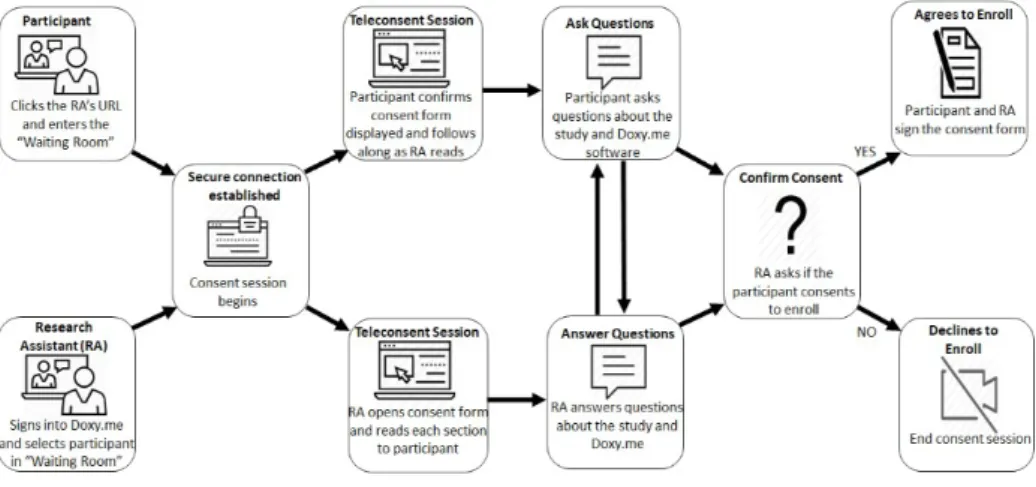
Teleconsent sessions were completed within a two-week period based upon participants’ availability. Participants were instructed to click on the RA’s link provided in the scheduling email and enter their name to sign into the waiting room. The RA then selected the participant from the waiting room, automatically starting the teleconsent session in the Doxy.me software. See Figure 1.
2.2 Teleconsent Sessions
Doxy.me is HIPAA (Health Insurance Portability and Accountability Act of 1996) compliant. The software adheres to the U.S. regulations to protect the privacy and security of health information by using encrypted point-to-point connections, and photo capture when obtaining signature to verify the participant's identity [1]. During the teleconsent session, the RA read the sections of the electronic consent form to the participant, and paused periodically to answer the participant’s questions. The electronic consent form was created from an existing IRB consent form template, and it consisted of nine sections: A) Purpose of the Research; B) Procedures; C) Duration; D)
Risks and Discomforts; E) Benefits; F) Costs; G) Compensation; H) Disclosure of Results; and I) Contact Information. After answering questions from participants, the RA requested the participant read the statement of consent and state if they agree to participate in the study. See workflow in Figure 1.
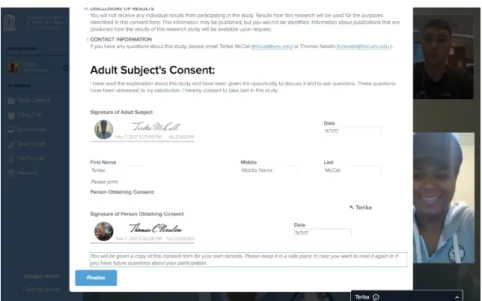
If the participant agreed, they were asked to click on the photo button underneath the signature of adult subject field. This allowed the participant to enter their name in the signature field and produced a cursive electronic signature and a picture of the participant to sign the consent form. See Figure 2. Finally, the RA then signed and dated the consent form. The participant and the RA downloaded a pdf copy of the completed consent form and stored it electronically for record-keeping.
2.3 Teleconsent Software User Interface Satisfaction Survey
After completing the teleconsent sessions, participants were sent a link to the
Teleconsent Software User Interface Satisfaction Survey (TSUIS) via an email sent from Qualtrics, online survey software. The TSUIS was developed using an adapted version of the validated Questionnaire for User Interaction Satisfaction (QUIS) [9]. Two questions were removed, because power adequacy and noise level of the system did not apply to the Doxy.me software. The TSUIS includes five categories: overall reaction to the software, information representation, language clarity, ease of use, system functionality. Response options for each question were displayed on a bipolar Likert scale of 0 to 9. All of the 23 quantitative questions were weighted equally. The survey included two qualitative questions which asked to list the most positive and negative aspects of the software separately in multi-line text fields.
3. Results
Of the 20 participants recruited for the study, 13 (65%) were female. 50% of the participants were white, and 40% were black. 65% participants were 21-35 years old, 10% were 36-50, and 25% were 51 or older. 90% of participants had a bachelor’s degree or higher. On average, each teleconsent session lasted eight minutes with a standard deviation of three minutes.
3.1 Overall Satisfaction Results
Questions focused on five different factors of the teleconsent experience, which were collapsed into five average scores for each of the participants. The domains were overall reaction to the software, screen, terminology and system information, learning, and systems capabilities. Questions to which participants responded “NA” were not included.
Participants’ mean responses for each of the five categories of questions were determined from a bipolar Likert scale ranging from 0 to 9. The mean score for each category ranged from 7.24 to 7.85. See Table 1. Due to the small sample size, an alpha level of .10 was used to assess statistical significance, as research has suggested that preliminary hypothesis testing should be conducted with a higher Type I error rate to ensure aims of pilot studies are completed in a timely manner with a smaller sample size [10]. A one-way ANOVA was used to assess whether responses varied by race. There was found to be no significant difference in mean responses in any category by race (F = 0.526). Similarly, a one-way ANOVA found no significant difference between mean responses in any category by education level (F = 1.431).
Table 1. Summary of Mean Scores for the Five Domains of Teleconsent Satisfaction Survey
N Minimum Maximum Mean Std. Deviation 1. Overall Reaction Mean Score 19 1.00 9.00 7.24 1.96
2. Overall Screen Mean Score 20 1.50 8.75 7.25 2.09
3. Terminology and System
Information Mean Score 19 2.50 9.00 7.98 1.48
4. Learning Mean Score 19 1.00 9.00 7.85 1.80
5. System Capabilities Mean Score 20 .00 9.00 7.41 2.55
3.2 Age and Satisfaction Correlations
A Pearson correlation between age and mean response by category was determined using a two-tailed alpha level of .10 to assess statistical significance. The results found a weak yet statistically significant correlation between age and mean response for the overall reaction category (r = 0.398, p = 0.091) and the systems capabilities category (r
= 0.380, p = 0.099). Also, Participants were asked to list the top three strengths and weaknesses of the software. The most common strengths were: the software’s ease of use, the high quality of the video feature, and the clean interface. The most common weaknesses reported were: difficulties scrolling through the consent form on Mac computers, some fields cut short on the finalized form, and difficulties navigating between screens.
Results of the study showed that younger users noted higher satisfaction with the teleconsent software. However, a positive overall reaction to the Doxy.me software was observed by participants of all age categories. Teleconsent is a viable solution to overcoming barriers to enrollment in studies that are present with more traditional methods, such as in-person consent. Offering teleconsent as an option for prospective participants reduces burden on the participant and provides greater access to people who may not be able to otherwise participate. This increases the generalizability of study results by allowing for recruitment outside the geographic region of the study team, which may increase the size and diversity of the study population.
4.1 Limitations
The main limitation of the study was the sample size of 20 participants, all of whom are English speakers. Most participants were 35 years old or younger, located in urban or suburban areas within the state of North Carolina, and had access to high-speed internet to complete the teleconsent session. Majority of the participants were college educated, reporting having at least a bachelor’s degree. Another limitation was that the consent form used was for obtaining consent to test the Doxy.me software and complete a user satisfaction survey. This cross-sectional study may be less burdensome than consenting to and participating in a longitudinal clinical research study.
5. Conclusion
Teleconsent software is an effective tool for obtaining informed consent for research studies. The study showed that use of the Doxy.me software was well received among all participants. Due to a gap in literature we are unable to compare usability test results of the software to similar software used for teleconsent. Future work will include collaborating with actively recruiting studies to offer the Doxy.me software as a mode to obtain informed consent from participants. Any feedback from participants or study staff about the software will be used by the developers to improve the design and functionality. The goal is to make the teleconsent interaction as simple and intuitive as possible for users, facilitating a positive informed consent experience.
References
[1] B. Welsh, Teleconsent: A novel approach to obtain informed consent for research Contemporary Clinical Trials Communications, 3 (2016), pp. 74-79.
[2] N.S. Sung, et al. Central challenges facing the national clinical research enterprise.
JAMA, 289 (2003), pp. 1278-1287.
[3] Forum on Drug Discovery, Development, and Translation, et al. Transforming Clinical Research in the United States: Challenges and Opportunities: Workshop Summary National Academies Press (2010)
[4] W.T. Friedewald Costs of clinical trials and the need for efficiency: a brief overview Stat. Med., 9 (1990), pp. 9-12.
[5] H.A. Glick, J.A. Doshi, S.S. Sonnad, D. Polsky Economic Evaluation in Clinical Trials. Oxford University Press (2014).
[7] M.K. Campbell, et al. Recruitment to randomized trials: strategies for trial enrollment and participation study. The STEPS study Health Technol. Assess., 11 (2007) iii, ix–105.
[8] C. Grady, The Changing Face of Informed Consent New England Journal of Medicine, 376;9 (2017), pp.856-867.
[9] J.P. Chin, V.A. Diehl, L.K. Norman. Development of an instrument measuring user satisfaction of the human-computer interface. Proceedings of the SIGCHI conference on Human factors in computing systems, (1998), p. 213–218.