111
Benders’ decomposition algorithm to solve bi-level bi-objective
scheduling of aircrafts and gate assignment under uncertainty
Mohsen Sadegh Amal Nik1*, Javad Ansarifar1, Faezeh Akhavizadegan1
1
School of Industrial Engineering, College of Engineering, University of Tehran, Tehran, Iran
[email protected], [email protected], [email protected]
Abstract
Management and scheduling of flights and assignment of gates to aircraft play a significant role in improving the procedure of the airport, due to the growing number of flights, decreasing the flight times. This research addresses assigning and scheduling of runways and gates in the main airport simultaneously. Moreover, this research considers the unavailability of runway’s constraint and the uncertain parameters relating to both areas of runway and gate assignment. The proposed model is formulated as a comprehensive bi-level bi-objective problem.The leader’s objective function minimizes the total waiting time for runways and gates for all aircrafts based on their importance coefficient. Meanwhile, the total distance traveled by all passengers in the airport terminal is minimized by a follower’s objective function. To solve the proposed model, the decomposition approach based on Benders’ decomposition method is applied. Empirical data are used to show the validation and application of our model. A comparison shows the effectiveness of the proposed model and its significant impact on cost decreasing.
Keywords: aircrafts scheduling, gate assignment, multi-objective, bi-level, fuzzy programming, Benders decomposition algorithm
1- Introduction
In recent decades, social welfare and economic growth increase the demand of the movement of passengers and goods by aircrafts in the world. According to the report of the Airport Council International, the number of passengers and the volume of air movements are increased annually (Airport Council International, 2010).In the other parts of this report, the total number of flights and movements in worldwide airports are investigated, showing the growth in air traffic. This growth has a direct relationship with the increasing of the number of passengers and the volume of goods. Statistics related to airports of each region of the world indicate that in just a few hours a large number of flights arriving and departing daily. For example: the Atlanta airport and Chicago in America (the busiest airports in the world) manage more than in 2500 and 2400 flights, Heathrow airport in London and Frankfurt in europe manages more than 1,300 flights, Bangkok and Hong Kong airports in the east asia manage more than 820 and 900flights, and Dubai airport in the middle east manages more than 900 landings and takeoffs daily. Summary of significant above statistics in this report is as follows: The number of air passengers around the world in 2013 increase 6.6 percentage.
*Corresponding author.
ISSN: 1735-8272, Copyright c 2016 JISE. All rights reserved
Journal of Industrial and Systems Engineering Vol. 9, No. 3, pp 111-126
112
This growth in the different continents is as follows: Latin America 13.2%, Middle East 12%, Asia-Pacific 11.3%, Africa 9.5%, Europe 4.3%, and North America 2.5%(Airport Council International, 2012). As another investigation (Airport Council International, 2010), the air traffic is predicted in the year, according to the statistics of the total air passengers and air goods for more than 9 billion people by 2015 and 214 million tons goods in the world.
These statistics and published studies illustrate that the importance of air transport management is an undeniable effort.Therefore, the problem that each airport faces individually is the management and scheduling of the high volume of flights in a short time by considering limited resources.It is obvious that the resources at each airport such as runways, gates connected to the terminal, ground facilities for serving the aircraft, and so onare very limited against this huge volume of demands. Accumulation of air traffic in an environment of airport results that the number of flights cannot get their desired services. For instance, anaircraft cannot land at your desired time that is commensurate with its economic speed to land or after landing the aircraft must wait for available gate. On the other hand, undesirable gate when assign to the aircraft, passengers are forced to travel more distances inside the airport, although the development of the airport resource as the basic solution has always been considered.However, this action is not possible simply due to the physical, geographical, and financial limitation, For example, the possibility of increasing the number of runways and expanding the airport terminal located in a city that does not exist. Therefore, simple and more practical solution that can be considered along with the first approach isthe application of management and operation research method for available resources.
In this study, assigning and scheduling gates and runways along with the scheduling of landing at the same airport are investigated so that the best gate and runway are assigned to each flight. Also the most appropriate scheduling for the landing of the aircrafts is determined.The main contribution of our study can be presented as follows.
• Formulation of the assigning and scheduling the gates and runways simultaneously
• Considering the unavailability of some runways due to the maintenance in the model
• Proposing a comprehensive bi-level bi-objective mathematical model so that the leader’s objective minimizes the total delays of aircrafts assigning to the runways and gates based on their importance, while, the follower’s objective minimizes the total distance that all passengers must travel across the airport
• Using the Fuzzy programming approach to deal with the uncertaintity of our reseach
• Solving the proposed model with a game based Benders’ decomposition algorithm
• Developing the simulation model to compare the proposed models with the real system
The rest of the research is structured as follows. Section 2 reviews the literature related to assigning gates and runways and scheduling of landing. Section 3 describes the mathematical model and a proposed Benders decomposition algorithm as a solution methodology is represented in Section 4. The case study and results of our model to show the performance and efficiency of ourmodel are reported in section 5. The overall conclusion and recommendations for future research are provided in section 6.
2- Literature review
In the recent decades, optimization and assignment of the airport’s resources are considered as the important areas of research to increase the efficiency of resources management. The two basic research areas, namely, assignment the gates and runway and scheduling the flights have attracted the most attention.The nature of these problems (assignment and scheduling) in the airports is similar to some other assigning and scheduling problems in operation research. For example, landing and departure scheduling problem can be considered as a vehicle routing problem with time windows. For instance, Psaraftis (1978) and Bianco, Dell'Olmo, and Giordani (1999) formulated the scheduling of the aircraft landing as the flowshop scheduling to solve the considered problem.As another research, Bianco, Dell’Olmo, and Giordani (2006) applied the Traveling Salesman Problem (TSP) to formulate the aircraft landing scheduling. Dynamic programming algorithm for TSP problem is developed to solve the problem. Bojanowski, Harikiopoulo, and Neogi (2011) focused on the aircraft landing scheduling in the airport with multiple runways to minimize the time the last landing.A heuristic algorithm is introduced that can solve their problem in a polynomial time. Beasley et al. (2000)
113
established a mixed integer linear programming for aircraft landing scheduling and provided a comprehensive review on the previous researches. Ernst, Krishnamoorthy, and Storer (1999) developed a certain simplex algorithm to determine the optimum scheduling for aircrafts landing at the airport with single and multiple runways. Harikiopouloand Neogi (2011), in their article tried to reform the traditional method (first-come-first-serve).
Jung and Laguna (2003) proposed a heuristic algorithm based on the division of the time. The planning horizon is dividedinto several sections so that each section is the sub-problem from the initial problem. Each sub-problemis developed as mixed integer linear programming that proposed by Beasley Beasley et al. (2000) and then is solved respectively. Balakrishnan and Chandran (2006) focused on the scheduling problem of aircraft landing and departure to maximize the throughput of the aircraft runway (or minimize departure time of a sequence of aircraft) by considering the operational constraints.Fahle et al.(2003) established several exact methods and heuristic algorithms to optimize the scheduling of the landing and departuring of aircraft at the airport. Then, they compared the two mathematical models with four heuristic algorithms based on the quality, speed and flexibility. For the first time, Papadakos (2009) developed several comprehensive models for optimization of the scheduling of airline. They combined the advanced Benders’ Decomposition by theaccelerated column generation to solve their proposed models. When (2005) presented a mixed integer programming model based on a proposed model by Beasley et al. (2000) in his thesis. In this research, the branch and bond and column generation are integrated to solve the proposed model. As another thesis, Sharma (2009) considered the aircraft landing scheduling problem to study. In this research, minimizing the total tardiness is defined as the objective function and the GAMS / CPLEX softwares are applied to solve the model.Beasley, Sonander, and Havelock (2001) applied a population-based meta-heuristic algorithmfor the improvement of the utilization of the airport in London by minimization of landing the all aircraft. Zhan, Zhang, and Gong (2009) solved the scheduling of aircraft landing by the ant colony algorithm. Liu (2011) proposed a local search based on the genetic algorithm for the aircraft landing scheduling problem. Moreover, Caprı̀, and Ignaccolo (2004) focused on the scheduling of the landing and departuring of aircraft. They proposed a dynamic model and applied the genetic algorithm to solve this model. In a paper presented by Bennell, Mesgarpour, and Potts (2011), the scheduling and assigning the runways to aircraft for landing and departuring, simultaneously. First, they reviewed the solution methodoly used in the previous study and then utilized dynamic programming, branch and bound and heuristic algorithms and meta-heuristic algorithms to solve their proposed model.Teodorović (1999) focused on the classification and analysis of the results of using fuzzy logic to formulate the air traffic and air transport. They indicated that the fuzzy logic as an effective mathematical approach can be used to formulate theair traffic and air transport in the uncertain environment.Atkin et al.(2007) focused on the current system at London Heathrow airport and described how it works and presented numerous limitations applied to schedule the aircraft. Then, they proposed a model for scheduling of landing and departuring the aircrafts. Soomer and Franx (2008) considered the preferences of the airlines to formulate the scheduling of the flights on the airline with a single runway.
Dorndorf et al.(2007) provide a literature review of the previous research in the gate assigning problem. Bihr (1990) proposed a linear model for the gate assigning problem by considering a minimizing the totaldistance traveled by all passengers in the airport as objective function. The proposed model is solved by using the simplex algorithm for small size example.Article provided by Bolat (2001) considered the confusion from delay, difficult climatic conditions, equipment failure to formulate the gate assigning problem. In this research, uniform distribution of idle of the gate is considered as the objective function.Genç et al. (2012) formulated the gate assigning problem by considering the minimizing of the idle time of gates as objective function. Tang, Yan, and Hou (2010) proposed a new reallocation structure for gates. Maharjan and Matis (2011) established a binary integer model to reassign the gates to flight to minimize the delays of flights daily. Zhang (2003) proposed a model based on the network flow to maximize the total assigned flights to the gates and minimize the distance traveled by flights in the airport in his thesis.Haghani and Chen (1998) introduced the gate assigning problem as a problem that is easy to understand. They formulated the problems as QAP model by considering the minimizing of the total distance traveled by passengers as objective function. Lim, Rodrigues, and Zhu (2005) focused on the actual state of gate assigning problem where it is possible to change the time of landing and departure of flights. Their objective
114
function is minimizing the distance traveled by passengers and goods in the airport.Cheng, Ho and Kwan (2012) compared the results of three meta-heuristic algorithms, namely, genetic algorithms, simulated annealing and tabu search and a hybrid algorithm consisting of simulated annealing and tabu search with each other for the gate assigning problem. Zalila (2002) investigated the performance of three meta-heuristic algorithms to find a suitable algorithm gate assigning problem. Ding et al. (2004) studied on the gate assigning problem by considering various constraints where the number of flights is more than the number of available gates to minimize the total distance traveled and flights without the gate.Şekerand Noyan (2012) developed an uncertain model to formulate the gate assigning problem under uncertainty environment. They applied a tabu search algorithm to achieve acceptable assigning in a reasonable time.In a paper presented by Wei and Liu (2007), a multi-objective model is developed and is solved by an optimization approach based on genetic algorithm. Their objectives minimized the distance traveled by passengers in the airport and minimized the idle time of the gates.
To the best of our knowledge, there are no studies that focus on the scheduling of the landing and departuring of flights comprehensively and assignment of gates ad runways to the flights. On the other hand, the unavailability of some runways constraint due to the maintenance is considered in some reaches. In this research, we consider these constraints and develop a bi-level bi-objective model under uncertain environment. Its leader's objective minimizes the total waiting time for runways and gates for all aircrafts based on their importance coefficient. The total distance traveled by all passengers in the airport terminal is minimized by its follower objective. For taking into account the uncertainty, the fuzzy programming approach is applied. This study is the first article that utilized a game based Benders’ decomposition algorithm for scheduling and assigning the runways and gates to the flights.
3- Description of the problem
In this section, the new assumptions based on the actual circumstance in the airport are studied first of all and then the proposed model is described. We investigate the problem in terms of the landing and departuring flights.When an arriving aircraft approached the airport, the airport control tower should obtain the optimum time for landing the aircraft based on its speed, height and number of other technical factors. Therefore, this time as the lower bound for the final time of landing aircraft is considered. These variables also considered as one of the important constraints.Whatever the final time is later than the lower bound determined the airport control tower, the mores cost is imposed to the system. The reasons are that higher fuel consumption, distance from the economic speed, and Delays (not only the time for passengers due to late arrival or loss later flight and also the need for airlines to reschedule the crew and the later flights). The considered problem can be investigated in terms of the departuring flights. In this case, the aircraft control tower assigns the optimal gate to the each aircraft according to the passenger flow between flights. Afterward, the departuring time for aircraft is determined.The most challangable issue that the airport managers face is the security on the runways and gates must be met. The aircrafts must be assigned to the same gates or runways with a specific time interval. This reason is that each aircraft after usage of the runway and gate creates a Hurricanes and disturbances. Thus, usage of the next aircraft from the runway and gate immediately lets to various risks. This time interval depends on the different factors such as, runway capacity, the size of the aircraft, atmospheric circumstance and so on.The landing and departuring flights are classified based on the importance of the airline into three categories: high, medium, and low importance. Ahigh important airline relates to the expensive airline with the highest number of passengers and the medium class is a foreign company, which generally corresponds to the number of passengers, is much less than the first class. Finally, the low important airlines are the low-cost companies and they are used to transfer the goods not the passengers. For each flight based on the status of aircraft (landing or departuring) and the type of airline, the important factor is defined that indicate itspriority. Some runways are out of reach due to the maintenance. We considered the unavailable constraints for runways in the formulation. In the following, the variables and parameters used in the model are described.
115 Sets:
I Number of the flights or aricrafts in the airport
(
i =1,...,I)
R Error! Bookmark not defined. Numer of the runways in the airport
(
r=1,...,R)
J Number of the gates in the airport
(
j =1,...,J)
Parameters:ii
N ′ Number of transit passenger between flight iandiˊ jj
Dt ′ Distance between gate j and gate jˊ
β
Cost of delays in the assignment of the gates to aircraftsMw Traveling time between aircraft and gate
i
A l Importantindicatorthe value of the flight i that the value of high, medium, and low important airline are equal to 3, 2, and 1.
i
Sz Indicator of aircraft sizes that value of small, medium and large aircraft are equal to 1, 2, and 3.
i
w Total importance of the flight i that is mutiplied by Important indicator and aircraft size (wi =A l Szi i)
Cost of delays in the assignment of the runway to aircraft i
i
St Binary paramter, 1 if the aircraft must be landed, while, 0 if the aircraft must be departured
ir
E Optimum time for the aircraft i to reach the runway r
ir
L Deadline for the aircraft i ro reach the runway r Interval time between the flight iandiˊ
Service time that aircraft ineed in the gate Service time that aircraft i need in the runway
Maintenarence duratunavailableway r that is unavaliable Time after runway that is available
M
Big positive numberVariables: i
T Starting time of the landing or departuring of aircraft i
i
E Optimum time for landing or departuring of aircraft i
i
L Deadline time for landing or departuring of aircraft i
i
A Starting time of aircrafti in the assigned gate
i
B Finishing time of aircraft iin the assigned gate
ii
DT ′ Distance between the flight iandiˊ ir
X Binary variable, 1 if the aircraft i is assigned to the runway r; 0, otherwise
ij
Y Binary variable, 1 if the aircraft i is assigned to the gate j; 0, otherwise
ii r
F ′ Binary variable, 1 if the aircraft iandiˊ are assigned to the runway r; 0, otherwise
ii j
H ′ Binary variable, 1 if the aircraft iandiˊ are assigned to the gate j; 0, otherwise
ii
P ′ Binary variable, 1 if the aircraft i is assigned after aircraftiˊto the same runway; 0, otherwise
ii
G ′ Binary variable, 1 if the aircraft i is assigned after aircraftiˊ to the same gate; 0, otherwise
i
116
In the following, the bi-level bi-objective models for scheduling of landing and departuring aircrafts and assigning of gates and runway to the flights are described.
= [ − + 1 − ! " − + # + ! − $ − # %]
'(
1 (2)
2
min ii ii
i I i I
Z N DT′ ′
′
∈ ∈
=
∑∑
St.
1 ir r R
X
∈
=
∑
∀ ∈
i
I
(3)1
ij j JY
∈
=
∑
∀ ∈
i
I
(4)i ir ir r R
E Y E
∈
=
∑
∀ ∈
i
I
(5)i ir ir r R
L X L
∈
=
∑
∀ ∈
i
I
(6)i i
T ≥E
∀ ∈
i
I
(7)i i
T ≤L
∀ ∈
i
I
(8)1
ii i iP
′+
P
′=
∀
i i
,
′
∈
I i
,
≠
i
′
(9)ii r i ir
F
′=
F
′∀
i i
,
′
∈
I i
,
≠
i
′
,
r
∈
R
(10)2 ir i r ii r
X X
F ′ ≤ + ′
∀
i i
,
′
∈
I i
,
≠
i
′
,
r
∈
R
(11)1 2 ir i r ii r
X X
F ′ ≥ + ′ −
∀
i i
,
′
∈
I i
,
≠
i
′
,
r
∈
R
(12)1
ii i iG
′+
G
′=
∀
i i
,
′
∈
I i
,
≠
i
′
(13)ii j i ij
H ′ =H ′
∀
i i
,
′
∈
I i
,
≠
i
′
,
j
∈
J
(14)2 ij i j ii j
Y Y
H ′ ′
+
≤
∀
i i
,
′
∈
I i
,
≠
i
′
,
j
∈
J
(15)1 2 ij i j ii j
Y Y
H ′ ≥ + ′ −
∀
i i
,
′
∈
I i
,
≠
i
′
,
j
∈
J
(16)≥
+
Fii r′*
+
+ − # ,
" ≥ " + Hii j′ ! − #
∀
i i
,
′
∈
I i
,
≠
i
′
,
j
∈
J
(18)≤
./
.− + #
.'0
∀ ∈
i
I
(19)≥
1
./
.− # 1 −
.'0
∀ ∈
i
I
(20)" ≥ + # − # !
∀ ∈
i
I
(21),
,
,
i i
′
I i
i
′
r
R
117
" − # 1 − ! ≤ − #
∀ ∈
i
I
(22)$ = " + !
∀ ∈
i
I
(23)2
( ) ( )
2 2
ij i j ij i j
ii jj
Y Y Y Y
DT ′≥Dt ′ + ′ ′ −M − + ′ ′
∀
i i
,
′
∈
I i
,
≠
i
′
, ,
j j
′
∈
J j
,
≠
j
′
(24),
,
,
,
0
i i i i i
T E L A B
≥
∀ ∈i I (25)0
iiDT
′≥
∀
i i
,
′
∈
I i
,
≠
i
′
(26){ }
0,1
irX
∈
∀ ∈
i
I r
,
∈
R
(27){ }
0,1
ijY
∈
∀ ∈
i
I j
,
∈
J
(28){ }
0,1
ii rF
′∈
∀
i i
,
′
∈
I i
,
≠
i
′
,
r
∈
R
(29){ }
0,1
ii jH
′∈
∀
i i
,
′
∈
I i
,
≠
i
′
,
j
∈
J
(30){ }
,
0,1
ii ii
P G
′ ′∈
∀
i i
,
′
∈
I i
,
≠
i
′
(31){ }
0,1
iZ
∈
∀ ∈
i
I
(32)The leader’s objective function is represented in equation (1).The total waiting times for runways and gates for all aircrafts based on their importance coefficient are minimized by leader objective. Equation (2) as follower objective minimizes the total distance traveled by all passengers in the airport.Constraints (3) and (4) certify that each aircraft is assigned to only one runway and only one gate, respectively. Constraints (5) and (6) calculate the optimum time and deadline time for the landing or departuring of each aircraft, respectively. Constraints (7) and (8) determine the starting time of the landing or departuring of each aircraft.The sequence of aircrafts assigned to the same runway is determined by constraint (9). Constraints (10) to (12) determine the aircrafts that assigned to the same runway. Constraint (13) determines the sequence of aircraft assigned to the same gate. Meanwhile, the aircraft assigned to the same gate are specified by constraint (14) to (16). Constraints (17) and (18) guarantee the interval time between two consecutive flights that assigned to the same runway and gate, respectively. Constraints (19) and (20) represent a time window for the unavailability of the runway due to the maintenance.Two constraints (21) and (22) calculate the starting time of aircraft in the assigned gates and the finishing time of aircrafts in the assigned gates are calculated by consraint (23). The distances between the two flights are determined by constraint (24). Constraints (25) and (26) represent the positive variables. While constaints (27) to (32) represents a binary variable.
In this study, to consider the uncertainty in the formulation, the Fuzzy programming approach is utilized. The uncertain parameters are presented as a triangular fuzzy number (2 =
3, 5, 6 ).Where, the 3, 5, 6Representthe pessimistic value, intermediate value, and optimistic
value of the fuzzy number that is estimated by experts.In the literature review, several approaches are presented to deal with the fuzzy parameter or uncertainty factors in the constraints and objective functions (Jiménez et al., 2007). The proposed uncertain model is transformed into the equivalent auxiliary crisp mixed-integer linear model of the approach presented by Jiménez et al. (2007)due to its high efficiency. Finally, the crisp form of the Fuzzy bi-level bi-objective models as MILP model can be presented as follows.
(33)
1
2
min [( )( )]
4
2 2
+ [( )(1 )( ( ))]
4 4
2 2
+ [( )( )( ( ))]
4 4
p m o
i i i
i i i
i I
p m o p m o
i i i i
i I
p m o p m o
i i i i
i I
Z w T E
Mw Mw Mw
w St A T
Mw Mw Mw
w St T B
α
α
α
β
β
β
β
β
β
∈ ∈ ∈ + + = − + + − − + + + + + − − + +
∑
∑
∑
118
(34)
2
min ii ii
i I i I
Z N DT′ ′
′
∈ ∈
=
∑∑
St.
(
(1
)
)
2
2
(
(1
)
)
(
)
2
2
m o p m
ii ii ii ii
i i ii r
m o p m
i i i i
ii r ii
Sp
Sp
Sp
Sp
T
T
F
D
D
D
D
F
M P
α
α
α
α
′ ′ ′ ′ ′ ′ ′ ′ ′ ′ ′ ′
+
+
≥
+
+ −
+
+
+
+ −
−
,
,
,
i i
′
I i
i
′
r
R
∀
∈
≠
∈
(35)
( (1 ) ) ( )
2 2
m o p m
i i i i
i i ii j ii
Gt Gt Gt Gt
A ≥A ′+H ′
α
′ + ′+ −α
′ + ′ −M G ′
,
,
,
i i
′
I i
i
′
j
J
∀
∈
≠
∈
(36)
( (1 ) )
2 2
( (1 ) ) ( )
2 2
m o p m
r r r r
i ir
r R
m o p m
i i i i
i
Un Un Un Un
T X
D D D D
M Z
α
α
α
α
∈ + + ≤ + − + + − + − + ∑
i
I
∀ ∈
(37)(
(1
)
)
(1
)
2
2
m o p m
r r r r
i ir i
r R
Ul
Ul
Ul
Ul
T
α
α
X
M
Z
∈
+
+
≥
+ −
−
−
∑
∀ ∈
i
I
(38)(1
)
(
)
2
2
m o p m
i i i
Mw
Mw
Mw
Mw
A
≥ +
T
α
+
+ −
α
+
−
M St
∀ ∈
i
I
(39)(1
)
(
(1
)
)
2
2
m o p m
i i i
Mw
Mw
Mw
Mw
A
−
M
−
St
≤ −
T
α
+
+ −
α
+
∀ ∈
i
I
(40)(
(1
)
)
2
2
m o p m
i i i i
i i
Gt
Gt
Gt
Gt
B
=
A
+
α
+
+ −
α
+
∀ ∈
i
I
(41)along with constraints (1) to (16) and (24) to (32).
4- Solution methodology
Some studies in the literature considered exact methods to solve their proposed models. Sarin, Wang, and Varadarajan (2010) applied a Benders decomposition algorithm to solve the scheduling of the courses university problem. Li and Womer (2009) proposed a hybrid Benders decomposition to solve the resource-constrained project scheduling problem. In some researches such as Redjem et al. (2012) and Rabeh, Saïd, and Eric (2011) the optimization softwares are applied to solve their problem. Whereas, some studied, namely, Gamst and Jensen (2012), Rasmussen et al. (2012), and Maenhout and Vanhoucke (2010) are considered an exact branch-and-price algorithm to solve their problems. Moreover, Trautsamwieser and Hirsch (2014) solve the scheduling of the home care problem by using the Branch-Price-and-Cut solution approach. A Lagrangian relaxation approach is utilized by Bard and Purnomo (2007) to solve their integer model. One of the contributions of this study is that the proposed model developed as the bi-level bi-objective problem. In bi-level models, there are two levels, namely the upper level and lower level. The upper level and lower level are defined as the leader and the follower, respectively. The solution space of the upper level of the problem is determined by own constraints plus the follower problem and thus this problem is a non-convex problem.
According to the proposed model, the leader’s objective minimizes the total waiting time for runways and gates for all aircrafts based on their importance coefficient. Moreover, the follower’s
119
objective minimizes the total distance traveled by all passengers in the airport. In general, the proposed bi-level bi-objective model identifies the assignment of the aircrafts to the gates and runways. In addition, the scheduling of aircrafts at the airport is determined in order to use the gates and runways. There are several researches applied the exact solution methodology to solve the mixed integer bi-level linear problems (MIBLP). The literature review shows that the enumeration techniques and the reformulation techniques are two kinds of exact methods to solve MIBLP. The enumeration techniques developed based on the property of the bi-level problem, that the global optimal solution lies in a corner of the feasible space determined by the upper and lower level constraints. The enumeration techniques are applied to solve the problems in the various studies such as, Moore and Bard (1990), Bard 1983, (1984), Vicente, Savard, and Judice (1996), Chen and Florian (1992), and Tuy, Migdalas, and Värbrand (1993). The reformulation techniques reformulates the MIBLP by using some approaches, for example, the Karush–Kuhn–Tucker (KKT) optimality conditions. The KKT reformulates the lower level as additional new constraints for the upper level problem and thus the bi-level problem is converted into a single level problem. Shi, Lu, and Zhang
(2005), Shi et al. (2006), Bialas and Karwan (1978) and Hansen et al. (1992) transformed the bi-level problem by using the KKT optimality into the single level problem.
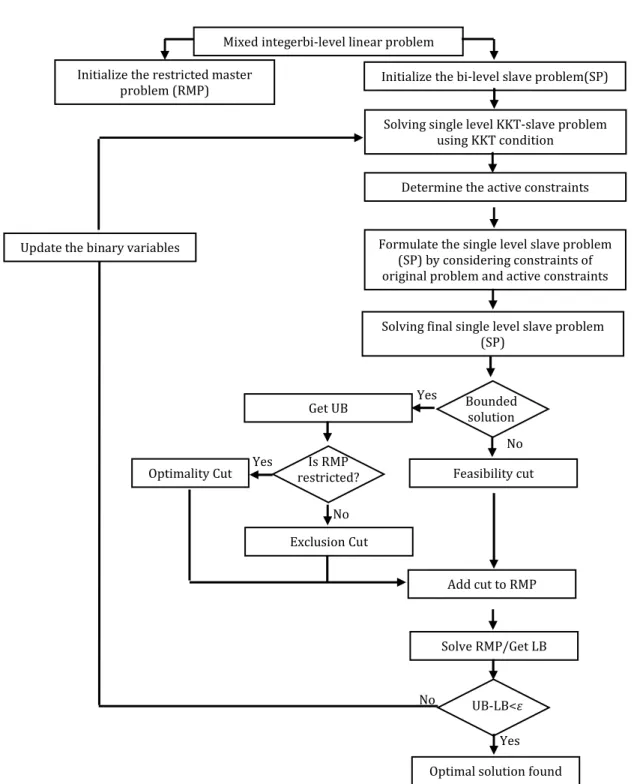
This paper utilized the reformulation technique that proposed by Saharidis and Ierapetritou (2009) to solve our model. According to this approach, the decomposition technique is applied to decompose the structure of the problem for facilitating solving procedure of the initial mixed integer level bi-objective problem through series sub-problems. A restricted master problem (RMP) and slave problems (SP) and KKT-slave problem are defined as the sub-problem of the initial problem is this approach. The KKT-slave problem contains the restricted initial problem (by fixing the value of the integer variables) and KKT optimality conditions of a lower level problem as constraints. Based on the solution of the KKT-slave problem, the active constraints of the initial problem are determined. Slave problem (SP) as another restricted sub-problem in this algorithm is formulated by fixing the feasible value of integer variables of the initial problem and considering which its constraints are active. An upper bound (UB) of the problem is determined by the slave problem when the initial problem is a minimization problem.
A lower bound (LB) for the problem if the initial problem is a minimizing the problem and the value of integer variables of the initial problem are determined by the restricted master problem (RMP). The lower and upper bound of the problem are updated in each iteration of the algorithm. Moreover, in each iteration, the salve problem creates a new valid cut, for the RMP. This cut leads to the RMP converge to the optimal solution. The procedure of the proposed algorithm is started by fixing the integer variable of the initial problem. Afterwards, the KKT-slave problem is applied to transform a bi-level problem into a single level by using KKT optimality conditions. After determining active constraints, the current slave problem determines an upper bound of the initial problem (in the case of minimization). The new cut based on the status of the slave problem is established and the optimal dual values of the current slave problem are added to the RMP. This procedure continues until the RMP optimality condition $ − 7$ < 9 is satisfied. Figure 1 shows the flow chart of the proposed algorithm. With respect to this algorithm, there are three following cuts could be established.
Optimality cuts: when the current slave problem gives a feasible solution (Saharidis & Ierapetritou, 2009);
Feasibility cuts: when the current slave problem gives an infeasible solution (Saharidis & Ierapetritou, 2009);
Exclusion Cut: when the current slave problem obtains a feasible solution, but the optimality cut does not restrict the RMP (Saharidis & Ierapetritou, 2009)
120
Figure 1. Flow chart of the proposed algorithm
5- Computational experiments
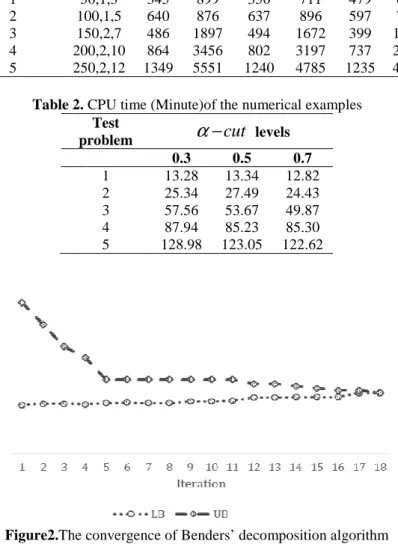
In this section, some examples based on the real-world are presented to illustrate how the model works and to certify the practicality and applicability of the proposed model. For this purpose, a number of examples based on the real-world are developed to evaluate the performance of the usefulness of the proposed bi-level bi-objective model. Table 1 illustrates the result of the optimal solution for numerical examples. The bi-level bi-objective Fuzzy model is coded and the Behders decomposition algorithm is implemented in the GAMS software. The result of each example is reported under three values (0.3, 0.5, and 0.7) for
α
−
cut
. The CPU time for these numericalMixed integerbi-level linear problem Initialize the restricted master
problem (RMP)
Initialize the bi-level slave problem(SP)
Solving single level KKT-slave problem using KKT condition
Determine the active constraints
Formulate the single level slave problem (SP) by considering constraints of original problem and active constraints
Solving final single level slave problem (SP)
Bounded solution
Feasibility cut Get UB
Yes
No Update the binary variables
Add cut to RMP Is RMP
restricted?
Exclusion Cut No Yes
Optimality Cut
Solve RMP/Get LB
UB-LB<9 Yes No
examples are shown in Table 2.
mixed integer bi-level bi-objective model
convergence of Benders decomposition algorithm for third example under Table 1.
Test problem
1 2 3
4 20 5 25 Table 2.
Figure2.The convergence of Benders
Also, the First-come-First-serve policy as the current system implemented is considered to present the simulation model. MATLAB® software word and then compare the simulation model with real system programming. of this airport, the performance of
system. For this purpose, analysis of variance (ANOVA) is applied. F equality of variance ( 2 2
0: 1 2 H δ =δ
systems are determined. Table 3 shows the results of ANOVA test. The results performance for simulation model and real system and no significant differe simulation model and real systems can be seen.
121
examples are shown in Table 2.The results show theapplication and suitability o objective model under uncertainty. Figure 2 show convergence of Benders decomposition algorithm for third example under
α
−cut =Table 1. Results of the numerical examples
, ,
I R J
cut
α
−
levels0.3 0.5 0.7
O.F O.F O.F
1
Z Z2 Z1 Z2 Z1
50,1,3 345 899 350 711 479 100,1,5 640 876 637 896 597 150,2,7 486 1897 494 1672 399 1450 200,2,10 864 3456 802 3197 737 2847 250,2,12 1349 5551 1240 4785 1235 4483
Table 2. CPU time (Minute)of the numerical examples Test
problem
α
−
cut
levels0.3 0.5 0.7
1 13.28 13.34 12.82 2 25.34 27.49 24.43 3 57.56 53.67 49.87 4 87.94 85.23 85.30 5 128.98 123.05 122.62
The convergence of Benders’ decomposition algorithm
rve policy as the current system implemented at the airport (case study) to present the simulation model. MATLAB® software is utilized
word and then compare the simulation model with real system programming. Based on empi
of this airport, the performance of the simulation model is evaluated and is compared with the real system. For this purpose, analysis of variance (ANOVA) is applied. F-test and T
2 2
0 δ1 =δ2) and average equity (H0:µ1=µ2) for simulation model and real systems are determined. Table 3 shows the results of ANOVA test. The results
performance for simulation model and real system and no significant differe simulation model and real systems can be seen.
of theproposed fuzzy shows the convergent
0.5 cut
− = .
O.F 2 Z 653 765 1450 2847 4483
the airport (case study) to simulate the real-Based on empirical data is evaluated and is compared with the real test and T-test as the test for ) for simulation model and real systems are determined. Table 3 shows the results of ANOVA test. The results illustrate the same performance for simulation model and real system and no significant difference between the
122
Table 3. Analysis of varianceresults for comparison between actual system and simulation model
Factor
F-test (equality of variances) t-test (equality of means)
F-value p-value 2 2
0: 1 2
H δ =δ T-value P-value H0:µ1=µ2
1
Z 0.54 0.277 Not rejected at α=0.05 0.70 0.681 Not rejected at α=0.05 2
Z 0.67 0.436 Not rejected at α=0.05 1.15 0.682 Not rejected at α=0.05
In the following, the performance of the proposed bi-level bi-objective model is compared with thesimulation models. For this purpose, the simulation and proposed model is implemented for 50 times and the mean objective functions of models are compared with each other with ANOVA test.The result of the equality of mean (H0:µ1=µ2) for objective functions is reported in Table 4. The results show that, at a significance level of 0:05, there isa significant difference between the proposed model and simulation model. Thus, the result indicates the superior of the proposed model.
Table 4. Comparison between the proposed model and the simulation model Factor Mean T-test (equality of means)
Proposed model Simulation model T-value P-value H0:µ1=µ2
1
Z 872 1758 1.45 0.0016 Rejected at α=0.05 2
Z 334 791 0.74 0.0021 Rejected at α=0.05
6- Conclusion
This study addresses the scheduling and assigning of gates and runways and aircraft landing at the same airport by considering unavailability of some runways constraint. For this purpose, after reviewing the literature and previous studies in the field of gate assigning and runway assigning, a two-level bi-objective mathematical model is presented. In this model, all the parameters and decision variables concerning gate and runway assigning and scheduling of the aircraft landing are considered.To consider the uncertainty environment in the model, a fuzzy programming approach is used. The proposed model is developed as bi-level bi-objective so that the leader objective minimizes the total tardiness of aircrafts assigning to the runways and gates based on their importance.Also,the follower objective minimizes the total distance traveled by all passengers in the airport. The game theoretical Benders decomposition algorithm is utilized to solve the proposed model. Several numerical examples are developed based on the experiments to investigate the validation and applicability of the proposed model. The computational results illustrate that the effectiveness and efficiency of the proposed model and also theSignificant saving in the costs and time isobtained. Comparison between the model and the simulation model based on the real-world showed that the proposed model is more appropriate and more efficient.
For future research related to scheduling and assigning of runways and gatesin the airports, we can propose various extensions with respect to various aspects. Other resources in the airports including ground services, sets, auxiliary machines, etc. can be considered in the modeling. Application of other approachesto deal with uncertainty aspects of data due to the changing in flight times or impossibility of usage of the facilities at the airport in the specific period, can be considered as future research. Moreover, another indicator can be considered as objective function in the future research.
References
Airport Council Intrnational.(2010).ACI Global traffic forecast 2010-2025 executive summery. Airport Council International.(2012). April,ACI releases word airport traffic report 2005-2011. Atkin, J.A., Burke, E.K., Greenwood, J.S. & Reeson, D.(2007). Hybrid metaheuristics to aid runway scheduling at London Heathrow Airport. Transportation Science, 41(1), 90-106.
123
Balakrishnan, H. & Chandran, B.(2006). August. Scheduling aircraft landings under constrained position shifting. In AIAA Guidance, Navigation, and Control Conference and Exhibit, Keystone, CO. Bard, J.F.(1983). An efficient point algorithm for a linear two-stage optimization problem. Operations
Research, 31(4), 670-684.
Bard, J.F. & Purnomo, H.W.(2007). Cyclic preference scheduling of nurses using a Lagrangian-based heuristic. Journal of Scheduling, 10(1), 5-23.
Beasley, J.E., Krishnamoorthy, M., Sharaiha, Y.M. & Abramson, D.(2000). Scheduling aircraft landings—the static case. Transportation science, 34(2), 180-197.
Beasley, J.E., Sonander, J. & Havelock, P.(2001). Scheduling aircraft landings at London Heathrow using a population heuristic. Journal of the operational Research Society, 483-493.
Bencheikh, G., Boukachour, J., Alaoui, A.E.H. & Khoukhi, F.E.(2009). Hybrid method for aircraft landing scheduling based on a job shop formulation. International Journal of Computer Science and
Network Security, 9(8), 78-88.
Bennell, J.A., Mesgarpour, M. & Potts, C.N.(2011). Airport runway scheduling. 4OR, 9(2), 115-138. Bialas, W. and Karwan, M., 1978. Multilevel linear programming. State University of New York at
Buffalo.
Bianco, L., Dell’Olmo, P. & Giordani, S.(2006). Scheduling models for air traffic control in terminal areas. Journal of Scheduling, 9(3), 223-253.
Bianco, L., Dell'Olmo, P. & Giordani, S.(1999). Minimizing total completion time subject to release dates and sequence‐dependentprocessing times. Annals of Operations Research, 86, 393-415.
Bihr, R.A.(1990). A conceptual solution to the aircraft gate assignment problem using 0, 1 linear programming. Computers & Industrial Engineering, 19(1), 280-284.
Bojanowski, L., Harikiopoulo, D. & Neogi, N.(2011), June. Multi-runway aircraft sequencing at congested airports. In Proceedings of American Control Conference (ACC), 2011, 2752-2758.
Bolat, A.(2001). Models and a genetic algorithm for static aircraft-gate assignment problem. Journal
of the Operational Research Society, 52(10), 1107-1120.
Caprı̀, S. & Ignaccolo, M.(2004). Genetic algorithms for solving the aircraft-sequencing problem: the introduction of departures into the dynamic model. Journal of Air Transport Management, 10(5), 345-351.
Chen, Y. & Florian, M.(1992). On the geometric structure of linear bilevel programs: a dual approach.
Centre De Recherche Sur Les Transports Publication, 867.
Cheng, C.H., Ho, S.C. & Kwan, C.L.(2012). The use of meta-heuristics for airport gate assignment.
Expert systems with applications, 39(16), 12430-12437.
Cheng, Y.(1997). A knowledge-based airport gate assignment system integrated with mathematical programming. Computers & Industrial Engineering, 32(4), 837-852.
Coello, C.C., Lamont, G.B. & Van Veldhuizen, D.A.(2007). Evolutionary algorithms for solving multi-objective problems. Springer Science & Business Media.
124
Dorndorf, U., Drexl, A., Nikulin, Y. & Pesch, E.(2007). Flight gate scheduling: State-of-the-art and recent developments. Omega, 35(3), 326-334.
Ernst, A.T., Krishnamoorthy, M. & Storer, R.H.(1999). Heuristic and exact algorithms for scheduling aircraft landings. Networks, 34(3), 229-241.
Fahle, T., Feldmann, R., Götz, S., Grothklags, S. & Monien, B.(2003). The aircraft sequencing problem. In Computer science in perspective,152-166.
Gamst, M., & Jensen, T. S. (2012). “A branch-and-price algorithm for the long-term home care scheduling problem”. In Proceedings of Operations Research, 483-488.
Genç, H.M., Erol, O.K., Eksin, İ., Berber, M.F. & Güleryüz, B.O.(2012). A stochastic neighborhood search approach for airport gate assignment problem. Expert Systems with Applications, 39(1), 316-327.
Haghani, A. & Chen, M.C.(1998). Optimizing gate assignments at airport terminals. Transportation
Research Part A: Policy and Practice, 32(6), 437-454.
Hamzawi, S.G.(1986). Management and planning of airport gate capacity: a microcomputer‐based gate assignment simulation model. Transportation Planning and Technology, 11(3), 189-202.
Hansen, J.V.(2004). Genetic search methods in air traffic control. Computers & Operations Research, 31(3), 445-459.
Hansen, P., Jaumard, B. & Savard, G.(1992). New branch-and-bound rules for linear bilevel programming. SIAM Journal on scientific and Statistical Computing, 13(5), 1194-1217.
Harikiopoulo, D. & Neogi, N.(2011). Polynomial-time feasibility condition for multiclass aircraft sequencing on a single-runway airport. Intelligent Transportation Systems, IEEE Transactions on, 12(1), p2-14.
Jiménez, M., Arenas, M., Bilbao, A. & Rodrı, M.V.(2007). Linear programming with fuzzy parameters: an interactive method resolution. European Journal of Operational Research, 177(3), 1599-1609.
Jung, G. & Laguna, M.(2003). Time segmenting heuristic for an aircraft landing problem.
Unpublished work, previously available from leeds-faculty. colorado.
Li, H. & Womer, K.(2009). Scheduling projects with multi-skilled personnel by a hybrid MILP/CP benders decomposition algorithm. Journal of Scheduling, 12(3), 281-298.
Lim, A., Rodrigues, B. & Zhu, Y.(2005). Airport gate scheduling with time windows. Artificial
Intelligence Review, 24(1), 5-31.
Ding, H., Lim, A., Rodrigues, B. & Zhu, Y.(2004). New heuristics for over-constrained flight to gate assignments. Journal of the Operational Research Society, 760-768.
Liu, Y.H.(2011). A genetic local search algorithm with a threshold accepting mechanism for solving the runway dependent aircraft landing problem. Optimization Letters, 5(2), 229-245.
Maenhout, B. & Vanhoucke, M.(2010). Branching strategies in a branch-and-price approach for a multiple objective nurse scheduling problem. Journal of Scheduling, 13(1), 77-93.
Maharjan, B. & Matis, T.I.(2011). An optimization model for gate reassignment in response to flight delays. Journal of Air Transport Management, 17(4), 256-261.
125
Moore, J.T. & Bard, J.F.(1990). The mixed integer linear bilevel programming problem. Operations
research, 38(5), 911-921.
Papadakos, N.(2009). Integrated airline scheduling. Computers & Operations Research, 36(1), 176-195.
Parra, M.A., Terol, A.B., Gladish, B.P. & Urıa, M.R.(2005). Solving a multiobjective possibilistic problem through compromise programming. European Journal of Operational Research, 164(3), 748-759.
Psaraftis, H.N.(1978). A dynamic programming approach to the aircraft sequencing problem.
Cambridge, Mass.: Massachusetts Institute of Technology, Flight Transportation Laboratory.
Şeker, M. & Noyan, N.(2012). Stochastic optimization models for the airport gate assignment problem. Transportation Research Part E: Logistics and Transportation Review, 48(2), 438-459. Rabeh, R., Saïd, K. & Eric, M.(2011). Collaborative model for planning and scheduling caregivers’ activities in homecare. In 18th IFAC World Congress, 2877-2882.
Rasmussen, M.S., Justesen, T., Dohn, A. & Larsen, J.(2012). The home care crew scheduling problem: Preference-based visit clustering and temporal dependencies. European Journal of
Operational Research, 219(3), 598-610.
Redjem, R., Kharraja, S., Xie, X. & Marcon, E. (2012). June. Routing and scheduling of caregivers in home health care with synchronized visits. In Proceedings of 9th International Conference of
Modeling, Optimization and Simulation, Bordeaux–France, 06-08.
Saharidis, G.K. & Ierapetritou, M.G.(2009). Resolution method for mixed integer bi-level linear problems based on decomposition technique. Journal of Global Optimization, 44(1), 29-51.
Sarin, S.C., Wang, Y. & Varadarajan, A.(2010). A university-timetabling problem and its solution using Benders’ partitioning—a case study. Journal of Scheduling, 13(2), 131-141.
Sharma, N.(2009). Mixed integer 0-1 programming for time-based metering in air traffic management.
Shi, C., Lu, J. & Zhang, G.(2005). An extended Kuhn–Tucker approach for linear bilevel programming. Applied Mathematics and Computation, 162(1), 51-63.
Shi, C., Lu, J., Zhang, G. & Zhou, H.(2006). An extended branch and bound algorithm for linear bilevel programming. Applied Mathematics and Computation, 180(2), 529-537.
Soomer, M.J. & Franx, G.J.(2008). Scheduling aircraft landings using airlines’ preferences. European
Journal of Operational Research, 190(1), 277-291.
Srihari, K. & Muthukrishnan, R.(1991). An expert system methodology for aircraft-gate assignment.
Computers & Industrial Engineering, 21(1-4), 101-105.
Stojković, G., Soumis, F., Desrosiers, J. & Solomon, M.M.(2002). An optimization model for a real-time flight scheduling problem. Transportation Research Part A: Policy and Practice, 36(9), 779-788.
Tang, C.H., Yan, S. & Hou, Y.Z.(2010). A gate reassignment framework for real time flight delays.
126
Teodorović, D.(1999). Fuzzy logic systems for transportation engineering: the state of the art.
Transportation Research Part A: Policy and Practice, 33(5), 337-364.
Trautsamwieser, A. & Hirsch, P.(2014). A Branch‐Price‐and‐Cut approach for solving the medium‐term home health care planning problem. Networks, 64(3), 143-159.
Tuy, H., Migdalas, A. & Värbrand, P.(1993). A global optimization approach for the linear two-level program. Journal of Global Optimization, 3(1), 1-23.
Vicente, L., Savard, G. & Judice, J.(1996). Discrete linear bilevel programming problem. Journal of
optimization theory and applications, 89(3), 597-614.
Wang, R.C. & Liang, T.F.(2005). Applying possibilistic linear programming to aggregate production planning. International Journal of Production Economics, 98(3), 328-341.
Wei, D. & Liu, C.(2007). August. Optimizing gate assignment at airport based on genetic-tabu algorithm. In Automation and Logistics, 2007 IEEE International Conference on, 1135-1140.
Wen, M.(2005). Algorithms of scheduling aircraft landing problem. (Doctoral dissertation,Technical
University of Denmark, DTU, DK-2800 Kgs. Lyngby, Denmark).
Xu, J. & Bailey, G.(2001). January. The airport gate assignment problem: mathematical model and a tabu search algorithm. In System Sciences, 2001.In Proceedings of the 34th Annual Hawaii
International Conference on, 10.
Zalila, F., 2002. An empirical study of rollout algorithms, beam search and multi-start adaptive
memory programming for the airline gate assignment problem.
Zhan, Z.H., Zhang, J. and Gong, Y.J., 2009, July. Ant colony system based on receding horizon control for aircraft arrival sequencing and scheduling. In Proceedings of the 11th Annual conference
on Genetic and evolutionary computation, 1765-1766.
Zhang, J., 2003, July. A Network-Flow model for assigning flights to gates at airports.Submitted in
partial fulfillment of the requirements for the degree of master of applied science at Dalhouse University.