Child Health, Development, and Helminthic Infection in Andean
Nations: Building the Case for Government-Sponsored
Deworming
By
Tiffany Pack
A Master’s Paper submitted to the faculty of The University of North Carolina at Chapel Hill
in partial fulfillment of the requirements for the degree of Master of Public Health in
the Public Health Leadership Program.
Chapel Hill 2010
___________________________
Advisor:
________________________________ Second Reader:
________________________________ Date
2
ABSTRACT
It is estimated that, globally, at least 2 billion people (Savioli 2004) are infected with soil-transmitted helminths (STHs) - whipworms, roundworms and hookworms. STH infections have, until recently, been marginalized in terms of international attention and resources. In the last decade, focus has begun to shift toward recognition of STH infections as neglected tropical diseases and serious long term health threats, and rightly so, as STH infections are responsible for a myriad of negative health effects such as chronic anemia, nutrient malabsorption and reduced cognitive function. In 2001, the World Health Assembly passed a resolution to treat STH infections in high-risk groups with a goal of treating over 75% of school-age children at risk by 2010. High risk groups are typically found within developing where poverty and its associated challenges of limited access to improved sanitation, clean drinking-water and health care endure.Among those infected with STHs , about one third are estimated to be children with the highest rates of infection typically in school age children between the ages of 5 and 15 years
(UN-ECOSOC 2010). Helminth infections adversely impact these children in terms of cognitive development, school attendance and educational performance. STHs have also been connected to anemia or malabsorption of Vitamin A and iron (WHO PPC 2010), deficiencies associated with increased measles and diarrheal morbidity and general fatigue in children (WebMD 2010) and with blindness and fatigue in adults (CDC 2010).
3
highest prevalences of soil-transmitted helminths, lack of access to safe water, improved sanitation and health care persist. Children within these communities are particularly affected. Until systemic improvements to foundational public health challenges can be achieved, child health and development and in turn the long term national health and productivity will be
4
Introduction
5
Helminth infections adversely impact school age children (children between the ages of 5 to 15 years), even those with asymptomatic infections, in terms of cognitive (language and memory) development, school attendance and educational performance. They have also been connected to anemia or malabsorption of Vitamin A and iron (WHO PPC 2010). These
deficiencies are associated with increased measles and diarrheal morbidity and general fatigue in children (WebMD 2010) and with blindness and fatigue in adults (CDC 2010).
In the western hemisphere, Andean nations (defined as Bolivia, Colombia, Ecuador, Peru and Venezuela) are particularly affected as, using national poverty standards,they are five of the six poorest countries in South America (World Bank 2008). In fact, in its 2006 report on
poverty, the World Bank noted that in the fifteen years leading up to 2006, while poverty fell slightly in Central America and declined in the Southern Cone area, it actually increased in the Andean Community (from 25 to 31 percent) (Perry, 2006). Given economic impediments, disparate progress has been made in the last decade in the areas of child nutrition, education and improved water and sanitation. However, for rural communities which are typically associated with the highest prevalences of soil-transmitted helminths, the complex public health issues of access to safe water, improved sanitation and health care persist. Children within these
communities are particularly affected. Until systemic improvements to foundational public health challenges can be achieved, child health and development and in turn the long term national health and productivity will be threatened. Therefore, until these challenges can be addressed, Andean region governments must take necessary steps to protect their nations’ children from these diseases in the short term. A straightforward, researched method of
6
only for immediate, individual child health and development, but also for the long term health, productivity of their nations.
Problem Scope
Global Prevalence
Soil-transmitted helminths are broadly dispersed throughout the tropics and subtropics and STH distribution in a country correlates closely with climate and soil characteristics (Savioli 2004). Equally important to STH distribution is poverty along with inadequate water supplies and sanitation. Throughout the developing world, the four most common soil-transmitted helminths are roundworm (Ascaris lumbricoides), whipworm (Trichuris trichiura), and the anthropophilic hookworms (Necator americanus and Ancylostoma duodenale) (Hotez 2006). Within Latin America as a whole, an estimated 19% of people have trichuriasis (100 million cases), 16% ascariasis (84 million cases), and 10% are positive for hookworm infection (50 million) (Tanner 2009).
Extrapolating the fact that children comprise about one third of those infected with helminths worldwide and that within the population of children, those of school age tend to be the hardest hit by intestinal parasite infection (Hotez 2008), we know that a significant portion of these estimated cases are within school age populations.
Helminth Infection Transmission and Contributors
7
infections can be both water-washed and food-borne (WHO 2010). Hookworms, on the other hand, infect the host via skin penetration when the host comes into direct contact with
contaminated soil. Figure 1 provides a visual overview of the routes of STH disease transmission.
Based on these defined routes, critical elements to prevent the spread of disease are: 1) access to improved water sources; 2) hygiene - personal, domestic and community; and 3) access to improved sanitation.
Figure 1. F Diagram of Disease Transmission.
Adapted from Wagner & Lanoix Model 1958
Lack of access to safe drinking water remains a reality of everyday life throughout the developing world. The World Health Organization considers improved drinking water sources to be those sources provided through technologies which are proven to be more likely to provide safe water (such as household connections, public standpipes, boreholes, protected dug wells, protected springs, and rainwater collections) than unimproved technologies (WHOSIS 2010). In
Feces
Fingers
Fluids
Fields/ Floors
Flies
Foods
8
2002, 1.1 billion people still lacked access to improved water sources, representing approximately 17% of the global population (WHO WSH 2010).
Hygiene plays an equally important role in the transmission of diseases, including helminth infection. In terms of hygiene, the WHO defines three areas of educational
opportunities related to the causes of disease and proliferation of parasitic disease. These are: 1) personal hygiene; 2) domestic hygiene; and 3) community hygiene (WHO WSH Chapter 8). Personal hygieneincludes, most importantly, hand hygiene and washing hands at critical points such as after defecation, after handling child feces and before and after handling food. In terms of hookworm prevention, it also includes education on the risks associated with going barefooted and the importance of wearing shoes. Domestic hygiene includes regular laundering which is important for the prevention of hygiene-related diseases such as scabies, ringworm, trachoma,
conjunctivitis and to remove potential fecal contamination from clothing and bedding.
Community hygiene encompasses areas such as water source protection, proper disposal of solid
waste and excreta, wastewater drainage, controlling animal rearing and market hygiene.
With consideration given to all related factors - water, hygiene and sanitation - it is lack of access to improved sanitation which has the most profound effect on the proliferation of human helminth infection. It is all but impossible for a country to guarantee its citizens clean water without widespread improvements in sanitation. The Joint Monitoring Programme (JMP) of the WHO and UNICEF defines improved sanitation as facilities that ensure hygienic
9
Globally, the JMP reports that, while significant improvements have been made in providing access to clean drinking water, sanitation lags behind the United Nations (UN)-specified Millennium Development Goal (MDG) target of reducing by half the proportion of people without access to basic sanitation by 2015 (JMP 2008). In 2002, when this goal was set, 2.6 billion people, or 42% of the world’s population, lacked access to improved sanitation (WHO WSH 2010). In 2009, it was estimated that in order to meet the sanitation MDG target by 2015, an additional 370, 000 people per day every day until 2015 must gain access to improved sanitation (WHO WSH 2010).
Global Burden of Helminth Disease
10
Table 1. DALYs associated with Helminth Infection Helminth DALYs lost in millions
Ascaris 10.5
Trichuris 6.4
Hookworms 22.1
Total 39.0
Source: Chan M.S. (1997) The global burden of intestinal nematode infections-fifty years on. Parasitol Today. 13(11):438-43
Child Health and STHs
As previously discussed, factors impacting population health most often have an intensified impact on child health. Esrey et al illustrated this point in their 1991 analysis which linked improvements in water and sanitation to reductions in parasitic infections and finally to dramatic improvements in child survival (Esrey 1991). Worldwide, the combination of poor hygiene and lack of access to sanitation are factors in about 88% of deaths of children under age 5 from diarrheal diseases (UN Water 2010). Not only do helminth infections overtly contribute to diarrheal cases, but they are also more subtly linked to malnutrition and growth stunting (Crompton 1993). While there are multiple predictors for stunting, helminth infections, like Ascaris, have been linked in a number of studies to micronutrient depletion and nutrient malabsorption (Casapia 2006). Further, Trichuris infection is associated not only with chronic dysentery, but also with iron deficiency, anemia and diminished growth rates (Stephenson 2000). And, hookworm infections are recognized as the leading cause of pathologic blood loss in tropical and subtropical countries, escalating anemia cases by causing blood loss through mechanical damage to mucosa. (Larocque 2005).
11
and the work of others like Berkman (2002) and Ezeamama (2005) are building on a growing body of evidence linking chronic parasitic infection and diminished cognitive development.
The notable association between poor physical and mental health outcomes and soil-transmitted helminth burden suggests that infections may affect school enrollment, attendance, and grade attainment (Hotez 2006). Fast-forwarding to the adulthoods of children with chronic helminth infection, these factors may portend long-term negative impacts in the link between helminth infection and economic health.
What Can be Done? STH Prevention and Treatment
Having discussed the magnitude of parasitic infection, its causes and effects on society’s most vulnerable, it is time to turn to what can be done to prevent these infections and their spread as well as how to treat to existing infections. Let’s begin with a discussion of prevention
methods, their benefits, costs and short and long term requirements for their achievement. See Figure 2 for a review of routes of STH disease transmission with an illustration of barrier points added.
Access to Improved Sanitation
12
latrines, pit latrines with slabs; and composting toilets (JMP 2008). According to the World Health Organization’s Water Sanitation and Health data, improved sanitation alone can reduce diarrhea morbidity by 32% (WHO WSH 2010). The barrier to achieving this level of reduction is its significant cost. It is estimated that halving the number of people globally without sustainable access to improved sanitation by 2015 would cost US$ 9.52 billion per year over and above current investments (WHO WSH 2010).
Figure 2. F Diagram of Disease Transmission and Control
Safe Water Barrier
Sanitation Barrier
Hygiene & Hand-washing Barriers Adapted from Wagner & Lanoix Model 1958
Access to Safe Drinking Water
Access to safe drinking water, as noted, is also a key component to reducing the spread of parasitic disease. By definition, improved water supply involves better access and protected water sources (e.g. stand post, borehole, protected spring or well, or collected rain water). It also implies a significantly increased probability that the water is safe and more accessible and that
Feces
Fingers
Fluids
Fields/ Floors
Flies
Foods
13
some measures are taken to protect the water source from contamination (WHO WSH 2010). With the inclusion of severe outcomes in the estimation, it is predicted that improved water supply can reduce diarrhea morbidity worldwideby between 6% and 25% (WHO WSH 2010). Bringing improved water to the developing world, though, is incredibly complex- politically, socially and economically. There is heated debate throughout the world regarding the efficacy and fitness of World Bank policies on this topic and its current promotion of water privatization as the best means to improve access to improved water. The Bank’s position is that poor
governments are often too corrupt and poorly equipped to run public water systems efficiently. Thus, allowing foreign corporations to take over these systems provides immediate investment and skilled management to system management and planning (Schultz 2005). Detractors to this theory point to Bolivia, in particular, where a privatization project at the end of the 20th century led to an almost immediate 200% increase in the cost of water (far more than most impoverished residents could afford) and to riots, martial law and an eventual ousting of the private company in question (Schultz 2005). Improved water is also financially challenging to achieve given that it is estimated to require an investment of approximately US$1.78 billion per year to reach the MDG of halving the proportion of people globally without sustainable access to improved water supply every year until 2015 (WHO WSH 2010).
Improved Hygiene and Hygiene Education Programs
14
human capital requirements and the less tangible factors like the difficulties inherent in creating sustained human behavioral change. Hygiene promotion programs have, in any case, in their favor relatively low cost of delivery. For example, UNICEF estimates that within the parameters of School Sanitation and Hygiene Education (SSHE), the provision of hygiene education to 600 million school aged children would carry an overall price tag of $1.2 billion (WELL 2010).
Improvement efforts related to all three areas – water, sanitation and hygiene - have been statistically linked to potential for reduction in human parasitic infection. In estimating the impact which improvements in all three areas might have on human helminth infection, the WHO’s assessment is that improvements in access to sanitation; access to safe water sources and hygiene practices together can reduce morbidity from ascariasis by 29% and hookworm by 4% (WHO WSH 2010).
Soil-transmitted Helminth Available Treatment and Targeted Programs
Deworming or anthelminthic drug treatment focuses on decreasing the parasite burden in a human host and, thus, associated morbidity. While people of all ages rapidly reacquire
15
The most common anthelminthic medications are Mebendazole and Albendazole. Each is widely available, has been proven safe to use in children and is relatively inexpensive. In 2001, when the World Health Assembly endorsed use of these drugs as part of integrated control programs, the Partners for Parasite Control (PPC) was formed. The PPC is made up of
governments of Member States with a commitment to reduce poverty in low-income countries; UNICEF, WHO, World Food Program (WFP), Office of the United Nations High Commissioner for Refugees (UNHCR), World Bank, nongovernmental organizations (NGOs), universities, philanthropic foundations and pharmaceutical companies. The PPC’s goal is to promote control of worm-induced diseases, specifically schistosomiasis and soil-transmitted helminthiasis. The group defines deworming as “the delivery of safety-tested, single dose, oral anthelminthic drugs for the reduction of both the subtle and the overt morbidity that accompanies worm infections” (WHO PPC 2004). The Partnership’s focus is to promote the extension of deworming programs deep into the populations of low-income, endemic countries. The PPC’s most important
functions are to serve as a platform for sharing the latest technical and scientific information and practical information on control programs; a centralized point where partners can collaborate to use their respective skills to “piggy-back” deworming onto existing campaigns and programs; a resource for necessary tools and training (field, lab and health education materials); a monitor of endemic country progress toward the 2010 goal; a local, national and global action generator; and as international advocate for worm control (WHO PPC 2004).
16
are the highest risk population sector for soil-transmitted helminth infection. One of the most promising aspects of school-based programs is their cost which ranges from as low as US$ .27 for a single drug treatment to US$3.50 per child per year for a fully-delivered school-based parasite prevention program (GiveWell 2010). Even so, given available structure and support, as of 2006 only 64 of the 130 countries considered to be endemic reported data to the WHO on treatment of school aged children; within these 64 countries, the average level of coverage for school age children was only 22% of those at risk; and only 9 of these countries had reached the target of 75% coverage of school aged children.
Source: International Organization for Migration http://www.iom.int/jahia/Jahia/activities/americas/andean-countries
Andean Nations – Helminth Prevalence, Contributing Factors and Progress
Prevalence and Child Health
Narrowing the focus to Andean countries, Bolivia, Colombia, Ecuador, Peru and Venezuela are particularly affected by transmitted helminth infection as they are each soil-transmitted helminth endemic nations and they are each five of the six poorest countries in South America (WHO WDI 2008). The status of human helminth infection in the region is particularly serious and more bleak than for Latin America as a whole. Recall from earlier discussion that the estimated average prevalence of Ascaris, for example, in Latin American is 16%. In
17
as 38% and 29% respectively. Table 2 provides STH prevalence data for the Andean region overall.
Table 2. Andean Prevalence: Soil-Transmitted Parasites Country Population Estimated Prevalence
Ascaris Trichuris Hookworms
Bolivia 9 million 15% 7% 15%
Colombia 45 million 14% 35.3% 6.8%
Ecuador 13 million 38.3% 12.5% 6.3%
Peru 29 million 26.1% 28.4% 5.5%
Venezuela 25 million 29% 35% 6%
Sources: Schools and Health Country Data. http://www.schoolsandhealth.org/Pages/CountryInformation.aspx & Hotez PJ (2009) A Constitutional Amendment for Deworming. PLoS Negl Trop Dis 3(8): e454
In Andean countries, as in the rest of the developing world, school age children (children between the ages of 5 and 15 years) comprise the population sector which is most highly impacted by soil-transmitted helminth disease. In Ecuador, the only Andean country where parasitic infection has received significant national attention throughout its last two political administrations, within its 3.3 million school age children, estimated average prevalence of ascaris, trichuris and hookworms are 39.5%, 18.2% and 2.5% respectively (Schools and Health 2010).
Contributing Factors
18
2006, failed. In Ecuador, the first president to win a second term since the 1970s, Rafael Correa, campaigned heavily on a platform which named access towater as a major issue and human right. He ratified a new constitution in 2008 which included water as a right for all. Notable advancements have been made in the last decade regarding access to improved sources of drinking water, but the data around improved water sources and specifically what this
description encompasses can be somewhat misleading. Recall that improved water supply is defined in terms of better access and protected water sources and implies a significantly
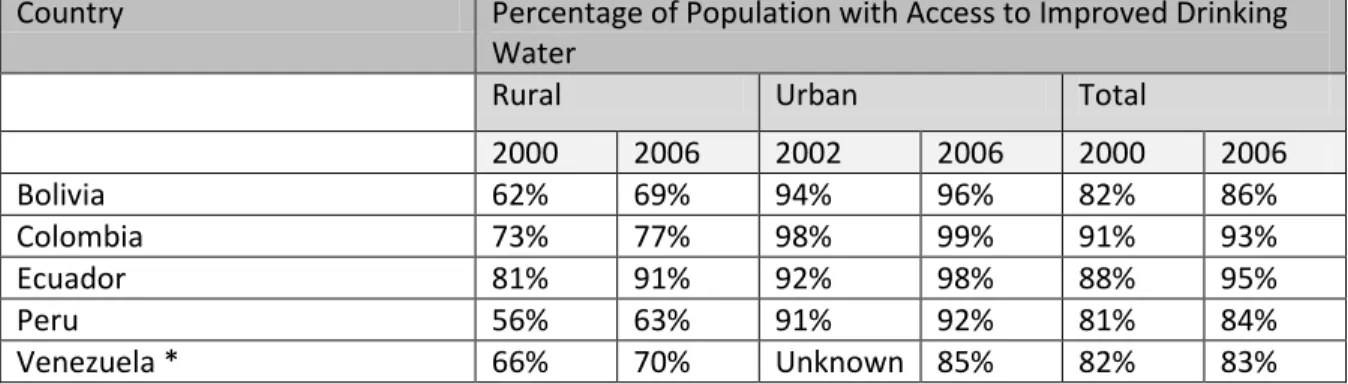
increased probability that the water is safe and more accessible and that some measures are taken to protect the water source from contamination (WHO WSH 2010). Improved water supply therefore does not necessarily imply disinfected water. Based on drinking water access data reported in Table 3 below, the region shows improvement. In conjunction with these estimates, however, it is worth noting that throughout Latin America as recently as 2001, only about 41% of those with household water connections received disinfected water and approximately 60% of water supply systems were intermittently operational (putting recipients at risk for contracting diarrheal and other waterborne diseases) (PAHO 2002).
Table 3. Andean Region Access to Improved Drinking Water
Country Percentage of Population with Access to Improved Drinking
Water
Rural Urban Total
2000 2006 2002 2006 2000 2006
Bolivia 62% 69% 94% 96% 82% 86%
Colombia 73% 77% 98% 99% 91% 93%
Ecuador 81% 91% 92% 98% 88% 95%
Peru 56% 63% 91% 92% 81% 84%
Venezuela * 66% 70% Unknown 85% 82% 83%
* Venezuelan data are from 2001 and 2004
Sources: WHOSIS & Wapedia Water Supply & Sanitation
19
country’s ability to provide secure sanitation. Multiple studies have cited rural populations as particularly at risk due to water and sanitation inequalities. This applies especially to rural populations in each of the Andean countries where access to improved sanitation in rural areas reported as recently as 2006 remains very low. Table 4 provides data regarding access to
improved sanitation in Andean countries. Even in countries where access to improved sanitation seems to be progressing toward desired Millenium Development Goals, these statistics, as they relate to STH prevalence, are deceptive. Ascaris and Trichuris are transmitted via ingestion and can infect the human host via water-washing. Only a very small percentage of the wastewater discarded by the populations of each of the Andean nations is treated. See Table 5. Helminths can survive in wastewater. In fact, at 20 – 30 degrees Celsius (68 – 86 degrees Fahrenheit), excreted Ascaris eggs can survive in sewage and freshwater for many months (Wescott 1997). Without significantly improved wastewater treatment coverage, natural water sources and
irrigated crops will continue to be contaminated sources proliferating human helminth infections. Table 4. Access to Improved Sanitation
Country Percentage of Population with Access to Improved
Sanitation (2006)
Rural Urban Total
Bolivia 22% 54% 43%
Colombia 58% 85% 78%
Ecuador 72% 94% 84%
Peru 36% 85% 72%
Venezuela 48% 71% Unknown
Sources: WHOSIS January 2010 & Water Supply and Sanitation: Coverage Estimates -Improved Sanitation for Venezuela. Retrieved from WHO / UNICEF Joint Monitoring Programme: http://www.cepis.ops-ms.org/bvsaar/e/lineamientos/pdf/jmp/VEN_san.pdf January, 2010
Table 5. Andean Country Coverage - Wastewater Treatment
Country Year Reported Estimated Percentage of
Wastewater Treatment
Bolivia 2004 22%
Colombia 2006 25%
Ecuador 2004 8%
Peru 2004 22%
Venezuela 2003 14%
20 Recent Initiatives Directly or Indirectly Addressing Helminth Prevention
In each of the Andean countries, there is a current focus on improving water and sanitation and, in several newly revised constitutions (those of Ecuador, Peru and Bolivia, for example) water has been recognized as a basic human right. These efforts are at the same time being challenged and will continue to be challenged by water shortages attributable to climate change. A study commissioned by the Andean Community of Nations in 2008 predicts that, due to melting glaciers and greater desertification of the Andean mountains, by 2025, about 70 million people across the region will have extreme difficulty accessing clean water sources (Portilla 2008).
Bolivia, after two failed attempts to privatize water, has adopted a new national water law, Water for Life, which legally recognizes “usos y costumbres” (traditional communal practices) and which includes independent water system protections, public consultations on rates, and a commitment to prioritizing social needs (Baer 2006). In conjunction with the
traditional communal practices approach to water, Community Led Total Sanitation (CLTS) was also brought to Bolivia by UNICEF Bolivia. CLTS is an innovative approach to eliminate open defecation; communities are facilitated to conduct their own appraisal and analysis of open defecation as a problem and take their own action to eradicate it (IDS 2010). Despite these innovative efforts, crumbling infrastructure, a diminishing water table and the current economy’s negative impact on international investment leave Bolivia’s public systems in a perilous situation (Baer 2006).
21
(SPA), which has the objective of improving conditions for people living in extreme poverty in urban areas; 2) Saneamiento de Vertimientos Municipales which addresses increased
wastewater treatment; 3) Agua Transparente, an initiative which aims to implement methodologies to discourage corrupt contractual practices in drinking water and sanitation
improvement projects; and 4) Lavado de Manos, an extensive national ad campaign delivered via all media sources to promote hand washing for the prevention of diarrhea (MinAmbiente 2010).
While progress has been made in Ecuador, the country is faced with challenges left by years of mismanagement and corruption in the water and sanitation services sector. According to a 2004 assessment by the Water Secretariat, as part of its research toward improvement of sanitation access, 13% of Ecuadorian systems are sustainable, at least 49% have mild to severe impairment and 38% have collapsed altogether. In spite of these challenges, in 2001the Rural and Small Town Water Supply and Sanitation Project (PRAGUAS I) set up a bold incentive framework for water and sanitation service investment for municipalities. The central
government grants loans to municipalities which delegate water and sanitation service contracts to more autonomous, accountable public, private or cooperative service providers (World Bank 2006). This project phase provided new water supply systems for 252,000 people and on-site sanitation for 127,000 people, approximately 5% and 3% of Ecuador’s total rural population of 4.7 million (Port of Entry 2006). PRAGUAS II, funded by the World Bank in 2006, is targeted to increase coverage and effective use of sustainable water and sanitation services in Ecuador for poorer populations in rural communities and small towns. This project should, at completion, impact another 490,000 rural Ecuadorians (Port of Entry 2006).
22
Ombudsman of Peru revolved around socio-environmental problems, many linked to the "water management" (Rosales 2009). Within this context, Agua Para Todos (Water for All), a sweeping plan laid out by President Alan Garcia in 2006, states that Millenium Development Goals for access to improved water sources and sanitation and for water for virtually everyone in Peru by 2015 can be achieved. The government's draft National Sanitation Plan considers that
investments of US$4,789 million would be needed in the period of 2005-2015 (US$497 million/year) in order to achieve the goal (PAHO 2006). Within the rural sector of Agua Para Todos (PRONASAR), while there are reports that up to 1911 projects have been completed under this program since 2006, the Peruvian government website reports that, as of December 31, 2009, 492 projects have been started and 333 of these have been completed benefitting 272,406 people (PRONASAR 2010). The program has been widely criticized for its
overcommitment and lack of detail. As recently as July 2009, analysts discussing the wastewater treatment aspect of the plan alone stated that reaching Garcia’s goal of 100% wastewater
coverage by 2015 would be a huge challenge for Peru to achieve even by 2020 (Medalla 2009). Venezuelan water and sanitation services are provided by the national water company HIDROVEN, five state water companies, the Corporación Venezolana de Guayana (CVG) and several municipalities and community-based organizations(Wapedia 2010). HIDROVEN developed a six year plan for the period 2002-2007, which was part of the economic
23
Investments under the Plan for 2002 and 2003 and, consequently, the objectives guidelines were not met. Nevertheless, HIDROVEN continues to view this document as the best approximation for its vision (CAF 2004). The plan estimates that a total of US$ 4.77 billion will be required between 2003-2015 for the sector, which implies an average annual investment of approximately US$ 500 million, or about four times historic investment levels (CAF 2004).
Throughout the Andean region, estimated investments required to meet water and sanitation goals are considerable. Table 6 shows the estimated requirement outlined in 2000 by each of the five nations in order to reach sanitation-related Millenium Development Goals. These noted requirements along with systemic, climate and global economic challenges make it nearly impossible for these countries to achieve their respective goals and address
soil-transmitted helminth infection and prevalence via these channels any time in the near future. Table 6. Andean Region Sanitation Goals and Estimated Costs - 2000
Country
Country-Specific MDG: Additional People to be Covered
Estimated Total Investment Required to Achieve Goal
Bolivia 2,663,000 US$ 262 Million
Colombia 12,500,000 US$ 1.3 Billion
Ecuador 3,500,000 US$ 359 Million
Peru 6,500,000 US$ 665 Million
Venezuela 9,400,000 US$ 964 Million
Source: Panamerican Health Organization Okinawa Paper Chapter 3: Access to Improved Sanitation. Retrieved from:
http://www.bvsde.paho.org/bvsacd/cd47/okinawapaper/cap3.pdf January, 2010
Turning now to other potential initiatives targeted to controlling soil-transmitted
24
Table 7. Percentage of School Age Children Being Treated for Parasites
Country
Year Reported
Estimated number of school-age children being treated
Estimated Percentage of school-age children being treated
Bolivia 2008 1,000,000 43.18 %
Colombia 2008 423,205 4.80 %
Ecuador 2006 2,415,000 85.00 %
Peru 2006 1,729,412 29.00 %
Venezuela 2008 25,250 .45 %
Sources: WHO Weekly Epidemiologic Review July 4, 2008. Retrieved from:
http://www.who.int/wer/2008/wer8327_28.pdf January 2010 & WHO Soil-Transmitted Helminthiasis Prevention Chemotherapy and Treatment Databank Retrieved from:
http://www.who.int/neglected_diseases/preventive_chemotherapy/sth/db/index.html?units=minimal®ion=all&country=bol%252Ccol%252Ce cu%252Cper%252Cven&countries=bol&countries=col&countries=ecu&countries=per&countries=ven&year=2008 January 2010
as part of its Escuelas Saludables initiative and regionally based programs are underway. Colombia focuses on addressing parasite control primarily through the health system. Neither Peru nor Venezuela report any centralized effort toward helminth control in school age children, though there appears to be significant non-governmental organizational focus ,via UNICEF, to this end in Peru.
Conclusion – Why are school-based programs an obvious choice?
25
First, to restate, among those infected with STHs, about one third are estimated to be children with the highest rates of infection in school age children (UN-ECOSOC 2010). STH infected-children are adversely affected in terms of cognitive development, school attendance and educational performance. Additionally, the heavier the intensity of infection, the greater the risk of school absenteeism to the point that some infected children attend school only half as much as their uninfected peers (World Bank 2010).
Second, as noted in earlier discussion, soil-transmitted helminth infections have also been connected to anemia associated with the malabsorption of Vitamin A and iron (WHO PPC 2010). These deficiencies can be correlated to increased measles and diarrheal morbidity and general fatigue in children (WebMD 2010). STH infection’s negative impact on education coupled with helminth infection’s connection to Vitamin A and iron-deficiency anemia and wasting foretell of a future of health-compromised adults and populations with diminished educational attainment (Guyatt 2000).
Third, regular treatment of school-age children helps to offset the worst effects of
infection, even when no improvement is made in safe water supply or sanitation (Savioli 2002). By reducing helminth infection transmission within the community, school-based deworming programs substantially improve health in untreated children as well those treated. In fact, it is estimated that treating only school age children can reduce the total burden of disease due to intestinal worm infections by up to70% in a given community as a whole (World Bank 2010).
26
(Psacharopoulos 2002). Additionally, health influences the GDP of a country as healthy workers are more productive than their similar unhealthy counterparts. Studies like those of Thomas and Strauss (1997) establish a relationship between height, BMI, per capita protein intake, per capita calorie intake and productivity and income levels with the conclusion that each of these health influencing factors net a substantial return in the labor market. Also, antihelminthic programs help to boost developmental factors which in turn reduce the spread of parasitic disease. In other words, in the short run, deworming programs avert helminth infections while, in the long run, the combination of programs and improved infrastructure and associated developmental gains
continually improves the opportunity for infections to be averted by reducing transmission altogether (Hotez 2006).
Fourth, in addition to their implied positive impacts on prevention of infection, health and productivity, school-based programs are evidenced to be very effective. Korea’s early approach to parasite prevention provides an excellent example of such evidence. Korea began mass antihelminth program for school-age children in 1970. In 1971, the country’s overall intestinal helminth egg positive rate was: Ascaris, 58.2%; Trichuris, 65.4%; and hookworms; 10.7%. By 2004, the egg positive rate had been reduced to: Ascaris, 0.03%; Trichuris, 0.02%; and
hookworms, 0%) ( Hong 2006). The Korean example also intimates that the social driving force to establish a national control system for organizing repeated mass chemotherapy, combined with environmental and sanitation improvement, is critical to achieving STH control in developing communities (Hong 2006). In other words, to be successful and enduring, these programs need to be supported and promoted at the national level.
27
schoolchildren can be determined using low cost surveys to ascertain whether or not a school is in an area of significant infection risk. Because antihelminthic drugs are very safe to use, even in children, there is no need for individual examination (World Bank 2010). Once need is
established, teachers can be taught to deliver the drugs safely with only a few hours training (World Bank 2010).
Sixth, school-based programs are also very cost-effective. Operational research in Ghana and Tanzania has demonstrated that for the first five years of intervention, the average yearly cost of delivered treatment is typically less than US$0.50, including training of teachers and the procurement and distribution of drugs to students (World Bank 2010). Using these figures, in a country like Bolivia, for example, with an estimated 1, 407,019 school age children in 2008 (Schools and Health 2010), total cost for school-base parasite prevention would be
approximately US$ 703,510 annually - an estimate which is substantially lower than the costs of providing improved sanitation in Bolivia for example, which based on data from Table 6, is estimated to require $17,466,666 annually for achievement of 2015 MDG goals.
28
infection is a public health “best buy”, combined with co-investments from the Global Network for Neglected Tropical Diseases and its partners, school-based deworming is an incredibly moderate but very cost-effective program for improving education, accelerating development and reducing poverty (Hotez 2009).
Finally, let us not forget that, apart from personal health, national development and the availability of external support, also exists politics and the struggle for governing administrations to stay in power. In at least two Andean countries, Bolivia and Ecuador, indigenous peoples have brought down successive administrations in protest over access to basic human
29 REFERENCES
Albonico, M., P. G. Smith, E. Ercole et al (1995). “Rate of Reinfection with Intestinal Nematodes after Treatment of
Children with Mebendazole or Albendazole in a Highly Endemic Area.” Transactions of the Royal Society of
Tropical Medicine and Hygiene 89: 538–41.
Baer, M.,(2006) Water Privatization and Civil Society in Bolivia – Addressing the Democratic Deficit of International Organizations University of California, Irvine Retrieved from:
http://www.allacademic.com//meta/p_mla_apa_research_citation/1/0/0/4/0/pages100408/p100408-1.php February 1, 2010
Berkman D.S., Lescano A.G., Gilman R.H., Lopez S.L., Black M.M. (2002) Effects of stunting, diarrhoeal disease, and parasitic infection during infancy on cognition in late childhood: A follow-up study Lancet, 359 (9306): 564-571.
Biology Online - Definition of Reproductive Ratio. Retrieved from: http://www.biology-online.org/dictionary/Reproductive_ratio January 31, 2010
Casapía M, Joseph SA, Núñez C, Rahme E, Gyorkos TW (2006) Parasite risk factors for stunting in grade 5 students in a community of extreme poverty in Peru. Int J Parasitol. 36(7):741
CDCs Nutrition for Everyone Retrieved from:
http://www.cdc.gov/nccdphp/dnpa/nutrition/nutrition_for_everyone/iron_deficiency/index.htm February 20, 2010
Chan M.S. (1997) The global burden of intestinal nematode infections--fifty years on. Parasitol Today. 13(11):438-43.
Corporación Andina de Fomento (CAF) (2004): Venezuela. Análisis del Sector Agua Potable y Saneamiento written by María Elena Corrales CAF Agua y Saneamiento Venezuela .
30 Esrey S.A., Potash J.B., Roberts L., and Shiff C. (1991) Effects of improved water supply and sanitation on
ascariasis, diarrhoea, dracunculiasis, hookworm infection, schistosomiasis, and trachoma. Bull World Health Organ. 69(5): 609–621
Ezeamama A.E., Friedman J.F., Acosta L.P., et al. (2005) Helminth infection and cognitive impairment among Filipino children. Am J Trop Med Hyg. 72(5):540-8.
GiveWell: Combination deworming (mass drug administration targeting both schistosomiasis and soil-transmitted helminths) Retrieved from: http://www.givewell.net/international/technical/programs/deworming January 30, 2010
Global Network (2008) PAHO, IDB and Sabin refine fight against neglected diseases in Latin America and Caribbean. Retrieved from: http://www.globalnetwork.org/press/2008/12/30/paho-idb-and-sabin-refine-fight-against-neglected-diseases-latin-america-and-caribb February 23, 2010
Guyatt H. L. (2000) Do Intestinal Nematodes Affect Productivity in Adulthood? Parasitology Today. 16: 153–58.
Hong S.T., Jong-Yil C., Choi M.H., et al. (2006) A successful experience of soil-transmitted helminth control in the Republic of Korea Korean Journal of Parasitology 44(3):177-185.
Hotez P.J., Bundy D.A., Beegle K. et al, (2006) Helminth Infections: Soil–Transmitted Helminth Infections and Schistosomiasis Disease Control Priorities in Developing Countries (2nd Edition),ed. , 467-482. New York: Oxford University Press.
Hotez PJ, Brindley PJ, Bethony JM, King CH, Pearce EJ, Jacobson J., (2008) Helminth infections: the great neglected tropical diseases. J Clin Invest. 118(4):1311-21.
Hotez PJ (2009) A Constitutional Amendment for Deworming. PLoS Negl Trop Dis 3(8): 454. Retrieved from: http://www.plosntds.org/article/info:doi%2F10.1371%2Fjournal.pntd.0000454
Institute of Development Studies (IDS). Community Led Total Sanitation. Retrieved from: http://www.communityledtotalsanitation.org/country/bolivia February 1, 2010
International Water and Sanitation Centre (IRC) WASH Facts and Figures. Retrieved from: http://www2.irc.nl/page.php/48 January 30, 2010
Jardim-Botelho A. et al (2008) Hookworm, Ascaris lumbricoides infection and polyparasitism associated with poor cognitive performance in Brazilian schoolchildren. Trop Med Int Health. 13(8):994-1004
Joint Monitoring Program (JMP) MDG Report 2008: Progress on Drinking Water and Sanitation- Special Focus on Sanitation. Retrieved from : http://documents.wssinfo.org/resources/documents.html January 19, 2010
Larocque R, Casapia M, Gotuzzo E, Gyorkos T.W. (2005) Relationship between intensity of soil-transmitted helminth infections and anemia during pregnancy. Am J Trop Med Hyg. 73(4):783-9.
Medalla, E. (2009)“Country could have 100% wastewater treatment by 2020, says analyst”. Business News Americas Water and Waste Retrieved from:
http://member.bnamericas.com/story.jsp?idioma=I§or=4¬icia=484591 February 15, 2010
Ministerio de Ambiente, Vivienda, y Desarrolla Territorial Republica de Colombia, Agua y Saneamiento Retrieved from: http://www.minambiente.gov.co/contenido/categoria.aspx?catID=89 February 14, 2010
31 Panamerican Health Organization (PAHO) ( 2006) PLANES NACIONALES DE VIVIENDA Y SANEAMIENTO
2006 – 2015 Ministerio de Vivienda, Construcción y Saneamiento Rudecindo Vega Carreazo, Ministro de Vivienda,
Construcción y Saneamiento, Guido Valdivia RodríguezViceministro de Vivienda y Urbanismo, Otto Eléspuru Nesanovich Viceministro de Construcción y Saneamiento Retrieved from: http://www.bvsde.paho.org/bvsacd/cd51/planes.pdf February 16, 2010
ParaSite (Stanford University). Parasites and Pestilence. Retrieved from:
http://www.stanford.edu/class/humbio153/AntiParasiticDrugs/index.html January 16, 2010
Perry G., Lopez J., Maloney W. et al, (2006) Poverty Reduction and Growth: Virtuous and Vicious Circles. World Bank Publications. Retrieved from:
http://web.worldbank.org/WBSITE/EXTERNAL/COUNTRIES/LACEXT/EXTLACOFFICEOFCE/0,,contentMDK :20819439~pagePK:64168445~piPK:64168309~theSitePK:870893,00.html
Port of Entry Environmental Industry News (2006) World Bank Approves US$111 Million to Support Water Supply and Sanitation, Education, and Rural Roads in Ecuador. Retrieved from:
http://www.portofentry.com/site/root/resources/industry_news/4013.html February 15, 2010
Portilla, Z. (2008) Climate change will cost Andes US$30 billion Science & Development Network. Retrieved from: http://www.scidev.net/en/climate-change-and-energy/news/climate-change-will-cost-andes-us-30-billion-.html February 26, 2010
PRONASAR Retrieved from: http://www.vivienda.gob.pe/pronasar/proyectosejec.html February 15, 2010
Psacharopoulos, G., and H. Patrinos. (2002) Returns to Investment in Education: A Further Update. Working Paper 2881, World Bank, Washington, DC.
Rosales, B. (2009) AMBIENTE: En Perú no hay agua para todos Inter Press Service. Retrieved from: http://ipsnoticias.net/nota.asp?idnews=91811 February 15, 2010
Savioli L. et al. (2002) Schistosomiasis and soil-transmitted helminth infections: forging control efforts. Trans. R.
Soc. Trop. Med. Hyg. 96 577–79.
Savioli L., Albonico M., (2004). Focus: Soil-transmitted helminthiasis. Nature Reviews Microbiology, 2(8), 618-619. Retrieved from http://www.nature.com.libproxy.lib.unc.edu/nrmicro/journal/v2/n8/full/nrmicro962.html January 16, 2010.
Schools and Health: Country Data. Retrieved from:
http://www.schoolsandhealth.org/pages/SchoolHealthDatabase.aspx January 17, 2010
Schultz, J. (2005) The Politics of Water in Bolivia. The Nation. Retrieved from: http://www.thenation.com/doc/20050214/shultz February 9. 2010
Stephenson, L.S., Holland, C.V., Cooper, E.S. (2000) The public health significance of Trichuris trichiura. Parasitology 121, S73–S95.
Tanner S., Leonard W.R., McDade T. Reyes-Garcia V., Godoy R., Huanca T., (2009) Influence of helminth infections on childhood nutritional status in lowland Bolivia. Am J Hum Biol.,21(5):651-6
Thomas D., Strauss, J. (1997) Health and Wages: Evidence on Men and Women in Urban Brazil. Journal of Econometrics. 77: 159–85.
32 UN-Water Why improved sanitation is important for children. Retrieved from:
http://www.unwater.org/wwd08/docs/kids-sanitation.pdf January 23, 2010
Wapedia Water supply and sanitation in Venezuela Retrieved from: http://wapedia.mobi/en/Water_supply_and_sanitation_in_Venezuela
WebMD eMedicine Vitamin D deficiency. Retrieved from: http://emedicine.medscape.com/article/126004-overview February 20, 2010
WELL Briefing Note 30 Breaking Sectoral Barriers for School Sanitation and Hygiene Education 2006 Retrieved from: http://www.lboro.ac.uk/well/resources/Publications/Briefing%20Notes/WELL%20BN%2030%20A3.pdf February 23, 2010
Wescott, D.W. (1997) Quality control of wastewater for irrigated crop production. Natural Resources and
Environment Department. Food and Agriculture Organization of the United Nations (FAO). Retrieved from FAO: http://www.fao.org/docrep/w5367e/w5367e04.htm#types%20of%20pathogens%20present%20in%20wastewater
World Bank. World Bank Public Health at a Glance: School Deworming. Retrieved from:
http://web.worldbank.org/WBSITE/EXTERNAL/TOPICS/EXTHEALTHNUTRITIONANDPOPULATION/EXTP HAAG/0,,contentMDK:20785786~menuPK:64229809~pagePK:64229817~piPK:64229743~theSitePK:672263,00.h tml#Evidence February 22, 2010
World Bank (2008) World Development Indicators (WDI). Retrieved from World Bank:
http://siteresources.worldbank.org/DATASTATISTICS/Resources/WDI08supplement1216.pdf January 26, 2010
World Bank (2006) Visible service improvements facilitate reforms in town water supply: PRAGUAS in Ecuador Water Supply and Sanitation Feature Story Retrieved from:
http://siteresources.worldbank.org/INTWSS/Resources/ecuador.pdf February 13, 2010
World Health Organization (WHO) Diseases and Disease Transmission. Retrieved from: http://www.who.or.id/eng/contents/aceh/wsh/books/diseases/cpd02.pdf January 27, 2010
World Health Organization (WHO) Health Information. Global Burden of Disease (GBD). Retrieved from: http://www.who.int/healthinfo/global_burden_disease/en/index.html January 24, 2010
World Health Organization (WHO) Partners for Parasite Control (PPC). Prevention and Control of Schistosomiasis and Soil-Transmitted Helminthiasis: WHO & UNICEF Joint Statement. Retrieved from:
http://www.who.int/wormcontrol/documents/joint_statements/en/ January 16, 2010
World Health Organization (WHO) Partners for Parasite Control (PPC). (2004) Report of the Third Global Meeting: Deworming for Health and Development Retrieved from:
http://whqlibdoc.who.int/hq/2005/WHO_CDS_CPE_PVC_2005.14.pdf
World Health Organization Statistical Information System (WHOSIS) Access to improved drinking water sources and to improved sanitation (percentage) Retrieved from;
http://www.who.int/whosis/indicators/2007ImprovedAccessWaterSanitation/en/index.html January 23, 2010
World Health Organization (WHO) Water, Sanitation and Hygiene: Chapter 8 - Personal, Domestic and Community Hygiene. Retrieved from: http://www.who.int/water_sanitation_health/hygiene/settings/hvchap8.pdf January 23, 2010
World Health Organization (WHO) Water, Sanitation and Health (WSH). Costs and benefits of water and sanitation improvements at the global level (Evaluation of the). Retrieved from:
33 World Health Organization (WHO) Water, Sanitation and Health (WSH) Facts and Figures Retrieved from:
http://www.who.int/water_sanitation_health/en/ January 23, 2010
World Health Organization (WHO) 2008 World Development Indicators (WDI). Retrieved from: