CHARLES W. KINSEY. Dosimetry of Custom Inserts for Electron
Beams Produced by a Varian Clinac 1800: Effect on Dose
Output and Mean Incident Energy.
Customizing of electron beam treatment dimensions is a
common clinical technique. The degree in which the measured
energy and dose output for a particular beam varies depends
on the degree of blocking and the nominal energy of that
beam. Published measurements for the Varian Clinac 1800 are
sparse and measurements for each custom insert manufactured
are time consuming.
Relative output and mean incident energy measurements
were performed for 160 nominal beam energy / cone / insert
combinations on a Varian 1800 at the Rock Hill Radiation
Therapy Center in Rock Hill, South Carolina.
Relative output measurements of the manufacturer sup¬
plied cones indicated no consistency in the data for all
nominal beam energies. For example, the variation in rela¬
tive output for increasing treatment field dimensions for
the 6 MeV beam is different than for the 20 MeV beam. For
custom square inserts within each cone, however, the data
presented consistent behavior for all beams. The "square
root" model for approximating relative output worked well
with the custom square inserts and rectangular inserts with
a relatively low length to width ratio. For rectangular
t.
inserts with a high length to width ratio, the model exhib¬
ited a positive bias for all nominal beam energies and
cones. It is theorized this bias may be due to the need to
extrapolate the measured data for very small dimensions. By
using some alternative measurement technique for these
smaller dimensions, the bias may be reduced to an acceptable
level.
The resulting energy measurements using the manufactur¬
er supplied cones and inserts were mimicked by the use of
custom inserts defining the same square dimensions for each
cone. These data showed no effect of the inserts / cones on
mean incident energy for the 6 MeV, 9 MeV, and 12 MeV nomi¬
nal beam energies. An effect on mean incident energy for
the 16 MeV and 20 MeV beams was noted only for the cases of
the 4x4 and 6x6 inserts and for cases of rectangular inserts
with a high length to width ratio. The "square root" model
for approximating mean incident energy appeared to be a
valid predictive tool for these measurements.
CONTENTS
List of Tables... vi
List of Figures...vili
1.0 INTRODUCTION ... 1
1.1 Clinical Use of Electron Beams ... 1
1.2 Varian Cllnac 1800 Electron Beam
Production ... 1
1.3 Custom Shaping o£ the Electron Beam... 4
1.4 Beam Characteritics Definitions ... 4
1.4.1 Dose Output and Relative Output .... 5
1.4.2 Mean Incident Energy... 7
1.5 Study Criteria Limits ... 8
1.5.1 Relative Output ... 9
1.5.2 Mean Incident Energy... 10
1.6 Study Objectives ... 10
2.0 MODEL DEVELOPMENT ... 12
2.1 AECL Therac 20 Electron Beam Production ... 12
2.2 Relative Output Model ... 12
2.3 Mean Incident Energy Model... 13
2.4 AECL Therac 20 and Varian Clinac 1800
Comparison... 14
3.0 MEASUREMENT METHODS ... 16
3.1 Study and Measurement Equipment ... 16
3.2 Relative Output Measurements ... 19
3.3 Mean Incident Energy Measurements ... 21
4.0 RESULTS... 23
4.1 Data Combinations... 23
4.2 Relative Output Measurements ... 23
4.3 Mean Incident Energy Measurements ... 32
4.4 Model Application ... 36
5.0 DISCUSSION... 67
5.1 Relative Output... 67
5.2 Mean Incident Energy... 71
5.3 Current Model Developments ... 72
6.0 SUMMARY...75
7.0 CONCLUSION...77
Appendix A...79
Appendix B...89
LIST OP TABLES
Table
1 Comparison between the Therac 20 and
the Clinac 1800...15
2 Applicators supplied by Varian ... 17
3 Custom Inserts manufactured ... 18
4 Varian Cones: Relative output ... .24
5 Custom square inserts: Relative output ... 26
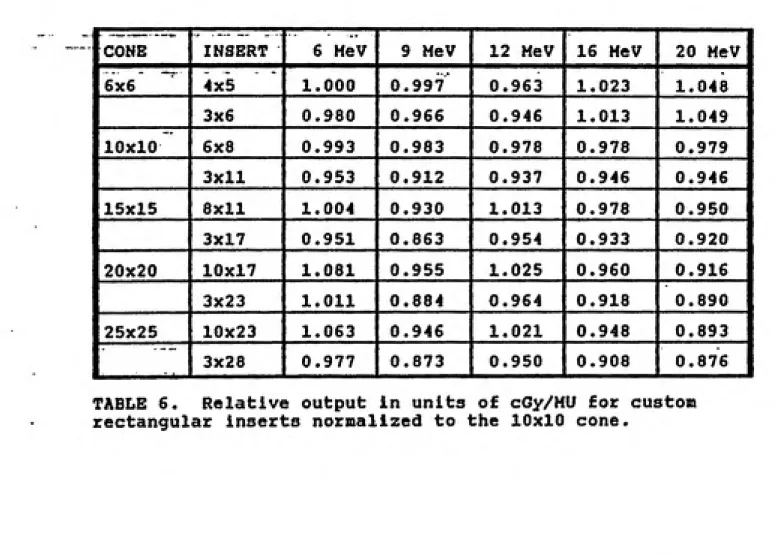
6 Custom rectangular inserts: Relative
output...33
7 Varian cones: 50% of maximum ionization
depth...34
8 Custom square inserts: 50% of maximum
ionization depth ... 37
9 Custom rectangular inserts: 50% of
maximum ionization ... 43
10a 6 MeV: Relative output - A comparison .... 46
10b 9 MeV: Relative output - A comparison .... 48
10c 12 MeV: Relative output - A comparison .... 50
lOd 16 MeV: Relative output - A comparison .... 52
lOe 20 MeV: Relative output - A comparison .... 54
11a 6 MeV: 50% Maximum Ionization - A
comparison...56
lib 9 MeV: 50% Maximum Ionization - A
comparison...58
lie 12 MeV: 50% Maximum Ionization - A
comparison...60
lid 16 MeV: 50% Maximum Ionization - A
comparison...62
12 Rbo to R«B (or Rbs) Difference...66
13 Relative Output Prediction Summary ... 68
14 Mean Incident Energy Prediction Summary .... 73
Figure
1 Varian Clinac 1800: A simplified diagram ... 3
2 Varian Cones: Relative output ... 25
3 6x6 Cone: Relative output ... 27
4 10x10 Cone: Relative output ... 28
5 15x15 Cone: Relative output ... 29
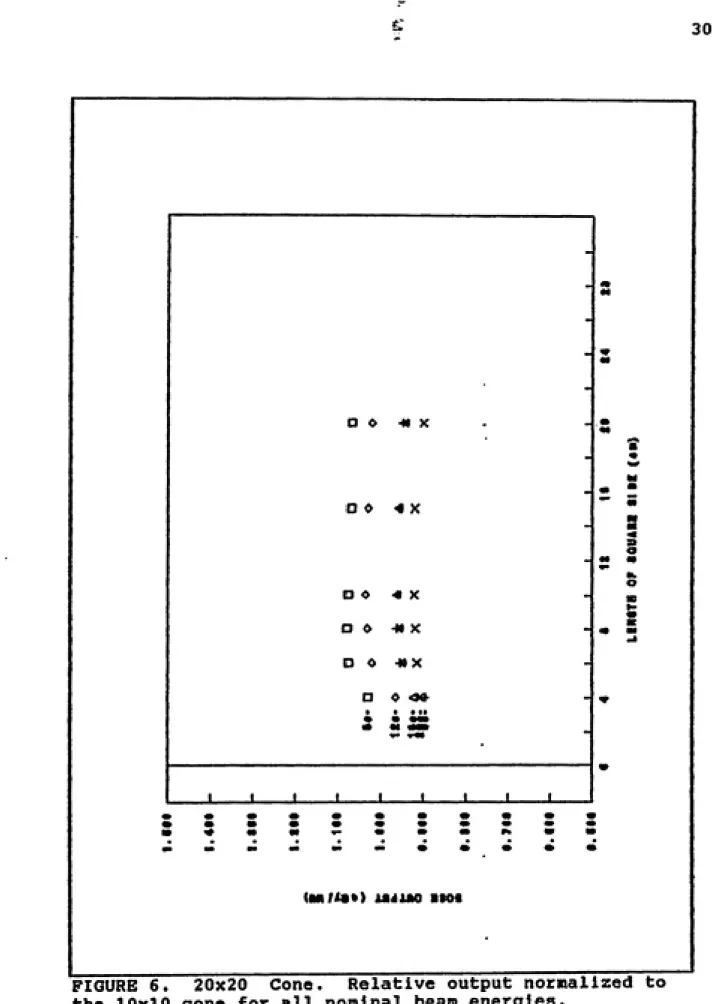
6 20x20 Cone: Relative output ... 30
7 25x25 Cone: Relative output ... 31
8 Varian Cones: 50% of maximum ionization
depth...35
9 6x6 Cone: 50% of maximum ionization
depth...38
10 10x10 Cone: 50% of maximum ionization
depth...39
11 15x15 Cone: 50% of maximum ionization
depth...40
12 20x20 Cone: 50% of maximum ionization
depth...41
13 25x25 Cone: 50% of maximum ionization
depth...42
14 Comparison of % Pass vs. increasing
criteria limits ... 70
1.0 INTRODUCTION
1.1 Clinical Use of Electron Beams
Microwave-powered electron linear accelerators have
become a popular tool for the treatment of cancer in the
practice of radiation therapy. One class of these accelera¬
tors, known as high energy medical linacs, can deliver x-ray
beam(s) of either single or dual energy and electron beams
of multiple energies over a relatively broad surface area.
Electron beams with their high surface dose delivery
and characteristically sharp dose fall-off with depth are
ideal for the treatment of relatively superficial tumors
such as skin lesions, cancers of the head and neck area, and
postoperative breasts and chestwalls.(10) It has been
estimated that electron beam therapy is indicated as either
the primary mode or as an adjunct to x-ray treatment for
approximately 10% of the patients treated in a radiation
therapy clinic.(10)
1.2 Varian Clinac 1800 Electron Beam Production
One model of linear accelerator that generates dual
x-ray energies and five electron energies and is the subject
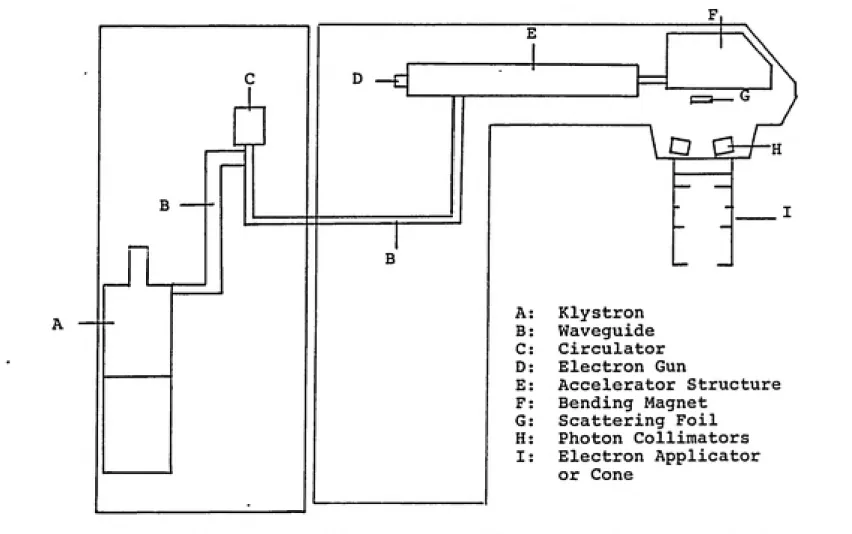
Asso-acceptable electron beam by the following (see Figure 1):
First, a stream of electrons is introduced by an
"electron gun" into a klystron powered accelerator
guide which will generate a current of an average
specified energy.
Second, this current enters a bending magnet which
produces a coarse steering of the electron current
and behaves as a discreet energy window for the
electrons.
Third, the steering of the electron current exit¬
ing the bending magnet is more finely adjusted by
electromagnetic steering coils so the electrons
will impinge onto a scattering foil. The interac¬
tion of the electron current with the scattering
foil generates a broad electron beam.
Fourth, this broad beam is first collimated or
shaped by interleaved x-ray collimators. Second¬
ary collimation is then performed by an attachment
made of a fiberglass frame with aluminum baffles
at varying distances from the source and a steel
insert located at the exit end of the attachment.
This insert defines the actual dimensions of the
electron beam produced for clinical use.
The manufacturer supplies a group of these attachments,
called applicators or cones. Each cone in combination with
B
L
B
Q O-h-E
Klystron
Waveguide
CirculatorElectron Gun
Accelerator Structure
Bending Magnet
Scattering Foil
Photon CollimatorsElectron Applicator
or Cone
.'
ͣ
fV-^Y ;!
Figure 1. Varian Clinac 1800: A simplified schematic diagreun indicating
the major components discussed in the text.
One difficulty with attempting clinical use with only
these square dimension inserts is that cancerous tumors very
rarely are shaped as squares. A mechanism is available for
the user to manufacture custom shaped inserts using a high-Z
metal alloy and attach them to the supplied cones to custom¬
ize the treatment field to the individual's case. This
allows the clinician greater flexibility in sparing non¬
cancerous regions on / in the patient.
A possible uncertainty in treatment is introduced by
using these custom inserts. The placing of a custom shaped
slab of high-Z material into the electron beam's path to
modify the treatment field dimensions may measurably affect,
within the effective treatment field, the characteristics
used as criteria for clinically acceptable use. The possi¬
ble modification of beam characteristics by the use of
custom inserts is the subject of this study.
1.4 Beam Characterictics Definitions
Two of the characteristics used to indicate the accept¬
able clinical use of an electron beam are a measured ab¬
sorbed dose delivered or dose output and a measured mean
C 5
1.4.1 Dose Output and Relative Output
Dose output is defined as the absorbed dose (usually in
units of gray (Gy) or centigray (cGy)) delivered at a depth
of maximum dose build-up (D«««) within a measurement phan¬
tom. In practice, this measurement is taken at the central
axis of the beam with a National Bureau of Standards (NBS)
traceable calibrated ionization chamber and electrometer
combination. The collected ionization data is then convert¬
ed to absorbed dose by the application of an accepted cali¬
bration protocol. For this study, the AAPM TG-21 (American
Association of Physicist in Medicine Task Group 21) calibra¬
tion protocol is used.(11) With this protocol the ioniza¬
tion readings, corrected for atmospheric conditions, are
converted to absorbed dose in the phantom material or medium
by the expression
D^-MxN^x(L/p):!^xP,^xP^^j_ (1)
where Dm.<9 = the absorbed dose at Dm«j. in the phantom
medium,
M = the ionization reading,
Ng*. = the ion chamber's calibration factor,
(L/p)«ic"'"** = the restricted stopping power ratio,
Pion = the chamber ionization recombination cor¬
rection factor,
and PjT-px = the chamber replacement (electron fluence)
correction factor.(11)
If the phantom material is water, as is true in the present
study, Dm.ei = Dw«i=-B. If the phantom is not water, then the
(S/p)m«ca'"'*=•*' = the unrestricted stopping power
ratio,
and Om«<a"
ͣ
*=•'' = the electron fluence phantom correc¬
tion factoris needed.(11)
Parallel plate ionization chambers in the accelerator
are used to continuously monitor the generated radiation.
The units of measurement for these chambers are designated
monitor units (MU). During accelerator calibration, the
electronics for these chambers are adjusted such that for a
designated defined field size (in this case 10 cm x 10 cm
dimensions) a dose output of 1.00 cGy/MU is measured in a
phantom at Dm««. For other field sizes or cones, the dose
output must be measured and is reported relative to the
designated field size. These dose outputs are called rela¬
tive outputs. TG-21 protocol does not specifically address
how these relative outputs should be measured which has
resulted in two basic techniques as to how these measure¬
ments are performed. One technique is that for each field
size the ionization measurements are performed at the depth
of maximum dose (i.e. Dm«>c} and the dose outputs are calcu¬
lated using equations 1 and 2. The other is to take ioniza¬
tion measurements at the depth of maximum ionization for
each field size and calculate ratios to the ionization
measurements obtained at the depth of maximum ionization for
the 1.00 cGy/MU designated field size discussed previously.
For this study, the measurement at maximum ionization depth
1.4.2 Mean Incident Energy
We have been using terms such as Dm.x without precisely
defining how it is found. Dm*x is found by initially ac¬
quiring an ionization intensity versus depth below surface
data set. This involves placing the probe at various depths
along the central axis of the beam and collecting ionization
data at each depth. These ionization data are then convert¬
ed to absorbed dose by the use of equations 1 and 2. The
resulting data set is called a percent depth dose (%DD)
curve. The depth at which the maximum absorbed dose occurs
is designated Dm«M. There is also a depth at which maximum
Ionization is measured. This depth is labeled Rxoo. It
should be noted by the reader that Rioo may or may not be
equal to Dm«„.
The depth at which the ionization intensity is reduced
to one-half of the maximum value is labeled Rso. The TG-21
protocol uses this value, when expressed in centimeters, to
calculate the mean incident energy (Eo) by the expression.
(11)
^-2.33-^X/25p. (3)
This mean incident energy value is used to acquire from
tables supplied with the protocol the restricted stopping
power ratios used in equation 1 and the unrestricted stop¬
ping ratios and the electron fluence correction values used
The constant 2.33 MeV/cm for equation 3 was obtained by
assunning plane-parallel, infinitely vide monoenergetic
electrons incident upon a seni-infinite water phantom.(11)
Some commercial software packages include table look-up
values for this *'constant** that is dependent upon the field
size of the beam. Using this table look-up method, two
electron beans of different field sizes with the exact sane
Rbo value could have different Be values. Since both calcu¬
lation techniques (i.e. 2.33 MeV/cm for all beans vs. a
seperate constant for each field size) are currently being
used by the medical physics community, it is felt that
reporting Ee values for each beam / insert combination in
this study could be a source of confusion that could either
mask or accentuate the effect of the insert. Therefore, the
Rbo value in units of centimeters for a specified nominal
beam energy with its selected insert will be used as the
energy measurement criteria for this study.
The term nominal beam energy will be used to identify
each beam by the labeled beam energy specified by the manu¬
facturer. An example of this would be that for the beam
with a nominal beam energy o£ 6 MeV (i.e. labeled by the
manufacturer) the mean incident energy is 4.9 MeV (i.e.
calculated by equation 3).
1.5 Study Criteria Limits
^ 9
with a custom Insert is to measure the mean incident energy
and relative output of the specified beam in a phantom with
the custom insert in place. This is a time consuming pro¬
cess and is difficult to schedule in a busy clinic before
patient treatment is started. The ability to predict both
when and by how much a custom insert affects a beam's rela¬
tive output and mean incident energy prospectively would be
of use clinically in the realm of increased quality of pa¬
tient care and increased task scheduling efficiency of
dosimetry personnel.
3,,$,1 PQlqtttvQ QqtPMt
It has been estimated that the uncertainty inherent in
measuring electron beam dose output is approximately one
percent.(6) A criterion previously used as to a clinically
acceptable predictive model for dose output relative to
actual measurements is that predicted value should be within
one percent of actual measured value.(7) This amount of
accepted uncertainty falls well within the recommended upper
limit of uncertainty for total dose delivery to a target
volume, which is usually taken at five percent.(4) For
acceptable model prediction of relative outputs compared to
measured data, we will use a criterion of one percent varia¬
1.5.2 Mean Incident Energy fR»«)
The uncertainty in energy measurements by using the Rbo
value is dependent on the type and dimensions o£ the mea¬
surement probe and the precision of measurement probe place¬
ment within the phantom. This will be discussed in section
3.0.
For this study, the variation limit for acceptable
model prediction will be set by one of two options. One, the
limit will be set to equal the estimated uncertainty of Rbo
measurement. Two, the limit will be set to equal the dif¬
ference in depth between the measured Rbo value and either
the measured Rss (i.e. 55% of maximum ionization depth) or
the measured R^b (i.e. 45% of maximum ionization depth)
values for that specific nominal beam energy. The choice of
which variation limit is applicable will be based upon which
criterion is the least restrictive.
1.6 study Oblectives
The purpose of this paper is two-fold. First, measure¬
ments of relative output and mean incident energy (Rbo) for
custom inserts that define varying treatment field dimen¬
sions will be presented to add to the relatively sparse
database for this type of information pertaining to high
energy Varlan accelerators. Second, the possible application
s: 11
that estimates both the effect on dose output and mean
incident energy for non-standard rectangular fields will
2.0 MODEL DEVELOPMENT
2.1 AECL Therac 20 Electron Beam Production
A model was presented by Mills, et al. (8) to predict
the dose output for rectangular shaped electron beam fields
for a Therac 20 Saturne accelerator manufactured by Atomic
Energy of Canada Limited (AECL). For this accelerator, the
beam of electrons exiting the accelerator structure is
spread into a broad beam with a scanning guadrapole magnet.
The collimation system is composed of primary interleaved
photon collimators and secondary collimators, called trim¬
mers. These trimmers are physically attached to the primary
collimators, therefore both sets open and close in synchro¬
nization. The primary collimators define a field dimension
5 cm greater than the trimmers at 100 cm from the source.(8)
2.2 Relative Output Model
For model development, the electron beam is assumed to
be made up of a collection of pencil beams. By using the
theory of multiple coulomb scattering for electrons, an
expression was developed (8) that describes the spreading of
these pencil beams from the scattering in air which begins
at the location of primary collimators. Assuming no energy
£ 13
secondary collimators, the following expression was devel¬
oped that predicts the dose output for a rectangular shaped
field. This expression which came to be called the
"square-root model" iswhere C*'* » the dose output of a rectangular field of
X^y dimensions,
0**'** » the dose output of a square field with
side dimension X,
and 0'''* = the dose output of a square field with
side dimension ¥.(8)
Appendix A is a reproduction of the original article which
contains this equation's derivation (equation number 15).
This expression will be used as the predictive model to
estimate relative outputs for non-standard rectangular in¬
serts.2.3 Mean Incident: Bnerqy (Rbq) Model
The same group of researchers presented an expression
to predict the beam energy in the form of percent depth dose
(%DD) for rectangular shaped fields.(3) This expression has
the same mathematical form as equation 4 and is given by
where DD>*'^ » the %DD of a rectangular field of
X,y dimensions,
DD>*..>* = the %DD of a square field with side
dimension X,
and DD^'" » the %DD of a square field with side
dimension Y.(3)
contains this equation's derivation (equation number 17).
This expression will be used as the predictive model to
estimate Rso for non-standard rectangular inserts.
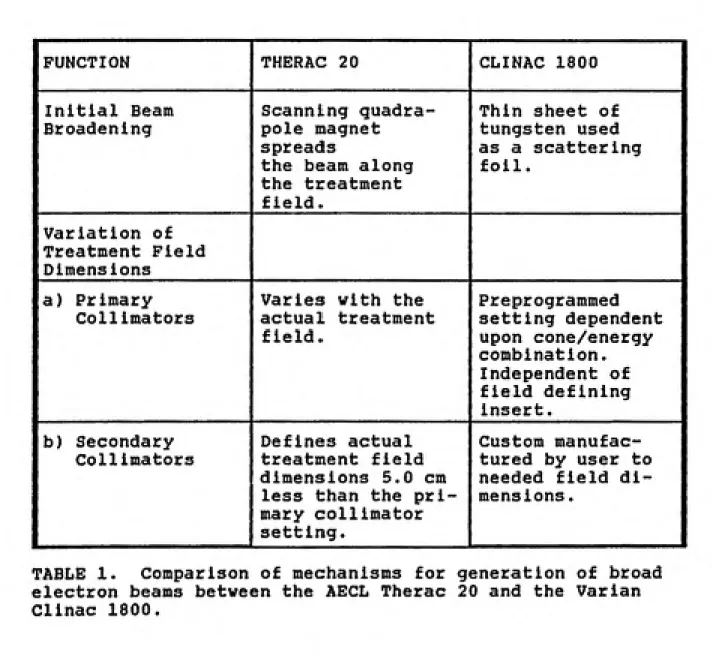
2.3 AECL Therac 20 and Varian Clinac 1800 Comparison
A possible difficulty with applying the previously
presented expressions to a Varian Clinac 1800 electron beam
is that its mechanism for the production of a broad electron
beam is different from the AECL Therac-20 Saturne for which
the model was developed. Table 1 compares some of differ¬
ences between the two accelerators. Even with these differ¬
ences noted, the present report focuses on the application
15
1 FUNCTION
THERAC 20CLINAC 1800 1
ͣ
Initial Beam
Scanning quadra-
Thin sheet of 1
1 Broadening
pole magnet
tungsten used 1
spreads
as a scattering 1
the beam along
foil. 1
the treatmentfield.
[variation of
1 Treatment Field
{Dimensions
la) Primary
Varies with thePreprogrammed 1
1 Collimators
actual treatmentsetting dependent 1
field.
upon cone/energy 1
combination. 1
Independent of 1
field defining 1
Insert. |
lb) Secondary
Defines actualCustom manufac- 1
1 Collimators
treatment fieldtured by user to 1
dimensions 5.0 cm
needed field dl- 1
less than the pri¬
mary collimator
setting.
menslons. 1
TABLE 1. Comparison of mechanisms for generation of broad
electron beams between the AECL Therac 20 and the Varian
3.0 MBASURBMEMT MBTHODS
3.1 Study and Measurement Equipment
The accelerator to which these measurements apply is a
Varian Associates' Clinac 1800 located at the Rock Hill
Radiation Therapy Center located in Rock Hill, South Caroli¬
na. This accelerator produces five electron beams with
nominal beam energies of 6, 9, 12, 16, and 20 MeV. Table 2
summarizes the field defining applicators or cones supplied
by the manufacturer with the nominal primary collimator
opening dimensions for each cone / energy combination.
A family of field shaping metal alloy inserts of square
and rectangular shape were made for each cone. The dimen¬
sions of the square inserts were chosen so that some would
mimic the defined field made by a smaller cone dimension.
One rectangular (i.e. length to width ratio greater than
one) insert with a small length to width ratio has side
dimensions that are bounded by the dimensions of the group
of custom square inserts for each specified cone. Another
rectangular insert with a large length to width ratio has
side dimensions that are larger and smaller respectively
than the dimensions of the group of custom square inserts
for each specified cone. Table 3 summarizes the actual
field defining inserts made for each cone.
manufac-17
1 APPLICATOR SIZE
COLLIMATOR SETTING |
6 AND 9 MeV
12, 16, and 20 1
MeV 1
4x4- 20x20
11x11 1
1 6x6-
20x20 11x1110x10 20x20
14x14 1
1 15x15
20x2019x19 1
1 20x20
25x2525x25 1
1 25x25
30x3030x30 1
Both inserts used with 6x6 cone.
TABLE 2. Applicator / cone sizes with Inserts supplied by
1 CONE
CUSTOM INSERT CONECUSTOM INSERT 1
1 6x6
4x4 20x204x4 1
5x5
6x6 1
4x5
8x8 1
3x6
10x10 1
15x15 1
1 10x10
4x410x17 1
6x6
3x23 1
8x8
6x8 25x25
4x4 1
3x11
6x6 1
8x8 1
1 15x15
4x410x10 1
6x6
15x15 1
8x8
20x20 1
10x10
10x23 1
8x11
3x28 1
3x17
TABLE 3. Custom inserts manufactured with a low melting
f 19
tured by MultiData Systems International Corp. was used.
This system consist of a 48 x 48 x 40 cm water phantom with
automated scanning mechanisms, two PTW model M2332 0.1 cc
ion chambers (cavity diameter = 0.35 cm), and a controller
which is an IBM AT-compatible desktop computer running
proprietary software with accompanying interface equipment.
Data acquisition is performed with this system by
first, through software manipulation, developing an "acqui¬
sition plan file" which will control the positioning within
the water phantom of one probe designated the "measurement
probe." The other probe is set in a fixed position in the
path of the beam and is designated the "reference probe."
All data collected are relative to readings of this refer¬
ence probe. This guards against dose output rate (i.e.
cGy/min.) fluctuations of the accelerator which could com¬
promise the data from measurement techniques involving the
continuous repositioning of the measurement probe in the
beam's path while radiation is being delivered. Collected
data are stored in a separate "study file" for mathematical
and / or graphical manipulation.
3.2 Relative Output Measurements
For each cone / insert / nominal beam energy combina¬
tion, relative output measurements were performed by col¬
lecting ionization data at Rxoo. This was accomplished by
First, manually set the center of the measurement
probe at both the center of the defined field and
at the water surface of the phantom which was
previously set at 100 cm from the "target** of the
accelerator.
Second, following the recommendation of Attix (l),
offset the probe 0.75 times the radius of the
probe's active volume (i.e. 0.1 cm) away for the
radiation beam "target" for all of the data mea¬
surement points. Set this position to be the
scanning origin of the water phantom.
Third, by computer keyboard control, move the
measurement probe to the previously determined
Rxoo depth (see Section 3.3) for a specified cone
/ insert / nominal beam energy combination.
Fourth, collect the signal from the measurement
probe with a PRM model SH-1 electrometer. This
will be the ionization data for that specific
combination.
Fifth, repeat the third and fouth steps until
ionization data for all cone / insert / nominal
beam energy combinations are acquired.
s: 21
values that were calculated by the following expression:
___ , lONIZATIOK READINGS) -^r ,^
icaazATim readings) ^qxio "'^
The 10x10 cone with Varian supplied insert combination
for each beam had been previously calibrated to a value of
1.00 cGy/MU at the depth of maximum dose (i.e. D»*m) with a
NBS traceable calibration dosimetry system. This system
consisted of the same PRM model SH-1 electrometer and a
Capintec model PR-06G Parmer-type probe.
3.3 Mgan Incident Energy (Rbq) MeasMcementg
For Rbo measurements, relative ionization versus depth
curves were acquired. This was performed for each cone /
insert / nominal beam energy by the following procedure:
First, manually set the center of the measurement
probe at both the center of the defined field and
at the water surface of the phantom which was
previously set at 100 cm from the "target" of the
accelerator.
Second, following the recommendation of Attix (1),
offset the probe 0.75 times the radius of the
probe's active volume (i.e. 0.1 cm) away for the
"target" for all of the data measurement points.
Set this position as the scanning orgin of the
water phantom.
the beam but not at a location that would inter¬
fere with the scanning mechanism.
Fourth, develop an acquisition plan that guides
the probe into the water phantom along the central
axis of the field at depth increments of 0.1 cm
and to an absolute depth past the effective range
of the electron beam's energy.
Fifth, with the system's electrometer time con¬
stant set at 0.2 seconds, have the probe pause 0.4
seconds at each depth increment or sampling point.
Sixth, enter the command to begin the acqusition
of the ionization intensity vs depth data.
The scanning system software will automatically display the
ionization intensity vs. depth scan normalized to the maxi¬
mum ionization value. A printout is then acquired which
contains depths of maximum ionization (Rioo), 50% of maximum
ionization (Rso), 55% of maximum ionization (Rss), and 45%
of maximum ionization (R419) values.
The combination of uncertainties in the previouly
described steps involved in probe positioning results in an
estimated uncertainty of 0.1 cm for the measured Rso value.
Therefore, one pass / fail criterion for Rso model predic¬
s." 23
4.0 RESULTS
4.1 Data Combinations
Relative output and ionization intensity versus depth
curves were measured for 180 nominal beam energy / cone /
insert combinations. Thirty combinations vere with Varlan
supplied Inserts, 100 combinations vere with custom square
inserts and 50 combinations vere vlth custom rectangular
Inserts.
4.2 Relative Output Measurements
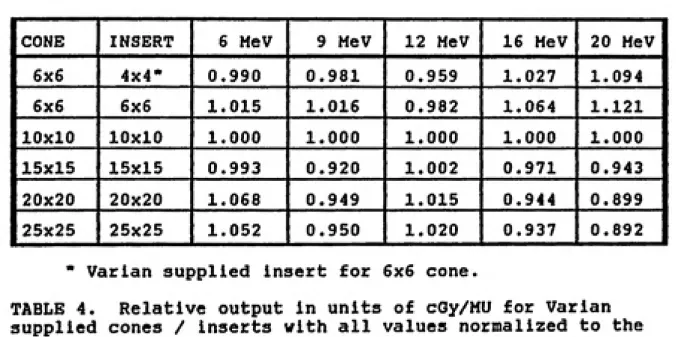
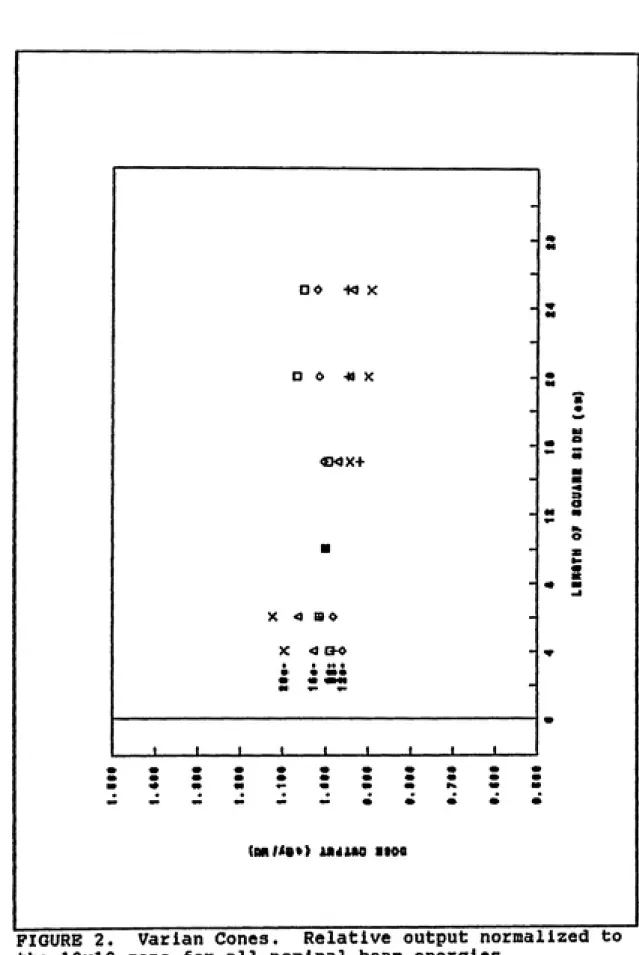
Table 4 presents the relative output measurements for
each nominal beam energy vith all cone / manufacturer sup¬
plied Inserts. Figure 2 presents these data graphically. A
reviev of this graph indicates no consistent shape of the
curves for all beams. This could be due to the different
primary collimators settings for different cone / beam
combinations and different construction dimensions for each
individual cone as indicated in table 2. Table 5 presents
the relative output measurements for all cone / square
insert / nominal beam energy combinations. Figures 3
through 7 graphically present these data for each beam. As
can be observed for these curves, there appears to be a
|cONB
INSERT 6 MeV 9 MeV 12 MeV 16 MeV20 MeV 1
1 6x6
4x4* 0.990 0.981 0.959 1.0271.094 1
16x6
6x6 1.015 1.016 0.982 1.0641.121 1
110x10
10x10 1.000 1.000 1.000 1.0001.000 1
115x15
15x15 0.993 0.920 1.002 0.9710.943 1
120x20
20x20 1.068 0.949 1.015 0.9440.899 1
125x25
25x25 1.052 0.950 1.020 0.9370.892 1
* Varian supplied insert for 6x6 cone.
TABLE 4. Relative output in units of cGy/MU for Varian
supplied cones / Inserts with all values normalized to the
25
1
_-
* 1
** 1
DO -W X
-s
DO -m X -
• 1
M 1
>> 1
• 1
CMX4
-•" S 1
M 1 MM 1 •• 1 Ik 1
e 1
ͣ
-s 1
^ 1
s
mm 1
^ 1
X O BO
-|
X < B-O J
V 1
ff t ffi i • • «•• • « «M«
« <• «-
-1
1 «
1 •
1 "
1 1 1 1 1 1 1 1 •
I « •» M «- • •» M
• • • • « •
» 1
» 1
> 1
1 m
', JiJitiJiml^m
•
•
•
•
ͣ
• 1
(Mlf««»> M4iM ItM
FIGURE 2. Varian Cones. Relative output normalized to
JCONE
INSERT 6 MeV 9 MeV 12 MeV 16 MeV20 MeV 1
lexe
4x4V 0.990 0.981 0.959 1.0271.094 1
4x4 0.982 0.980 0,948 1.016
1.064 1
5x5 1.012 1.013 0.960 1.036
1.082 1
6x6V 1.015 1.016 0.982 1.064
t ^-^21 1
110x10
4x4 0.962^ 0.924
0.956 0.9680.966 1
6x6
; 1.001
0.990 0.992 0.9920.990 1
8x8 0.996 0.998 0.995 0.995
0.991 1
lOxlOV 1.000 1.000 1.000 1.000
1.000 1
115x15
4x4 0.965 0.874 0.956 0.9370.931 1
6x6 0.993 0.920 0.998 0.961
0.941 1
8x8 0.996 0.932 1.013 0.972
0.953 1
10x10 0.995 0.930 1.012 0.980
0.954 1
15xl5V 0.993 0.920 1.002 0.971
0.943 1
120x20
4x4 1.030 0.895 0.965 0.9230.906 1
6x6 1.076 0.955 1.020 0.951
0.915 1
8x8 1.078 0.962 1.031 0.957
0.918 1
10x10 1.075 0.961 1.035 0.962
0.921 1
1 -.
15x15 1.068 0.956 1.029 0.9580.919 1
20x20V
1.068 0.949 1.020 0.9440.899 1
125x25 1
4x4 1.017 0.9040.979 1
0.9340.913 1
6x6 1.067 0.966 1.037 0.966
0.940 1
8x8 1.072 0.974
1.047 1
0.9730.939 1
1
10x10 1.071 0.9741.049 '
0.9690.932 1
15x15 1.064
0.964 J
1.0400.966
0.924 1
20x20 1.059 0.954 1.028
0.951 !
0.907 1
25x25V
1.052 0.950 1.020 0.9370.892 1
TABLE 5. Relative output
square inserts and Varian
10x10 cone.
27
X 4 BO
X *m o
XX 4)B<»
• • «ͣ •
I I I_____I_____I---1_____I_____L
• S •* # *
UMfAl*) ia^JUM IIM
FIGURE 3. 6x6 Cone. Relative output normalized to the
<•«»<••) U4AM Itoa
FIGURE 4. 10x10 Cone. Relative output normalized to
29
CMX-I-<09X4 <04K4
+
Ha •
J_____\ \_____L J_____L
s
8
(Mlf4«t) M4iM IMA
1
M
M
a 0 •« X •«•
• 1
O 0 4 X
•
m
8
5 1
ͣ
1
* 1
o « « XK 1
1
ͣͣ
1
i^ 1
O « -MX «
O O -MX
a o 4«- »
• • • t*
1 1 1 1 1 1 1 1 1
1 «
1 «
1 n
; s 8 s s s : :
••
:
1
• 4» •
\mit%%} AaiiM ͣ•»•
FIGURE 6. 20x20 Cone. Relative output normalized to
31
s
O* +« X
* 1
«ͣ 1o» -m X
4» 1
M 1• 1
DO 4 X
4 1 ^ 1 OO « X
oo «x DO «X
D 9 4»«>
« 1
• • I M
1 «
1 4
1 ͣ
1 1 t t 1 1 1 I i
• •
• •
» 1
» 1
> 1
..»«ͣ•*• • •
• 1
(Mli«»> AII4AM BM«
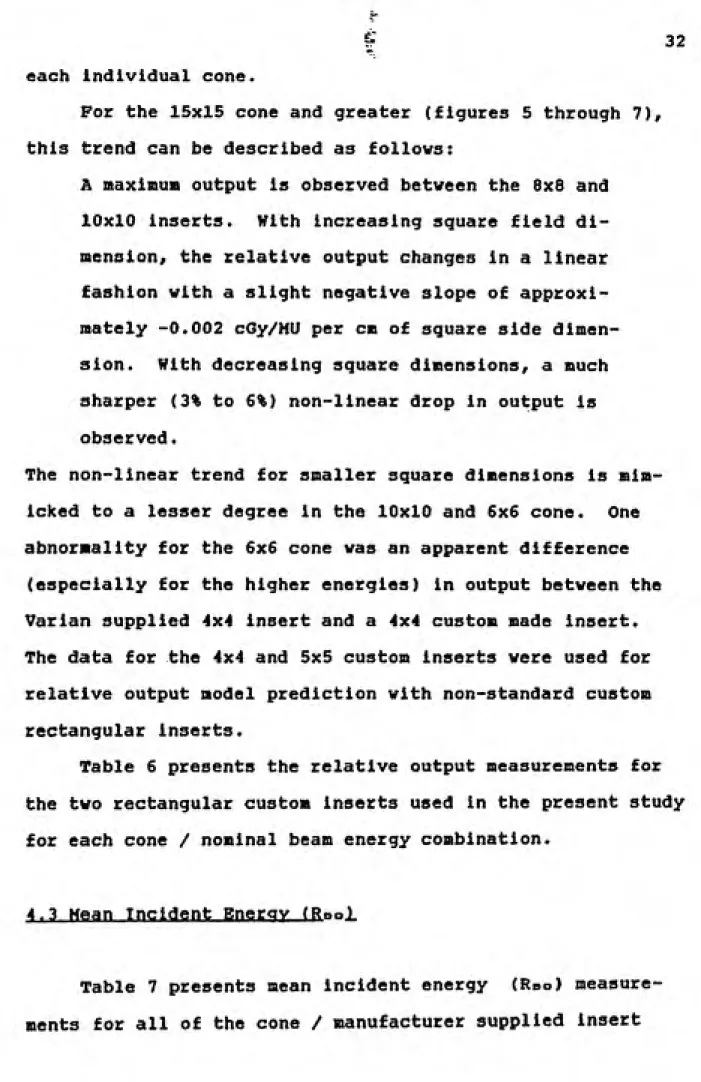
each individual cone.
For the 15x15 cone and greater (figures 5 through 7),
this trend can be described as follows:
A maximum output is observed between the 8x8 and
10x10 inserts. With increasing square field di¬
mension, the relative output changes in a linear
fashion with a slight negative slope of approxi¬
mately -0.002 cGy/HU per cm of square side dimen¬
sion. With decreasing square dimensions, a much
sharper (3% to 6%) non-linear drop in output is
observed.
The non-linear trend for smaller square dimensions is mim¬
icked to a lesser degree in the 10x10 and 6x6 cone. One
abnormality for the 6x6 cone was an apparent difference
(especially for the higher energies) in output between the
Varian supplied 4x4 insert and a 4x4 custom made insert.
The data for the 4x4 and 5x5 custom inserts were used for
relative output model prediction with non-standard custom
rectangular inserts.
Table 6 presents the relative output measurements for
the two rectangular custom inserts used in the present study
for each cone / nominal beam energy combination.
4.3 Mean Incident Energy (RboI
Table 7 presents mean incident energy (Rbo) measure¬
33
|COME
INSERT1 6 MeV
9 MeV 12 MeV 16 MeV20 Mev|
Isxe
4x5 1.000 0.997 0.963 1.0231.048 1
3x6 0.980 0.966 0.946 1.013
1.049 1
110x10
6x8 0.993 0.983 0.978 0.9780.979 1
3x11 0.953 0.912 0.937 0.946
0.946 1
115x15
8x11 1.004 0.930 1.013 ͣ 0.9780.950 1
3x17 0.951 0.863 0.954 0.933
0.920 1
120x20
10x17 1.061 0.9551.025
0.9600.916 1
3x23 1.011 0.884 0.964 0.918
0.890 1
125x25
10x23 1.063 0.946 1.021 0.9480.893 1
3x28 0.977 0.873 0.950 0.908
0.876 1
1 COMB
INSERT 6 MeV 9 MeV 12 MeV 16 MeV20 Mev|
1 6x6
4x4* 2.2 3.4 4.3 5.76.6 1
1 6x6
6x6 2.2 3.4 4.5 6.17.4 1
1 10x10
I 10x10
2.1 3.3 4.5 6.47.8 1
I 15x15
15x15 2.2 3.41 4.5
6.37.8 1
I 20x20
20x20 2.2 3.4 4.5 6.47.9 1
1 25x25
,25x25
2.1 3.4 4.5 6.47.9 1
* Varian supplied insert for 6x6 cone.
TABLE 7. 50% of the ttaximuA ionization depth in centiaeters
35
-1
H
X 4 ^ + O
-]
X 4 ^ + O
-1
X 4 « + D
-1
X 4 0 + O
A
X 4 « + D
J
X 4 o + ͤ J
ͣ
t • • • •
•
•
M
• 1
•
•
4
...i... ...In,,.. 1. ..,.,1...i...1 ____L- 1 i
i
. s
8
!
ͣ
•) HOIiVXMOl MMIIXVII %«t
FIGURE 6. Varian Cones. 50% of naximun ionization
combinations. Figure 8 presents thes data graphically. As
can be seen, for the 6 MeV, 9 MeV, and 12 MeV nominal beam
energies, the Rbo value remains constant for all combina¬
tions. For the 16 MeV and 20 MeV nominal beam energies,
these data indicate a Rao value decrease for the 6x6 cone
vith the 6x6 and 4x4 inserts.
Table 8 presents the mean incident energy (Rso) mea¬
surements for each cone vith their respective families of
custom inserts. Figures 9 through 13 graphically present
these data for each beam. A review of these graphs indicate
a Rso value decrease for the 16 MeV and 20 MeV nominal beam
energies with the 10x10 and greater dimension cones' 4x4 and
6x6 inserts. This Rso decrease for the smaller inserts is
qualitatively similar to that noted earlier with the cone /
manufacturer supplied inset combinations. The 6 MeV, 9 MeV,
and 12 MeV nominal beam energies' data are constant for all
inserts which is again comparable to data for the individual
cones.
Table 9 presents mean incident energy (Rbo) measure¬
ments for the two rectangular custom inserts used in the
present study for each cone / nominal beam energy combina¬
tion.
4.4 Model Application
For application of the square root model for both
predic-37
1 CONE
INSERT 6 MeV 9 MeV 12 MeV 16 MeV20 Mev|
1 6x6
4x4V 2.2 3.4 4.3 5.76.6 1
4x4 2.2 3.3
1 4.4
5.81 6.8 1
5X5 2.1 3.3 4.4 6.2
7,3 1
1 6x6V
2.2 3.4 4.51 6.1
7.4 1
1 10x10
4x4\ 2.1
3.3 4.3 5.96.8 1
1 6x6
I ^'^
3.3 4.5 6.37.6 1
8x8 2.1 3.3 4.5 6.4
i ^'^ i
1
1 lOxlOV
2.1 3.3 4.5 6.41 7.8 1
1 15x15
4x4 2.2 3.4 4.4 6.07.0 1
1
6x6 2.2 3.5 4.6 6.37.6 1
8x8 2.2 3.5 4.6 6.3
7.7 1
10x10 2.2 3.5 4.6 6.3
7.8 1
1
15x15V
2.2 3.4 4.5 6.37.8 1
1 20x20
4x4 2.1 3.3 4.3 5.96.9 1
6x6 2.1 3.4
4.5 1
6.3 1
7.6 1
8x8 2.1
3.4 i
4.5 6.4 i7.8 1
10x10 2.1 3.4 4.5 6.5
7.8 1
15x15 2.2 3.5 4.5 6.4
7.8 1
20x20V 2.2 3.4 4.5 6.4
7.9 1
I 25x25
4x4 J
2.1 3.3 4.35.8 J
6.9 1
1
6x6 1
2.1 1
3.44.5 1
6.37.7 1
8x8 1
2.23.4 '
4.5 6.48.0 1
10x10 2.2 3.4 4.5 6.4
8.0 1
15x15
2.2 3.5 4.6 6.58.1 1
1 ͣ" ͣ !
20x20
2.1 3.4 4.5 6.37.9 1
25x25V
2.1 3.4 4.5 6.47.9 1
TABLE 8. 50% of aaxinum i
all square custom inserts
onization depth in centimeters for
Hit) iOliVXMOl RMtXVR »«t
PIGURB 9. 6x6 Cone. 50% o£ naxinum ionization depth
.39
X 4
X 4
X < X 4
O « «
+
+
+
o o D O
• •
J_____I_____1_____I_____I_____I_____I I I
s
m
- 6
8
(
ͣ
•> MIAVZIIiOl IMIIIXVa «M
FIGURE 10. 10x10 Cone. 50% o£ maxinua ionization depth
K <
X <
X 4
X 4
•
4 4
4
4 a o D O
J_____L J_____L
i
•• A
!
!
ͣ
•> lOUVIIIOI HMIXm KM
FIGURE 11. 15x15 Cone. 50% o£ naxi»un ionization depth
.41
»•> MOIAVIIiOl NMIKVR ««t
FIGURE 12. 20x20 Cone. 50% of maxiKua ionization depth
-]
X 4 ^ + o
-j
X < 6 + o
-1
X < 0 + o
-|
X 4 0 + o
-j
X 4 ' o 4 ͣ o
-1
X « + D
-1
X < 0 + O J
• • • •
t • «
I •
• 1
•
•
4
1 .. , L... 1 1 1 1 1 i
1 t
48
lit) MUVIIiOl RMixvn «u
FIGURE 13. 25x25 Cone. 50% o£ maxinlin ionization depth
43
|C0MB '
INSERT 6 MeVi 9 MeV
! 12 MeV
16 MeV\ 20 Mev|
1 6x6
4x5 2.1 3.3 4.4 5.96.9 1
3x6 2.1 3.2 4.3
1 ^*^
6.7 1
1 10x10
1 6x8
2.21 3.3
4.51 ^'^
1 ^'^ 1
3x11 2 .^ : 3.3
i *'*
5.96.9 1
1 15x15
8x11 2.2 3.4\ *'^
6.47.8 1
1
3x17 2.2 3.4 4.4 5.97.0 1
1 20x20
10x17 2.2 3.4 4.5 6.47.9 1
3x23 2.2 3.4 4.4 5.9
7.1 1
1 25x25
10x23 2.2 3.4 4.5 6.47.9 1
1
3x28 2.2 3.41 *'*
6.07.1 1
TABLE 9. 50% o£ maximum ionization depth in centimeters for
tion, a simple table look up algorithm was developed with
linear interpolation for field defining dimensions between
table values and linear extrapolation for field defining
dimensions outside the table values. Examples of this
algorithm are:
Bxample 1 - Relative output prediction using linear
interpolation and equation 4.
Cone: 20 cm x 20 cm
Beam: 16 HeV
Table: lOd
Insert: 10 cm x 17 cm
Qxomxy (measured) = 0.960 cGy/MU
0»««»«-0.962 coy/IflJ
Qi7jrtT. 0.952 c^/|«7
pmar . qUjos^
(^^'''0.951 cay/MU
Example 2 - Energy (Rbo) prediction using linear ex¬
trapolation and equation 5.
Cone: 20 cm x 20 cm
Beam: 16 MeV
Table: lid
Insert: 3 cm x 23 cm
!* 45
SD^*'" S .f cm
i»»»*»*-6.4caB
Tables 10a through lOe present comparisons between the
measured and predicted values of the relative output for all
square and rectangular inserts for each cone and for each
nominal beam energy, 6 MeV through 20 MeV respectively.
Tables 11a through lie present comparisons between the
measured and predicted values of Roo for square and rectan¬
gular inserts for each cone and for each nominal beam ener¬
gy, 6 MeV through 20 MeV respectively.
Table 12 contains the variation in depth values between
measured Rbo and measured R^b (or Rbb) for each nominal beam
energy. These data are to be used as a possible pass / fail
1 Cone
Insert Cone Model ConeMode 1
Meas. Pred. Pred. %Diff.%Diff. 1
1 6x6
4x4V 0.990 0.990 0.990 0.0%0.0% 1
6x6V 1.015 1.015 1.015 0.0%
0.0% 1
4x4 0.982 0.990 0.982 0.8%
0.0% 1
5x5 1.012 1.015 1.012 0.3%
0.0% 1
4x5 0.997 1.015 0.997 1.8%
0.0% 1
3x6 0.980 1.015 0.997 3.6%
1.7% 1
10x10 4x4 0.962 1.000 0.962 3.9%
0.0% 1
6x6 1.001 1.000 1.001 -0.1%
0.0% 1
8x8 0,996 1.000 0.996 0.4%
0.0% 1
lOxlOV 1.000 1.000 1.000 0.0%
0.0% 1
6x8 0.993 1.000 0.998 0.7%
0.5% 1
3x11 0.953 1.000 0.972 4.9%
2.0% 1
15x15 4x4 0.965 0.993 0.965 2.9%
0.0% 1
6x6 0.993 0.993 0.993 0.0%
0.0% 1
8x8 0.996 0.993 0.996 -0.3%
0.0% 1
10x10 0.995 0.993 0.995 -0.2%
0.0% 1
15xl5V 0.993 0.993 0.993 0.0%
0.0% 1
8x11 1.004 0.993 0.995 -1.1%
-0.9% 1
3x17 0.951 0.993 0.972 4.4%
2.2% j
TABLE 10a. 6 MeV: Relative Output. Comparison between
model prediction, assumption of no effect (cone), and actual
measurement for Varian and custom inserts. All absolute
values are in units of cGy/MU.
NOTE:
^Dlff
47
1 Cone
Insert Cone Model ConeMode 1
Meas. Pred. Pred. %Diff
%Diff 1
1 20x20
4x4 1.030 1.068 1.030 3.7%0.0% 1
6x6 1.076 1.068 1.076 -0.7%
0.0% 1
8x8 1.078 1.068 1.078 -0.9%
0.0% 1
10x10 1.075 1.068 1.075 -0.6%
0.0% 1
15x15 1.068 1.068 1.068 0.0%
0.0% 1
20x20V 1.068 1.068 1.068 0.0%
0.0% 1
10x17 1.081 1.068 1.071 -1.2%
-0.9% 1
3x23 1.011 1.068 1.037 5.6%
2.6% 1
1 25x25
4x4 1.017 1.052 1.017 3.4%0.0% 1
6x6 1.067 1.052 1.067 -1.4%
0.0% 1
8x8 1.072 1.052 1.072 -1.9%
0.0% 1
10x10 1.071 1.052 1.071 -1.8%
0.0% 1
15x15 1.064 1.052 1.064 -1.2%
0.0% 1
20x20 1.059 1.052 1.059 -0.6%
0.0 1
25x25V 1.052 1.052 1.052 0.0%
0.0% 1
10x23 1.063 1.052 1.063 -1.0%
0.0% 1
3x28 0.977 1.052 1.020 7.7%
4.4% 1
TABLE 10a (cont.). 6 MeV: Relative Output. Comparison
between model prediction, assumption of no effect (cone),
actual measurement for Varian and custom inserts. All
absolute values are in units of cGy/MU.
1 Cone
Insert Cone Model ConeMode 1
Meas . Pred. Pred. %Diff%Diff 1
1 6x6
4x4V 0.981 0.981 0.981 0.0%0.0% 1
6x6V 1.016 1.016 1.016 0.0%
0.0% 1
4x4 0.980 1.016 0.980 3.7%
0.0% 1
5x5 1.013 1.016 1.013 0.3%
0.0% 1
4x5 0.997 1.016 0.996 1.9%
-0.1% 1
3x6 0.966 1.016 0.996 5.2%
3.1% 1
1 10x10
4x4 0.924 1.000 0.924 8.2%0.0% 1
6x6 0.990 1.000 0.990 1.0%
0.0% 1
8x8 0.998 1.000 0.998 0.2%
0.0% 1
lOxlOV 1.000 1.000 l.OOO 0.0%
0.0% 1
6x8 0.983 1.000 0.994 1.7%
1.1% 1
3x11 0.912 1.000 0.944 9.6%
3.5% 1
1 15x15
4x4 0.874 0.920 0.874 5.3%0.0% 1
6x6 0.920 0.920 0.920 0.0%
0.0% 1
8x8 0.932 0.920 0.932 -1.3%
0.0% 1
10x10 0.930 0.920 0.930 -1.0%
0.0% 1
15x15V 0.920 0.920 0.920 0.0%
0.0% 1
8x11 0.930 0.920 0.930 -1.1%
0.0% 1
3x17 0.863 0.920 0.883 6.6%
2.3% 1
TABLE 10b. 9 MeV: Relative Output. Comparison between
model prediction, assumption of no effect (cone), and actual
measurement for Varian and custom inserts. All absolute
.49
1 Cone
Insert Cone Model ConeMode 1
Meas. Pred. Pred. %Diff
%Diff 1
1 20x20
4x4 0.895 0.949 0.895 6.0%0.0% 1
6x6 0.955 0.949 0.955 -0.6%
0.0% 1
8x8 0.962 0.949 0.962 -1.4%
0.0% 1
10x10 0.961 0.949 0.961 -1.3%
0.0% 1
15x15 0.956 0.949 0.956 -0.7%
0.0% 1
20x20V 0.949 0.949 0.949 0.0%
0.0% 1
10x17 0.955 0.949 0.957 -0.6%
0.2% 1
3x23 0.884 0.949 0.904 7.4%
2.3% 1
1 25x25
4x4 0.904 0.950 0.904 5.1%0.0% 1
6x6 0.966 0.950 0.966 -1.6%
0.0% 1
8x8 0.974 0.950 0.974 -2.4%
0.0% 1
10x10 0.974 0.950 0.974 -2.5%
0.0% 1
15x15 0.964 0.950 0.964 -1.5%
0.0% 1
20x20 0.954 0.950 0.954 -0.4%
0.0% 1
25x25V 0.950 0.950 0.950 0,0%
0.0% 1
10x23 0.946 0.950 0.962 0.4%
1.7% 1
3x28 0.873 0.950 0.910 8.8%
4.2% 1
TABLE 10b (cont.). 9 MeV: Relative Output. Comparison
between model prediction, assumption of no effect (cone), and
actual measurement for Varian and custom inserts. All
1 Cone
Insert Cone Model ConeModel 1
Meas. Pred. Pred. %Diff%Diff 1
1 6x6
4x4V 0.959 0.959 0.959 0.0%0.0% 1
5x6V 0.982 0.982 0.982 0.0%
0.0% 1
4x4 0.948 0.982 0.948 3.6%
0.0% 1
5x5 0.960 0.982 0.960 2.3%
0.0% 1
4x5 0.963 0.982 0.954 2.0%
-0.9% 1
3x6 0.946 0.982 0.954 3.8%
0.8% 1
1 10x10
4x4 0.956 1.000 0.956 4.6%0.0% 1
6x6 0.992 1.000 0.992 0.8%
0.0% 1
8x8 0.995 1.000 0.995 0.5%
0.0% 1
lOxlOV 1.000 1.000 1.000 0.0%
0.0% 1
6x8 0.978 1.000 0.993 2.2%
1.5% 1
3x11 0.937 1.000 0.970 6.7%
3.5% 1
1 15x15
4x4 0.956 1.002 0.956 4.8%0.0% 1
6x6 0.998 1.002 0.998 0.4%
0.0% 1
8x8 1.013 1.002 1.013 -1.1%
0.0% 1
10x10 1.012 1.002 1.012 -1.0%
0.0% 1
15xl5V 1.002 1.002 1.002 0.0%
0.0% 1
8x11 1.013 1.002 1.011 -1.1%
-0.2% 1
3x17 0.954 1.002 0.966 5.0%
1.3% 1
TABLE 10c, 12 MeV: Relative Output. Comparison between
model prediction, assumptiom of no effect (cone), and actual
measurement for Varian and custom inserts. All absolute
51
1 Cone
Insert Cone Model ConeModel 1
Meas. Pred. Pred. %Diff
%Diff 1
1 20x20
4x4 0.965 1.015 0.965 5.2%0.0% 1
6x6 1.020 1.015 1.020 -0.5%
0.0% 1
8x8 1.031 1.015 1.031 -1.5%
0.0% 1
10x10 1.035 1.015 1.035 -1.9%
0.0% 1
15x15 1.029 1.015 1.029 -1.3%
0.0% 1
20x20V 1.020 1.015 1.020 -0.5%
0.0% 1
10x17 1.025 1.015 1.030 -1.0%
0.5% 1
3x23 0.964 1.015 0.975 5.3%
1.1% 1
1 25x25
4x4 0.979 1.020 0.979 4.2%0.0% 1
6x6 1.037 1.020 1.037 -1.6%
0.0% 1
8x8 1.047 1.020 1.047 -2.6%
0.0% 1
10x10 1.049 1.020 1.049 -2.8%
0.0% 1
15x15 1.040 1.020 1.040 -1.9%
0.0% 1
20x20 1.028 1.020 1.028 -0.8%
0.0% 1
25x25V 1.020 1.020 1.020 0.0%
0.0% 1
10x23 1.021 1.020 1.036 -0.1%
1.5% 1
3x28 0.950 1.020 0.982 7.4%
3.4% 1
TABLE 10c (cont.). 12 MeV: Relative Output. Comparison
between model prediction, assumption of no effect (cone), and
actual measurements for Varian and custom inserts. All
1 Cone
Insert Cone Model ConeMode 1
Meas . Pred. Pred. %Diff%Diff 1
1 6x6
4x4V 1.027 1.027 1.027 0.0%0.0% 1
6x6V 1.064 1.064 1.064 0.0%
0.0% 1
4x4 1.016 1.064 1.016 4.7%
0.0% 1
5x5 1.036 1.064 1.036 2.7%
0.0% 1
4x5 1.023 1.064 1.026 4.0%
0.3% 1
3x6 1.013 1.064 1.026 5.0%
1.3% 1
1 10x10
4x4 0.968 1.000 0.968 3.3%0.0% 1
6x6 0.992 1.000 0.992 0.8%
0.0% 1
8x8 0.995 1.000 0.995 0.5%
0.0% 1
lOxlOV 1.000 1.000 1.000 0.0%
0.0% 1
6x8 0.978 1.000 0.993 2.2%
1.5% 1
3x11 0.946 1.000 0.979 5.7%
3.5% 1
1 15x15
4x4 0.937 0.971 0.937 3.6%0.0% 1
6x6 0.961 0.971 0.961 1.1%
0.0% 1
8x8 0.972 0.971 0.972 -0.1%
0.0% 1
10x10 0.980 0.971 0.980 -1.0%
0.0% 1
15xl5V 0.971 0.971 0.971 0.1%
0.0% 1
8x11 0.978 0.971 0.975 -0.7%
-0.3% 1
3x17 0.933 0.971 0.946 4.1%
1.4 1
TABLE lOd. 16
model prediction,
measurement for
values are in uni
MeV: Relative Output. Comparison between
assumption of no effect (cone), and actual
Varian and custom inserts. All absolute
53
1 Cone
Insert Cone Model ConeMode 1
Meas. Pred. Pred. %Diff
%Diff 1
1 20x20
4x4 0.923 0.944 0.923 2.2%0.0% 1
6x6 0.951 0.944 0.951 -0.7%
0.0% 1
8x8 0.957 0.944 0.957 -1.4%
0.0% 1
10x10 0.962 0.944 0.962 -1.9%
0,0% 1
15x15 0.958 0.944 0.958 -1.4%
0.0% J
20x20V 0.944 0.944 0.944 0.0%
0.0% 1
10x17 0.960 0.944 0.957 -1.7%
-0.3% 1
3x23 0.918 0.944 0.922 2.8%
0.4% 1
25x25 4x4 0.934 0.937 0,934 0.4%
0.0% 1
6x6 0.966 0.937 0.966 -3.0%
0.0% 1
8x8 0.973 0.937 0.973 -3.7%
0,0% j
10x10 0.969 0.937 0.969 -3.3%
0.0% 1
15x15 0.966 0.937 0.966 -3.0%
0.0% j
20x20 0.951 0.937 0.951 -1.5%
0.0% 1
25x25V 0.937 0.937 0.937 0.0%
0.0% j
10x23 0.948 0.937 0.956 -1.2%
0.8% 1
3x28 0.908 0.937 0.923 3.2%
1.7% 1
TABLE lOd (cont.). 16 MeV: Relative Output, Comparison
between model prediction, assumption of no effect (cone), and
actual measurement for Varian and custom inserts. All
1 Cone
Meas. Pred. Pred. %Diff
%Diff 1
1 6x6
4x4V 1.094 1.094 1.094 0.0%0.0% 1
6x6V 1.121 1.121 1.121 0.0%
0.0% 1
4x4 1.064 1.121 1.064 5.4%
0.0% 1
5x5 1.082 1.121 1.082 3.6%
0.0% 1
4x5 1.048 1.121 1.073 7.0%
2.4% 1
3x6 1.049 1.121 1.073 6.9%
2.3% 1
1 10x10
4x4 0.966 1.000 0.966 3.5%0.0% 1
6x6 0.990 1.000 0.990 1.0%
0.0% 1
8x8 0.991 1.000 0.991 0.9%
0.0% 1
lOxlOV 1.000 1.000 1.000 0.0%
0.0% 1
6x8 0.979 1.000 0.990 2.1%
1.1% 1
3x11 0.946 1.000 0.979 5.7%
3.5% 1
1 15x15
4x4 0.931 0.943 0.931 1.3%0.0% 1
6x6 0.941 0.943 0.941 0.2%
0.0% 1
8x8 0.953 0.943 0.953 -1.0%
0.0% 1
10x10 0.954 0.943 0.954 -1.1%
0.0% 1
15xl5V 0.943 0.943 0.943 0.0%
0.0% 1
8x11 0.950 0.943 0.952 -0.7%
0.2% 1
3x17 0.920 0.943 0.932 2.5%
1.3% 1
TABLE lOe. 20 MeV: Relative Output. Comparison between
model prediction, assumption of no effect (cone), and actual
measurement for Varian and custom inserts. All absolute
55
1 Cone
Insert Cone Model ConeModel 1
Meas. Pred. Pred. %Diff
%Dif 1
1 20x20
4x4 0.906 0.899 0.906 -0.8%0.0% 1
6x6 0.915 0.899 0.915 -1.7%
0.0% 1
8x8 0.918 0.899 0.918 -2.1%
0.0% 1
10x10 0.921 0.899 0.921 -2.4%
0.0% 1
15x15 0.919 0.899 0.919 -2.2%
0.0% 1
20x20V 0.899 0.899 0.899 0.0%
0.0% 1
10x17 0.916 0.899 0.914 -1.9%
-0.2% 1
3x23 0.890 0.899 0.894 1.0%
0.4% 1
1 25x25
4x4 0.913 0.892 0.913 -2.3%0.0% 1
6x6 0.940 0.892 0.940 -5.1%
0.0% 1
8x8 0.939 0.892 0.939 -5.0%
0.0% 1
10x10 0.932 0.892 0.932 -4.3%
0.0% 1
15x15 0.924 0.892 0.924 -3.5%
0.0% 1
20x20 0.907 0.892 0.907 -1.7%
0.0% 1
25x25V 0.892 0.892 0.892 0.0%
0.0% 1
10x23 0.893 0.892 0.915 -0.1%
2.5% 1
3x28 0.876 0.892 0.891 1.8%
1.7% 1
TABLE lOe (cont.). 20 MeV: Relative Output. Comparison
between model prediction, assumption of no effect (cone),
actual measurement for Varian and custom inserts. All
absolute measurements are in units of cGy/MU.
1 Cone
Insert Cone Model ConeModel 1
Meas . Pred. Pred. Diff .Diff. 1
1 6x6
4x4V 2.2 2.2 N/A 0.0N/A 1
6x6V 2.2 2.2 N/A 0.0
N/A 1
4x4 2.2 2.2 N/A 0.0
N/A 1
5x5 2.1 2.2 N/A 0.1
N/A 1
4x5 2.1 2.2 N/A 0.1
N/A 1
3x6 2.1 2.2 N/A 0.1
N/A 1
1 10x10
4x4 2.1 2.1 N/A 0.0N/A 1
6x6 2.1 2.1 N/A 0.0
N/A 1
8x8 2.1 2.1 N/A 0.0
N/A 1
lOxlOV 2.1 2.1 N/A 0.0
N/A j
6x8 2.2 2.1 N/A -0.1
N/A 1
3x11 2.2 2.1 N/A -0.1
N/A 1
1 15x15
4x4 2.2 2.2 N/A 0.0N/A 1
6x6 2.2 2.2 N/A 0.0
N/A 1
8x8 2.2 2.2 N/A 0.0
N/A 1
10x10 2.2 2.2 N/A 0.0
N/A 1
15xl5V 2.2 2.2 N/A 0.0
N/A 1
8x11 2.2 2.2 N/A 0.0
N/A 1
3x17 2.2 2.2 N/A 0.0
N/A 1
TABLE 11a. 6 MeV: 50% of Maximum Ionization Depth.
Comparison between assumption of no effect (cone), and actual
measurement for Varian and custom inserts. As stated in the
text, model prediction for this energy is unnecessary. All
values in units of centimeters.
NOTE:Diff) COD* " ^t^ eonm ~ ^o)
,57
1 Cone
Insert Cone Model ConeModel 1
Meas. Pred. Pred Diff .
Diff 1
1 20x20
4x4 2.1 2.2 N/A 0.1N/A 1
6x6 2.1 2.2 N/A 0.1
N/A 1
8x8 2.1 2.2 N/A 0.1
N/A 1
10x10 2.1 2.2 N/A 0.1
N/A 1
15x15 2.2 2.2 N/A 0.0
N/A 1
20x20V 2.2 2.2 N/A 0.0
N/A 1
10x17 2.2 2.2 N/A 0.0
N/A 1
3x23 2.2 2.2 N/A 0.0
N/A 1
25x25 4x4 2.1 2.1 N/A 0.0
N/A 1
6x6 2.1 2.1 N/A 0.0
N/A 1
8x8 2.2 2.1 N/A -0.1
N/A 1
10x10 2.2 2.1 N/A -0.1
N/A 1
15x15 2.2 2.1 N/A -0.1
N/A 1
20x20 2.1 2.1 N/A 0.0
N/A 1
25x25V 2.1 2.1 N/A 0.0
N/A 1
10x23 2.2 2.1 N/A -0.1
N/A 1
3x28 2.2 2.1 N/A -0.1
N/A 1
TABLE 11a (cont.). 6 MeV: 50% of Maximum Ionization Depth.
Comparison between assumption of no effect (cone), and actual
measurement for Varian and custom inserts. As stated in the
text, model prediction for this energy is unnecessary. All
Meas. Pred. Pred. Diff.
Diff. 1
1 6x6
4x4V 3.4 3.4 N/A 0.0N/A 1
6x6V 3.4 3.4 N/A 0.0
N/A 1
4x4 3.3 3.4 N/A 0.1
N/A 1
5x5 3.3 3.4 N/A 0.1
N/A 1
4x5 3.3 3.4 N/A 0.1
N/A 1
3x6 3.2 3.4 N/A 0.2
N/A 1
1 10x10
4x4 3.3 3.3 N/A 0.0N/A 1
6x6 3.3 3.3 N/A 0.0
N/A 1
8x8 3.3 3.3 N/A 0.0
N/A 1
lOxlOV 3.3 3.3 N/A 0.0
N/A 1
6x8 3.3 3.3 N/A 0.0
N/A 1
3x11 3.3 3.3
N/A
0.0N/A 1
1 15x15
4x4 3.4 3.4N/A
0.0N/A 1
6x6 3.5 3.4
N/A
-0.1N/A 1
8x8 3.5 3.4 N/A -0.1
N/A 1
10x10 3.5 3.4
N/A
-0.1N/A 1
15xl5V 3.4 3.4 N/A 0.0
N/A 1
8x11 3.4 3.4 N/A 0.0
N/A 1
3x17 3.4 3.4
N/A
0.0N/A 1
TABLE lib. 9 MeV: 50% of Maximum Ionization Depth.
Comparison between assumption of no effect (cone) and actual
measurement for Varian and custom inserts. As stated in the
text, model prediction for this energy is unnecessary. All
59
1 Cone
Insert Cone Model ConeMode 1
Meas . Pred. Pred . Diff.
Diff 1
1 20x20
4x4 3.3 3.4 N/A 0.1N/A 1
6x6 3.4 3.4 N/A 0.0
N/A 1
8x8 3.4 3.4 N/A 0.0
N/A 1
10x10 3.4 3.4 N/A 0.0
N/A 1
15x15 3.5 3.4 N/A -0.1
N/A 1
20x20V 3.4 3.4 N/A 0.0
N/A 1
10x17 3.4 3.4 N/A 0.0
N/A 1
3x23 3.4 3.4 N/A 0.0
N/A 1
1 25x25
4x4 3.3 3.4 N/A 0.1N/A 1
6x6 3.4 3.4 N/A 0.0
N/A 1
8x8 3.4 3.4 N/A 0.0
N/A 1
10x10 3.4 3.4 N/A 0.0
N/A 1
15x15 3.5 3.4 N/A -0.1
N/A 1
20x20 3.4 3.4 N/A 0.0
N/A 1
25x25V 3.4 3.4 N/A 0,0
N/A 1
10x23 3.4 3.4 N/A 0.0
N/A 1
3x28 3.4 3.4 N/A 0.0
N/A 1
TABLE lib (cont.). 9 MeV: 50% of Maximum Ionization
Comparison between assumption of no effect (cone) and
measurement for Varian and custom inserts. As stated
text, model prediction for this energy is unnecessary
values are in units of centimeters.
Depth,
actual in the