GRAÇA BRESSAN REGINA MELO SILVEIRA WILSON VICENTE RUGGIERO
LARC – Laboratório de Arquitetura e Redes de Computadores PCS - Escola Politécnica da Universidade de São Paulo
Av. Prof.Luciano Gualberto, Trav.3, no 158, 05508-900 Sao Paulo, SP, Brazil {gbressan,regina,wilson}@larc.usp.br
Abstract: We describe here the Distance Learning System Architecture being developed at LVD2 (Distributed Video on Demand Laboratory) of LARC. The aim of this system is to make distance learning available in Web environment, by means of multimedia interactive courses. The present work proposes a course description model and the corresponding framework, needed for the creation and management of courses making use of many kind of media, including video.
Keywords: Distance Learning, Web Education, Remote Education, Video and Internet.
1 Introduction
The technological advance creates high demands in training in most knowledge areas. Long-distance on-line education is favored by technology in networks like high-speed communication and, in this way, training becomes available to a higher number of people in far locations.
This work is aimed to interactive education using Internet communication framework where many forms of interaction among students, instructors and the course management system are possible through a browser. The on-line material includes multimedia objects like hypertext, picture, audio, animation and video.
The design of this system includes the conception of a pedagogical model, independent of the media, keeping a didactic coherence. Moreover, a system architecture is proposed which is able to support the volume of data required for user interaction. The system objectives are defined to accomplish the intended educational material, providing the dynamic behavior and the interactive nature demanded by the learning process.
The employment of multimedia in courseware, when properly used, provides an agreeable and profitable learning interaction.
2 Long-distance Interactive Education
Education was chosen as object of inquiry and example of application for the LVD2 project. Long-distance education aims, through communication systems, the knowledge transmission and new technologies absorption for distant populations. Information distribution is not the main issue when we talk about education. On line courses must be defined in the way to favor the learning process. Distance education offers many challenges that will direct our research efforts.
Education is a field that involves trans-disciplinary aspects [Bonilha 1995] and our purpose is to analyze them to have a better understanding of their necessities in terms of tools and environments for interactive course development.
This work is oriented towards interactive education allowing the student participation through a browser. The multimedia educational material employs hypertext, picture, audio, animation, video and applications. The educational server manages the pages and controls the admission of the student to the course following his evolution during the
learning process. The student is submitted to an evaluation to proceed from a stage to the next in the course. In the case of unsuccessful evaluation, the student may review the part of the material where he had difficulty. Interaction between students and instructors are carried through mechanisms of messages or voice interaction in real time through the network.
The development of an environment for long-distance interactive courses, using Internet communication framework, presumes activities in the following fronts:
• Study and conception of pedagogical techniques suited to remote interactive education.
• Design of the course structure.
• Design and development of the system architecture to support remote interactive courses.
• Study of methods and techniques for multimedia didactic material production.
• Design, selection and development of authoring tools for definition and design of courses.
• Elaboration of cases studies to essay the techniques and to evaluate the developed tools and environment. 3 Interactive Courses Strategies
Interactive on-line education uses concepts common to the disciplines of education. The knowledge transmission can have theoretical approach, suited to the learning of concepts, or practical approach suited to the learning of procedures. The following strategies can be used in the teach-learning process:
• Deductive – a rule (or principle) is presented to the student that is requested to find examples of the rule.
• Inductive – some instances (or examples) of a rule are presented to the student that are requested to deduce the rule. These strategies can be allied and it must be noticed that both presume interactivity between the student and the education system. The deductive strategy can be developed in a faster rhythm and results in bigger absorption of the knowledge. The inductive strategy demands more time to be developed but it has the effect to teach the student to learn. In interactive education, less conventional strategies and resources could be used. Beyond expositive methods and exercises in form of multiple choices tests, where the correction is immediate, it is possible to develop randomly selected comprehensive questions taken from a database. Simulators and games enable constructive learning strategies and workout of the learned knowledge and abilities. The expositive methods may be enriched by videos and animations. A issue to be faced is how to keep the students motivated to follow the course along the sessions for days or months. Videos will be extensively used in the courses to keep the student attention. It is possible to keep the professor present in the screen and conducting the learning through the modules of the course. But besides this, the professor must be present in other ways like scheduled real time meetings with tools like chat.
4 Development of an Interactive Course
It is important to identify the differences between the development of traditional regular courses (local interaction) and on-line (remote interaction) courses.
We borrowed techniques and methodologies of video and film production for organizing the development of the course. The development steps are the following:
a) Identification of the objectives and the audience to be reached by the course. In the objectives definition it must be considered the knowledge to be acquired and the behavior changes to be promoted. The target audience defines the concepts to be transmitted and the language to be used in the course.
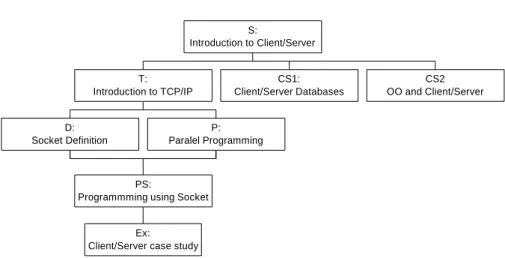
b) Definition of the conceptual modules as well as the way those modules relates to each other. This process results in a diagram like the one illustrated in figure 1. Modules will be performed sequentially only when necessary and all the conceptually independent modules could be developed without a definitive order.
c) The next step details each module a defines the specific objectives to be reached, and which concepts must be transmitted in this module.
d) Selection of the strategies to accomplish the objectives identified in the previous step. These strategies must define the most adequate media to be used for the concept presentation and which kind of exercises or games will be used to strengthen the learning. When a media, such as text, picture, sound, animation, simulation, game or video, was chosen, the next step is to define its presentation strategy. This means to write the treatment to be used, and what kind of dramatic action and narrative events will be employed.
e) At this step, enough material exists for the establishment of a general course script that is composed by individual scripts one for each of its modules. In particular, if the module will be a video then all the methodologies and techniques known for the video production could be used.
f) Each one of these steps will suffer the necessary walks through until a final solution be developed.
g) At the final step, an analysis and evaluation of the process is made to verify if the objectives considered in the beginning had been reached.
When the process is finished, we have in hand a script for the development of a distance course implemented using hypermedia.
Figure 1: Organization chart of a course
The idea is to use the concepts of video production [Kindem 1997], with the necessary changes, to adapt to course module elaboration. Thus, the script structure, in two columns, for example, can be used. A module can be implemented by Web pages that present in each screen, multiple objects in many kind of media, one of then could be a video. In this case, it is proposed an extension for multi-column script model to include alternative media. In the same way audio and video demand synchronism, also the other elements, texts, pictures, sound and photos, may be synchronized.
Heading:
Author: Date:
Target audience: Page:
Scene # Texts Actions Window 1 Window 2 Audio Jump 1 Text presenting concepts Simulations, tests, and games Photos, drawings, slide presentations, animations used to clarify some concept. Video Scene 1: Location: Talent: Action: Plans: Dialog, narration, music,... Conditional jump to a scene. n ... ... ... ... ...
Figure 2: Script in multi-columns format
Course: Client/Server S: Introduction to Client/Server D: Socket Definition P: Paralel Programming Ex: Client/Server case study
PS:
Programmming using Socket T: Introduction to TCP/IP CS1: Client/Server Databases CS2 OO and Client/Server
At this point we can propose a multimedia scripts editor with the following requirements:
• The script editor must be independent of the available tools like document editor and Web page editor
• An element in a scene may be synchronized with other. For instance, the audio and the video may be synchronized with the scrolling of the text.
• It must allow the definition of non-linear sequences of scenes. Unlike movie scripts, here we have branches from a scene to other.
5 Descriptive Model of Interactive Courses
An interactive course is structured as a set of concepts. The concept is the unit of representation of an idea,theory or rule. The concepts can be organized in sequences where a concept is followed by another, creating a dependency chain. Sequences of concepts can be developed in parallel inside a course, when the involved concepts are independent. Conventional courses in classroom or educative programs in video are formed as sequences of concepts, in spite of interruptions, changes between subjects, cuts, and scenes. An interactive media, like CD-ROM or Internet, can be structured as parallel sequences of concepts allowing the students to choose and follow one of the parallel sequences in any order at their own speed. Junction points can exist where the condition to progress to another concepts is that two or more parallel conditions have been fulfilled.
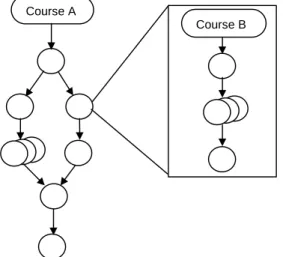
The representation that suits more closely to interactive courses, reflecting this possible chaining, is directed graph. An interactive course is, then, defined as a direct graph where nodes are linked through directed arcs, indicating the possible sequences to be followed during the accomplishment of the course.
From the course implementation point of view, each concept is defined as a module that uses different forms of representation: simple texts, hypertext or multimedia documents with graphics, pictures, applications, sounds, animation, video clips and full video programs. Each module corresponds to a concept and consists of an expositive part that presents the concept, a training part that consists of exercises and simulations or games to pursue the knowledge and to develop practical skills. Optionally, an evaluation part may exist to determine if the student absorbed the concept allowing the measurement of his performance.
The concept can be complex. It can be presented in several steps using a recursive definition: a module can correspond to an elementary concept with an auto-contained presentation, or can correspond to a complex concept and, in this case, it is structured as another course or sub-module. This recursive structure allows the modularity property to be present in course descriptions. A module describing a common concept belonging to several different courses may have its description reused so many times as needed.
Figure 3: Graph Representation of Courses Course A
Course B
Beginning of a course Module
Module with multiple representation
5.1 Structure of a Module
As mentioned before each course is organized as a set of modules. Each module corresponds to the presentation of a concept and the correspondent exercise and evaluation. Modules also are used to define other elements of the course such as procedures, summaries, index, attaches, and bibliographical references.
One concept may have different presentation using diverse strategies like inductive, deductive and with diferent levels of difficulties. For this reason a module may have more than one representation. In figure 3, some module are represented by multiple circles representing different representations.
A module is represented by the following description elements:
• Input condition: relational expression that defines the conditions for execution of the current module based on previous modules execution results.
• Content: defines the content of the module in any possible media types like text, hypertext, audio, pictures, graphs, animation, video. The description may include synchronization conditions between contents like text and audio.
• Training: exercises, simulations and games for the practice of the presented concepts. Its implementation uses active and reactive elements to allow interaction with the student.
• Evaluation: set of tests used in the student learning evaluation. If the link points to a course then the evaluation is gotten from the final evaluation of the course contained in its header.
• Output result: defines the result of themoduleexecution, which can be an integer value to indicate the result ofthe evaluation. This defines the score obtained by the student in this module.
• Link to a course: points to the beginning of a course. This link is empty when the module description defines its own content, that is, there is no other sub-modules (recursive definition) associated to it.
The execution of the modules follows the links of the courses graph. In case of links to alternative modules, the student may chose one of the directions.
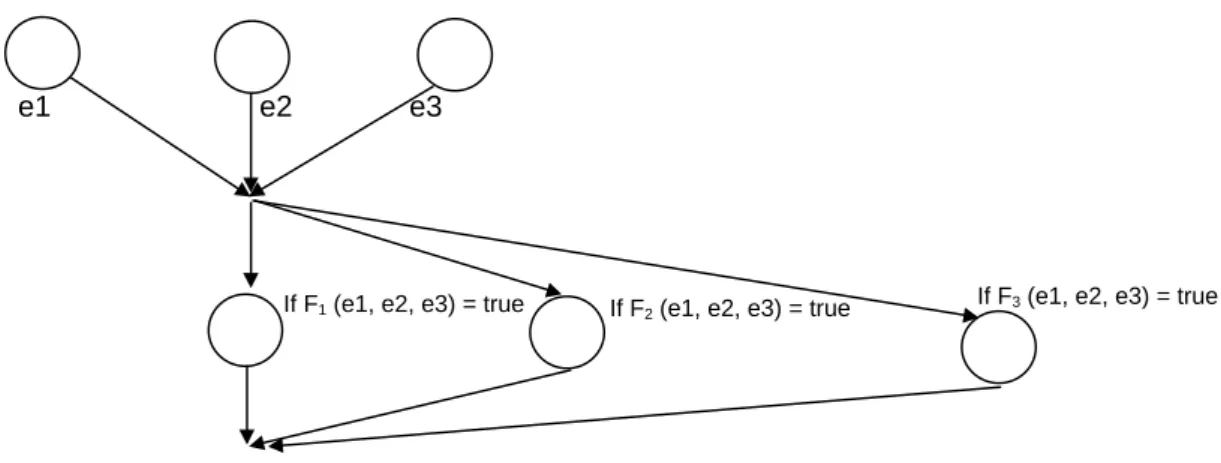
To enter a module the student must fulfill the input condition of the module. This condition depends on the score obtained by the student in evaluations of the previous modules (figure 4).
Figure 4: Entry in a single representation module
A module may have multiple representation and in this case each one will have its own set of description elements. A representation of a module can differ from other representations of the same module in respect to pedagogical strategy (like inductive or deductive), tools, level of detail or difficulty. Depending on the student and his maturity, one representation will work better than other. This mechanism allows the systems to adapt to particularities of the students. The multiple representations of the module are ordered from the hardest to the easiest according to the input condition.
If F(e1, e2, e3) = true e1 e2 e3
e1, e2, e3 define the evaluation results from previous modules F(e1, e2, e3) defines the input condition
When a module has multiple representation, the score of a student may not fulfill the conditions to enter a given module but may be enough to enter a easier representation of the module. The student will enter one a representation according to his score in the previous modules (figure 5) .
Figure 5: Entry in a multiple representation module.
If the student fail in the evaluation of one representation of the module, and the module has another easier representation, he will enter a easier representation of the same module (figure 6).
Figure 6: Module with (a) single representation and (b) multiple representations.
More details of on-line courses system implementation are described in [Gonzalez 1999].
6 Multimedia Distance Learning System Architecture
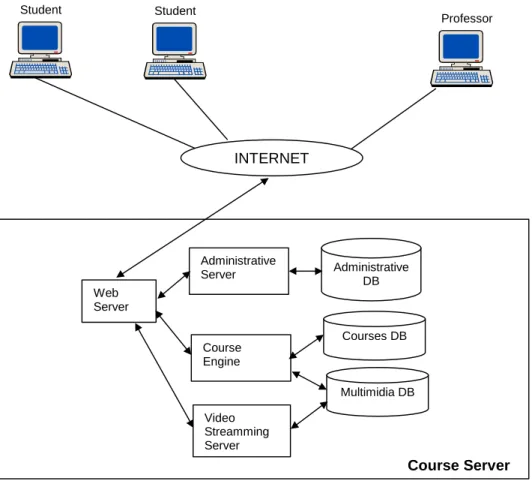
The Multimedia Distance Learning System consists of the following components: Success Failure a) Success Failure Failure Failure b)
If F1 (e1, e2, e3) = true
e1 e2 e3
e1, e2, e3 define the evaluation results from previous modules
Fi (e1, e2, e3) defines the input condition of the representation i of the module
• Administration Server – permits the candidates to register in a course, controls the login into the lectures, administrates the student evolution and registering the scores obtained by students and time spent in modules.
• Course engine - control the flow of the course execution. This component has the graph view of the course, keeps a instance of the graph for every student and register the state of students in respect to the execution of a instance of the course graph.
• Course development tools – includes a course editor permitting the professor to describe the course graph, and to define the contents of the modules, a evaluation editor for the professor to create different kind of multiple choice tests. These tools, that are been developed at LARC, generates documents oriented to Web environment. For multimedia Web objects edition, like video, audio and animation, specifics tools available on the market are used. One of these tools is a complete video and audio production workstation including hardware and software for non-linear video edition.
• Library of objects – the professor, during the course definition may use objects from a library and he may contribute with new objects to the library. This library may includes applets animations and simulators and class of objects to be used in the developing of applets.
The interactions with the administrative server and the course engine are implemented as dynamic documents and CGIs executing in the server.
Figure 7: Multimedia Distance Learning System
To implement multimedia on-line course in Web environment, it is necessary to create a client/server structure capable of, in the server side, to store, transmit and integrate all the involved media, and in the client side, to receive and
INTERNET Administrative DB Courses DB Administrative Server Multimidia DB Course Engine Web Server Video Streamming Server Course Server Student Student Professor
adequately reproduce the educational material. The customer will use a browser and plug-ins for audio and video, already available in the Internet. In the server side it is necessary to architect a system to hold all the course material. Multimedia can be divided in two parts [Fluckiger 1995]:
• Discrete media, where only spatial dimensions are involved (texts, hypertexts and pictures);
• Continuous media, that involves as much spatial dimensions as temporal dimensions (video and audio).
The storage and distribution of the discrete media do not cause difficulties usually due to the small volume of data that these media present. For the continuous media, we must consider that the system intends to implement transmission in real time [Deloddere et all1994], that is, the audio and video data will be transmitted on demand. Although audio is a continuous media, it imposes small transmission rates, mainly when some compression technique is used. Digitized video presents great volumes of data, even in the case of pictures in movement and graphical animation, requiring the use of compression techniques and hierarchies of storage.
The structure designed for our application uses features of the LARC local network, which is based on an Internet site, complemented by servers and tertiary storage specific for videos. The Multimedia Distance Learning System uses other components like Web Servers, Video Streaming Server, DBMS Server and for the selection of those components we considered the products with open interfaces and compliant to standards like HTML, MPEG, JAVA, Java Script. The communication framework is provided by a broadband network using ATM technology. A more detailed technical view of the system, including the communication systems, and issues related to video transmission are described in [Silveira 1999].
7 Conclusions
The computer and communication framework for this project was implemented and is in use for online courses development. Some of the courses implemented are oriented to undergraduate courses and have being used to complement lectures.
The courses material includes texts, presentations, simulations and animations applets, audio and video digitally recorded from lectures and evaluations tests. The first version of the evaluation system is in use allowing self-evaluation tests. Beside that, we have a library of simulations and animations JAVA applets. We are now developing the Administrative System and the Course Editor for the creation of courses. After that we will implement the Course Engine to control the course execution.
The use of video in online courses offer some challenges considering needs in transmission band, storage, integration and automatic synchronization with other media. Other point to explore is tools for cooperation between students and instructors, besides the traditional forms like e-mail and chat. We need tools for a more strong cooperation between students.
During the project we felt necessary to involve people of areas like art design, video production and pedagogy. Now is clear to us that the solution to the challenges we are facing need a multidisciplinary efforts for a better solution.
8 References
[Bonilha 1995]M. H. S. Bonilha, Concepções do Uso do Computador na Educação, Espaços Escola, no. 18, out./dez. 1995, Faculdade de Educação, USP.
[Deloddere 1994] D. Deloddere, W. Verbiest and H. Verhille; Interactive Video On Demand, IEEE Communications Magazine, May 1994.
[Fluckinger 1995] F. Fluckiger, Understanding Networked Multimedia - Aplications and Technology, Prentice Hall, 1995.
[Gonzalez 1999] L.G. Gonzalez, F.E.C. Lemos and W.V. Ruggiero, Organization and Development of Distance
[Kindern 1997] G. Kindem, R. B. Musburger, Introduction to Media Production from Analog to Digital, Focal Press, Butterworth - Heinerman, 1997.
[Silveira 1999] R. M. Silveira et al, A Multimedia on Demand System for Distance Education , International Conference on Technology and Distance Education, Fort Lauderdale - Florida, June 1999.