SANDIA REPORT
SAND 2011-3446
Unlimited Release Printed October 2011
Phoenix: Complex Adaptive System of
Systems (CASoS) Engineering Version
1.0
Robert J. Glass, Theresa J. Brown, Arlo L. Ames, John M. Linebarger, Walter E. Beyeler, S. Louise Maffitt, Nancy S. Brodsky, and Patrick D. Finley
with
Stephen H. Conrad, Thomas F. Corbet, Jr., Richard J. Detry, P. Sue Downes, Mark A. Ehlen, Paul G. Kaplan, Andjelka Kelic, Michael Mitchell, Roger A. Mitchell, Thomas W. Moore, Alexander V. Outkin, Tu-Thach Quach, Geoffrey E. Reedy, Eric D. Russell, Shirley J. Starks, Daniel J. Sunderland, Vanessa N. Vargas, Stephen J. Verzi, Aldo A. Zagonel and Eric D. Vugrin
Prepared by
Sandia National Laboratories Albuquerque, New Mexico 87185
Sandia National Laboratories is a multi-program laboratory managed and operated by Sandia Corporation, a wholly owned subsidiary of Lockheed Martin Corporation, for the United States Department of Energy’s National Nuclear Security Administration under Contract DE-AC04-94AL85000.
Issued by Sandia National Laboratories, operated for the United States Department of Energy by Sandia Corporation.
NOTICE: This report was prepared as an account of work sponsored by an agency of the United States
Government. Neither the United States Government, nor any agency thereof, nor any of their employees, nor any of their contractors, subcontractors, or their employees, make any warranty, express or implied, or assume any legal liability or responsibility for the accuracy, completeness, or usefulness of any information, apparatus, product, or process disclosed, or represent that its use would not infringe privately owned rights. Reference herein to any specific commercial product, process, or service by trade name, trademark, manufacturer, or otherwise, does not necessarily constitute or imply its endorsement, recommendation, or favoring by the United States Government, any agency thereof, or any of their contractors or subcontractors. The views and opinions expressed herein do not necessarily state or reflect those of the United States Government, any agency thereof, or any of their contractors.
Printed in the United States of America. This report has been reproduced directly from the best available copy. Available to DOE and DOE contractors from
U.S. Department of Energy
Office of Scientific and Technical Information P.O. Box 62
Oak Ridge, TN 37831
Telephone: (865)576-8401 Facsimile: (865)576-5728 E-Mail: [email protected]
Online ordering: http://www.osti.gov/bridge Available to the public from
U.S. Department of Commerce National Technical Information Service 5285 Port Royal Rd
Springfield, VA 22161
Telephone: (800)553-6847 Facsimile: (703)605-6900 E-Mail: [email protected]
SAND 2011-3446 Unlimited Release Printed October 2011
Phoenix: Complex Adaptive System of
Systems (CASoS) Engineering Version 1.0
Robert J. Glass, Systems Research, Analysis & Applications Theresa J. Brown, Policy and Decision Analytics
Arlo L. Ames, Analytics and Cryptography
John M. Linebarger, Systems Research, Analysis & Applications Walter E. Beyeler, Policy and Decision Analytics S. Louise Maffitt, Systems Research, Analysis & Applications
Nancy S. Brodsky, Resilience and Regulatory Effects Patrick D. Finley, Operations Research and Knowledge Systems
with Stephen H. Conrad Paul G. Kaplan
Thomas F. Corbet, Jr. Mark A. Ehlen Andjelka Kelic
Policy and Decision Analytics
Michael Mitchell Roger A. Mitchell Thomas W. Moore Eric D. Russell
Shirley J. Starks Stephen J. Verzi
Systems Research, Analysis & Applications
Alexander V. Outkin Vanessa N. Vargas Aldo A. Zagonel Eric D. Vugrin
Resilience and Regulatory Effects
P. Sue Downes
Combustion & Industrial Tech
Richard J. Detry
Operations Research & Knowledge Systems
Tu-Thach Quach
Next Generation Monitoring Systems
Geoffrey E. Reedy
Embedded Systems Engineering
Daniel J. Sunderland
Computational Simulation Infrastructure
Sandia National Laboratories P. O. Box 5800
Albuquerque, NM 87185-1138
Abstract
Complex Adaptive Systems of Systems, or CASoS, are vastly complex ecological, sociological, economic and/or technical systems which we must understand to design a secure future for the nation and the world. Perturbations/disruptions in CASoS have the potential for far-reaching effects due to pervasive interdependencies and attendant vulnerabilities to cascades in associated systems. Phoenix was initiated to address this high-impact problem space as engineers. Our overarching goals are maximizing security, maximizing health, and minimizing risk. We design interventions, or problem solutions, that influence CASoS to achieve specific aspirations. Through application to real-world problems, Phoenix is evolving the principles and discipline of CASoS Engineering while growing a community of practice and the CASoS engineers to populate it. Both grounded in reality and working to extend our understanding and control of that reality, Phoenix is at the same time a solution within a CASoS and a CASoS itself.
PREFACE
This is a living manuscript documenting the evolving capability of CASoS Engineering from its beginnings within multiple programs at Sandia National Labs. One of four living
documents, this report summarizes the history and guiding principles of Phoenix; the others provide greater detail on Applications, Framework and Environment. Additional living manuscripts will be added to this list in coming years.
At the time of this printing, people who have contributed to this effort are listed as co-authors; those in the first group on the title page have taken leadership roles and are
encouraging others to join the growing Phoenix effort. People who join the project contribute directly to this and other manuscripts: thus, as with all living documents, some sections are slightly out of sync with others, there is some redundancy, and content is presented in a variety of styles. We accept all of these idiosyncrasies for the benefit of increased ownership. Periodically, more concise documentation of Phoenix and its projects will be distilled, such as Complex Adaptive Systems of Systems (CASoS) Engineering: Mapping Aspirations to Problem Solutions, written for the New England Complex Systems Institute’s 8th
International Conference on Complex Systems, and also presented as the keynote at the 6th
IEEE International Conference on Systems of Systems Engineering, both in June 2011.
ACKNOWLEDGEMENTS
Following the favorable reception of theSandia National Laboratories A Roadmap for the Complex Adaptive Systems of Systems (CASoS) Engineering Initiative, initial Phoenix funding was provided in 2008 through Sandia’s Laboratory Directed Research and
Development (LDRD) from the Energy Resources and Nonproliferation (ERN, reconfigured to be ECIS or Environment, Climate and Infrastructure Security in 2010) Strategic
Management Unit (SMU) to develop a pilot for the initiative in context of analysis for the Global Energy System. Reported on in A General Engineering Framework for the Definition, Design, Testing and Actualization of Solutions within Complex Adaptive Systems of Systems (CASoS) with Application to the Global Energy System (GES), this initial development has
continued to evolve with additional contributions from Sandia LDRD within both ERN-ECIS and Homeland Security and Defense (HSD, reconfigured to be IHNS or International,
Homeland and Nuclear Security in 2010) and from projects funded by a wide range of institutions:
National Infrastructure Simulation and Analysis Center (NISAC), Department of Homeland Security (DHS)
Science and Technology Division (S&T), DHS
Public Health & Environmental Hazards (OPHEH), Veterans Health Administration (VHA), Department of Veterans Affairs (DVA)
Center for Tobacco Products (CTP), U.S. Food and Drug Administration (FDA) Department of Health and Human Services (HHS)
Department of Defense (DOD)
Office of the Secretary of Defense (OSD), Human Social Culture Behavior Modeling (HSCB) Program, DOD
Center for International Security and Cooperation (CISAC), Stanford University New Mexico Small Business Administration (NMSBA), New Mexico Livestock
Board (NMLB)
This work benefited greatly from the support of the following individuals within Sandia National Laboratories administration: Les Shephard (retired, previously 6000), Steve Roehrig (retired, previously 6300), Margie Tatro (6100), Rush Robinett (6110), Richard Griffith (6130), Pablo Garcia (6920), and Steve Kleban (6132).
CONTENTS
1. The Phoenix Pilot ... 9
2. Defining Phoenix as a CASoS ... 14
3. Aspirations ... 16
4. Functional Structure ... 17
4.1. CASoS Engineering Applications... 19
4.2. CASoS Engineering Framework ... 25
4.3. CASoS Engineering Environment ... 28
5. Definition and Development of CASoS Engineers ... 30
6. Organizational Roles ... 33
7. Maturing Phoenix: Steps to Build a Sustainable Future ... 36
8. Conclusion ... 39
9. References ... 40
Appendix I: Phoenix Students ... 41
Appendix II: Phoenix Work Products ... 43
Appendix III: Work Products Accomplishment Plan ... 62
FIGURES
Figure 1. Phoenix contributing components ... 12Figure 2. Diagram of CASoS Engineering Theory and Experiment Evolving through Application to Real-World Problems ... 17
Figure 3. Diagram of Phoenix’s Structural Integration of Theoretical Framework, Engineering Environment, and the Driving Reality of Real-World Applications .. 18
Figure 4. Integrated CASoS Engineering Applications Space as a Simplified Network of Aspirations, Perturbations and CASoS ... 20
Figure 5. Diagram of CASoS Engineering Process and Components ... 27
Figure 6. CASoS Engineering Environment Integrated Platforms ... 29
Figure 7. The Interrelations of People Produce the Integrated Evolution of all CASoS Engineering Components ... 31
TABLES
Table 1. Summary of Phoenix Applications ... 23ACRONYMS, INITIALISMS, AND ABBREVIATIONS
AMTI Advanced Methods and Techniques Investigations CASoS Complex Adaptive Systems of Systems
CDC Centers of Disease Control and Prevention DOE Department of Energy
DOD Department of Defense
DHS Department of Homeland Security DS&A Defense Systems and Assessments DVA Department of Veterans Affairs
ECIS Energy Climate and Infrastructure Security ERN Energy, Resources and Nonproliferation FDA Food and Drug Administration
GES Global Energy System
HSD Homeland Security and Defense HHS Health and Human Services
IHNS International, Homeland and Nuclear Security LDRD Laboratory Directed Research and Development MS&A Modeling, Simulation, and Analysis
NISAC National Infrastructure Simulation and Analysis Center NMSBA New Mexico Small Business Administration
NW Nuclear Weapons
NSTS National Security Technologies and Systems
PI Principal Investigator
R&D&A Research, Development, and Application Sandia Sandia National Laboratories
SMG Strategic Management Group SMU Strategic Management Unit
SoS System-of-Systems (concerning a specific system) or Systems-of-Systems (concerning the field of systems)
STE Science, Technology, and Engineering
U.S. United States
VHA Veterans Health Administration
1. THE PHOENIX PILOT
Humans use myriad systems for the exchange of goods and services, for the generation of food and power, for the delivery of water and internet connectivity, for the execution of law, and many other transactions. Humanity’s systems operate within the ecological and
meteorological systems of the planet on which we live. All of these systems are complex, are adaptive to changing conditions, and depend on numerous other contributing systems. All of these systems include people, encompassing some of humanity’s largest problems.
Examples of such systems include: ecological and agricultural systems; cities and megacities (and their network on the planet); interdependent infrastructures; government and political systems, educational systems, health care systems, financial systems, economic systems and their supply networks; and the global energy system which itself is a system within the global climate system.
We have used the terms that define the principal attributes of such systems to name them: Complex Adaptive Systems-of-Systems, or CASoS. Our objective is to engineer solutions to problems within CASoS with the overarching goals of maximizing security, maximizing health, and minimizing risk.
CASoS are complex, often complicated, large and irreducible. Their dynamics have a wide
range of time scales so that interpretation, modification, and quantifying the impacts of modification are difficult. CASoS are adaptive, often hysteretic and/or recursive, so building
understanding through testing is challenging because repeatable initial conditions are generally not achievable and simultaneous tests are often not independent. CASoS are
systems of systems, composed of systems that cannot be replaced by a single entity, and may
be enormously complicated. Perturbations/disruptions in CASoS can devastate systems, causing harm, deprivation, disease or other impacts on local, national and global scales. Through their laboratory directed research and development (LDRD) program, Sandia
National Laboratories provided four years of funding beginning in 2008 for the Phoenix Pilot to evolve the CASoS Engineering discipline that had been developing at the lab since 2002. In recent decades the vulnerabilities created by the high degrees of complexity and
interdependency among the systems we rely on have drawn the attention of scientists and generated new fields of study in many domains addressing complex systems and complex adaptive systems (CAS). Phoenix combines the bottom up “complex systems” and “complex adaptive systems” view with the top down “systems engineering” and “system-of-systems” (SoS) view to seek solutions that minimize the risks inherent in CASoS.
As engineers, we are interested in influencing (designing, controlling, manipulating) systems to solve a problem, exploit an opportunity, achieve a goal, and/or answer a question. Phoenix utilizes CASoS Engineering approaches focused by principles of system definition,
conceptual modeling and representation, uncertainty quantification, and integrated, recursive research, development, and application to support policy decisions with solutions that
improve system resilience, avoid unintended consequences, and perform well under a wide range of uncertainties.
Like the mythical reincarnating bird for which it is named, we expect Phoenix to cycle through growth, death and rebirth as time proceeds. Phoenix has been designed as a CASoS solution, one which itself is a CASoS with all the potential for dynamic, adaptive, and
cascading behaviors that implies. In many ways, Phoenix is well aligned with the New
England Complex Systems Institute, the Santa Fe Institute, National Centers for Systems of
Systems (SoS) Engineering and others that focus on Complex Systems and systems of systems, but Phoenix is distinguished by our focus on engineering robust solutions for CASoS problems.
To accomplish the goal of engineering solutions to problems within CASoS, Phoenix must develop, hone and apply the principles of CASoS Engineering. Motivation for this
development comes through a combination of critical need, ability, and opportunity. This motivation initiated the construction of the CASoS Engineering Initiative Roadmap in 2007-2008 at Sandia National Laboratories.
The Roadmap defines CASoS, CASoS Engineering, and the path forward to build the
discipline of CASoS Engineering. The path intrinsically integrates research, development and application by developing CASoS Engineering theory and principles within context of
designing problem solutions through applications.
A set of applications connected through the Roadmap’s principal authors, Glass and Ames, formed the initial basis of Phoenix’s implementation of CASoS Engineering. At the current stage of our development, “applications” of CASoS theory, methods, and philosophy are implemented within the bounds of what Sandia usually terms “projects.” From this initial set of applications, an outwardly growing network of research, development, and application connections is creating a CASoS Engineering community of theory, practice and culture. Phoenix’s current CASoS applications cross many internal Sandia organizational boundaries as well as many external federal agency funding boundaries (e.g., Department of Energy [DOE], Department of Defense [DOD], Department of Homeland Security [DHS], Department of Veterans Affairs [DVA], Health and Human Services [HHS]). Addressing many of critical problems requiring solutions, these applications have now begun to engage industry, academia and other institutions in collaborative research, development and analysis. The kernel of Phoenix (people, applications, approaches, methods and theory) takes its roots from the National Infrastructure Simulation and Analysis Center (NISAC) funded by DHS. In 2002, the Advanced Methods and Techniques Investigations (AMTI) effort group was
created to identify and develop theories, methods, and analytical tools in the field of
Complex Adaptive Systems (CAS) and apply them to understand the structure, function, and evolution of complex interdependent critical infrastructures. This work was documented in the 2003 report Defining Research and Development Directions for Modeling and Simulation
of Complex, Interdependent Adaptive Infrastructure, which mapped the next steps in our
capability development. Through AMTI, NISAC’s analysis of social, economic and
technical infrastructures, such as public health, energy, supply chains, banking, and finance, led to high impact solutions, some with national and international recognition. Our work to
design interventions for pandemic influenza was particularly successful in both influencing
public policy and confirming the significance of our approach.
A basis for CASoS Engineering is outlined in the Roadmap. Here we first define Phoenix as a CASoS (Section 2) and then explicitly stating its aspirations (Section 3). As we proceed,
we are developing and applying CASoS Engineering principles recursively to other CASoS as well as Phoenix’s organization, development, and growth. As the functional structure of
Phoenix emerges and new applications/projects and people join the Pilot (Section 4), our
understanding of CASoS evolves and our aspirations are refined.
The functional structure of Phoenix has formed to fundamentally integrate Research, Development and Application:
Application: High-impact CASoS Engineering Applications having problem and
system orientation that meet CASoS criteria are chosen from the newly forming as well as established projects for which we have funding. The choice, sequence, and integration of applications are critical to the success of Phoenix and the growth of CASoS Engineering research and development; we must learn to walk before we can run. Here, application drives the need for Research and Development and the
requirements for CASoS Engineering. (Section 4.1)
Research: The ever-evolving CASoS Engineering Framework systematizes the
theory and practice of CASoS Engineering across wide ranging domains and diverse aspirations for affecting CASoS behavior. The Framework integrates three
components:
- Defining the CASoS, problem and approach
- Designing and Testing solutions that are robust to uncertainty while identifying critical enablers of system resilience
- Actualization of the solution within the CASoS.
Here, Research is defining the science of CASoS Engineering. (Section 4.2)
Development: A CASoS Engineering Environment that supports the Framework by
providing:
- A modeling, simulation and analysis platform in which modular
computational tools can be assembled in many ways and for many purposes - A knowledge facilitation platform for the capture, integration and evolution of
the theory and practice of CASoS Engineering, providing for the education and training of newly emerging CASoS Engineers.
Here, Development is creating the tools of CASoS Engineering. (Section 4.3)
Through implementation within and across these components, we seek the next steps and episodic transformations whereby intrinsic connections between research, development, application, insights, and breakthroughs in any area can inform the others. Accelerating this process will allow Phoenix to develop and use CASoS Engineering principles (e.g.,
simplicity, analogy, dimensional analysis and similitude, verification and validation) and methods (e.g., networks and adaptive networks, agents, hybrid approaches that blend discrete with the continuous, uncertainty analysis, experimental design and high performance
computing) effectively and efficiently and thus more rapidly pose and provide innovative solutions to problems currently beyond our reach.
The definition and development of the CASoS Engineer has begun as the functional structure of Phoenix has emerged with the addition of new applications and people (Section 5).
Although coming from diverse classical disciplines, CASoS Engineers share a drive to solve cross disciplinary economic, social, ecological, and technical problems. These
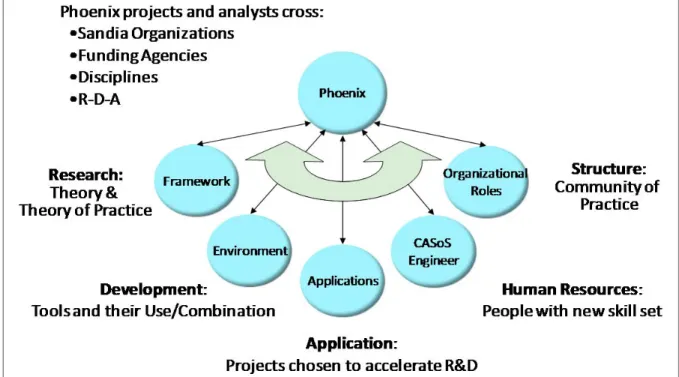
applications. Each person adds to and evolves the Initiative’s three functional components (Framework, Environment and Application): as each learns, they contribute back to the whole. Components created for an explicit educational process are in development: these include a short course, an orientation seminar series, and external website-based access to foundational documentation and bibliographies. Figure 1 diagrams components contributing
to the Phoenix’s structure.
Figure 1. Phoenix contributing components
Organizational roles have emerged within Phoenix that mirror its functional structure (Section 6). The current set of roles has formed to integrate and coordinate applications to
enable evolution of the tools and science of CASoS Engineering. For the CASoS Engineering Initiative to be successful, these roles must form a core, fundamental, and pervasive
component of a growing number of projects (both within and outside of Sandia) and generate a community of practice for CASoS Engineering. As the depth, breadth, and number of projects and people increases, the designated roles within Phoenix will necessarily change. As we evaluate the past and design our near future (Section 7), we recognize that our
achievements have come through great effort and perseverance. Although Phoenix was initiated in the context of ongoing projects and management structures holding expectations not always fully aligned with our aspirations, the enthusiastic involvement of team members has led to many successful developments. These achievements are reflected in the increasing external recognition of Phoenix in many forums, including invited talks given at NSF
workshops in Complex Systems, Education, in MegaCities given at national and international conferences, and at universities (see Appendices II and III for complete listings of products
and plans). The coming year of the Phoenix Pilot will build upon this foundation and 1) add new applications/projects that are well aligned with our aspirations (total funding as of this
writing ~$6M/year and growing), 2) better integrate new and existing applications/projects to feed back to the Engineering Framework and build the Engineering Environment, 3) enhance our education and training components, and 4) enlist a Board of Advisors and Funding Partners into active roles within Phoenix. Through these efforts, we will continue to grow our CASoS Engineering community of theory, practice and culture.
2. DEFINING PHOENIX AS A CASOS
As outlined in the CASoS Engineering Initiative Roadmap, the definition of the CASoS is the first step in the process of CASoS Engineering. In Appendix D of the Roadmap this definition process is described and applied to 10 different ecological, social, economic, and technical systems of critical importance to the nation and indeed the world. The last of these
defining examples is Sandia National Laboratories. Phoenix has been designed to achieve a
set of aspirations within the Sandia CASoS, which itself is part of an expanding nested sequence of CASoS including the military-industrial complex, the United States, and the global environment (both physical and political). Evaluating Phoenix as a CASoS: 1. System: Phoenix is a system, whose functional components include Applications
(projects), an Engineering Environment, and an Engineering Framework. These functional components are composed of people, many of whom are CASoS Engineers. Functional roles include: problem definer, subject matter expert, theorist, conceptual modeler, software developer, and knowledge manager/facilitator. Organizational roles include: Funder, Orchestrator, Framework architect, Environment architect, Engineering Applications architect, Conceptual Model architect, Communication Specialist,
Application/Project leader, and Advisory Board member. In their various roles, people form a growing and changing network for the flow of information, influence, and funding 2. Environment: The environment within which Phoenix interacts, grows, and evolves
includes Sandia components plus related personnel/organizations in the U.S. Government (e.g., DOE, DOD, DHS, DVA, HHS, etc.), other funding sources, internal and external competitors, collaborators, academia, and the home environments of staff. Sandia components include its line-hierarchy (e.g. departments, groups, centers, etc), mission areas (e.g. Energy, Climate, and Infrastructure Security [ECIS], International Homeland and Nuclear Security [IHNS], Defense Systems & Assessments [DS&A], Nuclear Weapons [NW], Science, Technology, and Engineering [STE], Laboratory Directed Research and Development [LDRD]), non-Phoenix projects, subject-matter-oriented and functional groups (e.g. engineers, scientists, and managers), corporate incentives and regulations, and support systems (infrastructure).
3. System of Systems: The three CASoS Engineering components (Framework,
Environment, and Application) can each be considered interdependent systems. Work opportunities within each component can emerge independently, as can work products. Coordination across these work opportunities is intrinsically a system-of-systems effort, especially across the various Applications (often thought of as independent). The organizational and functional roles of people each form systems within which information, influence, and funds flow.
4. Complex: Phoenix is composed of a growing set of people and projects with connections
to a growing number internal/external funders and groups. Many types of and motivations for interaction exist among these compositional entities: organizational, functional, project/subject, funding, social, and spatial. Project constraints, funding changes, technical innovations, and conceptual breakthroughs all form perturbations that lead to a wide variety of dynamically changing interactions and the spontaneous
emergence of sub-groups and new or reconfigured external connections to accomplish new goals. Complex behavior is a result of interactions among a number of entities. Such
behavior is more likely to emerge in medium-sized organizations: small groups tend not to exhibit complex behavior due to inadequate numbers of interactions, while large organizations frequently dampen complex behaviors through command and control. 5. Adaptive: People conduct applications/projects in the context of the processes, theory,
and philosophy of the Engineering Framework. People develop Engineering Environment capabilities and tools which will, in turn, change the definition and solution of problems within current and new Applications as well as the Framework and the Environment. Each of these components adapts to changes in the others, as well as to changes in personnel, funding, and the problem portfolio. Additionally, as Sandia adapts to changes in its environment, Phoenix must adapt as well: Sandia mission area changes and re-assortments influence departments, groups, centers and directorates.
The definition of Phoenix as a CASoS will naturally evolve in the years ahead as we continue to grow and consider Phoenix more explicitly in context of the wider national and
3. ASPIRATIONS
The overarching goals of the Phoenix Initiative are to maximize security, maximize health, and minimize risk in the world. In the design of the Initiative, we also established aspirations as the basis from which we can engineer our CASoS (Phoenix) and solve problems within it as they arise. Our aspirations to create and grow the discipline of CASoS Engineering include: Develop the science of CASoS Engineering: the theories, methods, and approaches
that enable the design of solutions for ecological, social, economic and technical problems, that are robust and resilient, and that can be applied such that their
actualization within the CASoS is reflexive. By reflexive we mean that as the CASoS itself adapts to the solution, conditions are created that may require the solution to adapt. The solutions themselves may create a new or different complex adaptive system of systems.
Develop an environment for CASoS Engineering: the Environment enables the application of CASoS Engineering to current and new applications and facilitates knowledge capture and transfer.
Integrate and assemble a set of individual CASoS Engineering Applications into a whole: the organization of diverse applications (scale, subject domain) emphasizes similarity such that solutions for one contribute to the foundation for all and foster the creation and growth of CASoS Engineering as a discipline.
Develop people to be CASoS Engineers: cultivate first generation CASoS Engineers to evolve the education and training needed for further generations, establishing an expanding community of practice that grows the new discipline.
Create Organizational Roles for Phoenix members: roles must fit both the individual and the whole, be empowering, be flexible, and foster the growth of CASoS
Engineering.
Apply CASoS Engineering principles to Phoenix itself.
Maturing through the definition, design and testing of solutions for other CASoS, Phoenix has grown and adapted in its first years in ways that have built in robustness and resilience to some of the perturbations placed upon it by the internal and external environments, e.g. Sandia (organizational shifts, funding).
In time, a definition, characterization, and measurement of the state of Phoenix must be made so that its robustness and resilience within its current and future environment may be
quantitatively evaluated. This evaluation must include a characterization of Phoenix’s internal structure, function, and health, a characterization of its interactions within Sandia and beyond, and an integration of measures into a combined index of systemic health.
4. FUNCTIONAL STRUCTURE
Technical objectives focused on overarching problems common to many applications are the primary drivers of the functional structure of Phoenix: research and development are
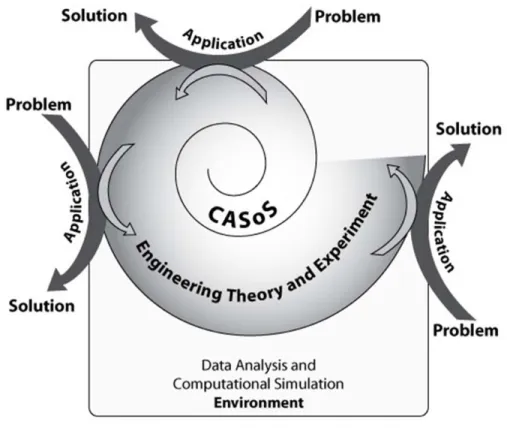
fundamentally entwined with applications. Graphically, this structure was depicted in the Roadmap as an outwardly growing spiral energized as each application brings knowledge and understanding to extend the core of Engineering Theory and Experiment within an expanding Environment of Data Analysis and Computational Simulation (Figure 2).
Expanding on Figure 1, this diagram illustrates the nautilus-like growth of the enterprise through the dynamic interactions among the theoretical Framework, the Environment, and the Applications.
Figure 2. Diagram of CASoS Engineering Theory and Experiment Evolving through Application to Real-World Problems
Phoenix has instantiated this vision using both established and new applications. The CASoS Engineering Framework guides the development of the Engineering Environment within which the theory and practice of CASoS Engineering are implemented through application development, simulation, and active knowledge transfer for education and training of both new and existing project teams and incoming CASoS Engineers.
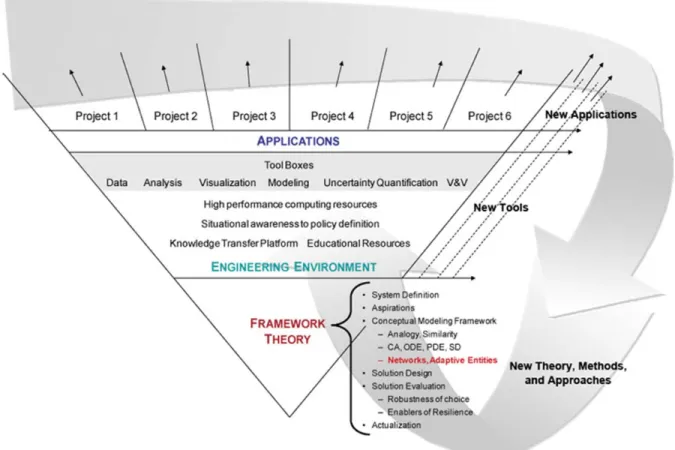
Through the process of application, the functional structure of Phoenix has emerged in greater detail.As illustrated in Figure 3, knowledge and insight gained from applications in
both established and frontier projects contribute to the advancement of CASoS Engineering theory and principles, which in turn leads to the development of new tools and methods of application. These new capabilities and understandings are brought to bear on new projects as well as infused back into existing projects allowing them to continue to develop and transform over time. As applications advance core capabilities, more diverse applications can be supported.
Figure 3. Diagram of Phoenix’s Structural Integration of Theoretical Framework, Engineering Environment, and the Driving Reality of Real-World Applications
Both new and established projects are critical for this evolutionary model of the “whole” to grow and thrive: relationships and interactions within new problem spaces inform and amplify understanding within the entire “multi-cellular organism” or “ecosystem” that is Phoenix. Adoption and application of CASoS Engineering capabilities in established projects extend project lifetimes to add greater stability to the whole. The link between new and established projects must be strong; this relationship enables the intrinsic integration of the individual applications into a whole.
The functional structure shown in Figure 3 combines the advantages of both closed-loop and
open-loop systems: while the closed-loop component of the structure exhibits goal-seeking behavior and stability, the open-loop element exhibits instability, divergence, and unbounded potential growth. The unbounded growth we are inviting through new applications is in knowledge and how we think about and understand problems. If we don’t invite divergence in the form of new principles, new methods and new organization, our thinking and our approach to problems stagnate.
4.1. CASoS
Engineering Applications
The applications that drive Phoenix are challenging because they require models that enhance our understanding of a particular situation or issue in CASoS; they depend on an integrated modeling and analysis environment to understand and communicate key conditions,
parameters and adaptive behaviors relative to the application goals; and they must allow for development and testing of theories about the vulnerabilities, strengths, and risks of
particular CASoS. We seek applications that foster the growth of the discipline of CASoS Engineering, particularly in the foundational stages of Phoenix.
Phoenix’s intention is to blend research and capability development efforts to grow the Framework and Environment, respectively, in combination with high consequence
Applications for funders who have real world problems that must be solved now. Research must address the entire space of applications, distill generality from what seem to be disparate independent problems, and promote understanding of the fundamental underlying similarity. This is the domain of the CASoS Engineering Framework. Capability
development requires the implementation of various theories, algorithms, conceptualization tools, and approaches identified through the Framework process. Knowledge of concepts (foundational) and details (tools) must be transferred across sub-teams working on discrete projects in a manner that enhances each group’s efforts. This dissemination is primarily the domain of the CASoS Engineering Environment.
Phoenix’s Applications are chosen to most effectively both PUSH and PULL the evolution of the Framework and Environment by transferring energy (funds, ideas, synergy between people and projects) to develop the CASoS Engineering discipline. Applications are also chosen to balance the portfolio for diversity in scale (local, regional, national, or global) and subject domain so that cross-disciplinary patterns can emerge. Ideally, applications should also cross internal organizational boundaries and external boundaries in order to form a cross-cutting kernel (both in terms of the domain and personnel) that is poised for growth. Outwardly growing research, development and application connections from this kernel will, if properly nurtured, ultimately form a CASoS Engineering community of theory, practice and culture that extends throughout the many fields where solutions to ecological,
sociological, economic, and technical problems are critically required.
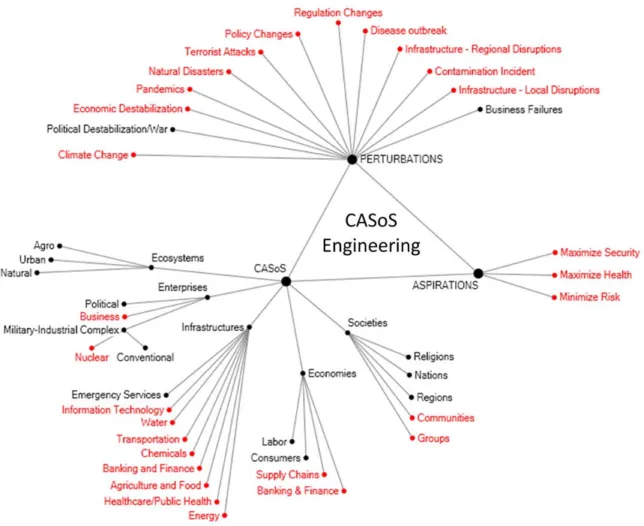
As a matter of practicality, Phoenix has been initiated with existing and newly formed projects in which we have domain expertise, have applied at least a rudimentary form of the CASoS Engineering Framework, and have existing models and funding. These projects are also connected to people who were early adopters and founders of Phoenix. Figure 4
provides a diagram of the evolved CASoS Engineering applications space as a simplified network connecting CASoS, their perturbations, and possible aspirations: existing
applications are shown in red; areas where we are currently building are shown in black. This diagram is not a complete picture of the problem space because it does not show all CASoS and perturbations, nor does it show the relationships among the individual elements. The diagram combines a classic categorization of subject areas (outer rim of elements) integrated by the CASoS Engineering approach that evaluates problems and transcends individual subject areas, bringing applications together to focus on the overarching goal of developing solutions that maximize security, maximize health, and minimize risk to the CASoS.
Figure 4. Integrated CASoS Engineering Applications Space as a Simplified Network of Aspirations, Perturbations and CASoS
Figure note: red indicates areas with artifacts, black indicates areas in development
CASoS comprise broad classes of ecosystems, enterprises, infrastructures, economies, and societies and their sub groups such as urban ecosystems, energy infrastructure, or religious society.
The same rationale, identification of subject matter needs for analysis, applies to
classification of perturbations. For example perturbations of concern for CASoS include: Regulation and Policy Changes
Climate Change
Economic Disruptions
Pandemics and Disease Outbreaks
Natural Disasters Terrorist Attacks Contamination
Infrastructure Disruptions Perturbation categories combine areas of subject domain expertise (e.g., climate, policy, terrorism) with actions that will cause the perturbation or series of perturbations (e.g., climate change, policy change, terrorist attack). This provides a description of the subject matter area and type of incident to be evaluated.
Supporting and refining Phoenix’s overarching objectives of maximizing security,
maximizing health, and minimizing risk, CASoS Engineering aspirations are categorized by the goal of the analysis (see the Framework section for more detail on how aspiration categories were developed). Example aspirations include:
Prevent or Cause Prepare Monitor Recover or Change Predict Control Design
Phoenix engineering domains combine the CASoS, perturbation(s), and aspiration(s). Examples include:
Maximize population health through policy design Minimize Food Risks using
stochastic mapping
Promote global security and resilience to perturbation Minimize energy security risks Note that this taxonomy of Phoenix applications is not static: it continues to evolve as we are presented with new opportunities to apply CASoS Engineering.
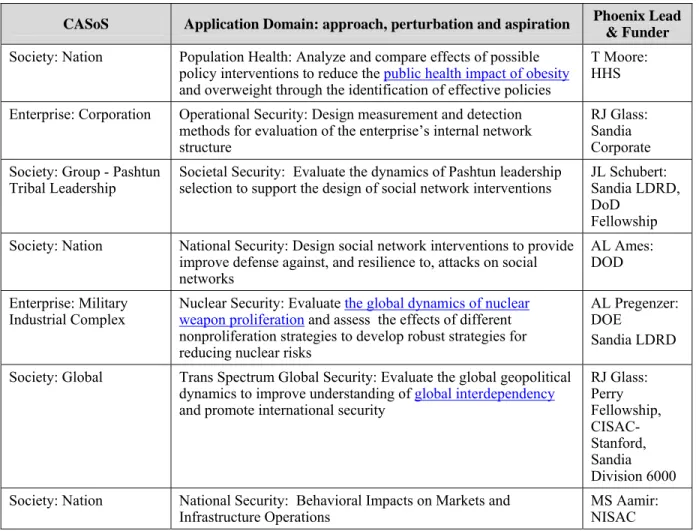
The current portfolio of CASoS applications (see Table 1, below) are at a variety of states of
maturity and cover only a portion of the problem space important to national and global security or for the development of a CASoS Engineering discipline. Our most mature application area, in community health, began with a design for containing the spread of influenza to prevent a deadly pandemic and was eventually used to set the national planning policy. The public health and healthcare sector has many problems of similar scale and potential impact: here, our applications have expanded to include evaluation and design of tobacco control policies to improve population-level health as well as the modeling and analysis of healthcare systems operations to identify risks and effective risk mitigation measures. We are developing collaborative relationships to expand our work to other behavior-driven population health problems such as obesity, alcohol abuse and the combination of all these issues (tobacco use, obesity, alcohol abuse and drug abuse). Although solutions can be devised based on an understanding of the system and how it will behave when perturbed, solutions that are robust to uncertainty, those that produce better outcomes no matter the conditions, are the ones we strive to develop in cases where
consequences of disruption are severe. For CASoS problems in which the uncertainty is large and the potential consequences are great, the multi-objective of maximizing security and minimizing risk leads us to seek solutions most likely to reduce consequences sufficient to be a threat to national security.
To accomplish this, we have identified a number of capabilities (both theoretical and environmental, the domains of Framework and Environment respectively) required to evaluate and design solutions for CASoS. These capabilities are actively driving
development in a wide range of topics. Table 2 summarizes the cross-cutting capabilities
being developed to support CASoS Engineering modeling and analysis for Phoenix applications.
The initial funding to create Phoenix came from Sandia’s ERN SMU through the LDRD project “Complex Adaptive Systems of Systems (CASoS) Engineering and Application to the Global Energy System (GES).” Recognizing that we needed more Applications to
advance the theoretical base we had developed, we first expanded the initiative to include the LDRD Multiple Network Cascading project. Our project to design community containment strategies for pandemic influenza motivated the transition from CASoS modeling and analysis to CASoS Engineering, contributing significantly to the development of the Framework and Environment components of the initiative.
Following the integration of CASoS analysis and recommendations in national policy for pandemic influenza containment (and the concomitant manifestation of our theoretical bases), we were able to engage funding partners explicitly in the context of CASoS
Engineering. Our application of CASoS Engineering principles for work with the Veterans Health Administration (VA) and the Food and Drug Administration (FDA), both multi-year projects, is building the discipline and has led to broadly-applicable Sandia capability development. Current Phoenix projects are mostly implemented under the International, Homeland and Nuclear Security (IHNS) SMU and the Energy, Climate and Infrastructure Security (ECIS) SMU: funding across the set of projects is > $6M and growing.
Integrating these projects to build a whole has been a challenge: the corporate
environment/culture does not naturally foster such integration and has been in transition through a major reorganization. Projects are considered independent, competing, and
associated with a single SMU or organizational unit and persons such as Project Leads, Task Leads and Principal Investigators (PIs). Phoenix is outside of the SMU and organizational hierarchies, thus we have relied on ties among Project Leads, Task Leads, and PIs to
accomplish the necessary integration. Phoenix has adapted and members have taken on roles to lead integration of applications with development, framework, and environment; however, more support from the corporate environment would improve the efficiency and successful establishment of the CASoS Engineering discipline.
Table 1. Summary of Phoenix Applications
CASoS Application Domain: approach, perturbation and aspiration Phoenix Lead & Funder Infrastructure:
Agriculture and Food Food Security: Analysis and design of interventions to reduce the consequences of food contamination using stochastic maps of food supply chains
SH Conrad: NISAC Infrastructure:
Agriculture and Food Agricultural Security: Analysis and design of disease intervention policy within the livestock industry using stochastic mapping RJ Glass: NMSBA-NMLB Infrastructure:
Banking & Finance
Financial Security: Evaluation of interbank payment system’s transfer topology and monetary policy on congestion and cascades in payment systems
WE Beyeler: NISAC Economies: Banking &
Finance Financial Security: Analysis of the global financial system to identify global financial risks and potential risk-mitigation measures
WE Beyeler: NISAC Society: Extremist
Groups Societal Security: Analysis of self-organized formation, activation and dissipation to identify potential threat extremist group mitigation measures
RJ Glass: DHS S&T Enterprise: Military
Industrial Complex Conventional Military Security: Field a means for predicting success of wide variety of socio/technical inventions within a military field of application.
AL Ames: DOD Infrastructures:
Chemicals and Energy Chemical Security: Evaluation of their dependencies on energy to identify the risks due to petrochemical networks and dependencies and propagating disruptions
WE Beyeler: NISAC, DHS S&T
Infrastructure: Water Water Security: Review existing uncertainty quantification and validity of a combined hydrological and macroeconomic analysis of U.S. climate risks
TJ Brown: Sandia LDRD Infrastructure: Energy Energy Security: Analyze the electric power network to identify
conditions that influence network congestion, potential for cascades and risks due to electric power disruptions.
RJ Glass: NISAC Infrastructure: Energy Energy Security: Develop the ability to evaluate global energy
system disruption impacts on national security WE Beyeler: Sandia LDRD Infrastructure: Natural
Gas Energy Security: Analyze the risk to earthquake hazards in the New Madrid Seismic Zone (NMSZ) natural gas supplies due to TF Corbet: NISAC Infrastructure: Petroleum
Fuels Energy Security: Analyze the risk to earthquake hazards in the New Madrid Seismic Zone (NMSZ) petroleum supplies due to TF Corbet: NISAC Society: Community Population Health: Develop a containment strategy to control the
spread of a pandemic strain of influenza RJ Glass: NISAC, VHA Society: National Population Health: Analyze the potential risks and benefits of
Tobacco Control Policy and develop effective strategies for reducing population health impacts due to tobacco use.
NS Brodsky: HHS/FDA Enterprise: Veterans
Health Administration (VHA)
Operational Security: Evaluate threats and design risk mitigation
strategies for the Veterans Health Administration NS Brodsky: VHA Society: Community Population Health: Develop a methodology for evaluating and
improving incident response and recovery prioritization to reduce population health risks
PD Finley: NISAC
CASoS Application Domain: approach, perturbation and aspiration Phoenix Lead & Funder Society: Nation Population Health: Analyze and compare effects of possible
policy interventions to reduce the public health impact of obesity and overweight through the identification of effective policies
T Moore: HHS Enterprise: Corporation Operational Security: Design measurement and detection
methods for evaluation of the enterprise’s internal network structure
RJ Glass: Sandia Corporate Society: Group - Pashtun
Tribal Leadership Societal Security: Evaluate the dynamics of Pashtun leadership selection to support the design of social network interventions JL Schubert: Sandia LDRD, DoD
Fellowship Society: Nation National Security: Design social network interventions to provide
improve defense against, and resilience to, attacks on social networks
AL Ames: DOD Enterprise: Military
Industrial Complex Nuclear Security: Evaluate weapon proliferation and assess the effects of different the global dynamics of nuclear nonproliferation strategies to develop robust strategies for reducing nuclear risks
AL Pregenzer: DOE
Sandia LDRD Society: Global Trans Spectrum Global Security: Evaluate the global geopolitical
dynamics to improve understanding of global interdependency and promote international security
RJ Glass: Perry Fellowship, CISAC-Stanford, Sandia Division 6000 Society: Nation National Security: Behavioral Impacts on Markets and
Infrastructure Operations MS Aamir: NISAC
Table 2: Cross-Cutting Capability Development Projects
Capability Area Capability Development Project Phoenix Lead & Funding Partner Networks Networks, dynamic networks and inter-network cascading :
design of multi-network models to evaluate vulnerabilities to perturbations
RJ Glass: Sandia LDRD, FDA/CTP, VHA Exchange Physics The conservative exchange of materials that can then be
transformed or consumed through productive processes (e.g., resources exchanged for money by entities within an economy)
WE Beyeler: Sandia LDRD, NISAC Transfer Physics The movement or spread of non-conservative constituents
(e.g., diseases, ideas) on reactive dynamic networks (e.g., epidemics on social networks, opinion on social networks)
RJ Glass:
NISAC, FDA/CTP, VHA
Behavior Representation of entity behavior by finite or infinite state
mathematics WE Beyeler: NISAC, Sandia LDRD
Behavior Evaluation of learning and behavioral models for generic
entities WE Beyeler: Sandia LDRD; VHA;
FDA/CTP Uncertainty
Quantification Develop rigorous methods to evaluate and rank modeled policy effectiveness in context of model uncertainty, provide metrics and information to characterize risks.
P Finley:
Sandia LDRD, VHA, FDA/CTP
Capability Area Capability Development Project Phoenix Lead & Funding Partner Validation and
Verification Identifying the true dynamical content of large dynamical models AL Ames: AFOSR, DOD Validation and
Verification Human, Social, and Cultural Behavior (HSCB): Design of a Generalized Validation & Verification Methodology AL Ames: AFOSR, DOD OSD HSCB Design of
Measurement and Detection
Analysis of Web-based Social Media for Detection AL Ames: Sandia LDRD The current structure and state of Phoenix applications, including goals, development supported, and associated framework advances, are provided in the SAND report entitled Complex Adaptive System of Systems (CASoS) Engineering Applications Version 1.0 (Brown
et al., currently in review).
4.2. CASoS Engineering Framework
Engineering within CASoS spans a wide functional space. CASoS are complex, often
complicated, large and irreducible. Their dynamics have a wide range of time scales so that interpretation, modification, and quantifying the impacts of modification are difficult. CASoS are adaptive, often hysteretic and/or recursive, so building understanding through
testing is challenging because repeatable initial conditions are generally not achievable and simultaneous tests are often not independent. CASoS are systems of systems, composed of
systems that cannot be replaced by a single entity, and may be enormously complicated. The ecological, sociological, economic, and/or technicalnature of many critically important CASoS require a wide range of “physics” to address technical concerns, economic concerns, political concerns, and the interfaces among them. Because CASoS almost always embed people, experimentation within them is risky and costly, often leaving modeling as the only practical option for identifying potential solutions to detrimental conditions. All these factors encourage widely different opinions on what the problems are, how big the problems are, and how to go about solving them.
As engineers, our aspiration is to influence (design, control, manipulate) CASoS to solve problems, exploit opportunities, and/or achieve goals. A focus on aspirations breaks us out of the endless cycle of learning more and more about the details of individual CASoS.
Aspirations fall into a set of clearly identified categories: Predict, Prevent or Cause, Prepare,
Monitor, Control, and Recover or Change. Within each category, three sets of similar questions naturally emerge that encompass: Decision, determining Robustness of Decision,
and Enabling Resilience. In the context of sociological, economic, technical CASoS, the
answers to these questions Inform Policy. Through such systemization, we argue that the
requisite theories, technologies, tools, and approaches for aspiration-focused CASoS Engineering are similar across many CASoS and can be organized within a CASoS Engineering Framework.
A general CASoS Engineering Framework must be wide and deep to cover the many potential opportunities for unexpected, nonlinear, interconnected behavior, and to find and make use of similarities across many disciplines. We envision the framework to be
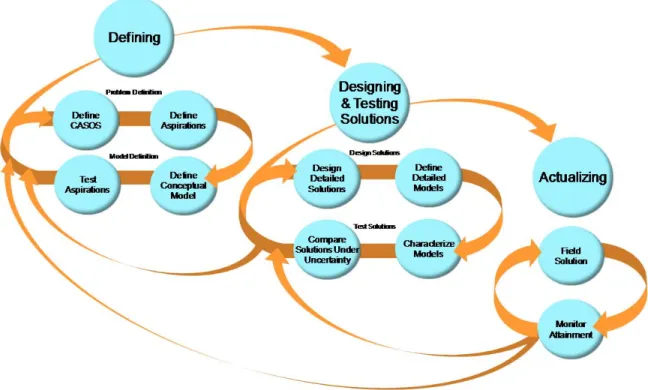
comprised of three phases applied primarily in succession but with some overlap, blending, and iteration to deliver CASoS engineered solutions (as diagrammed in Figure 5, below):
Defining (blackboard to details):
1. The CASoS of interest
2. The Aspirations (Predict, Prevent or Cause, Prepare, Monitor, Control, and Recover or Change)
3. Choice of aspirations based on constraints and impact
4. Choice of appropriate methods and theories from the full space of those possible based on aspirations chosen
5. Appropriate conceptual models
6. Required data to support conceptual model development and validation Possible methods, theories and fields of contribution include analogy,
dimensional analysis and similitude, experimental design, system dynamics, non-equilibrium thermodynamics, complex adaptive systems, game theory,
percolation phenomena, agent-based modeling, networks, system optimization and control, and many others.
Designing and Testing Solutions using computational models, data
mining/integration, experiments, etc, within a common quantitative analysis
environment. The design and testing of solutions are problem dependent, focused on answering the three general sets of questions relevant to any aspiration: 1) What are
feasiblechoices within the multi-objective space, 2) how robust are these choices to
uncertainties in assumptions, and 3) what are the critical enablers that increase system
resilience. Included in this process is the delineation of unintended consequences and
their amelioration/mitigation.
Actualizing the engineered solutions devised through application within the real
system. The engineered solution may be a concept, a computational tool, a sensor, a control policy, etc. This activity involves working with decision makers (change the world), other researchers (change the field), and people affected by the change (understand the impact). This involvement requires a long term commitment: these are high-consequence systems that adapt to change. Any change makes us part of the system with concurrent obligation through a solution’s lifecycle.
Figure 5. Diagram of CASoS Engineering Process and Components
As in classical engineering, iteration and blending among the phases is intrinsic.
Actualization will require designing and testing to suggest future steps, and adaptations of the system might require us to return to fundamental thinking to understand the adaptations and possibly redefine the CASoS and our aspirations as the system changes.
Critical supporting efforts currently underway are Conceptual Modeling and Uncertainty Quantification.
Conceptual modeling works inward from boundary conditions identified by problem definition and aspirations to develop a formal description of a system that allows us to derive the effects of actions on aspirations. The actions and observable properties related to the aspirations define essential “nodes” of the model. The model is
developed by exploring and detailing the causal connections (“edges”) among and between these nodes.
Rigorous uncertainty analysis of model results provides a defensible basis for
integrating CASoS modeling into policy design processes. We demonstrate the utility and limitations of experimental designs and statistical methods for extracting
actionable information from model output. Parameter sweeps are useful for initial interpretation and to clarify basic model responses. Multivariate sensitivity analysis using space-filling experimental designs generate more-useful information on parameter interactions. Casting policy options as continuous rather than categorical variables permit the use of surrogate-based analysis to yield straightforward rankings of policy options that are robust to the identified aleatory and epistemic model uncertainties. These methods provide the additional advantage of requiring relatively few model runs to achieve a consistent and defensible ranking.
The current structure and state of the CASoS Engineering Framework are provided in the SAND report entitled Complex Adaptive Systems of Systems (CASoS) Engineering
Framework Version 1.0 (Ames et al., currently in review).
4.3. CASoS Engineering Environment
The CASoS Engineering Environment supports all aspects of the CASoS engineering effort by providing integrated platforms for CASoS engineers to engage in conceptual design, modeling, simulation, analysis, education, training, communication, and collaboration. Computational and human resources are brought together through Framework principles and techniques, enabled by the Environment, to design, test, and implement solutions to CASoS problems.
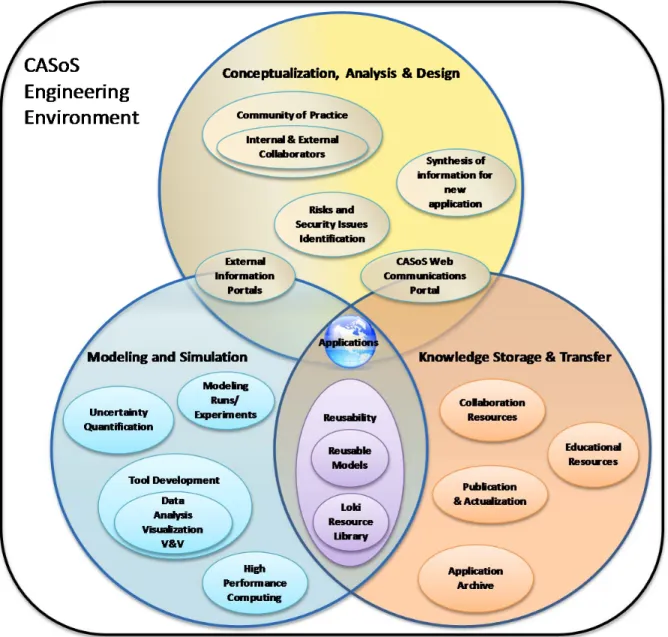
The CASoS Engineering Environment (diagrammed in Figure 6) illustrates the overlapping platforms for Conceptualization, Analysis, and Design; Modeling and Simulation; and Knowledge Storage and Transfer.
Conceptualization, Analysis, and Design (upper circle) focuses on CASoS Engineers and analytical processes. A community of practice is developed in which CASoS can be defined, researched, and analyzed. The process of CASoS Engineering, as described by the
Framework, is implemented here. The Modeling and Simulation Environment (lower left circle) forms the cornerstone of computational capability required to implement the analysis process. Knowledge Storage and Transfer (lower right) organizes the information gained from analyses, captures the wisdom gained from Applications, and formulates it in ways that can be relevant to other problems. All elements of the Environment are connected through Applications which provide the opportunity to implement solutions and drive capability development.
This CASoS Engineering Environment supports the community of practice, communications, modeling resources, uncertainty quantification, and data analysis and visualization tools. Other modeling, simulation, visualization, and analysis capabilities, both internal and
external to Sandia, continue to be explored for potential integration. The CASoS Engineering external, open website currently provides access to the growing body of theory and
application from across Phoenix projects and the community. It is continuously evolving as an outreach mechanism, enabling us to more broadly engage with others working in complex adaptive systems-of-systems and related fields. Other components in active development include support for literature search, archive, retrieval, and exchange, both internally and with external partners; and the creation of a technology-enhanced collaboration space that facilitates group brainstorming and design activities and seamlessly captures the results. The Environment instantiates the core principles and processes defined by the Framework, supports the creation of Applications, and captures the knowledge and experiences gained for potential reuse.
Figure 6. CASoS Engineering Environment Integrated Platforms
The current structure and state of the CASoS Engineering Environment are provided in the SAND report entitled Complex Adaptive Systems-of-Systems (CASoS) Engineering
Environment Version 1.0 (Linebarger et al., currently in review). There are many challenges
in developing and integrating a common engineering environment. Some examples of the challenges include: competition for the attention of the CASoS engineers due to project demands, limited funding for the environment design and implementation, corporately mandated hardware and software requirements and changes to those requirements which necessitate rebuilding existing capabilities, As with the other Phoenix documents, this is a living document used to guide our development and articulate progress.
5. DEFINITION AND DEVELOPMENT OF CASOS
ENGINEERS
CASoS engineers are practitioners of CASoS Engineering. CASoS engineers do not widely exist at Sandia, nor are they being trained within academia or industry. Those that do exist have taught themselves and each other through the initial implementations of CASoS Framework theory, methods, and philosophy.
CASoS Engineers need skills that span CASoS Engineering components: Framework, Environment, Applications. Generally, people come to the Initiative with the following backgrounds:
complexity science
basic and standard scientific and engineering fields
computer science and engineering, software engineering and programming project management
domain expertise
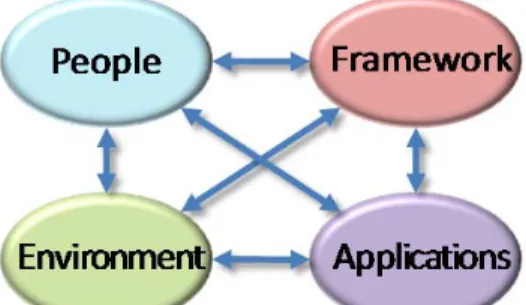
Engineers from each of these backgrounds could operate independently and their output be orchestrated into a whole. However, it is preferable to educate and train individuals to understand and practice the science and application of CASoS Engineering. Specialists are needed but the whole of problem solution comes together much better if all the participants understand how and why to interact. Figure 7 illustrates the interconnections necessary for
effective evolution of CASoS Engineering; it is “complete” (i.e. fully connected).
The CASoS Engineering Framework will evolve through new applications, implementations, and the new perspectives brought by those who join Phoenix. Our understanding of the process of CASoS Engineering and the hallmarks of good engineered solutions is growing; the Framework will of necessity evolve as we learn how to engineer in this new domain. The Engineering Environment evolves through the application of the Framework; the reuse of existing capabilities and the development of new capabilities to support CASoS
applications; and through new people with fresh perspectives and innovative ideas. The CASoS Engineering Environment documents itself through the education and training platform.
New Applications bring new challenges for framework and environment and new people who are domain experts (collaborators), program managers, project leads.
People learn by doing and implementing and interacting with others. Their ideas also change and adapt the Framework, Environment in the process of Application. Those entrained into Phoenix become part of the ongoing process of research, development and application for the evolving science of CASoS Engineering.
Figure 7. The Interrelations of People Produce the Integrated Evolution of all CASoS Engineering Components
We have found through our initial applications that an explicit training process must be designed and implemented for new CASoS Engineers. Just throwing people into the process of implementing CASoS analysis is not efficient. In the first year, a set of weekly meetings were instituted to provide this training. However, without accountability on the part of the learners to invest time doing homework this set of meetings was not as effective as we would have liked.
Current educational / training elements:
Short Course: Developed in response to the request of Italian banking system
representatives impressed by our published work in Payment Systems, our Short Course in Complex Adaptive Systems of Systems (CASoS) Modeling and Engineering was first given at Università di Roma in October 2010. A 4-day course of study, it includes advance readings and bibliography, introduction of CASoS Engineering principles and process, in-depth lectures on two example applications, a demonstration problem to implement the process, and a follow-on independent project that extends or applies the concepts presented in the lectures. The course’s generic structure allows it to serve as the basis for CASoS courses in any subject domain.
Orientation Course Summer 2011: Now in review, a series of seminars prepared (and
presented) for students will soon be available on the website for incoming CASoS engineers and others new to our projects.
Phoenix Wiki: Currently used to capture information about the overall CASoS effort as
well as detailed information about CASoS applications, the Wiki also supports the development of the modeling, simulation, and analysis platform to create CASoS applications. Application-specific Wiki pages can vary considerably in content, but there is common structure to help practitioners find similar information from within different application groups.
Students: The program draws students from universities around the country: graduate
and undergraduate, summer and year-round, short-term and multi-year. These student interns are mentored by experienced Phoenix staff. The complete listing through the summer of FY11 is provided in Appendix I.
Staff: Staff members are encouraged to use their 32 hours of Sandia education time for
independent reading or for classes at the Santa Fe Institute or the New England
modeling and analysis results at conferences such as the 8th International Conference on Complex Systems, the 29th International Conference of the System Dynamics Society, and Centers for Disease Control and Prevention meetings over this past year (FY11).
External Website: The site summarizes the development and current state of Phoenix
and the CASoS Engineering discipline and Applications. It provides access to our
complexity primer (with links to our initial course of study, foundational books, and
visual maps of Complex Systems domains and history), short course and workshop
presentations, a listing of conferences that address our fields of study, and links to other
websites where work is being done across the field. The site is also an open access repository for all unlimited release CASoS articles, documents, reports, and
presentations as well as providing biographical and contact information for Phoenix staff.
A Version 1 report of our CASoS engineer education and training component that expands upon this synopsis in detail is scheduled to be written in the coming year.
6. ORGANIZATIONAL ROLES
Growing a capability in CASoS Engineering requires an organizational structure that integrates “bottom up” initiative and creative forces with “top down” direction, cultivation, and support. In this combination, the top down force provides a path for facilitated growth but does not dictate the internal structure or the details of the growth process, allowing individuals to take responsibility and engage CASoS Engineering in ways most productive for themselves as well as for the whole.
In general, the role of Sandia staff is to design, modify (as needed) and implement Phoenix as a CASoS. The role of Level 2 and higher Sandia management is to guide, support and
facilitate Phoenix as a unique experimental organizing structure within our lab-wide research, development and analysis environment. Sandia Level 1 management’s role is to incentivize, facilitate and support staff to institute Phoenix as a living CASoS.
Our goal is to learn from the Phoenix Pilot so that we can apply CASoS Engineering through large single-funding partner programs such as NISAC, through large multi-customer groups such as Interdependency and Consequence Effects (ICE), and through Sandia and beyond as a multi-institutional network of collaborations that builds the community of practice and eventually the field of CASoS Engineering.
The set of roles initially articulated in the CASoS Engineering Roadmap has since evolved to incorporate both the current membership and needed areas of growth for the future. Roles may change, new roles will be defined in time, and people will come and go. There may be advantages to making positions revolve (or be subsumed by emerging requirements). Natural inclination and individual enthusiasm must drive those who are in leadership positions.
First and foremost, ALL ARE CASoS ENGINEERS. CASoS engineers are responsible
for developing and implementing (development through implementation) the theory
and practice of CASoS Engineering. CASoS engineers also act as ambassadors for CASoS Engineering and work to draw others into the fold.
Phoenix Conductor. The Conductor (currently Bob Glass) has overall responsibility
for the orchestration of Phoenix and is a primary contact for Phoenix and the
application of CASoS principles. The conductor defines overall long-range goals and a vision that incorporates the essentials of CASoS Engineering and also satisfies individual project programmatic and technical objectives.
Phoenix Engineering Framework Architect. The Engineering Framework Architect
(currently Arlo Ames) has responsibility to lead the development of the CASoS Engineering Framework. The Framework Architect maps the relationship between engineering and the unique requirements of CASoS, devises engineering processes, ensures that processes support the needs of practitioners, tests the framework through application to real problems, works with practitioners to teach them, and integrates new understanding into the framework (including what works and what doesn’t). Phoenix Engineering Applications Architect. The Applications Architect (currently
Theresa Brown) works across individual applications to unify capability
development, methodology testing and solutions engineering. Responsibilities include identifying application gaps and developing initiatives to fill those gaps to achieve the