8004H&8008H&8004NEXT
HVR
User’s installation and operation
Manual V1.01.2
Welcome
Thank you for purchasing our DVR!
This manual is designed to be a reference tool for the installation and operation of your system. Here you can find information about this series DVR features and functions, as well as a detailed menu tree.
Before installation and operation please read the following safeguards and warnings carefully!
Important Safeguards and Warnings
Do not place heavy objects on the DVR.Please brush printed circuit boards, connectors, fans, machine box and so on regularly. Before the dust cleaning please switch off the power supply and unplug it.
Do not disassemble or repair the DVR by yourself. Do not replace the components by yourself.
Environment
Please place and use the DVR between 0℃ and 40℃.Avoid direct sunlight. Stay away from heat source.
Do not install the DVR in damp environment.
Do not use the DVR in smoky or dusty environment. Avoid collision or strong fall.
Please insure the DVR level installation in a stable workplace. Please install in ventilated place. Keep the vent clean.
Use within the rating input and output scope.
Directory
1 Production Introduction ... 4
1.1 Product overview ... 4
1.2 Main functions ... 4
2 Open-package check and cable connections ... 6
2.1 Open-package check ... 6
2.2 Hard disk installation ... 6
2.3 Front panel ... 7
2.4 Rear panel ... 8
2.5 Audio and video input and output connections ... 8
2.5.1 Video input connections ... 8
2.5.2 Video output connections and options ... 9
2.5.3 Audio signal input ... 9
2.5.4 Audio signal output ... 9
2.6 Alarm input and output connections ... 10
2.6.3 Alarm output port relay parameters ... 12
2.7 Speed dome connections ... 13
3 Basic operation ... 14
3.1 Turn on ... 14
3.2 Turn off ... 14
3.3 System Login ... 15
3.4 Preview ... 15
3.5 Desktop shortcut menu ... 16
3.5.1 Main menu ... 16 3.5.2 Playback ... 17 3.5.3 Record Mode ... 19 3.5.4 Alarm output ... 19 3.5.5 PTZ control ... 20 3.5.6 Color setting ... 25 3.5.7 Output adjust ... 25 3.5.8 Logout ... 26 3.5.9 Window switch... 26 4 Main menu ... 27
4.1 Main menu navigation ... 27
4.2 Record ... 29 4.2.1 Record Config ... 29 4.2.2 Snapshot Storage...30 4.2.3 Playback ... 31 4.2.4 Backup ... 31 4.3 Alarm ... 33 4.3.1 Motion Detect ... 33 4.3.2 Video Blind ... 37 4.3.3 Video Loss ... 38 4.3.4 Alarm input ... 39 4.3.5 Alarm output ... 40
4.3.6 Abnormal ... Errore. Il segnalibro non è definito. 4.4 System ... 37 4.4.1 General ... 38 4.4.2 Encode ... 39 4.4.3 Network ... 40 4.4.4 NetSevice ... 41 4.4.5 GUI Display ... 49 4.4.6 PTZ/RS485 ... 50 4.4.7 RS232 ... 51 4.4.8 Tour ... 51 4.4.9 Digital Management……….51 4.5 Advanced ... 52 4.5.1 HDD Manage ... 52 4.5.2 Account ... 53 4.5.3 Online user ... 56 4.5.4 Output adjust ... 56
4.5.5 Auto maintain ... 57 4.5.6 Restore ... 65 4.5.7 Upgrade ... 58 4.5.8 Device Info...58 4.6 Info ... 66 4.6.1 HDD info ... 66 4.6.2 BPS ... 67 4.6.3 Log ... 68 4.6.4 Version ... 68
4.7 Shut down system ... 69
5 FAQ and maintenance ... 70
5.1 FAQ ... 70
5.2 Maintenance ... 76
Appendix 1.Remote controller operation ... 78
Appendix 2.Mouse operation ... 79
Appendix 3.Hard disk capability calculation ... 80 Appendix 4.Technique parameters ...
1 Production Introduction
1.1 Product overview
The series DVR is designed specially for security and defence field which is an outstanding digital surveillance product. It introduces embedded LINUX operating system which is more stable. It introduces standard H.264mp video compressed format and G.711A audio compressed format which insures the high quality image, low error coding ratio and single frame playing. It introduces TCP/IP network technology which achieves the strong network communication ability and telecommunication ability.
The series DVR can be used individually or online applied as a part of a safety surveillance network. With the professional network video surveillance software it achieves the strong network communication ability and telecommunication ability.
The series DVR can be applied in the bank, telecom, electric power system, judicial system, transportation, intelligent housing, factory, storehouse, water conservancy and so on.
1.2 Main functions
Real-time surveillance
analog interface and VGA interface (VGA interface is equipped selectively) surveillance function through monitor or display
Storage
non-working hard disk dormancy processing which is convenient to radiate heat, reduce power and extend the life-span
special storage format which insures the data safety
Compression
real-time compression by individual hard disk which insures the audio and video signal stable synchronization
Backup
through SATA interface and USB interface such as USB equipment, removable hard disk and so on through net download the files in the hard disk
individual real-time video recording as well as searching, playback, network surveillance, recording check, downloading and so on
multi-playback mode zoom at arbitrary region
Net operating
through net tele-surveillance in the real time tele-PTZ control
tele-recording check and real-time playback
Alarm linkage
multi-route relay alarm output which is convenient for the alarm linkage and light control at the spot protecting circuits at the alarm input and output interface which protects the main machine from damage
Communication interface
RS485 interface which fulfills the alarm input and PTZ control
standard ethernet network interface which fulfills the telecommuting function
Intelligent operating
mouse action function
2 Open-package check and cable connections
2.1 Open-package check
When you receive the DVR, please check first .
First, please check whether there is any visible damage to the package appearance. The protective materials used for the package of the DVR can protect most accidental clashes during transportation.
Then, please open the box and get rid off the plastic protective materials. Check whether there is any visible damage to the DVR appearance.
At last, please open the machine crust and check the data wire in the front panel, power wire, the connection between the fan power and the main board.
Front panel and rear panel
The key function specification in the front panel and the interface specification in the real panel are in the specification.
Please check the product type in the front panel whether is accordant with the product type you order.
The label in the real panel is very important for the after service. Please protect it carefully. When you contact us for after service, please provide the product type and serial number in the label.
2.2 Hard disk installation
For the first use,please install the hard disk.
④fix the screw of hard disk ⑤connect the data wire ⑥connect the power wire
⑦cover the machine ⑧fix the cover
2.3 Front panel
2.4 Rear panel
8004H&8004NEXT
8008H
(6)VGA (7)port for outer device (8)DC power port (9)Switch (10)HDMI port (11) Audio input (13)Audio output
2.5 Audio and video input and output connections
2.5.1 Video input connections
The video input port is BNC connector plug. The demand of input signal is PAL/NTSC BNC(1.0VP-P,75Ω).
The video signal must be accorded with the state standard which has the high signal to noise ratio, low aberration and low interference. The image must be clear and has natural color in the appropriate brightness.
Insure the vidicon signal stable and credible
The vidicon should be installed in the appropriate location where is away from backlighting and low illumination or adopts the better backlighting and low illumination compensation.
The ground and power supply of the vidicon and the DVR should be shared and stable.
Insure the transmission line stable and credible
The video transmission line should adopt high quality coaxial pair which is chosen by the transmission distance. If the transmission distance is too far, it should adopt shielded twisted pair, video compensation equipment and transmit by fiber to insure the signal quality.
The video signal line should be away from the electro magnetic Interference and other equipments signal lines. The high voltage current should be avoided especially.
Insure the connection stable and credible
The signal and shield lines should be firm and connected credible which avoid false and joint welding and oxidation.
2.5.2 Video output connections and options
The video output is divided into PAL/NTSC BNC(1.0VP-P,75Ω) and VGA output(selective
configuration).
When replace the monitor by the computer display, there are some issues to notice. 1、Do not stay in the turn-on state for a long time.
3、Stay away from the electro magnetic Interference.
TV is not a credible replacement as a video output. It demands reducing the use time and control the power supply and the interference introduced by the nearby equipments strictly. The creepage of low quality TV can lead to the damage of other equipments.
2.5.3 Audio signal input
Audio port is BNC connection.
The input impedance is high so the tone arm must be active.
The audio signal line should be firm and away from the electro magnetic Interference and connected credible which avoid false and joint welding and oxidation. The high voltage current should be avoided especially.
2.5.4 Audio signal output
Commonly the output parameter of DVR audio signal is greater than 200mv 1KΩ(BNC) which can connect the low impedance earphone and active sound box or other audio output equipments through power amplifier. If the sound box and the tone arm can not be isolated, howling phenomena is often existed. There are some methods to deal with the above phenomena.
1、 Adopt better directional tone arm.
2、 Adjust the sound box volume to be under the threshold that produces the howling phenomena. 3、 Use fitment materials that absorb the sound to reduce reflection of the sound.
4、 Adjust the layout of the sound box and the tone arm.
2.6 Alarm input and output connections
1、Alarm input
A. Alarm input is grounding alarm input.
B. Alarm input demand is the grounding voltage signal.
C. When the alarm is connected with two DVRs or connected with DVR and other equipments, it should be isolated by relay.
2、Alarm output
loop it must prevent the big current from relay damage. Use the contact isolator when there is a high-power load
3、PTZ decoder connections
A. The grounding of the PTZ decoder and DVR must be shared otherwise the common-mode voltage will lead to the PTZ control failure. The shielded twisted pair is recommended.
B. Avoid the entrance of high voltage. Make the layout reasonably. Take precaution from the thunder.
C. In the outlying end connect 120Ω resistance paralleled to reduce the inflection and insure the signal quality.
D. The 485 AB lines of DVR can not connected with other 485 output equipments paralleled. E. The voltage between the AB lines of the decoder must be less than 5V.
4、Front equipment grounding note
Bad grounding can lead to the burnout of the chip.
5、Alarm input type unlimited
The DVR alarm output port is constant opening type.
(1) alarm input 1,2,3,4 (2) grounding (3) RS232 (4) RS485 (5) alarm input 5,6,7,8 (6) grounding (7) alarm output
parameter meaning
(2) & (6) grounding
(7) Alarm output interface(constant open type) (3) RS232 port
(4) 485communication interface which is connected with the recording control equipments such as the decoder
2.6.1 Alarm input port specification
8 channels alarm input. Alarm input type unlimited.
The grounding and the com port of the alarm sensor are parallel (The alarm sensor is external power supply) .
The grounding of the alarm and the DVR should be shared.
The NC port of the alarm sensor must be connected with the DVR alarm input port.
The grounding of the power supply and the alarm sensor must be shared when used in external power supply.
2.6.2 Alarm output port specification
2 channels alarm output. There is external power supply when using the external alarm equipment. Please refer to the relay relevant parameters to avoid the overload that damages main machine.
2.6.3 Alarm output port relay parameters
Type:JRC-27F
Interface material silver rating
(resistance load)
Rating switch capacity 30VDC 2A, 125VAC 1A
maximal switch power 125VA 160W maximal switch voltage 250VAC, 220VDC maximal switch current 1A
isolation Homo-polarity interface 1000VAC 1minute Inhomo-polarity interface 1000VAC 1 minute Interface and winding 1000VAC 1 minute Surge voltage Homo-polarity
interface
1500VAC (10×160us) Turn-on time 3ms max
Turn-off time 3ms max
longevity mechanical 50×106 MIN(3Hz) electric 200×103 MIN (0.5Hz) Environment
temperature
2.7 Speed dome connections
1、Connect the 485 lines of the speed dome with the DVR 485 interface.
2、Connect the video line with the DVR video input. 3、Electrify the speed dome.
3 Basic operation
Note: The button in gray display indicates nonsupport.
3.1 Turn on
Plug the power supply and turn on the power supply switch. Power supply indicator light shining indicates turning on the video recorder. After the startup you will hear a beep. The default setting of video output is multiple-window output mode. If the startup time is within the video setting time, the timing video recording function will start up automatically. Then the video indicator light of corresponding channel is shining and the DVR is working normally.
Note:1. Make sure that the input voltage corresponds with the switch of the DVR power supply. 2. Power supply demands: 220V±10% /50Hz.
Suggest using the UPS to protect the power supply under allowable conditions.
3.2 Turn off
There are two methods to turn off the DVR. Entering [main menu] and choosing [turn off] in the [turn off the system] option is called soft switch. Pressing the power supply switch is called hard switch. Illumination:
1、Auto resume after power failure
If the DVR is shut down abnormally, it can automatically backup video and resume previous working status after power failure.
2、Replace the hard disk
Before replacing the hard disk, the power supply switch in the real panel must be turned off. 3、Replace the battery
Before replacing the battery, the setting information must be saved and the power supply switch in the real panel must be turned off. The DVR uses button battery. The system time must be checked regularly. If the time is not correct you must replace the battery, we recommend replacing the battery every year and using the same battery type.
will lose.
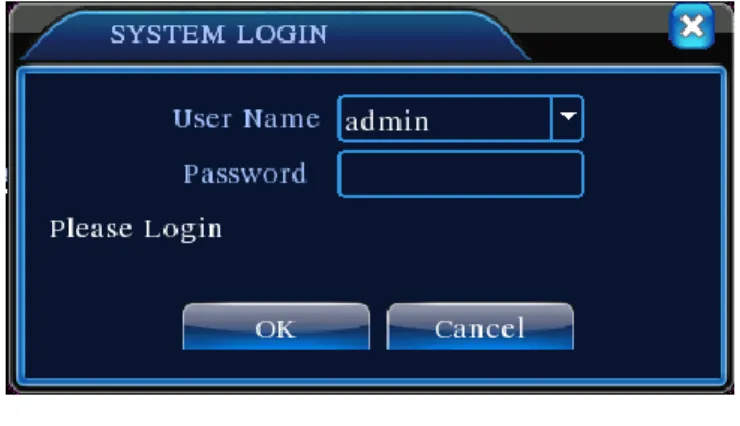
3.3 System Login
When the DVR boots up, the user must login and the system provides the corresponding functions with the user purview. There are three user settings. The names are admin, guest and default and these names have no password. Admin is the super user purview; guest and default’s permissions are
preview and video playback. User admin and guest’s password can be revised, while their permissions
can’t be revised; user default is the default login user whose permission can be revised but not its password.
Picture 3.1 System Login
Password protection: If the password is continuous wrong three times, the alarm will start. If the password is continuous wrong five times, the account will be locked. (Through reboot or after half an hour, the account will be unlocked automatically).
For your system security, please modify your password after first login.
3.4 Preview
You can right click mouse to choose the switch between the windows.
The system date, time and channel name are shown in each viewing window. The surveillance video and the alarm status are shown in each window.
1 Recording status 3 Video loss
2 Motion detect 4 Camera lock Table 3.1 Preview icon
3.5 Desktop shortcut menu
In preview mode you can right click mouse to get a desktop shortcut menu. The menu includes:
main menu, record mode, playback, PTZ control, High Speed PTZ, Alarm Output, color Setting, Output adjust, Logout, view mode shift .
Shortcut under Hybrid mode Shortcut menu under full digital mode Picture 3.2 Shortcut Menu
3.5.1 Main menu
When you login, the system main menu is shown as below.
3.5.2 Playback
There are two methods for you to play the video files in the hard disk. 1、 In the desktop shortcut menu.
2、 Main menu>Record->Playback
Note: The hard disk that saves the video files must be set as read-write or read-only state.(4.5.1)
Picture 3.4 video playback 1. Playback control 2. Operation hint 3. file searching 4. listed files 5. file information
【Listed files】Look up the listed files that accord with the searching criteria.
【File information】Look up the found file information.
【Playback control】See detail in below chart
Key Function Key Function
/
Play/Pause Backward playSlow forward Fast forward
Previous frame Next frame
Round play Full screen Stop
Picture 3.5 Playback control key
Note: play under frame by frame, the playback status should be paused firstly. 【Operation tips】show function of the key that cursor placed.
Special functions:
Accurate playback:Input time (h/m/s) in the time column and then click play
button. The
system can operate accurate playback according to the searching time.
Local zoom:When the system is in single-window full-screen playback mode, you can drag your mouse in the screen to select a section and then left click mouse to realize local zoom. You can right click mouse to exit.
Note: When current resolution of the channel is over Max resolution, to playback this channel, will show a Red “X”.
3.5.3 Record Control
Please check current channel status: “○” means it is not in recording status, “●” means it is in recording status.
You can use desktop shortcut menu or click [main menu]> [recording function]> [recording set] to enter the recording control interface.
Picture 3.8 Record Mode
【Schedule】Record according to the configuration.
【Manual】Click the all button and the according channel is recording no matter the channel in any state.
【Stop】Click the stop button and the according channel stops recording no matter the channel in any state.
3.5.4 Alarm output
Please check current channel status: “○” means it is not in alarming status, “●” means it is in alarming status.
You can use desktop shortcut menu or click [main menu]> [alarm function]> [alarm output] to enter the alarm output interface.
Picture 3.9 alarm output
【Configuration】Alarm is on according to the configuration.
【Manual】Click the all button and the according channel is alarming no matter the channel in any state.
【Stop】Click the stop button and the according channel stops alarming no matter the channel in any state.
3.5.5 PTZ control
*PTZ control is a little different between hybrid mode & full digital mode:
Digital channel – the digital channel need link PTZ, the remote device should connect with PTZ and with protocol correctly set also.
Analog channel – Only when the device is connect with PTZ and configure protocol correctly is ok.
Operation interface is as followed. The functions include: PTZ direction control, step, zoom, focus, iris, setup operation, patrol between spots, trail patrol, boundary scan, assistant switch, light switch, level rotation and so on.
Note1. Decoder A(B)line connects with DVR A(B)line. The connection is right.
2. Click [main menu] >[system configuration] >[PTZ setup] to set the PTZ parameters. 3. The PTZ functions are decided by the PTZ protocols.
Picture 3.10 PTZ setup
【Speed】Set the PTZ rotation range. Default range: 1 ~ 8.
【Zoom】Click / button to adjust the zoom multiple of the camera.
【Focus】Click / button to adjust the focus of the camera .
【Iris】Click / button to adjust the iris of the camera.
【Direction control】Control the PTZ rotation. 8 directions control is supportive.(4 directions in Front panel is supportive )
【High speed PTZ】Full-screen show channel image. Left press mouse and control PTZ to rotate orientation. Left press mouse and then rotate the mouse to adjust the zoom multiple of the camera.
【Set】Enter the function operation menu.
【Page switch】Switch between different pages.
Special functions
:
1、Preset
Set a location for the preset, calls the preset points, PTZ automatically turns to the setting position
1)Preset option
Set a location for the preset, procedure is as follows:
Step1: in Picture 3.10, click the Direction button will turn into preset position , click the Settings button to enter Picture 3.11.
Step 2: click the Preset button , then write the preset points in the input blank,
preset position corresponds.
Clear Preset:Input preset points, click Remove button, remove the preset。
Picture 3.11 Preset Settings 2)Preset Point Calls
In Picture 3.10, click Page Shift button, enter PTZ control interface as shown in Picture 3.12. In the input blank, write the preset points, then click Preset button, PTZ turn to the corresponding preset point.
Picture 3.12 PTZ Control
2、Cruise between Points
Multiple preset points connected cruise lines, call cruise between points, the PTZ run around on the line
1)Cruise Between Points Settings
Cruise lines is connected by multiple preset points, setting procedure is as follows:
Step1: In Picture 3.10, the Direction key will turn PTZ to designated location , click Settings button to enter Picture 3.13,
Preset button Preset point input blank
Step 2: click Cruise buttons, the write proper value into the Cruise Line and Preset Points blank,
then click Add Preset Points button, complete setting (also can add and delete cruise line which has been set up)
Step 3: repeat step1 and step2 , until set out all the preset designated cruise lines。
Remove Preset:Please input preset value in the blank, click Remove Preset button, then remove the preset points.
Remove Cruise Line:Input the number of cruise line, click Remove Cruise Lines button, then remove the cruise lines set。
Picture 3.13 Cruise Between Points Settings 2)The Calls of Cruise between Points
In Picture 3.10, click Page Shift button, enter PTZ control menu as shown in Picture 3.12. Please input the number of cruise in the value blank, then click Cruise between Points button, PTZ begins to work on the cruise line. Click Stop button to stop cruise.
3、Scan
PTZ also can work on the preset scan line repeatedly. 1)Scan setup
Step1:In Picture 3.10, click Setup button ,enter Picture 3.14;
Step2:Click Scan button,the input proper value in the scan value blank;
Step3:Click Start button, enter Picture3.10,here you can set the following items: Zoom、
Focus、Aperture、Direction and so on. Click Setup button to go back Picture 3.14;
Step4:Click End button to complete setup。Click the right button of the mouse to exit.
Cruise Button
Cruise Line Blank Preset Points Blank
Picture 3.14 Scan Setup 2)Scan Calls
In Picture 3.10, click Page Shift button, then enter PTZ control menu as shown in Picture 3.12. Please input the number of scan in the value blank , then click Scan button,PTZ begins to work on the scan line . Click Stop button to stop.
4、Boundary Scan
1)Boundary Scan setup
Step1:In Picture 3.10, click Direction button to turn the PTZ to preset direction, then click Setup button enter Picture 3.15, select the left boundary, return to Picture 3.10;
Step2:Please click direction arrows to adjust PTZ direction, click Setup button enter Picture3.15, then select the right boundary ,return to Picture 3.10;
Step3: Complete setup, that is the position of left and right boundary
Picture 3.15 Boundary Scan Setup
Scan value blank Scan Button
Line scan button border
2)Boundary Scan Calls
In Picture 3.10, click Page Shift button, then enter PTZ control menu as shown in Picture 3.12. Please input the number of scan in the value blank , then click Scan button,PTZ begins to work on the scan line . Click Stop button to stop.
5、Horizontal Rotating
Click Horizontally Rotating button, PTZ begins to rotate horizontally (relative to the original position of the camera). Click the Stop button to stop.
6、Rotate
Click on horizontal Rotating button, PTZ turn around.
7、Reset
PTZ restart, all the data clears to 0.。
8、Page Shift
In Picture 3.12, click Page Shift button into Picture3.16, setting auxiliary function. Auxiliary number corresponding to auxiliary switch on the decoder.
Picture 3.16 Auxiliary Function Control
【Intuitive Auxiliary Operation】 choose auxiliary equipment, select Open or Close button, switch control;
【Auxiliary Number】The operation of corresponding auxiliary switch according to PTZ agreement;
【Page Shift】In Picture 3.16,click Page Shift button enter the Picture 3.17 PTZ Main Menu , the menu itself can be control by the menu control buttons
3.5.6 Color setting
Set the selective image parameters (current channel for single window display and cursor place for multi-window display). You can use the desktop shortcut menu and enter the interface. The image parameters include: tonality, brightness, contrast, saturation. You can set different parameters at different time sections.
Picture 3.18 Color Setting
3.5.7 Output Adjust
Hybrid mode is with black margin vertical & horizontal, while full digital mode without.
Adjust TV output area parameters. You can use the desktop shortcut menu or enter [main menu]> [management tools]> [Output adjust].
Hybrid Mode Full digital Mode Picture 3.19 Output Adjust
Note: The black margin vertical & horizontal at output adjust of hybrid mode is only effect to analog channel.
3.5.8 Logout
Logout, shut down the system or reboot up. You can use the desktop shortcut menu or enter [main menu].
Picture 3.20 Logout/Shutdown/Reboot the system
【logout】Quit the menu. Offer password next entrance.
【shut down】Quit the system. Turn off the power supply.
When press the shut down button, there is schedule hint. After three seconds, the system is shut down. Cancel midway is of no effect.
【reboot】Quit the system. Reboot up the system.. 3.5.9 Window switch
Preview in single window/four windows/eight windows/nine windows/sixteen windows according to your choice.
4 Main menu
4.1 Main menu navigation
Main menu Sub menu Function
Record
Config Set the recording configuration, recording type, recording time section playback Set recording search, recording play, video file storage
Storage
Set screen capture period, type ,etc.
Note: Only hybrid mode have this function
backup Detect backup device, format device, back the selective files
Alarm
Motion detection
Set motion detect alarm channel, sensitivity, area, linkage parameters: defending time section, alarm output, screen hint, recording, screen shot (Note: only for hybrid mode), PTZ, patrol, buzz, email and FTP upload Video
blind
Set camera mask alarm channel, sensitivity, linkage parameters: defending time section, alarm output, screen hint, recording, screen shot
(Note: only for hybrid mode), PTZ, patrol, buzz, email and FTP upload Video
loss
Set video loss alarm channel, linkage parameters: defending time section, alarm output, screen hint, recording, screen shot (Note: only
for hybrid mode), PTZ, patrol, buzz, email and FTP upload Alarm
input
Set alarm input channel, equipment type, linkage parameters: defending time section, alarm output, screen hint, recording, screen shot (Note:
only for hybrid mode), PTZ, patrol, buzz, email and FTP upload Alarm output Set alarm mode: configuration, manual, shut down
Exception handling
No HDD, HDD error, HDD capacity not enough, network cut, IP Conflict, linkage parameters, screen hint or buzz.
System configuratio
General configuration
Set system time, data format, language, hard disk full time operation, machine number, video format, output mode, summertime, stay time
n
Encode configuration
Set main (assistant) coding parameter: code mode, resolving ability, frame rate, code stream control, image quality type, code stream value,
frame between value, video/audio enable,
Note: only hybrid mode with encode settings.
Network configuration
Set basic network parameters, DHCP and DNS parameters, network high speed download
NetService PPPOE、NTP、Email、IP purview、DDNS parameter
GUI display
Set channel title, preview hint icon state, transparency, cover area, time title, channel title fold.
(Note: only hybrid mode can set channel title, cover area, time title, channel title fold )
PTZ configuration
Set channel, PTZ protocol, address, baud rate, date bit, stop bit, check
(Note: Hybrid mode shows: PTZ configuration)
RS485 Device
Set protocol, address, baud rate, date bit, stop bit, check
(Note: Full digital mode shows : RS485 Device)
Serial port Configuration
(RS232)
Set serial port function, baud rate, date bit, stop bit, check
Tour Set patrol mode and interval time
Digital manage
Set channel mode, check channel status and configure the digital channel, etc. Manageme nt tools Hard disk management
Set appointed hard disk as read-write disc, read-only disc or redundant disc, clear data, resume date and so on
User management
Modify user, team or password. Add user or team. Delete user or team.
Online user
Break the connection with the already login user. Lock the account after break until booting up again.
Output adjust
Adjust upside, downside, nearside, starboard distance, black margin vertical & horizontal
(Note: Only hybrid mode with black margin vertical & horizontal)
Automatic maintenance
Set automatic reboot system and automatic deleting files.
Restore
Resume setup state: common setup, code setup, recording setup, alarm setup, network setup, network service, preview playback, serial port
setup, user management Device
information
To configure the hardware information of device.
System information
Hard disk information
Display hard disk capability and recording time Code stream
statistics
Display code stream information Log
information
Clear all log information according to the log video and time Edition
information
Display edition information
Shut down Logout, shut down or reboot
4.2 Record
Operations related to record, including: Record, Playback, Backup, Screen shot (Only for Hybrid mode)
4.2.1 Record Config
Set the recording parameters in the surveillance channel. The system is set 24 hours consecutive recording in the first startup. You can enter [main menu]> [recording function]> [recording setup] to set.
Picture 4.1 Record Config
【Channel】Choose the corresponding channel number to set the channel. Choose the all option to set the entire channels.
【Redundancy】Choose the redundancy function option to implement the file double backup function. Double backup is writing the video files in two hard disks. When you do the double backup, make sure that there are two hard disks installed. One is read-write disk and the other is redundant disk. (refer to 4.5.1)
【SD card record】Device input with SD card, enable SD card for record to start recording.
【Length】Set the time length of each video file. 60minutes is default value.
【Pre-Record】Record 1-30 seconds before the action. (time length is decided by the code stream)
【Record mode】Set video state: schedule, manual or stop.
Schedule:Record according to the set video type (common, detection and alarm)and time section.
Manual:Click the button and the according channel is recording no matter the channel in any state.
Stop:Click the stop button and the according channel stops recording no matter the channel in any state.
【Period】Set the time section of common recording, The recording will start only in the set range.
【Record type】Set recording type: regular, detection or alarm.
Regular:Perform the regular recording in the set time section. The video file type is “R”.
Detect:Trigger the “motion detect”, “camera mask” or “video loss” signal. When above
file type is “M”.
Alarm:Trigger the external alarm signal in the set time section. When above alarm is set as opening recording, the “detection recording” state is on. The video file type is “A”.
Note:Refer to chapter 4.3 to set corresponding alarm function.
4.2.2 Snapshot Storage
When device set as Hybrid mode, there will be snapshot storage function in record, while only analog channel have this snapshot storage function.
Setup snapshot parameters for different channels.At first time it's set for 24hours snapshot continuously, pls go to Main Menu->Record->Snapshot Storage for appropriate settings.
Note:If normal snapshot storage,pls setup Snap at Main Menu->Advanced->Snapshot(pls refer to chapter 4.5.1 HDD Manage)
Picture 4.2
【Channel】Select the related channel to set,click "all" to set all channels.
【Presnap】Setup presnap picture quantity before recording,default is 5 pieces.
【Record】Set record status,"Schedule","Manual" and "Stop"
Schedule:Realise snapshot according to record type(regular,detect and alarm) and period.
Manual:No matter what the present channel is in a state,once choose "manual" button,it will have snapshot at related channels.
Stop:No matter what the present channel is in a state,once choose "stop" button,it will stop snapshot at related channels.
【Period】Set normal record period,it only startup Snapshot Storage at set period.
【Type】Three types:regular,detect and alarm
【Record type】Three types:regular,detect and alarm Regular: snapshot at set period
Detect:snapshot at set period when motion detect,video blind and video loss which are preset for snapshot enable.
Alarm:snapshot at set period when alarm in which is preset for snapshot enable. Note:for related alarm function,pls refer to chapter 4.3.
4.2.3 Playback
Refer to chapter 3.5.2.
4.2.4 Backup
You can backup the video files to external storage through setup.
Note:The storage must be installed before the file backup. If the backup is terminated, the already backup can playback individually.
Picture 4.3 Backup
【Detect】Detect the storage connected with the DVR such as hard disk or universal disk.
【Backup】Click backup button and the dialog box is popped up. You can choose the backup file according to the type, channel and time.
Picture 4.4 File Backup
Remove:Clear the file information.
Add:Show the file information satisfying the set file attributes.
Start/pause:Click the play button to start the backup and click the pause button to stop the backup.
Note:During backup you can exit the page layout to carry out other functions.
[Imprinting] click imprinting, will copy the record of related channel
【Erase】Choose the file to delete and click erasure to delete the file.
【Stop】Stop the backup.
4.3 Alarm Function
Alarm functions include: motion detect,video blind, video loss, alarm input and alarm output.
4.3.1 Motion Detect
When system detects the motion signal that reaches the set sensitivity, the motion detect alarm is on and the linkage function is turned on.
*Motion detect function is different between Hybrid mode & Full digital mode:
Digital channel: not only to enable motion detect function at local side, but also to enable the remote device that was connected. when remote device detect motion movement, local side will start alarm recording, otherwise this function is not enable.
Picture 4.4 Hybrid mode(4+2) Motion Detect
Full digital mode Motion Detect
【Channel】Choose the set motion detect channel.
【Enable】■ means that the motion detect function is on.
【Sensitivity】Choose in the six options according to the sensitivity.
【Region】Click [set] to enter the set area. The area is divided into PAL22X18. Red block means the motion detect defensive area. White block means the unfenced area. You can set the area as followed, Drag the mouse and draw the area. Default: all selected blocks are detection area.
Note: Only the motion detect under hybrid mode have this function of setting region, and also only the analog channel can set region.
Picture 4.5 Region
【Period】Trigger the motion detect signal in the set time section. You can set according to week or set uniformly. Each day is divided into four time sections.■ means the set valid.
Picture 4.6 set the time section
【Interval】Only one alarm signal is turned on even there are several motion detect signals in the set interval.
【Alarm output】Start the external equipment of corresponding linkage alarm when the motion detect alarm is turned on.
【Delay】Delay a few moments and stop when the alarm state is turned off. The range is 10~300 seconds.
【Record channel】Choose the recording channel (multiple option supportive). Trigger the video signal when the alarm is turned on.
Note:Set in the [recording setup] and perform the linkage recording. Start detecting video files in the corresponding time section.
【Tour】■ means that the selective channel is single window alternate patrol preview. The interval is set in the [Main Menu]>[System] > [Tour].
【Snapshot】Choose record channels, when alarm happens, system triggers related channels for snapshot signal.
Note: For Snapshot activation, please go to set period, detect and alarm enable at Main Menu-> Record->Record configure,
*Snapshot is only at motion detect under hybrid mode, snapshot shows only analog channel. 【PTZ Activation】Set the PTZ activation when the alarm is turned on.
Note:PTZ activation is set in the [shortcut menu] >[ PTZ control]. Set the patrol between spots, trail patrol and so on.
*Hybrid mode, PTZ link to the related PTZ information of analog channel, While digital channel model, the PTZ is link to the related PTZ information on the remote device connected.
Note:to link PTZ, need go [Shortcut menu]->[PTZ control] to set preset point, cruise between points & interval time, etc.
Picture 4.8 PTZ Activation under hybrid mode
【Delay】When alarm is over,recording will last some seconds(10~300sec),then stop.
【Show message】Pop the alarm information dialog box in the local host computer screen.
【Send EMAIL】■ means sending an email to user when the alarm is turned on.
Note:Set in the [NetService] and send email.
【FTP upload】to tick it, the video & picture of related record channel & snapshot channel will be uploaded to assigned position.
Note:FTP upload need be set at [Netservice]
4.3.2 Video Blind
When the video image is influenced by the environment such as bad brightness or reaching the set sensitivy parameter, the camera mask function is turned on and the linkage function is turned on.
*Same as motion detect function, video blind is different between Hybrid mode & Full digital mode: Digital channel: not only to enable video blind function at local side, but also to enable the remote device that was connected. when remote device with video blind, local side will start alarm recording, otherwise this function is not enable.
Hybrid mode: only need to enable video blind function at local side.
Video Blind under Hybrid mode(4+2)
Video blind under full digital mode
Set method: refer to chapter 4.3.1. Motion detect
4.3.3 Video Loss
When the equipment can not obtain the channel video signal, the video loss alarm is turned on and the linkage function is turned on.
*Same as motion detect function, video loss is different between Hybrid mode & Full digital mode:
Digital channel: not only to enable video loss function at local side, but also to enable the remote device that was connected. when remote device with video loss, local side will start alarm recording, otherwise this function is not enable.
Hybrid mode: only need to enable video loss function at local side.
Video loss under Hybrid Mode (4+2)
Video loss under full digital mode Picture 4.10 Video loss Set method: refer to chapter 4.3.1. Motion detect
Note: "Advanced" button is the same as right click.
4.3.4 Alarm input
When the equipment obtains the external alarm signal, the alarm function is turned on.
*Alarm input is the same between hybrid mode & full digital mode, function enable, when it was set normal, only need to connect alarm sensor at alarm input port on local side, the alarm information is occurring, and will link to related setting functions at the same time
Alarm input under hybrid mode(4+2)
Alarm input under full digital mode Picture 4.11 Alarm input Set method: refer to chapter 4.3.1. Motion detect
4.3.5 Alarm output
Refer to chapter 3.5.4.
4.3.6 Abnormal
Analysing and inspecting current software and hardware of the device: When some abnormal events happen,the device will make a relative answer such as show message and buzzer.
Picture 4.12 Abnormal
【Event Type】 selecting abnormity you want to inspect
【Enable】 Select it to make sure abnormal function workable
【Show message】 Automatically alarm cue dialog box come out of the main screen
【Buzzer】 Device will have two long nosie “di di” while alarm is happening
4.4 System setup
Set the system parameters such as General, Encode, Network, Net service, GUI display, PTZ configure/RS485 device, RS232 and Tour setup, Digital Manage.
4.4.1 General
Picture 4.13 General setup
【System time】Set the system data and time.
【Date format】Choose the data format: YMD, MDY, DMY.
【Date Separator】Choose list separator of the data format.
【Time Format】Choose time format: 24-hour or 12-hour.
【Language】
Arabic,Czech,English,Finnish,Greek,Indonesian,Italian,,Japanese,Portuguese,Russian,Thai,T-Chinese,S-Ch inese,Turkish,Brazilian,Bulgarian,Farsi,French,German,Hebrew,Hungarian,Polish,Romanian,Spanish,Swedi sh,Vietnamese
【HDD full】Choose stop record: Stop recording when the hard disk is full.
Choose overwrite: Cover the earliest recording files and continue recording when the hard disk is full.
【DVR No.】Only when the address button in the remote controller and the corresponding DVR number is matched, the remote operation is valid.
【Video Standard】PAL or NTSC.
【Auto Logout】Set the latency time in 0-60. 0 means no latency time.
Picture 4.14 DST (week)
Picture 4.15 DST (date)
4.4.2 Encode setup
There is Encode settings at hybrid mode only, encode settings is for analog channel only.
Set the video/audio code parameter: video file, remote monitoring and so on. Set every main stream parameter in the left part, and set the extra stream parameter in the right part.
Note: extra stream introduces video compression technique which was applying for multi-channel playback simultaneously, Dial-up multi-channel real-time monitor under poor bandwidth, or mobile monitor and so on.
Picture 4.16 Encode setup
【Channel】Choose the channel number.
【Compression】Standard H.264 main profile.
【Resolution】Resolution type:D1/ HD1/CIF / QCIF.
【Frame Rate】P:1 frame/s~25 frame/s; N: 1 frame/s~30 frame/s
【Bit Rate Type】You can choose limited code stream or variable code stream. When you choose the variable code stream there are six image quality options.
【Bit Rate】Set the code stream value to modify the image quality. The larger code stream value the better image quality.
D1(1000~1500kbps),CIF(384~1500kbps), QCIF(64~512kbps)
【Video/Audio】When the icons are all in reverse displayed, the video file is video and audio multiplex stream.
Extra stream Settings
【Extra stream】is used for client side monitoring & mobile monitoring.
【Channel title】select channel title and then to choose whether need enable video & audio. The resolution, frame rate, bit rate type settings is the same as main stream.
4.4.3 Network setup
【Net Card】You can choose cable network card or wireless network card.
【DHCP Enable】Obtain IP address automatically(not suggested)
Note:DHCP server is preinstalled.
【IP address】Set the IP address. Default: 192.168.1.10.
【Subnet mask】Set the subnet mask code. Default: 255.255.255.0.
【Gateway】Set the default gateway. Default: 192.168.1.1.
【DNS setup】Domain Name Server. It translates the domain name into IP address. The IP address is offered by network provider. The address must be set and reboot then it works.
【TCP port】Default: 34567.
【HTTP port】Default: 80.
【HS Download】
【Transfer Policy】There are three strategies: self-adaption, image quality precedence and fluency precedence. The code stream will adjust according to the setup. Self-adaption is the tradeoff between the image quality precedence and fluency precedence. Fluency precedence and self-adaption are valid only when the assistant code stream is turned on. Otherwise image quality precedence is valid.
4.4.4 NetService
Choose the network service option and click the set button to configure the advanced network functions or double click the service button to configure the parameters.
【PPPoE setup】
Picture4.19 PPPOE
Input the user name and password that ISP(Internet service provider)provides. After saving it reboot up your system. Then the DVR will build a network connection based on PPPoE. The IP address will change into dynamic IP address after above operation is well done.
Operation:After PPPoE dialing successfully look up the IP address in the [IP address] and obtain the current IP address. Then use this IP address to visit the DVR through user port.
【NTP setup】
Picture 4.20 NTP The NTP server must be installed in the PC.
Host computer IP:Input the IP address installed NTP server.
Port:Default: 123. You can set the port according to NTP server.
Time zone:London GMT+0 Berlin GMT +1 Cairo GMT +2 Moscow GMT +3 New Delhi GMT +5 Bangkok GMT +7 Hongkong Beijing GMT +8 Tokyo GMT +9 Sydney GMT +10 Hawaii GMT-10 Alaska GMT-9 Pacific time GMT-8 American mountain time GMT-7 American mid time GMT-6 American eastern time GMT-5 Atlantic time GMT-4 Brazil GMT-3 Atlantic mid time GMT-2.
Update Period:The same with the NTP server check interval. Default: 10minutes.
【EMAIL setup】
If the alarm is turned on or the alarm linkage photos are taken, send an email about the alarm information and the photos to appointed address.
Picture 4.21 EMAIL
SMTP server:Email server address. It could be an IP address or domain name. Domain name can be translated only it is the correct DNS configuration.
Port:Email server port number.
SSL:Decide whether using Secure Socket Layer protocol to login.
User Name:Apply the email server user name.
Password:Input the password corresponding to the user.
Sender:Set the email sender address.
Receiver:Send the email to appointed receivers when the alarm is turned on. You can set three receivers at most.
Title:You can set as you wish.
【IP Filter setup】
When choosing the white list, only the listed IP address can connect the DVR. The 64 IP addressed are supportive in the list.
are supportive in the list.
You can delete the set IP address by √ in the options.
Note:When the same IP address is in the white and black list at the same time, the black list precedence is higher.
Picture 4.22 IP IP FILTER
【DDNS】
It is the abbreviation of dynamic domain name server.
Local domain name:Provide the domain name registered by DDNS.
User name:Provide the account registered by DDNS. Password:Provide the password registered by DDNS.
When the DDNS is successfully configured and start, you can connect the domain name in the IE address column to visit.
Note:The DNS setup must be configured correctly in the network setup.
【FTP setup】FTP is available only when alarm happens,or alarm activates record and snapshot,it will upload related record and snapshot pictures to FTP server.
Picture 4.24 FTP setup
【Enable】Click Enable,then all settings will be available
【Server IP】
IP address for FTP server
【Port】Domain Port of FTP,default 21
【User Name】User name of FTP【Password】Password of user
【Max File Length】Max length for upload files at every packed,default 128M 【DirName】Directory of uploading files
Note: The user should be with authority to upload files.
【ARSP】
[Type] choose "DNS"
[Enable]: ■ means it is chosen [Sever IP]: IP address of DDNS server
[Port]: Port No. of device, related DDNS server listen port [User name] the user name that device can log in DDNS server [Password] the password related to the user name.
[Refresh cycle]:Time interval between device and DDNS when chynchronously. Note: Please set up server before using DDNS.
【Alarm center】
When alarm occurring, report alarm information to alarm server.
Alarmserver setting
【Protocol type】GENERAL;
【Server IP】IP address of Alarm Server; 【Port】Device Port No;
【Alarm Report】Tick it means to report alarm information to server. 【Log Report】Tick it, means to report log to server.
【Wireless Config】
ADSL through 3G net card,use CMS to visit and config the device
Picture 4.25 Wireless Config
【Enable】Choose Enable to make all settings available
【Type】Dial type,default AUTO
【Wireless AP】3G access point
【Dial Number】3G Dial Number
【User Name】User name of 3G
【Password】Password of dial user 【IP Address】IP address,got from dial
【Mobile Monitor Setup】
To visit the device by mobile,pls make a router mapping of this port and use CMS to monitor and operate it by protocol.
Picture 4.26 Mobile Monitor Setup
【Enable】 Select it to make sure abnormal function workable
【Port】 It’s a port of mobile monitoring which you need to make a router mapping of if want to visit it by mobile
【UPNP】UPNP protocol can auto port forwarding on router,make sure UPNP is running on router before use it.
Picture 4.27
【Enable】Choose Enable to make sure all UPNP settings available
【HTTP】Route will automatically distribute HTTP port for the device,when IE viewing,it need this port(eg. 60.12.9.26:66)
【TCP】Router will automatically distribute TCP port for the device,when monitoring via CMS,it need this port.
【MobilePort】Router will automatically distribute Mobile Port for the device,when mobile monitor,it need this port.
【WIFI】
【Search】 search SSID of wireless LAN
【Enable】 Select it to enable the function
【SSID】 SSID name
【Password】 password of WIFI
【IP Address】 IP address of WIFI
【Subnet Mask】 Subnet mask of WIFI
【Gateway】 Gateway of WIFI
4.4.5 GUI Display
Configure the video output parameters including the front output mode and code output mode. Front output:In the local preview mode include: channel title, time display, channel title, record status, alarm status, bit rate info, transparency and region cover.
Code output:In the network surveillance and video file mode include: channel title, time display, channel title, record status, alarm status, bit rate info, transparency and region cover.
GUI display of Hybrid Mode
GUI display of Full digital mode Picture 4.28 GUI Display
【Channel Title】Click the channel name modify button and enter the channel name menu. Modify the channel name. The 16 Chinese characters and 25 letters are supportive.
【Time Display】means the selective state. Display the system data and time in the surveillance window.
【Channel Title】means the selective state. Display the system channel number in the surveillance window.
【Record Status】means the selective state. Display the system recording status in the surveillance window.
【Alarm Status】means the selective state. Display the system alarm status in the surveillance window.
the nine-window preview status.
【Transparency】Choose the background image transparency. The range is 128~255.
【Resolution】set display resolution.
【Channel】Choose the set code output channel number.
【Region Cover】means the selective state. Click the cover area button and enter the corresponding channel window. You can cover the arbitrary using mouse. (Black region is for output)
【Time display】and 【Channel display】
*There is channel title, region cover, time display and channel display settings at GUI display under hybrid mode only
4.4.6 PTZ settings / RS485 device
When system set as hybrid mode, it will shows with PTZ settings, including PTZ device & RS485 device.
Picture 4.29 PTZ config
【Channel】Choose the dome camera input channel.
【Protocol】Choose the corresponding dome protocol. (PELCOD as an example)
【Address】Set as the corresponding dome address. Default: 1.(Note:The address must be consistent with the dome address.)
【Baudrate】Choose the corresponding dome baud rate length. You can control the PTZ and vidicion. Default: 115200.
【Parity】Include odd check, even check, sign check, blank check. Default: void.
*When system set as full digital channel, it will show RS485 device only
【Protocol】Choose protocol of related brand model;
【Address】Set related address, default is 1;
【Baudrate】choose bardrate of related device, default is: 115200;
【Data bits】Include 5-8 options. Default: 8.
【Stop bits】Include 2 options. Default: 1.
【Parity】Include odd check, even check, sign check, blank check. Default: void.
Noted: when hybrid mode, PTZ config shows PTZ device and RS485 device, if full digital mode, there will be RS485 device only.
4.4.7 RS232 setup
【Serial Port Function】Common serial port is used to debug and update program or set up specific serial port.
【Baud rate】Choose the corresponding baud rate length.
【Data bits】Include 5-8 options.
【Stop bits】Include 2 options.
【Parity】Include odd, even, mark, space. Default is void.
4.4.8 Tour setup
Set the patrol display. means that the tour mode is turned on. You can choose the single view, four views or six views with single mode or hybrid mode tour.
Picture 4.31 tour setup
【interval】Set the patrol switch interval. The set range is 5-120 seconds.
【Return after alarm】Tick it, when alarm ends system will shift back to 6 view interface.
Note: at preview mode, click / to turn on/off tour.( mean turn on, mean turn off)。
4.4.9 Digital Manager
Digital Channels:
【Channel】select channel title;
【Enable】Open digital channel, tick enable, then can do related settings;
【Time Synchronization】Tick it means the time of this channel and device is the same.
【Connection Mode】can be singe connect or multi-ink, multi-link modes can connect to several devices, device will be tour displayed one by one, tour interval can be set, no less then 10s;
【Add】click add will come out below page to add new device:
【Configur Name】device is with default config title, user can revise it as you like;
【Device Type】3 types: IPC、DVR、HVR,user can choose as what you like, default is IPC;
【Protocol】Default is TCP
【Remote channel】User can input remote channel title from the device that you want to connect remotely;
【Stream】Default is main stream, do not support extra-stream at present; 【Device address】IP address of device.
【Port】Default is 34567; 【User name】Default is admin
Remark: click 【search】will show all the devices that searched out, user can choose any of the device that you like.
Channel Status:
Channel status is to show the status of all the digital channel, including Max Resolution, This Resolution, Connection Status.
When a channel is added with device and it is online, you will see as below:
Channel status interface under full digital mode (One of the channel without device)
below:
Under all digital channel mode, Max resolution of channel 3 is D1, if it was connected to a device with resolution over D1 ( such as 960H), you will see below pic:
Channel Mode:
Remark: The system support mode of 0+6, 4+2, 2+4, 0+4, 0+2 as present, user can shift the mode as they like.
4.5 Advanced
4.5.1 HDD Manage
Configure and manage the hard disk. The menu displays current hard disk information: hard disk number, input port, type, status and overall capability. The operation include: setup the write-read disk, read-only disk, redundant disk, hard disk format, resume default. Choose the hard disk and click the right function button to execute.
Note:Read/Write Disk:The equipment can write or read data.
Read-only Disk:The equipment can read data but can not write data. Redundant Disk:Double backup the video files in the write-read disk.
Picture4.32 HDD Manage
4.5.2 Account
Manage the user purview.
Note:1. The character length is 8 bytes at most for the following user and user team name. The blank ahead or behind the character string is invalid.The middle blank in the character string is valid. Legal characters include: letter, number, underline, subtraction sign, dot.
2. There is no limit in the user and user group. You can add or delete the user group according to user definition. The factory setup include: user\admin. You can set the team as you wish. The user can appoint the purview in the group.
3. The user management include: group/ user. The group and user name can not be the same. Each user only belongs to one group.
【Modify User】Modify the existed user attribute. 【Modify Group】Modify the existed team attribute.
【Modify Password】Modify the user password. You can set 1-6 bit password. The blank ahead or behind the char string is invalid. The middle blank in the char string is valid.
Note:The user who possess the user control purview can modify his/her own or other users password
Picture 4.34 Modify Password
【Add user】Add a user in the team and set the user purview. Enter the menu interface and input the user name and password. Choose the team and choose whether cover using the user. Cover using means that the account can be used by multiple users at the same time.
Once choose the team the user purview is the subclass of the team.
Picture 4.35 add user
【Add Group】Add a user team and set the purview. There are 36 different purviews: shut down the equipment, real time surveillance, playback, recording setup, video file backup and so on.
Picture 4.36 Add Group
【Delete User】Delete the current user. Choose the user and click delete user button.
Picture 4.37 Delete Group
4.5.3 Online User
Look up the network user information in the local DVR. You can choose the network user and cut the connection. Then the user is locked until next boot-strap.
Picture 4.38 Online User
4.5.4 TV adjust
4.5.5 Auto Maintain
The user can set the auto reboot time and auto file deleting time limit.
Picture 4.39 Auto maintain
4.5.6 Restore
The system restore to the default setup. You can choose the items according to the menu.
4.5.7 Upgrade
Picture 4.41
Upgrade
【
Upgrade
】
choose USB interface.
【
Upgrade file
】
choose the file which needs upgraded.
4.5.8 Device Info
Provide device interface info like audio in, alarm in/out to be conveniently used for user.
Picture 4.42 Device Info.
4.6 System Info
Shows with device information, including: HDD information, BPS Statistics, Log information, Version information.
4.6.1 HDD info
Display the hard disk state: hard disk type, overall capability, residual capability, the recording time and so on.
Picture 4.43 HDD Info
Clue:○ means that the hard disk is normal. X means that the hard disk is broken-down.- means that
there is no hard disk. If the user need to change the damaged hard disk, you must shut down the DVR and take up all the damaged hard disks,then install a new one.
* behind serial number means the current working disk such as 1*. If the corresponding disk is damaged, the information will show “?”.
4.6.2 BPS
Display the code stream(Kb/S)and hard disk capability (MB/H)in real time. It displays as the wave sketch map.
4.6.3 LOG
Look up system log according to the set mode.
Log information include: system operation, configuration operation, data management, alarm affair, recording operation, user management, file management and so on. Set the time section to look up and click the look up button. The log information will display as a list. (one page is 128 items)Press Page up
or Page down button to look up and press delete button to clear all the log information.
Picture4.45 LOG
4.6.4 Version
Picture 4.46 Version
4.7 Shut down system
5 FAQ and maintenance
5.1 FAQ
If the problems are not listed, please contact the local service or call the HQ service. We are willing to offer the service.
1、 The DVR can not boot up normally.
Possible reasons are as followed: 1 The power supply is not correct.
2 Switch power supply line is not in good connection. 3 Switch power supply is damaged.
4 The program updating is wrong.
5 The hard disk is damaged or the hard disk lines are broken. 6 The front panel is damaged.
7 The main board of the DVR is damaged.
2、 The DVR reboots automatically or stops working after boot up a few minutes. Possible reasons are as followed:
1 The input voltage is not stable or too low.
2 The hard disk is damaged or the hard disk lines are broken. 3 The power of the switch power supply is low.
4 Frontal video signal is not stable.
5 Bad heat radiator or too much dust or bad running circumstance for the DVR. 6 The hardware of the DVR is damaged.
3、 System can not detect hard disk.
Possible reasons are as followed:
1 The hard disk power supply line is not connected. 2 The cables of the hard disk are damaged.
3 The hard disk is damaged.
4 The SATA port of main board is damaged.