Update on ISO 9001:2008
Current status
Following a recent meeting of ISO’s Technical Committee TC176 in Helsinki, Finland, from June 11th– 15th 2007, publication of the new version of ISO 9001 has been brought forward from 2009 and is now scheduled to be published in August 2008. Experts representing over 70 ISO member bodies, met to discuss the comments received during circulation of the Committee Draft (“CD”) of the new standard, and concluded that in view of the very limited changes being proposed, the draft is now sufficiently mature to progress directly to the DIS (Draft International Standard) stage (see Figure 1 for an explanation of the various stages in the ISO standards development process).
The main changes being introduced into the new standard are as follows:
• Clause 0.2 (Process approach)
o Text added to emphasize the importance of processes being capable of achieving desired outputs
• Clause 1.1 (Scope)
o Clarification that “product” also includes intermediate product o Explanation regarding statutory, regulatory and legal requirements
• Clause 4.1 (General requirements)
o Notes added to explain more about outsourcing
o Types of control that may be applied to outsourced processes o Relationship to clause 7.4 (Purchasing)
o Clarification that outsourced processes are still responsibility of the organization and must be included in the quality management system
• Clause 4.2.1 (Documentation)
o Clarification that QMS documentation also includes records o Documents required by the standard may be combined
o ISO 9001 requirements may be covered by more than one documented procedure
• Clause 4.2.3 (Document control)
o Clarification that only external documents relevant to the QMS need to be controlled
• Clause 4.2.4 (Records control)
o Editorial changes only (better alignment with ISO 14001)
• Clause 5.5.2 (Management rep)
o Clarifies that this must be a member of the organization’s own management
• Clause 6.2.1 (Human resources)
o Clarification that competence requirements are relevant for any personnel who are involved in the operation of the quality management system
• Clause 6.3 (Infrastructure)
o Includes information systems as example
• Clause 6.4 (Work environment)
o Clarifies that this includes conditions under which work is performed and includes, for example physical, environmental and other factors such as noise, temperature, humidity, lighting, or weather
• Clause 7.2.1 (Customer related processes)
o Clarifies that post-delivery activities may include:
§ Actions under warranty provisions
§ Contractual obligations such as maintenance services
§ Supplementary services such as recycling or final disposal
• Clause 7.3.1 (Design & development planning)
o Clarifies that design and development review, verification and validation have distinct purposes
o These may be conducted and recorded separately or in any combination as suitable for the product and the organization
• Clause 7.3.3(Design & development outputs)
o Clarifies that information needed for production and service provision includes preservation of the product
• Clause 7.5.4 (Customer property)
o Explains that both intellectual property and personal data should be considered as customer property
• Clause 7.6 (Now retitled Control of Monitoring and Measuring equipment)
o Explanatory notes added regarding the use of computer software:
“Confirmation of the ability of computer software to satisfy the intended application would typically include its verification and configuration management to maintain its suitability for use.”
• Clause 8.2.1 (Customer satisfaction)
o Note added to explain that monitoring of customer perception may include input from sources such as customer satisfaction surveys, customer data on delivered product quality, user opinion surveys, lost business analysis, compliments, and dealer reports
• Clause 8.2.3 (Monitoring / Measurement of process)
o Note added to clarify that when deciding on appropriate methods, the organization should consider impact on the conformity to product requirements and on the effectiveness of the quality management system.
The ISO Standards Development Process
ISO standards are always user-driven, and in the case of ISO 9001, the standard is always the result of extensive communication to determine the needs and expectations of all interested parties (certified organizations, purchasers, regulatory bodies, certification bodies,
governmental organizations, consultants and others). After an analysis of user needs and expectations, the design specifications for a new or revised standard are developed and agreed. Drafting work then begins, and Working Drafts (“WD’s”) are developed by the drafting groups that are made up of nominated experts from ISO member bodies. These very rough drafts are not normally circulated outside of the drafting groups themselves. As the draft standards mature, they pass through the Committee Draft (“CD”) phase, during which they are circulated among ISO members for analysis and comment, the Draft International Standard (“DIS”) phase and Final Draft International Standard (“FDIS”) phase, both of which result in a formal ballot of ISO members, prior to the official publication of the International Standard (“IS”). At all stages, verification activities are carried out to ensure that the draft standards meet the requirements of the design specifications, and at later stages (typically the CD and DIS phase) validation exercises may take place with actual users of the standards.
Figure 1
Design Specification for ISO 9001:2008
Based on surveys carried out in 2003/2004 to assess the acceptance of the ISO 9000:2000 standards, and the need for improvements, very few changes are being proposed for the 2008 version of ISO 9001. The clear message given in over 1500 comments from 63 different countries received as part of the web-based survey was that users are happy with the process model, and they wanted to avoid any changes that would cause major impact to their existing systems.
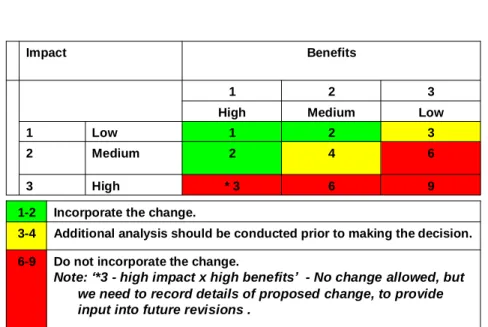
As a result, ISO/TC176 agreed on a design specification that adopts an “impact vs benefit” approach to analyse every individual change to ISO 9001 that might be proposed. The design specification recommends limiting any changes to those where there are clear benefits to users and where the potential impact to users is deemed to be only “low” or “medium” (see Figure 2). Whilst ISO makes no formal distinction between a “revision” and an “amendment” to its standards, the decision to describe the next revision of ISO 9001 as an “amendment” is intended to send a clear message to the more than 750,000 certificate holders worldwide that
The ISO standards development
process
VERIFICATION NEEDS & EXPECTATIONS PREPARATION SPECIFICATIONSWDs
CD1
CD2 DIS
FDIS
VALIDATION PROJECTSIS
only those changes necessary for clarification of the document, ease of use, consistency with the ISO 9000 Family or for achieving greater alignment with the ISO 14001 environmental management system standard will be considered. Any proposed change that would lead to a change in the focus, structure and content of the standard will not be considered in this amendment.
The design specification for ISO 9001 makes a total of 48 recommendations that could potentially affect 32 requirements of the standard if accepted by the drafters. However, the design specification recommends the drafters to consider the potential impact of any changes as follows:
Ø “High impact” if the proposed change:
o Requires extensive changes to documents o Requires extensive change to processes
o Recertification required within a defined transition period o Extensive (for example one to five days) training required
Ø “Medium impact” if the proposed change:
o Requires minimum changes to documents o Requires minimum change to processes
o Requires minimal training such as half-day awareness training)
o Permits recertification within the certified organization’s existing certification cycle
Ø “Low impact ” if:
o No additional training is required o No change to documents is needed o No change to processes is needed
o No effect on current certification is needed
In the “benefit” category, the drafters are recommended to consider the potential benefit to users as:
Ø “High” if it:
o Removes ambiguity in the requirements
o Considerably increases compatibility with ISO 14001
o There is no evidence of inconsistency with the ISO 9000 family of standards o Results in significant improvement in translatability
Ø “Medium” if it:
o Provides better clarity than before
o Improves the compatibility with ISO 14001
o Improves consistency with the ISO 9000 family of standards o Results in a slight improvement in translatability
Ø “Low” if it:
o Does not improve the clarity
o Has no impact on the compatibility with ISO 14001
o Has no impact on consistency with the ISO 9000 family of standards o Results in no improvement in translatability
The expected results of this impact/benefit analysis and the disposition of any proposed changes are shown schematically in Figure 2:
Figure 2
Impact analysis
9 6 * 3 High 3 6 4 2 Medium 2 3 2 1 Low 1 Low Medium High 3 2 1 Benefits ImpactDo not incorporate the change.
Note: ‘*3 - high impact x high benefits’ - No change allowed, but we need to record details of proposed change, to provide input into future revisions .
6-9
Additional analysis should be conducted prior to making the decision. 3-4
Incorporate the change. 1-2