Model 109SS
Temperature Probe
Revision: 12/10
Warranty and Assistance
The MODEL 109SS TEMPERATURE PROBE FOR HARSH
ENVIRONMENTS is warranted by Campbell Scientific, Inc. to be free from defects in materials and workmanship under normal use and service for twelve (12) months from date of shipment unless specified otherwise. Batteries have no warranty. Campbell Scientific, Inc.'s obligation under this warranty is limited to repairing or replacing (at Campbell Scientific, Inc.'s option) defective products. The customer shall assume all costs of removing, reinstalling, and shipping defective products to Campbell Scientific, Inc. Campbell Scientific, Inc. will return such products by surface carrier prepaid. This warranty shall not apply to any Campbell Scientific, Inc. products which have been subjected to modification, misuse, neglect, accidents of nature, or shipping damage. This warranty is in lieu of all other warranties, expressed or implied, including warranties of merchantability or fitness for a particular purpose. Campbell Scientific, Inc. is not liable for special, indirect, incidental, or consequential damages.
Products may not be returned without prior authorization. The following contact information is for US and International customers residing in countries served by Campbell Scientific, Inc. directly. Affiliate companies handle repairs for customers within their territories. Please visit
www.campbellsci.com to determine which Campbell Scientific company serves your country.
To obtain a Returned Materials Authorization (RMA), contact Campbell Scientific, Inc., phone (435) 753-2342. After an applications engineer determines the nature of the problem, an RMA number will be issued. Please write this number clearly on the outside of the shipping container. Campbell Scientific's shipping address is:
CAMPBELL SCIENTIFIC, INC. RMA#_____
815 West 1800 North Logan, Utah 84321-1784
For all returns, the customer must fill out a “Declaration of Hazardous Material and Decontamination” form and comply with the requirements specified in it. The form is available from our website at www.campbellsci.com/repair. A completed form must be either emailed to [email protected] or faxed to 435-750-9579. Campbell Scientific will not process any returns until we receive this form. If the form is not received within three days of product receipt or is incomplete, the product will be returned to the customer at the customer’s expense. Campbell Scientific reserves the right to refuse service on products that were exposed to contaminants that may cause health or safety concerns for our employees.
109SS Table of Contents
PDF viewers note: These page numbers refer to the printed version of this document. Use the Adobe Acrobat® bookmarks tab for links to specific sections.
1. General
...1
1.1 Specifications...2
2. Accuracy
...3
3. Installation and Wiring
...4
3.1 Burial ...4 3.2 Submersion ...4
4. Wiring
...4
5. Programming
...4
5.1 CRBasic ...5 5.1.1 CRBasic Examples...55.1.1.1 Sample Program for CR200(X) Series Datalogger ...6
5.1.1.2 Example 2. Sample Program for CR1000 Datalogger ...6
5.1.1.3 Sample Program for CR5000 ...7
5.2 Edlog...7
5.2.1 Example Edlog Program ...7
5.3 Electrical Noisy Environments ...9
5.4 Long Lead Lengths ...9
6. Measurement Details
...10
7. Maintenance and Calibration
...11
8. Troubleshooting
...11
Figures
1-1. 109SS Temperature Probe...12-1. Steinhart and Hart...3
2-2. Possible Errors...3
6-1. 109SS Thermistor Probe Schematic ...10
Tables
4-1. Connections to Campbell Scientific Dataloggers ...45-1. Wiring for Example Programs ...5
Model 109SS Temperature Probe
1. General
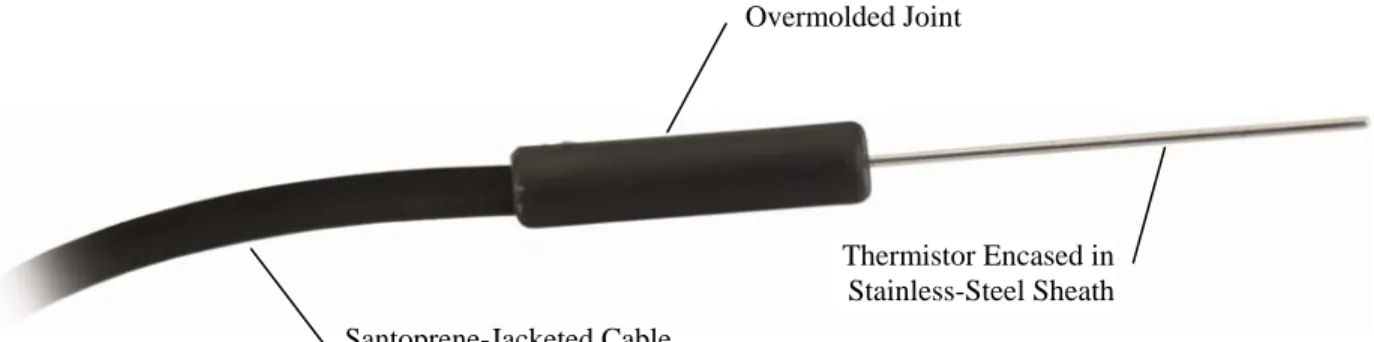
The –L portion of this probe’s model number indicates the probe has a user-specified lead length. For readability purposes, the probe will be referred to as the 109SS throughout this document.
The 109SS consists of a thermistor encased in a stainless-steel sheath. The rugged stainless-steel sheath protects the thermistor allowing the 109SS to be buried or submerged in harsh, corrosive environments. It also has a fast time response. This probe measures temperature from -40° to +70°C. The
thermistor can survive temperatures up to 100°C, but the overmolded joint and cable should not be exposed to temperatures greater than +70°C (see Figure 1-1).
Overmolded Joint
Thermistor Encased in Stainless-Steel Sheath Santoprene-Jacketed Cable
FIGURE 1-1. 109SS Temperature Probe
The 109SS probe is typically used with the CR200(X)-series, CR800, CR850, CR1000, and CR3000 dataloggers, which have a special instruction for measuring it. The probe can also be measured with other Campbell Scientific dataloggers using generic measurement instructions.
The 109SS ships with: (1) Resource CD
Model 109SS Temperature Probe
1.1 Specifications
Temperature Range: -40° to +70°C
Survival Range: -50° to +100°C (thermistor); -50°C to +70°C (overmolded joint and cable)
Thermistor Interchangeability Tolerance: Temperature Tolerance -40°C ±0.6°C 0°C ±0.38°C 25°C ±0.1°C 50°C ±0.3°C 70°C ±0.45°C Time Constant: Fluid τ
Still Air 31 seconds Air @ 3 meter/second 7.5 seconds Antifreeze/Water Rolling 0.5 seconds Water submersion depth: 150 ft (63 psi)
Linearization Error: Steinhart & Hart equation; maximum error is 0.02°C at -40°C.
Maximum Lead Length: 1000 ft Other Information:
Thermistor: BetaTherm - Micro-BetaCHIP Probe 10K3MCD1 0.018" diameter, 10Kohms at 25 C
Probe:
stainless steel sheath 0.063 inch (0.16 cm) diameter, 2.3 inch (5.84 cm) length overmolded joint 0.40 inch (1.02 cm) diameter, 1.67 inch (4.24 cm) length Cable: Santoprene 0.220 inch diameter
Cable/probe connection: "ATUM" heat shrink, "Macromelt" overmolded joint Weight: 0.2 lbs/10 1/2 ft cable
The black outer jacket of the cable is Santoprene® rubber. This compound was chosen for its resistance to temperature extremes, moisture, and UV degradation. However, this jacket will support combustion in air. It is rated as slow burning when tested according to U.L. 94 H.B. and will pass FMVSS302. Local fire codes may preclude its use inside buildings.
NOTE
Model 109SS Temperature Probe
2. Accuracy
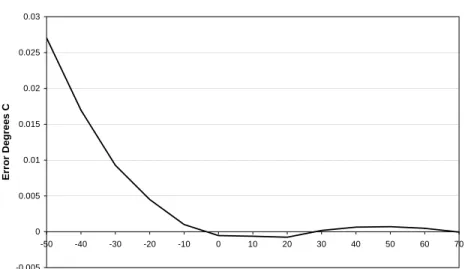
The overall probe accuracy is a combination of the thermistor's interchangeability specification and the accuracy of the bridge resistor. The Steinhart and Hart equation used to calculate temperature has a negligible error (Figure 2-1). In a "worst case" the errors add to an accuracy of ±0.6°C over the range of -40° to 70°C and ±0.49°C over the range of -20°C to 70°C. The major error component is the interchangeability specification (tolerance) of the thermistor. The bridge resistor has a 0.1% tolerance with a 10 ppm temperature coefficient. Figure 2-2 shows the possible worst case probe and measurement errors.
Steinhart & Hart - Tabulated values
-0.005 0 0.005 0.01 0.015 0.02 0.025 0.03 -50 -40 -30 -20 -10 0 10 20 30 40 50 60 70 Temperature Degrees C Error Degrees C
FIGURE 2-1. Steinhart and Hart
Model 109SS Temperature Probe
3. Installation and Wiring
3.1 Burial
The 109SS is suitable for shallow burial only. It should be placed horizontally at the desired depth to avoid thermal conduction from the surface to the thermistor. Placement of the cable inside a rugged conduit may be advisable for long cable runs, especially in locations subject to digging, mowing, traffic, use of power tools, or lightning strikes.
3.2 Submersion
The 109SS can be submerged to 150 ft (63 psi). Please note that the 109SS is not weighted. Therefore, the installer should either add a weighting system or secure the probe to a fixed or submerged object such as a piling.
4. Wiring
Connections to Campbell Scientific dataloggers are given in Table 4-1. Temperature is measured with one single-ended input channel and a Voltage Excitation channel. Multiple probes can be connected to the same excitation channel (the number of probes per excitation channel is physically limited by the number of lead wires that can be inserted into a single voltage excitation terminal, approximately six).
TABLE 4-1. Connections to Campbell Scientific Dataloggers
Color Description CR200(X) CR800 CR850 CR3000 CR1000 CR510 CR500 CR10(X) CR5000 21X CR7 CR23X Black Excitation Switched
Voltage Excitation Switched Voltage Excitation Switched Voltage Excitation Red Temperature Signal Single-Ended Input Single-Ended Input Single-Ended Input Purple Signal Ground AG
Clear Shield G
5. Programming
This section is for users who write their own datalogger programs. A datalogger program to measure this sensor can be generated using Campbell Scientific’s Short Cut Program Builder software. You do not need to read this section to use Short Cut.
NOTE
Model 109SS Temperature Probe
The datalogger is programmed using either CRBasic or Edlog. Dataloggers that use CRBasic include our CR200(X)-series, CR800, CR850, CR1000, CR3000, CR5000, and CR9000(X); see Section 5.1. Dataloggers that use Edlog include our CR10, CR10(X), CR23X, and CR7; refer to Section 5.2. CRBasic and Edlog are included in our LoggerNet, PC400, and RTDAQ software.
If applicable, please read “Section 5.3—Electrical Noisy Environments” and “Section 5.4—Long Lead Lengths” prior to programming your datalogger. Measurement details are provided in Section 6.
5.1 CRBasic
In the CR200(X)-series, CR800, CR850, CR1000, and CR3000 dataloggers, Instruction Therm109 is used to measure temperature. Therm109 provides excitation, makes a single ended voltage measurement, and calculates temperature.
The Therm109 instruction has the following form:
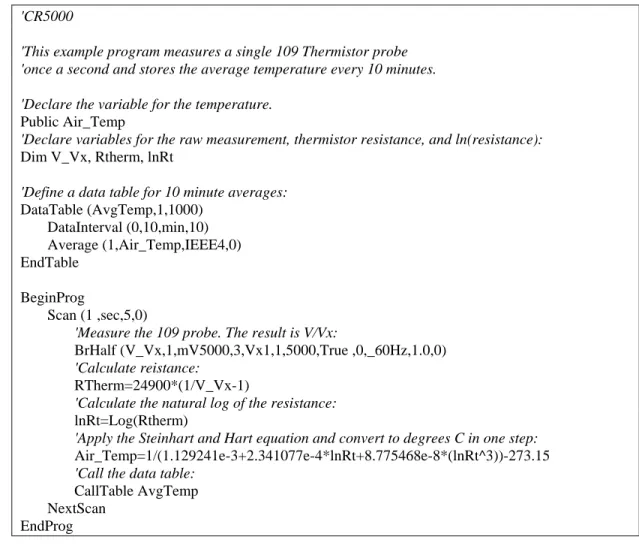
Therm109 (Dest, Repetitions, SE Chan, Ex Chan, Multiplier, Offset) A multiplier of 1.0 and an offset of 0.0 yields temperature in Celsius. For Fahrenheit, use a multiplier of 1.8 and an offset of 32. Sections 5.1.1.1 and 5.1.1.2 provide example programs that use the Therm109 instruction. The CR5000 and CR9000(X) use the BrHalf instruction to read the 109SS’s resistance. The Steinhart-Hart equation is entered as an expression to convert the resistance to degrees Celsius (see Section 5.1.1.3).
5.1.1 CRBasic Examples
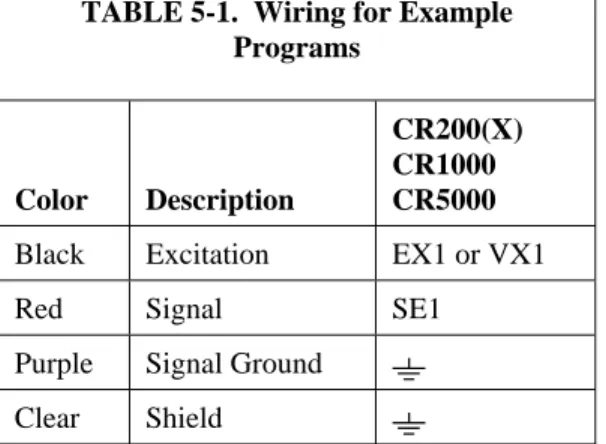
TABLE 5-1. Wiring for Example Programs
Color Description
CR200(X) CR1000 CR5000 Black Excitation EX1 or VX1
Red Signal SE1
Purple Signal Ground Clear Shield
Model 109SS Temperature Probe
5.1.1.1 Sample Program for CR200(X) Series Datalogger 'CR200(X) Series Datalogger
‘This example program measures a single 109SS Thermistor Probe ‘once a second and stores the average temperature every 10 minutes.
‘Declare the variable for the temperature measurement
Public Air_Temp
‘Define a data table for 10 minute averages:
DataTable (AvgTemp,1,1000) DataInterval (0,10,min) Average (1,Air_Temp,0) EndTable BeginProg Scan (1 ,sec)
‘Measure the temperature:
Therm109 (Air_Temp,1,1,Ex1,1.0,0)
Call the data table:
CallTable AvgTemp NextScan
EndProg
5.1.1.2 Example 2. Sample Program for CR1000 Datalogger 'CR1000
'Declare Variables and Units
Public T109_C Units T109_C=Deg C
'Define Data Tables
DataTable(Table1,True,-1) DataInterval(0,10,Min,10) Average(1,T109_C,FP2,False) EndTable 'Main Program BeginProg Scan(1,Sec,1,0)
'Default Datalogger Battery Voltage measurement Batt_Volt: '109SS Temperature Probe measurement T109_C:
Therm109(T109_C,1,1,1,0,_60Hz,1.0,0.0)
'Call Data Tables and Store Data
CallTable(Table1) NextScan
EndProg
Model 109SS Temperature Probe
5.1.1.3 Sample Program for CR5000 'CR5000
'This example program measures a single 109 Thermistor probe 'once a second and stores the average temperature every 10 minutes.
'Declare the variable for the temperature.
Public Air_Temp
'Declare variables for the raw measurement, thermistor resistance, and ln(resistance):
Dim V_Vx, Rtherm, lnRt
'Define a data table for 10 minute averages:
DataTable (AvgTemp,1,1000) DataInterval (0,10,min,10) Average (1,Air_Temp,IEEE4,0) EndTable BeginProg Scan (1 ,sec,5,0)
'Measure the 109 probe. The result is V/Vx:
BrHalf (V_Vx,1,mV5000,3,Vx1,1,5000,True ,0,_60Hz,1.0,0)
'Calculate reistance:
RTherm=24900*(1/V_Vx-1)
'Calculate the natural log of the resistance:
lnRt=Log(Rtherm)
'Apply the Steinhart and Hart equation and convert to degrees C in one step:
Air_Temp=1/(1.129241e-3+2.341077e-4*lnRt+8.775468e-8*(lnRt^3))-273.15
'Call the data table:
CallTable AvgTemp NextScan
EndProg
5.2 Edlog
In Edlog, Instruction 5 is typically used to measure the 109SS resistance. Instruction 55 is used to apply the Steinhart and Hart equation. Instruction 55 does not allow entering the coefficients with scientific notation. In order to use this instruction with as much resolution as possible, the ln resistance term is pre scaled by 10-3. This allows the first order coefficient (B) to be multiplied by 103, and the 3rd
order coefficient (C) to be multiplied by 109 (see Section 5.2.1).
5.2.1 Example Edlog Program
TABLE 5-2. Wiring for Example Program
Color Description CR10X
Black Excitation E1
Red Signal SE1
Purple Signal Ground AG
Model 109SS Temperature Probe
Example Program for CR10X ;{CR10X}
;
*Table 1 Program
01: 1 Execution Interval (seconds) 1: AC Half Bridge (P5)
1: 1 Reps
2: 25 2500 mV 60 Hz Rejection Range 3: 1 SE Channel
4: 1 Excite all reps w/Exchan 1 5: 2500 mV Excitation 6: 1 Loc [ V_Vx ] 7: 1.0 Mult 8: 0.0 Offset 2: Z=1/X (P42) 1: 1 X Loc [ V_Vx ] 2: 2 Z Loc [ Vx_V ] 3: Z=X+F (P34) 1: 2 X Loc [ Vx_V ] 2: -1 F 3: 3 Z Loc [ Vx_V_1 ] 4: Z=X*F (P37) 1: 3 X Loc [ Vx_V_1 ] 2: 24900 F 3: 4 Z Loc [ Rtherm ] 5: Z=LN(X) (P40) 1: 4 X Loc [ Rtherm ] 2: 5 Z Loc [ lnRt ] 6: Z=X*F (P37) 1: 5 X Loc [ lnRt ] 2: .001 F 3: 6 Z Loc [ Scal_lnRt ] 7: Polynomial (P55) 1: 1 Reps 2: 6 X Loc [ Scal_lnRt ] 3: 7 F(X) Loc [ 1_Tk ] 4: .001129 C0 5: .234108 C1 6: 0.0 C2 7: 87.7547 C3 8: 0.0 C4 9: 0.0 C5 8: Z=1/X (P42) 1: 7 X Loc [ 1_Tk ] 2: 8 Z Loc [ Tk ] 8
Model 109SS Temperature Probe 9: Z=X+F (P34) 1: 8 X Loc [ Tk ] 2: -273.15 F 3: 9 Z Loc [ Air_Temp ] 10: If time is (P92)
1: 0 Minutes (Seconds --) into a 2: 10 Interval (same units as above) 3: 10 Set Output Flag High (Flag 0) 11: Real Time (P77) 1: 110 Day,Hour/Minute (midnight = 0000) 12: Average (P71) 1: 1 Reps 2: 9 Loc [ Air_Temp ] *Table 2 Program
02: 0.0000 Execution Interval (seconds) *Table 3 Subroutines
End Program
5.3 Electrical Noisy Environments
AC power lines, pumps, and motors, can be the source of electrical noise. If the 109SS probe or datalogger is located in an electrically noisy environment, the 109SS probe should be measured with the 60 Hz or 50 Hz integration option as shown in the examples in Section 5.1.1.2 and Section 5.2.1. The 60 Hz and 50 Hz integration options are not available for the CR200(X).
5.4 Long Lead Lengths
Additional settling time may be required for lead lengths longer than 300 feet, where settling time is the delay before the measurement is made.
For the CR800, CR850, CR1000, and CR3000, the 60 Hz and 50 Hz integration options include a 3 ms settling time; longer settling times can be entered into the Settling Time parameter. The 60 Hz and 50 Hz integration options as well as the Settling Time parameter are not available for the CR200(X). The example Therm109 instruction listed below has a 20 mSec (20000 μSec) delay:
‘Therm109 ( Dest, Reps, SEChan, ExChan, SettlingTime, Integ, Mult, Offset )
Therm109(T109_C,1,1,1,20000,_60Hz,1.0,0.0)
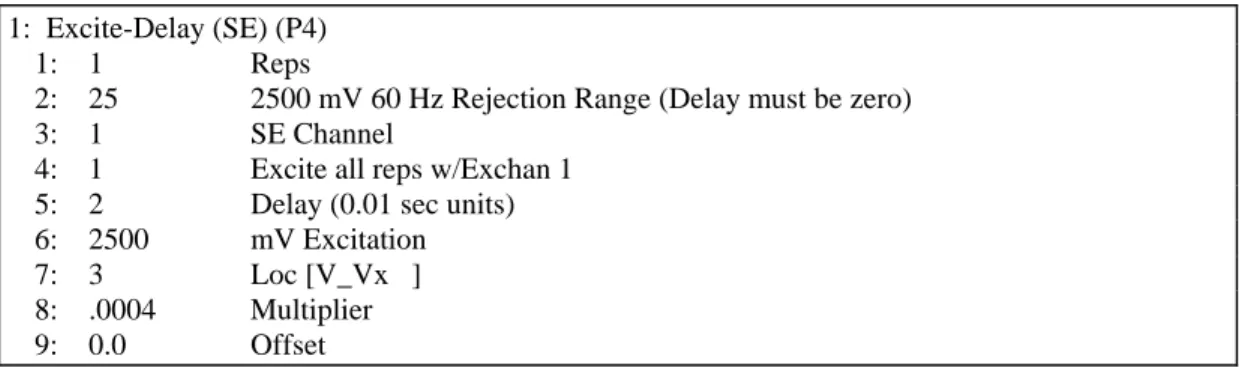
In Edlog, use the DC Half Bridge instruction (P4) with a 20 millisecond delay as shown below. Use P4 in place of P5 in Section 5.2.1 (the instructions that follow P5 to convert the measurement result to temperature are still required).
Model 109SS Temperature Probe
1: Excite-Delay (SE) (P4) 1: 1 Reps
2: 25 2500 mV 60 Hz Rejection Range (Delay must be zero) 3: 1 SE Channel
4: 1 Excite all reps w/Exchan 1 5: 2 Delay (0.01 sec units) 6: 2500 mV Excitation 7: 3 Loc [V_Vx ] 8: .0004 Multiplier 9: 0.0 Offset
6. Measurement Details
Understanding the details in this section are not necessary for general operation of the 109SS Probe with CSI's dataloggers.
The Therm109 Instruction outputs a 2500 mV excitation and measures the voltage across the 24.9 K resistor (Figure 6-1). The thermistor resistance changes with temperature.
EX HI AG G BLACK RED PURPLE CLEAR 24.9K Ω, 0.1% 10K3AI THERMISTOR
FIGURE 6-1. 109SS Thermistor Probe Schematic
The measured voltage, V, is:
t EX
R
V
V
+
=
900
,
24
900
,
24
Where VEX is the excitation voltage, 24,900 ohms is the resistance of the fixed
resistor and Rt is the resistance of the thermistor
Model 109SS Temperature Probe
The resistance of the thermistor is:
⎟
⎠
⎞
⎜
⎝
⎛
−
=
24
,
900
1
V
V
R
EX tThe Steinhart and Hart equation is used to calculate temperature from Resistance: 3 )) (ln( ) ln( 1 T T K R C R B A T + + =
Where TK is the temperature in Kelvin. The Steinhart and Hart coefficients
used in the Therm109 instruction are: A = 1.129241x10⁻³
B = 2.341077x10⁻⁴
C = 8.775468x10⁻⁸
7. Maintenance and Calibration
The 109SS Probe requires minimal maintenance. Periodically check cabling for proper connections, signs of damage, and possible moisture intrusion. For all factory repairs and recalibrations, customers must get a returned materials authorization (RMA). Customers must also properly fill out a “Declaration of Hazardous Material and Decontamination” form, and comply with the requirements specified in it. Refer to the “Warranty and Assistance” page for more information.
8. Troubleshooting
Symptom: Temperature is NAN, -INF, -9999, -273
Verify the red wire is connected to the correct Single-Ended analog input channel as specified by the measurement instruction, the black wire is connected to the switched excitation channel as specified by the measurement instruction, and the purple wire is connected to datalogger ground.
Symptom: Incorrect Temperature
Verify the multiplier and offset parameters are correct for the desired units (Section 5). Check the cable for signs of damage and possible moisture intrusion.
For all factory repairs, customers must get an RMA. Customers must also properly fill out a “Declaration of Hazardous Material and Decontamination” form and comply with the requirements specified in it. Refer to the “Warranty and Assistance” page for more information.
Model 109SS Temperature Probe
12
Symptom: Unstable Temperature
Try using the 60 Hz or 50 Hz integration options, and/or increasing the settling time as described in Sections 8 and 9. Make sure the clear shield wire is connected to datalogger ground, and the datalogger is properly grounded.
Campbell Scientific Companies
Campbell Scientific, Inc. (CSI)815 West 1800 North Logan, Utah 84321
UNITED STATES
www.campbellsci.com • [email protected]
Campbell Scientific Africa Pty. Ltd. (CSAf)
PO Box 2450 Somerset West 7129
SOUTH AFRICA
www.csafrica.co.za • [email protected]
Campbell Scientific Australia Pty. Ltd. (CSA)
PO Box 444 Thuringowa Central QLD 4812 AUSTRALIA
www.campbellsci.com.au • [email protected]
Campbell Scientific do Brazil Ltda. (CSB)
Rua Luisa Crapsi Orsi, 15 Butantã CEP: 005543-000 São Paulo SP BRAZIL www.campbellsci.com.br • [email protected]
Campbell Scientific Canada Corp. (CSC)
11564 - 149th Street NW Edmonton, Alberta T5M 1W7
CANADA
www.campbellsci.ca • [email protected]
Campbell Scientific Centro Caribe S.A. (CSCC)
300 N Cementerio, Edificio Breller Santo Domingo, Heredia 40305
COSTA RICA
www.campbellsci.cc • [email protected]
Campbell Scientific Ltd. (CSL)
Campbell Park 80 Hathern Road
Shepshed, Loughborough LE12 9GX UNITED KINGDOM
www.campbellsci.co.uk • [email protected]
Campbell Scientific Ltd. (France)
Miniparc du Verger - Bat. H 1, rue de Terre Neuve - Les Ulis 91967 COURTABOEUF CEDEX
FRANCE
www.campbellsci.fr • [email protected]
Campbell Scientific Spain, S. L.
Avda. Pompeu Fabra 7-9, local 1 08024 Barcelona
SPAIN
www.campbellsci.es • [email protected]