Mobile Network Operators
and Cooperation
A Tele-Economic Study of Infrastructure Sharing
and Mobile Payment Services
JAN MARKENDAHL
PhD Thesis in
Telecommunications
Stockholm, Sweden 2011
Mobile Network Operators and Cooperation
A Tele-Economic Study of Infrastructure Sharing and Mobile Payment Services
JAN MARKENDAHL
PhD Thesis in
Telecommunications
Stockholm, Sweden 2011
ISRN KTH/COS/R--11/01--SE SWEDEN Akademisk avhandling som med tillstånd av Kungl Tekniska högskolan framlägges till offentlig granskning för avläggande av teknologie doktorsexamen i Telekommu-nikation Fredagen den 11 Februari 2011 klockan 14.00 i sal C1, Electrum1, Kungliga Tekniska Högskolan, Isafjordsgatan 26, Kista.
©Jan Markendahl, February 2011 Tryck: Universitetsservice US AB
i
Abstract
Mobile network operators are currently faced with a number of chal-lenges at the market. The revenues from voice services have decreased the last couple of years. Mobile broadband access services are being adopted and the demand is increasing. The increasing traffic volumes require investments in order to increase the network capacity.
This development leads to a large interest in network solutions that can offer high capacity and low cost. Besides the use of more effi-cient radio access technology mobile network operators use strategies for network deployment and operation involving other market actors. Operators share networks with competitors or out source network de-ployment and operation to other companies, typically the supplier of network equipment. In these examples the mobile operators cooperate about the networks, the relations to end-users are the same as if the operator would operate the network on its own.
However, in other areas other actors enter the market for mobile services where mobile operators traditionally have been the dominant player. Handset manufacturers and Internet companies offer value added services and applications to the end-users. They also establish relations with customers of the mobile operators.
Hence, mobile operators look into new technical solutions and ser-vices in order to reduce costs and find new serser-vices and sources of rev-enues. Many of the networking solutions and services require that the operator cooperates with some other actor. In this PhD thesis cooper-ation with competitors, customers and different types of partners are considered. The partner can be a provider of a non-telecom service like public transportation, financial institutes or third parties taking intermediary roles.
The main research questions in the thesis revolves around why and how mobile operators cooperate. The drivers for cooperation and the way the cooperation is organized is analyzed for a number of cases. Three types of services and markets are analyzed:
- Public mobile broadband access services - Services and solutions for indoor wireless access - Mobile payment, ticketing and contactless services
A number of technical solutions, business concepts and different types of cooperation and business scenarios have been investigated. Two overall research questions that are applicable for all cases of cooperation are identified for the analysis.
- What are the main drivers for a specific type of cooperation? - In what ways can the actors organize the cooperation?
Acknowledgements
When I today in January 2011 am finalizing my doctoral studies at the Communi-cations systems department I would like to look back some years. The time frame is longer then the last 8 years when I have been researcher, project manager and teacher at KTH.
30 years ago I started as an industry PhD student at Telecommunication Theory (TTT) at KTH. At that time I had a position at Televerket (now Telia). My task was to make techno-economic analysis of the new digital PCM transmission systems that were deployed. My responsibilities were in the area of "tele-economics"!
- So, it seems difficult to change track!
After more than 20 years in the industry I was offered a position at KTH and "returned" to university research. At that time I did not have a clue that I would be a PhD student "again". Today I am both very happy and feel privileged that it was possible to make a re-start after the Licentiate degree many many years ago. Hence, there are a number of persons that I would like to thank.
First of all I am very grateful to my two supervisors, Prof. Jens Zander, head of our department RST and Prof. Per Andersson at Stockholm School of Economics. Thanks to Jens I have got this extraordinary opportunity to re-start doctoral studies at the age of 52. I am very grateful to Jens for two other reasons. First, Jens had the courage to let me start to start studies in a research area that was new to me. Secondly, all the time at the department and at Wireless@KTH RST I have had a very strong feeling of being trusted by Jens.
In the projects, conferences and authoring together with Per I have had the privilege to see and learn many new things. Per has introduced me in his field of research in a very supporting way. It has been extremely rewarding to get ac-quainted to a completely new research field with a different research tradition.
I would like to thank Prof. Heikki Hämmäinen for accepting the role as oppo-nent at my defense. I am also grateful to the members of the grading committee, Prof Anders Henten, Dr Fredrik Gessler and Carl-Gustaf Jansson. A special thank to Fredrik Gessler for his review of the PhD proposal and the useful comments and suggestions on how to re-structure the work leading to this dissertation.
A very warm "thank you" to my colleges and co-authors that has reviewed differ-ent draft versions of the dissertation: Bengt G. Mölleryd, Lars-Gunnar Mattsson, Mats Nilsson, Östen Mäkitalo, Jan Werding and Niklas Arvidsson. All the dark December and January hours that you have spent providing comments and sugges-tions has helped me to substantially improve the different chapters in the thesis.
I would like to thank all colleges at KTH for the collaboration in the different research projects: Klas Johansson, Johan Hultell, Mats Blomgren, Miguel Berg, Olav Queseth, Pietro Lungaro, Bogdan Timus, Aurelian Bria, Juan Espino, Ömer Oleri, Mark Smith and Cleas Beckman.
Many thanks to Bertil Thorngren, Pablo Valiente and Niklas Kviselius for good collaboration in the joint research projects with Stockholm School of Economics and KTH as partners.
In the Ambient Networks project I have spent many interesting hours and days at interesting locations together with interesting people. I am glad to have worked together with you and also for the papers that we manage to produce. Thanks to all of you: Petteri Pöyhönen, Ove Strandberg, Nadeem Akhtar, Martin Johns-son, Oscar Rietkerk, George Huitema, Henk Ensing, Mikael Prytz, Peter CarlsJohns-son, Lester Ho.
I am also grateful to Lise-Lotte Wahlberg, Irina Radulescu, Ulla Eriksson, Anna Barkered och Lissi Perséus for excellent administrative support and guidance in the world of university administration. For support on computer issues I am grateful to Niklas Olsson, Robin Gehrke and Ali Özyagci.
I really appreciate the support from Luca Stabellini and Anders Markendahl that helped me to reveal the secrets of LaTex.
I also want to thank my wife Marika for all help with literature support, ref-erences and the excellent compilation of the bibliography. I am also extremely grateful to Marika for all caring support during the finalization of this dissertation.
Jan Markendahl Uppsala, Sweden, 2011
Contents
Acknowledgements iii
Contents v
List of Tables vii
List of Figures ix
1 Introduction 1
1.1 Background . . . 3
1.2 Research questions, scope and delimitations . . . 8
1.3 Thesis outline . . . 10
1.4 Contributions . . . 12
2 Research approach 19 2.1 Scope of the techno-economic feasibility analysis . . . 19
2.2 Related work . . . 22
2.3 The overall analysis approach . . . 25
3 Network sharing and dynamic roaming 31 3.1 Chapter introduction . . . 31
3.2 Related work . . . 33
3.3 Methodology . . . 38
3.4 Existing types of operator cooperation . . . 41
3.5 Dynamic roaming . . . 47
3.6 Cost and capacity . . . 54
3.7 Opinions about cooperation . . . 60
3.8 Analysis . . . 66
3.9 Conclusions . . . 77
4 Indoor wireless systems and femtocells 81 4.1 Chapter introduction . . . 81
4.2 Related work and activities . . . 86 v
4.3 Methodology . . . 89
4.4 The Femtocell concept . . . 93
4.5 Existing indoor solutions and business models . . . 97
4.6 Cost and capacity analysis . . . 101
4.7 Co-existence of macrocells and femtocells . . . 112
4.8 Analysis . . . 118
4.9 Conclusions . . . 130
5 Mobile payment and contactless services 133 5.1 Chapter introduction . . . 133
5.2 Related work . . . 137
5.3 Methodology . . . 141
5.4 The Pay Buy Mobile approach . . . 147
5.5 SMS based ticketing and payments services . . . 151
5.6 Emerging contact-less services in Sweden . . . 164
5.7 Other types of payment and ticketing solutions . . . 178
5.8 NFC services in Japan . . . 183
5.9 Comparison of solutions . . . 189
5.10 Conclusions . . . 196
6 Conclusions and future work 197 Bibliography 203 Publications . . . 203
List of Tables
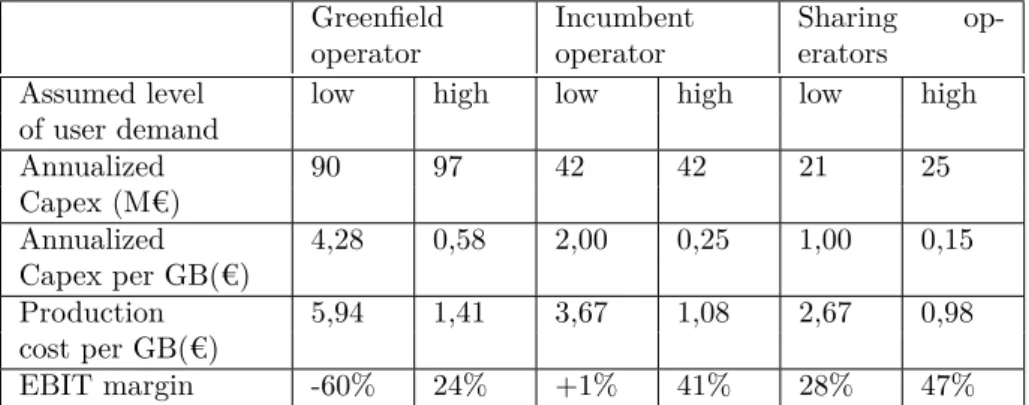
3.1 Network investments in different areas (Million€) for different
deploy-ment strategies in the example country case . . . 57
3.2 Investments in mobile networks (Million SEK) in Sweden year 2000 -2009, data compiled by Bengt G. Mölleryd based on annual reports . . . 57
3.3 Production costs per GB for operators in the country case . . . 58
3.4 Mobile Broadband subscriptions, from Telenor web page 2010-12-27 . . 67
3.5 Mobile Broadband subscriptions, from Hi3G web page 2010-12-27 . . . . 67
3.6 Mobile Broadband subscriptions, from Tele2 web page 2010-12-27 . . . . 67
3.7 Mobile Broadband subscriptions, from Telia web page 2010-12-27 . . . . 67
3.8 Additional information about data rates for mobile broadband subscrip-tions, from the Telia web page 2010-12-27 . . . 69
4.1 Companies interviewed for local access services . . . 91
4.2 Discussion partners on femtocell deployment and spectrum allocation . 91 4.3 Companies interviewed about indoor solutions and deployment . . . 92
4.4 Examples of theoretical number of served users . . . 103
4.5 Investments and deployed Macrocell capacity . . . 106
4.6 Investments and deployed capacity using DAS . . . 106
4.7 Investments and deployed Femtocell capacity . . . 107
4.8 Base station density (N) required to compensate for wall attenuation . . 108
4.9 Investments and deployed Macrocell capacity . . . 108
4.10 Site densities . . . 110
4.11 Example of number of served users with the two approaches average throughput andguaranteed bit rate . . . 110
5.1 Companies interviewed about technology solutions . . . 144
5.2 Workshops and seminars 2009 about mobile payments, mobile wallet and NFC services . . . 145
5.3 Companies interviewed about mobile payment and ticketing services . . 146
5.4 Distribution of activities among actors for SMS ticketing . . . 161
5.5 Roles for different actors in the pilot project on NFC locks at hotels . . 166
5.6 Distribution of business roles among actors for ticketing cases . . . 191 vii
List of Figures
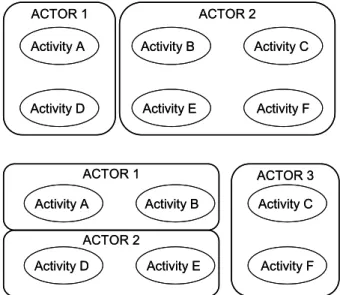
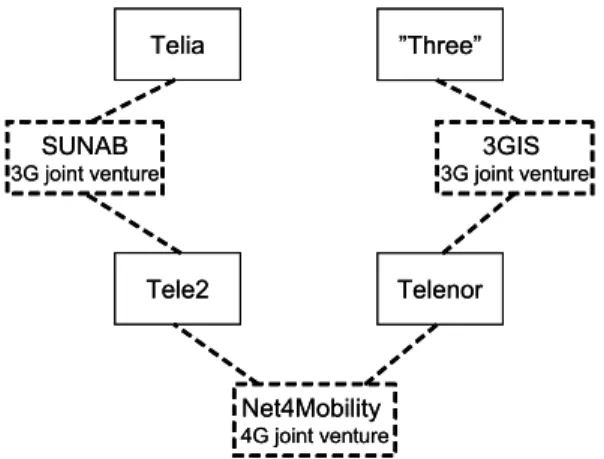
2.1 Example with two ways to distribute activities among actors . . . 28 2.2 Examples of maps with actors and relations . . . 29 3.1 UMTS and GSM networks of Hi3G, Telenor and the joint venture 3GIS 41 3.2 GSM networks of Telia and Tele2 and the UMTS network run by the
joint venture SUNAB . . . 42 3.3 Mobile operators and joint ventures for 3G and 4G networks in Sweden 42 3.4 Activity groups and business roles for Mobile Network Operators, active
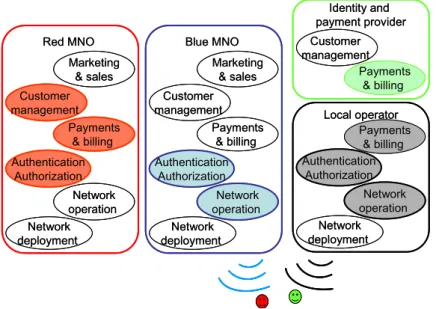
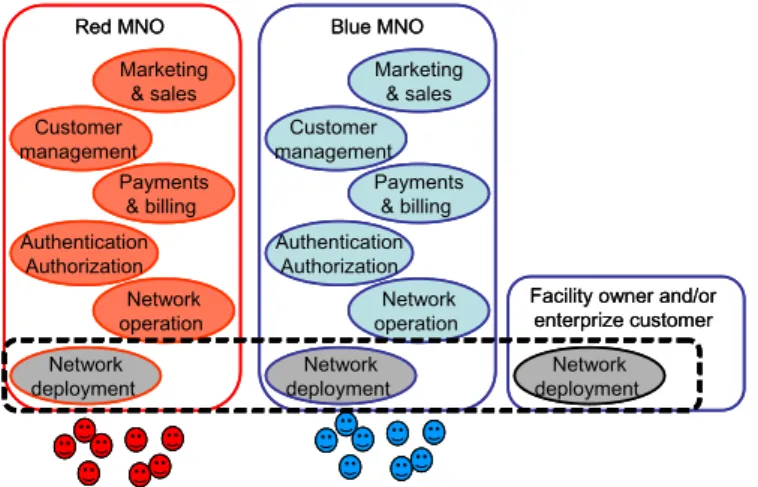
business roles are colored. To the left - the red operator serves the own users; to the right - national roaming where the blue operator serves one red roaming user . . . 44 3.5 Active Business roles for a Mobile Virtual Network Operator and a
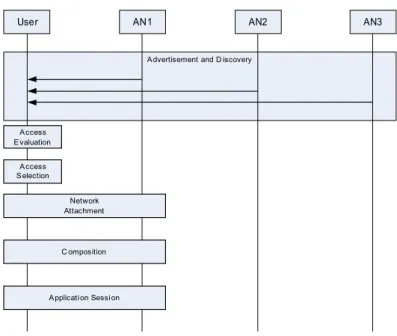
Mo-bile Network operator that provide the network resources to the MVNO 45 3.6 Business roles for the 3G networks provided by Hi3G and Telenor . . . 46 3.7 Business roles for 3G networks provided by Tele2 and Telia . . . 46 3.8 Example of sequence of actions for Network composition . . . 48 3.9 Distribution of activities and roles for two examples of dynamic roaming.
Different actors are involved doing different types of activities . . . 49 3.10 Example of a multi-operator multi-network scenario. Wide cylinders
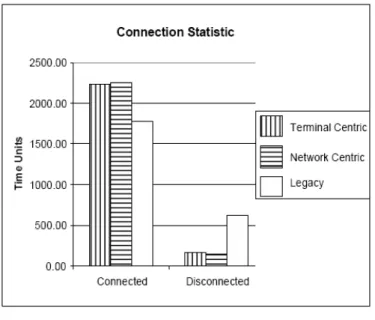
represent wide area coverage networks and "high" cylinders represent networks with"high" average capacity . . . 51 3.11 Example of connection statistics for handover experiment in a
multi-operator multi-network scenario. Legacy case represent single-multi-operator case (i.e. no handover). Terminal and network centric algorithms means hand-over for the multi-operator case, from [8] . . . 52 3.12 Served mobile nodes (%) for different levels of network load, with and
without operator cooperation (i.e. possibility to switch network or not), from [13] . . . 53 3.13 Examples of site capacity and deployment costs . . . 55 3.14 Number of base station sites as function of spectral efficiency of radio
access technologies and amount of used spectrum for a capacity limited scenario . . . 60
3.15 Examples of peak data rates with and without spectrum aggregation (assuming spectral efficiency of 4 bps per Hz, e.g. 80 Mbps for 20 MHz) 73
4.1 Business roles for the SpringMobil solution for enterprise telephony. . . 98
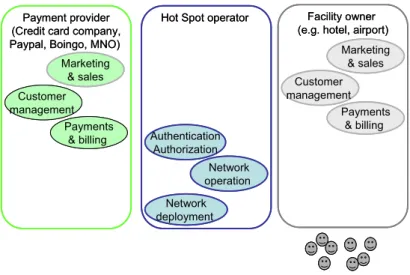
4.2 Business roles for a WiFi hot spot operator cooperating with a facility owner (site manager) and payment providers. . . 99
4.3 Illustration of a passive distributed antenna system. . . 99
4.4 Business roles for operators sharing an indoor DAS infrastructure. . . . 100
4.5 Capacity and generic cost structure for macro sites and femtocells . . . 102
4.6 Site locations downtown Stockholm, blue circles indicate GSM and green squares indicate 3G sites . . . 109
4.7 Comparison of deployment costs . . . 111
4.8 Dead zones or coverage holes for macrocell users around femtocells . . . 112
4.9 Allocation of WCDMA bands for femtocell deployment . . . 113
4.10 Dead zones or coverage holes for macrocell users around femtocells . . . 114
4.11 The size of coverage holes as a function of received signal strength from the MBS for co-channel and adjacent channel operation . . . 114
4.12 Deadzones for WCDMA - different carrier separation . . . 115
4.13 Allocation of sub carriers, Macrocell: Black, Femtocell: Red . . . 116
4.14 Deadzones for OFDMA . . . 117
4.15 Relative willingness to pay in order to ensure indoor coverage . . . 120
4.16 Actors and relations for mobile operators with enterprize customers . . 121
4.17 Actors and relations for public access at a hotel . . . 122
4.18 Actors and relations for a WiFi hot spot at a hotel . . . 122
4.19 Actors and relations for a shopping mall scenario . . . 123
4.20 Actors and relations for deployment of DAS . . . 123
5.1 Actors supporting the business relation between merchants, (non-telecom) service providers and their customers . . . 135
5.2 Example of the approach for describing distribution of business roles, activities and activity groups among actors . . . 142
5.3 The Pay-Buy-mobile ecosystem proposed by GSMA. Actors in a credit card based system are complemented with mobile operators and a TSM (in grey) . . . 147
5.4 Eco-system for Mobile NFC services . . . 149
5.5 Vending machine where you can use cash or SMS payments . . . 152
5.6 Generic picture (drawn at many interviews) for actors and relations for provisioning of SMS services. . . 154
5.7 Distribution of activities among actors for the case bus and subway tickets provided by SL . . . 157
5.8 Distribution of activities among actors for the case parking tickets paid by SMS using a separate company for aggregation . . . 158
5.9 Actors and relations where the provider of the SMS tickets is not visible to the end-users . . . 162
List of Figures xi
5.10 Actors and relations where the mobile payment parking provider man-ages the interface with the end-users . . . 162 5.11 Contactless readers for use of SL Access card at subway gates, at buses
and for manual ticket control. Pictures from www.sl.se . . . 164 5.12 An example of groups of activities for provisioning and payment of
tick-ets for public transportation . . . 167 5.13 Actors and components of the mobile phone key and check-in/out service
at a hotel . . . 168 5.14 Activities and roles for provisioning of home care services with digital
locks and time registration . . . 169 5.15 Activities and actors roles for the PayEx Mobile solution . . . 172 5.16 Illustration of distribution of activities among actors for the Payair
pay-ment solution "Best effort" (based on ownbest effort analysis) . . . 174 5.17 Actors and relations for the Payair pilot project and the PayEx Mobil
business landscape in Uppsala . . . 176 5.18 Actors and relations for the cases of mobil phone locks in the hotel pilot
project (to the left) and for home care services (to the right) . . . 177 5.19 Ticket machine where you can pay by cash, by credit card or use mobile
services for payment of parking tickets. Two MPPP offer payments using parking subscriptions, one of them also offers SMS-tickets . . . 179 5.20 Activities when a mobile parking subscription is used . . . 180 5.21 Actors and relations for mobile parking payment services (to the left)
and for separate charging services (to the right) . . . 182 5.22 Actors and relations for Suica payment services . . . 184 5.23 Actors and relations for the QUICPay and iD credit card services . . . . 186 5.24 Actors and relations for Sony and JR East for the case of Suica services 187 5.25 The position of Sony and NTT Docomo for provisioning of Felica and
Chapter 1
Introduction
In this thesis new types of networking and business solutions will be analyzed, both for reduction of network costs as well as for generation of new types of revenues for mobile operators. The motivation for the research is to fill a knowledge gap within the techno-economic field. Another motivation is the ambition to contribute to the industry need to find new solutions and concepts that improve the profitability of mobile operators. The rapid development of mobile broadband access services have vastly increased the interest in wireless solutions combining high-capacity low-cost. These solutions generate a number of technical challenges that has motivated and driven research in the area of wireless systems and networks for several years.
The research in this PhD thesis was initially driven by the call for solutions that can reduce operator costs for deployment and operation of wireless networks. During the later phase of the research process the scope has been complemented with research on new services and new sources of revenues. The main objective of the research projects I have been involved in at KTH has been to propose technical concepts and pursue analysis of the technical and economic feasibility. To get a deeper understanding about potential problems for proposed technical solutions activities have been initiated in order to evaluate if and how a new solution can fit into an overall networking or business context.
In the analysis you need to consider if the new solution will complement or replace existing solutions, or if it will enable new services and offers.
Evaluation in an overall context includes a multitude of aspects: technical and cost performance, profitability and market position, conditions set by legacy sys-tems, regulation and market structure, existing business models and how the value network is configured. Decisions on cooperation with suppliers, partners, customers as well as with competitors is part of the company strategy.
The main theme in this PhD thesis revolves around cooperative strategies of mobile operators. This includes questions if and how mobile cooperators can or will cooperate with other actors. Another theme, running in parallel, is the evaluation of a technical solution in an overall techno-economic context.
The research questions are however related to the theme about cooperation. Key aspects are cooperation patterns, the configuration of the value networks, and the position of the mobile operators as a result of the business roles that are taken. The motivation to look in detail into how operators cooperate, or can cooperate, is derived from the pattern how mobile operators traditionally have acted. In order to exploit opportunities with new solutions operators in many ways may consider the need to change the mood of operation, and maybe even the mind set. The mobile operators to a large extent run their business in a similar fashion as the former telecom monopolies. Many roles in the value chain or the value network are occupied by the operator itself - a vertically integrated value chain.
However, many new networking solutions and concepts for mobile communica-tion services do not fit into the picture with a vertically integrated value chain. Both solutions to reduce network costs and to support new types of services are characterized by the fact that mobile operators do not do everything themselves. Network resources can be shared and several actors contribute to a common supply network offering services to customers common to many providers in the network, SMS payments for public transportation is a good example.
Often the customers of the mobile operators are seen as individual consumers with a communication need. The mobile operators employ a business to consumer (B2C) approach where no attention is paid to the context of the use of communica-tion services. In the case of business to business (B2B) services customers in many cases are seen as a group of consumers with a common billing address. However, in many cases customers make use of communication services within some kind of context. The communication service can be adapted or extended to fulfill the specific needs of the business customer.
It can also be a Business to Business to Consumer service (B2B2C) where the mobile operators have two types of customers; a business providing any kind of (non-telecom) service and the consumer that make use of the service. SMS pay-ments and tickets in public transportation can once again be used as an example. Hence, in order to play a role in the provisioning of B2B and B2B2C services mo-bile operators need to understand, and know more about other types of businesses. Hence the cooperation is both related to have competence within a certain area of business and to establish and maintain business relations.
The remainder of this chapter is organized as follows: First, a background is provided discussing operator challenges, solutions to reduce network costs and to generate new revenues, techno-economic evaluation and different types of operator cooperation. The overall research questions, common for all chapters, are described in section 1.2 together with the thesis scope and delimitations. The third section contains the outline. The research and author contributions are summarized in 1.4 with reference to own publications that are listed in the end of the thesis.
1.1. BACKGROUND 3
1.1
Background
Challenges for mobile operators
During the last couple of year’s mobile network operators have been challenged by decreasing revenues from fixed and mobile voice services. Concurrently, the so called revenue gap is used to illustrate how rapidly growing traffic volumes of mobile broadband services (MBB) are de-coupled from the revenues, see e.g. Blennerud [164] and Mölleryd [3] . For voice services there has traditionally been a strict relation between the traffic and revenues, since users have paid for the usage in terms of voice minutes. However, this relation has changed with the growth of mobile broadband services through the introduction of flat rate or box pricing subscriptions. The increasing traffic volumes require investments in order to in-crease the network capacity. This development leads to a large interest in network solutions that can offer high capacity and low cost.
These high-capacity low-cost solutions are related to a number of technical chal-lenges that has motivated and driven research in the area of wireless systems and networks for many years The challenges combine aspects like cost structure and scalability of cellular systems; performance in terms of spectral efficiency, alloca-tion of spectrum and different types of network deployment.
A key characteristic of the cost structure of mobile network is that it is expen-sive to build new base stations sites and to extend transmission to the sites, see Johansson [63]. The cost of radio equipment is a minor share, and prices have de-creased substantially during the last couple of years. According to Zander [165] the scalability implies that, for a specific radio access technology, N times more capacity per area unit requires a N times denser network for a given amount of spectrum. Limitations in availability of spectrum will lead to deployment of a denser network in order to meet an increasing demand.
In addition to these network-related issues mobile operators are faced with a number of challenges in the business and market domain. Other actors enter the market for mobile services where mobile operators traditionally have been the only or the dominant players. On one side mobile operators outsource network deploy-ment and operation to other companies, e.g. the major telecom vendors. Companies like Apple, Nokia and Google also offer value added services, applications and start to establish relations with end-users1.
Vendors of telecom equipment enter part of the mobile operator business. Man-ufacturers of network equipment operate networks and handset manMan-ufacturers de-velop and offer value added services. These changes in the roles of different types of actors are of course driven both by cost and efficiency reasons. When the traditional business is challenged by increasing competition, decreasing demand or declining prices there is an increasing need to strengthen the market position.
1See e.g presentation by Lars Nyberg at TeliaSonera Investor Day 2009 September 7,
In parallel with these changes the business landscape is changing. The telecom business is integrated in the Internet way of doing business. Using this perspective, the telecom sector is no longer seen as a business where operators build and operate networks and where the services are offered on top of the connectivity. Instead, the telecom industry is a business where networks and connectivity are seen as enablers for development of other businesses or for development of the society.
One type of challenge with this type of market development is related to the overall cost structure for mobile operators. Mobile operators do not only invest in networks, they also invest in brand, marketing, customers, handset subsidies and service platforms. Operators can chose to only provide the networks, the connectiv-ity infrastructure and services, with the to merely be a bit pipe provider. However, mobile operators provide a large part of the business infrastructure including the customer base, customer care and support, billing platforms and processes and a set of business agreements with other actors. Other actors can make use of these types of company assets and different forms of infrastructures at the established markets. Hence, it is important for operators that they can use and control these assets and also re-use and exploit the assets for provisioning of improved or new type of services.
Decreased network costs and new sources of revenues
In order to cope with declining revenues from voice services mobile operators are interested in strategies which both reduce network costs and develop new sources of revenues. One way to decrease network costs has already been mentioned - to outsource the network operation. Other means to lower production costs are to share network resources, by using common networks or part of networks, by using different types of roaming or to use deployment based on relaying or offloading to local networks. By applying spectrum sharing and aggregation of spectrum in different bands the number of base station sites can be reduced. Moreover, the use of secondary spectrum could also be a way to increase the available bandwidth.
New sources of revenues could be found by increasing the price for existing services or by offering new types of mobile services. However, mobile operators have so far been unable to get any major revenues from downloads or use of mobile added value services or applications. For the case of Iphone applications other market actors, i.e. Apple and the application developers, get the revenues. Mobile operators can also exploit other company assets like customer and billing relations and the billing platforms in order to enter new types of businesses. Typical examples can be found in the area of mobile payments and mobile ticketing.
In this Ph.D. thesis cost saving strategies based on network sharing, spectrum sharing, roaming and on femtocell deployment2 will be analyzed. The thesis also includes a number of case studies of different strategies to exploit new types of services and revenues.
1.1. BACKGROUND 5
In this area, the main focus is on mobile payments and ticketing services, both existing payment services and proposed future concepts including NFC technology3.
Moreover, value added services targeting daily life office services or companies with a mobile work force will be briefly discussed in the end of the thesis.
Analysis of technical and economic feasibility
In order to evaluate the feasibility of new technical solutions and systems they need to be placed into an overall context including a multitude of different aspects. These aspects can typically be: costs for deployment and operation, migration and co-existence with existing systems, the type of business and revenue model for a specific service. External factors like market structure, spectrum licensing, telecom regulation and policies also need to be considered4.
For evaluation of wireless network solutions both industry R&D and academia predominately focus on technical issues. In the research phase new technical con-cepts are typically evaluated from the two perspectives: ifit worksand ifit performs. If the functions, interfaces and protocols of the new concept works as expected it is considered as it works. The solution is considered to perform if the technical performance is proven for a set of working assumptions and scenarios. The per-formance metrics of specific radio access technology can be e.g. spectral efficiency, cell throughput, capacity per area unit or expressed as coverage. The performance evaluation from an engineering perspective regularly includes cost and scalability aspects as well. Cost is estimated as a function of coverage, throughput, capacity or number of served users with specific demand. The check of scalability usually means that the system shall perform for different demand levels and for a large number of users and nodes.
Another aspect to consider is how a new technical standard or solution fit into existing standards and solutions, which is often called migration. The issue is whether a new solution will replace existing systems or if it is a complement and thereby co-exists with existing solutions. It may even be that a new solution en-ables new services or new ways of doing things. Analysis of co-existing systems and standards both include thatit works, e.g. that the interfaces are compatible and thatit performs5, e.g. that the systems do not interfere with each other. The
mi-gration and co-existence aspects also have a business and market dimension. Will the new solution be used to complement or to replace existing services or will it enable new types of services? The introduction of a new technical solution that re-duces costs or generates new revenue streams has an impact on the competitiveness of the company. Hence, also the market position of the companies and the market structure is influenced.
3NFC = Near Field Communication is technology for contactless short distance communication 4In the analysis in this PhD thesis the external factors will be handled as different sets of
working assumptions and evaluation scenarios
5Statement by Prof. Jens Zander year 2006 related to different research traditions for system
Some technical solutions also include cooperation between actors, e.g. network sharing and roaming. In other cases, actors can be more or less forced to cooperate (or to agree on a common solution), e.g. for provisioning of radio coverage in subways or when aggregating SMS traffic. Hence, cooperation between actors is an important aspect to consider when formulating business scenarios used in a techno-economic evaluation.
Mobile operators and cooperation
Mobile operators have a large variety of business relations and cooperate with a broad range of actors: customers, suppliers, partners, regulators and even competi-tors. The outsourcing of network operation to vendors is an example of cooperation with suppliers. National roaming is an example of cooperation between competi-tors. The actors in the telecom industry also join forces in standardization and pre-competitive research. Another example where telecom companies cooperate and promote a common opinion is the consulting and lobbying for allocation of radio spectrum. Here it usually the telecom industry versus the broadcasters and public service.
Companies can form alliances in order to strengthen their market position; one example is the Star Alliance in the airline industry. However, in this thesis the focus will be on cooperation that is required or enabled by a technical solution or integrated in the solution itself. Network sharing and mobile ticketing are typi-cal examples where cooperation between actors is part of the solution. Another delimitation is that the analysis is focused on cooperation for deployment and pro-visioning of mobile services. This implies that cooperation in the standardization design or manufacturing phases are not addressed in this PhD thesis.
When we study existing and proposed technical concepts for reducing network costs and for mobile payments mentioned above we can see that these concepts target markets with a high degree of cooperation between different types of market actors. We can identify a number of technical solutions that are based on cooper-ation between mobile operators, i.e. competitors.
• Network sharing have been used in Sweden for deployment of the 3G net-works and some operators have started a joint venture for deployment of 4G networks.
• A key feature of the network composition concept proposed by the Ambient Networks project is the so called dynamic roaming between different opera-tors.
• Spectrum sharing and aggregation of bands, currently part of the ongoing 3GPP standardization, allow operators to improve network performance.
• Distributed antenna systems used to provide indoor coverage in public loca-tions are often deployed jointly by several operators and a facility owner.
1.1. BACKGROUND 7
In other cases the solution concepts are based on cooperation between an op-erator and a business customer where the end-users are employees or customers of the business customer:
• Distributed antenna systems used to provide indoor coverage at offices, i.e. for private access are deployed by operators in cooperation with the customer company.
• Telephony services for companies can be complemented with call center and switchboard functions that often result in a close relation between the oper-ator and the company.
• Support service for companies with a mobile work force, e.g. health care in the home and for craftsmen, require operator knowledge about the working processes.
Finally, there are forms of cooperation where a number of partners form a network of suppliers where each actor contributes with different types of resources, competencies or business relations. Typically one actor provides a non-telecom service e.g. a hotel, a transportation company or a fast food restaurant. The other involved actors support the business of the non-telecom service provider and its relations with the end-users.
This support of the non-telecom business can include customer acquisition, cus-tomer support, ticketing support, trust provisioning, payment support, end-user billing and different forms of mediation (e.g. clearing) where some kind of a neu-tral actor is required. Examples are
• SMS payments and ticketing used for public transportation and in vending machines.
• Public WiFi access services in hotels, airports and railway stations.
• Mobile payment and billing services provided by payment providers.
• Contactless pay-buy-mobile payment and access services 6 involving mer-chants and service providers, mobile operators and financial institutions. To summarize, in this PhD thesis different types of cooperation with different types of actors will be studied and analyzed. This includes operator cooperation with customers, partners and competitors.
1.2
Research questions, scope and delimitations
Overall research questions
A number of technical solutions, business concepts and different types of coopera-tion and business scenarios will be investigated. The business scenarios include a number of case studies representing different types of cooperation in B2C, B2B and B2B2C settings. Two general research questions that are applicable for all cases of cooperation are identified.
Research questions that are specific to different groups of solutions and services will be described in the beginning of each of the analysis chapters 3 to 5. The general research questions address the questionswhy and how actors cooperate?.
RQ1. What are the main drivers for a specific type of cooperation?
The answer to the question why actors cooperate? is often obvious but the drivers are of different types. Examples are cost reductions or when own resources need to be complemented. Cooperation can also be used to strengthen or protect an existing service. Cooperation can also be an entrance ticket required to acquire a new customer or to enter a specific market. Examples are network sharing in order to get access to radio spectrum or shared indoor coverage solutions for a large building, shopping mall, etc. For WLAN hot spot services, SMS tickets and mobile payments many partners are companies outside the telecom sector.
The question why actors cooperate? also include to evaluate the impact of the cooperation. The type of analysis will describe to what extent the expected benefits can be achieved or if potential problems can be reduced. The impact of cooperation can be evaluated in one or several of the analysis dimensions service availability and quality, cost reductions or potential for increased revenues. Hence, conclusions can be made on what kind of impact the actor cooperation will have on the profitability and the market position of the cooperating partners.
The second research question addresseshow the actors cooperate?, e.g. what is included in the cooperation and not, what kind of resources that are needed and how resources from different actors are combined in order to provide the service.
RQ2. In what ways can the actors organize the cooperation?
A key aspect of the analysis is how the business roles and responsibilities are distributed among actors. The resources can be communication infrastructure, ser-vice platforms and business support functionality as well as the customer base, the company brand, trustworthiness, business relations and agreements. This is related to what kind of resources and capabilities that are needed for an actor in order to take a specific business role.
1.2. RESEARCH QUESTIONS, SCOPE AND DELIMITATIONS 9
The two research questions are related since the role of the mobile operator within the value network will influence the market position of the operator. For both of the research questions it is important to consider the relations between actors. In order to capture a brief understanding of this complexity the control of resources can be considered. Firstly, what competencies, assets and relations are needed in order to control a certain resource and secondly, what is the impact at the market if an actor controls a specific resource in a specific scenario. These aspects will be discussed for different types of cooperation. In addition to network resources there are other types of infrastructure (e.g. service and billing platforms) that are essential to the mobile operations. Moreover, other types of resources and assets are business relations with customers, suppliers and partners.
Scope and delimitations
Type of services and solutions. The analysis includes analysis of solutions for wireless access services and mobile payments and ticketing services. Both mobile broadband services provided by mobile operators and WiFi Internet access pro-vided by other types of operators are included. Both outdoor and indoor network deployment strategies are considered including network sharing, spectrum sharing and roaming solutions. Value added services for companies linked to the access services are discussed but is not the main focus.
Services for mobile payment and ticketing services include solutions using SMS, NFC technology, phone subscriptions or payment solution offered by independent actors. Mobile banking, e.g. by using a mobile terminal to access the Internet, is not included.
The focus is on the provisioning of the wireless access, payment or ticketing service. Design of user equipment or the business of mobile applications is not included. Outsourcing of network operation (managed services), often cooperation with suppliers, is not included.
Actor perspective. The analysis perspective used in the thesis is the one of a mobile network operator - what problems can be seen, or will be seen, by an operator and what solutions can be identified? The B2C, B2B and B2B2C services are seen from an operator perspective.
Geographical region. The study is mainly based on observations and charac-teristics of the Swedish and Nordic markets. Examples from other markets will be used in order to support the analysis or to highlight differences.
Time frame. The time frame of the analysis is the time period 2005 - 2015 where different time perspectives are used in different parts of the thesis: i) What has happened the last five years?, ii) What is ongoing right now? and iii) How to predict the impact on future systems?
1.3
Thesis outline
General
The PhD thesis consists of three types of content. The first two chapters can be labeled, setting the scene and includes this introductory chapter and a chapter about overall research approach. The following three chapters contain results and analysis and the last part consists of a chapter with conclusions and future work.
In chapter two related work on general models and analysis methods used in thesis are described. There are also related work sections in each of the analysis chapters on the research topics, technical solutions and business aspects that are analyzed in these chapters. In each of the analysis chapters a technical solution or concept is evaluated within a techno-economic context and compared to existing solutions and business models. Descriptions of specific research questions and the used methodology are included in these chapters:
• Dynamic roaming proposed is compared to Network sharing used for deploy-ment of mobile broadband networks.
• Femtocell technology is compared to existing technical solutions and business models used for provisioning of indoor wireless access.
• Mobile wallet applications using NFC technology are compared to existing and emerging mobile payment and ticketing services.
Chapter 2: Research approach
The chapter starts with a discussion on requirements on techno-economic feasibility analysis. The related work includes research on infrastructure cost modeling and analysis, business modeling and analysis of actors, roles and relations. The chosen approach is then described with the dimensions that will be used in the analysis.
Chapter 3: Network sharing and dynamic roaming
This chapter covers operator cooperation for deployment and operation of mo-bile broadband networks including network sharing, national roaming and dynamic roaming. Existing types of operator cooperation are introduced and described in terms of value networks.
Cost and capacity aspects are analyzed using deployment examples. The net-work composition and dynamic roaming concepts are introduced and potential ben-efits for users and operators are described. The analysis includes an description of the market for mobile broadband services and the potential impact of network sharing and dynamic roaming.
In this chapter the cooperation is between two competitors. The operators share network resources but compete for the end-customers.
1.3. THESIS OUTLINE 11
Chapter 4: Indoor wireless systems and femtocell networks
This chapter deals with mobile broadband systems for indoor deployment and re-lated types of business models. The solutions are WiFi hot spot networks for public access, cellular systems for public or private access and extensions of cellular system using distributed antenna systems.
Different types of business models and actor cooperation for these solutions are described. Deployment of femtocell networks are analyzed in terms of network costs, co-existence problems with the macrolayer and spectrum allocation. Options for femtocell business models are analyzed for different business scenarios.
Also in this chapter the cooperation is of the type infrastructure sharing. It includes competing operators, facility owners and companies that are customers of the operators. *The end-users are customers of the mobile operators but also customers or employees of the companies that have an interest of indoor coverage.
Chapter 5: Mobile payment, ticketing and contactless services
This chapter includes analysis of different types of mobile payment systems and different patterns of actor cooperation that occur on the market. The payment and ticketing solutions are provided by banks, credit card companies, mobile operators, specialized mobile services providers, payment solution providers, merchants or public transportation companies.
The solution-to-test are contactless mobile wallet applications, like the pay-buy-mobile system proposed by the financial and telecom industries. The roles of mobile operators and of different intermediary actors are analyzed. The end-users are customers of mobile operators and financial institutions but they are also customers of the providers of the services requiring the payments or tickets. business researchers, to business developers and to regulators.
Chapter 6: Conclusions and future work
The last chapter includes summary, major conclusions and proposes work items for future research.
1.4
Contributions
General
In this section the research contributions for each chapter in the thesis are sum-marized. In addition to results related to research problems the contributions also include novel aspects when it comes to identification of problem, research approach and selection of networking and business scenarios where concepts are evaluated.
Chapter 2: Research approach
During the work in different research projects at KTH a specific research approach has been developed and applied when it comes to the analysis of actor interaction and value networks. The descriptions of how value networks are configured and how business roles are distributed among actors were initially developed and used within the Ambient Networks and the Novel Access Provisioning projects 2006-2007. The ideas were presented at workshops 2006 [26]7 and was published for the first time 2007 [39], [38], [40].
The analysis approach has been applied to similar problems within other projects: the Business Infrastructure project, the Affordable Wireless Broadband Access project [41] [45] and the Force project on mobile payment and contactless ser-vices [48] [50] and [53]. This approach for analysis of value networks have been adapted to and combined with the ARA model (Actors, Resources and Activi-ties) [81], [82] in order to analyze relations between actors and to identify patterns or types of cooperation [49], [51] and [52].
Another related contribution is that empirical data have been collected and applied to the models and analysis approach mentioned above. Hence, the results in the publications above indicate that the approach has been tested. It has been proved to be applicable to different types of markets and services, e.g. WiFi access in hot spots, mobile services provided by operators, SMS ticketing and mobile payments provided by independent providers.
Finally, the approach to combine technical and economical components in the evaluation including both quantitative and qualitative analysis is a methodological contribution, see chapters 2, 3 and 4 in this PhD thesis.
Author contributions. Markendahl is the main contributor to the method used for mapping of actor and roles and for the adaptation to the ARA model. Mark-endahl made the first proposal to use commercial use cases in order to reflect not only technical aspects but also the business related functionally and interfaces. This was further developed and used to describe the business related data exchange and the implications for business agreements.
7"Ambient Networks commercial use cases for WWI business model workshop", presentation
1.4. CONTRIBUTIONS 13
Chapter 3: Network sharing and dynamic roaming
Mobile broadband deployment, network & spectrum sharingThe benefits of network sharing and re-use of existing base station sites is described for different operator deployment and cooperation strategies that can be found at the Swedish market. The analysis is made for different levels of demand and different amount of allocated bandwidth; hence it is not a single point in space analysis. The results are expressed in terms of production costs per GB, investments and running costs [1] [2] [3].
The value of spectrum is estimated using a comparative approach analyzing different urban and rural deployment scenarios [5] [6]. Compared to previous work in the area the contribution in these papers is to investigate both the engineering and strategic value of spectrum. In addition, existing infrastructure is taken into account where both upgrading of existing sites and deployment of new sites is considered. The analysis of capacity limited scenarios by Sweet [154] is extended to include both capacity and coverage limited scenarios. Cost and capacity aspects for deployment of mobile broad band is analyzed. The strategic value of spectrum is discussed for spectrum aggregation used by cooperating operators [6].
Author contributions. The network dimensioning and modeling and analysis of user demand, network cost and capacity is done by Markendahl, Mölleryd has done the financial modeling and analysis. The analysis of spectrum allocation strategies and the analysis of value of spectrum are made jointly by Mölleryd and Markendahl.
Analysis of dynamic roaming
The potential benefits of network composition use for dynamic roaming are ana-lyzed. The analysis based on connection statistics [8] [9] is extended to consider network utilization for different levels of network load. The benefits in service availability when roaming solutions are used are analyzed in [11] [14]. Performance metrics for user satisfaction (USI) is proposed and tested [10] [11]. The USI metric is used to express user perception of increased service availability due to opera-tor cooperation, in this case roaming [14] [15]. This has implications for customer satisfaction, loyalty and churn as discussed in [13].
Author contributions. The methodology and user and operator performance metrics were initially proposed by Markendahl and developed and analyzed together with Pöyhönen. Development of algorithms for access selection and the network simulations was done by Pöyhönen. The analysis of user experience and a user experience survey was done by Markendahl. Werding has collected data about customer loyalty and churn.
Analysis of transaction costs of network composition
Another contribution, just briefly mentioned in the thesis, is the analysis of in-creased complexity due to the introduction of network composition functionality. The analysis is motivated by the potentially very large number of services and ac-cess providers. The analysis includes both the increase of signaling load and the in-creased complexity in the business domain due to multiple agreements [17] [18] [19].
Author contributions The basic description of the signaling load for transaction cost analysis is done by Akhtar and Queseth. The analysis of consequences and implications of the signaling load distribution is done jointly by Markendahl and Akhtar. The description of the business environment and the analysis of agreement complexity are done by Markendahl.
Analysis of business models and value networks
The final type of contribution in this chapter is the analysis of actor networks and the description of identified drivers and obstacles for different types of operator cooperation based on network sharing and roaming. Several publications describe the different types of value networks and the business implications of dynamic roaming [20] - [25].
However, these papers do not say much about "if" or "under what circumstances" these cooperative scenarios are likely to happen. These questions will be analyzed based on interviews in the Ambient Network project 2007 and on interviews with Swedish operators done 2010 (not previously published). The results and con-clusions about operator adoption of dynamic roaming presented in the thesis are original work not previously presented elsewhere.
Regulatory, competition and market entry aspects of dynamic roaming are dis-cussed in [28]. The possibilities to use dynamic roaming and network composition as a tool for regulation are highlighted.
Author contributions. The work performed within the Ambient network project is a joint effort. In the conference papers Markendahl is the main contributor in the areas of telecom regulation, business models and value networks. Markendahl and Rietkerk have made the major contributions on business roles. Other authors have contributed to the description of business roles, compensations schemes, dynamic pricing and security and other related Ambient Networks concepts.
Markendahl was one out of three researchers involved in the interviews 2006. Interviews and discussions with operators and vendors and the analysis of the re-sults have been done jointly by Markendahl and Mölleryd during 2009 and 2010.
The findings about mechanisms and drivers for network sharing infrastructure discussed in this chapter provide an important input for the analysis in the next chapter on sharing of infrastructure in indoor locations.
1.4. CONTRIBUTIONS 15
Chapter 4: Indoor wireless systems and femtocell networks
The overall theme of the contributions in this chapter is the analysis ofif and how
femtocell networks can fit into the existing and future market for indoor coverage and capacity solutions. The focus is on deployment of mobile broadband access services for public access or for use in offices. Hence, this is different to the large interest in voice services in homes that has been the focus area for the industry organization Femtoforum.
Analysis of of femtocell deployment
Different forms of indoor solutions and related business models are described in [45]. The main contributions are the observations that: i) infrastructure sharing and operator cooperation are common at the Swedish market and ii) different technical solutions can be used in different types of cooperation. This means that the mobile operator and other actors can be connected to the end-users in different ways. This multitude of customer relations, subscriptions and payment solutions is also reported in [39] [36] [42] for WiFi hot spot services.
The cost-capacity analysis in [44] highlights the importance to consider both the user demand levels and the existing infrastructure when analyzing if femtocells can be used as a complement or as a substitute for macro cellular solutions. The findings in [44] take into account the substantial improvements in capacity to cost ratio for radio equipment that are observed the last years. This can be seen by comparing the conclusions from year 2008 [43] and 2010 [44]. The comparison of distributed antenna systems with macrocell and femtocell deployment presented in section 4.6 is original work not presented before.
Femtocell interference of user equipment connected to macro cellular base sta-tions have been investigated in [46] and [47]. The contribution of the interference analysis in co-channel and adjacent channel cases is the implications on spectrum allocation for femtocells.
Author contributions. The network dimensioning and the modeling and anal-ysis of user demand, network cost and capacity is done by Markendahl. Mäkitalo has done the analysis of impact of wall penetration losses. Markendahl and Nilsson have jointly made the functional descriptions of the indoor solutions. Markendahl and Werding are the main contributors to the description of related work for de-velopment of femtocell systems.
The collection of empirical data on indoor solutions and markets are done by Markendahl. The description and analysis of business models and value networks and the cooperation strategies for indoor solutions are done by Markendahl.
The description of the interference problem is joint work by Espino, Markendahl and Bria. Espino is the main contributor to the interference analysis including network modeling and simulations. Markendahl is the main contributor in the area of spectrum allocation and management.
Business modeling and analysis of local area access services
The conclusions about the multitude of business models in [45] are also supported by interviews done 2005 - 2007 with WiFi hot spot providers and other companies offering WiFi access [37] - [41]. A large variety of business models and cooperation patterns were observed involving mobile and fixed line operators, local operators, transportation companies, restaurants, facility owners, and credit card companies These findings were also supported by initial conceptual work on provisioning of local access services and the type of required resources and competencies [32] [34] [34]. These results provide a good basis for the analysis of the multi-actor value networks to be discussed in chapter 4 and 5.
Concepts for integration of user deployed infrastructure in mobile networks, public access to private networks and on local access points and relays [29] [30] [31] were proposed 2003-2004. Although not included in the PhD thesis, it is anyway interesting to note that these types of concepts are now available at the market. In addition to femtocells there are now also combined relays and routers using cellular wide area connectivity and WiFi for local coverage8.
Author contributions. The definition of local access provisioning and related problems and the analysis of company assets and drivers for re-use of these assets are the result of a joint effort by Markendahl, Mäkitalo, Hultell and Werding. The mobile operator cost structure analysis is made by Werding. The modeling and analysis of different forms of customer relations was made by Markendahl who also applied it to empirical data.
The main part of the data collection and interviews 2005 - 2007 was conducted by Markendahl and the remaining part was done by Werding. The analysis frame-work with key business roles and configuration of value netframe-works was proposed by Markendahl who also applied this approach to the empirical data. The initial analysis approach with supply-push and demand-pull was proposed and used by Valiente.
The work on user deployed access points and integration into mobile operator networks was done jointly by Johansson, Markendahl, Lind, Berg and Hultell.
8 An early example of a "relaying access point" is the wireless routers offered by
Net1 ( www.net1.se/privat/), previously called Ice.net . Recently the MiFi concept was presented, http://threestore.three.co.uk/broadband/?mifi=1&ID=1184 http://www.technology-digital.com/news/virginmobile/virginmobileofferingnovatelmifihotspot
1.4. CONTRIBUTIONS 17
Chapter 5: Mobile payment, ticketing and contactless services
In this chapter the contributions all have to do with the roles and relations of in-volved actors. Both the collection of primary data, interviews, discussion meetings as well as the analysis and mapping resulting in identification of different coopera-tion patterns are a contribucoopera-tion in the methodology domain. The papers [48] [53] focus on the market for SMS payments and ticketing whereas the papers [49] [51] [50] also discusses services using NFC enabled phones and platforms.
One finding from the analysis of existing mobile payment services are that dif-ferent types of new intermediary actors have a key position since they take many business roles and establish business relations with a multitude of actors [49] [52].
Complementary to this conclusion is the finding that mobile operators do not play a central role, and in some cases the operators are not even involved at all [49] [51]. In [51] the possibility for other actors like Apple, Google, IKEA etc to enter the payment business is discussed.
A final contribution of relevance for the NFC mobile ecosystem proposed by GSAM is that the unclear situation when it comes to business models, roles and relations will probably remain if the financial institutions and mobile operators do not change approach. The existing proposals very much focus on the interaction between the financial institutions and the mobile operators themselves. The in-tegration of new solutions into the businesses of merchants and service providers and the relations with their customers seem to have low priority. In all the studied cases of existing mobile payment and ticketing schemes, the service concept include a high degree of involvement in the non-telecom business [49] [51].
Author contributions Author contributions Interviews, analysis and mapping of actor resources and relations has been done by Markendahl. Collection of sec-ondary data and analysis of intermediaries were done jointly by Andersson and Markendahl. Problem formulation and analysis of new usiness creation was done jointly by Andersson and Mattsson. Mark Smith has contributed on NFC technol-ogy, security and SIM card aspects in paper [51].
Chapter 2
Research approach
This chapter presents the general approach used for the modeling and analysis of the different concepts. First, the scope of the techno-economic feasibility analysis is discussed. Next, related work is summarized in the areas network cost modeling and analysis, business modeling and analysis, and analysis of actors and relations. Then the chosen approach with its different elements are outlined.
Finally, information are provided about analysis of network capacity and cost, how functionality is linked to activities, roles and actors, and the approach for analysis of actors and relations.
Methodology, models and assumptions specific for the analysis in each of the chapters 3 to 5 are described in these chapters.
2.1
Scope of the techno-economic feasibility analysis
The evaluation of a technical solution, a service or business concept combines anal-ysis in the technical and business domains. The analanal-ysis approach should be able to consider many different technical and economic aspects. One part of this dis-cussion deals with what to analyze and how. Another part deals with under what conditions the evaluation is made. This addresses the working assumptions, use cases and scenarios.
Candidate aspects for the analysis
A trade-off need to be made between how many aspects that are include and the level of details in the modeling and analysis. The required depth and width will be different for different problems and need to be adapted to the specific problem. It should be deep and wide enough in order to be able to answer the questions and solve the problems.
The description and analysis should cover different technical, demand side and supply side aspects.
• The demand side aspects can be; the market segment and type of customers, users needs and willingness to pay, the combination of users and usage of services ( user environments), the added value of different services (how users perceive the added value) and customer satisfaction and loyalty.
• The supply side include aspects like; the service offer and the value proposition (the intended added value), the cost structure, the type and number of actors and their relations, the organization of the supply chain, business roles and how they are combined into a valuechain, network or constellation. Included is also how firms establish and maintain their customer relations, strategies for pricing, marketing and bundling of service offers.
• The technical aspects include architectural and interface design and the tech-nical performance. Specific performance metrics like data rate, throughput, range, bit error rate should be able to be expressed in terms of more high level metrics like service availability, reliability and quality. The technical performance should be expressed as a function of different capabilities and the resources and costs that are needed to provide these capabilities.
Relations between different analysis aspects
The analysis is seldom a one-dimensional analysis where the value of one parameter is considered. The analysis usually includes multiple parameters and trade-offs between different requirements. It is important to identify links between different
aspects, what mechanisms that are inter-related and under what conditions. For deployment of wireless networks a number of characteristics are inter-related and different trade-offs need to be done. E.g. more spectrum enables higher data rates, wide area coverage requires high transmission power, higher data rates means shorter ranges, and more spectrum leads to cheaper systems. This aspects were highlighted by Jens Zander at a seminar about spectrum allocation1 .
"In principle you can deploy any type of system anywhere, it is just a trade off between different limiting factors. In the case of wireless system it is often cost, power and amount of spectrum"
The trade-offs are not only done in the technical domain where you often can calculate and predict what will happen. There may also be trade-offs between tech-nical performance and non-techtech-nical aspects. The history, existing systems, usage and market aspect also need to be considered. In addition, the own organization may put requirements or limitations on what can be achieved. This is illustrated by an example from one of the interviews with a local local transportation company in Sweden.
1Seminar "New spectrum bands - for TV or for mobile broadband", February 5, 2008
orga-nized by IVA The Royal Swedish Academy of Engineering Sciences, presentations available at http://www.iva.se/upload/Ettan/Seminarier/080205KTH.pdf
2.1. SCOPE OF THE TECHNO-ECONOMIC FEASIBILITY ANALYSIS 21
"A new NFC based ticketing system will probably be better. But we have just finalized the installation of a new system and started to use it. We have to live with that one for a number of years. We do not have the resources (or wish) to start again with specification, procurement and negotiations for a new (NFC) system"
Combine economic and technical research tradition
Technical research is focused on designs of solutions, functionality and algorithms and on performance evaluation. Usually no clear requirement specification is needed; the more and the faster - the better. The motivations is oftenHow can systems, functions and algorithms be designed in order to provide better performance?
Business research has another approach where the focus is to describe how services and market systems are built and how they work. Sometimes, but not always, an analysis is includedwhy the market works the way it does.
A combination of these research traditions is essential for techno-economic anal-ysis. The knowledge and insights acquired by business researchers can be exploited and used as input for both the technical and business design. In analysis of mar-kets, services and business mechanisms can be used to design requirements for the designs. The results of the technical performance can be used as input to require-ment list for both technical and business design. The market understanding is also beneficial to show within which business scenarios different technical solution and business concepts have a potential. In addition, the engineering approach tosolve problemsandimprove systems would be able to apply also in the business domain. Even if you consider a lot of technical and business aspects, a new concept may not be adopted, it may not even be considered. When you want to predict business feasibility of a technical solution or solution you also need to consider these two questions
• What kind of development canmake it happen?
• What are the consequences of this scenarioif it happens?
It may be that a technical solution that clearly shows good performance in some aspects turn out to be less suitable if some other aspects are considered. When the adoption is slow typically a number of obstacles are identified. It may be high costs, lack of standardization or shortage of some type of equipment, e.g. handsets or contactless readers.
Even when these obstacles are removed it turns out that the solution or service is not used because ofsome other reason. In order to understand the mechanisms behind these other reasons you need to understand the behavior of organizations (and people) in different situations.
This type of analysis is one of the key questions that will be discussed in this PhD thesis.