Solution
3.0 VU Datenmodellierung 2 / 6.0 VU Datenbanksysteme
About the exercises
General information
In this part of the exercises you apply the theoretical knowledge about transaction manage-ment, recovery, and multi-user synchronization that you have gained in the lecture.
We recommend you to solve the problemson your own (it is a good preparation for the exam – and also for your possible future job – to carry out the tasks autonomously). Please note that if we detect duplicate submissions or any plagiarism, both the “original” and the “copy” will be awarded 0 points.
Your submission must consist of a single, typset PDF document (max. 5MB). We do not accept PDF files with handwritten solutions.
In total there are 8 tasks and at most15 points that can be achieved on the entire sheet. Deadlines
until 11.12. 12:00 pm Upload your solutions to TUWEL
07.01. 13:00 pm Evaluation and feedback is provided inTUWEL
Consultation Hours (optional)
In the week before the deadline there are consultation hours held by tutors. If you have problems understanding the topics of the exercise sheet or questions about the exercises, you are welcome to just drop in at these consultation hours. The tutors will gladly answer your questions and help you understand the subjects.
The goal of these consultation hours is to help you withunderstanding the topics and specific tasks of the exercise sheet. The tutors will not solve your exercises or check your answers before you hand them in.
Participation is completely voluntary — dates and locations of the consultation hours can be found inTUWEL.
Debriefing (optional)
A few days after you received your feedback and grading of this exercise sheet, there is the opportunity to go through the tasks in small groups (max. 25 persons). The (relative) small group size is intended to enable an active participation. Each of these groups will be held by an assistant. The specific agenda of these meetings will depend on the interests and question of the participants (i.e., you). The main objectives are answering your open questions and resolving your remaining issues regarding the exercises. Therefore, please have a look at your feedback and evaluation to identify such problems before you attend the class. When participating, dare to ask your questions – no question has a (negative) impact on your grade. Participation is absolutely voluntary. Registration in TUWEL is required to keep the size
of the groups small. Dates and locations can be found inTUWEL.
Further questions – TUWEL forum
If you have any further questions concerning the contents or organization, do not hesitate to ask them onTUWEL forum.
Recovery
This section is about the use of log records to ensure atomicity and durability of transactions. For log records the format presented in the lecture is used, which is summarized here: Log records for actions performed by a transaction have the following format
[LSN, TA, PageID, Redo, Undo, PrevLSN],
whereLSN indicates the LogSequenceNumber of the record,TAidentifies the transaction per-forming the action andPageID specifies the page that was changed. Redo and Undo contain the redo/undo information and PrevLSN the LSN of the previous log record of the same transaction.
Redo- and Undo-information are recorded by describing the necessary changes using addi-tion and subtracaddi-tion (we will only deal with numerical values):
An example for such a log record is [#i,Tj,PX,X+=d1,X-=d2, #k],
which indicates that according to the log record with the numberi, the transactionTj wrote a fieldX on pagePX. In order to redo this action,X needs to be increased byd1, whereas to
undothis step,Xmust be decreased byd2. Finally, the previous log record of this transaction
has numberk.
Log records recording the begin of a transaction (BOT) and commit of transaction only contain the LSN, the TA, the type of operation (BOT or commit), and the PrevLSN. The corresponding log records thus have the following format:
[LSN, TA, (BOT|Commit), PrevLSN].
Compensation Log Records (CLRs) are formatted as follows:
hLSN, TA, PageID, Redo, PrevLSN, UndoNextLSNi,
with UndoNextLSN being the LSN of the next log record for the same transactions that needs to be undone. Like for the “standard” log records, also for BOT-CLRs the shortened format
hLSN, TA, BOT, PrevLSNi
may be used.
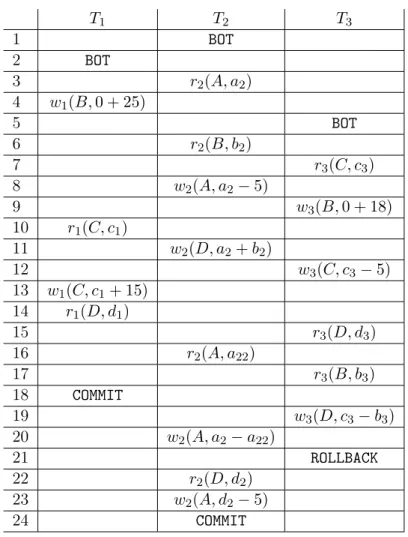
Task 1 (Logging) [1point] Consider the schedule in Figure 1, which shows the three transactionsT1,T2 and T3. The
capital letters A, B, C and D represent fields in the database and ai, bi, ci and di are local variables of the different transactions. Moreover, ri(Γ, γ) denotes a read (the value of the field Γ is read from the database and stored in the local variable γ) and wi(Γ, γ) indicates a write (the value represented byγ is written to the fieldΓin the database). COMMIT marks the successful termination of a transaction andROLLBACKthe rollback of a transaction. Assume that the rollback of a transaction takes places before the next action according to the schedule is performed, i.e. the rollback starts at the point marked with ROLLBACK, and completes successfully before the next action takes place. (e.g. theROLLBACKin step 21 finishes before the write in step 22 takes place).
T1 T2 T3 1 BOT 2 BOT 3 r2(A, a2) 4 w1(B,0 + 25) 5 BOT 6 r2(B, b2) 7 r3(C, c3) 8 w2(A, a2−5) 9 w3(B,0 + 18) 10 r1(C, c1) 11 w2(D, a2+b2) 12 w3(C, c3−5) 13 w1(C, c1+ 15) 14 r1(D, d1) 15 r3(D, d3) 16 r2(A, a22) 17 r3(B, b3) 18 COMMIT 19 w3(D, c3−b3) 20 w2(A, a2−a22) 21 ROLLBACK 22 r2(D, d2) 23 w2(A, d2−5) 24 COMMIT
Figure 1: Schedule for exercise 1.
Finally, assume that at the start (line 1) relevant part of the database consists of the following values:
A: 10 B: 57 C: 31 D: 43
(a) For each line of the schedule where either a field in the database or a local variable is changed, provide the value of this field/variable after the operation. Provide the corre-sponding line number of the schedule (for all changes caused by the ROLLBACK, use line number 21).
Wert 3 a2 = 10 4 B= 25 6 b2= 25 7 c3= 31 8 A= 5 9 B= 18 10 c1= 31 11 D= 35 12 C= 26 13 C= 46 14 d1= 35 15 d3= 35 16 a22 = 5 17 b3 = 18 19 D= 13 20 A= 5 21 D= 35 21 C = 51 21 B = 25 22 d2= 35 23 A= 30
(b) List the log records created by this schedule in the order of their creation. Use the format described at the beginning of this section. Recall that the redo- and undo information are supposed to be recorded using addition and subtraction. Assume that each fieldΓ is located on the pagePΓ. To increase readability, please use the style #i for theLSN and
PrevLSN. If, for some record, no previous record exists, please use0as the previous LSN. Your list should also include the log records for the rollback ofT3.
Note: Format the log records in a readable way, e.g. in a real list (with one entry per row) or a table (again, one record per row). Donot write the log records as continuous text. If the answer is formatted in a way that is not readable, we may give 0 points for this exercise. (In case you use the LATEX template provided, you can find a suggestion for a somewhat readable format there.)
Lösung:
Log:
[LSN, TA, PageID, Redo, Undo, PrevLSN] bzw.
hLSN, TA, PageID, Redo, PrevLSN, UndoNextLSNi
1 [#1,T2,BOT, #0] 2 [#2,T1,BOT, #0] 4 [#3,T1,PB, B-=32, B+=32, #2] 5 [#4,T3,BOT, #0] 8 [#5,T2,PA, A-=5, A+=5, #1] 9 [#6,T3,PB, B-=7, B+=7, #4] 11 [#7,T2,PD, D-=8, D+=8, #5] 12 [#8,T3,PC, C-=5, C+=5, #6] 13 [#9,T1,PC, C+=20, C-=20, #3] 18 [#10,T1,COMMIT, #9] 19 [#11,T3,PD, D-=22, D+=22, #8] 20 [#12,T2,PA, A+=0, A-=0, #7] 21 h#13, T3,PD, D+=22, #11, #8i 21 h#14, T3,PC, C+=5, #13, #6i 21 h#15, T3,PB, B+=7, #14, #4i 21 h#16, T3,BOT, #15i 23 [#17,T2,PA, A+=25, A-=25, #12] 24 [#18,T2,COMMIT, #17]
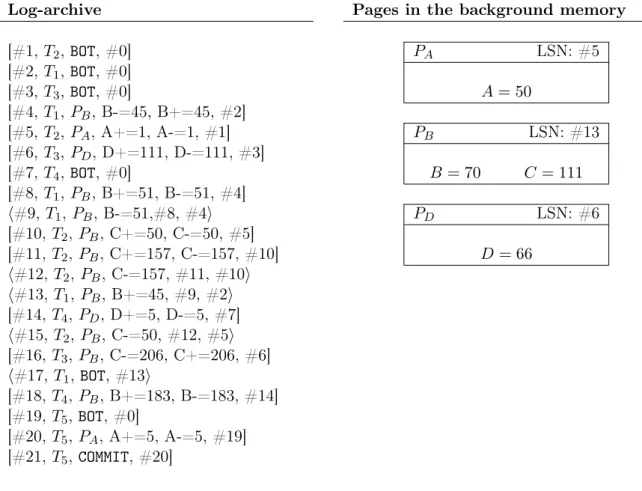
Task 2 (Recovery) [1.5 points] Suppose that after a crash of some database system you find the situation shown in Figure 2. The left side of the figure shows the content of the recovered logfile. On the right side, the content of the pagesPA,PB, and PD is illustrated.
Log-archive [#1,T2,BOT, #0] [#2,T1,BOT, #0] [#3,T3,BOT, #0] [#4,T1,PB, B-=45, B+=45, #2] [#5,T2,PA, A+=1, A-=1, #1] [#6,T3,PD, D+=111, D-=111, #3] [#7,T4,BOT, #0] [#8,T1,PB, B+=51, B-=51, #4] h#9, T1,PB, B-=51,#8, #4i [#10,T2,PB, C+=50, C-=50, #5] [#11,T2,PB, C+=157, C-=157, #10] h#12, T2,PB, C-=157, #11, #10i h#13, T1,PB, B+=45, #9, #2i [#14,T4,PD, D+=5, D-=5, #7] h#15, T2,PB, C-=50, #12, #5i [#16,T3,PB, C-=206, C+=206, #6] h#17, T1,BOT, #13i [#18,T4,PB, B+=183, B-=183, #14] [#19,T5,BOT, #0] [#20,T5,PA, A+=5, A-=5, #19] [#21,T5,COMMIT, #20]
Pages in the background memory
PA LSN: #5 A= 50 PB LSN: #13 B= 70 C = 111 PD LSN: #6 D= 66
Figure 2: Specification for Task 2: The content of the log archive (left) and the pages of the database (right) after some crash.
Use this information to carry out a recovery of the database. (a) State the values ofA,B,C, and Dafter the redo-step.
Lösung:
A:55; B:253; C:-145; D:71
(b) State the Compensation Log Records (CLRs) created during the recovery. Lösung:
Log:
hLSN, TA, PageID, Redo, PrevLSN, UndoNextLSNi h#22, T4,PB, B-=183, #18, #14i h#23, T3,PC, C+=206, #16, #6i h#24, T4,PD, D-=5, #22, #7i h#25, T4,BOT, #24i h#26, T3,PD, D-=111, #23, #3i h#27, T2,PA, A-=1, #15, #1i h#28, T3,BOT, #26i h#29, T2,BOT, #27i
(c) State the values of A,B,C, and Donce the recovery is completed. Lösung:
Concurrency Control
Task 3 (Properties of transactions) [2.6 points]
Consider the set T of transactions and the corresponding scheduleH, which is given by a
sequence of basic operations:
T ={T1, T2, T3, T4, T5, T6, T7}
H=b1 → r1(A)→ b2 → r2(B) →r2(A) → w2(B) → b3 →w3(C) → b7 →w1(A) → r7(C)
→b6 → b4 → r6(A) →w4(A)→ r7(A) →b5 →w6(A)→ r3(A)→ r7(B) →r6(B) → r7(C)
→ w5(D) → w6(C) → a6 → a1 → r5(B) → r2(C) → r5(C) → c2 → r3(C) → w5(C) → c3
→w5(B) →c7 → c5 → w4(D) → c4.
(a) Create the precedence graph (serializability graph) SG(H).
(b) For each edge in the precedence graph, provide at least one pair pi → pj of operations that justify the existence of this edge.
For the edgesT2 →T5,T3 →T6, andT4 →T7 (if they are part of the graph) listall pairs
of operations that justify the existence of these edges.
(c) If the schedule is conflict serializable, state one possible conflict equivalent serial order of the transactions. If the schedule is not conflict serializable, state a minimal set of transactions that must be removed from the schedule to get a conflict serializable schedule. For the remaining schedule, state such a conflict equivalent serial schedule.
(d) List all pairs of transactions(Ti, Tj) in the schedule H such that Tj reads from Ti. For each such pair(Ti, Tj) state at least one pair (wi(X), rj(X))of operations that makeTj reading fromTi.
(e) Determine which of the following properties hold for the schedule H:
• Recoverable
• Avoids cascading abort • Strict
Justify your answer.
(f) Determine which of the properties from part (e) of this task (Recoverable, avoids cascading abort, and strict) are satisfied by the following schedule consisting of four transactions T1,T2,T3 andT4:
b1 →b2 →b3 →b4 →r3(A) →w2(A) →w4(C)→r1(B) →r2(A)→w4(C) →r2(A)→
a4 → w3(C) → w2(B) → c2 → r1(A) → w3(B) → r3(A) → w1(C) → c3 → r1(C) →
r1(B)→c1
Lösung:
(a) Precedence graph:
T2
T3 T4
T5
T7
(b) “Reasons” for the edges: T2 →T4 • r2(A)→w4(A) T2 →T5 • r2(B)→w5(B) • r2(C)→w5(C) • w2(B)→r5(B) • w2(B)→w5(B) T2 →T7 • w2(B)→r7(B) T3 →T2 • w3(C)→r2(C) T3 →T5 • r3(C)→w5(C) • w3(C)→r5(C) • w3(C)→w5(C) T3 →T7 • w3(C)→r7(C) • w3(C)→r7(C) T4 →T3 • w4(A)→r3(A) T4 →T7 • w4(A)→r7(A) T5 →T4 • w5(D)→w4(D) T7 →T5 • r7(B)→w5(B) • r7(C)→w5(C) • r7(C)→w5(C) (c) Conflict serializable:
No, the scheduleis notconflict serializable: The precedence graph contains several cycles, e.g.
• T3 →T2 →T7 →T5 →T4→T3
• T3 →T2 →T4 →T3
• T3 →T7 →T5 →T4 →T3
• T3 →T5 →T4 →T3
• T4 →T7 →T5 →T4
Aborting only one transaction is not enough. More precisely at least two transactions must be canceled in order to obtain a conflict serializable schedule. There are several possible solutions, e.g. abortT3 and T7. The resulting precedence graph
T2
T4
T5
(This precedence graph was not asked in the exercises!)
The schedule of the remaining transactions is conflict serializable. One possible equivalent serial execution is
T2 before T5 before T4
(d) Reading dependencies:
• T2 reads fromT3: (w3(C), r2(C))(w6(C) has been reset)
• T3 reads fromT6: (w6(A), r3(A))
• T5 reads fromT2: (w2(B), r5(B))
• T5 reads fromT3: (w3(C), r5(C))(w6(C) has been reset)
• T6 reads fromT2: (w2(B), r6(B))
• T7 reads fromT2: (w2(B), r7(B))
• T7 reads fromT3: (w3(C), r7(C)),(w3(C), r7(C))
• T7 reads fromT4: (w4(A), r7(A))
(e) Classification of the schedule: • Recoverable:
No, the schedule is not recoverable. A schedule is recoverable if no transaction Ti COMMITsbefore a transactions from which Ti has read.
Except from T6, which reads from T2 and aborts (therefore, never COMMITs) and
T7 which COMMITs before T4 and depends on the value read from T4, all reading
transactions commit before transactions from which they read. • Avoid cascading abort:
No. Clearly this results from the fact that the schedule is not recoverable. However, there is also a concrete counter example. To avoid cascading aborts it is necessary that each operation reads a value written from a successfully committed transaction. The present schedule violates this condition in many cases. One example can be found at the end of the first row: r7(c) reads a value of w3(C), although T3 is still
• Strict Schedule:
No. Firstly, this is because the schedule does not avoid cascading aborts. Moreover, the counter example mentioned abover7(C) andw3(C) is also an example of a non
strict schedule. A further example which additionally violates the condition for a strict schedule is the operation w5(C) at the end of the third row. This operation
overwritesw3(C), but T3 is not finished yet.
(f) Properties of the second schedule: • Recoverable:
Yes, the schedule is recoverableT1 and T3 read from T2 and T2 commits before T1
andT3. Additionally,T1 reads fromT3, but commits afterT3.
• Avoids cascading aborts:
Yes, the schedule avoids cascading aborts. Each reading access to a date written by another transaction occurs after the commit of the writing transaction.
• Strict schedule:
No. The schedule is not strict, because T1 overwrites the value C before T3 (the
transaction which wrote the value before T1) commits. I.e. we found w3(C) before
Task 4 (Locks and Deadlocks) [2.5 points]
Consider the sequence of lock requests shown below, where “lockSi(O)” (resp. “lockXi(O)”) indicates a transaction Ti requesting a shared (resp. an exclusive) lock on an object O, and “reli(O)” describes a transactionTi releasing all locks on O:
lockX1(C) → lockS3(D) → lockS2(D) → lockX4(A) → lockX4(D) → lockS1(A) →
lockX2(B) → lockS4(B) → rel2(D) → lockS3(C) → lockX3(B).
(a) Assume some DBMS receives the above sequence of lock requests and works through them in the given order. Whenever some request cannot be granted to a transaction, this transaction is blocked (i.e. its subsequent lock requests are postponed until the transaction is revoked).
State the order in which the DBMS works through the lock requests, and state immedi-ately after each request whether the lock is granted or whether the transaction has to wait for it. Use grantSi(O) and grantXi(O) to denote that a shared- resp. exclusive lock on an objectOis granted, usewait(i)to indicate that a transaction was blocked to wait for a lock, userelSi(O) and relXi(O) to show that a shared- resp. exclusive lock on object O was released (as the result of some reli(O)), and useresume(i) to indicate that some transaction was revoked because the requested lock is now available and is granted. To determine the correct order, assume that once a blocked transaction is revoked, it catches up all “skipped” operations, i.e. all of its omitted operations are performed, until either the transaction blocks again, or there are no more omitted operations for this transactions. Only if one of these two conditions is reached, proceed with working through the actions on the original release.
Example: Consider the sequence
lockS1(A) → lockS2(A) → lockX1(A) →lockX2(B) → lockS1(B)
of lock requests of two transactionsT1,T2.
We obtain the following list:
1: lockS1(A) 2: grantS1(A) 3: lockS2(A) 4: grantS2(A) 5: lockX1(A) 6: wait(1) 7: lockX2(B) 8: grantX2(B) Lösung:
1: lockX1(C) 2: grantX1(C) 3: lockS3(D) 4: grantS3(D) 5: lockS2(D) 6: grantS2(D) 7: lockX4(A) 8: grantX4(A) 9: lockX4(D) 10: wait(4) 11: lockS1(A) 12: wait(1) 13: lockX2(B) 14: grantX2(B) 15: rel2(D) 16: relS2(D) 17: lockS3(C) 18: wait(3)
(b) Sketch the current situation of held locks resp. blocked transactions. Therefor provide a table as shown below. Into each field of the table, insert anX (aS) if the corresponding transaction has an exclusive (resp. a shared) lock on this object. For each blocked trans-action fill in aW S (wait shared) orW X (wait exclusive) into the corresponding field for the lock request that blocked the transaction.
Lösung: A B C D T1 WS X T2 X T3 S WS S T4 X WX
(c) Show the wait (“wait-for”) graph for the current situation. Lösung:
wait-for graph:
T3 T2
T1
T4
(d) State whether there currently exists a deadlock. Solution: Yes (e) State one possible sequence of releases that releases all locks currently held. If releasing
have to be handled before additional releases may be defined. If there currently exists a deadlock, abort transactionT4 (i.e. all locks ofT4 are released immediately).
Lösung:
As there is currently a deadlock, transaction T4 is aborted. This leads to the following
release:
rel4(A)→relX4(A)
Due to this releaseT1 can continue and we get:
resume(1)→grantS1(A)
NowT1 can release its locks again.
rel1(A)→relS1(A)→rel1(C)→relX1(C)
Thus transactionT3 can proceed
resume(3)→grantS3(C)→lockX3(B)→wait(3)
NowT2 can release the locks
rel2(B)→relX2(B)
Which leads to the fact thatT3 gets the last lock and subsequently also all locks can be
released.
resume(3)→grantX3(B)→rel3(C)→relS3(C)→rel3(B)→relX3(B)
(f) Consider the given sequence of lock requests and releases. Does it violate two-phase locking (2PL)? What about the sequence you created in task (e)?
Lösung:
No. In both cases no transaction requests a lock after releasing the first lock. This meets the requirements of 2PL.
Task 5 (Two-Phase Locking) [1.5 points]
Consider the following three transactions T1, T2, and T3, and the respective sequence of
operations (ri(O) and wi(O) denote a read- resp. write operation by Ti on O, andci marks the commit ofTi).
T1: r1(A) → r1(B) → w1(A) → w1(C) → w1(B) → c1
T2: r2(A) → r2(D) → w2(D) → r2(A) → w2(E) → c2
T3: w3(C) → r3(C) → r3(B) → w3(D) → r3(E) → c3
Assume that(“normal”) 2 Phase Lockingis applied to these transactions. State the resulting schedule (consisting of the lock requests, the read- and write operations, the releases of the locks, and the commits).
Make the following assumptions:
• Notation: Please use lockSi(O) and lockXi(O) to denote a request for a shared- resp. exclusive lock on object O by transaction Ti. Please also use reli(O) to indicate the release of all locks byTi onO. (Hint: You don’t need to state explicitly whether a lock is granted or not. This information is given implicitly by the transaction performing a corresponding read resp. write afterwards – or not.)
• Lock requests and releasing locks: For each operation (read, write, commit), state the required lock requests (unless the transaction already holds the required locks). In doing so, assume that locks are requested as economical as possible, which means:
– A lock is only requested if it is really needed.
– A lock is held as short as possible, i.e. locks are requested at the latest possible time and released at the earliest possible point in time.
• Scheduling of the transactions: Assume that each transaction performs one operations (read, write, commit) before the next transaction is scheduled. I.e., in our case the real sequence of actions is r1(A) → r2(A) → w3(C) → r1(B) → . . .. Lock requests and
releasing locks do not count as operations, i.e. before and after each operation (read, write, commit), the transaction is allowed to request or release an arbitrary number of locks, before it is the next transactions turn.
Deviations from this sequence are only allowed if one transaction is blocked. In such a case, the transaction is omitted every time it is blocked. This is continued until the transaction is revoked. Once this happens, the transaction again takes her turns in the schedule as before – again only performing one operation (read, write, commit) per turn. The following example demonstrates the control flow for two transactions: Assume T1
consists of actionsα1, α2, . . ., andT2ofβ1, β2, . . .. The normal sequence isα1, β1, α2, β2, . . ..
Assuming T2 requires a lock for β3 that is held byT1, i.e.T2 blocks, then the sequence
would continueα3, α4, α5, . . .. If the lock is released afterα5, then the sequence
Task 6 (Multi-Granularity Locking) [2.4 points] Consider the hierarchy within a database depicted in Figure 3.
D a1 p1 s1 s2 p2 s3 s4 a2 p3 s5 s6 p4 s7 p5 s8 s9 a3 p6 s10 s11 s12
Figure 3: Hierarchy of database objects for Task 6
Consider the following sequences of lock requests and releases of locks of four transactions T1,T2,T3, and T4 on the resources described in Figure 3.
(a) lockS1(p2) → lockX2(s9) → lockS3(p6) → lockX1(p3) → lockS3(s4) → lockX2(s3) →
lockS4(a1)→ rel1(p2)
(b) lockX1(p4) → lockS2(p5) → lockX3(p1) → lockS3(s8) → lockX2(s5) → lockX1(s6) →
lockX1(p1) → lockS2(p3)→ lockS4(s10) →rel3(s8) lockX3(s7) → rel1(p4)
Within these sequences,lockSi(O)denotes transactionTirequesting a shared lock on object O,lockXi(O)denotes transaction Ti requesting an exclusive lock onO, andreli(O)denotes transactionTi releasing all locks held onO.
Answer the following questions for both sequences:
• Show how one has to proceed to process the lock requests and releases of locks in accordance to the Multi Granularity Locking (MGL) protocol: State the sequence of required lock requests, and in the case of a release state which further locks can be released as a result. Hint: Make sure to keep the required order in both cases, when requesting and releasing a lock.
Please use the following notation: lockISi(O),lockIXi(O),lockSi(O), andlockXi(O) for transactionTirequesting aIS-,IX-,S- resp.X-lock on objectO;relISi(O),relIXi(O), relSi(O), andrelXi(O)for transactionTi releasing aIS-,IS-,S- resp.X-lock on object O. Make also sure that a transaction only requires locks it does not already hold. • Mark lock requests that cannot be granted. Assume that in such a case the
correspond-ing transaction is blocked, i.e. no further actions of the transaction are performed until the lock is granted and the transaction revoked. This may happen because of another transaction releasing the lock (Lock requests and releases of locks of blocked transac-tions are omitted). Once the transaction is revoked, all omitted actransac-tions are made up for before the processing of the sequence is continued at the position where the lock was released.
• For each declined lock, state why this lock is not granted.
• Does a deadlock occur as a result of this sequence? If this is the case, explain why. • If no deadlock occurs, but there is at least one transaction blocked at the end of the
sequence: Provide a minimal number of locks that must be released to continue these transactions. By doing that, note that transactions can only release shared and exclusive locks explicitly; but provide also the IX- and IS-locks which are released implicitly by them. (Don’t forget to maintain the right order.)
Once the blocked transaction is revoked, continue the execution of this transaction. If this makes the transaction block again, state again a minimal number of locks that need to be released in order to continue with processing the transaction.
Hint:
• If the situation occurs that a transaction acquires a lock it already holds on one or more children of this node, you may assume that these locks are automatically removed from the child nodes (you need not state the release of these locks explicitly).
Task 7 (Timestamp based Locking) [3 points] Consider the following sequence of operations of four transactionsT1,T2,T3, andT4 which
access three objectsA,B, and C.
BOT2 → BOT3 → w2(A) → w3(A) → BOT1 → r2(A) → r2(B) → w1(B) → BOT4 → r2(B) →
res?→ w4(C) → r1(A) →r2(C) → w4(B) → c2 → c3 → res?→ c1 →c4
In this sequence,BOTi denotes the start of a transactioni,ri(X) denotes a read (transaction Tireads objectX),wi(X)denotes a write (transactionTiwrites objectX), andcidenotes the successful termination (commit) of transaction i. Entries res? indicate that at these points in time, one transaction shall be restarted in case some transaction has been reset earlier but was not yet restarted. In case there is more than one such transaction, restart the transaction that was reset first. After the restart, execute all operations of this transaction prior to the current position (i.e. the position of the currentres?) in the sequence.
(a) Use the concurrency control protocol based on timestamps discussed in the lecture to create a valid (according to this protocol) schedule. Use the version of the protocol that not necessarily creates recoverable schedules. I.e. writes are performed immediately and the access to such fields is controlled only by the read- and write timestamps (i.e. transaction are either reset or get access, but are not blocked).
In case some transaction is reset, you need not care about whether other transactions are affected by this rollback. Only the current transaction is reset, and no cascading rollback is performed (even if possible).
In case of such a rollback, both the read- and write TS of all fields remain unchanged. Please state the resulting schedule as a table with the following columns:
# action rTS(A) wTS(A) rTS(B) wTS(B) rTS(C) wTS(C)
The column # should contain an increasing number. For the column action, please use the format forBOT actions, COMMIT actions, as well as reads and writes described above
and also used in the description. If a transaction is reset, please use reseti for the corresponding record. In the remaining columns, please state the values of the read- and write TS after the execution of the corresponding action.
(b) Is the created schedule recoverable?
(c) Next, use the variant of the protocol that guarantees strict schedules. (Apply the variant using a dirty bit.) In case a transaction is reset – if applicable – the write timestamps shall be reset as well. Read timestamps remain unchanged.
Like for exercise a), state the resulting schedule in a table. In addition to the information already provided in exercise a), also provide these information:
• state for each fieldA,B, andC whether the dirty bit is set or not. I.e., use a table with the following columns:
# action wTS(A) d(A) rTS(B) wTS(B) d(B) rTS(C) wTS(C) d(C) • If a transactionTi is blocked, add blocki to the schedule.
(d) Is the created schedule recoverable?
To solve these exercises, please consider the following assumptions and conventions: • Assume that the initial values of readTSand writeTSof each, A,B, and C is 0. • As timestamps for the transactions, use the #of the correspondingBOT record.
• When you reach the end of the schedule and there are still transactions that have been reset but not yet restartet (i.e. no suitable res? record exists), then this transaction is just not restartet.
Task 8 (Transactions in SQL) [0.5 points] Consider the following relational schema of a company, that contains records of performed tasks and charging information on these tasks:
(Primary keys are underlined, foreign keys are italic).
Tasks (task_id, by_person, for_person, task_description, amount) paid (task_id: Tasks.task_id)
approved (task_id: Tasks.task_id, approval)
Identify for every scenario described below thelowest isolation level that offers the required degree of isolation, respectively. Describe also, whether transactions can run with the given concurrency in their respective isolation level as desired, or whether problems are occurring. Due to lack of space, below we provide only sketches of the queries/transactions. You can find the complete queries in the available SQL files.
(a) Description: Alice and Bob both insert a new task, for which the other person is charged, respectively. When doing so, they subtract from the actual cost of the task the amount of money they owe the other person. The company has strict conditions for inserting new tasks: tasks are not allowed to be inserted in parallel, but it must be possible to identify a clear order in which the tasks were added.
Schedule:
Alice Bob
BEGIN;
SET TRANSACTION ISOLATION LEVEL ____ BEGIN;
SET TRANSACTION ISOLATION LEVEL ____ SELECT sum(amount)
FROM Tasks(’Bob’, ’Alice’); INSERT INTO paid
(SELECT task_id
FROM Tasks(’Bob’, ’Alice’)); INSERT INTO Tasks VALUES
(9, ’Alice’, ’Bob’, ’work’, 211.20);
SELECT sum(amount)
FROM Tasks(’Alice’, ’Bob’); INSERT INTO paid
(SELECT task_id
FROM Tasks(’Alice’, ’Bob’)); INSERT INTO Tasks VALUES
(8, ’Bob’, ’Alice’, ’work’, 211.20); COMMIT;
COMMIT; whereTasks(a,b)stands for the following string:
Tasks WHERE by_person=a AND for_person=b AND task_id NOT IN (SELECT task_id FROM paid)
Lösung:
Isolation Level: SERIALIZABLE
(b) Description: Before customers can be charged for tasks, the corresponding task has to be approved by the responsible supervisor. The approvals are inserted in the database within the scope of transactions. These transactions should restrict the possibility of executing transactions in parallel as little as possible. In addition, it is no problem if finished parallel updates on the database become visible during the course of these transactions.
Schedule:
Supervisor Parallel Queries
BEGIN;
SET TRANSACTION ISOLATION LEVEL ____ SELECT * FROM Tasks WHERE ¬approved
INSERT INTO Tasks VALUES (12, ...); INSERT INTO Tasks VALUES (13, ...); SELECT * FROM Tasks NATURAL JOIN paid
SELECT * FROM Tasks NATURAL JOIN paid WHERE ¬paid
INSERT INTO approved VALUES (5, ...); SELECT * FROM Tasks WHERE ¬approved
INSERT INTO Tasks VALUES (10, ...); INSERT INTO Tasks VALUES (11, ...); SELECT * FROM Tasks WHERE ¬approved
COMMIT;
where¬approved and¬paidstand for the conditions: task_id NOT IN (SELECT task_id FROM approved)resp. task_id NOT IN (SELECT task_id FROM paid)
Lösung:
Isolation Level: READ COMMITTED
(c) Description: Accounting wants to issue invoices to customers with approved, but yet unpaid tasks. For this operation (i.e., billing), it is important to work with consistent data, i.e. the data must not change due to parallel writes while the invoices are created. Schedule:
Supervisor Parallel Queries
BEGIN;
SET TRANSACTION ISOLATION LEVEL ____ SELECT * FROM open
INSERT INTO Tasks VALUES (12, ...); INSERT INTO Tasks VALUES (13, ...); SELECT sum(amount) FROM open
INSERT INTO Tasks VALUES (10, ...); INSERT INTO Tasks VALUES (11, ...); SELECT count(task_id) FROM open
whereopenstands for the condition
tasks NATURAL JOIN approved WHERE task_id NOT IN (SELCT task_id FROM paid)
Lösung:
Isolation Level: REPEATABLE READ
Please note: You can test these scenarios with the SQL files on a DBMS (the files are written for Postgres, but they can be tested with minor changes on another DBMS). With Postgres, please proceed as follows:
1. Open a database console by the commandpsql.
2. In another terminal, open a second database console bypsql.
3. In one terminal, load the scenario by\i Szenario1-a.sql(where “1” should be replaced by the desired number)
4. In the other terminal, load the parallel scenario byıSzenario1-b.sql(where “1” should be replaced by the desired number)
5. The execution of the SQL commands should be interrupted in both terminals with the message Press Enter to continue (i)
6. Press [Enter] in that console wherei has the smaller value.
If the result at a chosen isolation level differs from your expectations, feel free to document this. In this case please provide the DBMS where you executed the transactions.
You can either use a database on your machine, or you can use our serverbordo. You can connect to the server via ssh and then usepsqlto get access to a PostgreSQL database. You can find additional information about how you can connect to the server and log in into the database in TUWEL. Your login information are provided in TUWEL.