A decision framework for
enterprise resource planning
maintenance and upgrade:
A client perspective
Celeste See Pui Ng
∗,†Information Systems Management Research Centre, Queensland University of Technology, 4001 QLD, Australia
SUMMARY
Over the last decade, many large organizations have been shifting from developing their own information system (IS) to licensing and installing large software packages known as enterprise resource planning (ERP) systems. These organizations now face the challenge of maintaining these costly systems and many are about to make their first upgrade decisions. The study reported herein aims to address the following research questions from the ERP-client perspective: (1) What are the fundamental factors driving ERP maintenance and upgrade decisions? (2) How do these factors differ from those for traditional custom, in-house software? and (3) Do existing software and hardware replacement models suffice for ERP maintenance and upgrade decision modeling? A single case study method and empirical data analysis were conducted and are presented here. We observe that ERP maintenance and upgrade characteristics are indeed unique in three ways: (1) most organizations maintain and upgrade their ERP systems in order to realize increased business benefits from the systems; (2) a new version upgrade reduces the number of ERP-client-done enhancement modifications; and (3) a new version upgrade potentially reduces future legal change patch (LCP) maintenance distributed by the ERP vendor. It was also found that on average LCP maintenance
is almost as costly asuser enhancements. Based on these findings, we conclude that the existing in-house
software and hardware replacement models are insufficient for ERP situations. We propose a preliminary
ERP decision model that overcomes the observed insufficiencies. Copyright2001 John Wiley & Sons, Ltd.
KEY WORDS: package software; user opportunity cost; software maintenance; software upgrade; decision support; case study
∗Correspondence to: Celeste See Pui Ng, Information Systems Management Research Centre, Queensland University of Technology, 4001 QLD, Australia.
Over the last decade, many large organizations have been shifting from developing their business application software to licensing and installing large commercial off-the-shelf software known as enterprise resource planning (ERP) systems. ERP systems are fully integrated, enterprise-wide business applications with not only a complete set of traditional modules such as accounting, human resources management, sales and distribution, and manufacturing, but they also provide extensions such as supply chain management, data warehouse, and customer relationship management. AMR, a well-known research and technology analysis center, claims that in the past decade approximately $300 billion has been invested in ERP worldwide [1]. Trade reports indicate that there are tens of thousands of organizations using ERP and millions of licensed users [2].
Many ERP-using organizations now have several years experience of maintaining their ERP systems and are facing their first ERP upgrades. Glass and Vessey [3] found that annual ERP client-initiated maintenance costs on average approximately 25% of the initial ERP investment. AMR Research states that an ERP upgrade costs approximately a further 25–33% of the initial investment [4], see also [5]. ERP maintenance and upgrade are thus costly decisions. The meager trade reports on ERP upgrade policies [6–9] provide mostly anecdotal evidence of practitioners’ experiences, pitfalls to avoid, and factors to consider prior to upgrading. However, little has been written on the ERP maintenance and upgrade decisions. In order to bridge this gap, this paper critically reviews the existing literature on ERP maintenance and upgrade decision drivers and synthesizes a decision framework based on the literature and new findings from our case study. This decision framework is important to ERP managers in making well-informed ERP maintenance and upgrade decisions.
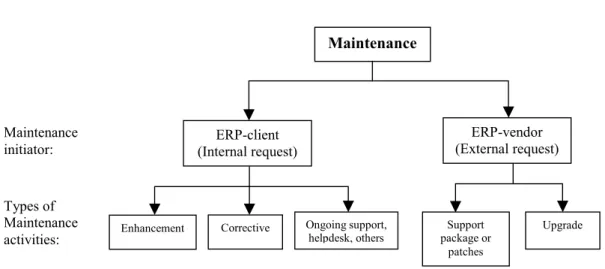
In an ERP environment, maintenance activities originate from two main sources, the ERP-client organization and the vendor [10], and they are illustrated in Figure1. The former includes requests for enhancement, bug fixes, ongoing system support, and helpdesk. The latter comprises support package or patch and upgrade, which are distributed by the vendor but implemented by an ERP client on its ERP system. A support package or patch contains corrections and further adjustments due to legal changes, and minor corrections for errors in the repository or data dictionary enhancements for an installed version. On the other hand, the upgrade version contains substantial enhancements and new functionality.
The size of an ERP upgrade could be classified based on two main dimensions: upgrade-version and upgrade-scope. Basically, there are two categories of upgrade-version: minor and major upgrade. A minor upgrade is described as an upgrade involving the same version series such as from 3.1H to 3.1I or 4.0B to 4.6C whereas a major upgrade is a migration to a different series, for example from three series to four series or higher. Upgrade-scope dimension consists of technical upgrade and functional upgrade. A technical upgrade is a ‘like to like functionality replacement’. On the other hand, a functional upgrade delivers major business improvements and enhancement benefits. However, a detailed discussion on this distinction is not the focus of this paper.
In this study, ERP maintenance and upgrade (or simply MU) decisions involve deciding the amount of ERP client-initiated maintenance-requests, vendor-introduced patches to implement and/or the timing to upgrade an installed ERP system with a new and readily available version. MU decisions will be used together because they are inextricably inter-related, as the upgrade can be postponed by continuing to maintain the existing system. The decision framework proposed is limited to judgement
Maintenance Maintenance initiator: ERP-client (Internal request) ERP-vendor (External request) Types of Maintenance
activities: Enhancement Corrective
Ongoing support, helpdesk, others Support package or patches Upgrade
Figure 1. ERP maintenance activities.
based on cost and benefit perspectives. The discussion on ERP MU decisions in this paper focuses mainly on the client perspective. Although vendors too have ERP maintenance and upgrade problems, this is not the main concern of this paper.
The organization of this paper is as follows. In Section2, background information on factors that influence ERP MU decisions such as ERP maintenance, new version upgrades, and benefit realization are presented. Section 3 describes the case study, data collection, and data analysis. In Section 4, findings from the case study are compared with the fundamental ERP MU decision factors synthesized from the literature; and new findings from the empirical evidence are discussed. Following this (in Section5), these factors (or characteristics driving ERP MU decisions) are evaluated by considering the characteristics considered in the existing in-house software and hardware replacement models. In light of the differences identified, an ERP MU decision framework is proposed in Section 6. A numerical example, illustrating how the proposed model is to work, is provided. In the last section, conclusions and directions for future research are provided.
2. LITERATURE REVIEW
2.1. ERP maintenance
It is argued in the trade press that ERP vendors drive much of their clients’ ERP maintenance and upgrade activities. (This differs from the traditional in-house software in which user-organization has full control over all the maintenance activities.) Vendors provide two main types of maintenance: support packages or legal change patches (LCPs) to the installed version, and new versions of the ERP system for upgrades. Both support package and new version upgrades are supplied by the vendor and implemented by the client, with/without assistance from external consultants, in order to fix bugs,
between support package/LCPs and new version upgrades are: (i) LCPs have relatively smaller impact on an installed ERP code whereas new version upgrades will overwrite an installed version with a new one; (ii) LCPs are introduced more frequently than new version upgrades; (iii) while LCPs are mandatory (in order to keep an installed version up to date), new version upgrades are optional as long as an installed version is still supported by the vendor; (iv) a new version upgrade is much more complex, expensive, and lengthy to implement than a LCP implementation; and (v) functional upgrade provides extensive new functionality than LCP maintenance.
ERP systems and industry solutions are generic solutions. More often than not, modifications which refer to the changes made to the standard ERP code and/or development of custom code are required during the implementation of an ERP system [11,12]. The number of modifications is dependent on the degree of fit between the ERP system and the organization’s existing (or desired) business processes, and the willingness of the organization to adapt its way of doing business to the package [13]. Anecdotal evidence suggests that the more modifications are done to the system at implementation time, the higher will be the billable hours or cost per LCP maintenance job [6]. This is because implementing a LCP maintenance will overwrite some of the custom code and previous modifications. Therefore, more effort is required to conduct impact analysis to verify the effects of each LCP (or support package) on each of the previous modifications [8]. Sometimes, re-application and re-testing of some of the previous modifications are required if they have been overwritten by a LCP. In fact, this modification does not end after the implementation phase. The modification done during the system implementation is the first maintenance project on an ERP system. These modification requests could also be introduced in the post-implementation or maintenance phase. They are called enhancement modifications in this study. Hence, modification should be a function of what is done during system implementation and also an accumulation of the related activities in the post-implementation phase.
2.2. New version upgrade
Unlike in-house software replacement, which requires much software development effort and extensive details of what and how the software system functions [14], the ERP-client could upgrade the installed version with a version readily available on the market. Upgrading an installed version to a new version is part of ERP post-implementation activities. In contrast to LCP maintenance, organizations typically upgrade to a new ERP version in order to realize the benefits of substantial new functionality [15], and new technologies or business opportunities (such as enterprise portal, data warehouse, and e-commerce) [16]. On the other hand, sometimes organizations feel compelled to upgrade, as the vendor withdraws support for old versions. ERP vendors impose a fixed time period for maintenance support for each version of the system [8,17,18]. A supported version of an ERP system is eligible for helpdesk support, and LCP support. After the support window is reached, ERP-clients will be entirely on their own in maintaining their systems. (However, in some cases, the vendors offer a service of monitoring the unsupported systems for their clients but this support is very limited and incurs a fee.)
Nevertheless, most of the trade press has cited that cost is prohibitive in considering an upgrade to an ERP system [4]. The upgrade cost could be as high as 25–33% of the initial ERP implementation [5]. Similar to the initial ERP implementation and acquisition cost, upgrade cost (including technical and functional upgrade) consists of the software cost, hardware cost, user training cost, consultancy fees,
flexibility, and extensibility, will generally cost more to upgrade. It is perceived that an organization is more likely to upgrade to the latest version of an ERP system. Some of the advantages for upgrading to the latest version of an ERP system are: (i) a minimal number of future upgrades; (ii) a longer period of maintenance support from the vendor; and (iii) the gaining of a competitive advantage through early utilization of new technologies. Upgrading to a new version of an ERP system often entails some purchase of additional and more powerful hardware [19], or new hardware that is compatible with the new system.
User training costs, associated with re-training the ERP system’s users, are driven by changes in the user interface and/or new functionality in a new system [5]. An increase in costs is anticipated if these features are dramatically different from an existing system. An ERP upgrade is a complex and large project requiring a wide range of knowledge and expertise, for example, in the area of software functionality, system configuration, system integration, business processes, project management, change management, and other technical aspects of new software and hardware. This knowledge and expertise is necessary for a successful upgrade of an ERP system [9,20,21]. However, not all of this knowledge and expertise is available internally, particularly for the first ERP upgrade project. Hence, most of the time, external consultants are required.
On the other hand, upgrade implementation costs involve the cost of data conversion, system analysis, system integration and testing, and post-implementation turmoil [22,23]. Post-implementation turmoil here refers to the potential system disruptions (e.g. a dip in operational efficiency and effectiveness) [24] or downtime in relation to the implementation of an upgrade or installation of a new system. It includes change management [7,25,26]. In general, upgrade implementation costs are driven by the complexity of the upgrade project, which is determined by the number of modules to be implemented and the number of business units involved.
2.3. Benefit realization
The third driver influencing an ERP MU decision is benefit realization from an installed ERP system, which is also known as ERP’ssecond wave. ERP is a real-time and centralized system, and supports complete data visibility for all levels of organizational management. Hence, ERP facilitates corporate and strategic decision making [27–29], enhances information flow among internal processes, and improves information flow to and from customers, suppliers, and business partners. In contrast, most of the traditional in-house applications are designed to support an individual operational or tactical area. Therefore, integration among these individual applications and business processes is not only loosely coupled but is also restrictive, if not prohibiting, to benefit realization from the disparate systems.
Benefit realization in this study means achieving full capabilities and benefits (or business values) from ERP systems through continuous systems maintenance. Besides internal maintenance requests from the system users, ERP-clients also receive maintenance ‘requests’ (as mentioned earlier in Section 2.1) from the vendor. An ERP vendor continuously updates, improves, and develops the ERP software. These business improvements or enhancements and latest technologies are delivered to clients in the forms of support packages or LCPs, and new version upgrades. In order to realize benefits from ERP systems, ERP-employing organizations are required to incorporate support packages, and upgrade to the newest version of an ERP system. (This is also important to the vendor in order to contain its maintenance costs and focus its development efforts on one or a few versions.) These
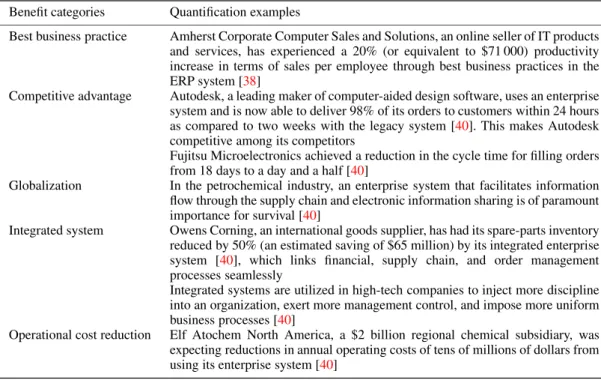
Table I. Examples of benefit realization from ERP systems. Benefit categories Quantification examples
Best business practice Amherst Corporate Computer Sales and Solutions, an online seller of IT products and services, has experienced a 20% (or equivalent to $71 000) productivity increase in terms of sales per employee through best business practices in the ERP system [38]
Competitive advantage Autodesk, a leading maker of computer-aided design software, uses an enterprise system and is now able to deliver 98% of its orders to customers within 24 hours as compared to two weeks with the legacy system [40]. This makes Autodesk competitive among its competitors
Fujitsu Microelectronics achieved a reduction in the cycle time for filling orders from 18 days to a day and a half [40]
Globalization In the petrochemical industry, an enterprise system that facilitates information flow through the supply chain and electronic information sharing is of paramount importance for survival [40]
Integrated system Owens Corning, an international goods supplier, has had its spare-parts inventory reduced by 50% (an estimated saving of $65 million) by its integrated enterprise system [40], which links financial, supply chain, and order management processes seamlessly
Integrated systems are utilized in high-tech companies to inject more discipline into an organization, exert more management control, and impose more uniform business processes [40]
Operational cost reduction Elf Atochem North America, a $2 billion regional chemical subsidiary, was expecting reductions in annual operating costs of tens of millions of dollars from using its enterprise system [40]
maintenance activities could be beneficial to ERP-clients for operational cost reduction, and generation of business opportunities [29–34]. It is reported that most organizations implement ERP systems because of some fundamental benefits that these organizations could realize from the enterprise systems. These benefits include best business practices [35–38], competitive advantage [39–42], globalization [43–45], integrated systems [46–48], and operational cost reduction [48–50]. It is assumed that these benefits will remain as the drivers for continuous ERP MU activities.
Best business practices are associated with improvements in business processes and business perfor-mance such as cost, quality, service, speed, and productivity, whereas competitive advantage relates to expansion of the capabilities and power to compete with other competitors. On the other hand, glob-alization is being engaged in activities which enhance the flow of information to and from customers, suppliers, and other business partners outside the enterprise in a tightly coupled mode. An integrated system benefits from an enhanced flow of information, better-informed corporate decision-making processes, and seamless system integration and communication among internal business processes. Operational cost reduction is concerned with minimal system operational and maintenance costs.
TableIprovides some illustrations of how these benefits have been realized and quantified by some ERP-clients.
3.1. Case study
In order to gain first-hand insights into ERP maintenance activities and upgrade issues, a case study was conducted [51–53]. The firm involved was a government agency (GA) in Australia. This organization was chosen for several reasons: (1) GA’s comprehensive ERP maintenance records; (2) the Information System Management Research Centre (ISMRC) support from GA and involvement with State Government in collaborative research; and (3) the ISMRC’s ongoing, existing collaborative projects with GA. GA was set up in 1996 and it is a corporate services provider to other Queensland government departments, all of whom use the SAP R/3 ERP system. These Queensland government departments are clients to GA. (SAP, an abbreviation for Systems, Applications, and Products, is a Germany company and one of the leading ERP vendors; the R/3 system is a client–server version of SAP’s software.)
In 1994, the Queensland government planned to replace the non-year-2000 compliant financial and human resources management systems. The SAP R/3 financial (FI) and human resources (HR) modules were selected. The FI module was implemented in November 1998 and HR in late April 1999. The initial version was 3.1H, and GA is upgrading to version 4.6C.
3.2. Data collection
There were five main sources of data collection for the purpose of this study: GA’s maintenance database, a series of semi-structured interviews, maintenance and upgrade documentations, GA’s LCP support database, and GA’s SAP system modifications database. GA’s maintenance database sufficiently records most of the necessary data pertaining to maintenance (i.e. change requests). This includes details on the request type, a description of the problem(s) associated with the request, the time spent on servicing the request, and the respective maintainer(s) and system analyst(s) involved in the maintenance request. It also contains information about the LCP maintenance projects that have been done. The semi-structured interviews were tape-recorded and then transcribed verbatim for context validation by the interviewees. These interviews were conducted with the General Manager, Systems Development Manager, Systems Operations Manager, and System/Business Analyst. Some of the interview questions were: What are the activities involved in the ERP maintenance environment? How does the firm manage its maintenance activities? What are the benefits and costs associated with maintenance activities and upgrade? What are the factors driving ERP maintenance and upgrade decisions, and how could these decisions be optimized? Relevant documents such as (i) GA’s Upgrade Business Case, detailing why GA upgrades to a new version, and all the cost components related to its upgrade exercise, and (ii) SAP R/3 enhancement-maintenance documentation (obtained from the SAP website), describing different options available for implementing enhancement to the SAP system, were consulted. GA’s LCP support database, which is provided by the SAP vendor, contains information about all the LCPs for different versions of the SAP software. On the other hand, the SAP system modifications database consists of details of GA’s existing enhancement modifications, which were done to its installed version of the SAP system, and information about those enhancements that would be required and those that would not be needed after the new upgrade to version 4.6C.
GA’s maintenance database was examined to study maintenance activities done by GA, and determine factors influencing the ERP/SAP maintenance effort. Documentations on SAP maintenance, obtained from the SAP website, were consulted to investigate the options available for carrying out enhancement to an SAP system. Findings from the interview transcripts and evidence from the Upgrade Business Case were utilized to identify the factors driving ERP MU decisions. GA’s LCP support database was explored to study the LCPs, introduced in a series of SAP software versions, distributed by the vendor. On the other hand, GA’s SAP system modifications database was analyzed to research the impact of an upgrade on its existing orpreviousenhancement modifications.
Descriptive data analysis was conducted on: (i) the maintenance request type, maintenance-project complexity, and LCP-project maintenance effort, from the maintenance database; (ii) the number of enhancement modifications required before and after the upgrade, from the modification database; and (iii) the number of LCPs in each version and the number of notes in each LCP, from the data collected from GA’s LCP support database. Non-parametric techniques such as the Kruskal–Wallis test (for several independent samples), and the Mann–Whitney U test (for two independent samples) were used to examine possible differences in the mean between two or more groups [54].
The empirical results were applied to extend the existing knowledge of the ERP MU, and propose a better representation or model of ERP MU decisions. For instance, a reduction in the number of previous enhancement modifications after an upgrade is incorporated into the decision framework proposed later on. The interview transcripts and Upgrade Business Case were used to determine the reliability of the ERP MU framework synthesized from the existing literature. For example, it is found that the two sources are consistent in that benefit realization is one of the main drivers for ERP MU decisions.
Note that the following discussion is focussed on GA’s ERP/SAP change requests, which were initiated from November 1998 to June 2000. Although maintenance requests related to the system usage, user training, and helpdesk is an interesting topic (for more details see [10]), it is not explored in this paper.
4. FINDINGS
4.1. ERP-client internal maintenance activities and effort determinant
Our study shows that maintenance requests from the ERP-client itself make up a major part of the overall ERP maintenance activities. In this study, it is observed that GA manages ERP maintenance activities that come from two main (internal) sources: (i) GA, the corporate service provider, and (ii) system users, GA’s client organizations. GA-initiated maintenance activities are mainly targeted at improving the quality of ongoing support to its clients and containing its operational cost (i.e. called GA enhancement). System users’ requests are aimed at correcting faults in the system and ongoing system support (i.e. corrective and master-data change), and requests for new functionality (user enhancement), which, while important to the business and operating environments, are not currently available from the installed version. An observation made from GA is that in addressing its system users’ maintenance requests, GA usually tries to fulfill the requests within the standard ERP code. All
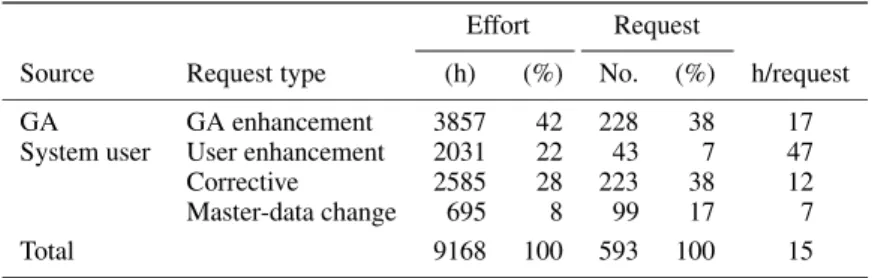
Table II. GA and system users: maintenance effort by request type. Effort Request
Source Request type (h) (%) No. (%) h/request
GA GA enhancement 3857 42 228 38 17
System user User enhancement 2031 22 43 7 47
Corrective 2585 28 223 38 12
Master-data change 695 8 99 17 7
Total 9168 100 593 100 15
corrective maintenance, except that associated with the modified SAP code, will be reported back to SAP and the relevant code or LCP (from the vendor) will then be applied.
Note that there are a number of options available in implementing enhancement requests [13,55]: (i) configuration by setting of the system parameters via SAP’s own interface; (ii) a bolt-on, a third-party package designed to work with the ERP system; (iii) enhancement to the ABAP/4 Dictionary elements such as table append, text enhancement, and field enhancement; (iv) add-on functionality using SAP customer exits; (v) the creation of customer-specific objects, for instance screens, and reports; (vi) workflow programming to create non-standard workflows; (vii) ERP programming, writing additional applications using the vendor’s ERP programming language, without changing the standard code; (viii) interface development to interface the ERP system with legacy systems; and (ix) modification of the SAP standard objects. Customer exit is the SAP R/3 Enhancement Concept that allows clients to add their own functionality to SAP without modifying the standard code. There are four basic types of customer exits: menu exits, screen exits, function module exits, and keyword exits. Brehmet al.[13] argue that enhancement-maintenance efforts depend on the type of these tailoring options. Note that option (i) is generally more favorable than options (ii)–(ix) because it will not be overwritten and affected by the SAP standard code during an upgrade or the implementation of a support package (or LCP). Thus, unlike other options, no ongoing maintenance effort is required for enhancement option (i).
While LCP maintenance efforts are claimed to be dependent on the number of enhancement modifications, this study investigates and provides empirical analysis of the factors which affect the amount of effort required to complete the ERP-client internal maintenance activities/requests. (Note that the ERP-client maintenance activities in GA’s case include those initiated by itself and its own clients.)
4.1.1. Maintenance request type
Effort analysis of the completed maintenance requests (a total of 593 valid data points) shows thatuser enhancementmaintenance requests, which are initiated by GA’s clients, are the most demanding (i.e. on time and effort). On average, it takes 47 (maintainer and analyst) hours to service a user-enhancement maintenance request (refer to Table II). In general, far more effort is required to implement auser
Table III. The Kruskal–Wallis test on four categories of request type.
Maintenance effort (h) Chi-square 56.648
df 3
Asymp. Sig. 0.000
enhancementrequest than aGA enhancementrequest (i.e. 17 hours per request). That is, on average, the implementation of aGA enhancementrequest consumes only 36% of effort required in servicing a user-enhancement request. This is explained as follows.GA enhancementis usually made around the standard SAP code whereas most of theuser enhancementrequests involve developing custom code or making changes to the standard SAP code.
By comparison, the average amount of effort to service a corrective maintenance request (12 h/request) andmaster-data change(7 h/request) is relatively less than the average effort required in aGA enhancementmaintenance request. This is related to the actual task involved incorrectiveand master-data changemaintenance.Correctivemaintenance involves activities such as correcting page formats, reports, error messages, and user interfaces. Depending on the source of the bug or error, if it originates from the standard SAP code, usually SAP’s patches will be applied. However, for bugs found in one of the customizations or modifications, GA will resolve the bugs for the users. Master-data changemaintenance comprises simpler tasks such as updating the master file and database.
An empirical test, the Kruskal–Wallis test [54], was conducted to determine if the means of the request types were statistically different. The results in Table IIIindicate that significant differences did exist in the maintenance effort across the four maintenance request types (p <0.01). Hence, we can say with some confidence that the maintenance request type can be used to predict the amount of effort required for completion.
4.1.2. Maintenance complexity
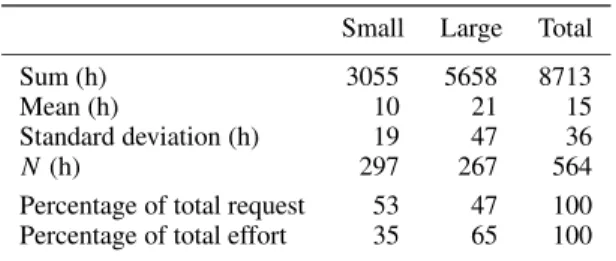
The scope of a maintenance project is used as a surrogate for maintenance complexity in this study. A maintenance project is defined as small(by GA) if not more than one staff member is required in order to accomplish the request (e.g. requests related to security and system configuration). On the other hand, a request which requires more than one staff member for maintenance tasks such as system analysis and programming is classified as a largeproject. (Due to restricted details of these data, another intermediate cluster of maintenance complexity is not possible in our data analysis.) It is observed that more than one-third of the small scope maintenance projects are involved in the request type of master-data change(i.e. work related to ongoing system support). On the other hand, more than half of the large scope projects are associated withuser enhancement. Analysis on maintenance complexity (for a total of 564 valid data points) shows that small scope maintenance projects take,
Table IV. GA and system users: the maintenance effort of two categories of maintenance scope.
Small Large Total
Sum (h) 3055 5658 8713
Mean (h) 10 21 15
Standard deviation (h) 19 47 36
N(h) 297 267 564
Percentage of total request 53 47 100 Percentage of total effort 35 65 100
Table V. The Mann–Whitney test on maintenance complexity. Maintenance effort (h) Mann–Whitney U 31066.500
Wilcoxon W 75319.500
Z −4.442
Asymp. Sig. (2-tailed) 0.000a
aSimilarly, this result is also significant with the Kruskal– Wallis test: chi-squared value=19.736,p <0.01.
on average, 10 h to complete as compared to 21 h for large scope ones (see TableIV). However, the standard deviation for the former is 19 h and that for the latter is 47 h. We note that other factors such as the effectiveness of project team communications, familiarity of the maintainer(s) with the application system, and expertise and programming knowledge of the maintainer(s) in the related area may have some impact on the overall maintenance effort.
The output from the Mann–Whitney test [54] on maintenance complexity indicates that the result was significant (p <0.01), thus significant differences in maintenance effort exist between small and large scope maintenance projects (see TableV). Therefore, we are confident in saying that the scope of a maintenance project can be used to determine the amount of maintenance effort required.
4.2. LCP maintenance
Data analysis on GA’s two large LCP maintenance projects shows that the average effort per LCP is 46 h (see TableVI). The average number of hours per LCP for the first project (57 h/LCP) is observed to be much larger than the second (10 h/LCP). This could be explained by the following factors: (i) familiarities with the LCP maintenance processes and procedures, the average effort required per
Table VI. LCP maintenance effort.
LCP project No. of LCPs No. of notes Notes/LCP Effort (h) h/note h/LCP
Project-1a(LCP # 29-62) 34 4406 130 1918 0.44 57
Project-2 (LCP # 63-72) 10 1212 121 99 0.08 10
Total 44b 5618 128 2017 0.36 46
aThe project for LCP # 1-28 had been implemented earlier but was not recorded in the maintenance database. bDoes not necessarily represent the exact number of LCPs introduced by the vendor during the study period.
LCP drops significantly after the first LCP project; (ii) the batch size of 34 may not be as productive as a batch size of 10, 57 h/LCP versus 10 h/LCP; and (iii) the number and characteristics of the modules involved in an LCP may have an impact on the total effort required for maintenance. Based on our data in TableVI, the number of notes per LCP (in this case) does not seem to be a critical factor influencing the LCP maintenance effort, as they are almost the same in both projects and yet the average number of hours per LCP in these projects are considerably different. Note that a ‘note’ is either a bug fix or an enhancement in an LCP. However, the characteristics of these notes are worth further investigation. More empirical data are required in order to validate the significance of these factors.
LCP maintenance accounts for approximately 18% (or 2017 h) of GA’s total ERP maintenance effort. GA’s General Manager emphasized that if they were to implement LCPs each time they arrived, as many do, instead of batching them, this activity would take up 80% of their maintenance effort or three times the effort now expended. He suggested that how one manages LCPs can have a huge impact on the costs of maintenance; a management strategy might be to batch enter these periodically, e.g. monthly or quarterly, or to monitor LCPs for cumulative benefits and wait until the perceived benefits justify the effort (as does GA). Consistent with the literature, interviews with GA’s Systems Development Manager confirmed that the LCP maintenance effort is driven by the number of enhancement modifications done to the standard ERP code.
4.3. New version upgrade
Interviews with GA’s senior managers and a review of the Upgrade Business Case show that upgrade implementation costs also depend on the version gap or migration path between an existing and a new upgrade version. For instance, upgrade from 3.1H to 3.1I, which are both in the same series, would be relatively cheaper and less complex than from a three series to a four series. The latter is more costly because of the changes in system structure and architecture, and also input screens. Following the changes in input screens completely new supporting documentation and extensive re-training of staff are required. Consistent with the trade press, upgrade cost is a major issue and is prohibitive for GA when considering its ERP system upgrade.
Table VII. A comparison of the total number of enhancement modifications before and after a new version upgrade.
Before upgrade
(from implementation Immediately date until the system after the development is frozen) upgrade
Number of previous 730 498
enhancement modifications
4.3.1. Impact on previous enhancement modifications
GA is an example of an ERP-client that has upgraded its ERP system because of the withdrawal of the vendor’s support for its current version of 3.1H. An upgrade process will reinstate the installed ERP system by the standard/vanillaERP version of the new version. However, the previous enhancement modifications (including bothGA enhancementanduser enhancement) that were set by using system parameters, customer objects, or customer exits, which adhered to SAP strict naming conventions, will not be affected by the upgrade process (nor LCP implementation). In contrast, organization-specific enhancements involving modifications of SAP code will be overwritten. Basic steps involved in an upgrade (or LCP implementation) to identify its impact onpreviousenhancement modifications are: (i) analyzing if the previous developments (e.g. those built using system parameters, customer exits, or customer objects) are working properly in the light of the changes to the SAP standard code or objects; and (ii) investigating if all the previous enhancement modifications, which were developed by using the enhancement options from (ii)–(ix) discussed in Section4.1,are affected or overwritten. However, this is usually signaled in the form of warning/error messages to inform the client-organization of these changes. Depending on the new functionality in the new version, some of the overwritten enhancement modifications may need to be re-applied. Re-testing will begin after re-entering the previous enhancement modifications. Therefore, the upgrade costs also depend on this endeavor.
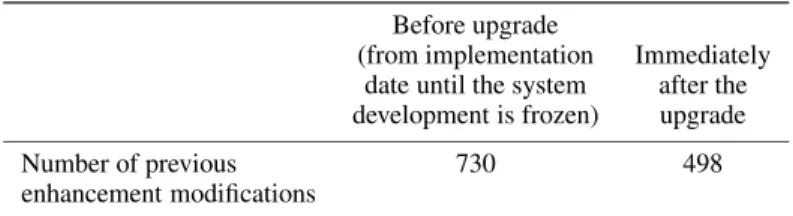
This study finds an interesting result concerning the impact of an upgrade on previous enhancement modifications. Analysis of the number of enhancements done on the installed version of the SAP system, from the system-implementation date until the system development is frozen for upgrade, was conducted for GA by a consulting firm. Based on the consulting firm’s investigation of GA’s installed version 3.1H, and the new capabilities and functionality in version 4.6C, it was found that after the upgrade the number of enhancement modifications decreased by one-third of the original total (see Table VII). Note that these enhancement modifications have an impact on the total effort required to upgrade the SAP system (or to implement an LCP maintenance project in the future). These enhancement modifications could be one of the enhancement options from (ii)–(ix), discussed earlier in Section4.1.
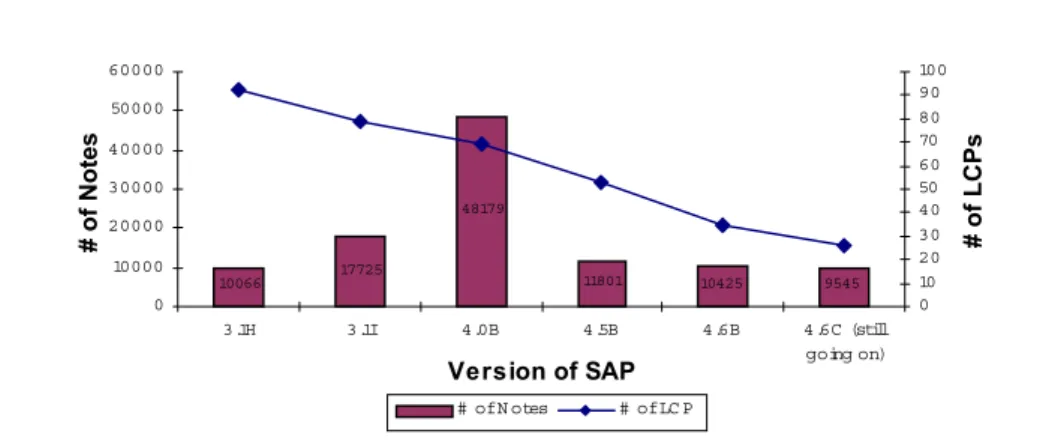
10066 17725 48179 11801 10425 9545 0 10000 20000 30000 40000 50000 60000 3.1H 3.1I 4.0B 4.5B 4.6B 4.6C (still going on) Version of SAP # of Notes 0 10 20 30 40 50 60 70 80 90 100 # of LCPs # of N otes # of LC P
Figure 2. SAP versions with the respective number of LCPs and notes.
The existing literature (see [6,8]) claims that support package or patch maintenance effort is driven by the number of enhancement modifications. In the light of this, together with the finding of a decrease in the total number of enhancement modifications after upgrade, it is expected that maintenance costs and effort for a new upgrade version would be reduced as compared to continuing to maintain an existing installed version. Thus, this could be one of the main advantages which an ERP manager should look for in considering an upgrade option. This decrease is mainly because these enhancement modifications are either now available in the new version or some of them are no longer required. Therefore, this benefit factor should be considered as one of the advantages when making an ERP upgrade decision.
4.3.2. Impact on future LCP maintenance
Analysis of the number of notes, where each note represents a fix or an enhancement, introduced in each of the LCPs initiated in the SAP R/3 versions 3.1H, 3.1I, 4.0B, 4.5B, 4.6B, and 4.6C (up to the end of June 2001 only), shows that the total number of notes and LCPs decreases from an older version to a newer version (Figure2). It is found that, on average, the number of notes decreases by about 44% (from one version to another) for the last three versions (from 4.0B to 4.6B). On the other hand, the number of LCPs, on average, decreases by about 21% from an older version to a later version. Hence, with this incentive it is expected that ERP-employing organizations would be able to set off this cost reduction (besides the cost component mentioned in previous section) against the upgrade cost in order to better justify their upgrade decisions (instead of delaying the upgrade decision, which also leads to delays in benefit realization and higher maintenance cost for the installed version).
It is noted that factors such as the characteristics of each version, the number of users associated with each version, and external technology changes are also worth further investigation in order to refine our findings. For example, a larger number of users will lead to more frequent usage of the system. When this happens more information about the system’s capabilities, functionality, and limitations will
On the other hand, as the system matures and stabilizes, fewer LCPs or notes are expected.
4.4. Benefit realization
The existing trade reports argue that maintenance and upgrades are fundamentally driven by benefit realization from the ERP system. Consistent with these reports, GA maintains its existing system and upgrades to a new version of ERP mainly with the aim of realizing benefits from the system; essentially, it looks for operational cost reduction, integration between financial and human resources systems, and the adoption of best business practices. With benefit realization in mind, Nget al.[10] propose a framework to classify the ERP maintenance activities based on the ERP-client’s benefit perspectives. In the proposed framework, the authors adopt a two-step process in classifying ERP maintenance activities. The first step involves an initial categorization using Chapin’s maintenance activities taxonomy [56] to distinguish enhancement maintenance from the mandatory maintenance activities (such as corrective and ongoing maintenance support); the second step suggests a further classification of enhancement maintenance based on five primary categories of benefit, which are identified as ‘integrated system’, ‘best business practice’, ‘competitive advantage’, ‘globalization’, and ‘operational cost reduction’ (see Section 2.3for details). These are the prevailing benefits of ERP systems to the clients. Recognizing this benefit component is crucial in order to justify costs and benefits for the dominant and expensive enhancement maintenance on ERP systems.
While continual maintenance and regular upgrades may allow organizations to achieve some of the mentioned benefits (although sometimes at high prices), delaying these requests (regardless of whether they are enhancement, corrective or LCP) and upgrades will incur user opportunity cost to the organizations (because of foregoing an earlier benefit realization from the requests and upgrades) (see also Nellemann [57] in his discussion of opportunity cost associated with ‘doing nothing’). Thus, ERP-using organizations should consider this factor as one of the tradeoffs in justifying MU decisions. 4.4.1. User opportunity cost quantification: A simple method
While TableIin Section2.3shows some examples of benefit realization in some organizations from their ERP systems after the maintenance or upgrade was done, some ERP clients may pay very little attention to quantifying user opportunity costs of not implementing the maintenance requests and upgrades. Omitting this quantification step, an organization could be uncertain if it has made an accurate or a best decision on maintenance and upgrade. Hence, in this section, an illustration of a simple method to quantify user opportunity cost, which is basically translated from the unrealized benefit(s), is provided.
It is assumed that all maintenance requests and new version upgrades can be mapped onto one or more of the benefit categories identified in the previous section. This is particularly true with a new version upgrade as it introduces a substantial number of new enhancements and additional functionality. This assumption is also reasonable because ERP/SAP clients are informed of the objectives and benefits of each LCP and upgrade version once they are made available to them. In quantifying user opportunity cost, we propose a two-step ‘weighting’ approach. This is done by first ‘weighting’ the benefit categories based on their degree of importance or criticality to an ERP-client’s business objectives, using a scale of 1 to 3, where ‘1’ indicates least important and ‘3’ is the most
hence its importance level is assigned to ‘3’. On the other hand, ‘integrated system’ and ‘best business practices’ have intermediate impact on GA’s business mission. Therefore, these benefit categories are given value ‘2’. However, due to the nature and background of GA, ‘competitive position’ and ‘globalization’ are the least important. The objective of this step is to allow strategic evaluation to be incorporated in the user opportunity cost quantification (see also [58]).
The second step involves identifying the benefit(s) delivered by a request and quantifying them (the unrealized benefits) in terms of dollar values, such as those found in the literature cited in Section2.3. Hence, we define the amount of user opportunity cost, for an unfulfilled request, as
Opportunity cost= 5
j=1
Wjxj (1)
The subscriptj, taking values from 1 to 5, represents one of the five benefit categories.Wj denotes a degree of importance/criticality of benefitj to an ERP-client’s business mission, andxj indicates the unrealized benefit value of the request evaluated under benefit j. The judgement of which benefit categories a request falls under and its value is assessed by senior managers and based on the objective(s) of a request.
4.4.2. Benefit realization quantification: examples
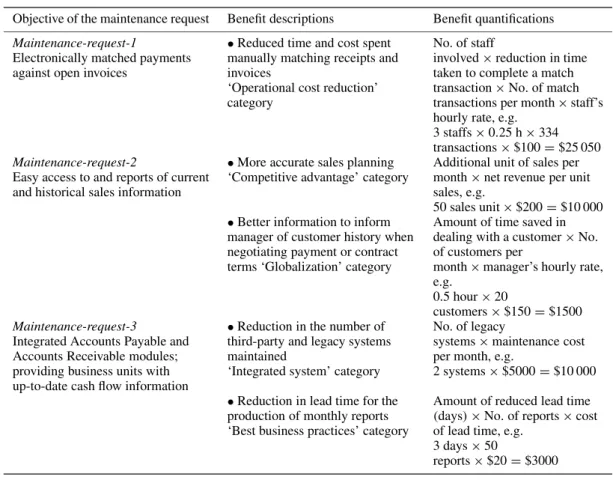
For illustration purposes, assume that there are three (non-mandatory) maintenance requests received by GA. Note that the requests’ objectives and benefit descriptions are taken from the benefit realization instances published in the Queensland Government Financial Management (QGFMS) Benefit Realization Guidelines [59] and are as illustrated in Table VIII. Hypothetical benefit value quantifications for these benefits are also given in this table. Maintenance request 1 is perceived to provide the benefit of ‘operational cost reduction’ only, and the monetary value for this benefit is computed to be $25 050. On the other hand, maintenance request 2 is found to deliver ‘competitive advantage’ and ‘globalization’ benefits only. Their monetary values are evaluated as $10 000 and $1500, respectively. Maintenance request 3 contributes to ‘integrated system’ and ‘best business practices’ benefits. They are assessed to be $10 000 and $3000, respectively.
It is noted that while some benefits are tangible and quantifiable, others are intangible and difficult to measure. However, in assessing intangible benefits, the quantification technique proposed by Hares and Royle [60] is adopted and suggested.
4.4.3. User opportunity cost quantification: an example
In contrast to the above, if these three requests are delayed, the benefit values computed in TableVIII become the unrealized benefit values. Using the data in Table VIII, TableIXis tabulated. The total basic user opportunity cost per month is computed using Equation (1), and request 1 is found to be the most costly to be foregone, followed by request 3. Hence, in order to minimize total user opportunity costs (incurred now and in the future), requests 1 and 3 should be implemented first prior to request 2, assuming that all requests are independent.
Table VIII. Examples of maintenance requests and benefit quantifications. Objective of the maintenance request Benefit descriptions Benefit quantifications
Maintenance-request-1
Electronically matched payments against open invoices
•Reduced time and cost spent manually matching receipts and invoices
‘Operational cost reduction’ category
No. of staff
involved×reduction in time taken to complete a match transaction×No.of match transactions per month×staff’s hourly rate, e.g.
3 staffs×0.25 h×334 transactions×$100=$25 050
Maintenance-request-2
Easy access to and reports of current and historical sales information
•More accurate sales planning ‘Competitive advantage’ category
Additional unit of sales per month×net revenue per unit sales, e.g.
50 sales unit×$200=$10 000 •Better information to inform
manager of customer history when negotiating payment or contract terms ‘Globalization’ category
Amount of time saved in dealing with a customer×No. of customers per
month×manager’s hourly rate, e.g.
0.5 hour×20
customers×$150=$1500
Maintenance-request-3
Integrated Accounts Payable and Accounts Receivable modules; providing business units with up-to-date cash flow information
•Reduction in the number of third-party and legacy systems maintained
‘Integrated system’ category
No. of legacy
systems×maintenance cost per month, e.g.
2 systems×$5000=$10 000 •Reduction in lead time for the
production of monthly reports ‘Best business practices’ category
Amount of reduced lead time
(days)×No.of reports×cost of lead time, e.g.
3 days×50
reports×$20=$3000
4.5. Summary of the findings
The key findings of this section can be summarized as follows.
• Request-type and maintenance-complexity variables can be used to determine the amount of effort required to complete an ERP-client-initiated maintenance request.
• On average, carrying out LCP maintenance was almost as effort demanding as carrying out a user enhancementrequest.
• New version upgrades reduce the number of enhancement modifications performed by the ERP client.
• New version upgrades potentially reduce future LCP or support package maintenance distributed by the ERP vendor.
T able IX. User opportunity costs (in $1000) and m aintenance request priorities. B enefi t cat egor ie s Op er atio n al co st In te g ra te d B es t b u sin es s C o m p etiti v e T o ta l b as ic u se r re duct io n syst em p ract ices adv ant age G lobal izat io n oppor tuni ty cost Mai n te nance request (W 1 = 3 )( W2 = 2 )( W3 = 2 )( W4 = 1 )( W5 = 1 ) (p er mont h) pr io ri ty ra nk R equest 1 25. 05 0 0 0 0 75. 15 1st R equest 2 0 0 0 10 1. 5 11. 5 3 rd R equest 3 0 10 3 0 0 2 6 2nd
Table X. A comparison of characteristics considered in existing replacement models and in the proposed ERP MU model.
In-house Hardware
Characteristics considered software model model ERP model Software technology, system size, and age X NA NA
Task complexity X NA X (client maintenance)
Number of previous enhancements X NA X (LCP maintenance)
Hardware capacity NA X NA
Hardware utilization NA X NA
Fix revenue (or output) generated NA X NA
Hardware acquisition size NA X NA
User opportunity (benefit realization) NC NC X
Reduction in previous (user) enhancements NA NA X
Reduction in amount of (LCP) maintenance NC NC X
X=considered, NA=not applicable, NC=applicable but not considered.
5. IMPLICATION FROM THE FINDINGS
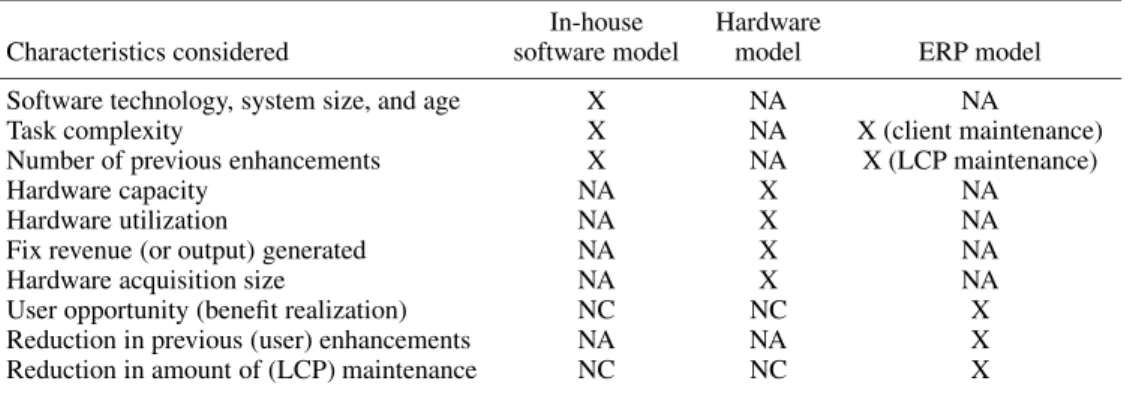
The findings obtained from the previous section (on factors driving ERP MU decisions) are compared with the existing in-house software and hardware replacement models to determine if they (the existing models) are adequate in the context of ERP. The results are summarized in TableX.
The existing in-house software replacement models (see [61,62]) consider characteristics such as software technology, source code size, and age as the main drivers influencing software replacement decisions. Software technology refers to the programming language and the environment used to develop and maintain a system; it has impact on program structure [63]. Thus, it affects the software maintainability and maintenance effort. A better technology, for example 4GL (Fourth Generation Language), is argued to contribute to a better program structure. Therefore, it is expected to have a higher maintainability and require less maintenance effort than 3GL or lesser programs. A large system generally implies more source code, and for this reason more effort is required to comprehend the program before debugging [64]. As the system ages it tends to be less well ordered [64] and also becomes more complex [65]. As a consequence, it will require more effort to maintain. These factors are unlikely to be applicable in package software because: (1) it is most likely that organizations do not have any choice as to the software technology that is used in a particular package system that they want to purchase; (2) source code size plays a limited impact on ERP-clients’ maintenance effort because these organizations make a relatively small number of changes/modifications to the system, and most of the ERP-software maintenance is shouldered by the vendor; and (3) ERP-using organizations have no control over the system age at all as the software code is managed by the vendor.
In contrast, factors such as task complexity and number of previous enhancement modifications are found to have an impact on both in-house developed and ERP package software maintenance decisions. However, the factor ‘previous enhancement modifications’ has slightly different impact and
Table XI. Impact of enhancementamaintenance on software code and maintenance effort.
Request type influenced Impact on Impact on by this request software code maintenance effort In-house software All types of maintenance
requests— corrective, adaptive,
perfective/enhancement, software replacement
Source code structure and quality
deterioration Software size may increase by increased custom code
Increased effort for source code comprehension Increased effort for programming
ERP package software LCP or support package maintenance, and software upgrade only
Standard code is changed/affected, and/or custom code increases
Increased effort for impact analysis before and after the LCP or support package implementation, and the new version upgrade exercise
aEnhancement is referred to activities which involve making changes to the (standard) software code; it is associated with enhancement initiated by the ERP client but not those from the vendor.
implications on the software code and maintenance effort requirements in in-house and ERP software. This is summarized in Table XI. In the context of in-house software, it is argued that the greater the modifications done to the system, the greater the deterioration in the software code structure and quality [66,67]. This increases the difficulties in understanding the existing code and making changes to it. As a result, more effort is necessary in both the source-code comprehension and programming phases. In contrast, the larger the number of ERP enhancement modifications (that are initiated by the ERP client and which involve changing the standard code or writing custom code), the higher the amount of custom code and/or standard code being changed and affected. This increases the amount of effort required to analyze the impact of a support package or LCP, and new version upgrade on these enhancements.
The hardware literature (see [68,69]) argues that hardware capacity and utilization deteriorates as it ages. However, software does not deteriorate by itself or when it is used. In contrast, software deterioration is caused by the maintenance work done on the source code over time [70]. This is the opposite for hardware as maintenance work repairs hardware deterioration [71]. Hopp and Nair [72] have relaxed this assumption by assuming that hardware does not deteriorate, and consider factors such as costs and revenues (or output) generated by the new hardware or technology. They presume that costs and revenues for technologies are known, and revenues are constant over time. The latter assumption is not realistic in software systems because their revenues are believed to change depending on software functionality and the timeliness of this software functionality. Other models such as the one proposed in [73] are also not applicable for software as they consider (hardware) acquisition size a determinant of the replacement decision.
opportunity (or benefit realization), a reduction in the number of previous enhancements modifications, and a reduction in the amount of future LCP maintenance are important characteristics for an ERP MU decision model. Although user opportunity and a reduction in the amount of future maintenance may also be applicable in in-house software and hardware, they are not considered in the existing literature. On the other hand, a reduction in the number of previous enhancement modifications is unlikely to be an in-house software replacement driver because its internal-system enhancements are unlikely to be available from external sources and therefore could not be replaced or reduced. It is also logically impossible to apply this factor in a hardware replacement model, as hardware is less malleable and usually more enhanced than its predecessors. In the light of these differences, a specific ERP MU decision framework is needed, and one is proposed in the next section.
6. A FRAMEWORK FOR ERP MAINTENANCE AND UPGRADE DECISIONS
6.1. Decision alternatives
The proposed decision framework (for GA) takes into account four fundamental decision alternatives, besides the typical option of ‘doing nothing’. These options include: (i) the system user maintenance requests; (ii) GA’s enhancement maintenance, (iii) LCP or support package maintenance; and (iv) a new version upgrade.
6.2. Tradeoffs involved in decision alternatives
The discussion of the preliminary decision framework is structured around the initiators and decision alternatives of GA’s maintenance activities and it is summarized in Figure 3. Descriptions of the variables used are given in TableXII.
6.2.1. System users’ maintenance
As discussed earlier, there are three types of system users’ change request: enhancement, corrective, and master-data change. The decision to implement a user enhancement request is based on the tradeoffs between the ongoing maintenance cost and the user opportunity cost of not implementing it. This enhancement implementation cost (in GA’s case) is charged back to the user, and does not incur a cost to GA. As a result, it is not included in the totaluser enhancementmaintenance cost in the framework. In contrast, the ongoing maintenance cost for this enhancement, which follows each LCP maintenance project (see Section4.2for details) and upgrade (see Section4.3.1), is borne by GA. Hence, for eachuser enhancementmodification, we define
Ongoing maintenance cost=(number of LCP projects+number of upgrades)
×(a fraction of its implementation cost) (2) On the other hand, user opportunity cost will be incurred if this enhancement request is ignored. However, there is a possibility that this enhancement would be introduced in the next version by the
In it ia to r Tra d eof f C o st F unct io n M a inten an c e Ac ti vi ti e s Sy s te m u s e rs : GA : V e ndo r (LC P ): > M a in te na nc e co st Ma in t_ co st_p ro v _ e nh = #_ of_ho urs** * X c ost_ per_h our + on goi ng_ ma in t_ co st* * > U s e r o pp ort u ni ty co st > M a in te na nc e co st > M a in te na nc e co st > U s e r o pp ort u ni ty co st > U s e r o pp ort u ni ty co st O p p o r_co st_G A _ e nh = (p ro b _ no t_ av ai l X O p por_c ost) + [pr o b_a va il X (O ppo r_ co st - ongo in g _ m a in t_c ost)] Opp or _c o st = (b en ef it_ c at eg or y_ w e ig ht X u n re a liz e d_ be ne fi t_ va lu e ) Ma in t_ co st_L C P = ( # _of_ hours X c os t_ pe r_ hour) X ( 1 + # _ of_m od if ic ati on) O p p o r_ co st = (b e n e fi t_c at eg o ry _ w e ig ht X u n re a li ze d _b en e fi t_v al ue ) V e ndo r( N e w V e rs io n U p g rad e): > R e d u ct io n in M a inten an c e c os t > U s e r o pp ort u ni ty co st > U p grad e c o st U p g rad e_ co s t = s o ft w ar e + ha rd w a re + r e a p p ly _ m o di fi ca ti o n _ c o st + u se r_ tr a ini n g _ c o s t + co n s u lt a n t_f ee s + u p g r_i m p le m e nt at io n_ co s t rea pp ly _ mod if ic ati o n_ c o s t = m od if ic ati o n_ req u ired X ho ur_p er_m od if ic ati o n X c os t_p er_h ou r c o ns u ltan t_ fe es = #_ of_c o n s u l_ ho ur X c o ns u l_c o s t_ pe r_ho ur up gr_ im pl em en ta ti on _c o s t = (c o m p le xi ty X v e rs io n _ g a p) X (i n te g ra ti on _a nd _tes ti n g _ c os t + s ys _ d is ru p ti o n _ c os t) O p p o r_ co st = (ben efi t_ ca te gory _ w e igh t X new _v ersi on_ unrea li z e d _ be ne fi t_v al ue) redu ce _m ai nt_c ost = - [ (#_ of_m od if ic ati on - m odi fi c a ti o n _req ui red ) X ongo in g _ m a in t_c ost + (LC P _ d e c re a s e _ ra te X a ve _a nnu al_LC P _c ost) ] No te s : * Th e us e r-e nh an c e m e n t im pl em en ta ti on c o s t is c h a rg e d b a c k to the r e q u e s tor' s o rga ni z a ti on . Th erefore , th is c os t w o ul d n o t in clu d e d in G A 's E R P D e cisio n F ram e w or k . ** T h is co st is i n cu rr e d if th e en ha nc eme nt-do ne i s a ffec ted by fu tu re LC P ma in te na nc e o r u pg ra de . ** * Th e nu mb er o f ho urs f o r t h e org an iz a ti o n -m a inten an c e ac ti v iti e s i s de te mi ne d by the r e q u e s t-ty p e ,a n d ma in te na nc e comp le xi ty ∑ ∑ ∑ If c o rr e c ti ve o r m a s te r d a ta c h a n g e O p p o r_co st = ( b ene fi t_c ate gor y _ w e ight X u n re ali z e d_b ene fi t_v alue ) ∑ If c o rr e c ti ve ma int_c ost _c or r = #_ of_h our s* ** X c os t_pe r_ hou r If e n h a n c e m e n t m a in t_c ost_ enh = i m pl em e n t_c ost * + o ngoi ng_ m a int_c ost** im pl em en t_ c o s t = # _ o f_ h o u rs ** * X c o s t_ p e r_ ho ur o n g o in g_ m a in t_ c o s t = (#_ of L C P _ p ro je c t + # _o f _u pg ra de ) X (a _f ra c ti o n_ of _i mp le me nt _c o st ) If e n h a n c e m e n t O p p o r_co st_u se r_ en h = (prob_ not_ av ai l X O ppo r_ cos t) + [ p rob _a va il X (O ppor_ cos t - on goi ng_m a int_ cos t)] O p po r_ c o st = (be ne fi t_ c a te gory _w e ight X u n rea liz e d _ b e n efi t_v a lu e) ∑ If m a s te r d a ta c h a n g e m a int_c ost _m as ter _da ta = #_ of_h our s* ** X c os t_pe r_ hou r F igur e 3 . E R P deci si on fr ame w o rk : d eci si on al te rn at iv es, tr adeof fs , and cost funct ions.
T ab le X II. A d es cr ip tio n o f th e v aria b le s co n sid er ed in th e d ec isio n fra me w o rk . Cost component, etc. M aintenance initiator V ariable in v olv ed D escription Mai n te nance cost S yst em u ser s (GA ’s clie n ts) Mai n t cost en h C o st fo r ma in ta in in g a user enhancem ent re quest Impl ement co st Co st fo r imp le me n tin g a user enhancem ent re q u est (i.e . th e in itia l co st). Its co st fa ct o r depends on compl exi ty and request types Mai n t cost corr Cost for m ai nt ai ni ng a u ser corr ect iv e re quest Mai n tcost master dat a C o st fo r m ai nt ai ni ng a u ser m a st er -dat a chang e re quest S y st em user s, G A O ngoi ng maint cost O ngoi ng mai n te nance cost o f the enhancement m odi fi cat io n # of modi fi cat io n T he to ta l number o f enhancement modi fi cat ions in th e exi st in g v er si on, in cl udi ng those done dur in g syst em imp le m en ta tio n A fra ctio n of im pl ement cost A cert ai n smal l port io n o f an enhancement -modi fi cat ion’ s imp le m en ta tio n co st GA M ain t cost pr o v enh C ost for im pl ement in g G A ’s enhancement V endor Mai n t cost L C P L C P mai n te nance cost (dr iv en by th e number o f enhancement m odi fi cat ions) U ser oppor tuni ty cost V endor , G A , syst em user O ppor cost U ser oppor tuni ty cost in cur re d w hen the respect iv e L CP mai n te nance, ne w v ersi on upgr ade, user corr ect iv e or m a st er -dat a chang e mai n te nance is not sat is fi ed Sy st em user -enhancement O ppor cost user enh U ser oppor tuni ty cost in cur re d w hen a user enhancem ent modi fi cat io n request is not sa tisfie d , ta k in g th e u n ce rta in ty fa ct o r in to co n sid er atio n G A enhancement O ppor cost GA enh U ser oppor tuni ty cost in cur re d w hen GA enhancem ent re quest is not sat is fi ed, ta ki ng th e u n ce rta in ty fa ct o r in to co n sid er atio n
T abl e X II . C ont inued. Cost component, etc. M aintenance initiator V ariable in v olv ed D escription S y st em user s, G A , v endor B enefi t cat egory w ei ght Im por ta nce o f a benefi t cat egor y to an E R P cl ie nt ’s b u si ness obj ect iv es (i .e . m easured on a scal e o f 1–3) Unreal ized benefi t v al u e U nr eal ized benefi t v al u e o f a re quest ev al uat ed o n a benefi t cat egor y V endor N ew ve rs io n unreal ized benefi t v al u e U nr eal ized benefi t v al u e o f a ne w v er si on ev al uat ed o n a benefi t cat egor y N ew v er si on upgr ade V endor U pgr ade cost T o ta l cost incur re d in an upgr ade ex er ci se S o ft w ar e C o st of li censi ng a n ew upgr ade v er si on Hardw are Cost associ at ed wi th purchasi n g addi ti onal h ard w are R eappl y modi fi cat io n cost Cost in curred in o rder to re -a ppl y/ im pl ement p re vi ous enhancement modi fi cat ions Modi fi cat io n re qui re d N umber o f p re vi ous enhancement mo d ific atio n s still re q u ire d afte r an upgr ade H our per modi fi cat io n A v er age hour s requi re d in o rd er to re -i mpl ement one uni t o f a pr ev ious enhancement m odi fi cat io n User tr ai ni ng cost C o st of educat in g and tr ai ni ng th e syst em user s C onsul ta nt fees C o st of hi ri ng consul ta nt s for th e upgr ade # of consul hour T o ta l number o f consul ta nt -hour s requi re d fo r an upgr ade C onsul cost per hour C onsul ta nt ’s ra te per hour U pgr imp le m en ta tio n cost U pgr ade impl ement at io n cost C o mpl exi ty C o mpl exi ty of an upgr ade p ro ject (i .e . hi gh, medi um, lo w ). It is det er m in ed by th e number o f m odul es to be im pl ement ed and th e n u m b er o f b u sin es s u n its in v o lv ed Ve rs io n gap V er si on gap b et w een th e exi st in g and ne w v ersion upgrade (i. e. functionality , upgrade pat h , techni cal aspect of upgr ade)
T abl e X II . C ont inued. Cost component, etc. M aintenance initiator V ariable in v olv ed D escription In te g ra tio n and te stin g co st Co st in v o lv ed in in te g ra tin g an d te stin g a ne w syst em Sy s di sr upt io n cost Cost of system do wntime and disruption d u rin g th e imp le m en ta tio n an d te stin g time and change management fo ll o w ing a n ew syst em upgr ade R educe maint cost Reduct io n in m ai nt enance cost fol lo wi ng a ne w v er si on upgr ade LCP decrease rat e A v erage rat e at w hi ch th e number o f L CP s decr eases fr o m one v er si o n to anot her Av e annual LCP cost A v er age annual L C P mai n te nance cost Mai n te nance request S y st em user s, G A , v endor # of hour T o ta l number o f hour s, an est im at io n o f the number o f st af f re qui re d and pr oj ect dur at ion— based o n request type and pr oj ect compl exi ty fo r compl et in g a request (as assessed b y senior m anager) O rgani zat ional fact or G A C o st per hour Mai n ta in er and anal y st ’s hour ly ra te L C P p roj ect GA # of LCP proj ect E st im at io n o f tot al L C P p roj ect s o v er a time h o riz o n Upgrade p roj ect GA # of upgr ade E st im at io n o f tot al upgr ade p ro ject s o v er a time h o riz o n Ex te rn al u n ce rta in tie s S y st em user , G A P rob av ai l P ro b ab ility th at an en h an ce m en t re q u este d b y a sy ste m u se r/GA will b e av aila b le in th e n ex t upgr ade v er si on Pro b not av ai l P ro b ab ility th at an en h an ce m en t re q u este d by a syst em u ser /G A w il l not be av ai la bl e in th e n ex t upgr ade v er si on