Inv e nt t he F ut ure College ofEngineering
Schedule Acceleration Techniques Using a CM
By
PI: Dr. Jesús M. de la Garza, Vecellio Professor
Graduate Student: Ms. Daniela Escobar Hidrobo
Final Report
September 1, 2006
Table of Contents
I. Introduction 5
II. The Construction Manager 6
Agency CM 6
CM at risk 6
Project Delivery 6
Construction management and project delivery method 6
Traditional approach (design-bid-build) 7
Multiple-prime contracting 7
Design-build 8
At-risk construction management 8
III. Schedule acceleration techniques 10
A. Good management practices during project development for achieving
reduced delivery times 11
1. Start-up driven scheduling 13
2. Participative management 13
3. Resources 13
4. Pre-project planning 13
5. Alignment 13
6. Well-defined organizational structure 13
7. Pareto's law management 14
8. Employee involvement 14
9. Realistic scheduling 14
10. Construction-driven scheduling 14
11. Concurrent evaluation of alternatives 14
12. Avoid scope definition shortcuts 14
13. Use of electronic media 14
14. Constructability 15
15. Freezing of project scope 15
16. Reusable engineering 15
17. Non-traditional drawing release 15
18. Supplier/engineer early interaction 15
19. Materials management 15
20. Material coordination 16
21. Prioritize procurement of material 16
22. Efficient packaging for transportation 16
23. Material I.D. on purchase documentation 16
25. Multiple suppliers 16
26. Supplier submittal control 17
27. Field management 17
28. Safety in workspace 17
29. Aggressive project close-out 17
30. Detailed plan 17
31. Determine system testing requirements 17
32. Zero accidents techniques 17
B. Freezing of project scope
a. Technique 18
b. Implementation 18
c. Advantages 19
d. Key elements to ensure a high degree of success 19
e. Disadvantages 20
f. Applicability and use 21
C. Constructability review
a. Technique 22
b. Implementation 23
c. Advantages 26
d. Key elements to ensure a high degree of success 27
e. Disadvantages 28
f. Applicability and use 28
g. Other special characteristics 28
D. Cycle time analysis
a. Technique 34
b. Implementation 34
c. Advantages 35
d. Key elements to ensure a high degree of success 35
e. Disadvantages 35
f. Applicability and use 36
E. Concurrent engineering
a. Technique 37
b. Implementation 38
c. Advantages 38
d. Key elements to ensure a high degree of success 39
e. Disadvantages 40
f. Applicability and use 40
g. Other special characteristics 40
F. Overlapping sequential design activities based on concurrent engineering
a. Technique 42
b. Implementation 43
c. Advantages 49
d. Key elements to ensure a high degree of success 49
f. Applicability and use 50
g. Other special characteristics 50
G. Lean design
a. Technique 52
b. Implementation 52
c. Advantages 54
d. Key elements to ensure a high degree of success 55
e. Disadvantages 55
f. Applicability and use 56
H. Value engineering
a. Technique 57
b. Implementation 57
c. Advantages 58
d. Key elements to ensure a high degree of success 59
e. Disadvantages 59
f. Applicability and use 59
I. Four-dimensional visualization of construction scheduling
a. Technique 61
b. Implementation 61
c. Advantages 62
d. Key elements to ensure a high degree of success 63
e. Disadvantages 64
f. Applicability and use 64
J. Overlapping sequential construction activities based on concurrent engineering
a. Technique 65
b. Implementation 66
c. Advantages 67
d. Key elements to ensure a high degree of success 67
e. Disadvantages 67
f. Applicability and use 68
g. Other special characteristics 68
K. Fast-track
a. Technique 71
b. Implementation 71
c. Advantages 71
d. Key elements to ensure a high degree of success 72
e. Disadvantages 74
f. Applicability and use 75
g. Other special characteristics 75
L. Just-in-time delivery
a. Technique 82
b. Implementation 82
d. Key elements to ensure a high degree of success 82
e. Disadvantages 82
f. Applicability and use 82
M. Lean construction
1. "The Last Planner": Shielding production through weekly work plans 84
a. Technique 84
b. Implementation 85
c. Advantages 88
d. Key elements to ensure a high degree of success 89
e. Disadvantages 90
f. Applicability and use 90
2. Improving labor flow reliability for better productivity through the use
of buffers 90
a. Technique 90
b. Implementation 91
c. Advantages 93
d. Key elements to ensure a high degree of success 93
e. Disadvantages 94
f. Applicability and use 94
N. Optimization of construction operations through simulation and genetic Algorithms
a. Technique 96
b. Implementation 97
c. Advantages 99
d. Key elements to ensure a high degree of success 100
e. Disadvantages 100
f. Applicability and use 101
O. Time-cost trade-offs
a. Technique 102
b. Implementation 102
c. Advantages 110
d. Key elements to ensure a high degree of success 110
e. Disadvantages 111
f. Applicability and use 113
IV. Summary 114
I. Introduction
In today’s businesses owners rely on first-to-market product strategies to gain competitive advantage and increase profit margins. Within the construction industry, this has created a growing need for enhanced performance delivery systems that can achieve successful project delivery in shorter time.
Owners demand greater improvements in the quality of project construction at lower costs and within reduced schedules. The completion of project’s time milestones is a crucial factor because not meeting them usually involves significant economic impacts to the owner while time savings can lead to profit improvements. However, the increasing complexity of project technologies along with the competitive nature of business oblige the owner to make changes in project scope at the last moment, hindering project delivery within the anticipated time.
Moreover, today’s market opportunities and competitiveness within the industry can also force the owner to accelerate project execution and demand earlier completions.
In the presence of increased demands for shortening project cycle times, research has dedicated in the last years significant time and effort in searching for the right tools and techniques to assist owners and construction managers to effectively manage time and resources aiming at expediting project execution and reducing project delivery time. Several sources of research provide the construction community with different strategies and techniques to effectively address today’s aggressive schedules and tight delivery demands. The document presented herein is a recompilation of the most effective techniques available to the construction manager that enable project acceleration to achieve reduced delivery times.
II. The Construction Manager (CM)
The Construction Management Association of America (CMAA) defines the construction manager as “a provider of professional services to the Owner, the CM organizes the effort, develops the management plan, monitors the participants’ progress against the plan and identifies actions to be taken in the event of deviance from the plan. The CM also provides expert advice in support of the Owner’s decisions in the implementation of the project. The CM can be a firm, a team of firms, or an individual” (CMAA 2002, pp.3).
Thus, construction management is the practice of professional management services applied to the planning, design and construction stages of a project, from inception to completion for the purpose of controlling time, scope, cost and quality (CMAA 2003). The ability of a professional CM to manage the different phases of a project has the potential to improve project’s success. Construction management can be applied in two different forms: CM in an agency basis and CM at risk.
Agency CM
The Agency CM acts as the Owner’s principal agent to advise on or manage the process from project conception to completion. Agency CM set of services can be applied to any project delivery method. Typically, the owner hires a CM to extend or supplement its own expertise and staff, and to manage the project throughout the delivery method chosen (CMAA 2002).
CM at risk
CM at risk provides professional management assistance to the Owner prior to construction and advice on constructability, budget and schedule considerations. The CM then converts to the equivalent of a contractor during construction as it assumes the obligations of construction execution and completion for an established price. Because of the responsibility held by the CM at risk over construction performance, CM at risk is a distinct delivery method (CMAA 2002).
Project Delivery
A project delivery method is a system designed to achieve the satisfactory completion of a construction project from conception to occupancy (CMAA 2003). There are numerous different approaches used in the construction industry to successfully deliver a project, and each of these may present several variations. However, the four basic delivery systems include:
• Traditional approach (design-bid-build)
• Multiple-prime contracting
• Design-build
• At-risk construction management
Construction management and project delivery method
Construction management is a discipline intended to provide professional services and expert support to the owner in the implementation of a construction project regardless of the chosen contract form or project delivery method. Thus, CM integrates owner and project needs by effectively managing project delivery through the application of comprehensive controls in the
different critical aspects of the project including time, cost, scope and quality throughout project’s phases of planning, design and construction. The different systems of project delivery and its variations can lead to different construction management practices and applications. But all project delivery approaches and variations can favorably take advantage of the benefits provided with construction management services in either the “agency” or “at-risk” form. The four basic project delivery methods are briefly summarized below, along with a discussion of some of the important characteristics of CM’s participation on each.
The traditional approach (design-bid-build)
The design-bid-build or traditional approach has been the most popular approach to deliver projects for many years. This method involves the owner, the designer, and one or more contractors with subcontractors. Thus, the owner hires a designer for the development of the design of the complete facility. Once design is completed, it is advertised so that the interested general contractors can prepare bids for the construction of the project. In most of the instances, the general contractor that submits the lowest responsive and responsible bid is selected to perform the work, and can employ subcontractors to carry out some or all components that comprise construction. The contractor is then responsible for constructing the facility in accordance with the design.
Under this approach, the contractor selected is responsible for the means, methods and sequence of construction, and for the scheduling and coordination of all subcontractors, suppliers and vendors. The owner thus manages the overall process and administers all contracts. The owner can also rely on the designer for monitoring construction as an agent, or hire a CM to administer contracts and manage all the construction work. The owner can also hire a CM from project conception, thus the CM provides professional services and support in project conception and pre-planning, planning of scope, design development, contract administration, and construction management. Thus, the CM operates as the owner’s agent and performs on the owner’s best interest throughout the entire project delivery process (CMAA 2003).
Multi-prime contracting
Under multi-prime contracting the owner holds separate contracts with contractors of various disciplines, such as general construction, structural, mechanical, and electrical. The owner may hire a CM to manage project development from conception and design, and to coordinate contractors and to manage the overall schedule and budget during the entire construction phase, thus the CM functions as the owner’s agent to administer the multiple contracts. Under this delivery approach, the owner holds direct contracts with the designer party and with each prime contractor. Trade construction contracts may be competitively bid or negotiation directly. Each contractor is responsible for the means and methods of construction.
There are two basic types of multi-prime contracting: phased construction and full multi-prime or trade contracting (CMAA 2003).
Phased construction: Under phased construction, the project is bid in phases such as site work, site utilities, and one or more general construction packages. The CM manages and coordinates the individual contracts on behalf of the owner. The owner, through the CM, has control over the overall schedule since the CM develops the schedule for bidding the individual work packages. The CM also assists the owner in managing costs throughout the phased procurement of
Trade contracting: Under this delivery method the owner holds contracts with each individual trade contractor. The CM is responsible for coordinating these contractors in the best interest of the owner.
The success of multiple-prime contracting largely depends on the effectiveness of the coordination of the prime contractors and the overall schedule through the CM. Design-build
In the design-build project delivery method the development of the design and execution of the construction of the project fall under the responsibility of one sole party or a joint-venture. Under this approach, the owner contracts with a design-build team to plan, design, construct, implement, and control the entire project from conception through completion, and sometimes through occupancy and startup. In consequence, the owner has one single point of responsibility for project delivery. Typically, a design-build firm or a joint-venture between a design and contractor firms provide all of the services required for project delivery. However, the design-build approach can present two different variations. The first one involves the owner engaging with a developer who then selects its own design and construction partners. Another approach to design-build delivery is given when the construction party acquires complete responsibility for the project and hires its own design team (CMAA 2003).
The CM comes into play when the owner decides to supplement his staff team and hire an agent to provide with professional and technical support services to guarantee that the design-build team performs accordingly to achieve the goals and objectives established by the project. At-risk construction management
Under this method the CM is hired by the owner at the early stages of project development during the pre-design and design phases. The CM works with the owner and the design team to provide professional support and advice to develop the design that best benefits the owner and to provide input on the methods of construction. When design has progressed and is partially completed (50% to 80%), the CM prepares an estimate for construction performance and offers the owner a total project cost usually in the form of a guaranteed maximum price (GMP) or fixed price (lump sum). If the owner decides not to employ the CM’s services for construction performance, the CM continues to perform as the owner’s agent (CMAA 2003).
When the CM performs the work under a GMP of lump sum, he becomes the equivalent of a general contractor or independent contractor during construction. Under this approach, the CM is completely responsible for delivering the project on time and within the pre-established
budget. The CM selects the methods, means, techniques and sequence of construction, the CM is as well responsible for the scheduling and coordination of all trade contractors, subcontractors, suppliers and vendors, and can also perform sections of the work with its own resources.
CM at risk also allows the CM to bid and subcontract portions of the work while other unrelated parts are still not completed. Thus, the owner and CM negotiate the GMP or fixed price for a partially completed portion of design (CMAA 2003).
Regardless of the form of contract agreement and the delivery system adopted, the CM performs professional tasks and responsibilities throughout all the phases of program or project
implementation in the best interest of the owner and the project. With this objective the CM is expected to have the ability to make recommendations regarding (CMAA 2002):
o Most effective use of available funds o Enhanced control of the scope of work o Optimal project/program scheduling options
o Best use of individual project team members’ expertise o Maximum avoidance of delays, changes and claims o Enhanced design and construction quality
o Optimum flexibility in contracting/procurement options
Having identified the basic systems of project delivery available to owners and the core characteristics of each one along with the role played by the CM under each approach, in the following sections the existing schedule acceleration techniques that can be applied to any given project with the use of a CM in order to reduce project durations and improve delivery times are presented.
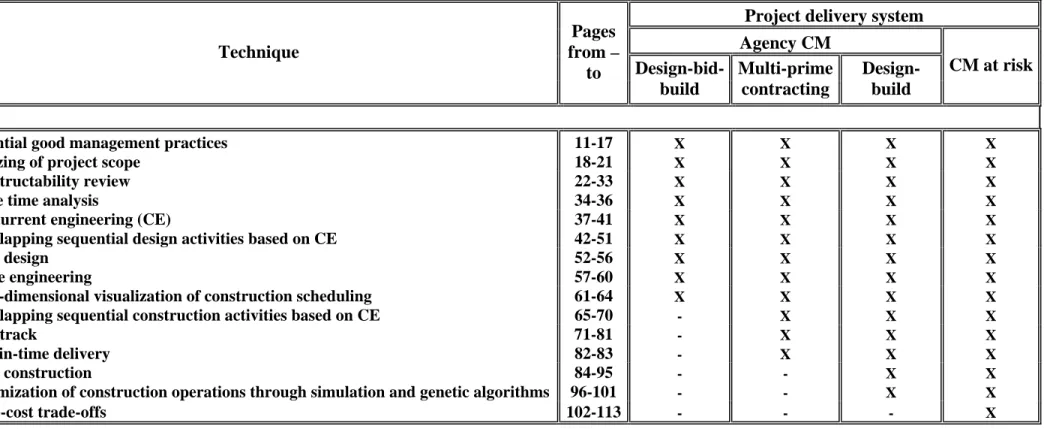
III. Schedule acceleration techniques
Project delivery system Agency CM
No. Technique
Pages from –
to
Design-bid-build
Multi-prime contracting
Design-build
CM at risk
A Essential good management practices 11-17 X X X X
B Freezing of project scope 18-21 X X X X
C Constructability review 22-33 X X X X
D Cycle time analysis 34-36 X X X X
E Concurrent engineering (CE) 37-41 X X X X
F Overlapping sequential design activities based on CE 42-51 X X X X
G Lean design 52-56 X X X X
H Value engineering 57-60 X X X X
I Four-dimensional visualization of construction scheduling 61-64 X X X X
J Overlapping sequential construction activities based on CE 65-70 - X X X
K Fast-track 71-81 - X X X
L Just-in-time delivery 82-83 - X X X
M Lean construction 84-95 - - X X
N Optimization of construction operations through simulation and genetic algorithms 96-101 - - X X
O Time-cost trade-offs 102-113 - - - X
A. Good management practices during project development for achieving
reduced delivery times
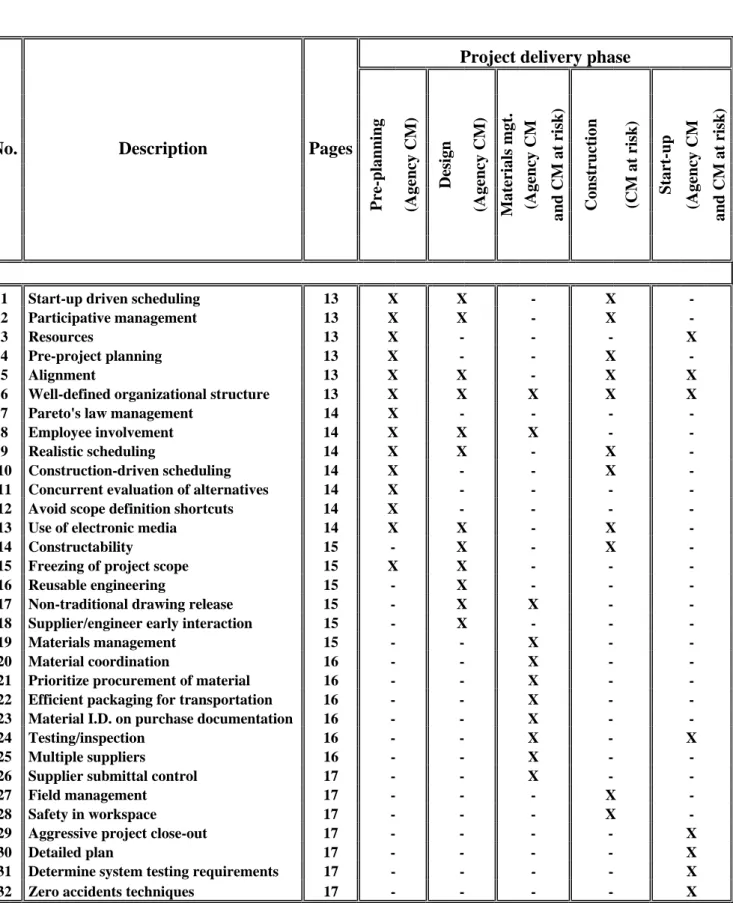
Control of project time is fundamental to achieve schedule compression and deliver projects in reduced periods of time. During project development from conception through planning, design, construction, until project close-out, the management and organization of time and schedules is a key to achieve successful project completion. Research reveals that a series of actions could be implemented and enforced throughout project development to give the construction manager an enhanced use of time. Below are listed a series of basic but essential management procedures that should be adopted in the execution of any given project to efficiently manage and control time with the objective of minimizing delays and reducing the time required to deliver
successful projects to owners. These actions can be applied to the different phases of project development including pre-planning, design development, materials management, construction and start-up. Nonetheless, the biggest opportunities for achieving true reductions in project delivery occur in the pre-planning and planning phases before the project begins. Consequently, following good management practices during early stages of project development is imperative to increase the potential for early project completion.
Project delivery phase
No. Description Pages
Pre-planning (Agency CM)
Design
(Agency CM) Materials mgt. (Agency CM
and CM at risk) Constructio
n
(CM at risk) Start-up (Agency CM
and CM at risk)
1 Start-up driven scheduling 13 X X - X -
2 Participative management 13 X X - X -
3 Resources 13 X - - - X
4 Pre-project planning 13 X - - X -
5 Alignment 13 X X - X X
6 Well-defined organizational structure 13 X X X X X
7 Pareto's law management 14 X - - - -
8 Employee involvement 14 X X X - -
9 Realistic scheduling 14 X X - X -
10 Construction-driven scheduling 14 X - - X -
11 Concurrent evaluation of alternatives 14 X - - - -
12 Avoid scope definition shortcuts 14 X - - - -
13 Use of electronic media 14 X X - X -
14 Constructability 15 - X - X -
15 Freezing of project scope 15 X X - - -
16 Reusable engineering 15 - X - - -
17 Non-traditional drawing release 15 - X X - -
18 Supplier/engineer early interaction 15 - X - - -
19 Materials management 15 - - X - -
20 Material coordination 16 - - X - -
21 Prioritize procurement of material 16 - - X - -
22 Efficient packaging for transportation 16 - - X - -
23 Material I.D. on purchase documentation 16 - - X - -
24 Testing/inspection 16 - - X - X
25 Multiple suppliers 16 - - X - -
26 Supplier submittal control 17 - - X - -
27 Field management 17 - - - X -
28 Safety in workspace 17 - - - X -
29 Aggressive project close-out 17 - - - - X
30 Detailed plan 17 - - - - X
31 Determine system testing requirements 17 - - - - X
32 Zero accidents techniques 17 - - - - X
1. Start-up-driven scheduling
The Construction Industry Institute (CII) recommends, under Engineering/procurement/
construction (EPC) projects, developing the overall schedule based on the owner’s needs related to the start-up dates and activities. Start-up activities define then construction dates and
construction schedule, and construction establishes procurement and engineering dates (CII: The Game Planner 2004). Thus, under this approach project completion is executed and achieved as per requested by the owner. The start-up driven schedule can then be used by the construction manager for following up, monitoring and controlling progress in relation to the schedule derived from owner requirements (CII: The Game Planner 2004).
2. Participative management
Participative management refers to the involvement of employees’ considerations and ideas to improve planning and productivity, and to reduce inefficiencies. CII defines participative management as the process of involving those who are influenced by decisions where everyone makes certain that everyone gets their needs met (CII: The Game Planner 2004, pp.12).
Participative management enhances employees’ motivation and commitment while reducing process inefficiencies, increasing the likelihood of reducing activity durations as well. Moreover, motivation among workers ultimately results in improved labor performance and higher levels of productivity.
3. Resources
It is important to assign enough and adequate resources to develop an effective project plan. Usually costs and expenses at the beginning stages of planning are minimal compared to overall project costs, and the effects that effective project planning may have over overall project duration are gigantic (CII: The Project Manager’s Playbook 2004).
4. Pre-project planning
Pre-project planning is the process of obtaining and developing important information with which the construction manager and the owner can assess and evaluate areas of higher risk within the project (CII: The Project Manager’s Playbook 2004). The identified risk can be addressed by committing more resources, leading to the minimization of areas of potential failure or delays.
5. Alignment
Alignment is defined as the condition where appropriate project participants are working within acceptable tolerances to develop and meet a uniformly defined and understood set of project objectives (CII: The Game Planner 2004, pp. 10). Alignment supports individuals’ and team performance to be consistent with project objectives and needs.
6. Well-defined organizational structure
From project conception and throughout project development, all project parties and members should have a clear and proper understanding of the authority, responsibility, and accountability of each position. The construction manager needs to clearly define project participant’s
functions and expected performance in order to reduce the potential delays caused by the lack of understanding on who is responsible for what (CII: The Game Planner 2004).
7. Pareto’s law management
Also known as the “80/20 rule”, Pareto’s law management rule suggests that attention should be given to the few activities and elements (20%) that represent the major part of the work or benefit (80%). Therefore, the construction manager should focus the attention of the project team in the activities that represent overall project duration. CII affirms that on average around 20 percent of project activities represent 80 percent of overall project schedule duration (CII: The Project Manager’s Playbook 2004).
8. Employee involvement
Employee involvement can be defined in terms of team building, training, communication, performance appraisal, and rewards. These factors are the key to achieve employee successful self-direction and process improvement (CII: The Game Planner 2004).
9. Realistic scheduling
Realistic scheduling is the action of constantly reviewing and updating the overall schedule to reflect real progress and actual situations of the project. Realistic scheduling involves the use of general schedules for overall control as opposed to detailed schedules which are more efficiently used for short-term planning (CII: The Game Planner 2004).
10.Construction-driven scheduling
The use of a construction-driven schedule is also an alternative for time management and control as it serves as a baseline for determining how much and when schedule reductions can be
achieved. Scheduling software can be very useful in preparing and tracking the schedule (CII: The Project Manager’s Playbook 2004).
11.Concurrent evaluation of alternatives
Concurrent evaluation of technical alternatives generates important savings in time (CII: The Project Manager’s Playbook 2004).
12.Avoid scope definition shortcuts
Good scope definition is crucial for project success, particularly when striving to reduce project delivery time. Consequently, it is not recommended to take shortcuts on project scope in an attempt to save time (CII: The Project Manager’s Playbook 2004).
13.Use of electronic media
The use of electronic media through computer technologies facilitates and improves information management by expediting information delivery, improving data management, encouraging strong communication and promoting project documentation, which finally leads to increased productivity and shorter delivery times (CII: The Game Planner 2004).
14.Constructability
The CII defines constructability as the optimum use of construction knowledge and experience in planning, design, procurement, and field operations to achieve overall project objectives (CII: The Project Manager’s Playbook 2004, pp. 10). Implementing a constructability program at early stages and following during project development can lead to reduced construction duration, ultimately reducing project delivery time. Constructability is further discussed in the following section.
15.Freezing of project scope
Project scope should be completed and frozen as early as possible in the planning and design phase such that all the major requirements and decisions are early made. Early freezing of project scope allows addressing important issues that may affect project schedule in an early manner, increasing the potential for project schedule reduction (CII: The Project Manager’s Playbook 2004). This technique is discussed in detail in the following section.
16.Reusable engineering
Design delivery time can be reduced by reusing design elements from previous projects or from standard design libraries when available. Examples of reusable engineering can be design
elements like structural steel connection details or instrument junction boxes, supplier’s standard designs for equipment or materials, particular systems such as air compressors, among others (CII: The Project Manager’s Playbook 2004). Standard design elements can also be produced and saved to be used several times in the same project.
17.Non-traditional drawing release
This technique involves the release of partially completed drawings that contain complete and approved detail to be used for expediting procurement and construction planning. This
procedure helps guaranteeing that material and equipment will be available when needed, minimizing delays caused by material or equipment unavailability, thus improving construction timely performance. Similar techniques related to drawing release will be discussed in more detail in following sections (CII: The Game Planner 2004).
18.Supplier/engineer early interaction
Obtaining in advance engineering information related to design components that allow follow-on engineering work enable a faster development of design. If it is necessary, the cfollow-onstructifollow-on manager should send staff to visit the supplier’s shop and obtain key engineering information in advance (CII: The Project Manager’s Playbook 2004).
19.Materials management
Materials management refers to the efficient planning and controlling of all the actions required to guarantee that materials and equipment are appropriately delivered in terms of quality and quantity in a timely manner at the places needed (CII: The Game Planner 2004). Adequate material and equipment availability is indispensable to allow construction progress.
20.Material coordination
The CII recommends delegating staff with the primary or exclusive function of coordinating and managing material at the jobsite. This person should be responsible for maintaining material status and reports to allow connection between field and procurement personnel. In addition, this individual could provide with useful advice in the coordination and management of material during weekly look-ahead planning meetings to assure material and equipment availability when required (CII: The Game Planner 2004).
21.Prioritize procurement of material
It is important to establish priorities related to the procurement of important equipment and materials according to the needs of the project but also considering supplier capabilities to make sure that the right items are delivered at the right time and in the right place. Sometimes,
coordination of material procurement is improved by having the prime contractor or CM at risk purchasing materials for subcontractors (CII: The Game Planner 2004).
22.Efficient packaging for transportation
Typically, the handling and transportation of oversized elements and components of construction involve increased costs and longer delivery times. Considering dimensional limitations of the available or of common means of transportation including length, width, height, volume and weight, during design can help in eliminating or minimizing the need for special transportation and handling (CII: The Game Planner 2004).
23.Material I.D. on purchase documentation
The use of a material identification code system can improve the management of materials. When possible, it should be requested to suppliers to provide materials with tags containing identification codes that match purchase orders as well as the working package for which each item or material is intended. This technique facilitates a better on-site control and routing of material, minimizing material misplacement or losses. This technique is only applicable to engineering or tagged items, not to bulk items (CII: The Game Planner 2004).
24.Testing/inspection
It is recommended to perform material and equipment inspection at fabricator’s or supplier’s shop prior to shipping to minimize testing on site. Deficiencies are also easier to correct in the shop rather than after delivered (CII: The Project Manager’s Playbook 2004).
25.Multiple suppliers
Suppliers may have problems accomplishing delivery dates when orders are too large. It is therefore recommended to use multiple suppliers with smaller orders, however too many
26.Supplier submittal control
On-time deliveries from suppliers are a vital factor to assure prompt construction delivery times. To achieve this, the construction manager should develop strict compliance policies regarding supply dates, submittals and approvals of documents, and shop drawings (CII: The Game Planner 2004).
27.Field management
Construction processes and schedules can be dramatically accelerated while improved by providing sufficient resources and staff with the sole responsibility of performing field management operations (CII: The Project Manager’s Playbook 2004).
28.Safety in workspace
Importance consideration should be given to planning for safety which can be achieved by orientations on safety and training. Incentive techniques can also be effective in promoting a safety environment for work. Safety improves workers moral and motivation, improves labor performance and increases productivity, all of these resulting in potential schedule reductions. On the other hand, reduced safety increases the likelihood of accidents, which are disruptive and commonly result in delays (CII: The Game Planner 2004).
29.Aggressive project close-out
Project closing-out should be managed as aggressively as the rest of the project. Developing a comprehensive list of the items that remain to be completed and a plan on how to complete them can help in accelerating project delivery and close-out (CII: The Project Manager’s Playbook 2004).
30.Detailed plan
The development of a detailed plan facilitates the transition to facility operations. The plan should include procedures, training, certification of operators, and a preventative maintenance program if required. Accounting for these minimizes transition delays and expedites facility start-up (CII: The Project Manager’s Playbook 2004).
31.Determine system testing requirements
Determining in advance which systems require testing is important to assure correct functioning and to eliminate unnecessary testing (CII: The Project Manager’s Playbook 2004).
32.Zero accident techniques
Safety is fundamental in project close-out and operations start-up. Planning for safety during transition to operations should be carried out to minimize potential accidents and injuries. Again, orientation and training on operations start-up as well as incentive programs enable productivity and better performance. Accidents even in the start-up stage of the project can result into
B. Freezing of Project scope
a.
Technique
Freezing of scope is a schedule reduction technique defined as the systematic approach to the early identification of major decisions and requirements that may affect the project delivery time (CII: An Investigation of Schedule Reduction Techniques 1996, pp. 106).
It also focuses attention on scope issues and details that are often omitted, forgotten, or left to be addressed at later dates. Identification and scoping of such issues can impact the project delivery time significantly.
b.
Implementation
Early freezing project scope aims at defining the project scope before commencement of
detailed engineering. Ideally, early freezing project scopes requires the owner to waive the right to make scope changes after the owner, construction manager and architect/engineer team have defined the project scope, unless these changes are in benefit of the project in terms of cost and schedule. It is recommended too that a date for freezing the project scope should be established and included in the overall project schedule as a milestone.
The scope should be completed such that all requirements are defined and major decisions made. Strong attention should be given to details early because addressing them at later stages do not allow for reducing project delivery time.
The Construction Industry Institute (CII) recommends following a number of strategies for early freezing of project scope and achievement of radical reduction in project cycle time (CII: The Project’s Manager Playbook 2004):
o Establish a date to “freeze” project scope. This motivates the project team to early define requirements and make decisions.
o Identify which deliverables will define the “baseline”.
o Perform all relevant reviews prior to scope freeze to add to the quality of scope definition and to minimize potential changes if the reviews were performed after scope freeze. Reviews can include constructability, environmental/health/safety, maintainability,
operability/reliability, process simplification and value engineering.
o Review to ensure that there is clear alignment of the project scope to the business goals and objectives prior to freezing the scope.
o If feasible, ask a contractor to review scope documents for clarity and completeness. This may include documents that a contractor typically would not review.
o Freeze portions of the total scope so that these portions can continue moving forward while other portions of the scope are being developed.
o Perform an integrated project team review of the scope to ensure completeness and alignment.
Companies that have experienced major costs and time saving through early freezing of project scope have adopted a series of common actions.
Developing a work plan at the beginning stages of the project that highlights the project’s objectives, limitations, and deliverables is one technique frequently adopted. The mission and
the details of the work plan are then communicated to the end-users and their feedback is
requested to identify aspects related to detailed use, operation, maintenance, etc. that might have been overlooked by the executive team (CII: An Investigation of Schedule Reduction
Techniques 1996).
When receiving feedback of the project’s objectives and work plan, the handling and
interpretation of such information is very important. End-users do not always have the required knowledge to understand all the information provided to them. It is also important to identify their needs from their wants. Having someone from the end-users background to participate in the exercise of developing the work plan can be very helpful.
The construction manager can then use the feedback to review the work plan and the project’s objectives, limitations, and deliverables, along with the owner and architect/engineer to convey the user’s needs. This process engages end-users in the decision making process as needed. Detailed milestone schedules can also be developed in the early stages of the project, identifying major tasks, dates and parties involved. All participants involved should be made aware of the developed schedules from its conception so to obtain their commitment to meet the established dates. Buy-in of all participants can also be achieved by involving them in the development of the milestone schedule.
Pre-qualifying vendors and suppliers, and establishing policies for handling substitutions also commit them to deliver their part of the work as programmed, decreasing changes and delays. The project mission and work plan should be revised continually by the team and end-users to stay focused on the planned objectives, limitations and deliverables.
c.
Advantages
Early freezing project scope has the potential of reducing project delivery time as major issues that impact considerably the project schedule are considered from the beginning.
Early freezing of the project scope can also result in fewer “do overs” which equal fewer change orders, and reducing change orders also reduces disputes between owner and contractor (CII: An Investigation of Schedule Reduction Techniques 1996). In addition, early freezing the project scope allows improved customer satisfaction and the development of partnering relationships with major customers.
Focusing early attention on scope issues and details that are often omitted, forgotten or left to be addressed at later dates enable a more effective planning and improved use of capital.
Implementing strategies for early freezing project scope enhances commitment of the team involved, and commitment drives the team to perform towards project success.
d.
Key elements to ensure a high degree of success
Success factors can be categorized in three different areas: employee related issues, management related issues, and process related issues (CII: An Investigation of Schedule Reduction
Employee related factors
o Technical skills of individuals have a very important impact in the success of early freezing of scope to reduce delivery time.
o Team dynamics and experience of key team members are also major determinants of success as well as people skills and commitment to success.
o High levels of trust between the owner, designer and contractor teams drive to a smoother implementation of this technique.
Management related factors
o Support from management and team empowerment motivates team members to achieve results.
o Management willingness to accept the results of taking risks is an important enabler. o Investment in appropriate training can offer significant pay-offs.
o Management needs to develop a high trusting environment and offer direct and visible support.
Process related factors
o Early involvement of end-users in the process allows an early identification of major project requirements.
o The use of information technology is a very helpful tool to establish communication with end-users.
o Process continuity is also an essential enabler of freezing scoping success.
e.
Disadvantages
Research carried out by the CII identifies several barriers that regularly hinder the
implementation of early freezing scope as a technique to reduce overall project duration. These barriers can be categorized as employee related, management related and process related. Employee related barriers
o Lack of skills and training Management related barriers
o Lack of budget Process related barriers
o Lack of continuity and frequent interruption
o Lack of identifying optimum degree of end-user involvement o Lack of determining cost-benefits ratio
f.
Applicability and use
In reality, it is rarely possible to identify all major decisions and requirements and to freeze the scope of a project with such anticipation without forgetting, overlooking or omitting important issues. In addition, the nature of construction and today’s competitive businesses environment make it impossible to have no changes once project execution has started. Nonetheless, implementing the actions suggested by this technique allows the owner, construction manager and all parties involved in project development to consider and address major issues and requirements that affect delivery time in early stages. It has been vastly proved that the biggest opportunities for achieving dramatic reductions in project delivery time occur at the early stages and early freezing of project scope increases its likelihood.
C. Constructability review
a.
Technique
The CII defines constructability as the optimum use of construction knowledge and experience in planning, design, procurement, and field operations to achieve overall project objectives (CII: Preview of Constructability Implementation 1993, pp. 1). Maximum benefits can be obtained when people with construction knowledge and experience become involved in the early stages of the project.
As a general overview, constructability involves a series of steps to determine more efficient construction methods after field forces have mobilized. This can be realized by allowing construction personnel to frequently review engineering documents during the design phase, assigning construction personnel to the engineering office during design progression, and through the development of a modularization or preassembly program (CII: Preview of Constructability Implementation 1993).
These activities are an essential part of a constructability effort but the truly effects of constructability can only be achieved through the effective and timely integration of construction input into planning, design, and field operations.
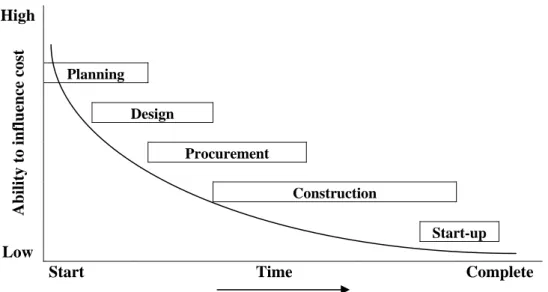
Furthermore, the earlier the implementation of constructability in the delivery process, the higher the potential benefits for cost and time savings. Therefore, the constructability process has to start with the owner’s conception of the project, and continue through project planning, design, construction, and start-up (figure 1).
High
Planning
Design
Procurement
Construction
Ability to inf
luence cost
Start-up
Low
Start Time Complete
Figure 1. Ability to influence the final cost over the life of the project (taken form CII: Preview of Constructability Implementation 1993, pp. 1)
b.
Implementation
The CII has developed a program aimed at providing the construction industry with a tool to be used as a guide in the planning, development and implementation of constructability in
construction projects (CII: Constructability Implementation Guide 1993). This process of constructability implementation consists of three major steps:
o Obtaining constructability capabilities
o Planning constructability implementation, and o Implementing constructability
1. Obtaining constructability capabilities
Obtaining constructability capabilities involves acquiring and engaging qualified construction personnel in major management and technical decisions that meet both design and construction needs, and retaining key personnel throughout the life cycle of the project.
The first step on implementing a constructability program is to define constructability objectives and measures. Developing a clear understanding of the project’s objectives and priorities is essential in guiding people’s efforts towards the goal, project delivery time reduction in this case. Once objectives have been identified, all participants in the process should be made aware of them. Establishing project planning duration, design duration, construction duration and start-up duration can be adopted as the general objectives of the constructability application. However, the definition of more specific objectives leads to increased team support and commitment through the implementation of the constructability program. The following are examples of specific objectives cited from the CII’s Constructability Implementation Guide (1993, pp. 37):
- Use of standardized elements - Use of modules/preassembly - Use of lift equipment
- Material laydown areas
- Ease of fabrication and erection - Number of field welds
- Jobsite accessibility
- Develop construction-friendly specifications - Improve constructor/engineer communications - Minimizing construction rework
- Minimizing design rework - Minimizing jobsite congestion
- Minimizing occurrence of labor disputes
After the construction management along with the project team has identified the goals and objective of the constructability program, the next step is to establish how these can be objectively measured. Adopting appropriate measures is important for evaluating the effectiveness of the constructability intention in project schedule performance. Examples of performance measures are labor productivity, number of items nonconforming with owner’s specifications, design rework work-hours, number of change orders, lost-time incident rate,
shut-down duration (hours), personnel and material jobsite accessibility (feet/hour/unit), etc (CII: Constructability Implementation Guide 1993).
An assessment of the owner’s available in-house capabilities should be carried out at this point. The procurement of external design and construction constructability expertise might need to be considered too. Decisions will depend on different factor including owner’s objectives,
availability of resources, project characteristics such as project complexity, project size, project location, construction type, contract type, technical difficulty, among others.
The owner’s selection of the contracting strategy has also considerable impact in the means and the extent of early construction input in the project. In the traditional design-bid-build or the multiple prime contracting approaches, it is not possible to bring the actual constructor to participate in the planning and design phases. Consequently, under these delivery methods the use of construction knowledge and expertise from outside should be considered. This input may come from the design team or an external consultant with the required expertise. However, construction input from external resources may not be as effective as input from the actual constructor. Conversely, under the design-build contracting strategy, constructability is better implemented because there is one design-build contractor who is naturally encouraged to use constructability in the design phase. Yet, it is important to keep in mind that constructability applied at the early stages of planning, before the design phase, increases potential schedule benefits. As a result, executing constructability under each project delivery technique will have different results due to the timing at which the constructor expertise is available to the project. After defining where constructability input will be obtained from, the next step is to determine how to facilitate an early implementation. When constructability is implemented through external resources, a surrogate construction contractor can provide the necessary construction knowledge and expertise. When the delivery system allows the early involvement of the
constructor or requires external resources, a constructability program can be included as part of the prequalification process to guarantee constructor’s experience and early commitment to use constructability.
The use of incentives is an option to enhance constructability performance. Incentives can be related to specific milestones and completion of specific stages. The benefit of incentive programs increases when incentives are effectively integrated between the design and constructor players.
2. Planning constructability implementation
Planning constructability implementation should begin as early as possible and be integrated into the entire project execution plan. It should also include all major project participants to the maximum possible extent. The development of the constructability implementation plan follows three basic steps (CII: Constructability Implementation Guide 1993): 1) Creating the
constructability team, 2) Identifying and address project barriers, and 3) Developing constructability procedures and integrating into project activities.
Creating the constructability team
The constructability team should include as a minimum participants that represent the owner, designer and constructor teams. However, to increase effectiveness of the program, it is also recommended to include representatives from subcontractors, vendors and consultants when
applicable. The members selected to participate in the constructability team should have construction experience and knowledge, but also strong interpersonal skills to be able to cooperate with the team and act as team players. Team members must understand the importance of constructability and the desired outcomes of its adoption. The construction manager should also enforce a clear understanding of each individual’s specific roles and responsibilities as members of the constructability team. A coordinator should be selected with appropriate experience and skills to manage the execution of the program.
Identifying and addressing project barriers
Constructability implementation commonly presents several barriers that make its execution more difficult. Some are related to owner’s and participants’ commitment, such as lack of constructability awareness, reluctance to provide funding or invest resources; and other barriers are more specifically related to team members performance or lack of performance thereof, such as complacency with the status quo, lack of construction experience, lack of designer’s
willingness to adopt constructor’s input, adverse relationships between design and constructors, construction input requested or provided too late to be of value, etc. The last section of this section presents a list of the most common barriers identified by the CII in the implementation of constructability. Identification of the potential barriers enables the team to anticipate and be prepared to overcome those shortcomings.
Developing constructability procedures and integrating into project activities
The development of constructability procedures will depend on the individual circumstances of the project. However, the CII (CII: The Project’s Manager Playbook 2005, CII: Constructability - A Primer 1986) establishes seven basic constructability concepts that are generally applicable to the design and procurement phases of any project.
o Design and procurement schedules should be construction-driven. o Designs have to be configured to enable efficient construction.
o Designs should consider major construction methods when establishing basic design approaches.
o Design elements need to be as standardized as possible.
o Construction efficiency should be considered in specification development.
o Module/preassembly designs need to be prepared to facilitate fabrication, transport, and installation.
o Designs must promote construction accessibility of personnel, material, and equipments. o Designs should facilitate construction under adverse weather conditions.
o Flexibility in designs and specifications should be provided to allow construction to determine the appropriate means and methods of installation.
o All of the appropriate information needed by construction should be contained on drawings or specifications or by reference.
o Dual-purpose designs should be considered. These are components that can serve a function in construction as well as commercial operations.
Constructability procedures and activities should be developed and integrated with the project schedule. These procedures may include developing a schedule with the timing for the various constructability studies and design inputs, developing schedules for regular meetings to discuss constructability concepts, share lessons learned, and provide constructability input to design. Constructability procedures should also embrace how decisions related to trade-off analysis will
be done, and how the constructability program progress will be monitored (CII: Constructability - A Primer 1986).
Finally, the constructability activities should be integrated into the project activities. One way to do this is by identifying the “what”, “when” and “who” portions of the process in the
constructability schedule and linking these to the project schedule.
3. Implementing constructability
Adequate implementation of constructability involves (CII: Construtability - A Primer 1986): 1) applying constructability concepts and procedures, and 2) monitoring and evaluating project program effectiveness
Applying constructability concepts and procedures
Constructability concepts are nothing more that lessons learned from past projects that have spread out within the construction industry. CII and other organizations have extensive checklists of general constructability concepts that can be applied in any given project. However, developing more specific concepts from individual experience and lessons learned improves the quality of constructability input during planning and design.
Constructability procedures are actions that have to be implemented by each team member throughout the design phase in order to generate construction input in design. Thus, each member should follow procedures based on its role and responsibilities.
Monitoring and evaluating project program effectiveness
The team coordinator should monitor constructability progress in order to measure its
effectiveness and take corrective actions when needed. When the program is failing in meeting constructability objectives, the coordinator can turn to the list of barriers identified in previous steps to find possible areas of failure. One common weakness in the process is poor
communication and deficient working relationships among team members. After obstacles and difficulties have been identified, actions should be adopted to address these. Sometimes it is also necessary to modify constructability procedures or activities to overcome barriers.
c.
Advantages
An appropriate and successful application of constructability in the early stages of project development provides with the following potential benefits (CII: Constructability
Implementation Guide 1993, CII: Constructability - A Primer 1986): o Significant schedule improvements
o Earlier project completion
o Significant reductions in overall installed project expenses, being construction savings the major factor in reducing expenses
o Improvement in project quality, for the most part design and construction quality o Better productivity
o Improvement of safety during construction
d.
Key elements to ensure a high degree of success
One of the major determinants of the success of constructability is the timing at which it is introduced. Hence, in order to explode its potential benefits to its maximum, constructability has to be implemented at the earliest stages when the project is conceptualizing, and continue
through project planning, design, construction, and start-up.
The construction manager has a critical influence on the success of the project’s constructability implementation. When all the team members are truly committed since constructability
planning, the chances of attaining greatest benefits increase. Therefore, construction manager’s efforts must focus on enhancing commitment from team members to establish a supportive environment and assure constructability success. Commitment however should not be merely directed implementation of the program itself but also to the results in terms of time expected from program’s implementation. Constructability can be enhanced when the influence it has over delivery time is emphasized and clearly understood by all parties involved.
The owner’s selection of the contracting strategy has also substantial impact in the means and the degree to which early construction input into project planning and design can be achieved. Establishing the appropriate project delivery technique will therefore contribute to a successful application of constructability reviews.
Regardless of the source from which constructability input will be obtained, a constructability program can be included as part of the prequalification process to guarantee constructor’s experience on constructability and early commitment to the program. This can be applicable to situations in which the actual constructor is involved early in project planning and design, or when external resources or consultants are required.
The use of incentives has the potential of enhancing constructability performance when incentives are effectively integrated between the design and constructor or constructability teams. The development of common goals among team members is also a key to developing joint-work to achieve constructability success.
When selecting members to make the constructability team, several aspects need to be taken in consideration to enhance team effectiveness. First, it is essential to compose a team of
individuals with extensive experience and knowledge. It may be worth to develop selection criteria in advance to obtain the minimum level of expertise. Nonetheless, it is also important to select team players that are willing to cooperate, work in team, and accept other participant’s points of views. An environment of open communication supports the development of a cohesive team with joined objectives which increases thereby commitment to the program. Finally, the importance of continuity within the team is fundamental to achieve success; team turn-over must be minimized.
Developing a constructability program based on a forward-looking, integrated planning philosophy instead of a backward-looking review of completed design increases the quality of design and decreases the risk of design rework. Developing a schedule which determines the needed time of constructability studies and design inputs allows for a smoother adaptability to the process.
Regular meetings of the constructability team enable discussing concepts, sharing lessons learned, and providing constructability input to design. An appropriate strategy to improve the
efficiency of constructability reviews is to perform a final review for completeness and accuracy of design details on design packages that are ready to be submitted. This approach can prevent rework when changes in design occurred after initial constructability review.
One way to monitor and evaluate constructability outcomes is by maintaining communication with the contractor throughout the construction phase of the project. Evaluations also allow discovering areas of possible improvement in the next stages of the constructability program.
e.
Disadvantages
Coordination of the different parties is a major issue when adopting constructability. If the team is not well managed and coordinated the introduction of other parties into the design stage of the project can result in adverse relationships hindering project success.
f.
Applicability and use
Extensive case studies have demonstrated that constructability applications are investments that result in substantial returns in terms of project quality, costs and time. The technique presented herein provides owners, construction managers and other applicable parties with the basic steps to successfully implement a constructability plan to improve construction performance and reduce delivery times. The more detailed and more time and effort devoted to implementing constructability the greater the likelihood of project success. However, taking into account basic constructability concepts during project design can improve construction performance (CII: The Project’s Manager Playbook 2004, CII: Constructability - A Primer 1986). The following are a few of these key concepts:
o Design and procurement schedules should be construction-driven. o Designs have to be configured to enable efficient construction.
o Designs should consider major construction methods when establishing basic design approaches.
o Design elements need to be as standardized as possible.
o Construction efficiency should be considered in specification development.
o Module/preassembly designs need to be prepared to facilitate fabrication, transport, and installation.
o Designs must promote construction accessibility of personnel, material, and equipments. o Designs should facilitate construction under adverse weather conditions.
o Flexibility in designs and specifications should be provided to allow construction to determine the appropriate means and methods of installation.
o All of the appropriate information needed by construction should be contained on drawings or specifications or by reference.
o Dual-purpose designs should be considered. These are components that can serve a function in construction as well as commercial operations.
g.
Other special characteristics
For a constructability program to be effectively implemented, potential barriers should be
identified and defeated. CII provides a list of typical barriers encountered in the implementation of constructability programs (CII: Constructability - A Primer 1986). The use of barriers
checklists can assist team participants in assessing whether a particular barrier is significant and needs more attention and effort to be addressed and overcome. The checklist can also be used
periodically to evaluate if identified barriers are being correctly addressed or still need to be mitigated, and to identify and defeat new barriers that can appear along with the implementation of constructability.
Some barriers are related to the owner, others the designers or contractors, and some affect all the parties involved in the project. The following are barriers checklists that affect a particular party or all of them at the corporate level and at the project level (CII: Constructability
Implementation Guide 1993):
Constructability barriers checklist applicable at the owner corporate level
• Complacency with the status quo o resistance to change
o conservative, non-innovative approaches
o risk-averse attitudes towards trying something new o no rewards for intelligent risk-taking
o a “not invented here” syndrome
• Lack of documentation and retrieval of “lessons learned” o no formal system for documenting lessons learned
o reliance on word-of-mouth and experienced personnel to transfer innovative ideas
• Lack of awareness/understanding of the concepts of constructability, no procedural “roadmap” is available
o constructability used as a buzzword
o efforts ineffective due to lack of coordination; direction
• Perceptions that “we do it”
o “routine design practices fully exploit constructability” o “we already pay for it”
o “we do value engineering; value engineering equals constructability”
• There are no proven benefits of constructability o “too expensive”
o senior management is not convinced of the cost-benefits
• Reluctance to invest additional money, effort, and time in early project stages o inability to acquire additional front-end funding
o inflexible design fee structure/inflexible scope of design services o expectation of free advice/consulting form contractors and consultants
• Lack of genuine commitment to constructability o constructability is low priority
o no policy statement exists, no champion o “there are higher priorities”