First edition 2001 © ISO/IEC 2001
GUIDE 71
Guidelines for standards
developers to address the needs
of older persons and persons
with disabilities
PDF disclaimer
This PDF file may contain embedded typefaces. In accordance with Adobe's licensing policy, this file may be printed or viewed but shall not be edited unless the typefaces which are embedded are licensed to and installed on the computer performing the editing. In downloading this file, parties accept therein the responsibility of not infringing Adobe's licensing policy. The ISO Central Secretariat accepts no liability in this area.
Adobe is a trademark of Adobe Systems Incorporated.
Details of the software products used to create this PDF file can be found in the General Info relative to the file; the PDF-creation parameters were optimized for printing. Every care has been taken to ensure that the file is suitable for use by ISO member bodies. In the unlikely event that a problem relating to it is found, please inform the Central Secretariat at the address given below.
© ISO/IEC 2001
All rights reserved. Unless otherwise specified, no part of this publication may be reproduced or utilized in any form or by any means, electronic or mechanical, including photocopying and microfilm, without permission in writing from either ISO at the address below or ISO's member body in the country of the requester.
ISO copyright office
Case postale 56 • CH-1211 Geneva 20 Tel. + 41 22 749 01 11
Fax + 41 22 749 09 47 E-mail [email protected] Web www.iso.ch Printed in Switzerland
© ISO/IEC 2001 – All rights reserved iii
Contents
Page Foreword...iv 0 Introduction...v 1 Scope ...1 2 References ...13 Terms and definitions ...2
4 General considerations...3
5 Using Guide 71...4
6 Developing standards — Issues to consider during the standards development process ...4
7 Tables of factors to consider to ensure standards provide for accessible design...5
7.1 Introduction...5
7.2 Purpose of Tables...5
7.3 Using the Tables ...6
8 Factors to consider ...14
8.1 General...14
8.2 Alternative format ...14
8.3 Location and layout of information and controls and positioning of handles...15
8.4 Lighting levels and glare...15
8.5 Colour and contrast...16
8.6 Size and style of font and symbols in information, warnings and labelling of controls...16
8.7 Clear language in written or spoken information...16
8.8 Graphical symbols and illustrations...17
8.9 Loudness and pitch of non-spoken communication ...17
8.10 Slow pace of information presentation ...17
8.11 Distinctive form of product, control or packaging...17
8.12 Ease of handling ...17
8.13 Expiration date marking...18
8.14 Contents labelling and warning of allergens...19
8.15 Surface temperature...19 8.16 Accessible routes ...19 8.17 Logical process ...20 8.18 Surface finish ...20 8.19 Non-allergenic/toxic materials ...21 8.20 Acoustics...21 8.21 Fail-safe ...21 8.22 Ventilation ...21
8.23 Fire safety of materials...21
9 Detail about human abilities and the consequences of impairment...21
9.1 General...21 9.2 Sensory abilities ...22 9.3 Physical abilities...24 9.4 Cognitive abilities ...26 9.5 Allergies...27 Bibliography...29
Foreword
ISO (the International Organization for Standardization) and IEC (the International Electrotechnical Commission) form the specialized system for worldwide standardization. National bodies that are members of ISO or IEC participate in the development of International Standards through technical committees established by the respective organization to deal with particular fields of technical activity. ISO and IEC technical committees collaborate in fields of mutual interest. Other international organizations, governmental and non-governmental, in liaison with ISO and IEC, also take part in the work.
International Standards are drafted in accordance with the rules given in the ISO/IEC Directives, Part 2.
Draft Guides adopted by the responsible Committee or Group are circulated to national bodies for voting. Publication as a Guide requires approval by at least 75 % of the national bodies casting a vote.
Attention is drawn to the possibility that some of the elements of this Guide may be the subject of patent rights. ISO and IEC shall not be held responsible for identifying any or all such patent rights.
ISO/IEC Guide 71 was prepared by an ad hoc TAG (Technical Advisory Group) based on the preliminary work undertaken by a COPOLCO (Committee on Consumer Policy) Working Group, at the request of the ISO/TMB Secretariat.
© ISO/IEC 2001 – All rights reserved v
0 Introduction
0.1 It is an important goal for the whole of society that all people have access to products, services, workplaces
and environments. The issue of accessibility to and usability of products and services has become more critical with the increasing percentage of older persons in the world’s population. While not all older persons have disabilities, the prevalence of disability or limitations is highest among this demographic group.
0.2 The needs and abilities of people change as they advance from childhood to old age and the abilities of
individuals in any particular age group vary substantially. It is important to recognize that functional and cognitive limitations vary from comparatively minor, such as mild hearing loss or use of spectacles only to read, to blindness, deafness or the inability to move part or all of one’s body. It should be noted that although some limitations may be minor in nature, in combination, as is the case in ageing, these can pose a significant problem.
0.3 For many years, standards bodies at the national and international level have addressed the needs of
persons with disabilities in the development of specific standards in the area of assistive technology and accessible building design. However, the needs of older persons and persons with disabilities are not being adequately addressed when other relevant standards for everyday products and services are written or revised. Standards bodies are starting to address ageing and disability issues and will, increasingly, develop and implement policies and programmes in their products and services to include the needs of older persons and persons with disabilities. It is important to ensure the representation of interests of older persons and persons with disabilities in the development of these solutions.
0.4 This Guide is intended to be part of the overall framework that standards bodies can use in their efforts to
support the need for more accessible products and services. The ISO/IEC Policy Statement 2000 — Addressing the Needs of Older Persons and People with Disabilities in Standardization Work sets out the principles for
ensuring that the needs of older persons and persons with disabilities1) are incorporated in the standards-making
process, providing justification on humanitarian and economic grounds. This Guide supplements the ISO/IEC Policy Statement by identifying problem areas which need to be considered when drafting standards, recognizing the constraint that standards should normally not be design-restrictive. It is intended for those involved in the preparation and revision of International Standards but also contains information which may be useful for others such as manufacturers, designers, service providers and educators.
0.5 Of necessity, guidance provided in this Guide is general. Usability issues for people with impairments are
identified without specific solutions. It is recognized that additional sector-related guides need to be developed for specific product or service sectors.
1) Developments in the field of accessibility have resulted in the creation and use of a wide variety of terms and definitions, related to older persons and disability, which differ throughout the world. For example, some people prefer to use the term “people with disabilities” and others prefer “disabled people”. Overall, terms have evolved to become more precise and descriptive, rather than negative or stigmatizing. As no universal practice exists, the terms used in this Guide reflect the language generally used by international agencies such as the United Nations Organization and the World Health Organization.
© ISO/IEC 2001 – All rights reserved
1
Guidelines for standards developers to address the needs of older
persons and persons with disabilities
1 Scope
1.1 This Guide provides guidance to writers of relevant International Standards on how to take into account the
needs of older persons and persons with disabilities. Whilst recognizing that some people with very extensive and complex disabilities may have requirements beyond the level addressed in this Guide, a very large number of people have minor impairments which can be easily addressed by relatively small changes of approach in standards, thereby increasing the market for the product or service.
This Guide aims
a) to inform, increase understanding and raise awareness about how human abilities impact on the usability of products, services and environments,
b) to outline the relationship between the requirements in standards and the accessibility and usability of products and services, and
c) to raise awareness about the benefits of adopting accessible design principles in terms of a wider market.
1.2 This Guide applies to products, services and environments encountered in all aspects of daily life and
intended for the consumer market and the workplace. For the purposes of this document, the term ‘products and services’ is used to reflect all these purposes.
1.3 This Guide
a) describes a process by which the needs of older persons and persons with disabilities may be considered in the development of standards,
b) provides tables to enable standards developers to relate the relevant clauses of a standard to the factors which should be considered to ensure that all abilities are addressed,
c) offers descriptions of body functions or human abilities and the practical implications of impairment,
d) offers a list of sources that standards developers can use to investigate more detailed and specific guidance materials.
1.4 This Guide provides general guidance. Consideration should be given to the development of additional
guides for specific product or service sectors.
1.5 While it is recognized that accessibility and usability are important for both products amd services,
international work on services standards is at the preliminary stage. At present, this Guide contains considerably more guidance on products than on services.
2 References
ISO/IEC Guide 50:—2), Safety aspects — Guidelines for child safety
ISO/IEC Guide 51:1999, Safety aspects — Guidelines for their inclusion in standards
ISO/IEC Policy Statement, 2000, Addressing the needs of older persons and people with disabilities in standardization work
World Health Organization, International Classification of Functioning and Disability, ICIDH-2 Beta-2
3 Terms and definitions
For the purposes of this Guide, the following terms and definitions apply.
NOTE This clause is designed to provide clarification of some of the terms used in the fields of ergonomics, accessibility and standardization. It does not provide descriptions of body functions and impairments. This information is provided in clause 9. (See also Introduction, footnote 1, page v.)
3.1
ergonomics human factors
that branch of science and technology that includes what is known and theorized about human behavioural and biological characteristics that can be validly applied to the specification, design, evaluation, operation and maintenance of products and systems, to enhance safety, and effective and satisfying use by individuals, groups and organizations
3.2
accessible design
design focussed on principles of extending standard design to people with some type of performance limitation to maximize the number of potential customers who can readily use a product, building or service which may be achieved by
designing products, services and environments that are readily usable by most users without any modification,
by making products or services adaptable to different users (adapting user interfaces), and
by having standardized interfaces to be compatible with special products for persons with disabilities.
NOTE 1 Terms such as design for all, barrier-free design, inclusive design and transgenerational design are used similarly but in different contexts.
NOTE 2 Accessible design is a subset of universal design where products and environments are usable by all people, to the greatest extent possible, without the need for adaptation or specialized design.
3.3
assistive technology assistive device
piece of equipment, product system, hardware, software or service that is used to increase, maintain or improve functional capabilities of individuals with disabilities
NOTE This can be acquired commercially off-the-shelf, modified or customized. The term includes technical aids for persons with disabilities. Assistive devices do not eliminate an impairment but may lessen the difficulty an individual has in carrying out a task or activity in specific environments.
© ISO/IEC 2001 – All rights reserved
3
3.4impairment
problem in body function or structure such as a significant deviation or loss which can be temporary due, for example, to injury, or permanent, slight or severe and can fluctuate over time, in particular, deterioration due to ageing
NOTE 1 Body function can be a physiological or psychological function of a body system; body structure refers to an anatomic part of the body such as organs, limbs and their components (as defined in ICIDH-2 of July 1999). See also footnote 1, page v.
NOTE 2 This definition differs from that in ISO 9999:2001 and, slightly, from ICIDH-2/ICF: May 2001, WHO. 3.5
activity limitation
difficulty an individual may have in executing taks or actions 3.6
user
person who interacts with the product, service or environment NOTE Adapted from ISO 9241-11:1998.
3.7 usability
extent to which a product can be used by specified users to achieve specified goals with effectiveness, efficiency and satisfaction in a specified context of use
[ISO 9241-11:1998] 3.8
alternative format
different presentation which may make products and services accessible by the use of another mobility or sensory ability
3.9
working dog
guide dog, hearing and seizure, service (usually assisting with mobility needs) and social therapy dog, or any combination of these
4 General
considerations
4.1 Aside from the humanitarian reasons for making products, services and environments more usable by older
persons and persons with disabilities, there are a number of economic benefits. The most obvious is the increase in potential customers. Features that make products and services usable for persons with disabilities can also make them convenient and easy to use for everyone else. This is particularly helpful when people have temporary difficulties, such as lost glasses, a broken leg or a journey with a pram/stroller or bulky luggage.
4.2 Addressing needs earlier rather than later in the design stage enables producers, at little or no extra cost, to
design and produce products, services and environments that more people can use. Standardization greatly influences the design of products and services that are of interest to the consumer and therefore can play an important role in this field.
4.3 Technical Committees are encouraged to address the needs of older persons and persons with disabilities in
the drafting of International Standards (see ISO/IEC Policy Statement, Addressing the Needs of Older Persons and People with Disabilities in Standardization Work). This Guide aims to provide standards developers and related others with a systematic approach to addressing ageing and disability issues in the writing and revision of International Standards and to assisting Technical Committees in evaluating how they are addressing these needs in their Work Programmes.
4.4 It is recognized that standards committees include risk assessments as part of their analysis (as specified in Guides 50 and 51). The present Guide will assist committees in the risk assessment process by identifying potential hazards which can present greater risks to those with impairments.
4.5 Assistive technology, in the form ofequipment, software or services, is available to meet some of the needs
of older persons and persons with disabilities. It is important that this is compatible with mainstream products. Consideration needs to be given to everyday products and their potential to allow the fitting of more technical assistive devices specifically for older persons and persons with disabilities. Baths and bath seats should be compatible; equally, hearing aids and telephones should be compatible.
4.6 The provision of personal assistance, including the assistance of working dogs, while sometimes
indispensable to a person with a disability, should never be relied upon to replace accessible design principles. Where accessible design cannot fully respond to the needs of older persons and persons with disabilities, in particular in the field of services, the need for personal assistance may still be required.
4.7 In product design there is potential for conflict between safety and usability. For example child-resistant
closures used on medicines to prevent access to children may also make closures more difficult to open for older persons who no longer see as well, or have reduced strength or dexterity. While safety is the primary objective, Technical Committees should try to develop solutions which also address ergonomic factors. Guidance on addressing the needs of children is given in ISO/IEC Guide 50.
5 Using
Guide
71
5.1 Clause 6 of this Guide suggests a process standards developers may use to address the needs of older
persons and persons with disabilities as part of their standards development process.
5.2 Clause 7 provides tables to help standards developers to identify factors that will affect the use of a product,
service or environment and to consider their significance for persons with different abilities.
5.3 Clause 8 provides more explanation of the factors to consider, using key words set out in the tables.
5.4 Clause 9 describes the different human abilities, sensory, physical and cognitive, referred to in the tables,
and provides some description of the causes and consequences of impairment. It also includes a section on allergies which can impose limitations on an individual’s activities and which are in some cases potentially life-threatening. It is desirable that all standards writers read all of clause 9, to increase awareness of the issues.
5.5 A Bibliography is also provided which offers a list of sources that standards developers can use to
investigate more detailed and specific guidance materials.
6 Developing standards — Issues to consider during the standards development
process
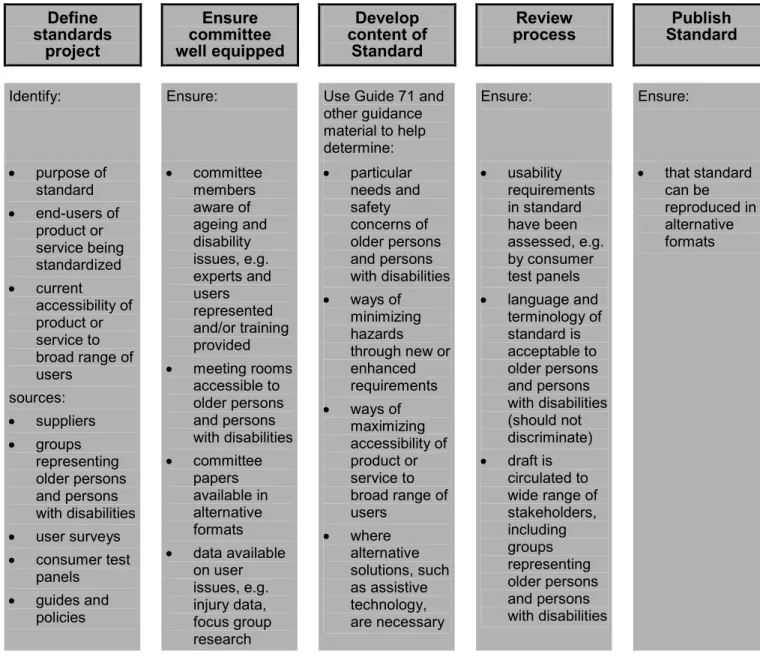
Committees may find the following process helpful in ensuring that the needs of older persons and persons with disabilities are included, when drafting a new standard or at each revision of an existing one. The process reads from left to right with guidance on achieving each objective in the columns below.
© ISO/IEC 2001 – All rights reserved
5
Define
standards
project
Ensure
committee
well equipped
Develop
content of
Standard
Review
process
Standard
Publish
Identify: Ensure: Use Guide 71 and
other guidance material to help determine: Ensure: Ensure: • purpose of standard • end-users of product or service being standardized • current accessibility of product or service to broad range of users sources: • suppliers • groups representing older persons and persons with disabilities • user surveys • consumer test panels • guides and policies • committee members aware of ageing and disability issues, e.g. experts and users represented and/or training provided • meeting rooms accessible to older persons and persons with disabilities • committee papers available in alternative formats • data available on user issues, e.g. injury data, focus group research • particular needs and safety concerns of older persons and persons with disabilities • ways of minimizing hazards through new or enhanced requirements • ways of maximizing accessibility of product or service to broad range of users • where alternative solutions, such as assistive technology, are necessary • usability requirements in standard have been assessed, e.g. by consumer test panels • language and terminology of standard is acceptable to older persons and persons with disabilities (should not discriminate) • draft is circulated to wide range of stakeholders, including groups representing older persons and persons with disabilities • that standard can be reproduced in alternative formats
7 Tables of factors to consider to ensure standards provide for accessible design
7.1 Introduction
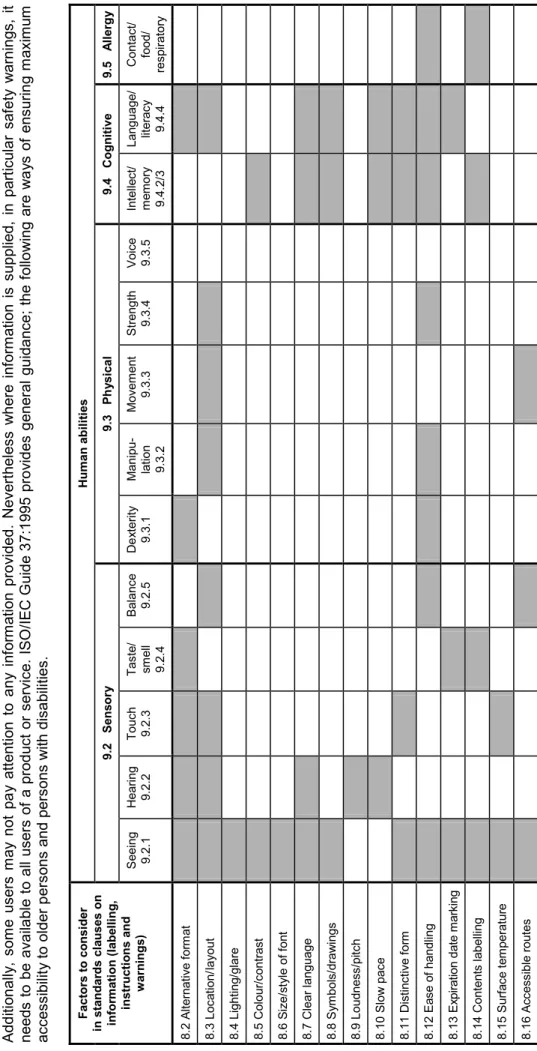
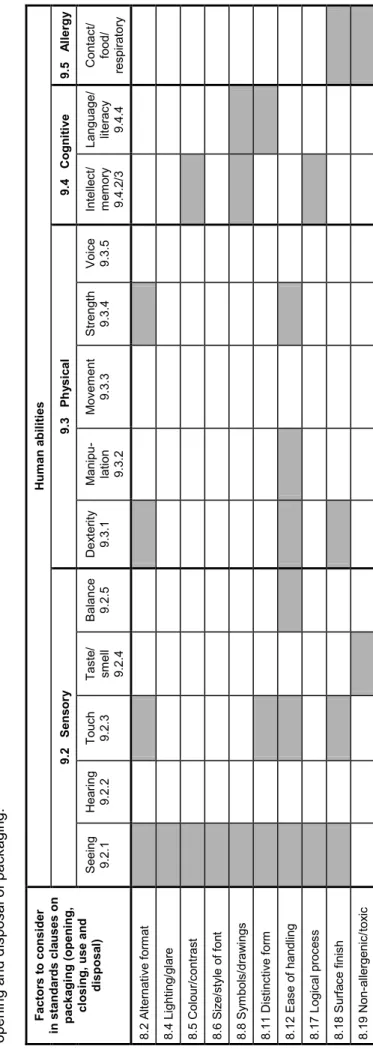
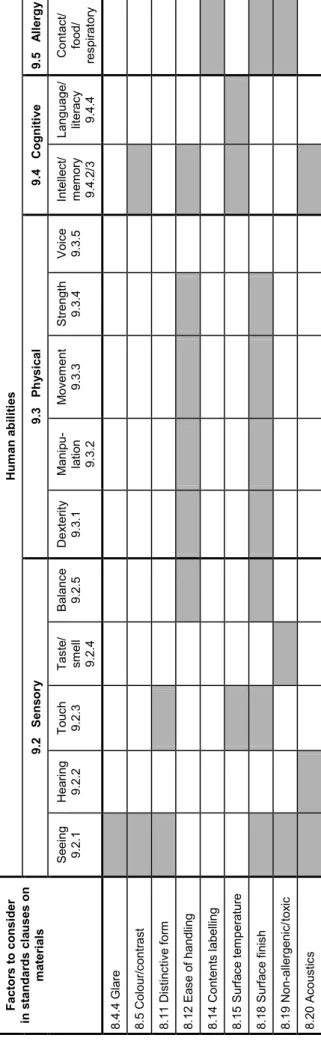
Tables 1 to 7 provide a tool intended to help standards developers to identify factors that will affect the use of a product, service or environment by people with different levels of ability. It should be noted that individual users may have impairment in more than one ability and all abilities should always be considered.
7.2 Purpose of Tables
Each Table identifies typical clauses or sections of International Standards as follows: Table 1 Information, labelling, instructions and warnings
Table 2 Packaging: opening, closing, use and disposal Table 3 Materials
Table 5 User interface, handling, controls and feedback Table 6 Maintenance, storage and disposal
Table 7 Built environments (buildings)
7.3 Using the Tables
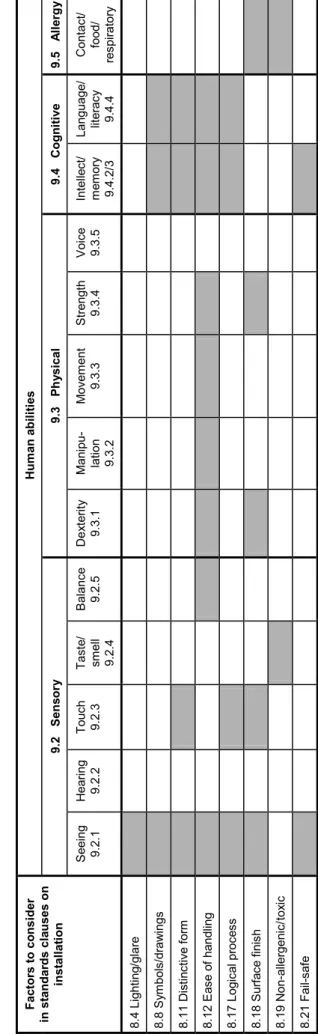
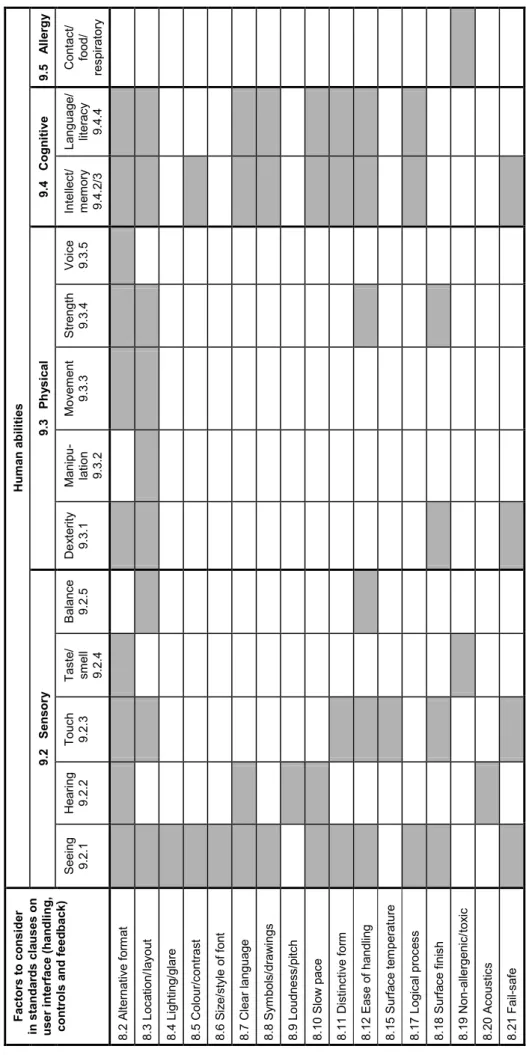
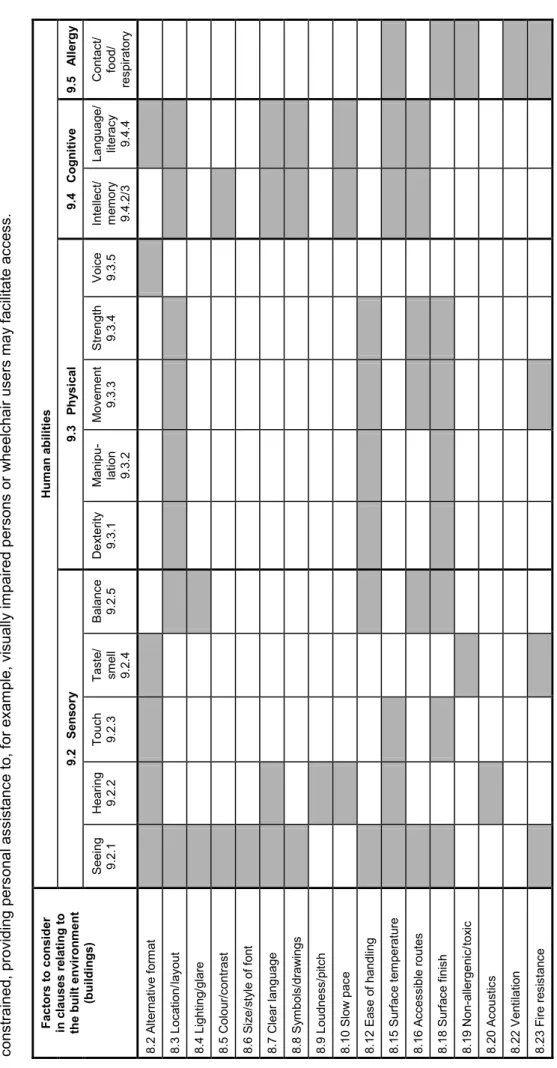
7.3.1 To use the Tables, it is suggested that standards developers first consider which Tables are relevant to
their draft International Standard, that is, what sorts of clauses they expect to include in the standard. For example, a standard related to an electrical product might have clauses covering information, packaging, materials, installation, user interface and maintenance and thus Tables 1 to 6 would be relevant. A standard on food packaging might have clauses covering information, packaging, materials, user interface and maintenance, and so Tables 1 to 3, 5 and 6 should be consulted. A standard on building access might include clauses on information, materials, installation, user interface and the built environment in general, suggesting Tables 1, 3, 4, 5 and 7 should be looked at.
7.3.2 Within each Table, the first column identifies, through key words, the factors which should be considered.
The key words are numbered as they are described in clause 8 of this Guide.
EXAMPLE For an electrical product, when drafting clauses on information and warnings, consideration should be given to alternative formats, the location and layout of information, the light conditions under which it should be viewed, etc. The key words “Alternative format” are explained in more detail in 8.2, “Location and layout” are covered in 8.3, and so on.
7.3.3 The remaining columns of each Table show, by shading, where factors are significant for those with
impairment in the various human abilities. Even though the factors which tend to be especially significant are shaded here, all the factors could be important and should be considered for each different case. So, again in Table 1, the use of alternative formats for information and warnings can be seen to be important for people with sensory impairment (in seeing, hearing, touch, taste or smell), and those who have impairment in dexterity or in language and literacy. The relevant alternative format may be different for different abilities but clearly the more alternative formats used, the greater the number of people who will be suited. Each of the human abilities is numbered as it appears in clause 9 so more information about, for example, an ability to see and the potential risks arising from impairment can be found in 9.2.1.
7.3.4 In conclusion, standards developers should use the Tables selectively — in terms of the Tables and factors
that are relevant to their International Standard. However, once the relevant Tables and factors have been identified, all the consequent row of Human abilities should be considered. This is because all factors relevant to a product, service or environment may be significant to people of any ability.
T ab le 1 — F act o rs t o co n sid er in clau ses o n in fo rm at io n T he bes t des igne d pr od uc ts or s er vic es avoi d the n e ed f or an y ex pl anat or y i nf or m ation, s ig nal ling th e w a y the y s ho uld b e us ed b y f or m and appear a nc e. Add iti on al ly , s om e us er s m ay n ot pa y att ent ion t o a n y i nf or m ation pr o vi ded . Never thel es s w h er e inf or m ation is s up pl ied, in par tic ul a r s af et y w ar n ings , i t needs to be a va ila bl e t o a ll us er s of a pr od uc t or s er vi ce. ISO /IEC G uid e 3 7:1 995 pr o vid es g ener a l gu ida nc e ; the f oll o w ing ar e w a ys of ens ur in g m ax im um ac ce ss ibil ity to ol der p er sons and per sons with dis a bi lities . Hu m an ab ili ti es 9. 2 S ens or y 9. 3 P h ys ical 9. 4 Cogn it iv e 9. 5 A ll erg y Factors to co nsi d er in standar d s cl au ses on inf o rm at ion ( la b el ling , in structi o ns and w arn ings) S eei ng 9. 2. 1 Heari ng 9. 2. 2 Touc h 9. 2. 3 Tas te / sm ell 9. 2. 4 B al anc e 9. 2. 5 De xt eri ty 9. 3. 1 M ani pu-la tion 9. 3. 2 M ovem ent 9. 3. 3 S trengt h 9. 3. 4 Vo ice 9. 3. 5 In te lle ct / me m or y 9. 4. 2/ 3 Language/ lit erac y 9. 4. 4 Cont ac t/ food/ res pi rat ory 8. 2 A lte rnat iv e fo rm at 8. 3 Loc at io n/ la yout 8. 4 Li ght in g/ gl are 8. 5 Col our/ cont rast 8. 6 S iz e/s ty le o f fo nt 8. 7 Cl ear l anguage 8. 8 S ym bol s/ draw ings 8. 9 Loudness /pi tc h 8. 10 S low pac e 8. 11 Di st in ct iv e fo rm 8. 12 E as e o f handl in g 8. 13 E xp ira tio n da te m ar ki ng 8. 14 C on te nt s la be llin g 8. 15 S urf ac e te m perat ure 8. 16 A cc ess ib le rout es
T ab le 2 — F act o rs t o co n sid er in clau ses o n p ack a g in g As pec ts to c ons id er i nc lu d e th e l abe llin g of pac kagin g w h ic h o ver laps wit h i nf or m ation gi ve n i n T abl es 1 ( ins tr uc tions ), 3 ( m at er ials ) and the pr oc es s of open in g an d d is pos a l of pa ck aging. H u ma n a b ilit ie s 9. 2 S ens or y 9. 3 P h ys ical 9. 4 Cogn it iv e 9. 5 A ll erg y Factors to co nsi d er in standar d s cl au ses on packagi n g (open ing , cl osi n g, use an d disposa l) S eei ng 9. 2. 1 Heari ng 9. 2. 2 Touc h 9. 2. 3 Tas te / sm ell 9. 2. 4 B al anc e 9. 2. 5 De xt eri ty 9. 3. 1 M ani pu-la tion 9. 3. 2 M ovem ent 9. 3. 3 S trengt h 9. 3. 4 Vo ice 9. 3. 5 In te lle ct / me m or y 9. 4. 2/ 3 Language/ lit erac y 9. 4. 4 Cont ac t/ food/ res pi rat ory 8. 2 A lte rnat iv e fo rm at 8. 4 Li ght in g/ gl are 8. 5 Col our/ cont rast 8. 6 S iz e/s ty le o f fo nt 8. 8 S ym bol s/ draw ings 8. 11 Di st in ct iv e fo rm 8. 12 E as e o f handl in g 8. 17 Logi ca l proc es s 8. 18 S urf ac e fini sh 8. 19 Non-al le rgeni c/ to xi c
T ab le 3 — F act o rs t o co n sid er in clau ses o n mat er ials T he natur e of m ater ials h as an im pac t on us er in ter ac tions . H u ma n a b ilit ie s 9. 2 S ens or y 9. 3 P h ys ical 9. 4 Cogn it iv e 9. 5 A ll erg y Factors to co nsi d er in standar d s cl au ses on ma te ri al s S eei ng 9. 2. 1 Heari ng 9. 2. 2 Touc h 9. 2. 3 Tas te / sm ell 9. 2. 4 B al anc e 9. 2. 5 De xt eri ty 9. 3. 1 M ani pu-la tion 9. 3. 2 M ovem ent 9. 3. 3 S trengt h 9. 3. 4 Vo ice 9. 3. 5 In te lle ct / me m or y 9. 4. 2/ 3 Language/ lit erac y 9. 4. 4 Cont ac t/ food/ res pi rat ory 8. 4. 4 G lare 8. 5 Col our/ cont rast 8. 11 Di st in ct iv e fo rm 8. 12 E as e o f handl in g 8. 14 C on te nt s la be llin g 8. 15 S urf ac e te m perat ure 8. 18 S urf ac e fini sh 8. 19 Non-al le rgeni c/ to xi c 8. 20 A coust ic s
T ab le 4 — F act o rs t o co n sid er in clau ses o n In st all at io n In m an y c as es , i ns tal lat io n wil l or s hou ld b e c ar ried out b y qu al ified p er sons who m a y b e les s lik el y to h ave c er tain im pair m en ts , s uc h as in s treng th. Ho w e ver a tten tio n s ho uld s til l b e g iv en t o c ater ing f or d iff er ent abi lit ies wher e ver p os si ble . H u ma n a b ilit ie s 9. 2 S ens or y 9. 3 P h ys ical 9. 4 Cogn it iv e 9. 5 A ll erg y Factors to co nsi d er in standar d s cl au ses on ins ta lla ti on S eei ng 9. 2. 1 Heari ng 9. 2. 2 Touc h 9. 2. 3 Tas te / sm ell 9. 2. 4 B al anc e 9. 2. 5 De xt eri ty 9. 3. 1 M ani pu-la tion 9. 3. 2 M ovem ent 9. 3. 3 S trengt h 9. 3. 4 Vo ice 9. 3. 5 In te lle ct / me m or y 9. 4. 2/ 3 Language/ lit erac y 9. 4. 4 Cont ac t/ food/ res pi rat ory 8. 4 Li ght in g/ gl are 8. 8 S ym bol s/ draw ings 8. 11 Di st in ct iv e fo rm 8. 12 E as e o f handl in g 8. 17 Logi ca l proc es s 8. 18 S urf ac e fini sh 8. 19 Non-al le rgeni c/ to xi c 8. 21 Fai l-s af e
T ab le 5 — F act o rs t o co n sid er in clau ses o n t h e u s er in te rf ace T his is the ar e a i n w h ic h a tt enti on t o f ac tor s c an ha ve m os t im pac t on us abi lit y b y a w ide r a nge of us er s. Hu m an ab ili ti es 9. 2 S ens or y 9. 3 P h ys ical 9. 4 Cogn it iv e 9. 5 A ll erg y Factors to co nsi d er in standar d s cl au ses on user i n terface (han dl in g , control s a nd feed back) S eei ng 9. 2. 1 Heari ng 9. 2. 2 Touc h 9. 2. 3 Tas te / sm ell 9. 2. 4 B al anc e 9. 2. 5 De xt eri ty 9. 3. 1 M ani pu-la tion 9. 3. 2 M ovem ent 9. 3. 3 S trengt h 9. 3. 4 Vo ice 9. 3. 5 In te lle ct / me m or y 9. 4. 2/ 3 Language/ lit erac y 9. 4. 4 Cont ac t/ food/ res pi rat ory 8. 2 A lte rnat iv e fo rm at 8. 3 Loc at io n/ la yout 8. 4 Li ght in g/ gl are 8. 5 Col our/ cont rast 8. 6 S iz e/s ty le o f fo nt 8. 7 Cl ear l anguage 8. 8 S ym bol s/ draw ings 8. 9 Loudness /pi tc h 8. 10 S low pac e 8. 11 Di st in ct iv e fo rm 8. 12 E as e o f handl in g 8. 15 S urf ac e te m perat ure 8. 17 Logi ca l proc es s 8. 18 S urf ac e fini sh 8. 19 Non-al le rgeni c/ to xi c 8. 20 A coust ic s 8. 21 Fai l-s af e
T ab le 6 — F act o rs t o co n sid er in clau ses o n main te n an ce, st o rag e an d d isp o sal T his m a y be u nder ta ken b y s om eone other t han the us er ; s ee a ls o T able 4. Hu m an ab ili ti es 9. 2 S ens or y 9. 3 P h ys ical 9. 4 Cogn it iv e 9. 5 A ll erg y Factors to co nsi d er in standar d s cl au ses on m ai n tena nce, stora g e and d isposal S eei ng 9. 2. 1 Heari ng 9. 2. 2 Touc h 9. 2. 3 Tas te / sm ell 9. 2. 4 B al anc e 9. 2. 5 De xt eri ty 9. 3. 1 M ani pu-la tion 9. 3. 2 M ovem ent 9. 3. 3 S trengt h 9. 3. 4 Vo ice 9. 3. 5 In te lle ct / me m or y 9. 4. 2/ 3 Language/ lit erac y 9. 4. 4 Cont ac t/ food/ res pi rat ory 8. 2 A lte rnat iv e fo rm at 8. 4 Li ght in g/ gl are 8. 8 S ym bol s/ draw ings 8. 11 Di st in ct iv e fo rm 8. 12 E as e o f handl in g 8. 17 Logi ca l proc es s 8. 19 Non al le rgeni c/ to xi c
T ab le 7 — F act o rs t o co n sid er in clau ses rel at in g t o t h e b u ilt en v iro n m en t ( b u ild in g s) Des ign of the bu ilt en vir o n m ent m a y n ee d to tak e int o ac count t he add ition al r e q uir em ents of as si st ive tec h nol og y. F or ex am ple w id er c or ridor s ar e n eed ed fo r w hee lc ha irs to pas s. Bui ld in gs other wis e c los e d to anim als s houl d ne ve rt heles s pr o vid e ac ce ss for w or king do gs . W her e des ig n s olut io ns ar e cons tr ain ed, pr ov id ing per sona l as si st anc e to, f or ex a m ple, vis u al ly im pair ed p er sons or w he elc h air us er s m a y f ac ili ta te ac ce ss . H u ma n a b ilit ie s 9. 2 S ens or y 9. 3 P h ys ical 9. 4 Cogn it iv e 9. 5 A ll erg y Factors to co nsi d er in c lauses re la ti ng to the bui lt env iron m ent (buil d in gs) S eei ng 9. 2. 1 Heari ng 9. 2. 2 Touc h 9. 2. 3 Tas te / sm ell 9. 2. 4 B al anc e 9. 2. 5 De xt eri ty 9. 3. 1 M ani pu - la tion 9. 3. 2 M ovem ent 9. 3. 3 S trengt h 9. 3. 4 Vo ice 9. 3. 5 In te lle ct / me m or y 9. 4. 2/ 3 Language/ lit erac y 9. 4. 4 Cont ac t/ food/ res pi rat ory 8. 2 A lte rnat iv e fo rm at 8. 3 Loc at io n/ la yout 8. 4 Li ght in g/ gl are 8. 5 Col our/ cont rast 8. 6 S iz e/s ty le o f fo nt 8. 7 Cl ear l anguage 8. 8 S ym bol s/ draw ings 8. 9 Loudness /pi tc h 8. 10 S low pac e 8. 12 E as e o f handl in g 8. 15 S urf ac e te m perat ure 8. 16 A cc ess ib le rout es 8. 18 S urf ac e fini sh 8. 19 Non-al le rgeni c/ to xi c 8. 20 A coust ic s 8. 22 V en til at ion 8. 23 Fi re re si st an ce
8 Factors to consider
8.1 General
8.1.1 This clause, to be used in conjunction with Tables 1 to 7 and the fuller descriptions of abilities in clause 9,
provides more detail on the features of products, services and environment that assist or hinder older persons and persons with disabilities.
8.1.2 Clauses 8.2 onwards expand on the key words used in the Tables, describing the factors to consider to
make products and services accessible. Examples of possible solutions are given but these should be treated as guidance and not specifications. The list of problems and solutions is not exhaustive.
8.1.3 Where they exist, International or national Standards on accessibility should be consulted before writing
new or revised standards that meet any of the table positions identified as a result of 7.3.3.
8.2 Alternative
format
8.2.1 General considerations
An alternative format (defined in 3.8) describes a different presentation or representation intended to make products and services accessible through a different modality or sensory ability. By providing all input and all output, i.e. information and functions, in at least one alternative format, for instance visual and tactile, more people, including some with language/literacy problems, may be helped. In terms of function for people with dexterity and strength impairment, alternative packaging solutions may need to be envisaged.
8.2.2 Alternatives to visual information
The type and texture of surface finishes can be important in providing tactile feedback which can reinforce
instructions and warnings for those with visual impairment. Where the principal form of instruction on a product or in a building is written, alternatives would be voice (instructions ‘spoken’ by a product or service), sound (feedback from clicks, bells and buzzers) or touch (tactile marking or grip).
Wherever feasible, visual information which is presented on electronic products should be available from the product in audio or other sensory stimuli for those with a visual impairment including those who cannot read braille, as well as for those who have difficulty with reading or are unable to read. Printed visual information should be available in alternative formats (electronic audio, large raised letters or braille, etc.) which are readable by individuals without vision and in large print for those with low vision.
8.2.3 Alternatives to auditory information
Wherever feasible, sound signals should be supported by visual or other sensory stimuli for those with a hearing impairment (e.g. communication in writing, graphical symbols, vibration or sign language). In particular, audible warnings, such as fire alarms, should also activate, for example, visual stimuli, such as flashing lights which are well sited and clearly indicated.
8.2.4 Alternatives to voice input
Where voice input is used to activate a process, for example building entry security systems, alternatives such as keypads or the use of video monitoring should be considered.
8.2.5 Biological identification and operation
Where biometric forms of identification are intended, an alternative form of identification or activation should also be provided. For example, if systems require a retinal scan and a person does not have a retina, or the system requires a fingerprint amd the person does not have hands or uses a prosthesis, such people are unable to operate the devices unless some alternative form of identification is substituted.
© ISO/IEC 2001 – All rights reserved
15
8.2.6 Prevention of seizuresFlicker rates, or flashing or blinking text, objects or video screens should avoid frequencies that are most likely to trigger visually induced seizures.
8.3 Location and layout of information and controls and positioning of handles
8.3.1 LocationThe position of information and controls on a product, or in a building, or even the point at which information is available for a service (e.g. warnings about the terms on which dry-cleaners accept clothes for processing) are important. They need to be prominent for someone with a visual impairment or language/literacy disability, visible from the angle of view of someone standing and seated in a wheelchair, and easily accessed by seated or standing users without bending and stretching. This may mean that the positioning needs to be flexible or adjustable or duplicated. Information or controls should be located in a position where they will not be obstructed, for example when a product is held by either or both hands, or held in a different way by someone with manipulation or strength impairment.
8.3.2 Buildings
The design of buildings can incorporate simple measures that enable people to feel more confident in the physical environment, such as well placed, sturdy handrails. Controls and door handles within easy reach facilitate use by those with impairment in dexterity, manipulation, movement or strength.
8.3.3 Layout
The layoutof information and controls will also determine how easy they are to read by someone with a visual or
cognitive impairment. Factors to consider include logical grouping of information and controls, line length of text, relevance of information and relationship of controls to actions to be undertaken.
8.4 Lighting levels and glare
8.4.1 Provision of lightingAppropriate lighting ensure that those with a visual impairment are better able to see instructions and controls. This should also be considered for those with a hearing impairment to assist with lip reading or sign language communication.
8.4.2 Consideration of ambient lighting
The likely lighting levels in typical use should be considered, for example television controls may be operated in a darkened room, installation of a product may be in a dark space.
8.4.3 Buildings
Adjustability of lighting levels in a building is desirable to suit different needs but sudden changes in lighting levels should be avoided.
8.4.4 Avoidance of glare
Too high light levels and strong directional light can result in deep shadows or glare. Reflecting surfaces on information panels and glossy paper in instruction books or on packaging containing warnings should be avoided, to reduce the possibility of glare.
8.5 Colour and contrast
8.5.1 Choice of colourThis is important for ease of recognition and ease of seeing. Some colour combinations are also more effective. For example some colours, such as red/green, are not distinguishable by a significant minority of the population (those with colour blindness).
8.5.2 Colour combinations
The best colour combinations depend on the purpose of information, whether it is for guidance or a hazard warning, and the lighting conditions under which it is most likely to be viewed. For example, black on yellow or light grey are general purpose combinations which provide strong definition without too much glare, pastel shades on pastel backgrounds or red lettering or symbols on light grey are difficult to see and should normally be avoided. 8.5.3 Colour coding of information
All information conveyed with colour should also be available without the perception of colour. Colour coding should not be used as the only means for conveying information, indicating a response or distinguishing a visual element.
8.6 Size and style of font and symbols in information, warnings and labelling of controls
The required size of font for information, warnings and labelling of controls, relates to the probable viewing distance, level of illumination and colour contrast of the text against its background. The choice of font, whether
with or without serif, in upright form or italics and light, medium or bold appearance also has a significant impact on
legibility. Standards developers should also be aware that text writen in CAPITAL letters is more difficult to read. This is significant for those with a visual impairment. Consideration should be given to specifying size and style of font and symbols for warnings.
8.7 Clear language in written or spoken information
8.7.1 Information available as textInformation should be made available in text format wherever possible, in addition to other forms, to facilitate recognition and translation into speech and other languages for those who have trouble seeing, recognizing or deciphering non-text information presentations.
8.7.2 Complexity of information
Instructions or operations which are too complex will often deter older persons and persons with limited intellect from using a product or device. Simple written or spoken messages are also clearer to understand by someone with a visual or hearing impairment.
8.7.3 Printed instructions
These should use short sentences of simple, straightforward and non-technical language and may include simple illustrations.
8.7.4 Spoken information
Rules for spoken information are similar to those for printed information. The context should always be given to ensure that information is meaningful and instructions should be provided in a logical order. Key points should be reinforced by repetition. People with hearing loss are at an increased risk or disadvantage if spoken announcements are not loud enough, or if the pitch is too high or too low.
© ISO/IEC 2001 – All rights reserved
17
8.7.5 Multiple languages
Where instructions are to be provided in more than one language, written information in each language should be presented in separate sections of a manual rather than interleaved on a page; spoken information should be preceded by a clear statement in the language to be used.
8.8 Graphical symbols and illustrations
The use of meaningful graphical symbols or illustrations, in addition to text, should be considered in instructions and also on a product, for ease of assembly or use. For example the same symbol should be used on the respective ends of parts to be joined, when assembling a product, or in the labels on controls.
8.9 Loudness and pitch of non-spoken communication
People with a hearing loss are at increased risk or are disadvantaged if warnings are not loud enough, or if the pitch is too high or too low. Where possible, volume should be adjustable over a wide range. Information should also be presented in multiple frequencies where possible (e.g. an alarm signal could consist of a strong component at multiple frequencies). Sudden changes in volume should also be avoided.
8.10 Slow pace of information presentation
Announcements spoken at a slow measured pace allow listeners to pick out the message; pauses between instructions give time to understand and act on the information. If a message is delivered too rapidly, it is difficult to assimilate by someone with a hearing or vision impairment, or learning disability. Consideration should be given to the length of time information remains in view when presented on moving displays, or when information is temporarily displayed and then removed.
8.11 Distinctive form of product, control or packaging
8.11.1 Identification by formA distinctive form can make it easier for those with visual impairment and reduced touch sensitivity to identify a product, to interpret the parts of a product to be joined during assembly and to distinguish between different controls. A familiar form can also aid those with impaired cognitive ability.
8.11.2 Orientation of product or control
Where possible, the form of the product or control should also indicate the orientation of the product or control, so the top or bottom, front or back, can be easily located by someone with a visual impairment.
8.11.3 Tactile warnings
The use of universally recognized tactile warnings on the container or packaging enables identification of toxic or corrosive materials. Similarly, tactile warnings are normally required in buildings, such as at stair openings, on steps, on platforms and at dangerous storage areas.
8.12 Ease of handling
8.12.1 Size, shape and massThese characteristics of a product will affect how easy it is to lift, hold and carry. Lifting and carrying is eased if articles are shaped to facilitate easy grasping, with either or both hands. Light, compact articles are generally preferable thus the density of manufacturing materials needs consideration. Provided safety is not compromised wherever possible, products should be capable of operation by only one hand, preferably either hand.
8.12.2 Instruction manuals and location of markings
The size, number of pages and weight of paper used in an instruction manual can affect the ease with which it is held and pages are turned, which will influence the extent it is used.
8.12.3 Controls 8.12.3.1 Handling
The force required to twist, turn, push or pull controls or fastenings is significant for people with various impairments. Operating controls should allow comfortable grip, avoid twisting of the wrist, avoid the need for simultaneous actions and offer minimal resistance. Textured surfaces, to increase friction, assist the application of force. Provision of alternative controls offering greater leverage or power-assistance should be considered. Pre-programmable operation and personal preferred settings can be effective, particularly for people with cognitive impairment.
8.12.3.2 Spacing
Controls should be spaced to avoid interference when another one is being operated. 8.12.3.3 Status
Multisensory feedback should be provided on the status of controls. 8.12.4 Containers and packaging
Containers should allow easy opening and closing by adopting appropriate shapes, sizes and surface finish. Packaging, such as some food wrappings which are difficult to open can result in injuries as users resort to sharp knives or other gadgets to attempt opening. Operating forces should be as low as reasonably attainable, compatible with security of contents.
8.12.5 Duration of actions
Products should not need a long handling time and unnecessary repetition of operations should be avoided. 8.12.6 Timed responses
Whenever possible, users should be able to control any limits on the amount of time available to them to read or respond.
8.12.7 Elements in building and the built enviroment
Elements and parts of buildings such as windows, doors, bathroom-elements, lifts/elevators, lobbies, intercom systems, etc., should be accessible and easy to handle. This concerns the application of force, positioning, logical structure and having enough space to move around when using assistive devices.
The same applies to the built environment (for example, street furniture, pedestrian crossings, parking meters) and handling in public transport (doors, ticket machines, etc.).
These aspects are particularly valuable for those with impairments in seeing, balance, dexterity, manipulation, movement, strength and cognitition. See also 8.3 and 8.16.
8.13 Expiration date marking
In order to reduce the risk of food poisoning, clear expiration date marking of food is important, as is the ability to interpret this. It is of particular value to those with an impairment in taste or smell.
© ISO/IEC 2001 – All rights reserved
19
8.14 Contents labelling and warning of allergens
8.14.1 Clear contents labelling is important, as is the ability to interpret this. Warning of potentially hazardous
substances, such as chemicals, gases and smoke is of particular value for those with visual impairment or in taste or smell. Clear content labelling of products and packaging is important for individuals who suffer from food or contact allergies. Attention should be drawn to any change in composition of existing products.
8.14.2 Specific labels for “allergy-tested” products and packaging, as well as clear instructions for safe use or
operation, are helpful.
8.15 Surface temperature
8.15.1 Surfaces which may be touched inadvertently during normal operation should not get excessively hot or
cold. The choice of materials to be used, for example under cold conditions, and the use of appropriate insulating materials needs consideration.
8.15.2 Warnings of where temperatures may be excessively high or low for functional reasons are of particular
benefit to those with limited sensitivity in their touch receptors. The format of the warnings should be accessible to people with visual or cognitive impairment.
8.16 Accessible routes
8.16.1 Changes of levelAccessibility in and around buildings can be improved by avoiding unnecessary changes in level at, for example, doorways and lift thresholds. Even very small changes of level, edges and protrusions can cause tripping. Where level changes cannot be avoided, they should be as low as possible, and clearly marked.
8.16.2 Lifts/elevators and ramps
Where there is a change of level, lifts/elevators and ramps should be provided. The slope of ramps should be appropriate in order to be safe and usable by persons using powered scooters, walking aids and wheelchairs. Lifts/elevators need to be of adequate size.
8.16.3 Stairs
Any stairs and steps should be designed to accommodate older persons and persons with disabilities by providing handrails of an appropriate diameter and height on both sides. Steps should be of a consistent rise and tread to accommodate the length of a human adult foot. Ends of flights of stairs should be marked by appropriate colour contrast.
8.16.4 Flooring
Flooring should be reasonably slip-resistant, firm and stable: see 8.18.3. Floor guidance for visually impaired people should be provided.
8.16.5 Swing, sliding or powered door-closing systems
These can knock people off balance and should incorporate appropriate safety mechanisms. Consider alternative controls such as (hands-free) automatic operation. The timing of any procedure or operation should allow more time for people who move slowly.
8.16.6 Seating
8.16.7 Coverage
Accessibility should be planned for all areas where people normally work or use the environment; it should be ensured that the accessible routes connect those areas by the shortest possible path. Care should be given to the inclusion of sanitary facilities within the accessible routes.
8.16.8 Route information
Guidance on accessible routes through a building is of particular value to those with a visual, movement or cognitive impairment.
8.16.9 Emergency routes
It is essential that emergency evacuation routes are obvious, intuitive and accessible to wheelchair users and others with a movement or visual impairment.
8.17 Logical process
8.17.1 OperationsThese, such as the opening of packaging and assembling, installing or operating a product, should follow simple, straightforward and logical sequences. This assists persons with visual or cognitive impairment.
8.17.2 Feedback
Consideration should be given to the provision of appropriate feedback when each action in a sequence of actions is successfully completed.
8.17.3 Repeated actions
Within a task, repetition can be helpful because it makes learning easier. (This may conflict with the needs of someone with a strength impairment, see 8.12.5.) Individuals with cognitive impairments can use most well designed controls and displays, but they take longer to learn to use them and need error protection.
8.18 Surface finish
8.18.1 Slip-resistance and texture
The surface finish of a product/material is important for people with limited dexterity. A non-slippery surface aids gripping and manipulating. The use of distinct textures can also help someone with a visual impairment to distinguish different parts of a product or to locate controls.
8.18.2 Sharp points
Surfaces should be free from sharp points and edges which are a potential hazard to anyone but are particularly so for someone with a visual or touch impairment.
8.18.3 Flooring
Floors should be slip-resistant to facilitate movement by those with a visual impairment, impaired balance and general difficulty in movement. Cushioned carpeting is not recommended as a springy surface does not offer a firm, stable foothold and deep-pile carpet causes resistance for those with a shuffling gait, risking a stumble. This type of carpet can also be a hazard for people using walking aids. A change of surface material can cause a danger and should be indicated.
© ISO/IEC 2001 – All rights reserved
21
8.19 Non-allergenic/toxic materials
Avoidance of toxic and allergenic materials is particularly important for people with impaired tasting or smelling
ability and those with contact, food or respiratory allergies. Examples of everyday objects that contain nickel or
chromium, which can create an allergic response, include doorknobs and window frames.
People with visual impairment who rely on touch or tactile feel may be at risk if they come into contact with allergenic materials.
8.20 Acoustics
8.20.1 Acoustical design
Attention to accoustical design will ensure that the environment is suitable for good verbal communication with low background noise, low reverberation and high quality amplification as appropriate. People with visual or cognitive impairment rely to a greater extent on sound clues.
8.20.2 Amplification and adjustment
Building these into audio equipment widens the range of users who may be accommodated. 8.20.3 Communication systems
Even with a good accoustic environment, hearing-impaired people have difficulty in hearing at a distance from the source of the sound. The availability of communication systems such as induction loops, infrared and radio systems means that they should be included.
8.21 Fail-safe
Product or system design should ensure that even when incorrectly assembled or installed or there is mistaken use of controls, the product or system will fail in a safe manner without hazard to the user.
8.22 Ventilation
Ventilation systems should not cause or enhance respiratory allergies or irritation.
8.23 Fire safety of materials
Consideration should be given to the fire-resistance qualities in products and buildings which are used by people with disabilities. Materials susceptible to ignition by a small source such as a cigarette, match or other small flame present a potential hazard if they continue to burn, producing toxic smoke or result in rapid growth of fire.
People who cannot move quickly or who do not see well are in particular at greater risk.
9 Detail about human abilities and the consequences of impairment
9.1 General
9.1.1 The needs and abilities of people change as they advance from childhood to old age and the abilities of
individuals in any particular age group vary substantially. It is important to recognize that functional and cognitive limitations vary from comparatively minor impairment to more extreme forms.
9.1.2 This clause, to be used in conjunction with clause 8, provides the tools for identifying and addressing the
9.1.3 A brief definition and description of each ability used in the Tables have been given along with information on the effects of ageing and the practical implications of impairment. Examples have been given, where appropriate, of hazards from which older persons and persons with disabilities are more at risk because of their functional limitations.
9.2 Sensory
abilities
9.2.1 Seeing
9.2.1.1 Description
Seeing relates to sensing the presence of light and sensing the form, size, shape and colour of visual stimuli.
9.2.1.2 Effects of ageing
The incidence and severity of visual impairment increase with age. Changes in the physical structure of the eye affect several aspects of visual functions, including:
loss of visual acuity (the image appears indistinct),
loss of near and/or distance vision (inability to accommodate changes of focus),
reduced field of vision (inability to see things to the side, top or bottom of where looking),
perception of colour, including age-related yellow vision (inability to distinguish colours),
depth perception (inability to judge distances),
speed of adaptation to changing light levels (temporary inability to see whilst eye adjusts to different lighting
levels, for example on entering a building), and
sensitivity to light; generally, older persons need more light to read than they did at 20 years of age.
9.2.1.3 Design considerations
People with no useful vision depend mainly on tactile and acoustic input. The majority of people with difficulties seeing have some vision, and therefore use visual stimuli such as size, luminance and colour contrast. Typically, the simpler an image and the clearer its definition, the easier it is to see and read.
9.2.1.4 Risks and hazards
People with a visual impairment are at an increased risk from, for example:
sharp points and edges on products being handled, particularly if the user relies on touch to identify features,
physically unstable items that might fall out of reach,
changes in surface level, obstacles or protrusions which may result in slip, trip, collision and fall hazards, or
cause injuries,
open fire and flames,
hot surfaces that might be touched inadvertently,
© ISO/IEC 2001 – All rights reserved
23
evacuation procedures which rely solely on visual indicators,
visual warnings which rely solely on colour or on colours with poor contrast between text and background.
9.2.2 Hearing
9.2.2.1 Description
Hearing functions relate to sensing the presence of sounds and discriminating the location, pitch, loudness, quality and comprehension of sounds. Hearing loss can range from a mild reduction in hearing to profound deafness.
9.2.2.2 Effects of ageing
The majority of people with hearing loss are older people. As people age, they tend to lose the ability to detect higher frequency sounds. Many older people use a hearing aid.
9.2.2.3 Design considerations
With or without a hearing aid, the level, frequency and clarity of any sound is important. Prelingually deaf people may have difficulty understanding written and spoken language.
9.2.2.4 Risks and hazards
People with a hearing loss are at an increased risk if spoken announcements and warnings are not loud or intelligible enough for them, or if frequencies are too high to detect.
9.2.3 Touch
9.2.3.1 Description
Touch functions relate to sensing surfaces and their texture or quality. There will be reliance on other stimuli, particularly visual and auditory.
9.2.3.2 Effects of ageing
As people age, they lose sensitivity and can no longer rely on touch and pain to give early feedback on temperature or injury.
9.2.3.3 Design considerations
People with artificial hands or who lack touch sensation may not be able to use tactile screens or similar types of control devices.
9.2.3.4 Risks and hazards
People with hypersensitive touch will be hurt by stimuli which might cause only discomfort to other people — for example, by sharp points and edges, and very hot/cold surfaces. These stimuli are also more likely to harm people with limited sensitivity, who might remain in contact with them for too long.
9.2.4 Taste/smell 9.2.4.1 Description
Taste and smell are separate senses but have been grouped together in the Tables because of their similar practical implications. Taste relates to sensing four basic qualities, through receptors on the tongue: bitter, sweet,
sour and salty. Smell relates to the use of receptors in the nose to sense odours and smells. The two senses of taste and smell are used together to identify the range of flavours which can normally be distinguished.
9.2.4.2 Effects of ageing
The ability to detect odours decreases as people get older.
9.2.4.3 Risks and hazards
Impairment of the sense of taste or smellreduces the body’s defence against toxic materials. For example, people
may not be able to detect when food has deteriorated or be alerted to hazards such as smoke. 9.2.5 Balance
9.2.5.1 Description
The ability to maintain balance and avoid falling is dependent on a complex system, which involves the brain coordinating visual stimuli, feedback from the balance mechanism in the ear and movement of the limbs. Continuous control of balance is required during virtually all types of activities.
9.2.5.2 Effects of ageing
The incidence of balance impairments, and thus falls, increases with age. Age-related attention deficits and visual impairment can reduce the ability to avoid hazards and to react to loss of balance.
9.2.5.3 Risks and hazards
Slips, trips or other unexpected disturbances to balance require rapid responses in joint rotations and limb movements and can place extraordinary demands on the balance control system. Even very small edges and protrusions can cause tripping. Older persons are more vulnerable to injury from falls as bones break more easily and consequent complications may be life-threatening. Balance impairment can lead to an increased fear of falling. People in wheelchairs, powered scooters and walkers may have balance limitations, and injuries can severely affect their independence.
9.3 Physical
abilities
9.3.1 Dexterity 9.3.1.1 Description
Dexterity relates to activities of hand and arm use, particularly coordinated actions of handling objects, picking them up, manipulating and releasing them, using one hand, fingers and more specifically, thumbs.
9.3.1.2 Design considerations
Dexterity impairment includes an inability to bring thumbs and fingers close together or an inability to separate them very far. Complex operations, such as push and turn, which require sustained pressure and twisting of the wrist, may be painful or impossible. These have implications for the size, shape and location of controls. People with involuntary movement have problems with tasks that require precision, such as opening packaging and dealing with fastenings.
9.3.1.3 Risks and hazards
People with limited dexterity may endanger themselves, for example by inadvertently activating controls, or failing to withdraw a hand quickly from a hazard, such as a flame.
© ISO/IEC 2001 – All rights reserved
25
9.3.2 Manipulation9.3.2.1 Description
Manipulation relates to activities of carrying, moving and manipulating objects. It includes actions using legs, feet, arms and hands — reaching, lifting, putting down, pulling, pushing, kicking, grasping, releasing, turning, throwing and catching.
9.3.2.2 Effects of ageing
Manipulation can be impaired by an inability to use both hands (or feet) when carrying out an activity. It is also affected when joint movement, particularly of the hands or arms, is restricted. Speed of manipulation also declines in old age as a result of slower reaction time and slower movement.
9.3.2.3 Risks and hazards
Individuals with impaired manipulation may risk injury through inadvertently dislodging a device during use. Product design needs to minimize the hazards and consequences of unintended actions.
9.3.3 Movement 9.3.3.1 Description
Movement relates to activities of maintaining and changing the body position and transferring oneself from one area to another using legs, feet, arms and hands.
9.3.3.2 Effects of ageing
Many impairments in movement are experienced in older age which can result in difficulties in daily living, such as dressing, sitting down and getting up again. Examples include:
limited ability to bear mass on the legs,
reduced walking speed and step length and/or height,
restricted range of movement in the joints of arms, legs and spine,
difficulty carrying out a controlled and coordinated movement.
9.3.3.3 Design considerations
Some people with movement difficulties are assisted by equipment such as wheelchairs or walking aids; others may require personal help. In both cases, extra space is needed around them to allow for approach and manoeuvring.
9.3.3.4 Risks and hazards
People with impaired movement are particularly at risk during emergency evacuation of vehicles or buildings. 9.3.4 Strength and endurance
9.3.4.1 Description
Strength relates to the force generated by the contraction of a muscle, or muscle group, when carrying out an