COS 480/580: Database Management Systems
Sudarshan S. Chawathe
University of Maine
Fall 2011
This course covers database systems from the perspective of database designers and pro-grammers, different from database system implementers. The emphasis is on fundamental topics that should be familiar to every computer scientist and good programmer. The course covers topics such as Entity-Relationship modeling, relational database design theory, relational algebra and calculus, SQL, Datalog, object-oriented and object-relational databases, with OQL and SQL3, and semistructured databases, with XQuery.
News and Reminders:
• Please read the newsgroup for timely announcements.
• Class newsgroup: Local group umaine.cos480on NNTP servernews.cs.umaine.edu. Web interface to get started: http://cs.umaine.edu/~chaw/news/.
• The most recent version of this document may be found athttp://cs.umaine.edu/~chaw/cos480/.
• Some sections below point to material in separate documents that are found on the class Web site, linked from the online version of this document.
• Please use the PDF version of this document for printing and reference: cos480.pdf
Goals
• Learn the fundamentals of database theory and practice.
• Acquire skills in forming declarative specifications in database query languages such as SQL, relational algebra, and XQuery.
• Learn techniques for mapping domain concepts to database constructs in a systematic manner with a good understanding of the consequences of each decision.
• Gain experience in reading the relevant research literature and other publications used to disseminate knowledge in the field.
• Practice the appropriate and ethical use of existing material of different kinds, such as source code, services, and documentation.
• Gain experience in contributing to the body of knowledge.
• Learn how to analyze the efficiency of data-intensive programs, with an emphasis on database queries.
• Gain experience in conducting and documenting experimental studies of database programs.
• Improve our programming skills, with attention to data-intensive programs and systems.
• Improve our communication skills, with particular emphasis on written communication and, further, well-written programs.
• Practice managing a self-directed, group project.
Contact Information
Class meetings:
Location: Neville Hall, Room 120.
Instructor: Sudarshan S. Chawathe
Office: Neville Hall, Room 224.
Office hours: (Please check for changes.)
Tuesdays: 8:00–9:00 a.m., 1:45–2:00 p.m., 3:15–3:30 p.m. Thursdays: 10:00–11:00 a.m., 1:45–2:00 p.m., 3:15–3:30 p.m.
Phone: +1-207-581-3930.
Please avoid calling except for truly urgent matters.
Email: [email protected]
Use email only for messages unsuitable for the newsgroup. (See below.) Please use only this email address and put the stringCOS480 (or COS580) near the beginning of the Subject header of your messages to me. All other messages may be ignored.
Web: http://cs.umaine.edu/~chaw/.
Teaching Assistant: Mark Royer
Office: East Annex, Room 229.
Office hours: (Please check for changes.) Mondays & Wednesdays: 1:00–4:00 p.m.
Phone: +1-207-581-2005.
Email: [email protected]
Online Resources
Class Web site:
http://cs.umaine.edu/~chaw/cos480/
We will use the class Web site for posting homework assignments, hints, solutions, etc. Please monitor it.
Class Newsgroup: We will use the local USENET newsgroup umaine.cos480on the NNTP (net news) server news.cs.umaine.edufor electronic discussions. If you are unfamiliar with USENET, you may find the Web interface athttp://cs.umaine.edu/~chaw/news/ useful as a quick way to get started. You may find further information on USENET at http://en.wikipedia.org/wiki/Usenet. The newsgroup is the primary forum for electronic announcements and discussions, so please monitor it regularly, and post messages there as well. Unless there is a reason for not sharing your question or comment, pleaseuse the newsgroup, not email, for questions and comments related to this course.
Class mailing list: Please make sure you are on the class mailing list. A sign-up sheet is circulated at the first class meeting. If you miss it, please contact me to get on the list. We will use this mailing list only for urgent messages because all other messages will go on the class newsgroup. I anticipate fewer than a dozen messages on this list over the semester.
Grading Scheme
Grade components: Students are expected to complete and submit all assigned coursework in good faith; those who fail to do will earn a failing grade, regardless of overall numerical score.
class participation 5 % classroom exercises and journal 10 %
homeworks 20 %
two quizzes (short exams) 10 % two midterm exams 20 %
final exam 15 %
term project 20 %
Class participation: Students are expected to contribute to learning by asking questions and making relevant comments in class and on the class newsgroup. Quality is more important than quantity. Disruptive activity contributes negatively. See policies below.
Classroom exercises and journal: Our work in the classroom will include a number of short group exercises, meant to solidify understanding of the concepts being discussed. One or more such exercises are likely to be part of most class meetings. Students must maintain a journal of their progress through the course and submit the journal near the end of the semester for grading. The journal consists of neatly organized classroom exercises and other material as announced in class. The exercises and journal will be graded primarily for effort, group work, and other contributions, and less so for simple correctness. Since attendance is not mandatory (cf. policies), some low-scoring exercises will be dropped for each student. Please see me if you have concerns about the interaction of this component and the attendance policy.
Homeworks: Homeworks include programming and non-programming ones, often mixed. No collaboration is permitted. You are encouraged to discuss the problems and solution strategies at a high level, but the final solution and details must be your individual work. If you are unclear on the boundary between permissible and non-permissible interactions in this regard, please ask me.
Exams and Quizzes: All exams and quizzes are open book, open notes. You are free to bring with you any resources that you find useful. However, no communications are permitted other than between students and me. The use of computers during exams is strongly discouraged, but brief use may be permitted provided it does not cause a disturbance, at the discretion of the proctor. You may use the Internet, but only as a library to look up material you may find useful. As above, check with me if you are unclear on what is permitted. The exams are designed to require no equipment other than a pen and paper, along with the textbook and assigned readings.
Midterm exams will be held during regular class meetings, and will be roughly an hour long. Each quiz is a short exam, roughly half an hour long, held during part of a class meeting. The final exam follows the usual university schedule, and is thus held outside of regular class meetings.
Project: In addition to the programming and other homeworks, the course features a semester-long group project. Students will work in groups of three or more to design and implement a substantial database application. Projects will be graded based on a written project report, the submitted source code, a demonstration, and a question-and-answer session following the demo. These materials will be due two weeks before finals week. Further details will follow.
COS 580: There will be additional readings assigned to COS 580 students. The readings will be a mix of some classic papers of the database field and more recent publications. COS 580 students are expected to be comfortable reading such papers. There will also be additional or different questions on the exams and homeworks. Similarly, COS 580 students will be held to a higher standard during the question-and-answer session following the project demo.
Policies
Due dates: All due dates and times, as announced in class, are strict, to the second. If you believe your work was delayed by truly exceptional circumstances, let me know as soon as those circumstances are
known to you and I will try to make a fair allowance. However,the default is that you get a zero if you don’t turn in the work on time, and fail the class if you don’t turn it in at all (cf. Grade Components above).
Attendance: Although I expect students to attend all class meetings, I will not be taking attendance.
If you miss a class meeting, you are responsible for catching up on the lost material, including any important announcements made in class, on your own. If you have a valid reason for missing a class, let me know early and I will try to help you make up the class. There will be no make-up exams or quizzes. A missed test earns zero credit. If you have a valid reason for missing a test, let me know as early as that reason is known to you and I will make a fair allowance but there will be no make tests in any case.
Classroom activities: This course is based on an active learning format, so effective classroom activities are critical to its success. Students are expected to contribute to their own learning and that of their classmates, and to devote 100% of their attention to these activities while in class. On a similar note, all electronic and other distractions (computers, phones, assorted gizmos, etc.) must be completely silenced and put away for the entire duration of the class. (Students who need any such devices for disability accommodations should follow the guidelines outlined below. Others who need any accommodation in this regard due to special circumstances should make advance arrangements with the instructor.) No food or drink is allowed in class, other than water in a spill-proof container. Students who violate these rules or otherwise cause distractions in class will be asked to leave withno warning; habitual violators will face disciplinary action.
Office hours: All students are encouraged to make use of both the instructor’s and TA’s office hours to further their learning, obtain assistance on homework assignments, obtain feedback on their class per-formance, etc. However, office hours are not to be used as a substitute for attending and participating in class meetings (see above). Similarly, assistance with homework assignments will be limited to what is appropriate based on fairness to all; students are expected to demonstrate substantial effort on the assignment before seeking assistance.
Make-up classes: I may have to reschedule a few classes due to my other professional commitments. I will make every attempt to minimize the number of such occurrences and to reschedule for a time that works for most students. Further, I will make sure no student is penalized by such occurrences.
Academic honesty (standard university wording): Academic dishonesty includes cheating, plagiarism and all forms of misrepresentation in academic work, and is unacceptable at The University of Maine. As stated in the University of Maine’s online undergraduate Student Handbook, plagiarism (the submission of another’s work without appropriate attribution) and cheating are violations of The University of Maine Student Conduct Code. An instructor who has probable cause or reason to believe a student has cheated may act upon such evidence, and should report the case to the supervising faculty member or the Department Chair for appropriate action.
Disabilities (standard university wording): If you have a disability for which you may be requesting an accommodation, please contact Ann Smith, Director of Disabilities Services, 121 East Annex, 581-2319, as early as possible in the term.
Special circumstances (standard university wording): In the event of an extended disruption of normal classroom activities, the format for this course may be modified to enable its completion within its programmed time frame. In that event, you will be provided an addendum to the syllabus that will supersede this version.
Programming
Programming: We will use PostgreSQL as the database system, Java and C as the primary programming languages, and a POSIX environment as the primary operating system, for programming assignments.
Other Languages: If you prefer to use languages other than Java and C, please check with me very early in the course so that we can determine feasibility go over the specifics to make sure your submissions can be tested and graded fairly. You should avail of this option only if you are confident enough of your programming skills to not require any programming help, and are prepared to take on additional work. There is no guarantee this option will be granted to anyone.
Literate Programming: All submitted work must use a literate programming style: Your programs must be designed with a human as the intended reader, although they must also compile and run correctly. Programs that do not meet this requirement are likely to receive a zero score with no further consideration. Details will be discussed in class. The use of any specific literate-programming or documentation tool is neither necessary nor sufficient for this requirement.
Class accounts: Class accounts for Unix and PostgreSQL will be generated based on the forms distributed at the first class meeting. These accounts are required for successful completion of homeworks and other assignments. You should be able to access your accounts from anywhere on the Internet, including the labs in Neville Hall and elsewhere on campus, by usingssh to connect tocs.umaine.edu. On most Unix hosts, the commandssh -l username cs.umaine.edu should suffice. For Windows hosts, the freely availablePutty
program works well: http://www.chiark.greenend.org.uk/~sgtatham/putty/. Do not use unencrypted telnet sessions to connect to your account.
Schedule
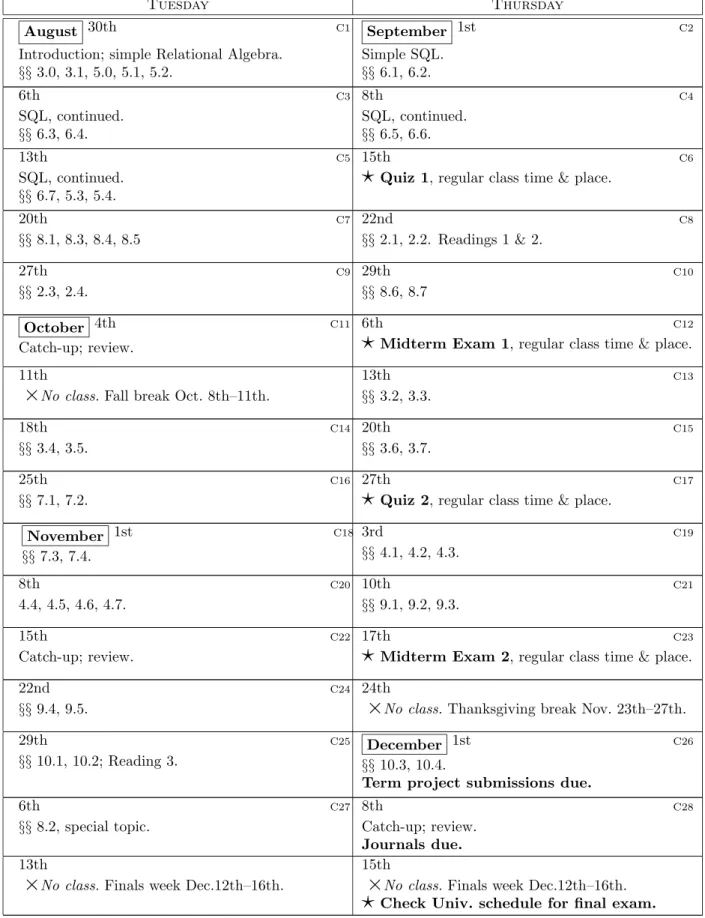
At the beginning and end of each class, I will announce sections of the textbook covered in each class and those due at the next class. An approximate schedule appears in Figure 1. Please use it only as a rough guide to plan your studies. Donot use it to schedule travel or other events. If you need a definite answer on when something will or will not occur, you should check with me.
Textbook and Readings
Textbook: A first course in database systems. Jeffrey D. Ullman and Jennifer Widom. Prentice-Hall, Upper Saddle River, New Jersey, third edition, 2008. The university bookstore carries this book, which is a required textbook for this course.
The textbook’s Web site has many useful resources: http://www-db.stanford.edu/~ullman/fcdb.html. In particular, for a more detailed listing of course topics, please refer to the textbook’s table of contents:
http://www-db.stanford.edu/~ullman/pub/fcdb-toc.txt
Readings: Items marked with ⋆ are required for COS 580 students. COS 480 students may wish to read them if they plan to attempt the extra-credit questions on tests. Readings marked with⋆⋆are extra credit for COS 580 students and double-extra credit for COS 480 students. Students who wish to receive credit for ⋆⋆items must discuss the specifics with me first. Everyone is encouraged to at least browse all the readings.
1. Edgar F. Codd. A relational model of data for large shared data banks. Communications of the ACM, 13(6):377–387, June 1970.
2. Notes on Codd’s paper: notes/rmodel.pdf;notes/rmodel/rmodel.html. 3. [A recent paper for 480 and 580 will be added here.]
4. ⋆Goetz Graefe. Query evaluation techniques for large databases. ACM Computing Surveys, 25(2):73– 170, June 1993.
Tuesday Thursday
August 30th C1
Introduction; simple Relational Algebra.
§§3.0, 3.1, 5.0, 5.1, 5.2. September 1st C2 Simple SQL. §§6.1, 6.2. 6th C3 SQL, continued. §§6.3, 6.4. 8th C4 SQL, continued. §§6.5, 6.6. 13th C5 SQL, continued. §§6.7, 5.3, 5.4. 15th C6
⋆
Quiz 1, regular class time & place.20th C7 §§8.1, 8.3, 8.4, 8.5 22nd C8 §§2.1, 2.2. Readings 1 & 2. 27th C9 §§2.3, 2.4. 29th C10 §§8.6, 8.7 October 4th C11 Catch-up; review. 6th C12
⋆
Midterm Exam 1, regular class time & place. 11th×
No class. Fall break Oct. 8th–11th.13th C13 §§3.2, 3.3. 18th C14 §§3.4, 3.5. 20th C15 §§3.6, 3.7. 25th C16 §§7.1, 7.2. 27th C17
⋆
Quiz 2, regular class time & place.November 1st C18 §§7.3, 7.4. 3rd C19 §§4.1, 4.2, 4.3. 8th C20 4.4, 4.5, 4.6, 4.7. 10th C21 §§9.1, 9.2, 9.3. 15th C22 Catch-up; review. 17th C23
⋆
Midterm Exam 2, regular class time & place.22nd C24
§§9.4, 9.5.
24th
×
No class.Thanksgiving break Nov. 23th–27th.29th C25
§§10.1, 10.2; Reading 3.
December 1st C26 §§10.3, 10.4.
Term project submissions due.
6th C27 §§8.2, special topic. 8th C28 Catch-up; review. Journals due. 13th
×
No class. Finals week Dec.12th–16th.15th
×
No class.Finals week Dec.12th–16th.⋆
Check Univ. schedule for final exam.5. Notes on Graefe’s paper: notes/qeval.pdf;notes/qeval/qeval.html. 6. [A recent paper for 580 will be added here.]
7. ⋆⋆ Fran¸cois Bancilhon and Raghu Ramakrishnan. An amateur’s introduction to recursive query processing strategies. InProceedings of the ACM SIGMOD International Conference on Management of Data (SIGMOD), pages 16–52, Washington, D.C., May 1986.
Further Reading: These books are not required reading and nothing in the course will depend directly on reading them. However, they are good sources for different explanations of some concepts, additional information on various topics, examples, and exercises.
1. Serge Abiteboul, Richard Hull, and Victor Vianu. Foundations of Databases. Addison-Wesley, 1995. This book is a textbook for COS 598, Advanced Topics in Databases, and focuses on Database Theory. The book is not light reading but it is much easier than reading the equivalent set of papers.
2. Hector Garcia-Molina, Jeffrey D. Ullman, and Jennifer Widom.Database Systems: The Complete Book. Prentice-Hall, 2002.
The first half of this book is essentially identical to the main textbook. The second half covers topics in database system implementation, and is a good resource for learning more about how database systems are implemented. Since the terminology and style is consistent with the main textbook, it should be easy reading.
3. Christopher J. Date. An Introduction to Database Systems. Addison-Wesley, Reading, Massachusetts, 2000.
A classic database-systems textbook.
4. Raghu Ramakrishnan and Johannes Gehrke. Database Management Systems. McGraw-Hill, third edition, 2002.
Another standard textbook with detailed coverage of some topics that we will cover briefly.
5. Roderic Geoffrey Galton Cattell. Object Data Management: Object-Oriented and Extended Relational Database Systems. Addison-Wesley, Reading, Massachusetts, 1994.
A good introduction to object and object-relational databases.
6. Fran¸cois Bancilhon, Claude Delobel, and Paris Kanellakis. Building an Object-Oriented Database System: The Story of O2. Morgan Kaufmann, 1992.
Another good book on object databases.
7. Michael Stonebraker and Joseph M. Hellerstein, editors. Readings in Database Systems. Morgan Kaufmaann, San Francisco, California, third edition, 1998.
This collection of papers, including some classics, provides a sampling of topics in database system implementation.
Exercises, Homeworks, Tests, and Notes
Material will appear here as we move along the semester. It may be useful to refer to material from the previous session: http://cs.umaine.edu/~chaw/201009/cos480/.
• Class exercises:
– Class Exercise 1: hwq/ce01.pdf.
– Class Exercise 2: hwq/ce02.pdf.
– Class Exercise 4: hwq/ce04.pdf.
– Class Exercise 5: hwq/ce05.pdf.
– Class Exercise 6: hwq/ce06.pdf.
– Class Exercise 7: hwq/ce07.pdf.
– Class Exercise 8: hwq/ce08.pdf.
– Class Exercise 9: hwq/ce09.pdf.
– Class Exercise 10: hwq/ce10.pdf.
– Class Exercise 11: hwq/ce11.pdf.
– Class Exercise 12: hwq/ce12.pdf.
– Class Exercise 13: hwq/ce13.pdf.
– Class Exercise 14: hwq/ce14.pdf.
• Homework assignments:
– Homework 1: hwq/hw01.pdf.
– Homework 2: hwq/hw02.pdf.
– Homework 3: hwq/hw03.pdf.
• Quizzes and Exams:
– Quiz 1: hwq/q01.pdf.