Study on the Application of Advanced Power Electronics in Smart Grid
Ma Zhengyou
Sichuan College of Architectural Technology Department of Electrical Engineering Deyang, Sichuan, China
ABSTRACT: It is well known that the tendency of the smart grid constructing is more reliable, secure and efficient. Advance-ment in power electronics technology provides an important approach for such purpose. Therefore, this paper studied on the application of advanced power electronics in smart grid. The demand of smart grid for advanced power electronics technol-ogy and the research and development trend of advanced power electronic technoltechnol-ogy was introduced firstly. Then the principle of power electronics technology and its applications in smart grid was presented, with emphasis on the application of FACTS (Flexible AC Transmission Systems) technology, HVDC (high voltage DC Direct Current) transmission system technology and power quality technology in smart grid. The security, efficiency and reliability of that smart grids which had applied advanced power electronics were evaluated. The result shows that application of the advanced power electronic technology can strengthen and optimize the grid, ensure the safety of power grid stability and promote the utilization of renewable energy.
Keywords: Smart grid, Power electronics, Power quality, Energy transformation
Received: 11 January 2017, Revised 13 February 2017, Accepted 20 February 2017
© 2017 DLINE. All Rights Reserved
1. Introduction
dynamics to meet the different goals and demands for the development of smart grid. This method reflected the relationship between the smart grid construction and intelligent techniques realized. And had made the evaluation on that model, the results showed that the method was effective. Wang et al. [3] investigated the information platform of smart grid based on cloud computing. In order to meet the need of the smart grid for reliable storage and effective management, they put up the information platform of smart grid based on cloud computing. The construction of the platform was introduced in detail. And evaluated the feasibility, advantages and problems of the new method. In addition, they combined the Hadoop and smart grid to achieve reliable storage and fast parallel processing of massive data. Cheng et al. [4] did their research on the homomorphism encryption based security data fusion technology of smart grid. They put up a safe and effective security data fusion scheme of the smart grid to promote the development of smart grid. The security analysis and performance analysis of the security data fusion scheme of the smart grid is performed. The experimental results show that the scheme is feasible, and is suitable for smart grid. However, there are no research on the application of the advanced power electronics in smart grid. Therefore, this paper study the application of advanced power electronics in smart grid. The second part introduced the demand of smart grid for advanced power electronics technology and the research and development trend of advanced power electronic technology. The third part describes the application of FACTS, HVDC and power quality technology in smart grid. And in the fourth quarter, the performance of the smart grid performance was compared and analyzed. Finally, in section 5, the research process and results are summarized.
2. State of the ART
2.1 The Demand of Smart Grid for Advanced Power Electronics Technology
There are five demands of smart grid for advanced power electronics technology [5]. The first demand is to strengthen the optimization and ensuring the safety of the power grid. It is known that the power grid structure in our country in our country, and the equipment of transmission and distribution needed to be adjusted and upgraded. In this case, advanced power electronic device is an important means of system control, which can be used to adjust the trend of the distribution of distribution power grid, enhance the space truss structure, inhibit the spread of power grid failure, and improve power grid under various fault “self-healing” ability, so as to improve the level of the safe and stable operation of power grid in China. The second demand is to promote the effective utilization of renewable energy [6-8]. Figure 1 and 2 presents the equipment of wind power. Large-scale, decentralized renewable energy has many disadvantages such as the intermittence and uncertainty. And the construction of the smart grid can make the renewable energy power predictable and controllable, which is the promise to promote the development of renewable energy [9, 10].
The third demand is to improve the power grid power quality and power market. Relevant statistics show that the loss caused by power quality as high as hundreds of billions of dollars every year [11]. How to improve the efficiency of energy utilization become the most important problem. The advanced power electronics technology and devices can be used to improve the quality of power grid power and the distribution efficiency of grid at the same time. The fourth demand is to safeguard power electronic device reliability. The disadvantages of the existing simulation technology also limits the development of power electronic technology, therefore, power electronics must be established a unified simulation platform to ensure the reliability of the power electronic devices, and finally to improve the power system reliability. The final demand is to promote the energy conservation and emissions reduction technology research. Today, more and more countries pay their attention on development of clean energy, and the application of advanced power electronics technology in smart grid is the effective way to meet this demand.
2.2 The Research and Development Trend of Advanced Power Electronic Technology
The advanced technology of power electronic technology development route in the next 20 years was describes as follows. the aim of DC transmission technology is to realize the core device of DC network; Flexible HVDC system of mature technology are applied, nationwide HVDC stepped into the stage of experiment in the year of 2020, and the next 10 years’s aim is to achieve DC transmission system based on the smart grid will play a leading role in the field of direct current transmission technology. The aim of flexible AC transmission technology is to complete new FACTS devices are widely used in smart grid and to implement the intelligent of the FACTS in the year of 2020, and the following 10 years is to make power electronic technology and its product modularity, unitization, intelligent, and to establish theoretical system of the complete system [12, 13]. The aim of power quality technology is to solve key problem of intelligent power distribution network and to implement custom power product specification guide and constraint mechanism, standardize in the year of 2020, and the following year will aim at achieving completely standardized custom power products and power quality classification system [14,15].
Figure 2. The research and development trend of advanced power electronic Technology
3. Methodology
3.1 The Application of FACTS Technology in Smart Grid
FACTS technology refers to the technology which combines the power electronic devices with the modern control technology to realize transmission system parameters and the original communication rapid flexible control of the network structure, so as to greatly improve the transmission capacity of lines and enhance system stability and reliability. With the development of power electronic devices, FACTS technology has moved from the original static reactive power compensator based on half controlled device (static varcompen-sator, SVC) and controllable series compensation (thyristor controlled series compensator, TCSC) technology to the synchronous compensator (static synchronous compensator, STATCOM) and uniform flow controller (unified power flow controller, UPFC) technology. The distribution of energy resources and the demand present reverse distribution, so it is necessary to achieve a wide range of energy transfer. During the process, it requires the mart grid should improve the transmission capacity of lines, and solved the related problems such as system oscillation, voltage instability and other issues. It is known that the FACTS technology has the ability to control the system rapidly and solve compatibility problems effectively. So, it has large development space in our country.
No. Aspects for the development of FACTS in next 5 years
1 The application of the 750 kV/1 000 kV controllable series compensation technology
2 The application of the 750 kV/1 000 kV controllable high technology.
3 The key technology of the static synchronous series compensator (SSSC) and the UPFC
4 The research on the FACTS which based on the wide-area measurement system
(wide area measurement system, the WAMS)
Table 1. The key direction for development of FACTS in next 5 years
3.2 The Application of HVDC Transmission System Technology in Smart Grid
UHVDC power transmission technology has great advantages in the long-distance large-capacity transmission, asynchronous networking and submarine cable transmission advantage, so it has been applied in a wide range. The success of the large capacity of the DC transmission must rely on the powerful communication system which will provide enough short circuit current (in current). However, the project of the acceptance system still needs large research. Flexible HVDC technology includes voltage source inverter (voltage source converter, VSC) and electronics insulated gate bipolar transistor (insulate -gate bipolar transistor, the IGBT). Flexible HVDC technology developed in the 1990 s with voltage source inverter (voltage source converter, VSC) and can shut off the power electronic devices insulated gate bipolar transistor (insulate - gate bipolar transistor, the IGBT) as its core, is a new generation of more flexible, environmental protection of HVDC technology. Its inherent technical advantages in reducing urban distribution network short-circuit current, the solution of renewable energy grid problem, island power and to specific areas of power supply in areas such as energy shortage and play a positive role. Flexible HVDC system of inverter adopts the commutation method which is four quadrant operation and the active and reactive power independent control. Is conducive to form both can conveniently control the trend and have higher reliability of parallel multi-terminal HVDC system. Used for networking without increasing the system short circuit capacity the amount. The converter station can be controlled independently of each other, no communication between the converter stations. These unique technical advantages in the distributed generation enter and isolated load and power supply in remote areas, urban grid connection, et. al all can play a positive role.
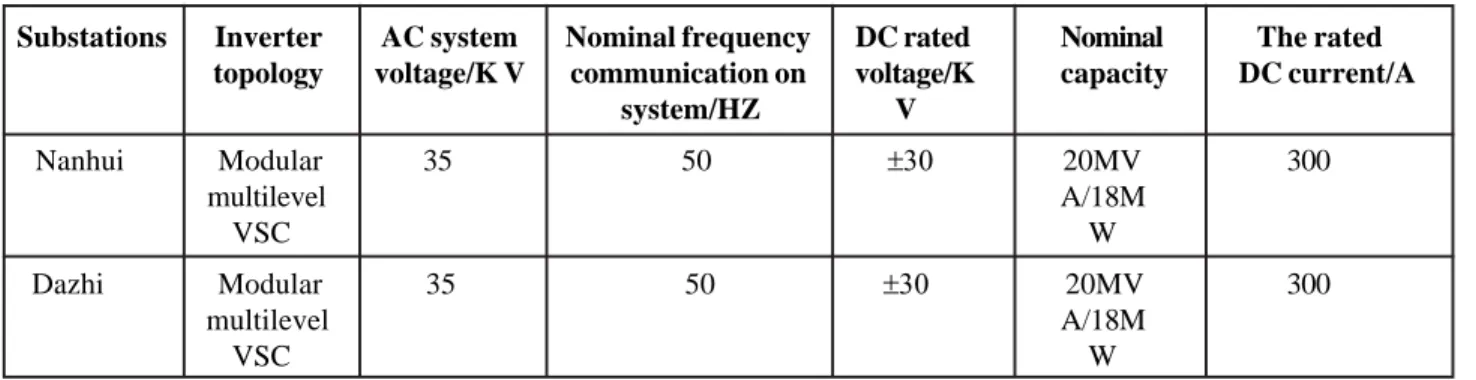
Its original advantages will make it popular in reducing urban distribution network short-circuit current, solving renewable energy grid problem etc. And the main technical parameters of the VSC-HVDC converter are presented in table 2.
Substations Inverter AC system Nominal frequency DC rated Nominal The rated topology voltage/K V communication on voltage/K capacity DC current/A
system/HZ V
Nanhui Modular 35 50 ±30 20MV 300
multilevel A/18M
VSC W
Dazhi Modular 35 50 ±30 20MV 300
multilevel A/18M
VSC W
Table 2. Main technical parameters of the VSC-HVDC converter
3.3 The Application of Power Quality Technology in Smart Grid
The frequency Voltage The phase Power Power consumption test error deviation Angle deviation
error
Parameters ≤ 0.01 Hz ≤ 0.2 % ≤ 0.2 % ≤ 0.5 % < 4VA
Table 3. Main technical parameters of the power quality technology
When power quality technology applied in the smart grid, the related technology include electrified railway power supply technology, adaptive static reactive compensation technology, continuously tuned filter dc active filter technology, unified power quality controller (unified power quality the controller, UPQC), high quality power park, etc. UPQC can ensure that important users of power quality effectively.
4. Result Analysis and Discussion
Advanced power electronic technology can strengthen and optimize the smart grid, ensure the safety of power grid stability, promote the effective use of renewable energy and improve the power quality of power grid. Just as the discussion in the before, the performance of Nanhui smart grid was discussed and the comparative parameters are showed in table 4.
Safety factor/% Stability factor/% Efficiency factor/% Quality factor/%
Before using
advanced 65 68 70 68 power electronics
After using
advanced power 86 87 85 82 electronics
Table 4. The performance of Nanhui smart grid
From the figure, it can be seen that the application of advanced power electronic technology in smart grid can improve the safety, stability, efficiency and quality. It also can be observed that all the parameters of the performance of smart grid enhanced to 80%. That is to say that the application of the advanced power electronic technology will bring great influence on the development of smart grid.
5. Conclusion
The smart grid can promote the development of economic benefit and improve social efficiency. However, the construction of the smart grid is still in its infancy. Therefore, this paper studied on the application of advanced power electronics in smart grid. This paper firstly introduced the basic knowledge of advanced power electronics and smart grid, then discussed the application of FACTS technology, HVDC transmission system technology and power quality technology in smart grid. The result shows that the application of advanced power electronics in smart grid will make the safety factor, stability factor, efficiency factor and quality factor increased over 20%, 19%, 15% and 14% respectively. That is to say the application of advanced power electronics not can improve the utilization rate of resources but also be the core factor of the smart grid development. However, there are many actual problems should be solved during the practical application.
References
[1] Gao, X., Zheng, Y. (2013). Comprehensive Assessment of Smart Grid Construction Based on Principal Component Analysis and Cluster Analysis. Power System Technology. 10 (37) 2238-2243.
Zidonghua/automation of Electric Power Systems. 12 (36) 16-21.
[3] Wang, D., Song, Y., Zhu, Y. (2010). Information Platform of Smart Grid Based on Cloud Computing. Dianli Xitong Zidonghua/ automation of Electric Power Systems. 34. 7-12.
[4] Cheng, L., Lin Y. F., (2016). Homomorphic Encryption Based Security Data Fusion Technology of Smart Grid. Modern Electronics Technique. 39. 82-86.
[5] Wang, Z. H., Shen F., Wu T. Z., (2000). FACTS applications in China and its developing trends, Automation of Electric Power Systems. 24. 1-5.
[6] Menanteau, P., Finon, D., Lamy, M L. (2003). Prices versus quantities: choosing policies for promoting the development of renewable energy. Energy Policy. 31 (8) 799-812.
[7] Tu, W., Zhang, L X., Zhou, Z. (2011). The development of renewable energy in resource-rich region: A case in China. Renewable & Sustainable Energy Reviews. 15 (15) 856-860.
[8] Liou, H M. (2010). Policies and legislation driving Taiwan’s development of renewable energy. Renewable & Sustainable Energy Reviews. 14 (7) 1763-1781.
[9] Georgiou, P N., Mavrotas, G., Diakoulaki, D. (2011). The effect of islands’ interconnection to the mainland system on the development of renewable energy sources in the Greek power sector. Renewable & Sustainable Energy Reviews. 15 (6) 2607-2620.
[10] Zalengera, C., Blanchard, R E., Eames, P C. (2014). Overview of the Malawi energy situation and A PESTLE analysis for sustainable development of renewable energy. Renewable & Sustainable Energy Reviews. 38 (38) 335-347.
[11] Zhao H., Qian F., Tang, G. F. (2009). Power System Harmonic Instability and Countermeasures. Proceedings of the CSEE. 29 29-34.
[12] Lee, I .W. C., Dash, P K. (2003). S-transform-based intelligent system for classification of power quality disturbance signals. IEEE Transactions on Industrial Electronics. 50 (4) 800-805.
[13] He H, Starzyk J A. (2006). A Self-Organizing Learning Array System for Power Quality Classification Based on Wavelet Transform. IEEE Transactions on Power Delivery. 21 (1) 286-295.
[14] Uyar, M., Yildirim, S., Gencoglu, M T. (2009). An expert system based on S-transform and neural network for automatic classification of power quality disturbances. Expert Systems with Applications. 36 (3) 5962-5975.