Eco 1001-
Introduction to
Macroeconomics
© 2007 Prentice Hall Business Publishing Principles of Economics 8e by Case and Fair
2 of
36
THE ECONOMIC PROBLEM:
SCARCITY AND CHOICE
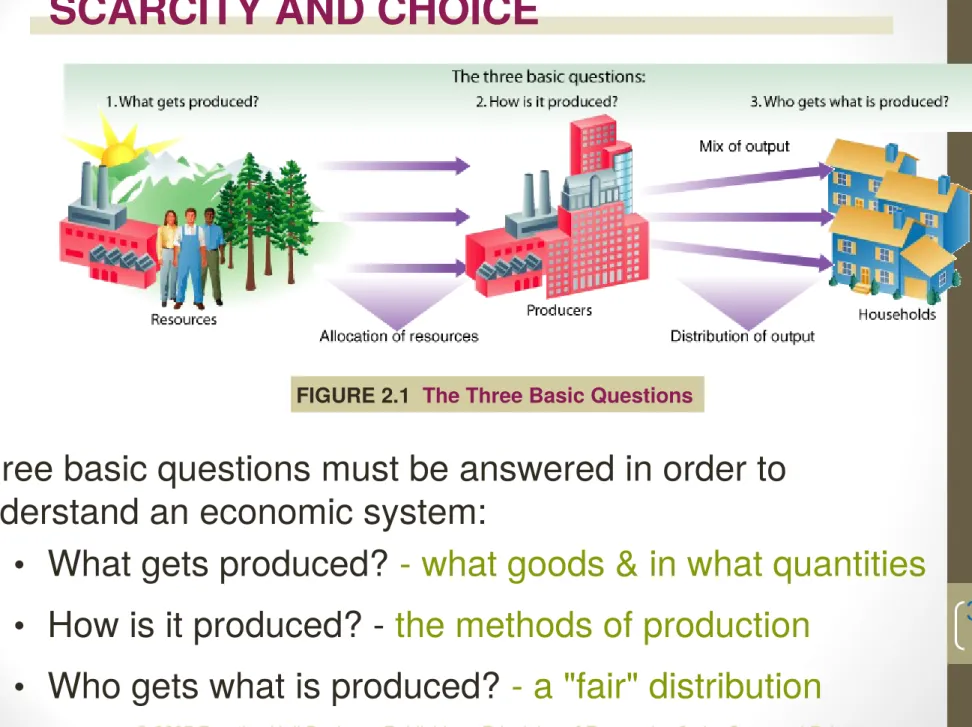
FIGURE 2.1
The Three Basic Questions
Three basic questions must be answered in order to
understand an economic system:
© 2007 Prentice Hall Business Publishing Principles of Economics 8e by Case and Fair
Capital
Things that are themselves produced and that are then used in
the production of other goods and services.
Labour
The broad category of human effort, both physical and mental
included
Land
Refers not only to land in the conventional sense of tracts of ground,
but all other natural resources
Entrepreneurial ability
The ability to organize production and bear risks.
4 of
34
Resources & Goods and Services
production
The process that transforms scarce
resources into useful goods and services.
THE ECONOMIC PROBLEM:
SCARCITY AND CHOICE
inputs
or
resources Anything provided
by nature or previous generations that
can be used directly or indirectly to
satisfy human wants.
To use resources,
wages
are paid to
© 2007 Prentice Hall Business Publishing Principles of Economics 8e by Case and Fair
6 of
34
Specialization, Exchange, and Comparative
Advantage
SCARCITY, CHOICE, AND OPPORTUNITY COST
theory of comparative advantage
SCARCITY, CHOICE, AND OPPORTUNITY COST
absolute advantage A producer has an
absolute advantage over another in the
production of a good or service if it can
produce that product using fewer
resources.
© 2007 Prentice Hall Business Publishing Principles of Economics 8e by Case and Fair
Absolute Advantage
© 2007 Prentice Hall Business Publishing Principles of Economics 8e by Case and Fair
Comparative Advantage
Comparative Advantage and
Gains from trade
•
Does trade still increase overall production?
•
ASSUMPTION:
The two can’t trade and they each spend half
of their time on each good
•
total output of the economy would be
11 bags of chips
and
12.5
jars of salsa
.
•
Now what if they trade?
•
Specialization
the total output of the economy
would be
10 bags of chips
and
15 jars of salsa
© 2007 Prentice Hall Business Publishing Principles of Economics 8e by Case and Fair
Comparative Advantage and
Gains from trade
•
…Imagine that Fifi decides she doesn’t want to spend ALL her
time making salsa. Say she makes 2 fewer jars of salsa. That
means she can make 2 x 0.8 = 1.6 bags of chips. That brings
the total output of the economy to
11.6 bags of chips
and
13
jars of salsa
, which is higher than our total output was before
we considered the option of trade.
We trade off present and future benefits in
small ways all the time.
SCARCITY, CHOICE, AND OPPORTUNITY COST
© 2007 Prentice Hall Business Publishing Principles of Economics 8e by Case and Fair
14 of
34
SCARCITY, CHOICE, AND OPPORTUNITY COST
Capital Goods and Consumer Goods
Consumer goods Goods produced for
present consumption.(
those goods and
services that directly satisfy our wants).
Capital goods satisfy our wants
indirectly by permitting more efficient
production of consumer goods.
SCARCITY, CHOICE, AND OPPORTUNITY COST
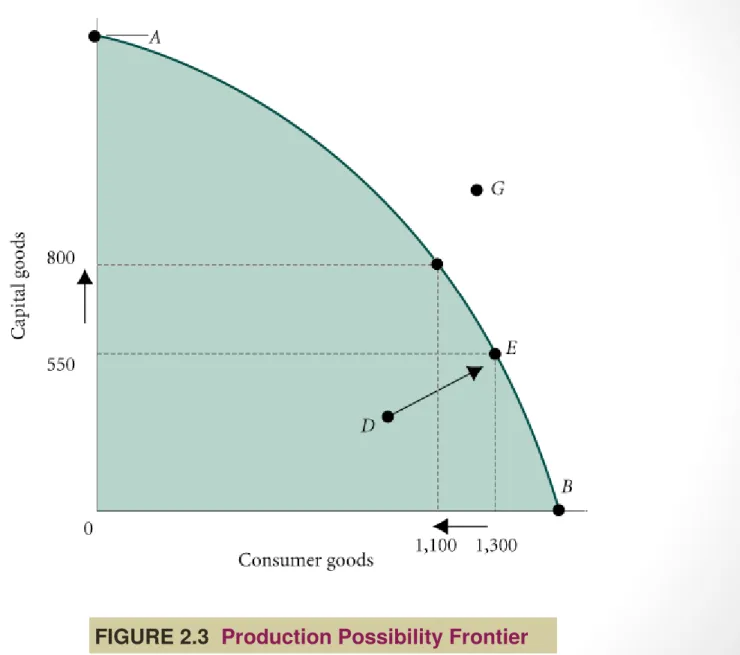
production possibility frontier (ppf) A
graph that shows all the combinations of
goods and services that can be
produced if all of society’s resources are
used efficiently.
© 2007 Prentice Hall Business Publishing Principles of Economics 8e by Case and Fair
16 of
34
SCARCITY, CHOICE, AND OPPORTUNITY COST
SCARCITY, CHOICE, AND OPPORTUNITY COST
•
The production possibilities curve illustrates two essential
principles
•
Scare resources
. There’s a limit to the amount we can produce in
a given time period with available technology and resources
•
Opportunity costs
. We can obtain additional quantities of any
desired good only by reducing the potential production of
© 2007 Prentice Hall Business Publishing Principles of Economics 8e by Case and Fair
18 of
34
SCARCITY, CHOICE, AND OPPORTUNITY COST
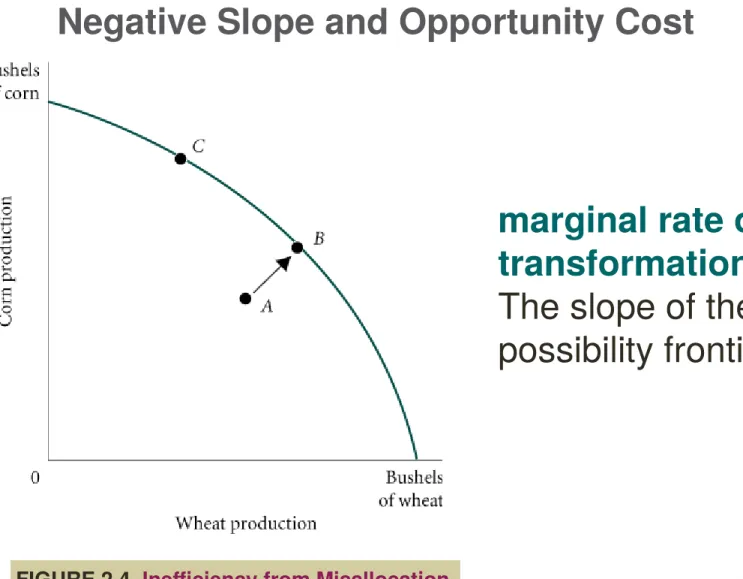
Negative Slope and Opportunity Cost
FIGURE 2.4
Inefficiency from Misallocation
of Land in Farming
marginal rate of
transformation (MRT)
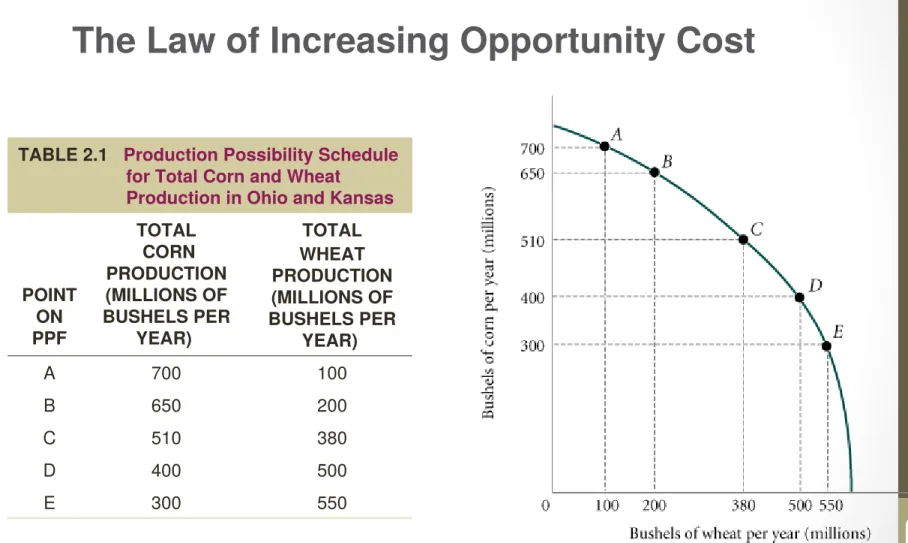
TABLE 2.1 Production Possibility Schedule for Total Corn and Wheat
Production in Ohio and Kansas
POINT ON PPF TOTAL CORN PRODUCTION (MILLIONS OF BUSHELS PER YEAR) TOTAL WHEAT PRODUCTION (MILLIONS OF BUSHELS PER YEAR)
A 700 100
B 650 200
C 510 380
D 400 500
SCARCITY, CHOICE, AND OPPORTUNITY COST
© 2007 Prentice Hall Business Publishing Principles of Economics 8e by Case and Fair
20 of
34
SCARCITY, CHOICE, AND OPPORTUNITY COST
Economic Growth
© 2007 Prentice Hall Business Publishing Principles of Economics 8e by Case and Fair
22 of
34
SCARCITY, CHOICE, AND OPPORTUNITY COST
COMPARATIVE ADVANTAGE AND THE
GAINS FROM TRADE
SCARCITY, CHOICE, AND OPPORTUNITY COST
© 2007 Prentice Hall Business Publishing Principles of Economics 8e by Case and Fair
24 of
34
SCARCITY, CHOICE, AND OPPORTUNITY COST
THE ECONOMIC PROBLEM
Recall the three basic questions facing
all economic systems:
(1) What gets produced?
(2) How is it produced?
(3) Who gets it?
ECONOMIC SYSTEMS
COMMAND ECONOMIES
command economy An economy in
which a central government either
© 2007 Prentice Hall Business Publishing Principles of Economics 8e by Case and Fair
26 of
34
ECONOMIC SYSTEMS
LAISSEZ-FAIRE ECONOMIES: THE FREE
MARKET
laissez-faire economy
Literally from
the French: “allow [them] to do.” An
economy in which individual people and
firms pursue their own self-interests
without any central direction or
regulation.
market The institution through which
buyers and sellers interact and engage
in exchange.
ECONOMIC SYSTEMS
consumer sovereignty The idea that
consumers ultimately dictate what will be
produced (or not produced) by choosing
what to purchase (and what not to
purchase).
© 2007 Prentice Hall Business Publishing Principles of Economics 8e by Case and Fair
28 of
34
ECONOMIC SYSTEMS
free enterprise The freedom of
individuals to start and operate private
businesses in search of profits.
ECONOMIC SYSTEMS
Distribution of Output
The amount that any one household
gets depends on its income and wealth.
Income
is the amount that a household
earns each year. It comes in a number of
forms: wages, salaries, interest, and the
like.
© 2007 Prentice Hall Business Publishing Principles of Economics 8e by Case and Fair
30 of
34
ECONOMIC SYSTEMS
Price Theory
In a free market system, the basic economic questions are answered without the help of
a central government plan or directives. This is what the “free” in free market means—
the system is left to operate on its own, with no outside interference. Individuals pursuing
their own self-interest will go into business and produce the products and services
that people want. Others will decide whether to acquire skills; whether to work;
and whether to buy, sell, invest, or save the income that they earn. The basic coordinating
mechanism is price.
ECONOMIC SYSTEMS
MIXED SYSTEMS, MARKETS, AND
GOVERNMENTS
The differences between command
economies and laissez-faire economies in
their pure forms are enormous. In fact,
these pure forms do not exist in the world;
all real systems are in some sense
© 2007 Prentice Hall Business Publishing Principles of Economics 8e by Case and Fair