Corresponding author: Meisam Naderi, Electrical Engineering Departments, Shahed University, Tehran, Iran.
An Efficient Timing and Frequency Synchronization Algorithm for OFDMA/TDD
Mode in Downlink of IEEE 802.16-2004 and its Analysis
Meisam Naderi, Hamidreza Bakhshi and Soroush Akhlaghi
Department of Electrical Engineering, Shahed University, Tehran, Iran.
Abstract: Timing and frequency synchronizationsare the important tasks in receiver. In this paper, an efficient timing and carrier frequency offset (CFO) estimation algorithm for orthogonal frequency division multiple access/ time division duplexing (OFDMA/TDD) mode in IEEE 802.16-2004 standard (WiMAX) is represented. This method has high performance and jointly estimates timing error and CFO. The performance is evaluated in AWGN channel. This algorithm can be easily used for other OFDM based systems which receiver knows preamble by itself.
Key words: timing synchronization, carrier frequency offset estimation, IEEE 802.16, AWGN channel.
INTRODUCTION
Orthogonal frequency division multiplexing has so applications in broadband communication systems such as wireless metropolitan area network (WiMAX) (IEEE std. 802.16-2004;IEEE std. 802.16e-2005). OFDM systems are very sensitive to timing and frequency errors as all the tasks in receiver will be feckless with imperfect synchronization (Polletet al., 1995). Thus timing and frequency synchronization in OFDM systems are very important task. Timing error and CFO lead to inter-symbol interference (ISI) and inter-carrier interference (ICI) respectively. some methods depend on preamble (Wu and Zhu, 2005;Schmidl and Cox, 1997; Kishore and Reddy, 2006),while the other methods are based on cyclic prefix (CP) (VandeBeeket al., 1997; Zhou et al., 2001). Synchronization algorithms for OFDMA-based systems in downlink are the same as synchronization algorithms for OFDM-based systems. We can’t use previous methods in OFDMA mode in WiMAX, because of preamble features. We should modify these methods for WiMAX preamble to use them in downlink transmission. The first symbol of downlink transition is preamble. The preamble of OFDMA mode in WiMAX has size of 2048 in time domain, which makes use of boosted BPSK modulation with specific pseudo-noise (PN) code (IEEE std. 802.16-2004). Accordingly, there are 114 different preamble signals. Each of them is served at a particular segment of a cell. Each cell is divided to three segments: 0, 1, and 2. The preamble carrier-sets are defined using equation (1) (IEEE std. 802.16-2004):
Preamble carrier setn=n+3k (1)
n and k are the number of preamble carrier set indexed 0, 1, 2 and a running index 0, 1,…, 567 respectively. Each segment uses a preamble composed of a carrier set out of the three available carrier set in the following manner (IEEE std. 802.16-2004):
- Segment 0 uses preamble carrier set 0. - Segment 1 uses preamble carrier set 1. - Segment 2 uses preamble carrier set 2.
Therefore each segment eventually modulates each third subcarrier. Thus we have 3 blocks (A, B, and C) with length of 682 in time domain that they are not same to each other, but they havegood cross correlation. This matter is because of 2048 is not divisible to 3. Blocks A, B, and C begin from 0 to 681, 682 to 1363, and 1366 to 2047 respectively. In (Pushpaet al., 2008)some methods are modified for this preamble. In WiMAX, the user situated in a cell is known by IDcell and number of segment and has its own preamble.
In section 2, system model is presented in AWGN channel. In section 3, Reddy algorithm is presented. In section 4, the proposed timing metric is presented. In section 5, analysis of proposed algorithm is drived. In section 6, simulation results are demonstrated and finally the conclusion is given in section 7.
System Model:
The transmitted samples in baseband OFDM modulation can be written as:
Where N is IFFT length.Ng, Ck, and n are cyclic prefix length, preamble data in subcarrier k, and timing sample
index respectively. We concentrate on preamble symbol. nth sample of received signal in AWGN channel is given by:
(3) Where and are carrier frequency offset normalized to the subcarrier spacing and zero mean complex AWGN with variance respectively.
Reddyalgorithm:
The Reddy algorithm is one of the most important algorithms that the receiver knows the preamble. The modified Reddy’s timing metric is given by (Pushpaet al., 2008):
(4)
where
(5)
(6)
means conjugate . , where , means floor(a). If , cross-correlation between blocks A and B is considered. If ), cross-correlation between blocks A and C is considered. Proposed Algorithm (PA):
By knowing the preamble in receiver, we propose a timing metric that has good performance even in low SNR and use it to estimate the CFO. The proposed timing metric is given by:
(7)
Where
, (8)
, (9)
If , cross-correlation between blocks A by A and B by B from received preamble and save preamble is considered. if , cross-correlation between blocks A by A and C by C from received preamble and save preamble is considered. The index of maximum of metric shows the start of symbol. We use this index ( ) to estimate CFO. CFO estimator is given by:
. (10)
Sign , means measured angle. We have CFO because of the change in environment and mismatching between transmitter and receiver oscillators. CFO consist of fractional and integer parts. In fixed-WiMAX, CFO is smaller than subcarrier spacing (fractional). In this paper fractional part of CFO will be considered.
Analysisofproposed Timing Metric:
in (Schmidl and Cox, 1997). For moderate values of SNR, the magnitude of the quadrature part is small compared to that of inPhase part and can be neglected (Schmidl and Cox, 1997). Then, upper bound of
is:
(12) And estimate of is (Kishore and Reddy, 2006):
(13)
From central limit theorem, both are Gaussian distributed. Expectations of them are according by:
(14)
E[] and , mean Expectation and energy of each block of preamble respectively. the energy of each block is equal to each other approximately.
(15)
From (Van Kempen and Van Vliet, 2000), expectation and variance of are obtained:
(16)
(17)
By definition , it can be seen that by increasing SNR, goes to one. But for Reddy algorithm by increasing SNR, goes to that in WiMAX preamble is 0.17 approximately and smaller than one. But for variance in simulation results indicate, both of algorithms have variances near to zero.
Simulation Results:
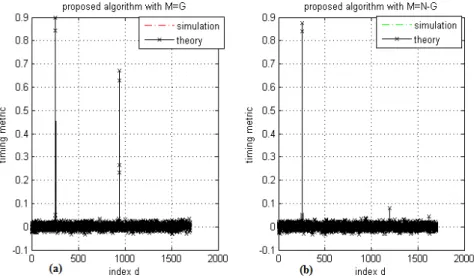
OFDM system with 2048 subcarriers and 256 samples for CP and AWGN channel is considered. The performance of proposed algorithm is evaluated by computer simulations. Simulation results demonstrate that this timing metric can achieve more accurate timing offset and CFO estimation than Reddy algorithm. Fig. 1, indicates timing metric for theory and simulation with 2πε=3 and SNR=0 dB for proposed algorithm with M=G and M=N-G can be seen theory and simulation coincide to each other. Fig. 2, also runs for Reddy algorithm in these qualifications. The largest peak is the first of symbol. We can see that proposed timing metric has better
performance for symbol detecting. Fig. 3, indicates comparison estimation of CFO (2πε=3) in various SNR
Fig. 1: Proposed timing metric, theory and simulation. (a) M=G and (b) M=N-G.
Fig. 2: Timing metric for reddy algorithm.
Fig. 3: MSE for estimation of CFO (2πε=3). Conclusion:
(A.1)
From (13) variance of can be calculated as:
(A.2)
From (12) and (13) covariance between and is drived as:
(A.3)
ACKNOWLEDGMENTS
This research has been supported in part by the Iran Telecommunications Research Center (ITRC).
REFERENCES
Kishore, C.N. and V.U. Reddy, 2006. A frame synchronization and frequency offset estimation algorithm for OFDM system and its analysis.EURASIP Journal on Wireless Communications and Networking, pp: 1-16.
Part 16: Air interface for fixed and mobile broadband wireless access systems.IEEE std. 802.16e-2005. Part 16: Air interface for fixed broadband wireless access systems. IEEE std. 802.16-2004.
Pollet, T., M. Van Bladel and M. Moeneclaey, 1995. BER sensitivity of OFDM systems to carrier frequency offset and Weiner phase noise. IEEE Trans. Commun., 43(1): 191-193.
Pushpa, K., C.N. Kishore and Y. Yoganandam, 2008. Comparative study of four modified timing metrics for the Frame Synchronization in OFDMA mode of WMAN.IEEE International Symposium on Personal, Indoor and Mobile Radio Communications, pp: 1-5.
Schmidl, T.M. and D.C. Cox, 1997. Robust frequency and timing synchronization for OFDM. IEEE Trans. Communications, vol. COM-45, pp: 1613-1621.
Van Kempen G. and L. Van Vliet, 2000. Mean and variance of ratio estimators used in fluorescence ratio imaging.Cytometry, 39(4): 300-305.
Vande Beek, J.J., M. Sandell and P.O. Borjesson, 1997. ML estimation of time and frequency offset in OFDM systems.IEEE Trans. Signal Processing, 45: 1800-1805.
Wu, M. and W.P. Zhu, 2005. A preamble-aided symbol and frequency synchronization scheme for OFDM systems. IEEE International Symposium on Circuts and systems, pp: 2627-2630.