But I Thought Tangent
Was…
2014 NCCTM Eastern Region Conference
Lee Shelton
Introduction
Welcome to the session on the origins of the trigonometric ratios and functions. Hopefully you will find the session insightful and informative. Most importantly my goal is that you will be able to use something today immediately into your classroom or be inspired to create lessons meaningful for your students.
Bio
I am currently a teacher at South Brunswick High School. I have taught there for the past twelve and a half years. Prior to moving to the beach I taught for six years at Wake Forest-Rolesville High School (now just Wake Forest High School) in Wake County. I graduated from N.C. State (1995) with a B.S. in Mathematics Education and UNCW (2013) with a M.Ed. with a
concentration in Secondary Mathematics. I am a NBPTS certified teacher in Mathematics-Adolescence and Young Adulthood. I was South Brunswick teacher of the year in 2005 and a WWAY TV 3 Teacher of the Week in 2012. I have taught pretty much every course offered in high school. Calculus and Discrete Math are my two favorite classes to teach. I enjoy piddling on Geometer’s Sketchpad and the TI-84 calculators.
I am married to my best friend Michelle. We have three kids: Anna (12), Christian (11), and Luke (9). I also have two dogs (Ariel and Petey), two cats (Norman and Kate), and two rabbits (Ninja and Midnight).
Lesson Background
This lesson came about around my second year of teaching. The Geometry book I was using had a chapter on right triangles in which we did the regular trigonometric ratios: sine, cosine, and tangent. The very next chapter was the chapter on circles where we discussed lines being tangent and secant to a circle. I then thought, “Why do they use the same word (tangent) to describe two different ideas?”
I had a History of Mathematics book from college so I started thumbing through it for any information. Well much to my surprise, there was a section regarding this. I thought that this information would be helpful to students.
Over the years the lesson has grown and expanded. Not only do we get an understanding of where the names of the functions come from, we also dive into the geometric relationships of trigonometric identities.
Introduction
There are a couple of things of note before starting: 1. _____________________ _______________
2. _____________________ _______________
3. __________________ of a _______________ centered at the ___________ with a _____________ of ___________.
Sine and Cosine
Sine originally came from the Arabic word ______-_____________.
This later got abbreviated to __________ which later got shortened to ______.
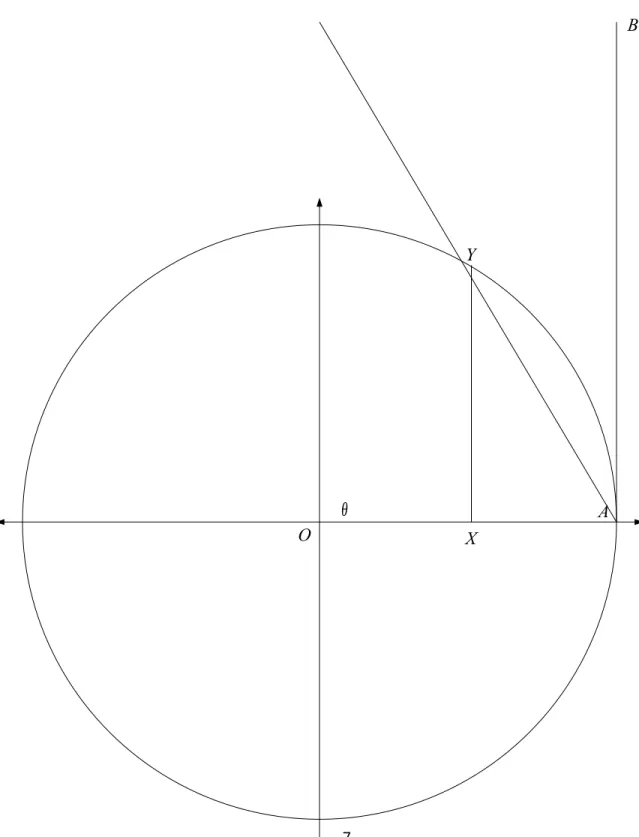
When translators came across this word they translated it _________ which translated means __________ or _________. In Latin the word is ______________ which is where we get sine. What was the original meaning? The original Arabic meaning was ________ ______________. Refer to the diagram. Which segment is a half-chord? _____________.
Now on to ______________. _____________ means the sineof the ______________________. Referring to the diagram, there are several angles that are _____________________ to θ . Name two:
Using the angle __________________ to θ , we can call that angle α .
What is the cosθ ? Or the sinα ? In other words what is the ___________ _________________
of the _________________________ of θ ?
Draw the segment from Y perpendicular to the y-axis. Give characteristics of this segment.
Now that sinθ and cosθ have been found on the diagram, what are the coordinates of Y?
(
¿
)
¿
¿
¿ ¿
According to the diagram, interpret a trigonometric identity? (Hint: Think __________________ _________________.
Sine and cosine are the basis for all other trigonometric ratios.
REVIEW
Tangent and Cotangent
Define tangent line:
According to the diagram is there a line tangent to a circle? ___________________ Find AB in terms of sine and cosine. Show the work used to reach your conclusion.
AB
is said to be a ________________ segment. The length ofAB
was_________________,
also known as the __________________ ____________.
So tanθ can be defined as the length of the ____________________ ________________ when the radius is extended.
3. cotθ=
Secant and Cosecant
Find OB. Show the work used to reach your conclusion.
Notice that
OB
cuts through the circle. What is another name of a segment that cuts through thecircle? ____________________________
So OB is called the ___________________ of ________ because it is the length along the ________________ segment.
This trigonometric ratio is almost always defined as _________________. As demonstrated on the diagram this has geometric consequences as well. Similarly cosecant can be found as the _____________________ of the ______________________________.
REVIEW
3. cscθ=
Geometric Representations of Trigonometric Identities
The goal is to prove the identities for sin(α+β) and cos(α+β) .
Consider the triangle formed at the origin with given angle
β
. That triangle is then rotated about the origin by the angle α . Resulting in the drawing in diagram 2.With the use of auxiliary lines and basic rules of sine and cosine a geometric representation of the sine and cosine of angle addition can be shown.
What about half angle identities? Use diagram 3 to prove the following:
tanθ 2=
sinθ
1+cosθ .
Diagram 1
O
B
A Y
X
Diagram 2
O
Y
X
β
Diagram 3
O
B
A
θ
2
θ
2