Unit -5
Data Link Control & Internet
Contents
Framing
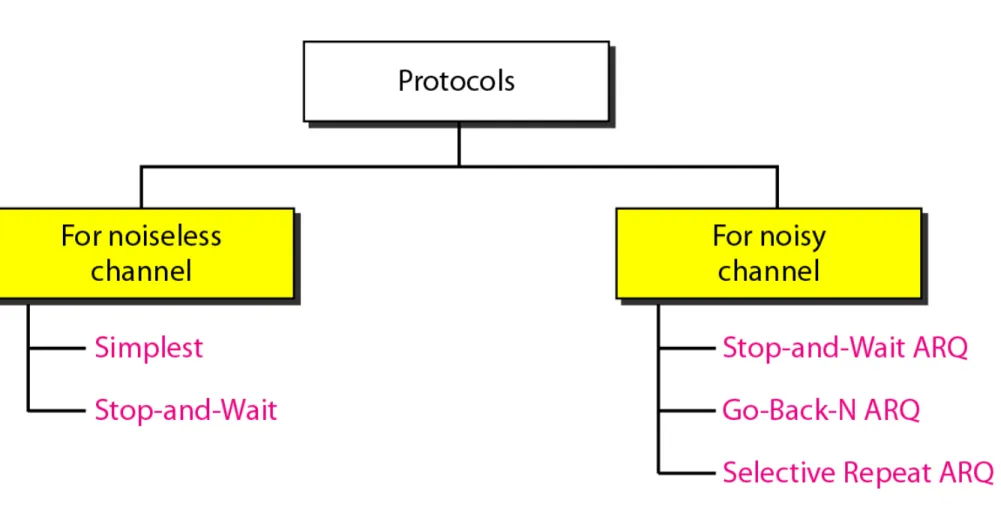
Flow & Error Control Protocols
Noiseless Channels
Noisy Channels
HDLC
P2P Protocols
Architecture of WWW
FRAMING
FRAMING
The data link layer needs to pack bits into
The data link layer needs to pack bits into framesframes, so that , so that each frame is distinguishable from another. Our postal
each frame is distinguishable from another. Our postal
system practices a type of framing. The simple act of
system practices a type of framing. The simple act of
inserting a letter into an envelope separates one piece of
inserting a letter into an envelope separates one piece of
information from another; the envelope serves as the
information from another; the envelope serves as the
delimiter.
delimiter.
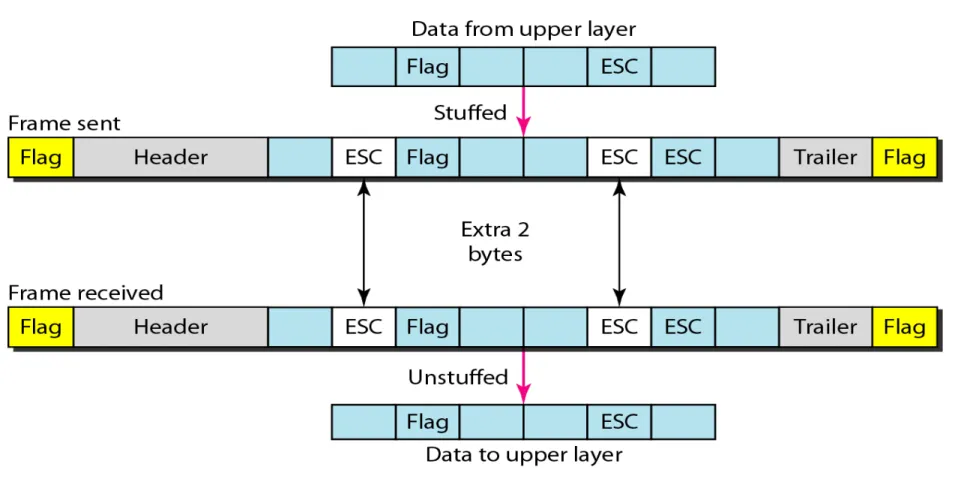
Figure 2 Byte stuffing and unstuffing
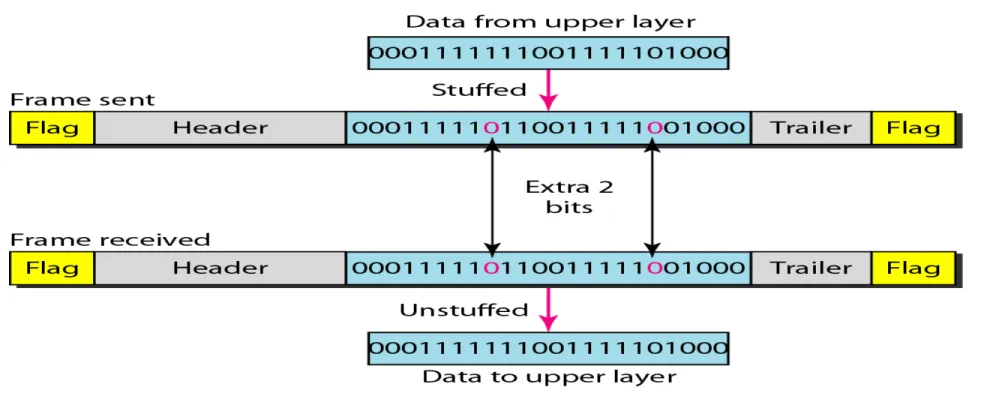
Figure 3 Bit stuffing and unstuffing
FLOW AND ERROR CONTROL PROTOCOLS
FLOW AND ERROR CONTROL PROTOCOLS
The most important responsibilities of the data link
The most important responsibilities of the data link
layer are
layer are flow controlflow control and error control and error control. Collectively, . Collectively, these functions are known as
these functions are known as data link controldata link control..
Flow control refers to a set of procedures used to
restrict the amount of data that the sender can send before waiting for acknowledgment.
Error control in the data link layer is based on
Contd….
Contd….
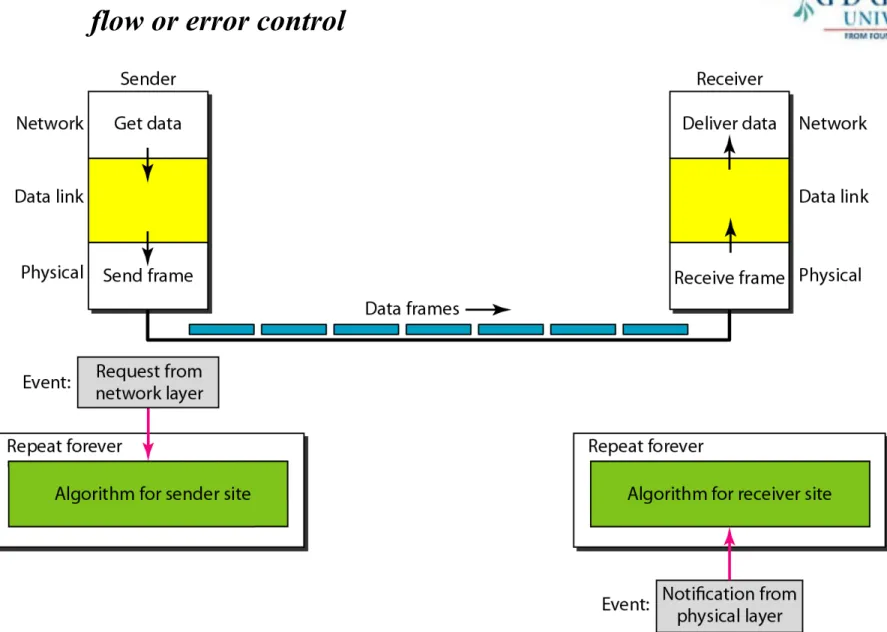
Now let us see how the data link layer can combine
Now let us see how the data link layer can combine
framing, flow control, and error control to achieve the
framing, flow control, and error control to achieve the
delivery of data from one node to another. The
delivery of data from one node to another. The
protocols are normally implemented in software by
protocols are normally implemented in software by
using one of the common programming languages. To
using one of the common programming languages. To
make our discussions language-free, we have written
make our discussions language-free, we have written
in pseudocode a version of each protocol that
in pseudocode a version of each protocol that
concentrates mostly on the procedure instead of
concentrates mostly on the procedure instead of
delving into the details of language rules.
NOISELESS CHANNELS
NOISELESS CHANNELS
Let us first assume we have an ideal channel in which
Let us first assume we have an ideal channel in which
no frames are lost, duplicated, or corrupted. We
no frames are lost, duplicated, or corrupted. We
introduce two protocols for this type of channel.
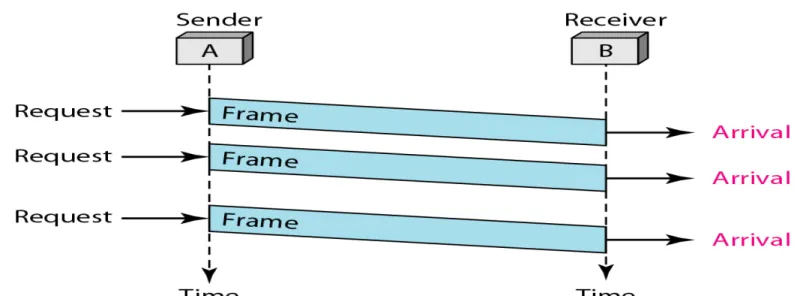
Figure 6 shows an example of communication using this protocol. It is very simple. The sender sends a sequence of frames without even thinking about the receiver. To send three frames, three events occur at the sender site and three events at the receiver site. Note that the data frames are shown by tilted boxes; the height of the box defines the transmission time difference between the first bit and the last bit in the frame.
Example 1
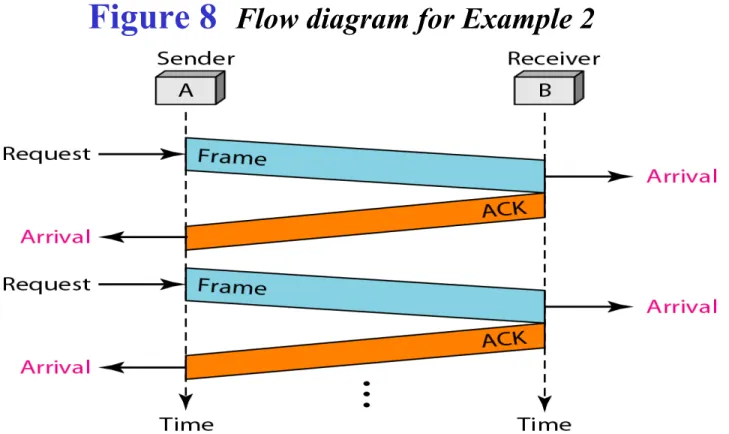
Figure 8 shows an example of communication using this protocol. It is still very simple. The sender sends one frame and waits for feedback from the receiver. When the ACK arrives, the sender sends the next frame. Note that sending two frames in the protocol involves the sender in four events and the receiver in two events.
Example 2
NOISY CHANNELS
NOISY CHANNELS
Although the Stop-and-Wait Protocol gives us an idea
Although the Stop-and-Wait Protocol gives us an idea
of how to add flow control to its predecessor, noiseless
of how to add flow control to its predecessor, noiseless
channels are nonexistent. We discuss three protocols
channels are nonexistent. We discuss three protocols
in this section that use error control. These
in this section that use error control. These
are:--Stop-and-Wait Automatic Repeat Request Go-Back-N Automatic Repeat Request
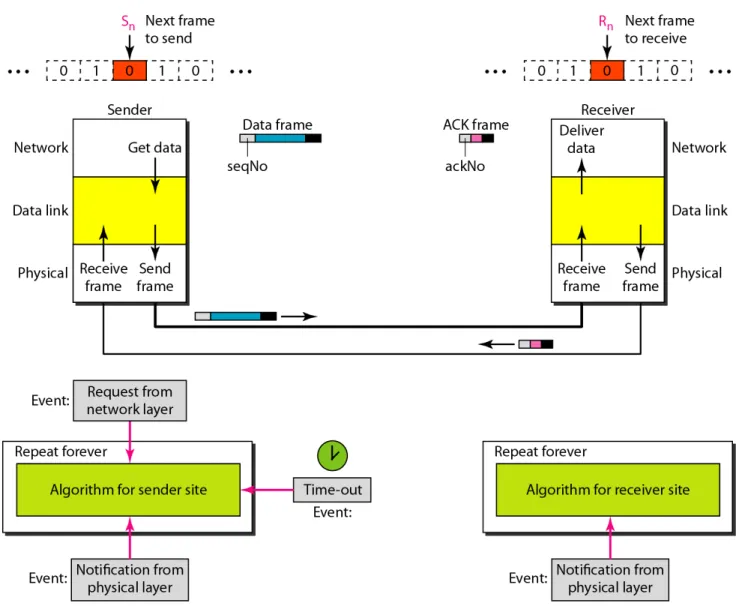
Error correction in Stop-and-Wait ARQ is done by keeping a copy of the sent frame and retransmitting of the frame when the timer expires.
In Stop-and-Wait ARQ, we use sequence numbers to
number the frames. The sequence numbers are based on modulo-2 arithmetic.
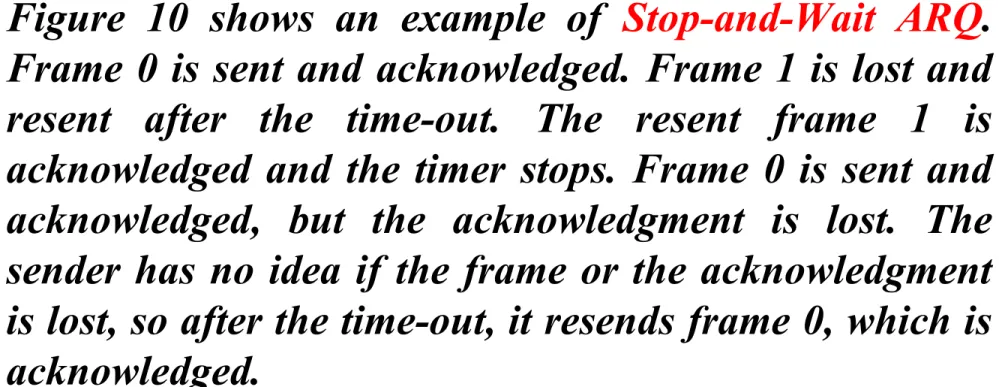
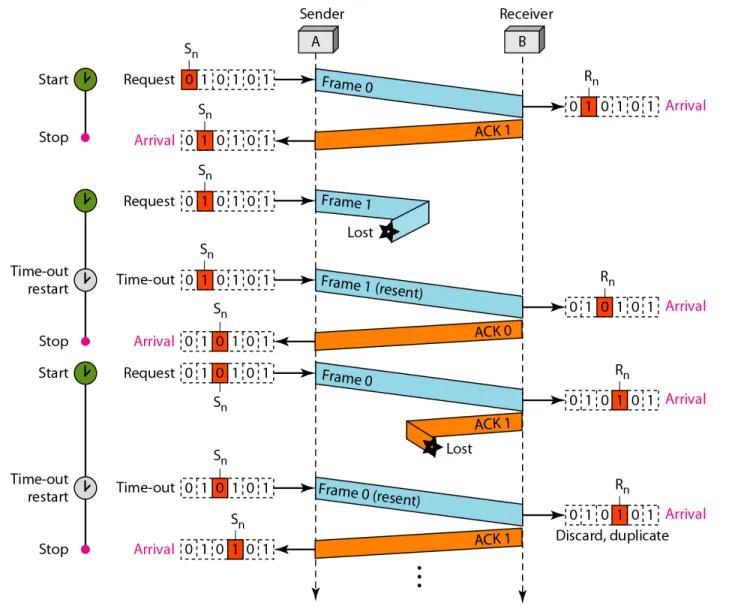
Figure 10 shows an example of Stop-and-Wait ARQ. Frame 0 is sent and acknowledged. Frame 1 is lost and resent after the time-out. The resent frame 1 is acknowledged and the timer stops. Frame 0 is sent and acknowledged, but the acknowledgment is lost. The sender has no idea if the frame or the acknowledgment is lost, so after the time-out, it resends frame 0, which is acknowledged.
HDLC
HDLC
High-level Data Link Control (HDLC)
High-level Data Link Control (HDLC) is a bit-oriented is a bit-oriented
protocol for communication over point-to-point and
protocol for communication over point-to-point and
multipoint links. It implements the ARQ mechanisms.
POINT-TO-POINT PROTOCOL
POINT-TO-POINT PROTOCOL
Although HDLC is a general protocol that can be used
Although HDLC is a general protocol that can be used
for both point-to-point and multipoint configurations,
for both point-to-point and multipoint configurations,
one of the most common protocols for point-to-point
one of the most common protocols for point-to-point
access is the
access is the Point-to-Point Protocol (PPP). Point-to-Point Protocol (PPP). PPP is a PPP is a
byte-oriented
byte-oriented protocol. protocol.
ARCHITECTURE OF WWW
HTTP
HTTP
The Hypertext Transfer Protocol (HTTP) is a protocol
The Hypertext Transfer Protocol (HTTP) is a protocol
used mainly to access data on the World Wide Web.
used mainly to access data on the World Wide Web.
HTTP functions as a combination of FTP and SMTP.
HTTP functions as a combination of FTP and SMTP.