Research Article – Environmental Science
The effect of sugar mill effluent on seed germination of green gram (
Vigna radiatia
L.)
T. Vaithiyanathan* and P. Sundaramoorthy
Department of Botany, Annamalai University, Annamalai Nagar – 608002, Tamil Nadu, India
Abstract
Sugar industry is an agro-based industry in India which released lot of effluent into the environment during sugar production. The formers used this effluent in agriculture for scarcity of water. The effluent contained large amount of organic and inorganic materials which affects the water, soil and living organisms especially plants. The present study was the analysis of sugar mill effluent and different concentrations (10, 25, 50, 75 and 100%) of sugar mill effluent effects on germination and growth development of green gram (Vigna radiata L.). As a result the lower concentration (10%) of sugar mill effluent promoted the germination and growth of the seedlings but higher concentrations of sugar mill effluent inhibited the germination and growth of the green gram seedlings. The lower concentration of effluent contained may be better nutrients of plant which used for irrigation purposed for high growth and yield.
Key words: Agriculture, effluent, germination, green gram and sugar industry
Introduction
Sugar industry plays a significant role in Indian economy and making of employment. The many industries are used raw materials from the by-products of sugar mills. However sugar industries have a great environmental impact upon the surrounding environment. The sugar mills released huge amount of wastewater as effluent into nearby water bodies during sugar production and it change of water chemistry. Generally, the effluent is generated from mill house, waste water from boiling house, waste water from boiler blow- down, condenser cooling water and soda and acid wastes (Kisku et al., 2000). The effluents are causing odor nuisance during decomposition. It contains high Biological Oxygen Demand (BOD) and Chemical Oxygen Demand (COD) which reduce available oxygen supply into water and it adversely affects the aquatic ecosystems (Jagannathan et al., 2014). High amount of organic and inorganic compounds were presented in sugar mill effluent which deposited the soil and it alter the soil quality as well as affect the plants and consumers. The sugar mill effluent has high amount of suspended solids and dissolved solids that reduce penetration capability of light into the water (Singh and Bhati, 2005). Sugar industries second rank among the agro based industries in India
and it seasonal in nature and operates only for 120 to 200 days in a year. Sugar mill effluent creates unpleasant odour when released into the environment without proper treatment. Farmers have been using these effluents for irrigation to alternative the scarcity of water which results reduced growth and yield of crops as well as soil quality. Adnan et al.,
(2010) reported that the untreated sugar mill effluent is toxic to plants when used for irrigation. The considerable amount of harmful substances including soluble salts and heavy metals like Fe, Cu , Zn , Mn , Pb were presented in sugar mill effluent which continuously used in agriculture to contaminates soil and toxic to plants and consumers (Fakayode, 2005). The effluent contained high amount of plant nutrient which alter use of fertilizer to promote development of plant (Kumar and Chopra 2012). The sugar mill effluent used in developing countries for agriculture as fertilizer has gained more significance as it is considered as a source of organic matter and plant nutrients and serves as good fertilizer. The present research work has been made to assess the physic-chemical characteristics of sugar mill effluent and their effects on germination behaviour and seedling growth of green gram (Vigna radiata L.)
Materials and Methods
Effluent samples
The effluent samples were collected in plastic containers from the out let of the N.P.K.R. Co-operative sugar mill in Thalainayar, Mayiladuthurai Taluk, Tamil Nadu, India. They were brought to the
Journal of Applied and Advanced Research 2016. 1(1); 20–24 http://www.phoenixpub.org/journals/index.php/jaar
Received: 16-04-2016; Revised: 20-05-2016; Accepted 22-05-2016; Published Online: 14-06-2016
*Corresponding Author
21 Ecology Laboratory, Department of Botany and stored in refrigerator at 4oC for analysis purpose.
Seed material
The seeds of Vigna radiata L. were obtained from Pulses seed Research Station, Vamban, Pudukkotai district. Healthy and uniform seeds were selected for the study.
Analysis of sugar mill effluent sample
The collected sugar mill effluent sample was analysed for their various physico-chemical roperties in Ecology Laboratory, Department of Botany, Annamalai University as per the routine standard methods mentioned in American Public Health Association (APHA, 2005).
Preparation of different concentrations of effluent
The collected effluent sample from the outlet of sugar mill industry was treated as 100 per cent raw effluent. Different concentrations (10, 25, 50, 75 and 100%) of sugar mill effluent were prepared freshly by using distilled water whenever necessary. They were used for germination studies.
Control : Distilled water
10% : 10 ml effluent + 90 ml water 25% : 25 ml effluent + 75 ml water 50% : 50 ml effluent + 50 ml water 75% : 75 ml effluent + 25 ml water 100% : Raw effluent
Germination studies
The healthy and uniform sized Vigna radiata L. seeds were selected and surface sterilized with 0.1% HgCl2 for two minutes. They are thoroughly washed
with tap water to avoid surface contamination. Twenty seeds were placed equidistantly in petridishes filled with sterilized soil. The seeds were irrigated with equal quantity of different concentrations of effluent and the seeds irrigated with distilled water treated as control. Five replicates were maintained for each treatment including control. The germination percentage, seedling length, seedling fresh weight and seedling dry weight were taken and recorded on the 7th day’s seedlings. The
values of vigour index, Tolerance index and percentage of phytotoxicity were also calculated.
Germination percentage
The number of seeds germinated in each concentration was counted on the 7th day and the
germination percentage was calculated by using the following formula
Germination percentage =
100 sown seeds of number Total germinated seeds of Number
Shoot and root length (cm/seedling)
Five seedlings were taken from each treatment and their shoot length and root length were measured by using a cm scale and these values were recorded.
Fresh weight (g/seedling)
Five seedlings were collected from each treatment and their fresh weights were measured with the help of an electrical single pan balance.
Dry weight (mg/seedling)
The same seedlings used for fresh weight were kept in hot air oven at 80C for 24 hours. Then, the seedlings were taken from the oven and kept in desiccators for some time. Their dry weights were taken by using an electrical single pan balance.
Vigour index
Vigour index of the seedlings was calculated by using the (Abdul–Baki and Anderson, 1973).
Vigour index = Germination percentage Length of seedling
Percentage of phytotoxicity
The percentage of phytotoxicity of effluent was calculated by using the formula (Chou et al.,1978). Percentage of phytotoxicity =
100 control of length Radicle test of lenght Radicle -control of length Radicle
Results and Discussion
Physico-chemical properties of sugar mill effluent are given in Table – 1. The analyses of sugar mill effluent showed that it is acidic in nature with dull white in colour. It contained high amounts of suspended solids and dissolved solids. It showed a high value of Biological Oxygen Demand (BOD) and Chemical Oxygen Demand (COD). The presence of considerable amounts of calcium, chloride, sulphate, nitrate, fluoride, and silica were also noticed in the effluent. This is in conformity with the earlier findings (Kaushik et al., 2004; Rajesh et al., 2013). The pollution load of the effluent depends upon the nature of raw materials, chemicals used, the processes involved in the factory and also the methods of treatments given to the effluent before they discharged from the factory.
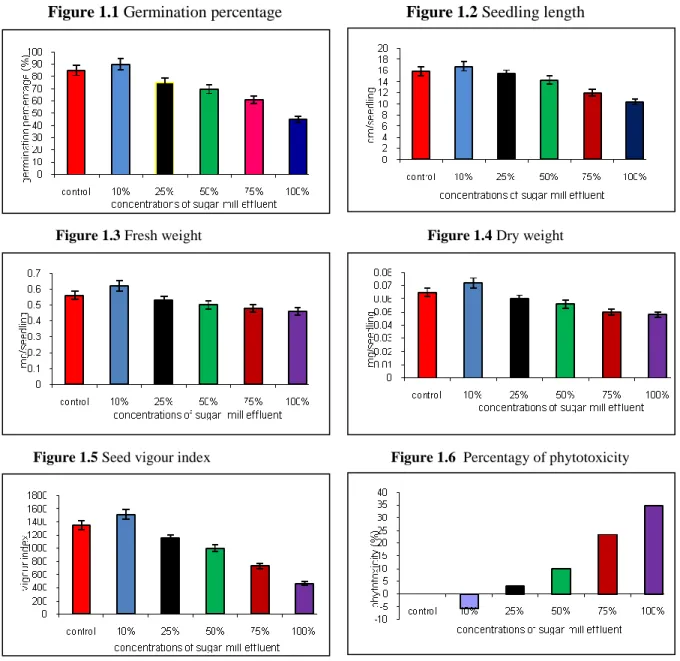
The effect of different concentrations of sugar mill effluent on germination studies of Vigna radiata
Table–1. Physico – Chemical analysis of sugar mill effluent with it’s to tolerance limits for agricultural irrigation
S. No. Properties Raw effluent
Tolerants limits for Agricultural irrigation suggested by TNPCB(2009)
1 Colour Dull white Colourless
2 Odour Decaying molasses smell -
3 pH 4.04 5.5-9.0
4 Electrical Conductivity (EC) 4745 Mm- homs -
5 Temperature (0C) 36.0 40.0
6 Acidity 1350.0 -
7 Suspended solids 180.0 200
8 Total dissolved solids 3725.0 200
9 Total solids 3905.0 2100
10 BOD 3480.0 30
11 COD 7880.0 250
12 Chloride 314.0 600
13 Sulphate 290.88 12
14 Magnesium 286.0 100
15 Phosphorous 7.2 10
16 Nitrogen 1250 600
17 Fluoride 1.88 1.0
18 Silica 99.0 -
19 Calcium 124.8 200
20 Zinc 0.89 0.01
21 Iron 16.00 1.00
22 Copper 0.420 0.01
23 Lead 0.52 0.05
24 Manganese 0.068 0.01
25 Oil & grease 19 10
All parameters except colour, odour, pH, EC and temperature are expressed in mg/l.; TNPCB - Tamil Nadu Pollution Control Board.
Seed absorption water during germination and hydrolyse stored food material and to activate enzymatic systems. During germination salts can inhibit germination. The high salt concentration can slow germination by several days or completely inhibit it (Sahai et al., 1979). The lower concentration of sugar mill effluent (10%) promoted the germination of green gram. It may be due to presence of optimum level of nutrients in this effluent concentration. Similar observation was recorded in many researchers (Rathore et al., 2000; Rajesh et al., 2013; Shalu Malik et al., 2014; vaithiyanathan et al., 2014). The seedling stage is the most sensitive stage in the life of a plant and more susceptible to physical and chemical adversities. Seedling growth and their fresh and dry weight of green gram seedlings increased at lower concentration of sugar mill effluent. It may be due to maximum uptake of nitrogen, phosphorus and potassium by plants from this effluent concentration. The improvement of vegetative growth may be ascribed to the role of potassium in nutrient and sugar translocation in plants and turgor pressure in plant cells (Vijayaragavan et al., 2011). However, the higher concentrations of sugar mill effluent
green gram plants. In higher concentrations of sugar mill effluent contains high amount of organic and inorganic compounds, it becomes toxic to plants. Similar observations were obtained by several workers (Sundaramoothy et al., 2007; Pandey et al.,
2008; Rajendra et al., 2010; Doke et al., 2011).
Conclusion
Figure 1.1 Germination percentage Figure 1.2 Seedling length
Figure 1.3 Fresh weight Figure 1.4 Dry weight
Figure 1.5 Seed vigour index Figure 1.6 Percentagy of phytotoxicity
Figure 1: Germination studies of green gram grown under different concentrations of the Sugar mill effluent.
Acknowledgement
The authors are thankful to Professor and Head, Department of Botany, Annamalai University for providing laboratory facilities to carry out the research experiments.
References
Abdul-Baki, A.A., Anderson, J.D. (1973). Vigour determination in soybean seed by multiple criteria. Crop Science, 3, 630-633.
Adnan, A., Taufeeq, A., Malik, E., Muhammad, A.k. (2010). Evaluation of industrial and city effluent quality using physiochemical and biological parameters. Electronic Journal of Environmental Agriculture and Food Chemistry, 9(5), 931-939. Chou, C.H., Chaiang, C., Kao, C.I. (1978). Impacts
of water pollution on crop growth in Taiwan. Botanical Bulletin of Academia Sinica, 19, 107-124.
Doke, M.K., Khan, E.M., Rapoul, J., Shaikh, A. (2011). Physico-chemical analysis of sugar industry effluent and its effect on seed germination of Vigna angularis, Vigna cylindrical and Sorghum cernum, Annals of Environmental Science, 5, 7-11.
Fakayode, P.K. (2005). Alteration in Physico-chemical characteristics of soil irrigated with sugar mill effluent. Journal of Environmental Biology, 12, 103-109.
Jagannathan, R., Venkatraman, K., Vasuki, R. (2014). Bioremediation of sugar mill effluent by immobilized Bacterial consortium. International Journal of Pharmacy and Technology, 6(3), 7107-7114.
Kisku, G.C., Barman, S.C., Bhargava, S.K. (2000). Contamination of soil and plants potentially toxic elements irrigated with mixed industrial effluent and impact in the environment. Journal of Water, Air and Soil Pollution, 120, 121-137. Kumar, V., Chopra, A.K. (2012). Fertigation effect
of distillery effluent on agronomical practices of
Trigonella foenum-graecum L. (Fenugreek). Environmental Monitoring and Assessment,
184(3), 1207–1219.
Pandey, S.N., Nautiyal, B.D., Sharma, C.P. (2008). Pollution level in distillery effluent and its phytotoxic effect on seed germination and early growth of Maize and Rice. Journal of Environmental Biology, 29(2), 267-270.
Rajendra, B.G., Uphade, B.K., Gadhave, A.G., Kuchekar, S.R. (2010). Effect of dairy effluent on seed germination and early seedling growth of soyabeansRasayan Journal of Chemistry, 3(1), 137-139.
Rajesh, M., Jayakumar, K., Sathees Kannan, T.M., Sankar Ganesh, K., 2013. Influence of sugar mill effluent on seed germination and seedling growth of Cluster Bean (Cyamopsis tetragonaloba). International Journal of Environment and Bioenergy, 7(2),54-62. Rathore, N.P., Iqbal, S.A., Panwar, K.S. (2000). Role
of sugar industry in agriculture. Indian Journal of Applied & Pure Biology, 15(2), 91-94.
Sahai, R., Agarwal, N., Khosla, N., 1979. Effect of fertilizer factory effluent on seed germination,
seedling growth and chlorophyll content of
Phaseolus Linn. Journal of Tropical Ecology,
20(2),155-165.
Shalu Malik, Harish Pal Bhati, Deepak Kumar, Vikas Kumar (2014). Germination and seedling growth of VignaradiataL.Under sugar mill effluent stress. International Journal of Pharmaceutical Research and Bio science, 3(1), 54-59.
Singh, G., Bhati, M. (2005) Growth of Dalbergia sissoo in desert regions of western India using municipal effluent and the subsequent changes in soil and plant chemistry. Bioresource Technology, 96, 1019–1028.
Sundaramoothy, P., Sankar Ganesh, K., Baskaran, L., Chidambaram, A.L.A. (2007). Impact of sugar mill effluent on tomato (Lycopersicum esculentum L.). Geobios, 34,21-24.
Vaithiyanathan, T., Soundari, M., Sundaramoorthy, P. (2014). Response of black gram (Vigna mungo L.) to sugar mill effluent treatment.
International Journal of Research in Botany, 4(1), 15-18.