CORRELATES AND CONTEXTS OF SEXUAL INFIDELITY IN AMERICAN ADULTS
Brandon Grant Wagner
A dissertation submitted to the faculty of the University of North Carolina at Chapel Hill in partial fulfillment of the requirements for the degree of Doctor of Philosophy in the
Department of Sociology.
Chapel Hill 2013
ii ©2013
iii Abstract
BRANDON WAGNER: Correlates and Contexts of Sexual Infidelity in American Adults (Under the direction of Kathleen Mullan Harris)
This project includes three projects that use sexual infidelity as a point of entry to examine topics such as digital data collection, relationship context, causation, measurement, and relationship satisfaction.
In the first chapter, I test a new potential source of data for exploratory social research. With current threats to survey research, namely declining response rates and limited financial support, developing new and reliable complementary data sources is of paramount importance. Using digitally derived data generated by respondent’s normal online activities offers a potential solution to concerns with existing data sources as they are not dependent on recruiting willing subjects, do not typically require massive financial
iv
My second chapter examines sexual infidelity across relationship contexts and explores whether sexual infidelity differs between married and cohabiting unions. Using a combination of design and analytic tools to separate selective and causal processes, I attempt understand the difference in reported rates of sexual infidelity between married and
cohabiting individuals. My results are consistent with differences between marital and cohabiting sexual infidelity frequency resulting from selection into marriage. I also find that association between relationship context and sexual infidelity by testing whether various social, demographic, and relationship measures may have differ between relationship contexts.
The last chapter focuses on the measuring relationship satisfaction. One problem with measuring whether relationships are “good” has been whether such measurement should include what happens in the relationship (description) or what the individual thinks of the relationship (evaluation). I suggest a solution for integrating descriptive and evaluative measures that models relationship satisfaction as a latent variable and varies the theorized causal pathways between relationship satisfaction and relationship description. Using sexual infidelity and perceived partner infidelity as the relationship descriptive behaviors, I
v
ACKNOWLEDGEMENTS
I am grateful to the Carolina Population Center (R24 HD050924) for general support during the preparation of this dissertation. This research uses data from Add Health, a program project directed by Kathleen Mullan Harris and designed by J. Richard Udry, Peter S.
Bearman, and Kathleen Mullan Harris at the University of North Carolina at Chapel Hill, and funded by grant P01-HD31921 from the Eunice Kennedy Shriver National Institute of Child Health and Human Development, with cooperative funding from 23 other federal agencies and foundations. Special acknowledgment is due Ronald R. Rindfuss and Barbara Entwisle for assistance in the original design. Information on how to obtain the Add Health data files is available on the Add Health website (http://www.cpc.unc.edu/addhealth). No direct support was received from grant P01-HD31921 for this analysis.
vi
Table of Contents
LIST OF TABLES...viii
LIST OF FIGURES...ix
Chapter I. INTRODUCTION...1
II. IDENTIFYING NOVEL CORRELATES OF PERCEIVED INFIDELITY USING GOOGLE SEARCH HISTORIES...9
Introduction...10
Data and Methods...20
Results...26
Conclusions...33
III. COHABITATION AND SEXUAL INFIDELITY IN AMERICAN YOUNG ADULTS...37
Infidelity...38
Cohabitation...43
Data...49
Methods...53
Results...56
Conclusion...58
IV. THE ROLE OF SEXUAL INFIDELITY IN THE MEASUREMENT OF RELATIONSHIP SATISFACTION...61
Data...75
Measures...75
Methods...79
Results...81
Discussion...83
V. CONCLUSION...89
REFERENCES...122
viii
LIST OF TABLES
Table
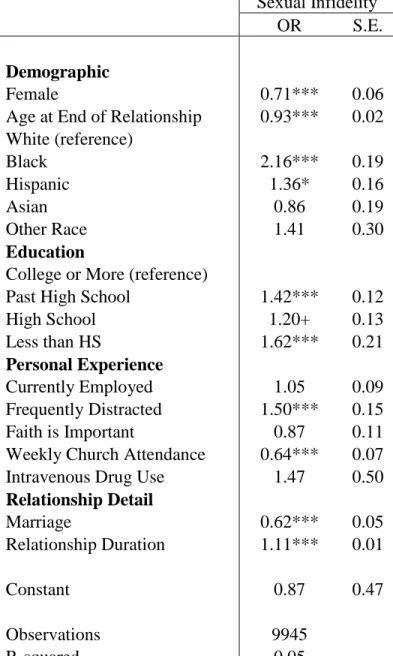
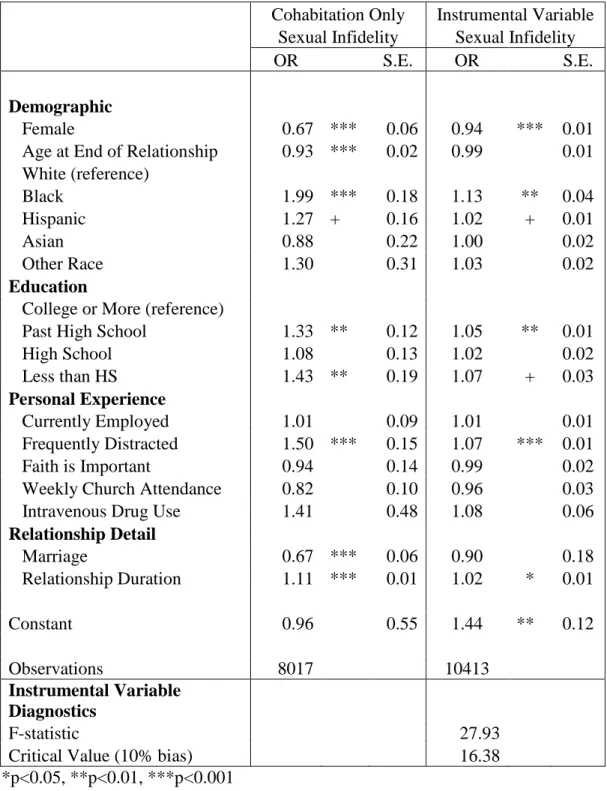
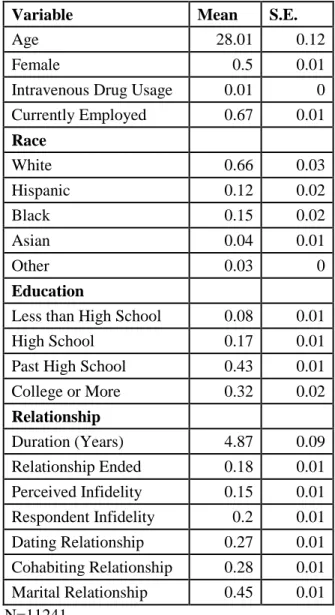
1.1 Description of the Analytic Sample for Empirical
Validation (weighted means)...104 1.2 Google Searches Correlated with Perceived Partner Infidelity,
Organized by Theoretical Domain...105 1.3 Selected Indicators for each Google Identified Conceptual Domain...107 1.4 Empirical Validation using data from Add Health, Wave IV
of Google Identified Concepts and Perceived Sexual Infidelity...108 2.1 Descriptive Statistics for Analytic Samples (weighted means)...111 2.2 Odds Ratios for Models Predicting Sexual Infidelity
within a Relationship...112 2.3 Odds Ratios for Models Predicting Sexual Infidelity
Addressing Selection into Marriage...113 2.4 Logistic Regression Models of Sexual Infidelity Stratified
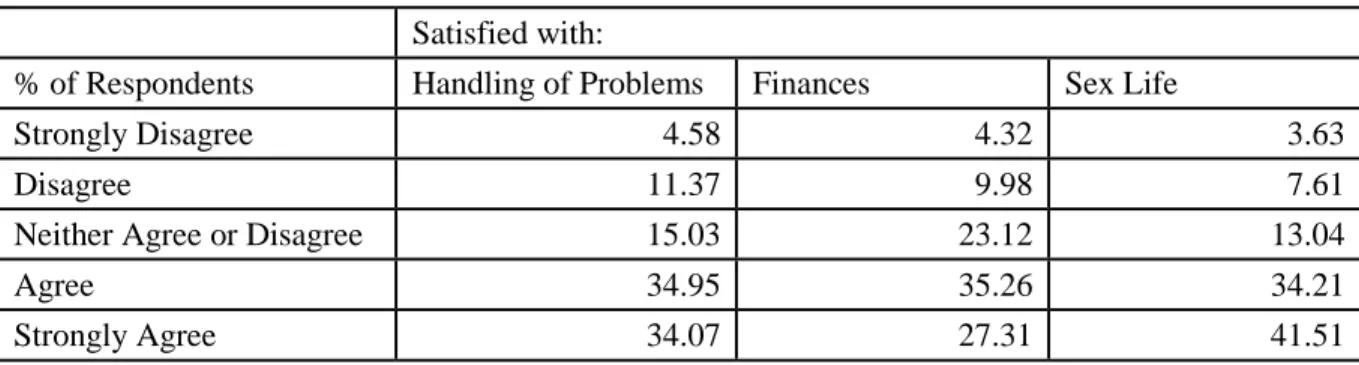
by Relationship Type (Odds Ratios shown)...114 3.1 Description of the Analytic Sample (weighted means)...115 3.2 Description of Relationship Satisfaction Effect Indicators...116 3.3 Comparison of Fit Between Theoretical Models of Relationship
Satisfaction and Sexual Infidelity...117 3.4 Measurement Model for the Preferred Theoretical Relationship...118 3.5 Multi-Group Comparison of the Confirmatory Factory Analysis
ix
LIST OF FIGURES
Figure
3.1 Simplified Models for the Theorized Relationship between
Introduction
David Petraeus. Tiger Woods. John Edwards. Mark Sanford. Bill Clinton. John F. Kennedy. Though far from an extensive, or gender balanced, list, common to all of these gentlemen is documented participation in extramarital affairs, otherwise known as sexual infidelity. Much as it unites this list of notables, sexual infidelity and concurrency
(temporally overlapping sexual partnerships) are the common elements in the following work you are reading.
Aside from selling tabloids, why should we care about sexual infidelity? Academically, the rationale for studying sexual infidelity is twofold. First and most obviously, it is an important behavior with broad consequences. Having concurrent sexual relationships is a crucial component for the transmission of sexual diseases like HIV
(Kretzschmar and Morris 1996; Morris and Kretzschmar 1997), HPV (Javanbakht, Gorbach, Amani, Walker, Cranston, Datta, and Kerndt 2010), and bacterial infections (Kraut-Becher and Aral 2003). Sexual infidelity is also a key predictor of marital trouble and dissolution (e.g., Whisman, Dixon, and Johnson 1997). As a means of reducing these consequences alone, researchers should be interested in better understanding sexual infidelity.
Second, sexual infidelity is a veritable academic nexus; researchers from multiple and diverse disciplinary backgrounds have interest in better understanding this behavior.
Biologists study it as a means to better understand sexual selection and evolutionary
2
impact that it has on relationships and the difficulties it creates for resolving relationship troubles (e.g., Atkins, Yi, Baucom, and Christensen 2005; Glass and Wright 1988; Halford, Keefer, and Osgarby 2002; Humphrey 1983; Olson, Russell, Higgins-Kessler, and Miller 2002; Whisman, Dixon, and Johnson 1997). Psychologists study sexual infidelity to better understand certain behavioral profiles and psychological predispositions (e.g, Buss and Shackelford 1997; Lalasz and Weigel 2011; Schmitt 2004). Public health researchers study it because of its role as a means of transmission of disease (e.g., Adimora, Schoenbach, Bonas, Martinson, Donaldson, and Stancil 2002; Adimora, Schoenbach, and Doherty 2007; Doherty, Schoenbach, and Adimora 2009; Javanbakht et al. 2010; Watts and May 1992). Cultural and gender scholars study it to understand gender norms (e.g., Raj, Decker, La Marche, and Silverman 2006; Wiederman and LaMar 1998). Demographers have classically studied sexual frequency and partnerships for their fertility consequences (e.g., Bongaarts 1978), and infidelity represents another context for sexual relationships and potential multiple-partner fertility.
Sexual infidelity and concurrency merit research attention then, not only for their cultural norms and, by extension, their consequences for individuals, but for the larger research questions they allow us to answer. Each of the following chapters uses infidelity as an opportunity to explore more general topics, such as new forms of data collection,
measurement of relationship concepts, causal influences, and relationship contexts.
3
infidelity is a violation of sexual exclusivity, typically within an environment in which such exclusivity would be assumed (i.e., cohabitation or marriage).
Though the scope of these terms is different, the distinction is primarily a
consequence of the difference in literatures from which these works draw. Sociologists, with their interest in social institutions, roles, and norms have primarily studied this behavior in the context of marriage and family, and as a result have written extensively on sexual infidelity. In public health, a desire to understand disease risk and transmission has led to higher importance attached to sexual behavior than union formation and marriage, so researchers have tended to focus more on sexual concurrency. In this work, I will generally refer to sexual infidelity. Given the specific measures available to me, sexual concurrency may be the more technically correct phrasing, but I follow this convention for two reasons. First, the context of the following work is primarily one in which sexual exclusivity is assumed. Second, I use “sexual infidelity” for continuity with the relevant sociological literature that provides the primary theoretical and substantive background for my work.
4
In part, the definition for this topic is a consequence of the specific nature of the available measures. Two particular variables will form the key dependent outcomes of the chapters to come. Of their current or most recent relationship, respondents were asked whether they had had sex with someone other the relationship partner during the sexual portion of the relationship and whether they believed that their partner had engaged in this behavior. These two variables are dichotomous measures that I use to capture sexual infidelity and perceived partner infidelity, respectively. This lack of specificity creates limitation of the measures; I am unable to ascertain either frequency or timing of the infidelity event within the relationship. However, there are benefits to this measure
simplicity. Incidence measures, like this “ever” measure of relationship infidelity, are more reliable measures of sexual behavior than frequency measures (reviewed in Catania, Gibson, Chitwood, and Coates 1990). Specific to sexual infidelity, self-report of infidelity is
preferred to calculating infidelity from a calendar of all previous sexual relationships (Nelson, Manhart, Gorbach, Martin, Stoner, Aral, and Holmes 2007).
5
of sexual behaviors. The long running relationship and rapport between respondents and the Add Health study should increase their willingness to divulge sensitive information.
Furthermore, respondents administer sensitive questions via computer-assisted self-interview (CASI). Self-administration of questionnaires yields more accurate reporting of sexual behavior (Schroder, Carey, and Vanable 2003) and data collection through CASI gathers more accurate information about sexual infidelity than does direct response to an interviewer (Whisman and Snyder 2007). Add Health also contains a wide variety of indicators gathered longitudinally throughout the respondents’ lives. The measurement of many different aspects of the respondents’ social lives is essential to these studies. In the following work, I take advantage of respondent measures, relationship measures, and even neighborhood measures to study sexual infidelity.
With these data, I study sexual infidelity in three very different ways. The following chapters will discuss topics as varied as digital data collection, relationship context,
causation, measurement, relationship satisfaction, and the perils of intravenous drugs.
In my first chapter, I suggest a new potential source of data for exploratory social research. In light of current threats posed to survey research, namely declining response rates and limited financial support, developing new and reliable complementary data sources is of paramount importance. Using digitally derived data generated by respondent’s normal online activities offers a potential solution to concerns with existing data sources. These data are not dependent on recruiting willing subjects, do not typically require massive financial
6
particular. By examining the patterns of search terms individuals use when they feel their partner may be “unfaithful” and finding other terms with similar temporal or spatial patterns, I am able to locate potential correlates of perceived sexual infidelity, a topic problematic for measurement in most survey research designs. To validate the potential of this new data source, I identify correlates of perceived sexual infidelity from online searchers based on their theoretical relevance and test these associations using individual data from the National Longitudinal Study of Adolescent Health (Add Health), Wave IV.
My second chapter is an examination of sexual infidelity by relationship context. Despite the marked recent change in the types of relationships in which individuals engage, the majority of research on relationship behaviors is undertaken within the marital context. This chapter explores whether sexual infidelity differs between married and cohabiting unions. I outline several possible theoretical explanations for this observed difference and then attempt to determine whether the difference in reported rates of sexual infidelity
between married and cohabiting individuals is a consequence of selection or causation. I use a combination of design and analytic tools to separate selective and causal processes. I further explore the association between relationship context and sexual infidelity by testing whether various social, demographic, and relationship measures may have different
associations with sexual infidelity in cohabitation or marriage.
In the final chapter, I focus on the measurements of relationship satisfaction. One problem with measuring whether relationships are “good” has been whether such
7
it does so by disregarding the informative potential of such measures. I suggest a potential solution for integrating descriptive and evaluative measures that models relationship
satisfaction as a latent variable and varies the theorized causal pathways between relationship satisfaction and relationship description. Using sexual infidelity and perceived partner
infidelity as the relationship descriptive behaviors, I demonstrate how such a model can be built, tested, and measured. Further extending this finding, I test whether sexual infidelity’s influence on relationship satisfaction varies between marriage, cohabitation, and dating.
Although my dissertation may seem like a set of eclectic papers, bound only by the focus on sexual infidelity, there are deeper connections. These papers subtly build upon and influence each other. The exploratory first chapter uncovers potential correlates of sexual infidelity. For the clearest associations (illicit drug usage), I include controls in subsequent chapters reflecting this new knowledge. The findings of the second chapter suggest that relationship behaviors may be associated with different factors, depending on relationship context, so I also construct a multiple group comparison for the measurement model in Chapter 3 and determine if influence of sexual infidelity on relationship satisfaction varies across contexts.
8
Furthermore, between these relationship contexts, I find that sexual infidelity is associated with different factors. Descriptive measures can be successfully included in the measurement model of relationship satisfaction; modeling sexual infidelity as a causal indicator of
relationship satisfaction seems the best fitting theoretical model for the observed data. The importance of sexual infidelity for relationship satisfaction varies between types of
Identifying Novel Correlates of Perceived Infidelity Using Google Search Histories
Introduction
Social science research is commonly reliant on survey research as a means of data collection. For example, of articles published in 2012 in American Sociological Review, 46% of the articles relied primarily on survey data. Despite this role as a traditional workhorse of social science, the use of surveys to gather data, particularly on sensitive subjects, today faces multiple threats. With these concerns, the need for additional sources and means of data collection in social science is acute.
Low survey response rates are increasingly a concern. While response rates are remarkably high when compelled by law (the American Community Survey currently boasts a remarkable response rate of 97% of selected households), such compulsion is beyond the means of most researchers. Commonly used forms of survey administration report lower response rates. Response rates to telephone surveys continue to decline in the United States, with this decline accelerating in recent years (Curtin, Presser, and Singer 2005). Researchers have reported response rates for telephone surveys involving cell phones to be under 20% in some cases (Lavrakas, Shuttles, Steeh, and Fienberg 2007). Even professional survey administrators have reported difficulties; Pew Research recently reported that current
10
decline in response rates, the coverage of traditional telephone surveys continues to decline (Lavrakas 2010). Recent federal data found that 2% of U.S. households have no telephone service in their residence and more than 1 in 3 U.S. households do not have landline telephone service (Blumberg and Luke 2012).
Particularly concerning, this cultural and technological change in telephonic access is particularly acute among certain population segments. Cell-phone use and ownership is disproportionately high among younger adults, renters, and lower income respondents (Blumberg and Luke 2007; Ehlen and Ehlen 2007). Consequently, telephone administered surveys increasingly rely on the ever-shrinking pool of “old women without cell phones” (Shephard 2012). This reliance potentially threatens the generalizability of survey samples collected in this manner as the sample composition from telephone surveys differs from that of the target population.
Potential solutions to these problems exist; however, they generally entail additional costs. Cellular phone listings can be added to telephone based surveys, but this inclusion results in fewer working numbers, lower contact rates, more eligibility screening, and the necessity of financial compensation for cell phone minutes (Lavrakas, Blumberg, Battaglia, Boyle, Brick, Buskirk, DiSogra, Dutwin, Fahimi, Fienberg, Fleeman, Guterbock, Hall, Keeter, Kennedy, Link, Piekarski, Shuttles, Steeh, Tompson, and ZuWallack 2010). Taken together, these factors increase the cost for researchers collecting data via telephone survey.
11
some published surveys only 2.5% of individuals sampled completed the survey (Larson 2005). Response rates to mail surveys can be increased through design decisions; however, such improvements offer, at best, incremental improvements to these rates. The use of different design choices, such as monetary incentives (52% average response rate),
respondent pre-qualification (46% average response rate), and multiple wave mailings (43% average response rate) increase response rates (Larson 2005). More recently, use of the U.S. Postal Service Delivery Sequence File has allowed researchers to, in certain design
conditions, reach response rates of up to 40% (Link, Battaglia, Frankel, Osborn, and Mokdad 2008). Similarly, web surveys have historically experienced low response rates, typically less than 25% (Dillman, Smythe, and Christian 2009). In a meta-analysis of survey administrations, internet administered surveys yielded response rates about 10% lower than other modes (Manfreda, Bosniak, Berzelak, Haas, and Vehovar 2008). If the invitation can evade spam filters and user disregard, emailed invitations do increase the response rate, but still lead to response rate underperformance relative to other forms of survey administration (Manfreda et al. 2008). While much has been done to improve response rates, survey error of this type will continue to be a concern for most forms of survey administration.
12
Gathering responses from samples of non-trivial size, researchers are consequently reliant on securing external funding to mount this data collection.
And yet, assuming the continued availability of funds for this data collection may be overly optimistic in the current financial and political climate. Budgeting constraints at the federal level in the United States, in addition to the recent recession, have led to various proposals potentially limiting available funding for scientific research. In the 2012 United States national election, candidates proposed heavy cuts in sources that have traditionally funded social science data collection. In May of the same year, the U.S. House of
Representatives voted to both defund the American Community Study and prohibit the National Science Foundation from funding political science research. Legislative action could similarly jeopardize other intensive, government sponsored research collections. Researchers must be prepared for the possibility that sources of funding for large scale research projects may not exist to the current extent in the near future.
In addition to these general limitations, surveys also face problems in collecting data on sensitive subjects. One well studied example of this is sexual behavior. Because of the importance of sexuality for topics ranging from health to fertility, there is widespread interest in understanding sexual attitudes and behaviors but since researchers began asking
13
the disparity between male and female reports is a commonly used tool to explore quality within a particular data collection (e.g., Schroder, Carey, and Vanable 2003). Chronic underestimation of normatively sanctioned sexual behavior is similarly suggestive of the limitations of survey self-reported sexual behavior. Surveys primarily rely on retrospective reports of sexual activity, which have well founded concerns surrounding the general recall of past events and self-report bias of sensitive topics (Schroder, Carey, and Vanable 2003). Despite improvements in the collection strategies of sexual behavior in surveys, the potential for meaningful measurement bias continues to exist.
Thus, both general and specific concerns face the continued usage of surveys to collect data on sexual behaviors. Generating sufficient response rate requires resources that whose availability cannot be assumed, and even if such undertaking is accomplished, we are uncertain of the quality of data that we have. Thus, we should consider the role and
possibility for new, cost efficient methods of data collection to complement survey research. Such new data sources can serve many roles in social research: complementing existing survey research, informing new inquiries, and allowing less problematic measurement of sensitive topic.
Digital Data Sources
14
the United States, this technology has spread beyond the computer. While not universal, Internet access is available to a large portion of the American population.
One consequence of the widespread usage of online tools is the creation of new data. Purely by virtue of their digital activities and interactions, individuals create new archives of digital data which are then available for research. In exchange for using Internet tools and services, individuals give service providers information. For example, when a person goes online to search for something, they enter their query into a search engine. Using this input, the company’s servers provide a list of relevant sites for the user to visit. However, the user’s experience is only half of this interaction. When the user enters their search, the search provider logs a variety of information: the search term, the time of the search, the location (determined by the computer’s unique IP Address), and web history from the user’s browser. When the user chooses a search result and navigates to a new page, this information is also logged. A single user’s search creates a record of numerous variables that are stored and analyzed, both individually and in aggregate. These search record data have a number of attractive properties for researchers: they are commonly free, publically available (at least in the aggregate), and with sufficient volume to study many specific topics.
15
Though a more recent entrant to the field, academic researchers have begun to explore the potential of this day to day digital data collection. Automated data collection, such as toll tag identification from automated toll roads has been used as an estimator of total economic production (Askitas and Zimmermann 2011b). Instances of mood description on Twitter have been used to predict stock market motion (Bollen, Mao, and Zeng 2011). Making use of an even larger data set, researchers have used search engine data to explore a number of topics. For example, one recent paper used Google search data to explore health behaviors and self-diagnosing (Askitas and Zimmermann 2011a). Other work has used search term volume for alcoholism related terms to estimate the relationship between economic activity and alcohol behavior (Frijters, Johnston, Lordan, and Shields 2013). Usage of search engine data has the capacity to capture valid measures of intended concepts; for example, a study of joblessness using Google search terms correlated well with other measures of unemployment (McLaren 2011).
The use of digital records could also provide better measurement of sensitive topics, such as sexual behavior, than survey questionnaires. Unobtrusive digital collection combines two key elements shown to increase the response rate and quality of sexual behaviors:
anonymity and self-administration. Respondents are more willing to respond to questions about sexual behavior in an anonymous setting (Durant, Carey, and Schroder 2002). As most people are unaware of the existence or degree of internet history surveillance, it is not
16
accurate information about sexual infidelity than direct response to an interviewer (Whisman and Snyder 2007). Using online records is a further extension of this development and should also benefit from the self-administered nature of the data collection. While web surveys may similarly benefit from these features, digital record usage has the additional strength of requiring no respondent effort. Minimizing the study burden on participants has long been a means to reduce respondent nonresponse, so we would expect that digital records would provide a better description of the online population than even a web survey.
In addition to uncovering frequencies of events, like flu incidence or unemployment rates, we could use these data for exploratory research. The size of the dataset and variety of searches suggests that search histories may be especially suited for exploration. The General Social Survey, as of 2010, has measured over 5,000 variables from over 50,000 respondents. Google search data, on the other hand, logged almost 17 billion unique search queries in November 2012. During this same period, by a conservative estimate, Google searches were used by over 50% of the U.S. population1. The unparalleled scope of these data provides power for data driven inquiry; with such a rich data source, researchers have the power to examine specific phrases to identify behavioral correlates that are outside current theory and therefore unexplored in existing studies. Using these data, I will uncover new potentially correlated concepts by examining patterns of searches and then comparing these patterns between search terms. Searches with similar trending and patterning are suggestive of potential associations between concepts. For example, even knowing nothing about football, by observing that the searches “Baltimore Ravens,” “Ray Lewis,” and “Joe Flacco” all have
1 During November 2012, 67% of all searches in the United States were accomplished via Google. Assuming
17
similar patterns, I might assume that a connection exists between these things. Observing correlations between search terms to uncover new avenues for potential research is a use of digital data that I will test in the context of perceived sexual infidelity. By exploring
congruence of search term patterns, I hope to not only uncover novel correlates of perceived sexual infidelity but also establish the value of search engine data as an exploratory data source.
Perceptions of Partner Sexual Infidelity
Sexual infidelity is an important behavior, not just for the “unfaithful” partner, but for all individuals connected, both sexually and socially, to this person. Having additional sex partners increases the likelihood an individual will contract sexually transmitted infections such as human papillomavirus (HPV) (Javanbakht et al. 2010) or bacterial based sexually transmitted infections (Kraut-Becher and Aral 2003). Concurrent sexual partnerships are important transmission means for HIV/AIDS (Kretzschmar and Morris 1996; Morris and Kretzschmar 1997) increasing the risk of disease contraction for the entire sexual network. Sexual infidelity is also a well-documented disruptor of relationships; clinicians traditionally view infidelity as one of the most damaging and difficult issues to treat (Whisman, Dixon, and Johnson 1997). It is estimated that 50-65% of the couples in clinical couples therapy are seeking help, in part, due to marital infidelity (Glass and Wright 1988; Humphrey 1983).
18
Believing that a romantic partner has other sexual partners can influence an individual’s behavior in a number of ways. In dating relationships, perceived infidelity is an important component of an individual’s risk assessment and behavioral negotiation (Lear 1995). Perceived infidelity, particularly on the part of the female, can trigger proprietary control or, in extreme cases, physical violence (Cousins and Gangestad 2007). In addition, perceived infidelity can trigger relationship dissolution or prevent relationship escalation, as
demonstrated in unmarried couples with children (Edin, England, and Linnenberg 2003). Because of these consequences, it is important to understand what factors might be
associated with perceived partner infidelity. Finding correlates of perceived partner infidelity could assist therapists interested in mitigating these effects, either by locating those who may be predisposed to distrust their partner’s sexual exclusivity or, if the correlation is due to a causal relationship, intervening to prevent the development of this belief altogether.
19
than an administered survey, should therefore yield measures of perceived infidelity that are more likely to be unbiased or valid and able to correctly assess correlations with this concept.
Though we might consider search engine data to be unobtrusively collected, individuals are still aware of how they interact with and use technology. Even when not considering how the data they enter are stored by service providers, they may be aware of how their online history is recorded on their own computer. For this reason, perceived infidelity is perhaps better suited for investigation with search engine data than is the behavior of sexual infidelity itself. The relative difference in the consequence of discovery for sexual infidelity and believing a partner to be unfaithful are such that, while there may be an incentive to hide the former, similar pressures are not as likely with regard to the latter. Those suspecting a partner of infidelity may seek out any source of information for help, thus leaving digital tracks. However, individuals engaged in extra-dyadic sexual relationships may be paranoid of discovery and less likely to use traceable forums, like internet searches, which can be generally seen by other users of the computer. Reliance on internet searches to study sexual infidelity may therefore miss the most secretive of individuals, but we are less concerned about individuals purposively avoiding disclosure of perceived infidelity.
20 Data and Methods
Search “Seeds”
Collection from the Google search database was accomplished in the following manner. I started with the search strings “cheating husband” and “cheating wife”. These strings were selected because of the almost universal expectation of sexual fidelity within marriage (Treas and Giesen 2000). While cohabiting unions have similar expectations (Treas and Giesen 2000), there exists no commonly used terminology to differentiate cohabiting partners from dating partners, where sexual exclusivity may not be assumed. These terms were also chosen for their colloquial usage in this context. While “sexual infidelity” may be a more technically defined term, “cheating” is the more commonly applied adjective. Using the more common phraseology allows me to better observe the searches that individuals actually perform. Attempts to complete the following procedure with terms including infidelity, such as “husband infidelity” or “wife infidelity,” provided insufficient search volume for the algorithm so that the more common terminology (“cheating”) was used for this analysis.
Search Term Identification
21
for selected users who entered a given search. If users who searched for “is my husband cheating” then searched for “cheating husband,” the first would be a suggested alternative search phrasing for the second. Using this tool, my initial search strings returned the following similar search terms: is husband cheating, cheating on husband, my husband, my cheating husband, wife cheating, wife cheating husband, cheating signs, signs husband cheating, signs of cheating, catch husband cheating. Related searches to “cheating wife” were: cheating on wife, my cheating wife, is wife cheating, a cheating wife, cheating wife caught, and cheating husband. Removing searches related to searcher’s, rather than
partner’s, infidelity and consolidating similar searches, the following search terms were used: cheating husband, is husband cheating, my cheating husband, signs husband cheating, catch husband cheating, cheating on wife, wife cheating, wife cheating husband, my cheating wife, is wife cheating, a cheating wife, cheating wife caught, cheating signs, signs of cheating.
Search Term Correlations
Volume for every search term entered into Google is normalized and scaled. These procedures calculate the share of the search as a function of all searches in a given unit (e.g., proportion of searches in Alabama involving “50 shades of grey”) and then scales this percentage from 1-100. Search term normalization was undertaken so that differences in search volume between spatial or temporal units are not responsible for similarity in
22
calculation of r2 values for the trends of these search terms. For example, searching for temporal correlations to the search term “Santa Claus” will yield search terms with similar patterns across months, like “love christmas” (r2=0.9895) and “oh holy night” (r2
=0.9814). To find search terms correlated with perceptions of a partner’s sexual infidelity, each of the search terms in the previous section was entered into Google Correlate
(http://www.google.com/trends/correlate/). Correlations for each term were located by observing both temporal (by month) and spatial (by US state) patterns of search history. While it is also possible to test for correlations using search data aggregated by week,
variation in search volume for these terms was insufficient to identify correlated search terms at this time dimension. In many cases, search volume for a particular search was insufficient for Google algorithms to return similarly patterned search terms. For search term
configurations with sufficient data to identify correlated terms (temporally: cheating husband, cheating wife caught, cheating signs; spatially: signs of cheating, cheating signs, cheating husband, cheating wife caught), the top 100 correlated terms for each seed term were extracted. The final file included 700 search terms related to these searches about perceived or suspected partner infidelity.
23
information. Some search terms were not classified due to rarity, specificity, or
incompleteness. Because of the nature of the identified search terms, I identified conceptual domains were identified from these terms. The search terms are short phrases, sometimes as short as a single word, and often very specific. These properties make other possible
algorithms or methods for clustering responses inappropriate.
Validation of Correlated Search Terms
Following organization of search terms into conceptual domains, I sought to validate the findings from the digital database. While there are many potential advantages of research involving search histories, the novelty of such data requires that we assess their performance using existing sources. If the Google identified correlates of perceived partner sexual infidelity are also found in other data sources, then I have evidence about the exploratory effectiveness of the method outlined above. While future work may generate potential correlates without this recourse to other data sources, this initial endeavor into search term pattern exploration necessitates careful evaluation.
This validation was accomplished in two ways. First, I identify theoretical rationale supportive of a correlation between perceived partner sexual infidelity and the observed conceptual domain. Second, I use data from Wave IV of the National Longitudinal Study of Adolescent Health (Add Health) to test the associations observed in the Google search database.
24
interviews in 1996 (Wave II), 2001-02 (Wave III), and 2008 (Wave IV). Add Health is school-based with the school sample stratified by region, ethnic mix, size, urbanicity
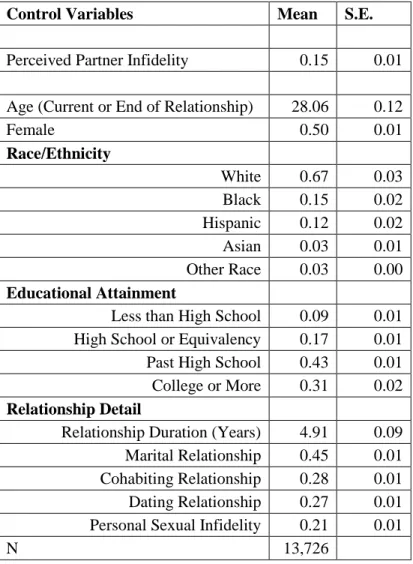
(urban/suburban/rural), and school type (public/private/parochial). The Add Health data set provides a unique and, in many ways, ideal data set to further explore correlations identified using search engine data. The individuals in the data set are, as of the most recent wave of data collection, in their mid-20s to early 30s. Individuals in this age range are likely to be both heavily using computers and Internet based technology and dealing with cohabiting and marital relationships. This dataset includes information about both sexual fidelity in the last or current relationship and perceived partner sexual fidelity. In addition, the large sample size, combined with variety of questions provides the power and range to explore a varied set of possible correlations. The analytic sample (N=14,346) was limited to those who reported on a current or recent romantic relationship, as only these individuals were asked about their perceptions of the partner’s sexual infidelity. A description of this sample is available in Table 1.1. While the Google identification focused on marital relationships, I use all romantic relationships for this validation. This choice is necessary to examine some identified
correlates, as certain measures, like intravenous drug usage, are rare in this sample. To account for this difference, I include controls for relationship type (marital, cohabiting, and dating/pregnancy) in all multivariate analyses.
25
with a dichotomous indicator from the question “As far as you know, during the time you and <Partner> had a sexual relationship, has <Partner> ever had any other sexual partners?” While this measure may appear different than the search terms above, they appear to capture similar concepts and meanings. Though it could be posited that the “cheating” terminology has a different valence from this variable, that phrasing is how individuals seek information regarding sexual infidelity. The ratio of searches for a cheating husband or wife to sexual infidelity is 75:1. For most individuals, there may therefore be no difference in connotation between these terms.
Two sets of models were estimated to test the association between perceived partner sexual infidelity and the concept identified from Google search terms. First, bivariate relationships between perceived infidelity and the indicator of interest were estimated with logistic regression. This model tested whether the correlations observed at the population level in the Google data are also found at the individual level among Add Health
(N=13,110-26
14,346) due to missing data. As all available indicators are tested for each identified conceptual domain, there is a possibility that by chance I would observe a number of significant effects. To account for the threat posed by multiple testing, I perform a Bonferroni correction within each conceptual domain to take into account the number of indicators utilized to measure that domain. All denoted p-values correspond to the corrected equivalent for the given level.
Results
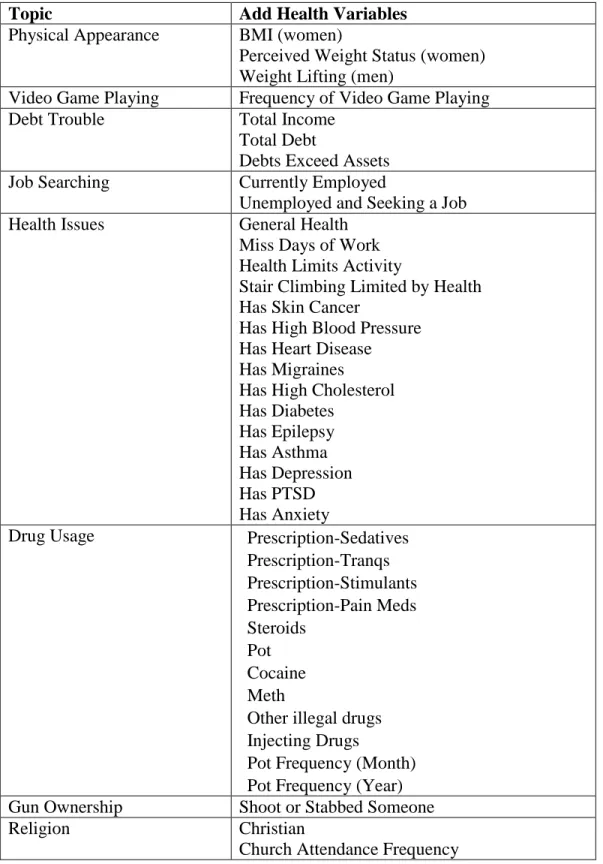
Eleven conceptual domains were constructed from the search terms identified by Google Correlate as having similar patterns as terms for perceived partner sexual infidelity. These domains were: physical appearance, video game playing, debt trouble, job seeking, pregnancy, health issues, drug usage, gun ownership, used cars, and religion. Table 1.2 shows the search terms that comprise these groups. While the gendered nature of search terms (husband or wife or spouse) was not generally relevant, it does appear relevant in measures of personal appearance. In this domain, women reported worrying about weight status while men reported concern over fitness and strength.
Theoretical Validation
Below I discuss the theoretical relevance of the conceptual domains in which search terms were most commonly identified in relation to searches of infidelity.
27
While mate desirability is determined by a number of factors, one of the most
important dimensions is physical attraction. Faced with contemplated or actual infidelity of a sexual partner, an individual may seek to re-establish sexual exclusivity by becoming a more desirable mate prospect than the alternative sexual partner. Therefore, to become more desirable to their partner, an individual can improve how attractive he or she is. Physical attractiveness is, of course, constructed by personal and cultural preferences and
idiosyncrasies; however, there appear to be some common factors, especially for the current American context.
For women, while there is cultural variation with regards to weight distribution and acceptable weights (Cunningham, Roberts, Wu, Barbee, and Druen 1995), body mass index (BMI) is a powerful predictor of sexual attractiveness (Tovee, Reinhardt, Emery, and Corneilssen 1998). Men report intermediate (i.e. “healthy” weight) as the most attractive (Tovee, Reinhardt, Emery, and Corneilssen 1998), though women believe men desire them to be even thinner (Buss 2003). Given the prevalence of obesity among adults in the United States (Flegal, Carroll, Ogden, and Johnson 2002), a belief in improving attractiveness for women will commonly take the form of a belief in needing to lose weight.
28
Thus, we would expect associations between perceived partner infidelity and beliefs about deficiency in physical appearance. It should also be noted that these correlations could be generated in the reverse direction. The degradation of an individual’s appearance, from weight gain or poor exercise, leads them to be less attractive than other potential sexual partners, so they begin to worry about the sexual faithfulness of their partner.
Video Game Playing
Multiple pathways could link videogame usage to perceived partner infidelity. The association could arise from population composition. Individuals who play videogames are more likely to be young (over 70% are under 50 years old) and male (2011 Entertainment Software Association calculations), attributes linked to sexual infidelity and perceived
infidelity. Video games, as potential competitors for shared time with a partner, could also be a source of relationship difficulty and dissatisfaction. Alternatively, an individual’s
excessive investment in video game playing could result in the partner seeking out additional sexual relationships.
Debt Trouble
29 Job Searching
Similarly to debt, unemployment is a stressful experience that can decay the social support provided by a marital partner (Atkinson, Liem, and Liem 1986). In addition to the general stress to the relationship, unemployment can reduce an individual’s sense of self-worth (Clark, Georgellis, and Sanfey 2001). Taken together, we would anticipate that the unemployment experience could either lead to partner’s infidelity or, by increasing
insecurity, increase fear of losing a partner through sexual infidelity. Job searching could also be a product of sexual infidelity as sexual infidelity triggers relationship dissolution which leads to an individual establishing economic independence. Most of the job searches associated with perceived infidelity were in highly gendered female fields, such as nursing or education. As men are more likely to be engaged in sexual infidelity, the data could indicate female dissolution of the marriage and establishment of economic self-support.
Pregnancy
Pregnancy, controlling for other demographic factors, is predictive of male sexual infidelity (Whisman, Gordon, and Chatav 2007). Following child birth, marital satisfaction declines (Twenge, Campbell, and Foster 2003) and as satisfaction and relationship quality are predictive of infidelity (Allen, Rhoades, Stanley, Markman, Williams, Melton, and Clements 2008; Bell, Turner, and Rosen 1975; Edwards and Booth 1976; Plack, Kroger, Allen,
Baucom, and Hahlweg 2010; Prins, Buunk, and Vanyperen 1993), this decline should increase the likelihood of sexual infidelity and consequently perception of the same.
30
Health problems, like economic trouble, can induce stress in a relationship, and this stress could degrade the quality of the relationship (for review, see Bradbury, Fincham, and Beach 2000). As individuals become more dissatisfied with the relationship, perceptions of either actual or potential infidelity of a partner increase. An individual’s health concerns may reduce the frequency of sexual intercourse in a relationship, resulting in the partner seeking other sexual relationships. Previous work has found evidence of the relationship between an individual’s health and their partner’s attachment to the relationship among brain cancer patients, where diagnosis of cancer leads to increased abandonment of a female partner by her husband almost double that observed in the general population (Glantz, Chamberlain, Liu, Hsieh, Edwards, Van Horn, and Recht 2009).
Drug Usage
Usage of illicit substances is associated with sexual concurrency (Adimora et al. 2002; Adimora, Schoenbach, and Doherty 2007). As both a relationship stressor and a primary risk factor, we would expect to find drug usage associated with not only sexual infidelity, but also perceptions of a partner’s infidelity.
Gun Ownership
31
non-owners, then we would expect gun owners to be similarly distrustful of their partners’ sexual fidelity. A bivariate analysis of current General Social Survey data provides some support for this position; individuals who have guns in their household report extramarital sex as more “wrong” than expected were the variables independent.
Used Cars
The search for used cars is potentially indicative of economic troubles. As with debt concerns, this economic trouble could impose stress on a relationship. This stress could lead to degradation of the relationship, which could manifest as either distrust of a partner’s fidelity or the partner actually engaging in an extramarital affair. Alternatively, the search for a used car could be indicative of a leaving a relationship as the individual seeks to establish economic independence or require their own transportation.
Religion
While religious service attendance is negatively associated with an individual’s likelihood of engaging in extramarital sexual activity (Atkins and Kessel 2008; Choi, Catania, and Dolcini 1994), it is less clear how religion may influence perceptions of a partner’s infidelity. Many religions common to the United States have particular emphasis on sexual exclusivity in marital relationships. Among the observed search terms, many explicitly refer to the Christian faith. Within this religious tradition, views toward
extramarital sexual relationships are outlined in both commandment (“Thou shall not commit adultery”-Exodus 20:14) and epistle (“Do not be deceived: neither the immoral, nor
32
Attention to and relevance of religious strictures could therefore be associated with greater attention to fulfilling this injunction.
Empirical Validation
The second validation strategy uses Add Health data to observe whether the
correlations observed in the Google data also exist at the individual level in survey data. For each domain uncovered from search terms, I selected measures relevant to the concept. A complete list of variables constructed is available in Table 1.3. However, some of the relationships could not be tested in the Add Health data. The association between recent pregnancy and perceived infidelity was not tested because the available measure of partner infidelity lacks a time reference and is therefore unable to be linked to a specific pregnancy period. As no measures of car ownership patterns were available in the data, the association between perceived infidelity and used car ownership was also not examined.
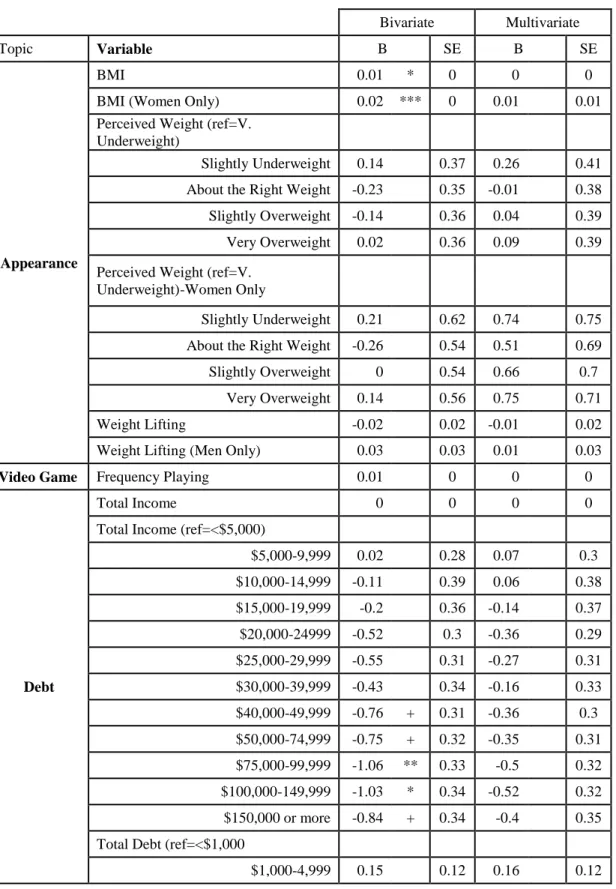
In the bivariate models (shown in the left column of Table 1.4), indicators of all concepts (except video game playing) were significantly associated with perceptions of partner infidelity. In all cases but religious service attendance, observed significant associations were in the hypothesized direction, providing support for the theoretical
33
meth, other drugs, injected drugs, and frequency of marijuana usage), and having stabbed or shot someone in the last 12 months were all associated with increased likelihood of perceived partner sexual infidelity. In contrast, higher levels of income and church attendance are associated with decreased likelihood of perceiving the relationship partner to be sexually unfaithful.
In multivariate models (shown in the rightmost column in Table 1.4) including controls, I found a number of correlates still significantly associated with perceived partner infidelity. Controlling for these background factors, measures of four search identified domains are significantly associated with perceived sexual infidelity. High levels of church attendance are associated with lower likelihood of distrusting partner’s faithfulness.
Measures of health (general health and depression), drug usage (sedative misuse, tranquilizer misuse, stimulant misuse, cocaine usage, methamphetamine usage, and injecting drugs), and gun ownership (shot or stabbed someone in the last year) were associated with higher likelihood to perceive partner sexual infidelity.
Conclusions
34
infidelity. The concepts located in this manner were validated with two different tests. Theoretically, I would expect to find associations between perceived infidelity and the identified topics. I also discovered correlations between these concepts and perceptions of partner infidelity in an empirical test using individual level survey data.
Using this search engine database, I was able to extract meaningful information about perceptions regarding the sexual infidelity of a partner. Rather than random search terms, there was a remarkable consistency in the terms that were correlated with perceived partner sexual infidelity; “loan” appeared in 1% of all correlated searches, “Bible” appeared in 1% of all correlated searches, and 1.5% of the identified searches included the word “job.” The consistency of these search terms suggests that these terms are capturing shared concepts, rather than random Google inputs.
Not only are there common concepts captured by these search terms, but the
identified concepts are related to perceived partner sexual infidelity. Theoretically, there are reasons to expect that the associations between perceived infidelity and the identified
35
In addition to highlighting a new data source for social research, this paper adds to the existing literature on perceptions of a partner’s sexual infidelity. The multivariate analysis tested whether the identified correlates allowed better prediction of perceived partner infidelity than basic individual and relationship characteristics. Finding significant
associations, even after controlling for compositional factors like age and sex, suggest that the tested conceptual domain can help explain perceptions of sexual infidelity. Measures of health, drug usage, religious attendance and gun ownership were significantly associated with perceived partner infidelity in these models and should be included in future
explorations of this topic. These concepts have not been previously linked with perceived partner sexual infidelity. Search engine data has therefore identified novel behavioral correlates for future study.
36
browsing session. Careful attention to both the unit on which the information is collected and to which the findings are being applied is required.
Future work on this particular source of data could take advantage of even more detailed information. In addition to identifying a correlation between a search term and the term of interest, Google Correlate reports the strength of this association. Future work could take advantage of this measure and potentially incorporate it into model expectations. If anything, this work uses only the most basic available internet data-location and time. Companies like Google, Facebook, and Amazon create complete profiles of individuals with full internet histories. These data allow examination of individual level behavior, rather than the aggregate data that I used for this project. While academics may not currently have access to this information, future work may be able to leverage such a wealth of information.
While many concerns face the continued use of surveys, both in general and in the specific case of sexual behavior, using online records is one possible solution. This paper shows that our reliance on survey data could be reduced in the future with the application of novel data sources. In specific circumstances, such as the study of sensitive topics or
Cohabitation and Sexual Infidelity in American Young Adults
Recent decades have witnessed profound change in the patterns of marriage and cohabitation in most industrialized societies. The structural and cultural shifts in modern Western society from an almost universal engagement in marriage to an increasing diversity of family forms have wide ranging implications and consequences. While there are a number of behavioral and contextual differences between cohabitation and marriage, the mechanism of these differences is not fully understood by current scholarship. For example, research on sexual infidelity has commonly studied marriages, exploring what factors might predict the likelihood of such behavior within these unions; however, the same investigations have not been extended to cohabiting couples. Despite almost universal expectations of exclusivity in both cohabitation and marriage, respectively 94% and 99% of individuals in such unions report expecting their partner to be sexually faithful (Treas and Giesen 2000), marriages and cohabiting unions exhibit different rates of sexual fidelity.
To date, the basis of these observed differences is incompletely understood. The
infidelity difference between marriage and cohabitation may indeed be the result of structural differences that impact engagement in infidelity. However, this observed association
38
The current paper examines the association between cohabitation and sexual infidelity, attempting to address this potential relationship selection. I address the selectivity of
cohabitation by comparing cohabiting unions to marriages with a history of cohabitation and the selectivity of marriage by using an instrumental variable approach. This paper also explores how relationship type, cohabitation and marriage, may moderate the association between previously identified social factors and sexual infidelity.
1. Infidelity
In the modern Western setting, most “serious” romantic relationships include an expectation of sexual exclusivity, with individuals in both marital and cohabiting relationships almost universally expecting partner sexual exclusivity (Treas and Giesen 2000). While alternative arrangements may exist, such as “open” marriages or “friends with benefits,” the transition from casual dating to committed relationship typically contains the assumption of sexual monogamy for modern American relationships. To fix terms, I refer to the violation of sexual exclusivity in a relationship which generally presupposes its existence - cohabitation or marriage - as sexual infidelity rather than the host of previously employed terms (e.g., extra-pair copulation, extra-dyadic sex, extramarital sex, extramarital infidelity, cheating, having an affair). As this study differs from most previous work in examining sexual infidelity in relationships other than marriage, I label previous findings regarding sexual infidelity in marriage as marital infidelity
39
Americans continue to assert the importance of exclusivity in sexual relationships (Laumann, Gagnon, Michael, and Michaels 1994). Over 90% of Americans, in a nationally
representative survey of adults aged 18-55 (National Health and Social Life Survey) reported that marital infidelity was “always wrong” or “almost always wrong” (Laumann, Gagnon, Michael, and Michaels 1994), as did over 94% of older Americans in the more recent National Social Life, Health, and Aging Project (NSHAP) in 2005-6. The acceptance of infidelity in recent rounds of the General Social Survey (GSS) suggests similar levels of disapproval. Even for currently married individuals who report that sexual infidelity is never wrong, only 18% have had an extramarital partner within the last year and 25% have never had an extramarital sex partner (Smith 1994).
Despite this almost universal denunciation, infidelity is a very real experience for many relationships. Studies from the mid-20th century in the United States estimated between about a quarter and half of all married men or women reported ever having extramarital sex during their marriage (Kinsey, Pomeroy, and Martin 1948; Kinsey, Pomeroy, Martin, and Gebhard 1953). However, these early studies were limited by non-representative samples and provided little incentive for respondents to report truthfully about sexual behavior. More recent estimates from nationally representative samples suggest that 15-25% of married or previously married Americans have ever had an extramarital sexual relationship during their marriage (Laumann, Gagnon, Michael, and Michaels 1994).
40
Sexual infidelity within a relationship has consequences for not only the sexually unfaithful individual, but by all those connected, both sexually and socially. Each additional partner and sex act is an additional exposure to disease contraction, so those who engage in sexual infidelity are more likely to contract sexually transmitted infections. Individuals involved in temporally overlapping sexual relationships have higher rates of human papillomavirus (HPV) (Javanbakht et al. 2010) and shorter gaps between partners are associated with higher incidences of bacterial based sexually transmitted infections (Kraut-Becher and Aral 2003). Mathematical models have suggested concurrent sexual partnerships, such as those created by sexually unfaithful partners, are an important component in
understanding disease transmission in HIV/AIDS (Kretzschmar and Morris 1996; Morris and Kretzschmar 1997). In addition to increasing their own health risk, sexually unfaithful
individuals operate as “bridges” among sexual networks, increasing the risk of their sexual partners contracting these diseases as well. These patterns may have consequences outside the relationship dyad for the entire sexually active population.
In addition to disease risk, individuals who have sex with additional partners risk having a child (Bongaarts 1978; Davis and Blake 1956). A child born outside of the primary relationship could stress relationships, impose financial costs, and divide attention from any existing children. With the low prevalence of polygamous groups in the modern American context, a child born in these circumstances will most likely be nonresidential and likely experience worse health and mental outcomes than if both parents were in residence (e.g., Bronte-Tinkew, Horowitz, and Scott 2009).
41
(Whisman, Dixon, and Johnson 1997). It is estimated that a majority of couples in clinical couples therapy are there, in part, due to marital infidelity (Glass and Wright 1988;
Humphrey 1983). Longitudinal studies following couples found that infidelity is one of the most important predictors of later marital dissolution and serves as a mediator of other predictive factors (demographic and life course variables) of divorce (Amato and Rogers 1997).
Correlates and Predictors of Sexual Infidelity
The variety and severity of these potential consequences makes understanding the how sexual infidelity occurs a crucial endeavor. With limits on both data and measurement, causal relationships are difficult to ascertain on this topic. Consequently, research into sexual infidelity has proceeded through identifying social factors associated with the behavior. Numerous social attributes have demonstrated association with sexual infidelity (for review, see Blow and Hartnett 2005). Conceptually, these correlates of sexual infidelity can be organized into three primary domains: the individual, the environment, and the relationship.
Many individual factors are correlated with sexual infidelity. Education (Atkins,
42
associated with sexual infidelity. Males tend to engage in or seek out such relationships at higher rates than females (Traeen and Stigum 1998), though there is evidence suggesting some of this sex difference may be due to differences in risk seeking behavior (Lalasz and Weigel 2011).
Environment external to the relationship is also associated with sexual infidelity. Living in an environment with a large number of alternative possible relationships (high population or dense population center) is associated with higher likelihood of sexual infidelity (Plack et al. 2010; Traeen and Stigum 1998). Even when controlling for income, married individuals employed outside of the household are more likely to be sexually unfaithful (Atkins, Baucom, and Jacobson 2001). Labor force participation gives an individual a chance to encounter people without, for most, the presence of their romantic partner. Spending time with coworkers and work based travel are associated with higher incidence of sexual infidelity (Plack et al. 2010; Traeen and Stigum 1998). This opportunity structuring could explain existing differences between male and female reports of lifetime marital infidelity. The historic sex disparity in labor force participation could mean men, by virtue of working outside the home, met more possible partners than women, increasing their likelihood of engaging in sexual infidelity. As women in recent cohorts have joined the labor force, this opportunity differential and thus the disparity between male and female
engagement in sexual infidelity have decreased (Laumann, Gagnon, Michael, and Michaels 1994).
43
levels of infidelity (Glass and Wright 1977; Plack et al. 2010). Relationship satisfaction and perceived relationship quality are also predictive of infidelity and infidelity desires (Allen et al. 2008; Bell, Turner, and Rosen 1975; Edwards and Booth 1976; Plack et al. 2010; Prins, Buunk, and Vanyperen 1993). Sexual satisfaction, particularly of men, is associated with a decreased likelihood of engaging in sexual infidelity (Traeen and Stigum 1998).
Relationship type is also relevant; cohabiting and dating relationships are less likely to be defined by sexual exclusivity (Forste and Tanfer 1996) and cohabitating individuals engage in sexual infidelity at higher rates than those who are married (Traeen and Stigum 1998; Treas and Giesen 2000).
This last finding suggests an important limitation of current research. Work examining sexual infidelity has been almost universally limited to marital relationships. Cohabiting unions differ from marriages in fundamental ways, so generalizing our understanding of marital behaviors, like sexual infidelity, to cohabiting unions may be invalid. Cohabiting unions differ from marriages, not only in the structure of relationships, but also in the type of individual selecting into each relationship. As a consequence of these differences, we might expect differences not only in levels of sexual infidelity, but in what factors are relevant for this behavior as well.
2. Cohabitation
44
the period 1995-2002, data from the National Study of Family Growth (NSFG) show that the percent of women aged 15-44 who are currently cohabiting rose from 3% to 12%. Today, almost half of all men and women aged 15-44 report having cohabitated at least once (Goodwin, Mosher, and Chandra 2010).
Marriage and cohabitation appear to differ with regard to purposes, processes, and development. While most individuals define marriage as an institution, the definition of cohabitation is less clear. These structural differences manifest from the outset: marriage is defined by an event (e.g. a wedding or a visit to the courthouse) but the fuzzier transition to cohabitation is perhaps better described as a sliding or drifting through a sequences of incremental steps and decisions (Manning and Smock 2005). Though marriage, as an institution, assumes a long-term commitment and sharing of resources, the numerous,
potential forms of cohabitation make it an “incompletely institutionalized institution” (Waite 1995). Indeed, while the institution of marriage is generally conceived of for purposes of family-building and life-long commitment, cohabitation can take on a number of specific different forms for participants: substitution for marriage, precursor to marriage, trial marriage, and co-residing daters (Casper and Sayer 2000). The ultimate goal of cohabiting unions is mixed as well (Bumpass, Sweet, and Cherlin 1991; Casper and Bianchi 2001). Though few couples view cohabitation as an alternative to marriage (Heuveline and Timberlake 2004), not all cohabiting individuals see themselves as part of the marriage pathway (Manning and Smock 2002). The remarkable heterogeneity within cohabitation suggests that, cohabiting sexual infidelity may be a different process than marital infidelity.
45
Currently in the United States, in both marriage and cohabitation there is an
expectation of sexual exclusivity, but these relationships differ in reported levels of sexual infidelity (Treas and Giesen 2000). This difference could be due to either the selectivity of relationship type or differences between cohabitation and marriage that influence the decision to engage in infidelity.
As previously noted, cohabiters differ from married individuals on many dimensions, such as race, education and income (for review, see Smock 2000). In addition, cohabiters may desire less structured relationships, be less family oriented, and desire more autonomy within the relationship than married individuals (Axinn and Thornton 1992; Clarkberg, Stolzenberg, and Waite 1995). As these personal characteristics predict who cohabits and, similarly, who engage in sexual infidelity, these characteristics may be responsible for the observed difference in reported infidelity between married and cohabiting individuals, rather than the state of cohabitation itself. The selective nature of cohabitation and marriage may therefore be an important component of the association between relationship type and sexual infidelity.
46
The legal, social, economic, and emotional commitments of marriage imply higher direct costs for dissolving a marital tie than a cohabiting one. Marriage assumes a long-term contract (“til death does us part”), creates co-insurance through sharing economic and social resources, benefits from economies of scale, and creates connections to other individuals and groups (Waite 1995), which cohabitation may not. Marriage is a “sticky” social institution that embeds individuals in a web of ties to other people and institutions, such as church; tie formation which cohabitation often inhibits (Stolzenberg, Blairloy, and Waite 1995). These social connections and obligations increase the costs of marital dissolution relative to that of a cohabiting union.
In addition to these direct costs, sexual infidelity can indirectly impose costs via loss of anticipated benefits. Classic research suggests that marriage serves as a unit wherein members exchange goods and services (Becker 1981). Sexual infidelity increases the likelihood of union dissolution, potentially risking these benefits. Cohabiting unions, by virtue of their “incomplete institutionalization” (Waite 1995), may not include this form of resource exchange. Consequently, potential loss of money, goods, and services is expected to be lower for dissolution of a cohabiting union than divorce. The disparity in indirect costs would suggest that cohabiting individuals should be more likely to engage in sexual infidelity than their married counterparts due to the nature of the relationship.