JOURNAL OF VERBAL LEARNING AND VERBAL BEHAVIOR 13, 585-589 (1974)
Reconstruction of Automobile Destruction :
A n Example of the Interaction Between Language and Memory’
ELIZABETH F. LOFTUS AND JOHN C. PALMER
University of Washington
Two experiments are reported in which subjects viewed films of automobile accidents and then answered questions about events occurring in the films. The question, “About how fast were the cars going when they smashed into each other?” elicited higher estimates
of speed than questions which used the verbs collided, bumped, contucted, or hit in place of
smashed. On a retest one week later, those subjects who received the verb smashed were more likely to say “yes” to the question, “Did you see any broken glass?”, even though broken glass was not present in the film. These results are consistent with the view that the questions asked subsequent t o an event can cause a reconstruction in one’s memory of that event.
How accurately d o we remember the details of a complex event, like a traffic accident, that has happened in our presence? More specifically, how well do we d o when asked to estimate some numerical quantity such as how long the accident took, how fast the cars were traveling, or how much time elapsed between the sounding of a horn and the moment of collision?
It is well documented that most people are markedly inaccurate in reporting such numeri- cal details as time, speed, and distance (Bird, 1927; Whipple, 1909). For example, most people have difficulty estimating the duration of an event, with some research indicating that the tendency is to overestimate the duration of events which are complex (Block, 1974; Marshall, 1969; Ornstein, 1969). The judg- ment of speed is especially difficult, and practically every automobile accident results in huge variations from one witness to another
This research was supported by the Urban Mass Transportation Administration, Department of Trans-
1 portation, Grant No. WA-11-0004. Thanks go to
as to how fast a vehicle was actually traveling (Gardner, 1933). In one test administered t o Air Force personnel who knew in advance that they would be questioned about the speed of a moving automobile, estimates ranged from 10 to 50 mph. The car they watched was actually going only 12 mph (Marshall, 1969, p. 23).
Given the inaccuracies in estimates of speed, it seems likely that there are variables which are potentially powerful in terms of influencing these estimates. The present research was conducted to investigate one such variable, namely, the phrasing of the question used to elicit the speed judgment. Some questions are clearly more suggestive than others. This fact of life has resulted in the legal concept of a leading question and in legal rules indicating when leading questions are allowed (Supreme Court Reporter, 1973).
A leading question is simply one that, either by its form or content, suggests to the witness what answer is desired or leads him to the desired answer.
Geoffrey Loftus, Edward E. Smith, and Stephen Woods for many important and helpful comments, Reprint requests should be sent to Elizabeth F. Loftus. Department of Psychology, University of Washington, Seattle, Washington 981 95.
Copyright 0 1974 by Academic Press, Inc.
In the present study, subjects were shown
answered questions about the accident. The films of traffic accidents and then they
subjects were interrogated about the speed of
585
586 LOFTUS AND PALMER
the vehicles in one of several ways. For example, some subjects were asked, “About how fast were the cars going when they hit each other?” while others were asked, “About how fast were the cars going when they smashed into each other?” As Fillmore (1971) and Bransford and McCarrell (in press) have noted, hit and si.r.lasl?ed may involve speci- fication of differential rates of movement. Furthermore, the two verbs may also involve differential specification of the likely con- sequences of the events to which they are referring. The impact of the accident is
apparently gentler for hit than for .n~ia.dtctI.
EXPERIMENT 1 Metliod
Forty-five students participated in groups of various sizes. Seven films were shown, each depicting a traffic accident. These films were segments from longer driver’s education f i l m borrowed from the Evergreen Safety Council and the Seattle Police Department. The length of the film segments ranged from
5 to 30 sec. Following each film, the subjects received a questionnaire asking then1 first to, “give an account of the accident you have just seen,“ and then to answer a series of specific questions about the accident. The critical question was the one that interrogated the subject about the speed of the vehicles involved in the collision. Nine subjects were asked, “About how fast were the cars going when they hit each other?” Equal numbers of the remaining subjects were interrogated with the verbs smashed, collided, buiiiped, and
contacted in place of hit. The entire experiment lasted about an hour and a half. A different ordering of the films was presented to each group of subjects.
R esiilt s
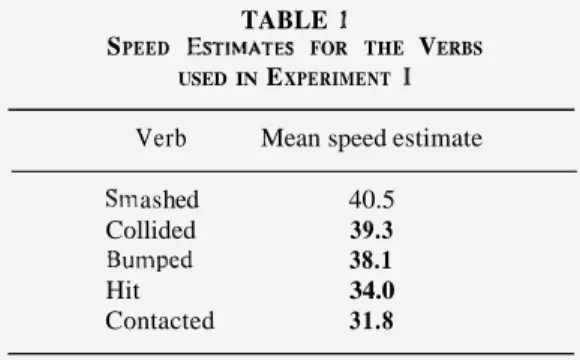
Table 1 presents the mean speed estimates for the various verbs. Following the pro- cedures outlined by Clark (1973), an analysis of variance was performed with verbs as a fixed effect, and subjects and films as random
TABLE 1
I
I
1
SPEED ESTIMATES FOR THE VERBSUSED IN EXPERIMENT 1
1
Verb Mean speed estimate
Sin as hed 40.5
Collided 39.3
Bumpcd 38.1
Hit 34.0
Contacted 31.8
efTects, yielding a significant quasi F ratio,
Some information about the accuracy of subjects’ estimates can be obtained from our data. Four of the seven films were staged crashes; the original purpose of these films was to illustrate what can happen to human beings when cars collide at various speeds. One collision took place at 20 mph, one at 30, and two at 40. The mean estimates of speed for these four films were: 37.7, 36.2, 39.7, and 36.1 mph, respectively. In agreement with previous work, people are not very good at judging how fast a vehicle was actually traveling.
!“(5,55) = 4.65, p < .005.
Discussioii
The results of this experiment indicate that the form of a question (in this case, changes in a single word) can markedly and systematically affect a witness’s answer to that question. The actual speed of the vehicles controlled little variance in subject reporting, while the phrasing of the question controlled con- siderable variance.
LANGUAGE A N D MEMORY CHANGES 587
“sees” the accident as being more severe than it actually was. If this is the case, we might expect subjects to “remember” other details that did not actually occur, but are com- mensurate with an accident occurring at higher speeds. The second experiment was designed to provide additional insights into the origin of the differential speed estimates.
with hit the estimate was 8.00 mph. These means are significantly different, t (98) = 2.00, p < -05.
TABLE 2
DISTRIBUTION OF “YES” A N D “ N O ” RES- PONSES TO THE QUESTION, “DID YOU S E E
ANY BROKEN GLASS?’ EXPERIMENT I1
Method
One hundred and fifty students participated in this experiment, in groups of various sizes. A film depicting a multiple car accident was shown, followed by a questionnaire. The film lasted less than 1 min; the accident in the film lasted 4 sec. At the end of the film, the subjects received a questionnaire asking them first to describe the accident in their own words, and then to answer a series of questions about the accident. The critical question was the one that interrogated the subject about the speed of the vehicles. Fifty subjects were asked, “About how fast were the cars going when they smashed into each other?” Fifty subjects were asked, “About how fast were the cars going when they hit each other?” Fifty subjects were not interrogated about vehicular speed.
One week later, the subjects returned and without viewing the film again they answered a series of questions about the accident, The critical question here was, “Did you see any broken glass?” which the subjects answered by checking “yes” or “no.” This question was embedded in a list totalling 10 questions, and it appeared in a random position in the list. There was no broken glass in the accident, but, since broken glass is commensurate with accidents occurring at high speed, we expected that the subjects who had been asked the
smashed question might more often say “yes”
k to this critical question.
Results
The mean estimate of speed for subjects interrogated with smaslted was 10.46 mph;
Verb condition
Response Smashed Hit Control ~-
Yes 16 7 6
No 34 43 44
Table 2 presents the distribution of ‘.yes” and “no” responses for the smashed, Itit, and control subjects. An independence chi-square test on these responses was significant beyond the .025 level, ~ ~ ( 2 ) = 7.76. The important result in Table 2 i s that the probability of saying “yes,” P(Y), to the question about broken glass is .32 when the verb sn?a.died is used, and .14 with hit. Thus smashed leads both to more “yes” responses and to higher speed estimates. It appears to be the case that the effect of the verb is mediated at least in part by the speed estimate. The question now arises : Is sniushed doing anything else besides increasing the estimate of speed? To answer this, the function relating P(Y) to speed estimate was calculated separately for stiiashed
and hit. If the speed estimate is the only way in which effect of verb is mediated, then for a given speed estimate, P(Y) should be in- dependent of verb. Table 3 shows that this is
TABLE 3
PROBABILITY OF SAYING “YES” TO, “DID Y O U SEE
ANY B R O K ~ N GLASS?’ CONDIT~ONALIZED ON SPEED
ESTIMATES
Speed estimate (mph)
Verb
--condition 1-5 6-10 11-15 16-20
Smashed .09 .27 .41 .62
588 LOFTUS AP
not the case. P(Y) is lower for hit than for
smashed; the difference between the two verbs
ranges from .03 for estimates of 1-5 mph t o .I8 for estimates of 6-10 mph. The average difference between the two curves is about .12. Whereas the unconditional difference of
.
I8 between the smashed and hit conditions is attenuated, it is by no means eliminated when estimate of speed is controlled for. It thus appears that the verb smashed has other effects besides that of simply increasing the estimate of speed. One possibility will be discussed in the next section.DISCUSSION
To reiterate, we have first of all provided a n additional demonstration of something that has been known for some time, namely, that the way a question is asked can enormously influence the answer that is given. In this instance, the question, “About how fast were the cars going when they smashed into each other?” led to higher estimates of speed than the same question asked with the verb
smashed replaced by hit. Furthermore, this seemingly small change had consequences for how questions are answered a week after the original event occurred.
As a framework for discussing these results, we would like to propose that two kinds of information go into one’s memory for some complex occurrence. The first is information gleaned during the perception of the original event; the second is external information supplied after the fact. Over time, information from these two sources may be integrated in such a way that we are unable to tell from which source some specific detail is recalled. All we have is one “memory.”
Discussing the present experiments in these terms, we propose that the subject first forms some representation of the accident he has witnessed. The experimenter then, while asking, “About how fast were the cars going when they smashed into each other?” supplies a piece of external information, namely, that the cars did indeed smash into each other.
4D PALMER
When these two pieces of information are integrated, the subject has a memory of an accident that was more severe than in fact it was. Since broken glass is commensurate with a severe accident, the subject is more likely to think that broken glass was present. There is some connection between the present work and earlier work on the influence of verbal labels on memory for visually presented form stimuli. A classic study in psychology showed that when subjects are asked to reproduce a visually presented form, their drawings tend to err in the direction of a more familiar object suggested by a verbal label initially associated with the to-be- remembered form (Carmichael, Hogan, & Walter, 1932). More recently, Daniel (1972) showed that recognition memory, as well as reproductive memory, was similarly affected by verbal labels, and he concluded that the verbal label causes a shift in the memory strength of forms which are better representa- tives of the label.
When the experimenter asks the subject, “About how fast were the cars going when they smashed into each other?”, he is effect- ively labeling the accident a smash. Extra- polating the conclusions of Daniel to this situation, it is natural to conclude that the label, smash, causes a shift in the memory representation of the accident in the direction of being more similar to a representation sug- gested by the verbal label.
REFERENCES
BIRD, C. The influence of the press upon the accuracy
of report. Journal of Abnormal and Social Psy-
BLOCK, R . A. Memory and the experience of duration
in retrospect. Memory & Cogtiition, 1974, 2,
BRANSFORD, J. D., & MCCARRELL, N. S. A sketch of a cognitive approach to comprehension : Some thoughts about understanding what it means to comprehend. In D. Palerrno & W. Weimer (Eds.), Cognition arid the synibolic processes. Washington, D.C.: V . H. Winston & Co., in press.
chology, 1927,22, 123-1 29.
I 53-1 60.
CAHMICHAI I-, L., HO(iAN, I I. l'., & WAI I I I(, A . A .
experimental study of the etl'ect ol' language 011 the reproduction of visually perceived form. Journal of Experimental Psychology, 1932, 15,
CLARK, H. H. The language-as-fixed-effect fallacy: A
critique of language statistics in psychological research. Journal of Verbal Learning and Verbal Behavior, 1973,12,335-359.
DANIEL, T. C. Nature of the effect of verbal labels on recognition memory for form. Journal of Experi- mental Psychology, 1972,96, 152-1 57.
FILLMORE, C. J. Types of lexical information. In
D. D. Steinberg and L. A. Jakobovits (Eds.),
Semantics: An interdisciplinary reader in philo- 73-86.
3
s o p l ~ y , t i i l ~ i i i . ~ / i c ~ v , tiircl p.v.i,c.liolcJ,~J.i.. C'iitiil~i.iclgc : Cambritlgc University Press, 1971.
GARDNER, D. S. The perception and memory of
witnesses. Cornell Law Quarterly, 1933, 8, 391 -409.
MARSHALL, J. Law and psychology in conflict. New York: Anchor Books, 1969.
ORNSTEIN, R. E. On the experience of time. Harmonds- worth. Middlesex. England: Penguin, 1969. WHIPPLE, G. M. The observer as reporter: A survey of
the psychology of testimony. Psychological Bulletin, 1909, 6 , 153-170.
Supreme Court Reporter, 1973, 3 : Rules of Evidence for United State Courts and Magistrates.