DSS: Data Stream Scan
Glenn Fowler and Balachander Krishnamurthy
Abstract— dss (data stream scan) is a framework for describing, trans-forming, reading, querying, and writing streams of record oriented data.
dss is implemented as a command and library API and used extensively
to aid network measurements in our organization. The API is extended by DLLs (shared libraries) that define data domain specific I/O, type and query functions. We provide a best-in-class repository for data scanning, along with up-to-date documentation as a side effect of coding to the API. Many large scale network applications have used dss significantly reducing the time spent in coding and in querying data. The reasons for the success of
dss are its lightweight and extensible architecture, generic usage template,
scope of supported data domains, scalability, and speed. dss compares ex-tremely favorably against perl, the typical recourse in the networking com-munity, and against customized C/C++ code written to deal with specific data sets. dss has been successfully applied over three years over a wide range of applications, including large volumes ofNETFLOWdata,BGP ta-bles,HTTPproxy and server logs,
logs, andOSPF LSA(Link State Advertisements.) The use of dss has led to fearless exploration of ideas across very large volumes of data.
I. INTRODUCTION
Parsing is a critical part of record oriented data analysis. It involves describing the record structure and splitting the record fields into a form suitable for the analysis tools. Each tool may have its own idiosyncratic record description and field identi-fier syntax and format, and some tools may be better at hiding the details than others. For example, tools like grep, awk, and
perl, intermix low and high level definition details within the
same program. Although relational databases provide high level abstractions and GUI interfaces suitable for an end user, data stream management and initial loading typically require more expertise. Loading expense may be worthwhile only for data that will be scanned more than a few times.
It is common to have many analysis tools, each with an inde-pendent parser, applied to the same data within a single group of analysts. This in itself is not a bad situation. A relational database may be overkill for an application that needs to visit each record only once; hand coded programs may be inappropri-ate for data that is too large to fit in memory, or that may benefit from indexed access, or that may undergo many record format changes. However, subtle parsing differences between indepen-dent analyzers can make comparisons difficult. The absence of read or load errors does not necessarily mean that the data was read correctly. While data access bugs can be fixed as they are discovered, in the worst case this could mean translating the fix to every analysis tool. In some cases it may even be impossible to recover from bugs that affected intermediate legacy data.
dss provides a data abstraction that can be used to mitigate
parsing differences between independent analysis tools. The key is that the abstraction provides efficient (in space and time) I/O support and a uniform interface for all data. This approach has multiple benefits: (1) allows data analysts to focus on analyzing data; (2) provides a target API for data I/O coders; (3) third par-ties familiar with the data abstraction model are automatically proficient in new data domains.
The authors are with AT&T Labs–Research, New Jersey. E-mail: [email protected], [email protected]
dss arose out of experience withBGPdata analysis in our lab. A few in-houseBGPtools gained popularity with the analysts. Each newBGPfeed and file format (cisco router table dumps,
MRTformat data, and ad-hoc flat files) necessitated a recoding effort, which meant changing a handful of related but slightly different implementations that had evolved over a four year pe-riod. Merging theBGPI/O and parsing into a unified API was a big time saver, and also uncovered several embarrassing bugs that had remained hidden for years. Also, by employing best of class coding practices, the merged interface produced notice-ably more efficient code. For example, the dssBGP MRTparser is 10 times faster than the one published by the originators of the format. By the time the analysts requested help onNETFLOW
data the lesson had been learned, and dss was designed, imple-mented, and extended to several additional data formats. Overall
dss shows that a tool can handle a wide variety of data formats
while being accurate and as fast or faster than tailored solutions.
II. DATAABSTRACTIONMODEL
dss partitions data stream access into components that form
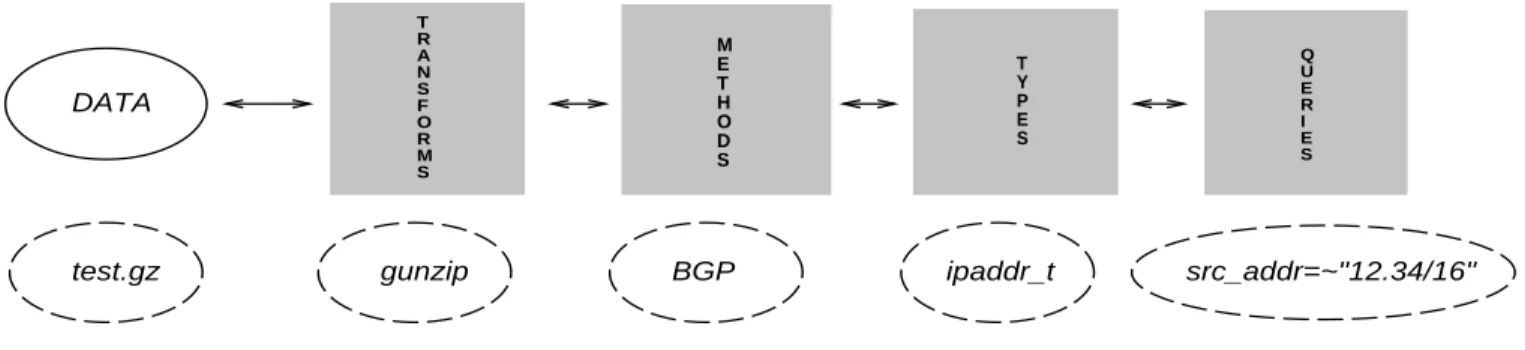
a uniform model for all data. The model guides both the im-plementation and user interfaces. It supports independent data methods, each with one or more physical formats. For exam-ple, theBGPmethod supports cisco router dump andMRT for-mats, and theNETFLOWmethod handles all versions of the cisco dump format. Each user visible item, whether in the base API or in DLL extensions, is placed in a dictionary. A dictionary entry has a name and descriptive text suitable for inclusion in manual pages. This information can also be listed by the runtime in-terfaces, so up-to-date documentation is always available. Fig-ure 1 illustrates the component relationships in the dss model. Some components are part of the default dss library, but most are implemented as independent dss API DLLs. Applications link against the base dss library which handles the mechanics of locating and loading the DLLs at runtime. Old applications thus have access to new methods without requiring recompilation.
A. TRANSFORM Components
Transforms are generic data independent filters that are plied to the raw data. They are automatically detected and ap-plied on input, and are selectively apap-plied on output, as deter-mined by user and/or data specific options. dss currently sup-plies compression transforms for gzip, pzip [1], bzip and
com-press; support for deltas (vcdiff [2]) and encryption is planned.
A transform may be implemented within the main dss process (e.g., the sfio [3] gzip discipline) or as a separate process (e.g.,
gzip or gunzip connected by a pipe.) In some cases it may be
possible to delay the current vs. separate process choice until runtime. For example, on a multi-cpu architecture with idle pro-cessors, running gzip as a separate process may take less real time than decompressing and scanning in a single process.
se-DATA
T
R A N S F O R M S
M
E T H O D S
T Y P E S
Q
U E R I E S
test.gz gunzip BGP ipaddr_t src_addr=~"12.34/16"
Fig. 1. dss Component Architecture
cure) manner. The data need only be converted when accessed. Given the volumes of available network data, compression or deltas, along with sampling, are essential for archiving.
B. METHOD Components
A method describes the data records for a specific data do-main and must be specified before dss accesses any data. It pro-vides a uniform view of all data domains supported by dss, both from the user command line and API perspectives. Lessons and techniques learned in one method most likely will apply to other methods as well. The method data description includes:
A dictionary of file storage formats with three functions: an identification function that automatically determines input for-mats (a format may be a different version (NETFLOWversions 1, 5 and 7) or a completely different structure (BGP MRTfiles vs. cisco router dumps.), and record read and write functions, both of which also handle format specific headers and trailers.
A dictionary of record field types and names that includes the union of fields available in all supported formats. Fields ab-sent in a particular format will have empty values. For example, the dssNETFLOWmethod supports all popularNETFLOW for-mats, and the same queries can be used on any of them. The
source maskfield, not in the version 1 format, is still avail-able for version 1 queries, but with a default value of 0.
An optional canonical record that provides access to a C struc-ture representation of each record. A method that provides a canonical record can simplify ad-hoc C queries by allowing the queries to be implemented as dynamic dss QUERY component functions, described below.
C. TYPE Components
A dss type provides functions that convert data between in-ternal and exin-ternal data representations. Some types may also have a base type that provides alternate access to the same data. Types are method independent and are often shared between methods. For example, theipaddr_ttype in the dss ip_t
type library implements anIPaddress as a 32 bit unsigned in-teger (the base type), and converts between the inin-teger represen-tation and quoted dotted-quad orDNSnames as the application requires. Often logs contain a mixture of dotted-quad andDNS IPaddresses. Both are handled by automatic conversions de-pending on the context.
D. QUERY Components
Queries are the user visible part of dss. They are used to se-lect, filter, and summarize data stream records. There are two
forms of queries. Interpreted queries provide named access to the data fields using C style operators, and dynamic queries pro-vide C-level access to the record stream. Interpreted queries allow users to experiment on small sets of data with many dif-ferent queries, and then to switch to a dynamic query for large data sets. The impact of switching is mostly on running time, i.e. the only changes are coding the query in a DLL (about 100 lines of C), and changing the dss command line query string to access the DLL. Queries may be composed similar to a UNIX pipeline. Interpreted queries are generic and may be used with any method. Dynamic queries may be generic or method spe-cific.
III. QUERY EXPRESSIONS ANDCOMPOSITION
Interpreted queries areCstyle expressions on the data fields defined by the current method. The Cexpression grammar is extended to allow string operands for the< <= == != >= >
operators and string regular expression matching for the=˜ !˜
operators, where the regular expression pattern is the second operand. Non-numeric constants are represented as quoted strings; e.g., the IP address "12.34.56.78" and the AS
path "123 456 789". A dss type may optionally provide a match function that overrides the default regular expres-sion string match for the =˜ and !˜ operators. For exam-ple, theipaddr_ttype match function doesIPprefix match-ing: (src_addr =˜ "12.34/16") selects all records where src_addr matches the IP prefix 12.34/16. The
aspath_ttype match function doesASpath regular expres-sion matching whereASnumbers are treated as individual to-kens (as opposed to the inefficient alternative of converting the
AS path to a string and applying a string regular expression match.)(path =˜ "ˆ 123 [ 456 789 ] - 8765$")
selects all records wherepathstarts withAS 123followed by
456or789and ends with8765.
A dynamic query is similar to a UNIX command, except that it is executed within the dss process. Dynamic queries accept options (including--manfor online documentation) and argu-ments, and are implemented by four functions:
An init function that is called once before the first record is read. init checks the options and arguments and may allocate private data to be used by the select, act, and done functions.
A select function that is called for each record. If it returns
truethen the act function is called, and if it returns error
then the scan terminates with an error.
An act function that is called for each record for which the
A done function that is called once after the last record is read.
done may list reports or summaries, and also releases any private
resources allocated by the init, select and act functions. The basic awk paradigm (begin, match, act, done) is evident in the dynamic query structure. There is also some similarity between perl modules and DLLs containing dynamic queries. The narrow focus of the dss API, however, allows for a much more efficient implementation.
The default dss library provides a few generic dynamic queries. The simplest is{count}which prints the number of selected records and total number of records after all records have been read. The {stats} query computes the count, mean, and unbiased standard deviation for the named numeric field arguments, and supports grouping by field value:
{stats --average --group=prot bytes}
ThisNETFLOWexample computes the average number of bytes per packet (the numericbytesfield value) grouped by protocol (theprotfield.)
Dynamic queries enclosed in {}and interpreted queries enclosed in()may be composed using the|,?:and; op-erators. Query composition allows for efficiently applying many queries to a data stream using just one pass over the data. Only one copy of each record is generated; the composition operators simply pass a record reference to the appropriate operands.
A|B specifies that query B processes records selected by query A. A?B:Cspecifies that query B processes the records selected by queryAand queryCprocesses the records not se-lected by queryA; queryBmay be omitted. A;Bspecifies that queriesAandBprocess the same records.
ThisNETFLOWquery
(src_addr =˜ "123.45/16") |
{stats --average --group=prot bytes}
lists the average number of bytes per packets, grouped by pro-tocol, for the records with sourceIPaddress matching theIP
prefix123.45/16. ThisNETFLOWquery
(prot == "TCP") ? {write > tcp.out} : (prot == "UDP") ? {write > udp.out} : {write > other.out}
splits the input record stream into three files,tcp.outforTCP
records, udp.outforUDP records, andother.outfor all other protocols.
When dynamic queries are composed the evaluation order of
init and done functions is important since one query may
refer-ence resources allocated by another query. The order is resolved using the composed query parse tree. The init functions are eval-uated using a post-order depth first traversal, and the done func-tions are evaluated using a pre-order depth first traversal.
IV. COMMAND ANDLIBRARYAPI
Thedsscommand provides generic access to all dss trans-form, method, type and query components. It can be used to test new components under development, as well as to explore interpreted queries that may be candidates for implementation as method-specific dynamic queries. The command syntax is:
dss[ options ] query [ file ]
The dss command scans a record-oriented data stream, ap-plies a query expression to each record, and writes the matching records to the standard output. The query-matches all records. If query does not contain|{write format}then the output format is the same as the format of the first input file.
The-xmethod option specifies the data method and--man
lists the manual page (with details for all options) on the
standard error. dss -x netflow ’{write --man}’
lists the formats supported by the netflow method, while
dss -x dss ’{stats --man}’ lists the stats query manual page, anddss -x bgp {count} *.gzcounts the number ofbgprecords in all.gzfiles in the current directory. The dss library API is based on the discipline and method ar-chitecture [4] where disciplines control library diagnostics and methods control data access. The user opens a session handle by first initializing a discipline and method pointer, and then calling thedssopen()function. Data files are accessed by opening one or more file streams usingdssfopen()and read-ing a record with dssfread()or writing new records with
dssfwrite(). Handle-specific resources are freed by calling the corresponding close function: dssclose()closes a dss session, anddssfclose()a file stream. More than one file stream may be open within a single dss session handle to do file format conversion. Similarly, more than one session may be open within a single program; e.g., programs that collect data from more than one method type.
V. GENERICFLATFILEMETHOD
The FLAT method provides generic support for files of records that contain fixed width or delimited fields, with op-tional (and ignored) header and trailer records. The record fields are described in a separate file using XML tags. XML was chosen to avoid writing yet another tiny description language (and lexer and parser); it is table driven and easily extended, and is also self documenting (dss -xflat,mandescribes the
FLAT method tags.) FLATmethods are useful for accessing intermediate data files and file formats typically found in the UNIX and networking communities: the password file, HTTP
proxy/server logs. Legacy COBOL and fixed width binary for-mats are also supported. This example illustrates basic FLAT
method concepts:
<FLAT>
<NAME>http-url</><DESCRIPTION>http url log file</> <LIBRARY>ip_t num_t time_t</>
<HEADER><DELIMITER>&newline;</><COUNT>1</>< /> <FIELD>
<NAME>time</><TYPE>time_t</> <DESCRIPTION>request time</> <PHYSICAL>
<QUOTEBEGIN>[</><QUOTEEND>]</><DELIMITER>&space;</> </>
</> <FIELD>
<NAME>addr</><TYPE>ipaddr_t</> <DESCRIPTION>request IP address</> <PHYSICAL><DELIMITER>&space;</></> </>
<FIELD>
<NAME>customer</><TYPE>string</> <DESCRIPTION>customer ID</>
<FIELD>
<NAME>accesses</><TYPE>integer</> <DESCRIPTION>access count</>
<PHYSICAL><TYPE>le_t</><WIDTH>4</></> </>
<FIELD>
<NAME>url</><TYPE>string</> <DESCRIPTION>request URL</>
<PHYSICAL><QUOTEBEGIN>"</><DELIMITER>&newli ne;</></> </>
</>
<FLAT>encapsulates the entireFLATmethod description
<LIBRARY>tags name the required type component libraries
<FIELD>tags specify the record fields
<PHYSICAL>tags specify the physical record syntax: quot-ing, delimiters; the last field delimiter also serves as the record delimiter
<CODE>tags specify alternate character code sets
<WIDTH>tags specify fixed (non-delimited) field widths
<TYPE>tags within<PHYSICAL>tags specify the physical storage type: herele_tspecifies a little endian integer
Typically this description would be placed in a file, say
small-log.dss, and copied to a common dss directory. The
-xflat:small-log dsscommand option would then ac-cess it as aFLATmethod.
The FLATmethod can be used to convert data from an old schema to a new one. The old schema and data files are passed as dss arguments, and the new schema file is passed as a{flat} conversion query argument. Fields omitted in the new schema are ignored, and additional fields not in the old schema are synthesized with default values. All field attributes are taken into account during the conversion. The{flat} con-version query has been used in scripts that accept mainframe (EBCDIC,BCD) COBOL copybooks (schema descriptions) and data and convert the data to field-delimited newline-terminated flat files suitable for UNIX database loading.
VI. APPLICATIONS
We have fine tuned the dss command and libraries to suit the growing needs of a range of applications. The basic nature of
dss, a stream model that simplifies the process of separating
parsing from semantic-actions that are unique to the application at hand, remains unchanged. It is important to stress the role of dss in removing one of the key bottlenecks for a data analyst: the fear of not being able to test out ideas on significant amounts of data (e.g., a full day’s worth of netflow dump from a router in a large ISP) in close to real time. The different categories of use of dss include parsing data, parsing and processing data into specific formats for different uses later, and finally, parsing and processing data via specific DLL queries with application-specific semantics encoded in the queries without loss of gen-erality. In each of these cases the generality of the dss model actually helped to simplify both existing application implemen-tations and new application designs.
dss has been ported and tested on UNIX, Windows, Mac and
MVS architectures. All reported times, unless otherwise men-tioned, are for a solaris machine with 48 sparc 900 MHz cpus.
A. Change Detection
To examine large scale changes in traffic as a means to iden-tifying anomalies [5], we needed to process large amounts of netflow data and output a subset of valid fields in binary form to enable subsequent sorting. We processed several billions of netflow records using 20 lines of new C code added to a boiler-plate netflow dynamic query. Typical processing time was over 220K records/second for most kinds of queries, as shown in Ta-ble I. The first column shows the duration of netflow (in min-utes, ranging from 10 minutes to a full day) while the second column shows the number of records (ranging from 2.5 Mil-lion to 328 MilMil-lion records). Note that all the netflow files are in .gz format and dss reads them in .gz format. The first query, dss -xnetflow ’{count}’ simply counts the number of records, with the numbers in parentheses indicating the thousands of records processed per second. The fourth col-umn shows the time for printing the number of packets in typical DNS transactions, via the query:
dss -xnetflow ’(prot==17&&dst_port==53)| {print "%(packets)d"}’
The last column shows the times for printing destination ad-dresses of typical Web transactions (protocol is TCP and des-tination port number is 80) where the TCP SYN FLAG is set, when restricted to a single (unsampled) router interface:
dss -xnetflow ’(input==9 && prot==6 && dst_port==80 && (tcp_flags&0x02))| {print "%(dst_addr)s"}’
Note that in all cases, with significant increase in the number of records processed, the rate of processing (in K records/second) remains largely constant, indicating the scala-bility of the dss approach. It should be clear that perl is not a practical option for files of this size.
B. OSPF LSA
Not all projects using dss do so for speed. The OSPF mon-itor project [6] collects LSA (Link State Advertisements) data from the network. dss is used to parse and select LSAs, based on user-specified query expressions, for subsequent processing and analysis. OSPF topology changes and OSPF routing table record types emanating from the LSA processing are also parsed by dss. The use of canonical records in dss allowed queries and analysis routines to be written against them, making it easer to add support for additional LSA formats. Prior to using dss, this project compiled queries directly into the analysis code; sepa-rating the tasks without sacrificing speed led to significant im-provements. On a recent LSA trace of nearly 100 files represent-ing 120 routers, dss was able to complete in under 7 seconds.
C. BGP Forwarding Tables
Log length gzip’d netflow Number of Counting Packet counts of TCP flows on 1 interface
(minutes) file size(MB) flow records occurrences DNS records on port 80 with SYN set
10 5.9 2502960 5.20s (481 Krec/s) 10.95s (228 Krec/s) 10.42s (240 Krec/s)
20 12.1 5125860 10.89s (470 Krec/s) 23.16s (221 Krec/s) 20.80s (246 Krec/s)
30 18.1 7664850 16.47s (465 Krec/s) 33.62s (228 Krec/s) 32.11s (239 Krec/s)
720 3304 147537990 5m 9.4s (476 Krec/s) 10m 38.43s(231 Krec/s) 10m 4.7s(244 Krec/s)
1440 7513 328198200 12m 52s (425 Krec/s) 25m 20.94s (216 Krec/s) 23m 6.58s (237 Krec/s)
TABLE I
DSS SYS+USER TIME FOR DIFFERENT ACTIONS IN NETFLOW DUMPS
Log ID # of records Perl script dss
B-L1 358339 840.88 16.99
B-L2 353538 1024.22 20.04
B-L3 339437 905.91 18.39
B-M1 290074 926.42 18.22
B-M2 284394 17.29 2.76
B-M3 284701 8.37 2.64
B-S1 127778 119.42 3.22
B-S2 104443 17.78 1.17
TABLE II
PERL SCRIPT VS.DSSCPUTIME COMPARISON FOR EXTRACTINGBGP
ATTRIBUTES IN FORWARDING TABLES
BGP routing tables for the edge routers in the network. Pars-ing and loadPars-ing the BGP tables contributed most of the latency and lowering this overhead was critical. In Table II we present a comparison between running dss and the perl script in use ear-lier.1.
D. SMTP data
We have access to lengthy SMTP logs of a very large ISP. The SMTP implementation is not sendmail but a tailored local vari-ant. The dss log analysis filters out suspected spam email—a key problems on the Internet today. Most fields are name=value to handle sparse records, but the semantics of name may depend on the values of other fields. TheFLATmethod has sub-structure constructs to qualify and disambiguate fields. Typical queries involved extractingFromandToaddress pair counts, examin-ing error records, correlatexamin-ing mail sizes and suspected addresses, and correlating SMTP error codes and email ids. Space con-straints prevent us from presenting detailed numbers on this application except to state that the average processing time is around 200 K records/second.
E. HTTP Data
We have extensive collections of HTTP Web server and proxy logs, and one author has considerable experience in parsing them over the years. Although this work is fairly standardized, it was instructive to code a dss parser for HTTP logs and com-pare both the speed with which such a parser can be built and the run times. Corresponding dss FLAT method descriptions
We thank Nick Feamster for his help in getting us the benchmarking numbers
Log # of records C code dss
P-L1 8807651 4m 4.32s 2m 40s
P-L2 8475763 3m 55.08s 2m 6.5s
P-L3 8358513 3m 41.67s 2m 32.98s
P-M1 6054027 3m 5.58s 1m 54.49s
P-M2 5476062 2m 7.23s 1m 43.76s
P-M3 5347157 2m 3.08s 1m 43.37s
P-S1 569255 14.25s 10.66s
P-S2 380288 11.34s 7.10s
TABLE III
CCODE VS.DSS SYS+USER TIME COMPARISON FOR PRINTINGURLQUERY
INHTTPPROXY LOGS
were coded and debugged in several hours. The HTTP proxy log description was 102 lines and the server log description was 86 lines (both with documentation.) The result was that Web server and proxy logs could be parsed as well or better than C code specifically tailored to the data. One of the reasons for this is that dss analyzes queries at runtime and controls the parser to compute details only for fields accessed by the query. Other parsers, e.g., in the scanf style, may convert all numeric and string field values, even for fields ignored by the current query.
When compared with the publicly available webalizer [8] tool (also specifically coded for HTTP log files), the webalizer pars-ing alone was twice as slow as simple dss{count}queries.
The proxy log comparisons were done on an SGI machine with 16 250 Mhz and 8 300 Mhz CPUs. The server logs com-parisons were carried out on a different SGI machine with 12 500 Mhz CPUs; the choice of machines had to with where the data resides. As Tables III— VI show, dss times are consis-tently significantly less than tailored C code for proxy and server logs. The smallest improvement is 22% and in some cases dss is nearly twice or more than twice as fast.
VII. EXPERIENCE, RELATED AND FUTUREWORK
Log # of records C code dss
P-L1 8807651 2m 9.96s 1m 15.22s
P-L2 8475763 1m 48.89s 1m 12.91s
P-L3 8358513 2m 4.17s 57.52s
P-M1 6054027 1m 39.26s 45.86s
P-M2 5476062 1m 23.21s 53.88s
P-M3 5347157 1m 24.62s 50.85s
P-S1 569255 9.27s 4.18s
P-S2 380288 6.10s 3.44s
TABLE IV
CCODE VS.DSS SYS+USER TIME COMPARISON FOR COUNTING RECORDS
INHTTPPROXY LOGS
Log ID Log size C code dss
S-L1 8919932 2m 10.24s 1m 21.07s
S-L2 8911376 2m 9.55s 1m 20.91s
S-L3 8707094 2m 7.59s 1m 19.03s
S-M1 7750026 1m 52.49s 1m 10.33s
S-M2 7531624 1m 49.15s 1m 8.30s
S-M3 7518351 1m 49s 1m 8.11s
S-S1 4550081 1m 6.37s 40.97s
S-S2 4419307 1m 4.05s 39.87s
TABLE V
CCODE VS.DSS SYS+USER TIME COMPARISON FOR PRINTING REQUESTS
INHTTPSERVER LOGS
from 1.3K lines forNETFLOWto 3.3K lines for the more gen-eralFLATmethod. A ballpark estimate is that a simple C-struct type data method implementation would be about 1K lines and more complex formats (MRT, cisco) would be around 3K lines.
As stated in Section VI, handling new flat file formats (such as HTTP proxy/server logs), is of the order of 100 lines of code. The run times for all methods are faster than any comparable
perl or C code that we have been able to compare against. While
it is possible that highly tailored, format-specific fast code might exist for some domains, we are fairly sure that it will not be as general as dss. If faster code materialized then we would sim-ply commandeer it into an existing method, transparent to the users (except for runtime speedups.) The built-in documenta-tion enables analysts to learn about the tool’s applicability to all supported domains.
New networking data domains and formats are added as the need arises, with a reasonable degree of confidence that they will fit our model. Among related tools that deal (only) with netflow, are Flowscan [9] and flow-tools [10]. FlowScan relies on the slow flex lexer as their documentation indicates and the filter expression is re-evaluated on a per-flow basis. Flowscan is capable of reading a variety of formats including cflow [11] and flow-tools. We added the flowtool format (thanks to Mark Fullmer for useful information) to the netflow method in a cou-ple of hours, so as to compare relative speed. A quick test showed that dss was twice as fast as flowtools with gzipped data. A direct comparison of run times against the same dataset showed that dss was more than five times faster on a
compara-Log ID Log size C code dss
S-L1 8919932 1m 9.65s 37.31s
S-L2 8911376 1m 9.64s 37.29s
S-L3 8707094 1m 7.1s 36.32s
S-M1 7750026 1m 0.58s 32.46s
S-M2 7531624 58.65s 31.36s
S-M3 7518351 58.43s 31.29s
S-S1 4550081 34.94s 18.73s
S-S2 4419307 34.09s 18.22s
TABLE VI
CCODE VS.DSS SYS+USER TIME COMPARISON FOR COUNTING RECORDS
INHTTPSERVER LOGS
ble architecture. In [12], the authors describe module compo-sition, which roughly corresponds to dynamic queries, except that inter-module relationships are hard-wired within the mod-ules themselves. Unlike dss, this rmod-ules out interpreted control over query composition.
We also plan to add a dss builtin to ksh93 and to extend the
ksh93 type system with dss type components.
dss has saved a considerable amount of work in our
organiza-tion. It has made it easier for new analysts to come on board to existing projects; it has simplified access to new data formats, both in coding parsers and queries; and it has improved the in-tegrity of data analysis by providing a common repository for the sometimes mundane tasks that nonetheless must be correct. We expect to make at least the command, library API,FLATfile method, and HTTP proxy/server log schemas open source.
REFERENCES
[1] A. L. Buchsbaum, D. F. Caldwell, K. W. Church, G. S. Fowler, and S. Muthukrishnan, “Engineering the compression of massive tables: An experimental approach,” in Proc. 11th ACM-SIAM Symp. on Discrete Al-gorithms, pp. 175–84, 2000.
[2] D. Korn and K.-P. Vo, “Engineering a Differencing and Compression Data Format,” in Proceedings of Usenix’2002, USENIX, 2002.
[3] D. G. Korn and K.-P. Vo, “SFIO: Safe/Fast String/File IO,” in Proc. of the Summer ’91 Usenix Conference, pp. 235–256, USENIX, 1991.
[4] K.-P. Vo, “The discipline and method architecture for reusable libraries,” Software, Practice and Experience, vol. 30, pp. 107–128, 2000. [5] B. Krishnamurthy, S. Sen, Y. Zhang, and Y. Chen, “Sketch-based change
detection: Methods, evaluation, and applications,” in Internet Measure-ment Conference 2003, October 2003.
http://www.research.att.com/˜bala/papers/nad- imc03.ps. [6] A. Shaikh and A. Greenberg, “Experience in black-box ospf
measure-ment,” in Proc. of the Internet Measurement Workshop, Nov 2001. [7] N. Feamster, J. Winick, and J. Rexford, “A model of BGP routing for
network engineering,” in ACM SIGMETRICS, June 2004.
[8] “The webalizer. what is your web server doing today?.”
http://www.mrunix.net/webalizer/.
[9] D. Plonka, “Flowscan: A network traffic flow reporting and visualization tool,” in Proc. USENIX 14th System Administration Conference, Dec 2000. [10] M. Fullmer.http://www.splintered.net/sw/flow-tools/. [11] cflow.http://net.doit.wisc.edu/˜plonka/Cflow/Cfl ow.html. [12] G. V. Cristian Estan, Stefan Savage, “Automated measurement of high