USP’s Perspective on Drug
USP s Perspective on Drug
Product Performance Test
Dissolution Test – Sources of Variability
• Variability in the formulation or due to variability in the manufacturing process may lead to:
manufacturing process may lead to: – Poor content uniformity
– Poor disintegration homogeneity
– Poor dissolution homogeneity i.e.; highly variable results • Within one run
• Between runs
– Examples for variable dissolution results: • Hard gelatine capsules
• Hard gelatine capsules • HPMC containg tablets • Buoyant dosage forms
Dissolution Test - Variability of Results
• High variability in results can make it difficult to identify trends or effects of formulation changes
effects of formulation changes
• High variability caused by the test make it impossible to describe differences in product quality
Di l ti lt b id d hi hl i bl if th l ti
• Dissolution results may be considered highly variable if the relative standard deviation (RSD) is greater than 20% at time points of 10 minutes or less and greater than 10% at later time points (test & product)
product)
• Most dissolution results exhibit less variability
Sources of Apparatus and Method Variability
• Sources of Variability:
• The Dissolution Apparatus (instrument qualification) – Vessels (instrument qualification)
• Perturbation studies provide proofPerturbation studies provide proof – Cover of waterbath
Sources of Apparatus and Method Variability
• The Method (method validation) Physical
– Physical
• deaeration • evaporation • Adsorbance
Ph sicochemical – Physicochemical • Precipitation
– Chemical
Dissolution Test – Causes Of Artifacts
• Artifacts associated with the test procedure
Coning tablets sticking to the vessel wall or basket screen – Coning, tablets sticking to the vessel wall or basket screen
– Any time the dosage contents do not disperse freely throughout the vessel in a uniform fashion, aberrant results can occur
• Reactions taking place at different rates during dissolution:Reactions taking place at different rates during dissolution: – excipient interactions or interferences
» film coatings (pellicule forming) » aged capsule shell (“cross-linking”) » aged capsule shell ( cross linking )
» secondary inclusions of drugs in excipients (“dead extraction”)
Dissolution Test – Decreasing Variability
• Usual remedies during method development include:
Ch i th t t d f it ti d ti
– Changing the apparatus type, speed of agitation, or deaeration – Consideration and/or examination of sinker type
– Changing the composition of the medium – Changing other parts of instrumentation
• Sinkers • ProbesProbes
• Vessels (size, material)
– Modifications to the apparatus may also be useful, with proper justification and validation
justification and validation
Sources of Variability
• For an integrated dissolution testing system in general, the sources of variability may come from:
th di l ti t ti t th t t th t t l ti
– the dissolution testing apparatus that generates the test solutions – including its environment
– The devices used for • SamplingSampling
• Processing – Filtration – Dilution – Transfer
– the details of the testing procedure
– the analytical instruments and method used to quantify the
di l d d b t i th t t l ti
dissolved drug substance in the test solution – the analyst
– Remember:the specimen under investigation and their intrinsic – Remember:the specimen under investigation and their intrinsic
Sources of Variability
• Test Assembly:
M h i d fl id d i
– Mechanics and fluid dynamics
– Instrumental and environmental vibrations – Vessel dimensions, asymmetry and surface
irregularities
– Vessel or shaft verticality
– Wobble, height, centering, rotation speedg g p – Paddle or basket dimensions
– Levelness
The Dissolution Apparatus
– The basic concepts of the dissolution apparatus were
established by empirical means rather than sound scientific and established by empirical means rather than sound scientific and engineering considerations
Th d i f t d di l ti t t h l d t
– The design of most modern dissolution testers has evolved to precisely control physical parameters, test conditions and
alignment to ensure that the release of drug from a dosage form will be determined consistently from one tester to another and will be determined consistently from one tester to another and from one laboratory to another
However apparatus found around the world are not all – However, apparatus found around the world are not all
Qualification of Dissolution Apparatus
• USP Chapter <711>
Formerly apparatus suitability test – Formerly apparatus suitability test
– Now performance verification test (PVT) • Use of reference i.e.; standard tablet
• tablet qualified by collaborative trial including labs of • tablet qualified by collaborative trial including labs of
– USP – FDA
HPB and abo t 30 others – HPB…. and about 30 others
• Spec‘s established for each new lot individually
• The how-to are part of the USP education course titled “Dissolution: Theory and Best PracticesDissolution: Theory and Best Practices”
– Mechanical Qualification is a prerequisite • may be more detailed in the future
May not replace PVT as demonstrated by the “perturbation • May not replace PVT as demonstrated by the perturbation
Sources of Variability for Apparatus 1 and 2
• Mechanical variables easily controlled – Dimension of stirring elementsg
– Shaft verticality vertical
– Vessel eccentricity ±2mm
– Stirring element depthStirring element depth 25±2mm25±2mm
• Operational variables
– Stirring rateStirring rate ±4%±4%
– Temperature ±0.5°C
– Medium Volume ±1%
– pH valuepH value ±0.05±0.05
Sources of Variability for Apparatus 1 and 2
• Mechanical variables not precisely defined – Vessel verticalityy vertical
– Shaft wobble without significant wobble
– Vessel dimensions cylindrical with a hemispherical bottom 1L
vessels: diameter: 98mm - 106mm
height: 160mm 210mm height: 160mm - 210mm
– Vibrations not significant
• Variability due to the “sample preparation”
The Dissolution Apparatus
The Dissolution Apparatus
• The vessel, however, is loosely defined
• USP <711> vessel definition
– covered vessel made of glass or other inert, transparent material
– is cylindrical with a hemispherical bottomy p
– for a nominal capacity of 1 liter, the height is 160mm to 210mm and its inside diameter is 98mm to 106mm 210mm and its inside diameter is 98mm to 106mm
Dissolution Vessels
• The vessel is usually made by traditional glass-blowing techniques
– Each vessel is more or less unique since they are effectively ac esse s o e o ess u que s ce ey a e e ec e y hand-made
Dissolution Vessels
The hemisphere may be distorted due to the method of manufacture :
manufacture :
“flattened”
“seam”
Dissolution Vessels
Dissolution Vessels
Even with perfect manufacture, “within specification” differences are significant
98mm ID 106mm
ID
Dissolution Vessels
Vessel Diameter: 900ml in 98mm 900ml in 106mm DifferenceH i ht C li d 8 67 6 66 23 2% Height - Cylinder 8.67cm 6.66cm -23.2%
Volume
-Cylinder 654cm3 588cm3 -10.1%
Volume Volume
-Hemisphere 246cm3 312cm3 +26.8%
Volume Ratio 2.66 1.88
Surface Area – Surface Area –
Cylinder 267cm2 222cm2 -16.9%
Surface Area
-Hemisphere 151cm2 176cm2 +14.2%
Surface Area
Ratio 1.77 1.26
Total Surface
Area 418cm2 398cm2 -4.78%
Vessel Quality Parameter - CMM
• Vessel dimensions
Cylinder inner diameter – Cylinder inner diameter – Cylinder circularity
– Cylindricity
Perpendicularity – Perpendicularity – Spherical radius – Circularity of the
hemisphere hemisphere
– Concentricity between center of hemisphere to center of cylindery – Flange diameter – Flange thickness
Vessel Dimensions – Inner Diameter
105 103 104 (mm) 102 103 n er D iam et er ( 100 101 A ver ag e I n n 99 1000 2 4 6 8 10 12
Vessel Dimensions – Cylindricity
1.2 1 m m) 0.6 0.8 y D evi at io n ( m 0.4 C y lin d ric it y 0 0.20 2 4 6 8 10 12
0 2 4 6 8 10 12
Vessel Dimensions – Radius of Hemisphere
53 52 52.5 m m) 51 51.5 h e re R a di us ( m 50 50.5 He m is p h 49.5 500 2 4 6 8 10 12
Vessel Dimensions – Hemisphere Roundness
3 2 2.5 a ti on ( m m ) 1.5 o undne s s D e v i 0.5 1 H e m is phe re R o 00 2 4 6 8 10 12
Source
H
Vessel Dimensions – Influence on Dissolution Results
75.0 75.0
Type B vessels Type A vessels
60.0 65.0 70.0 75.0 d is s o lved mean min max 60.0 65.0 70.0 75.0 d isso lved mean min max 40.0 45.0 50.0 55.0 pr e d in is one 40.0 45.0 50.0 55.0 p re d in is o n e 30.0 35.0
1 2 3 4 5 6
Vessel #
%
30.0 35.0
1 2 3 4 5 6
Vessel #
%
Vessel # Vessel #
Arithm. mean, min. and max values of six replicates.
Repeatability/Reproducibility
Analyst Position Run # 11 Run # 22 Run # 33 Run # 44 Run # 55 Run # 66
A 5 70.4 64.3 65.1 62.7 72.4 71.5
A 6 74.4 71.6 68.4 66.7 56.1 69.3
B 6 70.6 74.4 74.9 71.4 71.5 67.0
C 6 69.9 69.2 65.3 70.8 68.2 70.2
D 5 67.5 71.1 62.9 70.5 69.1 63.1
D 6 64.3 71.3 65.0 55.7 56.0 61.2
Prednisone RS Tablets, Lot P, % prednisone dissolved,
Tester α, Paddle Apparatus, 500 ml deaerated Water, 50 rpm
Switching Vessels
Tester : Alpha
α-Vessels ε-Vessels
α-Vessels ε-Vessels
Analyst Mean* SD RSD, % Mean* SD RSD, %
A-α 61.2 8.5 13.8 - -
-B-α 57.2 9.0 15.8 41.4 1.7 4.2
C-α 53.7 9.4 17.5 44.7 2.9 6.6
D-α 55.5 9.5 17.1 - -
-Mean 56.9 9.1 16.1 43.0 2.3 5.4
Tester : Gamma
ε-Vessels α-Vessels
ε-Vessels α-Vessels
Analyst Mean* SD RSD, % Mean* SD RSD, %
A-γ 46.0 2.3 4.9 - -
-B-γ 46.5 2.0 4.3 49.7 7.6 15.3
C-γ 43.7 1.7 3.8 44.0 2.6 5.9
D-γ 47.7 2.6 5.4 - -
-E-γ - - - 42.9 2.6 6.2
F-γ 41.4 1.8 4.3 - -
Perturbation Studies on Apparatus 2
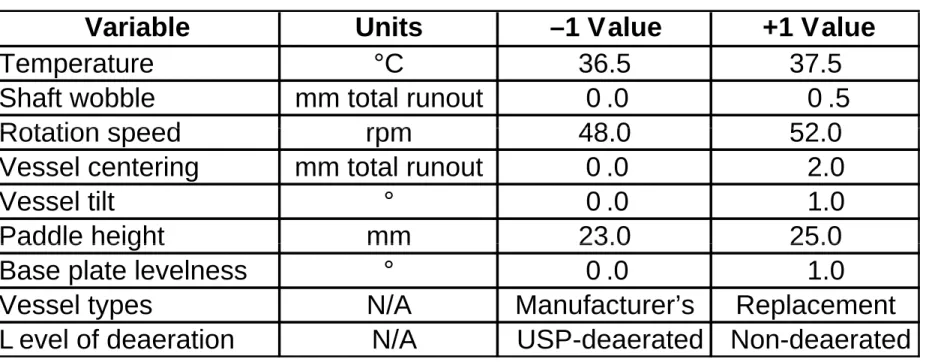
Table 1. Variables Included in Design of Experiment Study
Variable Units –1 Value +1 Value
Temperature °C 36.5 37.5
Shaft wobble mm total runout 0.0 0.5
Rotation speed rpm 48 0 52 0
Rotation speed rpm 48.0 52.0
Vessel centering mm total runout 0.0 2.0
Vessel tilt ° 0.0 1.0
Paddle height mm 23.0 25.0
Paddle height mm 23.0 25.0
Base plate levelness ° 0.0 1.0
Vessel types N/A Manufacturer’s Replacement
Level of deaeration N/A USP-deaerated Non-deaerated
To evaluate the effect of deaeration is considered to be part of method validation. The USP prednisone reference tablets were used for the pertubation studies:
Perturbation Studies on Apparatus 2
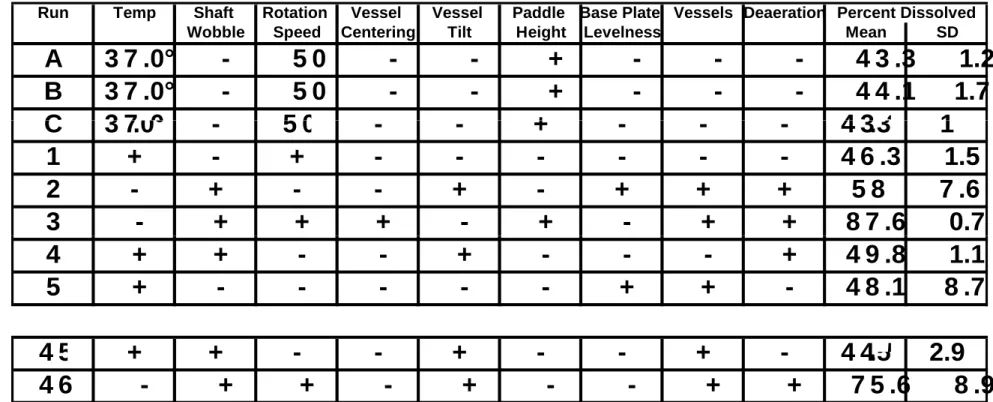
Table 2. Experimental Design and Results
Run Temp Shaft Rotation Vessel Vessel Paddle Base Plate Vessels Deaeration
Wobble Speed Centering Tilt Height Levelness Mean SD
A 37.0° - 50 - - + - - - 43.3 1.2
B 37.0° - 50 - - + - - - 44.1 1.7
C 37 0° 50 + 43 3 1
Percent Dissolved
C 37.0° - 50 - - + - - - 43.3 1
1 + - + - - - - - - 46.3 1.5
2 - + - - + - + + + 58 7.6
3 - + + + - + - + + 87.6 0.7
4 + + - - + - - - + 49.8 1.1
5 + - - - - - + + - 48.1 8.7
45 + + + + 44 5 2 9
45 + + - - + - - + - 44.5 2.9
Perturbation Studies on Apparatus 2
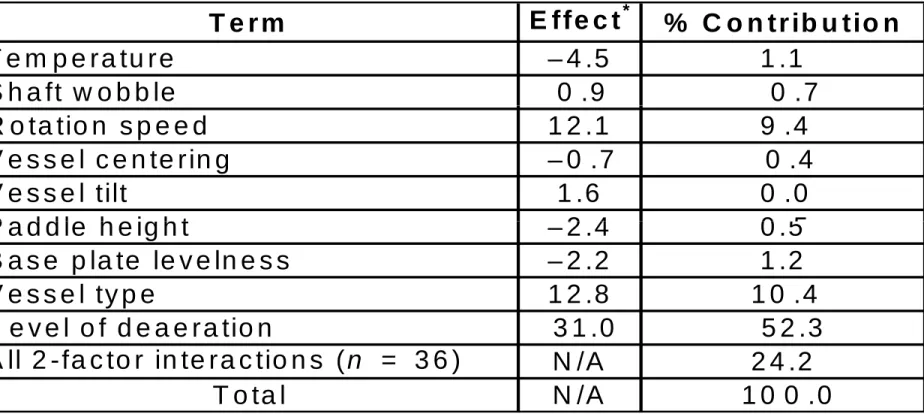
Table 3. Effects List for Mean Percent Dissolved Results
T e r m E ffe c t* % C o n tr ib u tio n
T e m p e ra tu re – 4 .5 1 .1
S h a ft w o b b le 0 .9 0 .7
R o ta tio n s p e e d 1 2 .1 9 .4
V e s s e l c e n te rin g – 0 .7 0 .4
V e s s e l tilt 1 .6 0 .0
P d d l h i h t 2 4 0 5
P a d d le h e ig h t – 2 .4 0.5
B a s e p la te le v e ln e s s – 2 .2 1 .2
V e s s e l ty p e 1 2 .8 1 0 .4
L e v e l o f d e a e ra tio n 3 1 .0 5 2 .3
A ll 2 -fa c to r in te ra c tio n s (n = 3 6 ) N /A 2 4 .2
T o ta l N /A 1 0 0 .0
FDA Guidance For Industry Jan. 2010
• The Guideline: Use of Mechanical Calibration of Dissolution Apparatus 1 and 2 – Current Good Manufacturing Practice refers to
2 Current Good Manufacturing Practice refers to – Internal CDER procedure
– ASTM Document E 2503-07: Standard Practice for Qualification of Basket and Paddle Apparatuspp
• Apparatus setup • Maintenance
• Mechanical calibration • Operation
Dissolution Toolkit
• Toolkit - Dissolution Procedure: Mechanical Calibration and Performance Verification Test
– http://www.usp.org/pdf/EN/dissolutionProcedureToolkit2010-03.pdf
– Assurance of the integrity of the dissolution procedure is
achieved through careful assembly qualification, analyst training, and use of validated analytical procedures
Th T lkit id
• The Toolkit provides
– Enhanced procedures and control limits for mechanical qualification
A guide to generate accurate Performance Verification Test – A guide to generate accurate Performance Verification Test
results
– A complete information basis to develop SOP for the GMP environment