R E S E A R C H
Open Access
Efficacy and safety of AZD3199 vs formoterol in
COPD: a randomized, double-blind study
Piotr Kuna
1*, Yavor Ivanov
2, Vasily Ivanovich Trofimov
3, Takefumi Saito
4, Ola Beckman
5, Thomas Bengtsson
5,
Carin Jorup
5and François Maltais
6Abstract
Background:We investigated the efficacy and safety of AZD3199, a novel inhaled ultra-LABA, with the main aim of establishing a dose that would maintain 24-hour bronchodilation in patients with COPD.
Methods:Patients (n = 329) were randomized to AZD3199 (200, 400 or 800μg o.d.), formoterol (9μg b.i.d.) or placebo via Turbuhaler® in a parallel group study. The primary objective of the study was to compare the clinical efficacy of three doses of AZD3199 inhaled once daily with 9μg formoterol twice daily and placebo, over a 4-week treatment period in adults with moderate-to-severe COPD. After 4 weeks, peak (0–4 h) and trough (24–26 h) forced expiratory volume in 1 second (FEV1) were assessed as the primary efficacy outcome variables.
Results:All AZD3199 doses significantly increased mean peak and trough FEV1versus placebo (106–171 ml and
97–110 ml increases, respectively), but with no clear dose–response; the level of bronchodilation was comparable to or greater than that achieved with formoterol. Forced vital capacity (FVC) at peak bronchodilation also
significantly increased with AZD3199 versus placebo (153–204 ml). COPD symptom scores and reliever use were reduced with AZD3199, while FEV1reversibility was unaltered. Adverse events were mild-to-moderate, with no
safety concerns identified. Drug exposure was dose-proportional, but lower than predicted from healthy volunteers. Conclusions:All three doses of AZD3199 produced 24-hour bronchodilation, but with no clear dose–response, suggesting that doses of 200μg or less may be sufficient to maintain bronchodilation over 24 hours in patients with COPD. No safety concerns were identified. Further studies are required to determine the once-daily AZD3199 dose for COPD.
Trial registration:Clinicaltrials.gov, NCT00929708
Keywords:Bronchodilation,β2-agonist, COPD, Once-daily, Ultra long-acting
Background
Chronic obstructive pulmonary disease (COPD) is char-acterized by the progressive development of airway ob-struction and airflow limitation. The condition is not fully reversible and typically leads to a decline in exer-cise performance and a deterioration in health [1]. COPD is associated with considerable morbidity and mortality, posing an enormous burden to the health care system [1,2]. Despite a decrease in the prevalence of smoking in developed countries, it is predicted that
COPD will be the third leading cause of death world-wide by 2020 [3-5].
Symptomatic treatment with bronchodilators is re-commended as the first stage of therapy for COPD [6]. As the symptoms of COPD require continual treatment, long-acting bronchodilators are more convenient for the patient and more effective on a number of endpoints than short-acting alternatives. Current guidelines for the treatment of COPD recommend a stepwise approach to treatment, with bronchodilators central to symptomatic management [6,7]. Regular use of long-actingβ-agonists (LABA) and long-acting muscarinic antagonists (LAMA), either as monotherapy or in combination, is recom-mended to achieve optimal bronchodilation and improve health status [6-8].
* Correspondence:[email protected] 1
Barlicki University Hospital, Medical University of Lodz, Kopcińskiego 22, 90-153Łódź, ul. Lodz, Poland
Full list of author information is available at the end of the article
AZD3199 is a novel inhaled, selective ultra-LABA (uLABA, i.e.≥24-hour duration of action) that has been investigated in asthma and COPD. A Phase II trial in patients with asthma (NCT00736489) demonstrated AZD3199 to be a potent LABA, with a bronchodilatory effect that persisted over 24 hours (data on file). The aim of the present study was to compare the efficacy of three different doses of inhaled, once-daily AZD3199 with that of twice-daily formoterol 9μg in patients with moderate to severe COPD. This study was conducted to establish an appropriate dose of AZD3199 to be used once-daily in patients with COPD.
Methods
Study design and medications
The trial was a 4-week randomized, double-blind, placebo-controlled, parallel-group study conducted at 53 sites in Bulgaria, Canada, Japan, Poland and Russia. Pa-tients with moderate-to-severe COPD who were symp-tomatic during a 2-week run-in period (total COPD symptom score≥2 for at least half the number of days of the run-in period) were randomized to treatment.
Patients who fulfilled the inclusion criteria and none of the exclusion criteria entered the 2-week run-in period with salbutamol as reliever medication (and in-haled glucocorticosteroids [GCS] at a constant dose, if applicable) as the only allowed COPD medications. Pa-tients using an inhaled GCS combination product at entry were switched to the corresponding monoproduct. Patients had to have been treated with inhaled GCS for at least 30 days before study entry to be allowed to con-tinue monotherapy during the study.
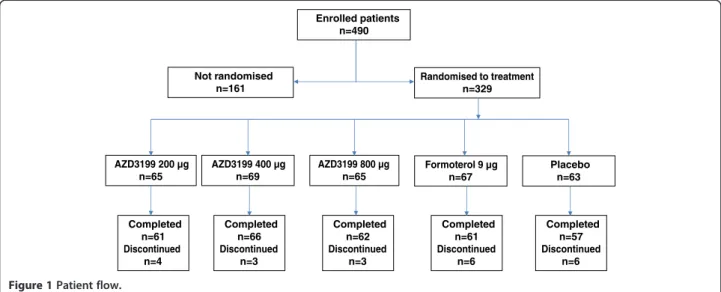
At the end of the 2-week run-in period, patients were randomized to receive AZD3199 (200μg, 400μg or 800μg once-daily), formoterol (9 μg twice-daily) or placebo, administered via Turbuhaler® (Figure 1). If required, a
short-acting β2-agonist (salbutamol) could be used as
reliever medication.
Objectives, assessments and outcome measures
The primary objective of the study was to assess the effi-cacy of AZD3199 in patients with COPD. The primary variables were mean peak (0–4 hours post-drug adminis-tration, E0-4) and mean trough (24–26 hours post-drug
administration, E24-26) forced expiratory volume in one
second (FEV1) following morning administration after 4
weeks of treatment. Spirometry measurements were made pre-dose and then post-dose at 5 and 15 minutes and then at 1, 2, 4, 24 and 26 hours.
Forced vital capacity (FVC) (E0–4and E24–26),
patient-reported outcomes (AstraZeneca COPD symptom
scores, Clinical COPD Questionnaire [CCQ], St George’s Respiratory Questionnaire for COPD [SGRQ-C]) and morning and evening use of reliever medication were assessed as secondary outcomes of the primary objective. AstraZeneca COPD symptom scores were assessed on a 5-point Likert-type scale and graded in severity from 0–4 [9]. The CCQ includes 10 questions summarized as overall mean and in three domains; Symptoms (four questions), Functional State (four questions) and Mental State (two questions). Responses were assessed on a 7-point scale from 0–6. A decrease in score of 0.4 units is regarded as the Minimal Important Difference (MID). In the SGRQ-C, each domain (symptoms, activity and impact) is scored individually and the domains are cal-culated by weighing the questions. Scores range from 0–100, with a change in 4 percentage units or more regarded as the MID.
The secondary objectives of the study were to investi-gate the safety of AZD3199 and to assess drug exposure of AZD3199. Safety variables included an examination of the nature, incidence and severity of adverse events, vital
Enrolled patients n=490
Randomised to treatment n=329
AZD3199 200 µg n=65
AZD3199 400 µg n=69
AZD3199 800 µg n=65
Completed n=61 Discontinued
n=4
Completed n=66 Discontinued
n=3
Completed n=62 Discontinued
n=3
Completed n=61 Discontinued
n=6
Completed n=57 Discontinued
n=6 Formoterol 9 µg
n=67
Placebo n=63 Not randomised
n=161
signs, ECG and laboratory assessments (haematology, clinical chemistry and urinalysis). FEV1reversibility was
also examined at randomization and at 26 hours after the last morning dose of AZD3199 treatment; FEV1was
assessed before and 15–30 minutes after inhalation of salbutamol 400 μg. After 4 weeks of treatment, blood samples were taken for analysis of AZD3199 pharmaco-kinetics at steady state. The maximum plasma concen-tration of AZD3199 (Cmax), time to Cmax(tmax) and the
area under the plasma concentration-time curve from 0–24 hours (AUC0–24) were examined.
Patients
To be eligible for the study, patients were required to be aged 40 years or above, to be symptomatic, to have a reproducible pre-bronchodilator FEV1 and with a
diagnosis of moderate-to-severe COPD for a period of more than one year. Patients were required to have a post-bronchodilator FEV1 value between 40 and 80%
of the predicted normal, and a post-bronchodilator FEV1/ FVC ratio of less than 70%. Patients were to be
current or ex-smokers with a smoking history of at least 10 pack-years.
Exclusion criteria for the study included current asthma, a history of asthma or atopy (such as allergic rhinitis) before 40 years of age. Patients with any current respiratory tract disorder other than COPD, including respiratory diseases described in GOLD 2008 or JRS Guidelines 2004 as needing to be differentiated from COPD, which was considered by the investigator to be clinically significant were not included in the study. Patients with a body mass index of less than 18 kg/m2 or a body weight of less than 30 kg were excluded from the study, with pregnancy, lactation and past or present alcohol or drug abuse as additional criteria for exclusion. Patients with COPD exacerbations (defined as use of systemic antibiotics and/or systemic glucocorticosteroids and/or hospitalization related to COPD) in the previous 30 days, patients requiring regular oxygen use and pa-tients with a heart condition affecting the QT/QTc
inter-val were also excluded from study participation.
Statistical methods
The sample size calculation was based on repeated FEV1
assessments after 4 weeks of treatment, with peak and
trough FEV1 as the primary endpoints. The
pre-bronchodilator FEV1 value at the start of the treatment
period constituted the baseline measurement. With 60 patients per group and a two-sided test at a 5% signifi-cance level, there was an 80% chance to detect a true difference of 5% between any two treatments. The sta-tistical analyses were performed using SAS version 9.1. Efficacy variables were compared between treatments using analysis of variance models with treatment and
country as fixed factors and baseline as a covariate. All analysis models were additive. Pairwise treatment con-trasts were calculated including estimated mean dif-ferences with 95% confidence intervals and p-values. Pharmacokinetic parameters were summarized using de-scriptive statistics for each dose level. A closed test pro-cedure starting with the highest dose of AZD3199 was used when determining the efficacy of AZD3199 relative to placebo.
Ethics
The clinical study protocol was approved in writing by the independent ethics committee in each participating coun-try. The study was performed in accordance with the eth-ical principles that have their origin in the Declaration of Helsinki and that are consistent with International Con-ference on Harmonisation (ICH)/Good Clinical Practice (GCP) and applicable regulatory requirements and the AstraZeneca policy on Bioethics. Informed consent was obtained from all patients prior to initiation of any study specific procedures, with information about the study pro-vided to all patients at visit 1.
Results
Baseline characteristics
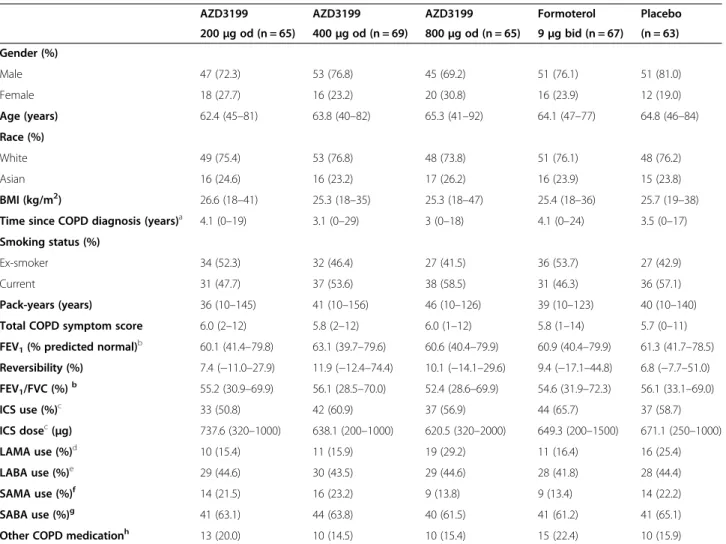
Of the 490 patients enrolled in the study, 329 were ran-domized to treatment. Incorrect enrolment (patients not fulfilling inclusion/exclusion criteria) and voluntary dis-continuation were the primary reasons for withdrawal before randomization. The baseline characteristics of pa-tients in each treatment arm were well-balanced and are outlined in Table 1. The average patient age was 64.1 years (range: 40–92); 75% of subjects were male; 76% were white and 24% were Asian. Participants were former (47%) or current (53%) smokers, with a median time since COPD diagnosis of 4 years (range: 0–29). The average post-bronchodilator FEV1was 61% (range: 40–80)
of predicted normal. Prior to enrolment inhaled corti-costeroids were used by 59% of patients, with 44% of patients using LABAs, 20% using LAMAs, 63% using SABAs, 19% using SAMAs and 18% using other COPD medications, such as tolubuterol, xanthines and muco-lytics. Patients were withdrawn from LABA and LAMA treatments following study enrolment. Inhaled salbuta-mol was permitted during the study period as reliever medication and patients who had been treated with inhaled corticosteroids (ICS) for > 30 days prior to en-rolment continued to take them at a constant dose throughout the study.
(n = 5), the development of an adverse event (n = 3), non-compliance to protocol (n = 1), with one patient lost to follow-up.
Objectives, assessments and outcome measures Peak and trough FEV1
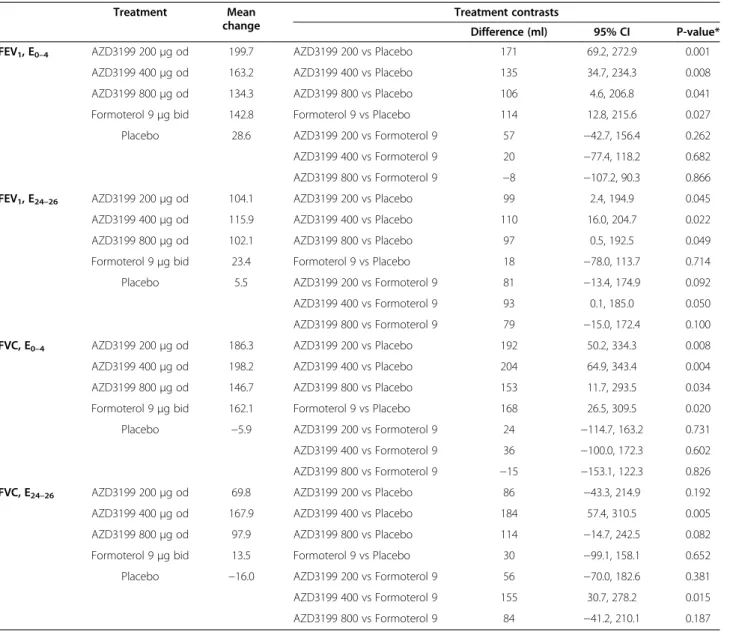
After 4 weeks of treatment, all doses of AZD3199 had increased mean peak and trough FEV1values compared
with placebo, but no clear dose–response was observed (Figure 2); peak FEV1 increased by 106–171 ml with
AZD3199 treatment compared with placebo, while trough FEV1increased by 97–110 ml (statistically
signifi-cant at all dose levels).
Formoterol 9μg twice-daily treatment statistically sig-nificantly increased peak FEV1(114 ml increase) but not
trough FEV1(18 ml increase).
All doses of once-daily AZD3199 had a comparable ef-fect to formoterol 9 μg twice-daily with regards to peak FEV1. On trough FEV1there was a tendency towards
in-creased bronchodilation for all doses of AZD3199 versus
formoterol 9 μg twice-daily (79–93 ml increase), but no statistically significant differences were observed (p > 0.05) (Table 2).
FVC
In a similar manner to FEV1, peak FVC was statistically
significantly increased with all doses of AZD3199 com-pared with placebo, but no clear dose–response was
ob-served (153–204 ml increase). Trough FVC was
increased by 86–184 ml with AZD3199 compared with placebo, but the difference was not statistically signifi-cant for AZD3199 200μg or 800μg.
Both peak and trough FVC were increased following treatment with formoterol 9 μg twice-daily (168 ml and 30 ml respectively), but this only reached statistical sig-nificance for peak FVC (p = 0.02).
There was no statistically significant difference in peak FVC between AZD3199 once-daily and formoterol 9 μg twice-daily (Table 2).
Table 1 Patient characteristics
AZD3199 AZD3199 AZD3199 Formoterol Placebo
200μg od (n = 65) 400μg od (n = 69) 800μg od (n = 65) 9μg bid (n = 67) (n = 63)
Gender (%)
Male 47 (72.3) 53 (76.8) 45 (69.2) 51 (76.1) 51 (81.0)
Female 18 (27.7) 16 (23.2) 20 (30.8) 16 (23.9) 12 (19.0)
Age (years) 62.4 (45–81) 63.8 (40–82) 65.3 (41–92) 64.1 (47–77) 64.8 (46–84) Race (%)
White 49 (75.4) 53 (76.8) 48 (73.8) 51 (76.1) 48 (76.2)
Asian 16 (24.6) 16 (23.2) 17 (26.2) 16 (23.9) 15 (23.8)
BMI (kg/m2) 26.6 (18
–41) 25.3 (18–35) 25.3 (18–47) 25.4 (18–36) 25.7 (19–38)
Time since COPD diagnosis (years)a 4.1 (0
–19) 3.1 (0–29) 3 (0–18) 4.1 (0–24) 3.5 (0–17)
Smoking status (%)
Ex-smoker 34 (52.3) 32 (46.4) 27 (41.5) 36 (53.7) 27 (42.9)
Current 31 (47.7) 37 (53.6) 38 (58.5) 31 (46.3) 36 (57.1)
Pack-years (years) 36 (10–145) 41 (10–156) 46 (10–126) 39 (10–123) 40 (10–140) Total COPD symptom score 6.0 (2–12) 5.8 (2–12) 6.0 (1–12) 5.8 (1–14) 5.7 (0–11) FEV1(% predicted normal)b 60.1 (41.4–79.8) 63.1 (39.7–79.6) 60.6 (40.4–79.9) 60.9 (40.4–79.9) 61.3 (41.7–78.5)
Reversibility (%) 7.4 (−11.0–27.9) 11.9 (−12.4–74.4) 10.1 (−14.1–29.6) 9.4 (−17.1–44.8) 6.8 (−7.7–51.0) FEV1/FVC (%)b 55.2 (30.9–69.9) 56.1 (28.5–70.0) 52.4 (28.6–69.9) 54.6 (31.9–72.3) 56.1 (33.1–69.0)
ICS use (%)c 33 (50.8) 42 (60.9) 37 (56.9) 44 (65.7) 37 (58.7)
ICS dosec(
μg) 737.6 (320–1000) 638.1 (200–1000) 620.5 (320–2000) 649.3 (200–1500) 671.1 (250–1000)
LAMA use (%)d 10 (15.4) 11 (15.9) 19 (29.2) 11 (16.4) 16 (25.4)
LABA use (%)e 29 (44.6) 30 (43.5) 29 (44.6) 28 (41.8) 28 (44.4)
SAMA use (%)f 14 (21.5) 16 (23.2) 9 (13.8) 9 (13.4) 14 (22.2)
SABA use (%)g 41 (63.1) 44 (63.8) 40 (61.5) 41 (61.2) 41 (65.1)
Other COPD medicationh 13 (20.0) 10 (14.5) 10 (15.4) 15 (22.4) 10 (15.9)
a
Median;b
Post-bronchodilator;c
Inhaled corticosteroids;d
Long-acting muscarinic antagonist;e
Long actingβ2-agonist;fShort-acting muscarinic antagonist; g
Patient-reported outcomes
Overall mean CCQ scores (Table 3) were statistically sig-nificantly reduced in the AZD3199 800μg and formoterol 9 μg twice-daily treatment groups, in comparison with placebo (p = 0.016 and 0.018 respectively). When assessed by sub-domain, AZD3199 800μg statistically significantly reduced scores for mental state (p = 0.016).
All doses of AZD3199 reduced COPD symptom scores, and this reached statistical significance for AZD3199 800 μg in reducing total symptom score (p = 0.008) (Table 3) and the individual symptom scores for breathlessness (p = 0.016), chest tightness (p = 0.05) and night-time awakenings (p = 0.003), in comparison with placebo. Total symptom score and individual symptom score were not significantly altered in the formoterol 9 μg twice-daily treatment group versus placebo. In compa-rison with formoterol 9μg twice-daily, AZD3199 800μg also statistically significantly reduced total symptoms (p = 0.033) and breathlessness (p = 0.007).
All active treatments reduced total SGRQ-C scores versus placebo, with scores lowered by 2.03–5.59 units with AZD3199 treatment (not statistically significant for AZD3199 800 μg) and 2.33 units for formoterol 9 μg twice-daily (Table 3). A decrease of 4 units is regarded as the clinically relevant MID. Reductions in the sub-domain scores for symptoms, activity and impact were also observed. However, reductions in total and SGRQ sub-domain scores did not reach statistical significance for AZD3199 800 μg and formoterol 9 μg, in compari-son with placebo.
All doses of AZD3199 statistically significantly reduced the daily use of rescue medication in comparison with the placebo group, with the greatest reduction in rescue
medication use after AZD3199 400 μg and 800 μg. In contrast, formoterol 9μg twice-daily did not statistically significantly influence the daily use of rescue medication when compared with placebo.
FEV1reversibility
In all AZD3199 treatment groups, FEV1 measurements
post-salbutamol inhalation increased by approximately 50 ml over the course of the study. Numerically, but not statistically, larger increases in post-salbutamol FEV1
values were observed for the AZD3199 treatment arms than for the placebo and formoterol 9 μg treatment arms. The increase in pre-salbutamol FEV1was
approxi-mately 100 ml for all AZD3199 treatment groups, resulting in a numerically smaller (5%) reversibility compared with the groups receiving formoterol 9 μg twice-daily or placebo. Thus, there were no adverse ef-fects of AZD3199 on the acute bronchodilatory action of salbutamol.
Safety
In the placebo group, one death was reported but this was judged as not causally related to the study drug, and was attributed to circulatory collapse. Serious adverse events were evenly distributed between the treatment groups. Overall, 8 patients experienced 10 serious ad-verse events (AZD3199 200 μg, n = 1; AZD3199 400μg, n = 4; AZD3199 800 μg, n = 0; formoterol 9 μg, n = 3; placebo, n = 2), of which 2 (both in the formoterol 9 μg treatment group) were considered to be causally related to the study medication. Discontinuation of treatment due to adverse events (DAEs) was reported for 11 pa-tients, primarily due to exacerbation of COPD. DAEs 200
250
150
100
50
0
-50
-100
Change in FEV
1
from day 1 (ml)
Time after morning administration (hours) 2
1
0 4 24 26
AZD3199 400 µg od AZD3199 800 µg od AZD3199 200 µg od
Formoterol 9 µg bid Placebo
were evenly distributed across the treatment groups
(AZD3199 200 μg, n = 0; AZD3199 400 μg, n = 2;
AZD3199 800 μg, n = 2; formoterol 9 μg, n = 3; placebo, n = 4).
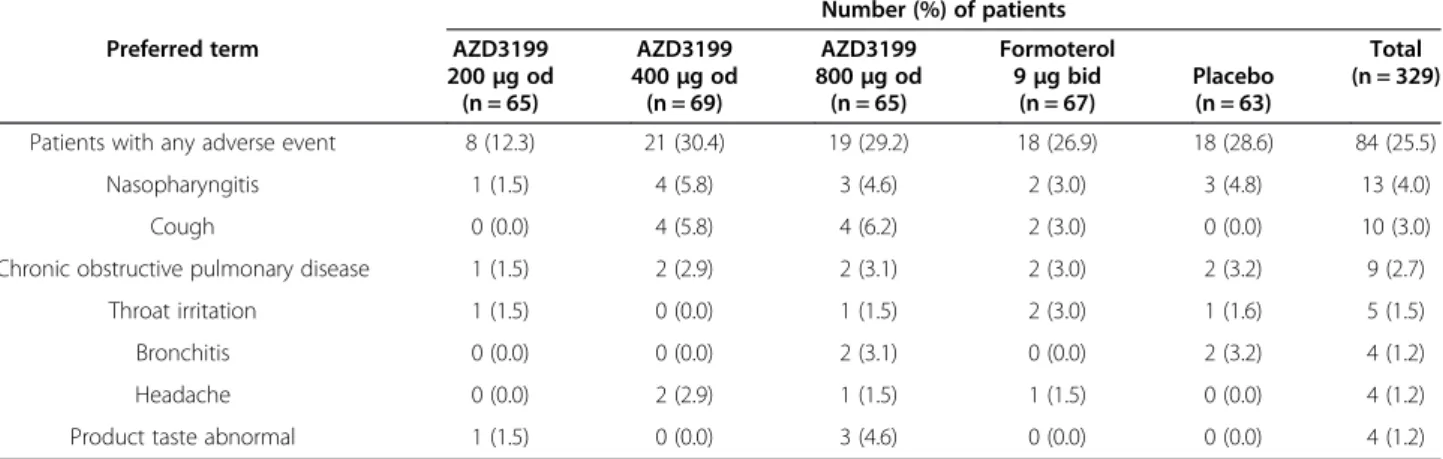
Altogether, 128 adverse events were experienced by 84 patients (26%). The majority of adverse events (95.3%) were considered to be of mild or moderate intensity, with nasopharyngitis, cough, COPD exacerbation and throat irritation reported most frequently (Table 4). The number of patients experiencing an adverse event was highest in the group receiving AZD3199 400 μg and lowest in the group receiving AZD3199 200 μg. The higher incidence of adverse events in the AZD3199 400 μg treatment group was attributable to several patients experiencing multiple events. Less than one-third (31.3%)
of the total adverse events were considered to be causally related to the study medication.
There were no consistent clinically significant changes across treatment groups in blood pressure, pulse, ECG or clinical laboratory parameters. As such, no safety con-cerns were raised for AZD3199.
Pharmacokinetics
Analysis of Cmax and AUC0–24 for AZD3199 indicated
steady-state exposure to be dose-proportional (Table 5). The exposure of AZD3199 was approximately half of that previously observed in healthy volunteers and patients with mild-to-moderate asthma. Absorption of AZD3199 was rapid, with a median tmax of 15 minutes for all doses
of AZD3199.
Table 2 Treatment estimates and pairwise contrasts for FEV1and FVC E0-4and E24-26, additive model (ml)
Treatment Mean
change
Treatment contrasts
Difference (ml) 95% CI P-value*
FEV1, E0–4 AZD3199 200μg od 199.7 AZD3199 200 vs Placebo 171 69.2, 272.9 0.001
AZD3199 400μg od 163.2 AZD3199 400 vs Placebo 135 34.7, 234.3 0.008
AZD3199 800μg od 134.3 AZD3199 800 vs Placebo 106 4.6, 206.8 0.041
Formoterol 9μg bid 142.8 Formoterol 9 vs Placebo 114 12.8, 215.6 0.027
Placebo 28.6 AZD3199 200 vs Formoterol 9 57 −42.7, 156.4 0.262
AZD3199 400 vs Formoterol 9 20 −77.4, 118.2 0.682
AZD3199 800 vs Formoterol 9 −8 −107.2, 90.3 0.866
FEV1, E24–26 AZD3199 200μg od 104.1 AZD3199 200 vs Placebo 99 2.4, 194.9 0.045
AZD3199 400μg od 115.9 AZD3199 400 vs Placebo 110 16.0, 204.7 0.022
AZD3199 800μg od 102.1 AZD3199 800 vs Placebo 97 0.5, 192.5 0.049
Formoterol 9μg bid 23.4 Formoterol 9 vs Placebo 18 −78.0, 113.7 0.714
Placebo 5.5 AZD3199 200 vs Formoterol 9 81 −13.4, 174.9 0.092
AZD3199 400 vs Formoterol 9 93 0.1, 185.0 0.050
AZD3199 800 vs Formoterol 9 79 −15.0, 172.4 0.100
FVC, E0–4 AZD3199 200μg od 186.3 AZD3199 200 vs Placebo 192 50.2, 334.3 0.008
AZD3199 400μg od 198.2 AZD3199 400 vs Placebo 204 64.9, 343.4 0.004
AZD3199 800μg od 146.7 AZD3199 800 vs Placebo 153 11.7, 293.5 0.034
Formoterol 9μg bid 162.1 Formoterol 9 vs Placebo 168 26.5, 309.5 0.020
Placebo −5.9 AZD3199 200 vs Formoterol 9 24 −114.7, 163.2 0.731
AZD3199 400 vs Formoterol 9 36 −100.0, 172.3 0.602
AZD3199 800 vs Formoterol 9 −15 −153.1, 122.3 0.826
FVC, E24–26 AZD3199 200μg od 69.8 AZD3199 200 vs Placebo 86 −43.3, 214.9 0.192
AZD3199 400μg od 167.9 AZD3199 400 vs Placebo 184 57.4, 310.5 0.005
AZD3199 800μg od 97.9 AZD3199 800 vs Placebo 114 −14.7, 242.5 0.082
Formoterol 9μg bid 13.5 Formoterol 9 vs Placebo 30 −99.1, 158.1 0.652
Placebo −16.0 AZD3199 200 vs Formoterol 9 56 −70.0, 182.6 0.381
AZD3199 400 vs Formoterol 9 155 30.7, 278.2 0.015
AZD3199 800 vs Formoterol 9 84 −41.2, 210.1 0.187
Discussion
This is the first study to evaluate the efficacy and safety of AZD3199 in patients with COPD. Treatment doses were selected based on the results of a Phase IIa study in patients with asthma (NCT00736489) and a multiple
ascending dose (MAD) study in healthy volunteers (NCT00713271), where AZD3199 was administered via Turbuhaler®. The low dose of 200μg was selected based on the Phase IIa study, as the lowest dose with a poten-tial for 24-hour duration of action. To provide a 2-fold
Table 4 Adverse events
Number (%) of patients
Preferred term AZD3199 AZD3199 AZD3199 Formoterol Total
(n = 329) 200μg od
(n = 65)
400μg od (n = 69)
800μg od (n = 65)
9μg bid (n = 67)
Placebo (n = 63)
Patients with any adverse event 8 (12.3) 21 (30.4) 19 (29.2) 18 (26.9) 18 (28.6) 84 (25.5)
Nasopharyngitis 1 (1.5) 4 (5.8) 3 (4.6) 2 (3.0) 3 (4.8) 13 (4.0)
Cough 0 (0.0) 4 (5.8) 4 (6.2) 2 (3.0) 0 (0.0) 10 (3.0)
Chronic obstructive pulmonary disease 1 (1.5) 2 (2.9) 2 (3.1) 2 (3.0) 2 (3.2) 9 (2.7)
Throat irritation 1 (1.5) 0 (0.0) 1 (1.5) 2 (3.0) 1 (1.6) 5 (1.5)
Bronchitis 0 (0.0) 0 (0.0) 2 (3.1) 0 (0.0) 2 (3.2) 4 (1.2)
Headache 0 (0.0) 2 (2.9) 1 (1.5) 1 (1.5) 0 (0.0) 4 (1.2)
Product taste abnormal 1 (1.5) 0 (0.0) 3 (4.6) 0 (0.0) 0 (0.0) 4 (1.2)
Table 3 Treatment comparisons for changes from run-in to treatment
Treatment Mean
change
Treatment contrasts
Difference 95% CI P-value*
CCQ variable
Overall mean AZD3199 200μg od −0.38 AZD3199 200 vs Placebo −0.262 −0.457, -0.067 0.009
AZD3199 400μg od −0.30 AZD3199 400 vs Placebo −0.178 −0.369, 0.014 0.068
AZD3199 800μg od −0.36 AZD3199 800 vs Placebo −0.240 −0.435, -0.045 0.016
Formoterol 9μg bid −0.36 Formoterol 9 vs Placebo −0.234 −0.427, -0.040 0.018
Placebo −0.12 AZD3199 200 vs Formoterol 9 −0.028 −0.219, 0.162 0.770
AZD3199 400 vs Formoterol 9 0.056 −0.132, 0.243 0.559
AZD3199 800 vs Formoterol 9 −0.007 −0.198, 0.184 0.945
AZ Diary card COPD Symptoms
Total Score (0–16) AZD3199 200μg od −0.94 AZD3199 200 vs Placebo −0.480 −1.011, 0.051 0.076
AZD3199 400μg od −0.94 AZD3199 400 vs Placebo −0.473 −1.000, 0.054 0.078
AZD3199 800μg od −1.19 AZD3199 800 vs Placebo −0.723 −1.254, -0.192 0.008
Formoterol 9μg bid −0.62 Formoterol 9 vs Placebo −0.152 −0.685, 0.380 0.574
Placebo −0.46 AZD3199 200 vs Formoterol 9 −0.327 −0.852, 0.197 0.220
AZD3199 400 vs Formoterol 9 −0.321 −0.841, 0.200 0.226
AZD3199 800 vs Formoterol 9 −0.570 −1.095, -0.046 0.033
SGRQ-C Scores
Total Score AZD3199 200μg od −5.61 AZD3199 200 vs Placebo −3.01 −7.31, 1.28 0.169
AZD3199 400μg od −8.18 AZD3199 400 vs Placebo −5.59 −9.78, -1.40 0.009
AZD3199 800μg od −4.63 AZD3199 800 vs Placebo −2.03 −6.29, 2.23 0.350
Formoterol 9μg bid −4.93 Formoterol 9 vs Placebo −2.33 −6.65, 1.99 0.289
Placebo −2.60 AZD3199 200 vs Formoterol 9 −0.68 −4.89, 3.53 0.751
AZD3199 400 vs Formoterol 9 −3.25 −7.34, 0.83 0.118
AZD3199 800 vs Formoterol 9 0.30 −3.86, 4.47 0.886
*Not adjusted for multiple comparisons.
safety margin to the maximum dose (1680 μg) given to healthy volunteers in the MAD study, the highest dose in this study was chosen as 800μg.
All doses of AZD3199 produced effective bronchodila-tion with 24-hour durabronchodila-tion of acbronchodila-tion that was compar-able to, or greater than, that achieved with formoterol twice-daily. However, no clear dose–response was ob-served for the bronchodilatory effects of AZD3199 at ei-ther peak or trough effects. Due to the lack of a clear dose–response, the present study was unable to identify a definitive dose of AZD3199 to carry forward to Phase III investigation. The current data suggest that in COPD patients a plateau of the dose–response curve may have been reached at or below a once-daily dose of AZD3199 200 μg. The effects of AZD3199 at steady state may be enhanced in patients with COPD relative to single doses, resulting in lower doses being sufficient to achieve a maximal bronchodilator response. Doses of AZD3199 at less than 200μg may therefore be sufficient to maintain bronchodilation over 24 hours in patients with COPD.
A reduction in COPD symptom scores was seen after AZD3199 800μg and a reduction in the daily use of re-liever medication was seen after all doses of AZD3199, in comparison with placebo. Although the present study was not powered to look at improvements in patient-reported outcomes, some evidence of positive effects on these variables was observed. CCQ scores were reduced with AZD3199 200μg, providing support for the use of this dose in Phase III investigation. SGRQ-C scores were also improved, complementing the bronchodilating ef-fect achieved. It has been suggested that regular admi-nistration of LABAs can lead to the development of tolerance to the effects of bronchodilation, potentially reducing the response to reliever medications such as salbutamol. Tolerance did not appear to develop to AZD3199 or formoterol in this 4-week study, as there was no adverse effect on the post-salbutamol FEV1levels.
The incidence of adverse effects was generally low and similar between study groups, and most adverse effects were of mild intensity. There were few cases of post-inhalation cough in the present study, but somewhat more cases with AZD3199 400 μg and 800 μg. There
were no clinically significant adverse findings for vital signs, laboratory parameters and ECGs; AZD3199 was therefore considered to be well-tolerated and no safety concerns were raised. A limitation of this study was that the relatively short 4-week duration of the study pre-cluded examination of longer term safety and tolerability parameters, but these can be assessed in future studies. Four weeks is generally considered adequate for assess-ments of efficacy and dose response.
Analysis of plasma AZD3199 revealed dose-proportional
pharmacokinetics. However, systemic exposure to
AZD3199 in patients with COPD was approximately half of that previously reported in healthy volunteers and patients with mild-to-moderate asthma, which may be related to reduced absorption or increased drug metabolism. This effect is in line with previous studies demonstrating reduced systemic exposure to formoterol, budesonide and fluticasone in patients with COPD, compared with healthy volunteers [10].
Conclusions
All of the AZD3199 doses produced 24-hour broncho-dilation, but with no clear dose–response, suggesting that doses of 200 μg or less may be sufficient to main-tain bronchodilation over 24 hours in patients with COPD. No safety concerns were identified. Further studies are required to determine the appropriate once-daily AZD3199 dose for COPD.
Abbreviations
COPD:Chronic obstructive pulmonary disease.
Competing interests
FM has received research grants for participating in multicenter trials sponsored by AstraZeneca and has also received fees for speaking at conferences sponsored by Boehringer Ingelheim, Pfizer and GlaxoSmithKline. He has served on an advisory board for GlaxoSmithKline and Boehringer Ingelheim and received research grants for participating in multicenter trials sponsored by GlaxoSmithKline, Boehringer Ingelheim, Altana Pharma, Merck, Nycomed and Novartis. He has received unrestricted research grants from Boehringer Ingelheim and GlaxoSmithKline. He holds a CIHR/GSK research chair on COPD. OB, CJ and TB were employees of AstraZeneca at the time this study was conducted and during the development of this manuscript and all have shares in AstraZeneca.
PK has received research grants for participating in multicenter trials sponsored by AstraZeneca and has received reimbursement for attending a symposium, fees for speaking and consultation fees from Adamed, Allergopharma, AstraZeneca, Boehringer Ingelheim, GSK, Krka, MSD, Novartis, Nycomed, Pfizer, Sandoz, Sanofi Aventis, Stallergen, Teva, UCB.
TS has received research grants for participating in multicenter trials sponsored by AstraZeneca and has received lecture fees from Novartis Pharma KK, Astellas Pharma Inc., MSD KK, Shionogi & Co. Ltd and Dainippon Sumitomo Pharma Co. Ltd.
VT has received research grants for participating in multicenter trials sponsored by AstraZeneca.
YI has has received research grants for participating in multicenter trials sponsored by AstraZeneca.
This study was supported by AstraZeneca.
Authors’contributions
PK, YI, VIT, TS, OB and FM participated in the design, recruitment and/or conduct of the study and were involved at all stages in the development of Table 5 Pharmacokinetics of AZD3199
Variable Dose group n G meana CVb
Cmax(nmol/L) 200μg 53 1.136 118.5
400μg 64 1.882 190.1
800μg 59 4.011 107.0
AUC0-24(nmol*h/L) 200μg 53 4.91 99.5
400μg 64 8.75 138.7
800μg 59 14.85 107.1
a
Geometric mean;b
the manuscript. TB participated in the design of the study and performed the statistical analysis. CJ is the AstraZeneca physician responsible for AZD3199. All authors read and approved the final manuscript.
Acknowledgements
The authors thank David Candlish and Natasha Hausman of inScience Communications, Springer Healthcare, for medical writing assistance funded by AstraZeneca.
Author details
1Barlicki University Hospital, Medical University of Lodz, Kopcińskiego 22, 90-153Łódź, ul. Lodz, Poland.2Medical University Pleven, Pleven, Bulgaria. 3Pavlov State Medical University, St. Petersburg Russia.4National Hospital
Organization Ibaraki-Higashi National Hospital, Naka-gun, Japan.5AstraZeneca R&D, Mölndal, Sweden.6Institut Universitaire de cardiologie et de
pneumologie de Québec, Université Laval, Québec, Canada.
Received: 8 February 2013 Accepted: 24 May 2013 Published: 3 June 2013
References
1. Wong CX, Carson KV, Smith BJ:Home care by outreach nursing for chronic obstructive pulmonary disease.Cochrane Database Syst Rev2011 Mar 16; (3):CD000994.
2. Mapel DW, Dutro MP, Marton JP, Woodruff K, Make B:Identifying and characterizing COPD patients in US managed care. A retrospective, cross-sectional analysis of administrative claims data.BMC Health Serv Res
2011,11:43.
3. Gross NJ:Chronic obstructive pulmonary disease: an evidence-based approach to treatment with a focus on anticholinergic bronchodilation.
Mayo Clin Proc2008,83:1241–1250.
4. Lopez AD, Shibuya K, Rao C, Mathers CD, Hansell AL, Held LS, Schmid V, Buist S:Chronic obstructive pulmonary disease: current burden and future projections.Eur Respir J2006,27:397–412.
5. Mathers CD, Loncar D:Projections of global mortality and burden of disease from 2002 to 2030.PLoS Med2006,3:e442.
6. From theGlobal Strategy for the Diagnosis, Management and Prevention of COPD, Global Initiative for Chronic Obstructive Lung Disease (GOLD) 2013. Available from: http://www.goldcopd.org/.
7. Qaseem A, Wilt T, Weinberger S, Hanania N, Criner G, van der Molen T, Marciniuk D, Denberg T, Schunemann H, Wedzicha W,et al:Diagnosis and management of stable chronic obstructive pulmonary disease: a clinical practice guideline update from the American College of Physicians, American College of Chest Physicians, American Thoracic Society, and European Respiratory Society.Ann Intern Med2011,155:179–191. 8. Cazzola M, Molimard M:The scientific rationale for combining long-acting
beta2-agonists and muscarinic antagonists in COPD.Pulm Pharmacol Ther
2010,23:257–267.
9. Farkas J, Kosnik M, Flezar M, Suskovic S, Lainscak M:Self-rated health predicts acute exacerbations and hospitalizations in patients with COPD.
Chest2010,138:323–330.
10. Dalby C, Polanowski T, Larsson T, Borgstrom L, Edsbacker S, Harrison TW:
The bioavailability and airway clearance of the steroid component of budesonide/formoterol and salmeterol/fluticasone after inhaled administration in patients with COPD and healthy subjects: a randomized controlled trial.Respir Res2009,10:104.
doi:10.1186/1465-9921-14-64
Cite this article as:Kunaet al.:Efficacy and safety of AZD3199 vs formoterol in COPD: a randomized, double-blind study.Respiratory Research201314:64.
Submit your next manuscript to BioMed Central and take full advantage of:
• Convenient online submission
• Thorough peer review
• No space constraints or color figure charges
• Immediate publication on acceptance
• Inclusion in PubMed, CAS, Scopus and Google Scholar
• Research which is freely available for redistribution
![Figure 2 Adjusted mean changes in FEV 1 after 4 weeks of treatment. Values shown are FEV 1 changes (from baseline [day 1] to end of week 4) at each post-dose time-point](https://thumb-us.123doks.com/thumbv2/123dok_us/8169536.2165365/5.892.86.811.134.451/figure-adjusted-changes-treatment-values-changes-baseline-point.webp)