Chapter 17
Software Testing Strategies
Slide Set to accompany
Software Engineering: A Practitioner’s Approach, 7/e
by Roger S. Pressman
Slides copyright © 1996, 2001, 2005, 2009
by Roger S. Pressman
For non-profit educational use only
May be reproduced ONLY for student use at the university level when used in conjunction
with Software Engineering: A Practitioner's Approach, 7/e. Any other reproduction or use is
prohibited without the express written permission of the author.
Software Testing
What Testing Shows
errors
errors
requirements conformance
requirements conformance
performance
performance
an indication
an indication
Strategic Approach
To perform effective testing, you should conduct
effective technical reviews. By doing this, many errors
will be eliminated before testing commences.
Testing begins at the component level and works
"outward" toward the integration of the entire
computer-based system.
Different testing techniques are appropriate for different
software engineering approaches and at different points
in time.
Testing is conducted by the developer of the software
and (for large projects) an independent test group.
Testing and debugging are different activities, but
V & V
Verification
refers to the set of tasks that ensure
that software correctly implements a specific
function.
Validation
refers to a different set of tasks that
ensure that the software that has been built is
traceable to customer requirements. Boehm
[Boe81] states this another way:
Who Tests the Software?
developer
developer
independent tester
independent tester
Understands the system
Understands the system
but, will test "gently"
but, will test "gently"
and, is driven by "delivery"
and, is driven by "delivery"
Must learn about the system,
Must learn about the system,
but, will attempt to break it
but, will attempt to break it
and, is driven by quality
Testing Strategy
System engineering
Analysis modeling
Design modeling
Code generation
Unit test
Integration test
Validation test
Testing Strategy
•
Unit testing makes heavy use of white-box
testing techniques
•
Black-box test case design techniques are
Testing Strategy
We begin by
‘testing-in-the-small’
and move
toward
‘testing-in-the-large’
For conventional software
The module (component) is our initial focus
Integration of modules follows
For OO software
our focus when “testing in the small” changes from
an individual module (the conventional view) to an
OO class that encompasses attributes and
Unit Testing
module
module
to be
to be
tested
tested
test cases
test cases
results
results
software
software
engineer
Unit Testing
interface
interface
local data structures
local data structures
boundary conditions
boundary conditions
independent paths
independent paths
Unit Test Environment
Module
Module
stub
stub
stub
stub
driver
driver
RESULTS
RESULTS
interface
interface
local data structures
local data structures
boundary conditions
boundary conditions
independent paths
independent paths
error handling paths
error handling paths
Unit testing
Test cases should uncover errors such as
(1) comparison of different data types, (2)
incorrect logical operators or precedence,
(3) expectation of equality when precision error
makes equality unlikely, (4) incorrect
Unit testing/error handling
Good design dictates that error conditions be
anticipated and error-handling paths
set up to reroute or cleanly terminate processing when
an error does occur.
A major interactive design system was developed under contract. In one
transaction processing module, a practical joker placed the following
error handling message after a series
of conditional tests that invoked various control flow branches: ERROR!
THERE IS NO
WAY YOU CAN GET HERE. This "error message" was uncovered by a
customer during user
Unit testing/error handling
Among the potential errors that should be tested when
error handling is evaluated
are
1.
Error description is unintelligible.
2.
Error noted does not correspond to error encountered.
3.
Error condition causes system intervention prior to error
handling.
Integration Testing Strategies
Options:
Options:
•
•
the “big bang” approach
the “big bang” approach
•
Integration Testing Strategies
Integration testing occurs when two or more
units are combined and tested.
In this phase of testing it is assumed that the
units combined have already been tested.
Goal of integration testing:
The goal of integration testing is to discover
any problems that might arise when the
components are integrated.
When does integration testing
occur?
Integration testing occurs at various levels. A
developer might code a class C1 and test it.
The same developer might then code class C2
that uses C1, and test both C1 and C2 as an
integrated unit.
Top Down Integration
top module is tested with
top module is tested with
stubs
stubs
stubs are replaced one at
stubs are replaced one at
a time, "depth first"
a time, "depth first"
as new modules are integrated,
as new modules are integrated,
some subset of tests is re-run
some subset of tests is re-run
A
A
B
B
C
C
D
D
E
E
F
Stubs replace low level modules at the beginning of
top-down testing; therefore, no significant data can
flow upward in the program structure.
The tester is left with three choices:
(1) delay many tests until stubs are replaced with
actual modules,
(2) develop stubs that perform limited functions that
simulate the actual module,
Bottom-Up Integration
drivers are replaced one at a
drivers are replaced one at a
time, "depth first"
time, "depth first"
worker modules are grouped into
worker modules are grouped into
builds and integrated
builds and integrated
A
A
B
B
C
C
D
D
E
E
F
F
G
G
Sandwich Testing
Top modules are
Top modules are
tested with stubs
tested with stubs
Worker modules are grouped into
Worker modules are grouped into
builds and integrated
builds and integrated
A
A
B
B
C
C
D
D
E
E
F
F
G
G
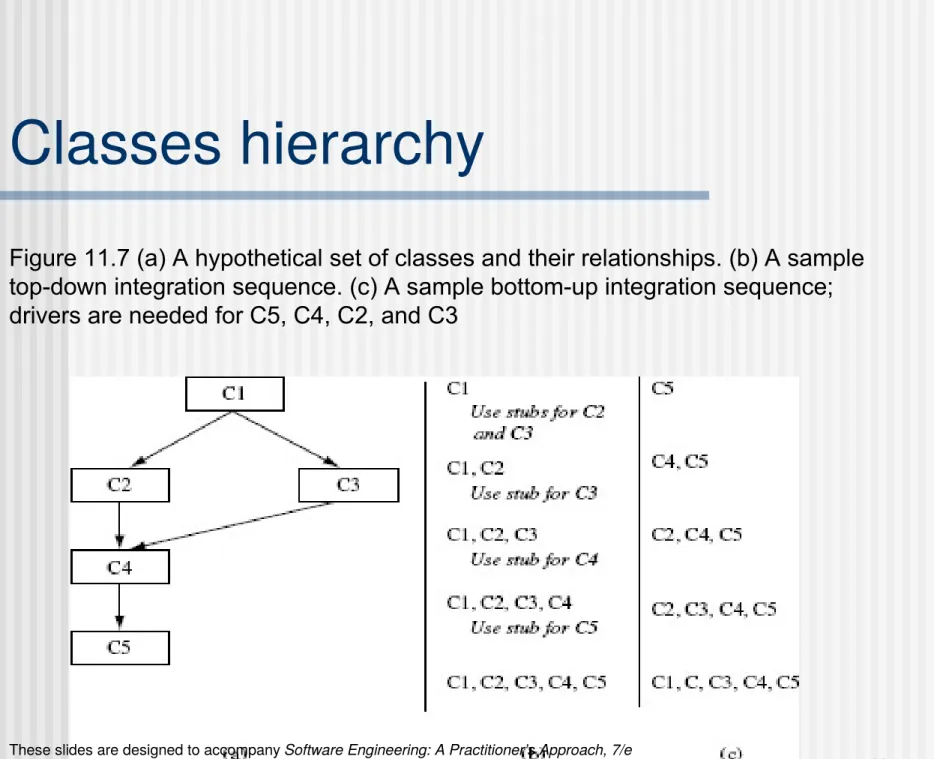
Classes Relationship
Classes
public class C2 extends C1{ // Extension of
C1. . . .}
public class C1 {
C2[ ] C2Objects = new C2[100]; // Aggregation of C2 objects.C2
aC2Object = new C2; // C1 uses a C2 object.. . . .
}
public class C1 {
. . .
int
d = C2.getVal( ); //
Use of method getVal( ) in C2.
float
p = C2.x+1; //
C1 accesses x in C2
.
public void
aMethod(C2 z); //
C1 uses a field in C2.
Classes hierarchy
Smoke Testing
A common approach for creating “daily builds” for product
software
Smoke testing steps:
Software components that have been translated into code are
integrated into a “build.”
•
A build includes all data files, libraries, reusable modules, and engineered
components that are required to implement one or more product
functions.
A series of tests is designed to expose errors that will keep the build
from properly performing its function.
•
The intent should be to uncover “show stopper” errors that have the
highest likelihood of throwing the software project behind schedule.
The build is integrated with other builds and the entire product (in its
current form) is smoke tested daily.
Regression Testing
Regression testing
is the re-execution of some subset of
tests that have already been conducted to ensure that
changes have not propagated unintended side effects
Whenever software is corrected, some aspect of the
software configuration (the program, its documentation,
or the data that support it) is changed.
Regression testing helps to ensure that changes (due to
testing or for other reasons) do not introduce
unintended behavior or additional errors.
Regression testing may be conducted manually, by
Object-Oriented Testing
begins by evaluating the correctness and
consistency of the analysis and design models
testing strategy changes
the concept of the ‘unit’ broadens due to
encapsulation
integration focuses on classes and their execution
across a ‘thread’ or in the context of a usage
scenario
validation uses conventional black box methods
Broadening the View of “Testing”
It can be argued that the review of OO analysis and
It can be argued that the review of OO analysis and
design models is especially useful because the
design models is especially useful because the
same semantic constructs (e.g., classes, attributes,
same semantic constructs (e.g., classes, attributes,
operations, messages) appear at the analysis,
operations, messages) appear at the analysis,
design, and code level. Therefore, a problem in the
design, and code level. Therefore, a problem in the
definition of class attributes that is uncovered
definition of class attributes that is uncovered
during analysis will circumvent side effects that
during analysis will circumvent side effects that
might occur if the problem were not discovered
might occur if the problem were not discovered
until design or code (or even the next iteration of
until design or code (or even the next iteration of
analysis).
Testing the CRC Model
1. Revisit the CRC model and the object-relationship model.
1. Revisit the CRC model and the object-relationship model.
2. Inspect the description of each CRC index card to determine if a
2. Inspect the description of each CRC index card to determine if a
delegated responsibility is part of the collaborator’s definition.
delegated responsibility is part of the collaborator’s definition.
3. Invert the connection to ensure that each collaborator that is
3. Invert the connection to ensure that each collaborator that is
asked for service is receiving requests from a reasonable source.
asked for service is receiving requests from a reasonable source.
4. Using the inverted connections examined in step 3, determine
4. Using the inverted connections examined in step 3, determine
whether other classes might be required or whether responsibilities
whether other classes might be required or whether responsibilities
are properly grouped among the classes.
are properly grouped among the classes.
5. Determine whether widely requested responsibilities might be
5. Determine whether widely requested responsibilities might be
combined into a single responsibility.
combined into a single responsibility.
6. Steps 1 to 5 are applied iteratively to each class and through
6. Steps 1 to 5 are applied iteratively to each class and through
each evolution of the analysis model.
OO Testing Strategy
class testing is the equivalent of unit testing
operations within the class are tested
the state behavior of the class is examined
integration applied three different strategies
thread-based testing—integrates the set of
classes required to respond to one input or event
use-based testing—integrates the set of classes
required to respond to one use case
WebApp Testing - I
The content model for the WebApp is
reviewed to uncover errors.
The interface model is reviewed to ensure that
all use cases can be accommodated.
The design model for the WebApp is reviewed
to uncover navigation errors.
The user interface is tested to uncover errors in
presentation and/or navigation mechanics.
WebApp Testing - II
Navigation throughout the architecture is tested.
The WebApp is implemented in a variety of different
environmental configurations and is tested for
compatibility with each configuration.
Security tests are conducted in an attempt to exploit
vulnerabilities in the WebApp or within its
environment.
Performance tests are conducted.
The WebApp is tested by a controlled and monitored
population of end-users. The results of their interaction
with the system are evaluated for content and
High Order Testing
Validation testing
Focus is on software requirements
System testing
Focus is on system integration
Alpha/Beta testing
Focus is on customer usage
Recovery testing
forces the software to fail in a variety of ways and verifies that recovery is
properly performed
Security testing
verifies that protection mechanisms built into a system will, in fact, protect it
from improper penetration
Stress testing
executes a system in a manner that demands resources in abnormal quantity,
frequency, or volume
Performance Testing